The Chemical makeup of DNA and RNA   DNA   is made up of many DNA nucleotides (nucleotides are the building blocks of nucleic acids). Each DNA nucleotide is composed of deoxyribose (a pentose, or five carbon sugar), a phosphate molecule and one of four nitrogenous bases:  Adenine, Thymine, Cytosine and Guanine. (A, T, C, G).
 
RNA   made up of many RNA nucleotides (nucleotides are the building blocks of Nucleic acids).  Each RNA nucleotide is composed of ribose (a pentose, or five carbon sugar), a phosphate molecule and one of four nitrogenous bases  Adenine, Uracil, Cytosine and Guanine.  (A, U, C, G). 
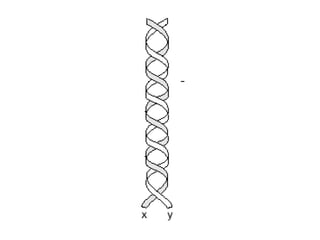
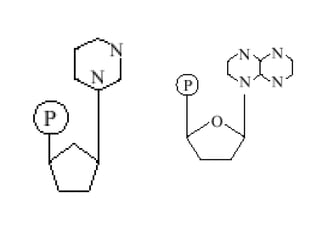
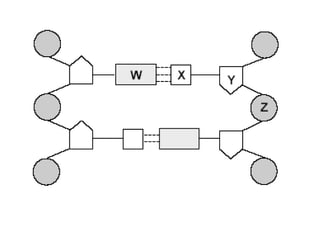
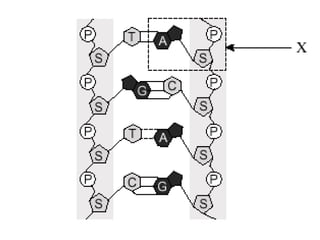
DNA and RNA Nucleotide Diagrams   The following diagrams show different diagrams of nucleotides, both RNA and DNA.  Be able to recognize: the sugar (the five sided figure in the first two diagrams and the five sided figure labeled Y in the third diagram) the phosphate (the circle with the P or Z inside) the base (the six sided figure with the N in its structure, labeled W or X in the third diagram)  The last diagram shows 4 nucleotides, showing bases, sugars and phosphates


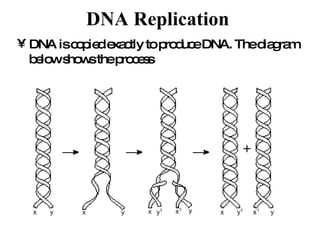
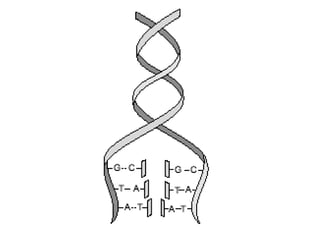
DNA Replication   DNA is copied exactly to produce DNA. The diagram below shows the process
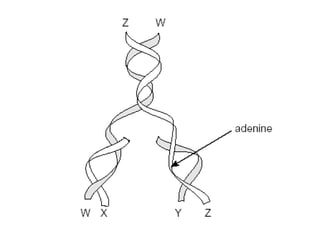
Steps in DNA Replication   Unzipping the molecule of DNA is unzipped. The hydrogen bonds between the complementary base pairs are broken. the DNA bases are exposed so complementary base pairing can occur. See the following diagram of the DNA unzipping
 
Complementary base pairing The nucleotide bases that make up the 2 strands of  the DNA molecule are exposed  nucleotides located in the nucleus move into place by complementary base pairing.  eg. Adenine is complementary to Thymine and vice versa, so A only bonds with T and  T only bonds with A. Cytosine is complementary to Guanine and vice versa so  C only bonds with G and G only bonds with C.  -The pairs of complementary nucleotides form the cross bridges of the DNA molecule (W and X in the diagram below). (the ladder steps)      In Transcription it is the same process only RNA is produced. (Uracil instead of Thymine).
 
Joining of adjacent nucleotides   Using the previous diagram - the vertical part (up and down) of the DNA molecule is formed when the sugar part (labelled Y) of one nucleotide bonds with the phosphate part (labelled Z) of an adjacent nucleotide.  These bonds produce the sides of the ladder.  The joining of the sugar/phosphate parts of adjacent nucleotide molecules causes the length of the new DNA molecule to increase.  Two complete molecules of DNA are formed, identical to the original one.
Protein Synthesis   Transcription  - the copying of the DNA molecule by mRNA  3 Steps: Unzipping Complementary base pairing Joining of adjacent nucleotides
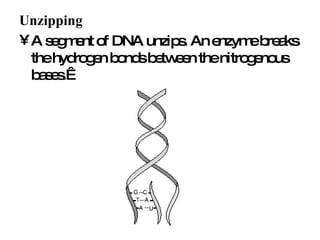
  Unzipping  A segment of DNA unzips. An enzyme breaks the hydrogen bonds between the nitrogenous bases.   
Complementary Base Pairing   RNA nucleotides bind with DNA nucleotides by complementary base pairing on one of the two  DNA strands that are exposed after unzipping Joining of Adjacent Nucleotides   An enzyme catalyzes the reaction that joins the sugar/phosphate molecules of adjacent nucleotides together. The newly produced mRNA strand passes from the nucleus into the cytoplasm to join with a ribosme.
Translation   mRNA codons are read amino acids are brought to the mRNA strand  polypeptides (proteins) are produced at the ribosomes.  Translation ends with the production of a protein.
The two specific parts of translation are: i. Initiation  - the ribosomal RNA (ribosome) and the mRNA strand become attached  ii. Elongation  - the polypeptide lengthens one amino acid at a time  the tRNA anti-codons (3 letter code of the tRNA)  bond to the mRNA codons (3 letter code of the mRNA)  by complementary base pairing at the ribosome. The codons determine the type of amino acid brought to the polypeptide chain.   The ribosome is large enough to accomodate two tRNA molecules at a time, one incoming and one outgoing The amino acid on the incoming tRNA forms a peptide bond with the amino acid on the outgoing tRNA.   The ribosome then moves laterally, allowing the outgoing tRNA to leave and making space for a new incoming tRNA.
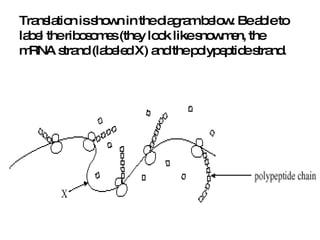
Translation is shown in the diagram below. Be able to label the ribosomes (they look like snowmen, the mRNA strand (labeled X) and the polypeptide strand.
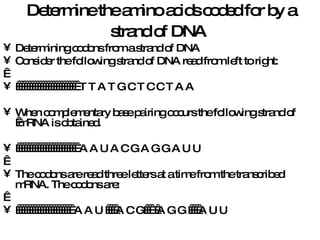
Determine the amino acids coded for by a strand of DNA   Determining codons from a strand of DNA Consider the following strand of DNA read from left to right:                            T T A T G C T C C T A A When complementary base pairing occurs the following strand of  mRNA is obtained.                          A A U A C G A G G A U U   The codons are read three letters at a time from the transcribed mRNA. The codons are:                          A A U     A C G     A G G     A U U
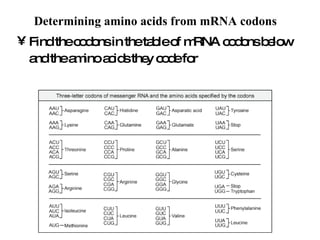
Determining amino acids from mRNA codons   Find the codons in the table of mRNA codons below and the amino acids they code for
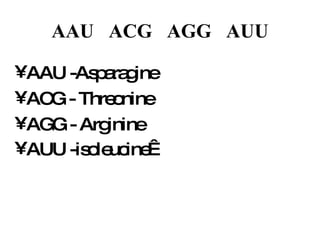
AAU  ACG  AGG  AUU AAU -Asparagine  ACG - Threonine  AGG - Arginine  AUU -isoleucine 
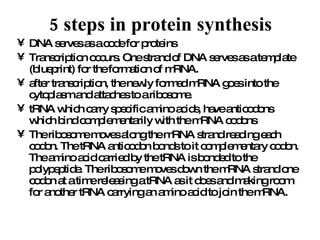
5 steps in protein synthesis DNA serves as a code for proteins Transcription occurs. One strand of DNA serves as a template (blueprint) for the formation of mRNA. after transcription, the newly formed mRNA goes into the cytoplasm and attaches to a ribosome. tRNA which carry specific amino acids, have anticodons which bind complementarily with the mRNA codons The ribosome moves along the mRNA strand reading each codon. The tRNA anticodon bonds to it complementary codon. The amino acid carried by the tRNA is bonded to the polypeptide. The ribosome moves down the mRNA strand one codon at a time releasing a tRNA as it does and making room for another tRNA carrying an amino acid to join the mRNA.
DNA - carries the blueprint for the order of amino acids to be produced during protein synthesis Messenger RNA (mRNA) - copies the DNA molecule in the nucleus during transcription and goes into the cytoplasm and attaches itself to a ribosome. One 3 letter unit in an mRNA chain is called a codon. Transfer RNA (tRNA) - drops off amino acids it is coded to carry at the ribosome. The 3 letter code is complementary to mRNA and this 3 letter code is called the anti-codon Ribosome (rRNA) - this is where protein synthesis occurs. (Where the protein is assembled)
Recombinant DNA   contains DNA from 2 different sources Organisms that have had a foreign gene inserted into them are called transgenic organisms
Use of Recombinant DNA research   in Bacteria -  used to produce large amounts of protein, eg insulin, human growth hormone, and hepatitis vaccine.  in plants - genes transferred to cotton, corn, and potato strains have made these plants resistant to pests, because these cells produce an insect toxin. Plants have also been engineered to produce, hormones, clotting factors and antibodies   in animals. - genepharming using transgenic organisms to produce pharmaceuticals eg genes that code for therapeutic and diagnostic proteins are incorporated in and animal's DNA and appear in milk. There are plans to produce drugs for the treatment of cystic fibrosis, cancer, blood diseases, and other disorders. Antithroujmbi III is used for preventing blood clots in surgery is being produced by a herd of goats
DNA QUIZ QUESTIONS   What is the general name for chemicals like DNA and RNA What general shape does the DNA molecule have? List 4 differences between RNA and DNA  Describe the function of the mRNA in Protein Synthesis What is the definition of a codon What is the definition of an anti-codon How many amino acids will result from the following strand of DNA? A C G C C C A A A T A C  Name the two stages that make up protein synthesis  Where in the cell does replication take place?  Describe the function of the tRNA in Protein Synthesis? 
Describe briefly the events that occur during transcription?  Name 2 common environmental mutagens   Describe briefly the events that occur during translation?  What is the definition of     a) translation       b) transcription  Define complementary base pairing and give an example?  Describe the function of the ribosome during protein synthesis  From a given strand of DNA. Show the results of Transcription or Replication  Make a drawing of DNA or RNA nucleotide and label the parts
Give 2 examples of     a) purines          b) pyrimidines  Name the 4 bases that make up DNA or RNA molecules  Describe how an environmental mutagen could cause a mutation Describe briefly the events that occur during replication? List 3 functions of DNA  Describe the function of the DNA in Protein Synthesis  What is the definition of a chromosomal mutation  What is the definition of a gene mutation  If the Nucleic acids are like ladders: What chemicals form the backbone of DNA or RNA molecules?  If the Nucleic acids are like ladders: What chemicals form the rungs of DNA or RNA molecule? Briefly describe what occurs during Protein synthesis  What is recombinant DNA. Give two uses of recombinant DNA

Ch 24 & 25 notes

  • 1.
    The Chemical makeupof DNA and RNA DNA is made up of many DNA nucleotides (nucleotides are the building blocks of nucleic acids). Each DNA nucleotide is composed of deoxyribose (a pentose, or five carbon sugar), a phosphate molecule and one of four nitrogenous bases: Adenine, Thymine, Cytosine and Guanine. (A, T, C, G).
  • 2.
  • 3.
    RNA made up of many RNA nucleotides (nucleotides are the building blocks of Nucleic acids). Each RNA nucleotide is composed of ribose (a pentose, or five carbon sugar), a phosphate molecule and one of four nitrogenous bases Adenine, Uracil, Cytosine and Guanine. (A, U, C, G). 
  • 4.
    DNA and RNANucleotide Diagrams The following diagrams show different diagrams of nucleotides, both RNA and DNA. Be able to recognize: the sugar (the five sided figure in the first two diagrams and the five sided figure labeled Y in the third diagram) the phosphate (the circle with the P or Z inside) the base (the six sided figure with the N in its structure, labeled W or X in the third diagram) The last diagram shows 4 nucleotides, showing bases, sugars and phosphates
  • 5.
  • 6.
  • 7.
  • 8.
    DNA Replication DNA is copied exactly to produce DNA. The diagram below shows the process
  • 9.
    Steps in DNAReplication Unzipping the molecule of DNA is unzipped. The hydrogen bonds between the complementary base pairs are broken. the DNA bases are exposed so complementary base pairing can occur. See the following diagram of the DNA unzipping
  • 10.
  • 11.
    Complementary base pairingThe nucleotide bases that make up the 2 strands of  the DNA molecule are exposed nucleotides located in the nucleus move into place by complementary base pairing. eg. Adenine is complementary to Thymine and vice versa, so A only bonds with T and  T only bonds with A. Cytosine is complementary to Guanine and vice versa so C only bonds with G and G only bonds with C. -The pairs of complementary nucleotides form the cross bridges of the DNA molecule (W and X in the diagram below). (the ladder steps)     In Transcription it is the same process only RNA is produced. (Uracil instead of Thymine).
  • 12.
  • 13.
    Joining of adjacentnucleotides Using the previous diagram - the vertical part (up and down) of the DNA molecule is formed when the sugar part (labelled Y) of one nucleotide bonds with the phosphate part (labelled Z) of an adjacent nucleotide. These bonds produce the sides of the ladder. The joining of the sugar/phosphate parts of adjacent nucleotide molecules causes the length of the new DNA molecule to increase. Two complete molecules of DNA are formed, identical to the original one.
  • 14.
    Protein Synthesis Transcription - the copying of the DNA molecule by mRNA 3 Steps: Unzipping Complementary base pairing Joining of adjacent nucleotides
  • 15.
      Unzipping A segment of DNA unzips. An enzyme breaks the hydrogen bonds between the nitrogenous bases.   
  • 16.
    Complementary Base Pairing RNA nucleotides bind with DNA nucleotides by complementary base pairing on one of the two  DNA strands that are exposed after unzipping Joining of Adjacent Nucleotides An enzyme catalyzes the reaction that joins the sugar/phosphate molecules of adjacent nucleotides together. The newly produced mRNA strand passes from the nucleus into the cytoplasm to join with a ribosme.
  • 17.
    Translation mRNA codons are read amino acids are brought to the mRNA strand polypeptides (proteins) are produced at the ribosomes. Translation ends with the production of a protein.
  • 18.
    The two specificparts of translation are: i. Initiation - the ribosomal RNA (ribosome) and the mRNA strand become attached ii. Elongation - the polypeptide lengthens one amino acid at a time the tRNA anti-codons (3 letter code of the tRNA)  bond to the mRNA codons (3 letter code of the mRNA)  by complementary base pairing at the ribosome. The codons determine the type of amino acid brought to the polypeptide chain.  The ribosome is large enough to accomodate two tRNA molecules at a time, one incoming and one outgoing The amino acid on the incoming tRNA forms a peptide bond with the amino acid on the outgoing tRNA.  The ribosome then moves laterally, allowing the outgoing tRNA to leave and making space for a new incoming tRNA.
  • 19.
    Translation is shownin the diagram below. Be able to label the ribosomes (they look like snowmen, the mRNA strand (labeled X) and the polypeptide strand.
  • 20.
    Determine the aminoacids coded for by a strand of DNA Determining codons from a strand of DNA Consider the following strand of DNA read from left to right:                           T T A T G C T C C T A A When complementary base pairing occurs the following strand of  mRNA is obtained.                         A A U A C G A G G A U U   The codons are read three letters at a time from the transcribed mRNA. The codons are:                         A A U     A C G     A G G     A U U
  • 21.
    Determining amino acidsfrom mRNA codons Find the codons in the table of mRNA codons below and the amino acids they code for
  • 22.
    AAU ACG AGG AUU AAU -Asparagine ACG - Threonine AGG - Arginine AUU -isoleucine 
  • 23.
    5 steps inprotein synthesis DNA serves as a code for proteins Transcription occurs. One strand of DNA serves as a template (blueprint) for the formation of mRNA. after transcription, the newly formed mRNA goes into the cytoplasm and attaches to a ribosome. tRNA which carry specific amino acids, have anticodons which bind complementarily with the mRNA codons The ribosome moves along the mRNA strand reading each codon. The tRNA anticodon bonds to it complementary codon. The amino acid carried by the tRNA is bonded to the polypeptide. The ribosome moves down the mRNA strand one codon at a time releasing a tRNA as it does and making room for another tRNA carrying an amino acid to join the mRNA.
  • 24.
    DNA - carriesthe blueprint for the order of amino acids to be produced during protein synthesis Messenger RNA (mRNA) - copies the DNA molecule in the nucleus during transcription and goes into the cytoplasm and attaches itself to a ribosome. One 3 letter unit in an mRNA chain is called a codon. Transfer RNA (tRNA) - drops off amino acids it is coded to carry at the ribosome. The 3 letter code is complementary to mRNA and this 3 letter code is called the anti-codon Ribosome (rRNA) - this is where protein synthesis occurs. (Where the protein is assembled)
  • 25.
    Recombinant DNA contains DNA from 2 different sources Organisms that have had a foreign gene inserted into them are called transgenic organisms
  • 26.
    Use of RecombinantDNA research in Bacteria -  used to produce large amounts of protein, eg insulin, human growth hormone, and hepatitis vaccine. in plants - genes transferred to cotton, corn, and potato strains have made these plants resistant to pests, because these cells produce an insect toxin. Plants have also been engineered to produce, hormones, clotting factors and antibodies   in animals. - genepharming using transgenic organisms to produce pharmaceuticals eg genes that code for therapeutic and diagnostic proteins are incorporated in and animal's DNA and appear in milk. There are plans to produce drugs for the treatment of cystic fibrosis, cancer, blood diseases, and other disorders. Antithroujmbi III is used for preventing blood clots in surgery is being produced by a herd of goats
  • 27.
    DNA QUIZ QUESTIONS What is the general name for chemicals like DNA and RNA What general shape does the DNA molecule have? List 4 differences between RNA and DNA  Describe the function of the mRNA in Protein Synthesis What is the definition of a codon What is the definition of an anti-codon How many amino acids will result from the following strand of DNA? A C G C C C A A A T A C  Name the two stages that make up protein synthesis  Where in the cell does replication take place?  Describe the function of the tRNA in Protein Synthesis? 
  • 28.
    Describe briefly theevents that occur during transcription?  Name 2 common environmental mutagens   Describe briefly the events that occur during translation?  What is the definition of     a) translation       b) transcription  Define complementary base pairing and give an example?  Describe the function of the ribosome during protein synthesis  From a given strand of DNA. Show the results of Transcription or Replication  Make a drawing of DNA or RNA nucleotide and label the parts
  • 29.
    Give 2 examplesof     a) purines          b) pyrimidines Name the 4 bases that make up DNA or RNA molecules  Describe how an environmental mutagen could cause a mutation Describe briefly the events that occur during replication? List 3 functions of DNA  Describe the function of the DNA in Protein Synthesis  What is the definition of a chromosomal mutation  What is the definition of a gene mutation  If the Nucleic acids are like ladders: What chemicals form the backbone of DNA or RNA molecules?  If the Nucleic acids are like ladders: What chemicals form the rungs of DNA or RNA molecule? Briefly describe what occurs during Protein synthesis  What is recombinant DNA. Give two uses of recombinant DNA