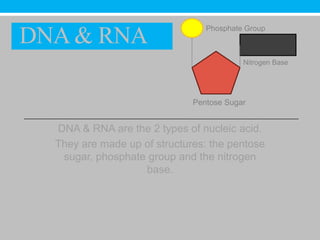
Phosphate Group
DNA & RNA
                                          Nitrogen Base


                              Pentose Sugar


  DNA & RNA are the 2 types of nucleic acid.
  They are made up of structures: the pentose
   sugar, phosphate group and the nitrogen
                   base.
Keywords:
• DNA
   • Deoxyribonucleic acid.
• RNA (mRNA, tRNA)
   • Ribonucleic acid (mRNA stands for messenger RNA, tRNA
     stands for transfer RNA).
• Nucleotide
   • A compound containing a pentose sugar, phosphate group
     and a nitrogen base.
• Polynucleotide
   • A polymer made up of many nucleotides.
• Pentose Sugar
   • A sugar that contains 5 carbon atoms.
• Phosphate Group
• A group important in energy transfer.
Keywords:
• Nitrogenous or Nitrogen-containing Base
  • A base that contains nitrogen and is necessary for protein
    synthesis.
• Semi-conservative
  • When a or chromatid is kept from the mother and its
    joining chromatid is made from the free nucleotides in the
    nucleus.
• Codon
  • A series of 3 adjacent bases that code for a certain amino
    acid.
• Anticodon
  • A series of 3 adjacent bases that correspond through
    complementary base pairing to the codon on a RNA strand.
• Triplet
  • A series of 3 adjacent bases on a DNA strand.
Nucleotides and Polynucleotides
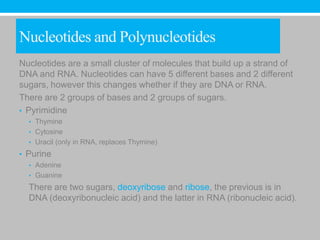
Nucleotides are a small cluster of molecules that build up a strand of
DNA and RNA. Nucleotides can have 5 different bases and 2 different
sugars, however this changes whether if they are DNA or RNA.
There are 2 groups of bases and 2 groups of sugars.
• Pyrimidine
  • Thymine
  • Cytosine
  • Uracil (only in RNA, replaces Thymine)

• Purine
  • Adenine
  • Guanine

  There are two sugars, deoxyribose and ribose, the previous is in
  DNA (deoxyribonucleic acid) and the latter in RNA (ribonucleic acid).
Complementary-base Pairing
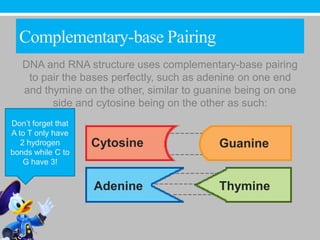
   DNA and RNA structure uses complementary-base pairing
    to pair the bases perfectly, such as adenine on one end
   and thymine on the other, similar to guanine being on one
         side and cytosine being on the other as such:
Don’t forget that
A to T only have
   2 hydrogen       Cytosine               Guanine
bonds while C to
    G have 3!


                    Adenine                Thymine
Transcription
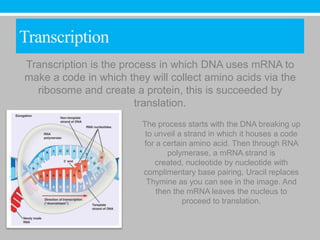
Transcription is the process in which DNA uses mRNA to
make a code in which they will collect amino acids via the
  ribosome and create a protein, this is succeeded by
                        translation.
                         The process starts with the DNA breaking up
                          to unveil a strand in which it houses a code
                         for a certain amino acid. Then through RNA
                                polymerase, a mRNA strand is
                             created, nucleotide by nucleotide with
                         complimentary base pairing, Uracil replaces
                          Thymine as you can see in the image. And
                             then the mRNA leaves the nucleus to
                                     proceed to translation.
Translation
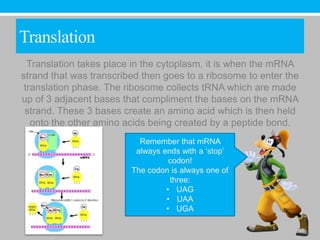
  Translation takes place in the cytoplasm, it is when the mRNA
strand that was transcribed then goes to a ribosome to enter the
 translation phase. The ribosome collects tRNA which are made
up of 3 adjacent bases that compliment the bases on the mRNA
 strand. These 3 bases create an amino acid which is then held
   onto the other amino acids being created by a peptide bond.
                           Remember that mRNA
                          always ends with a ‘stop’
                                   codon!
                         The codon is always one of
                                   three:
                                  • UAG
                                  • UAA
                                  • UGA
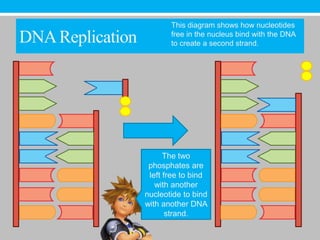
This diagram shows how nucleotides
DNA Replication          free in the nucleus bind with the DNA
                         to create a second strand.


                        The two
                   phosphates are
                   left free to bind
                     with another
                  nucleotide to bind
                  with another DNA
                         strand.
DNA Replication ~ pt.2
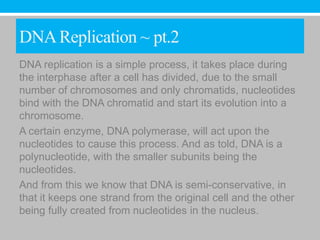
DNA replication is a simple process, it takes place during
the interphase after a cell has divided, due to the small
number of chromosomes and only chromatids, nucleotides
bind with the DNA chromatid and start its evolution into a
chromosome.
A certain enzyme, DNA polymerase, will act upon the
nucleotides to cause this process. And as told, DNA is a
polynucleotide, with the smaller subunits being the
nucleotides.
And from this we know that DNA is semi-conservative, in
that it keeps one strand from the original cell and the other
being fully created from nucleotides in the nucleus.
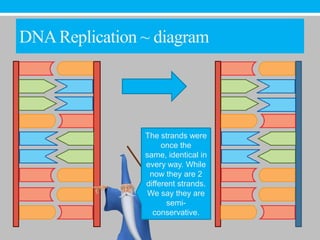
DNA Replication ~ diagram


                The strands were
                     once the
                same, identical in
                every way. While
                 now they are 2
                different strands.
                 We say they are
                       semi-
                  conservative.
Questions?
Thank you!

DNA & RNA

  • 1.
    Phosphate Group DNA &RNA Nitrogen Base Pentose Sugar DNA & RNA are the 2 types of nucleic acid. They are made up of structures: the pentose sugar, phosphate group and the nitrogen base.
  • 2.
    Keywords: • DNA • Deoxyribonucleic acid. • RNA (mRNA, tRNA) • Ribonucleic acid (mRNA stands for messenger RNA, tRNA stands for transfer RNA). • Nucleotide • A compound containing a pentose sugar, phosphate group and a nitrogen base. • Polynucleotide • A polymer made up of many nucleotides. • Pentose Sugar • A sugar that contains 5 carbon atoms. • Phosphate Group • A group important in energy transfer.
  • 3.
    Keywords: • Nitrogenous orNitrogen-containing Base • A base that contains nitrogen and is necessary for protein synthesis. • Semi-conservative • When a or chromatid is kept from the mother and its joining chromatid is made from the free nucleotides in the nucleus. • Codon • A series of 3 adjacent bases that code for a certain amino acid. • Anticodon • A series of 3 adjacent bases that correspond through complementary base pairing to the codon on a RNA strand. • Triplet • A series of 3 adjacent bases on a DNA strand.
  • 4.
    Nucleotides and Polynucleotides Nucleotidesare a small cluster of molecules that build up a strand of DNA and RNA. Nucleotides can have 5 different bases and 2 different sugars, however this changes whether if they are DNA or RNA. There are 2 groups of bases and 2 groups of sugars. • Pyrimidine • Thymine • Cytosine • Uracil (only in RNA, replaces Thymine) • Purine • Adenine • Guanine There are two sugars, deoxyribose and ribose, the previous is in DNA (deoxyribonucleic acid) and the latter in RNA (ribonucleic acid).
  • 5.
    Complementary-base Pairing DNA and RNA structure uses complementary-base pairing to pair the bases perfectly, such as adenine on one end and thymine on the other, similar to guanine being on one side and cytosine being on the other as such: Don’t forget that A to T only have 2 hydrogen Cytosine Guanine bonds while C to G have 3! Adenine Thymine
  • 6.
    Transcription Transcription is theprocess in which DNA uses mRNA to make a code in which they will collect amino acids via the ribosome and create a protein, this is succeeded by translation. The process starts with the DNA breaking up to unveil a strand in which it houses a code for a certain amino acid. Then through RNA polymerase, a mRNA strand is created, nucleotide by nucleotide with complimentary base pairing, Uracil replaces Thymine as you can see in the image. And then the mRNA leaves the nucleus to proceed to translation.
  • 7.
    Translation Translationtakes place in the cytoplasm, it is when the mRNA strand that was transcribed then goes to a ribosome to enter the translation phase. The ribosome collects tRNA which are made up of 3 adjacent bases that compliment the bases on the mRNA strand. These 3 bases create an amino acid which is then held onto the other amino acids being created by a peptide bond. Remember that mRNA always ends with a ‘stop’ codon! The codon is always one of three: • UAG • UAA • UGA
  • 8.
    This diagram showshow nucleotides DNA Replication free in the nucleus bind with the DNA to create a second strand. The two phosphates are left free to bind with another nucleotide to bind with another DNA strand.
  • 9.
    DNA Replication ~pt.2 DNA replication is a simple process, it takes place during the interphase after a cell has divided, due to the small number of chromosomes and only chromatids, nucleotides bind with the DNA chromatid and start its evolution into a chromosome. A certain enzyme, DNA polymerase, will act upon the nucleotides to cause this process. And as told, DNA is a polynucleotide, with the smaller subunits being the nucleotides. And from this we know that DNA is semi-conservative, in that it keeps one strand from the original cell and the other being fully created from nucleotides in the nucleus.
  • 10.
    DNA Replication ~diagram The strands were once the same, identical in every way. While now they are 2 different strands. We say they are semi- conservative.
  • 11.
  • 12.