Genes and Gene Expression   Macromolecules and Genetic Information
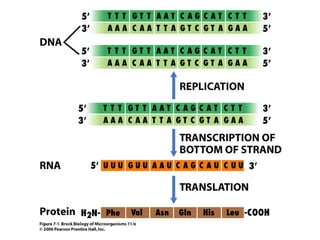
Macromolecular Synthesis The three key processes of synthesis: (1) DNA  replication   (2)  transcription  (the synthesis of RNA from a DNA template) (3)  translation  (the synthesis of proteins using messenger RNA as a template)
 
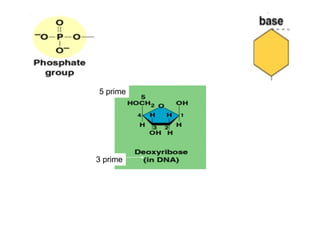
o 3 prime 5 prime
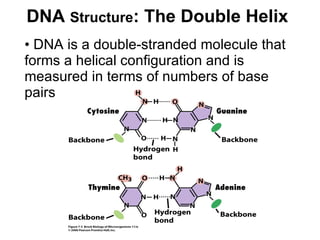
DNA  Structure : The Double Helix DNA is a double-stranded molecule that forms a helical configuration and is measured in terms of numbers of base pairs
Complementary Strands and Bases DNA exists as two polynucleotide strands whose base sequences are  complementary .  The complementarity of DNA arises from the specific pairing of the purine and pyrimidine bases  Adenine always pairs with thymine,  Guanine always pairs with cytosine.
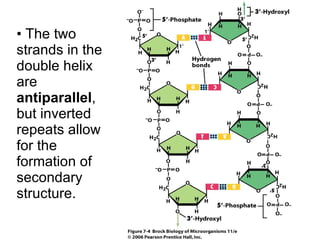
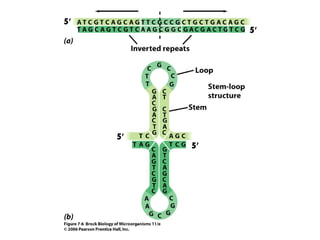
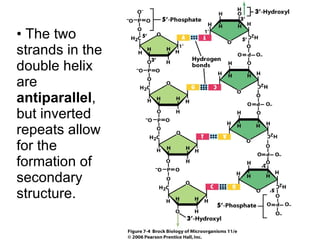
The two strands in the double helix are  antiparallel , but inverted repeats allow for the formation of secondary structure.
 
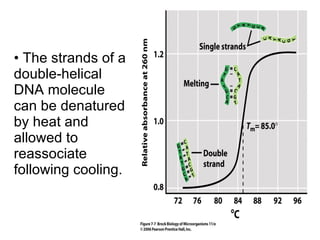
The strands of a double-helical DNA molecule can be denatured by heat and allowed to reassociate following cooling.
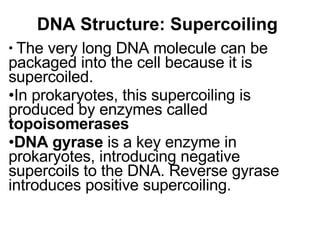
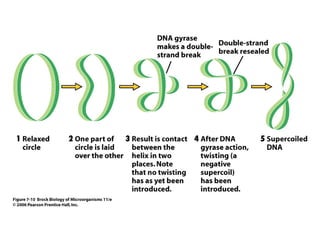
DNA Structure: Supercoiling The very long DNA molecule can be packaged into the cell because it is supercoiled. In prokaryotes, this supercoiling is produced by enzymes called  topoisomerases DNA gyrase  is a key enzyme in prokaryotes, introducing negative supercoils to the DNA. Reverse gyrase introduces positive supercoiling.
 
Extranuclear DNA Plasmids:  DNA molecules that exist separately from the chromosome of the cell.  Mitochondria and chloroplasts:  contain their own DNA chromosomes.  Viruses:  contain a  genome , either DNA or RNA, that controls their own replication.  Transposable elements:  exist as a part of other genetic elements.
Replication Semiconservative replication :  Both strands of the DNA helix serve as templates for the synthesis of two new strands The two progeny double helices each contain one parental strand and one new strand.  The new strands are replicated by addition to the 3' end of parent strand. DNA polymerases  require a  primer , which is composed of RNA
The two strands in the double helix are  antiparallel , but inverted repeats allow for the formation of secondary structure.
 
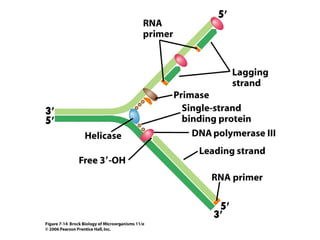
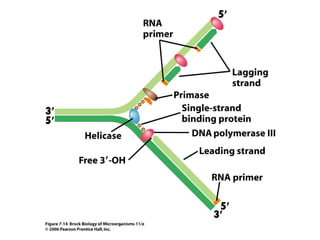
DNA Replication: The Replication Fork   Origin of Replication : Where  DNA synthesis begins  Helicase : unwinds the double helix and is stabilized by single-strand binding protein. Replication Fork : the site of replication, moves down the DNA.  Extension of the DNA:  occurs continuously on the leading strand but discontinuously on the lagging strand
 
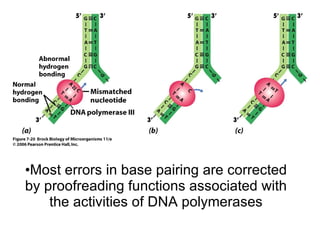
Most errors in base pairing are corrected by proofreading functions associated with the activities of DNA polymerases
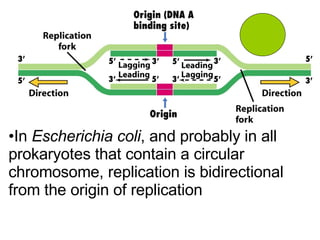
In  Escherichia coli , and probably in all prokaryotes that contain a circular chromosome, replication is bidirectional from the origin of replication
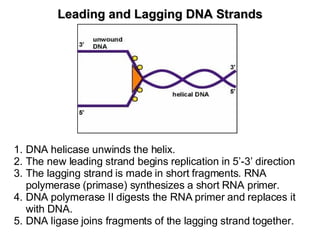
DNA helicase unwinds the helix.  The new leading strand begins replication in 5’-3’ direction The lagging strand is made in short fragments. RNA polymerase (primase) synthesizes a short RNA primer.  DNA polymerase II digests the RNA primer and replaces it with DNA.  DNA ligase joins fragments of the lagging strand together.  Leading and Lagging DNA Strands
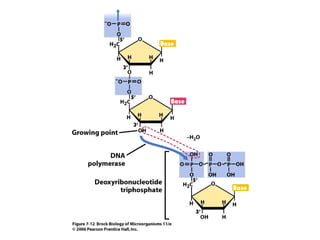
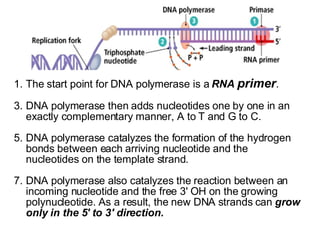
The start point for DNA polymerase is a  RNA  primer . DNA polymerase then adds nucleotides one by one in an exactly complementary manner, A to T and G to C. DNA polymerase catalyzes the formation of the hydrogen bonds between each arriving nucleotide and the nucleotides on the template strand.  DNA polymerase also catalyzes the reaction between an incoming nucleotide and the free 3' OH on the growing polynucleotide. As a result, the new DNA strands can  grow only in the 5' to 3' direction.
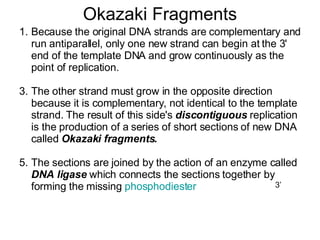
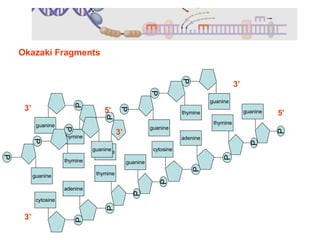
Okazaki Fragments Because the original DNA strands are complementary and run antiparallel, only one new strand can begin at the 3' end of the template DNA and grow continuously as the point of replication.  The other strand must grow in the opposite direction because it is complementary, not identical to the template strand. The result of this side's  discontiguous  replication is the production of a series of short sections of new DNA called  Okazaki fragments. The sections are joined by the action of an enzyme called  DNA ligase  which connects the sections together by forming the missing  phosphodiester  3’
 
P adenine P cytosine guanine P P thymine guanine P P 5’ Okazaki Fragments P adenine P cytosine thymine 3’ P thymine P guanine adenine 3’ P thymine P guanine guanine 3’ 5’ P P thymine P guanine guanine 3’ 5’ P
Tools for Manipulating DNA,    Restriction Enzymes and Hybridization
Restriction Enzyme Digestion  Restriction enzymes  recognize specific short sequences in DNA and make breaks in the DNA The products of restriction enzyme digestion can be separated using gel electrophoresis and complementary sequences detected by  hybridization . The Southern blot technique is used to hybridize probes to DNA fragments that have been separated by gel electrophoresis DNA can be sequenced by the Sanger method, which involves copying the DNA to be sequenced in the presence of chain-terminating dideoxynucleotides
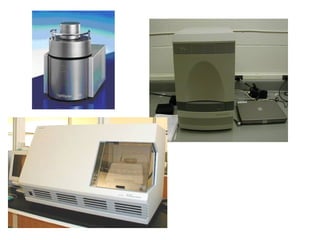
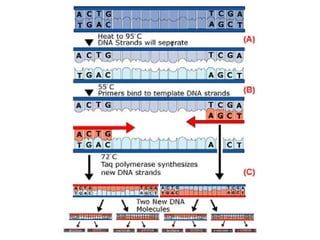
Large number of identical molecules of DNA produced  in vitro Critical to amplify DNA in variety of situations To amplify genome of unknown pathogen  DNA polymerase from thermophilic  Bacillus  used for replication Repetitive process consisting of three steps Denaturation Priming Extension Can be automated using a thermocycler The Polymerase Chain Reaction (PCR)
a
 
Transcription –DNA is copied to make RNA Translation – RNA copied to make polypeptides Proteins are synthesized on ribosomes Central dogma of genetics DNA transcribed to RNA RNA translated to form polypeptides Transfer of Genetic Information
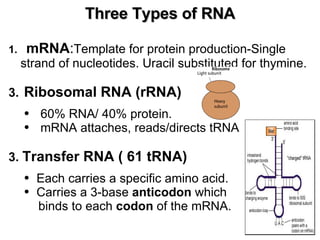
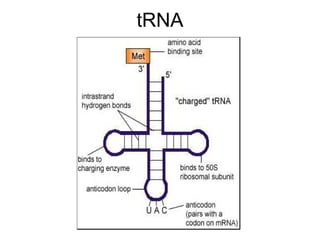
mRNA : Template for protein production-Single strand of nucleotides. Uracil substituted for thymine. Ribosomal RNA (rRNA) 60% RNA/ 40% protein.  mRNA attaches, reads/directs tRNA  3.  Transfer RNA ( 61 tRNA)  Each carries a specific amino acid.  Carries a 3-base  anticodon  which  binds to each  codon  of the mRNA. Three Types of RNA
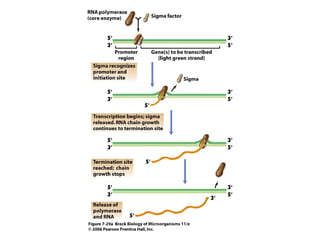
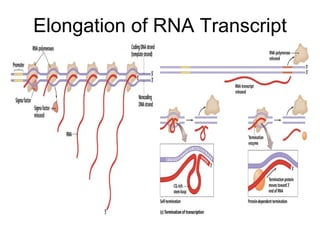
RNA Polymerase : Transcription of RNA from DNA, which adds bases onto the 3' ends of growing chains.  Promoter : RNA polymerase needs no primer and recognizes a specific start site on the DNA called the  promoter Sigma Subunit : In  Bacteria,  promoters are recognized by the sigma subunit of RNA polymerase.  Transcription
 
Elongation of RNA Transcript
Terminators RNA polymerase stops transcription at specific sites called  transcription terminators Signals function at the level of RNA. In  Bacteria , these sequences are often stem-loops followed by a run of uracils. Other terminators require proteins, such as Rho.
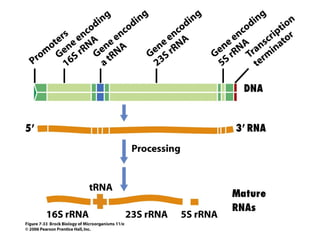
The Unit of Transcription The unit of transcription often contains more than a single  gene . The mRNA may contain the information for more than one polypeptide. Genes that are transcribed together from a single promoter constitute an  operon .  In all organisms, genes encoding rRNA are transcribed together and then are processed to form the final rRNA species
 
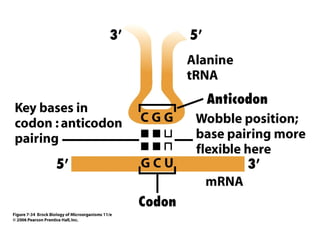
Codons A codon is recognized following specific base-pairing of mRNA with a sequence of three bases on a tRNA called the  anticodon Some tRNAs can recognize more than one codon.  In these cases, tRNA molecules form standard base pairs only at the first two positions of the codon, while tolerating irregular base pairing at the third position. This apparent mismatch phenomenon is called  wobble .
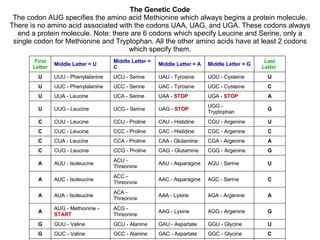
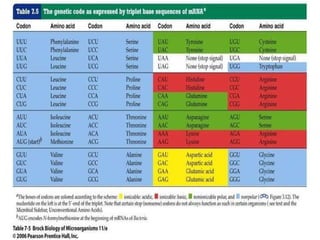
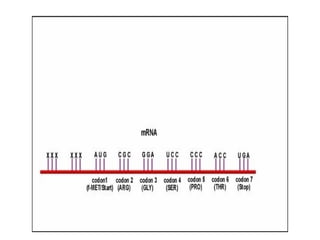
The Genetic Code  The codon AUG specifies the amino acid Methionine which always begins a protein molecule. There is no amino acid associated with the codons UAA, UAG, and UGA. These codons always end a protein molecule. Note: there are 6 codons which specify Leucine and Serine, only a single codon for Methionine and Tryptophan. All the other amino acids have at least 2 codons which specify them. First Letter   Middle Letter = U   Middle Letter = C   Middle Letter = A   Middle   Letter = G   Last Letter   U UUU - Phenylalanine  UCU - Serine  UAU - Tyrosine  UGU - Cysteine  U U UUC - Phenylalanine  UCC - Serine  UAC - Tyrosine  UGC - Cysteine  C U UUA - Leucine  UCA - Serine  UAA -  STOP   UGA -  STOP   A U UUG - Leucine  UCG - Serine  UAG -  STOP   UGG - Tryptophan  G C CUU - Leucine  CCU - Proline  CAU - Histidine  CGU - Argenine  U C CUC - Leucine  CCC - Proline  CAC - Histidine  CGC - Argenine  C C CUA - Leucine  CCA - Proline  CAA - Glutamine  CGA - Argenine  A C CUG - Leucine  CCG - Proline  CAG - Glutamine  CGG - Argenine  G A AUU - Isoleucine  ACU - Threonine  AAU - Asparagine  AGU - Serine  U A AUC - Isoleucine  ACC - Threonine  AAC - Asparagine  AGC - Serine  C A AUA - Isoleucine  ACA - Threonine  AAA - Lysine  AGA - Argenine  A A AUG - Methionine  - START   ACG - Threonine  AAG - Lysine  AGG - Argenine  G G GUU - Valine  GCU - Alanine  GAU - Aspartate  GGU - Glycine  U G GUC - Valine  GCC - Alanine  GAC - Aspartate  GGC - Glycine  C G GUA - Valine  GCA - Alanine  GAA - Glutamine  GGA - Glycine  A G GUG - Valine  GCG - Alanine  GAG - Glutamine  GGG - Glycine  G
 
 
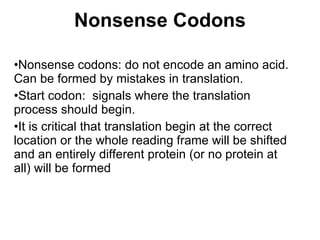
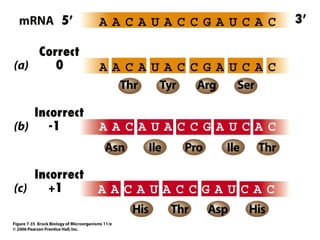
Nonsense Codons Nonsense codons: do not encode an amino acid. Can be formed by mistakes in translation. Start codon:  signals where the translation process should begin. It is critical that translation begin at the correct location or the whole reading frame will be shifted and an entirely different protein (or no protein at all) will be formed
 
Transfer RNA One or more transfer RNAs exist for each amino acid found in a protein. Enzymes called  aminoacyl-tRNA synthetases  attach an amino acid to a tRNA. The  ribosome  plays a key role in the translation process, bringing together mRNA and aminoacyl tRNAs.
tRNA
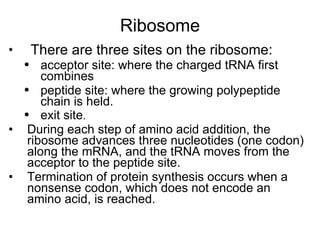
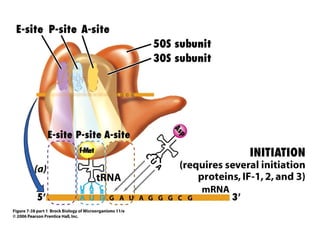
Ribosome There are three sites on the ribosome:  acceptor site: where the charged tRNA first combines peptide site: where the growing polypeptide chain is held. exit site . During each step of amino acid addition, the ribosome advances three nucleotides (one codon) along the mRNA, and the tRNA moves from the acceptor to the peptide site.  Termination of protein synthesis occurs when a nonsense codon, which does not encode an amino acid, is reached.
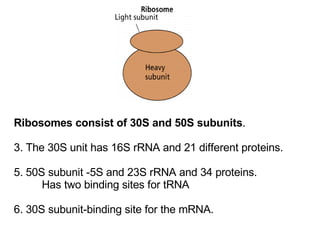
Ribosomes consist of 30S and 50S subunits .  The 30S unit has 16S rRNA and 21 different proteins.  50S subunit -5S and 23S rRNA and 34 proteins.  Has two binding sites for tRNA 30S subunit-binding site for the mRNA.
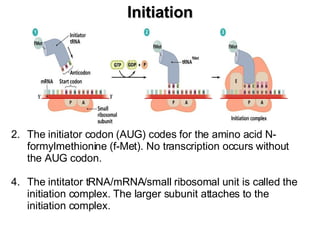
Initiation The initiator codon (AUG) codes for the amino acid N-formylmethionine (f-Met). No transcription occurs without the AUG codon.  The intitator tRNA/mRNA/small ribosomal unit is called the initiation complex. The larger subunit attaches to the initiation complex.
 
The ribosome continues to move along the mRNA molecule, adding amino acids one at a time until it encounters a codon that does not code for an amino acid - a stop codon. Since no additional amino acids can be added, this terminates the synthesis and the protein chain is now complete.  The ribosome then detaches from the mRNA and re-binds to the start codon of either the same mRNA or to another. Translation-Elongation
 
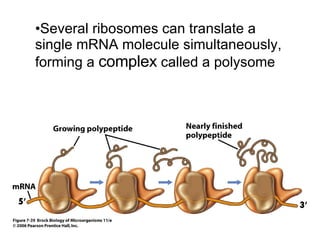
Several ribosomes can translate a single mRNA molecule simultaneously, forming a  complex  called a polysome
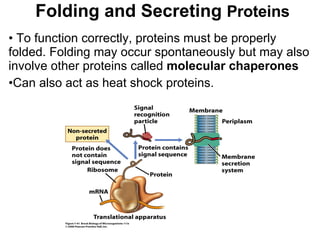
Folding and Secreting  Proteins To function correctly, proteins must be properly folded. Folding may occur spontaneously but may also involve other proteins called  molecular chaperones Can also act as heat shock proteins.
Moving through Membrane Proteins must move in/out of cell. Signal Sequence at beginning of molecule. Signal recognition particle (small rna) TAT transport system

chapter 7

  • 1.
    Genes and GeneExpression  Macromolecules and Genetic Information
  • 2.
    Macromolecular Synthesis Thethree key processes of synthesis: (1) DNA replication (2) transcription (the synthesis of RNA from a DNA template) (3) translation (the synthesis of proteins using messenger RNA as a template)
  • 3.
  • 4.
    o 3 prime5 prime
  • 5.
    DNA Structure: The Double Helix DNA is a double-stranded molecule that forms a helical configuration and is measured in terms of numbers of base pairs
  • 6.
    Complementary Strands andBases DNA exists as two polynucleotide strands whose base sequences are complementary . The complementarity of DNA arises from the specific pairing of the purine and pyrimidine bases Adenine always pairs with thymine, Guanine always pairs with cytosine.
  • 7.
    The two strandsin the double helix are antiparallel , but inverted repeats allow for the formation of secondary structure.
  • 8.
  • 9.
    The strands ofa double-helical DNA molecule can be denatured by heat and allowed to reassociate following cooling.
  • 10.
    DNA Structure: SupercoilingThe very long DNA molecule can be packaged into the cell because it is supercoiled. In prokaryotes, this supercoiling is produced by enzymes called topoisomerases DNA gyrase is a key enzyme in prokaryotes, introducing negative supercoils to the DNA. Reverse gyrase introduces positive supercoiling.
  • 11.
  • 12.
    Extranuclear DNA Plasmids: DNA molecules that exist separately from the chromosome of the cell. Mitochondria and chloroplasts: contain their own DNA chromosomes. Viruses: contain a genome , either DNA or RNA, that controls their own replication. Transposable elements: exist as a part of other genetic elements.
  • 13.
    Replication Semiconservative replication: Both strands of the DNA helix serve as templates for the synthesis of two new strands The two progeny double helices each contain one parental strand and one new strand. The new strands are replicated by addition to the 3' end of parent strand. DNA polymerases require a primer , which is composed of RNA
  • 14.
    The two strandsin the double helix are antiparallel , but inverted repeats allow for the formation of secondary structure.
  • 15.
  • 16.
    DNA Replication: TheReplication Fork Origin of Replication : Where DNA synthesis begins Helicase : unwinds the double helix and is stabilized by single-strand binding protein. Replication Fork : the site of replication, moves down the DNA. Extension of the DNA: occurs continuously on the leading strand but discontinuously on the lagging strand
  • 17.
  • 18.
    Most errors inbase pairing are corrected by proofreading functions associated with the activities of DNA polymerases
  • 19.
    In Escherichiacoli , and probably in all prokaryotes that contain a circular chromosome, replication is bidirectional from the origin of replication
  • 20.
    DNA helicase unwindsthe helix. The new leading strand begins replication in 5’-3’ direction The lagging strand is made in short fragments. RNA polymerase (primase) synthesizes a short RNA primer. DNA polymerase II digests the RNA primer and replaces it with DNA. DNA ligase joins fragments of the lagging strand together. Leading and Lagging DNA Strands
  • 21.
    The start pointfor DNA polymerase is a RNA primer . DNA polymerase then adds nucleotides one by one in an exactly complementary manner, A to T and G to C. DNA polymerase catalyzes the formation of the hydrogen bonds between each arriving nucleotide and the nucleotides on the template strand. DNA polymerase also catalyzes the reaction between an incoming nucleotide and the free 3' OH on the growing polynucleotide. As a result, the new DNA strands can grow only in the 5' to 3' direction.
  • 22.
    Okazaki Fragments Becausethe original DNA strands are complementary and run antiparallel, only one new strand can begin at the 3' end of the template DNA and grow continuously as the point of replication. The other strand must grow in the opposite direction because it is complementary, not identical to the template strand. The result of this side's discontiguous replication is the production of a series of short sections of new DNA called Okazaki fragments. The sections are joined by the action of an enzyme called DNA ligase which connects the sections together by forming the missing phosphodiester 3’
  • 23.
  • 24.
    P adenine Pcytosine guanine P P thymine guanine P P 5’ Okazaki Fragments P adenine P cytosine thymine 3’ P thymine P guanine adenine 3’ P thymine P guanine guanine 3’ 5’ P P thymine P guanine guanine 3’ 5’ P
  • 25.
    Tools for ManipulatingDNA,   Restriction Enzymes and Hybridization
  • 26.
    Restriction Enzyme Digestion Restriction enzymes recognize specific short sequences in DNA and make breaks in the DNA The products of restriction enzyme digestion can be separated using gel electrophoresis and complementary sequences detected by hybridization . The Southern blot technique is used to hybridize probes to DNA fragments that have been separated by gel electrophoresis DNA can be sequenced by the Sanger method, which involves copying the DNA to be sequenced in the presence of chain-terminating dideoxynucleotides
  • 27.
    Large number ofidentical molecules of DNA produced in vitro Critical to amplify DNA in variety of situations To amplify genome of unknown pathogen DNA polymerase from thermophilic Bacillus used for replication Repetitive process consisting of three steps Denaturation Priming Extension Can be automated using a thermocycler The Polymerase Chain Reaction (PCR)
  • 28.
  • 29.
  • 30.
    Transcription –DNA iscopied to make RNA Translation – RNA copied to make polypeptides Proteins are synthesized on ribosomes Central dogma of genetics DNA transcribed to RNA RNA translated to form polypeptides Transfer of Genetic Information
  • 31.
    mRNA : Templatefor protein production-Single strand of nucleotides. Uracil substituted for thymine. Ribosomal RNA (rRNA) 60% RNA/ 40% protein. mRNA attaches, reads/directs tRNA 3. Transfer RNA ( 61 tRNA) Each carries a specific amino acid. Carries a 3-base anticodon which binds to each codon of the mRNA. Three Types of RNA
  • 32.
    RNA Polymerase :Transcription of RNA from DNA, which adds bases onto the 3' ends of growing chains. Promoter : RNA polymerase needs no primer and recognizes a specific start site on the DNA called the promoter Sigma Subunit : In Bacteria, promoters are recognized by the sigma subunit of RNA polymerase. Transcription
  • 33.
  • 34.
  • 35.
    Terminators RNA polymerasestops transcription at specific sites called transcription terminators Signals function at the level of RNA. In Bacteria , these sequences are often stem-loops followed by a run of uracils. Other terminators require proteins, such as Rho.
  • 36.
    The Unit ofTranscription The unit of transcription often contains more than a single gene . The mRNA may contain the information for more than one polypeptide. Genes that are transcribed together from a single promoter constitute an operon . In all organisms, genes encoding rRNA are transcribed together and then are processed to form the final rRNA species
  • 37.
  • 38.
    Codons A codonis recognized following specific base-pairing of mRNA with a sequence of three bases on a tRNA called the anticodon Some tRNAs can recognize more than one codon. In these cases, tRNA molecules form standard base pairs only at the first two positions of the codon, while tolerating irregular base pairing at the third position. This apparent mismatch phenomenon is called wobble .
  • 39.
    The Genetic Code The codon AUG specifies the amino acid Methionine which always begins a protein molecule. There is no amino acid associated with the codons UAA, UAG, and UGA. These codons always end a protein molecule. Note: there are 6 codons which specify Leucine and Serine, only a single codon for Methionine and Tryptophan. All the other amino acids have at least 2 codons which specify them. First Letter Middle Letter = U Middle Letter = C Middle Letter = A Middle Letter = G Last Letter U UUU - Phenylalanine UCU - Serine UAU - Tyrosine UGU - Cysteine U U UUC - Phenylalanine UCC - Serine UAC - Tyrosine UGC - Cysteine C U UUA - Leucine UCA - Serine UAA - STOP UGA - STOP A U UUG - Leucine UCG - Serine UAG - STOP UGG - Tryptophan G C CUU - Leucine CCU - Proline CAU - Histidine CGU - Argenine U C CUC - Leucine CCC - Proline CAC - Histidine CGC - Argenine C C CUA - Leucine CCA - Proline CAA - Glutamine CGA - Argenine A C CUG - Leucine CCG - Proline CAG - Glutamine CGG - Argenine G A AUU - Isoleucine ACU - Threonine AAU - Asparagine AGU - Serine U A AUC - Isoleucine ACC - Threonine AAC - Asparagine AGC - Serine C A AUA - Isoleucine ACA - Threonine AAA - Lysine AGA - Argenine A A AUG - Methionine - START ACG - Threonine AAG - Lysine AGG - Argenine G G GUU - Valine GCU - Alanine GAU - Aspartate GGU - Glycine U G GUC - Valine GCC - Alanine GAC - Aspartate GGC - Glycine C G GUA - Valine GCA - Alanine GAA - Glutamine GGA - Glycine A G GUG - Valine GCG - Alanine GAG - Glutamine GGG - Glycine G
  • 40.
  • 41.
  • 42.
    Nonsense Codons Nonsensecodons: do not encode an amino acid. Can be formed by mistakes in translation. Start codon: signals where the translation process should begin. It is critical that translation begin at the correct location or the whole reading frame will be shifted and an entirely different protein (or no protein at all) will be formed
  • 43.
  • 44.
    Transfer RNA Oneor more transfer RNAs exist for each amino acid found in a protein. Enzymes called aminoacyl-tRNA synthetases attach an amino acid to a tRNA. The ribosome plays a key role in the translation process, bringing together mRNA and aminoacyl tRNAs.
  • 45.
  • 46.
    Ribosome There arethree sites on the ribosome: acceptor site: where the charged tRNA first combines peptide site: where the growing polypeptide chain is held. exit site . During each step of amino acid addition, the ribosome advances three nucleotides (one codon) along the mRNA, and the tRNA moves from the acceptor to the peptide site. Termination of protein synthesis occurs when a nonsense codon, which does not encode an amino acid, is reached.
  • 47.
    Ribosomes consist of30S and 50S subunits . The 30S unit has 16S rRNA and 21 different proteins. 50S subunit -5S and 23S rRNA and 34 proteins. Has two binding sites for tRNA 30S subunit-binding site for the mRNA.
  • 48.
    Initiation The initiatorcodon (AUG) codes for the amino acid N-formylmethionine (f-Met). No transcription occurs without the AUG codon. The intitator tRNA/mRNA/small ribosomal unit is called the initiation complex. The larger subunit attaches to the initiation complex.
  • 49.
  • 50.
    The ribosome continuesto move along the mRNA molecule, adding amino acids one at a time until it encounters a codon that does not code for an amino acid - a stop codon. Since no additional amino acids can be added, this terminates the synthesis and the protein chain is now complete. The ribosome then detaches from the mRNA and re-binds to the start codon of either the same mRNA or to another. Translation-Elongation
  • 51.
  • 52.
    Several ribosomes cantranslate a single mRNA molecule simultaneously, forming a complex called a polysome
  • 53.
    Folding and Secreting Proteins To function correctly, proteins must be properly folded. Folding may occur spontaneously but may also involve other proteins called molecular chaperones Can also act as heat shock proteins.
  • 54.
    Moving through MembraneProteins must move in/out of cell. Signal Sequence at beginning of molecule. Signal recognition particle (small rna) TAT transport system