REPRODUCTION
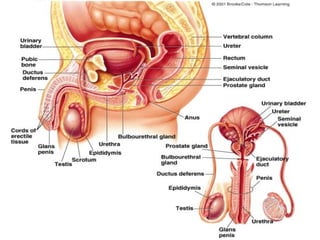
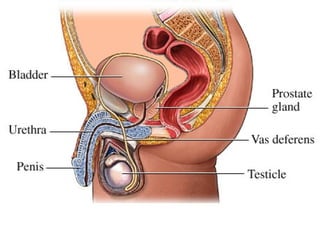
The Male Reproductive System P1: Identify and give functions for each of the following: testes, seminiferous tubules, interstitial cells, epididymis, ductus (vas)deferens, prostate gland, Cowper’s (bulbourethral) gland, seminal vesicles, penis, urethra. P2: Demonstrate a knowledge of the path of sperm from the seminiferous tubules to the urethral opening
 
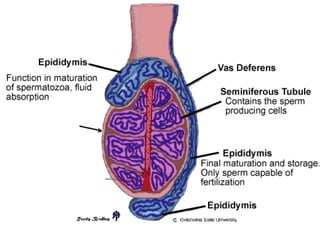
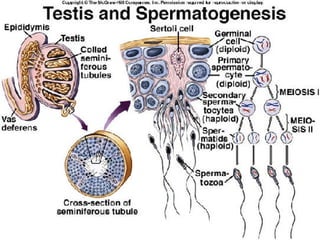
Testes  (singular = testis) Male  gonads Suspended outside the abdominal cavity in the  scrotum Hang outside the body to ensure optimal  temperatures  for sperm  production  (a few degrees  below  body temperature is required) Testes descend into scrotum during last 2 months of fetal development If testes do not descend, sperm can not develop properly Male may become sterile Increased chance of testicular cancer & injuries **Testes are able to move in and out of abdominal cavity to maintain proper temperature for spermatogenesis 2 Functions Make  s perm  in  seminiferous  tubules, maturing sperm are moved to the  epididymis Make  hormones :  androgens  and  testosterone
 
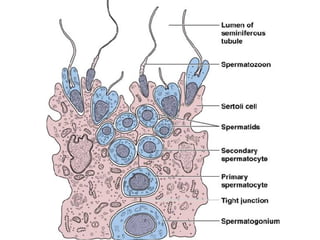
Seminiferous Tubules~250m in length! site of  spermatogenesis  (meiosis) also produce  inhibin  (negative -feedback vehicle to regulate the production of  testosterone ) Interstitial Cells Site of  testosterone  production Epididymis area where sperm  mature  and begin to gain  motility  and the ability to  fertilize storage area for  sperm tightly coiled  tubules
 
 
Spermatogenesis After puberty this is ongoing (unlike females) Usually100-300 million sperm delivered per ejaculate Only 15% are viable, of this only 400 survive to fertilize egg Vas deferens  (plural = vas deferentia) (also ductus deferens) storage area for  sperm tube which carries the  sperm  to the ejaculatory duct and the  urethra Smooth muscle  contractions  propel the sperm into the vas deferens
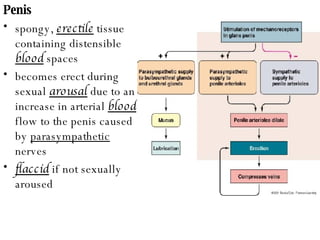
Penis  spongy,  erectile  tissue containing distensible  blood  spaces becomes erect during sexual  arousal  due to an increase in arterial  blood  flow to the penis caused by  parasympathetic  nerves flaccid  if not sexually aroused
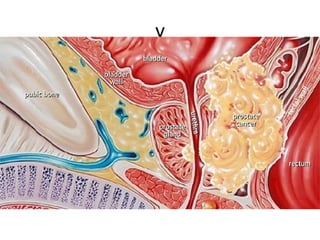
P3: List the functions of the seminal fluid Semen  ( seminal  fluid) thick, whitish fluid contains  sperm  and fluids from the  seminal  vesicles, the  prostate  and  Cowper’s  gland. is used for  nutrition ,  motility ,  neutralization,  and  lubrication Seminal Vesicles : lie at base of  bladder secrete a thick, clear fluid containing  fructose  (energy),  prostaglandins  (chemical signal in female to trigger rhythmic contractions of smooth muscle in female – facilitates movement of sperm towards egg Prostate gland Secretes a milky alkaline buffer that protects the sperm from the acidic environment of the vagina. Helps activate sperm, helps with motility
 
y
Cowper’s gland  (bulbourethral glands) secrete mucous  secretes mucus rich fluids prior to ejaculation, thought to neutralize any remaining acidic urine in the urethra.  Also contains some sperm before ejaculation – reason for high failure rate of withdrawl method of birth control.   May also help to  lubricate  the urethra Urethra Double purpose tube (semen&urine) but NEVER at same time Semen is expelled out of the urethra by rhythmic smooth muscle contractions = male orgasm
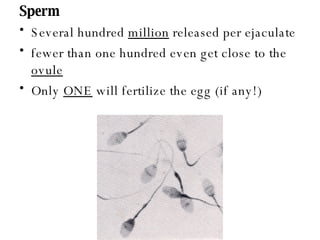
Sperm Several hundred  million  released per ejaculate fewer than one hundred even get close to the  ovule Only  ONE  will fertilize the egg (if any!)
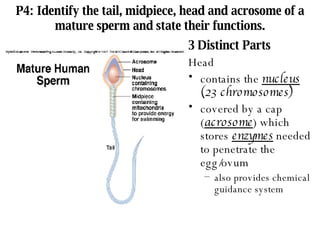
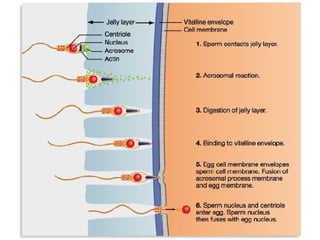
P4: Identify the tail, midpiece, head and acrosome of a mature sperm and state their functions. 3 Distinct Parts Head contains the  nucleus  (23 chromosomes) covered by a cap ( acrosome ) which stores  enzymes  needed to penetrate the egg/ovum also provides chemical guidance system
 
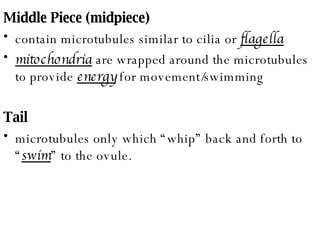
Middle Piece (midpiece) contain microtubules similar to cilia or  flagella mitochondria  are wrapped around the microtubules to provide  energy  for movement/swimming Tail microtubules only which “whip” back and forth to “ swim ” to the ovule.
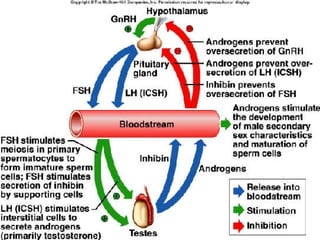
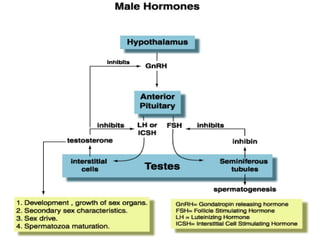
P6: Demonstrate a knowledge of the control of testosterone levels by the endocrine system . Hormonal Regulation in Males hypothalamus secretes  gonadotropic  releasing hormone (GnRH) GnRH stimulates the  anterior  pituitary to secrete the  gonadotropic  hormones: Follicle-stimulating  hormone (FSH) and  luteinizing  hormone (LH) [this is true of both  males  and females]
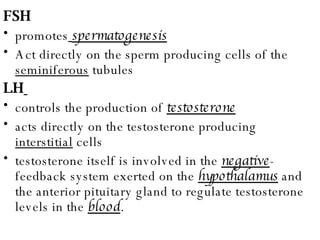
FSH   promotes   spermatogenesis Act directly on the sperm producing cells of the  seminiferous  tubules LH   controls the production of  testosterone acts directly on the testosterone producing  interstitial  cells testosterone itself is involved in the  negative -feedback system exerted on the  hypothalamus  and the anterior pituitary gland to regulate testosterone levels in the  blood .
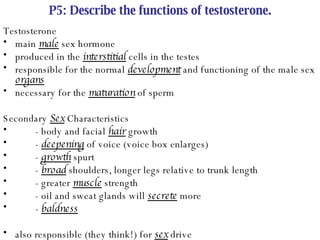
P5: Describe the functions of testosterone. Testosterone main  male  sex hormone produced in the  interstitial  cells in the testes responsible for the normal  development  and functioning of the male sex  organs necessary for the  maturation  of sperm Secondary  Sex  Characteristics - body and facial  hair  growth -  deepening  of voice (voice box enlarges) -  growth  spurt -  broad  shoulders, longer legs relative to trunk length - greater  muscle  strength - oil and sweat glands will  secrete  more -  baldness also responsible (they think!) for  sex  drive


Male Reproductive system

  • 1.
  • 2.
    The Male ReproductiveSystem P1: Identify and give functions for each of the following: testes, seminiferous tubules, interstitial cells, epididymis, ductus (vas)deferens, prostate gland, Cowper’s (bulbourethral) gland, seminal vesicles, penis, urethra. P2: Demonstrate a knowledge of the path of sperm from the seminiferous tubules to the urethral opening
  • 3.
  • 4.
    Testes (singular= testis) Male gonads Suspended outside the abdominal cavity in the scrotum Hang outside the body to ensure optimal temperatures for sperm production (a few degrees below body temperature is required) Testes descend into scrotum during last 2 months of fetal development If testes do not descend, sperm can not develop properly Male may become sterile Increased chance of testicular cancer & injuries **Testes are able to move in and out of abdominal cavity to maintain proper temperature for spermatogenesis 2 Functions Make s perm in seminiferous tubules, maturing sperm are moved to the epididymis Make hormones : androgens and testosterone
  • 5.
  • 6.
    Seminiferous Tubules~250m inlength! site of spermatogenesis (meiosis) also produce inhibin (negative -feedback vehicle to regulate the production of testosterone ) Interstitial Cells Site of testosterone production Epididymis area where sperm mature and begin to gain motility and the ability to fertilize storage area for sperm tightly coiled tubules
  • 7.
  • 8.
  • 9.
    Spermatogenesis After pubertythis is ongoing (unlike females) Usually100-300 million sperm delivered per ejaculate Only 15% are viable, of this only 400 survive to fertilize egg Vas deferens (plural = vas deferentia) (also ductus deferens) storage area for sperm tube which carries the sperm to the ejaculatory duct and the urethra Smooth muscle contractions propel the sperm into the vas deferens
  • 10.
    Penis spongy, erectile tissue containing distensible blood spaces becomes erect during sexual arousal due to an increase in arterial blood flow to the penis caused by parasympathetic nerves flaccid if not sexually aroused
  • 11.
    P3: List thefunctions of the seminal fluid Semen ( seminal fluid) thick, whitish fluid contains sperm and fluids from the seminal vesicles, the prostate and Cowper’s gland. is used for nutrition , motility , neutralization, and lubrication Seminal Vesicles : lie at base of bladder secrete a thick, clear fluid containing fructose (energy), prostaglandins (chemical signal in female to trigger rhythmic contractions of smooth muscle in female – facilitates movement of sperm towards egg Prostate gland Secretes a milky alkaline buffer that protects the sperm from the acidic environment of the vagina. Helps activate sperm, helps with motility
  • 12.
  • 13.
  • 14.
    Cowper’s gland (bulbourethral glands) secrete mucous secretes mucus rich fluids prior to ejaculation, thought to neutralize any remaining acidic urine in the urethra. Also contains some sperm before ejaculation – reason for high failure rate of withdrawl method of birth control. May also help to lubricate the urethra Urethra Double purpose tube (semen&urine) but NEVER at same time Semen is expelled out of the urethra by rhythmic smooth muscle contractions = male orgasm
  • 15.
    Sperm Several hundred million released per ejaculate fewer than one hundred even get close to the ovule Only ONE will fertilize the egg (if any!)
  • 16.
    P4: Identify thetail, midpiece, head and acrosome of a mature sperm and state their functions. 3 Distinct Parts Head contains the nucleus (23 chromosomes) covered by a cap ( acrosome ) which stores enzymes needed to penetrate the egg/ovum also provides chemical guidance system
  • 17.
  • 18.
    Middle Piece (midpiece)contain microtubules similar to cilia or flagella mitochondria are wrapped around the microtubules to provide energy for movement/swimming Tail microtubules only which “whip” back and forth to “ swim ” to the ovule.
  • 19.
    P6: Demonstrate aknowledge of the control of testosterone levels by the endocrine system . Hormonal Regulation in Males hypothalamus secretes gonadotropic releasing hormone (GnRH) GnRH stimulates the anterior pituitary to secrete the gonadotropic hormones: Follicle-stimulating hormone (FSH) and luteinizing hormone (LH) [this is true of both males and females]
  • 20.
    FSH promotes spermatogenesis Act directly on the sperm producing cells of the seminiferous tubules LH controls the production of testosterone acts directly on the testosterone producing interstitial cells testosterone itself is involved in the negative -feedback system exerted on the hypothalamus and the anterior pituitary gland to regulate testosterone levels in the blood .
  • 21.
    P5: Describe thefunctions of testosterone. Testosterone main male sex hormone produced in the interstitial cells in the testes responsible for the normal development and functioning of the male sex organs necessary for the maturation of sperm Secondary Sex Characteristics - body and facial hair growth - deepening of voice (voice box enlarges) - growth spurt - broad shoulders, longer legs relative to trunk length - greater muscle strength - oil and sweat glands will secrete more - baldness also responsible (they think!) for sex drive
  • 22.
  • 23.