GENE
EXPRESSION:
RNA & Protein
Synthesis
ppt. by Robin D. Seamon
D N A
D N A
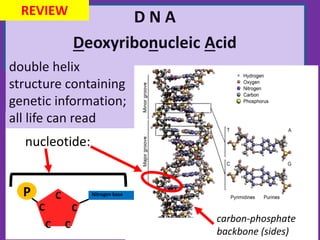
Deoxyribonucleic Acid
REVIEW
C
CC
C C
P Nitrogen base
nucleotide:
carbon-phosphate
backbone (sides)
double helix
structure containing
genetic information;
all life can read
DNA Strands per human cell:
• 23 base pairs of chromosomes
A – T C – G
• each chromosome has 2 strands of DNA
(double helix)
• There are equal amounts of A & T since they
pair (and equal amounts of C & G).
REVIEW
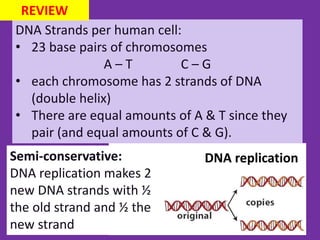
DNA replicationSemi-conservative:
DNA replication makes 2
new DNA strands with ½
the old strand and ½ the
new strand
R N A
GENE EXPRESSION
• also called Protein Synthesis
• also called Transcription/ Translation
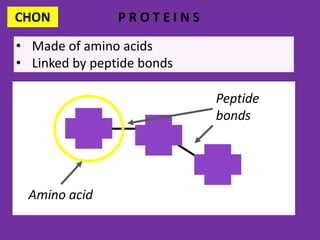
CHON P R O T E I N S
• Made of amino acids
• Linked by peptide bonds
Peptide
bonds
Amino acid
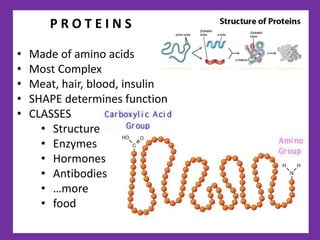
P R O T E I N S
• Made of amino acids
• Most Complex
• Meat, hair, blood, insulin
• SHAPE determines function
• CLASSES
• Structure
• Enzymes
• Hormones
• Antibodies
• …more
• food
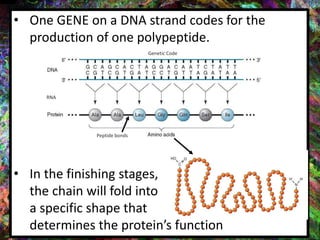
• One GENE on a DNA strand codes for the
production of one polypeptide.
• In the finishing stages,
the chain will fold into
a specific shape that
determines the protein’s function
Peptide bonds
Genetic Code
RNA
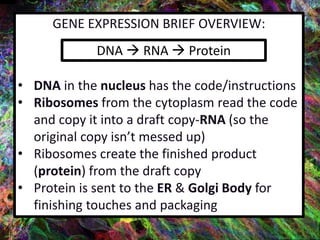
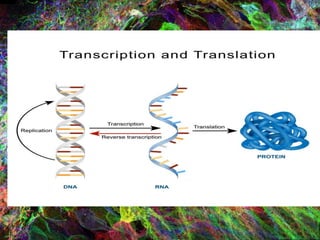
GENE EXPRESSION BRIEF OVERVIEW:
• DNA in the nucleus has the code/instructions
• Ribosomes from the cytoplasm read the code
and copy it into a draft copy-RNA (so the
original copy isn’t messed up)
• Ribosomes create the finished product
(protein) from the draft copy
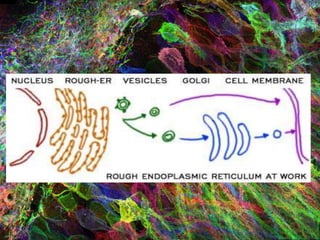
• Protein is sent to the ER & Golgi Body for
finishing touches and packaging
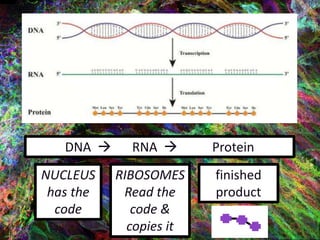
DNA  RNA  Protein
DNA  RNA  Protein
NUCLEUS
has the
code
RIBOSOMES
Read the
code &
copies it
finished
product
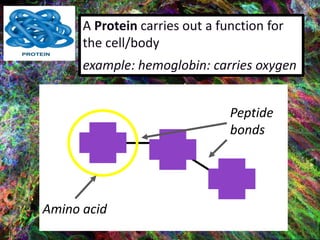
A Protein carries out a function for
the cell/body
example: hemoglobin: carries oxygen
Peptide
bonds
Amino acid
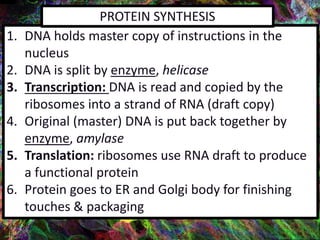
1. DNA holds master copy of instructions in the
nucleus
2. DNA is split by enzyme, helicase
3. Transcription: DNA is read and copied by the
ribosomes into a strand of RNA (draft copy)
4. Original (master) DNA is put back together by
enzyme, amylase
5. Translation: ribosomes use RNA draft to produce
a functional protein
6. Protein goes to ER and Golgi body for finishing
touches & packaging
PROTEIN SYNTHESIS
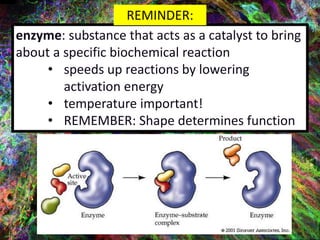
enzyme: substance that acts as a catalyst to bring
about a specific biochemical reaction
• speeds up reactions by lowering
activation energy
• temperature important!
• REMEMBER: Shape determines function
REMINDER:
example:
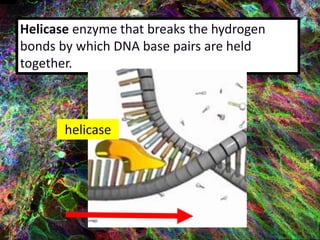
helicase- breaks hydrogen bonds
Where did we learn hydrogen bonds were?
Helicase enzyme that breaks the hydrogen
bonds by which DNA base pairs are held
together.
helicase
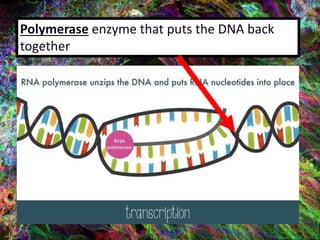
Polymerase enzyme that puts the DNA back
together
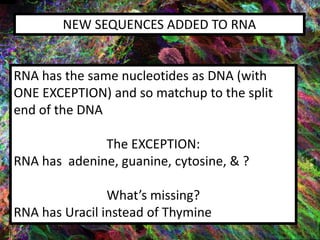
NEW SEQUENCES ADDED TO RNA
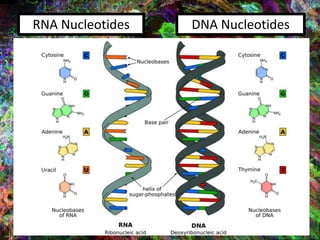
RNA has the same nucleotides as DNA (with
ONE EXCEPTION) and so matchup to the split
end of the DNA
The EXCEPTION:
RNA has adenine, guanine, cytosine, & ?
What’s missing?
RNA has Uracil instead of Thymine
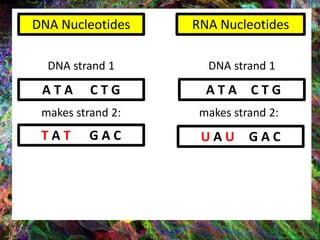
DNA Nucleotides RNA Nucleotides
A T A C T G A T A C T G
DNA strand 1
makes strand 2:
DNA strand 1
makes strand 2:
T A T G A C U A U G A C
RNA Nucleotides DNA Nucleotides
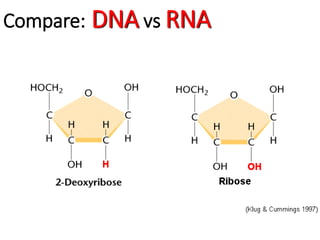
Compare: DNA vs RNA
DETAIL
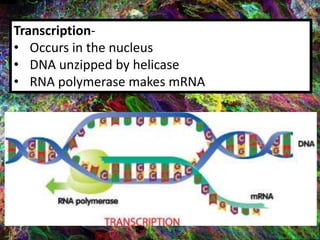
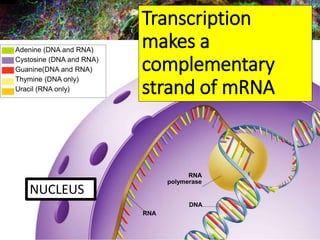
Transcription-
• Occurs in the nucleus
• DNA unzipped by helicase
• RNA polymerase makes mRNA
RNA
DNA
RNA
polymerase
Adenine (DNA and RNA)
Cystosine (DNA and RNA)
Guanine(DNA and RNA)
Thymine (DNA only)
Uracil (RNA only)
Transcription
makes a
complementary
strand of mRNA
NUCLEUS
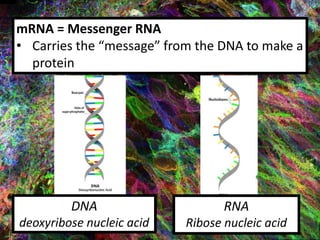
mRNA = Messenger RNA
• Carries the “message” from the DNA to make a
protein
RNA
Ribose nucleic acid
DNA
deoxyribose nucleic acid
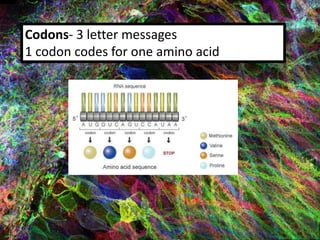
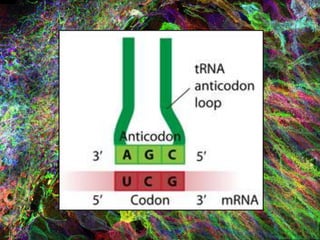
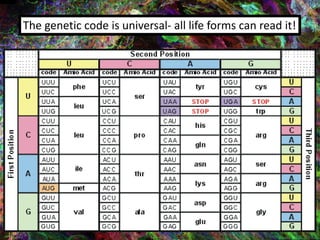
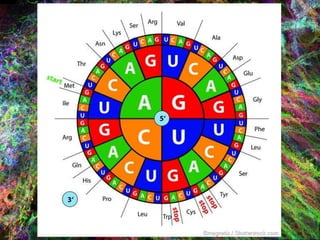
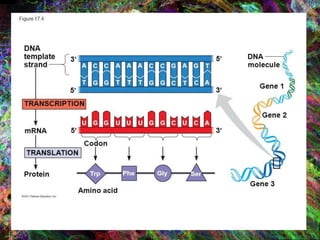
Codons- 3 letter messages
1 codon codes for one amino acid
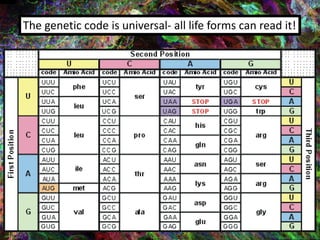
The genetic code is universal- all life forms can read it!
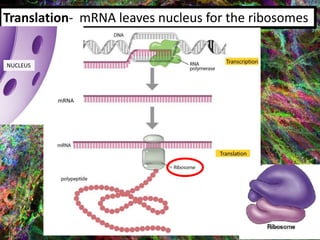
Translation- mRNA leaves nucleus for the ribosomes
NUCLEUS
mRNA
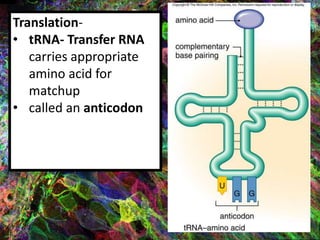
Translation-
• tRNA- Transfer RNA
carries appropriate
amino acid for
matchup
• called an anticodon
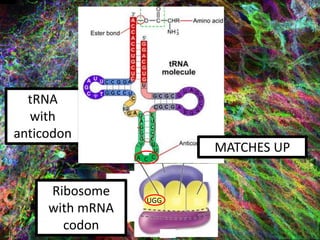
tRNA
with
anticodon
Ribosome
with mRNA
codon
UGG
A C C
MATCHES UP
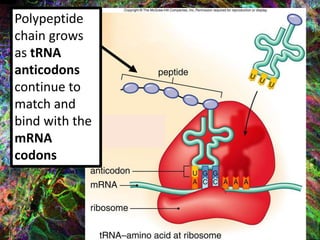
Polypeptide
chain grows
as tRNA
anticodons
continue to
match and
bind with the
mRNA
codons
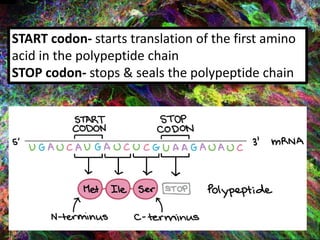
START codon- starts translation of the first amino
acid in the polypeptide chain
STOP codon- stops & seals the polypeptide chain
The genetic code is universal- all life forms can read it!
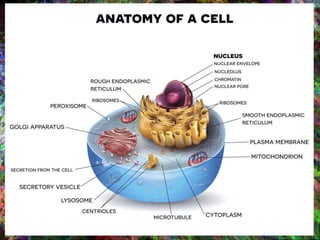
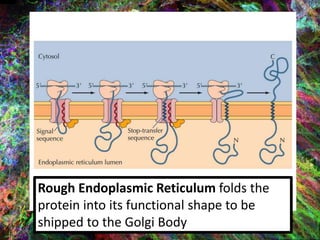
Rough Endoplasmic Reticulum folds the
protein into its functional shape to be
shipped to the Golgi Body
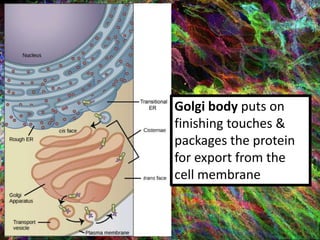
Golgi body puts on
finishing touches &
packages the protein
for export from the
cell membrane
REVIEW
DNA  RNA  Protein
(mRNA & tRNA)
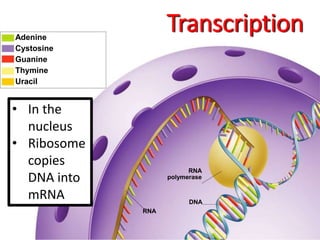
RNA
DNA
RNA
polymerase
Adenine
Cystosine
Guanine
Thymine
Uracil
Transcription
• In the
nucleus
• Ribosome
copies
DNA into
mRNA
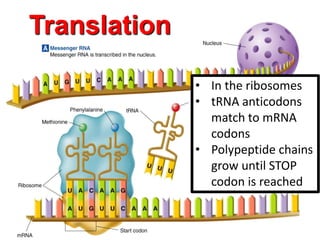
Translation
• In the ribosomes
• tRNA anticodons
match to mRNA
codons
• Polypeptide chains
grow until STOP
codon is reached
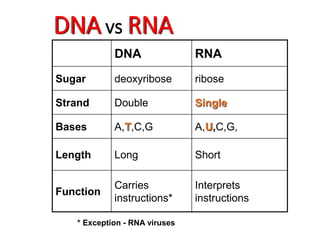
DNA vs RNA
DNA RNA
Sugar deoxyribose ribose
Strand Double Single
Bases A,T,C,G A,U,C,G,
Length Long Short
Function
Carries
instructions*
Interprets
instructions
* Exception - RNA viruses
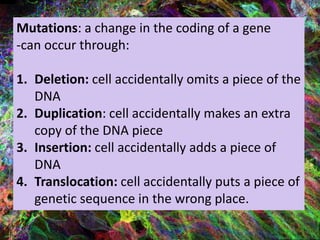
Mutations: a change in the coding of a gene
-can occur through:
1. Deletion: cell accidentally omits a piece of the
DNA
2. Duplication: cell accidentally makes an extra
copy of the DNA piece
3. Insertion: cell accidentally adds a piece of
DNA
4. Translocation: cell accidentally puts a piece of
genetic sequence in the wrong place.
46
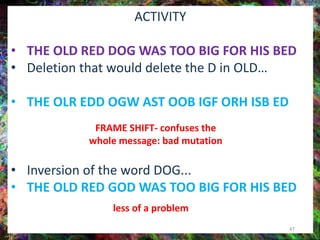
ACTIVITY
• THE OLD RED DOG WAS TOO BIG FOR HIS BED
• Deletion that would delete the D in OLD…
• THE OLR EDD OGW AST OOB IGF ORH ISB ED
• Inversion of the word DOG...
• THE OLD RED GOD WAS TOO BIG FOR HIS BED
47
FRAME SHIFT- confuses the
whole message: bad mutation
less of a problem
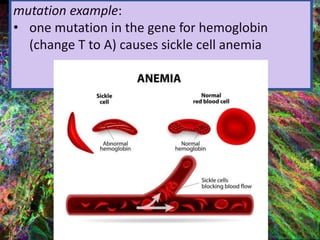
mutation example:
• one mutation in the gene for hemoglobin
(change T to A) causes sickle cell anemia

Gene expression/ RNA & Protein Synthesis

  • 1.
  • 2.
  • 3.
    D N A DeoxyribonucleicAcid REVIEW C CC C C P Nitrogen base nucleotide: carbon-phosphate backbone (sides) double helix structure containing genetic information; all life can read
  • 4.
    DNA Strands perhuman cell: • 23 base pairs of chromosomes A – T C – G • each chromosome has 2 strands of DNA (double helix) • There are equal amounts of A & T since they pair (and equal amounts of C & G). REVIEW DNA replicationSemi-conservative: DNA replication makes 2 new DNA strands with ½ the old strand and ½ the new strand
  • 5.
  • 6.
    GENE EXPRESSION • alsocalled Protein Synthesis • also called Transcription/ Translation
  • 7.
    CHON P RO T E I N S • Made of amino acids • Linked by peptide bonds Peptide bonds Amino acid
  • 8.
    P R OT E I N S • Made of amino acids • Most Complex • Meat, hair, blood, insulin • SHAPE determines function • CLASSES • Structure • Enzymes • Hormones • Antibodies • …more • food
  • 9.
    • One GENEon a DNA strand codes for the production of one polypeptide. • In the finishing stages, the chain will fold into a specific shape that determines the protein’s function Peptide bonds Genetic Code RNA
  • 10.
    GENE EXPRESSION BRIEFOVERVIEW: • DNA in the nucleus has the code/instructions • Ribosomes from the cytoplasm read the code and copy it into a draft copy-RNA (so the original copy isn’t messed up) • Ribosomes create the finished product (protein) from the draft copy • Protein is sent to the ER & Golgi Body for finishing touches and packaging DNA  RNA  Protein
  • 11.
    DNA  RNA Protein NUCLEUS has the code RIBOSOMES Read the code & copies it finished product
  • 12.
    A Protein carriesout a function for the cell/body example: hemoglobin: carries oxygen Peptide bonds Amino acid
  • 14.
    1. DNA holdsmaster copy of instructions in the nucleus 2. DNA is split by enzyme, helicase 3. Transcription: DNA is read and copied by the ribosomes into a strand of RNA (draft copy) 4. Original (master) DNA is put back together by enzyme, amylase 5. Translation: ribosomes use RNA draft to produce a functional protein 6. Protein goes to ER and Golgi body for finishing touches & packaging PROTEIN SYNTHESIS
  • 15.
    enzyme: substance thatacts as a catalyst to bring about a specific biochemical reaction • speeds up reactions by lowering activation energy • temperature important! • REMEMBER: Shape determines function REMINDER:
  • 16.
    example: helicase- breaks hydrogenbonds Where did we learn hydrogen bonds were?
  • 17.
    Helicase enzyme thatbreaks the hydrogen bonds by which DNA base pairs are held together. helicase
  • 18.
    Polymerase enzyme thatputs the DNA back together
  • 19.
    NEW SEQUENCES ADDEDTO RNA RNA has the same nucleotides as DNA (with ONE EXCEPTION) and so matchup to the split end of the DNA The EXCEPTION: RNA has adenine, guanine, cytosine, & ? What’s missing? RNA has Uracil instead of Thymine
  • 20.
    DNA Nucleotides RNANucleotides A T A C T G A T A C T G DNA strand 1 makes strand 2: DNA strand 1 makes strand 2: T A T G A C U A U G A C
  • 21.
  • 22.
  • 23.
  • 24.
    Transcription- • Occurs inthe nucleus • DNA unzipped by helicase • RNA polymerase makes mRNA
  • 25.
    RNA DNA RNA polymerase Adenine (DNA andRNA) Cystosine (DNA and RNA) Guanine(DNA and RNA) Thymine (DNA only) Uracil (RNA only) Transcription makes a complementary strand of mRNA NUCLEUS
  • 26.
    mRNA = MessengerRNA • Carries the “message” from the DNA to make a protein RNA Ribose nucleic acid DNA deoxyribose nucleic acid
  • 27.
    Codons- 3 lettermessages 1 codon codes for one amino acid
  • 28.
    The genetic codeis universal- all life forms can read it!
  • 29.
    Translation- mRNA leavesnucleus for the ribosomes NUCLEUS mRNA
  • 30.
    Translation- • tRNA- TransferRNA carries appropriate amino acid for matchup • called an anticodon
  • 31.
  • 33.
    Polypeptide chain grows as tRNA anticodons continueto match and bind with the mRNA codons
  • 34.
    START codon- startstranslation of the first amino acid in the polypeptide chain STOP codon- stops & seals the polypeptide chain
  • 35.
    The genetic codeis universal- all life forms can read it!
  • 37.
    Rough Endoplasmic Reticulumfolds the protein into its functional shape to be shipped to the Golgi Body
  • 38.
    Golgi body putson finishing touches & packages the protein for export from the cell membrane
  • 40.
    REVIEW DNA  RNA Protein (mRNA & tRNA)
  • 41.
  • 42.
    Translation • In theribosomes • tRNA anticodons match to mRNA codons • Polypeptide chains grow until STOP codon is reached
  • 44.
    DNA vs RNA DNARNA Sugar deoxyribose ribose Strand Double Single Bases A,T,C,G A,U,C,G, Length Long Short Function Carries instructions* Interprets instructions * Exception - RNA viruses
  • 46.
    Mutations: a changein the coding of a gene -can occur through: 1. Deletion: cell accidentally omits a piece of the DNA 2. Duplication: cell accidentally makes an extra copy of the DNA piece 3. Insertion: cell accidentally adds a piece of DNA 4. Translocation: cell accidentally puts a piece of genetic sequence in the wrong place. 46
  • 47.
    ACTIVITY • THE OLDRED DOG WAS TOO BIG FOR HIS BED • Deletion that would delete the D in OLD… • THE OLR EDD OGW AST OOB IGF ORH ISB ED • Inversion of the word DOG... • THE OLD RED GOD WAS TOO BIG FOR HIS BED 47 FRAME SHIFT- confuses the whole message: bad mutation less of a problem
  • 48.
    mutation example: • onemutation in the gene for hemoglobin (change T to A) causes sickle cell anemia