Sustainable Construction
- A Guide on Fire Protection and
Performance-based Fire Engineering
5 Maxwell Road, #16-00 Tower Block MND Complex, Singapore 069110 Tel: +65 6325 7720 Fax: +65 6325 4800 Website: www.bca.gov.sg
ISBN 978-981-05-9686-6
Printed on Recycled Paper
SustainableConstruction-AGuideonFireProtectionandPerformance-basedFireEngineering
BCA Sustainable Construction Series - 2
Sustainable Construction
- A Guide on Fire Protection and
Performance-based Fire Engineering
2
Sustainable Construction -Sustainable Construction -
Fire Protection and Performance-based Fire Engineering
Foreword
3
The Building and Construction Authority (BCA) has been working closely
with industry partners to promote sustainable construction. Sustainable
construction refers to the adoption of building designs, construction
methods and materials that are environmentally friendly. It also means
using materials and resources that have sustainable supplies and are
readily available from many sources.
Instead of relying too heavily on raw materials such as sand and
granite, we should also consider the adoption of steel, composite
materials and other forms of construction such as using drywalls.
However one major concern among the building practitioners is the
level of fire protection required and the effectiveness of these
protective measures. It is therefore important to address these issues
and clear the misperceptions that are associated with fire protection
for sustainable construction. This publication is timely as the Fire
Code had been reviewed and the revised Fire Code was published
in June 20 07 to address these concerns.
This is the second in the Sustainable Construction series. It aims to provide
information on fire safety requirements for buildings adopting steel and
other methods of sustainable construction, different passive fire protection
methods and the concept of performance-based fire engineering.
Special thanks go to the Working Committee members for their time and
effort in preparing this publication. I am confident that it will promote a
better understanding of fire safety requirements for sustainable construction
and serve as a useful guide for all building practitioners.
Dr John Keung
Chief Executive Officer
Building and Construction Authority
A Guide on Fire Protection and Performance-based Fire Engineering
4
Sustainable Construction -
Fire Protection and Performance-based Fire Engineering
Content
06 Introduction
07 Terminology simply explained
08 Using the Guide
11 Section 1: General Requirements
25 Section 2: Building Elements
39 Section 3: Fire Protection Methods
63 Section 4: Performance-based Approach to
Fire Safety Design
76 References
77 Acknowledgements
78 Photographs/Graphics Credit
5
A Guide on Fire Protection and Performance-based Fire Engineering
6
Sustainable Construction -
Introduction
The Building and Construction Authority has been actively promoting
sustainable construction to the construction industry. Various efforts have
been put in place to encourage wider use of sustainable materials and
products such as steel, drywalls and recycled materials.
One major concern on the use of sustainable construction is the level of fire
protection required and the effectiveness of these protective measures.
Traditionally, designers follow a set of prescriptive Fire Code requirements
in applying the required fire protection. However, in recent years, performance-
based fire safety engineering has gained popularity among designers,
especially for big and complex buildings as more economic designs can
be obtained through analysis and modeling.
This Guide attempts to provide useful information on passive fire protection
and fire engineering for building practitioners who are involved in the
development, design and construction of buildings using sustainable
materials. It comprises four sections. Section One explains the general
requirements pertaining to fire resistance. Section Two elaborates the
application of metal decking system, drywall system, fire-rated ceiling board
system and other dry construction. Section Three highlights the different
types of passive fire protection and Section Four explains the concept of
performance-based fire engineering.
Detailed engineering analysis and/or calculations and active fire protection
measures such as sprinkler system and mechanical ventilation are beyond
the scope of this Guide. Designers are advised to refer to technical journals
for comprehensive design and analysis.
6
Sustainable Construction -
Fire Protection and Performance-based Fire Engineering
7
Terminology simply explained
Combustible
Material that burns intensely, or has rapid rate of flame
spread.
Compartment
A part of a building separated from all other parts
of the same building by compartment walls and/or
compartment floors. A roof space above the top storey of
a compartment is included in that compartment.
Compartment wall/
compartment floor
A wall or a floor which is provided for the purpose of
dividing a building into compartments.
Cubical extent
The cubicle extent of a building or compartment is
the volume of space contained within the building
or compartment.
Fire engineering/
Fire safety
engineering
A branch of engineering discipline that deals with the
application of science and engineering principles
to protect people and their environments from the
destructive effects of fire and smoke.
Fire protection
Prevention and reduction of the hazards associated with
outbreak of fire.
Fire resistance/
Fire rating
The minimum period of time during which an isolated
structural or non-structural element may be expected to
function satisfactorily while subjected to a standard fire
test. The standard fire test referred to by the Fire Code is
the British Standards BS 476 Part 20 to 23 or its equivalent.
Flammable
Material quality that could ignite easily when exposed
to flame.
Relevant Authority
Relevant Authority means the Commissioner of Singapore
Civil Defence Force and includes officers authorised
by him generally or specifically to exercise the powers,
functions and duties conferred by the Fire Safety Act.
A Guide on Fire Protection and Performance-based Fire Engineering
8
Using the Guide
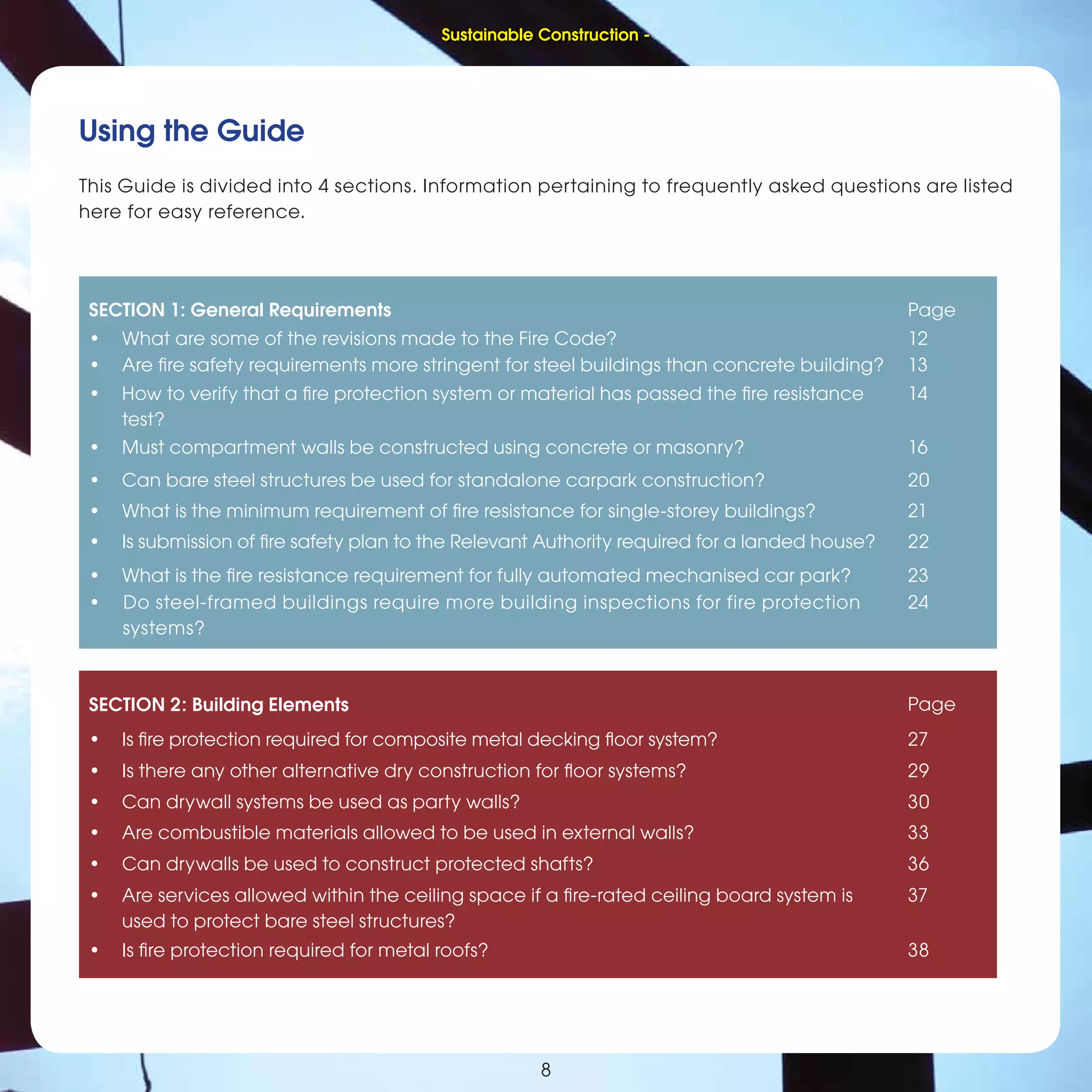
This Guide is divided into 4 sections. Information pertaining to frequently asked questions are listed
here for easy reference.
SECTION 1: General Requirements Page
• What are some of the revisions made to the Fire Code? 12
• Are fire safety requirements more stringent for steel buildings than concrete building? 13
• How to verify that a fire protection system or material has passed the fire resistance
test?
14
• Must compartment walls be constructed using concrete or masonry? 16
• Can bare steel structures be used for standalone carpark construction? 20
• What is the minimum requirement of fire resistance for single-storey buildings? 21
• Is submission of fire safety plan to the Relevant Authority required for a landed house? 22
• What is the fire resistance requirement for fully automated mechanised car park? 23
• Do steel-framed buildings require more building inspections for fire protection
systems?
24
SECTION 2: Building Elements Page
• Is fire protection required for composite metal decking floor system? 27
• Is there any other alternative dry construction for floor systems? 29
• Can drywall systems be used as party walls? 30
• Are combustible materials allowed to be used in external walls? 33
• Can drywalls be used to construct protected shafts? 36
• Are services allowed within the ceiling space if a fire-rated ceiling board system is
used to protect bare steel structures?
37
• Is fire protection required for metal roofs? 38
Sustainable Construction -
9
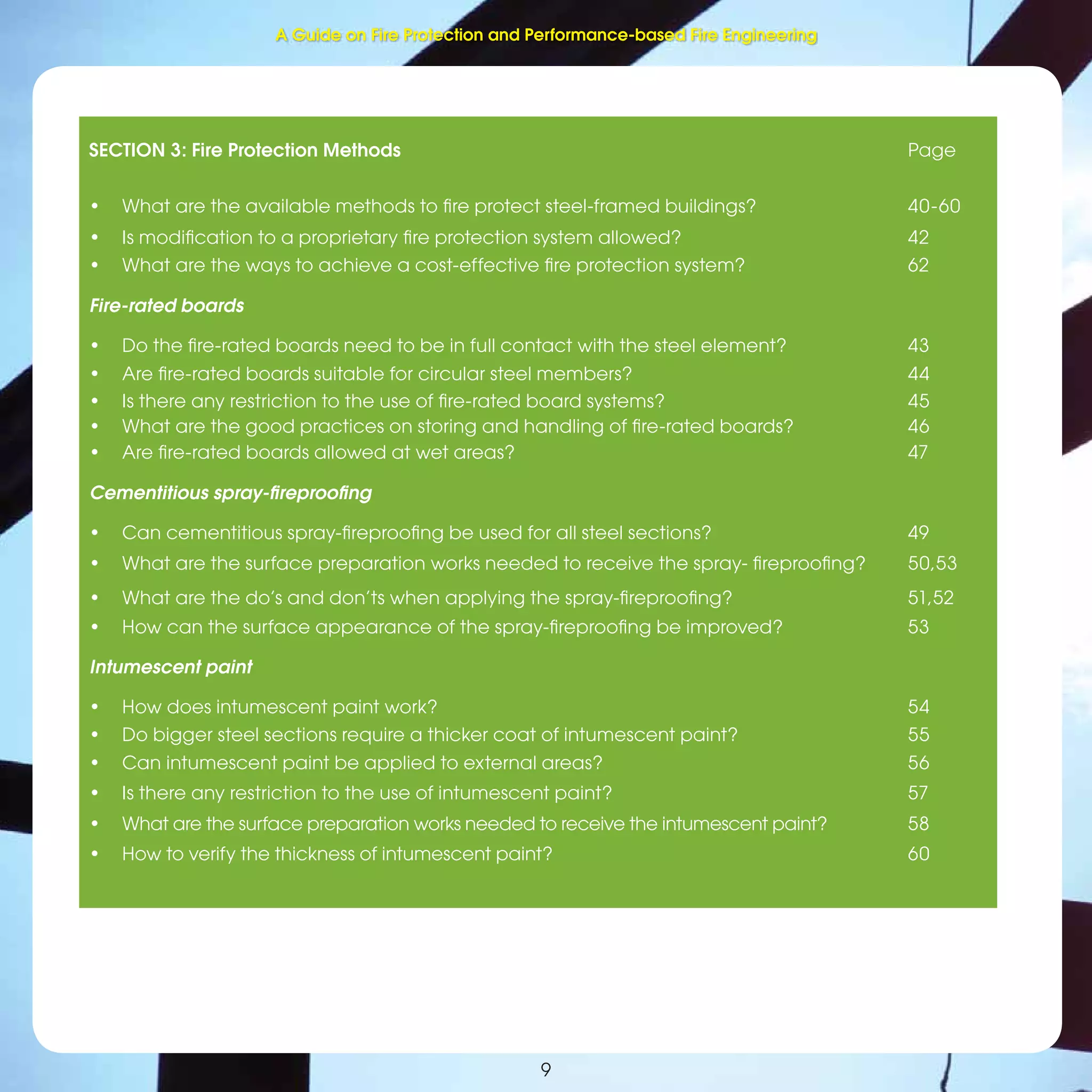
SECTION 3: Fire Protection Methods Page
• What are the available methods to fire protect steel-framed buildings? 40-60
• Is modification to a proprietary fire protection system allowed? 42
• What are the ways to achieve a cost-effective fire protection system? 62
Fire-rated boards
• Do the fire-rated boards need to be in full contact with the steel element? 43
• Are fire-rated boards suitable for circular steel members? 44
• Is there any restriction to the use of fire-rated board systems? 45
• What are the good practices on storing and handling of fire-rated boards? 46
• Are fire-rated boards allowed at wet areas? 47
Cementitious spray-fireproofing
• Can cementitious spray-fireproofing be used for all steel sections? 49
• What are the surface preparation works needed to receive the spray- fireproofing? 50,53
• What are the do’s and don’ts when applying the spray-fireproofing? 51,52
• How can the surface appearance of the spray-fireproofing be improved? 53
Intumescent paint
• How does intumescent paint work? 54
• Do bigger steel sections require a thicker coat of intumescent paint? 55
• Can intumescent paint be applied to external areas? 56
• Is there any restriction to the use of intumescent paint? 57
• What are the surface preparation works needed to receive the intumescent paint? 58
• How to verify the thickness of intumescent paint? 60
A Guide on Fire Protection and Performance-based Fire Engineering
Sustainable Construction -
1010
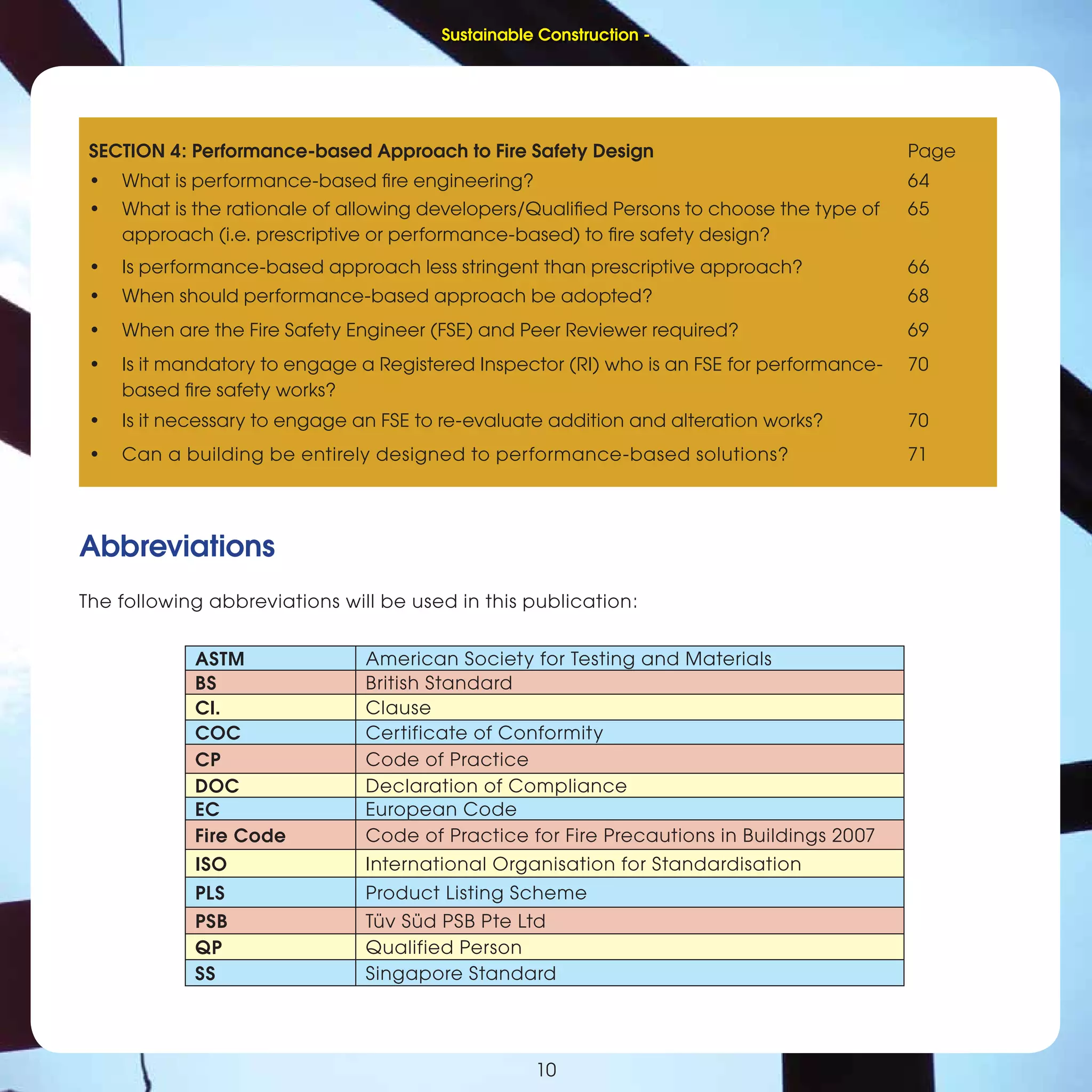
Abbreviations
The following abbreviations will be used in this publication:
ASTM American Society for Testing and Materials
BS British Standard
Cl. Clause
COC Certificate of Conformity
CP Code of Practice
DOC Declaration of Compliance
EC European Code
Fire Code Code of Practice for Fire Precautions in Buildings 2007
ISO International Organisation for Standardisation
PLS Product Listing Scheme
PSB Tüv Süd PSB Pte Ltd
QP Qualified Person
SS Singapore Standard
SECTION 4: Performance-based Approach to Fire Safety Design Page
• What is performance-based fire engineering? 64
• What is the rationale of allowing developers/Qualified Persons to choose the type of
approach (i.e. prescriptive or performance-based) to fire safety design?
65
• Is performance-based approach less stringent than prescriptive approach? 66
• When should performance-based approach be adopted? 68
• When are the Fire Safety Engineer (FSE) and Peer Reviewer required? 69
• Is it mandatory to engage a Registered Inspector (RI) who is an FSE for performance-
based fire safety works?
70
• Is it necessary to engage an FSE to re-evaluate addition and alteration works? 70
• Can a building be entirely designed to performance-based solutions? 71
Sustainable Construction -
Section 1:
General Requirements
11
A Guide on Fire Protection and Performance-based Fire Engineering
Sustainable Construction -
12
One of the main provisions of the Fire Code requires building elements and building materials
to achieve the appropriate fire resistance when they formed part of the building compartment.
The structural elements of a building are to be constructed with non-flammable or non-
combustible materials and with the desired rating in fire resistance.
In considering the types of structural materials to be used in a new
building, one must know that the minimum period of fire resistance
depends on factors such as the usage, floor area, habitable height
and cubicle extent of the building. The required fire resistance does
not depend on the type of building materials used in the building.
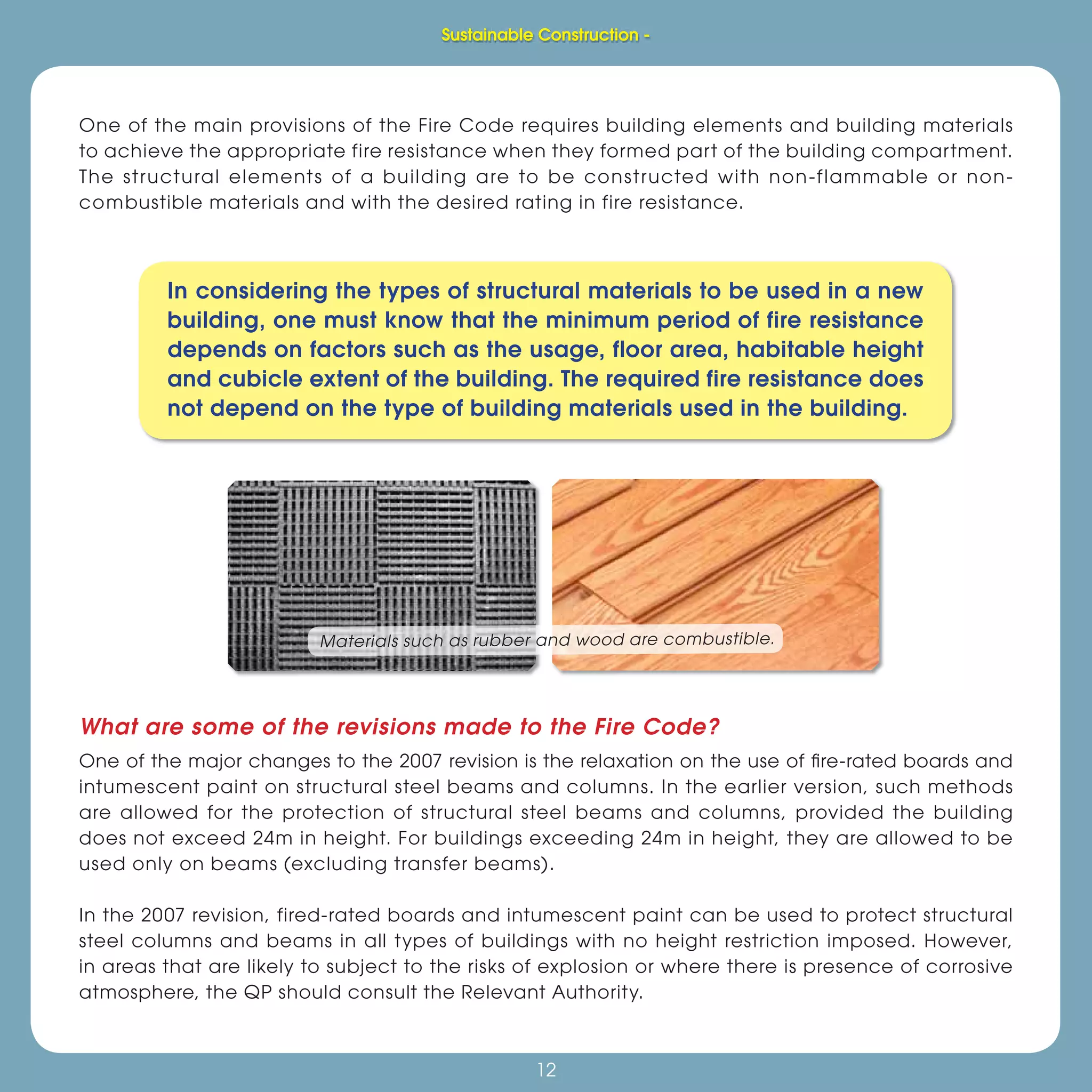
Materials such as rubber and wood are combustible.
What are some of the revisions made to the Fire Code?
One of the major changes to the 2007 revision is the relaxation on the use of fire-rated boards and
intumescent paint on structural steel beams and columns. In the earlier version, such methods
are allowed for the protection of structural steel beams and columns, provided the building
does not exceed 24m in height. For buildings exceeding 24m in height, they are allowed to be
used only on beams (excluding transfer beams).
In the 2007 revision, fired-rated boards and intumescent paint can be used to protect structural
steel columns and beams in all types of buildings with no height restriction imposed. However,
in areas that are likely to subject to the risks of explosion or where there is presence of corrosive
atmosphere, the QP should consult the Relevant Authority.
Sustainable Construction -
Fire Protection and Performance-based Fire Engineering
13
Are fire-safety requirements more stringent for steel buildings than concrete
buildings?
The fire-safety requirements are similar for both types of buildings. The only difference is the method
of protection which depends on whether the building is constructed using steel or concrete.
Fire resistance is a property of a particular building element which measures its ability to resist the
spread of fire through the material characteristics of
• stability (resistance to collapse or excessive deflection);
• integrity (resistance to passage of flames and hot gases); and
• insulation (resistance to excessive temperature rise on exposed face).
Usually, fire resistance of a building element is expressed in terms of the minimum period of time
during which the building element would function satisfactorily while subject to a standard fire test,
measured in BS 476: part 20 to 23.
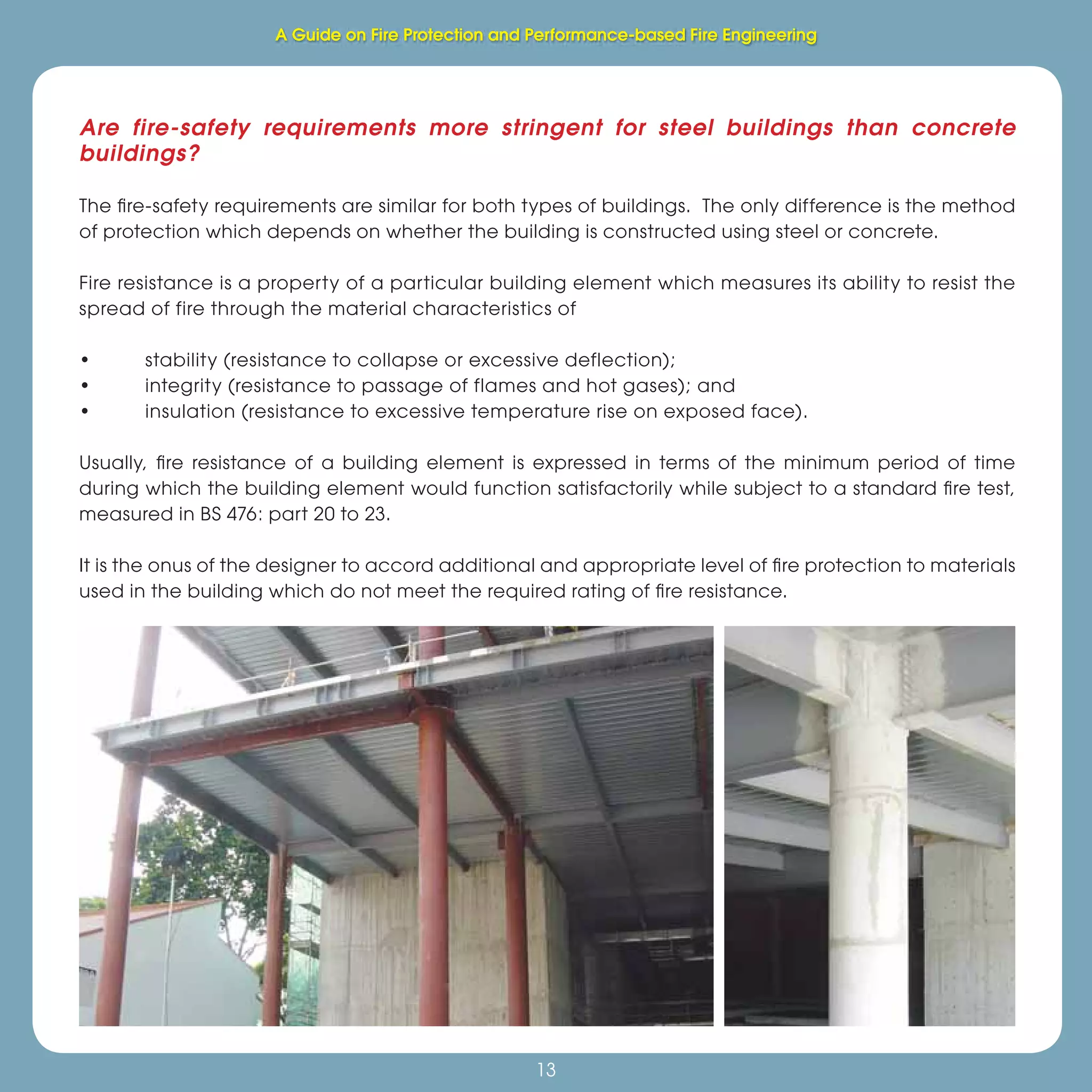
It is the onus of the designer to accord additional and appropriate level of fire protection to materials
used in the building which do not meet the required rating of fire resistance.
A Guide on Fire Protection and Performance-based Fire Engineering
Sustainable Construction -
14
How to verify that a fire protection system or material has passed the fire
resistance test?
All testing of non-combustible materials and fire-rated construction have to be certified under
the Product Listing Scheme (PLS) managed by an Accreditation Body. Currently in Singapore, the
PLS is managed by Tüv Süd PSB Pte Ltd (formerly known as PSB Corporation).
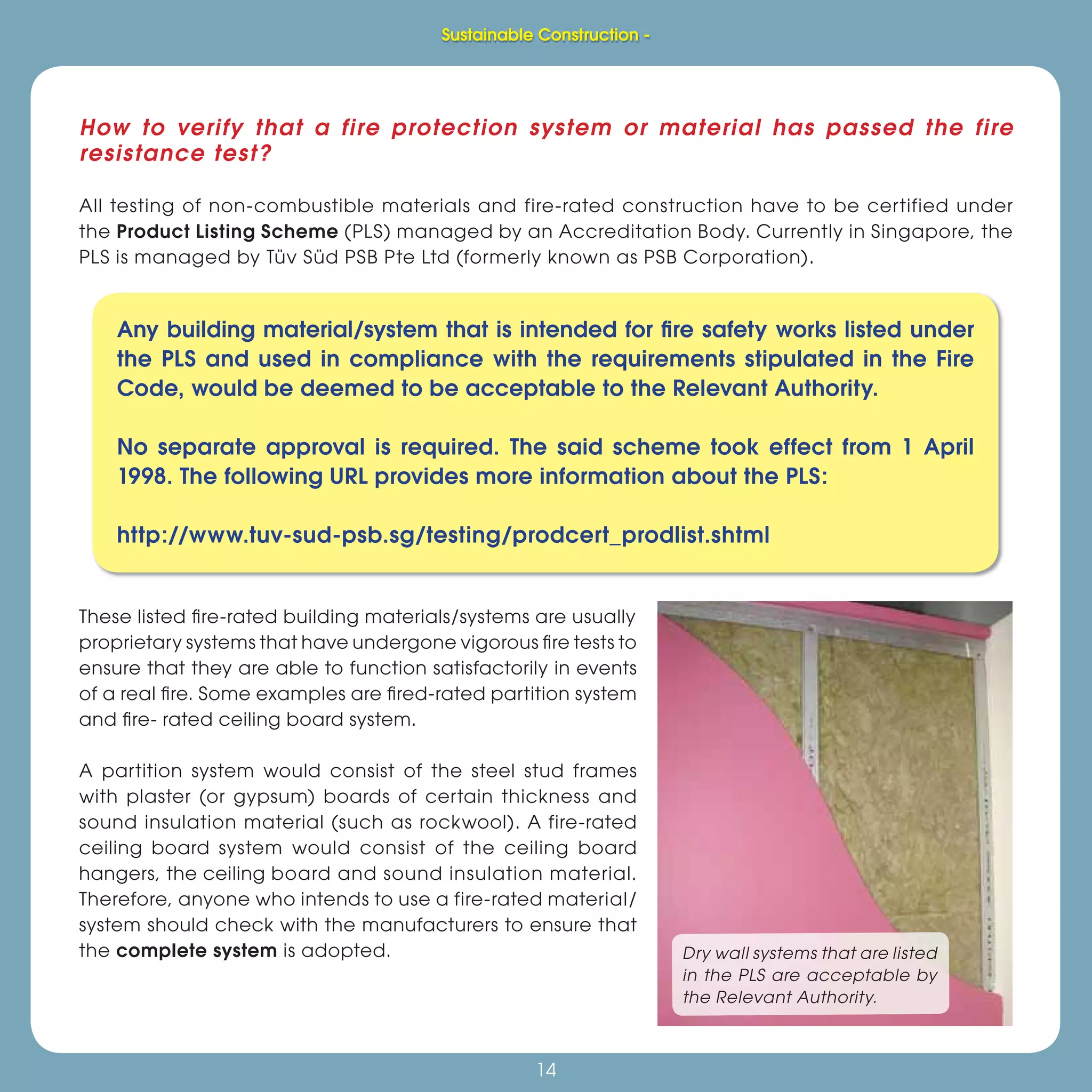
These listed fire-rated building materials/systems are usually
proprietary systems that have undergone vigorous fire tests to
ensure that they are able to function satisfactorily in events
of a real fire. Some examples are fired-rated partition system
and fire- rated ceiling board system.
A partition system would consist of the steel stud frames
with plaster (or gypsum) boards of certain thickness and
sound insulation material (such as rockwool). A fire-rated
ceiling board system would consist of the ceiling board
hangers, the ceiling board and sound insulation material.
Therefore, anyone who intends to use a fire-rated material/
system should check with the manufacturers to ensure that
the complete system is adopted.
Any building material/system that is intended for fire safety works listed under
the PLS and used in compliance with the requirements stipulated in the Fire
Code, would be deemed to be acceptable to the Relevant Authority.
No separate approval is required. The said scheme took effect from 1 April
1998. The following URL provides more information about the PLS:
http://www.tuv-sud-psb.sg/testing/prodcert_prodlist.shtml
Sustainable Construction -
Fire Protection and Performance-based Fire Engineering
15
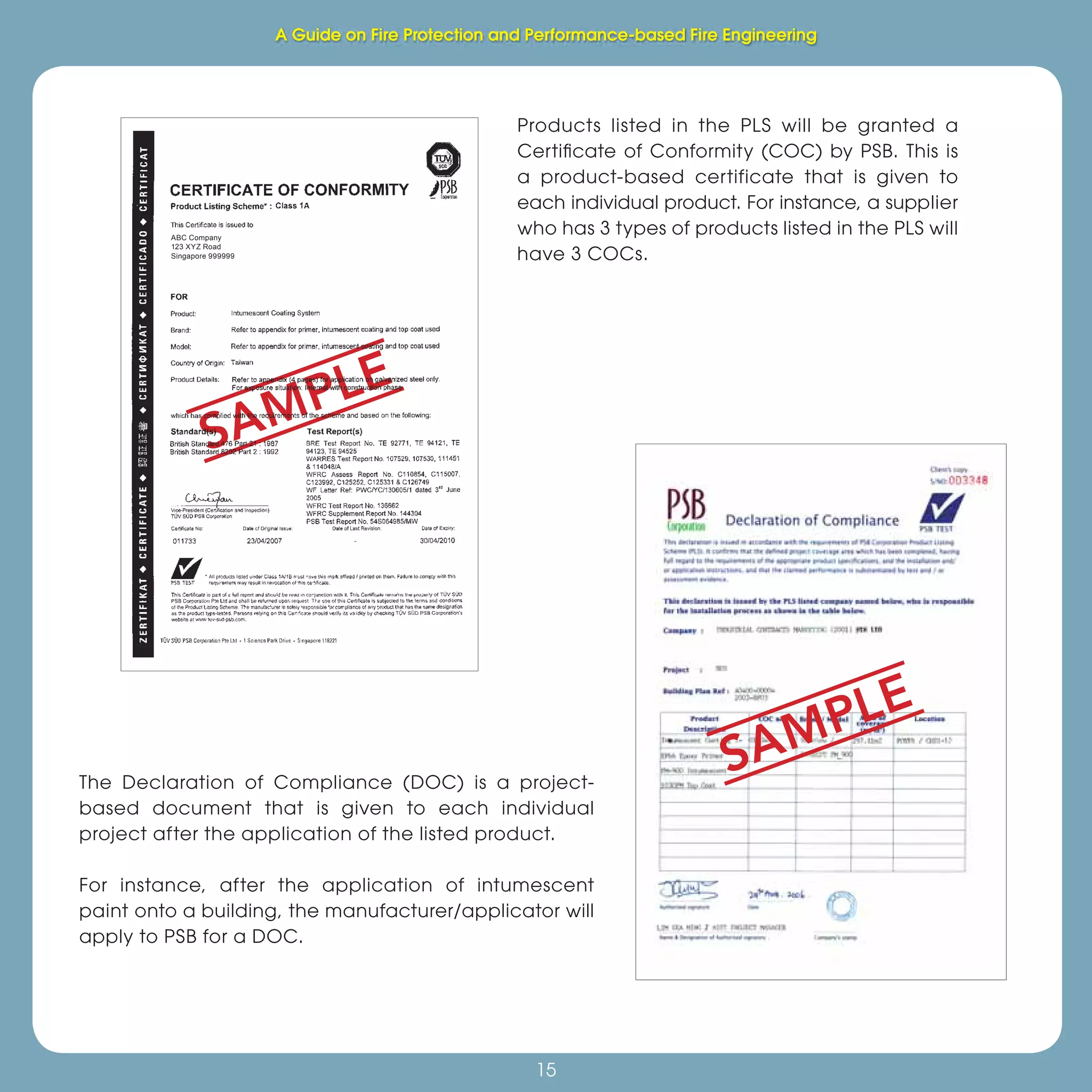
Products listed in the PLS will be granted a
Certificate of Conformity (COC) by PSB. This is
a product-based certificate that is given to
each individual product. For instance, a supplier
who has 3 types of products listed in the PLS will
have 3 COCs.
The Declaration of Compliance (DOC) is a project-
based document that is given to each individual
project after the application of the listed product.
For instance, after the application of intumescent
paint onto a building, the manufacturer/applicator will
apply to PSB for a DOC.
SAMPLE
SAMPLE
ABC Company
123 XYZ Road
Singapore 999999
A Guide on Fire Protection and Performance-based Fire Engineering
16
Sustainable Construction -
16
Compartment walls and floors
The same compartment rules apply to both concrete and steel-framed buildings.
It is not necessary for compartment walls to be in concrete or masonry construction.
Drywalls that comply with the performance criteria stipulated in the Fire Code can
also be used as compartment walls.
Sustainable Construction -
Must compartment walls be constructed using concrete or masonry?
A compartment is a part of a building separated from other parts of the same building by
compartment walls, floors and other relevant separating structures.
The purpose of dividing a building into compartments is to prevent the spread of fire between
specified parts of a building. This is the most basic passive protection device to limit the fire
size, contain the fire and prevent the spread of
fire and smoke from one part of the building
to another. Therefore compartment walls and
floors have to be in non-combustible materials
to achieve the desired fire resistance rating.
Compartment walls and floors form part of
elements of structure which include beams,
columns, loadbearing walls and external walls.
The desired fire resistance of compartment wall,
floor and other relevant separating structures is
the minimum period of time during which a
particular building element may be expected to
function satisfactorily while subject to a standard
fire test, currently measured in BS 476: Part 20
to 23.
17
Fire Protection and Performance-based Fire Engineering
17
Compartmentation requirements for different types of buildings
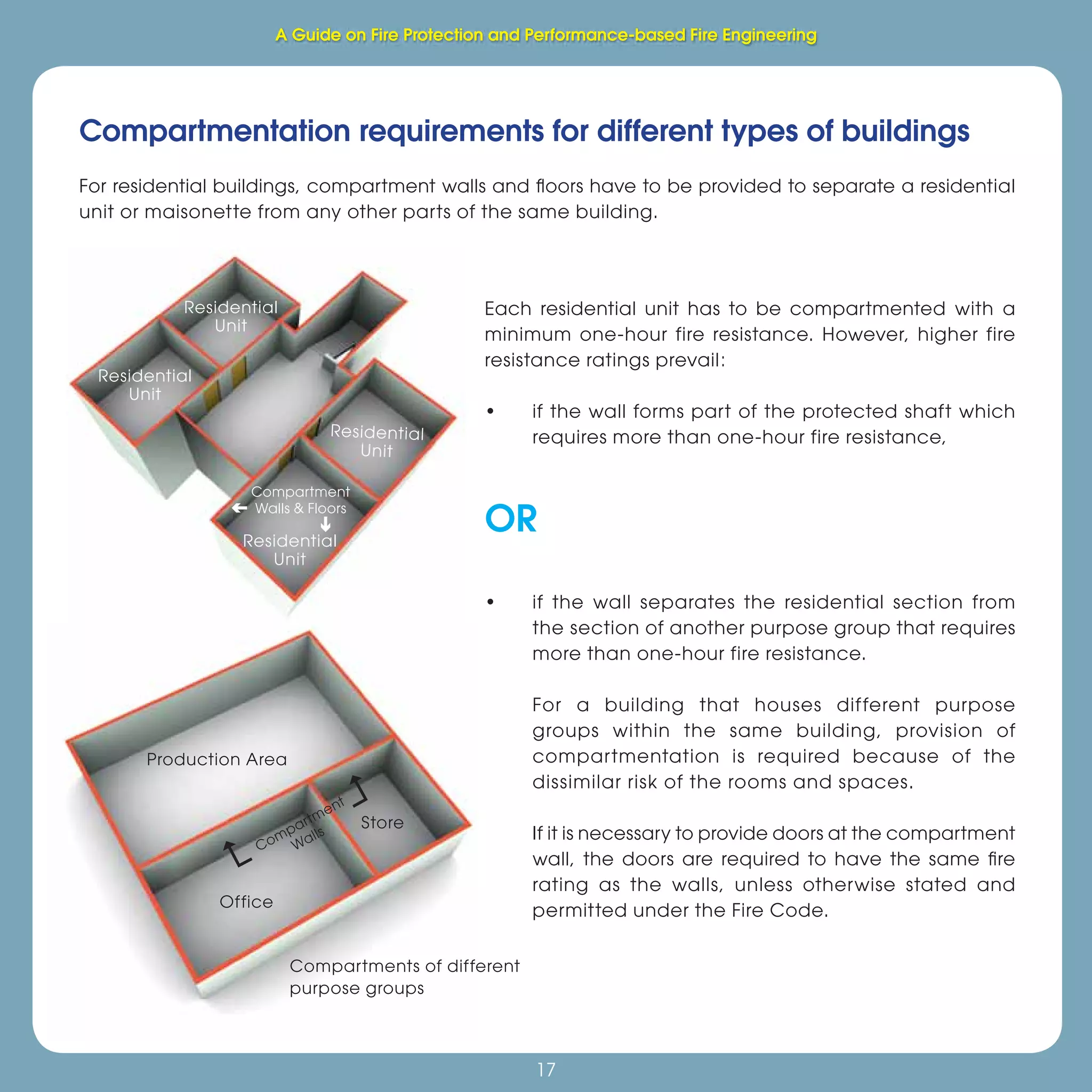
For residential buildings, compartment walls and floors have to be provided to separate a residential
unit or maisonette from any other parts of the same building.
Each residential unit has to be compartmented with a
minimum one-hour fire resistance. However, higher fire
resistance ratings prevail:
• if the wall forms part of the protected shaft which
requires more than one-hour fire resistance,
OR
• if the wall separates the residential section from
the section of another purpose group that requires
more than one-hour fire resistance.
For a building that houses different purpose
groups within the same building, provision of
compartmentation is required because of the
dissimilar risk of the rooms and spaces.
If it is necessary to provide doors at the compartment
wall, the doors are required to have the same fire
rating as the walls, unless otherwise stated and
permitted under the Fire Code.
Residential
Unit
Residential
Unit
Residential
Unit
Residential
Unit
Compartment
Walls & Floors
Production Area
Office
Store
Compartment
Walls
Compartments of different
purpose groups
f
g
A Guide on Fire Protection and Performance-based Fire Engineering
18
Sustainable Construction -
18
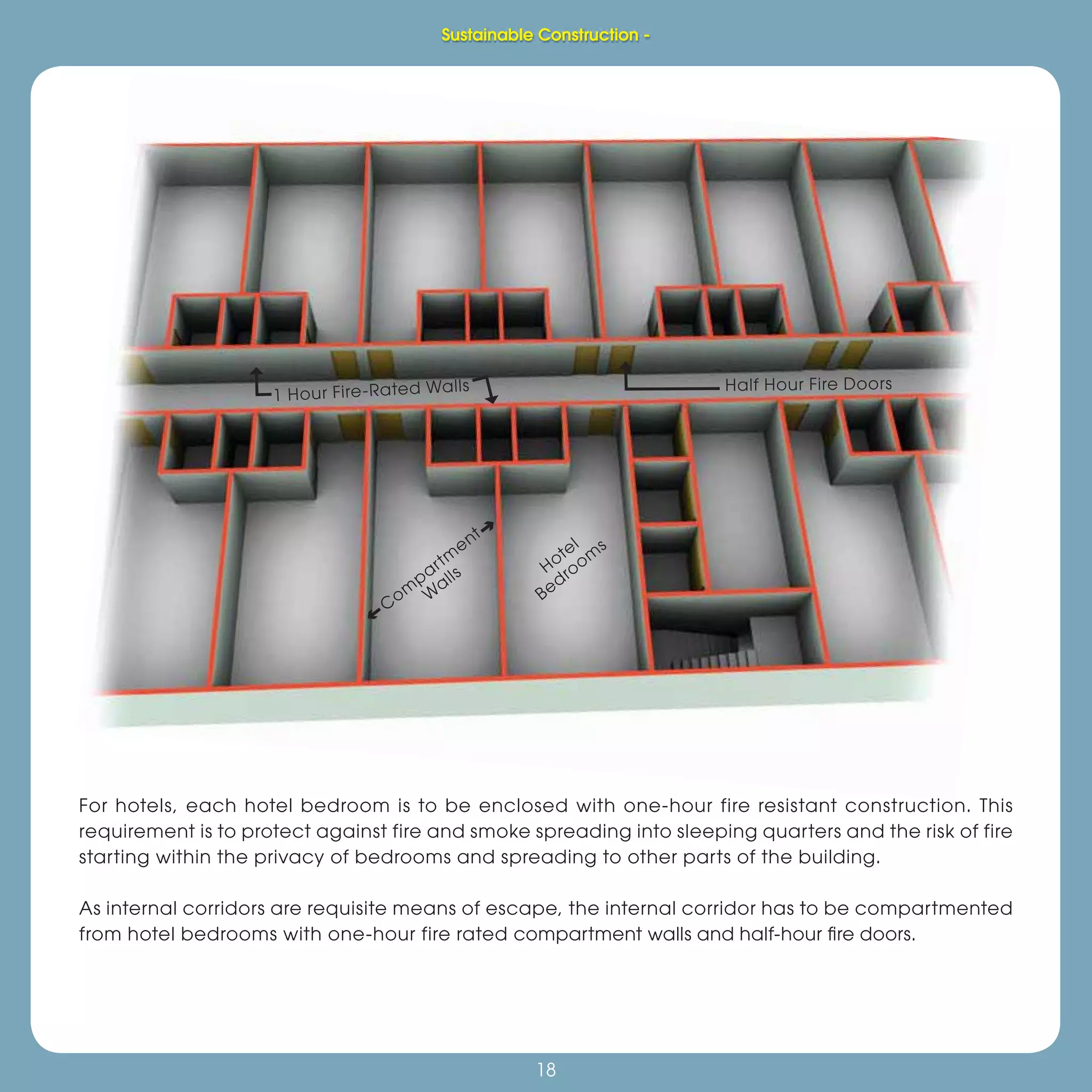
For hotels, each hotel bedroom is to be enclosed with one-hour fire resistant construction. This
requirement is to protect against fire and smoke spreading into sleeping quarters and the risk of fire
starting within the privacy of bedrooms and spreading to other parts of the building.
As internal corridors are requisite means of escape, the internal corridor has to be compartmented
from hotel bedrooms with one-hour fire rated compartment walls and half-hour fire doors.
Hotel
Bedroom
s
1 Hour Fire-Rated Walls Half Hour Fire Doors
C
om
partm
ent
W
alls
f
g
Sustainable Construction -
19
Fire Protection and Performance-based Fire Engineering
19
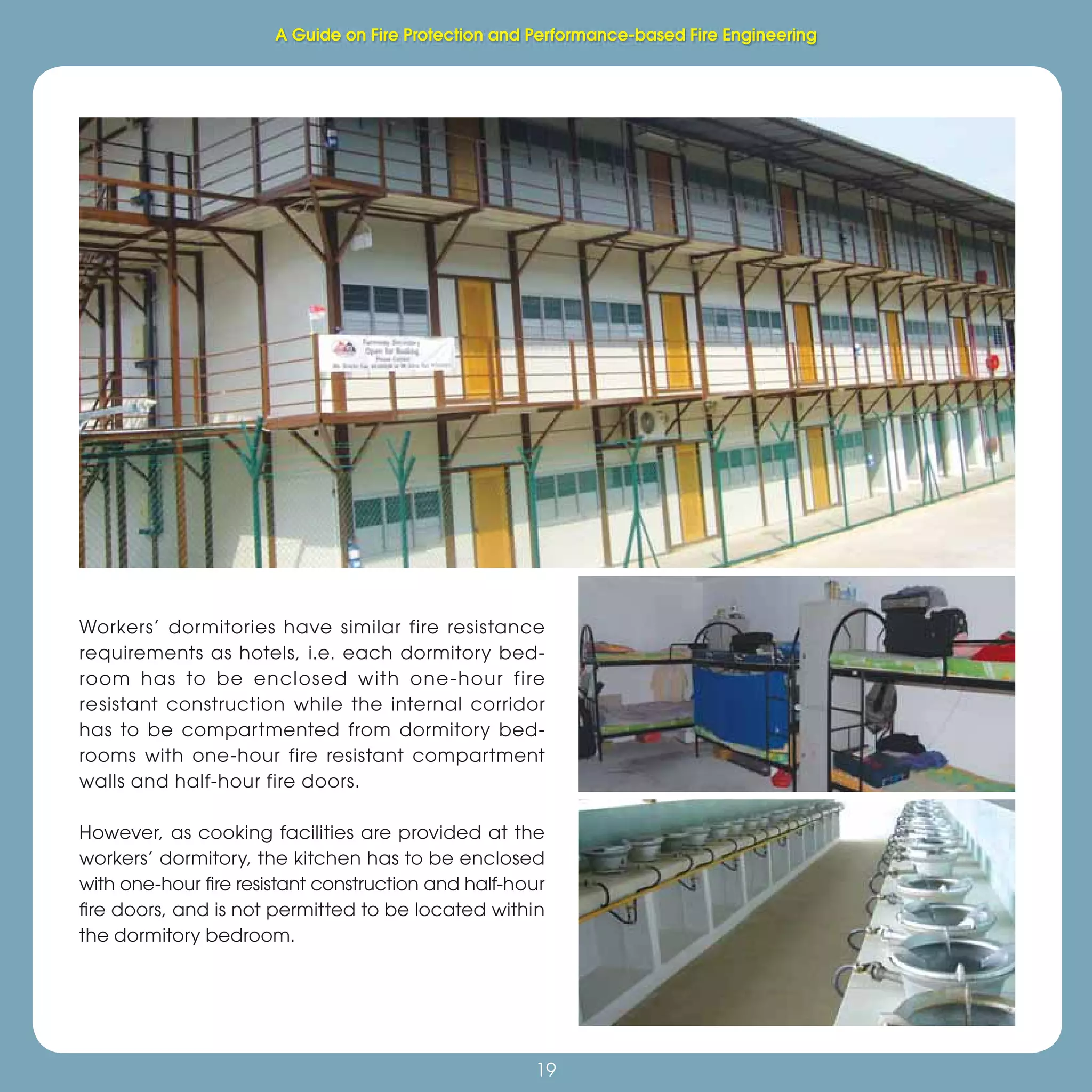
Workers’ dormitories have similar fire resistance
requirements as hotels, i.e. each dormitory bed-
room has to be enclosed with one-hour fire
resistant construction while the internal corridor
has to be compartmented from dormitory bed-
rooms with one-hour fire resistant compartment
walls and half-hour fire doors.
However, as cooking facilities are provided at the
workers’ dormitory, the kitchen has to be enclosed
with one-hour fire resistant construction and half-hour
fire doors, and is not permitted to be located within
the dormitory bedroom.
A Guide on Fire Protection and Performance-based Fire Engineering
20
Sustainable Construction -
20
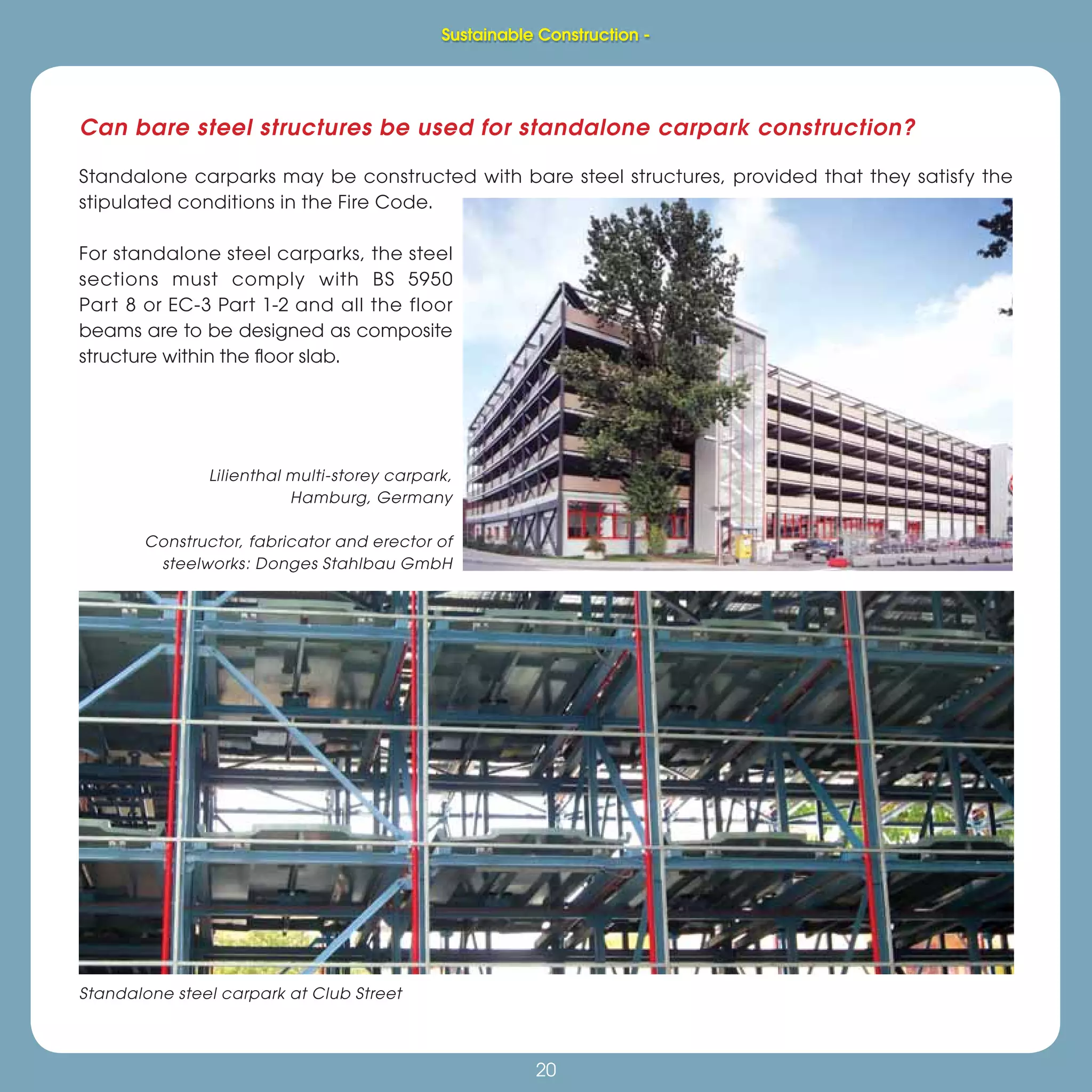
Can bare steel structures be used for standalone carpark construction?
Standalone carparks may be constructed with bare steel structures, provided that they satisfy the
stipulated conditions in the Fire Code.
For standalone steel carparks, the steel
sections must comply with BS 5950
Part 8 or EC-3 Part 1-2 and all the floor
beams are to be designed as composite
structure within the floor slab.
Standalone steel carpark at Club Street
Lilienthal multi-storey carpark,
Hamburg, Germany
Constructor, fabricator and erector of
steelworks: Donges Stahlbau GmbH
Sustainable Construction -
21
Fire Protection and Performance-based Fire Engineering
21
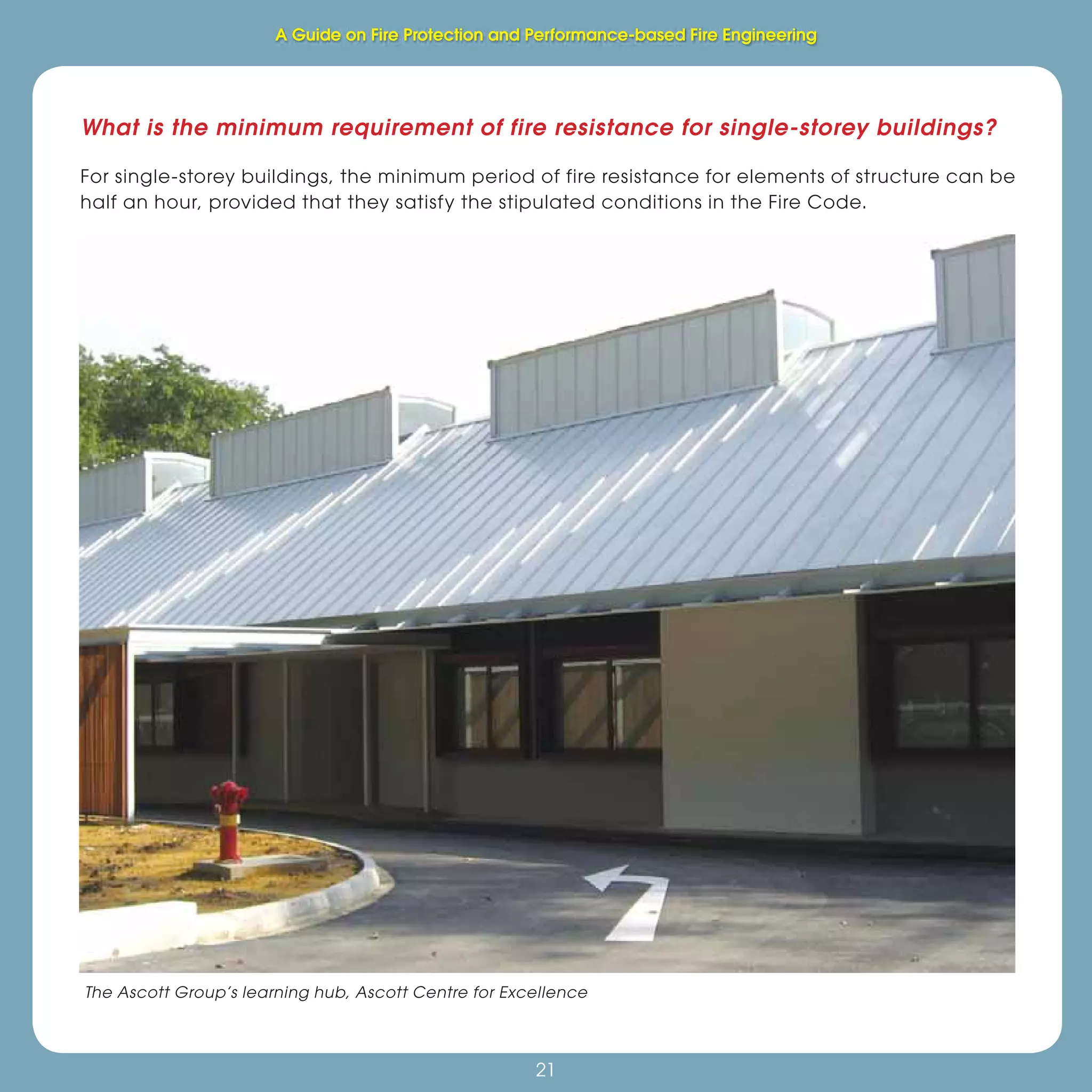
What is the minimum requirement of fire resistance for single-storey buildings?
For single-storey buildings, the minimum period of fire resistance for elements of structure can be
half an hour, provided that they satisfy the stipulated conditions in the Fire Code.
The Ascott Group’s learning hub, Ascott Centre for Excellence
A Guide on Fire Protection and Performance-based Fire Engineering
22
Sustainable Construction -
22
Is submission of fire safety plan to the Relevant Authority required for a landed
house?
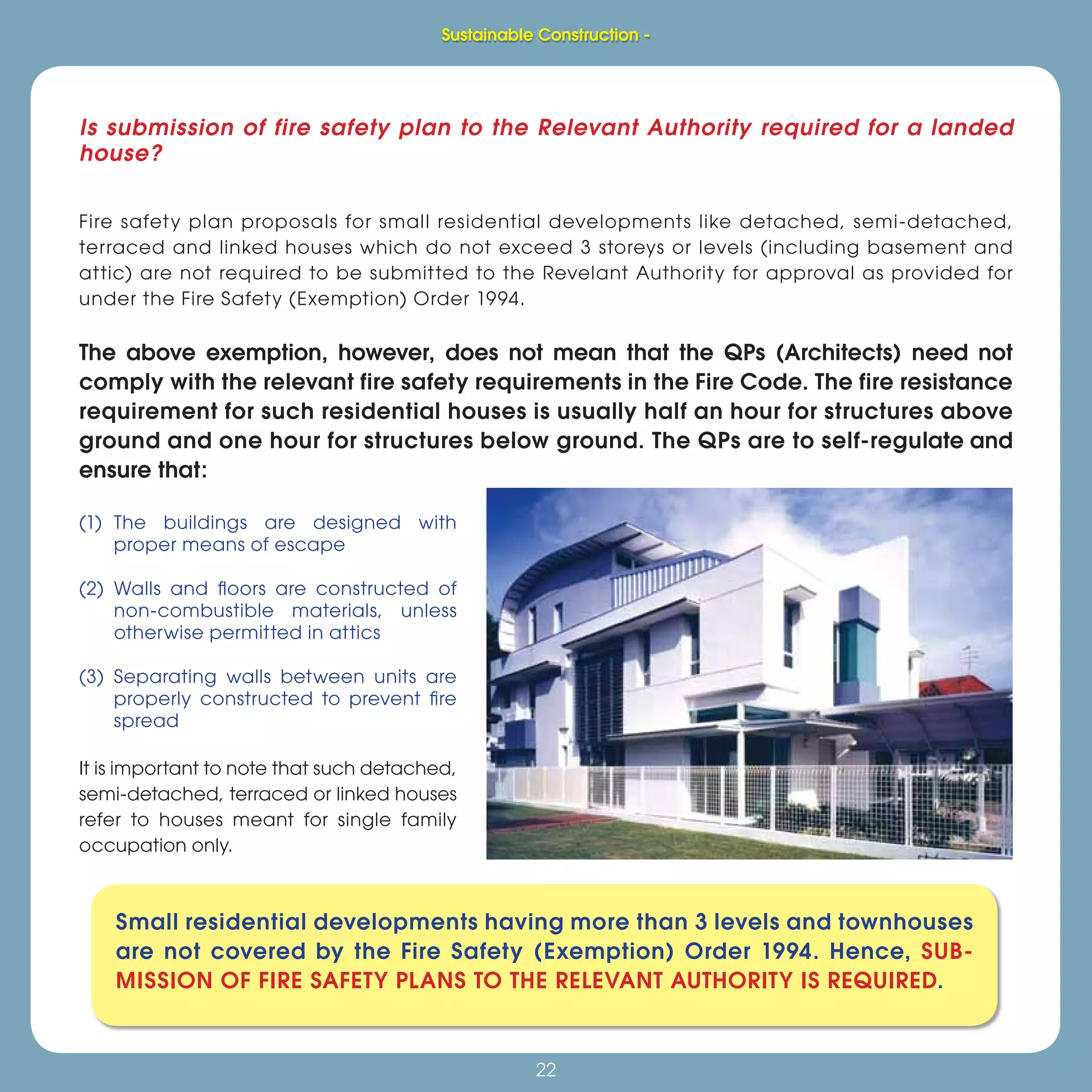
Fire safety plan proposals for small residential developments like detached, semi-detached,
terraced and linked houses which do not exceed 3 storeys or levels (including basement and
attic) are not required to be submitted to the Revelant Authority for approval as provided for
under the Fire Safety (Exemption) Order 1994.
The above exemption, however, does not mean that the QPs (Architects) need not
comply with the relevant fire safety requirements in the Fire Code. The fire resistance
requirement for such residential houses is usually half an hour for structures above
ground and one hour for structures below ground. The QPs are to self-regulate and
ensure that:
(1) The buildings are designed with
proper means of escape
(2) Walls and floors are constructed of
non-combustible materials, unless
otherwise permitted in attics
(3) Separating walls between units are
properly constructed to prevent fire
spread
It is important to note that such detached,
semi-detached, terraced or linked houses
refer to houses meant for single family
occupation only.
Small residential developments having more than 3 levels and townhouses
are not covered by the Fire Safety (Exemption) Order 1994. Hence, SUB-
MISSION OF FIRE SAFETY PLANS TO THE RELEVANT AUTHORITY IS REQUIRED.
Sustainable Construction -
23
Fire Protection and Performance-based Fire Engineering
23
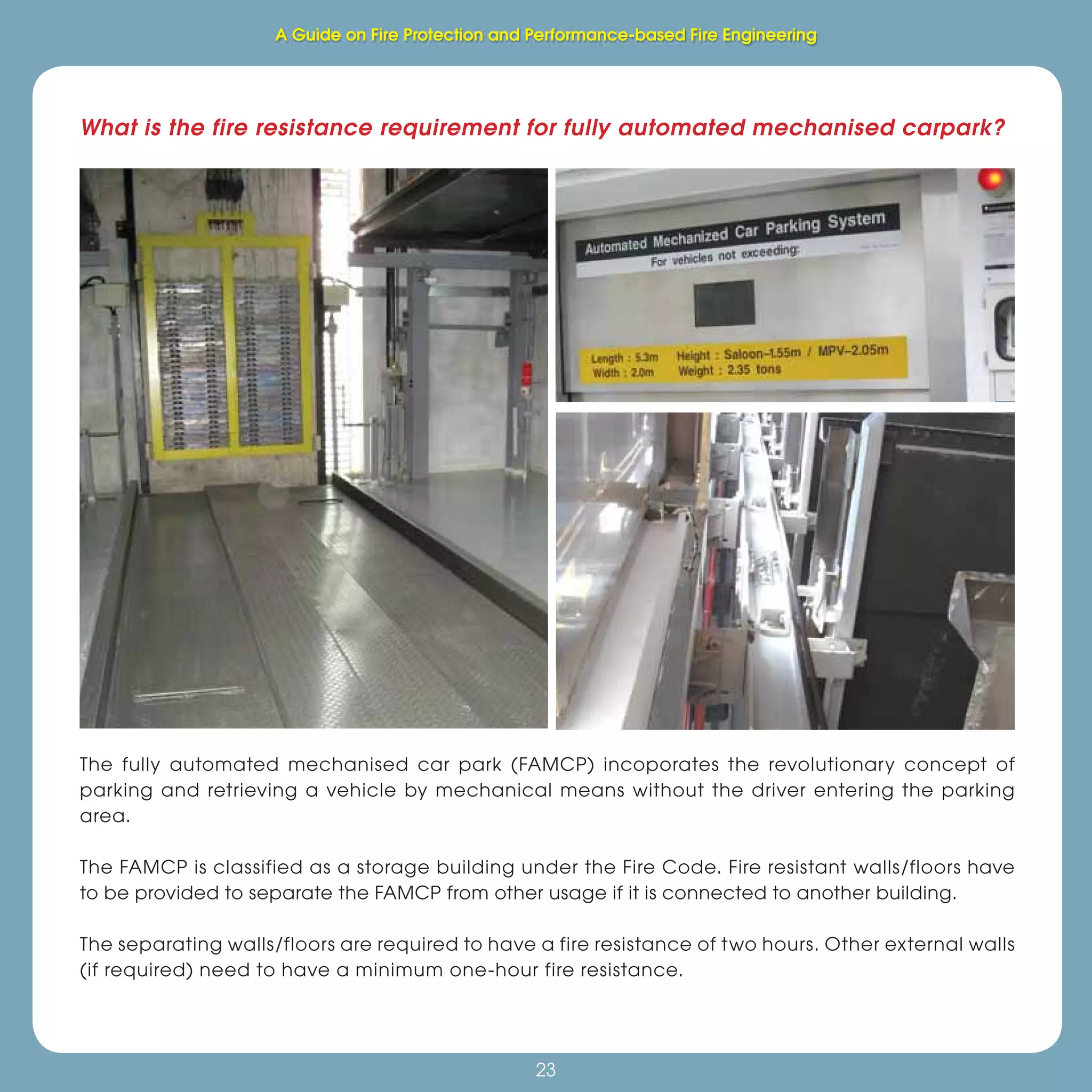
The fully automated mechanised car park (FAMCP) incoporates the revolutionary concept of
parking and retrieving a vehicle by mechanical means without the driver entering the parking
area.
The FAMCP is classified as a storage building under the Fire Code. Fire resistant walls/floors have
to be provided to separate the FAMCP from other usage if it is connected to another building.
The separating walls/floors are required to have a fire resistance of two hours. Other external walls
(if required) need to have a minimum one-hour fire resistance.
What is the fire resistance requirement for fully automated mechanised carpark?
A Guide on Fire Protection and Performance-based Fire Engineering
24
Do steel-framed buildings require
more building inspections for fire
protection systems?
Under the current Fire Safety Act, public
buildings such as offices, hospitals and
shopping complexes with an occupant
load of more than 200 persons, as well
as industrial buildings that fall within the
stipulated criteria, are required to obtain
a Fire Certificate.
This Fire Certificate has to be renewed
yearly. Prior to the application or renewal
of the Fire Certificate, inspection has to
be carried out to ensure that fire safety
systems and measures are properly main-
tained and in good working condition.
This requirement is the same for buildings
constructed using steel or concrete.
Generally the list of items to be inspected
includes active fire protection measures
such as sprinkler system and emergency
power supply. It also includes passive
fire protection systems such as fire-rated
boards, spray-on materials and intumescent
paints.
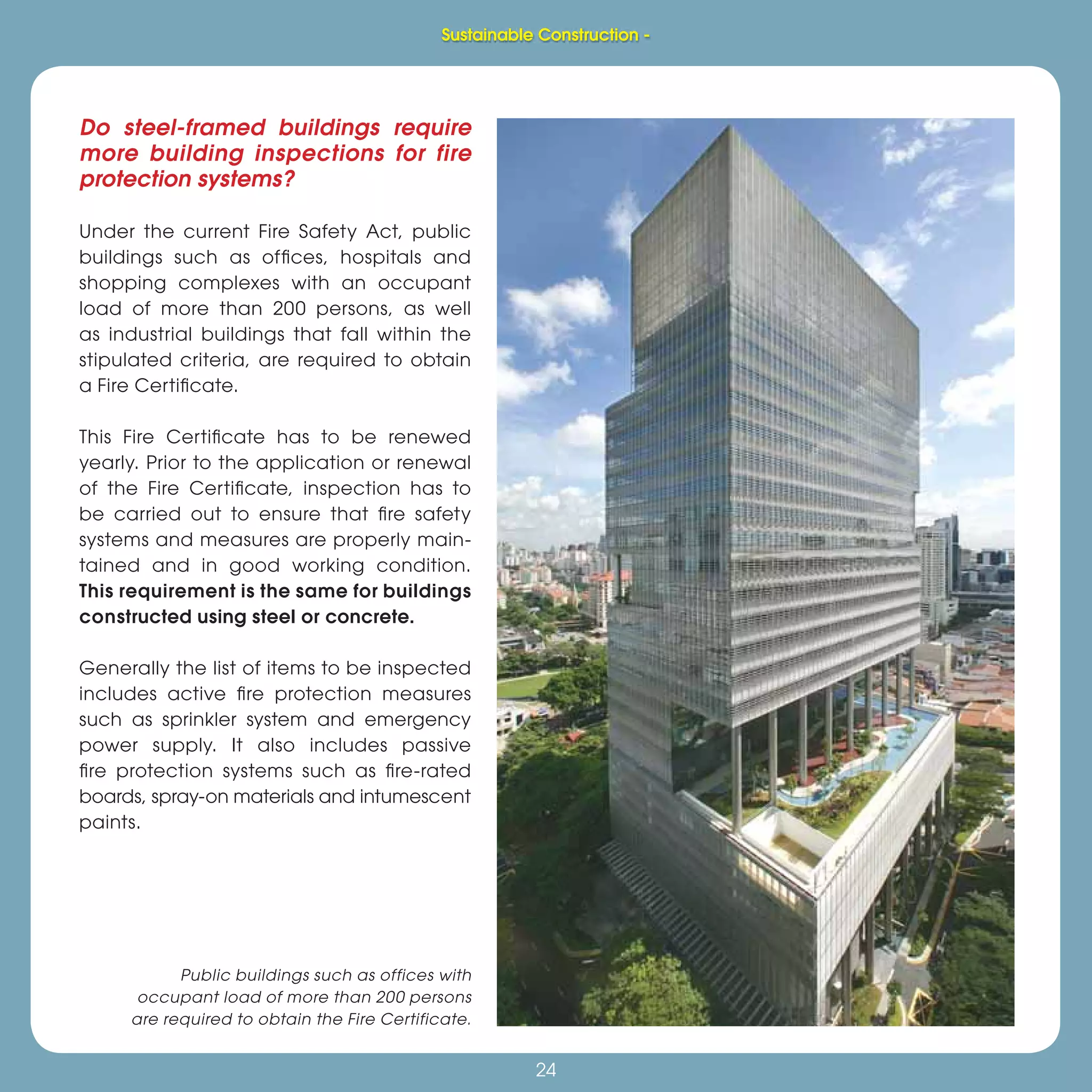
Public buildings such as offices with
occupant load of more than 200 persons
are required to obtain the Fire Certificate.
Sustainable Construction -
25
Fire Protection and Performance-based Fire EngineeringFire Protection and Performance-based Fire Engineering
25
Section 2:
Building Elements
25
A Guide on Fire Protection and Performance-based Fire Engineering
26
Sustainable Construction -
26
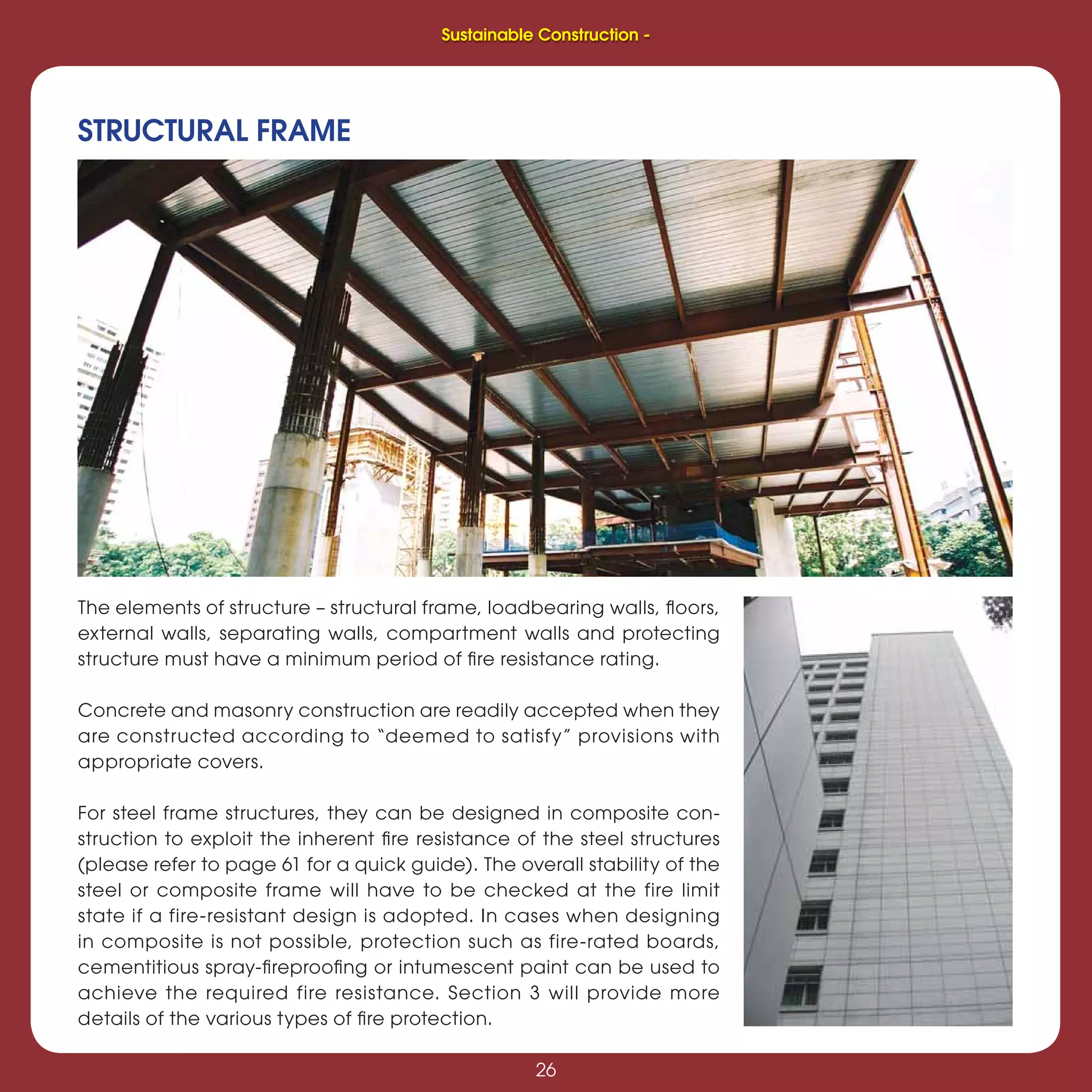
The elements of structure – structural frame, loadbearing walls, floors,
external walls, separating walls, compartment walls and protecting
structure must have a minimum period of fire resistance rating.
Concrete and masonry construction are readily accepted when they
are constructed according to “deemed to satisfy” provisions with
appropriate covers.
For steel frame structures, they can be designed in composite con-
struction to exploit the inherent fire resistance of the steel structures
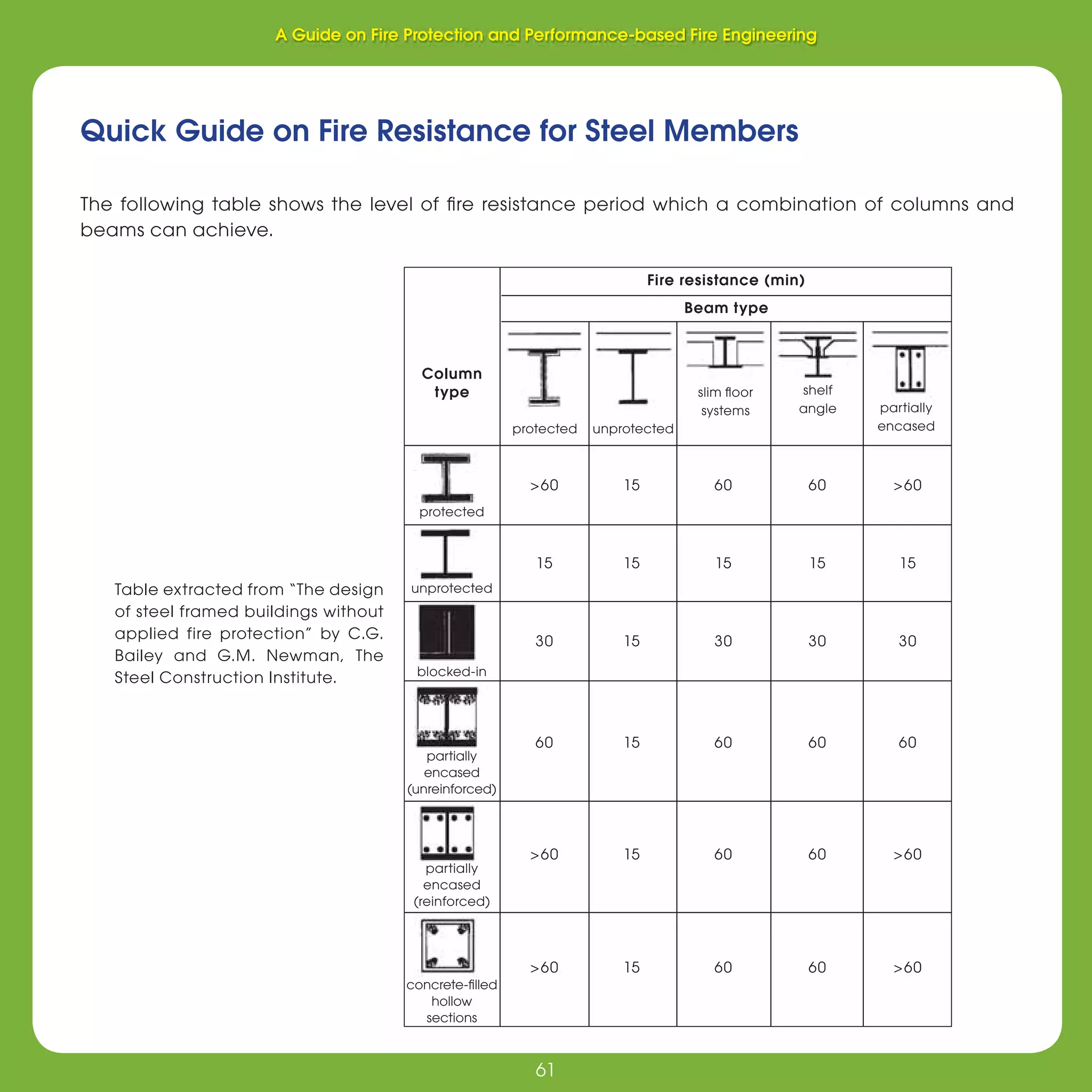
(please refer to page 61 for a quick guide). The overall stability of the
steel or composite frame will have to be checked at the fire limit
state if a fire-resistant design is adopted. In cases when designing
in composite is not possible, protection such as fire-rated boards,
cementitious spray-fireproofing or intumescent paint can be used to
achieve the required fire resistance. Section 3 will provide more
details of the various types of fire protection.
STRUCTURAL FRAME
Sustainable Construction -
27
Fire Protection and Performance-based Fire Engineering
27
FLOORS
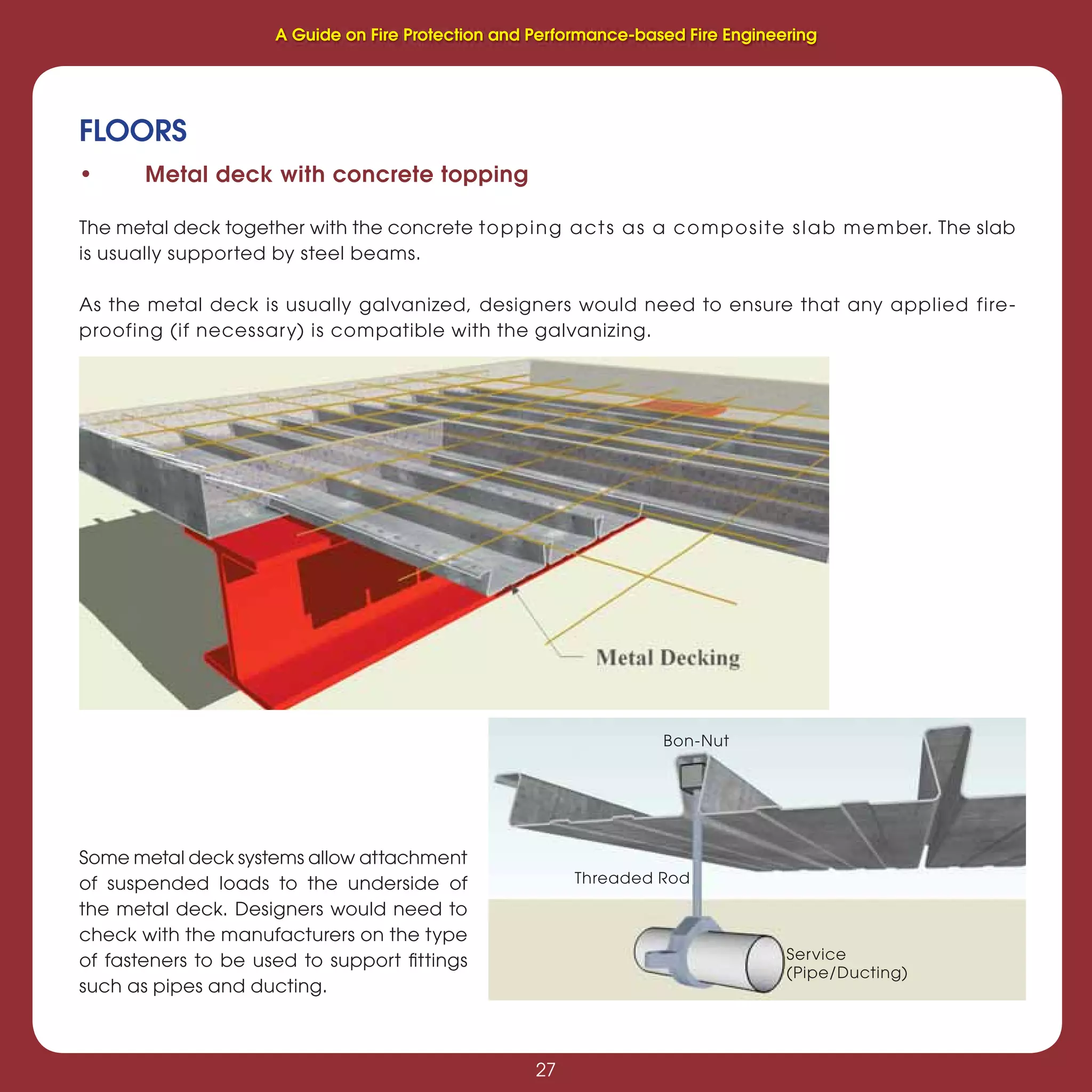
• Metal deck with concrete topping
The metal deck together with the concrete topping acts as a composite slab member. The slab
is usually supported by steel beams.
As the metal deck is usually galvanized, designers would need to ensure that any applied fire-
proofing (if necessary) is compatible with the galvanizing.
Some metal deck systems allow attachment
of suspended loads to the underside of
the metal deck. Designers would need to
check with the manufacturers on the type
of fasteners to be used to support fittings
such as pipes and ducting.
Service
(Pipe/Ducting)
Threaded Rod
Bon-Nut
A Guide on Fire Protection and Performance-based Fire Engineering
28
Sustainable Construction -
28
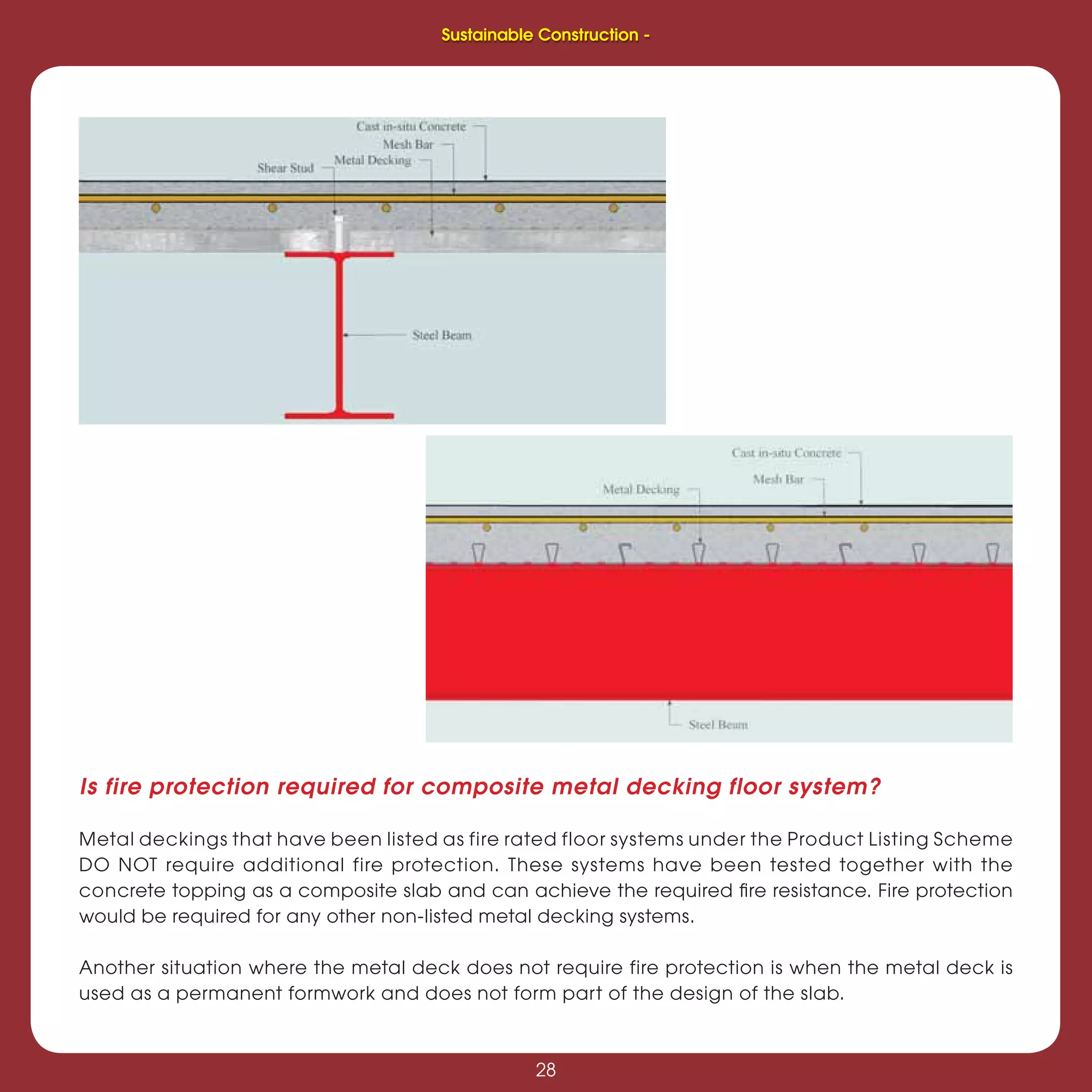
Is fire protection required for composite metal decking floor system?
Metal deckings that have been listed as fire rated floor systems under the Product Listing Scheme
DO NOT require additional fire protection. These systems have been tested together with the
concrete topping as a composite slab and can achieve the required fire resistance. Fire protection
would be required for any other non-listed metal decking systems.
Another situation where the metal deck does not require fire protection is when the metal deck is
used as a permanent formwork and does not form part of the design of the slab.
Sustainable Construction -
29
Fire Protection and Performance-based Fire Engineering
29
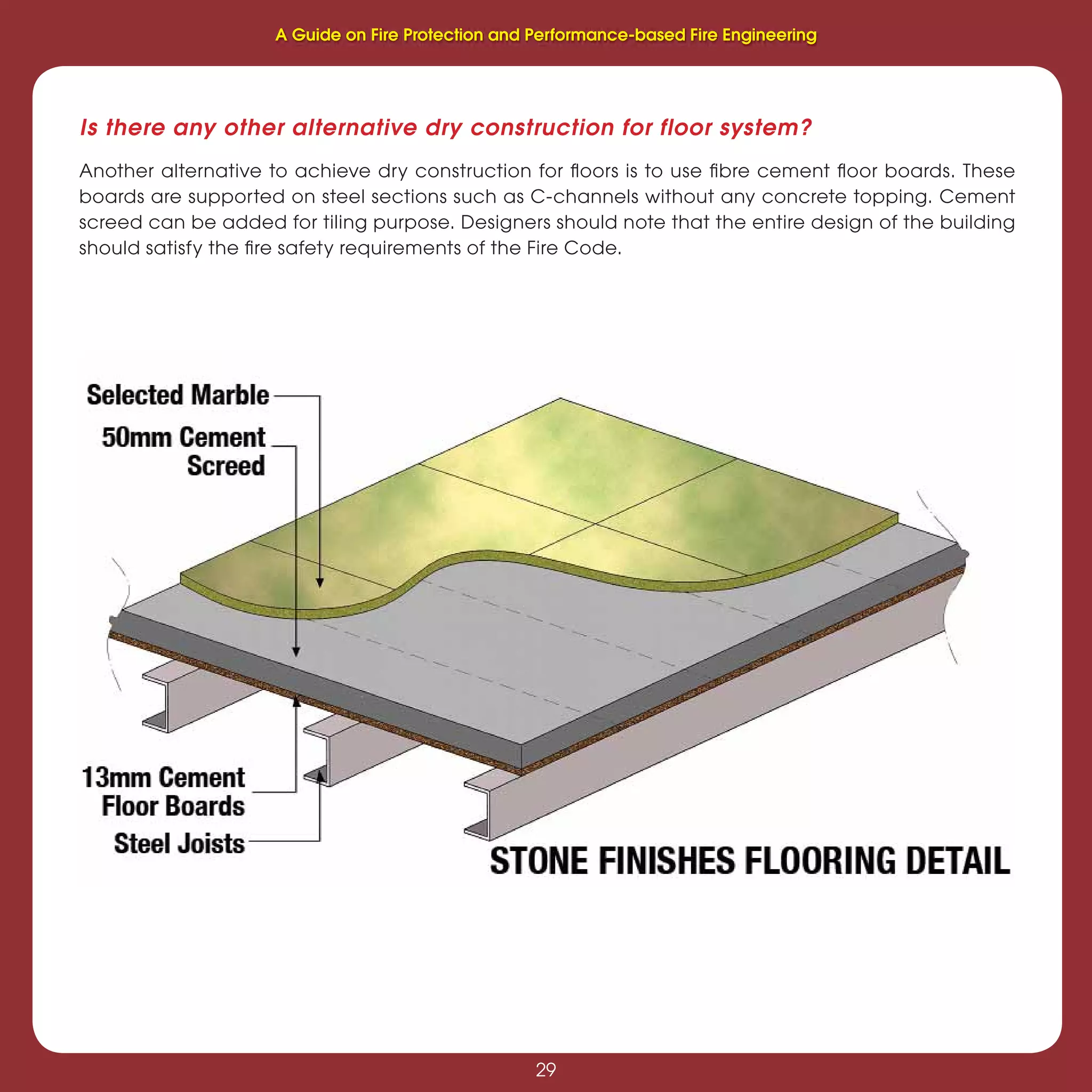
Another alternative to achieve dry construction for floors is to use fibre cement floor boards. These
boards are supported on steel sections such as C-channels without any concrete topping. Cement
screed can be added for tiling purpose. Designers should note that the entire design of the building
should satisfy the fire safety requirements of the Fire Code.
Is there any other alternative dry construction for floor system?
A Guide on Fire Protection and Performance-based Fire Engineering
30
Sustainable Construction -
30
WALLS
• Drywall System
In recent years, many forward-looking developers have used the dry wall system as internal
partition walls for residential projects. The dry wall system consists of dry boards (non-combustible
plaster boards or fibre cement boards) attached to metal studs and sound-insulated by rockwool.
Can drywalls be used as party walls?
Drywall system can also be used as a compartment wall or party wall separating 2 dwelling units,
provided that it meets the fire resistance requirement. Designers should select drywall systems that
are certified under the PLS.
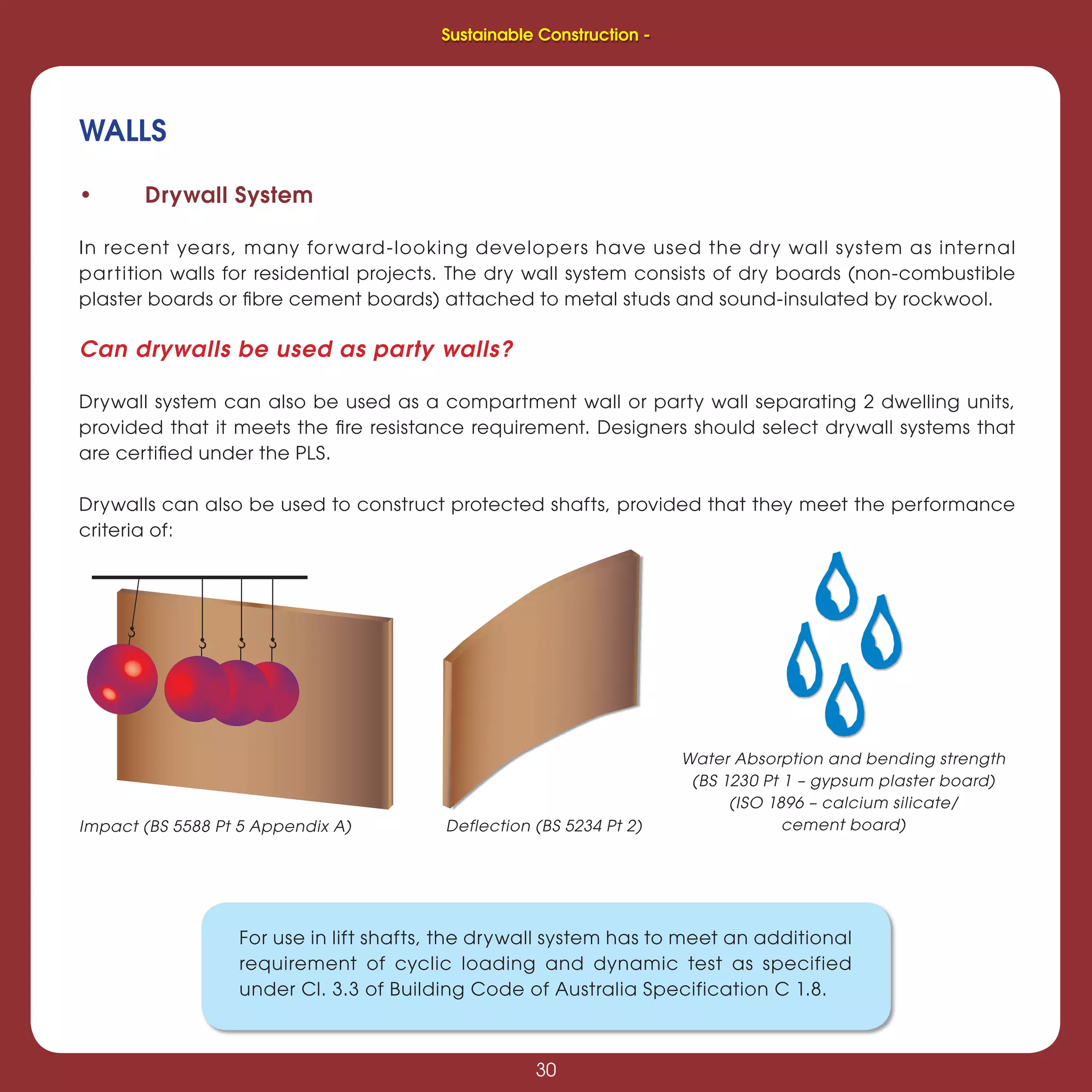
Drywalls can also be used to construct protected shafts, provided that they meet the performance
criteria of:
Water Absorption and bending strength
(BS 1230 Pt 1 – gypsum plaster board)
(ISO 1896 – calcium silicate/
cement board)
For use in lift shafts, the drywall system has to meet an additional
requirement of cyclic loading and dynamic test as specified
under Cl. 3.3 of Building Code of Australia Specification C 1.8.
Impact (BS 5588 Pt 5 Appendix A) Deflection (BS 5234 Pt 2)
Sustainable Construction -
31
Fire Protection and Performance-based Fire Engineering
31
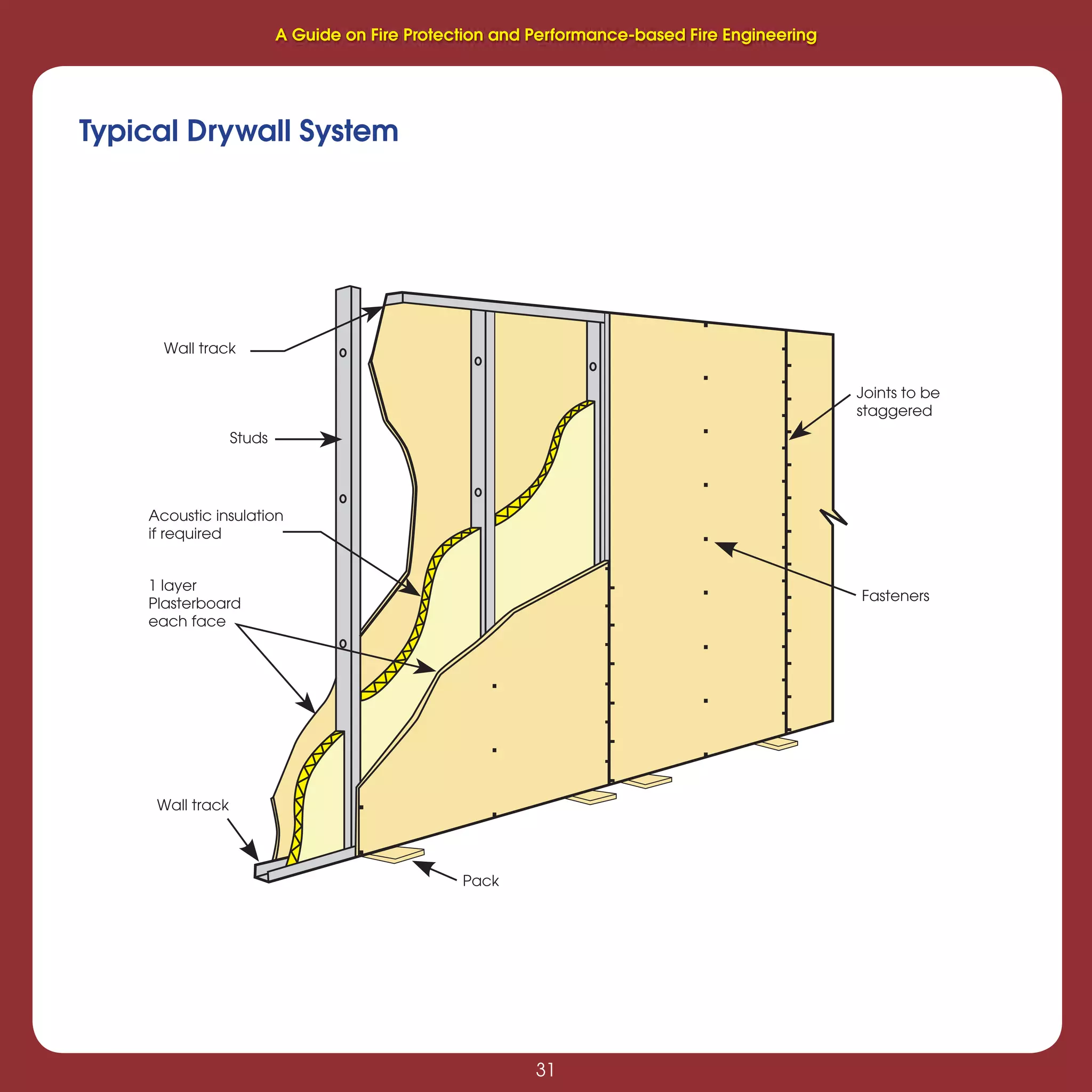
Joints to be
staggered
Fasteners
Pack
Wall track
1 layer
Plasterboard
each face
Acoustic insulation
if required
Studs
Wall track
Typical Drywall System
A Guide on Fire Protection and Performance-based Fire Engineering
32
Sustainable Construction -
32
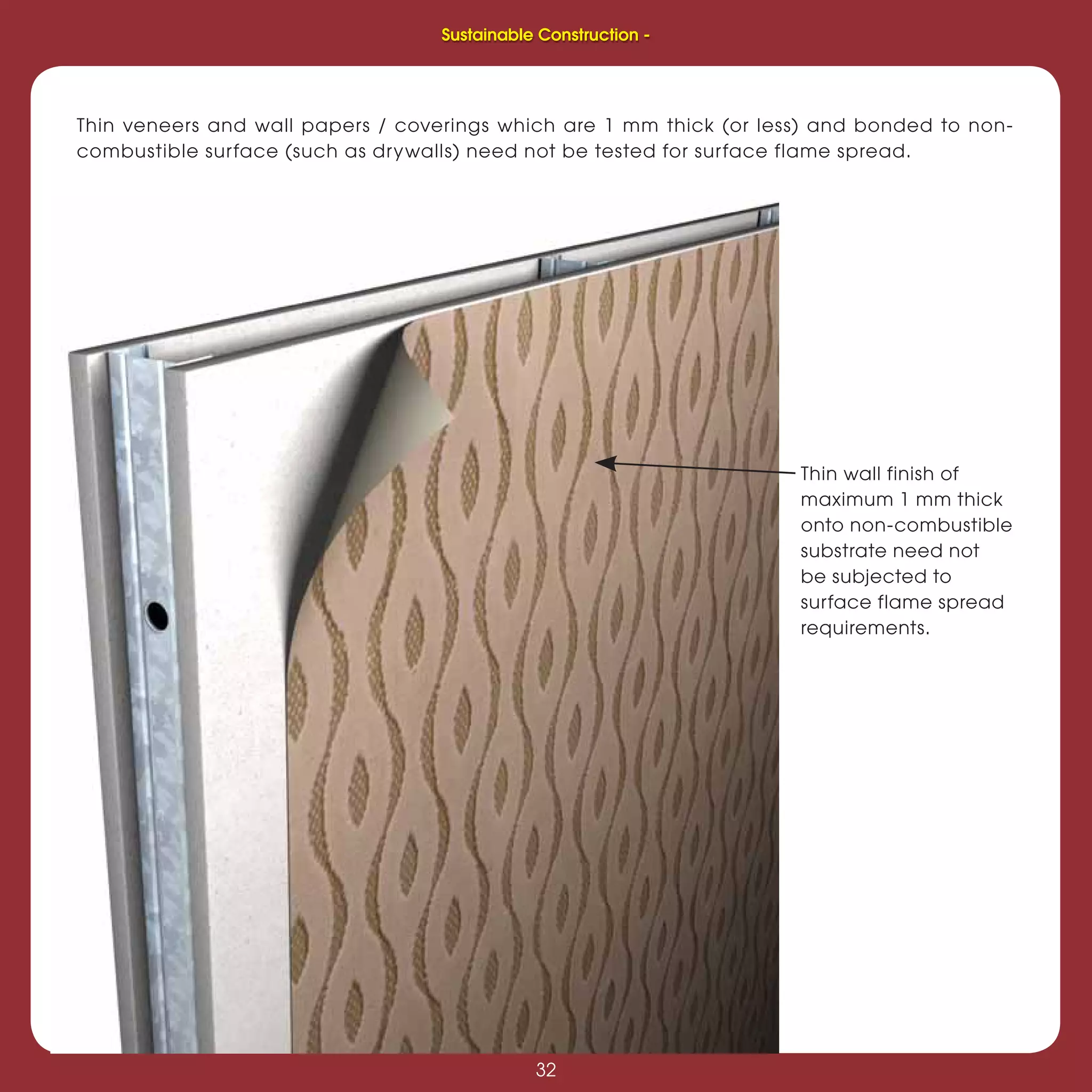
Thin wall finish of
maximum 1 mm thick
onto non-combustible
substrate need not
be subjected to
surface flame spread
requirements.
Thin veneers and wall papers / coverings which are 1 mm thick (or less) and bonded to non-
combustible surface (such as drywalls) need not be tested for surface flame spread.
Sustainable Construction -
33
Fire Protection and Performance-based Fire Engineering
33
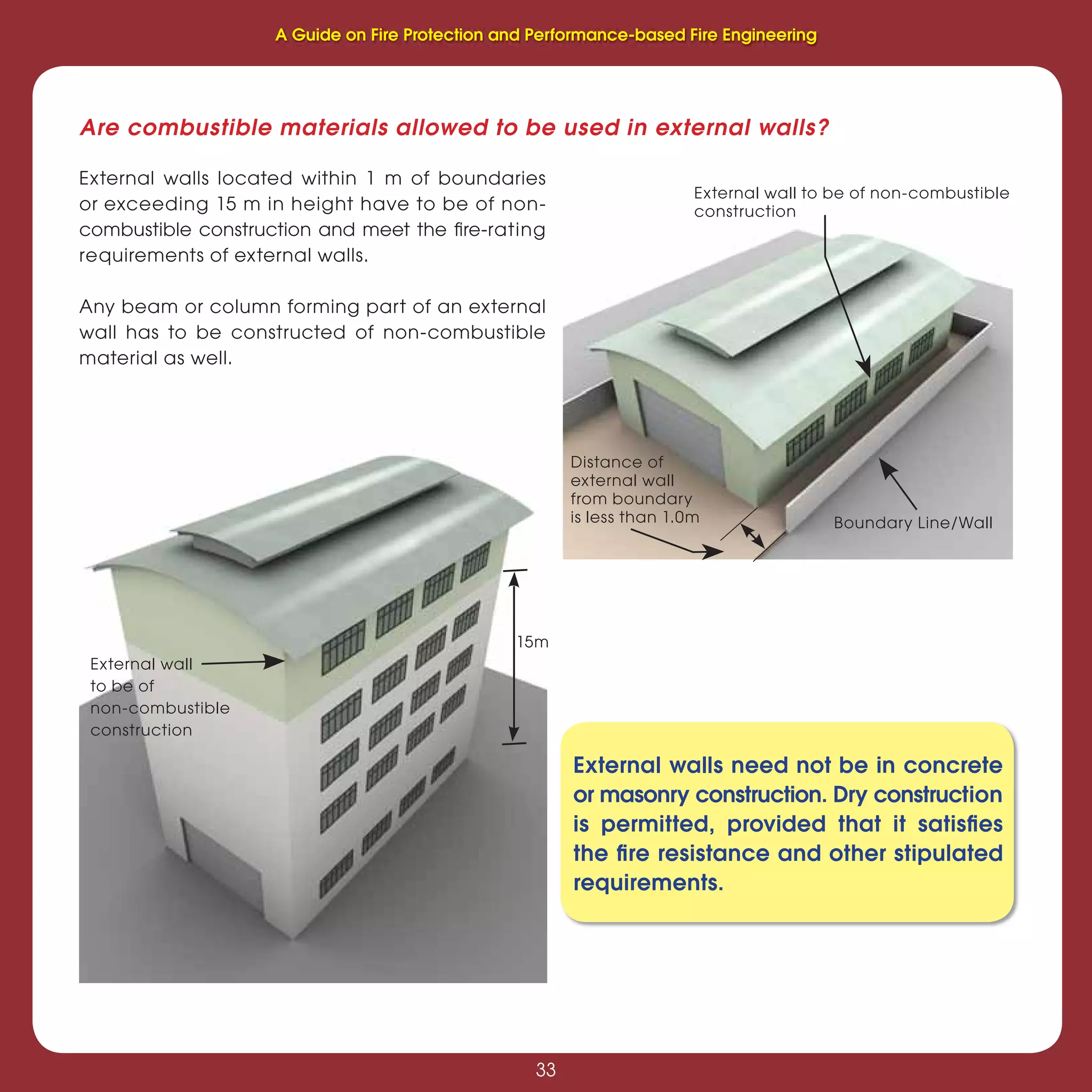
Are combustible materials allowed to be used in external walls?
External walls located within 1 m of boundaries
or exceeding 15 m in height have to be of non-
combustible construction and meet the fire-rating
requirements of external walls.
Any beam or column forming part of an external
wall has to be constructed of non-combustible
material as well.
External wall to be of non-combustible
construction
Boundary Line/Wall
Distance of
external wall
from boundary
is less than 1.0m
External wall
to be of
non-combustible
construction
External walls need not be in concrete
or masonry construction. Dry construction
is permitted, provided that it satisfies
the fire resistance and other stipulated
requirements.
15m
A Guide on Fire Protection and Performance-based Fire Engineering
34
Sustainable Construction -
34
Materials like timber can be used as external wall systems provided that the external wall
is situated 1 m or more from the relevant boundary and the building does not exceed 15 m in
height. The setback of 1 m or more from the boundary is to prevent fire spreading from one building
to another.
Designers who intend to use any form of plastic material as external walls system would need to seek
approval from the Relevant Authority.
Residential building not
exceeding 3 storeys
Boundary Line
Distance of
external wall
from boundary
is more than 1m
This relaxation of rule comes with a condition:
The external walls must be provided with minimum period of 15 minutes
insulation (method of fire exposure - from inside the building) under BS
476: Parts 20 to 23.
Wooden louvres at external wall allowed for buildings
< 15 m in height and the external wall 1 m or more
from boundary
Sustainable Construction -
35
Fire Protection and Performance-based Fire Engineering
35
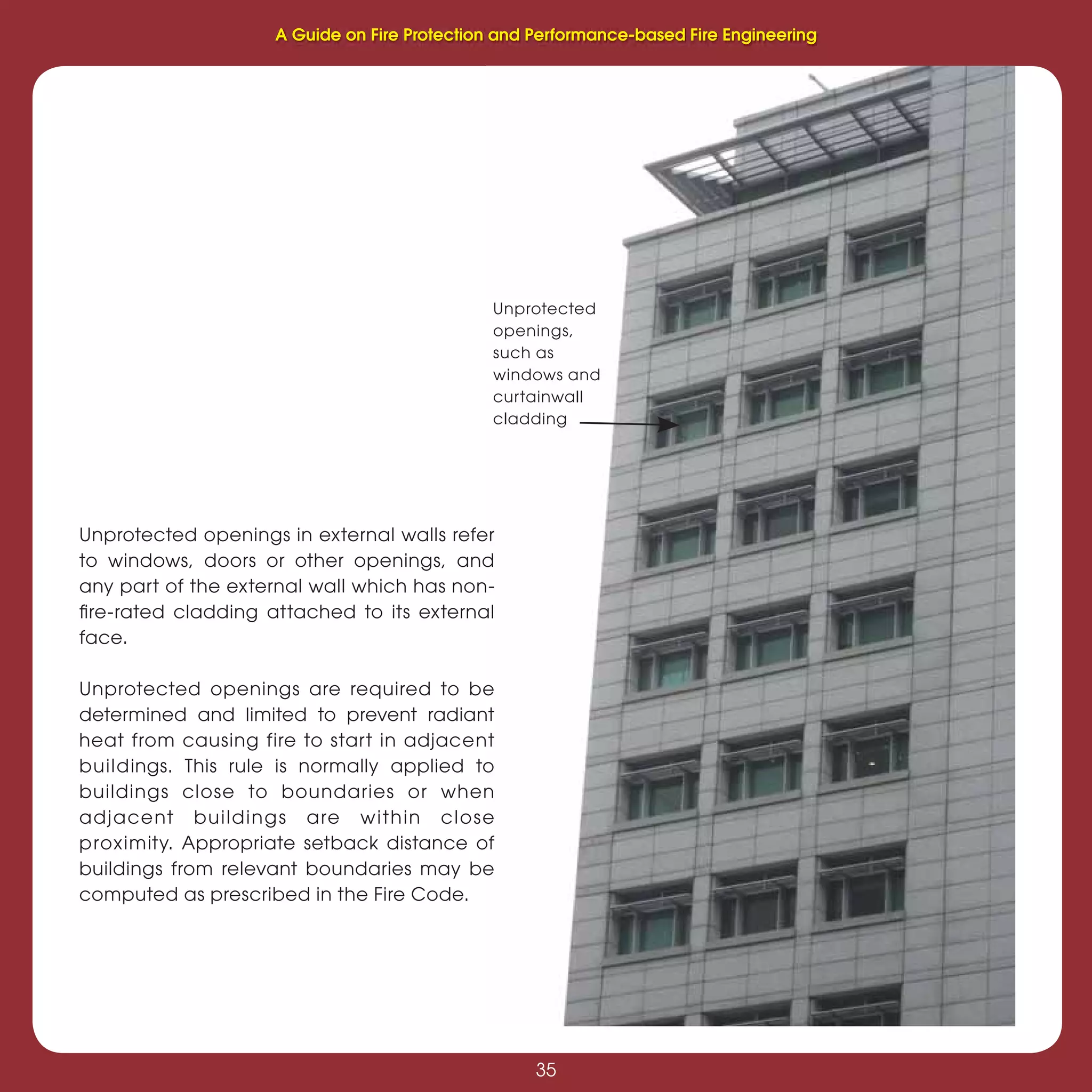
Unprotected openings in external walls refer
to windows, doors or other openings, and
any part of the external wall which has non-
fire-rated cladding attached to its external
face.
Unprotected openings are required to be
determined and limited to prevent radiant
heat from causing fire to start in adjacent
buildings. This rule is normally applied to
buildings close to boundaries or when
adjacent buildings are within close
proximity. Appropriate setback distance of
buildings from relevant boundaries may be
computed as prescribed in the Fire Code.
Unprotected
openings,
such as
windows and
curtainwall
cladding
A Guide on Fire Protection and Performance-based Fire Engineering
36
Sustainable Construction -
36
Can drywalls be used to construct protected shafts?
Protected shafts must be constructed of non-combustible materials.
Traditionally bricks or reinforced concrete walls are used to construct such
shafts. Sustainable materials such as drywalls can also be used to construct
the protected shafts provided they are designed to meet the performance
criteria stipulated in the Fire Code.
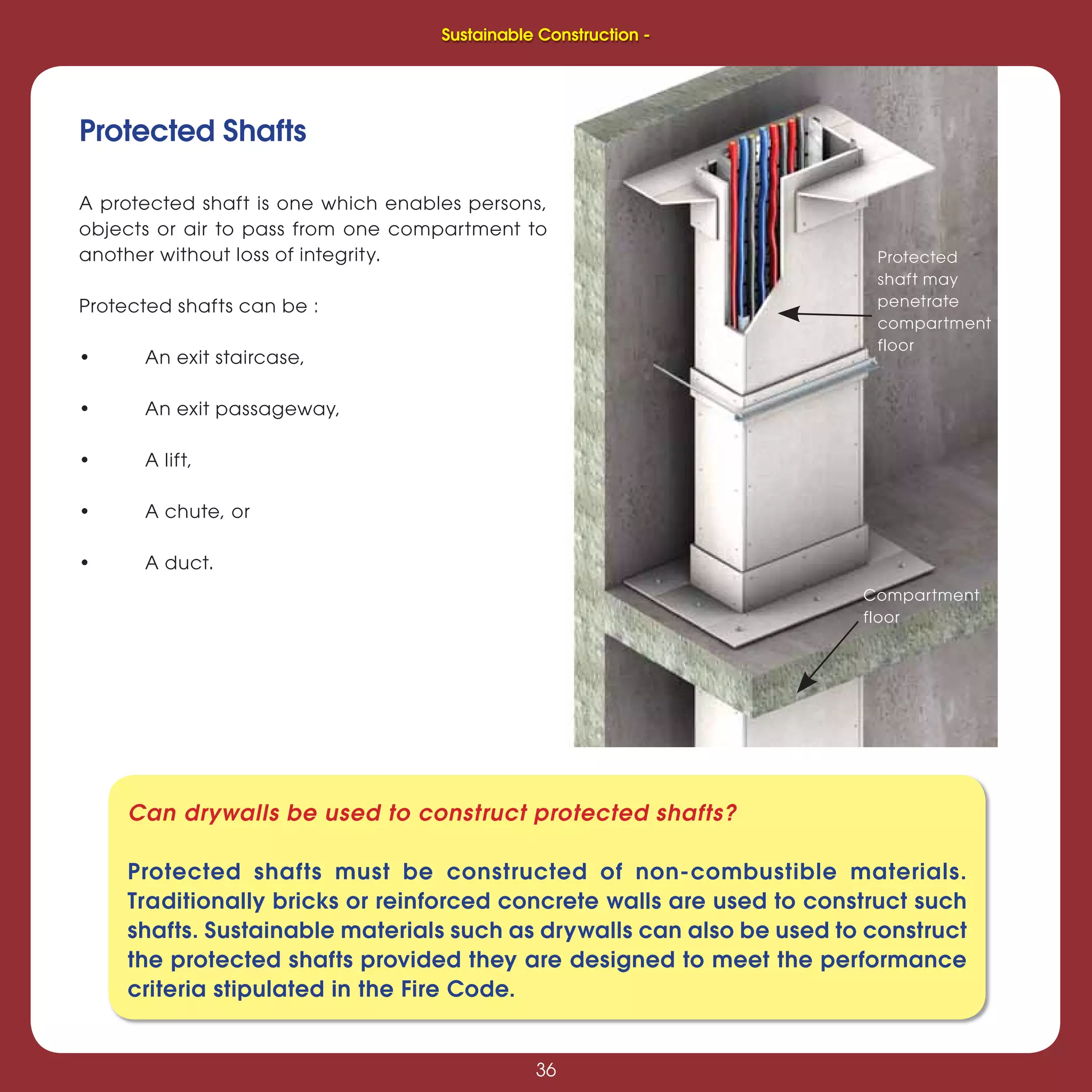
A protected shaft is one which enables persons,
objects or air to pass from one compartment to
another without loss of integrity.
Protected shafts can be :
• An exit staircase,
• An exit passageway,
• A lift,
• A chute, or
• A duct.
Protected Shafts
Protected
shaft may
penetrate
compartment
floor
Compartment
floor
Sustainable Construction -
37
Fire Protection and Performance-based Fire Engineering
37
Ceilings
For a steel-framed building, fire-
rated ceiling board system can
be installed to provide the
required fire resistance for bare
steel structures.
Are services allowed within the
ceiling space if a fire-rated ceiling
board system is used to protect
bare steel structures?
In such cases, no ducting is permitted
within the space above the fire resistant
suspended ceiling (which forms part of
the fire resistant floor ceiling system)
unless the ducting is also fire protected.
Bare Steel Beam
Mineral Wool
Steel Hanger
Fire Rated Ceiling Board
Slab
Services in ceiling space are prohibited
unless fire protected
Fire-rated ceiling
contributes to
fire resistance
of floor
XXXX
A Guide on Fire Protection and Performance-based Fire Engineering
38
Sustainable Construction -
38
However for buildings of different heights that abut each other,
5m width of the roof over the lower part requires 1 hour fire resistance
OR
9m height of the external wall abutting the lower area requires at least 1
hour fire resistance.
This is to prevent vertical spread of fire
through the roof from the lower part of the
building to the higher part.
In such cases, fire-rated ceiling board system
can be used to provide the necessary fire
protection.
Is fire protection required for metal roofs?
For standalone buildings, the metal roof need not be fire protected.
Minimum 9m of
external wall to
be fire-rated
Minimum 5m of
roof to be fired-rated
Sustainable Construction -
39
Fire Protection and Performance-based Fire Engineering
Section 3:
Fire Protection Methods
39
A Guide on Fire Protection and Performance-based Fire Engineering
40
Sustainable Construction -
40
What are the available methods to fire protect Steel-framed buildings?
In buildings, fire protection entails a series of measures that lead to the provision of escapes,
compartments and suppression systems to either prevent or mitigate an outbreak of fire.
A wide range of materials and products are available to protect structural steelwork from fire. An
appropriate type of protection can be selected based on the needs of the development.
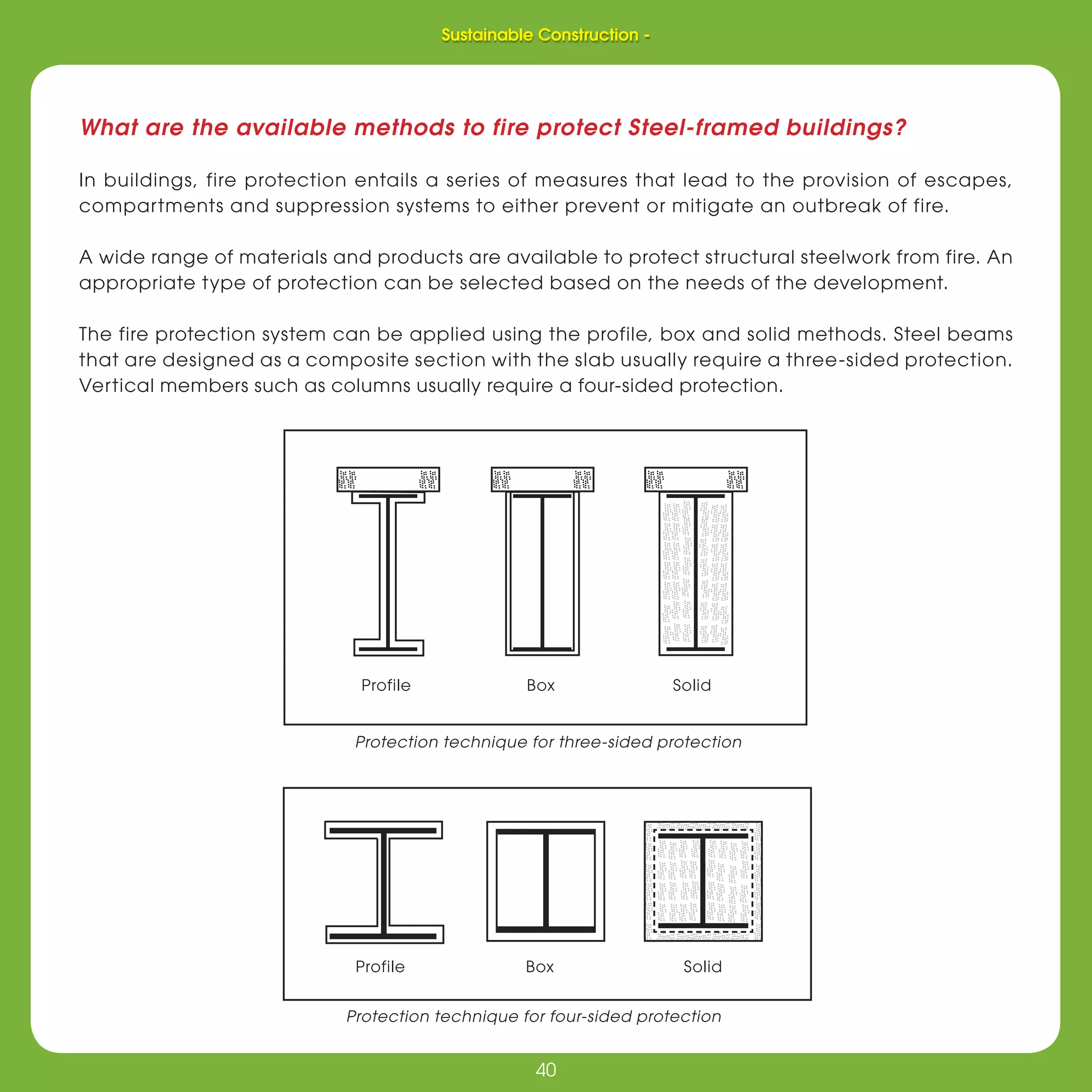
The fire protection system can be applied using the profile, box and solid methods. Steel beams
that are designed as a composite section with the slab usually require a three-sided protection.
Vertical members such as columns usually require a four-sided protection.
Protection technique for three-sided protection
Protection technique for four-sided protection
Profile Box Solid
Profile Box Solid
Sustainable Construction -
41
Fire Protection and Performance-based Fire Engineering
41
Traditionally, designers would provide the fire
protection in accordance to the prescriptive
fire code. Concrete encasement or concrete
infill of hollow steel sections, is one such method
of fire protection for structural steelwork.
The advantages of concrete encasement are:
✓ durable and robust; used mostly in cases where resistance to
impact damage, abrasion and weather exposure are important
✓ elements can be designed as composite members to enhance
the load resistance
The disadvantages are:
✕ building weight increases considerably due to thick encasement
✕ time consuming at site to carry out encasement works
✕ overall section size can be quite large for concrete encasement
compared to bare steel and other systems
A Guide on Fire Protection and Performance-based Fire Engineering
42
Sustainable Construction -
42
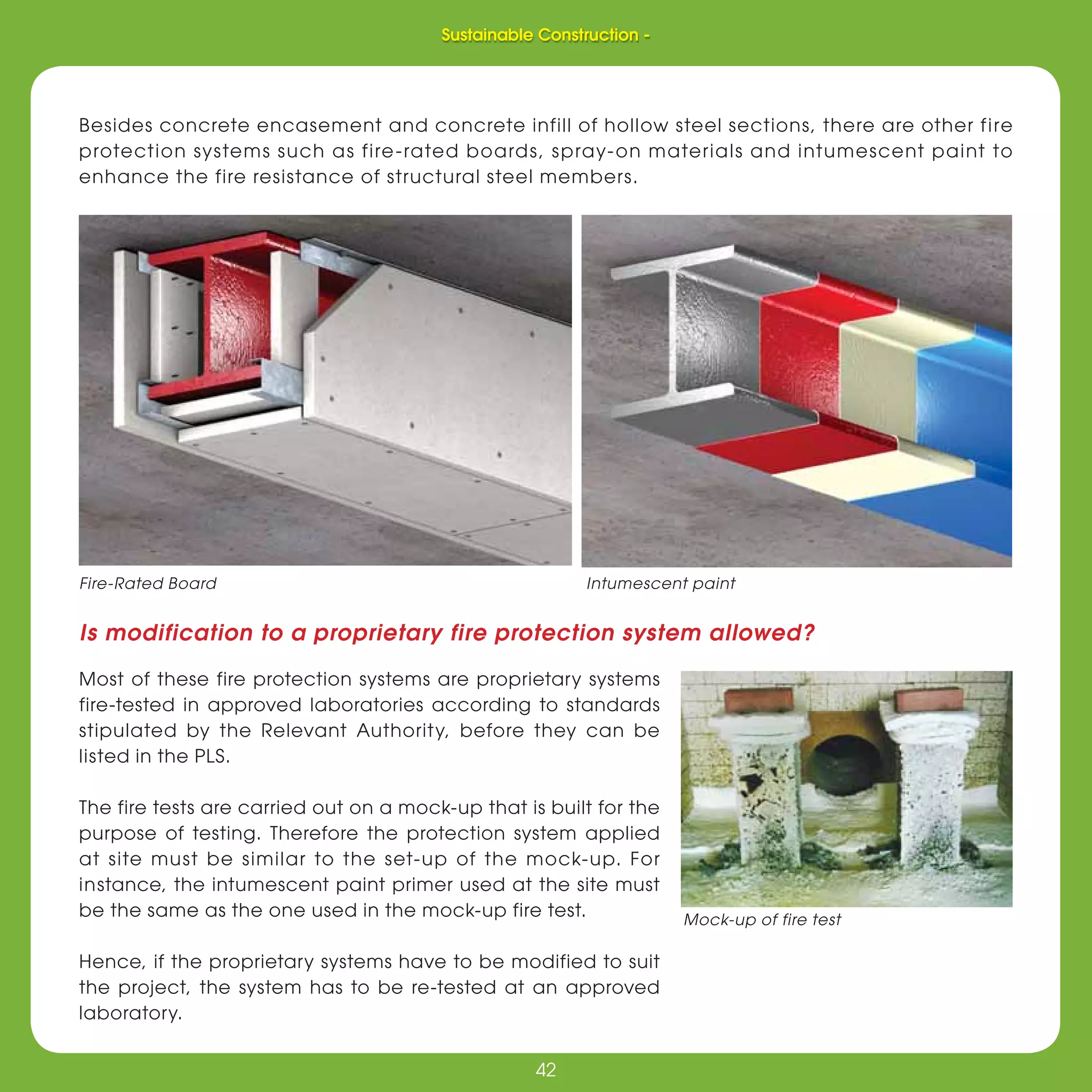
Besides concrete encasement and concrete infill of hollow steel sections, there are other fire
protection systems such as fire-rated boards, spray-on materials and intumescent paint to
enhance the fire resistance of structural steel members.
Fire-Rated Board Intumescent paint
Most of these fire protection systems are proprietary systems
fire-tested in approved laboratories according to standards
stipulated by the Relevant Authority, before they can be
listed in the PLS.
The fire tests are carried out on a mock-up that is built for the
purpose of testing. Therefore the protection system applied
at site must be similar to the set-up of the mock-up. For
instance, the intumescent paint primer used at the site must
be the same as the one used in the mock-up fire test.
Hence, if the proprietary systems have to be modified to suit
the project, the system has to be re-tested at an approved
laboratory.
Mock-up of fire test
Sustainable Construction -
Is modification to a proprietary fire protection system allowed?
43
Fire Protection and Performance-based Fire Engineering
43
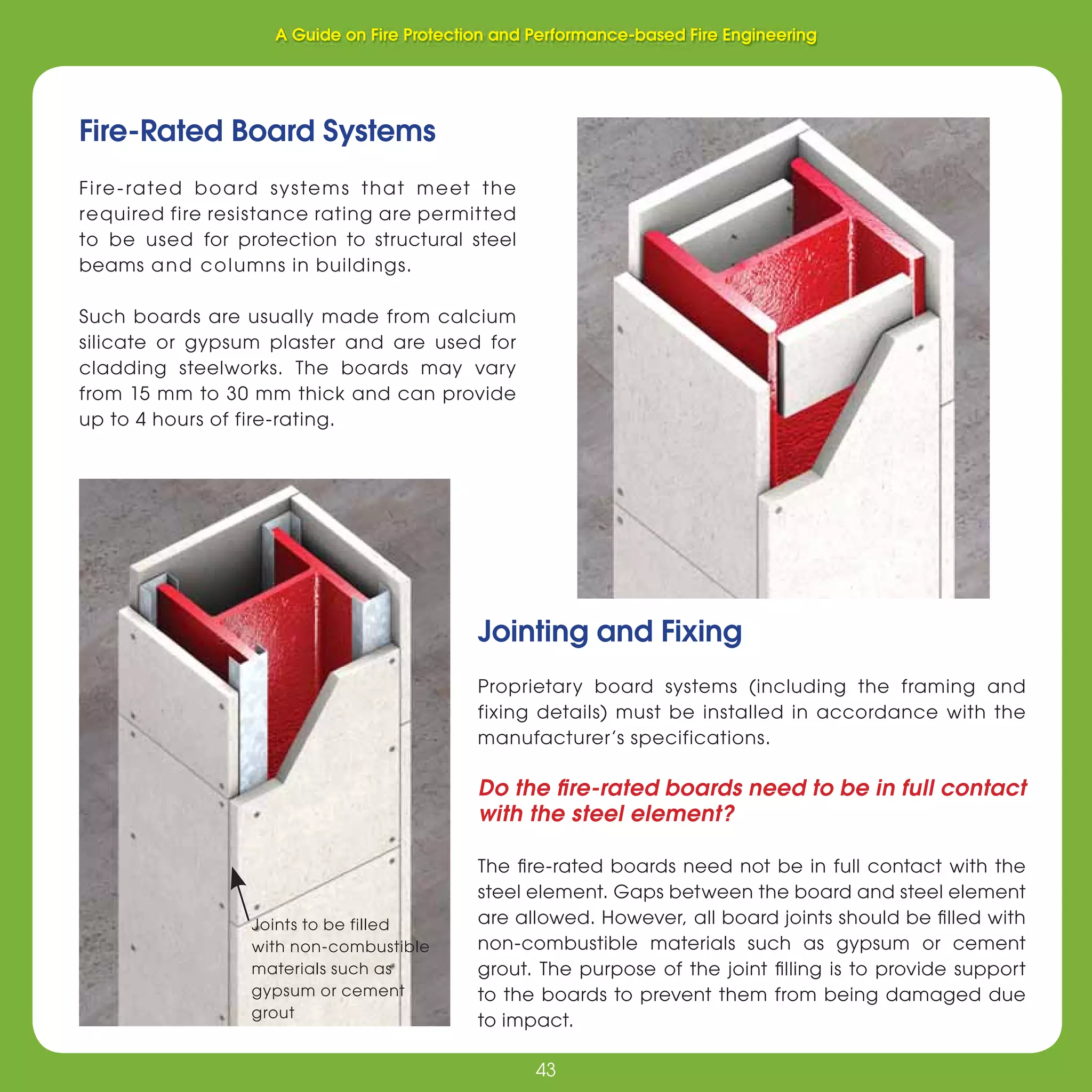
Fire-Rated Board Systems
Fire-rated board systems that meet the
required fire resistance rating are permitted
to be used for protection to structural steel
beams and columns in buildings.
Such boards are usually made from calcium
silicate or gypsum plaster and are used for
cladding steelworks. The boards may vary
from 15 mm to 30 mm thick and can provide
up to 4 hours of fire-rating.
Joints to be filled
with non-combustible
materials such as
gypsum or cement
grout
Jointing and Fixing
Proprietary board systems (including the framing and
fixing details) must be installed in accordance with the
manufacturer’s specifications.
Do the fire-rated boards need to be in full contact
with the steel element?
The fire-rated boards need not be in full contact with the
steel element. Gaps between the board and steel element
are allowed. However, all board joints should be filled with
non-combustible materials such as gypsum or cement
grout. The purpose of the joint filling is to provide support
to the boards to prevent them from being damaged due
to impact.
A Guide on Fire Protection and Performance-based Fire Engineering
44
Sustainable Construction -
44
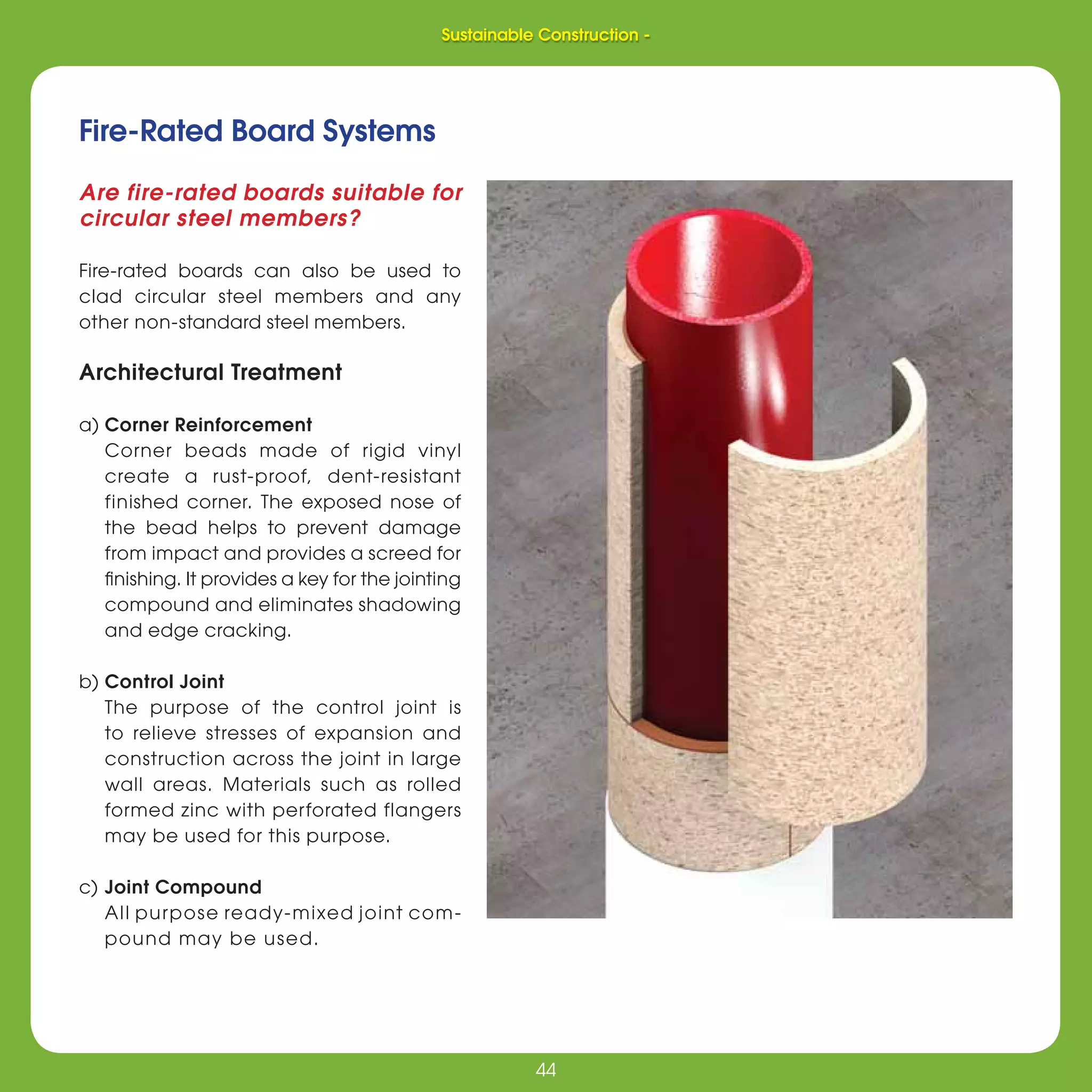
Fire-Rated Board Systems
Are fire-rated boards suitable for
circular steel members?
Fire-rated boards can also be used to
clad circular steel members and any
other non-standard steel members.
Architectural Treatment
a) Corner Reinforcement
Corner beads made of rigid vinyl
create a rust-proof, dent-resistant
finished corner. The exposed nose of
the bead helps to prevent damage
from impact and provides a screed for
finishing. It provides a key for the jointing
compound and eliminates shadowing
and edge cracking.
b) Control Joint
The purpose of the control joint is
to relieve stresses of expansion and
construction across the joint in large
wall areas. Materials such as rolled
formed zinc with perforated flangers
may be used for this purpose.
c) Joint Compound
All purpose ready-mixed joint com-
pound may be used.
Sustainable Construction -
45
Fire Protection and Performance-based Fire Engineering
45
Fire-Rated Board Systems
Is there any restriction to the use of fire-rated board systems?
The Fire Code does not restrict the use of fire-rated boards for any particular type
of building.
The advantages of fire-rated boards are:
✓ easy to install in a dry process
✓ easy to finish with decorative materials
The disadvantages are:
✕ holes cut into the board (e.g. for services) have to be filled
with a compatible fire protection material.
✕ Gypsum plasterboard will lose its insulation property after
a fire, so replacement is likely to be required.
CORROSIVE
However, fire-rated boards should not be used to protect structural
steel in industrial areas which may be subjected to accidental
blasts as the boards may be displaced by the force of the
blast. If QPs intend to use the fire-rated boards at areas where
corrosive atmosphere may be present, they are to consult the
Relevant Authority.
A Guide on Fire Protection and Performance-based Fire Engineering
46
Sustainable Construction -
46
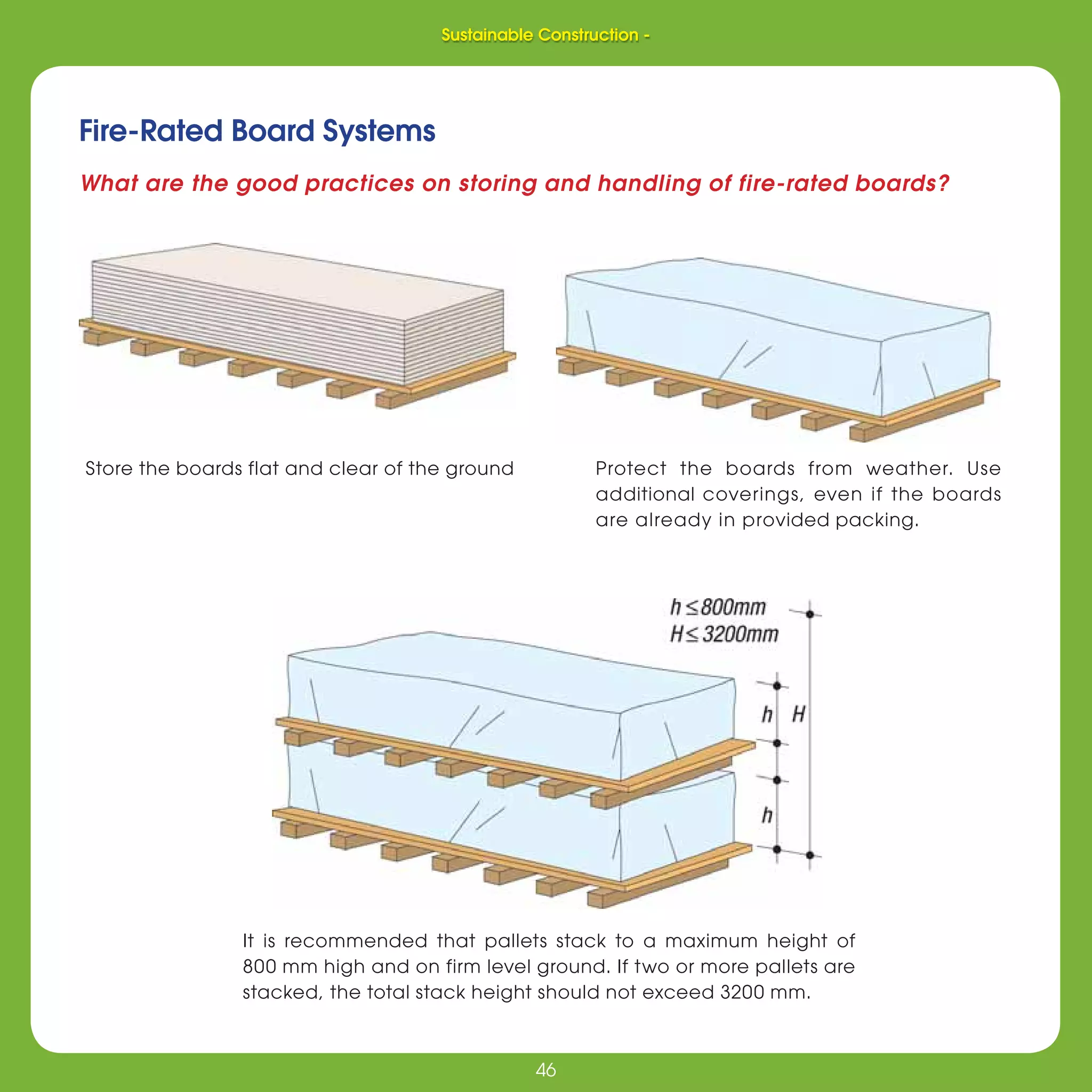
What are the good practices on storing and handling of fire-rated boards?
Store the boards flat and clear of the ground Protect the boards from weather. Use
additional coverings, even if the boards
are already in provided packing.
Fire-Rated Board Systems
It is recommended that pallets stack to a maximum height of
800 mm high and on firm level ground. If two or more pallets are
stacked, the total stack height should not exceed 3200 mm.
Sustainable Construction -
47
Fire Protection and Performance-based Fire Engineering
47
Fire-Rated Board Systems
Limitations
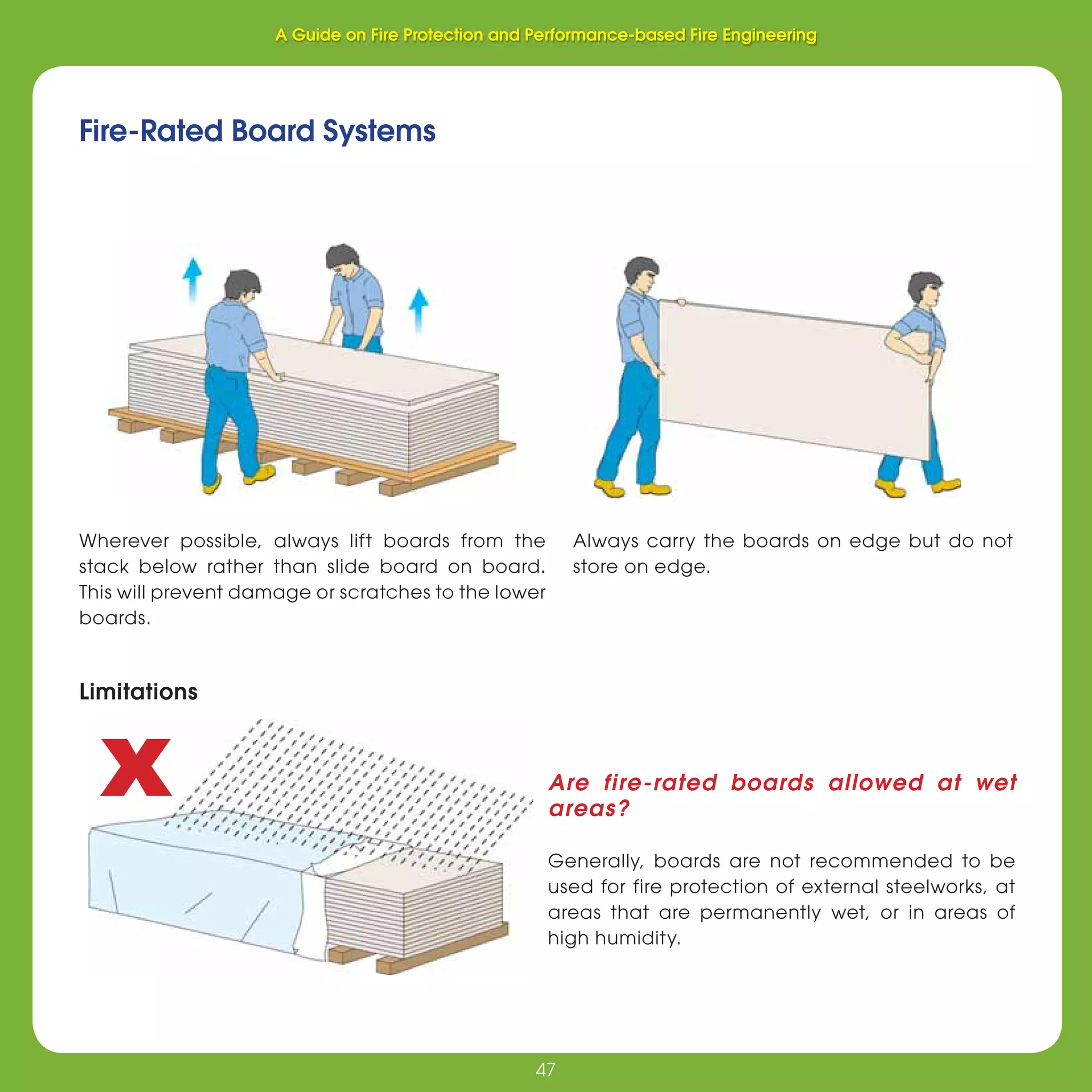
Wherever possible, always lift boards from the
stack below rather than slide board on board.
This will prevent damage or scratches to the lower
boards.
Always carry the boards on edge but do not
store on edge.
Are fire-rated boards allowed at wet
areas?
Generally, boards are not recommended to be
used for fire protection of external steelworks, at
areas that are permanently wet, or in areas of
high humidity.
A Guide on Fire Protection and Performance-based Fire Engineering
48
Sustainable Construction -
48
Cementitious spray-fireproofing
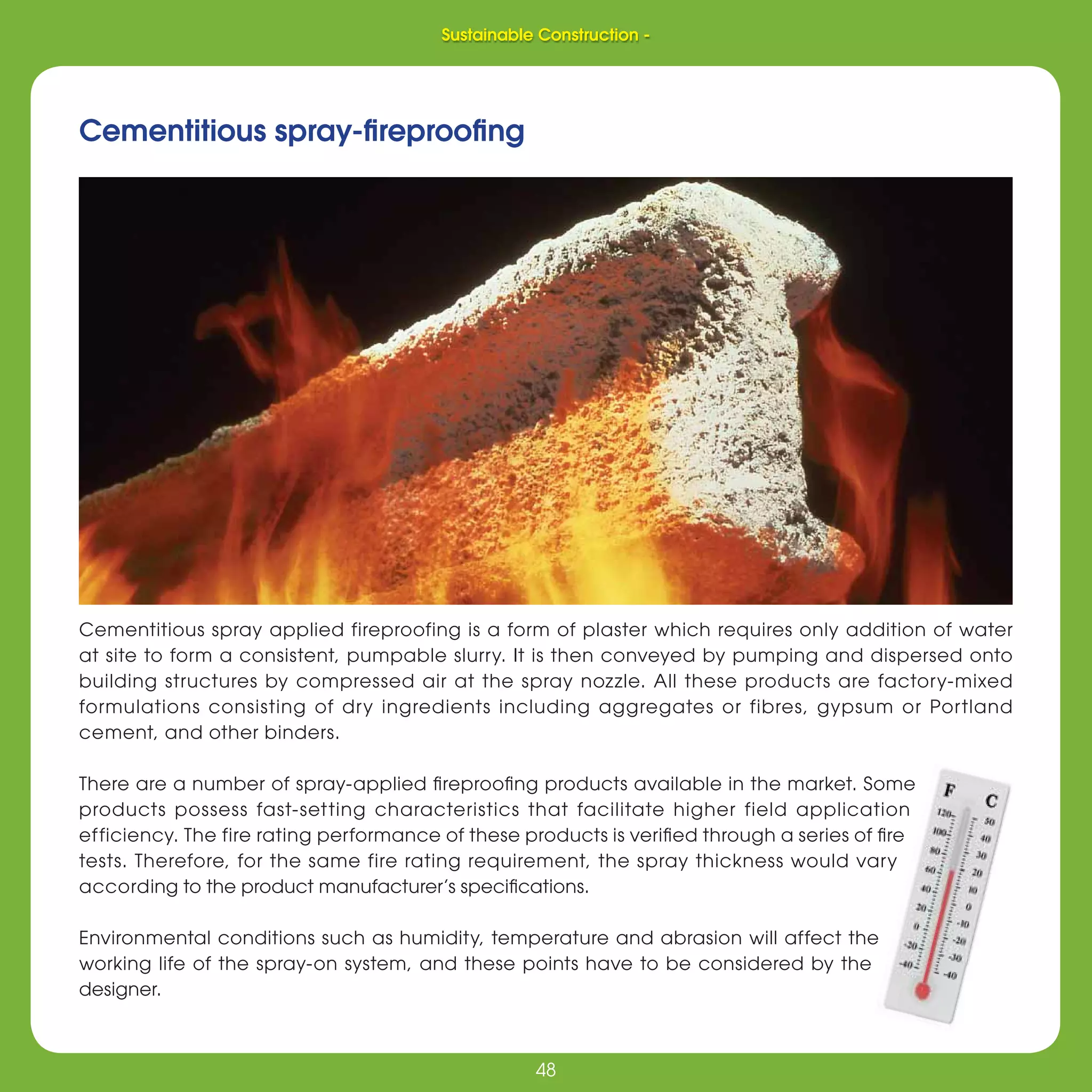
Cementitious spray applied fireproofing is a form of plaster which requires only addition of water
at site to form a consistent, pumpable slurry. It is then conveyed by pumping and dispersed onto
building structures by compressed air at the spray nozzle. All these products are factory-mixed
formulations consisting of dry ingredients including aggregates or fibres, gypsum or Portland
cement, and other binders.
There are a number of spray-applied fireproofing products available in the market. Some
products possess fast-setting characteristics that facilitate higher field application
efficiency. The fire rating performance of these products is verified through a series of fire
tests. Therefore, for the same fire rating requirement, the spray thickness would vary
according to the product manufacturer’s specifications.
Environmental conditions such as humidity, temperature and abrasion will affect the
working life of the spray-on system, and these points have to be considered by the
designer.
Sustainable Construction -
49
Fire Protection and Performance-based Fire Engineering
49
Cementitious spray-fireproofing
Can cementitious spray-fire-
proofing be used for all steel
sections?
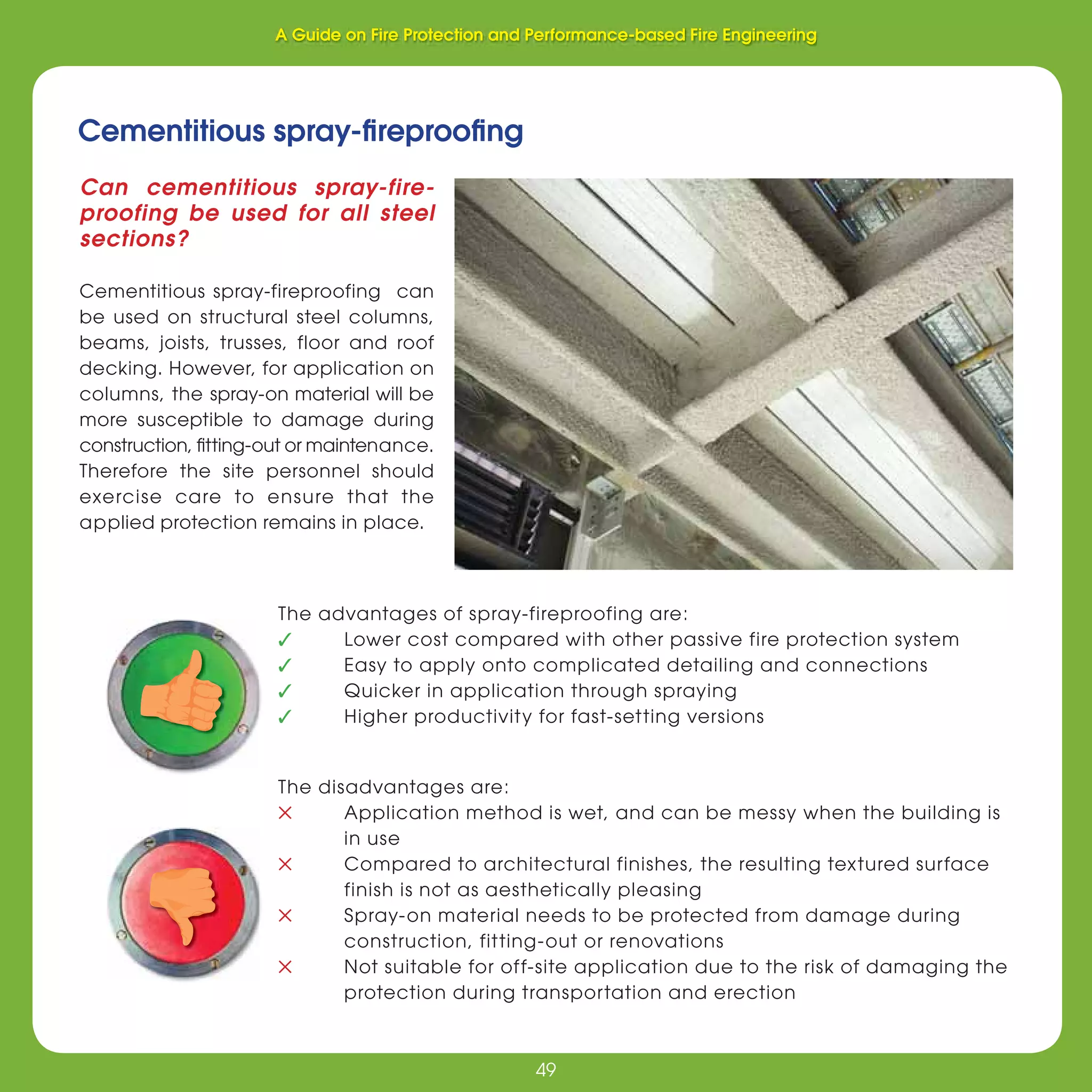
Cementitious spray-fireproofing can
be used on structural steel columns,
beams, joists, trusses, floor and roof
decking. However, for application on
columns, the spray-on material will be
more susceptible to damage during
construction, fitting-out or maintenance.
Therefore the site personnel should
exercise care to ensure that the
applied protection remains in place.
The advantages of spray-fireproofing are:
✓ Lower cost compared with other passive fire protection system
✓ Easy to apply onto complicated detailing and connections
✓ Quicker in application through spraying
✓ Higher productivity for fast-setting versions
The disadvantages are:
✕ Application method is wet, and can be messy when the building is
in use
✕ Compared to architectural finishes, the resulting textured surface
finish is not as aesthetically pleasing
✕ Spray-on material needs to be protected from damage during
construction, fitting-out or renovations
✕ Not suitable for off-site application due to the risk of damaging the
protection during transportation and erection
A Guide on Fire Protection and Performance-based Fire Engineering
50
Sustainable Construction -
50
Cementitious spray-fireproofing
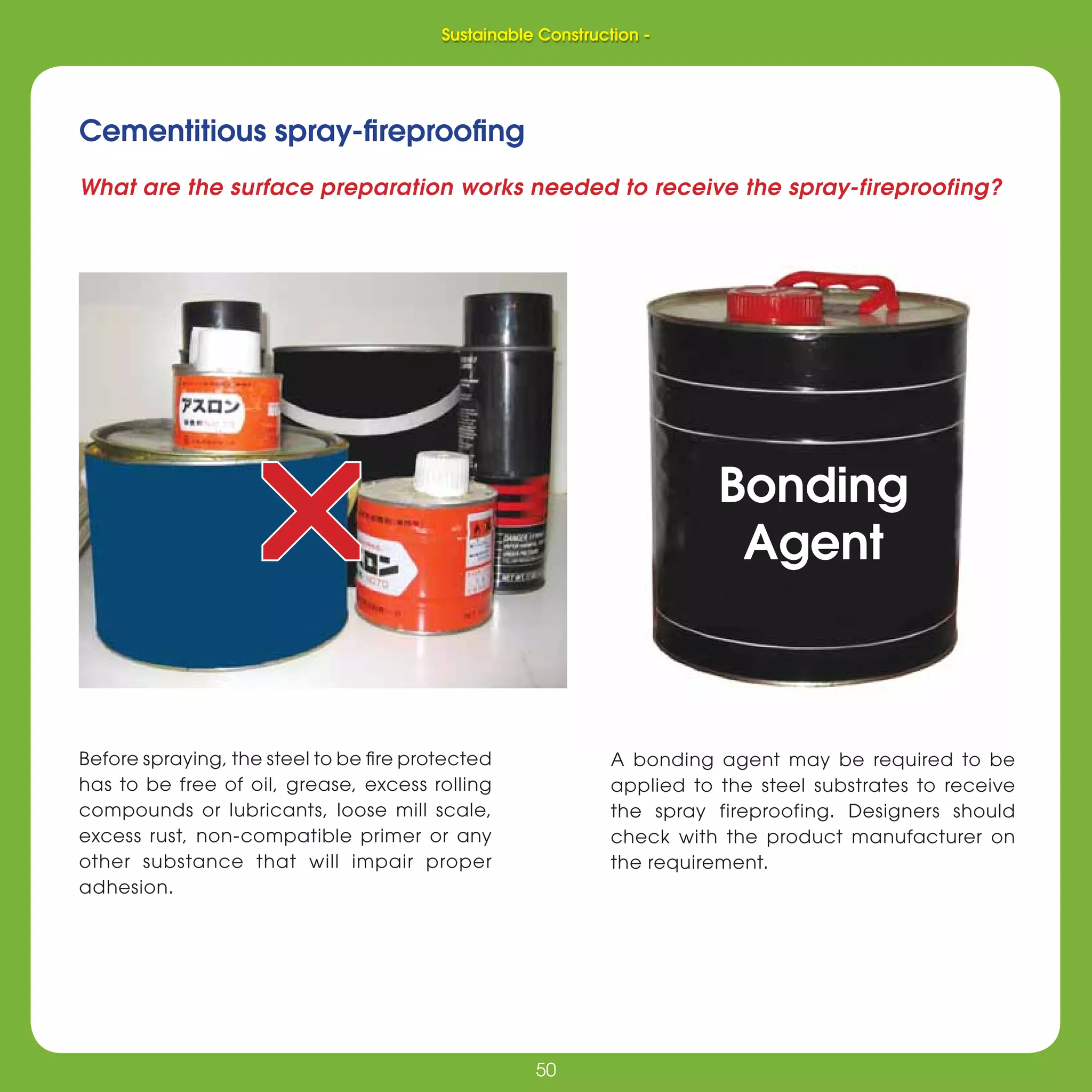
Before spraying, the steel to be fire protected
has to be free of oil, grease, excess rolling
compounds or lubricants, loose mill scale,
excess rust, non-compatible primer or any
other substance that will impair proper
adhesion.
A bonding agent may be required to be
applied to the steel substrates to receive
the spray fireproofing. Designers should
check with the product manufacturer on
the requirement.
What are the surface preparation works needed to receive the spray-fireproofing?
rr Bonding
Agent
Sustainable Construction -
51
Fire Protection and Performance-based Fire Engineering
51
Cementitious spray-fireproofing
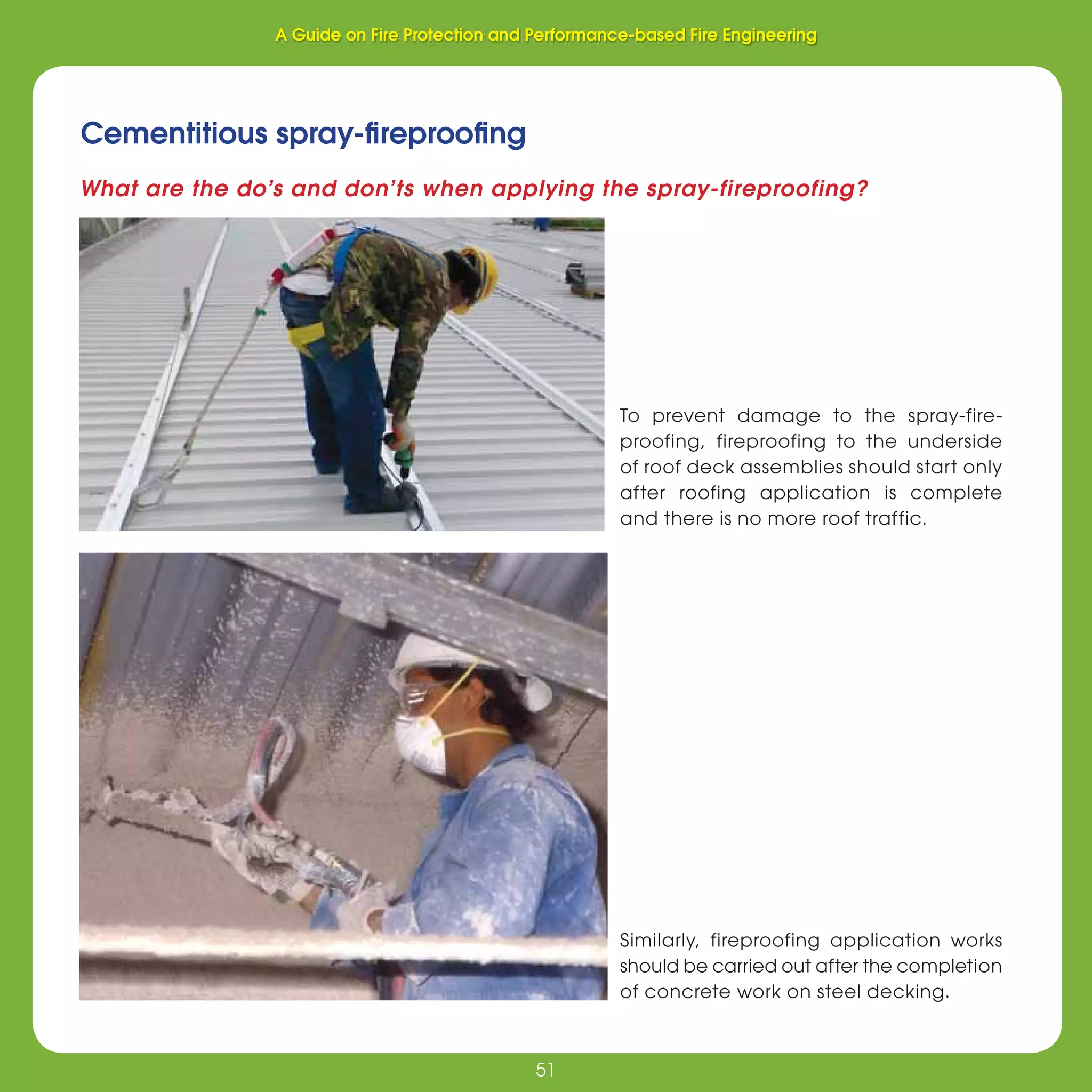
What are the do’s and don’ts when applying the spray-fireproofing?
To prevent damage to the spray-fire-
proofing, fireproofing to the underside
of roof deck assemblies should start only
after roofing application is complete
and there is no more roof traffic.
Similarly, fireproofing application works
should be carried out after the completion
of concrete work on steel decking.
A Guide on Fire Protection and Performance-based Fire Engineering
52
Sustainable Construction -
52
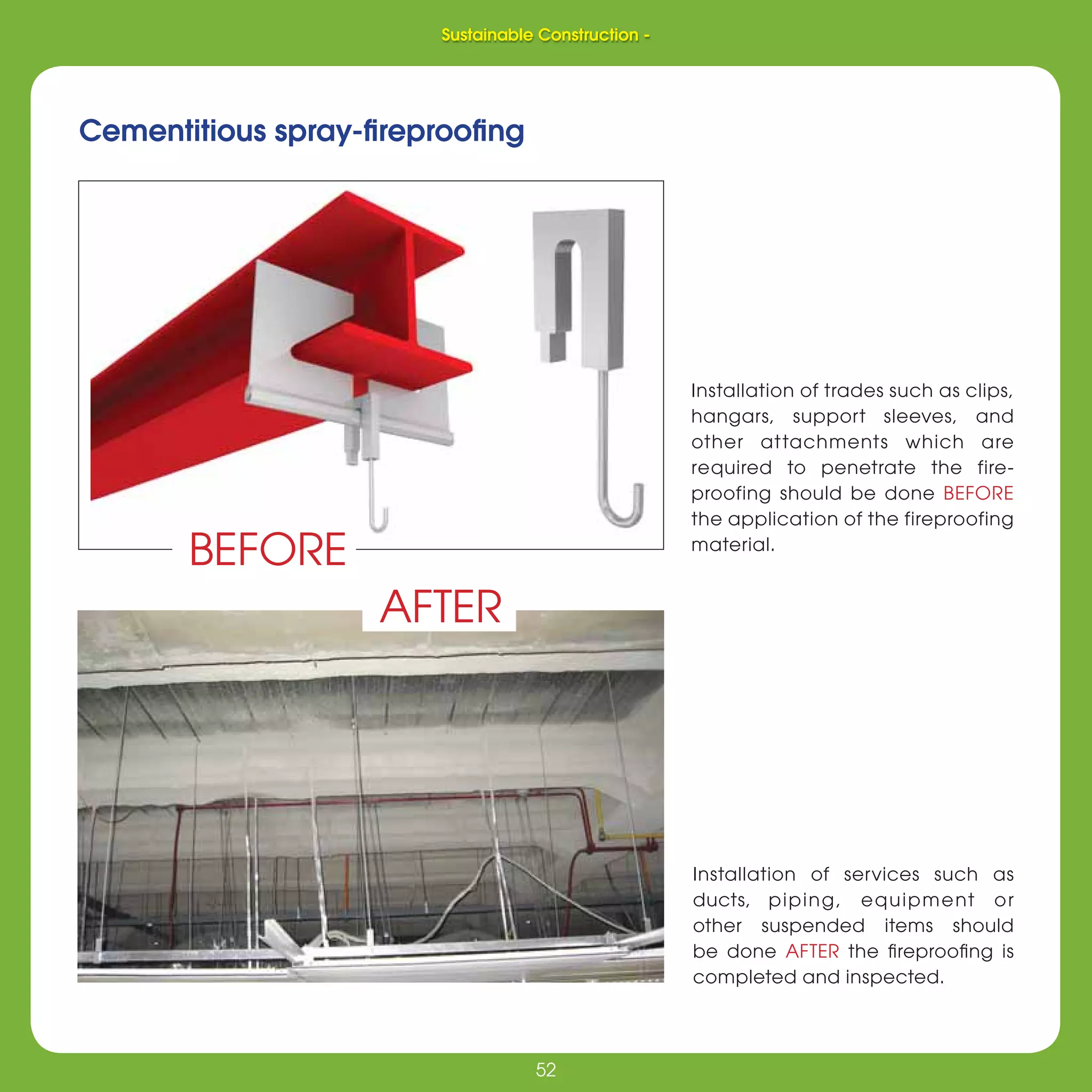
Installation of services such as
ducts, piping, equipment or
other suspended items should
be done AFTER the fireproofing is
completed and inspected.
Cementitious spray-fireproofing
Installation of trades such as clips,
hangars, support sleeves, and
other attachments which are
required to penetrate the fire-
proofing should be done BEFORE
the application of the fireproofing
material.
BEFORE
AFTER
Sustainable Construction -
53
Fire Protection and Performance-based Fire Engineering
53
Cementitious spray-fireproofing
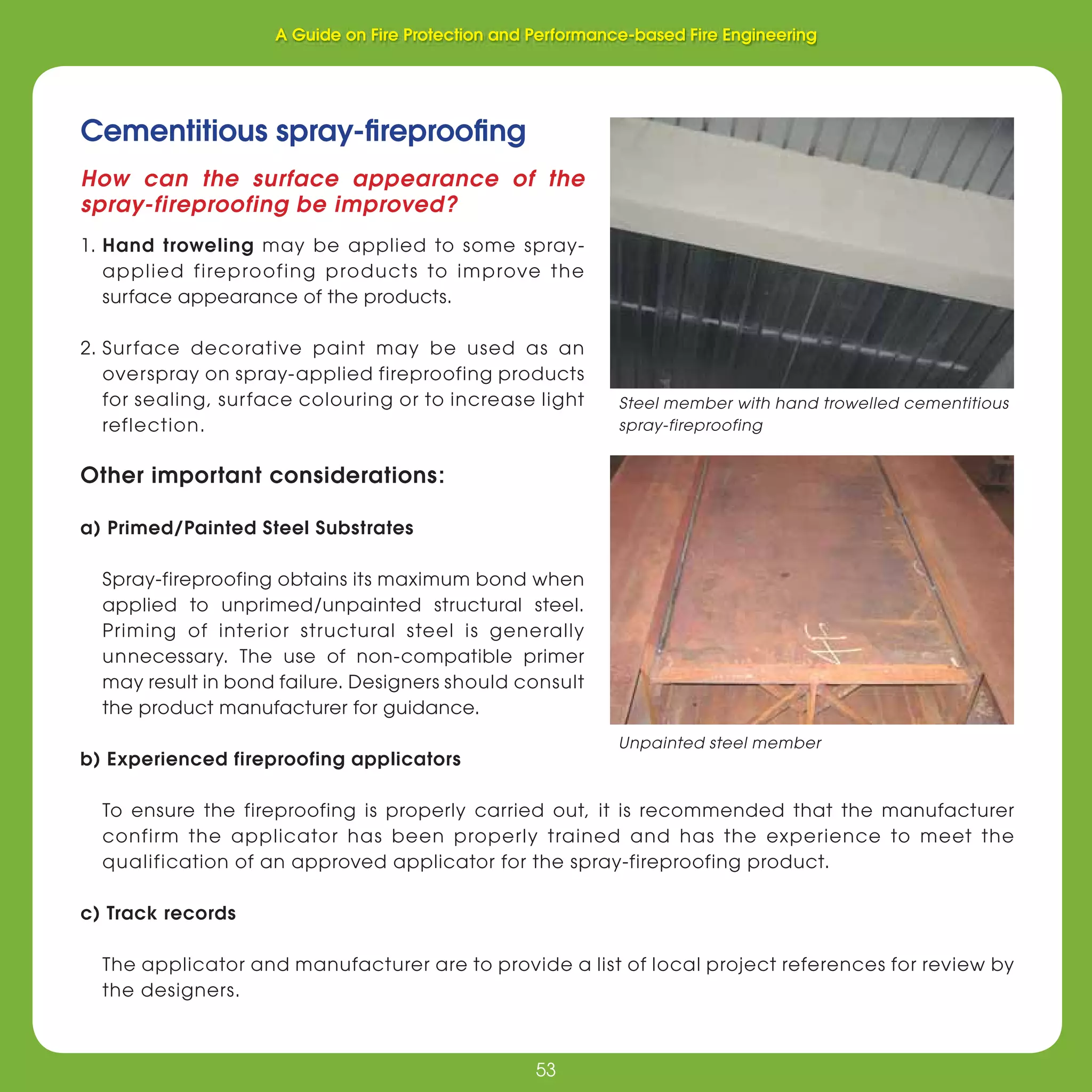
How can the surface appearance of the
spray-fireproofing be improved?
1. Hand troweling may be applied to some spray-
applied fireproofing products to improve the
surface appearance of the products.
2. Surface decorative paint may be used as an
overspray on spray-applied fireproofing products
for sealing, surface colouring or to increase light
reflection.
Other important considerations:
a) Primed/Painted Steel Substrates
Spray-fireproofing obtains its maximum bond when
applied to unprimed/unpainted structural steel.
Priming of interior structural steel is generally
unnecessary. The use of non-compatible primer
may result in bond failure. Designers should consult
the product manufacturer for guidance.
b) Experienced fireproofing applicators
To ensure the fireproofing is properly carried out, it is recommended that the manufacturer
confirm the applicator has been properly trained and has the experience to meet the
qualification of an approved applicator for the spray-fireproofing product.
c) Track records
The applicator and manufacturer are to provide a list of local project references for review by
the designers.
Unpainted steel member
A Guide on Fire Protection and Performance-based Fire Engineering
54
Sustainable Construction -
54
Intumescent Paint
The use of intumescent coating to
give fire protection to steel structure
is permissible as long as it is applied
appropriately and the environment in
which the structure is subjected to is
non-detrimental to the fire protective
properties of the coating. Intumescent
paint coatings may be applied to give
up to 120 minutes of fire protection.
Only intumescent paint products
listed in the PLS are acceptable to the
Relevant Authority.
How does intumescent paint work?
In the event of fire, the thin coating of
intumescent paint expands up to 50 times
to form a layer of insulating foam. The car-
bonaceous material in the intumescent paint,
typically starch, is charred whilst the heat
also causes the release of acids. These act
to produce large volumes of non-inflammable
gases which blow up the charring starch within
the softened binder of the intumescent paint
into an insulating cellular carbon layer.
Sustainable Construction -
55
Fire Protection and Performance-based Fire Engineering
55
Intumescent Paint
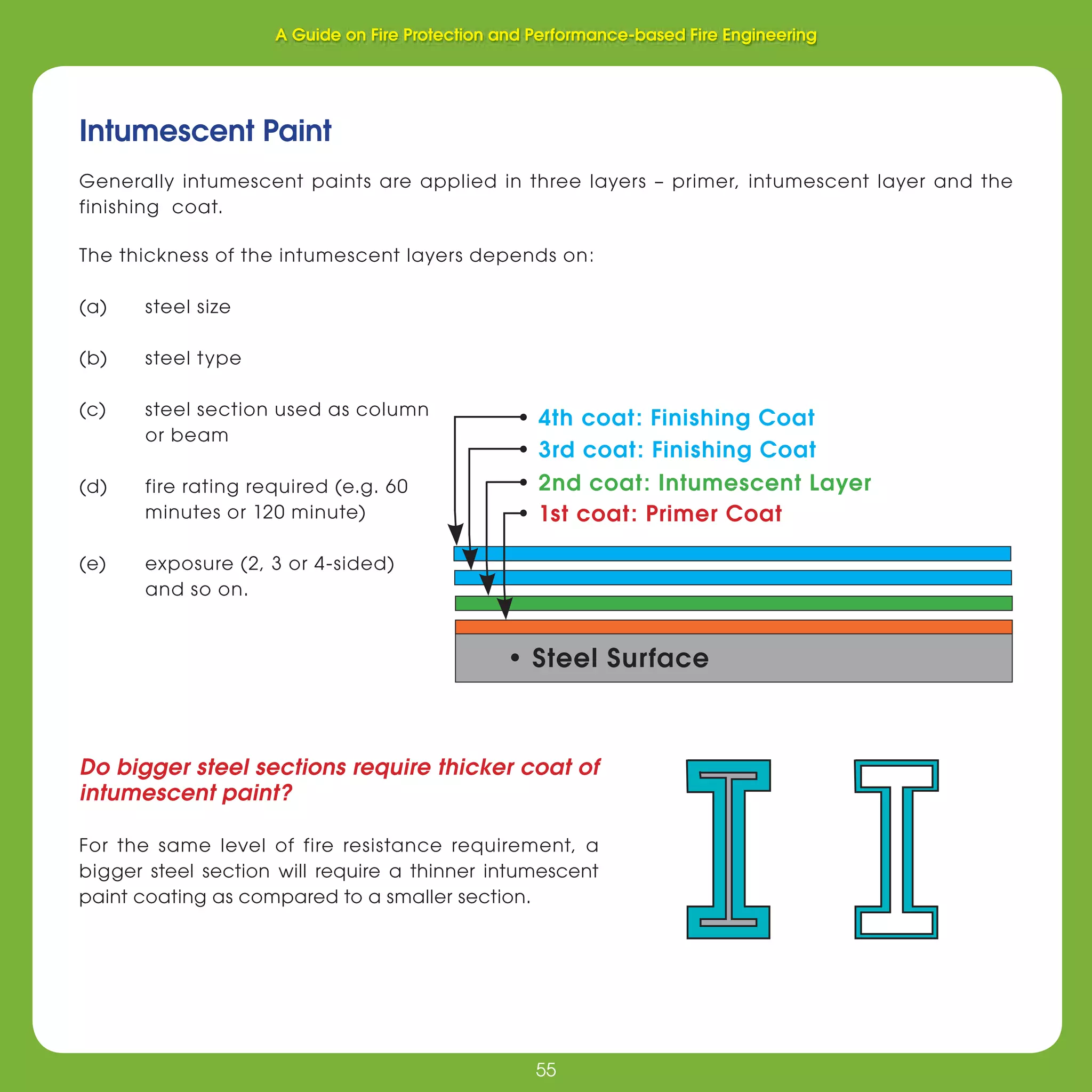
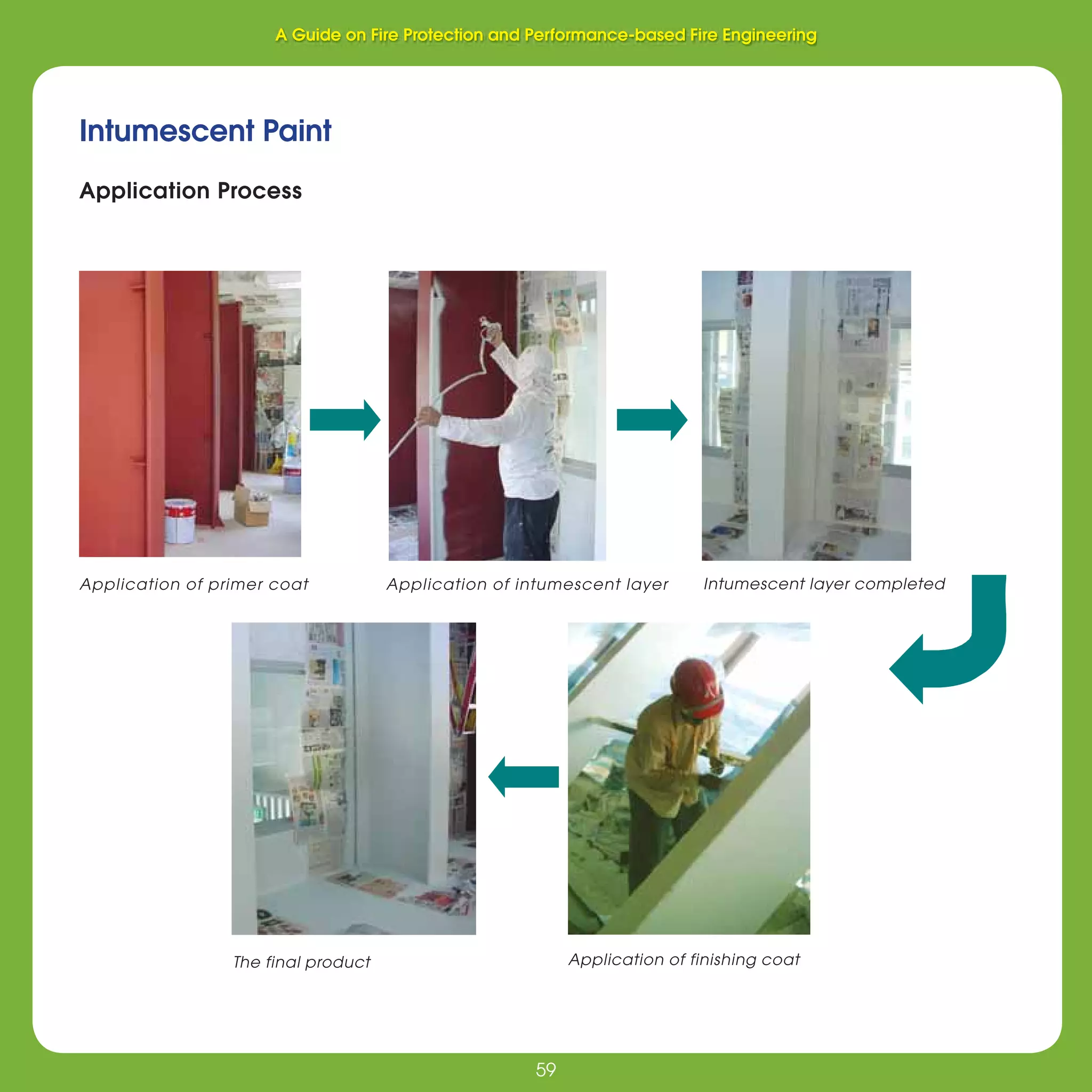
Generally intumescent paints are applied in three layers – primer, intumescent layer and the
finishing coat.
The thickness of the intumescent layers depends on:
(a) steel size
(b) steel type
(c) steel section used as column
or beam
(d) fire rating required (e.g. 60
minutes or 120 minute)
(e) exposure (2, 3 or 4-sided)
and so on.
Do bigger steel sections require thicker coat of
intumescent paint?
For the same level of fire resistance requirement, a
bigger steel section will require a thinner intumescent
paint coating as compared to a smaller section.
• Steel Surface
• 4th coat: Finishing Coat
• 3rd coat: Finishing Coat
• 2nd coat: Intumescent Layer
• 1st coat: Primer Coat
A Guide on Fire Protection and Performance-based Fire Engineering
56
Sustainable Construction -
56
Intumescent Paint
The intumescent paints have to be
tested to BS 476: Part 20/21 and BS
8202: Part 2.
Can intumescent paint be
applied to external areas?
For intumescent paints intended for
external area, they have to pass a 2-
year local weathering test in accord-
ance to BS8202: Part 2, prior to listing in
the PLS.
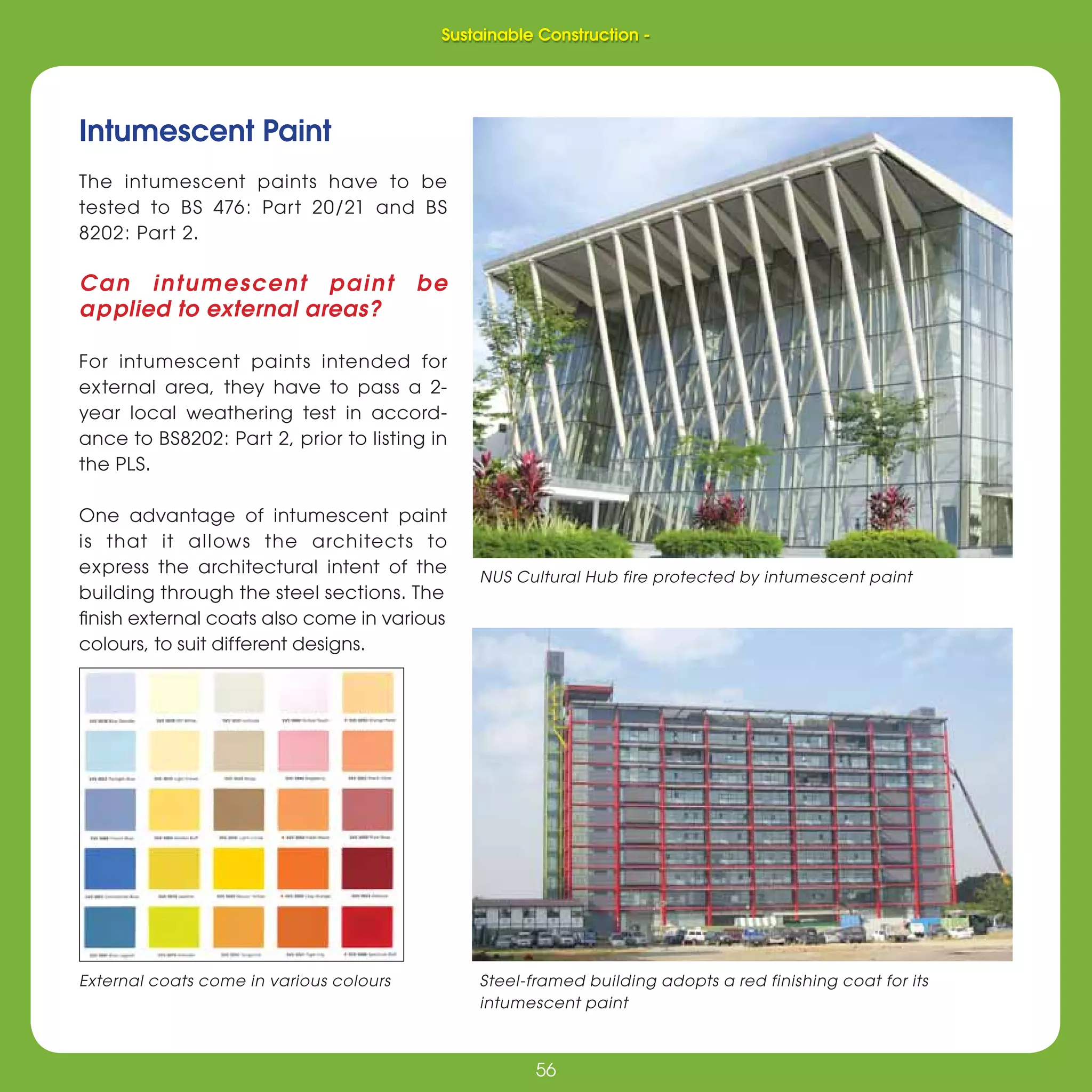
One advantage of intumescent paint
is that it allows the architects to
express the architectural intent of the
building through the steel sections. The
finish external coats also come in various
colours, to suit different designs.
External coats come in various colours Steel-framed building adopts a red finishing coat for its
intumescent paint
NUS Cultural Hub fire protected by intumescent paint
Sustainable Construction -
57
Fire Protection and Performance-based Fire Engineering
57
Is there any restriction to the use of intumescent paint?
The Fire Code does not restrict the use of intumescent
paints for any particular type of building. However in
buildings where there may be presence of corrosive atmosphere
that may affect the effectiveness of protection by the intumescent
paints, QPs are to consult the Relevant Authority.
For submission procedures and documents required for submission,
please refer to Appendix F of the Fire Code.
Intumescent Paint
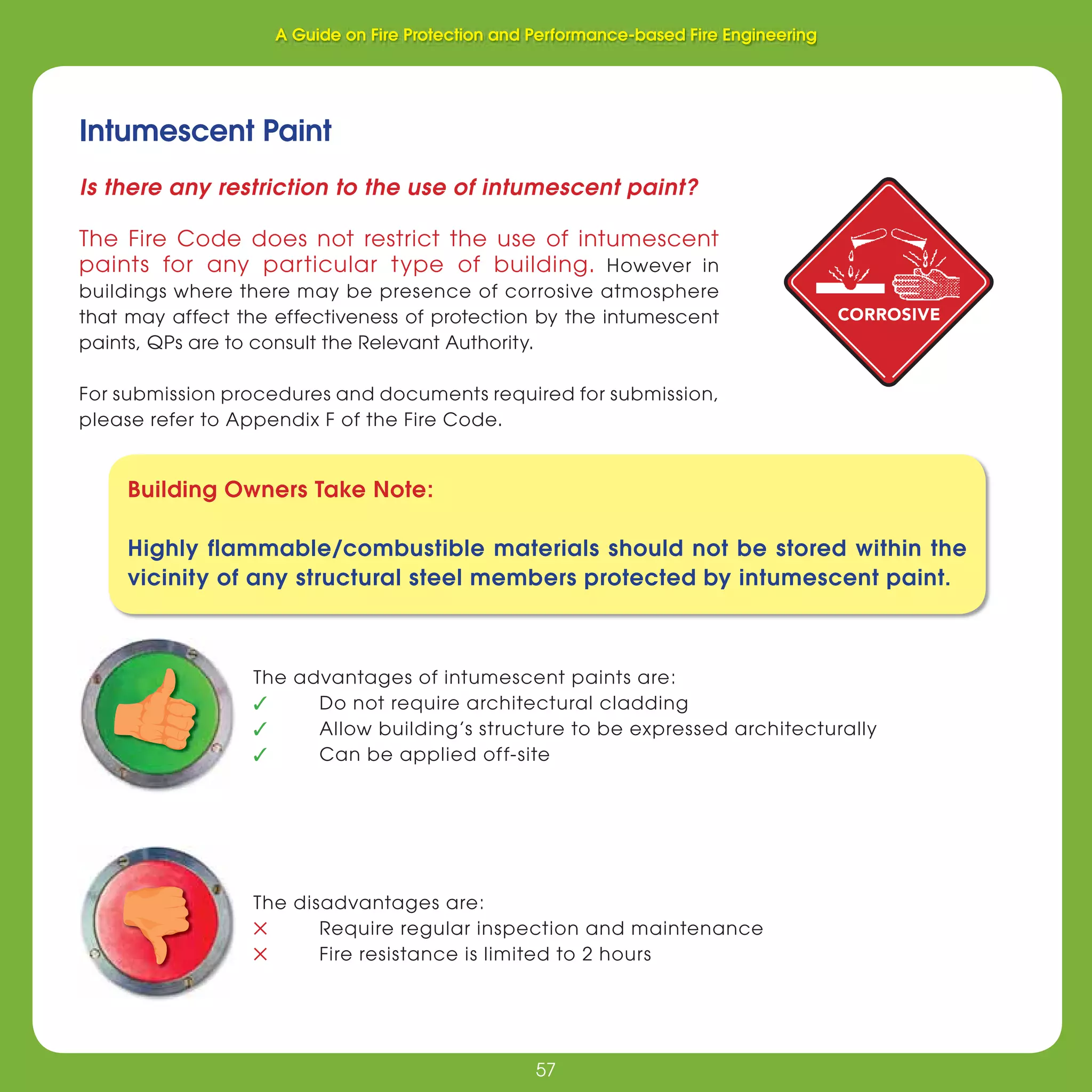
The advantages of intumescent paints are:
✓ Do not require architectural cladding
✓ Allow building’s structure to be expressed architecturally
✓ Can be applied off-site
The disadvantages are:
✕ Require regular inspection and maintenance
✕ Fire resistance is limited to 2 hours
Building Owners Take Note:
Highly flammable/combustible materials should not be stored within the
vicinity of any structural steel members protected by intumescent paint.
CORROSIVE
A Guide on Fire Protection and Performance-based Fire Engineering
58
Sustainable Construction -
58
What are the surface preparation works needed to receive the intuescent paint?
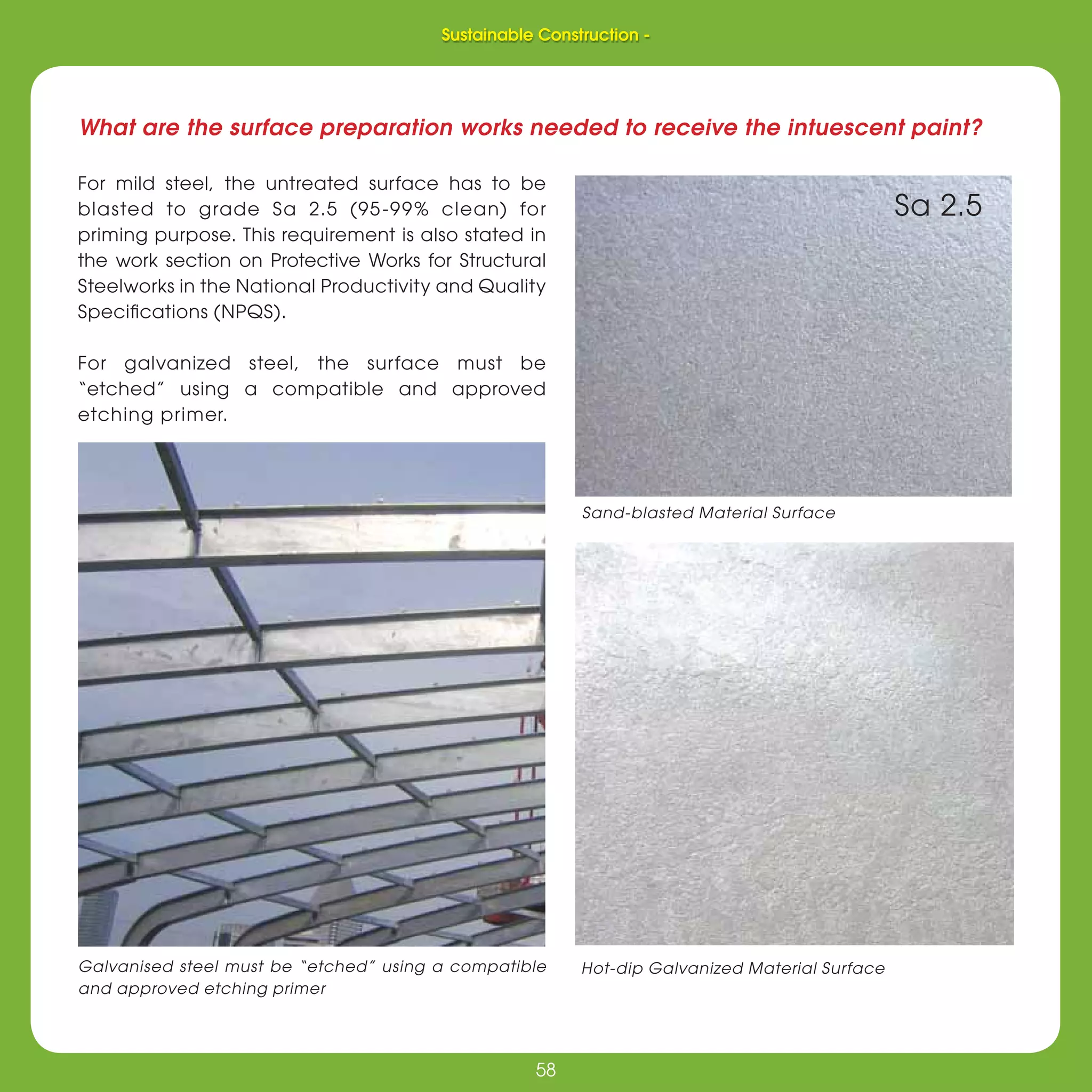
For mild steel, the untreated surface has to be
blasted to grade Sa 2.5 (95-99% clean) for
priming purpose. This requirement is also stated in
the work section on Protective Works for Structural
Steelworks in the National Productivity and Quality
Specifications (NPQS).
For galvanized steel, the surface must be
“etched” using a compatible and approved
etching primer.
Galvanised steel must be “etched” using a compatible
and approved etching primer
Sand-blasted Material Surface
Hot-dip Galvanized Material Surface
Sa 2.5
Sustainable Construction -
59
Fire Protection and Performance-based Fire Engineering
59
Intumescent Paint
Application Process
Application of finishing coat
Application of intumescent layer Intumescent layer completedApplication of primer coat
The final product
A Guide on Fire Protection and Performance-based Fire Engineering
60
Sustainable Construction -
60
Intumescent Paint
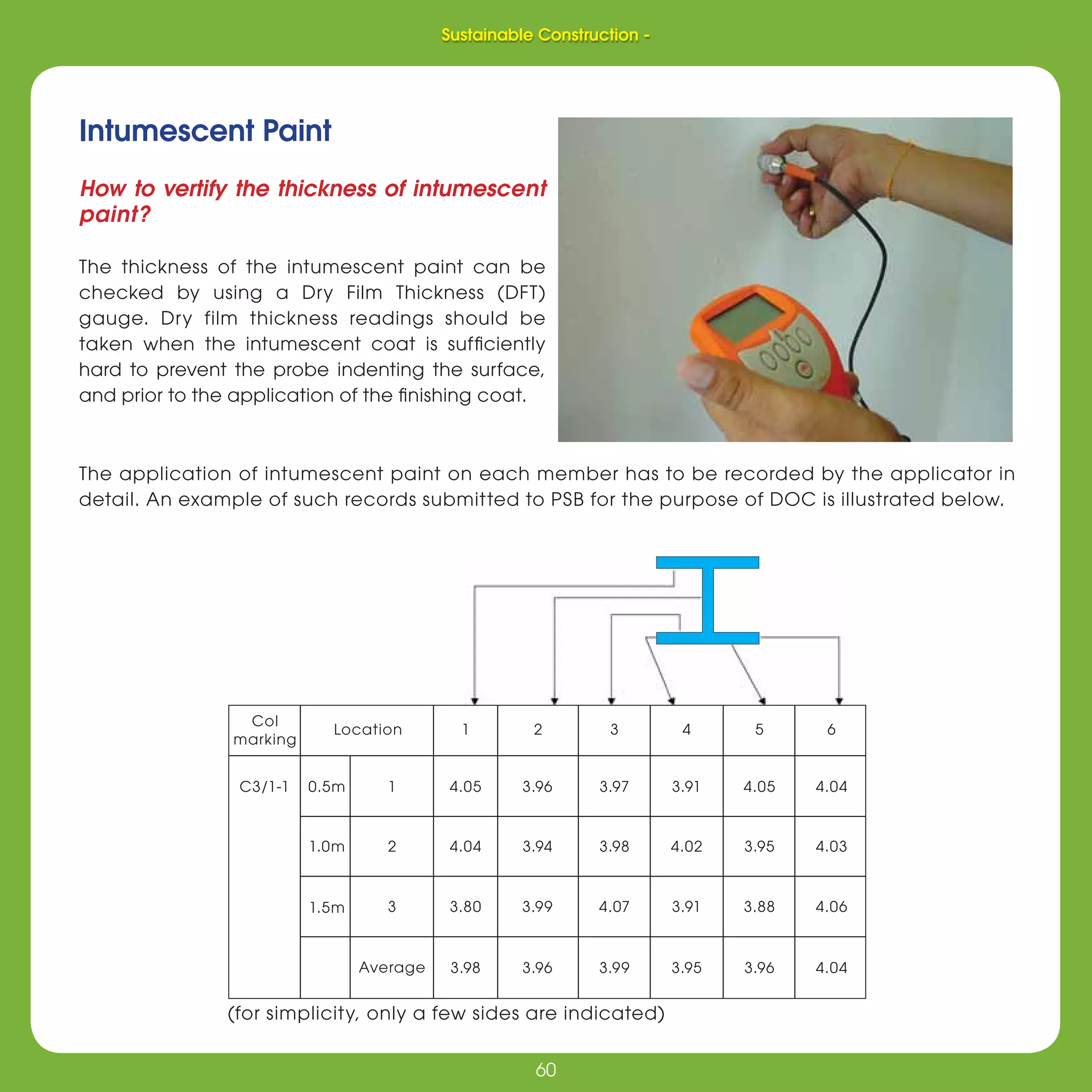
The application of intumescent paint on each member has to be recorded by the applicator in
detail. An example of such records submitted to PSB for the purpose of DOC is illustrated below.
How to vertify the thickness of intumescent
paint?
The thickness of the intumescent paint can be
checked by using a Dry Film Thickness (DFT)
gauge. Dry film thickness readings should be
taken when the intumescent coat is sufficiently
hard to prevent the probe indenting the surface,
and prior to the application of the finishing coat.
(for simplicity, only a few sides are indicated)
Col
marking
Location 1 2 3 4 5 6
C3/1-1 0.5m
1.0m
1.5m
1
Average
4.05 3.96 3.97 3.91 4.05 4.04
2 4.04 3.94 3.98 4.02 3.95 4.03
3 3.80 3.99 4.07 3.91 3.88 4.06
3.98 3.96 3.99 3.95 3.96 4.04
Sustainable Construction -
61
Fire Protection and Performance-based Fire Engineering
61
The following table shows the level of fire resistance period which a combination of columns and
beams can achieve.
>60 15 60 60 >60
15 15 15 15 15
30 15 30 30 30
60 15 60 60 60
>60 15 60 60 >60
>60 15 60 60 >60
Fire resistance (min)
Beam type
Column
type
protected
unprotected
blocked-in
partially
encased
(unreinforced)
partially
encased
(reinforced)
concrete-filled
hollow
sections
protected unprotected
slim floor
systems
shelf
angle partially
encased
Table extracted from “The design
of steel framed buildings without
applied fire protection” by C.G.
Bailey and G.M. Newman, The
Steel Construction Institute.
Quick Guide on Fire Resistance for Steel Members
A Guide on Fire Protection and Performance-based Fire Engineering
62
Sustainable Construction -
62
What are the ways to achieve a cost-effective fire protection system?
Cost comparisons made between different systems should be based on total costs, instead of fire
protection costs alone. The time required for the fire protection works, the need for additional
finishes and future maintenance will have an impact on the overall cost. Nevertheless, the following
pointers should be useful in achieving a more cost-effective fire protection system.
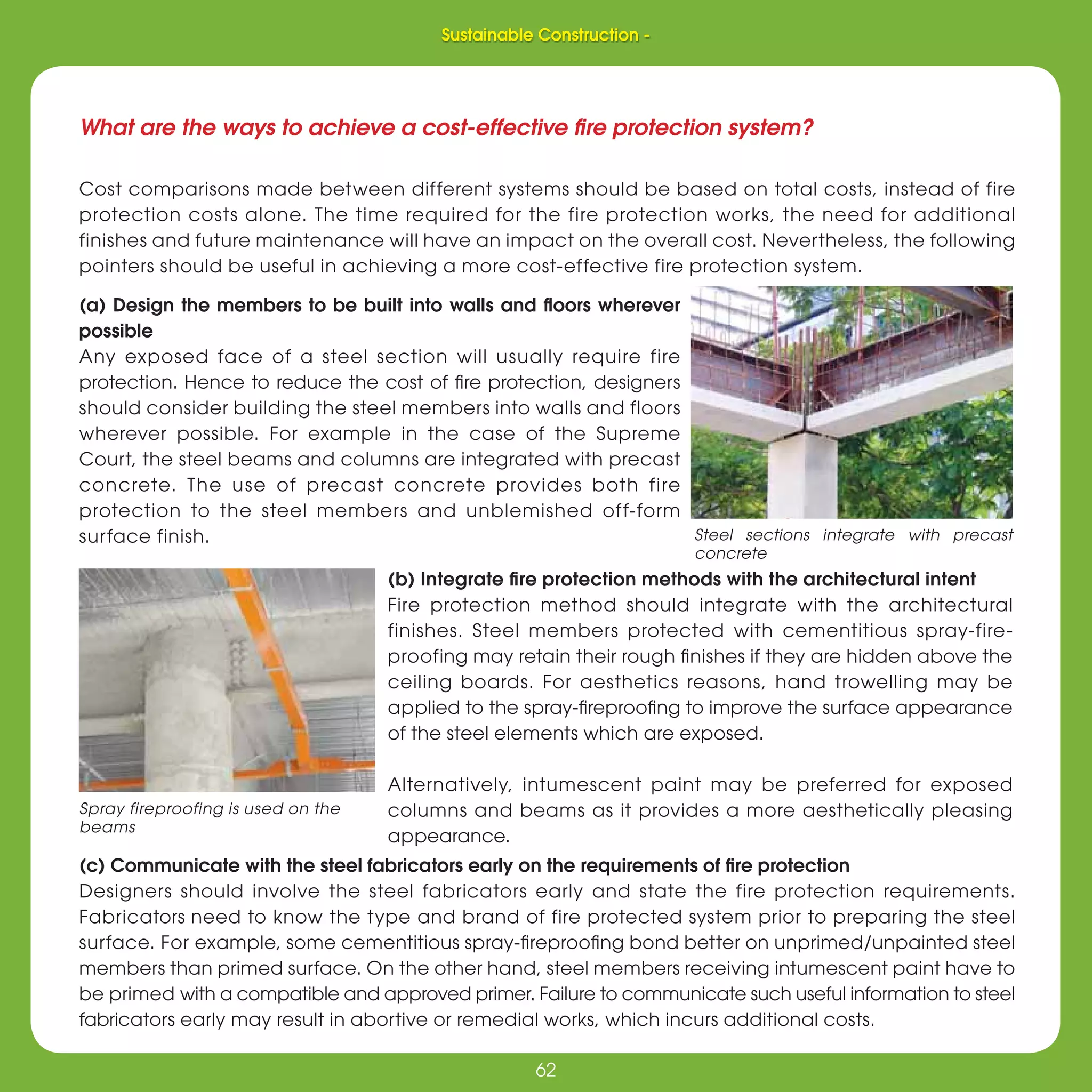
(a) Design the members to be built into walls and floors wherever
possible
Any exposed face of a steel section will usually require fire
protection. Hence to reduce the cost of fire protection, designers
should consider building the steel members into walls and floors
wherever possible. For example in the case of the Supreme
Court, the steel beams and columns are integrated with precast
concrete. The use of precast concrete provides both fire
protection to the steel members and unblemished off-form
surface finish.
Spray fireproofing is used on the
beams
(b) Integrate fire protection methods with the architectural intent
Fire protection method should integrate with the architectural
finishes. Steel members protected with cementitious spray-fire-
proofing may retain their rough finishes if they are hidden above the
ceiling boards. For aesthetics reasons, hand trowelling may be
applied to the spray-fireproofing to improve the surface appearance
of the steel elements which are exposed.
Alternatively, intumescent paint may be preferred for exposed
columns and beams as it provides a more aesthetically pleasing
appearance.
(c) Communicate with the steel fabricators early on the requirements of fire protection
Designers should involve the steel fabricators early and state the fire protection requirements.
Fabricators need to know the type and brand of fire protected system prior to preparing the steel
surface. For example, some cementitious spray-fireproofing bond better on unprimed/unpainted steel
members than primed surface. On the other hand, steel members receiving intumescent paint have to
be primed with a compatible and approved primer. Failure to communicate such useful information to steel
fabricators early may result in abortive or remedial works, which incurs additional costs.
Steel sections integrate with precast
concrete
Sustainable Construction -
63
Fire Protection and Performance-based Fire Engineering
63
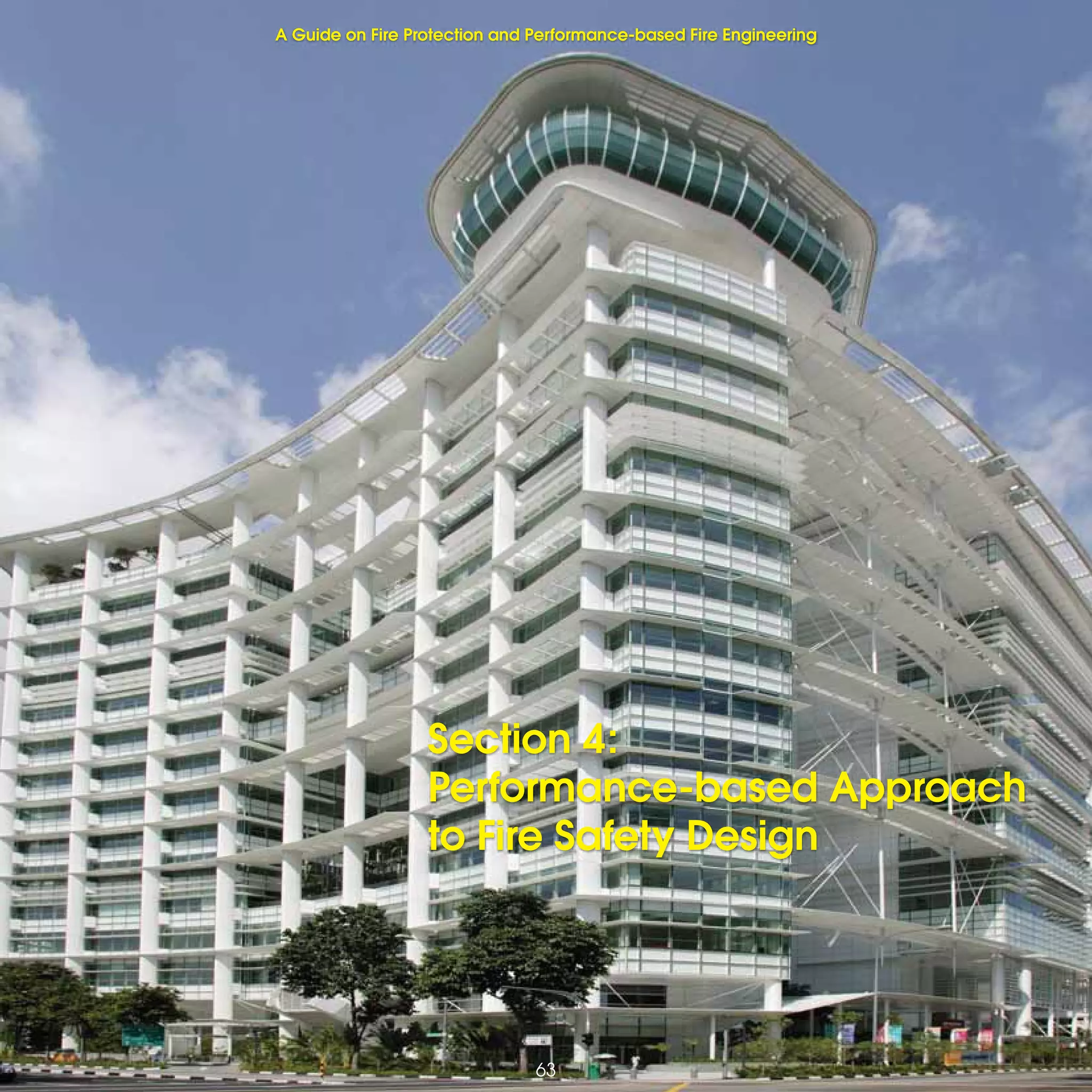
Section 4:
Performance-based Approach
to Fire Safety Design
A Guide on Fire Protection and Performance-based Fire Engineering
64
Sustainable Construction -
64
The performance-based approach to fire safety design relies on the use of fire engineering principles,
calculations and/or appropriate software modelling tools to satisfy the intentions of the Code of
Practice for Fire Precautions in Buildings 2007 (Fire Code).
This new approach provides alternative means of meeting the intentions of the Fire Code.
Building practitioners will have the added flexibility in the application of fire
safety for their buildings by having a choice of using the performance-based
approach, the prescriptive approach or a combination of both.
The performance-based approach is unique in that its provisions spell out
the intent of the code qualitatively but the means of achieving the desired
intent of the code is open to the building practitioner. The building practitioner
will need to substantiate that the proposed solution fully meets the intent of the
Fire Code using established fire safety engineering methodology.
The performance-based regulatory system was officially launched on 1 July 2004.
What is performance-based fire engineering?
Sustainable Construction -
65
Fire Protection and Performance-based Fire Engineering
65
What is the rationale of allowing developers/Qualified Persons (QPs) to choose the
type of approach (i.e. prescriptive or performance-based) to fire safety design?
The introduction of a performance-based approach to fire safety design offers building designers
greater flexibility in design and possible cost optimisation. The prescriptive approach is more
restrictive in the sense that the building designers have to adhere strictly to the requirements
stipulated in the Fire Code. The performance-based approach, however, provides a platform
for customised building designs so long as fire safety standards are maintained.
A Guide on Fire Protection and Performance-based Fire Engineering
66
Sustainable Construction -
66
Is performance-based approach less stringent than prescriptive approach?
The performance-based approach should not be viewed as less stringent, but it is definitely less
restrictive. The use of the performance-based approach to complement the prescriptive approach
is widely accepted in many countries, such as Australia, New Zealand, UK, USA, Sweden and Japan.
In Singapore, there are several buildings where the performance-based approach has been
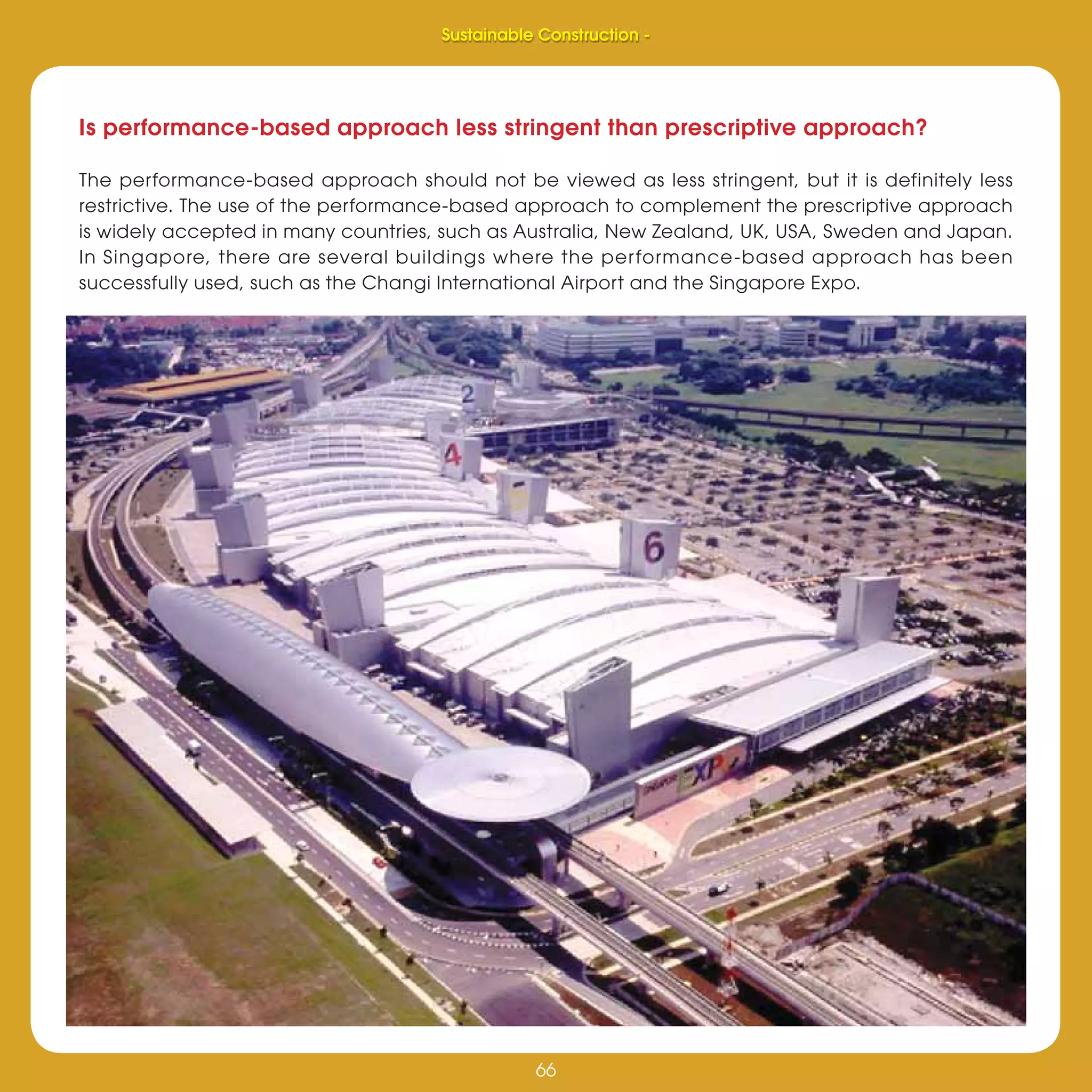
successfully used, such as the Changi International Airport and the Singapore Expo.
Sustainable Construction -
67
Fire Protection and Performance-based Fire Engineering
67
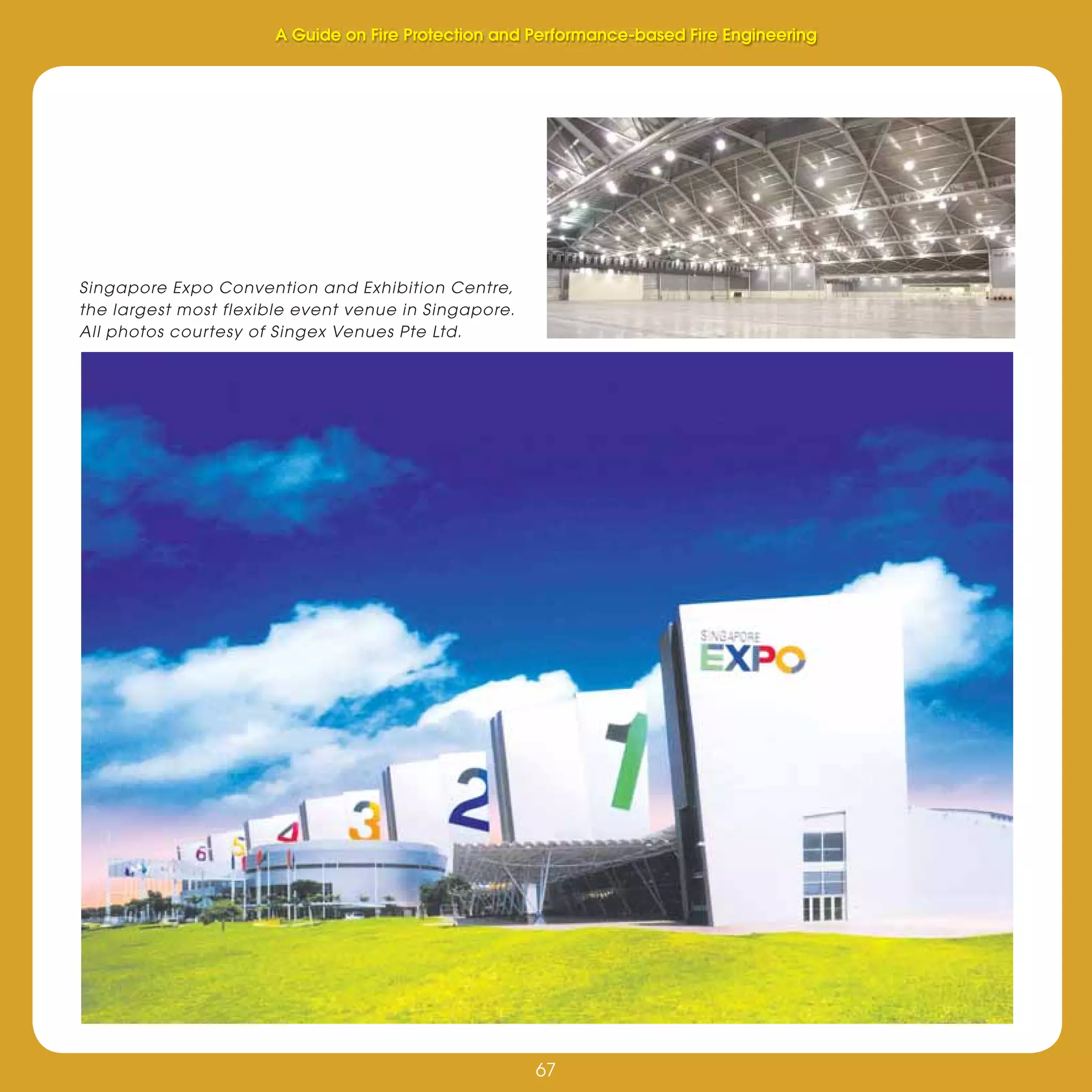
Singapore Expo Convention and Exhibition Centre,
the largest most flexible event venue in Singapore.
All photos courtesy of Singex Venues Pte Ltd.
A Guide on Fire Protection and Performance-based Fire Engineering
68
Sustainable Construction -
68
When should performance-based approach be adopted?
Only registered Fire Safety Engineers (FSEs) are qualified to assess a performance-based design
approach. It is a norm in the industry that the prescriptive approach is used for standard-design
buildings whereas the performance-based approach is for more complex buildings. If there is
possible cost optimisation or design constraints faced when using the prescriptive method, the
decision may then be made to use the performance approach. Ultimately, it is a decision to be
made by the developers and QPs.
Sustainable Construction -
69
Fire Protection and Performance-based Fire Engineering
69
When are the Fire Safety Engineer (FSE) and Peer Reviewer required?
The Building Developer should engage the FSE on the onset of building project involving
performance-based works, during the conceptual design stage, and not as a remedial solution
to resolve deadlocks in the approval process.
The Building Developer should engage the Peer Reviewer only after the FSE has completed his
Fire Safety Engineering Report (FSER), detailed specifications and drawings and the Building
Operations and Maintenance manual (O&M). It is important that the Peer Reviewer does not
participate or interfere with the design process prior to this stage. The Peer Reviewer will make
his comments in his Peer Reviewer’s Report. In the event that the Peer Reviewer has disagreeable
comments on the documents reviewed, the FSE and the Peer Reviewer will need to discuss
objectively to resolve the outstanding issues.
The Project QP is responsible to submit all the mentioned documents to the Relevant Authority
for final plan approval.
A Guide on Fire Protection and Performance-based Fire Engineering
70
Sustainable Construction -
70
Is it mandatory to engage a
Registered Inspector (RI) who is
an FSE for performance-based fire
safety works?
Yes, it is mandatory to engage an RI who
is an FSE for inspection of the completed
performance-based fire safety works. These
RIs are qualified fire safety engineers and
are in a better position to highlight any
irregularities in the fire safety engineering
works that are implemented on-site for a
building.
Is it necessary to engage an FSE to
re-evaluate addition and alteration
works?
For buildings designed to a performance-
based fire safety design, the Building
Owner can refer to the O&M manual
prepared by the orginal FSE. The O&M
manual would spell out the extent of
the performance-based solution in the
building. Based on the information
provided, the Building Owner has the
responsibility to engage an FSE to re-
evaluate addition and alteration works
where necessary.
Sustainable Construction -
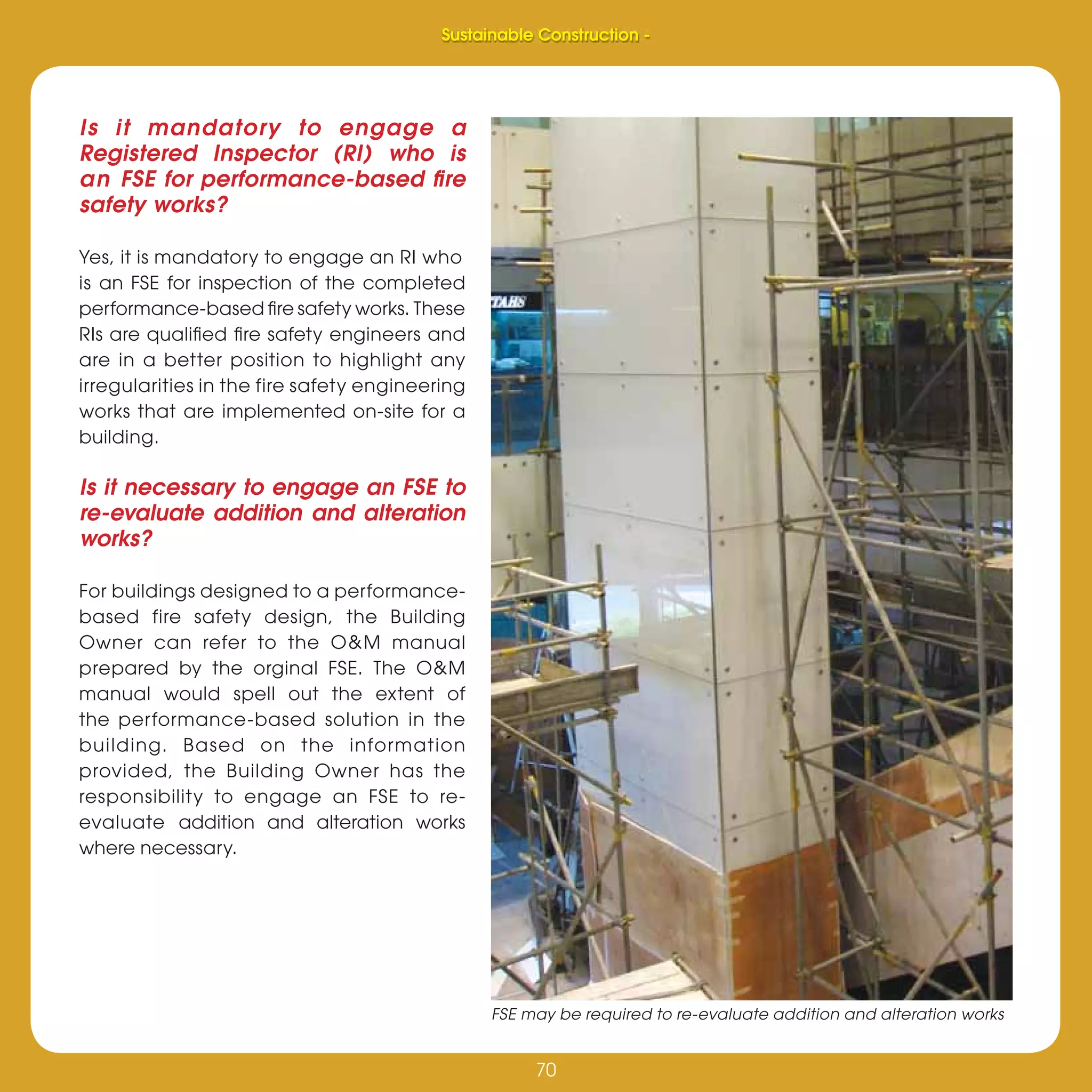
FSE may be required to re-evaluate addition and alteration works
71
Fire Protection and Performance-based Fire Engineering
71
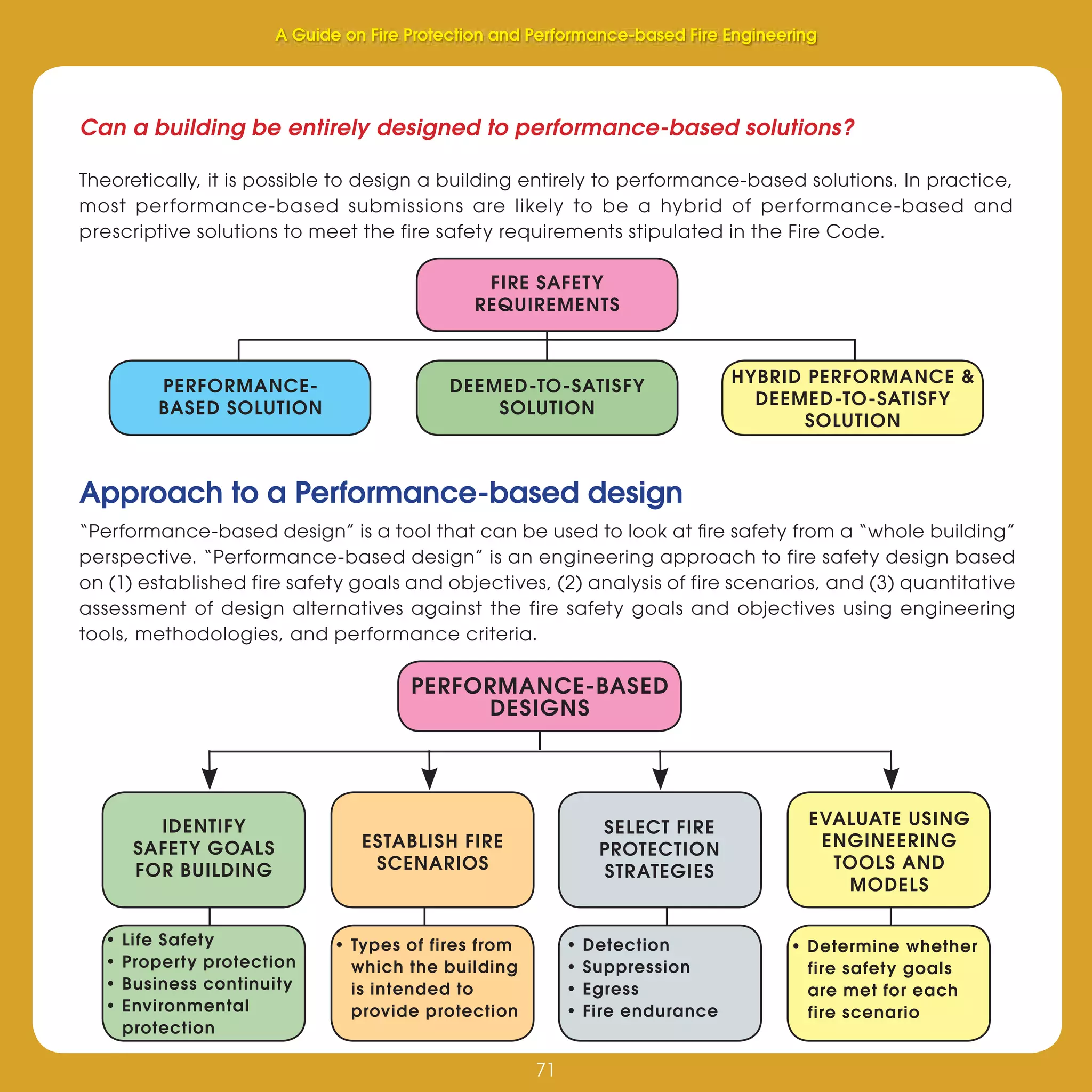
Can a building be entirely designed to performance-based solutions?
Theoretically, it is possible to design a building entirely to performance-based solutions. In practice,
most performance-based submissions are likely to be a hybrid of performance-based and
prescriptive solutions to meet the fire safety requirements stipulated in the Fire Code.
HYBRID PERFORMANCE &
DEEMED-TO-SATISFY
SOLUTION
DEEMED-TO-SATISFY
SOLUTION
PERFORMANCE-
BASED SOLUTION
FIRE SAFETY
REQUIREMENTS
Approach to a Performance-based design
“Performance-based design” is a tool that can be used to look at fire safety from a “whole building”
perspective. “Performance-based design” is an engineering approach to fire safety design based
on (1) established fire safety goals and objectives, (2) analysis of fire scenarios, and (3) quantitative
assessment of design alternatives against the fire safety goals and objectives using engineering
tools, methodologies, and performance criteria.
PERFORMANCE-BASED
DESIGNS
IDENTIFY
SAFETY GOALS
FOR BUILDING
ESTABLISH FIRE
SCENARIOS
SELECT FIRE
PROTECTION
STRATEGIES
EVALUATE USING
ENGINEERING
TOOLS AND
MODELS
• Life Safety
• Property protection
• Business continuity
• Environmental
protection
• Types of fires from
which the building
is intended to
provide protection
• Detection
• Suppression
• Egress
• Fire endurance
• Determine whether
fire safety goals
are met for each
fire scenario
A Guide on Fire Protection and Performance-based Fire Engineering
72
Sustainable Construction -
72
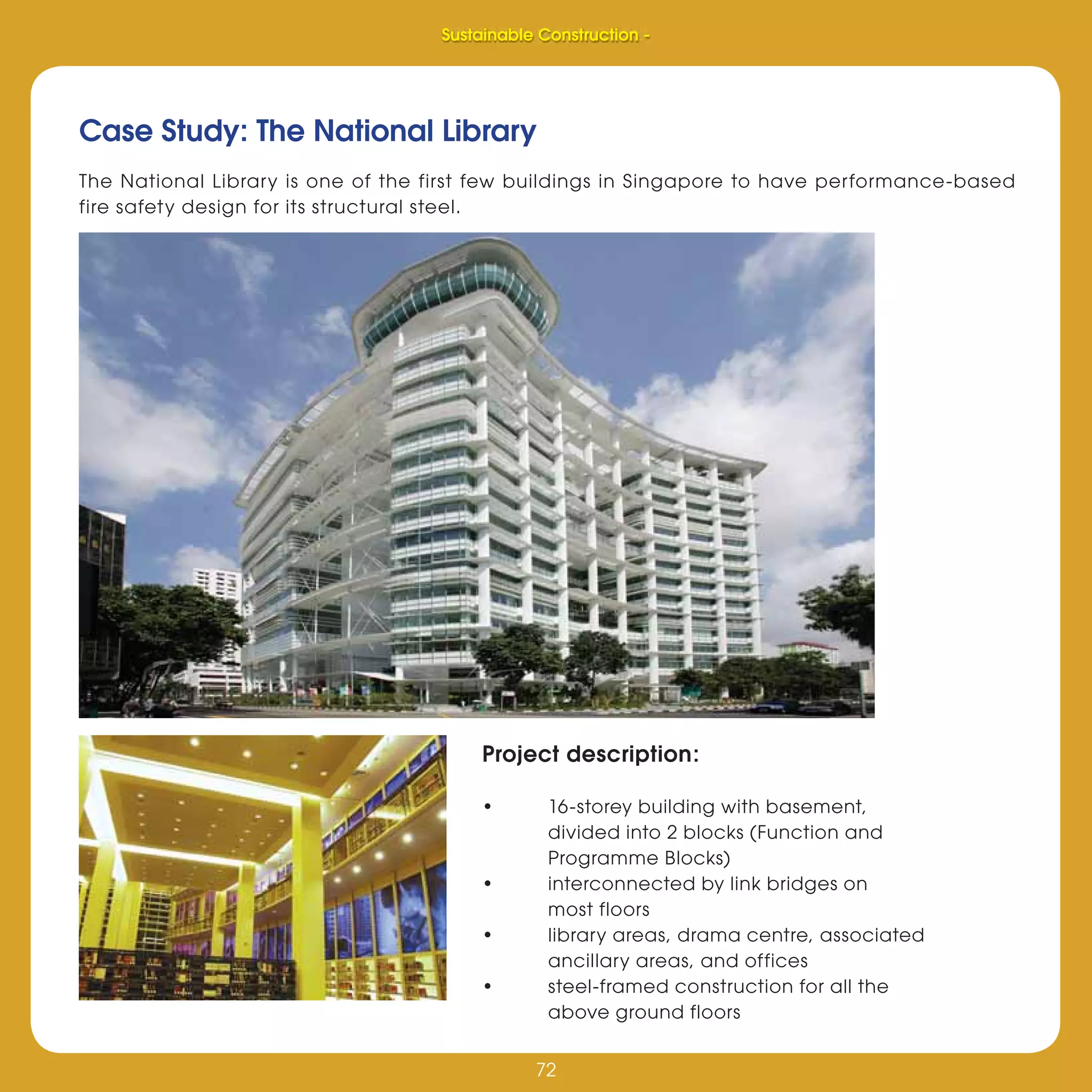
Case Study: The National Library
The National Library is one of the first few buildings in Singapore to have performance-based
fire safety design for its structural steel.
Project description:
• 16-storey building with basement,
divided into 2 blocks (Function and
Programme Blocks)
• interconnected by link bridges on
most floors
• library areas, drama centre, associated
ancillary areas, and offices
• steel-framed construction for all the
above ground floors
Sustainable Construction -
73
Fire Protection and Performance-based Fire Engineering
73
A Guide on Fire Protection and Performance-based Fire Engineering
Fire Scenarios:
• A fire starts in a given building, and
• Occupants fail to extinguish the fire, and
• Automated fire sprinklers fail to control or extinguish the fire, and
• Fire continues to grow, but only on the storey of origin or
on floors connected by a void, until the fire fighters
intervene to control and extinguish it.
In the event that a major fire develops and the automated fire sprinklers fail to control or extinguish
the fire, the performance-based design is to ensure that the structural adequacy of the building frame
is maintained until the fire fighters intervene.
74
Sustainable Construction -
74
The Solution:
The performance-based design allows most of the steel floor beams to be unprotected while
maintaining the building’s structural stability in a fire.
This enabled the bare steel structure to be expressed and enabled cost-effective construction of
the building.
The performance-based solution also allowed the two blocks to face each other with no additional
fixed fire protection systems.
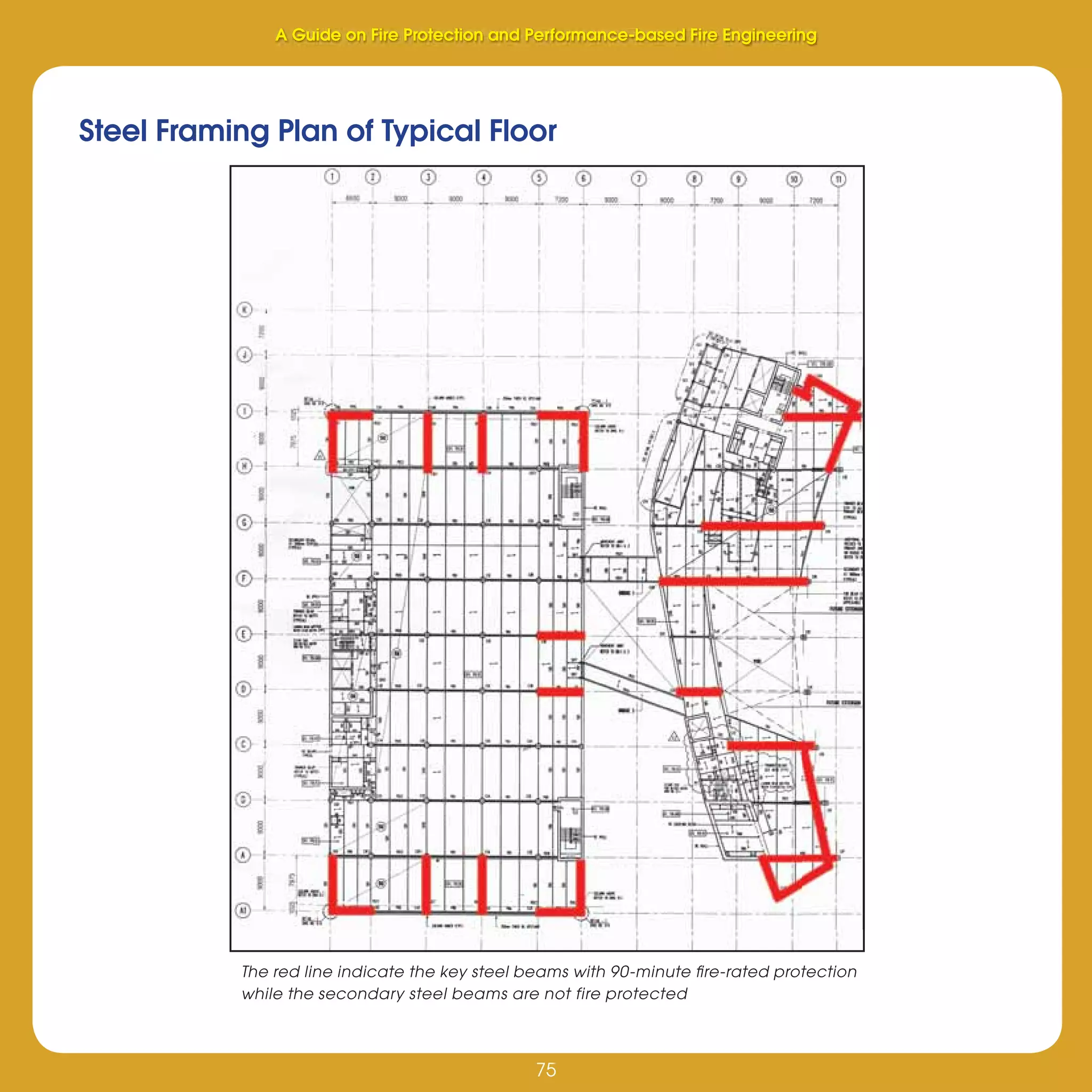
Only selected beams were fire rated. These key steel beams were chosen to be fire-rated for
enhanced safety factor and they generally occur in critical areas like corners of the building or
in long span areas.
The Approach:
Analyse the risk of fire starting in building.
• Check the effectiveness of the automated fire sprinkler system
• Take measures to increase the reliability of the automated fire sprinkler system
• Study the fire growth and compartment fire conditions, taking into consideration
the fire fighters intervention
In terms of structural performance, allow:
• Load-carrying mechanisms for beams and slabs in a structural frame to include
membrane action
• Load redistribution from members
Sustainable Construction -
75
Fire Protection and Performance-based Fire Engineering
75
The red line indicate the key steel beams with 90-minute fire-rated protection
while the secondary steel beams are not fire protected
Steel Framing Plan of Typical Floor
A Guide on Fire Protection and Performance-based Fire Engineering
76
Sustainable Construction -
76
References
The following URLs provide information on fire protection and fire engineering.
Association for Specialist Fire Protection, UK
http://www.asfp.org.uk/index.html
Nanyang Technological University Fire Engineering Research Group
http://www.ntu.edu.sg/cee/research/research_groups/fireresearch/research.htm
Singapore Civil Defence Force
http://www.scdf.gov.sg/Building_Professionals/Fire_Safety_Plan_Approval/performance
/index.html
http://www.scdf.gov.sg/Building_Professionals/Publications/index.html
University of Manchester One-Stop Shop in Structural Fire Engineering
http://www.mace.manchester.ac.uk/project/research/structures/strucfire/
University of Sheffield Fire Engineering Group
http://www.fire-research.group.shef.ac.uk/
Sustainable Construction -
77
Fire Protection and Performance-based Fire Engineering
77
Acknowledgements
This publication was developed with inputs from members of the Working Committee and fire
protection specialists. BCA would like to thank them for their valuable contributions towards the
completion of this Guide.
Members of the Working Committee:
From Building and Construction Authority
Mr Lim Tee Yoke (Chairman)
Ms Goh Siam Imm
Ms Rose Nguan
Ms Phua Hui Chun
From Housing & Development Board Er. Teh Poh Suan
From Nanyang Technological University Assoc Professor Tan Kang Hai
From Singapore Civil Defence Force LTC Philip Tham
Representing Singapore Institute of Architects Mr Song Yew Kee (DP Architects Pte Ltd)
Representing Singapore Structural Steel Society Er. Tay Yak Hong (TYH Consulting Engineers)
BCA would also like to thank the following persons/ organizations for their consent to use their materials
and photographs:
• Arup
• BlueScope Lysaght (Singapore) Pte Ltd
• Boral Plasterboard (M) Sdn Bhd
• Donges Stahlbau GmbH, Germany
• DP Architects Pte Ltd
• Industrial Contracts Marketing (2001) Pte Ltd
• Professor Colin Bailey, University of Manchester
and Mr Gerald Newman, The Steel Construction
Institute
• Promat Building System Pte Ltd
• Singex Venues Pte Ltd
• The Ascott Group
• TTJ Design and Engineering Pte Ltd
• W.R. Grace (Singapore) Pte Ltd
• Yongnam Engineering & Construction Pte Ltd
A Guide on Fire Protection and Performance-based Fire Engineering
78
Sustainable Construction -
78
Photographs/Graphics Credit:
Copyright to photographs and graphics from the following pages are held with the respective
company who has granted permission to BCA for reproduction in this publication.
Company Page
BlueScope Lysaght (Singapore) Pte Ltd 27, 28 and 51 (top)
Boral Plasterboard (M) Sdn Bhd 14
Industrial Contracts Marketing (2001) Pte Ltd 15, 42 (bottom), 55, 56 (bottom left), 59, and 60
Promat Building System Pte Ltd
16, 17, 18, 32, 33, 34 (left), 36, 37, 38, 42 (top left and
top right), 43, 44, 46, 47, 52 (top) and 54 (bottom)
TTJ Design and Engineering Pte Ltd 53 (bottom) and 58 (left)
W.R. Grace (Singapore) Pte Ltd 39, 48 (top), 49 (top) and 51 (bottom)
Yongnam Engineering & Construction (Pte) Ltd 58 (right top and right bottom)
Sustainable Construction -
79
Fire Protection and Performance-based Fire Engineering
79
Copyright @ 2008 Building and Construction Authority, Singapore. All rights reserved. This document or any part thereof
may not be reproduced for any reason whatsoever in any form or means whatsoever and howsoever without the prior
written consent and approval of the Building and Construction Authority.
Whilst every effort has been made to ensure the accuracy of the information contained in this publication, the Building
and Construction Authority, its employees or agents and members of the Working Committee shall not be responsible
for any mistake or inaccuracy that may be contained herein and all such liability and responsibility are expressly
disclaimed by these said parties.
This publication may include information of suppliers who have, in one way or another, contributed to the development
of this publication. The Building and Construction Authority does not endorse the products included. It is the responsibility
of the users to select the appropriate products and ensure the selected products meet their specific requirements.
ISBN 978-981-05-9686-6
a touche design production @ 6743 5450
A Guide on Fire Protection and Performance-based Fire Engineering
Sustainable Construction
- A Guide on Fire Protection and
Performance-based Fire Engineering
5 Maxwell Road, #16-00 Tower Block MND Complex, Singapore 069110 Tel: +65 6325 7720 Fax: +65 6325 4800 Website: www.bca.gov.sg
ISBN 978-981-05-9686-6
Printed on Recycled Paper
SustainableConstruction-AGuideonFireProtectionandPerformance-basedFireEngineering
BCA Sustainable Construction Series - 2

A guide on fire protection_guide

  • 1.
    Sustainable Construction - AGuide on Fire Protection and Performance-based Fire Engineering 5 Maxwell Road, #16-00 Tower Block MND Complex, Singapore 069110 Tel: +65 6325 7720 Fax: +65 6325 4800 Website: www.bca.gov.sg ISBN 978-981-05-9686-6 Printed on Recycled Paper SustainableConstruction-AGuideonFireProtectionandPerformance-basedFireEngineering BCA Sustainable Construction Series - 2
  • 2.
    Sustainable Construction - AGuide on Fire Protection and Performance-based Fire Engineering
  • 3.
  • 4.
    Fire Protection andPerformance-based Fire Engineering Foreword 3 The Building and Construction Authority (BCA) has been working closely with industry partners to promote sustainable construction. Sustainable construction refers to the adoption of building designs, construction methods and materials that are environmentally friendly. It also means using materials and resources that have sustainable supplies and are readily available from many sources. Instead of relying too heavily on raw materials such as sand and granite, we should also consider the adoption of steel, composite materials and other forms of construction such as using drywalls. However one major concern among the building practitioners is the level of fire protection required and the effectiveness of these protective measures. It is therefore important to address these issues and clear the misperceptions that are associated with fire protection for sustainable construction. This publication is timely as the Fire Code had been reviewed and the revised Fire Code was published in June 20 07 to address these concerns. This is the second in the Sustainable Construction series. It aims to provide information on fire safety requirements for buildings adopting steel and other methods of sustainable construction, different passive fire protection methods and the concept of performance-based fire engineering. Special thanks go to the Working Committee members for their time and effort in preparing this publication. I am confident that it will promote a better understanding of fire safety requirements for sustainable construction and serve as a useful guide for all building practitioners. Dr John Keung Chief Executive Officer Building and Construction Authority A Guide on Fire Protection and Performance-based Fire Engineering
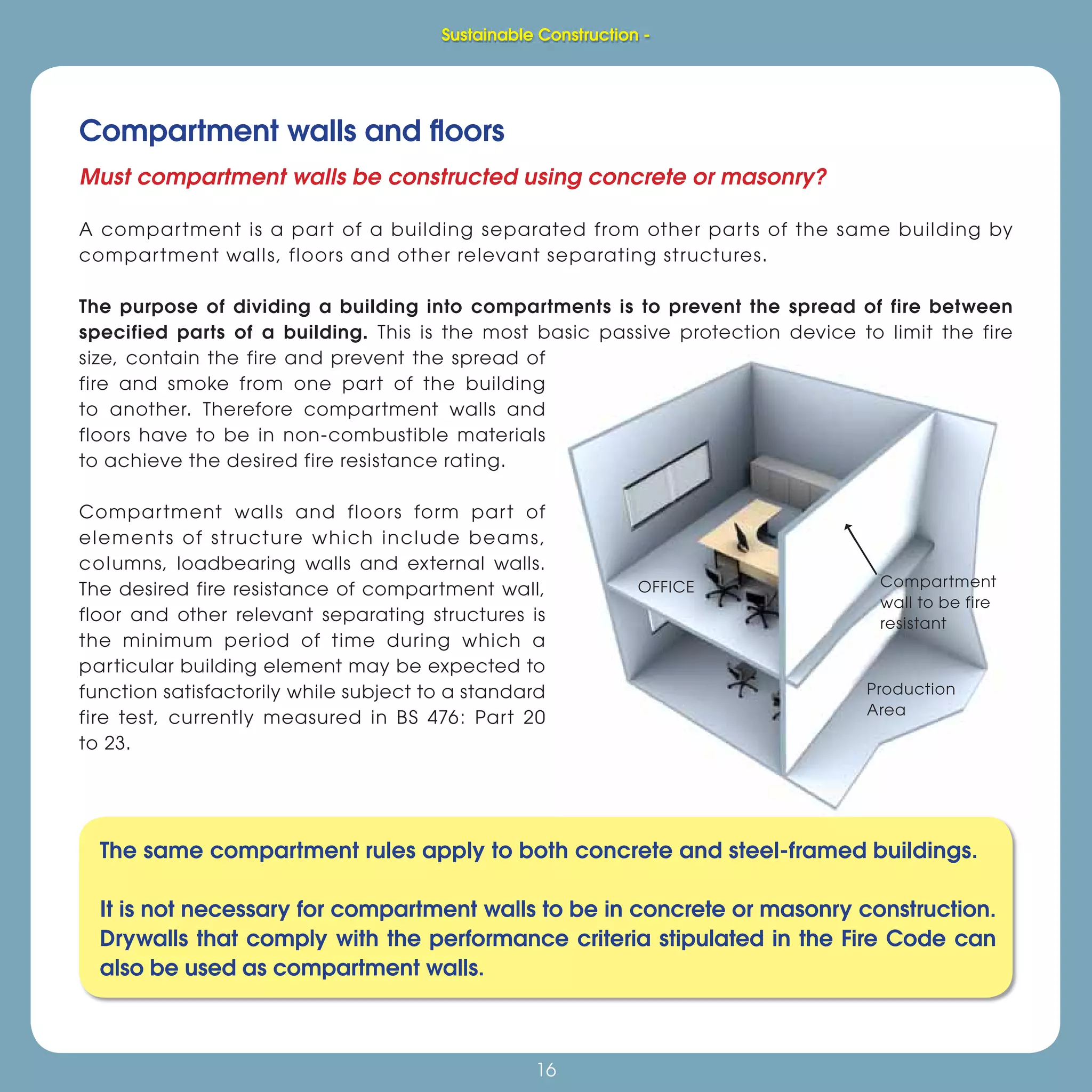
  • 5.
  • 6.
    Fire Protection andPerformance-based Fire Engineering Content 06 Introduction 07 Terminology simply explained 08 Using the Guide 11 Section 1: General Requirements 25 Section 2: Building Elements 39 Section 3: Fire Protection Methods 63 Section 4: Performance-based Approach to Fire Safety Design 76 References 77 Acknowledgements 78 Photographs/Graphics Credit 5 A Guide on Fire Protection and Performance-based Fire Engineering
  • 7.
    6 Sustainable Construction - Introduction TheBuilding and Construction Authority has been actively promoting sustainable construction to the construction industry. Various efforts have been put in place to encourage wider use of sustainable materials and products such as steel, drywalls and recycled materials. One major concern on the use of sustainable construction is the level of fire protection required and the effectiveness of these protective measures. Traditionally, designers follow a set of prescriptive Fire Code requirements in applying the required fire protection. However, in recent years, performance- based fire safety engineering has gained popularity among designers, especially for big and complex buildings as more economic designs can be obtained through analysis and modeling. This Guide attempts to provide useful information on passive fire protection and fire engineering for building practitioners who are involved in the development, design and construction of buildings using sustainable materials. It comprises four sections. Section One explains the general requirements pertaining to fire resistance. Section Two elaborates the application of metal decking system, drywall system, fire-rated ceiling board system and other dry construction. Section Three highlights the different types of passive fire protection and Section Four explains the concept of performance-based fire engineering. Detailed engineering analysis and/or calculations and active fire protection measures such as sprinkler system and mechanical ventilation are beyond the scope of this Guide. Designers are advised to refer to technical journals for comprehensive design and analysis. 6 Sustainable Construction -
  • 8.
    Fire Protection andPerformance-based Fire Engineering 7 Terminology simply explained Combustible Material that burns intensely, or has rapid rate of flame spread. Compartment A part of a building separated from all other parts of the same building by compartment walls and/or compartment floors. A roof space above the top storey of a compartment is included in that compartment. Compartment wall/ compartment floor A wall or a floor which is provided for the purpose of dividing a building into compartments. Cubical extent The cubicle extent of a building or compartment is the volume of space contained within the building or compartment. Fire engineering/ Fire safety engineering A branch of engineering discipline that deals with the application of science and engineering principles to protect people and their environments from the destructive effects of fire and smoke. Fire protection Prevention and reduction of the hazards associated with outbreak of fire. Fire resistance/ Fire rating The minimum period of time during which an isolated structural or non-structural element may be expected to function satisfactorily while subjected to a standard fire test. The standard fire test referred to by the Fire Code is the British Standards BS 476 Part 20 to 23 or its equivalent. Flammable Material quality that could ignite easily when exposed to flame. Relevant Authority Relevant Authority means the Commissioner of Singapore Civil Defence Force and includes officers authorised by him generally or specifically to exercise the powers, functions and duties conferred by the Fire Safety Act. A Guide on Fire Protection and Performance-based Fire Engineering
  • 9.
    8 Using the Guide ThisGuide is divided into 4 sections. Information pertaining to frequently asked questions are listed here for easy reference. SECTION 1: General Requirements Page • What are some of the revisions made to the Fire Code? 12 • Are fire safety requirements more stringent for steel buildings than concrete building? 13 • How to verify that a fire protection system or material has passed the fire resistance test? 14 • Must compartment walls be constructed using concrete or masonry? 16 • Can bare steel structures be used for standalone carpark construction? 20 • What is the minimum requirement of fire resistance for single-storey buildings? 21 • Is submission of fire safety plan to the Relevant Authority required for a landed house? 22 • What is the fire resistance requirement for fully automated mechanised car park? 23 • Do steel-framed buildings require more building inspections for fire protection systems? 24 SECTION 2: Building Elements Page • Is fire protection required for composite metal decking floor system? 27 • Is there any other alternative dry construction for floor systems? 29 • Can drywall systems be used as party walls? 30 • Are combustible materials allowed to be used in external walls? 33 • Can drywalls be used to construct protected shafts? 36 • Are services allowed within the ceiling space if a fire-rated ceiling board system is used to protect bare steel structures? 37 • Is fire protection required for metal roofs? 38 Sustainable Construction -
  • 10.
    9 SECTION 3: FireProtection Methods Page • What are the available methods to fire protect steel-framed buildings? 40-60 • Is modification to a proprietary fire protection system allowed? 42 • What are the ways to achieve a cost-effective fire protection system? 62 Fire-rated boards • Do the fire-rated boards need to be in full contact with the steel element? 43 • Are fire-rated boards suitable for circular steel members? 44 • Is there any restriction to the use of fire-rated board systems? 45 • What are the good practices on storing and handling of fire-rated boards? 46 • Are fire-rated boards allowed at wet areas? 47 Cementitious spray-fireproofing • Can cementitious spray-fireproofing be used for all steel sections? 49 • What are the surface preparation works needed to receive the spray- fireproofing? 50,53 • What are the do’s and don’ts when applying the spray-fireproofing? 51,52 • How can the surface appearance of the spray-fireproofing be improved? 53 Intumescent paint • How does intumescent paint work? 54 • Do bigger steel sections require a thicker coat of intumescent paint? 55 • Can intumescent paint be applied to external areas? 56 • Is there any restriction to the use of intumescent paint? 57 • What are the surface preparation works needed to receive the intumescent paint? 58 • How to verify the thickness of intumescent paint? 60 A Guide on Fire Protection and Performance-based Fire Engineering
  • 11.
    Sustainable Construction - 1010 Abbreviations Thefollowing abbreviations will be used in this publication: ASTM American Society for Testing and Materials BS British Standard Cl. Clause COC Certificate of Conformity CP Code of Practice DOC Declaration of Compliance EC European Code Fire Code Code of Practice for Fire Precautions in Buildings 2007 ISO International Organisation for Standardisation PLS Product Listing Scheme PSB Tüv Süd PSB Pte Ltd QP Qualified Person SS Singapore Standard SECTION 4: Performance-based Approach to Fire Safety Design Page • What is performance-based fire engineering? 64 • What is the rationale of allowing developers/Qualified Persons to choose the type of approach (i.e. prescriptive or performance-based) to fire safety design? 65 • Is performance-based approach less stringent than prescriptive approach? 66 • When should performance-based approach be adopted? 68 • When are the Fire Safety Engineer (FSE) and Peer Reviewer required? 69 • Is it mandatory to engage a Registered Inspector (RI) who is an FSE for performance- based fire safety works? 70 • Is it necessary to engage an FSE to re-evaluate addition and alteration works? 70 • Can a building be entirely designed to performance-based solutions? 71 Sustainable Construction -
  • 12.
    Section 1: General Requirements 11 AGuide on Fire Protection and Performance-based Fire Engineering
  • 13.
    Sustainable Construction - 12 Oneof the main provisions of the Fire Code requires building elements and building materials to achieve the appropriate fire resistance when they formed part of the building compartment. The structural elements of a building are to be constructed with non-flammable or non- combustible materials and with the desired rating in fire resistance. In considering the types of structural materials to be used in a new building, one must know that the minimum period of fire resistance depends on factors such as the usage, floor area, habitable height and cubicle extent of the building. The required fire resistance does not depend on the type of building materials used in the building. Materials such as rubber and wood are combustible. What are some of the revisions made to the Fire Code? One of the major changes to the 2007 revision is the relaxation on the use of fire-rated boards and intumescent paint on structural steel beams and columns. In the earlier version, such methods are allowed for the protection of structural steel beams and columns, provided the building does not exceed 24m in height. For buildings exceeding 24m in height, they are allowed to be used only on beams (excluding transfer beams). In the 2007 revision, fired-rated boards and intumescent paint can be used to protect structural steel columns and beams in all types of buildings with no height restriction imposed. However, in areas that are likely to subject to the risks of explosion or where there is presence of corrosive atmosphere, the QP should consult the Relevant Authority. Sustainable Construction -
  • 14.
    Fire Protection andPerformance-based Fire Engineering 13 Are fire-safety requirements more stringent for steel buildings than concrete buildings? The fire-safety requirements are similar for both types of buildings. The only difference is the method of protection which depends on whether the building is constructed using steel or concrete. Fire resistance is a property of a particular building element which measures its ability to resist the spread of fire through the material characteristics of • stability (resistance to collapse or excessive deflection); • integrity (resistance to passage of flames and hot gases); and • insulation (resistance to excessive temperature rise on exposed face). Usually, fire resistance of a building element is expressed in terms of the minimum period of time during which the building element would function satisfactorily while subject to a standard fire test, measured in BS 476: part 20 to 23. It is the onus of the designer to accord additional and appropriate level of fire protection to materials used in the building which do not meet the required rating of fire resistance. A Guide on Fire Protection and Performance-based Fire Engineering
  • 15.
    Sustainable Construction - 14 Howto verify that a fire protection system or material has passed the fire resistance test? All testing of non-combustible materials and fire-rated construction have to be certified under the Product Listing Scheme (PLS) managed by an Accreditation Body. Currently in Singapore, the PLS is managed by Tüv Süd PSB Pte Ltd (formerly known as PSB Corporation). These listed fire-rated building materials/systems are usually proprietary systems that have undergone vigorous fire tests to ensure that they are able to function satisfactorily in events of a real fire. Some examples are fired-rated partition system and fire- rated ceiling board system. A partition system would consist of the steel stud frames with plaster (or gypsum) boards of certain thickness and sound insulation material (such as rockwool). A fire-rated ceiling board system would consist of the ceiling board hangers, the ceiling board and sound insulation material. Therefore, anyone who intends to use a fire-rated material/ system should check with the manufacturers to ensure that the complete system is adopted. Any building material/system that is intended for fire safety works listed under the PLS and used in compliance with the requirements stipulated in the Fire Code, would be deemed to be acceptable to the Relevant Authority. No separate approval is required. The said scheme took effect from 1 April 1998. The following URL provides more information about the PLS: http://www.tuv-sud-psb.sg/testing/prodcert_prodlist.shtml Sustainable Construction -
  • 16.
    Fire Protection andPerformance-based Fire Engineering 15 Products listed in the PLS will be granted a Certificate of Conformity (COC) by PSB. This is a product-based certificate that is given to each individual product. For instance, a supplier who has 3 types of products listed in the PLS will have 3 COCs. The Declaration of Compliance (DOC) is a project- based document that is given to each individual project after the application of the listed product. For instance, after the application of intumescent paint onto a building, the manufacturer/applicator will apply to PSB for a DOC. SAMPLE SAMPLE ABC Company 123 XYZ Road Singapore 999999 A Guide on Fire Protection and Performance-based Fire Engineering
  • 17.
    16 Sustainable Construction - 16 Compartmentwalls and floors The same compartment rules apply to both concrete and steel-framed buildings. It is not necessary for compartment walls to be in concrete or masonry construction. Drywalls that comply with the performance criteria stipulated in the Fire Code can also be used as compartment walls. Sustainable Construction - Must compartment walls be constructed using concrete or masonry? A compartment is a part of a building separated from other parts of the same building by compartment walls, floors and other relevant separating structures. The purpose of dividing a building into compartments is to prevent the spread of fire between specified parts of a building. This is the most basic passive protection device to limit the fire size, contain the fire and prevent the spread of fire and smoke from one part of the building to another. Therefore compartment walls and floors have to be in non-combustible materials to achieve the desired fire resistance rating. Compartment walls and floors form part of elements of structure which include beams, columns, loadbearing walls and external walls. The desired fire resistance of compartment wall, floor and other relevant separating structures is the minimum period of time during which a particular building element may be expected to function satisfactorily while subject to a standard fire test, currently measured in BS 476: Part 20 to 23.
  • 18.
    17 Fire Protection andPerformance-based Fire Engineering 17 Compartmentation requirements for different types of buildings For residential buildings, compartment walls and floors have to be provided to separate a residential unit or maisonette from any other parts of the same building. Each residential unit has to be compartmented with a minimum one-hour fire resistance. However, higher fire resistance ratings prevail: • if the wall forms part of the protected shaft which requires more than one-hour fire resistance, OR • if the wall separates the residential section from the section of another purpose group that requires more than one-hour fire resistance. For a building that houses different purpose groups within the same building, provision of compartmentation is required because of the dissimilar risk of the rooms and spaces. If it is necessary to provide doors at the compartment wall, the doors are required to have the same fire rating as the walls, unless otherwise stated and permitted under the Fire Code. Residential Unit Residential Unit Residential Unit Residential Unit Compartment Walls & Floors Production Area Office Store Compartment Walls Compartments of different purpose groups f g A Guide on Fire Protection and Performance-based Fire Engineering
  • 19.
    18 Sustainable Construction - 18 Forhotels, each hotel bedroom is to be enclosed with one-hour fire resistant construction. This requirement is to protect against fire and smoke spreading into sleeping quarters and the risk of fire starting within the privacy of bedrooms and spreading to other parts of the building. As internal corridors are requisite means of escape, the internal corridor has to be compartmented from hotel bedrooms with one-hour fire rated compartment walls and half-hour fire doors. Hotel Bedroom s 1 Hour Fire-Rated Walls Half Hour Fire Doors C om partm ent W alls f g Sustainable Construction -
  • 20.
    19 Fire Protection andPerformance-based Fire Engineering 19 Workers’ dormitories have similar fire resistance requirements as hotels, i.e. each dormitory bed- room has to be enclosed with one-hour fire resistant construction while the internal corridor has to be compartmented from dormitory bed- rooms with one-hour fire resistant compartment walls and half-hour fire doors. However, as cooking facilities are provided at the workers’ dormitory, the kitchen has to be enclosed with one-hour fire resistant construction and half-hour fire doors, and is not permitted to be located within the dormitory bedroom. A Guide on Fire Protection and Performance-based Fire Engineering
  • 21.
    20 Sustainable Construction - 20 Canbare steel structures be used for standalone carpark construction? Standalone carparks may be constructed with bare steel structures, provided that they satisfy the stipulated conditions in the Fire Code. For standalone steel carparks, the steel sections must comply with BS 5950 Part 8 or EC-3 Part 1-2 and all the floor beams are to be designed as composite structure within the floor slab. Standalone steel carpark at Club Street Lilienthal multi-storey carpark, Hamburg, Germany Constructor, fabricator and erector of steelworks: Donges Stahlbau GmbH Sustainable Construction -
  • 22.
    21 Fire Protection andPerformance-based Fire Engineering 21 What is the minimum requirement of fire resistance for single-storey buildings? For single-storey buildings, the minimum period of fire resistance for elements of structure can be half an hour, provided that they satisfy the stipulated conditions in the Fire Code. The Ascott Group’s learning hub, Ascott Centre for Excellence A Guide on Fire Protection and Performance-based Fire Engineering
  • 23.
    22 Sustainable Construction - 22 Issubmission of fire safety plan to the Relevant Authority required for a landed house? Fire safety plan proposals for small residential developments like detached, semi-detached, terraced and linked houses which do not exceed 3 storeys or levels (including basement and attic) are not required to be submitted to the Revelant Authority for approval as provided for under the Fire Safety (Exemption) Order 1994. The above exemption, however, does not mean that the QPs (Architects) need not comply with the relevant fire safety requirements in the Fire Code. The fire resistance requirement for such residential houses is usually half an hour for structures above ground and one hour for structures below ground. The QPs are to self-regulate and ensure that: (1) The buildings are designed with proper means of escape (2) Walls and floors are constructed of non-combustible materials, unless otherwise permitted in attics (3) Separating walls between units are properly constructed to prevent fire spread It is important to note that such detached, semi-detached, terraced or linked houses refer to houses meant for single family occupation only. Small residential developments having more than 3 levels and townhouses are not covered by the Fire Safety (Exemption) Order 1994. Hence, SUB- MISSION OF FIRE SAFETY PLANS TO THE RELEVANT AUTHORITY IS REQUIRED. Sustainable Construction -
  • 24.
    23 Fire Protection andPerformance-based Fire Engineering 23 The fully automated mechanised car park (FAMCP) incoporates the revolutionary concept of parking and retrieving a vehicle by mechanical means without the driver entering the parking area. The FAMCP is classified as a storage building under the Fire Code. Fire resistant walls/floors have to be provided to separate the FAMCP from other usage if it is connected to another building. The separating walls/floors are required to have a fire resistance of two hours. Other external walls (if required) need to have a minimum one-hour fire resistance. What is the fire resistance requirement for fully automated mechanised carpark? A Guide on Fire Protection and Performance-based Fire Engineering
  • 25.
    24 Do steel-framed buildingsrequire more building inspections for fire protection systems? Under the current Fire Safety Act, public buildings such as offices, hospitals and shopping complexes with an occupant load of more than 200 persons, as well as industrial buildings that fall within the stipulated criteria, are required to obtain a Fire Certificate. This Fire Certificate has to be renewed yearly. Prior to the application or renewal of the Fire Certificate, inspection has to be carried out to ensure that fire safety systems and measures are properly main- tained and in good working condition. This requirement is the same for buildings constructed using steel or concrete. Generally the list of items to be inspected includes active fire protection measures such as sprinkler system and emergency power supply. It also includes passive fire protection systems such as fire-rated boards, spray-on materials and intumescent paints. Public buildings such as offices with occupant load of more than 200 persons are required to obtain the Fire Certificate. Sustainable Construction -
  • 26.
    25 Fire Protection andPerformance-based Fire EngineeringFire Protection and Performance-based Fire Engineering 25 Section 2: Building Elements 25 A Guide on Fire Protection and Performance-based Fire Engineering
  • 27.
    26 Sustainable Construction - 26 Theelements of structure – structural frame, loadbearing walls, floors, external walls, separating walls, compartment walls and protecting structure must have a minimum period of fire resistance rating. Concrete and masonry construction are readily accepted when they are constructed according to “deemed to satisfy” provisions with appropriate covers. For steel frame structures, they can be designed in composite con- struction to exploit the inherent fire resistance of the steel structures (please refer to page 61 for a quick guide). The overall stability of the steel or composite frame will have to be checked at the fire limit state if a fire-resistant design is adopted. In cases when designing in composite is not possible, protection such as fire-rated boards, cementitious spray-fireproofing or intumescent paint can be used to achieve the required fire resistance. Section 3 will provide more details of the various types of fire protection. STRUCTURAL FRAME Sustainable Construction -
  • 28.
    27 Fire Protection andPerformance-based Fire Engineering 27 FLOORS • Metal deck with concrete topping The metal deck together with the concrete topping acts as a composite slab member. The slab is usually supported by steel beams. As the metal deck is usually galvanized, designers would need to ensure that any applied fire- proofing (if necessary) is compatible with the galvanizing. Some metal deck systems allow attachment of suspended loads to the underside of the metal deck. Designers would need to check with the manufacturers on the type of fasteners to be used to support fittings such as pipes and ducting. Service (Pipe/Ducting) Threaded Rod Bon-Nut A Guide on Fire Protection and Performance-based Fire Engineering
  • 29.
    28 Sustainable Construction - 28 Isfire protection required for composite metal decking floor system? Metal deckings that have been listed as fire rated floor systems under the Product Listing Scheme DO NOT require additional fire protection. These systems have been tested together with the concrete topping as a composite slab and can achieve the required fire resistance. Fire protection would be required for any other non-listed metal decking systems. Another situation where the metal deck does not require fire protection is when the metal deck is used as a permanent formwork and does not form part of the design of the slab. Sustainable Construction -
  • 30.
    29 Fire Protection andPerformance-based Fire Engineering 29 Another alternative to achieve dry construction for floors is to use fibre cement floor boards. These boards are supported on steel sections such as C-channels without any concrete topping. Cement screed can be added for tiling purpose. Designers should note that the entire design of the building should satisfy the fire safety requirements of the Fire Code. Is there any other alternative dry construction for floor system? A Guide on Fire Protection and Performance-based Fire Engineering
  • 31.
    30 Sustainable Construction - 30 WALLS •Drywall System In recent years, many forward-looking developers have used the dry wall system as internal partition walls for residential projects. The dry wall system consists of dry boards (non-combustible plaster boards or fibre cement boards) attached to metal studs and sound-insulated by rockwool. Can drywalls be used as party walls? Drywall system can also be used as a compartment wall or party wall separating 2 dwelling units, provided that it meets the fire resistance requirement. Designers should select drywall systems that are certified under the PLS. Drywalls can also be used to construct protected shafts, provided that they meet the performance criteria of: Water Absorption and bending strength (BS 1230 Pt 1 – gypsum plaster board) (ISO 1896 – calcium silicate/ cement board) For use in lift shafts, the drywall system has to meet an additional requirement of cyclic loading and dynamic test as specified under Cl. 3.3 of Building Code of Australia Specification C 1.8. Impact (BS 5588 Pt 5 Appendix A) Deflection (BS 5234 Pt 2) Sustainable Construction -
  • 32.
    31 Fire Protection andPerformance-based Fire Engineering 31 Joints to be staggered Fasteners Pack Wall track 1 layer Plasterboard each face Acoustic insulation if required Studs Wall track Typical Drywall System A Guide on Fire Protection and Performance-based Fire Engineering
  • 33.
    32 Sustainable Construction - 32 Thinwall finish of maximum 1 mm thick onto non-combustible substrate need not be subjected to surface flame spread requirements. Thin veneers and wall papers / coverings which are 1 mm thick (or less) and bonded to non- combustible surface (such as drywalls) need not be tested for surface flame spread. Sustainable Construction -
  • 34.
    33 Fire Protection andPerformance-based Fire Engineering 33 Are combustible materials allowed to be used in external walls? External walls located within 1 m of boundaries or exceeding 15 m in height have to be of non- combustible construction and meet the fire-rating requirements of external walls. Any beam or column forming part of an external wall has to be constructed of non-combustible material as well. External wall to be of non-combustible construction Boundary Line/Wall Distance of external wall from boundary is less than 1.0m External wall to be of non-combustible construction External walls need not be in concrete or masonry construction. Dry construction is permitted, provided that it satisfies the fire resistance and other stipulated requirements. 15m A Guide on Fire Protection and Performance-based Fire Engineering
  • 35.
    34 Sustainable Construction - 34 Materialslike timber can be used as external wall systems provided that the external wall is situated 1 m or more from the relevant boundary and the building does not exceed 15 m in height. The setback of 1 m or more from the boundary is to prevent fire spreading from one building to another. Designers who intend to use any form of plastic material as external walls system would need to seek approval from the Relevant Authority. Residential building not exceeding 3 storeys Boundary Line Distance of external wall from boundary is more than 1m This relaxation of rule comes with a condition: The external walls must be provided with minimum period of 15 minutes insulation (method of fire exposure - from inside the building) under BS 476: Parts 20 to 23. Wooden louvres at external wall allowed for buildings < 15 m in height and the external wall 1 m or more from boundary Sustainable Construction -
  • 36.
    35 Fire Protection andPerformance-based Fire Engineering 35 Unprotected openings in external walls refer to windows, doors or other openings, and any part of the external wall which has non- fire-rated cladding attached to its external face. Unprotected openings are required to be determined and limited to prevent radiant heat from causing fire to start in adjacent buildings. This rule is normally applied to buildings close to boundaries or when adjacent buildings are within close proximity. Appropriate setback distance of buildings from relevant boundaries may be computed as prescribed in the Fire Code. Unprotected openings, such as windows and curtainwall cladding A Guide on Fire Protection and Performance-based Fire Engineering
  • 37.
    36 Sustainable Construction - 36 Candrywalls be used to construct protected shafts? Protected shafts must be constructed of non-combustible materials. Traditionally bricks or reinforced concrete walls are used to construct such shafts. Sustainable materials such as drywalls can also be used to construct the protected shafts provided they are designed to meet the performance criteria stipulated in the Fire Code. A protected shaft is one which enables persons, objects or air to pass from one compartment to another without loss of integrity. Protected shafts can be : • An exit staircase, • An exit passageway, • A lift, • A chute, or • A duct. Protected Shafts Protected shaft may penetrate compartment floor Compartment floor Sustainable Construction -
  • 38.
    37 Fire Protection andPerformance-based Fire Engineering 37 Ceilings For a steel-framed building, fire- rated ceiling board system can be installed to provide the required fire resistance for bare steel structures. Are services allowed within the ceiling space if a fire-rated ceiling board system is used to protect bare steel structures? In such cases, no ducting is permitted within the space above the fire resistant suspended ceiling (which forms part of the fire resistant floor ceiling system) unless the ducting is also fire protected. Bare Steel Beam Mineral Wool Steel Hanger Fire Rated Ceiling Board Slab Services in ceiling space are prohibited unless fire protected Fire-rated ceiling contributes to fire resistance of floor XXXX A Guide on Fire Protection and Performance-based Fire Engineering
  • 39.
    38 Sustainable Construction - 38 Howeverfor buildings of different heights that abut each other, 5m width of the roof over the lower part requires 1 hour fire resistance OR 9m height of the external wall abutting the lower area requires at least 1 hour fire resistance. This is to prevent vertical spread of fire through the roof from the lower part of the building to the higher part. In such cases, fire-rated ceiling board system can be used to provide the necessary fire protection. Is fire protection required for metal roofs? For standalone buildings, the metal roof need not be fire protected. Minimum 9m of external wall to be fire-rated Minimum 5m of roof to be fired-rated Sustainable Construction -
  • 40.
    39 Fire Protection andPerformance-based Fire Engineering Section 3: Fire Protection Methods 39 A Guide on Fire Protection and Performance-based Fire Engineering
  • 41.
    40 Sustainable Construction - 40 Whatare the available methods to fire protect Steel-framed buildings? In buildings, fire protection entails a series of measures that lead to the provision of escapes, compartments and suppression systems to either prevent or mitigate an outbreak of fire. A wide range of materials and products are available to protect structural steelwork from fire. An appropriate type of protection can be selected based on the needs of the development. The fire protection system can be applied using the profile, box and solid methods. Steel beams that are designed as a composite section with the slab usually require a three-sided protection. Vertical members such as columns usually require a four-sided protection. Protection technique for three-sided protection Protection technique for four-sided protection Profile Box Solid Profile Box Solid Sustainable Construction -
  • 42.
    41 Fire Protection andPerformance-based Fire Engineering 41 Traditionally, designers would provide the fire protection in accordance to the prescriptive fire code. Concrete encasement or concrete infill of hollow steel sections, is one such method of fire protection for structural steelwork. The advantages of concrete encasement are: ✓ durable and robust; used mostly in cases where resistance to impact damage, abrasion and weather exposure are important ✓ elements can be designed as composite members to enhance the load resistance The disadvantages are: ✕ building weight increases considerably due to thick encasement ✕ time consuming at site to carry out encasement works ✕ overall section size can be quite large for concrete encasement compared to bare steel and other systems A Guide on Fire Protection and Performance-based Fire Engineering
  • 43.
    42 Sustainable Construction - 42 Besidesconcrete encasement and concrete infill of hollow steel sections, there are other fire protection systems such as fire-rated boards, spray-on materials and intumescent paint to enhance the fire resistance of structural steel members. Fire-Rated Board Intumescent paint Most of these fire protection systems are proprietary systems fire-tested in approved laboratories according to standards stipulated by the Relevant Authority, before they can be listed in the PLS. The fire tests are carried out on a mock-up that is built for the purpose of testing. Therefore the protection system applied at site must be similar to the set-up of the mock-up. For instance, the intumescent paint primer used at the site must be the same as the one used in the mock-up fire test. Hence, if the proprietary systems have to be modified to suit the project, the system has to be re-tested at an approved laboratory. Mock-up of fire test Sustainable Construction - Is modification to a proprietary fire protection system allowed?
  • 44.
    43 Fire Protection andPerformance-based Fire Engineering 43 Fire-Rated Board Systems Fire-rated board systems that meet the required fire resistance rating are permitted to be used for protection to structural steel beams and columns in buildings. Such boards are usually made from calcium silicate or gypsum plaster and are used for cladding steelworks. The boards may vary from 15 mm to 30 mm thick and can provide up to 4 hours of fire-rating. Joints to be filled with non-combustible materials such as gypsum or cement grout Jointing and Fixing Proprietary board systems (including the framing and fixing details) must be installed in accordance with the manufacturer’s specifications. Do the fire-rated boards need to be in full contact with the steel element? The fire-rated boards need not be in full contact with the steel element. Gaps between the board and steel element are allowed. However, all board joints should be filled with non-combustible materials such as gypsum or cement grout. The purpose of the joint filling is to provide support to the boards to prevent them from being damaged due to impact. A Guide on Fire Protection and Performance-based Fire Engineering
  • 45.
    44 Sustainable Construction - 44 Fire-RatedBoard Systems Are fire-rated boards suitable for circular steel members? Fire-rated boards can also be used to clad circular steel members and any other non-standard steel members. Architectural Treatment a) Corner Reinforcement Corner beads made of rigid vinyl create a rust-proof, dent-resistant finished corner. The exposed nose of the bead helps to prevent damage from impact and provides a screed for finishing. It provides a key for the jointing compound and eliminates shadowing and edge cracking. b) Control Joint The purpose of the control joint is to relieve stresses of expansion and construction across the joint in large wall areas. Materials such as rolled formed zinc with perforated flangers may be used for this purpose. c) Joint Compound All purpose ready-mixed joint com- pound may be used. Sustainable Construction -
  • 46.
    45 Fire Protection andPerformance-based Fire Engineering 45 Fire-Rated Board Systems Is there any restriction to the use of fire-rated board systems? The Fire Code does not restrict the use of fire-rated boards for any particular type of building. The advantages of fire-rated boards are: ✓ easy to install in a dry process ✓ easy to finish with decorative materials The disadvantages are: ✕ holes cut into the board (e.g. for services) have to be filled with a compatible fire protection material. ✕ Gypsum plasterboard will lose its insulation property after a fire, so replacement is likely to be required. CORROSIVE However, fire-rated boards should not be used to protect structural steel in industrial areas which may be subjected to accidental blasts as the boards may be displaced by the force of the blast. If QPs intend to use the fire-rated boards at areas where corrosive atmosphere may be present, they are to consult the Relevant Authority. A Guide on Fire Protection and Performance-based Fire Engineering
  • 47.
    46 Sustainable Construction - 46 Whatare the good practices on storing and handling of fire-rated boards? Store the boards flat and clear of the ground Protect the boards from weather. Use additional coverings, even if the boards are already in provided packing. Fire-Rated Board Systems It is recommended that pallets stack to a maximum height of 800 mm high and on firm level ground. If two or more pallets are stacked, the total stack height should not exceed 3200 mm. Sustainable Construction -
  • 48.
    47 Fire Protection andPerformance-based Fire Engineering 47 Fire-Rated Board Systems Limitations Wherever possible, always lift boards from the stack below rather than slide board on board. This will prevent damage or scratches to the lower boards. Always carry the boards on edge but do not store on edge. Are fire-rated boards allowed at wet areas? Generally, boards are not recommended to be used for fire protection of external steelworks, at areas that are permanently wet, or in areas of high humidity. A Guide on Fire Protection and Performance-based Fire Engineering
  • 49.
    48 Sustainable Construction - 48 Cementitiousspray-fireproofing Cementitious spray applied fireproofing is a form of plaster which requires only addition of water at site to form a consistent, pumpable slurry. It is then conveyed by pumping and dispersed onto building structures by compressed air at the spray nozzle. All these products are factory-mixed formulations consisting of dry ingredients including aggregates or fibres, gypsum or Portland cement, and other binders. There are a number of spray-applied fireproofing products available in the market. Some products possess fast-setting characteristics that facilitate higher field application efficiency. The fire rating performance of these products is verified through a series of fire tests. Therefore, for the same fire rating requirement, the spray thickness would vary according to the product manufacturer’s specifications. Environmental conditions such as humidity, temperature and abrasion will affect the working life of the spray-on system, and these points have to be considered by the designer. Sustainable Construction -
  • 50.
    49 Fire Protection andPerformance-based Fire Engineering 49 Cementitious spray-fireproofing Can cementitious spray-fire- proofing be used for all steel sections? Cementitious spray-fireproofing can be used on structural steel columns, beams, joists, trusses, floor and roof decking. However, for application on columns, the spray-on material will be more susceptible to damage during construction, fitting-out or maintenance. Therefore the site personnel should exercise care to ensure that the applied protection remains in place. The advantages of spray-fireproofing are: ✓ Lower cost compared with other passive fire protection system ✓ Easy to apply onto complicated detailing and connections ✓ Quicker in application through spraying ✓ Higher productivity for fast-setting versions The disadvantages are: ✕ Application method is wet, and can be messy when the building is in use ✕ Compared to architectural finishes, the resulting textured surface finish is not as aesthetically pleasing ✕ Spray-on material needs to be protected from damage during construction, fitting-out or renovations ✕ Not suitable for off-site application due to the risk of damaging the protection during transportation and erection A Guide on Fire Protection and Performance-based Fire Engineering
  • 51.
    50 Sustainable Construction - 50 Cementitiousspray-fireproofing Before spraying, the steel to be fire protected has to be free of oil, grease, excess rolling compounds or lubricants, loose mill scale, excess rust, non-compatible primer or any other substance that will impair proper adhesion. A bonding agent may be required to be applied to the steel substrates to receive the spray fireproofing. Designers should check with the product manufacturer on the requirement. What are the surface preparation works needed to receive the spray-fireproofing? rr Bonding Agent Sustainable Construction -
  • 52.
    51 Fire Protection andPerformance-based Fire Engineering 51 Cementitious spray-fireproofing What are the do’s and don’ts when applying the spray-fireproofing? To prevent damage to the spray-fire- proofing, fireproofing to the underside of roof deck assemblies should start only after roofing application is complete and there is no more roof traffic. Similarly, fireproofing application works should be carried out after the completion of concrete work on steel decking. A Guide on Fire Protection and Performance-based Fire Engineering
  • 53.
    52 Sustainable Construction - 52 Installationof services such as ducts, piping, equipment or other suspended items should be done AFTER the fireproofing is completed and inspected. Cementitious spray-fireproofing Installation of trades such as clips, hangars, support sleeves, and other attachments which are required to penetrate the fire- proofing should be done BEFORE the application of the fireproofing material. BEFORE AFTER Sustainable Construction -
  • 54.
    53 Fire Protection andPerformance-based Fire Engineering 53 Cementitious spray-fireproofing How can the surface appearance of the spray-fireproofing be improved? 1. Hand troweling may be applied to some spray- applied fireproofing products to improve the surface appearance of the products. 2. Surface decorative paint may be used as an overspray on spray-applied fireproofing products for sealing, surface colouring or to increase light reflection. Other important considerations: a) Primed/Painted Steel Substrates Spray-fireproofing obtains its maximum bond when applied to unprimed/unpainted structural steel. Priming of interior structural steel is generally unnecessary. The use of non-compatible primer may result in bond failure. Designers should consult the product manufacturer for guidance. b) Experienced fireproofing applicators To ensure the fireproofing is properly carried out, it is recommended that the manufacturer confirm the applicator has been properly trained and has the experience to meet the qualification of an approved applicator for the spray-fireproofing product. c) Track records The applicator and manufacturer are to provide a list of local project references for review by the designers. Unpainted steel member A Guide on Fire Protection and Performance-based Fire Engineering
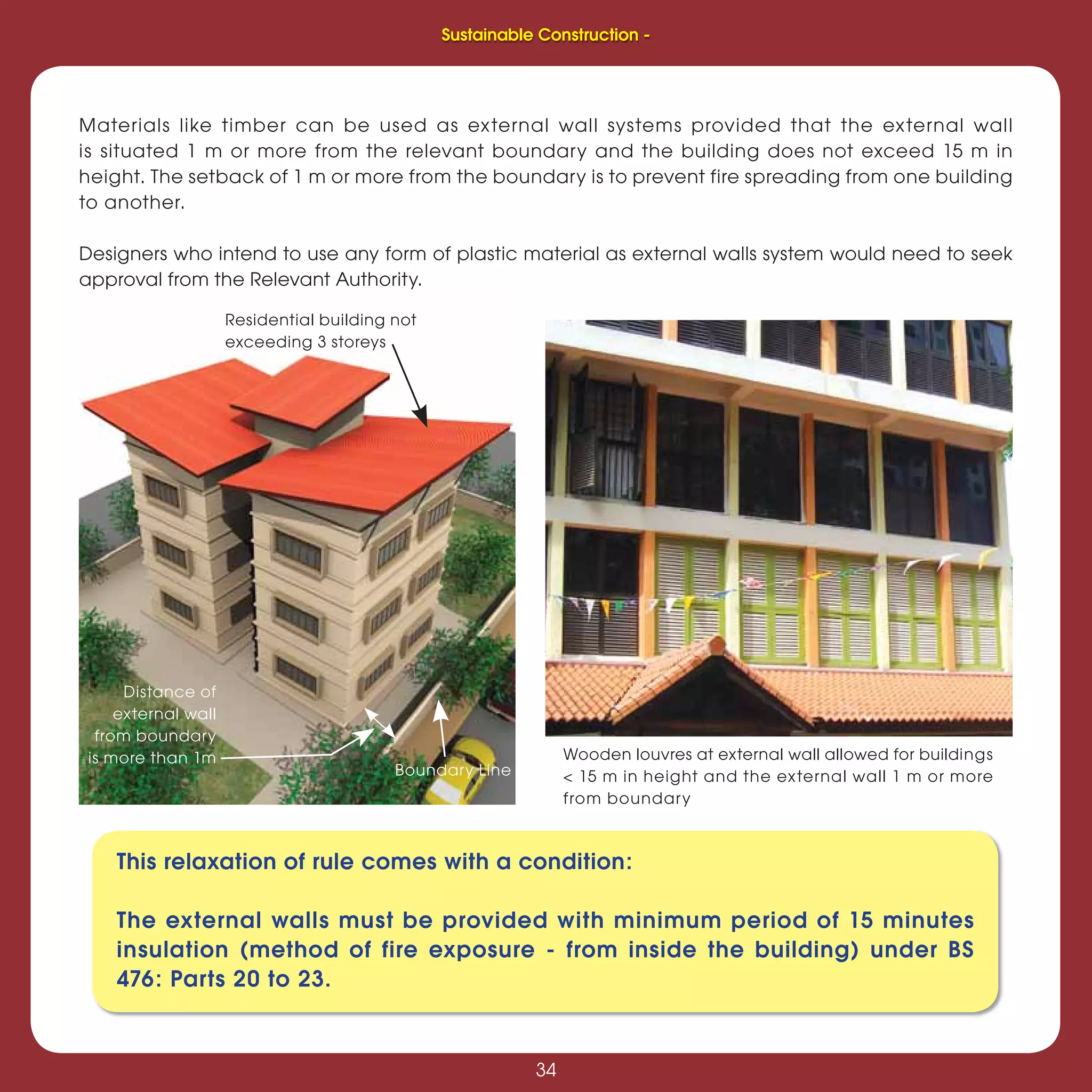
  • 55.
    54 Sustainable Construction - 54 IntumescentPaint The use of intumescent coating to give fire protection to steel structure is permissible as long as it is applied appropriately and the environment in which the structure is subjected to is non-detrimental to the fire protective properties of the coating. Intumescent paint coatings may be applied to give up to 120 minutes of fire protection. Only intumescent paint products listed in the PLS are acceptable to the Relevant Authority. How does intumescent paint work? In the event of fire, the thin coating of intumescent paint expands up to 50 times to form a layer of insulating foam. The car- bonaceous material in the intumescent paint, typically starch, is charred whilst the heat also causes the release of acids. These act to produce large volumes of non-inflammable gases which blow up the charring starch within the softened binder of the intumescent paint into an insulating cellular carbon layer. Sustainable Construction -
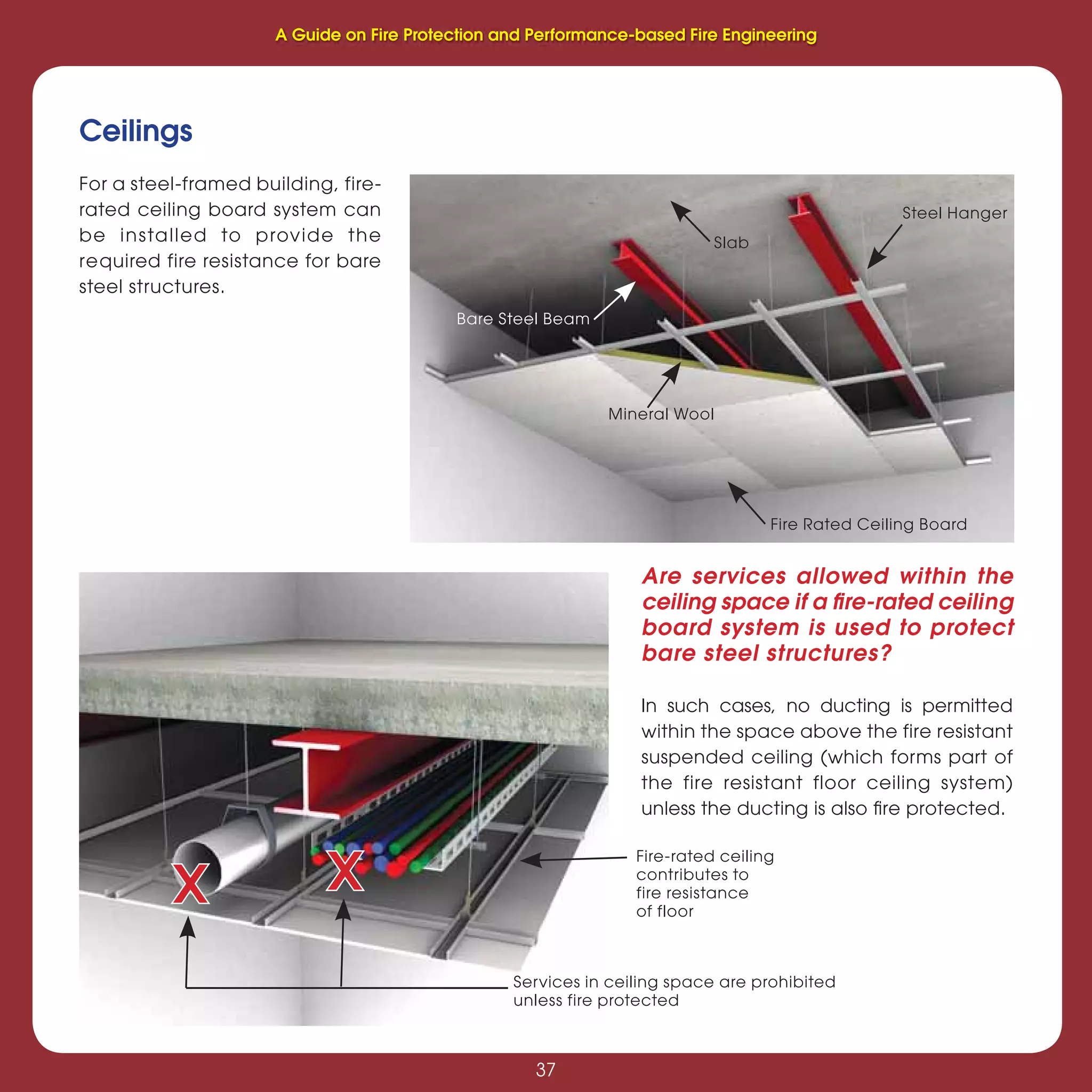
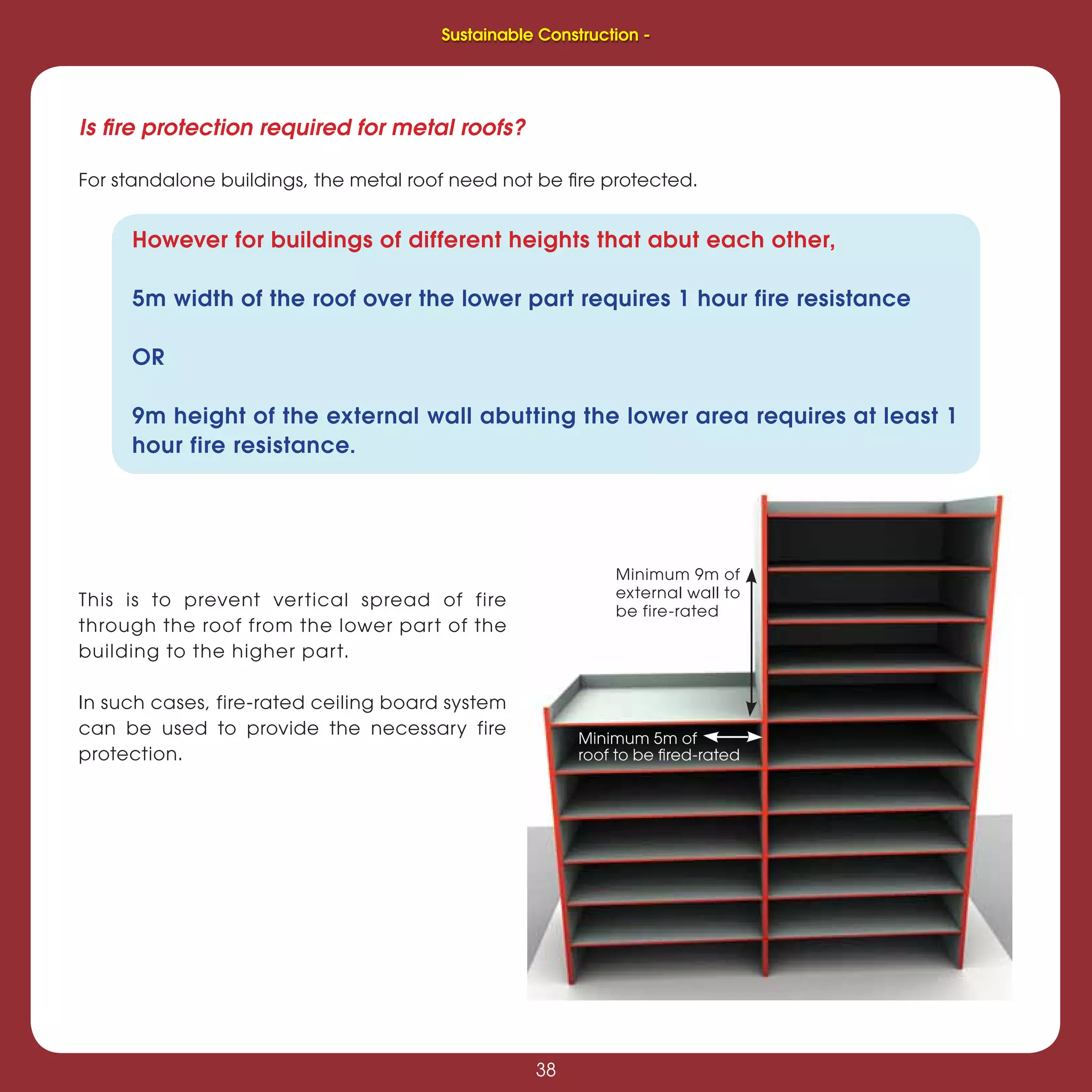
  • 56.
    55 Fire Protection andPerformance-based Fire Engineering 55 Intumescent Paint Generally intumescent paints are applied in three layers – primer, intumescent layer and the finishing coat. The thickness of the intumescent layers depends on: (a) steel size (b) steel type (c) steel section used as column or beam (d) fire rating required (e.g. 60 minutes or 120 minute) (e) exposure (2, 3 or 4-sided) and so on. Do bigger steel sections require thicker coat of intumescent paint? For the same level of fire resistance requirement, a bigger steel section will require a thinner intumescent paint coating as compared to a smaller section. • Steel Surface • 4th coat: Finishing Coat • 3rd coat: Finishing Coat • 2nd coat: Intumescent Layer • 1st coat: Primer Coat A Guide on Fire Protection and Performance-based Fire Engineering
  • 57.
    56 Sustainable Construction - 56 IntumescentPaint The intumescent paints have to be tested to BS 476: Part 20/21 and BS 8202: Part 2. Can intumescent paint be applied to external areas? For intumescent paints intended for external area, they have to pass a 2- year local weathering test in accord- ance to BS8202: Part 2, prior to listing in the PLS. One advantage of intumescent paint is that it allows the architects to express the architectural intent of the building through the steel sections. The finish external coats also come in various colours, to suit different designs. External coats come in various colours Steel-framed building adopts a red finishing coat for its intumescent paint NUS Cultural Hub fire protected by intumescent paint Sustainable Construction -
  • 58.
    57 Fire Protection andPerformance-based Fire Engineering 57 Is there any restriction to the use of intumescent paint? The Fire Code does not restrict the use of intumescent paints for any particular type of building. However in buildings where there may be presence of corrosive atmosphere that may affect the effectiveness of protection by the intumescent paints, QPs are to consult the Relevant Authority. For submission procedures and documents required for submission, please refer to Appendix F of the Fire Code. Intumescent Paint The advantages of intumescent paints are: ✓ Do not require architectural cladding ✓ Allow building’s structure to be expressed architecturally ✓ Can be applied off-site The disadvantages are: ✕ Require regular inspection and maintenance ✕ Fire resistance is limited to 2 hours Building Owners Take Note: Highly flammable/combustible materials should not be stored within the vicinity of any structural steel members protected by intumescent paint. CORROSIVE A Guide on Fire Protection and Performance-based Fire Engineering
  • 59.
    58 Sustainable Construction - 58 Whatare the surface preparation works needed to receive the intuescent paint? For mild steel, the untreated surface has to be blasted to grade Sa 2.5 (95-99% clean) for priming purpose. This requirement is also stated in the work section on Protective Works for Structural Steelworks in the National Productivity and Quality Specifications (NPQS). For galvanized steel, the surface must be “etched” using a compatible and approved etching primer. Galvanised steel must be “etched” using a compatible and approved etching primer Sand-blasted Material Surface Hot-dip Galvanized Material Surface Sa 2.5 Sustainable Construction -
  • 60.
    59 Fire Protection andPerformance-based Fire Engineering 59 Intumescent Paint Application Process Application of finishing coat Application of intumescent layer Intumescent layer completedApplication of primer coat The final product A Guide on Fire Protection and Performance-based Fire Engineering
  • 61.
    60 Sustainable Construction - 60 IntumescentPaint The application of intumescent paint on each member has to be recorded by the applicator in detail. An example of such records submitted to PSB for the purpose of DOC is illustrated below. How to vertify the thickness of intumescent paint? The thickness of the intumescent paint can be checked by using a Dry Film Thickness (DFT) gauge. Dry film thickness readings should be taken when the intumescent coat is sufficiently hard to prevent the probe indenting the surface, and prior to the application of the finishing coat. (for simplicity, only a few sides are indicated) Col marking Location 1 2 3 4 5 6 C3/1-1 0.5m 1.0m 1.5m 1 Average 4.05 3.96 3.97 3.91 4.05 4.04 2 4.04 3.94 3.98 4.02 3.95 4.03 3 3.80 3.99 4.07 3.91 3.88 4.06 3.98 3.96 3.99 3.95 3.96 4.04 Sustainable Construction -
  • 62.
    61 Fire Protection andPerformance-based Fire Engineering 61 The following table shows the level of fire resistance period which a combination of columns and beams can achieve. >60 15 60 60 >60 15 15 15 15 15 30 15 30 30 30 60 15 60 60 60 >60 15 60 60 >60 >60 15 60 60 >60 Fire resistance (min) Beam type Column type protected unprotected blocked-in partially encased (unreinforced) partially encased (reinforced) concrete-filled hollow sections protected unprotected slim floor systems shelf angle partially encased Table extracted from “The design of steel framed buildings without applied fire protection” by C.G. Bailey and G.M. Newman, The Steel Construction Institute. Quick Guide on Fire Resistance for Steel Members A Guide on Fire Protection and Performance-based Fire Engineering
  • 63.
    62 Sustainable Construction - 62 Whatare the ways to achieve a cost-effective fire protection system? Cost comparisons made between different systems should be based on total costs, instead of fire protection costs alone. The time required for the fire protection works, the need for additional finishes and future maintenance will have an impact on the overall cost. Nevertheless, the following pointers should be useful in achieving a more cost-effective fire protection system. (a) Design the members to be built into walls and floors wherever possible Any exposed face of a steel section will usually require fire protection. Hence to reduce the cost of fire protection, designers should consider building the steel members into walls and floors wherever possible. For example in the case of the Supreme Court, the steel beams and columns are integrated with precast concrete. The use of precast concrete provides both fire protection to the steel members and unblemished off-form surface finish. Spray fireproofing is used on the beams (b) Integrate fire protection methods with the architectural intent Fire protection method should integrate with the architectural finishes. Steel members protected with cementitious spray-fire- proofing may retain their rough finishes if they are hidden above the ceiling boards. For aesthetics reasons, hand trowelling may be applied to the spray-fireproofing to improve the surface appearance of the steel elements which are exposed. Alternatively, intumescent paint may be preferred for exposed columns and beams as it provides a more aesthetically pleasing appearance. (c) Communicate with the steel fabricators early on the requirements of fire protection Designers should involve the steel fabricators early and state the fire protection requirements. Fabricators need to know the type and brand of fire protected system prior to preparing the steel surface. For example, some cementitious spray-fireproofing bond better on unprimed/unpainted steel members than primed surface. On the other hand, steel members receiving intumescent paint have to be primed with a compatible and approved primer. Failure to communicate such useful information to steel fabricators early may result in abortive or remedial works, which incurs additional costs. Steel sections integrate with precast concrete Sustainable Construction -
  • 64.
    63 Fire Protection andPerformance-based Fire Engineering 63 Section 4: Performance-based Approach to Fire Safety Design A Guide on Fire Protection and Performance-based Fire Engineering
  • 65.
    64 Sustainable Construction - 64 Theperformance-based approach to fire safety design relies on the use of fire engineering principles, calculations and/or appropriate software modelling tools to satisfy the intentions of the Code of Practice for Fire Precautions in Buildings 2007 (Fire Code). This new approach provides alternative means of meeting the intentions of the Fire Code. Building practitioners will have the added flexibility in the application of fire safety for their buildings by having a choice of using the performance-based approach, the prescriptive approach or a combination of both. The performance-based approach is unique in that its provisions spell out the intent of the code qualitatively but the means of achieving the desired intent of the code is open to the building practitioner. The building practitioner will need to substantiate that the proposed solution fully meets the intent of the Fire Code using established fire safety engineering methodology. The performance-based regulatory system was officially launched on 1 July 2004. What is performance-based fire engineering? Sustainable Construction -
  • 66.
    65 Fire Protection andPerformance-based Fire Engineering 65 What is the rationale of allowing developers/Qualified Persons (QPs) to choose the type of approach (i.e. prescriptive or performance-based) to fire safety design? The introduction of a performance-based approach to fire safety design offers building designers greater flexibility in design and possible cost optimisation. The prescriptive approach is more restrictive in the sense that the building designers have to adhere strictly to the requirements stipulated in the Fire Code. The performance-based approach, however, provides a platform for customised building designs so long as fire safety standards are maintained. A Guide on Fire Protection and Performance-based Fire Engineering
  • 67.
    66 Sustainable Construction - 66 Isperformance-based approach less stringent than prescriptive approach? The performance-based approach should not be viewed as less stringent, but it is definitely less restrictive. The use of the performance-based approach to complement the prescriptive approach is widely accepted in many countries, such as Australia, New Zealand, UK, USA, Sweden and Japan. In Singapore, there are several buildings where the performance-based approach has been successfully used, such as the Changi International Airport and the Singapore Expo. Sustainable Construction -
  • 68.
    67 Fire Protection andPerformance-based Fire Engineering 67 Singapore Expo Convention and Exhibition Centre, the largest most flexible event venue in Singapore. All photos courtesy of Singex Venues Pte Ltd. A Guide on Fire Protection and Performance-based Fire Engineering
  • 69.
    68 Sustainable Construction - 68 Whenshould performance-based approach be adopted? Only registered Fire Safety Engineers (FSEs) are qualified to assess a performance-based design approach. It is a norm in the industry that the prescriptive approach is used for standard-design buildings whereas the performance-based approach is for more complex buildings. If there is possible cost optimisation or design constraints faced when using the prescriptive method, the decision may then be made to use the performance approach. Ultimately, it is a decision to be made by the developers and QPs. Sustainable Construction -
  • 70.
    69 Fire Protection andPerformance-based Fire Engineering 69 When are the Fire Safety Engineer (FSE) and Peer Reviewer required? The Building Developer should engage the FSE on the onset of building project involving performance-based works, during the conceptual design stage, and not as a remedial solution to resolve deadlocks in the approval process. The Building Developer should engage the Peer Reviewer only after the FSE has completed his Fire Safety Engineering Report (FSER), detailed specifications and drawings and the Building Operations and Maintenance manual (O&M). It is important that the Peer Reviewer does not participate or interfere with the design process prior to this stage. The Peer Reviewer will make his comments in his Peer Reviewer’s Report. In the event that the Peer Reviewer has disagreeable comments on the documents reviewed, the FSE and the Peer Reviewer will need to discuss objectively to resolve the outstanding issues. The Project QP is responsible to submit all the mentioned documents to the Relevant Authority for final plan approval. A Guide on Fire Protection and Performance-based Fire Engineering
  • 71.
    70 Sustainable Construction - 70 Isit mandatory to engage a Registered Inspector (RI) who is an FSE for performance-based fire safety works? Yes, it is mandatory to engage an RI who is an FSE for inspection of the completed performance-based fire safety works. These RIs are qualified fire safety engineers and are in a better position to highlight any irregularities in the fire safety engineering works that are implemented on-site for a building. Is it necessary to engage an FSE to re-evaluate addition and alteration works? For buildings designed to a performance- based fire safety design, the Building Owner can refer to the O&M manual prepared by the orginal FSE. The O&M manual would spell out the extent of the performance-based solution in the building. Based on the information provided, the Building Owner has the responsibility to engage an FSE to re- evaluate addition and alteration works where necessary. Sustainable Construction - FSE may be required to re-evaluate addition and alteration works
  • 72.
    71 Fire Protection andPerformance-based Fire Engineering 71 Can a building be entirely designed to performance-based solutions? Theoretically, it is possible to design a building entirely to performance-based solutions. In practice, most performance-based submissions are likely to be a hybrid of performance-based and prescriptive solutions to meet the fire safety requirements stipulated in the Fire Code. HYBRID PERFORMANCE & DEEMED-TO-SATISFY SOLUTION DEEMED-TO-SATISFY SOLUTION PERFORMANCE- BASED SOLUTION FIRE SAFETY REQUIREMENTS Approach to a Performance-based design “Performance-based design” is a tool that can be used to look at fire safety from a “whole building” perspective. “Performance-based design” is an engineering approach to fire safety design based on (1) established fire safety goals and objectives, (2) analysis of fire scenarios, and (3) quantitative assessment of design alternatives against the fire safety goals and objectives using engineering tools, methodologies, and performance criteria. PERFORMANCE-BASED DESIGNS IDENTIFY SAFETY GOALS FOR BUILDING ESTABLISH FIRE SCENARIOS SELECT FIRE PROTECTION STRATEGIES EVALUATE USING ENGINEERING TOOLS AND MODELS • Life Safety • Property protection • Business continuity • Environmental protection • Types of fires from which the building is intended to provide protection • Detection • Suppression • Egress • Fire endurance • Determine whether fire safety goals are met for each fire scenario A Guide on Fire Protection and Performance-based Fire Engineering
  • 73.
    72 Sustainable Construction - 72 CaseStudy: The National Library The National Library is one of the first few buildings in Singapore to have performance-based fire safety design for its structural steel. Project description: • 16-storey building with basement, divided into 2 blocks (Function and Programme Blocks) • interconnected by link bridges on most floors • library areas, drama centre, associated ancillary areas, and offices • steel-framed construction for all the above ground floors Sustainable Construction -
  • 74.
    73 Fire Protection andPerformance-based Fire Engineering 73 A Guide on Fire Protection and Performance-based Fire Engineering Fire Scenarios: • A fire starts in a given building, and • Occupants fail to extinguish the fire, and • Automated fire sprinklers fail to control or extinguish the fire, and • Fire continues to grow, but only on the storey of origin or on floors connected by a void, until the fire fighters intervene to control and extinguish it. In the event that a major fire develops and the automated fire sprinklers fail to control or extinguish the fire, the performance-based design is to ensure that the structural adequacy of the building frame is maintained until the fire fighters intervene.
  • 75.
    74 Sustainable Construction - 74 TheSolution: The performance-based design allows most of the steel floor beams to be unprotected while maintaining the building’s structural stability in a fire. This enabled the bare steel structure to be expressed and enabled cost-effective construction of the building. The performance-based solution also allowed the two blocks to face each other with no additional fixed fire protection systems. Only selected beams were fire rated. These key steel beams were chosen to be fire-rated for enhanced safety factor and they generally occur in critical areas like corners of the building or in long span areas. The Approach: Analyse the risk of fire starting in building. • Check the effectiveness of the automated fire sprinkler system • Take measures to increase the reliability of the automated fire sprinkler system • Study the fire growth and compartment fire conditions, taking into consideration the fire fighters intervention In terms of structural performance, allow: • Load-carrying mechanisms for beams and slabs in a structural frame to include membrane action • Load redistribution from members Sustainable Construction -
  • 76.
    75 Fire Protection andPerformance-based Fire Engineering 75 The red line indicate the key steel beams with 90-minute fire-rated protection while the secondary steel beams are not fire protected Steel Framing Plan of Typical Floor A Guide on Fire Protection and Performance-based Fire Engineering
  • 77.
    76 Sustainable Construction - 76 References Thefollowing URLs provide information on fire protection and fire engineering. Association for Specialist Fire Protection, UK http://www.asfp.org.uk/index.html Nanyang Technological University Fire Engineering Research Group http://www.ntu.edu.sg/cee/research/research_groups/fireresearch/research.htm Singapore Civil Defence Force http://www.scdf.gov.sg/Building_Professionals/Fire_Safety_Plan_Approval/performance /index.html http://www.scdf.gov.sg/Building_Professionals/Publications/index.html University of Manchester One-Stop Shop in Structural Fire Engineering http://www.mace.manchester.ac.uk/project/research/structures/strucfire/ University of Sheffield Fire Engineering Group http://www.fire-research.group.shef.ac.uk/ Sustainable Construction -
  • 78.
    77 Fire Protection andPerformance-based Fire Engineering 77 Acknowledgements This publication was developed with inputs from members of the Working Committee and fire protection specialists. BCA would like to thank them for their valuable contributions towards the completion of this Guide. Members of the Working Committee: From Building and Construction Authority Mr Lim Tee Yoke (Chairman) Ms Goh Siam Imm Ms Rose Nguan Ms Phua Hui Chun From Housing & Development Board Er. Teh Poh Suan From Nanyang Technological University Assoc Professor Tan Kang Hai From Singapore Civil Defence Force LTC Philip Tham Representing Singapore Institute of Architects Mr Song Yew Kee (DP Architects Pte Ltd) Representing Singapore Structural Steel Society Er. Tay Yak Hong (TYH Consulting Engineers) BCA would also like to thank the following persons/ organizations for their consent to use their materials and photographs: • Arup • BlueScope Lysaght (Singapore) Pte Ltd • Boral Plasterboard (M) Sdn Bhd • Donges Stahlbau GmbH, Germany • DP Architects Pte Ltd • Industrial Contracts Marketing (2001) Pte Ltd • Professor Colin Bailey, University of Manchester and Mr Gerald Newman, The Steel Construction Institute • Promat Building System Pte Ltd • Singex Venues Pte Ltd • The Ascott Group • TTJ Design and Engineering Pte Ltd • W.R. Grace (Singapore) Pte Ltd • Yongnam Engineering & Construction Pte Ltd A Guide on Fire Protection and Performance-based Fire Engineering
  • 79.
    78 Sustainable Construction - 78 Photographs/GraphicsCredit: Copyright to photographs and graphics from the following pages are held with the respective company who has granted permission to BCA for reproduction in this publication. Company Page BlueScope Lysaght (Singapore) Pte Ltd 27, 28 and 51 (top) Boral Plasterboard (M) Sdn Bhd 14 Industrial Contracts Marketing (2001) Pte Ltd 15, 42 (bottom), 55, 56 (bottom left), 59, and 60 Promat Building System Pte Ltd 16, 17, 18, 32, 33, 34 (left), 36, 37, 38, 42 (top left and top right), 43, 44, 46, 47, 52 (top) and 54 (bottom) TTJ Design and Engineering Pte Ltd 53 (bottom) and 58 (left) W.R. Grace (Singapore) Pte Ltd 39, 48 (top), 49 (top) and 51 (bottom) Yongnam Engineering & Construction (Pte) Ltd 58 (right top and right bottom) Sustainable Construction -
  • 80.
    79 Fire Protection andPerformance-based Fire Engineering 79 Copyright @ 2008 Building and Construction Authority, Singapore. All rights reserved. This document or any part thereof may not be reproduced for any reason whatsoever in any form or means whatsoever and howsoever without the prior written consent and approval of the Building and Construction Authority. Whilst every effort has been made to ensure the accuracy of the information contained in this publication, the Building and Construction Authority, its employees or agents and members of the Working Committee shall not be responsible for any mistake or inaccuracy that may be contained herein and all such liability and responsibility are expressly disclaimed by these said parties. This publication may include information of suppliers who have, in one way or another, contributed to the development of this publication. The Building and Construction Authority does not endorse the products included. It is the responsibility of the users to select the appropriate products and ensure the selected products meet their specific requirements. ISBN 978-981-05-9686-6 a touche design production @ 6743 5450 A Guide on Fire Protection and Performance-based Fire Engineering
  • 81.
    Sustainable Construction - AGuide on Fire Protection and Performance-based Fire Engineering 5 Maxwell Road, #16-00 Tower Block MND Complex, Singapore 069110 Tel: +65 6325 7720 Fax: +65 6325 4800 Website: www.bca.gov.sg ISBN 978-981-05-9686-6 Printed on Recycled Paper SustainableConstruction-AGuideonFireProtectionandPerformance-basedFireEngineering BCA Sustainable Construction Series - 2