CONCRETE FORMWORK
                  CONCRETEDavid H. Glabe, P.E.
                      Presented by
                                   FORMWORK


© 2012, DH Glabe & Associates, Westminster, CO 80031 All Rights Reserved
Guide to Formwork for Concrete
                  ACI 347R-03


•   Chapter 1 – Introduction
•   Chapter 2 – Design
•   Chapter 3 – Construction
•   Chapter 4 – Materials
FORMWORK
• ACI 347, Chapter 1, Section 1.2
Formwork – total system of support for freshly placed concrete, including the
   mold or sheathing that contacts the concrete and all supporting members,
   hardware, and necessary bracing.


• CDOT, Section 601.11
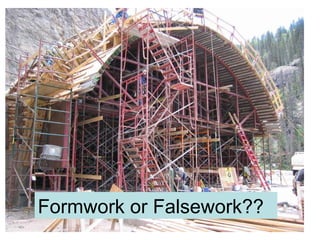
Falsework is defined as any temporary construction used to support vertical
   loads for a structure until it becomes self-supporting. Formwork is the
   temporary structure or mold used to retain plastic or fluid concrete in its
   designated shape until it hardens.
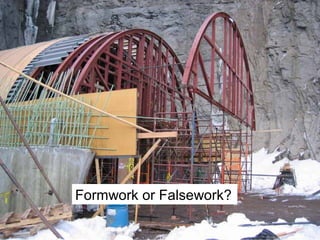
Formwork or Falsework??
Formwork v. Falsework
• ACI - Formwork includes Falsework
• CDOT – Formwork and Falsework are
  separate
• Formwork is the “Jello” Mold that holds
  fresh concrete
• Falsework supports formwork and other
  structures (such as precast girders)
Formwork – the “Jello Mold”
There are two types of Formwork:
 1. Vertical Forms
 2. Horizontal Forms

Vertical Forms are used to hold pressure
Horizontal Forms are used to hold weight
Vertical Forms
Vertical Forms are used to form:

            Walls
            Columns
            Piers
            Abutments
            Beamsides
            Other Vertical Concrete Surfaces
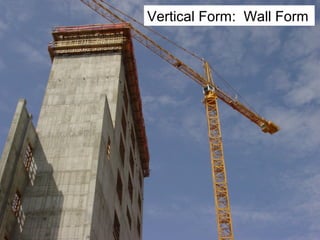
Vertical Form: Wall Form
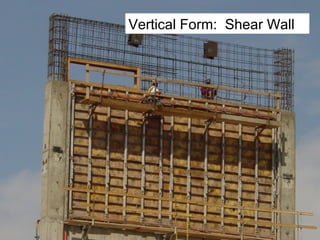
Vertical Form: Shear Wall
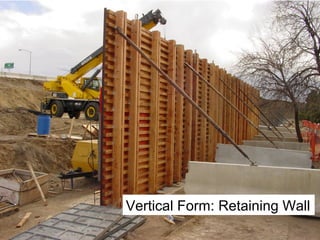
Vertical Form: Retaining Wall
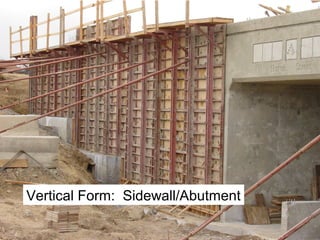
Vertical Form: Sidewall/Abutment
Horizontal Forms
• Horizontal Forms are used to form:

    Bridge Decks
    Floors
    Overhangs
    Other Horizontal Concrete Elements
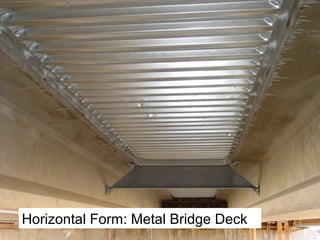
Horizontal Form: Metal Bridge Deck
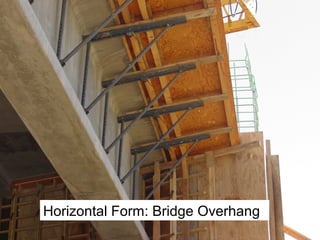
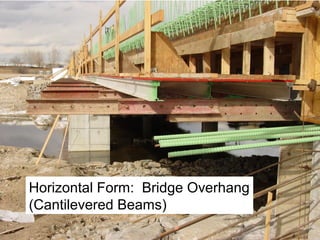
Horizontal Form: Bridge Overhang
(Cantilevered Beams)
Formwork or Falsework?
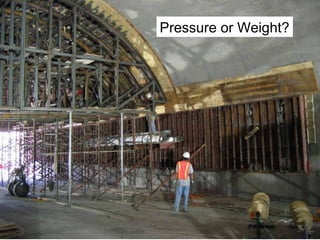
Pressure or Weight?
Pressure
• Vertical Forms are designed to resist
  pressure. Form Pressure is affected by:

  The Concrete Mix
  The Rate of Placement
  The Temperature of the Concrete
  The Weight of the Concrete
Weight
• Horizontal Forms are designed to hold the
  weight of the concrete. The design weight
  is determined by:

The Depth of the Concrete
The Unit Weight of Concrete
The Amount of Reinforcing
Concrete Structures
The Quality of the finished product is
 determined by:

Materials
Design
Construction
Placement of the Concrete
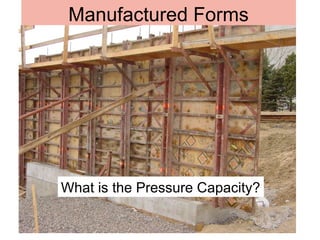
Manufactured Forms


What is the Pressure Capacity?
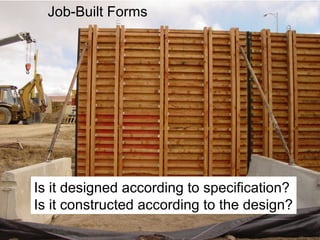
Job-Built Forms


Is it designed according to specification?
Is it constructed according to the design?
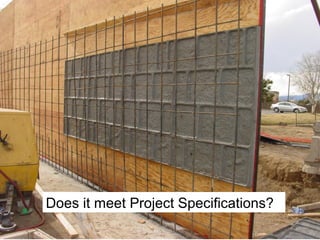
Does it meet Project Specifications?
Success?
Success is measured by how well the Jello
Mold conforms to the owner’s expectations.

Is it the right shape?
Are the length, height and width correct?
Is it within tolerance?
Is it in the right location?
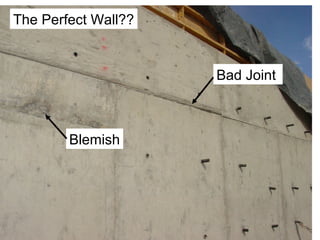
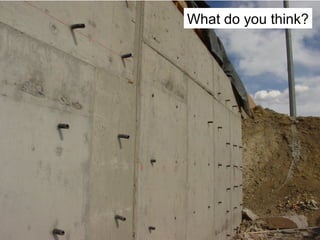
The Perfect Wall??


                     Bad Joint


        Blemish
What do you think?
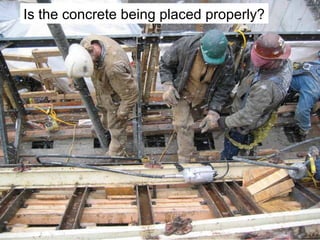
Is the concrete being placed properly?
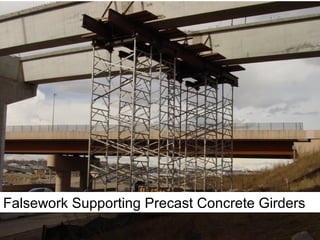
Falsework
Falsework is used to support fresh concrete
 and the Jello Mold it is in. Falsework is
 also used to support other structures such
 as precast girders, steel girders, and
 existing bridges.
Falsework Supporting Pier Cap Formwork
Falsework Supporting Precast Concrete Girders
Formwork-the “jello”
mold
   Wall forms hold pressure.
   Deck Forms hold weight.
   Falsework holds formwork.
   Watch your tolerances.
   What are their qualifications?
   What are your qualifications?

Formwork design vs falsework design key differences