Graduation Project (1)
Strengthening of an existing
reinforced concrete structure
Student Name
Student Name ID No.
ID No.
Nabil Raweh Qahtan
Nabil Raweh Qahtan 980410066
980410066
Mohammed Eisa Al-Harrasi
Mohammed Eisa Al-Harrasi 980710101
980710101
Hazem Bakri Al-Naser
Hazem Bakri Al-Naser 199901443
199901443
United Arab Emirates University
College of Engineering
Civil and Environmental Department
Instructor: Dr. Ashraf Biddah
Introduction
Introduction

Exclusive Summary
Exclusive Summary

The general idea of the project.

Problems Facing reinforced concrete
structures.
structures.
Exclusive Summary
Exclusive Summary
The main achievements:

Studying the Strengthening Methods.

Selection of an exiting building.

Experimental Test.
Experimental Test.

Beginning of Structural Analysis.
The general idea of the project

The owner of a residential building wanted to
convert his building to a commercial building.

According to change in the use of existing
structure, the structural system of the
building will be modified to fit the new
changes.
changes.

PROBLEM: The old building cannot carry the
new loads that come from the changes.

DESIGN BRIEF : Design a strengthening
system that can increase the capacity of the
existing structural system to be able to carry
the new loads that come from the changes
the new loads that come from the changes.
.
Problems Facing Reinforced
Concrete Structures
Concrete Structures

Load increases.
Load increases.

Damage to structural parts.

Improvements in suitability for use.

Modification of structural system.

Errors in planning or construction.
STRENGTHENING REINFORCED
CONCRETE STRUCTURES BY BONDING
STEEL PLATES
STEEL PLATES
:
:

Strengthening
Strengthening is the process of
is the process of
adding capacity to a member of
structure.
structure.

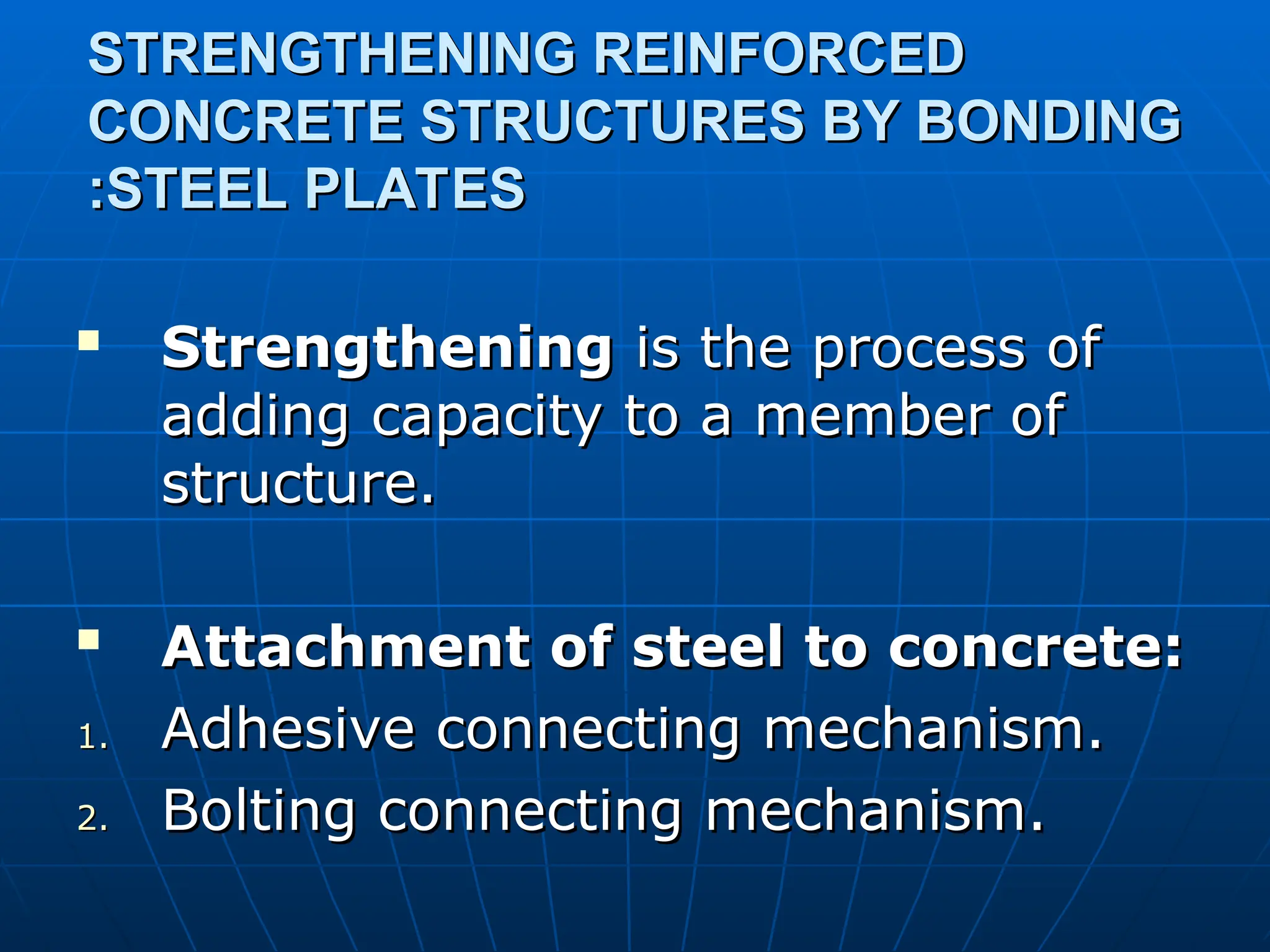
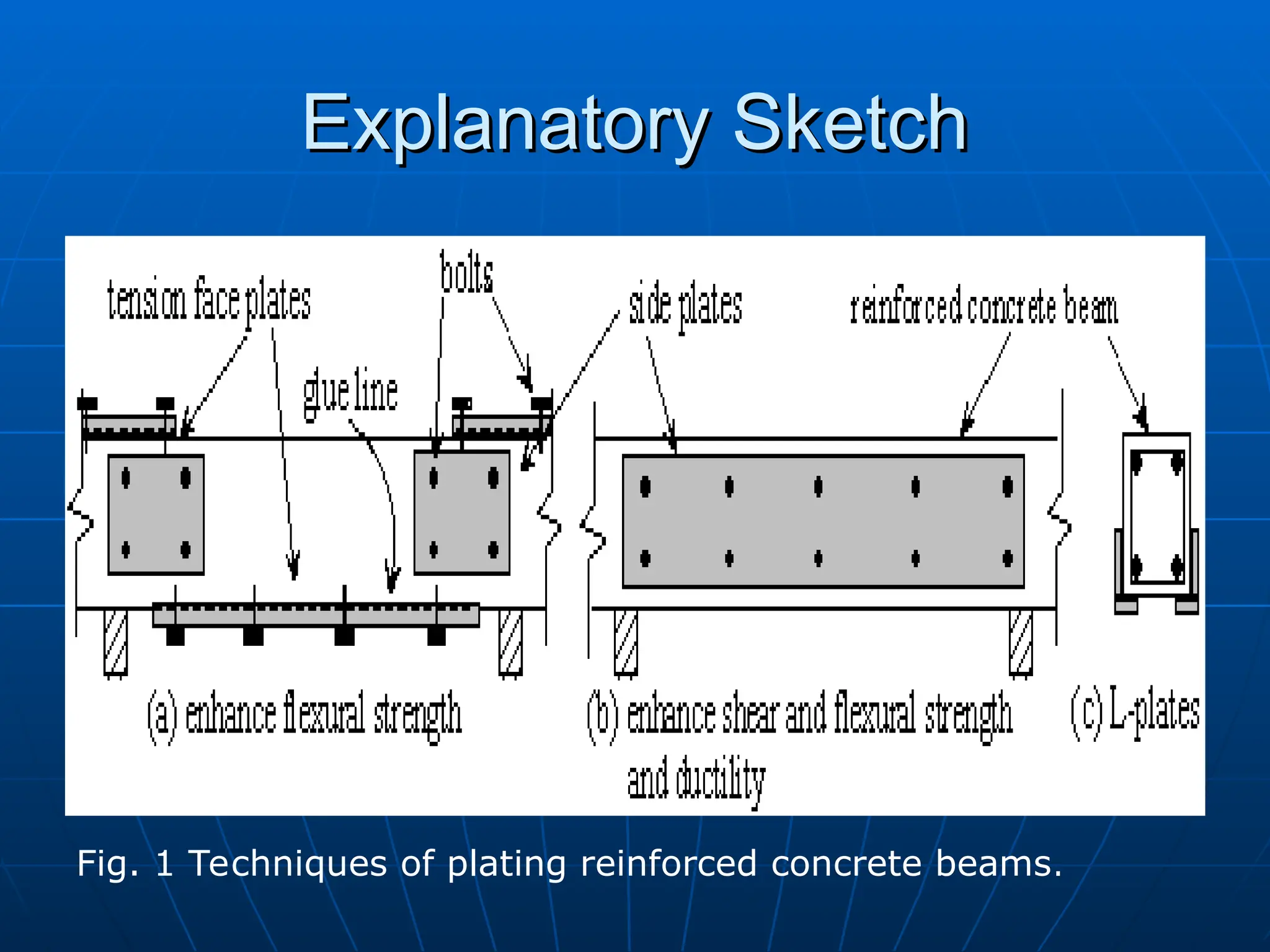
Attachment of steel to concrete:
1.
1. Adhesive connecting mechanism.
Adhesive connecting mechanism.
2.
2. Bolting connecting mechanism.
Bolting connecting mechanism.
Explanatory Sketch
Explanatory Sketch
Fig. 1 Techniques of plating reinforced concrete beams.
STRENGTHENING REINFORCED
CONCRETE STRUCTURES BY
PRESTRESSING CABLES
PRESTRESSING CABLES
:
:

Post-tensioning
Post-tensioning is a technique used
is a technique used
to prestress reinforced concrete after
concrete is placed.
concrete is placed.

The tensioning provides the member
with an immediate and active load-
carrying capability.
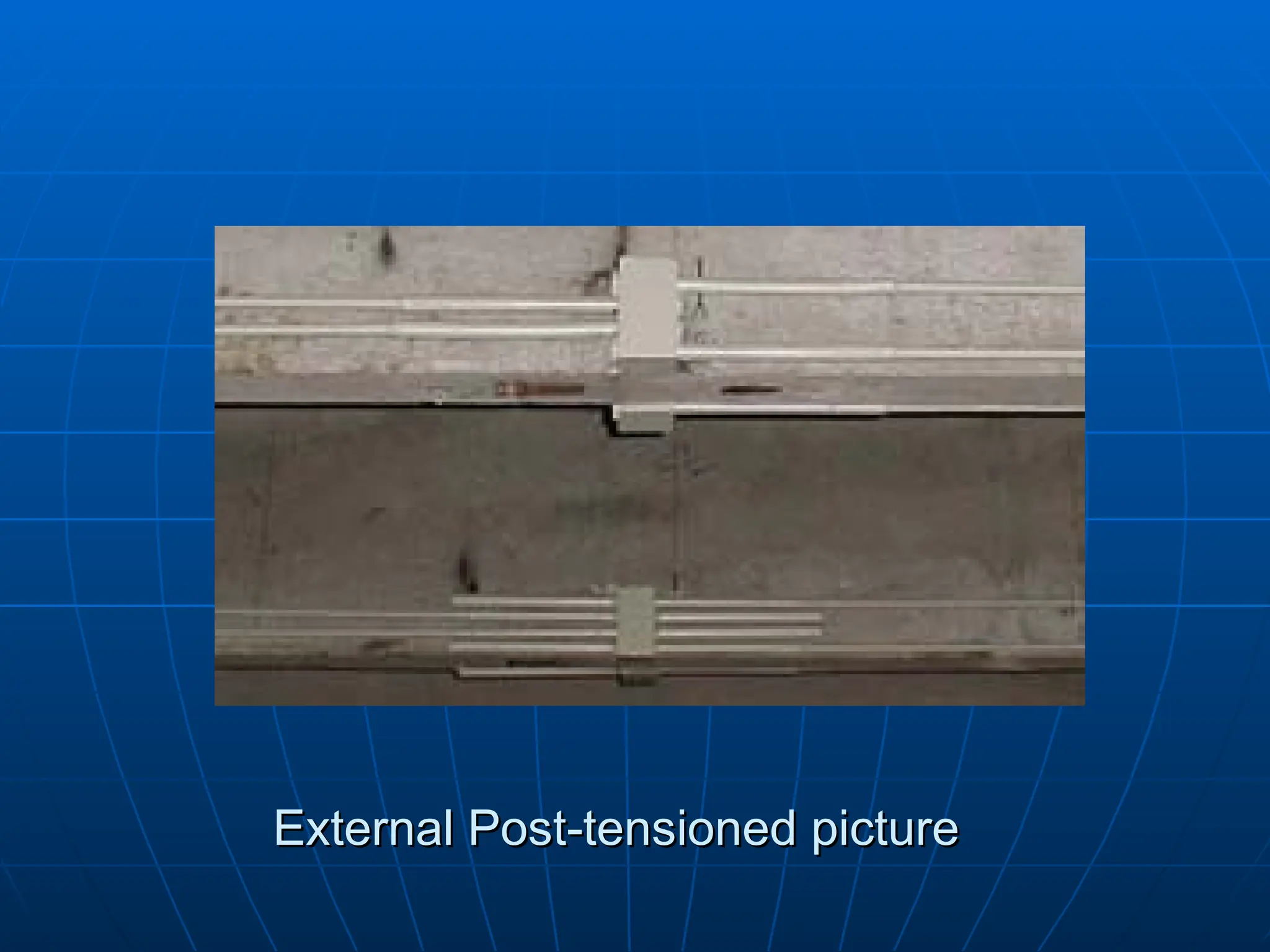
External Post-tensioned picture
The advantages of External
Prestressing
Prestressing

Ability to restress, destress and
exchange any external prestressing
cable.
cable.

Crack free members.
Crack free members.

Reduce deflection.
Reduce deflection.

High fatigue and impact resistance.
The Disadvantages of External
Prestressing
Prestressing

Usually requiring a greater section
depth.
depth.

More exposed to environmental
influences (fire, vandalism,
aggressive chemicals etc.).

Handling of the tensioning devices
may be more difficult.

High cost.
High cost.
Concrete Jackets
Concrete Jackets
(Section Enlargement)
Concrete Jackets
Concrete Jackets
(Section Enlargement)
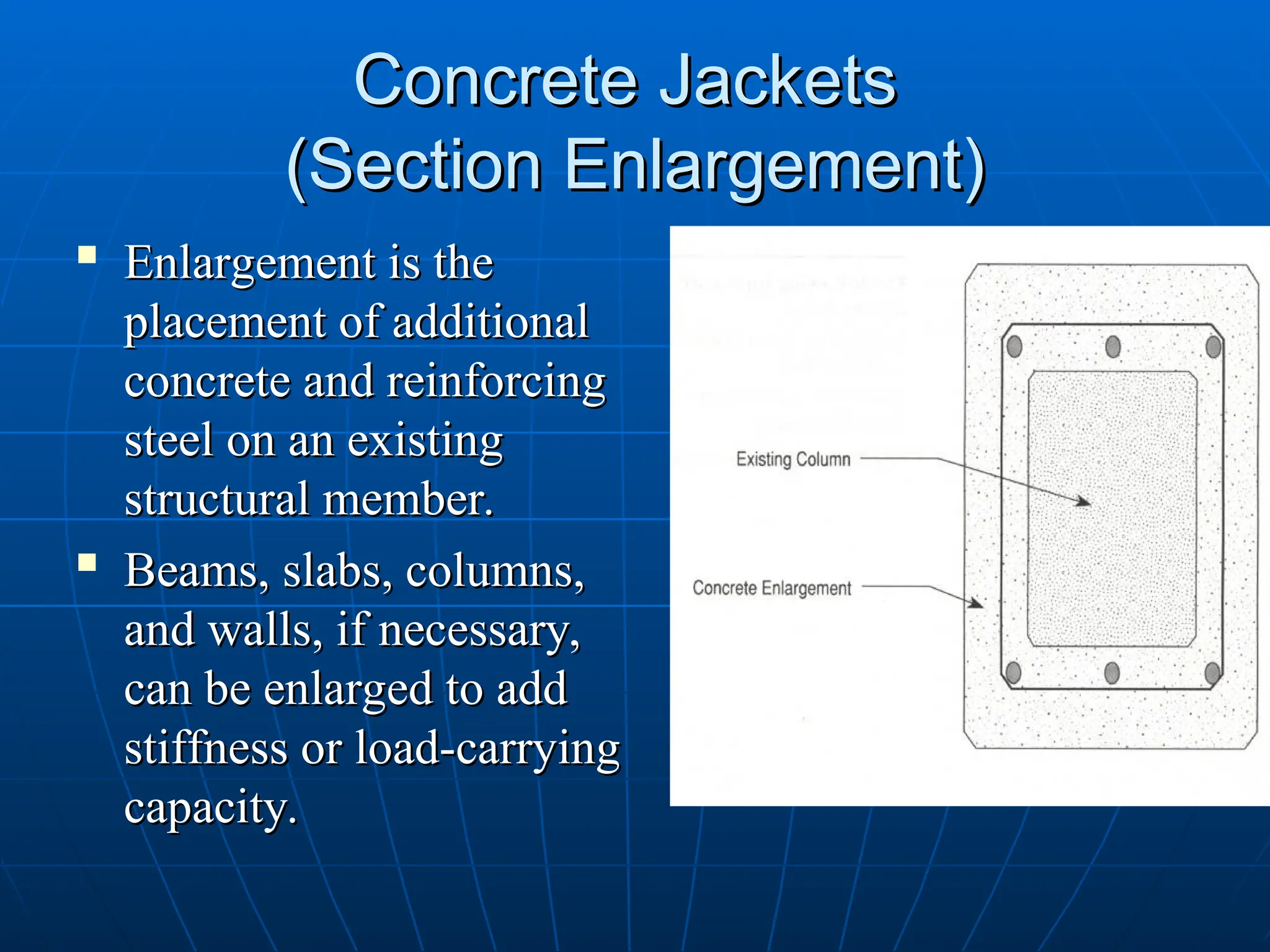
 Enlargement is the
Enlargement is the
placement of additional
concrete and reinforcing
steel on an existing
structural member.
structural member.

Beams, slabs, columns,
and walls, if necessary,
can be enlarged to add
stiffness or load-carrying
capacity.
capacity.
Concrete Jackets
Concrete Jackets
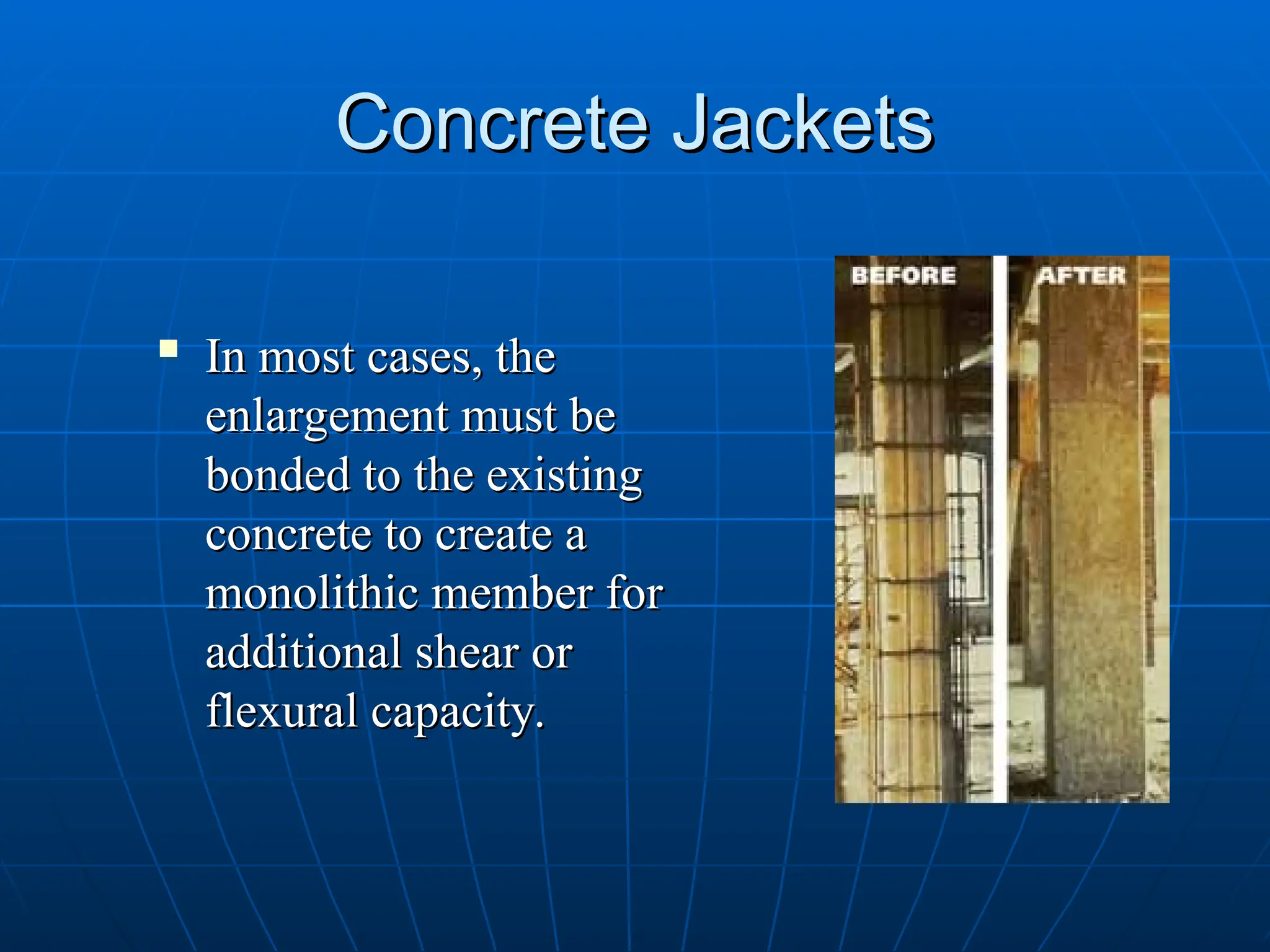
 In most cases, the
In most cases, the
enlargement must be
enlargement must be
bonded to the existing
concrete to create a
monolithic member for
additional shear or
additional shear or
flexural capacity.
flexural capacity.
Column Compressive strengthening by
Section Enlargement
Section Enlargement
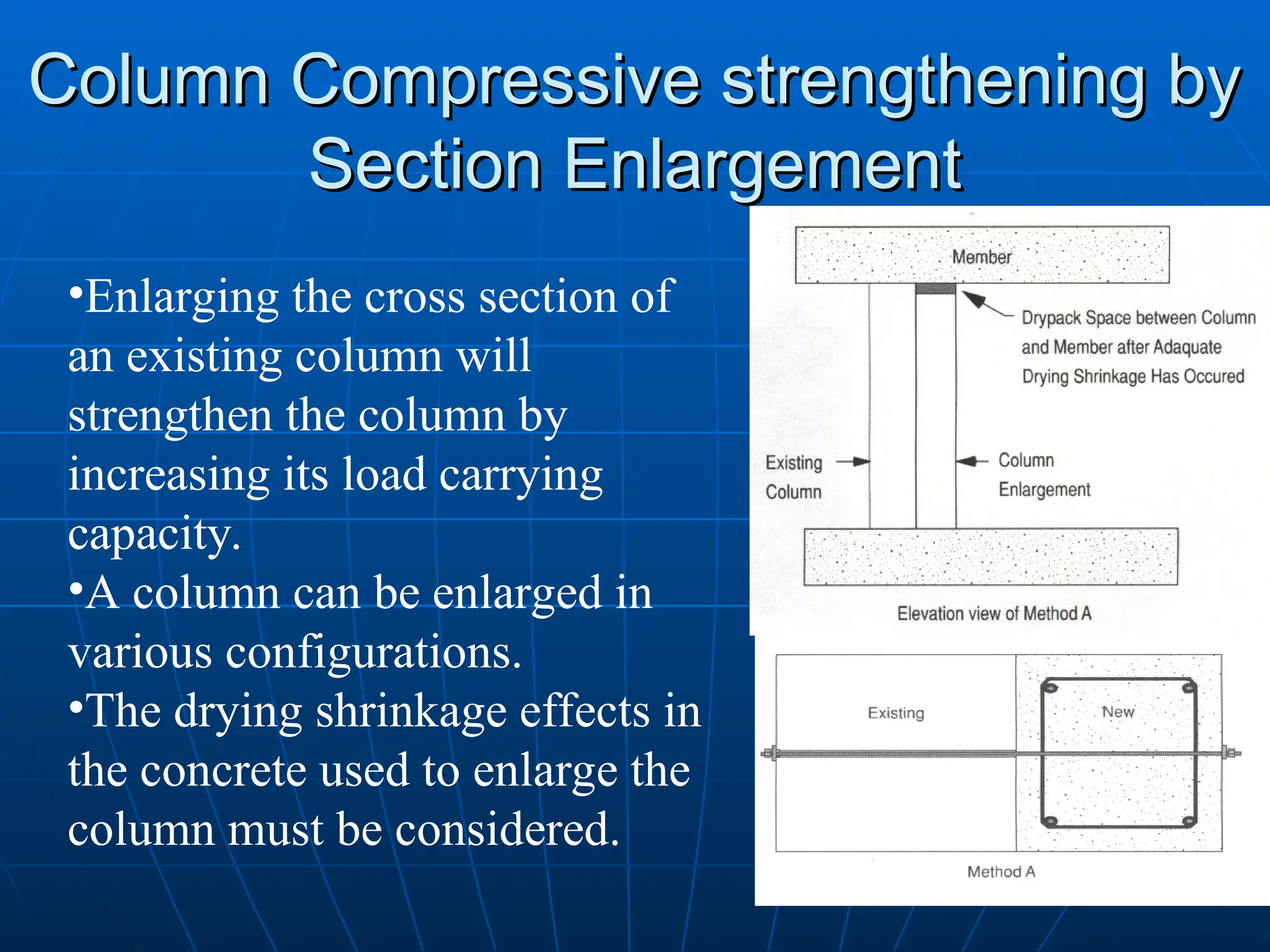
•Enlarging the cross section of
an existing column will
strengthen the column by
increasing its load carrying
capacity.
•A column can be enlarged in
various configurations.
•The drying shrinkage effects in
the concrete used to enlarge the
column must be considered.
Section Enlargement
Section Enlargement
Method A
Method A
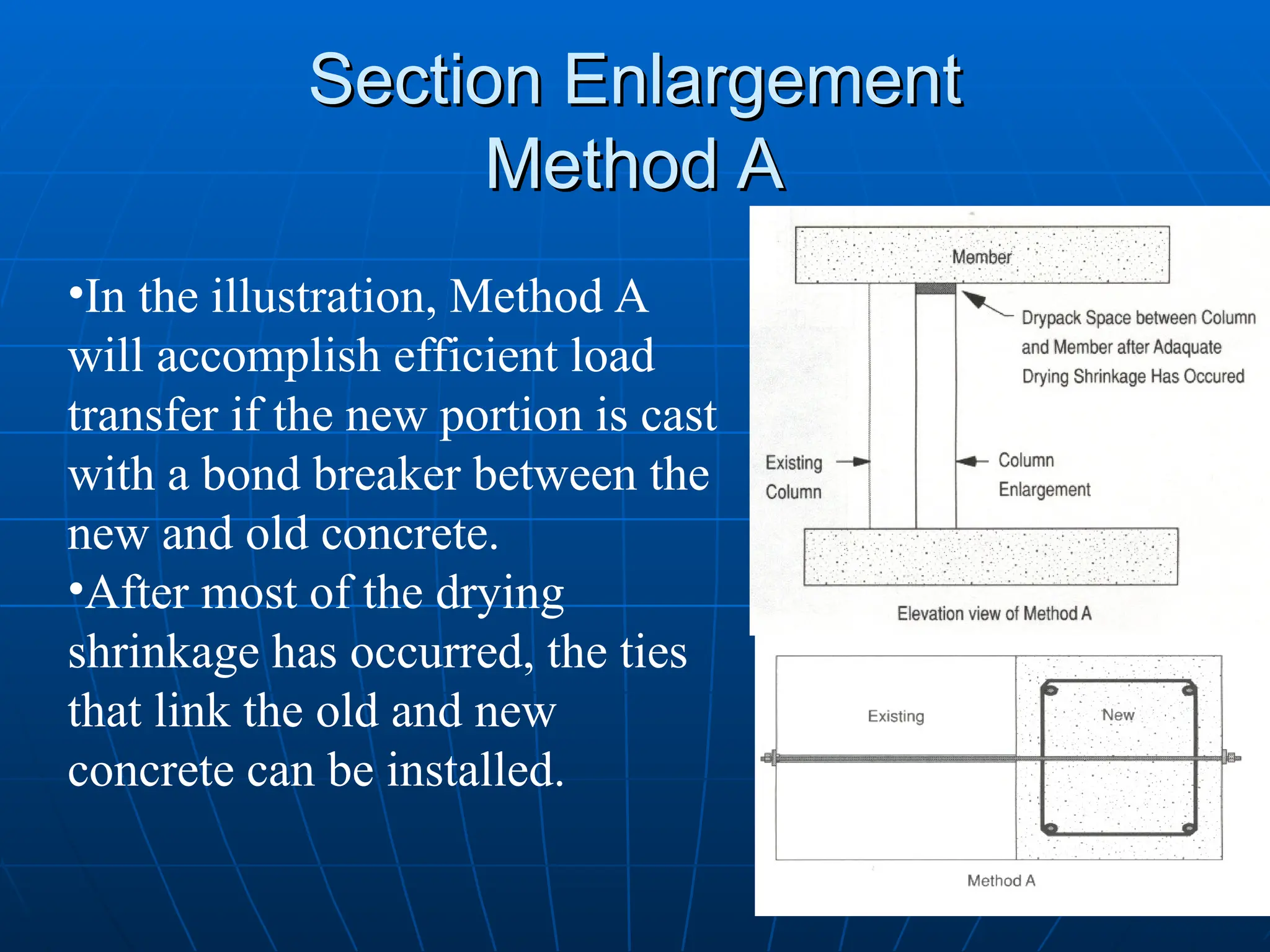
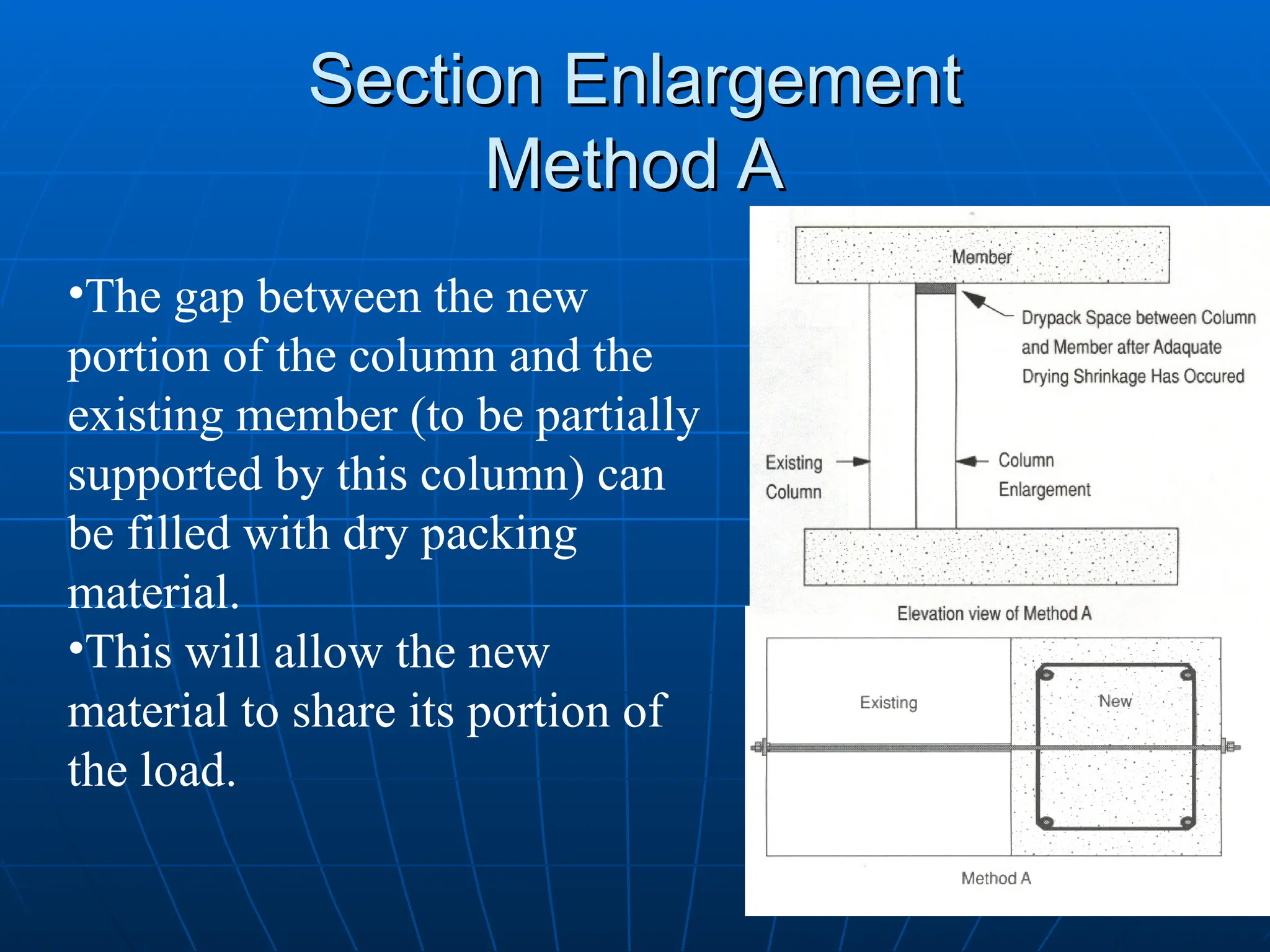
•In the illustration, Method A
will accomplish efficient load
transfer if the new portion is cast
with a bond breaker between the
new and old concrete.
•After most of the drying
shrinkage has occurred, the ties
that link the old and new
concrete can be installed.
Section Enlargement
Section Enlargement
Method A
Method A
•The gap between the new
portion of the column and the
existing member (to be partially
supported by this column) can
be filled with dry packing
material.
•This will allow the new
material to share its portion of
the load.
Section Enlargement
Section Enlargement
Methods B & C
Methods B & C
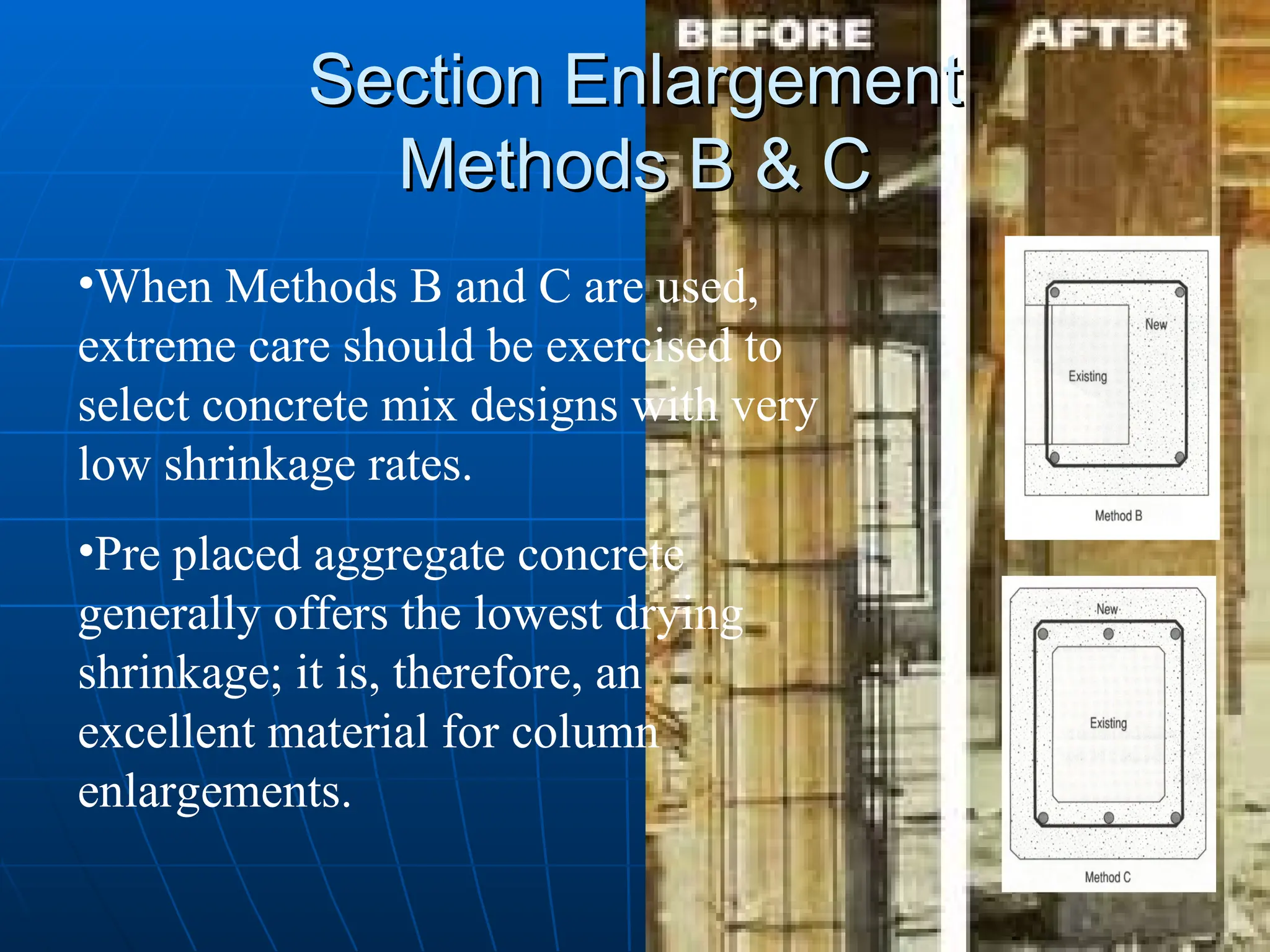
•When Methods B and C are used,
extreme care should be exercised to
select concrete mix designs with very
low shrinkage rates.
•Pre placed aggregate concrete
generally offers the lowest drying
shrinkage; it is, therefore, an
excellent material for column
enlargements.
Disadvantages of the concrete
jackets
jackets
 Increasing the size of the element, which make
Increasing the size of the element, which make
its usage very limited.
 Difficult to construct in some active buildings
Difficult to construct in some active buildings
such as hospitals, schools because of the noise
of equipments.
of equipments.

Needs shuttering, formworks, reinforced steel,
concrete, concrete pumps, vibrators, …etc.
Fiber Reinforced
Fiber Reinforced
Polymer
Polymer
Fiber Reinforced Polymer (FRP)

FRP is a new class of composite
material for the development and
repair of new and deteriorating
structures in Civil Engineering.

Search for alternatives to Steel and
alloys to combat the high costs of
repair and maintenance of structures
damaged by corrosion and heavy use.
FRP Laminate Structure
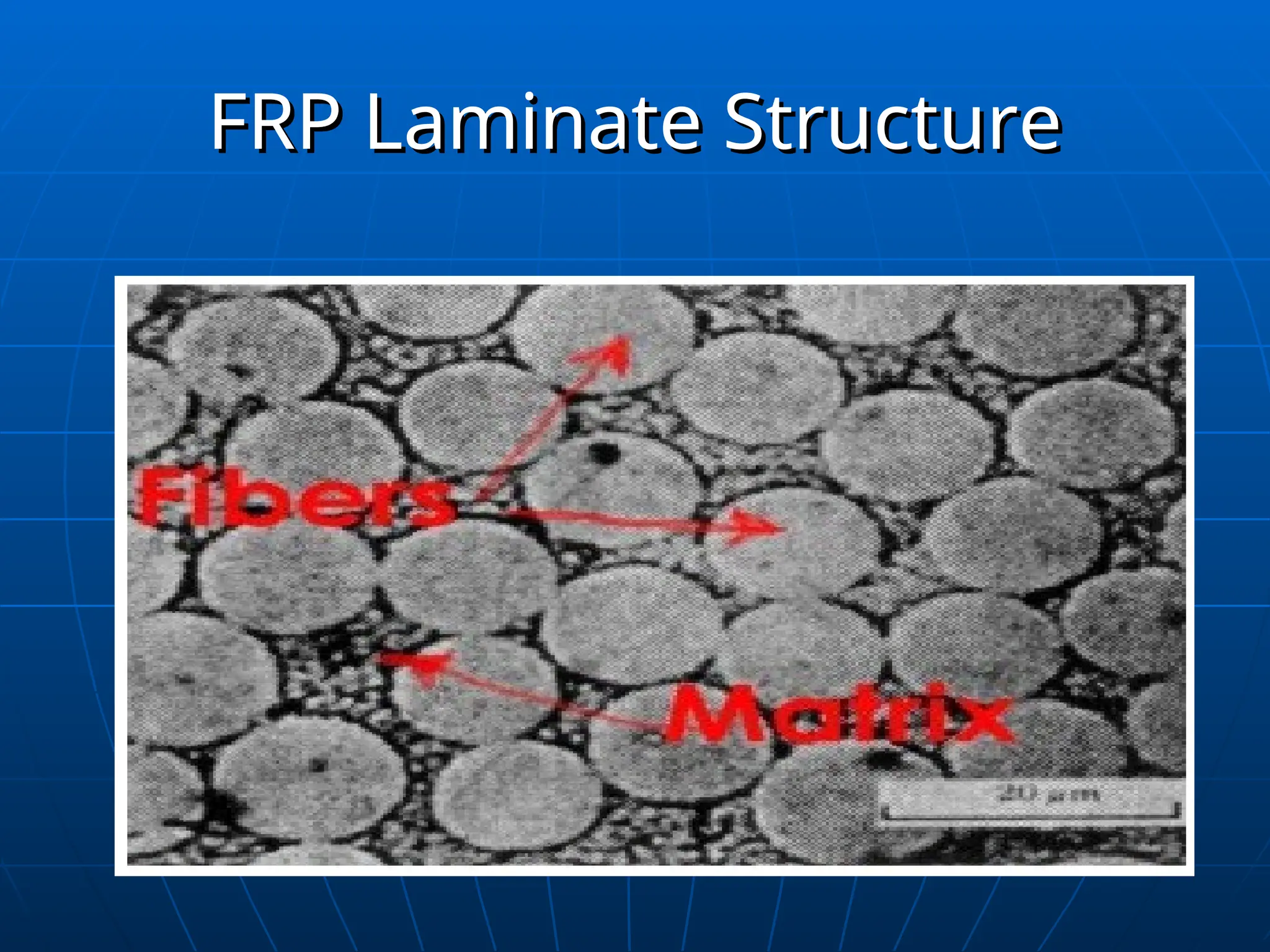
• FRPs are organized in a laminate
FRPs are organized in a laminate
structure.
structure.
• each lamina (flat layer) contains an
each lamina (flat layer) contains an
arrangement of unidirectional fibers
fabrics embedded within a thin layer
of light polymer matrix material.
 FRP consists of two main components:
FRP consists of two main components:
1.
1.Fibers.
Fibers.
2.
2.Resin or Matrix.
Resin or Matrix.
FRP Laminate Structure
Types of FRP
Types of FRP
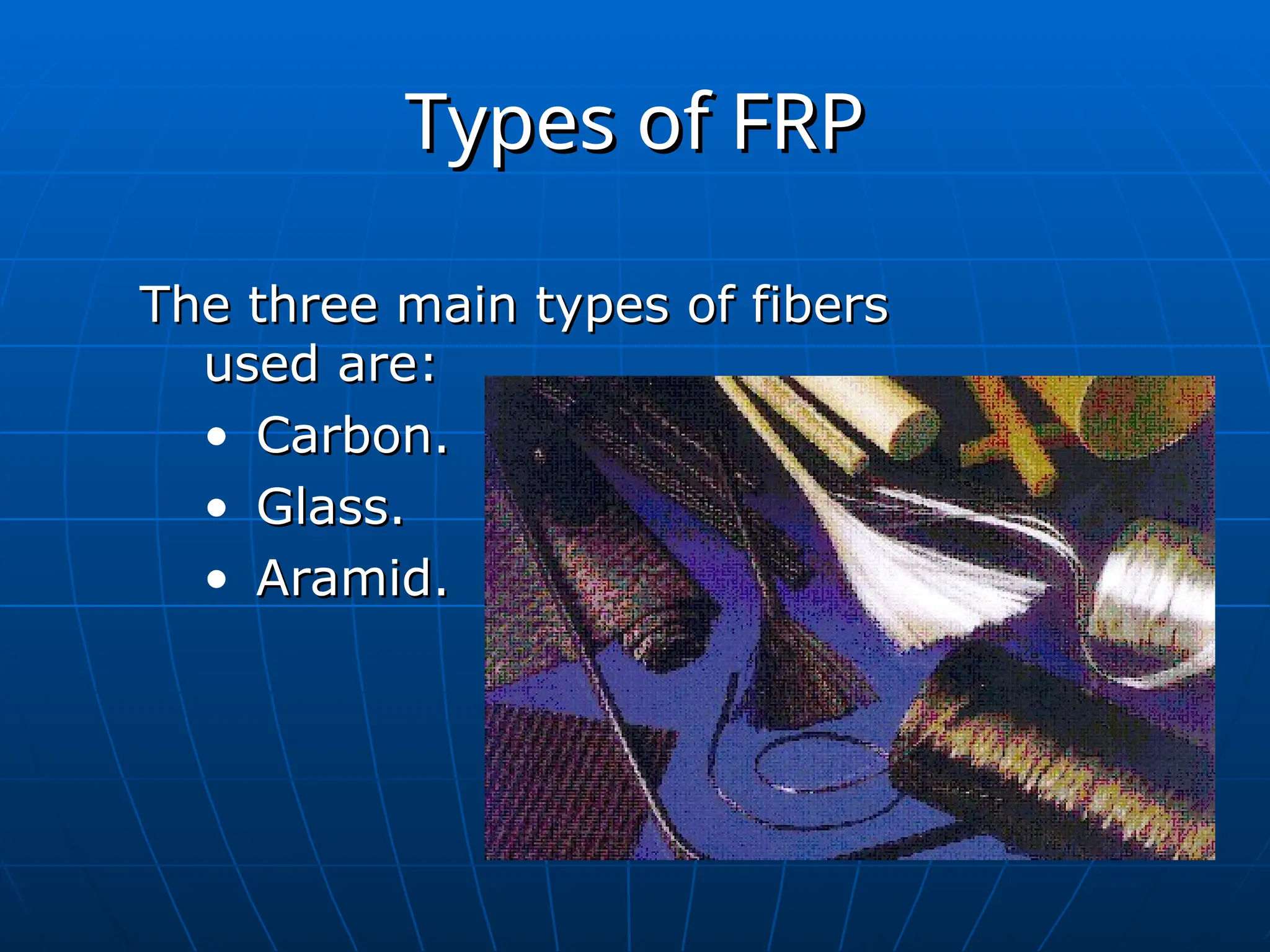
The three main types of fibers
used are:
used are:
• Carbon.
Carbon.
• Glass.
Glass.
• Aramid.
Aramid.
Suitability of FRP for Uses in
Structural Engineering

FRP properties and advantages makes it
ideal for wide spread applications in
construction worldwide.

FRP has a few disadvantages.
Advantages of FRP
Advantages of FRP
:
:

Corrosion Resistance.

Lightweight.
Lightweight.

Ease of installation.

Less Finishing.
Less Finishing.

Less maintenance.
Less maintenance.

Ductility of FRP wrapped members
improves dramatically.

They are ideal for external application.
Advantages of FRP
Advantages of FRP

They are extremely durable.

They are available in various
forms: sheets, plates, fabric, etc.

They are available in long lengths
that eliminates joints and splices.

They cure within 24 hours.

Versatility.
Versatility.

Anti-seismic behavior.
Disadvantages of FRP

High cost, susceptibility to
deformation under long-term loads

Temperature and moisture effects,
lack of design codes, and most
importantly, lack of awareness.
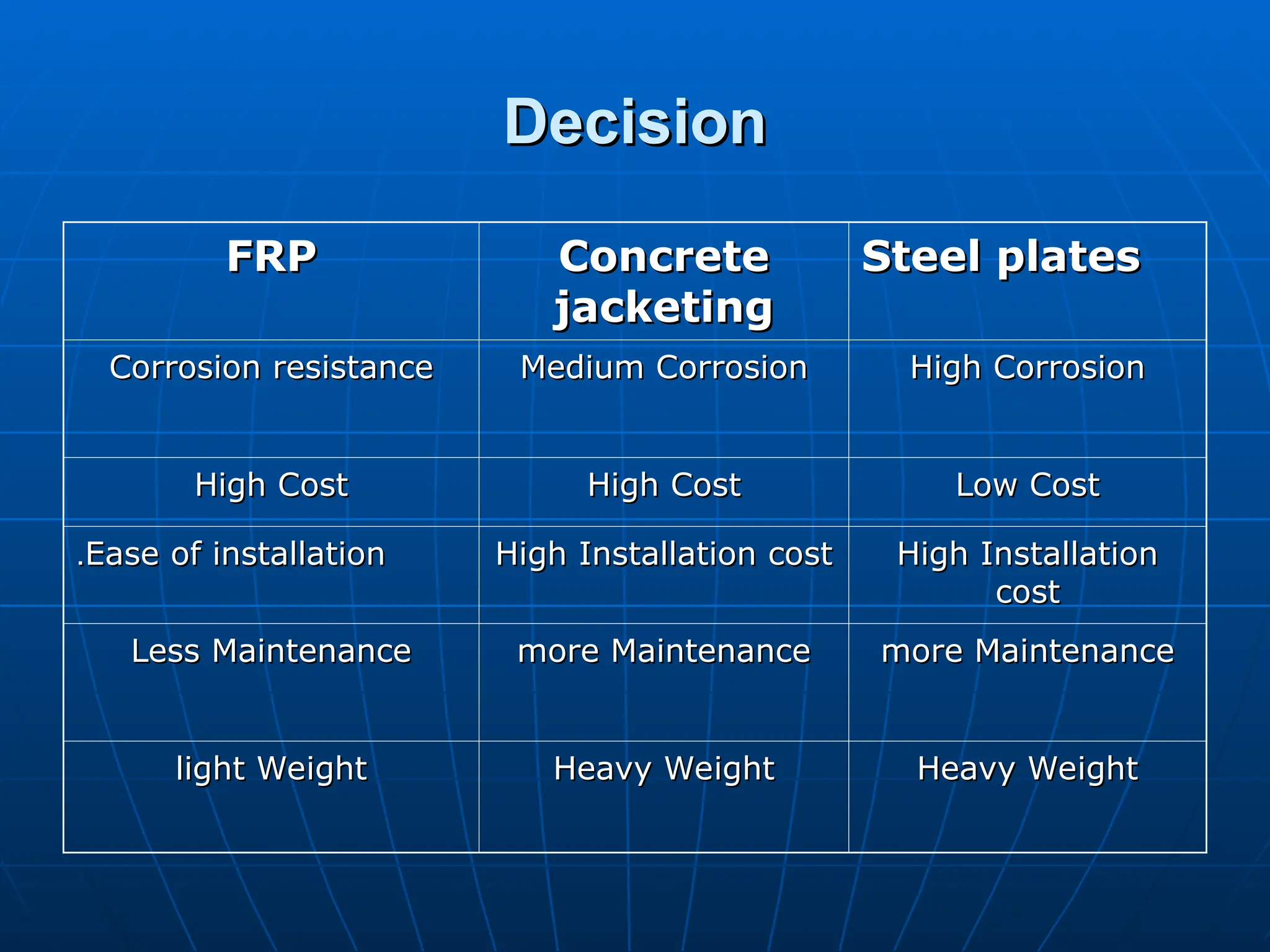
Decision
Decision
Steel plates
Steel plates
Concrete
Concrete
jacketing
jacketing
FRP
FRP
High Corrosion
High Corrosion
Medium Corrosion
Medium Corrosion
Corrosion resistance
Low Cost
Low Cost
High Cost
High Cost
High Cost
High Cost
High Installation
High Installation
cost
cost
High Installation cost
Ease of installation
.
.
more Maintenance
more Maintenance
more Maintenance
more Maintenance
Less Maintenance
Less Maintenance
Heavy Weight
Heavy Weight
Heavy Weight
Heavy Weight
light Weight
light Weight
Introduction
Introduction

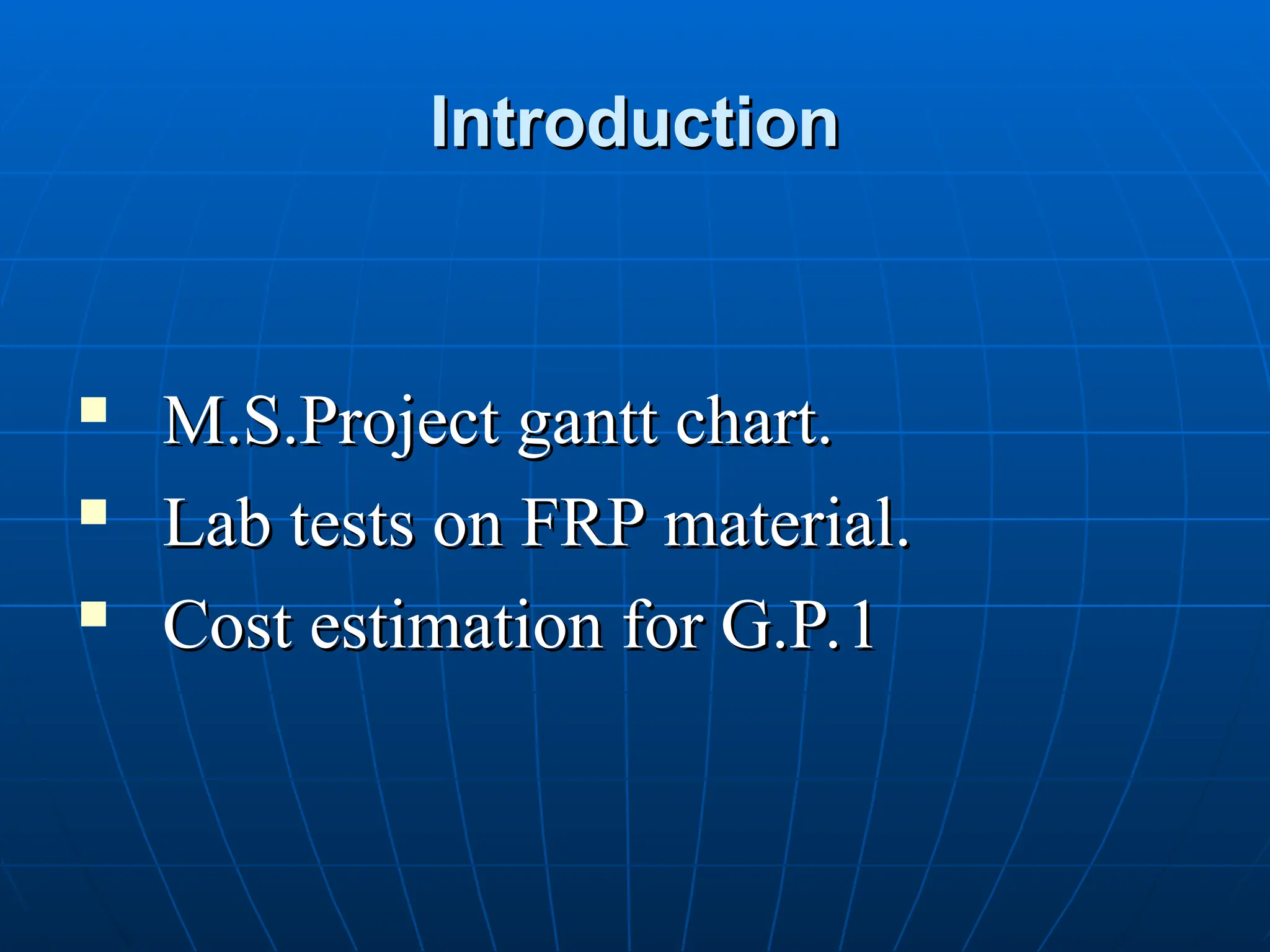
M.S.Project gantt chart.

Lab tests on FRP material.

Cost estimation for G.P.1
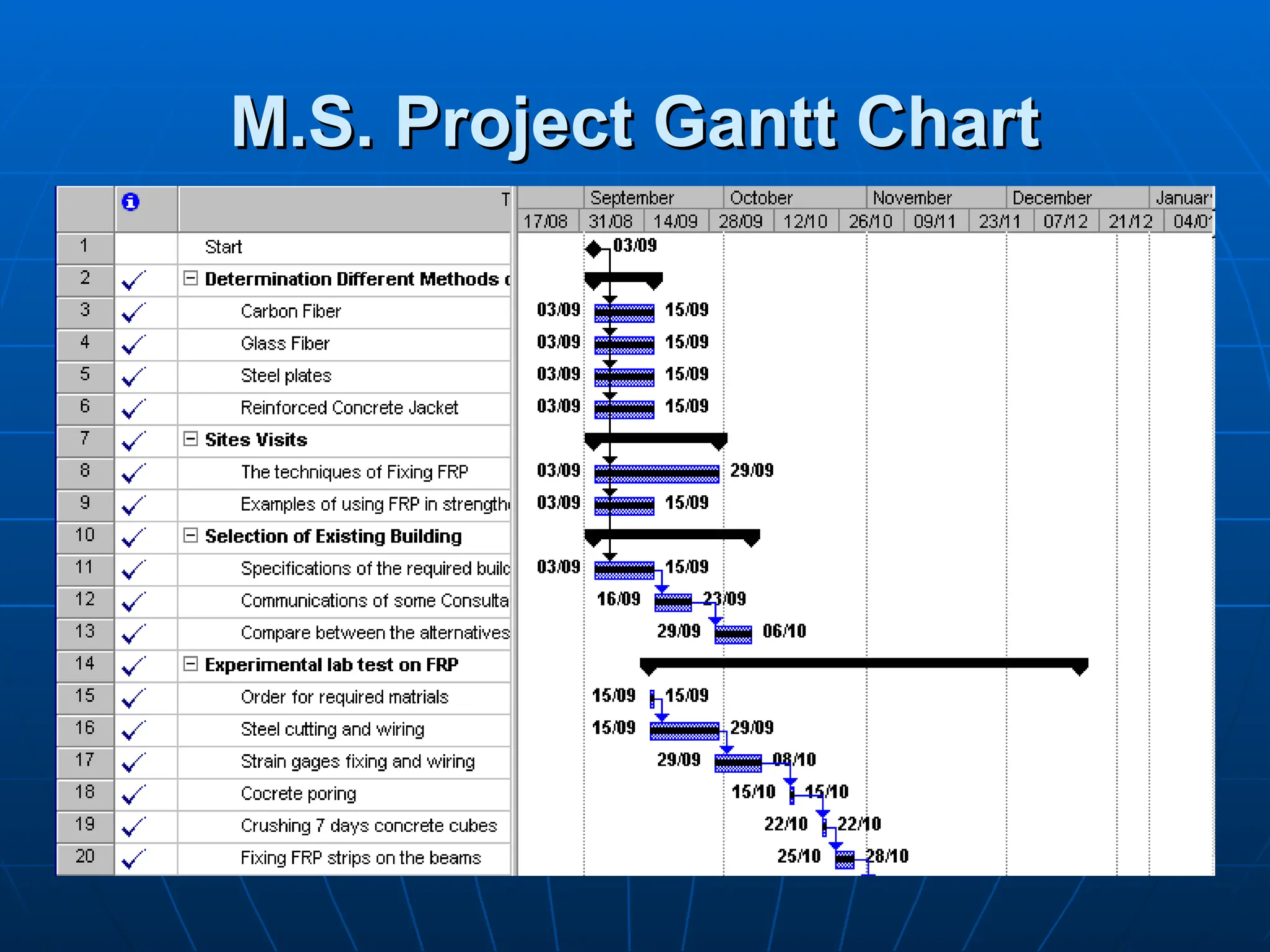
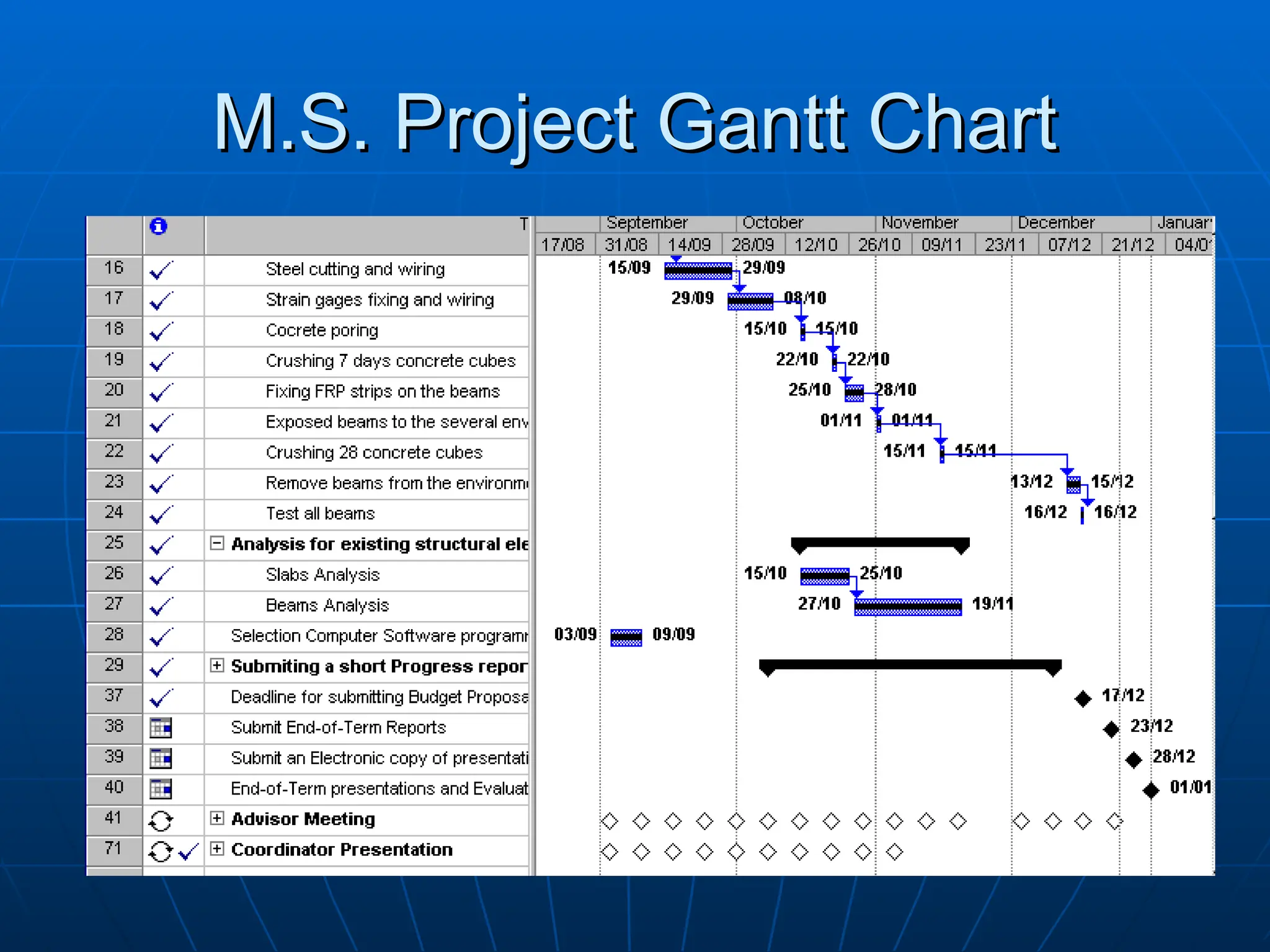
M.S. Project Gantt Chart
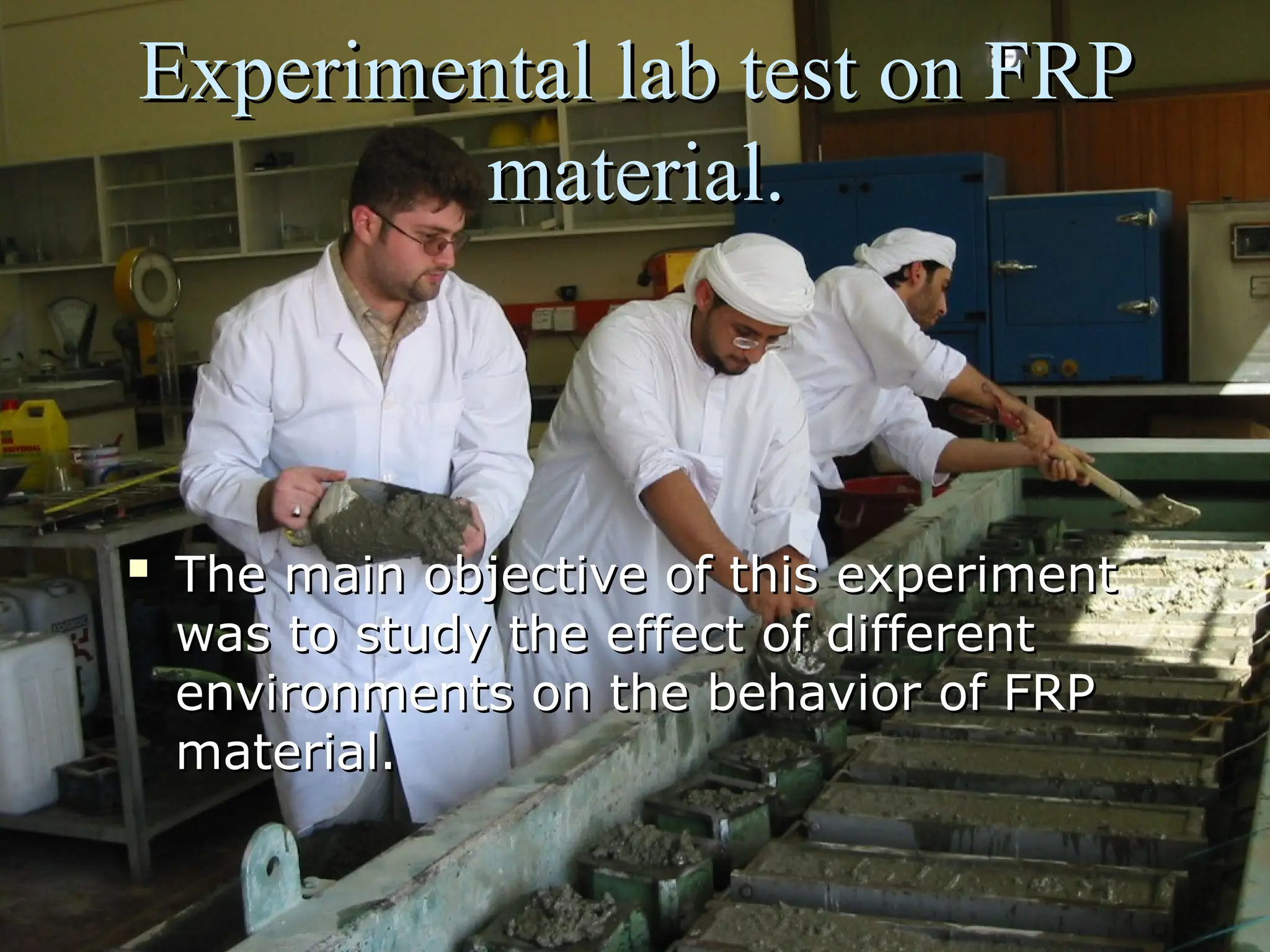
Experimental lab test on FRP
material.
material.

The main objective of this experiment
was to study the effect of different
environments on the behavior of FRP
material.
material.
Beams Details
Beams Details
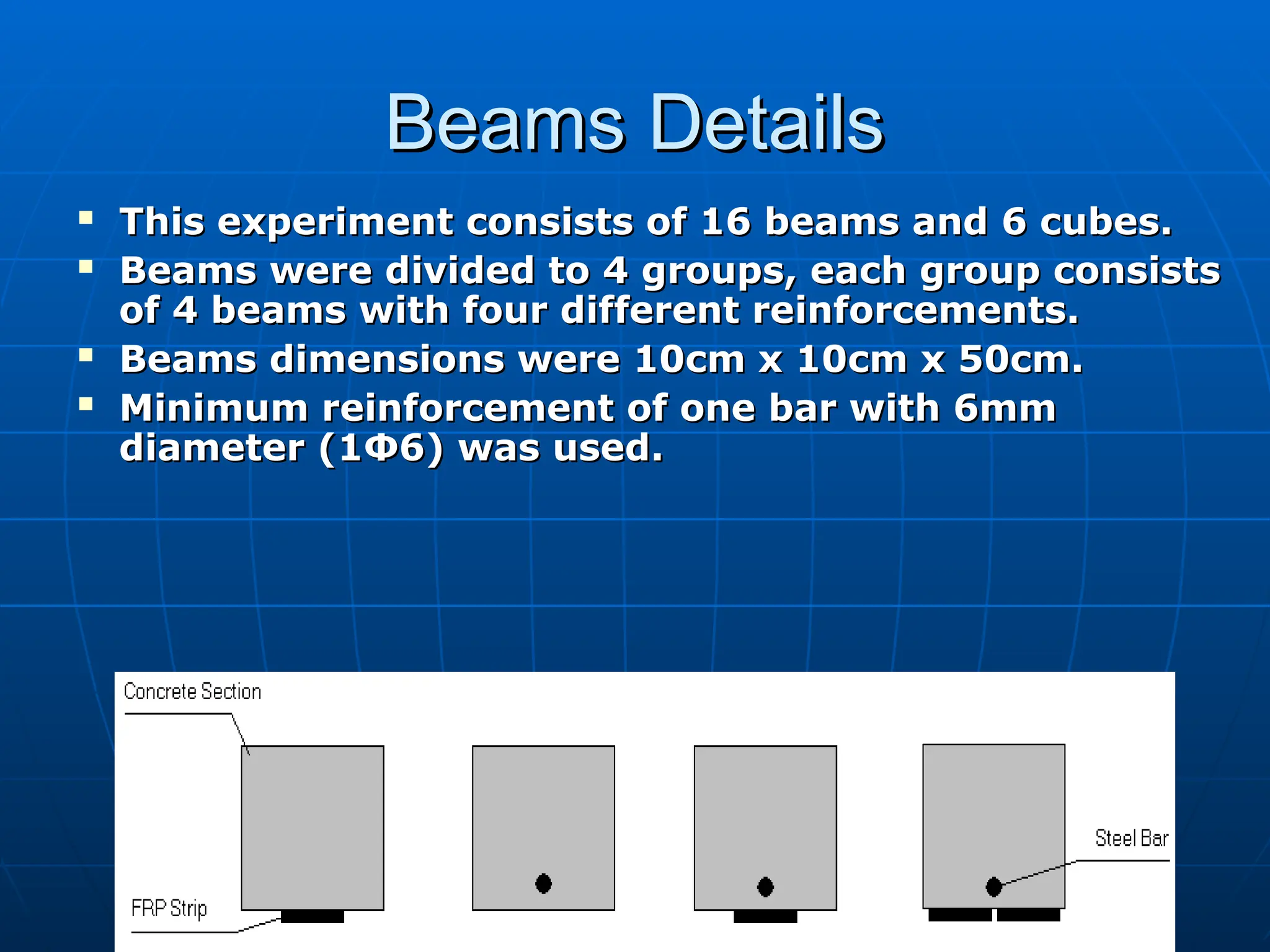
 This experiment consists of 16 beams and 6 cubes.
This experiment consists of 16 beams and 6 cubes.
 Beams were divided to 4 groups, each group consists
Beams were divided to 4 groups, each group consists
of 4 beams with four different reinforcements.
 Beams dimensions were 10cm x 10cm x 50cm.
Beams dimensions were 10cm x 10cm x 50cm.
 Minimum reinforcement of one bar with 6mm
Minimum reinforcement of one bar with 6mm
diameter (1
diameter (1Φ
Φ6) was used.
6) was used.
Groups Environment
Groups Environment
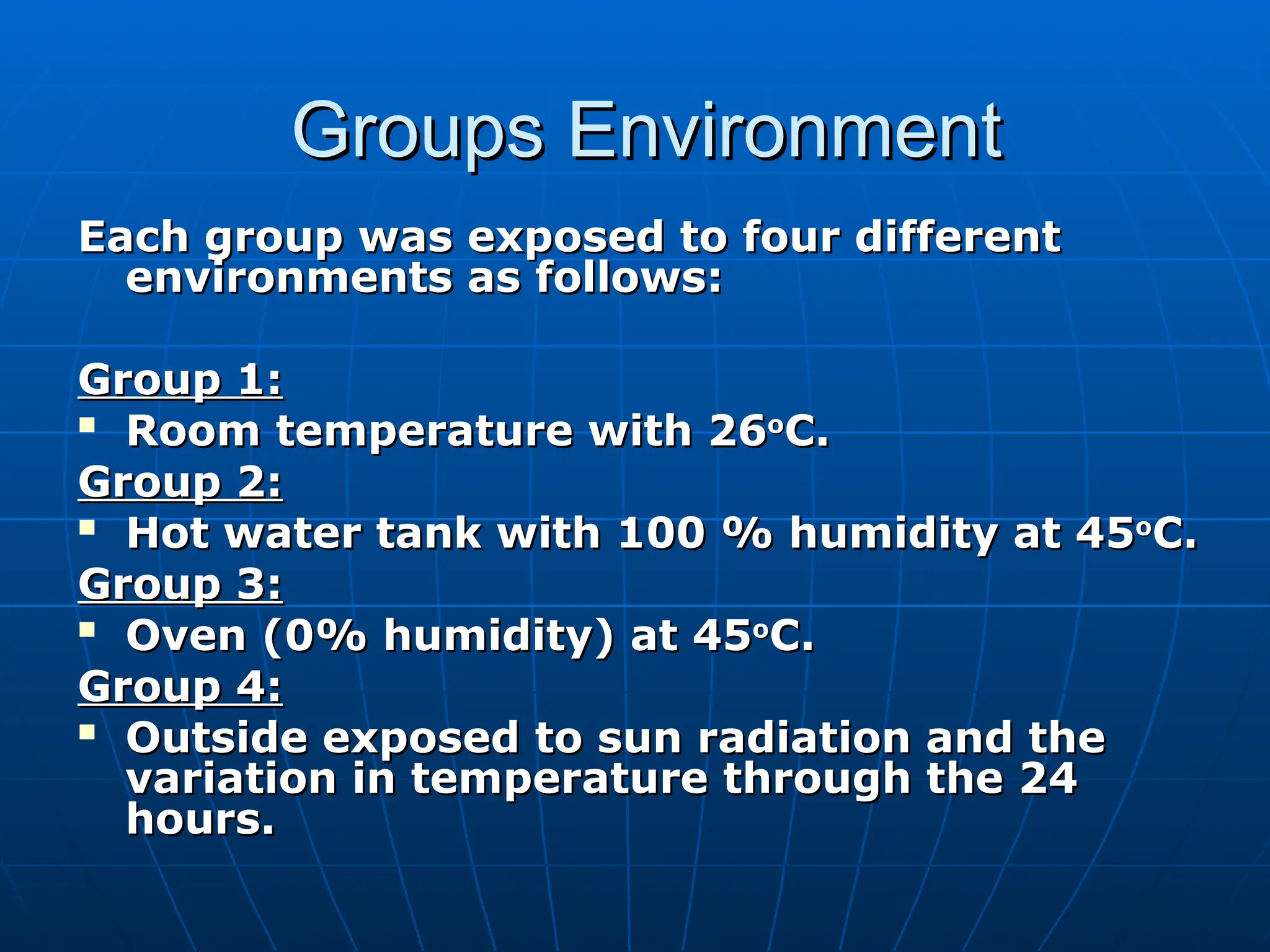
Each group was exposed to four different
environments as follows:
Group 1:
Group 1:

Room temperature with 26
Room temperature with 26o
o
C.
C.
Group 2:
Group 2:

Hot water tank with 100 % humidity at 45
Hot water tank with 100 % humidity at 45o
o
C.
C.
Group 3:
Group 3:

Oven (0% humidity) at 45
Oven (0% humidity) at 45o
o
C.
C.
Group 4:
Group 4:

Outside exposed to sun radiation and the
variation in temperature through the 24
hours.
hours.

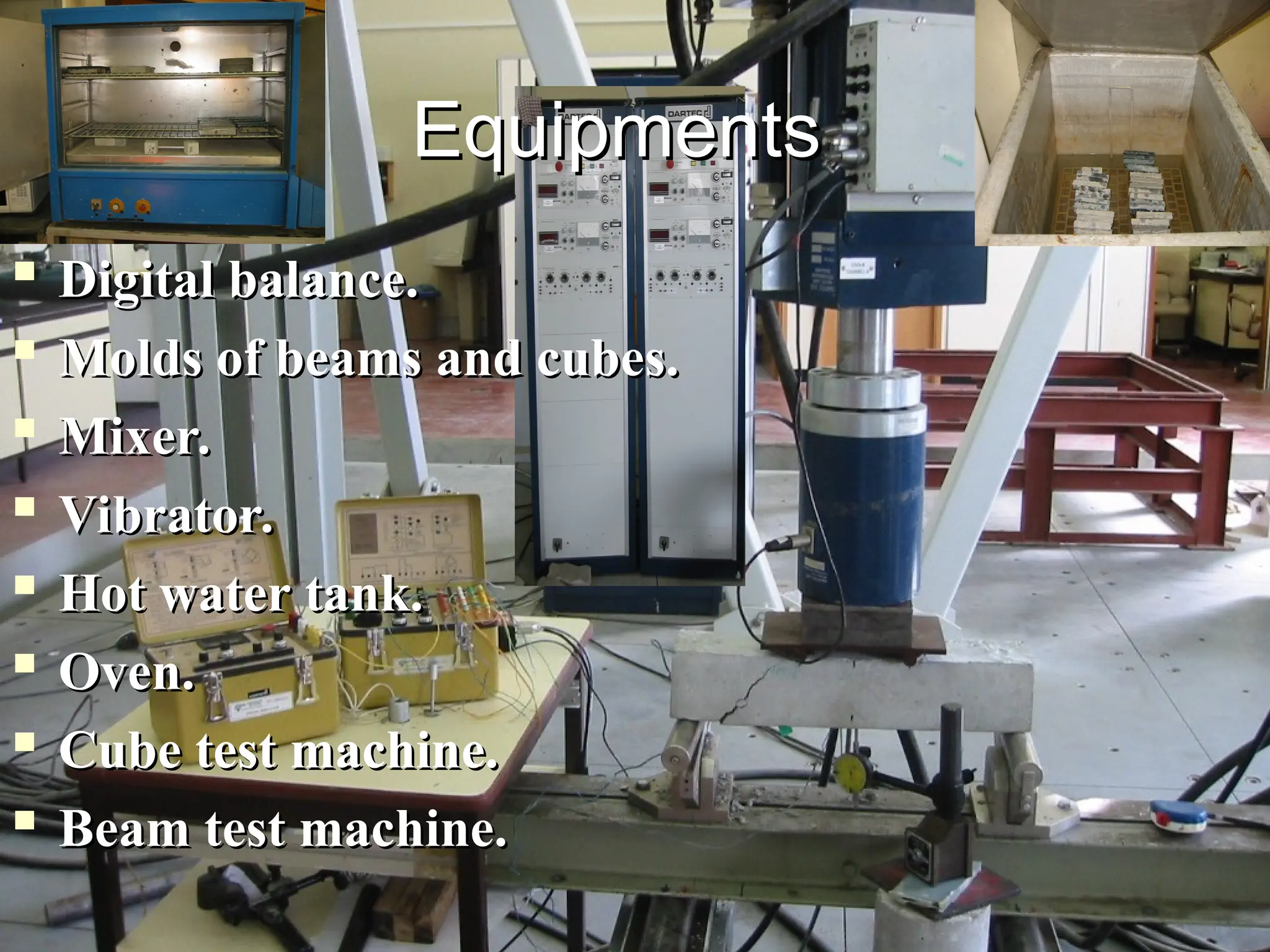
Digital balance.
Digital balance.

Molds of beams and cubes.

Mixer.
Mixer.

Vibrator.
Vibrator.

Hot water tank.
Hot water tank.

Oven.
Oven.

Cube test machine.
Cube test machine.

Beam test machine.
Beam test machine.
Equipments
Equipments
Materials
Materials

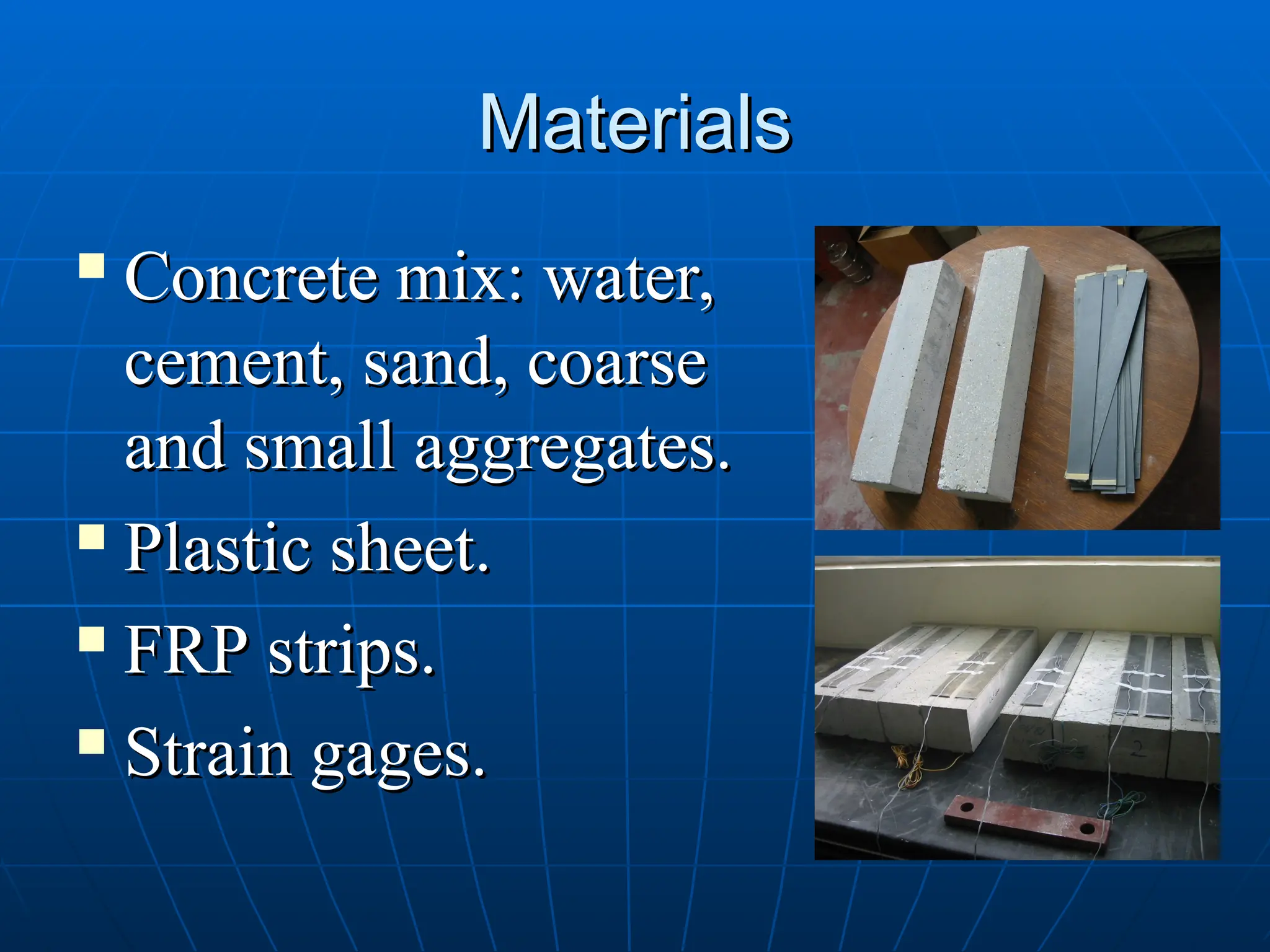
Concrete mix: water,
cement, sand, coarse
and small aggregates.

Plastic sheet.
Plastic sheet.

FRP strips.
FRP strips.

Strain gages.
Strain gages.
Procedures
Procedures
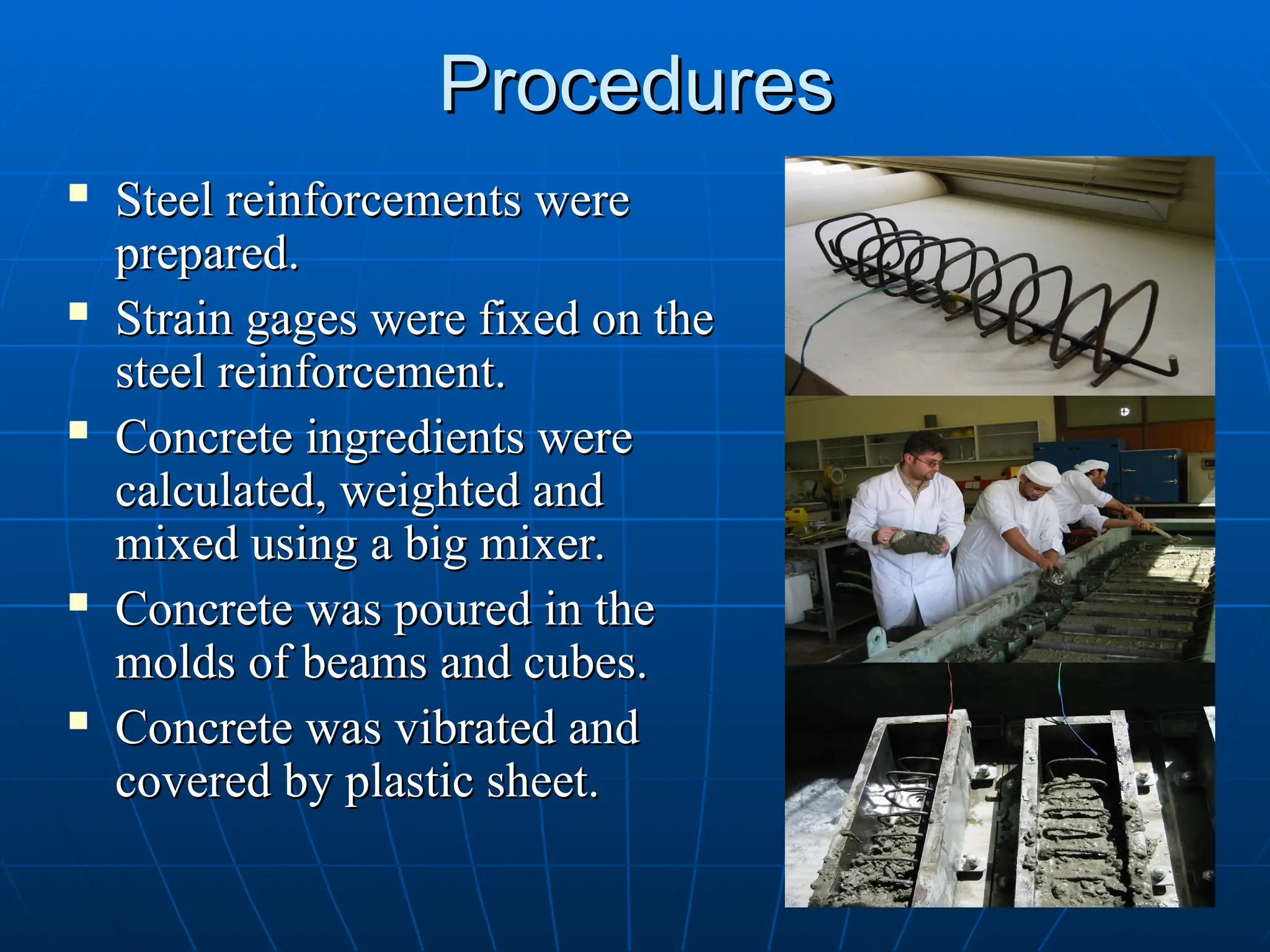
 Steel reinforcements were
Steel reinforcements were
prepared.
prepared.
 Strain gages were fixed on the
Strain gages were fixed on the
steel reinforcement.
 Concrete ingredients were
Concrete ingredients were
calculated, weighted and
mixed using a big mixer.
 Concrete was poured in the
Concrete was poured in the
molds of beams and cubes.
 Concrete was vibrated and
Concrete was vibrated and
covered by plastic sheet.
Procedures
Procedures

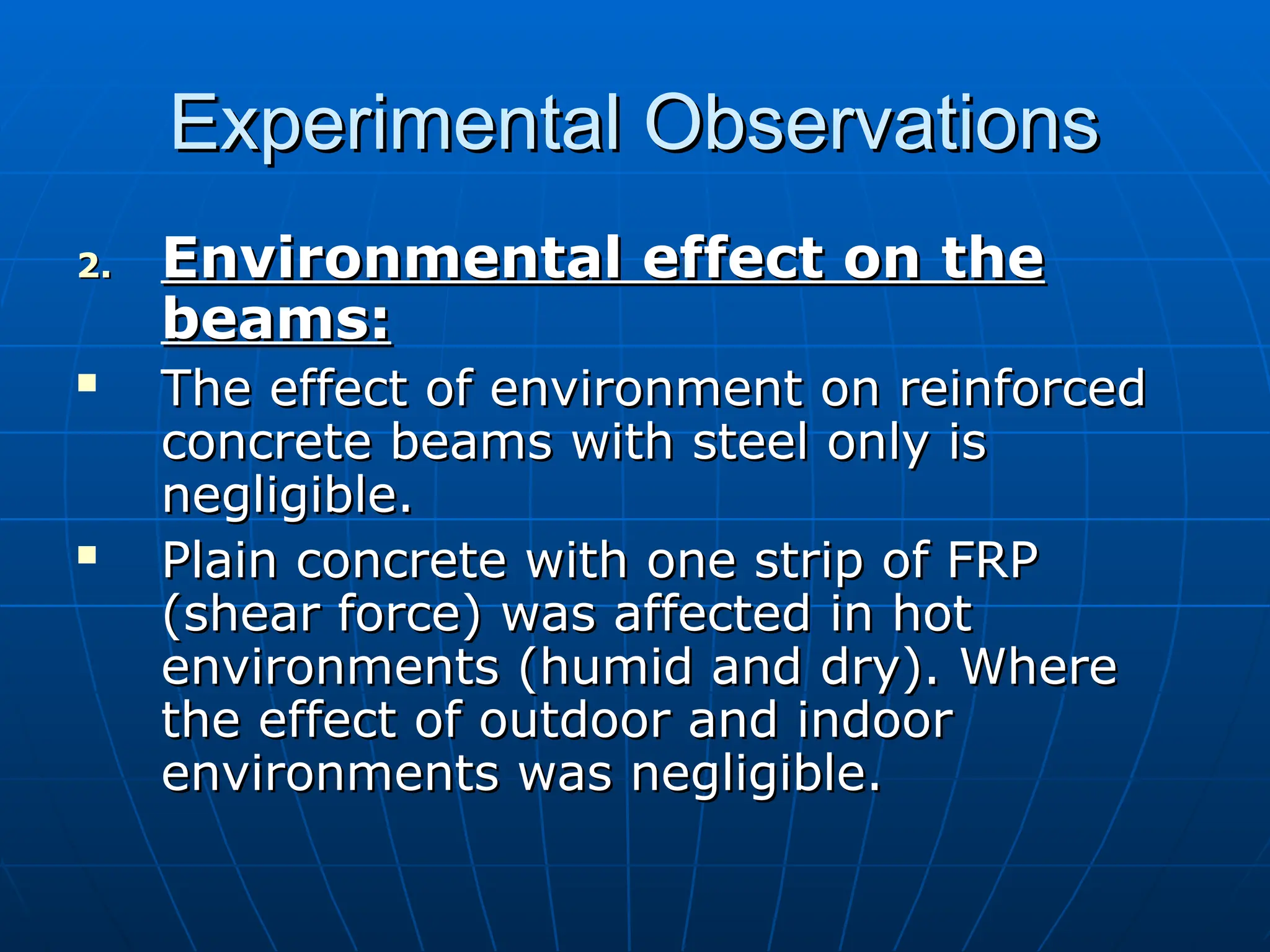
3 cubes were tested after 7 days.

Concrete beams and cubes were
removed from molds and cured in
potable water for 14 days.

Beams and cubes were exposed to
air drying in laboratory.
Procedures
Procedures
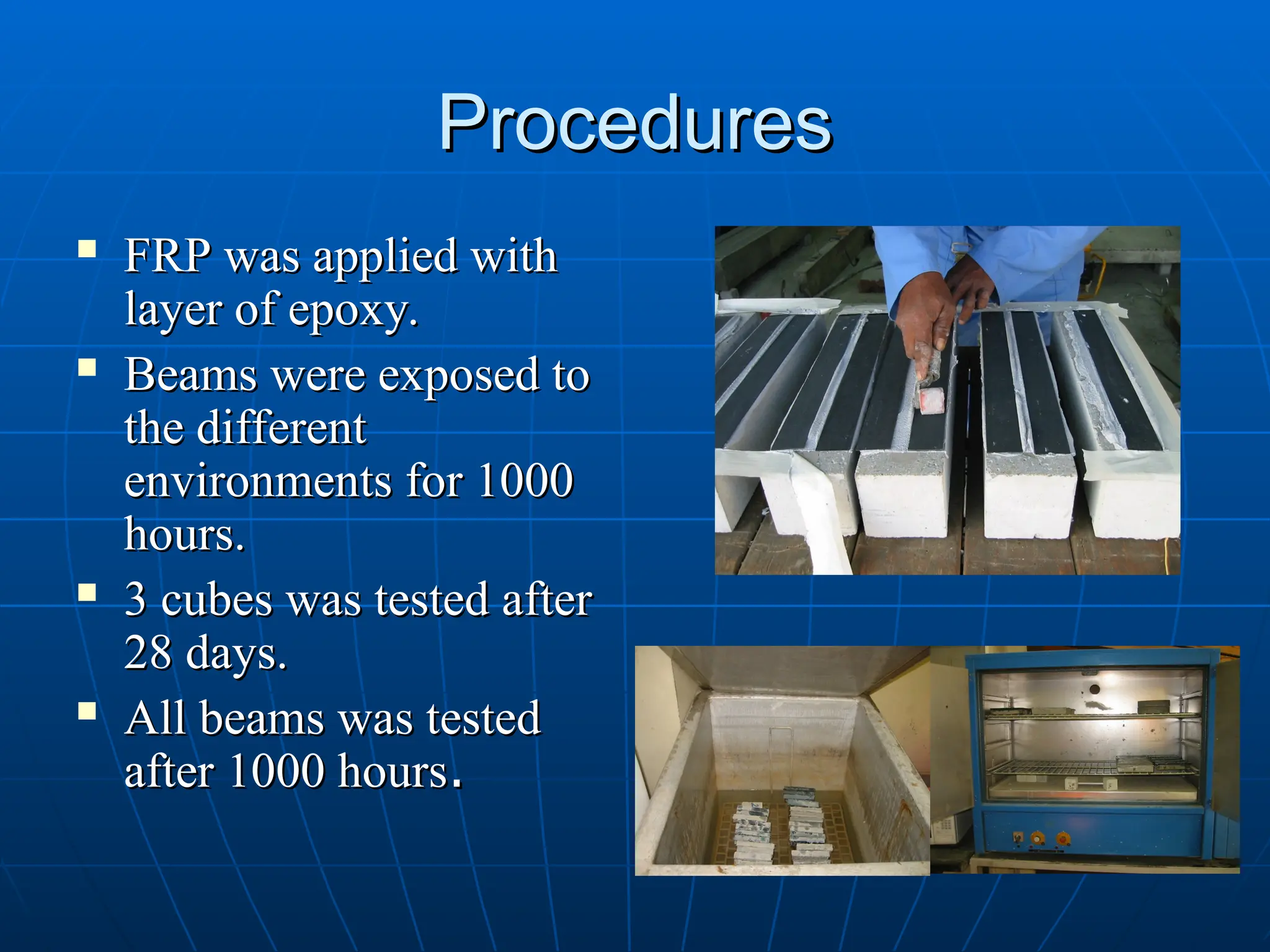
 FRP was applied with
FRP was applied with
layer of epoxy.
layer of epoxy.
 Beams were exposed to
Beams were exposed to
the different
the different
environments for 1000
hours.
hours.
 3 cubes was tested after
3 cubes was tested after
28 days.
28 days.
 All beams was tested
All beams was tested
after 1000 hours
after 1000 hours.
.
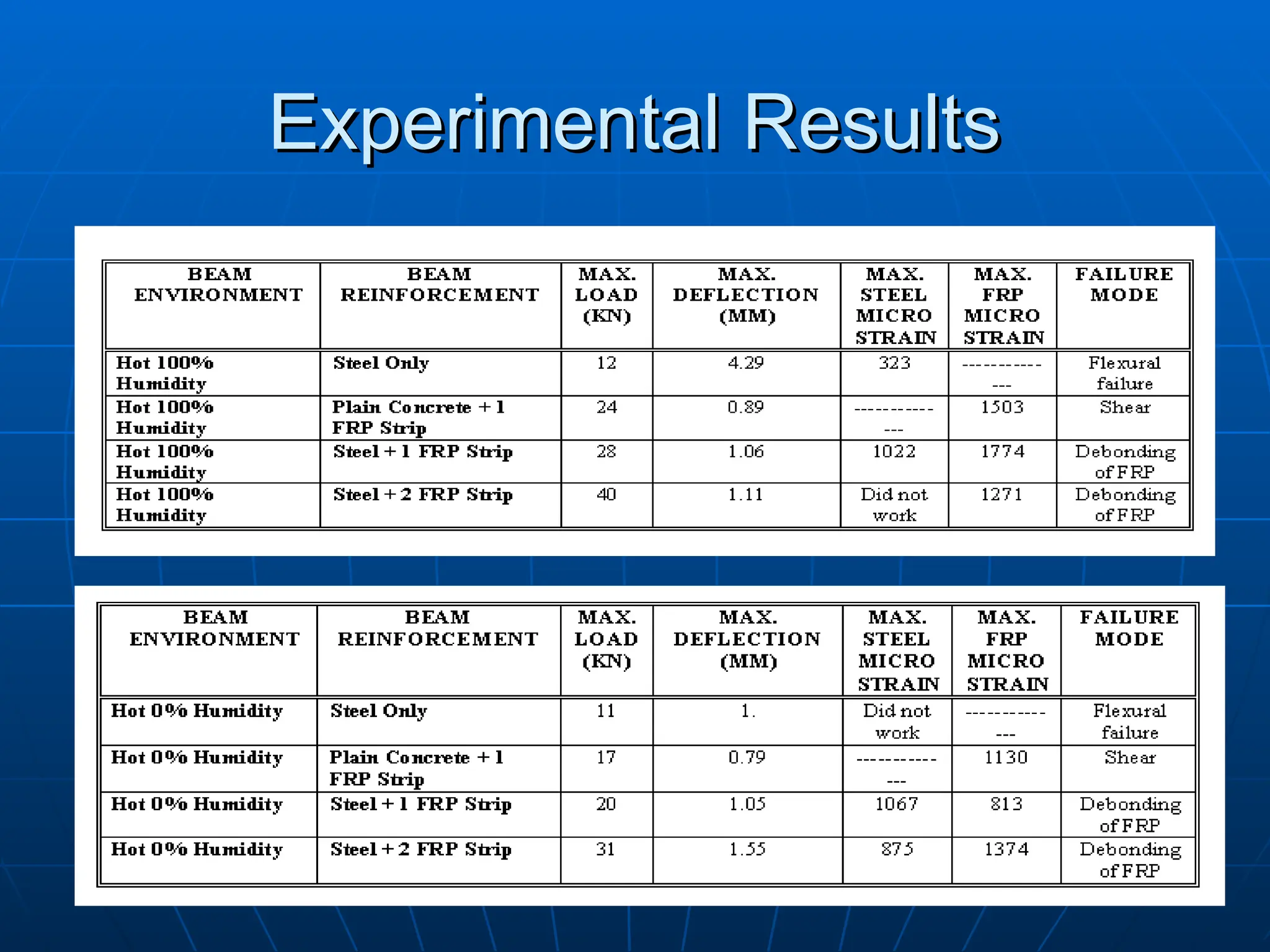
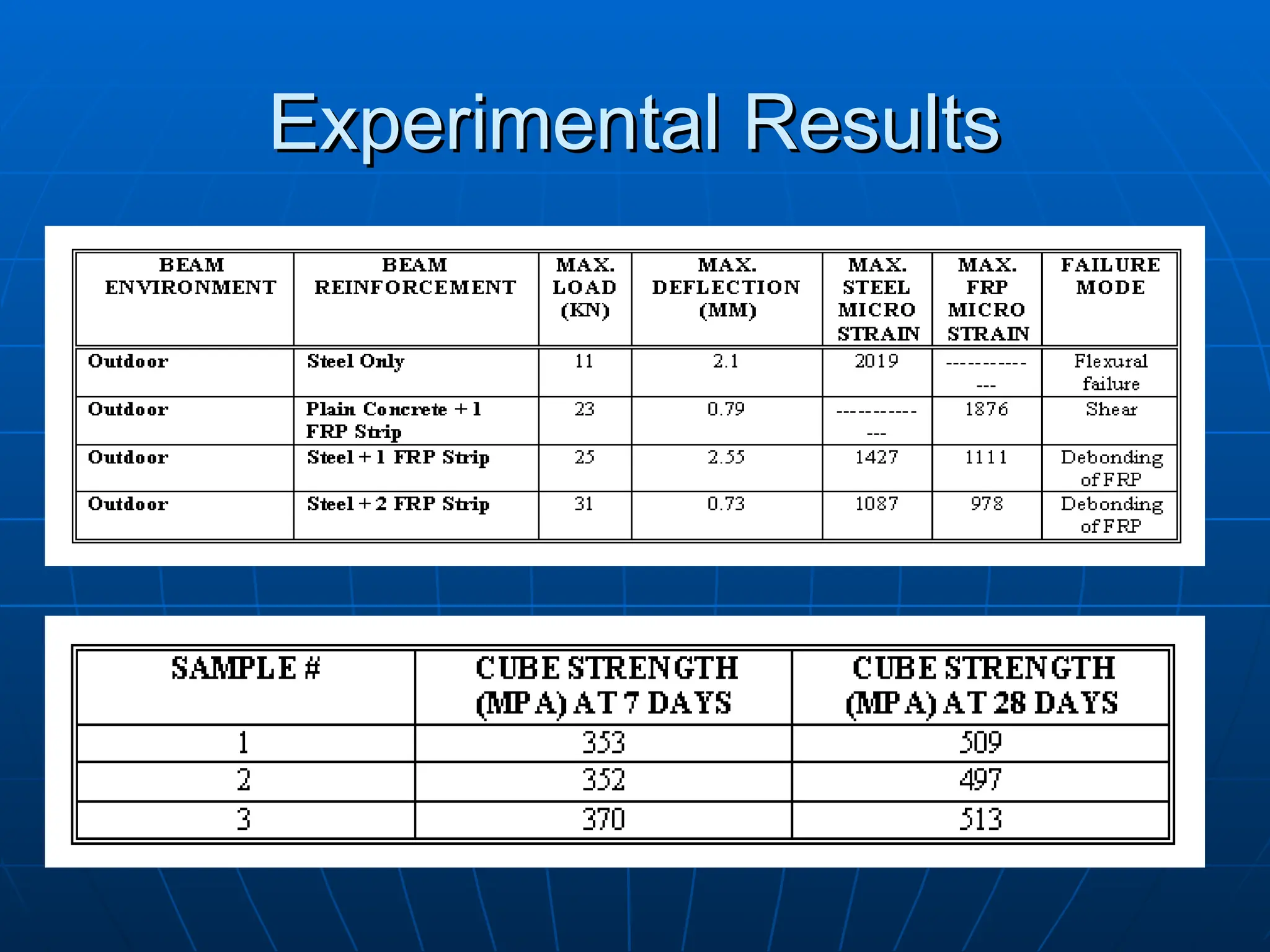
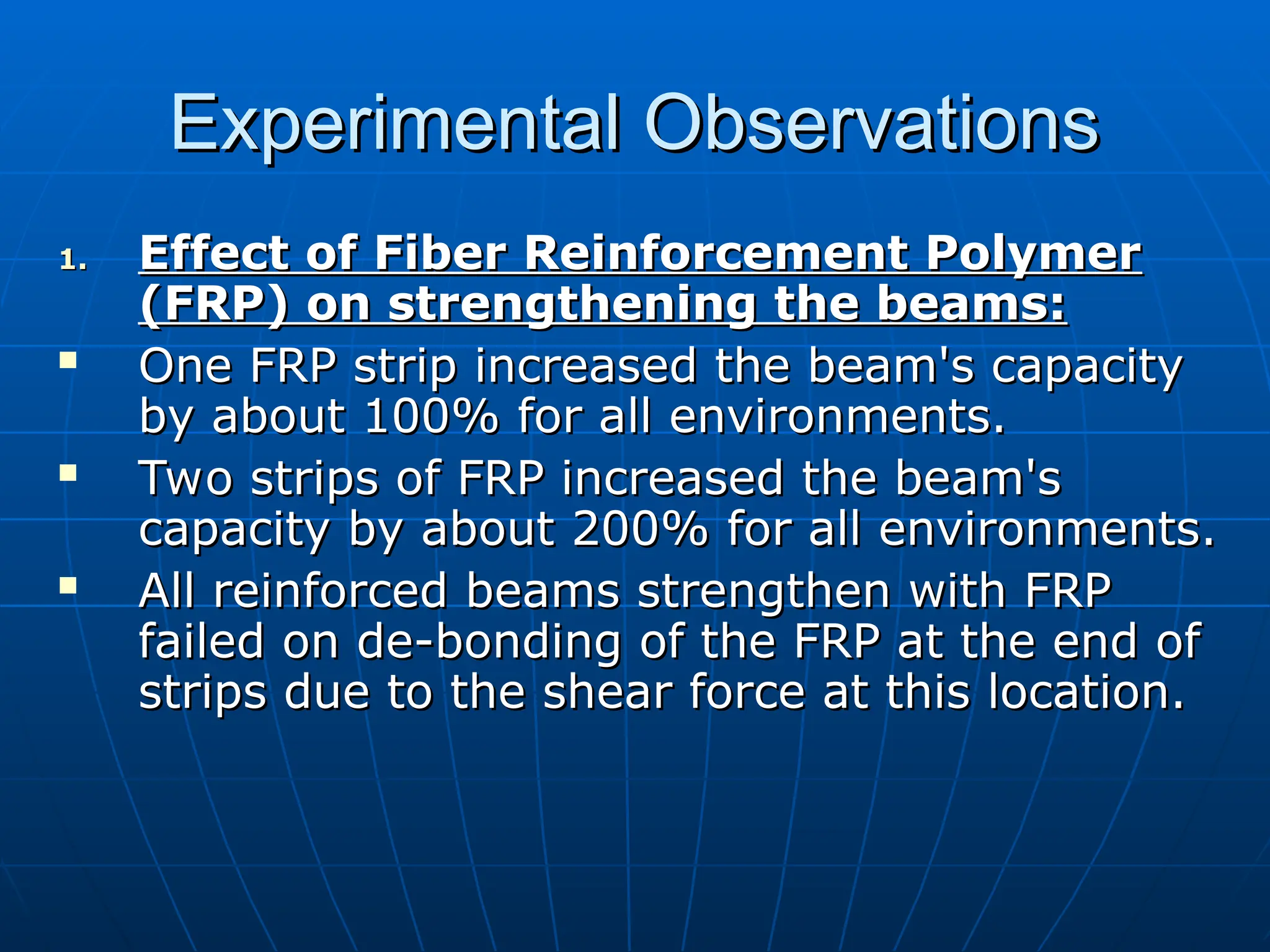
Experimental Result
Experimental Result
Experimental Results
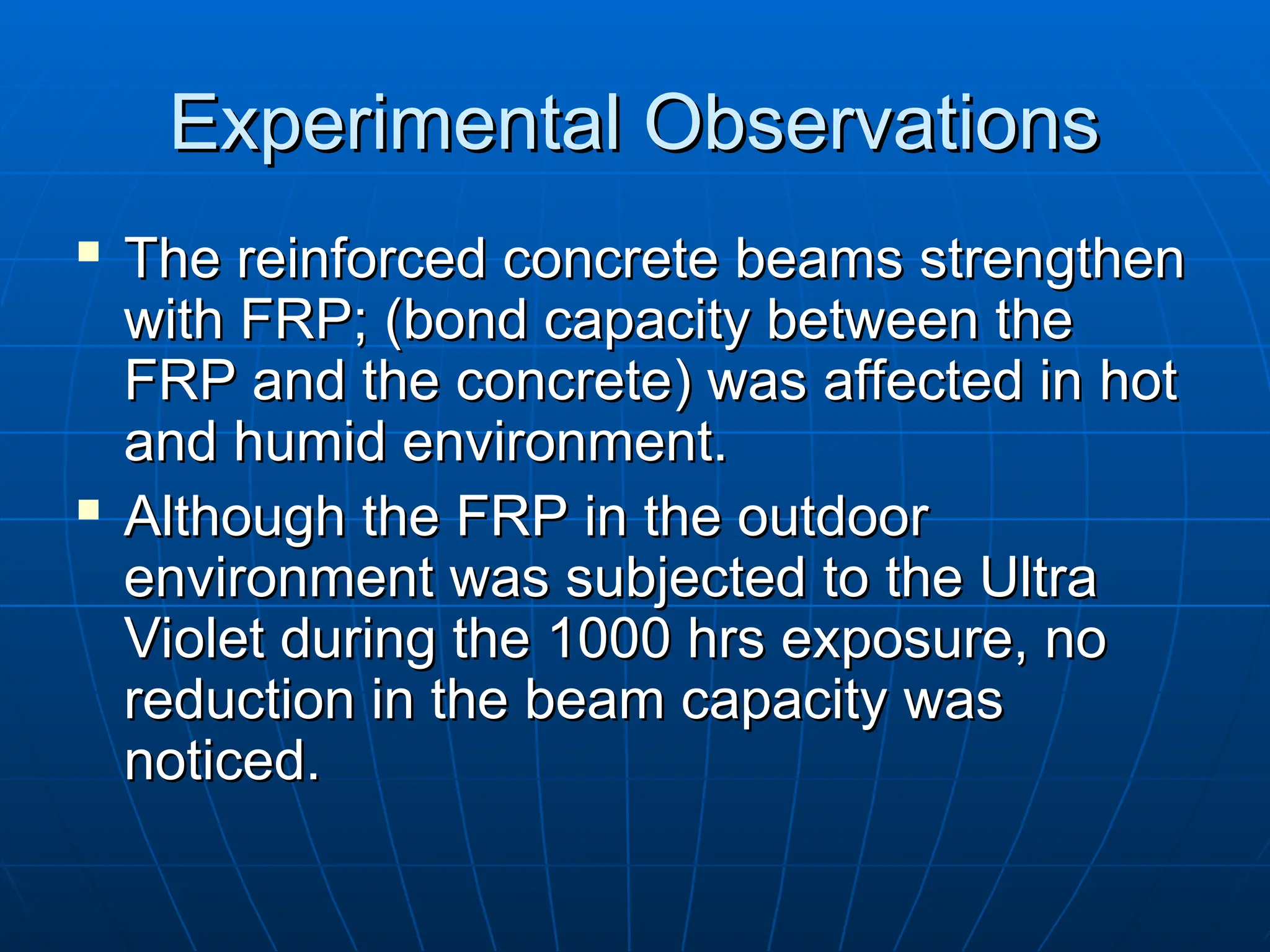
Experimental Observations
1.
1. Effect of Fiber Reinforcement Polymer
Effect of Fiber Reinforcement Polymer
(FRP) on strengthening the beams:
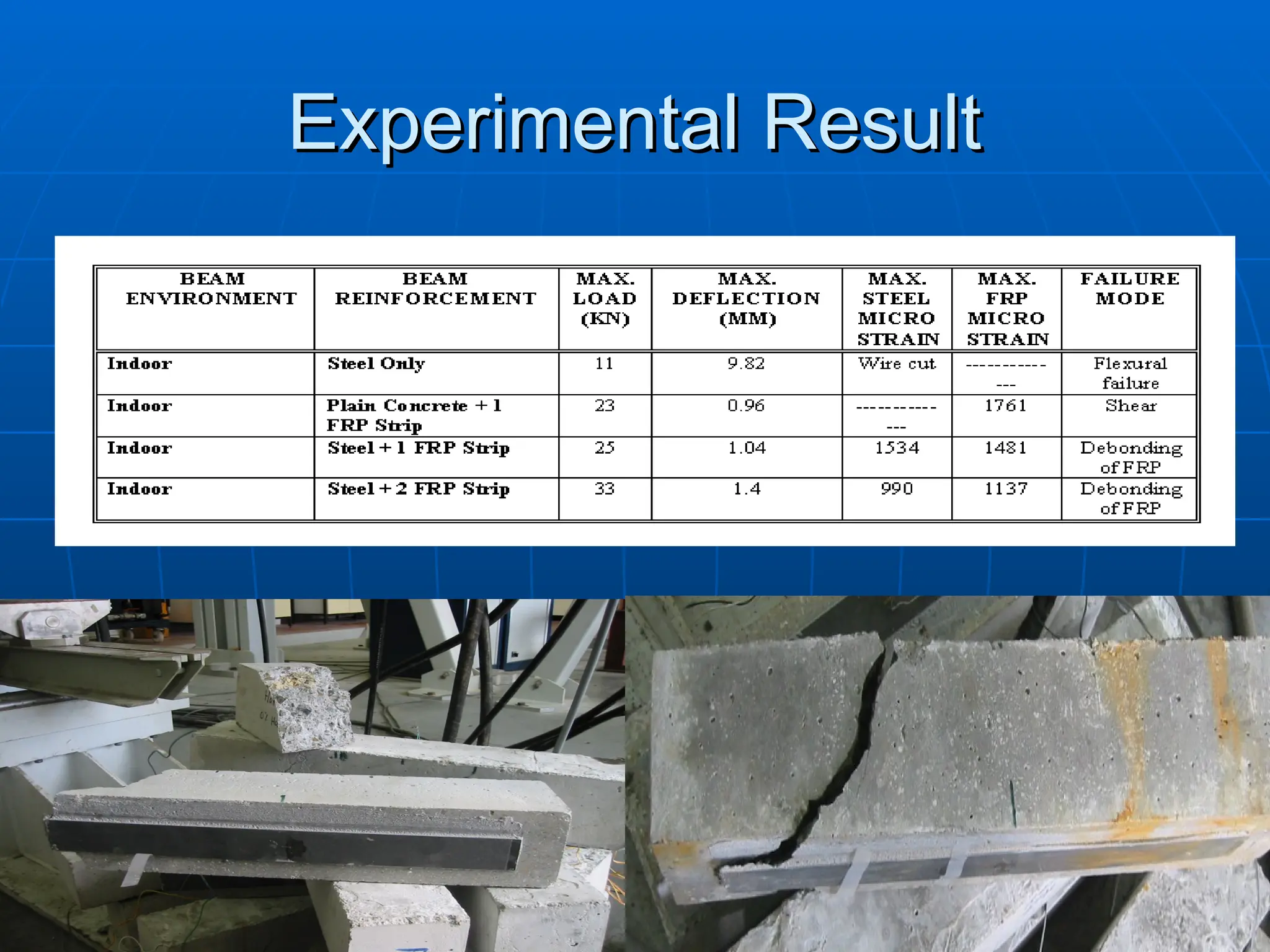
 One FRP strip increased the beam's capacity
One FRP strip increased the beam's capacity
by about 100% for all environments.
 Two strips of FRP increased the beam's
Two strips of FRP increased the beam's
capacity by about 200% for all environments.
 All reinforced beams strengthen with FRP
All reinforced beams strengthen with FRP
failed on de-bonding of the FRP at the end of
strips due to the shear force at this location.
Experimental Observations
2.
2. Environmental effect on the
Environmental effect on the
beams:
beams:
 The effect of environment on reinforced
The effect of environment on reinforced
concrete beams with steel only is
negligible.
negligible.
 Plain concrete with one strip of FRP
Plain concrete with one strip of FRP
(shear force) was affected in hot
environments (humid and dry). Where
the effect of outdoor and indoor
environments was negligible.
Experimental Observations
 The reinforced concrete beams strengthen
The reinforced concrete beams strengthen
with FRP;
with FRP; (
(bond capacity between the
bond capacity between the
FRP and the concrete
FRP and the concrete)
) was affected in
was affected in hot
hot
and humid environment.
 Although the FRP in the outdoor
Although the FRP in the outdoor
environment was subjected to the Ultra
Violet during the 1000 hrs exposure, no
reduction in the beam capacity was
noticed.
noticed.
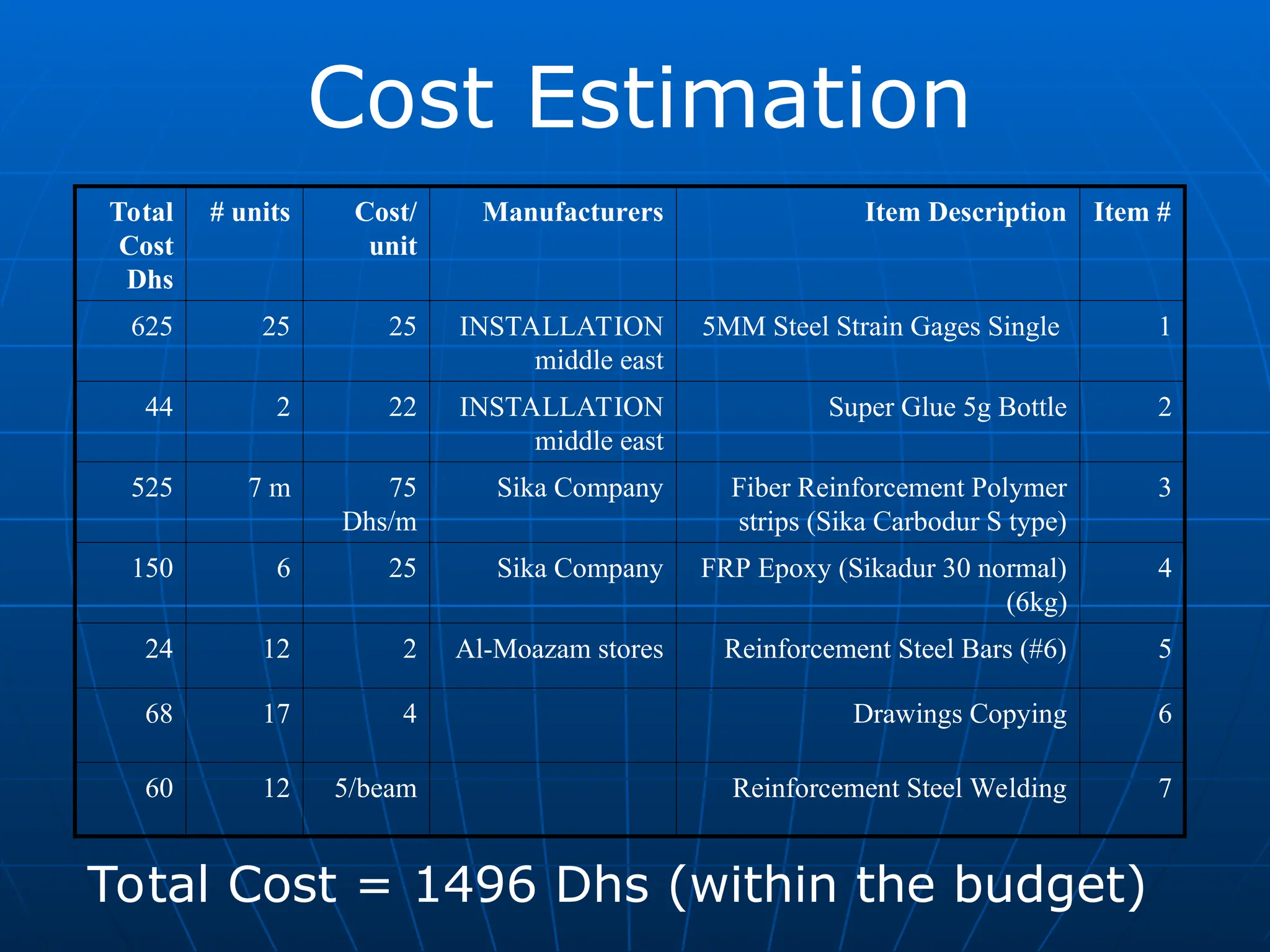
Cost Estimation
Total Cost = 1496 Dhs (within the budget)
Item #
Item Description
Manufacturers
Cost/
unit
# units
Total
Cost
Dhs
1
5MM Steel Strain Gages Single
INSTALLATION
middle east
25
25
625
2
Super Glue 5g Bottle
INSTALLATION
middle east
22
2
44
3
Fiber Reinforcement Polymer
strips (Sika Carbodur S type)
Sika Company
75
Dhs/m
7 m
525
4
FRP Epoxy (Sikadur 30 normal)
(6kg)
Sika Company
25
6
150
5
Reinforcement Steel Bars (#6)
Al-Moazam stores
2
12
24
6
Drawings Copying
4
17
68
7
Reinforcement Steel Welding
5/beam
12
60
Analysis background
Analysis background

The most important and most
difficult task faced by the structural
designer is the accurate estimation
of the loads that may be applied to
the structure during its life.

The next problem is to decide the
worst possible combinations of these
loads that might occur at one time.
Analysis background
Analysis background

The loads that will be used in this
project are dead and live loads.

Dead loads are loads of constant
magnitude that remain in one
position.
position.

Live loads are loads that can change
in magnitude and position.
Analysis background
Analysis background

ACI code (9.2) states that the
required ultimate load carrying
ability of the member U provided to
resist the dead load D and the live
load L must at least equal:
U = 1.4D + 1.7L
U = 1.4D + 1.7L
Analysis background
Analysis background

The Loads carried by the structure are
transferred from one structural element to
another until it reaches its final destination
to the supporting ground.

The loads that come from slabs to beams
can be estimated according to the slabs
design system and the geometry of these
slabs.
slabs.
Analysis background
Analysis background

In one direction slabs the beam is
carrying half of the slab as a
rectangular or square shape.

In two way slabs the each beam
around the slab is carrying triangle
or trapezoidal shape of the slab.
Prokon Structural Analysis & Design
 Prokon structural analysis and design
Prokon structural analysis and design
is a useful tool for analysis and
design of structures.
 The PROKON suite has two main
The PROKON suite has two main
components:
components:
 PROKON Calcpad.
PROKON Calcpad.
 PROKON analysis and design
PROKON analysis and design
modules .
modules .
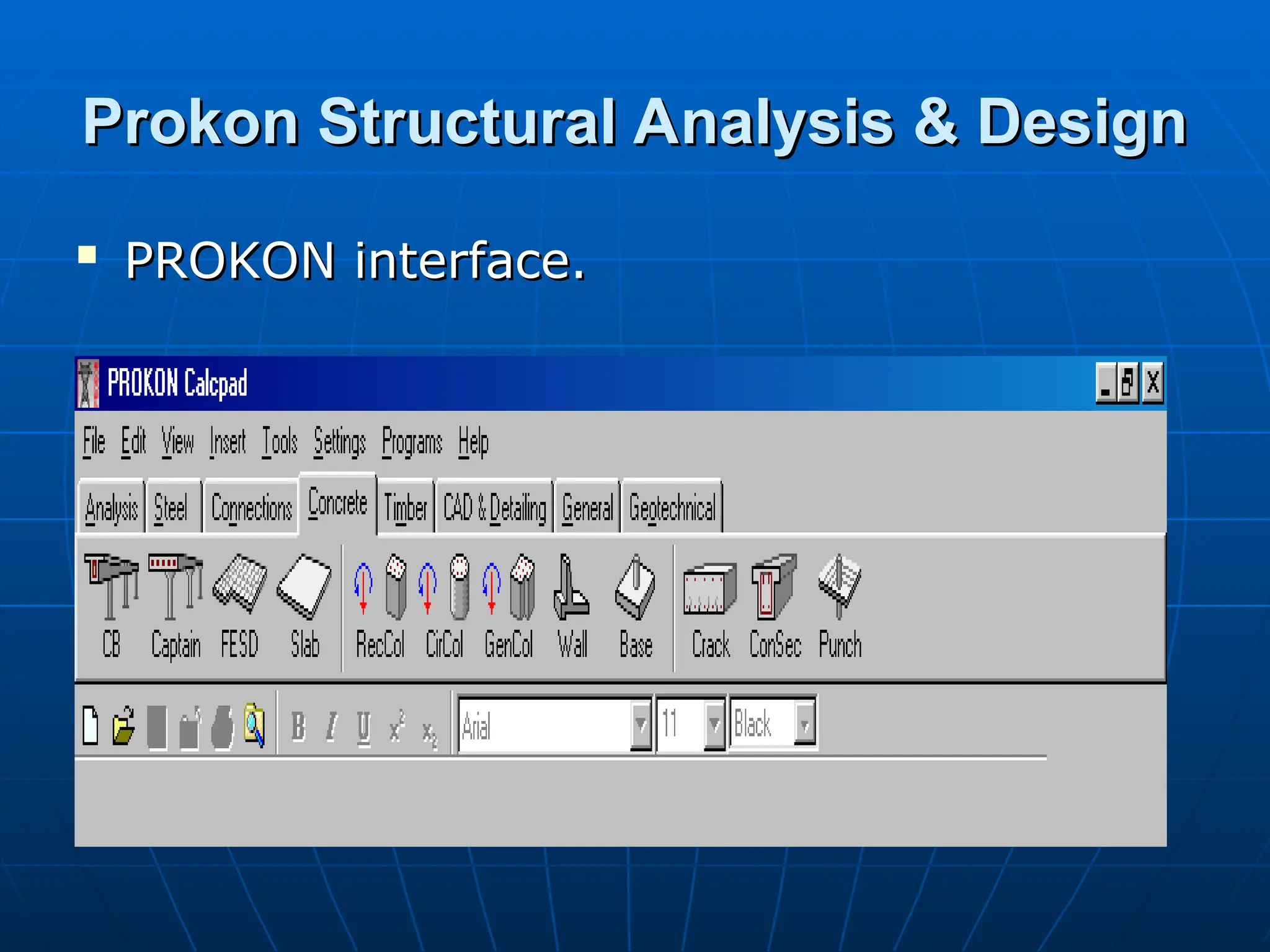
Prokon Structural Analysis & Design

PROKON interface.
PROKON interface.
Prokon Structural Analysis & Design

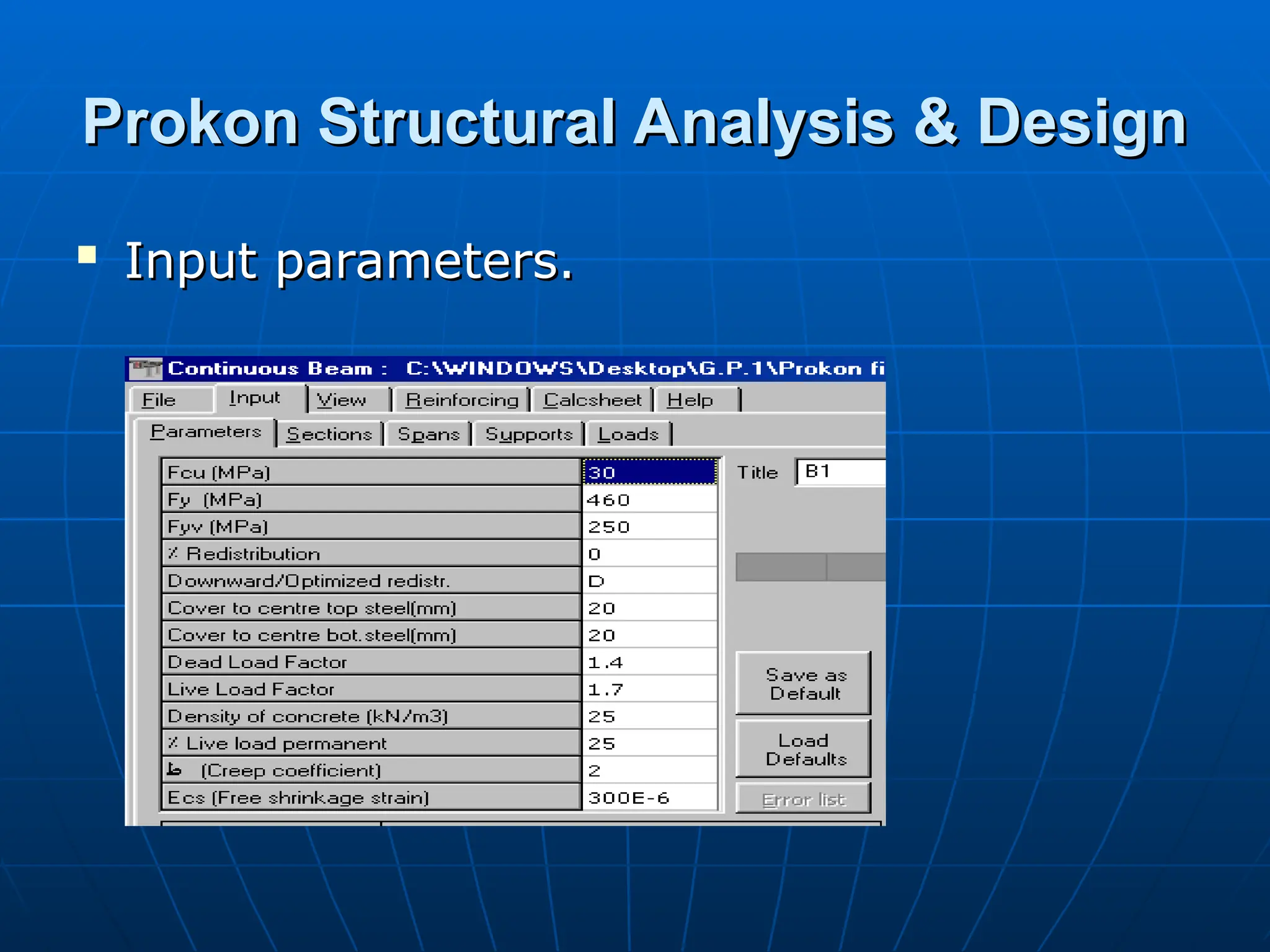
Input parameters.
Input parameters.
Prokon Structural Analysis & Design

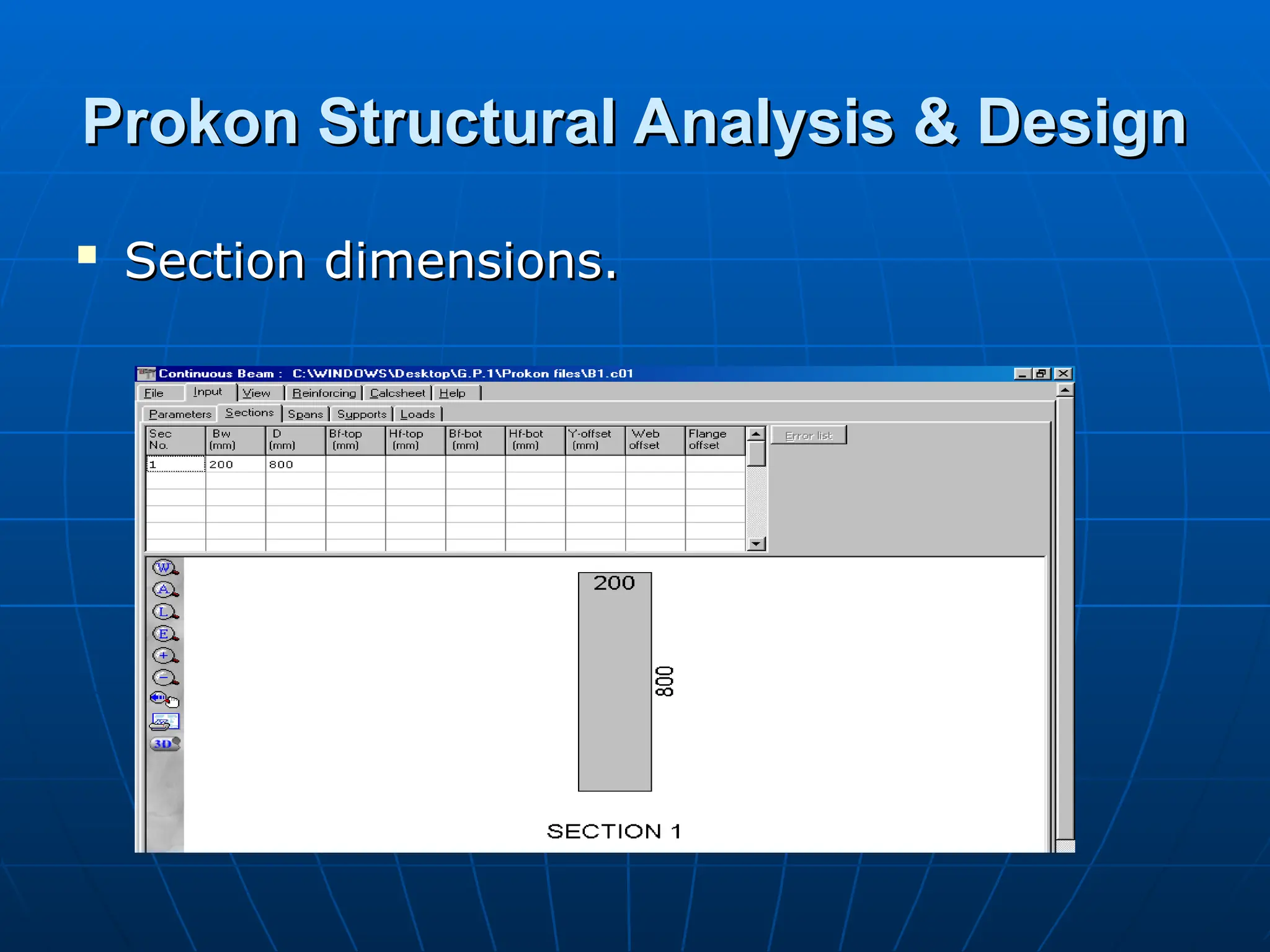
Section dimensions.
Section dimensions.
Prokon Structural Analysis & Design

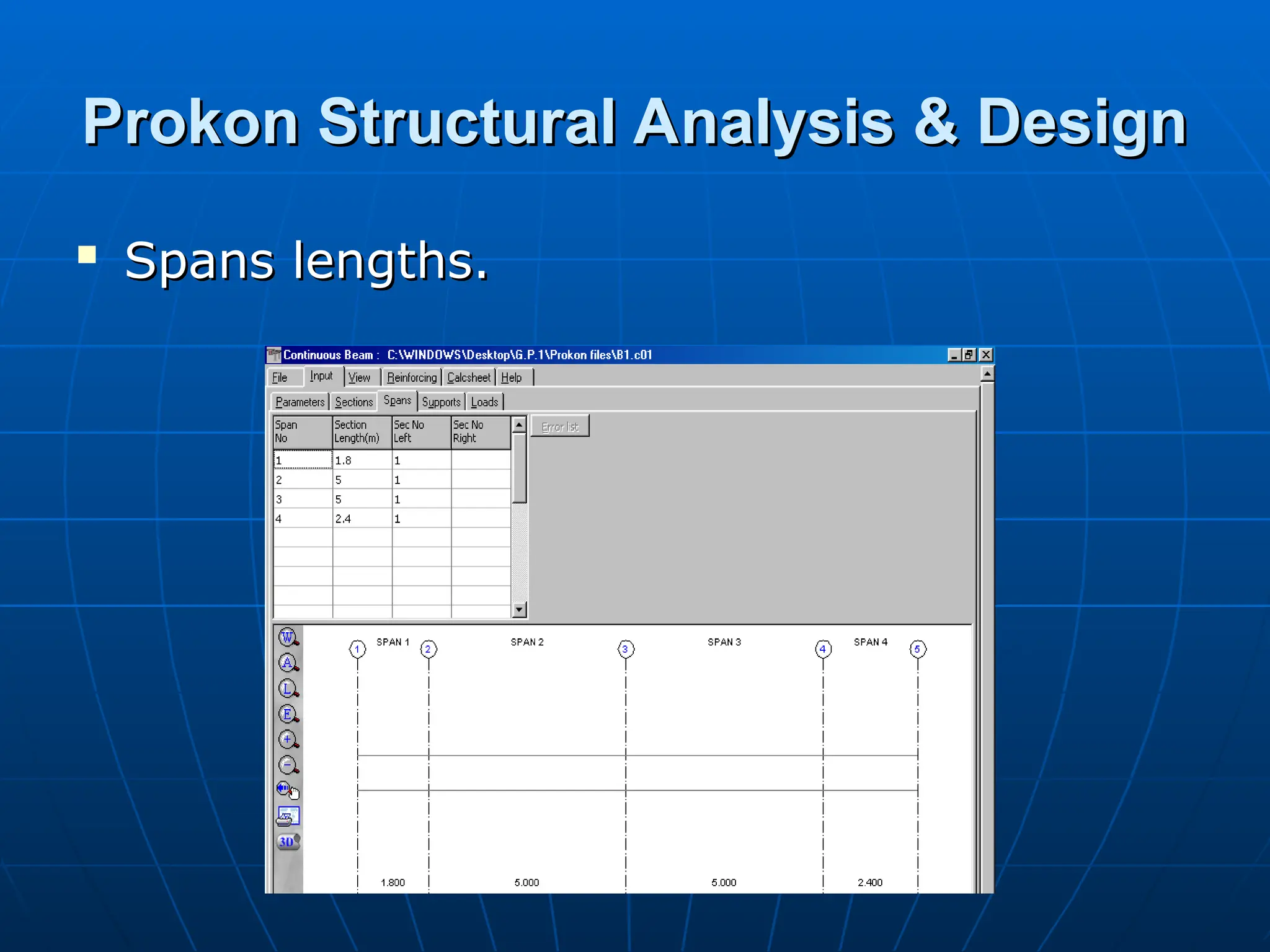
Spans lengths.
Spans lengths.
Prokon Structural Analysis & Design

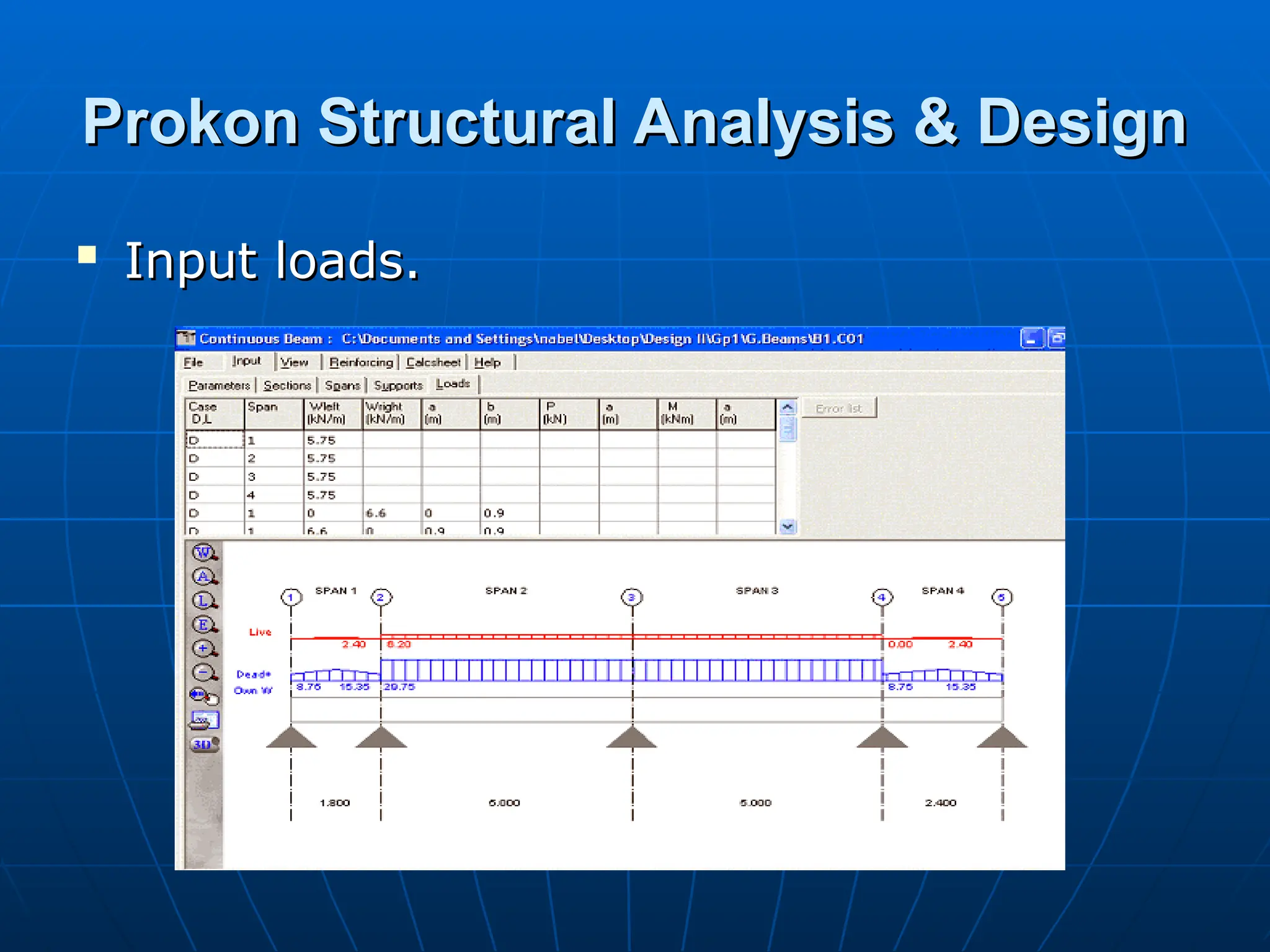
Input loads.
Input loads.
Prokon Structural Analysis & Design

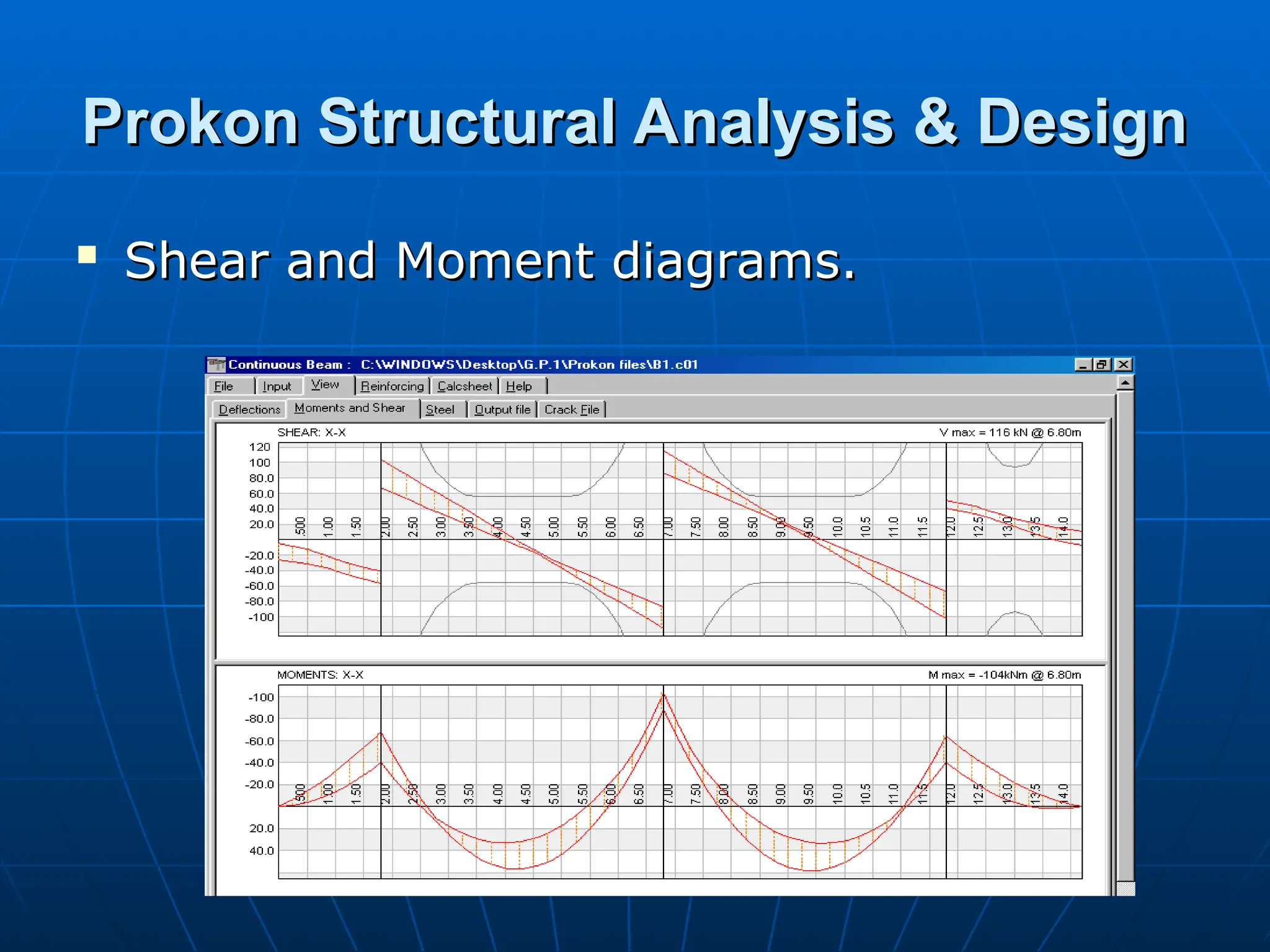
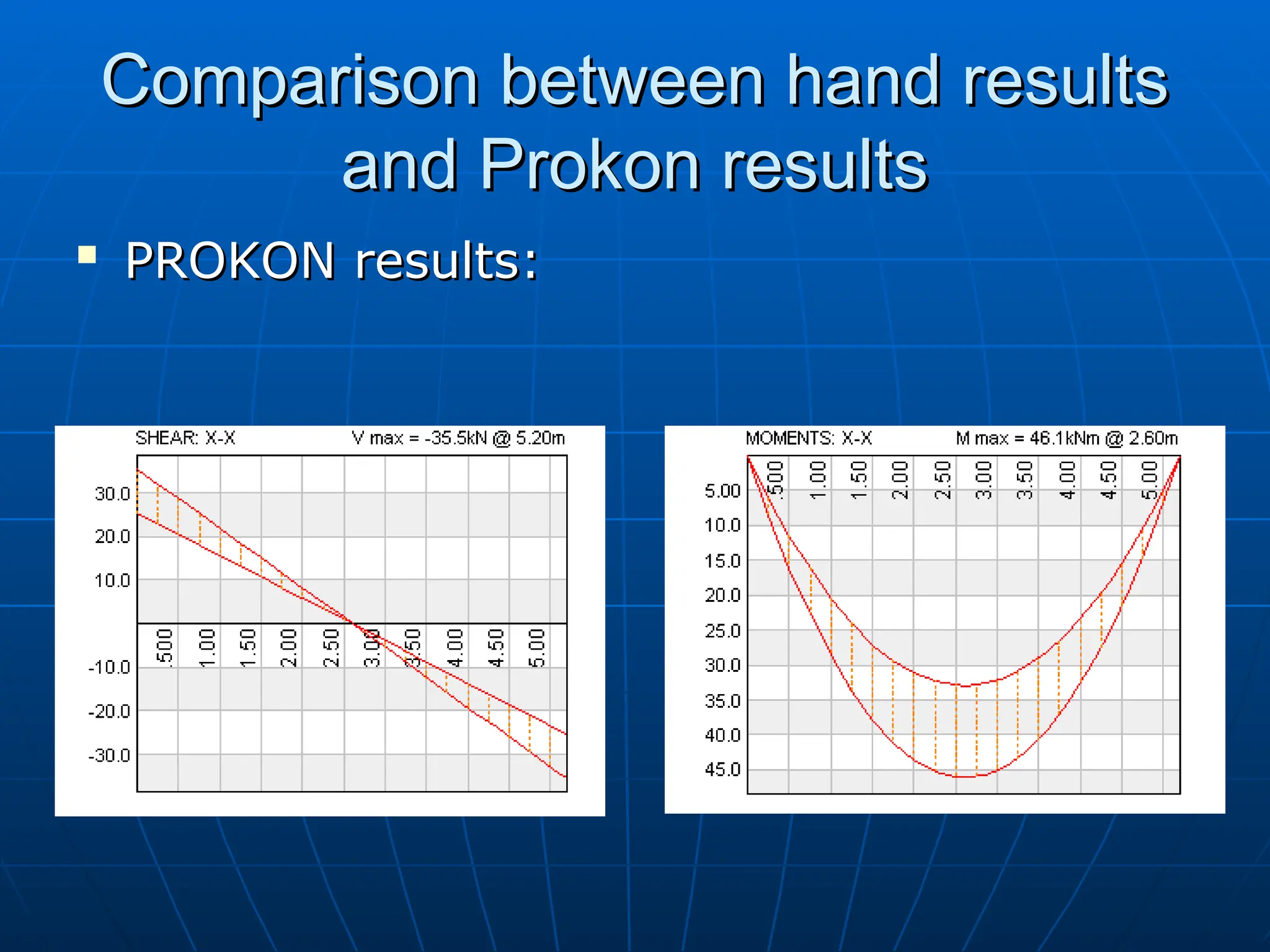
Shear and Moment diagrams
Shear and Moment diagrams.
.
Structural system of the building
 Area = 750 m
Area = 750 m2
2
.
.
 It consists of two stories.
It consists of two stories.
 Types of slabs: One way Hurdy
Types of slabs: One way Hurdy
slabs, two way hurdy slabs and two
way solid slabs.
way solid slabs.
 Types of columns: Rectangular and
Types of columns: Rectangular and
circular.
circular.
 There are projected beams and
There are projected beams and
hidden beams.
hidden beams.
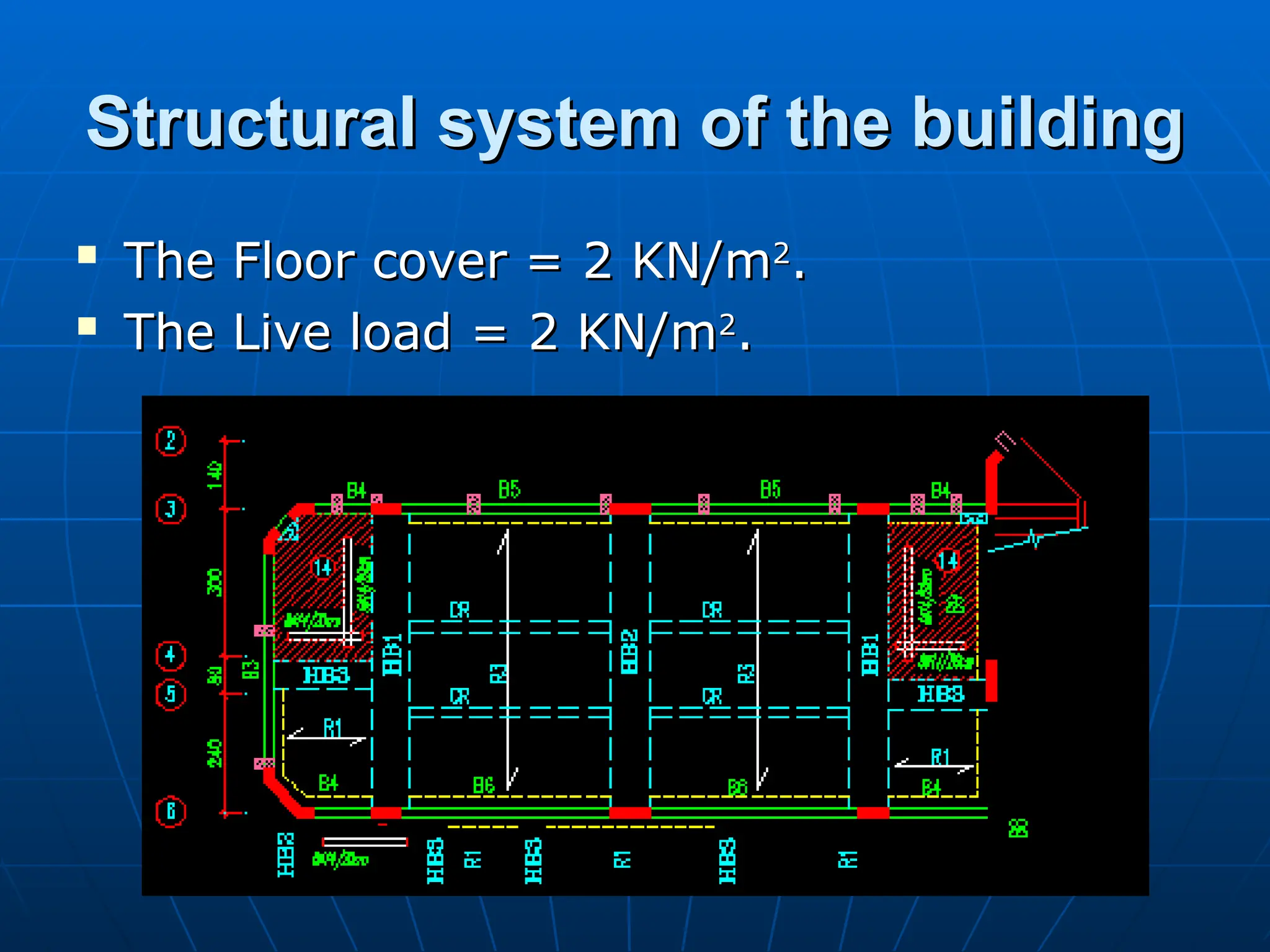
Structural system of the building

The Floor cover = 2 KN/m
The Floor cover = 2 KN/m2
2
.
.

The Live load = 2 KN/m
The Live load = 2 KN/m2
2
.
.
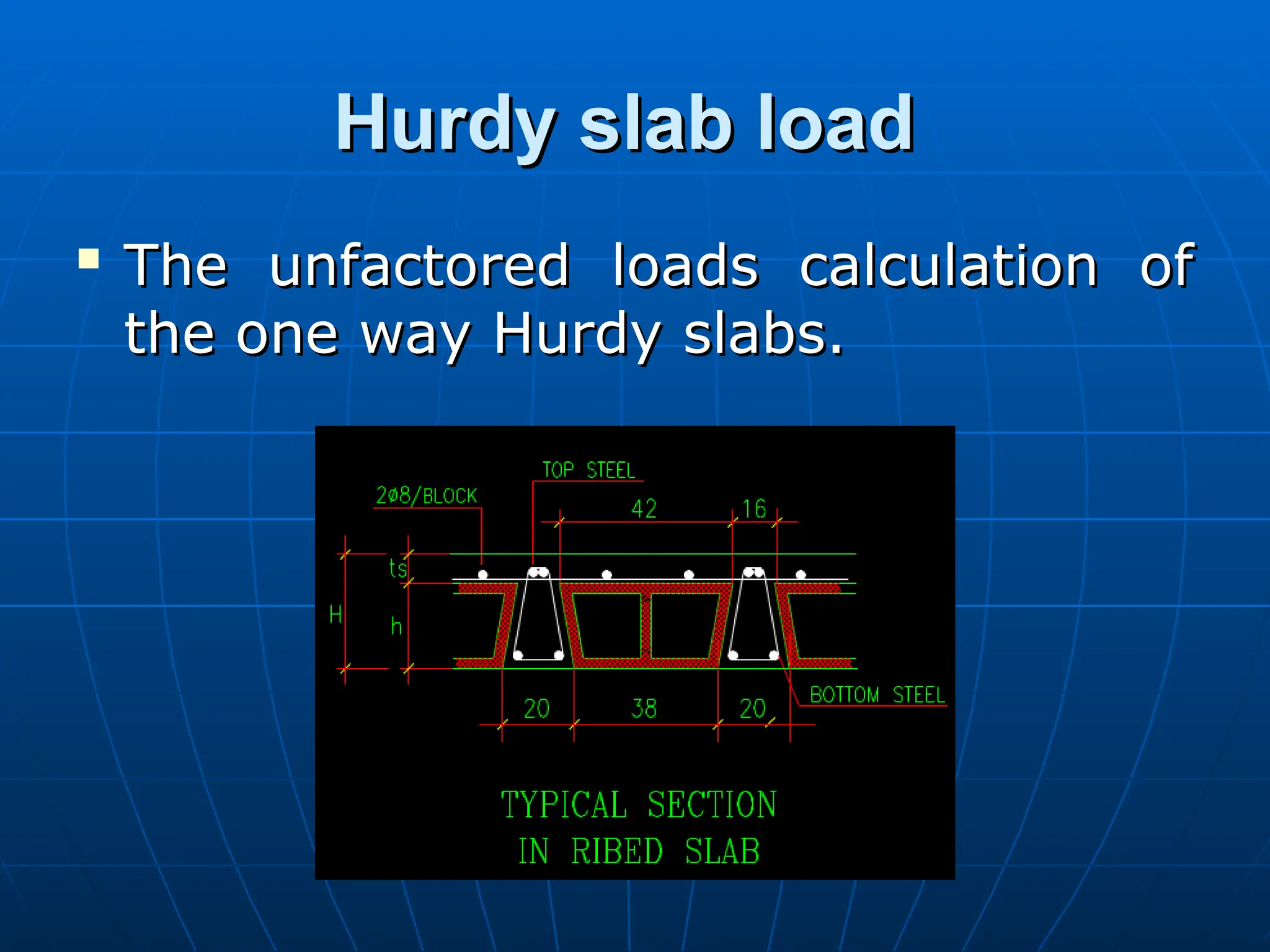
Hurdy slab load
Hurdy slab load

The unfactored loads calculation of
the one way Hurdy slabs.
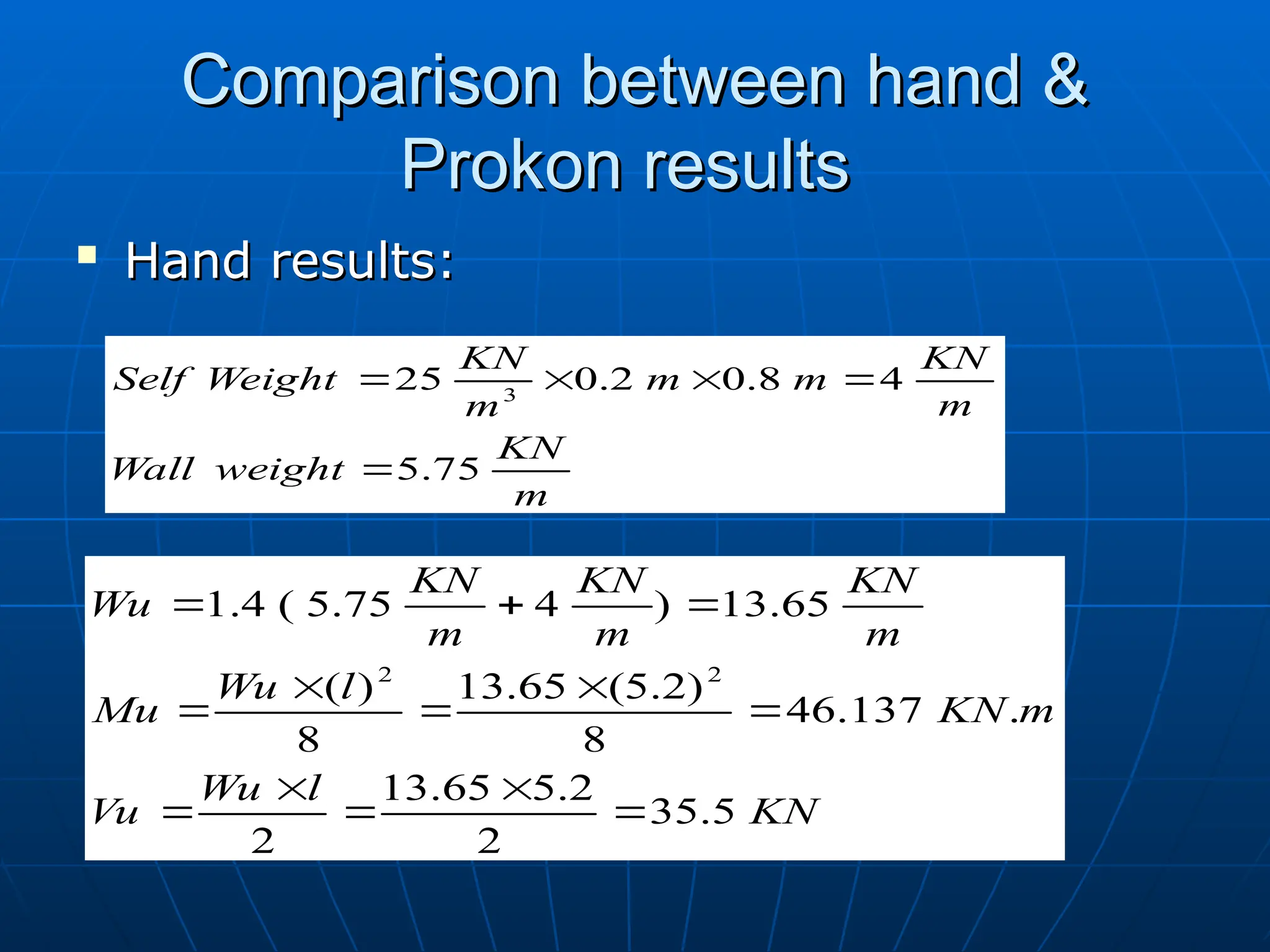
Comparison between hand &
Prokon results
Prokon results

Hand results:
Hand results:
m
KN
weight
Wall
m
KN
m
m
m
KN
Weight
Self
75
.
5
4
8
.
0
2
.
0
25 3





KN
l
Wu
Vu
m
KN
l
Wu
Mu
m
KN
m
KN
m
KN
Wu
5
.
35
2
2
.
5
65
.
13
2
.
137
.
46
8
)
2
.
5
(
65
.
13
8
)
(
65
.
13
)
4
75
.
5
(
4
.
1
2
2













Comparison between hand results
and Prokon results
and Prokon results

PROKON results:
PROKON results:
Conclusion
Conclusion

It was learned some modern
technologies in strengthening
concrete structures.

It was learned a new computer
software program.
software program.

The a knowledge that we gained
from structural analysis and design
courses were applied.
Conclusion
Conclusion

From the experimental results, it was
found that the FRP was effected by
20 % in the hot (0% humidity)
environment.
environment.

It was decided to use FRP to strength
the building.
the building.

It was learned how to analyze one
way Hurdy slabs and beams.
Thank You
Thank You
for Listening
for Listening

Strengthening of an existing reinforced concrete structure.ppt

  • 1.
    Graduation Project (1) GraduationProject (1) Strengthening of an existing Strengthening of an existing reinforced concrete structure reinforced concrete structure Student Name Student Name ID No. ID No. Nabil Raweh Qahtan Nabil Raweh Qahtan 980410066 980410066 Mohammed Eisa Al-Harrasi Mohammed Eisa Al-Harrasi 980710101 980710101 Hazem Bakri Al-Naser Hazem Bakri Al-Naser 199901443 199901443 United Arab Emirates University College of Engineering Civil and Environmental Department Instructor: Dr. Ashraf Biddah
  • 2.
    Introduction Introduction  Exclusive Summary Exclusive Summary  Thegeneral idea of the project. The general idea of the project.  Problems Facing reinforced concrete Problems Facing reinforced concrete structures. structures.
  • 3.
    Exclusive Summary Exclusive Summary Themain achievements: The main achievements:  Studying the Strengthening Methods. Studying the Strengthening Methods.  Selection of an exiting building. Selection of an exiting building.  Experimental Test. Experimental Test.  Beginning of Structural Analysis. Beginning of Structural Analysis.
  • 4.
    The general ideaof the project The general idea of the project  The owner of a residential building wanted to The owner of a residential building wanted to convert his building to a commercial building. convert his building to a commercial building.  According to change in the use of existing According to change in the use of existing structure, the structural system of the structure, the structural system of the building will be modified to fit the new building will be modified to fit the new changes. changes.  PROBLEM: The old building cannot carry the PROBLEM: The old building cannot carry the new loads that come from the changes. new loads that come from the changes.  DESIGN BRIEF : Design a strengthening DESIGN BRIEF : Design a strengthening system that can increase the capacity of the system that can increase the capacity of the existing structural system to be able to carry existing structural system to be able to carry the new loads that come from the changes the new loads that come from the changes. .
  • 5.
    Problems Facing Reinforced ProblemsFacing Reinforced Concrete Structures Concrete Structures  Load increases. Load increases.  Damage to structural parts. Damage to structural parts.  Improvements in suitability for use. Improvements in suitability for use.  Modification of structural system. Modification of structural system.  Errors in planning or construction. Errors in planning or construction.
  • 6.
    STRENGTHENING REINFORCED STRENGTHENING REINFORCED CONCRETESTRUCTURES BY BONDING CONCRETE STRUCTURES BY BONDING STEEL PLATES STEEL PLATES : :  Strengthening Strengthening is the process of is the process of adding capacity to a member of adding capacity to a member of structure. structure.  Attachment of steel to concrete: Attachment of steel to concrete: 1. 1. Adhesive connecting mechanism. Adhesive connecting mechanism. 2. 2. Bolting connecting mechanism. Bolting connecting mechanism.
  • 7.
    Explanatory Sketch Explanatory Sketch Fig.1 Techniques of plating reinforced concrete beams.
  • 8.
    STRENGTHENING REINFORCED STRENGTHENING REINFORCED CONCRETESTRUCTURES BY CONCRETE STRUCTURES BY PRESTRESSING CABLES PRESTRESSING CABLES : :  Post-tensioning Post-tensioning is a technique used is a technique used to prestress reinforced concrete after to prestress reinforced concrete after concrete is placed. concrete is placed.  The tensioning provides the member The tensioning provides the member with an immediate and active load- with an immediate and active load- carrying capability. carrying capability.
  • 9.
  • 10.
    The advantages ofExternal The advantages of External Prestressing Prestressing  Ability to restress, destress and Ability to restress, destress and exchange any external prestressing exchange any external prestressing cable. cable.  Crack free members. Crack free members.  Reduce deflection. Reduce deflection.  High fatigue and impact resistance. High fatigue and impact resistance.
  • 11.
    The Disadvantages ofExternal The Disadvantages of External Prestressing Prestressing  Usually requiring a greater section Usually requiring a greater section depth. depth.  More exposed to environmental More exposed to environmental influences (fire, vandalism, influences (fire, vandalism, aggressive chemicals etc.). aggressive chemicals etc.).  Handling of the tensioning devices Handling of the tensioning devices may be more difficult. may be more difficult.  High cost. High cost.
  • 12.
    Concrete Jackets Concrete Jackets (SectionEnlargement) (Section Enlargement)
  • 13.
    Concrete Jackets Concrete Jackets (SectionEnlargement) (Section Enlargement)  Enlargement is the Enlargement is the placement of additional placement of additional concrete and reinforcing concrete and reinforcing steel on an existing steel on an existing structural member. structural member.  Beams, slabs, columns, Beams, slabs, columns, and walls, if necessary, and walls, if necessary, can be enlarged to add can be enlarged to add stiffness or load-carrying stiffness or load-carrying capacity. capacity.
  • 14.
    Concrete Jackets Concrete Jackets In most cases, the In most cases, the enlargement must be enlargement must be bonded to the existing bonded to the existing concrete to create a concrete to create a monolithic member for monolithic member for additional shear or additional shear or flexural capacity. flexural capacity.
  • 15.
    Column Compressive strengtheningby Column Compressive strengthening by Section Enlargement Section Enlargement •Enlarging the cross section of an existing column will strengthen the column by increasing its load carrying capacity. •A column can be enlarged in various configurations. •The drying shrinkage effects in the concrete used to enlarge the column must be considered.
  • 16.
    Section Enlargement Section Enlargement MethodA Method A •In the illustration, Method A will accomplish efficient load transfer if the new portion is cast with a bond breaker between the new and old concrete. •After most of the drying shrinkage has occurred, the ties that link the old and new concrete can be installed.
  • 17.
    Section Enlargement Section Enlargement MethodA Method A •The gap between the new portion of the column and the existing member (to be partially supported by this column) can be filled with dry packing material. •This will allow the new material to share its portion of the load.
  • 18.
    Section Enlargement Section Enlargement MethodsB & C Methods B & C •When Methods B and C are used, extreme care should be exercised to select concrete mix designs with very low shrinkage rates. •Pre placed aggregate concrete generally offers the lowest drying shrinkage; it is, therefore, an excellent material for column enlargements.
  • 19.
    Disadvantages of theconcrete Disadvantages of the concrete jackets jackets  Increasing the size of the element, which make Increasing the size of the element, which make its usage very limited. its usage very limited.  Difficult to construct in some active buildings Difficult to construct in some active buildings such as hospitals, schools because of the noise such as hospitals, schools because of the noise of equipments. of equipments.  Needs shuttering, formworks, reinforced steel, Needs shuttering, formworks, reinforced steel, concrete, concrete pumps, vibrators, …etc. concrete, concrete pumps, vibrators, …etc.
  • 20.
  • 21.
    Fiber Reinforced Polymer(FRP) Fiber Reinforced Polymer (FRP)  FRP is a new class of composite FRP is a new class of composite material for the development and material for the development and repair of new and deteriorating repair of new and deteriorating structures in Civil Engineering. structures in Civil Engineering.  Search for alternatives to Steel and Search for alternatives to Steel and alloys to combat the high costs of alloys to combat the high costs of repair and maintenance of structures repair and maintenance of structures damaged by corrosion and heavy use. damaged by corrosion and heavy use.
  • 22.
    FRP Laminate Structure FRPLaminate Structure • FRPs are organized in a laminate FRPs are organized in a laminate structure. structure. • each lamina (flat layer) contains an each lamina (flat layer) contains an arrangement of unidirectional fibers arrangement of unidirectional fibers fabrics embedded within a thin layer fabrics embedded within a thin layer of light polymer matrix material. of light polymer matrix material.  FRP consists of two main components: FRP consists of two main components: 1. 1.Fibers. Fibers. 2. 2.Resin or Matrix. Resin or Matrix.
  • 23.
    FRP Laminate Structure FRPLaminate Structure
  • 24.
    Types of FRP Typesof FRP The three main types of fibers The three main types of fibers used are: used are: • Carbon. Carbon. • Glass. Glass. • Aramid. Aramid.
  • 25.
    Suitability of FRPfor Uses in Suitability of FRP for Uses in Structural Engineering Structural Engineering  FRP properties and advantages makes it FRP properties and advantages makes it ideal for wide spread applications in ideal for wide spread applications in construction worldwide. construction worldwide.  FRP has a few disadvantages. FRP has a few disadvantages.
  • 26.
    Advantages of FRP Advantagesof FRP : :  Corrosion Resistance. Corrosion Resistance.  Lightweight. Lightweight.  Ease of installation. Ease of installation.  Less Finishing. Less Finishing.  Less maintenance. Less maintenance.  Ductility of FRP wrapped members Ductility of FRP wrapped members improves dramatically. improves dramatically.  They are ideal for external application. They are ideal for external application.
  • 27.
    Advantages of FRP Advantagesof FRP  They are extremely durable. They are extremely durable.  They are available in various They are available in various forms: sheets, plates, fabric, etc. forms: sheets, plates, fabric, etc.  They are available in long lengths They are available in long lengths that eliminates joints and splices. that eliminates joints and splices.  They cure within 24 hours. They cure within 24 hours.  Versatility. Versatility.  Anti-seismic behavior. Anti-seismic behavior.
  • 28.
    Disadvantages of FRP Disadvantagesof FRP  High cost, susceptibility to High cost, susceptibility to deformation under long-term loads deformation under long-term loads  Temperature and moisture effects, Temperature and moisture effects, lack of design codes, and most lack of design codes, and most importantly, lack of awareness. importantly, lack of awareness.
  • 29.
    Decision Decision Steel plates Steel plates Concrete Concrete jacketing jacketing FRP FRP HighCorrosion High Corrosion Medium Corrosion Medium Corrosion Corrosion resistance Corrosion resistance Low Cost Low Cost High Cost High Cost High Cost High Cost High Installation High Installation cost cost High Installation cost High Installation cost Ease of installation Ease of installation . . more Maintenance more Maintenance more Maintenance more Maintenance Less Maintenance Less Maintenance Heavy Weight Heavy Weight Heavy Weight Heavy Weight light Weight light Weight
  • 30.
    Introduction Introduction  M.S.Project gantt chart. M.S.Projectgantt chart.  Lab tests on FRP material. Lab tests on FRP material.  Cost estimation for G.P.1 Cost estimation for G.P.1
  • 31.
    M.S. Project GanttChart M.S. Project Gantt Chart
  • 32.
    M.S. Project GanttChart M.S. Project Gantt Chart
  • 33.
    Experimental lab teston FRP Experimental lab test on FRP material. material.  The main objective of this experiment The main objective of this experiment was to study the effect of different was to study the effect of different environments on the behavior of FRP environments on the behavior of FRP material. material.
  • 34.
    Beams Details Beams Details This experiment consists of 16 beams and 6 cubes. This experiment consists of 16 beams and 6 cubes.  Beams were divided to 4 groups, each group consists Beams were divided to 4 groups, each group consists of 4 beams with four different reinforcements. of 4 beams with four different reinforcements.  Beams dimensions were 10cm x 10cm x 50cm. Beams dimensions were 10cm x 10cm x 50cm.  Minimum reinforcement of one bar with 6mm Minimum reinforcement of one bar with 6mm diameter (1 diameter (1Φ Φ6) was used. 6) was used.
  • 35.
    Groups Environment Groups Environment Eachgroup was exposed to four different Each group was exposed to four different environments as follows: environments as follows: Group 1: Group 1:  Room temperature with 26 Room temperature with 26o o C. C. Group 2: Group 2:  Hot water tank with 100 % humidity at 45 Hot water tank with 100 % humidity at 45o o C. C. Group 3: Group 3:  Oven (0% humidity) at 45 Oven (0% humidity) at 45o o C. C. Group 4: Group 4:  Outside exposed to sun radiation and the Outside exposed to sun radiation and the variation in temperature through the 24 variation in temperature through the 24 hours. hours.
  • 36.
     Digital balance. Digital balance.  Moldsof beams and cubes. Molds of beams and cubes.  Mixer. Mixer.  Vibrator. Vibrator.  Hot water tank. Hot water tank.  Oven. Oven.  Cube test machine. Cube test machine.  Beam test machine. Beam test machine. Equipments Equipments
  • 37.
    Materials Materials  Concrete mix: water, Concretemix: water, cement, sand, coarse cement, sand, coarse and small aggregates. and small aggregates.  Plastic sheet. Plastic sheet.  FRP strips. FRP strips.  Strain gages. Strain gages.
  • 38.
    Procedures Procedures  Steel reinforcementswere Steel reinforcements were prepared. prepared.  Strain gages were fixed on the Strain gages were fixed on the steel reinforcement. steel reinforcement.  Concrete ingredients were Concrete ingredients were calculated, weighted and calculated, weighted and mixed using a big mixer. mixed using a big mixer.  Concrete was poured in the Concrete was poured in the molds of beams and cubes. molds of beams and cubes.  Concrete was vibrated and Concrete was vibrated and covered by plastic sheet. covered by plastic sheet.
  • 39.
    Procedures Procedures  3 cubes weretested after 7 days. 3 cubes were tested after 7 days.  Concrete beams and cubes were Concrete beams and cubes were removed from molds and cured in removed from molds and cured in potable water for 14 days. potable water for 14 days.  Beams and cubes were exposed to Beams and cubes were exposed to air drying in laboratory. air drying in laboratory.
  • 40.
    Procedures Procedures  FRP wasapplied with FRP was applied with layer of epoxy. layer of epoxy.  Beams were exposed to Beams were exposed to the different the different environments for 1000 environments for 1000 hours. hours.  3 cubes was tested after 3 cubes was tested after 28 days. 28 days.  All beams was tested All beams was tested after 1000 hours after 1000 hours. .
  • 41.
  • 42.
  • 43.
  • 44.
    Experimental Observations Experimental Observations 1. 1.Effect of Fiber Reinforcement Polymer Effect of Fiber Reinforcement Polymer (FRP) on strengthening the beams: (FRP) on strengthening the beams:  One FRP strip increased the beam's capacity One FRP strip increased the beam's capacity by about 100% for all environments. by about 100% for all environments.  Two strips of FRP increased the beam's Two strips of FRP increased the beam's capacity by about 200% for all environments. capacity by about 200% for all environments.  All reinforced beams strengthen with FRP All reinforced beams strengthen with FRP failed on de-bonding of the FRP at the end of failed on de-bonding of the FRP at the end of strips due to the shear force at this location. strips due to the shear force at this location.
  • 45.
    Experimental Observations Experimental Observations 2. 2.Environmental effect on the Environmental effect on the beams: beams:  The effect of environment on reinforced The effect of environment on reinforced concrete beams with steel only is concrete beams with steel only is negligible. negligible.  Plain concrete with one strip of FRP Plain concrete with one strip of FRP (shear force) was affected in hot (shear force) was affected in hot environments (humid and dry). Where environments (humid and dry). Where the effect of outdoor and indoor the effect of outdoor and indoor environments was negligible. environments was negligible.
  • 46.
    Experimental Observations Experimental Observations The reinforced concrete beams strengthen The reinforced concrete beams strengthen with FRP; with FRP; ( (bond capacity between the bond capacity between the FRP and the concrete FRP and the concrete) ) was affected in was affected in hot hot and humid environment. and humid environment.  Although the FRP in the outdoor Although the FRP in the outdoor environment was subjected to the Ultra environment was subjected to the Ultra Violet during the 1000 hrs exposure, no Violet during the 1000 hrs exposure, no reduction in the beam capacity was reduction in the beam capacity was noticed. noticed.
  • 47.
    Cost Estimation Total Cost= 1496 Dhs (within the budget) Item # Item Description Manufacturers Cost/ unit # units Total Cost Dhs 1 5MM Steel Strain Gages Single INSTALLATION middle east 25 25 625 2 Super Glue 5g Bottle INSTALLATION middle east 22 2 44 3 Fiber Reinforcement Polymer strips (Sika Carbodur S type) Sika Company 75 Dhs/m 7 m 525 4 FRP Epoxy (Sikadur 30 normal) (6kg) Sika Company 25 6 150 5 Reinforcement Steel Bars (#6) Al-Moazam stores 2 12 24 6 Drawings Copying 4 17 68 7 Reinforcement Steel Welding 5/beam 12 60
  • 48.
    Analysis background Analysis background  Themost important and most The most important and most difficult task faced by the structural difficult task faced by the structural designer is the accurate estimation designer is the accurate estimation of the loads that may be applied to of the loads that may be applied to the structure during its life. the structure during its life.  The next problem is to decide the The next problem is to decide the worst possible combinations of these worst possible combinations of these loads that might occur at one time. loads that might occur at one time.
  • 49.
    Analysis background Analysis background  Theloads that will be used in this The loads that will be used in this project are dead and live loads. project are dead and live loads.  Dead loads are loads of constant Dead loads are loads of constant magnitude that remain in one magnitude that remain in one position. position.  Live loads are loads that can change Live loads are loads that can change in magnitude and position. in magnitude and position.
  • 50.
    Analysis background Analysis background  ACIcode (9.2) states that the ACI code (9.2) states that the required ultimate load carrying required ultimate load carrying ability of the member U provided to ability of the member U provided to resist the dead load D and the live resist the dead load D and the live load L must at least equal: load L must at least equal: U = 1.4D + 1.7L U = 1.4D + 1.7L
  • 51.
    Analysis background Analysis background  TheLoads carried by the structure are The Loads carried by the structure are transferred from one structural element to transferred from one structural element to another until it reaches its final destination another until it reaches its final destination to the supporting ground. to the supporting ground.  The loads that come from slabs to beams The loads that come from slabs to beams can be estimated according to the slabs can be estimated according to the slabs design system and the geometry of these design system and the geometry of these slabs. slabs.
  • 52.
    Analysis background Analysis background  Inone direction slabs the beam is In one direction slabs the beam is carrying half of the slab as a carrying half of the slab as a rectangular or square shape. rectangular or square shape.  In two way slabs the each beam In two way slabs the each beam around the slab is carrying triangle around the slab is carrying triangle or trapezoidal shape of the slab. or trapezoidal shape of the slab.
  • 53.
    Prokon Structural Analysis& Design Prokon Structural Analysis & Design  Prokon structural analysis and design Prokon structural analysis and design is a useful tool for analysis and is a useful tool for analysis and design of structures. design of structures.  The PROKON suite has two main The PROKON suite has two main components: components:  PROKON Calcpad. PROKON Calcpad.  PROKON analysis and design PROKON analysis and design modules . modules .
  • 54.
    Prokon Structural Analysis& Design Prokon Structural Analysis & Design  PROKON interface. PROKON interface.
  • 55.
    Prokon Structural Analysis& Design Prokon Structural Analysis & Design  Input parameters. Input parameters.
  • 56.
    Prokon Structural Analysis& Design Prokon Structural Analysis & Design  Section dimensions. Section dimensions.
  • 57.
    Prokon Structural Analysis& Design Prokon Structural Analysis & Design  Spans lengths. Spans lengths.
  • 58.
    Prokon Structural Analysis& Design Prokon Structural Analysis & Design  Input loads. Input loads.
  • 59.
    Prokon Structural Analysis& Design Prokon Structural Analysis & Design  Shear and Moment diagrams Shear and Moment diagrams. .
  • 60.
    Structural system ofthe building Structural system of the building  Area = 750 m Area = 750 m2 2 . .  It consists of two stories. It consists of two stories.  Types of slabs: One way Hurdy Types of slabs: One way Hurdy slabs, two way hurdy slabs and two slabs, two way hurdy slabs and two way solid slabs. way solid slabs.  Types of columns: Rectangular and Types of columns: Rectangular and circular. circular.  There are projected beams and There are projected beams and hidden beams. hidden beams.
  • 61.
    Structural system ofthe building Structural system of the building  The Floor cover = 2 KN/m The Floor cover = 2 KN/m2 2 . .  The Live load = 2 KN/m The Live load = 2 KN/m2 2 . .
  • 62.
    Hurdy slab load Hurdyslab load  The unfactored loads calculation of The unfactored loads calculation of the one way Hurdy slabs. the one way Hurdy slabs.
  • 63.
    Comparison between hand& Comparison between hand & Prokon results Prokon results  Hand results: Hand results: m KN weight Wall m KN m m m KN Weight Self 75 . 5 4 8 . 0 2 . 0 25 3      KN l Wu Vu m KN l Wu Mu m KN m KN m KN Wu 5 . 35 2 2 . 5 65 . 13 2 . 137 . 46 8 ) 2 . 5 ( 65 . 13 8 ) ( 65 . 13 ) 4 75 . 5 ( 4 . 1 2 2             
  • 64.
    Comparison between handresults Comparison between hand results and Prokon results and Prokon results  PROKON results: PROKON results:
  • 65.
    Conclusion Conclusion  It was learnedsome modern It was learned some modern technologies in strengthening technologies in strengthening concrete structures. concrete structures.  It was learned a new computer It was learned a new computer software program. software program.  The a knowledge that we gained The a knowledge that we gained from structural analysis and design from structural analysis and design courses were applied. courses were applied.
  • 66.
    Conclusion Conclusion  From the experimentalresults, it was From the experimental results, it was found that the FRP was effected by found that the FRP was effected by 20 % in the hot (0% humidity) 20 % in the hot (0% humidity) environment. environment.  It was decided to use FRP to strength It was decided to use FRP to strength the building. the building.  It was learned how to analyze one It was learned how to analyze one way Hurdy slabs and beams. way Hurdy slabs and beams.
  • 67.
    Thank You Thank You forListening for Listening