Solving 
Equations
A quadratic equation is an equation equivalent to one of the form 
ax2 + bx + c = 0 
Where a, b, and c are real numbers and a ¹ 0 
So if we have an equation in x and the highest power is 2, it is quadratic. 
To solve a quadratic equation we get it in the form above 
and see if it will factor. 
x2 = 5x - 6 Get form above by subtracting 5x and 
adding 6 to both sides to get 0 on right side. 
-5x + 6 -5x + 6 
x2 - 5x + 6 = 0 Factor. 
( x - 3)( x - 2) = 0 Use the Null Factor law and set each 
factor = 0 and solve. 
x -3 = 0 or x - 2 = 0 x = 3 x = 2
Remember standard form for a quadratic equation is: 
0x ax2 + c = 0 
ax2 + bx + c = 0 
In this form we could have the case where b = 0. 
When this is the case, we get the x2 alone and then square 
root both sides. 
2x2 - 6 = 0 Get x2 alone by adding 6 to both sides and then 
dividing both sides by 2 
+ 6 + 6 
2x2 = 6 
2 2 
x2 = 3 
Now take the square root of both 
sides remembering that you must 
consider both the and 
negative root. 
root. 
± 
positive and 
check: 2( 3) 6 0 2 - = 2( 3) 6 0 2 - - = 
x = ± 3 Let's 
6 - 6 = 0 6 - 6 = 0
ax2 + bx + 0 c = 0 
What if in standard form, c = 0? 
We could factor by pulling 
an x out of each term. 
2x2 - 3x = 0 Factor out the common x 
x(2x - 3) = 0 Use the Null Factor law and set each 
factor = 0 and solve. 
x = 0 or 2x - 3 = 0 
x = 0 or x = 3 If you put either of these values in for x 
2 
in the original equation you can see it 
makes a true statement.
ax2 + bx + c = 0 
What are we going to do if we have non-zero values for 
a, b and c but can't factor the left hand side? 
x2 + 6x + 3 = 0 This will not factor so we will complete the 
square and apply the square root method. 
First get the constant term on the other side by 
6 3 subtracting 3 from both sides. x2 + x = - 
x2 + 6x + ___ = -3+ ___ 
9 9 x2 + 6x + 9 = 6 
Let's add 9. Right now we'll see that it works and then we'll look at how 
to find it. 
We are now going to add a number to the left side so it will factor 
into a perfect square. This means that it will factor into two 
identical factors. If we add a number to one side of the equation, 
we need to add it to the other to keep the equation true.
x2 + 6x + 9 = 6 Now factor the left hand side. 
( x + 3)( x + 3) = 6 
two identical factors 
This can be written as: ( x + 3)2 = 6 
Now we'll get rid of the square by 
square rooting both sides. 
( x + 3)2 = ± 6 Remember you need both the 
positive and negative root! 
x + 3 = ± 6 Subtract 3 from both sides to get x alone. 
x = -3 ± 6 
These are the answers in exact form. We 
can put them in a calculator to get two 
approximate answers. 
x = -3 + 6 » -0.55 x = -3 - 6 » -5.45
Okay---so this works to solve the equation but how did we 
know to add 9 to both sides? 
x2 + 6x + _9__ = -3+ _9__ 
( x + 3)( x + 3) = 6 We wanted the left hand side to factor 
into two identical factors. 
When you FOIL, the outer terms and the 
inner terms need to be identical and need 
to add up to 6x. 
+3x 
+3 x 
6 x 
The last term in the original trinomial will then be the middle 
term's the middle coefficient term's divided coefficient by 2 and divided squared by 2 since and last squared 
term 
times last term will be (3)(3) or 32. 
So to complete the square, the number to add to both sides 
is…
Let's solve another one by completing the square. 
2x2 -16x + 2 = 0 To complete the square we want the coefficient 
of the x2 term to be 1. 
2 2 2 2 
x2 -8x +1 = 0 Divide everything by 2 
Since it doesn't factor get the constant on the 
other side ready to complete the square. 
x2 -8x + ___ 16 = -1+ ___ 
16 
So what do we add to both sides? =16 
8 
ö çè 
( x - 4)( x - 4) = ( x - 4)2 =15 Factor the left hand side 
( x - 4)2 = ± 15 
x - 4 = ± 15 Add 4 to both sides to x = 4 ± 15 
Square root both sides (remember 
±) 
get x alone 
2 
2 
÷ø 
æ - 
the middle term's coefficient divided by 2 and squared
By completing the square on a general quadratic equation in 
standard form we come up with what is called the quadratic formula. 
(Remember the song!! ) 
= - ± 2 - 4 
x b b ac 
a 
2 
This formula can be used to solve any quadratic equation 
whether it factors or not. If it factors, it is generally easier to 
factor---but this formula would give you the solutions as well. 
We solved this by completing the square 
but let's solve it using the quadratic formula 
= - ± 2 - 4 
x b b ac 
6 6 (3) 
a 
2 
1 
(1) 
(1) 
= - 6 ± 36 -12 
2 
Don't make a mistake with order of operations! 
Let's do the power and the multiplying first. 
ax2 + bx + c = 0 
x2 + 6x + 3 = 0
x = - 6 ± 36 -12 
2 
24 = 4´6 = 2 6 
= - 6 ± 24 
2 
= - 6 ± 2 6 
2 
( ) 
= 2 - 3± 6 
2 
There's a 2 in common in 
the terms of the numerator 
= -3± 6 These are the solutions we 
got when we completed the 
square on this problem. 
NOTE: When using this formula if you've simplified under the 
radical and end up with a negative, there are no real solutions. 
(There are complex (imaginary) solutions, but that will be dealt 
with in year 12 Calculus).
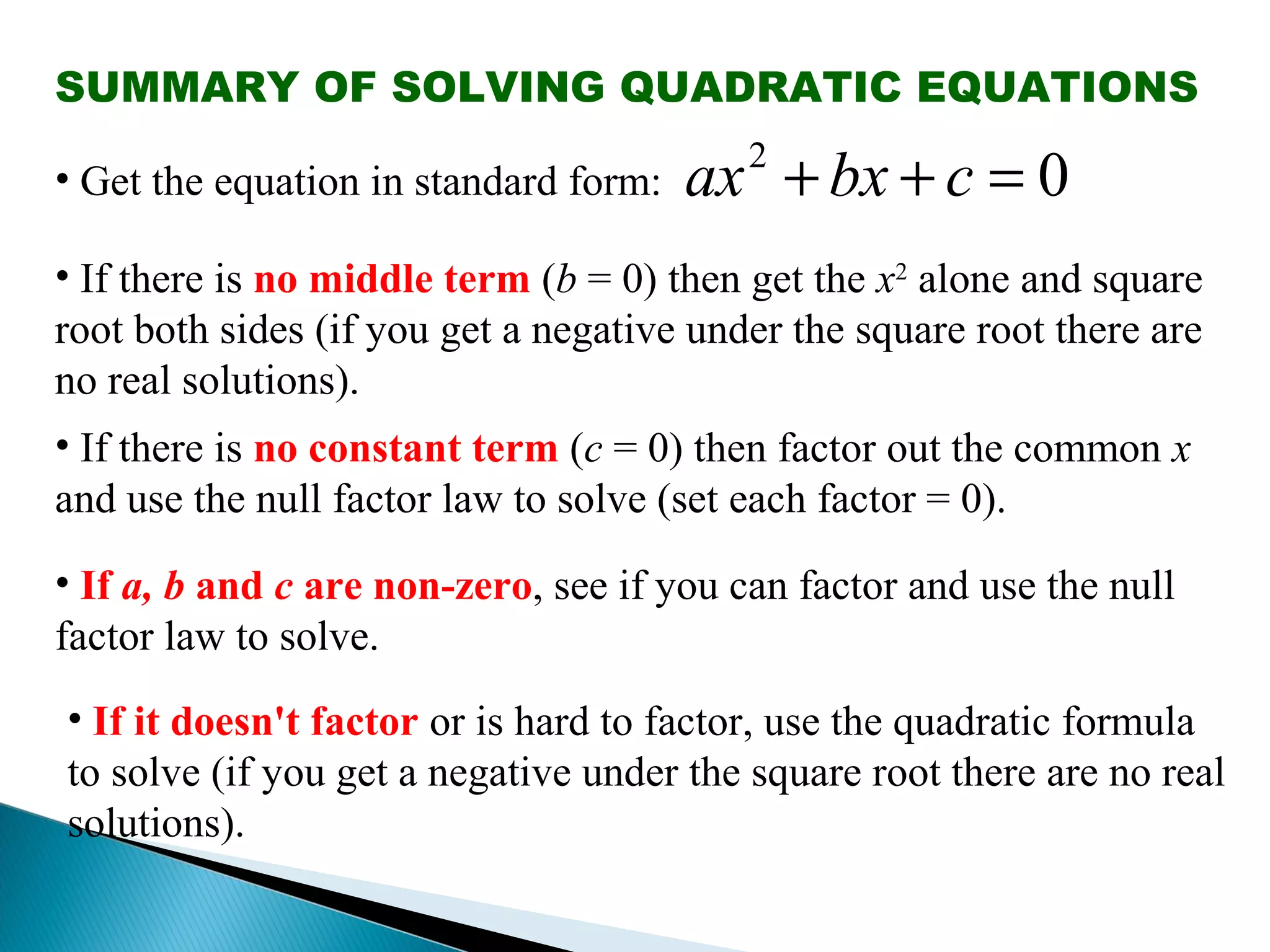
SUMMARY OF SOLVING QUADRATIC EQUATIONS 
• Get the equation in standard form: ax2 + bx + c = 0 
• If there is no middle term (b = 0) then get the x2 alone and square 
root both sides (if you get a negative under the square root there are 
no real solutions). 
• If there is no constant term (c = 0) then factor out the common x 
and use the null factor law to solve (set each factor = 0). 
• If a, b and c are non-zero, see if you can factor and use the null 
factor law to solve. 
• If it doesn't factor or is hard to factor, use the quadratic formula 
to solve (if you get a negative under the square root there are no real 
solutions).
This "discriminates" or tells us what type of solutions we'll have. 
ax bx c 0 x b b 4 
ac 
a 
2 
2 
2 + + = = - ± - 
If we have a quadratic equation and are considering solutions 
from the real number system, using the quadratic formula, one of 
three things can happen. 
1. The "stuff" under the square root can be positive and we'd get 
two unequal real solutions if b2 - 4ac > 0 
2. The "stuff" under the square root can be zero and we'd get one 
solution (called a repeated or double root because it would factor 
into two equal factors, each igfi bv2in-g4 uasc th=e0 same solution). 
3. The "stuff" under the square root can be negative and we'd get 
no real solutions. 
if b2 -4ac < 0 
The "stuff" under the square root is called the discriminant. 
The Discriminant D = b2 - 4ac
PRESENTED BY, 
RAJEEV. R 
MATHEMATICS OPTIONAL 
REG.NO: 13971013 
KUCTE, KUMARAPURAM
Quadratic equations

Quadratic equations

  • 1.
  • 2.
    A quadratic equationis an equation equivalent to one of the form ax2 + bx + c = 0 Where a, b, and c are real numbers and a ¹ 0 So if we have an equation in x and the highest power is 2, it is quadratic. To solve a quadratic equation we get it in the form above and see if it will factor. x2 = 5x - 6 Get form above by subtracting 5x and adding 6 to both sides to get 0 on right side. -5x + 6 -5x + 6 x2 - 5x + 6 = 0 Factor. ( x - 3)( x - 2) = 0 Use the Null Factor law and set each factor = 0 and solve. x -3 = 0 or x - 2 = 0 x = 3 x = 2
  • 3.
    Remember standard formfor a quadratic equation is: 0x ax2 + c = 0 ax2 + bx + c = 0 In this form we could have the case where b = 0. When this is the case, we get the x2 alone and then square root both sides. 2x2 - 6 = 0 Get x2 alone by adding 6 to both sides and then dividing both sides by 2 + 6 + 6 2x2 = 6 2 2 x2 = 3 Now take the square root of both sides remembering that you must consider both the and negative root. root. ± positive and check: 2( 3) 6 0 2 - = 2( 3) 6 0 2 - - = x = ± 3 Let's 6 - 6 = 0 6 - 6 = 0
  • 4.
    ax2 + bx+ 0 c = 0 What if in standard form, c = 0? We could factor by pulling an x out of each term. 2x2 - 3x = 0 Factor out the common x x(2x - 3) = 0 Use the Null Factor law and set each factor = 0 and solve. x = 0 or 2x - 3 = 0 x = 0 or x = 3 If you put either of these values in for x 2 in the original equation you can see it makes a true statement.
  • 5.
    ax2 + bx+ c = 0 What are we going to do if we have non-zero values for a, b and c but can't factor the left hand side? x2 + 6x + 3 = 0 This will not factor so we will complete the square and apply the square root method. First get the constant term on the other side by 6 3 subtracting 3 from both sides. x2 + x = - x2 + 6x + ___ = -3+ ___ 9 9 x2 + 6x + 9 = 6 Let's add 9. Right now we'll see that it works and then we'll look at how to find it. We are now going to add a number to the left side so it will factor into a perfect square. This means that it will factor into two identical factors. If we add a number to one side of the equation, we need to add it to the other to keep the equation true.
  • 6.
    x2 + 6x+ 9 = 6 Now factor the left hand side. ( x + 3)( x + 3) = 6 two identical factors This can be written as: ( x + 3)2 = 6 Now we'll get rid of the square by square rooting both sides. ( x + 3)2 = ± 6 Remember you need both the positive and negative root! x + 3 = ± 6 Subtract 3 from both sides to get x alone. x = -3 ± 6 These are the answers in exact form. We can put them in a calculator to get two approximate answers. x = -3 + 6 » -0.55 x = -3 - 6 » -5.45
  • 7.
    Okay---so this worksto solve the equation but how did we know to add 9 to both sides? x2 + 6x + _9__ = -3+ _9__ ( x + 3)( x + 3) = 6 We wanted the left hand side to factor into two identical factors. When you FOIL, the outer terms and the inner terms need to be identical and need to add up to 6x. +3x +3 x 6 x The last term in the original trinomial will then be the middle term's the middle coefficient term's divided coefficient by 2 and divided squared by 2 since and last squared term times last term will be (3)(3) or 32. So to complete the square, the number to add to both sides is…
  • 8.
    Let's solve anotherone by completing the square. 2x2 -16x + 2 = 0 To complete the square we want the coefficient of the x2 term to be 1. 2 2 2 2 x2 -8x +1 = 0 Divide everything by 2 Since it doesn't factor get the constant on the other side ready to complete the square. x2 -8x + ___ 16 = -1+ ___ 16 So what do we add to both sides? =16 8 ö çè ( x - 4)( x - 4) = ( x - 4)2 =15 Factor the left hand side ( x - 4)2 = ± 15 x - 4 = ± 15 Add 4 to both sides to x = 4 ± 15 Square root both sides (remember ±) get x alone 2 2 ÷ø æ - the middle term's coefficient divided by 2 and squared
  • 9.
    By completing thesquare on a general quadratic equation in standard form we come up with what is called the quadratic formula. (Remember the song!! ) = - ± 2 - 4 x b b ac a 2 This formula can be used to solve any quadratic equation whether it factors or not. If it factors, it is generally easier to factor---but this formula would give you the solutions as well. We solved this by completing the square but let's solve it using the quadratic formula = - ± 2 - 4 x b b ac 6 6 (3) a 2 1 (1) (1) = - 6 ± 36 -12 2 Don't make a mistake with order of operations! Let's do the power and the multiplying first. ax2 + bx + c = 0 x2 + 6x + 3 = 0
  • 10.
    x = -6 ± 36 -12 2 24 = 4´6 = 2 6 = - 6 ± 24 2 = - 6 ± 2 6 2 ( ) = 2 - 3± 6 2 There's a 2 in common in the terms of the numerator = -3± 6 These are the solutions we got when we completed the square on this problem. NOTE: When using this formula if you've simplified under the radical and end up with a negative, there are no real solutions. (There are complex (imaginary) solutions, but that will be dealt with in year 12 Calculus).
  • 11.
    SUMMARY OF SOLVINGQUADRATIC EQUATIONS • Get the equation in standard form: ax2 + bx + c = 0 • If there is no middle term (b = 0) then get the x2 alone and square root both sides (if you get a negative under the square root there are no real solutions). • If there is no constant term (c = 0) then factor out the common x and use the null factor law to solve (set each factor = 0). • If a, b and c are non-zero, see if you can factor and use the null factor law to solve. • If it doesn't factor or is hard to factor, use the quadratic formula to solve (if you get a negative under the square root there are no real solutions).
  • 12.
    This "discriminates" ortells us what type of solutions we'll have. ax bx c 0 x b b 4 ac a 2 2 2 + + = = - ± - If we have a quadratic equation and are considering solutions from the real number system, using the quadratic formula, one of three things can happen. 1. The "stuff" under the square root can be positive and we'd get two unequal real solutions if b2 - 4ac > 0 2. The "stuff" under the square root can be zero and we'd get one solution (called a repeated or double root because it would factor into two equal factors, each igfi bv2in-g4 uasc th=e0 same solution). 3. The "stuff" under the square root can be negative and we'd get no real solutions. if b2 -4ac < 0 The "stuff" under the square root is called the discriminant. The Discriminant D = b2 - 4ac
  • 13.
    PRESENTED BY, RAJEEV.R MATHEMATICS OPTIONAL REG.NO: 13971013 KUCTE, KUMARAPURAM