ACTIVITY:
“Agree or
disagree , that is
the question!”
Do you Agree?
 The more time I drive (at a
constant rate), the more distance
I cover.
 If you increase a recipe for more
people, the more of ingredients
you need.
 (In a computer shop)The more
hours you play online games, the
more money you pay.
Do you Agree?
 The more apparels I purchase, the
more money it costs.
 The less time you study, the lower
scores you will get in the exam.
 The less water you drink, the less
trips to the bathroom you have to
make.
 The more time you play temple run,
the longer your cellphone battery
stays.
Do you Agree?
 The more time I drive (at a
constant rate), the more distance
I cover.
 If you increase a recipe for more
people, the more of ingredients
you need.
 (In a computer shop)The more
hours you play online games, the
more money you pay.
Do you Agree?
 The more apparels I purchase, the
more money it costs.
 The less time you study, the lower
scores you will get in the exam.
 The less water you drink, the less
trips to the bathroom you have to
make.
 The more time you play temple run,
the longer your cellphone battery
stays.
Direct Variation
What …
Know:__________________
Want to learn: ___________
Had learned:_____________
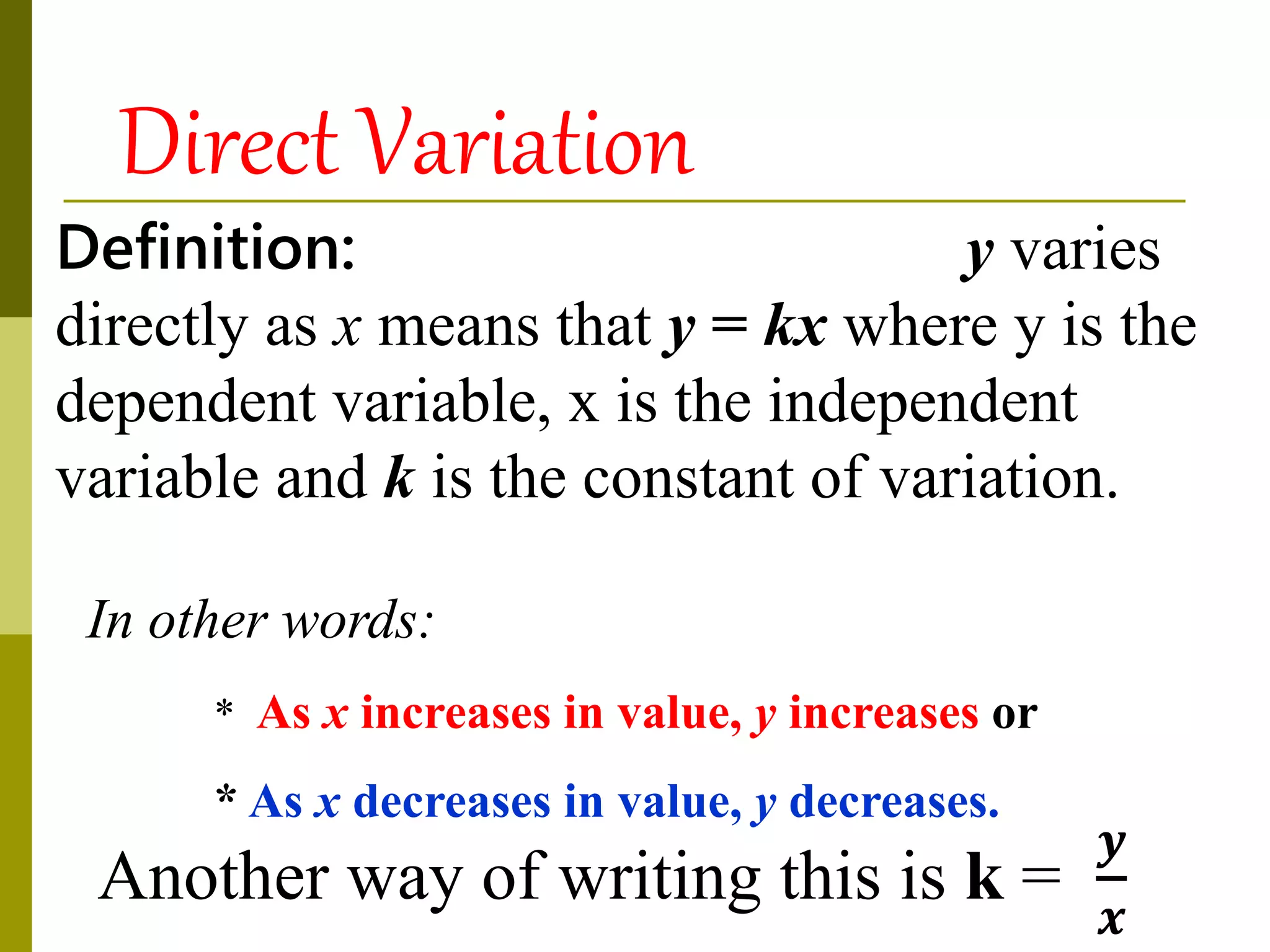
Definition: y varies
directly as x means that y = kx where y is the
dependent variable, x is the independent
variable and k is the constant of variation.
In other words:
* As x increases in value, y increases or
* As x decreases in value, y decreases.
Direct Variation
Another way of writing this is k =
𝒚
𝒙
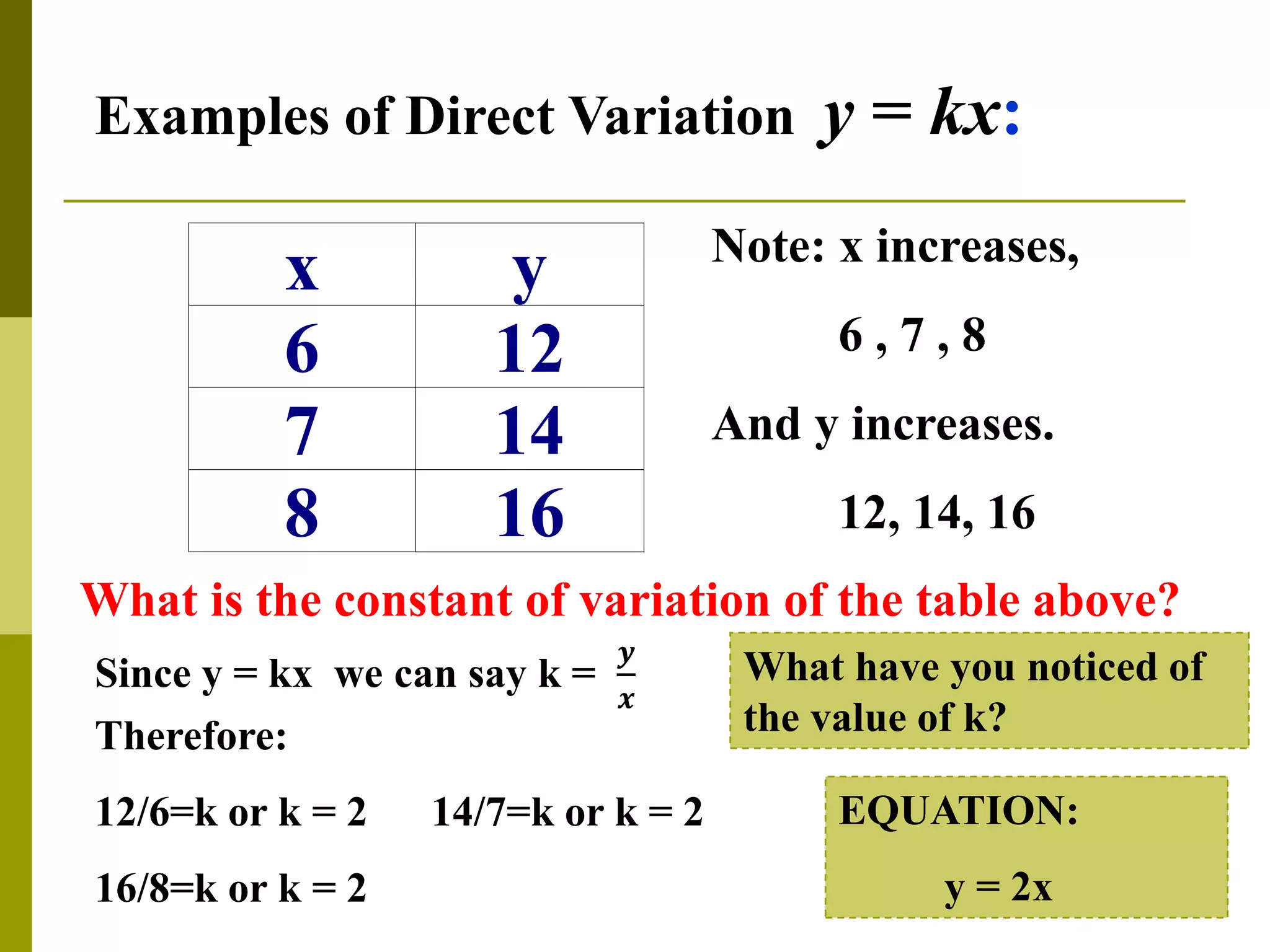
Examples of Direct Variation y = kx:
x y
6 12
7 14
8 16
Note: x increases,
6 , 7 , 8
And y increases.
12, 14, 16
What is the constant of variation of the table above?
Since y = kx we can say k =
𝒚
𝒙
Therefore:
12/6=k or k = 2 14/7=k or k = 2
16/8=k or k = 2
EQUATION:
y = 2x
What have you noticed of
the value of k?
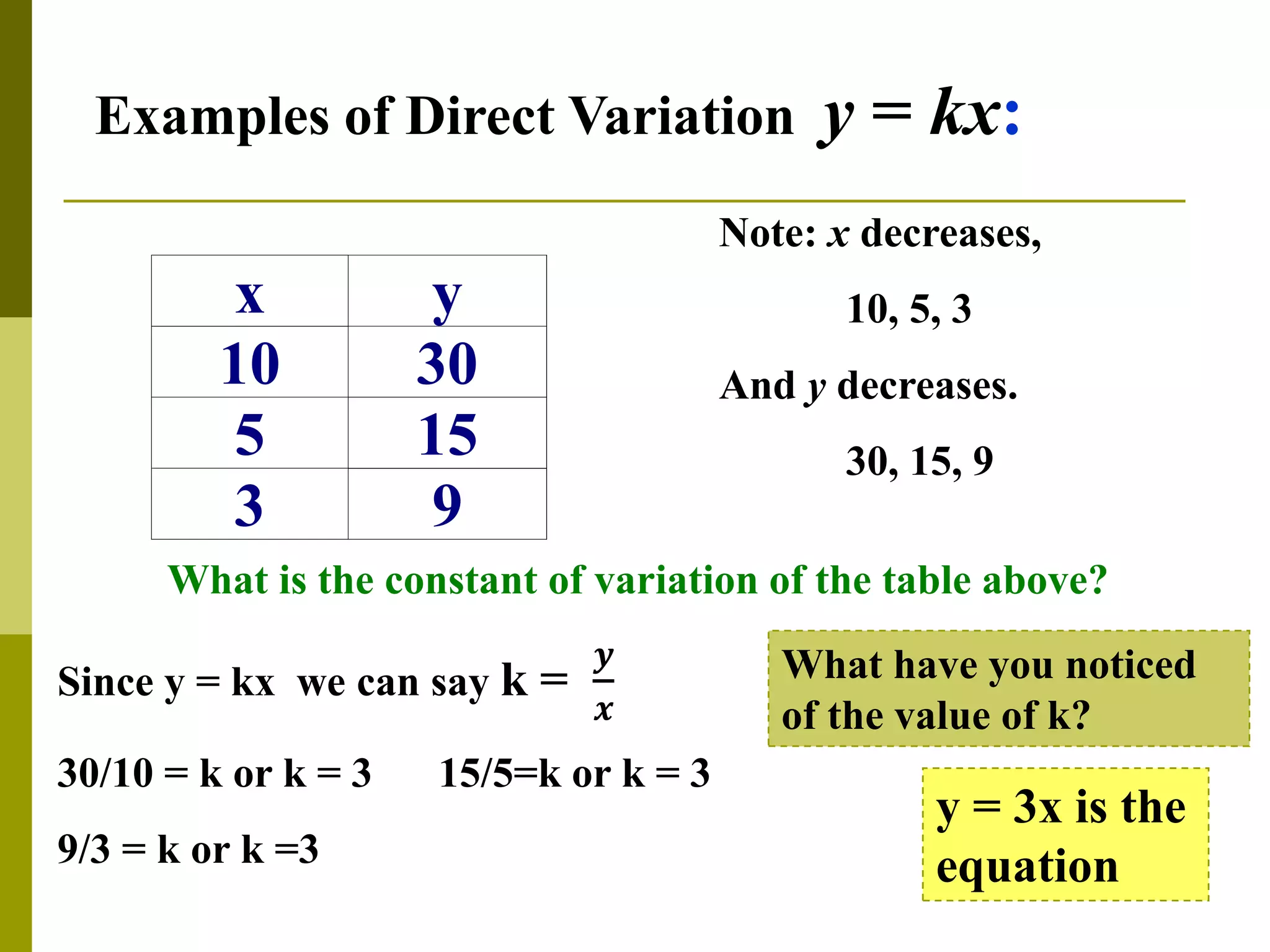
x y
10 30
5 15
3 9
Note: x decreases,
10, 5, 3
And y decreases.
30, 15, 9
What is the constant of variation of the table above?
Since y = kx we can say k =
𝒚
𝒙
30/10 = k or k = 3 15/5=k or k = 3
9/3 = k or k =3
y = 3x is the
equation
Examples of Direct Variation y = kx:
What have you noticed
of the value of k?
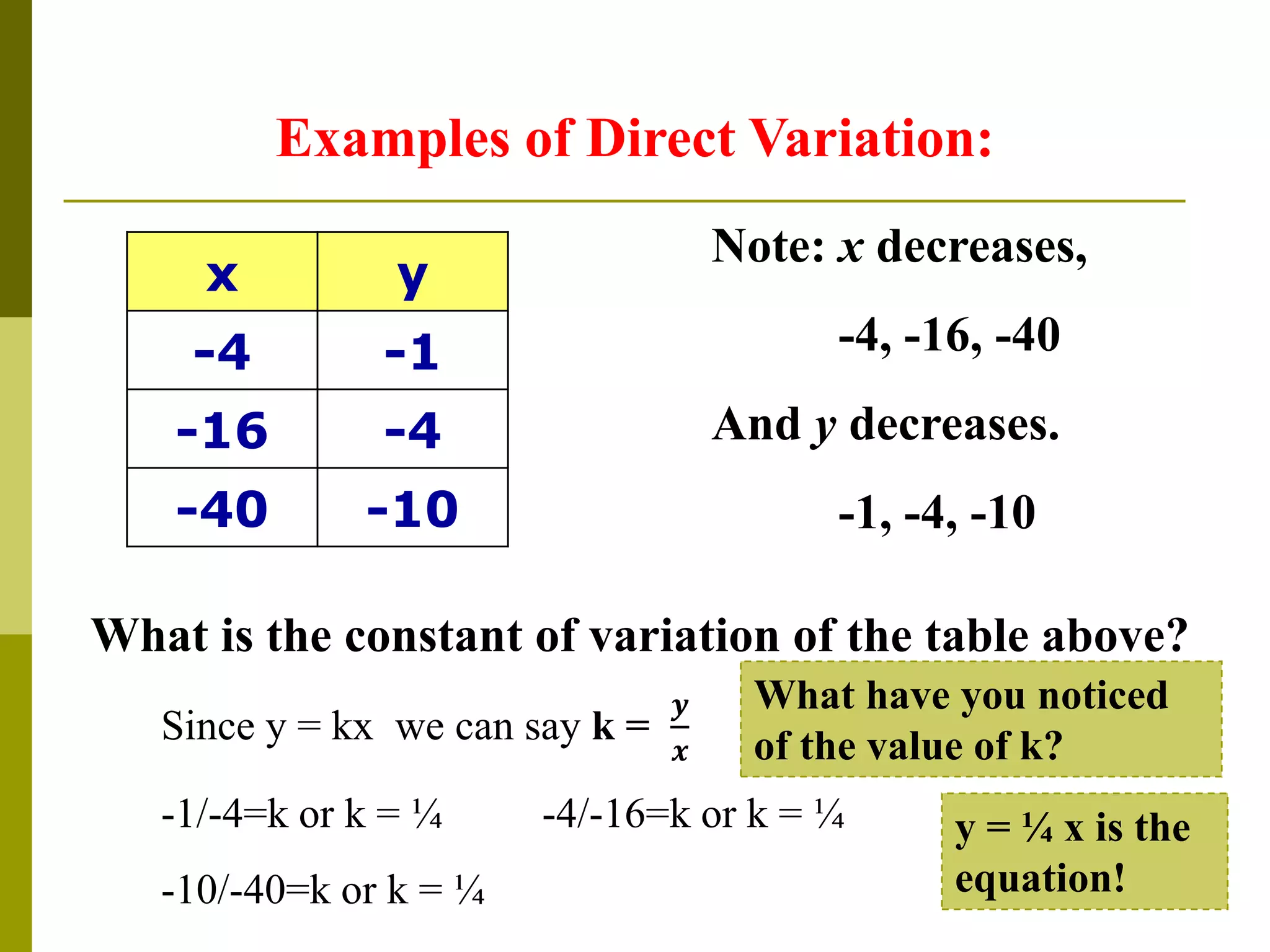
Note: x decreases,
-4, -16, -40
And y decreases.
-1, -4, -10
What is the constant of variation of the table above?
Since y = kx we can say k =
𝒚
𝒙
-1/-4=k or k = ¼ -4/-16=k or k = ¼
-10/-40=k or k = ¼
y = ¼ x is the
equation!
Examples of Direct Variation:
What have you noticed
of the value of k?
x y
-4 -1
-16 -4
-40 -10
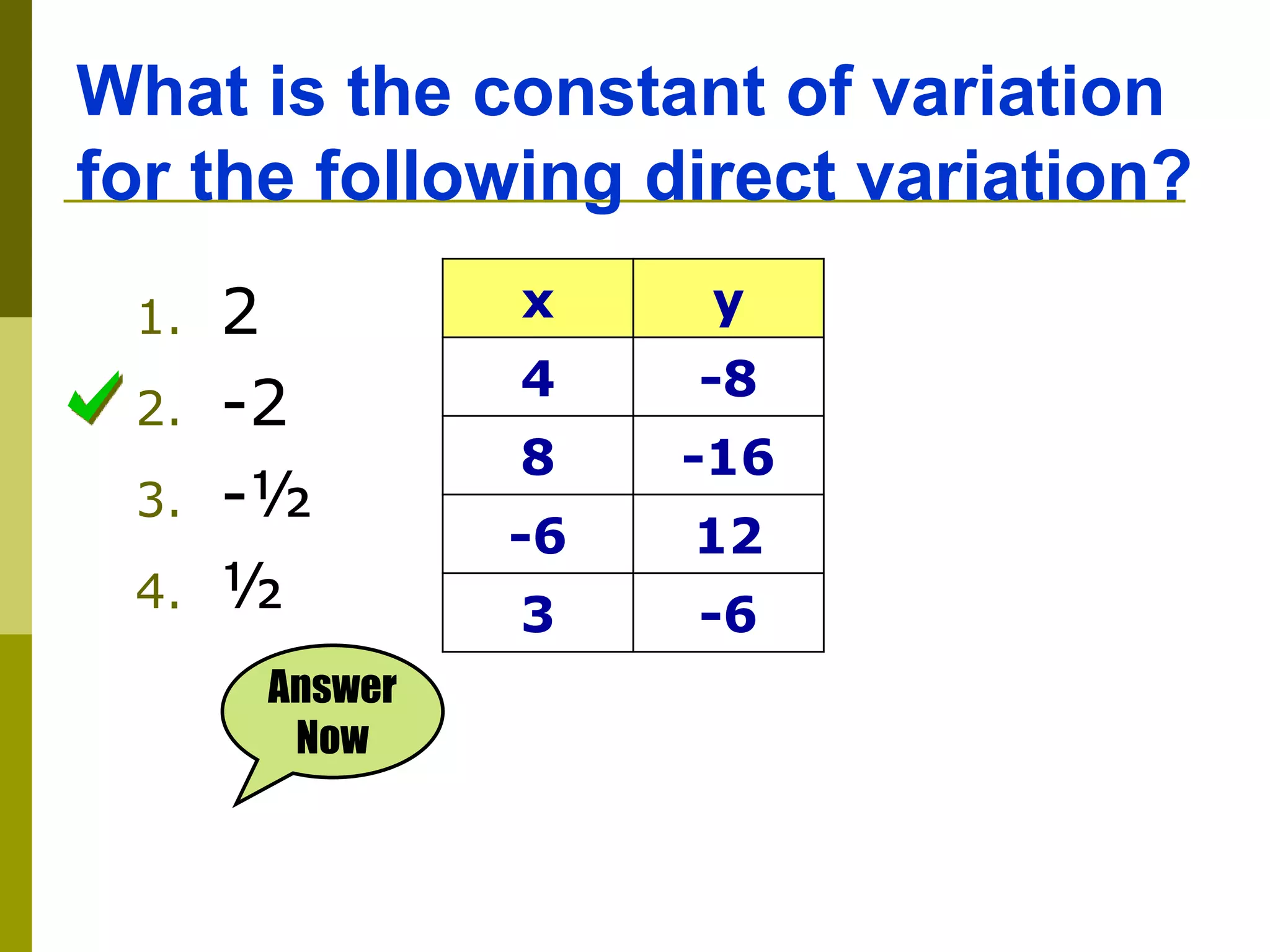
What is the constant of variation
for the following direct variation?
Answer
Now
1. 2
2. -2
3. -½
4. ½
x y
4 -8
8 -16
-6 12
3 -6
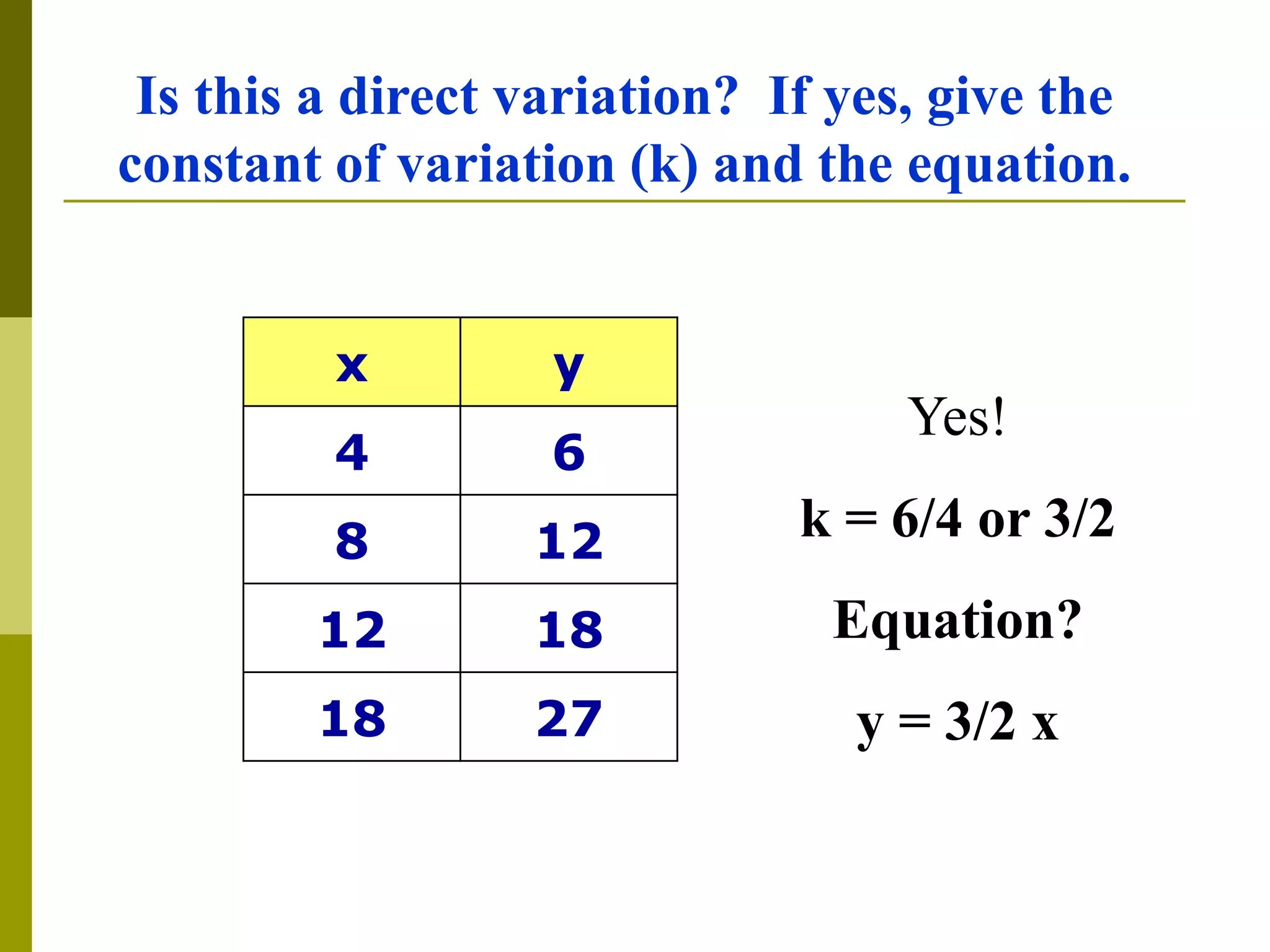
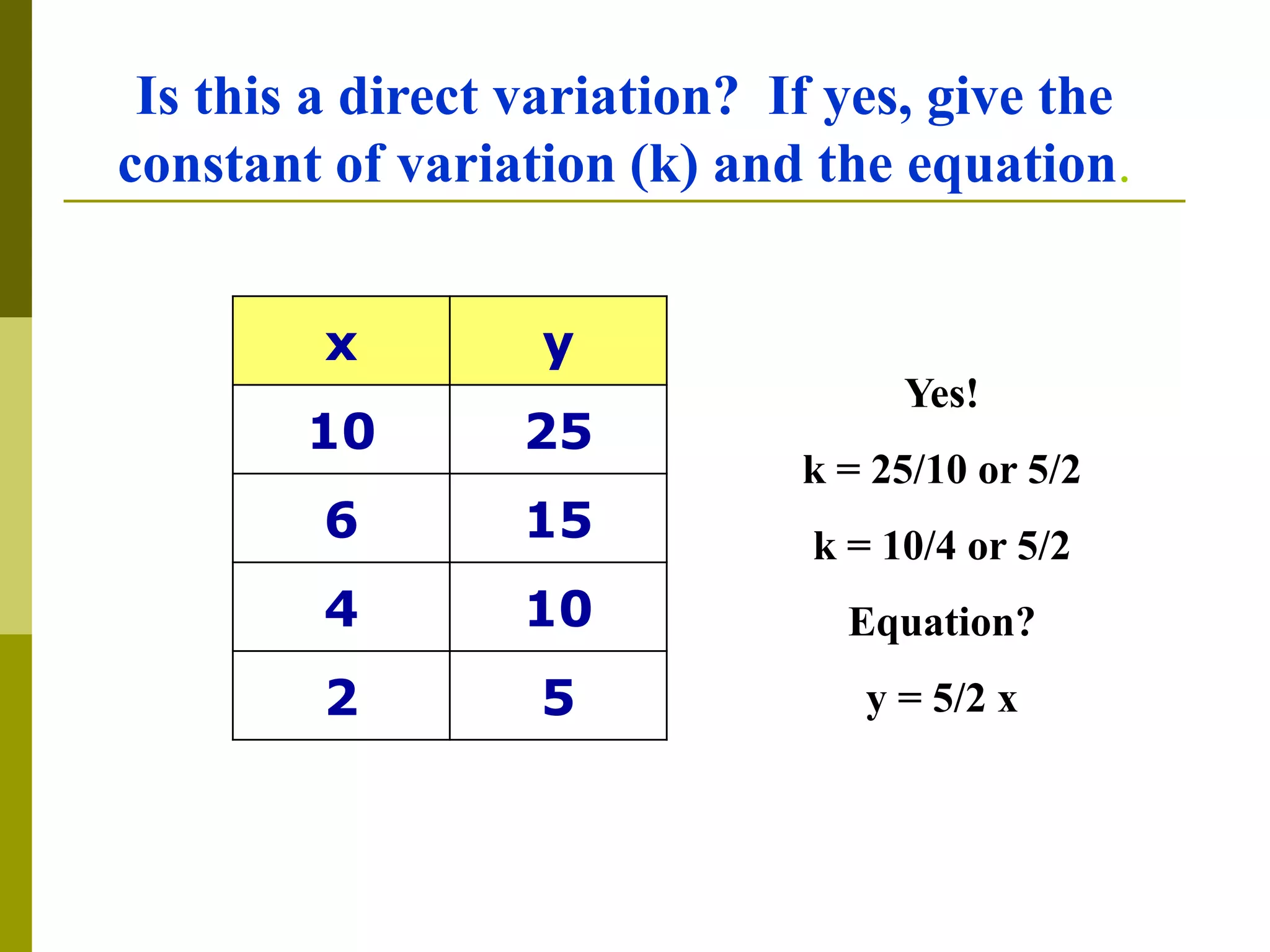
Is this a direct variation? If yes, give the
constant of variation (k) and the equation.
Yes!
k = 6/4 or 3/2
Equation?
y = 3/2 x
x y
4 6
8 12
12 18
18 27
Yes!
k = 25/10 or 5/2
k = 10/4 or 5/2
Equation?
y = 5/2 x
Is this a direct variation? If yes, give the
constant of variation (k) and the equation.
x y
10 25
6 15
4 10
2 5
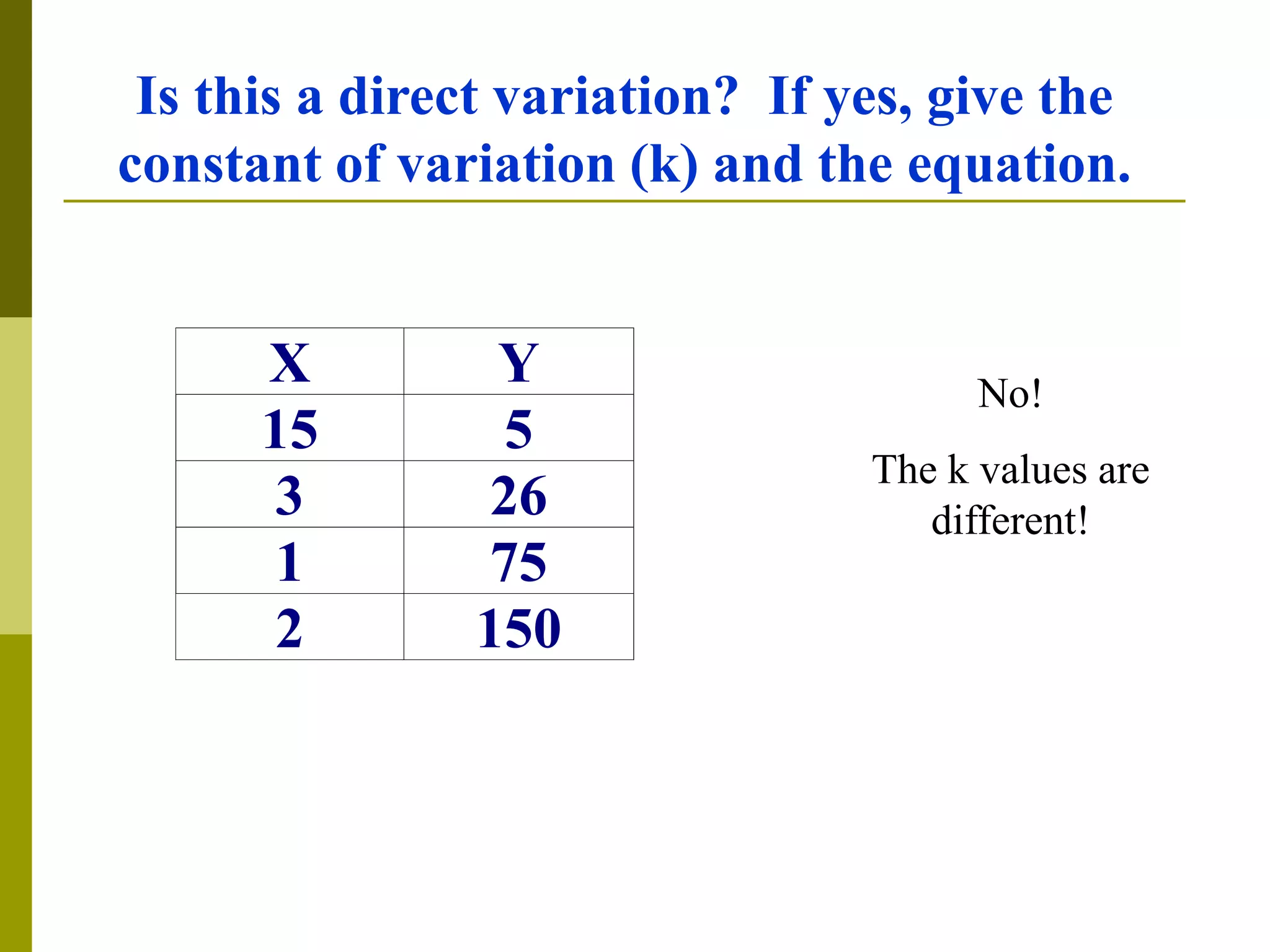
X Y
15 5
3 26
1 75
2 150
No!
The k values are
different!
Is this a direct variation? If yes, give the
constant of variation (k) and the equation.
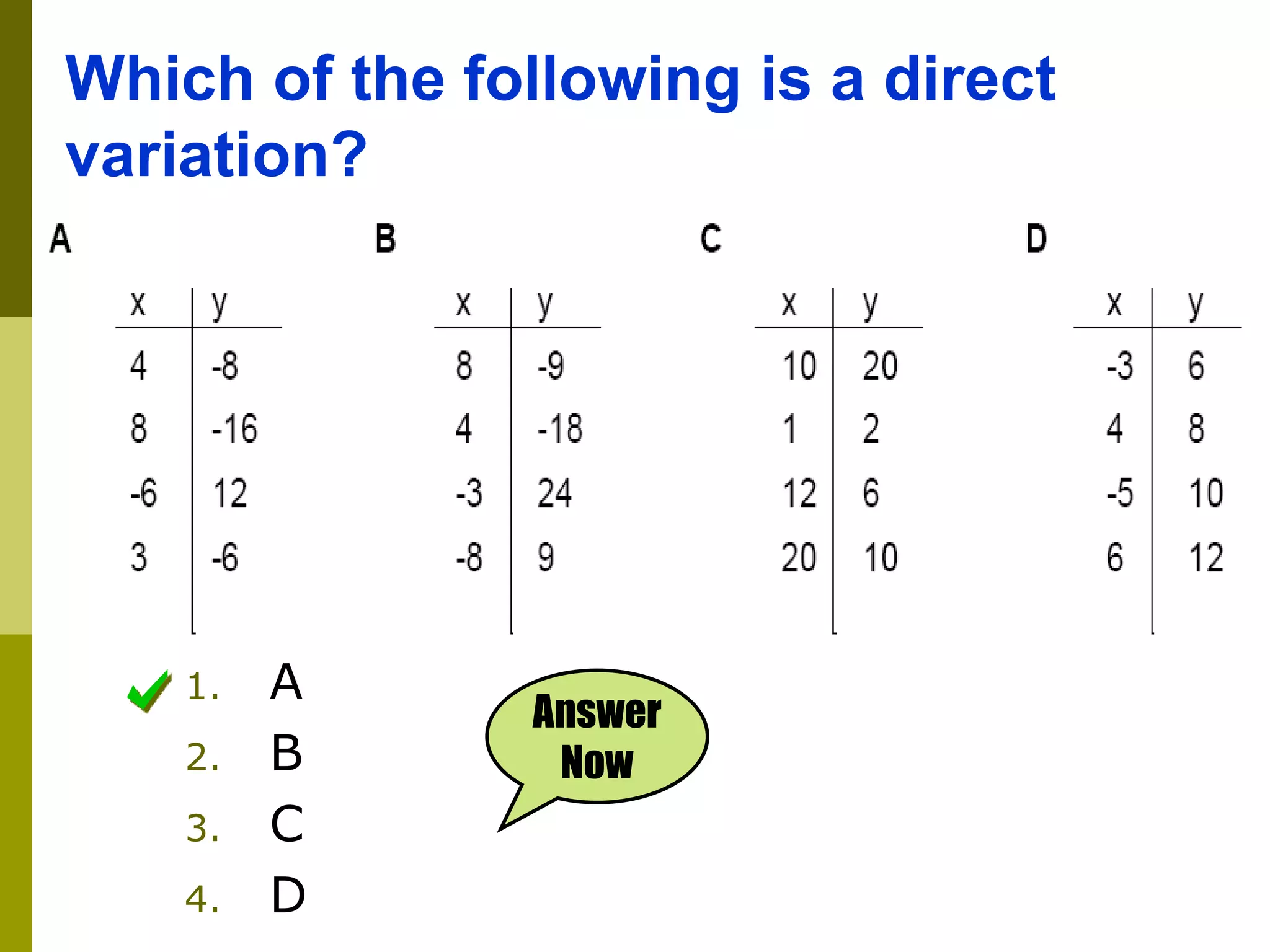
Which of the following is a direct
variation?
1. A
2. B
3. C
4. D
Answer
Now
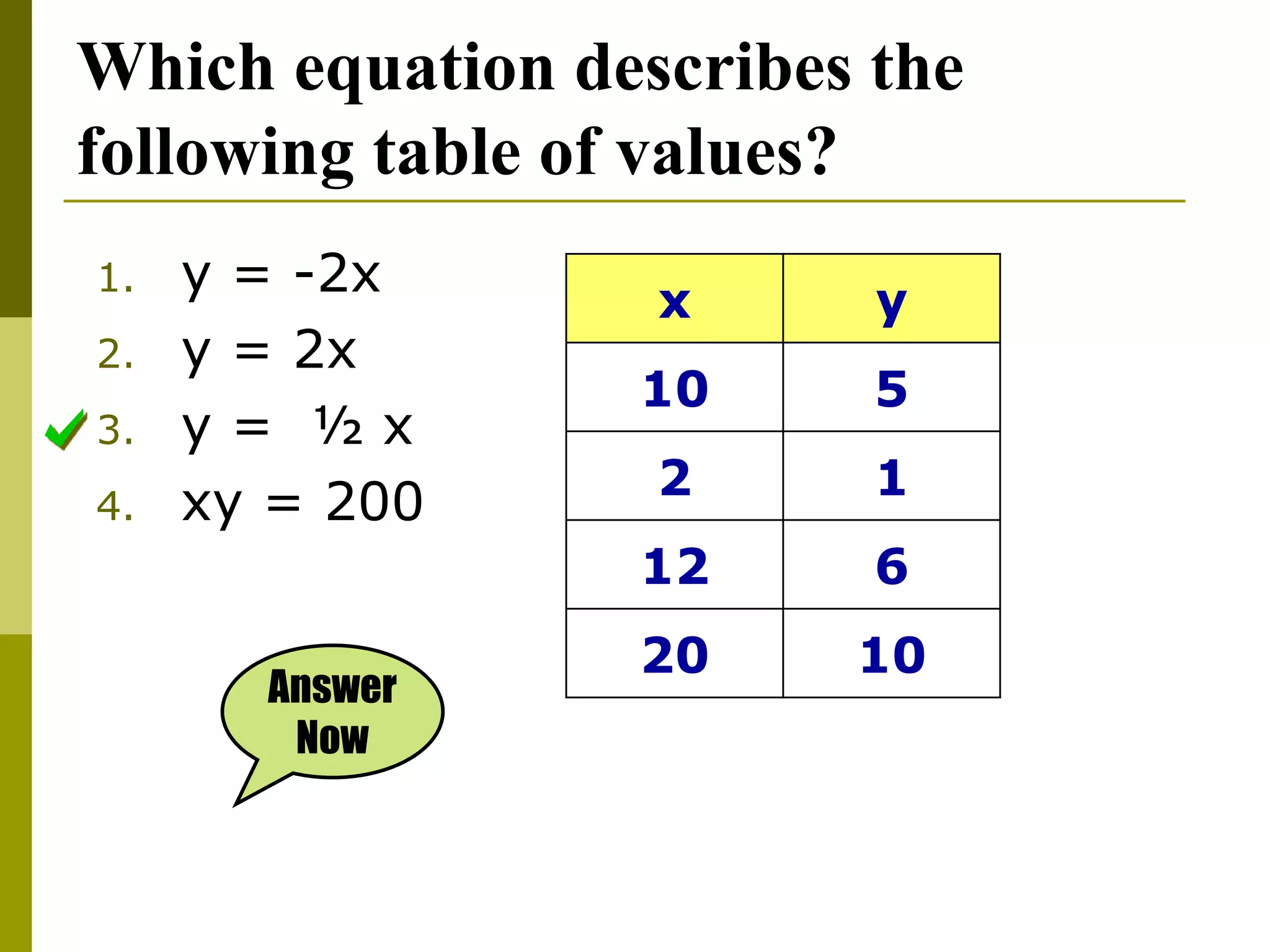
Which equation describes the
following table of values?
1. y = -2x
2. y = 2x
3. y = ½ x
4. xy = 200
Answer
Now
x y
10 5
2 1
12 6
20 10
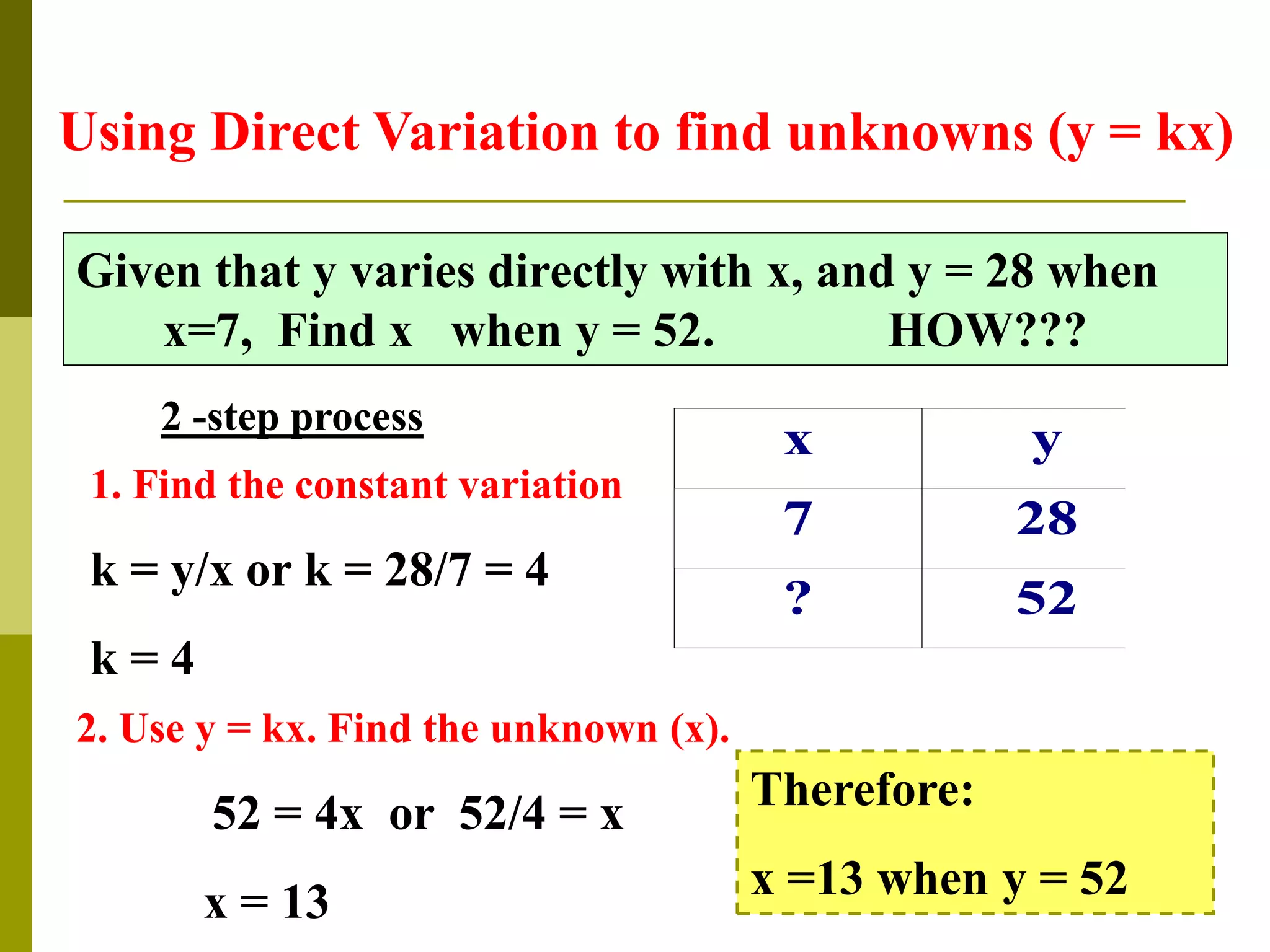
Using Direct Variation to find unknowns (y = kx)
Given that y varies directly with x, and y = 28 when
x=7, Find x when y = 52. HOW???
2 -step process
x y
7 28
? 52
1. Find the constant variation
k = y/x or k = 28/7 = 4
k = 4
2. Use y = kx. Find the unknown (x).
52 = 4x or 52/4 = x
x = 13
Therefore:
x =13 when y = 52
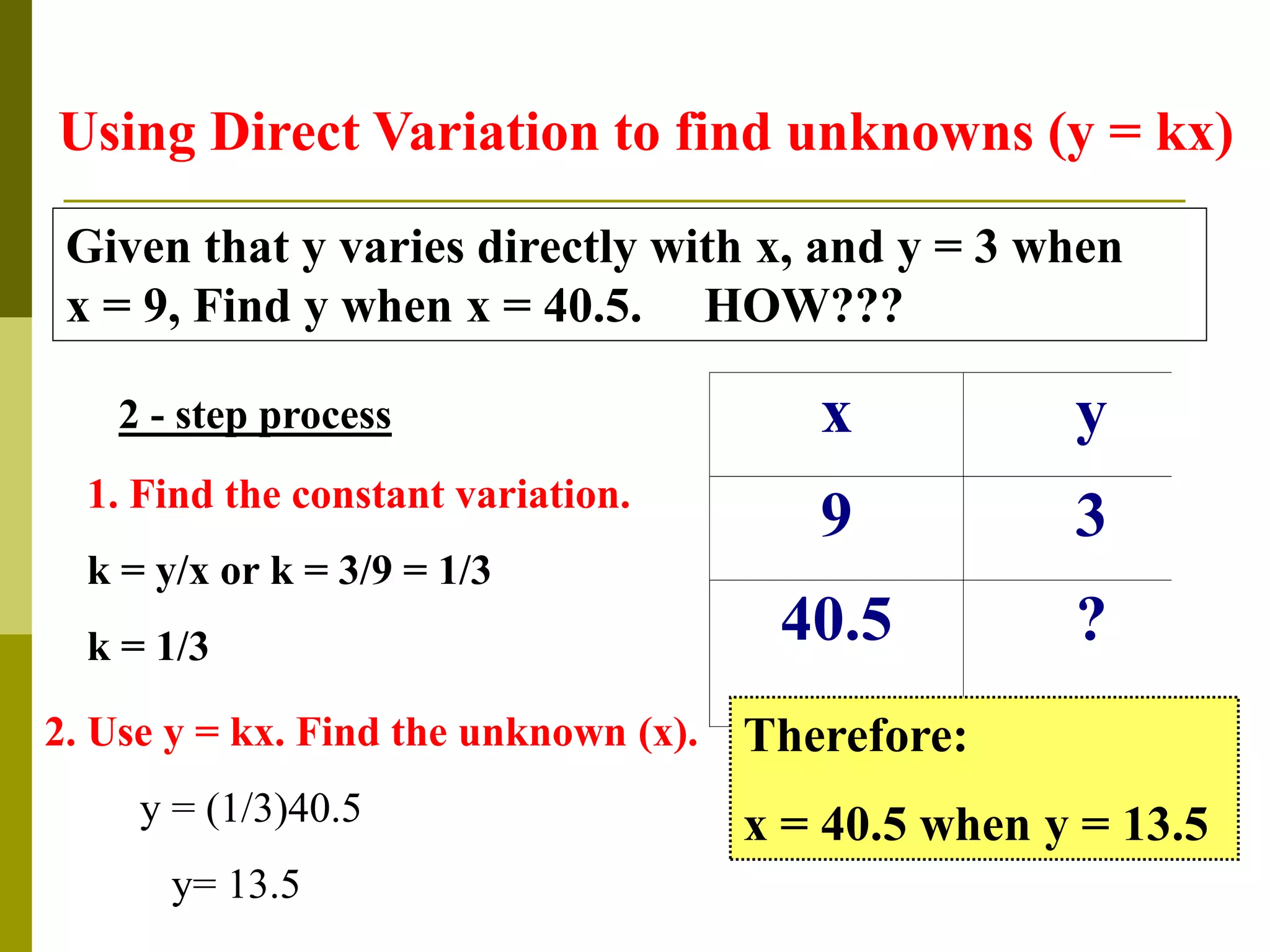
Given that y varies directly with x, and y = 3 when
x = 9, Find y when x = 40.5. HOW???
2 - step process x y
9 3
40.5 ?
1. Find the constant variation.
k = y/x or k = 3/9 = 1/3
k = 1/3
2. Use y = kx. Find the unknown (x).
y = (1/3)40.5
y= 13.5
Therefore:
x = 40.5 when y = 13.5
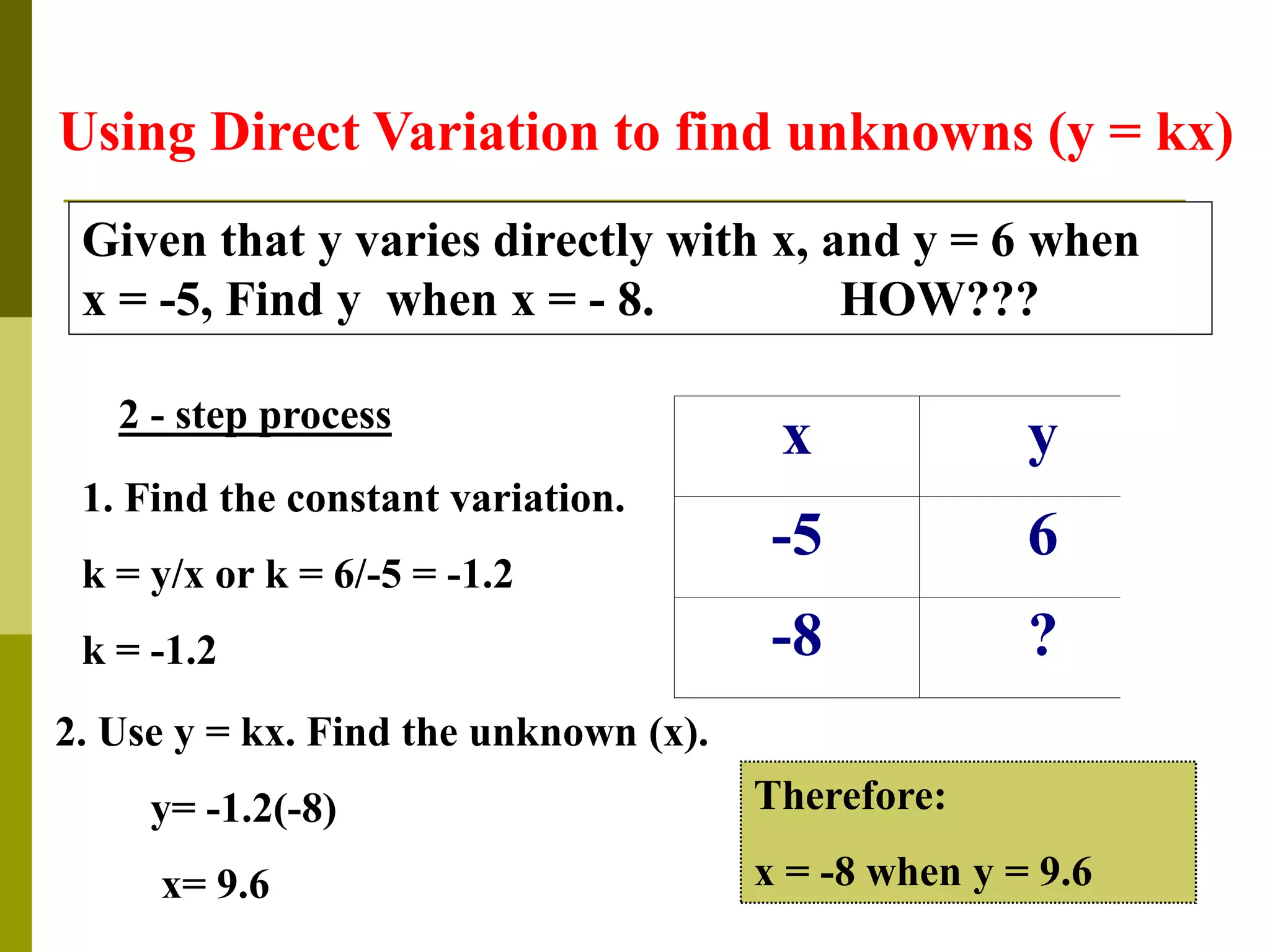
Using Direct Variation to find unknowns (y = kx)
Given that y varies directly with x, and y = 6 when
x = -5, Find y when x = - 8. HOW???
2 - step process
x y
-5 6
-8 ?
1. Find the constant variation.
k = y/x or k = 6/-5 = -1.2
k = -1.2
2. Use y = kx. Find the unknown (x).
y= -1.2(-8)
x= 9.6
Therefore:
x = -8 when y = 9.6
Using Direct Variation to find unknowns (y = kx)
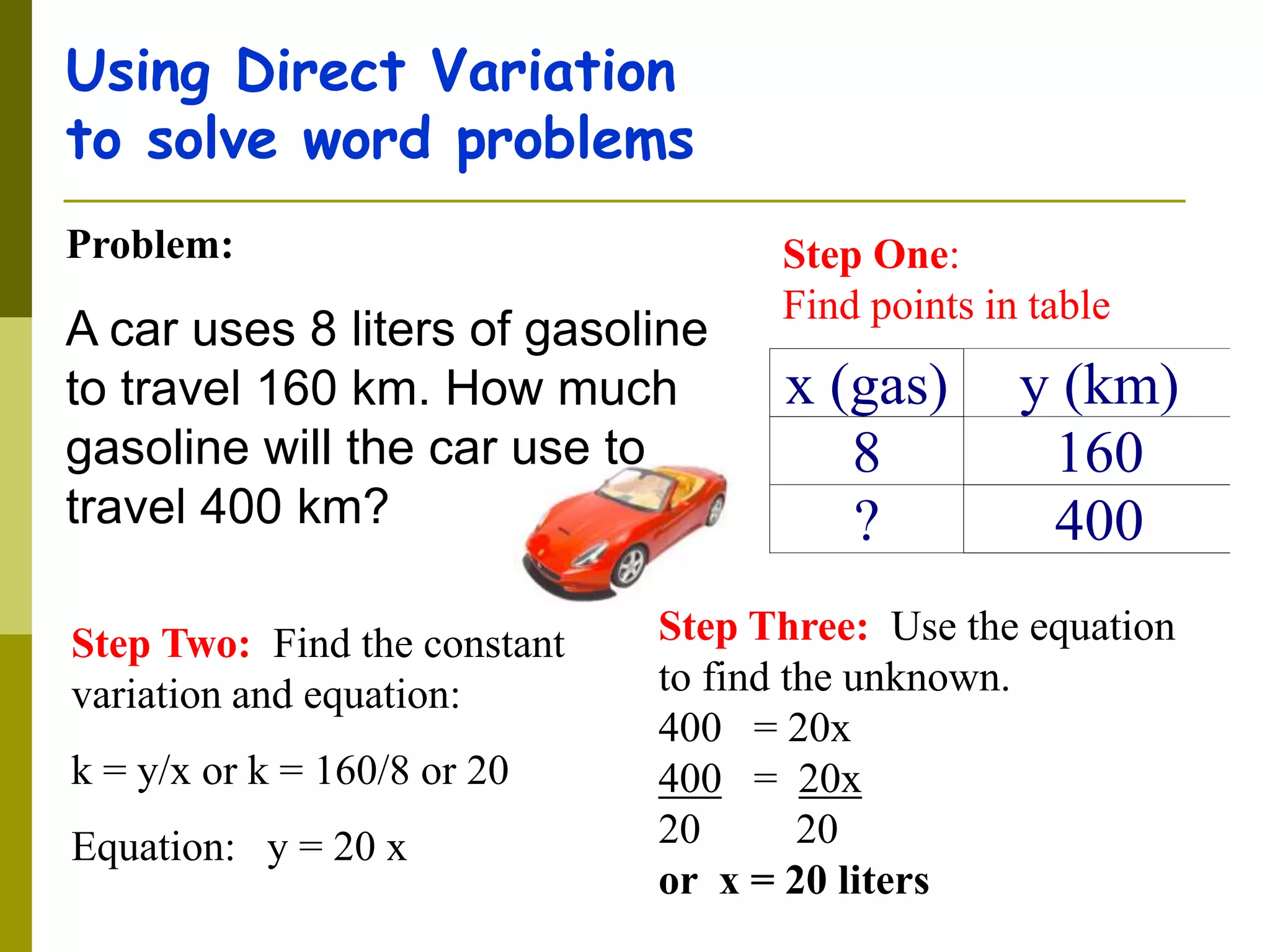
Using Direct Variation
to solve word problems
Problem:
A car uses 8 liters of gasoline
to travel 160 km. How much
gasoline will the car use to
travel 400 km?
Step One:
Find points in table
x (gas) y (km)
8 160
? 400
Step Two: Find the constant
variation and equation:
k = y/x or k = 160/8 or 20
Equation: y = 20 x
Step Three: Use the equation
to find the unknown.
400 = 20x
400 = 20x
20 20
or x = 20 liters
Using Direct Variation
to solve word problems
Step One:
Find points in table
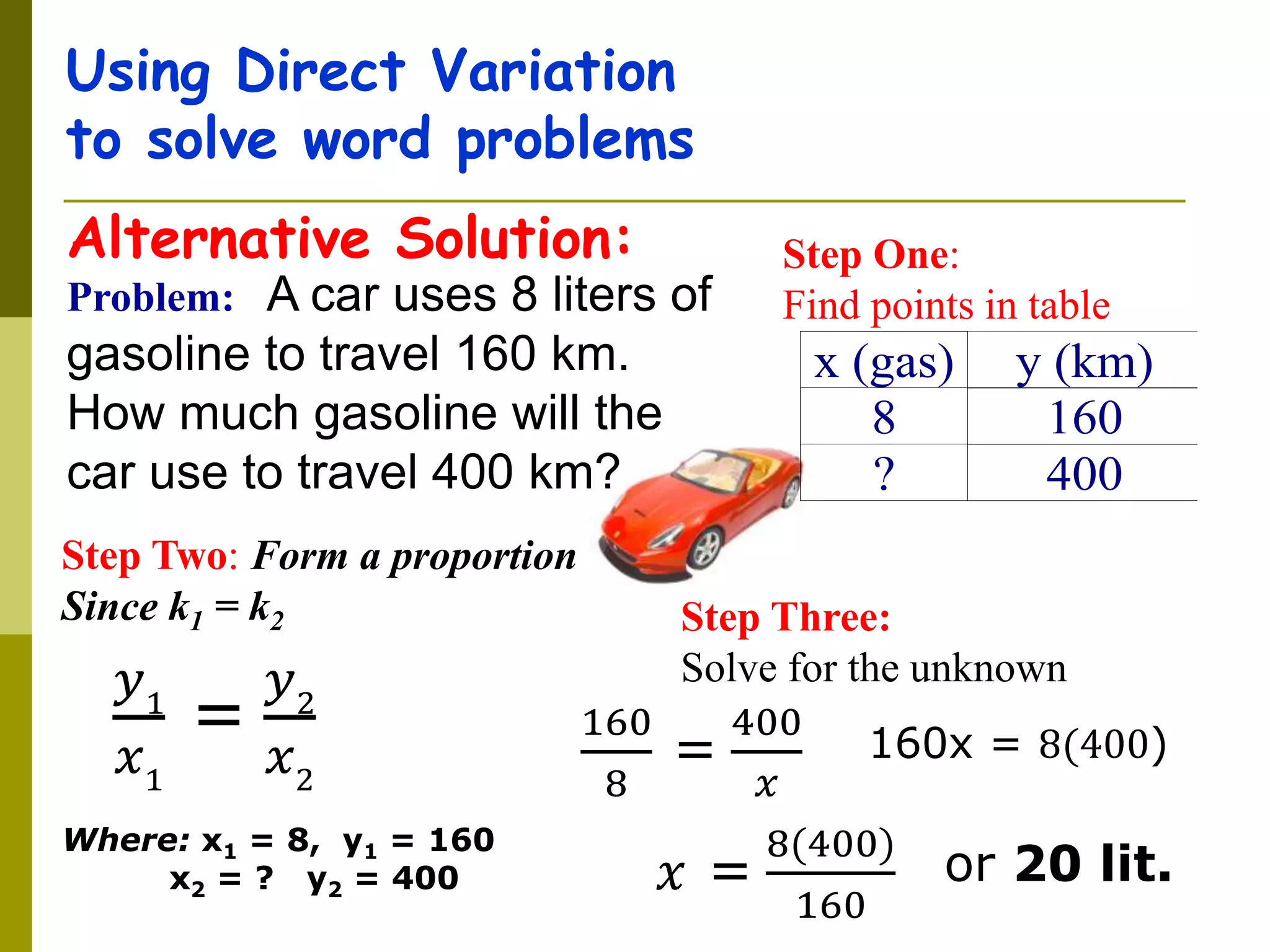
Alternative Solution:
Step Three:
Solve for the unknown
160
8
=
400
𝑥
160x = 8(400)
or 20 lit.𝑥 =
8(400)
160
Problem: A car uses 8 liters of
gasoline to travel 160 km.
How much gasoline will the
car use to travel 400 km?
x (gas) y (km)
8 160
? 400
Where: x1 = 8, y1 = 160
x2 = ? y2 = 400
Step Two: Form a proportion
Since k1 = k2
𝑦1
𝑥1
=
𝑦2
𝑥2
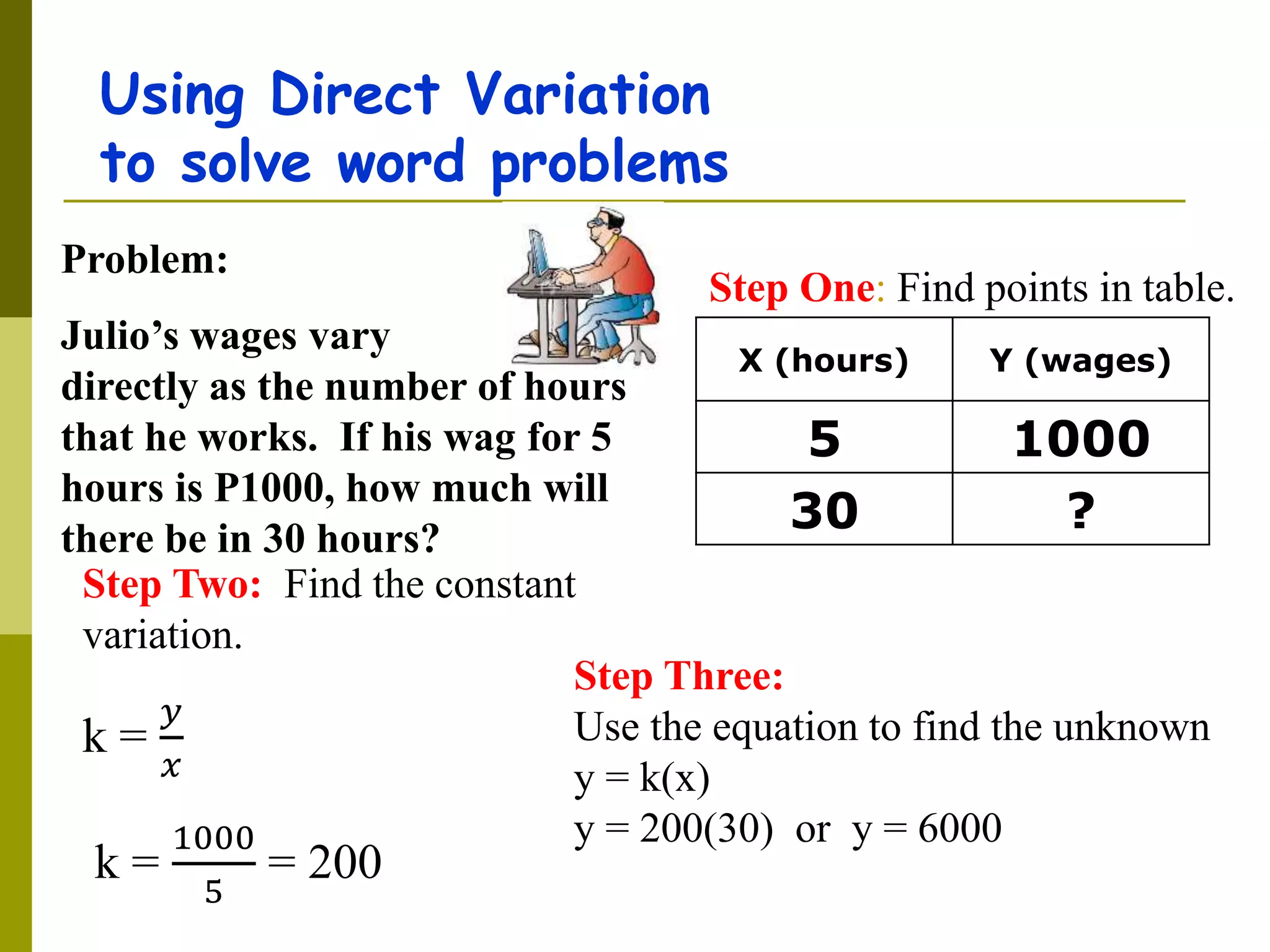
Step One: Find points in table.
Step Two: Find the constant
variation.
k =
𝑦
𝑥
k =
1000
5
= 200
Step Three:
Use the equation to find the unknown
y = k(x)
y = 200(30) or y = 6000
Using Direct Variation
to solve word problems
Problem:
Julio’s wages vary
directly as the number of hours
that he works. If his wag for 5
hours is P1000, how much will
there be in 30 hours?
X (hours) Y (wages)
5 1000
30 ?
Using Direct Variation
to solve word problems
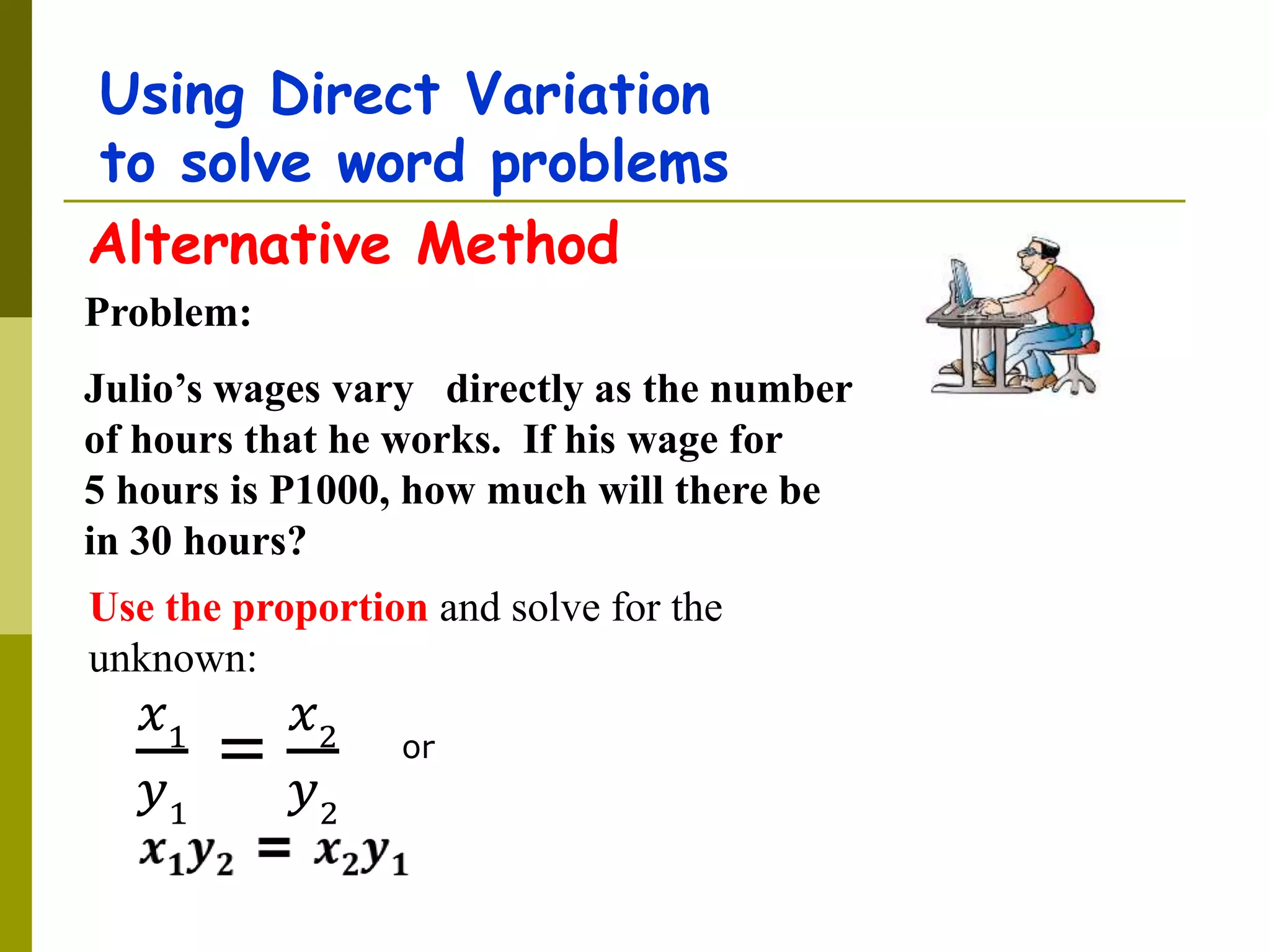
Problem:
Julio’s wages vary directly as the number
of hours that he works. If his wage for
5 hours is P1000, how much will there be
in 30 hours?
Use the proportion and solve for the
unknown:
Alternative Method
or
𝑥1
𝑦1
=
𝑥2
𝑦2
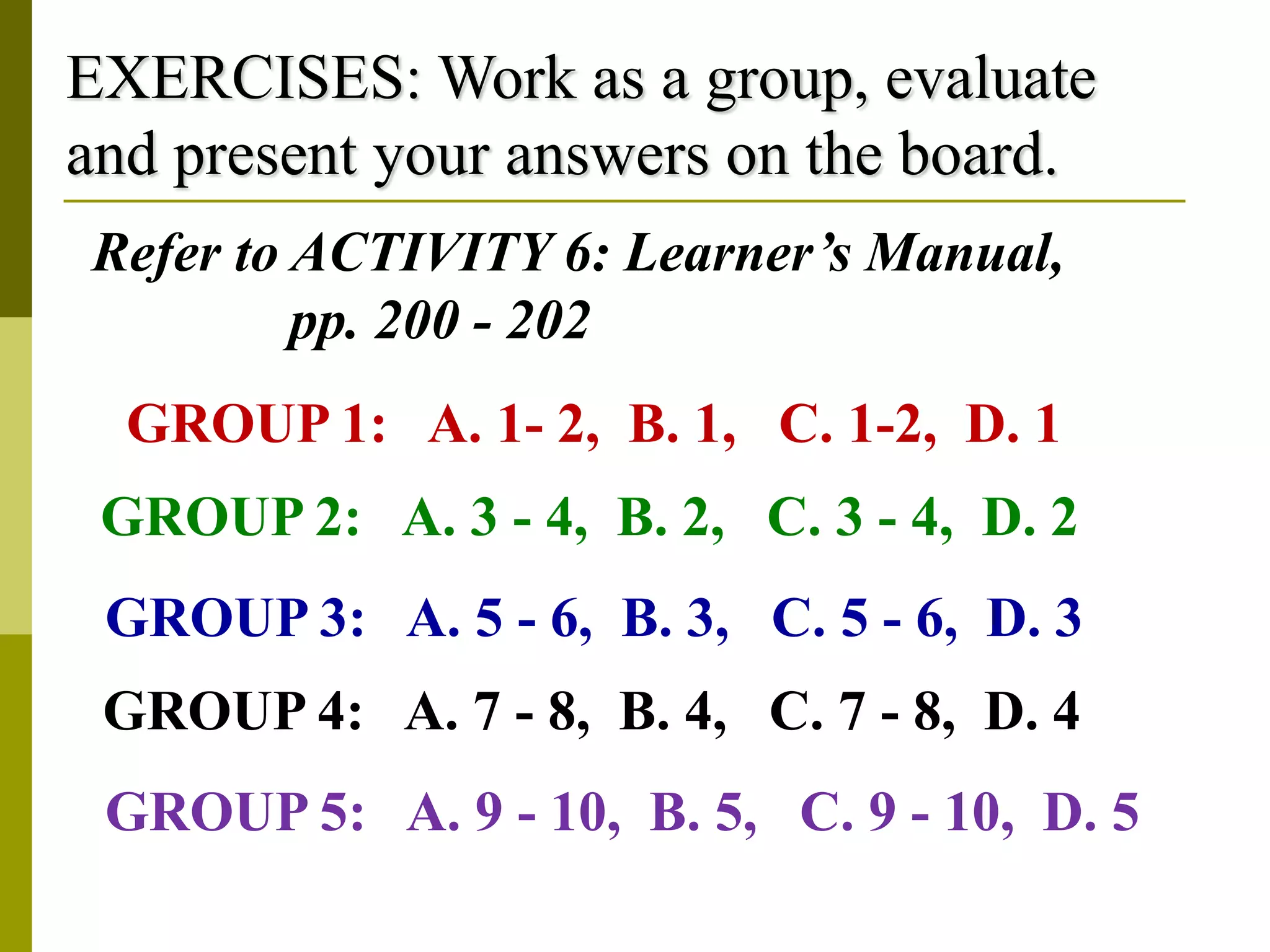
EXERCISES: Work as a group, evaluate
and present your answers on the board.
Refer to ACTIVITY 6: Learner’s Manual,
pp. 200 - 202
GROUP 1: A. 1- 2, B. 1, C. 1-2, D. 1
GROUP 2: A. 3 - 4, B. 2, C. 3 - 4, D. 2
GROUP 3: A. 5 - 6, B. 3, C. 5 - 6, D. 3
GROUP 4: A. 7 - 8, B. 4, C. 7 - 8, D. 4
GROUP 5: A. 9 - 10, B. 5, C. 9 - 10, D. 5
Reflect:
How did you find the activity?
What were the problems encountered
in working with the group activity?
How were you able to manage and
mitigate the circumstances you’ve
encountered?
ASSIGNMENT:
A. Choose and evaluate 3 odd problems if your first
name starts with a vowel, otherwise, choose 3 even
numbers if your first name starts with consonant.
Reference: LM, p. 203
B. Make a narrative of your inspiring experience
where knowledge of direct proportion guided and
molded you to be a better individual.
Be ready to share next meeting.
End

direct variation grade9 module 3 by mr. joel garcia

  • 1.
    ACTIVITY: “Agree or disagree ,that is the question!”
  • 2.
    Do you Agree? The more time I drive (at a constant rate), the more distance I cover.  If you increase a recipe for more people, the more of ingredients you need.  (In a computer shop)The more hours you play online games, the more money you pay.
  • 3.
    Do you Agree? The more apparels I purchase, the more money it costs.  The less time you study, the lower scores you will get in the exam.  The less water you drink, the less trips to the bathroom you have to make.  The more time you play temple run, the longer your cellphone battery stays.
  • 4.
    Do you Agree? The more time I drive (at a constant rate), the more distance I cover.  If you increase a recipe for more people, the more of ingredients you need.  (In a computer shop)The more hours you play online games, the more money you pay.
  • 5.
    Do you Agree? The more apparels I purchase, the more money it costs.  The less time you study, the lower scores you will get in the exam.  The less water you drink, the less trips to the bathroom you have to make.  The more time you play temple run, the longer your cellphone battery stays.
  • 6.
    Direct Variation What … Know:__________________ Wantto learn: ___________ Had learned:_____________
  • 7.
    Definition: y varies directlyas x means that y = kx where y is the dependent variable, x is the independent variable and k is the constant of variation. In other words: * As x increases in value, y increases or * As x decreases in value, y decreases. Direct Variation Another way of writing this is k = 𝒚 𝒙
  • 8.
    Examples of DirectVariation y = kx: x y 6 12 7 14 8 16 Note: x increases, 6 , 7 , 8 And y increases. 12, 14, 16 What is the constant of variation of the table above? Since y = kx we can say k = 𝒚 𝒙 Therefore: 12/6=k or k = 2 14/7=k or k = 2 16/8=k or k = 2 EQUATION: y = 2x What have you noticed of the value of k?
  • 9.
    x y 10 30 515 3 9 Note: x decreases, 10, 5, 3 And y decreases. 30, 15, 9 What is the constant of variation of the table above? Since y = kx we can say k = 𝒚 𝒙 30/10 = k or k = 3 15/5=k or k = 3 9/3 = k or k =3 y = 3x is the equation Examples of Direct Variation y = kx: What have you noticed of the value of k?
  • 10.
    Note: x decreases, -4,-16, -40 And y decreases. -1, -4, -10 What is the constant of variation of the table above? Since y = kx we can say k = 𝒚 𝒙 -1/-4=k or k = ¼ -4/-16=k or k = ¼ -10/-40=k or k = ¼ y = ¼ x is the equation! Examples of Direct Variation: What have you noticed of the value of k? x y -4 -1 -16 -4 -40 -10
  • 11.
    What is theconstant of variation for the following direct variation? Answer Now 1. 2 2. -2 3. -½ 4. ½ x y 4 -8 8 -16 -6 12 3 -6
  • 12.
    Is this adirect variation? If yes, give the constant of variation (k) and the equation. Yes! k = 6/4 or 3/2 Equation? y = 3/2 x x y 4 6 8 12 12 18 18 27
  • 13.
    Yes! k = 25/10or 5/2 k = 10/4 or 5/2 Equation? y = 5/2 x Is this a direct variation? If yes, give the constant of variation (k) and the equation. x y 10 25 6 15 4 10 2 5
  • 14.
    X Y 15 5 326 1 75 2 150 No! The k values are different! Is this a direct variation? If yes, give the constant of variation (k) and the equation.
  • 15.
    Which of thefollowing is a direct variation? 1. A 2. B 3. C 4. D Answer Now
  • 16.
    Which equation describesthe following table of values? 1. y = -2x 2. y = 2x 3. y = ½ x 4. xy = 200 Answer Now x y 10 5 2 1 12 6 20 10
  • 17.
    Using Direct Variationto find unknowns (y = kx) Given that y varies directly with x, and y = 28 when x=7, Find x when y = 52. HOW??? 2 -step process x y 7 28 ? 52 1. Find the constant variation k = y/x or k = 28/7 = 4 k = 4 2. Use y = kx. Find the unknown (x). 52 = 4x or 52/4 = x x = 13 Therefore: x =13 when y = 52
  • 18.
    Given that yvaries directly with x, and y = 3 when x = 9, Find y when x = 40.5. HOW??? 2 - step process x y 9 3 40.5 ? 1. Find the constant variation. k = y/x or k = 3/9 = 1/3 k = 1/3 2. Use y = kx. Find the unknown (x). y = (1/3)40.5 y= 13.5 Therefore: x = 40.5 when y = 13.5 Using Direct Variation to find unknowns (y = kx)
  • 19.
    Given that yvaries directly with x, and y = 6 when x = -5, Find y when x = - 8. HOW??? 2 - step process x y -5 6 -8 ? 1. Find the constant variation. k = y/x or k = 6/-5 = -1.2 k = -1.2 2. Use y = kx. Find the unknown (x). y= -1.2(-8) x= 9.6 Therefore: x = -8 when y = 9.6 Using Direct Variation to find unknowns (y = kx)
  • 20.
    Using Direct Variation tosolve word problems Problem: A car uses 8 liters of gasoline to travel 160 km. How much gasoline will the car use to travel 400 km? Step One: Find points in table x (gas) y (km) 8 160 ? 400 Step Two: Find the constant variation and equation: k = y/x or k = 160/8 or 20 Equation: y = 20 x Step Three: Use the equation to find the unknown. 400 = 20x 400 = 20x 20 20 or x = 20 liters
  • 21.
    Using Direct Variation tosolve word problems Step One: Find points in table Alternative Solution: Step Three: Solve for the unknown 160 8 = 400 𝑥 160x = 8(400) or 20 lit.𝑥 = 8(400) 160 Problem: A car uses 8 liters of gasoline to travel 160 km. How much gasoline will the car use to travel 400 km? x (gas) y (km) 8 160 ? 400 Where: x1 = 8, y1 = 160 x2 = ? y2 = 400 Step Two: Form a proportion Since k1 = k2 𝑦1 𝑥1 = 𝑦2 𝑥2
  • 22.
    Step One: Findpoints in table. Step Two: Find the constant variation. k = 𝑦 𝑥 k = 1000 5 = 200 Step Three: Use the equation to find the unknown y = k(x) y = 200(30) or y = 6000 Using Direct Variation to solve word problems Problem: Julio’s wages vary directly as the number of hours that he works. If his wag for 5 hours is P1000, how much will there be in 30 hours? X (hours) Y (wages) 5 1000 30 ?
  • 23.
    Using Direct Variation tosolve word problems Problem: Julio’s wages vary directly as the number of hours that he works. If his wage for 5 hours is P1000, how much will there be in 30 hours? Use the proportion and solve for the unknown: Alternative Method or 𝑥1 𝑦1 = 𝑥2 𝑦2
  • 24.
    EXERCISES: Work asa group, evaluate and present your answers on the board. Refer to ACTIVITY 6: Learner’s Manual, pp. 200 - 202 GROUP 1: A. 1- 2, B. 1, C. 1-2, D. 1 GROUP 2: A. 3 - 4, B. 2, C. 3 - 4, D. 2 GROUP 3: A. 5 - 6, B. 3, C. 5 - 6, D. 3 GROUP 4: A. 7 - 8, B. 4, C. 7 - 8, D. 4 GROUP 5: A. 9 - 10, B. 5, C. 9 - 10, D. 5
  • 25.
    Reflect: How did youfind the activity? What were the problems encountered in working with the group activity? How were you able to manage and mitigate the circumstances you’ve encountered?
  • 26.
    ASSIGNMENT: A. Choose andevaluate 3 odd problems if your first name starts with a vowel, otherwise, choose 3 even numbers if your first name starts with consonant. Reference: LM, p. 203 B. Make a narrative of your inspiring experience where knowledge of direct proportion guided and molded you to be a better individual. Be ready to share next meeting.
  • 27.