Solve simultaneous linear equations by Elimination
Method
By Hector Castellanos
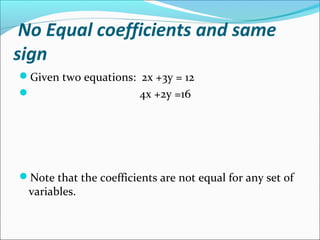
No Equal coefficients and same
sign
Given two equations: 2x +3y = 12
 4x +2y =16
Note that the coefficients are not equal for any set of
variables.
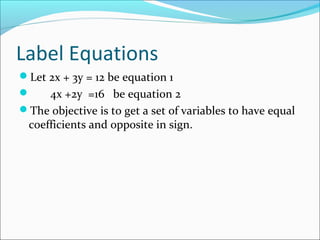
Label Equations
Let 2x + 3y = 12 be equation 1
 4x +2y =16 be equation 2
The objective is to get a set of variables to have equal
coefficients and opposite in sign.
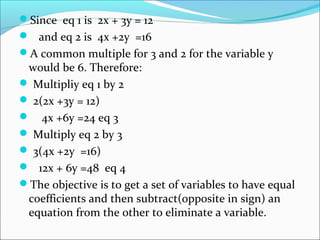
Since eq 1 is 2x + 3y = 12
 and eq 2 is 4x +2y =16
A common multiple for 3 and 2 for the variable y
would be 6. Therefore:
 Multipliy eq 1 by 2
 2(2x +3y = 12)
 4x +6y =24 eq 3
 Multiply eq 2 by 3
 3(4x +2y =16)
 12x + 6y =48 eq 4
The objective is to get a set of variables to have equal
coefficients and then subtract(opposite in sign) an
equation from the other to eliminate a variable.
Solve for x
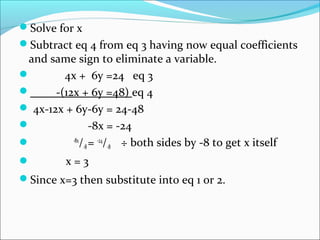
Subtract eq 4 from eq 3 having now equal coefficients
and same sign to eliminate a variable.
 4x + 6y =24 eq 3
 -(12x + 6y =48) eq 4
 4x-12x + 6y-6y = 24-48
 -8x = -24
 -8x
/-8= -24
/-8 ÷ both sides by -8 to get x itself
 x = 3
Since x=3 then substitute into eq 1 or 2.
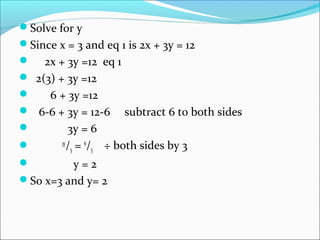
Solve for y
Since x = 3 and eq 1 is 2x + 3y = 12
 2x + 3y =12 eq 1
 2(3) + 3y =12
 6 + 3y =12
 6-6 + 3y = 12-6 subtract 6 to both sides
 3y = 6
 3y
/3 = 6
/3 ÷ both sides by 3
 y = 2
So x=3 and y= 2
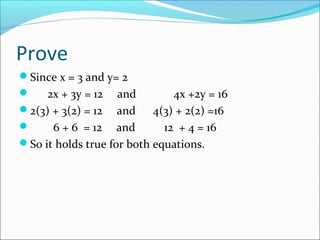
Prove
Since x = 3 and y= 2
 2x + 3y = 12 and 4x +2y = 16
2(3) + 3(2) = 12 and 4(3) + 2(2) =16
 6 + 6 = 12 and 12 + 4 = 16
So it holds true for both equations.
Conclusion
Label both equations (Example eq 1 and eq 2).
Multiple equations to get a common coefficient for a
set of variable
Subtract one equation from the other to eliminate the
said variable.
Substitute for the solved variable and solve for the
eliminated variable.

Simultaneous equations elimination 3

  • 1.
    Solve simultaneous linearequations by Elimination Method By Hector Castellanos
  • 2.
    No Equal coefficientsand same sign Given two equations: 2x +3y = 12  4x +2y =16 Note that the coefficients are not equal for any set of variables.
  • 3.
    Label Equations Let 2x+ 3y = 12 be equation 1  4x +2y =16 be equation 2 The objective is to get a set of variables to have equal coefficients and opposite in sign.
  • 4.
    Since eq 1is 2x + 3y = 12  and eq 2 is 4x +2y =16 A common multiple for 3 and 2 for the variable y would be 6. Therefore:  Multipliy eq 1 by 2  2(2x +3y = 12)  4x +6y =24 eq 3  Multiply eq 2 by 3  3(4x +2y =16)  12x + 6y =48 eq 4 The objective is to get a set of variables to have equal coefficients and then subtract(opposite in sign) an equation from the other to eliminate a variable.
  • 5.
    Solve for x Subtracteq 4 from eq 3 having now equal coefficients and same sign to eliminate a variable.  4x + 6y =24 eq 3  -(12x + 6y =48) eq 4  4x-12x + 6y-6y = 24-48  -8x = -24  -8x /-8= -24 /-8 ÷ both sides by -8 to get x itself  x = 3 Since x=3 then substitute into eq 1 or 2.
  • 6.
    Solve for y Sincex = 3 and eq 1 is 2x + 3y = 12  2x + 3y =12 eq 1  2(3) + 3y =12  6 + 3y =12  6-6 + 3y = 12-6 subtract 6 to both sides  3y = 6  3y /3 = 6 /3 ÷ both sides by 3  y = 2 So x=3 and y= 2
  • 7.
    Prove Since x =3 and y= 2  2x + 3y = 12 and 4x +2y = 16 2(3) + 3(2) = 12 and 4(3) + 2(2) =16  6 + 6 = 12 and 12 + 4 = 16 So it holds true for both equations.
  • 8.
    Conclusion Label both equations(Example eq 1 and eq 2). Multiple equations to get a common coefficient for a set of variable Subtract one equation from the other to eliminate the said variable. Substitute for the solved variable and solve for the eliminated variable.