KAILASH RAI SARASWATI VIDYA MANDIR
BY:- SANJU BABA
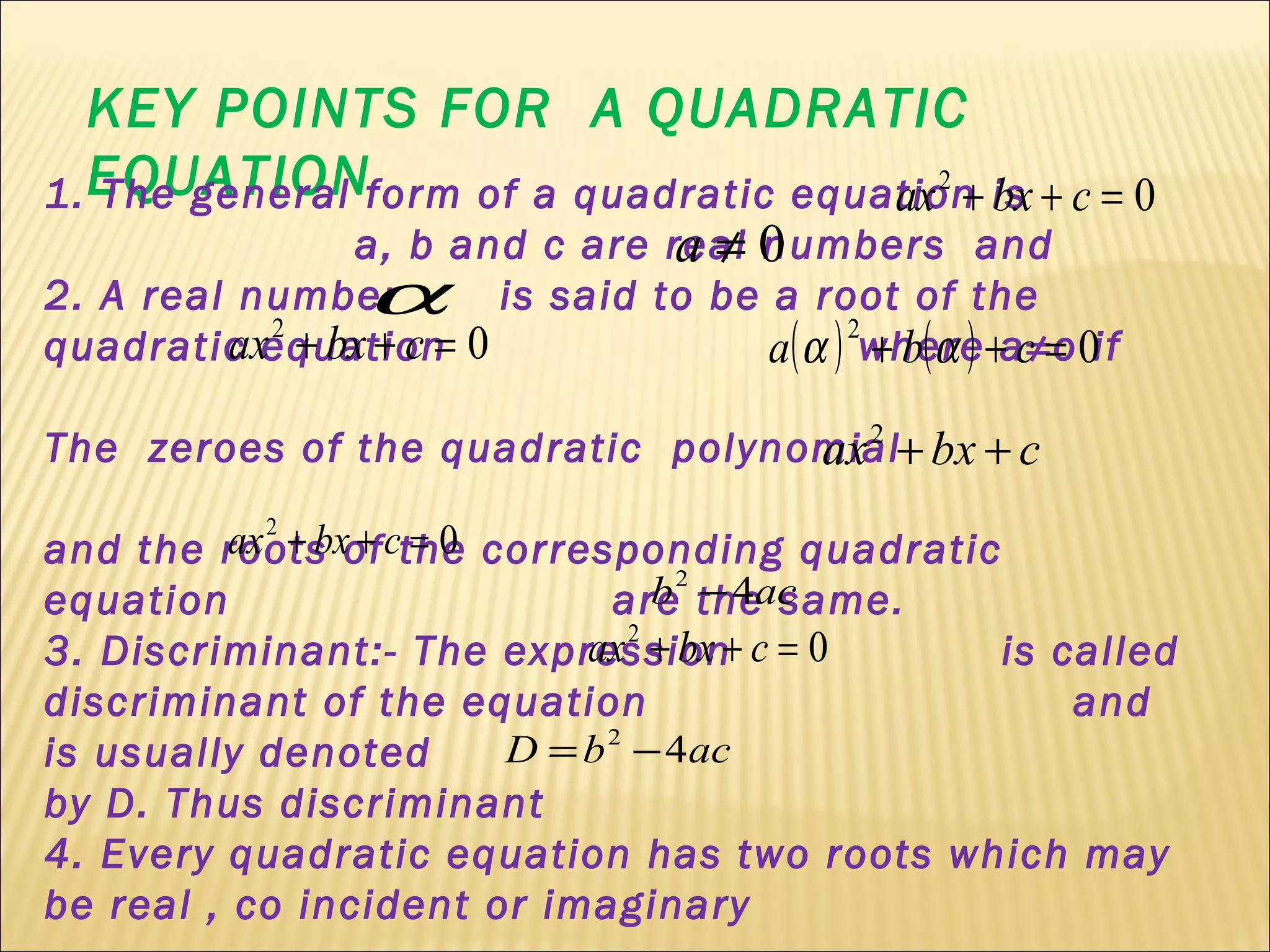
KEY POINTS FOR A QUADRATIC
EQUATION1. The general form of a quadratic equation is
a, b and c are real numbers and
2. A real number is said to be a root of the
quadratic equation where a≠o if
The zeroes of the quadratic polynomial
and the roots of the corresponding quadratic
equation are the same.
3. Discriminant:- The expression is called
discriminant of the equation and
is usually denoted
by D. Thus discriminant
4. Every quadratic equation has two roots which may
be real , co incident or imaginary
02
=++ cbxax
02
=++ cbxax ( ) ( ) 0
2
=++ cba αα
α
cbxax ++2
02
=++ cbxax
acb 42
−
02
=++ cbxax
acbD 42
−=
0≠a
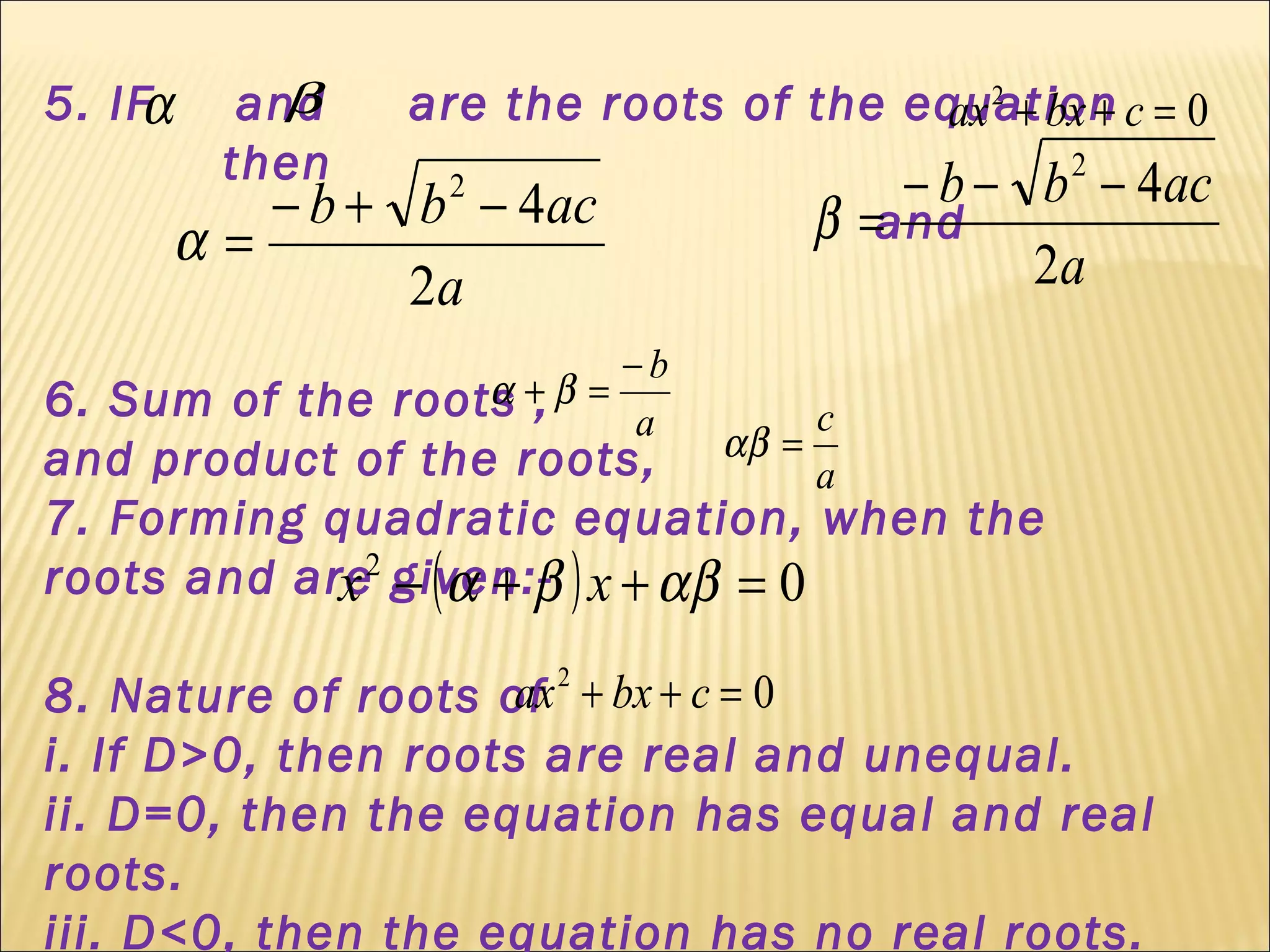
5. IF and are the roots of the equation
then
and
6. Sum of the roots ,
and product of the roots,
7. Forming quadratic equation, when the
roots and are given:-
8. Nature of roots of
i. If D>0, then roots are real and unequal.
ii. D=0, then the equation has equal and real
roots.
iii. D<0, then the equation has no real roots.
α β 02
=++ cbxax
a
acbb
2
42
−+−
=α a
acbb
2
42
−−−
=β
a
b−
=+ βα
a
c
=αβ
( ) 02
=++− αββα xx
02
=++ cbxax
KEEP
LEARNING……………………

Quadratic equation of class 10

  • 1.
    KAILASH RAI SARASWATIVIDYA MANDIR BY:- SANJU BABA
  • 2.
    KEY POINTS FORA QUADRATIC EQUATION1. The general form of a quadratic equation is a, b and c are real numbers and 2. A real number is said to be a root of the quadratic equation where a≠o if The zeroes of the quadratic polynomial and the roots of the corresponding quadratic equation are the same. 3. Discriminant:- The expression is called discriminant of the equation and is usually denoted by D. Thus discriminant 4. Every quadratic equation has two roots which may be real , co incident or imaginary 02 =++ cbxax 02 =++ cbxax ( ) ( ) 0 2 =++ cba αα α cbxax ++2 02 =++ cbxax acb 42 − 02 =++ cbxax acbD 42 −= 0≠a
  • 3.
    5. IF andare the roots of the equation then and 6. Sum of the roots , and product of the roots, 7. Forming quadratic equation, when the roots and are given:- 8. Nature of roots of i. If D>0, then roots are real and unequal. ii. D=0, then the equation has equal and real roots. iii. D<0, then the equation has no real roots. α β 02 =++ cbxax a acbb 2 42 −+− =α a acbb 2 42 −−− =β a b− =+ βα a c =αβ ( ) 02 =++− αββα xx 02 =++ cbxax
  • 4.