ILLUSTRATION OF
QUADRATIC EQUATION
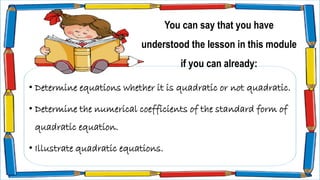
• Determine equations whether it is quadratic or not quadratic.
• Determine the numerical coefficients of the standard form of
quadratic equation.
• Illustrate quadratic equations.
You can say that you have
understood the lesson in this module
if you can already:
QUADRATIC EQUATION
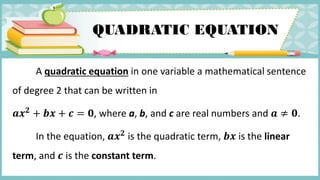
A quadratic equation in one variable a mathematical sentence
of degree 2 that can be written in
𝒂𝒙𝟐
+ 𝒃𝒙 + 𝒄 = 𝟎, where a, b, and c are real numbers and 𝒂 ≠ 𝟎.
In the equation, 𝒂𝒙𝟐
is the quadratic term, 𝒃𝒙 is the linear
term, and 𝒄 is the constant term.
Two Kinds of Quadratic Equations
• Complete Quadratic Equation
Examples:
𝑥2
− 4𝑥 + 1 = 0 and 3𝑥2
+ 2𝑥 − 1 = 0
• Incomplete Quadratic Equations
Examples:
2𝑥2
+ 9 = 0 2𝑥2
= 0 4𝑥2
− 8 = 0
𝑥2 − 9𝑥 = 0 𝑥2 − 4 = 0 𝑥2 + 7𝑥 = 0
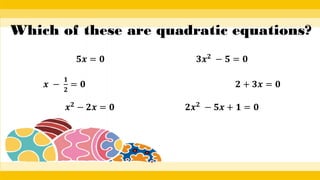
Which of these are quadratic equations?
𝟓𝒙 = 𝟎 𝟑𝒙𝟐
− 𝟓 = 𝟎
𝒙 −
𝟏
𝟐
= 𝟎 𝟐 + 𝟑𝒙 = 𝟎
𝒙𝟐 − 𝟐𝒙 = 𝟎 𝟐𝒙𝟐 − 𝟓𝒙 + 𝟏 = 𝟎
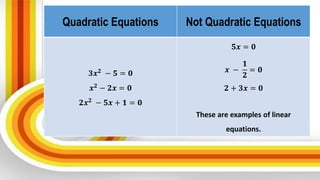
Quadratic Equations Not Quadratic Equations
𝟑𝒙𝟐
− 𝟓 = 𝟎
𝒙𝟐
− 𝟐𝒙 = 𝟎
𝟐𝒙𝟐 − 𝟓𝒙 + 𝟏 = 𝟎
𝟓𝒙 = 𝟎
𝒙 −
𝟏
𝟐
= 𝟎
𝟐 + 𝟑𝒙 = 𝟎
These are examples of linear
equations.
TRANSFORMING QUADRATIC
EQUATIONS IN STANDARD
FORM AND IDENTIFYING THE
VALUES OF a, b, and c
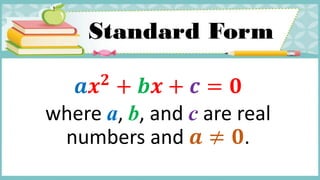
Standard Form
𝒂𝒙𝟐
+ 𝒃𝒙 + 𝒄 = 𝟎
where a, b, and c are real
numbers and 𝒂 ≠ 𝟎.
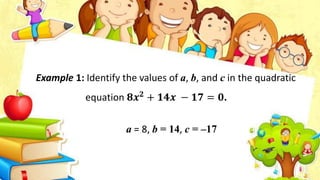
Example 1: Identify the values of a, b, and c in the quadratic
equation 𝟖𝒙𝟐
+ 𝟏𝟒𝒙 − 𝟏𝟕 = 𝟎.
a = 8, b = 14, c = –17
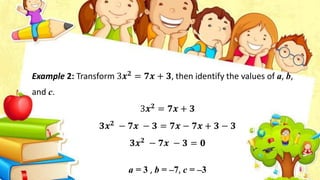
Example 2: Transform 3𝒙𝟐
= 𝟕𝒙 + 𝟑, then identify the values of a, b,
and c.
3𝒙𝟐 = 𝟕𝒙 + 𝟑
𝟑𝒙𝟐 − 𝟕𝒙 − 𝟑 = 𝟕𝒙 − 𝟕𝒙 + 𝟑 − 𝟑
𝟑𝒙𝟐 − 𝟕𝒙 − 𝟑 = 𝟎
a = 3 , b = –7, c = –3
Example 3: Transform 𝟐𝒙 𝒙 − 𝟏 = 𝟕,
then identify the values of a, b, and c.
𝟐𝒙 𝒙 − 𝟏 = 𝟕
𝟐𝒙𝟐 − 𝟐𝒙 = 𝟕
𝟐𝒙𝟐 − 𝟐𝒙 − 𝟕 = 𝟕 − 𝟕
𝟐𝒙𝟐
− 𝟐𝒙 − 𝟕 = 𝟎
a = 2, b = –2, c = –7
Example 4: Transform 𝒙 + 𝟓 𝟐 = 𝟎,
then identify the values of a, b, and c.
𝒙 + 𝟓 𝟐 = 𝟎
𝒙𝟐 + 𝟏𝟎𝒙 + 𝟐𝟓 = 𝟎
a = 1, b = 10, c = 7
Example 5: Transform
4𝒙𝟐 + 𝒙 = (𝒙 − 𝟏)𝟐, then identify the
values of a, b, and c.
4𝒙𝟐 + 𝒙 = (𝒙 − 𝟏)𝟐
4𝒙𝟐 + 𝒙 = 𝒙𝟐 − 𝟐𝒙 + 𝟏
4𝒙𝟐
− 𝒙𝟐
+ 𝒙 + 𝟐𝒙 − 𝟏 = 𝟎
𝟑𝒙𝟐 + 𝟑𝒙 − 𝟏 = 𝟎
a = 3 , b = 3, c = –1
Example 6: Transform
𝟐𝒙 + 𝟓 𝒙 + 𝟏 = 𝟖, then identify the
values of a, b, and c.
𝟐𝒙 + 𝟓 𝒙 + 𝟏 = 𝟖
𝟐𝒙𝟐 + 𝟐𝒙 + 𝟓𝒙 + 𝟓 = 𝟖
𝟐𝒙𝟐
+ 𝟕𝒙 + 𝟓 − 𝟖 = 𝟎
𝟐𝒙𝟐 + 𝟕𝒙 − 𝟑 = 𝟎
a = 2, b = 7, c = –3
Illustrates quadratic equation

Illustrates quadratic equation

  • 1.
  • 2.
    • Determine equationswhether it is quadratic or not quadratic. • Determine the numerical coefficients of the standard form of quadratic equation. • Illustrate quadratic equations. You can say that you have understood the lesson in this module if you can already:
  • 3.
    QUADRATIC EQUATION A quadraticequation in one variable a mathematical sentence of degree 2 that can be written in 𝒂𝒙𝟐 + 𝒃𝒙 + 𝒄 = 𝟎, where a, b, and c are real numbers and 𝒂 ≠ 𝟎. In the equation, 𝒂𝒙𝟐 is the quadratic term, 𝒃𝒙 is the linear term, and 𝒄 is the constant term.
  • 4.
    Two Kinds ofQuadratic Equations • Complete Quadratic Equation Examples: 𝑥2 − 4𝑥 + 1 = 0 and 3𝑥2 + 2𝑥 − 1 = 0 • Incomplete Quadratic Equations Examples: 2𝑥2 + 9 = 0 2𝑥2 = 0 4𝑥2 − 8 = 0 𝑥2 − 9𝑥 = 0 𝑥2 − 4 = 0 𝑥2 + 7𝑥 = 0
  • 5.
    Which of theseare quadratic equations? 𝟓𝒙 = 𝟎 𝟑𝒙𝟐 − 𝟓 = 𝟎 𝒙 − 𝟏 𝟐 = 𝟎 𝟐 + 𝟑𝒙 = 𝟎 𝒙𝟐 − 𝟐𝒙 = 𝟎 𝟐𝒙𝟐 − 𝟓𝒙 + 𝟏 = 𝟎
  • 6.
    Quadratic Equations NotQuadratic Equations 𝟑𝒙𝟐 − 𝟓 = 𝟎 𝒙𝟐 − 𝟐𝒙 = 𝟎 𝟐𝒙𝟐 − 𝟓𝒙 + 𝟏 = 𝟎 𝟓𝒙 = 𝟎 𝒙 − 𝟏 𝟐 = 𝟎 𝟐 + 𝟑𝒙 = 𝟎 These are examples of linear equations.
  • 7.
    TRANSFORMING QUADRATIC EQUATIONS INSTANDARD FORM AND IDENTIFYING THE VALUES OF a, b, and c
  • 8.
    Standard Form 𝒂𝒙𝟐 + 𝒃𝒙+ 𝒄 = 𝟎 where a, b, and c are real numbers and 𝒂 ≠ 𝟎.
  • 9.
    Example 1: Identifythe values of a, b, and c in the quadratic equation 𝟖𝒙𝟐 + 𝟏𝟒𝒙 − 𝟏𝟕 = 𝟎. a = 8, b = 14, c = –17
  • 10.
    Example 2: Transform3𝒙𝟐 = 𝟕𝒙 + 𝟑, then identify the values of a, b, and c. 3𝒙𝟐 = 𝟕𝒙 + 𝟑 𝟑𝒙𝟐 − 𝟕𝒙 − 𝟑 = 𝟕𝒙 − 𝟕𝒙 + 𝟑 − 𝟑 𝟑𝒙𝟐 − 𝟕𝒙 − 𝟑 = 𝟎 a = 3 , b = –7, c = –3
  • 11.
    Example 3: Transform𝟐𝒙 𝒙 − 𝟏 = 𝟕, then identify the values of a, b, and c. 𝟐𝒙 𝒙 − 𝟏 = 𝟕 𝟐𝒙𝟐 − 𝟐𝒙 = 𝟕 𝟐𝒙𝟐 − 𝟐𝒙 − 𝟕 = 𝟕 − 𝟕 𝟐𝒙𝟐 − 𝟐𝒙 − 𝟕 = 𝟎 a = 2, b = –2, c = –7
  • 12.
    Example 4: Transform𝒙 + 𝟓 𝟐 = 𝟎, then identify the values of a, b, and c. 𝒙 + 𝟓 𝟐 = 𝟎 𝒙𝟐 + 𝟏𝟎𝒙 + 𝟐𝟓 = 𝟎 a = 1, b = 10, c = 7
  • 13.
    Example 5: Transform 4𝒙𝟐+ 𝒙 = (𝒙 − 𝟏)𝟐, then identify the values of a, b, and c. 4𝒙𝟐 + 𝒙 = (𝒙 − 𝟏)𝟐 4𝒙𝟐 + 𝒙 = 𝒙𝟐 − 𝟐𝒙 + 𝟏 4𝒙𝟐 − 𝒙𝟐 + 𝒙 + 𝟐𝒙 − 𝟏 = 𝟎 𝟑𝒙𝟐 + 𝟑𝒙 − 𝟏 = 𝟎 a = 3 , b = 3, c = –1
  • 14.
    Example 6: Transform 𝟐𝒙+ 𝟓 𝒙 + 𝟏 = 𝟖, then identify the values of a, b, and c. 𝟐𝒙 + 𝟓 𝒙 + 𝟏 = 𝟖 𝟐𝒙𝟐 + 𝟐𝒙 + 𝟓𝒙 + 𝟓 = 𝟖 𝟐𝒙𝟐 + 𝟕𝒙 + 𝟓 − 𝟖 = 𝟎 𝟐𝒙𝟐 + 𝟕𝒙 − 𝟑 = 𝟎 a = 2, b = 7, c = –3