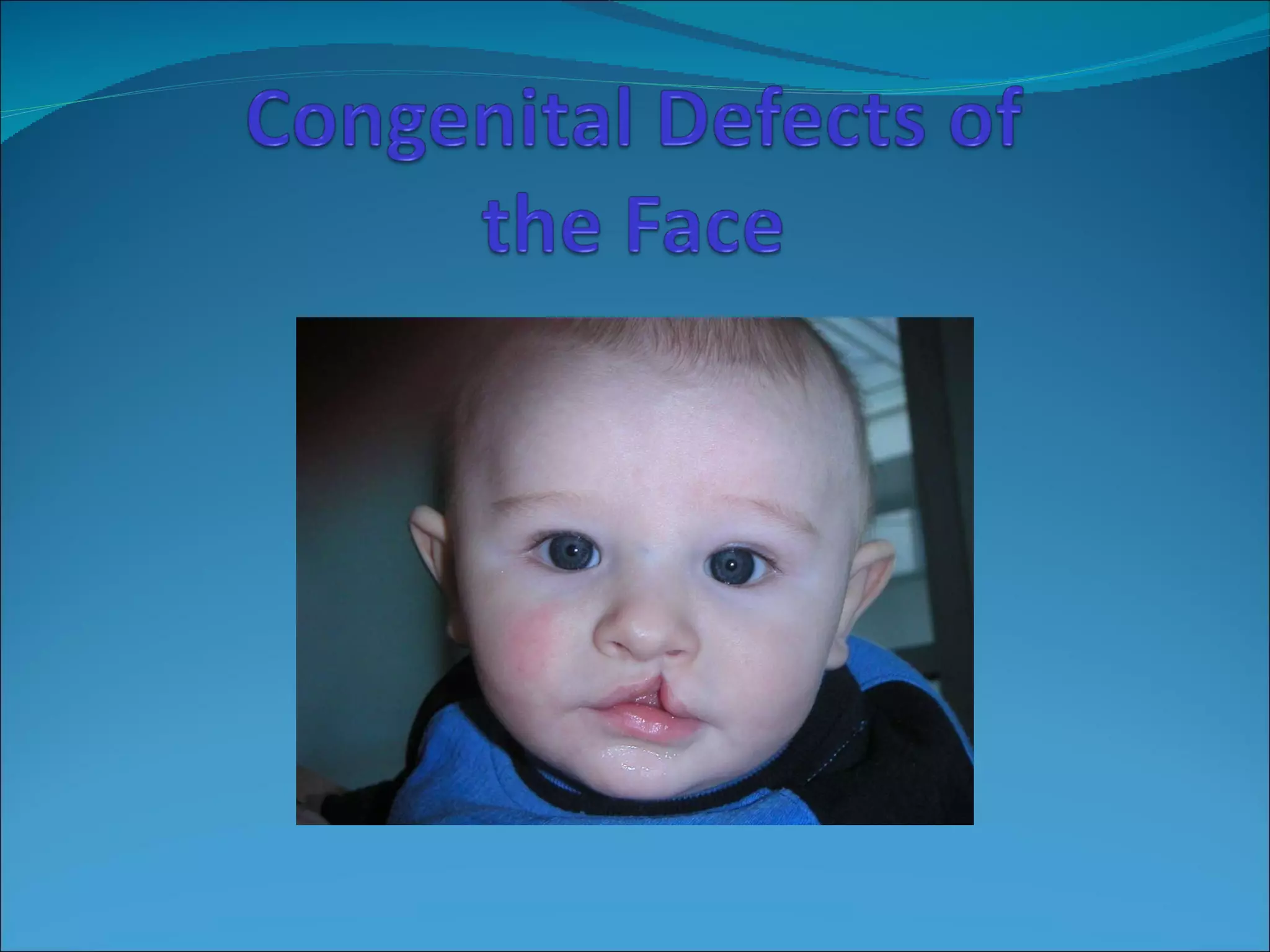
Introduction Includes: Cleft lip and palate Developmental abnormalities of the jaw and teeth Cleft lip, alveolus,hard and soft palate are the most common congenital abnormalities of the orofacial structures.
Incidence Cleft lip and palate is 1 in 600 live births. Isolated cleft palate is 1 in 1000 live births. The typical distribution of cleft types is: Cleft lip alone 15% Cleft lip and palate 45% Isolated cleft palate 40% Cleft lip palate predominates in male Cleft lip alone more in females In unilateral cleft lip, the deformity affects left side in 60% of cases.
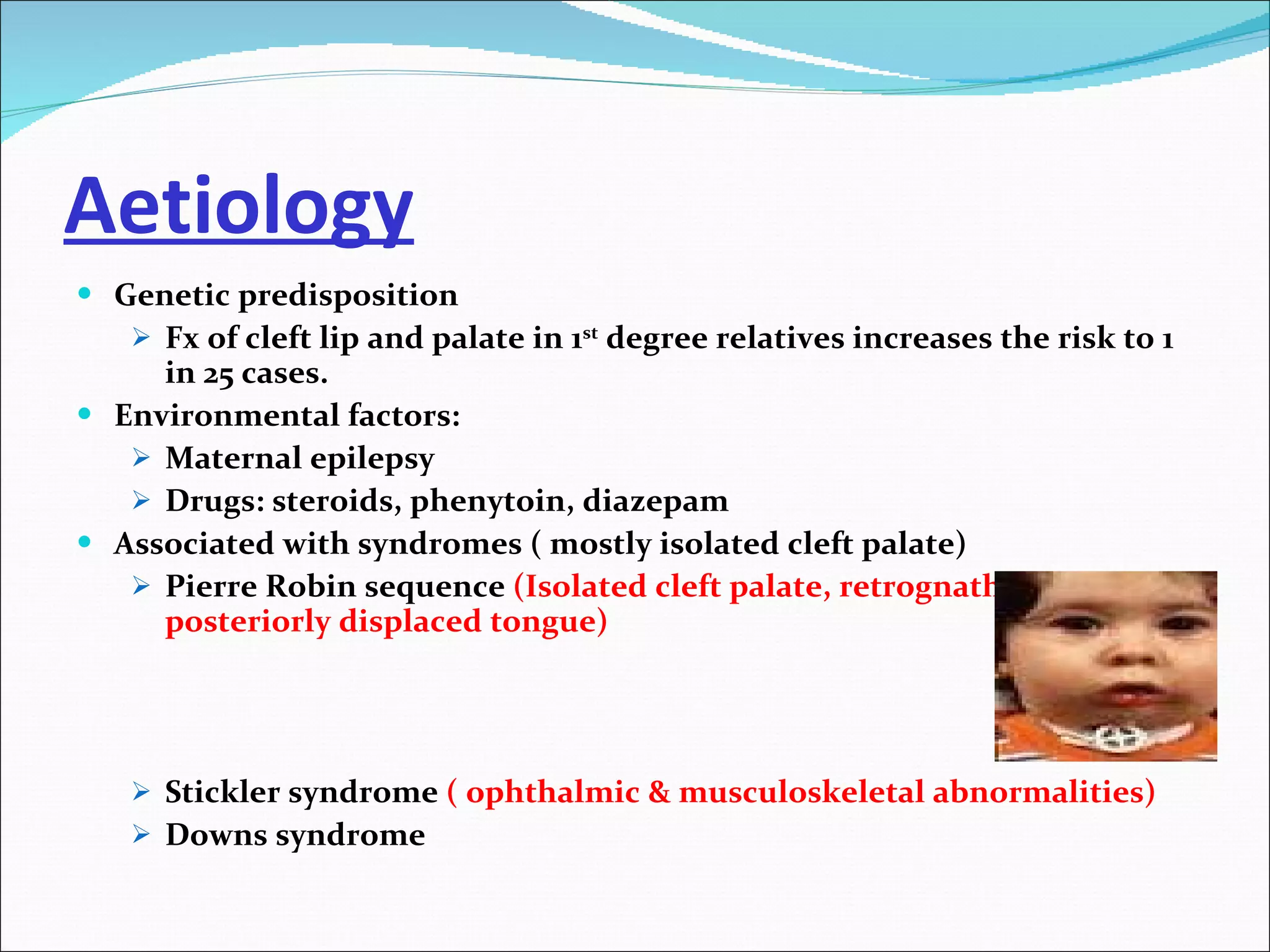
Aetiology Genetic predisposition Fx of cleft lip and palate in 1 st  degree relatives increases the risk to 1 in 25 cases. Environmental factors: Maternal epilepsy Drugs: steroids, phenytoin, diazepam Associated with syndromes ( mostly isolated cleft palate) Pierre Robin sequence  (Isolated cleft palate, retrognathia, posteriorly displaced tongue) Stickler syndrome  ( ophthalmic & musculoskeletal abnormalities) Downs syndrome
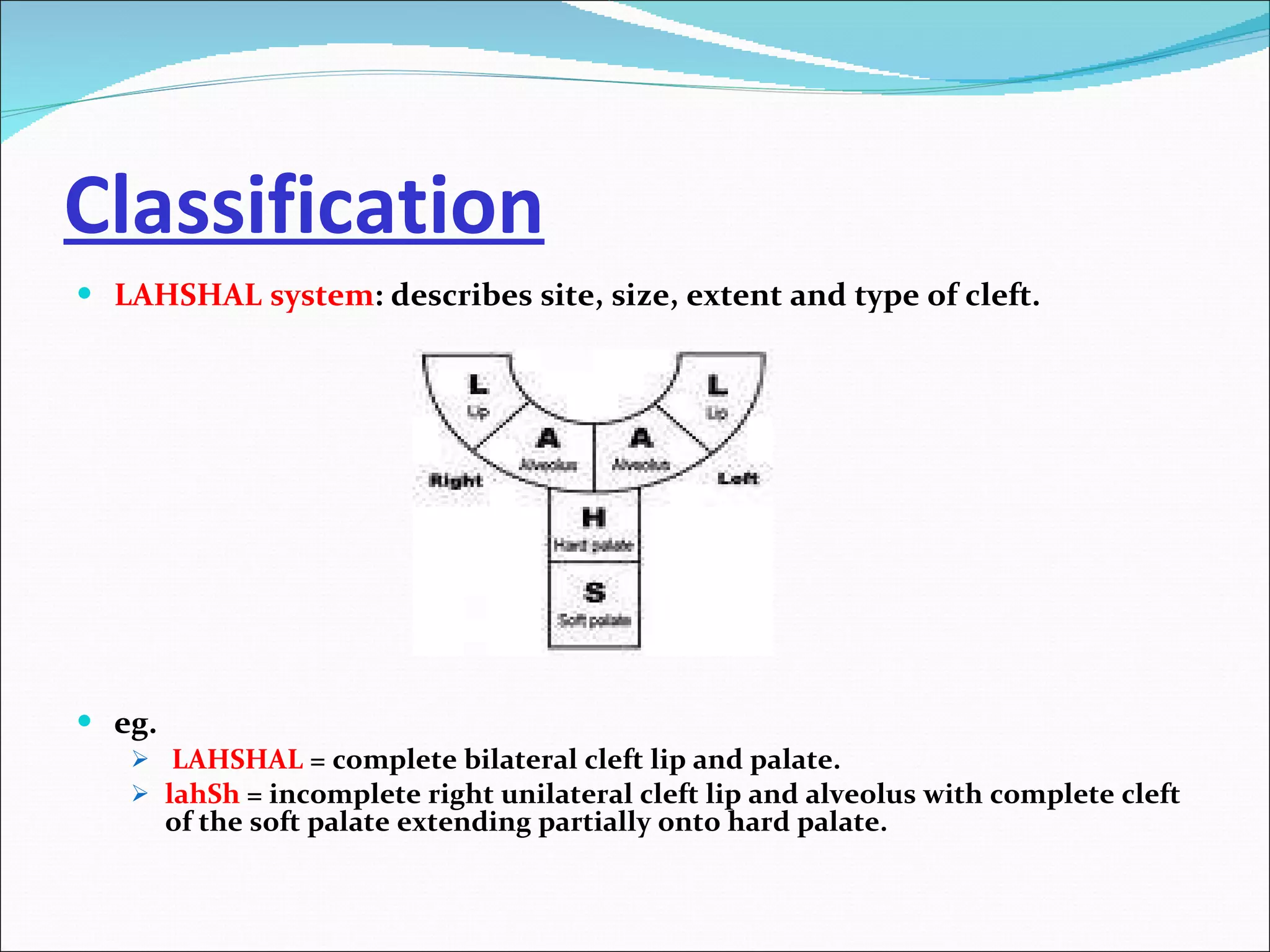
Classification LAHSHAL system : describes site, size, extent and type of cleft. eg. LAHSHAL  = complete bilateral cleft lip and palate. lahSh  = incomplete right unilateral cleft lip and alveolus with complete cleft of the soft palate extending partially onto hard palate.
Cleft Lip Anatomy: Frontal view showing muscle chain of the face A) nasolabial muscles 1- transverse nasalis 2- levator labii superioris alaeque nasi 3-levator labii superioris B) bilabial muscles orbicularis oris 4-  oblique head 5- horizontal head 6- lower lip C) labiomental muscles 7- depressor anguli oris 8- depressor labii inferioris 9- mantalis
Cleft lip Types: Unilateral cleft lip: Nasolabial and bilabial muscle rings are disrupted on one side resulting in asymmetrical deformity involving external nasal cartilage, nasal septum, and maxilla  causing displacement of nasal skin onto the lip and retraction of labial skin. Bilateral cleft lip: Symmetrical deformity Two muscular rings are disrupted on both sides.
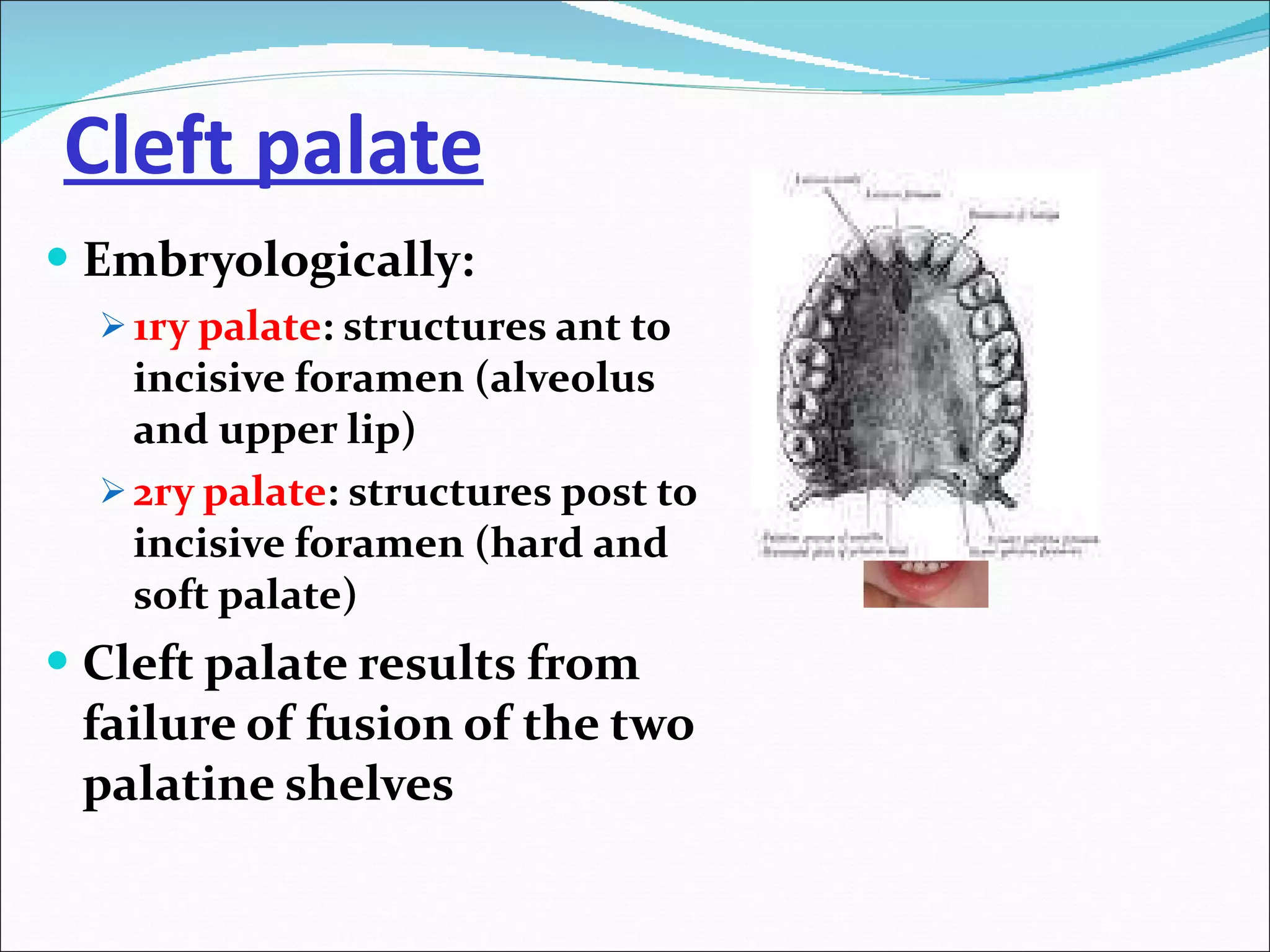
Cleft palate Embryologically: 1ry palate : structures ant to incisive foramen (alveolus and upper lip) 2ry palate : structures post to incisive foramen (hard and soft palate) Cleft palate results from failure of fusion of the two palatine shelves
Soft Palate Muscle fibers of the soft palate are oriented  transversely  with no significant attachment to the hard palate. In cleft soft palate, muscle fibers are orientated in an  anteroposterior direction , inserting into the posterior edge of the hard palate
Hard Palate Anatomy: 1-  Palatal fibromucosa:  lies directly below the floor of the nose. 2-  Maxillary fibromucosa : contains the greater palatine neurovascular bundle. 3-  Gingival fibromucosa : adjacent to the teeth.
Types   Incomplete:  when the cleft of the hard palate remains attached to the nasal septum and vomer. Complete : when the nasal septum and the vomer are completely separated from the palatine process
Primary management Antenatal diagnosis: cleft lip could be diagnosed by US after week 18 of gestation Cleft palate cannot be diagnosed on antenatal scan Feeding: Soft teats and modified teats Enlarging the hole in the teat.
Cont.   Surgical techniques: Cleft lip Principle : attach and reconnect the muscles around nasal aperture and oral sphincter Performed btw 3- 6 months Skin incisions to restore displaced tissues including skin and cartilage to their normal position Nasolabial muscles are anchored to the premaxilla  Oblique muscles of orbicularis oris are sutured to the base of the ant nasal spine Closure is completed by suturing the horizontal fibers of orbicularis oris.
Cont. Surgical techniques: Cleft palate Principle : mobilization and reconstruction of the abbarent soft palate muscles, together with closure of the residual hard palate cleft by minimal dissection and subsequent scarring Cleft palate closure can be achieved by one or two stage palatoplasty
Cont. Delaire technique and sequence is one the regimens used for timing of primary cleft lip and palate procedures: Cleft lip alone: Unilateral :  one operation   at 5-6 months Bilateral :  one operation   at 4-5 moths Cleft palate only: Soft palate only :  one operation, at 6month Soft and hard palate :  two operations ,  soft at 6 months,  hard at 15- 18 months Cleft lip and palate: Unilateral :  two operations :  cleft lip and soft palate at 5-6months  Hard palate at 15- 18months Bilateral :  two operations : cleft lip and soft palate at 4-5 months Hard palate at 15- 18 months
Secondary management Hearing  Higher incidence of sensorinueral hearing loss and conductive hearing loss Regular hearing tests should be performed before 12 months of age Speech: Velopharyngeal incompetence Articulation problems Speech problems Dental: Hypodontia, hyperdontia, delayed eruption of teeth are common problems Management include dietary advice, fluoride supplements, and fissure sealants.
Secondary surgery for cleft lip and palate Includes: Cleft lip revision Alveolar bone graft Simultaneous lip revision and alveolar bone graft 2ry palate procedures Dentoalveolar procedure Rhinoplasty Orthognathic surgery
Cleft lip revision Should be delayed for at least 2 years after the 1ry surgery Aims to improve incomplete 1ry reconstruction Indications: Lip deformities: Misaligned vermilion Asymmetrical cupid’s bow Muscle discontinuity or misalignment  Nasal deformity : Lateral drift of alar base Poor nasal tip projection Deviated nasal septum
Alveolar bone graft Done in patients with residual alveolar cleft ass with cleft lip and palate Aim: promotion of eruption of canine tooth into the cleft site Eliminates oronasal fistula Best performed between 8- 11 years
Orthognathic surgery Impaired growth of maxilla is due to poor and traumatic 1ry surgery. Genetic predisposition Principle of deformity: underdevelopment in both horizontal and vertical direction of maxilla leading to pseudoprognathism  (A projection of the mandible due to occlusal disharmonies that force the mandible forward; the mandibular condyles are forward of their expected functional position) surgery is performed when facial growth is completed( female 16 years, male 19 years)
Developmental abnormalities of the jaw Disproportionate growth between the maxilla and the mandible resulting in derangement of the dental occlusion Classification: Class I : theres normal relation between upper and lower incisors and molar dentition Class II : the mandibular teeth are placed post to the maxillary teeth Class III : the mandibular teeth are placed ant to the maxillary teeth. Management: orthognathic surgery
Developmental abnormalities of the teeth Divided into: Abnormality in number Defects of structure and size Disorders of eruption of teeth
Number Anodontia:  congenital absence of all teeth. Rare Partial anodontia : failure of development of 1ry or more commonly 2ry dentition Most frequent absent teeth: Third molar ( wisdom teeth) 2 nd  premolars Maxillary lateral incisor teeth Ass with: Ectodermal dysplasia Down syndrome Cleft lip and palate Management: prosthetic replacement of teeth
Defects of structure of the teeth Causes:  Genetic disorders: Amelogenesis imperfecta : changes in the structure (hypoplasia) or mineralization ( hypocalcification) Dentinogenesis imperfecta : ass with soft dentine with short roots. Usually ass with osteogenesis imperfecta  Systemic causes: Measels Rickets Hypoparathyroidism Tetracycline
Disorders of eruption Delayed eruption of teeth may involve a single tooth or the entire dentition Local factors: Loss of space/ overcrowding Additional teeth Retention of deciduous tooth Systemic factors: Matabolic diseases: critinism and rickets Osteodystrophies Hereditary gingival fibromatosis  Management:  Remove any obstruction Can be left alone

Congenital defects of the Face

  • 1.
  • 2.
    Introduction Includes: Cleftlip and palate Developmental abnormalities of the jaw and teeth Cleft lip, alveolus,hard and soft palate are the most common congenital abnormalities of the orofacial structures.
  • 3.
    Incidence Cleft lipand palate is 1 in 600 live births. Isolated cleft palate is 1 in 1000 live births. The typical distribution of cleft types is: Cleft lip alone 15% Cleft lip and palate 45% Isolated cleft palate 40% Cleft lip palate predominates in male Cleft lip alone more in females In unilateral cleft lip, the deformity affects left side in 60% of cases.
  • 4.
    Aetiology Genetic predispositionFx of cleft lip and palate in 1 st degree relatives increases the risk to 1 in 25 cases. Environmental factors: Maternal epilepsy Drugs: steroids, phenytoin, diazepam Associated with syndromes ( mostly isolated cleft palate) Pierre Robin sequence (Isolated cleft palate, retrognathia, posteriorly displaced tongue) Stickler syndrome ( ophthalmic & musculoskeletal abnormalities) Downs syndrome
  • 5.
    Classification LAHSHAL system: describes site, size, extent and type of cleft. eg. LAHSHAL = complete bilateral cleft lip and palate. lahSh = incomplete right unilateral cleft lip and alveolus with complete cleft of the soft palate extending partially onto hard palate.
  • 6.
    Cleft Lip Anatomy:Frontal view showing muscle chain of the face A) nasolabial muscles 1- transverse nasalis 2- levator labii superioris alaeque nasi 3-levator labii superioris B) bilabial muscles orbicularis oris 4- oblique head 5- horizontal head 6- lower lip C) labiomental muscles 7- depressor anguli oris 8- depressor labii inferioris 9- mantalis
  • 7.
    Cleft lip Types:Unilateral cleft lip: Nasolabial and bilabial muscle rings are disrupted on one side resulting in asymmetrical deformity involving external nasal cartilage, nasal septum, and maxilla causing displacement of nasal skin onto the lip and retraction of labial skin. Bilateral cleft lip: Symmetrical deformity Two muscular rings are disrupted on both sides.
  • 8.
    Cleft palate Embryologically:1ry palate : structures ant to incisive foramen (alveolus and upper lip) 2ry palate : structures post to incisive foramen (hard and soft palate) Cleft palate results from failure of fusion of the two palatine shelves
  • 9.
    Soft Palate Musclefibers of the soft palate are oriented transversely with no significant attachment to the hard palate. In cleft soft palate, muscle fibers are orientated in an anteroposterior direction , inserting into the posterior edge of the hard palate
  • 10.
    Hard Palate Anatomy:1- Palatal fibromucosa: lies directly below the floor of the nose. 2- Maxillary fibromucosa : contains the greater palatine neurovascular bundle. 3- Gingival fibromucosa : adjacent to the teeth.
  • 11.
    Types Incomplete: when the cleft of the hard palate remains attached to the nasal septum and vomer. Complete : when the nasal septum and the vomer are completely separated from the palatine process
  • 12.
    Primary management Antenataldiagnosis: cleft lip could be diagnosed by US after week 18 of gestation Cleft palate cannot be diagnosed on antenatal scan Feeding: Soft teats and modified teats Enlarging the hole in the teat.
  • 13.
    Cont. Surgical techniques: Cleft lip Principle : attach and reconnect the muscles around nasal aperture and oral sphincter Performed btw 3- 6 months Skin incisions to restore displaced tissues including skin and cartilage to their normal position Nasolabial muscles are anchored to the premaxilla Oblique muscles of orbicularis oris are sutured to the base of the ant nasal spine Closure is completed by suturing the horizontal fibers of orbicularis oris.
  • 14.
    Cont. Surgical techniques:Cleft palate Principle : mobilization and reconstruction of the abbarent soft palate muscles, together with closure of the residual hard palate cleft by minimal dissection and subsequent scarring Cleft palate closure can be achieved by one or two stage palatoplasty
  • 15.
    Cont. Delaire techniqueand sequence is one the regimens used for timing of primary cleft lip and palate procedures: Cleft lip alone: Unilateral : one operation at 5-6 months Bilateral : one operation at 4-5 moths Cleft palate only: Soft palate only : one operation, at 6month Soft and hard palate : two operations , soft at 6 months, hard at 15- 18 months Cleft lip and palate: Unilateral : two operations : cleft lip and soft palate at 5-6months Hard palate at 15- 18months Bilateral : two operations : cleft lip and soft palate at 4-5 months Hard palate at 15- 18 months
  • 16.
    Secondary management Hearing Higher incidence of sensorinueral hearing loss and conductive hearing loss Regular hearing tests should be performed before 12 months of age Speech: Velopharyngeal incompetence Articulation problems Speech problems Dental: Hypodontia, hyperdontia, delayed eruption of teeth are common problems Management include dietary advice, fluoride supplements, and fissure sealants.
  • 17.
    Secondary surgery forcleft lip and palate Includes: Cleft lip revision Alveolar bone graft Simultaneous lip revision and alveolar bone graft 2ry palate procedures Dentoalveolar procedure Rhinoplasty Orthognathic surgery
  • 18.
    Cleft lip revisionShould be delayed for at least 2 years after the 1ry surgery Aims to improve incomplete 1ry reconstruction Indications: Lip deformities: Misaligned vermilion Asymmetrical cupid’s bow Muscle discontinuity or misalignment Nasal deformity : Lateral drift of alar base Poor nasal tip projection Deviated nasal septum
  • 19.
    Cleft lip revisionShould be delayed for at least 2 years after the 1ry surgery Aims to improve incomplete 1ry reconstruction Indications: Lip deformities: Misaligned vermilion Asymmetrical cupid’s bow Muscle discontinuity or misalignment Nasal deformity : Lateral drift of alar base Poor nasal tip projection Deviated nasal septum
  • 20.
    Cleft lip revisionShould be delayed for at least 2 years after the 1ry surgery Aims to improve incomplete 1ry reconstruction Indications: Lip deformities: Misaligned vermilion Asymmetrical cupid’s bow Muscle discontinuity or misalignment Nasal deformity : Lateral drift of alar base Poor nasal tip projection Deviated nasal septum
  • 21.
    Alveolar bone graftDone in patients with residual alveolar cleft ass with cleft lip and palate Aim: promotion of eruption of canine tooth into the cleft site Eliminates oronasal fistula Best performed between 8- 11 years
  • 22.
    Orthognathic surgery Impairedgrowth of maxilla is due to poor and traumatic 1ry surgery. Genetic predisposition Principle of deformity: underdevelopment in both horizontal and vertical direction of maxilla leading to pseudoprognathism (A projection of the mandible due to occlusal disharmonies that force the mandible forward; the mandibular condyles are forward of their expected functional position) surgery is performed when facial growth is completed( female 16 years, male 19 years)
  • 23.
    Developmental abnormalities ofthe jaw Disproportionate growth between the maxilla and the mandible resulting in derangement of the dental occlusion Classification: Class I : theres normal relation between upper and lower incisors and molar dentition Class II : the mandibular teeth are placed post to the maxillary teeth Class III : the mandibular teeth are placed ant to the maxillary teeth. Management: orthognathic surgery
  • 24.
    Developmental abnormalities ofthe teeth Divided into: Abnormality in number Defects of structure and size Disorders of eruption of teeth
  • 25.
    Number Anodontia: congenital absence of all teeth. Rare Partial anodontia : failure of development of 1ry or more commonly 2ry dentition Most frequent absent teeth: Third molar ( wisdom teeth) 2 nd premolars Maxillary lateral incisor teeth Ass with: Ectodermal dysplasia Down syndrome Cleft lip and palate Management: prosthetic replacement of teeth
  • 26.
    Defects of structureof the teeth Causes: Genetic disorders: Amelogenesis imperfecta : changes in the structure (hypoplasia) or mineralization ( hypocalcification) Dentinogenesis imperfecta : ass with soft dentine with short roots. Usually ass with osteogenesis imperfecta Systemic causes: Measels Rickets Hypoparathyroidism Tetracycline
  • 27.
    Disorders of eruptionDelayed eruption of teeth may involve a single tooth or the entire dentition Local factors: Loss of space/ overcrowding Additional teeth Retention of deciduous tooth Systemic factors: Matabolic diseases: critinism and rickets Osteodystrophies Hereditary gingival fibromatosis Management: Remove any obstruction Can be left alone