Introduction
• Cervical cancer is the third Most common cancer in women worldwide. The cancer is a
disease that develops quite slowly and begins with a precancerous condition known as
dysplasia
• Cervical cancer is a malignant tumor deriving from cells of the cervix uteri, which is the
lower part, the neck of the womb, of the female reproductive system.
Pathophysiology
• Cervical cancer starts in the cells lining the cervix, the lower part of the uterus(womb). The
cervix connects the body of the uterus to the vagina. Cancer starts when the cells in the
body begin to grow out of control.
• The cervix is made of two parts and is covered with two different types of cells. The
endocervix is the opening of the cervix that leads into the uterus. It is covered with
glandular cells.
• The exocervix is the outer part of the cervix that can be seen when doing a speculum exam.
It is covered in squamous cells.
• The place where these two cell types meet in the cervix is called the transformation zone.
The exact location of the transformation zone changes as you get older and if you give
birth. Most cervical cancers begin in the cells in the transformation zone.
Causes
Human papillomavirus- infection with the common human papillomavirus is a cause of
approximately 90% of all the cervical cancers. About half of the sexually transmitted HPVs are
associated with cervical cancer.
Sexual history- a woman has a higher-than-average risk of developing cervical if she:
 Has had multiple sexual partners
 Began having sexual relations before the age of 18
 Has a partner who has had sexual contact with an infected woman with cervical cancer
Other causes
 Sexually transmitted infections
 Smoking
 Birth control pills
 Weak immune system
 Pregnancy history
 Diet
 Genetic
Risk factors
• Smoking
• Weakened immune system
• Several pregnancies
• Giving birth at a very young age
• Long-term use of the contraceptive pills
• Family history
Signs and symptoms
 Bleeding that occurs between regular menstrual periods
 Bleeding after sexual intercourse, douching, or a pelvic exam
 Menstrual periods that last longer and are heavier than before
 Bleeding after going through menopause
 Increased vaginal discharge
 Pelvic pain
Stages of cervical cancer
 Stage 1- cancer is confined to the cervix
 Stage 2. Cancer at this stage includes the cervix and uterus, but hasn’t spread to the
pelvic wall or the lower portion of the vagina
 Stage 3. Cancer at this stage has moved beyond the cervix and uterus to the pelvic wall
or the lower portion of the vagina
 Stage 4. At this stage, cancer has spread to nearby organs, such as the bladder or
rectum, or it has spread to other areas of the body, such as the lungs, liver or bones.
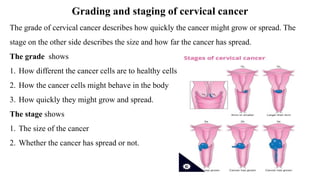
Grading and staging of cervical cancer
The grade of cervical cancer describes how quickly the cancer might grow or spread. The
stage on the other side describes the size and how far the cancer has spread.
The grade shows
1. How different the cancer cells are to healthy cells
2. How the cancer cells might behave in the body
3. How quickly they might grow and spread.
The stage shows
1. The size of the cancer
2. Whether the cancer has spread or not.
A microscope is used to view the cells therefore giving the cells a grade from 1 to 3
 Grade 1: these cells look similar to healthy cells. They tend to grow more slowly than
higher grades.
 Grade 2: these cells look a bit like healthy cells but are not healthy and may grow a bit
quicker
 Grade 3: theses cells look very different from healthy cells. They tend to grow more
quickly which means they are more likely to spread. Grade 3 cancers might need more
intensive treatment than lower grades.
THE TNM STAGING
The TNM classification is a system for classifying a malignancy. Tx identifies carcinoma in situ. It is primarily used
in solid tumors and can be used to assist in prognostic cancer staging. The system has its basis on assessing the tumor,
regional lymph nodes and distant metastasis as detailed below.
T- TUMOR: it is used to describe the size of the primary tumor and it’s invasion into adjacent tissues.
T0; indicates that no evident tumor is present.
T1; indicates the invasion into the submucosa in colorectal cancer
T2; indicates an invasion of the muscularis propria
T3; indicates an invasion into the subserosa
T4; indicates tumor extension through all layers of the colon and invasion of the visceral peritoneum or adjacent
structures.
N- NODES: used to describe regional lymph node involvement of the tumor. Lymph nodes
function as biological filters as fluid from the body is absorbed into the lymphatic capillaries
and flows to the lymph nodes. N-values are assessed differently for specific tumors and their
regional lymph node drainage.
N0; indicates no regional lymph node drainage.
N1; indicates the involvement of 1-3 regional nodes
N2; indicates the involvement of 4-6 regional lymph nodes.
N3; indicates 7+ regional nodes involvement.
Nx is used when lymph nodes are unable to be assessed,. N1-N3 indicates that there is some
degree of nodal spread, with a progressively distal spread from N1 to N3.
M- METASTASIS: used to identify the presence of distant metastases of the primary tumor.
Metastasis is when a tumor spreads beyond regional nodes. A tumor is classified as
M0; if no distant metastasis is present
M1; if there is evidence of distant metastasis
FIGO stages of cervical cancer
This staging system was developed by the International Federation of Obstetrics and Gynecology. Hence
“FIGO”. Staging is based on the results of a physical exam, imaging scans, and biopsy.
STAGE 1: the cancer has spread from the cervix lining into the deeper tissue but is still just found in the uterus.
It has not spread to other parts of the body. This stage is subdivided.
o Stage 1A: the cancer is diagnosed only by cervical tissue or cells under a microscope. Imaging or evaluation
can also be used to determine tumor size.
o Stage 1A2: there is a cancerous area 3mm to less than 5mm in depth.
o Stage 1B: in this stage, the tumor is larger but is still only confined to the cervix. There is no distant spread.
o Stage 1B1: the tumor is 5mm or more in depth and less than 2 centimeters wide. A cm is roughly equal to
the width of a standard pen or pencil.
o Stage 1B2: the tumor is 5mm or more in depth and between 2 and 4cm wide.
o Stage 1B3: the tumor is 4cm more in width.
STAGE 2: the cancer has spread beyond the uterus to nearby areas, such as the vagina or
tissue near the cervix, but it is still inside the pelvic area. The cancer has not spread to the
other parts of the body. This stage may be divided into smaller groups to describe the cancer
in more details.
o Stage 2A: the tumor is limited to the upper two-thirds of the vagina. It has not spread to
the tissue next to the cervix, which is called the parametrial area.
o Stage 2A1: the tumor is less than 4cm wide.
o Stage 2A2: the tumor is 4cm or more in width.
o Stage 2B: the tumor has spread to the parametrial area. The tumor does not reach the
pelvic wall.
STAGE 3: the tumor involves the lower third of the vagina and/or : has spread to the pelvic
wall; causes swelling of the kidney, called hydronephrosis; stops a kidney from functioning;
and/or involves regional lymph nodes. Lymph nodes are small, bean-shaped organs that help
fight infections. There is no distant spread.
o Stage 3A: the tumor involves the lower third of the vagina, but it has not grown into the
pelvic wall.
o Stage 3B: the tumor has grown into the pelvic wall and/or affects a kidney.
o Stage 3C: the tumor involves regional lymph nodes. This can be detected using imaging
tests or pathology. Adding a lowercase “r” indicates imaging tests were used to
determine the stage.
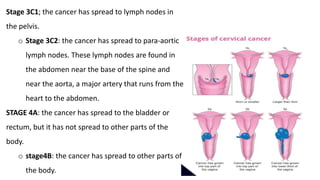
Stage 3C1; the cancer has spread to lymph nodes in
the pelvis.
o Stage 3C2: the cancer has spread to para-aortic
lymph nodes. These lymph nodes are found in
the abdomen near the base of the spine and
near the aorta, a major artery that runs from the
heart to the abdomen.
STAGE 4A: the cancer has spread to the bladder or
rectum, but it has not spread to other parts of the
body.
o stage4B: the cancer has spread to other parts of
the body.
Diagnostic Findings
pap test – routine screening for cervical abnormalities can detect early-stage cancer and
precancerous conditions that could progress to invasive disease. The progress begins with pap
test, also known as a pap smear
 HPV DNA test- like the pap test, the HPV DNA test involves collecting cells from the cervix
for lab testing.
 Colposcopy
 Cone biopsy
 Chest X-ray
 CT scan
 Pelvic ultrasound
Medical management
• Chemotherapy- is the use of chemicals (medications) to destroy cancer cells. Cytotoxic
medication prevents cancer cells from dividing ang growing
Chemotherapy for cervical cancer, as well as most other cancers, is used to target cancer
cells that surgery cannot or did not remover, or to help the symptoms of patients with
advanced cancer. Cisplatin, a chemotherapy drug, is frequently used in combination with
radiotherapy.
• Radiotherapy- is also known as radiation therapy. It works by damaging the DNA
inside the tumor cells, destroying their ability to reproduce. For patients with advanced
cervical cancer radiation combined cisplatin-based chemotherapy is the most effective
treatment.
Surgical management
 Laser surgery- a narrow beam of intense light destroys cancerous and precancerous cells
 LEEP (loop electrosurgical excision procedure)- a wire loop which has an electric current
cut through tissue removing cells from the mouth of the cervix
 Cryosurgery
 Hysterectomy
Dietary management
 Flavonoids are chemical compounds in fruits and vegetables that are thought to be a leading
source protection against cancer. The flavonoid-rich foods are; apples, black beans, broccoli,
brussels sprouts, cabbage, garlic, onions, soy, spinach.
 Folate (a water-soluble B vitamin) reduce the risk of cervical cancer in people with HPV.
Food’s rich in folate include; avocados, breads, lentils, orange juice and strawberries.
 Carotenoids is a source of vitamin A, these are also helpful in preventing cervical cancer
risk. Foods such as; carrots, sweet potatoes and pumpkin are rich in vitamin A.
COMPLICATIONS
• Early menopause
• Narrowing of the vagina
• Lymphoedema
• Emotional impact
Complications of advanced cervical cancer
• Pain
• Kidney failure
• Blood clots
• Bleeding
• fistula
Prevention
• HPV vaccine- if every female adheres to current HPV vaccination programs the total
number of female deaths from cervical cancer can reduce
 Safe sex
 Cervical screening every after 3months
 Have few sexual intercourse
 Don’t smoke
 Abstinence

cervical cancer.pptx

  • 1.
    Introduction • Cervical canceris the third Most common cancer in women worldwide. The cancer is a disease that develops quite slowly and begins with a precancerous condition known as dysplasia • Cervical cancer is a malignant tumor deriving from cells of the cervix uteri, which is the lower part, the neck of the womb, of the female reproductive system.
  • 3.
    Pathophysiology • Cervical cancerstarts in the cells lining the cervix, the lower part of the uterus(womb). The cervix connects the body of the uterus to the vagina. Cancer starts when the cells in the body begin to grow out of control. • The cervix is made of two parts and is covered with two different types of cells. The endocervix is the opening of the cervix that leads into the uterus. It is covered with glandular cells. • The exocervix is the outer part of the cervix that can be seen when doing a speculum exam. It is covered in squamous cells. • The place where these two cell types meet in the cervix is called the transformation zone. The exact location of the transformation zone changes as you get older and if you give birth. Most cervical cancers begin in the cells in the transformation zone.
  • 4.
    Causes Human papillomavirus- infectionwith the common human papillomavirus is a cause of approximately 90% of all the cervical cancers. About half of the sexually transmitted HPVs are associated with cervical cancer. Sexual history- a woman has a higher-than-average risk of developing cervical if she:  Has had multiple sexual partners  Began having sexual relations before the age of 18  Has a partner who has had sexual contact with an infected woman with cervical cancer
  • 5.
    Other causes  Sexuallytransmitted infections  Smoking  Birth control pills  Weak immune system  Pregnancy history  Diet  Genetic
  • 6.
    Risk factors • Smoking •Weakened immune system • Several pregnancies • Giving birth at a very young age • Long-term use of the contraceptive pills • Family history
  • 7.
    Signs and symptoms Bleeding that occurs between regular menstrual periods  Bleeding after sexual intercourse, douching, or a pelvic exam  Menstrual periods that last longer and are heavier than before  Bleeding after going through menopause  Increased vaginal discharge  Pelvic pain
  • 8.
    Stages of cervicalcancer  Stage 1- cancer is confined to the cervix  Stage 2. Cancer at this stage includes the cervix and uterus, but hasn’t spread to the pelvic wall or the lower portion of the vagina  Stage 3. Cancer at this stage has moved beyond the cervix and uterus to the pelvic wall or the lower portion of the vagina  Stage 4. At this stage, cancer has spread to nearby organs, such as the bladder or rectum, or it has spread to other areas of the body, such as the lungs, liver or bones.
  • 9.
    Grading and stagingof cervical cancer The grade of cervical cancer describes how quickly the cancer might grow or spread. The stage on the other side describes the size and how far the cancer has spread. The grade shows 1. How different the cancer cells are to healthy cells 2. How the cancer cells might behave in the body 3. How quickly they might grow and spread. The stage shows 1. The size of the cancer 2. Whether the cancer has spread or not.
  • 10.
    A microscope isused to view the cells therefore giving the cells a grade from 1 to 3  Grade 1: these cells look similar to healthy cells. They tend to grow more slowly than higher grades.  Grade 2: these cells look a bit like healthy cells but are not healthy and may grow a bit quicker  Grade 3: theses cells look very different from healthy cells. They tend to grow more quickly which means they are more likely to spread. Grade 3 cancers might need more intensive treatment than lower grades.
  • 11.
    THE TNM STAGING TheTNM classification is a system for classifying a malignancy. Tx identifies carcinoma in situ. It is primarily used in solid tumors and can be used to assist in prognostic cancer staging. The system has its basis on assessing the tumor, regional lymph nodes and distant metastasis as detailed below. T- TUMOR: it is used to describe the size of the primary tumor and it’s invasion into adjacent tissues. T0; indicates that no evident tumor is present. T1; indicates the invasion into the submucosa in colorectal cancer T2; indicates an invasion of the muscularis propria T3; indicates an invasion into the subserosa T4; indicates tumor extension through all layers of the colon and invasion of the visceral peritoneum or adjacent structures.
  • 12.
    N- NODES: usedto describe regional lymph node involvement of the tumor. Lymph nodes function as biological filters as fluid from the body is absorbed into the lymphatic capillaries and flows to the lymph nodes. N-values are assessed differently for specific tumors and their regional lymph node drainage. N0; indicates no regional lymph node drainage. N1; indicates the involvement of 1-3 regional nodes N2; indicates the involvement of 4-6 regional lymph nodes.
  • 13.
    N3; indicates 7+regional nodes involvement. Nx is used when lymph nodes are unable to be assessed,. N1-N3 indicates that there is some degree of nodal spread, with a progressively distal spread from N1 to N3. M- METASTASIS: used to identify the presence of distant metastases of the primary tumor. Metastasis is when a tumor spreads beyond regional nodes. A tumor is classified as M0; if no distant metastasis is present M1; if there is evidence of distant metastasis
  • 14.
    FIGO stages ofcervical cancer This staging system was developed by the International Federation of Obstetrics and Gynecology. Hence “FIGO”. Staging is based on the results of a physical exam, imaging scans, and biopsy. STAGE 1: the cancer has spread from the cervix lining into the deeper tissue but is still just found in the uterus. It has not spread to other parts of the body. This stage is subdivided. o Stage 1A: the cancer is diagnosed only by cervical tissue or cells under a microscope. Imaging or evaluation can also be used to determine tumor size. o Stage 1A2: there is a cancerous area 3mm to less than 5mm in depth. o Stage 1B: in this stage, the tumor is larger but is still only confined to the cervix. There is no distant spread. o Stage 1B1: the tumor is 5mm or more in depth and less than 2 centimeters wide. A cm is roughly equal to the width of a standard pen or pencil. o Stage 1B2: the tumor is 5mm or more in depth and between 2 and 4cm wide. o Stage 1B3: the tumor is 4cm more in width.
  • 15.
    STAGE 2: thecancer has spread beyond the uterus to nearby areas, such as the vagina or tissue near the cervix, but it is still inside the pelvic area. The cancer has not spread to the other parts of the body. This stage may be divided into smaller groups to describe the cancer in more details. o Stage 2A: the tumor is limited to the upper two-thirds of the vagina. It has not spread to the tissue next to the cervix, which is called the parametrial area. o Stage 2A1: the tumor is less than 4cm wide. o Stage 2A2: the tumor is 4cm or more in width. o Stage 2B: the tumor has spread to the parametrial area. The tumor does not reach the pelvic wall.
  • 16.
    STAGE 3: thetumor involves the lower third of the vagina and/or : has spread to the pelvic wall; causes swelling of the kidney, called hydronephrosis; stops a kidney from functioning; and/or involves regional lymph nodes. Lymph nodes are small, bean-shaped organs that help fight infections. There is no distant spread. o Stage 3A: the tumor involves the lower third of the vagina, but it has not grown into the pelvic wall. o Stage 3B: the tumor has grown into the pelvic wall and/or affects a kidney. o Stage 3C: the tumor involves regional lymph nodes. This can be detected using imaging tests or pathology. Adding a lowercase “r” indicates imaging tests were used to determine the stage.
  • 17.
    Stage 3C1; thecancer has spread to lymph nodes in the pelvis. o Stage 3C2: the cancer has spread to para-aortic lymph nodes. These lymph nodes are found in the abdomen near the base of the spine and near the aorta, a major artery that runs from the heart to the abdomen. STAGE 4A: the cancer has spread to the bladder or rectum, but it has not spread to other parts of the body. o stage4B: the cancer has spread to other parts of the body.
  • 18.
    Diagnostic Findings pap test– routine screening for cervical abnormalities can detect early-stage cancer and precancerous conditions that could progress to invasive disease. The progress begins with pap test, also known as a pap smear  HPV DNA test- like the pap test, the HPV DNA test involves collecting cells from the cervix for lab testing.  Colposcopy  Cone biopsy  Chest X-ray  CT scan  Pelvic ultrasound
  • 19.
    Medical management • Chemotherapy-is the use of chemicals (medications) to destroy cancer cells. Cytotoxic medication prevents cancer cells from dividing ang growing Chemotherapy for cervical cancer, as well as most other cancers, is used to target cancer cells that surgery cannot or did not remover, or to help the symptoms of patients with advanced cancer. Cisplatin, a chemotherapy drug, is frequently used in combination with radiotherapy. • Radiotherapy- is also known as radiation therapy. It works by damaging the DNA inside the tumor cells, destroying their ability to reproduce. For patients with advanced cervical cancer radiation combined cisplatin-based chemotherapy is the most effective treatment.
  • 20.
    Surgical management  Lasersurgery- a narrow beam of intense light destroys cancerous and precancerous cells  LEEP (loop electrosurgical excision procedure)- a wire loop which has an electric current cut through tissue removing cells from the mouth of the cervix  Cryosurgery  Hysterectomy
  • 21.
    Dietary management  Flavonoidsare chemical compounds in fruits and vegetables that are thought to be a leading source protection against cancer. The flavonoid-rich foods are; apples, black beans, broccoli, brussels sprouts, cabbage, garlic, onions, soy, spinach.  Folate (a water-soluble B vitamin) reduce the risk of cervical cancer in people with HPV. Food’s rich in folate include; avocados, breads, lentils, orange juice and strawberries.  Carotenoids is a source of vitamin A, these are also helpful in preventing cervical cancer risk. Foods such as; carrots, sweet potatoes and pumpkin are rich in vitamin A.
  • 22.
    COMPLICATIONS • Early menopause •Narrowing of the vagina • Lymphoedema • Emotional impact Complications of advanced cervical cancer • Pain • Kidney failure • Blood clots • Bleeding • fistula
  • 23.
    Prevention • HPV vaccine-if every female adheres to current HPV vaccination programs the total number of female deaths from cervical cancer can reduce  Safe sex  Cervical screening every after 3months  Have few sexual intercourse  Don’t smoke  Abstinence