Invasive Cervical Cancer Pedro T. Ramirez, M.D. Associate Professor Director of Minimally Invasive Research & Education Department of Gynecologic Oncology
Epidemiology Worldwide, cervical cancer is the second-leading cause of cancer mortality in women Among the ~500,000 new cases each year, ~75% occur in developing countries Cervical cytologic testing has reduced the incidence of cervical cancer by 70% in countries where it is easily available
Cervical Cancer and HPV Human papillomavirus (HPV) is central to cervical carcinogenesis Worldwide, the prevalence of HPV in cervical tumors is 99.7% High-risk HPV types include   16, 18, 31 and 41 High-risk HPV infection is  necessary  but  insufficient  for cervical cancer
Additional Risk Factors Early onset sexual activity Multiple sexual partners High-risk sexual partner History of a sexually transmitted infection Immunosupression Low socio-economic status Previous history of vulvar, vaginal or cervical squamous dysplasia
Diagnosis of cervical cancer Cervical cytology (Pap smear) - results may suggest invasive cancer Diagnosis  must  be confirmed by a biopsy When a tumor is clinically evident, a biopsy is usually sufficient If biopsy only shows intraepithelial disease or invasion is <3 mm, a cervical cone biopsy is indicated
 
Histologic Subtypes Squamous-Cell Carcinoma Keratinizing or Nonkeratinizing Verrucous Papillary transitional Lymphoepithelioma-like Adenocarcinoma Mucinous Endometrioid Clear Cell Serous Mesonephric Well differentiated villoglandular Minimal deviation (adenoma malignum) Other epithelial Adenosquamous Glassy Cell Carcinoid Tumor Neuroendocrine Small-cell Undifferentiated
Patterns of Spread
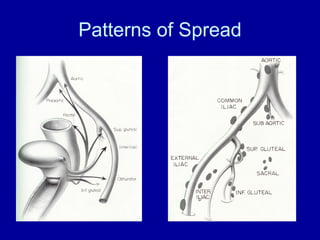
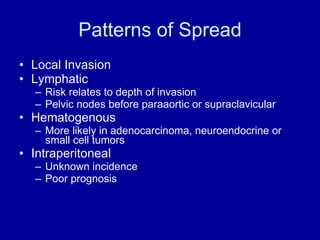
Patterns of Spread Local Invasion Lymphatic Risk relates to depth of invasion Pelvic nodes before paraaortic or supraclavicular Hematogenous More likely in adenocarcinoma, neuroendocrine or small cell tumors Intraperitoneal Unknown incidence Poor prognosis
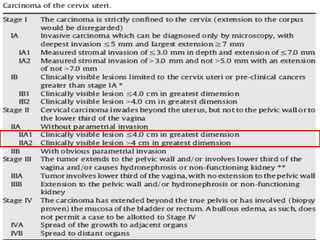
Cervical Cancer Staging   The International Federation of Gynecology and Obstetrics (FIGO) staging system is exclusively based on clinical evaluation This allows staging to occur in low resource settings
What are the symptoms of cervical cancer? Early stage disease:   Often no symptoms! Vaginal discharge Abnormal bleeding Post-coital bleeding Abnormal menses Post-menopausal bleeding Late stage disease: Pelvic or lower back pain Sciatica Weight loss Bowel or bladder fistula
How is cervical cancer staged? Physical exam Palpation and inspection of primary tumor Palpation of groin and supraclavicular lymph nodes Rectovaginal exam Exam under anesthesia Diagnostic exam(s) Chest X-ray Intravenous pyelogram (IVP) Procedures Conization Cystoscopy Proctosigmoidoscopy
 
Imaging Modalities  Prognosis- NOT Staging Computed Tomography (CT scan) Magnetic Resonance Imaging (MRI) May help define extent of disease in cervix and parametria Positron Emission Tomography (PET) Superior for detecting metastatic disease compared to CT or MRI Surgical “Staging”  The “gold standard” for lymph node evaluation
Stage Determines Treatment Early Stage (I-IB1 [IB2-IIa]) Primary Surgery Chemoradiation Locally Advanced(IB2-IVA) Primary Chemoradiation Disease with Distant Metastases (IVB) Systemic chemotherapy
Treatment of Early Stage (I-IIA) SURGERY Pros Preserves ovarian function Opportunity for pathologic information Preferred for women at risk for irradiation complications  Cons Surgical morbidity and mortality Risk of general anesthesia Risk of bleeding/transfusion Possibility of long-term bowel and bladder problems Possible need for post-op XRT RADIATION THERAPY Pros Avoids risks of surgical morbidity, blood loss/transfusion, general anesthesia Allows for outpatient treatment Cons Permanent ovarian failure Vaginal shortening and fibrosis Possibility of long-term bowel and bladder problems Risk of bladder or bowel fistula, or rectal stricture
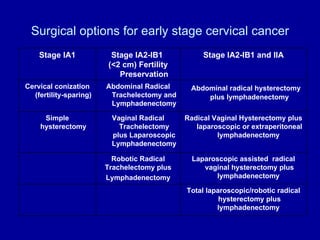
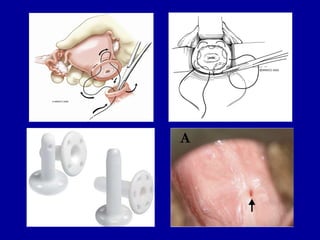
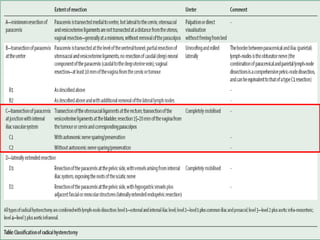
Surgical options for early stage cervical cancer Stage IA1 Stage IA2-IB1  (<2 cm) Fertility Preservation Stage IA2-IB1 and IIA Cervical conization (fertility-sparing) Abdominal Radical Trachelectomy and Lymphadenectomy Abdominal radical hysterectomy plus lymphadenectomy Simple hysterectomy Vaginal Radical Trachelectomy plus Laparoscopic Lymphadenectomy Radical Vaginal Hysterectomy plus laparoscopic or extraperitoneal lymphadenectomy  Robotic Radical Trachelectomy plus Lymphadenectomy Laparoscopic assisted  radical vaginal hysterectomy plus lymphadenectomy  Total laparoscopic/robotic radical hysterectomy plus lymphadenectomy
Fertility Preserving Surgery
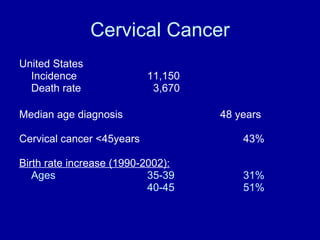
Cervical Cancer United States Incidence 11,150 Death rate       3,670 Median age diagnosis   48 years Cervical cancer <45years  43% Birth rate increase (1990-2002): Ages 35-39 31% 40-45 51%
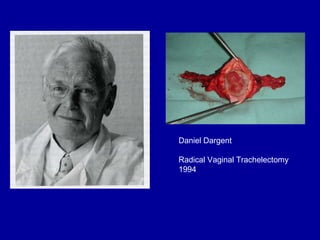
Daniel Dargent Radical Vaginal Trachelectomy 1994
 
 
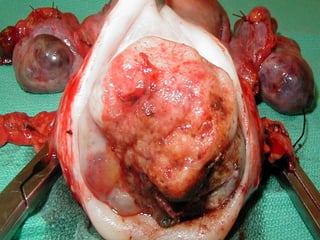
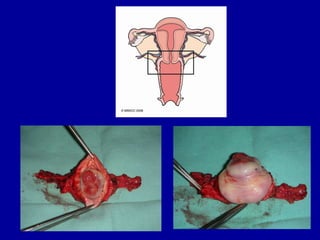
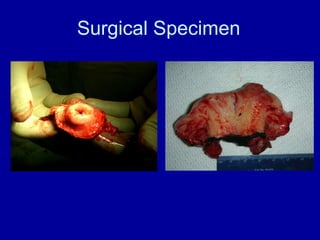
Surgical Specimen
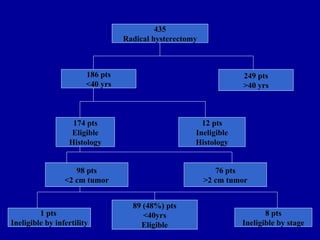
Cervical Cancer Candidates for Radical Trachelectomy MSKCC 1985-2001 (N=435) Criteria for eligibility: Confirmed cervical cancer Stage IA1 with LVSI, IA2-IB1 Lesion <2 cm No evidence of metastases Limited endocervical involvement Cervical length >2cm Post conization 4-6 weeks BMI < 35kg/m2 Desire for future fertility No evidence of impaired fertility Sonoda Y Gynecol Oncol 2004;95:534-538
435 Radical hysterectomy 186 pts <40 yrs 249 pts >40 yrs 174 pts Eligible Histology 12 pts Ineligible Histology 98 pts <2 cm tumor 76 pts >2 cm tumor 8 pts Ineligible by stage 89 (48%) pts <40yrs Eligible 1 pts  Ineligible by infertility
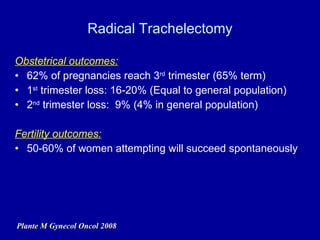
Radical Trachelectomy Obstetrical outcomes: 62% of pregnancies reach 3 rd  trimester (65% term) 1 st  trimester loss: 16-20% (Equal to general population) 2 nd  trimester loss:  9% (4% in general population) Fertility outcomes: 50-60% of women attempting will succeed spontaneously Plante M Gynecol Oncol 2008
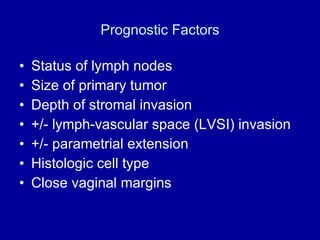
Prognostic Factors  Status of lymph nodes Size of primary tumor Depth of stromal invasion +/- lymph-vascular space (LVSI) invasion +/- parametrial extension Histologic cell type Close vaginal margins
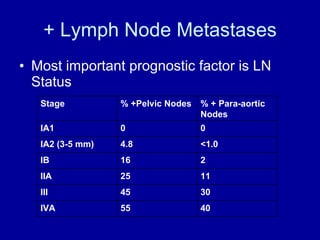
+ Lymph Node Metastases Most important prognostic factor is LN Status Stage % +Pelvic Nodes % + Para-aortic Nodes IA1 0 0 IA2 (3-5 mm) 4.8 <1.0 IB 16 2 IIA 25 11 III 45 30 IVA 55 40
 
 
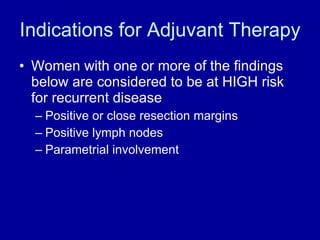
Indications for Adjuvant Therapy Women with one or more of the findings below are considered to be at HIGH risk for recurrent disease Positive or close resection margins Positive lymph nodes Parametrial involvement
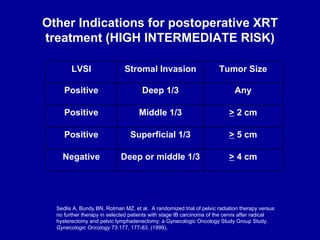
Sedlis A, Bundy BN, Rotman MZ, et al.  A randomized trial of pelvic radiation therapy versus no further therapy in selected patients with stage IB carcinoma of the cervix after radical hysterectomy and pelvic lymphadenectomy: a Gynecologic Oncology Study Group Study.  Gynecologic Oncology  73:177,  177-83, (1999),  Other Indications for postoperative XRT treatment (HIGH INTERMEDIATE RISK) LVSI Stromal Invasion Tumor Size Positive Deep 1/3 Any Positive Middle 1/3 >  2 cm Positive Superficial 1/3 >  5 cm Negative Deep or middle 1/3 >  4 cm
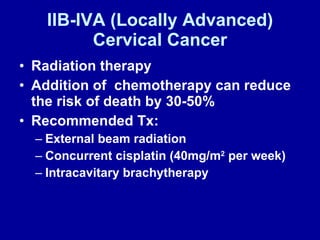
IIB-IVA (Locally Advanced) Cervical Cancer Radiation therapy  Addition of  chemotherapy can reduce the risk of death by 30-50% Recommended Tx: External beam radiation  Concurrent cisplatin (40mg/m 2  per week) Intracavitary brachytherapy
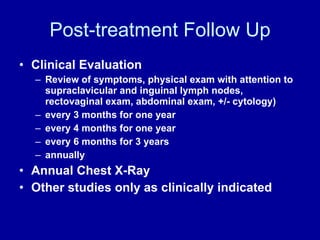
Post-treatment Follow Up Clinical Evaluation  Review of symptoms, physical exam with attention to supraclavicular and inguinal lymph nodes, rectovaginal exam, abdominal exam, +/- cytology) every 3 months for one year every 4 months for one year every 6 months for 3 years annually Annual Chest X-Ray Other studies only as clinically indicated
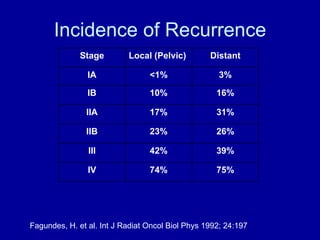
Incidence of Recurrence Fagundes, H. et al. Int J Radiat Oncol Biol Phys 1992; 24:197 Stage Local (Pelvic)  Distant IA <1% 3% IB 10% 16% IIA 17% 31% IIB 23% 26% III 42% 39% IV 74% 75%
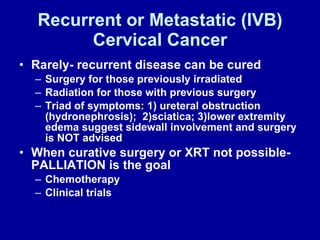
Recurrent or Metastatic (IVB) Cervical Cancer Rarely- recurrent disease can be cured Surgery for those previously irradiated Radiation for those with previous surgery Triad of symptoms: 1) ureteral obstruction (hydronephrosis);  2)sciatica; 3)lower extremity edema suggest sidewall involvement and surgery is NOT advised When curative surgery or XRT not possible- PALLIATION is the goal Chemotherapy Clinical trials
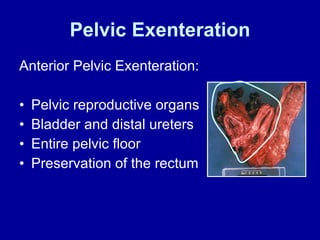
Pelvic Exenteration Anterior Pelvic Exenteration: Pelvic reproductive organs Bladder and distal ureters Entire pelvic floor Preservation of the rectum
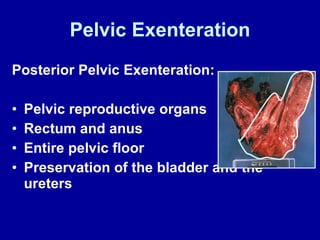
Pelvic Exenteration Posterior Pelvic Exenteration: Pelvic reproductive organs Rectum and anus Entire pelvic floor Preservation of the bladder and the ureters
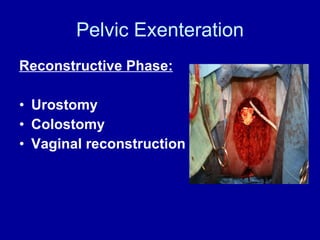
Pelvic Exenteration Reconstructive Phase: Urostomy Colostomy Vaginal reconstruction
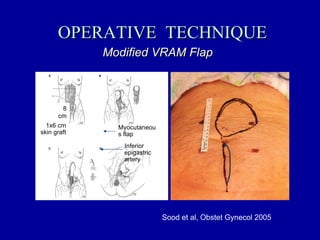
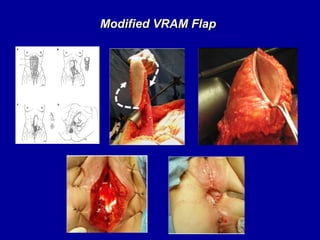
OPERATIVE  TECHNIQUE Modified VRAM Flap Sood et al, Obstet Gynecol 2005 8 cm 1x6 cm skin graft Inferior epigastric artery Myocutaneous flap
Modified VRAM Flap
Prognosis in Recurrent Disease 80% of recurrences occur within 2 years of primary  Depends on site of recurrence and ability to pursue potentially curative therapy Overall, poor prognosis if curative therapy not possible Favorable prognostic factors Localized, central pelvic recurrence Disease-free interval >6 months Size < 3cm No sidewall fixation
MD Anderson Cancer Center

Cervical Cancer

  • 1.
    Invasive Cervical CancerPedro T. Ramirez, M.D. Associate Professor Director of Minimally Invasive Research & Education Department of Gynecologic Oncology
  • 2.
    Epidemiology Worldwide, cervicalcancer is the second-leading cause of cancer mortality in women Among the ~500,000 new cases each year, ~75% occur in developing countries Cervical cytologic testing has reduced the incidence of cervical cancer by 70% in countries where it is easily available
  • 3.
    Cervical Cancer andHPV Human papillomavirus (HPV) is central to cervical carcinogenesis Worldwide, the prevalence of HPV in cervical tumors is 99.7% High-risk HPV types include 16, 18, 31 and 41 High-risk HPV infection is necessary but insufficient for cervical cancer
  • 4.
    Additional Risk FactorsEarly onset sexual activity Multiple sexual partners High-risk sexual partner History of a sexually transmitted infection Immunosupression Low socio-economic status Previous history of vulvar, vaginal or cervical squamous dysplasia
  • 5.
    Diagnosis of cervicalcancer Cervical cytology (Pap smear) - results may suggest invasive cancer Diagnosis must be confirmed by a biopsy When a tumor is clinically evident, a biopsy is usually sufficient If biopsy only shows intraepithelial disease or invasion is <3 mm, a cervical cone biopsy is indicated
  • 6.
  • 7.
    Histologic Subtypes Squamous-CellCarcinoma Keratinizing or Nonkeratinizing Verrucous Papillary transitional Lymphoepithelioma-like Adenocarcinoma Mucinous Endometrioid Clear Cell Serous Mesonephric Well differentiated villoglandular Minimal deviation (adenoma malignum) Other epithelial Adenosquamous Glassy Cell Carcinoid Tumor Neuroendocrine Small-cell Undifferentiated
  • 8.
  • 9.
    Patterns of SpreadLocal Invasion Lymphatic Risk relates to depth of invasion Pelvic nodes before paraaortic or supraclavicular Hematogenous More likely in adenocarcinoma, neuroendocrine or small cell tumors Intraperitoneal Unknown incidence Poor prognosis
  • 10.
    Cervical Cancer Staging The International Federation of Gynecology and Obstetrics (FIGO) staging system is exclusively based on clinical evaluation This allows staging to occur in low resource settings
  • 11.
    What are thesymptoms of cervical cancer? Early stage disease: Often no symptoms! Vaginal discharge Abnormal bleeding Post-coital bleeding Abnormal menses Post-menopausal bleeding Late stage disease: Pelvic or lower back pain Sciatica Weight loss Bowel or bladder fistula
  • 12.
    How is cervicalcancer staged? Physical exam Palpation and inspection of primary tumor Palpation of groin and supraclavicular lymph nodes Rectovaginal exam Exam under anesthesia Diagnostic exam(s) Chest X-ray Intravenous pyelogram (IVP) Procedures Conization Cystoscopy Proctosigmoidoscopy
  • 13.
  • 14.
    Imaging Modalities Prognosis- NOT Staging Computed Tomography (CT scan) Magnetic Resonance Imaging (MRI) May help define extent of disease in cervix and parametria Positron Emission Tomography (PET) Superior for detecting metastatic disease compared to CT or MRI Surgical “Staging” The “gold standard” for lymph node evaluation
  • 15.
    Stage Determines TreatmentEarly Stage (I-IB1 [IB2-IIa]) Primary Surgery Chemoradiation Locally Advanced(IB2-IVA) Primary Chemoradiation Disease with Distant Metastases (IVB) Systemic chemotherapy
  • 16.
    Treatment of EarlyStage (I-IIA) SURGERY Pros Preserves ovarian function Opportunity for pathologic information Preferred for women at risk for irradiation complications Cons Surgical morbidity and mortality Risk of general anesthesia Risk of bleeding/transfusion Possibility of long-term bowel and bladder problems Possible need for post-op XRT RADIATION THERAPY Pros Avoids risks of surgical morbidity, blood loss/transfusion, general anesthesia Allows for outpatient treatment Cons Permanent ovarian failure Vaginal shortening and fibrosis Possibility of long-term bowel and bladder problems Risk of bladder or bowel fistula, or rectal stricture
  • 17.
    Surgical options forearly stage cervical cancer Stage IA1 Stage IA2-IB1 (<2 cm) Fertility Preservation Stage IA2-IB1 and IIA Cervical conization (fertility-sparing) Abdominal Radical Trachelectomy and Lymphadenectomy Abdominal radical hysterectomy plus lymphadenectomy Simple hysterectomy Vaginal Radical Trachelectomy plus Laparoscopic Lymphadenectomy Radical Vaginal Hysterectomy plus laparoscopic or extraperitoneal lymphadenectomy Robotic Radical Trachelectomy plus Lymphadenectomy Laparoscopic assisted radical vaginal hysterectomy plus lymphadenectomy Total laparoscopic/robotic radical hysterectomy plus lymphadenectomy
  • 18.
  • 19.
    Cervical Cancer UnitedStates Incidence 11,150 Death rate 3,670 Median age diagnosis 48 years Cervical cancer <45years 43% Birth rate increase (1990-2002): Ages 35-39 31% 40-45 51%
  • 20.
    Daniel Dargent RadicalVaginal Trachelectomy 1994
  • 21.
  • 22.
  • 23.
  • 24.
    Cervical Cancer Candidatesfor Radical Trachelectomy MSKCC 1985-2001 (N=435) Criteria for eligibility: Confirmed cervical cancer Stage IA1 with LVSI, IA2-IB1 Lesion <2 cm No evidence of metastases Limited endocervical involvement Cervical length >2cm Post conization 4-6 weeks BMI < 35kg/m2 Desire for future fertility No evidence of impaired fertility Sonoda Y Gynecol Oncol 2004;95:534-538
  • 25.
    435 Radical hysterectomy186 pts <40 yrs 249 pts >40 yrs 174 pts Eligible Histology 12 pts Ineligible Histology 98 pts <2 cm tumor 76 pts >2 cm tumor 8 pts Ineligible by stage 89 (48%) pts <40yrs Eligible 1 pts Ineligible by infertility
  • 26.
    Radical Trachelectomy Obstetricaloutcomes: 62% of pregnancies reach 3 rd trimester (65% term) 1 st trimester loss: 16-20% (Equal to general population) 2 nd trimester loss: 9% (4% in general population) Fertility outcomes: 50-60% of women attempting will succeed spontaneously Plante M Gynecol Oncol 2008
  • 27.
    Prognostic Factors Status of lymph nodes Size of primary tumor Depth of stromal invasion +/- lymph-vascular space (LVSI) invasion +/- parametrial extension Histologic cell type Close vaginal margins
  • 28.
    + Lymph NodeMetastases Most important prognostic factor is LN Status Stage % +Pelvic Nodes % + Para-aortic Nodes IA1 0 0 IA2 (3-5 mm) 4.8 <1.0 IB 16 2 IIA 25 11 III 45 30 IVA 55 40
  • 29.
  • 30.
  • 31.
    Indications for AdjuvantTherapy Women with one or more of the findings below are considered to be at HIGH risk for recurrent disease Positive or close resection margins Positive lymph nodes Parametrial involvement
  • 32.
    Sedlis A, BundyBN, Rotman MZ, et al. A randomized trial of pelvic radiation therapy versus no further therapy in selected patients with stage IB carcinoma of the cervix after radical hysterectomy and pelvic lymphadenectomy: a Gynecologic Oncology Study Group Study. Gynecologic Oncology 73:177, 177-83, (1999), Other Indications for postoperative XRT treatment (HIGH INTERMEDIATE RISK) LVSI Stromal Invasion Tumor Size Positive Deep 1/3 Any Positive Middle 1/3 > 2 cm Positive Superficial 1/3 > 5 cm Negative Deep or middle 1/3 > 4 cm
  • 33.
    IIB-IVA (Locally Advanced)Cervical Cancer Radiation therapy Addition of chemotherapy can reduce the risk of death by 30-50% Recommended Tx: External beam radiation Concurrent cisplatin (40mg/m 2 per week) Intracavitary brachytherapy
  • 34.
    Post-treatment Follow UpClinical Evaluation Review of symptoms, physical exam with attention to supraclavicular and inguinal lymph nodes, rectovaginal exam, abdominal exam, +/- cytology) every 3 months for one year every 4 months for one year every 6 months for 3 years annually Annual Chest X-Ray Other studies only as clinically indicated
  • 35.
    Incidence of RecurrenceFagundes, H. et al. Int J Radiat Oncol Biol Phys 1992; 24:197 Stage Local (Pelvic) Distant IA <1% 3% IB 10% 16% IIA 17% 31% IIB 23% 26% III 42% 39% IV 74% 75%
  • 36.
    Recurrent or Metastatic(IVB) Cervical Cancer Rarely- recurrent disease can be cured Surgery for those previously irradiated Radiation for those with previous surgery Triad of symptoms: 1) ureteral obstruction (hydronephrosis); 2)sciatica; 3)lower extremity edema suggest sidewall involvement and surgery is NOT advised When curative surgery or XRT not possible- PALLIATION is the goal Chemotherapy Clinical trials
  • 37.
    Pelvic Exenteration AnteriorPelvic Exenteration: Pelvic reproductive organs Bladder and distal ureters Entire pelvic floor Preservation of the rectum
  • 38.
    Pelvic Exenteration PosteriorPelvic Exenteration: Pelvic reproductive organs Rectum and anus Entire pelvic floor Preservation of the bladder and the ureters
  • 39.
    Pelvic Exenteration ReconstructivePhase: Urostomy Colostomy Vaginal reconstruction
  • 40.
    OPERATIVE TECHNIQUEModified VRAM Flap Sood et al, Obstet Gynecol 2005 8 cm 1x6 cm skin graft Inferior epigastric artery Myocutaneous flap
  • 41.
  • 42.
    Prognosis in RecurrentDisease 80% of recurrences occur within 2 years of primary Depends on site of recurrence and ability to pursue potentially curative therapy Overall, poor prognosis if curative therapy not possible Favorable prognostic factors Localized, central pelvic recurrence Disease-free interval >6 months Size < 3cm No sidewall fixation
  • 43.

Editor's Notes

  • #4 It is now accepted that infection with the human papillomavirus (HPV) is central to cervical carcinogenesis. Worldwide, the prevalence of HPV in cervical tumors is 99.7%.
  • #5 Additional epidemiologic risk factors for cervical cancer include early onset of sexual activity, multiple sexual partners, and a high-risk sexual partner, history of a sexually transmitted infection, smoking, immunosuppression, low socioeconomic status and previous history of vulvar, vaginal or cervical squamous dysplasia.
  • #13 Physical exam is crucial for determining extent of disease. FIGO guidelines allow palpation and inspection of the primary tumor, palpation of the groin and supraclavicular lymph nodes. Careful rectovaginal exam allows more thorough investigation of possible parametrial, cul-de-sac, or pelvic sidewall involvement. Exam under anesthesia can provide a more comfortable and thorough exam. Diagnostic exams such as radiographs of chest and skeleton, intravenous pylogram (IVP) studies may be utilized. Procedures such as conization, cystoscopy, and proctosigmoidoscopy are also acceptable diagnostic aids for staging.
  • #15 Critics to the FIGO staging state that important prognostic factors, such as lymph node involvement cannot be determined with allowable staging procedures.