

NURATIQAH BINTI M. HANAPIAH
 Cervical Cancer the Third Most Common Cancer Among Malaysian
Women (www.venusbuzz.com/.../cervical-cancer-the-third-most-comm)
 (www.mgcs.org.my)
 Expert-reviewed information summary about the treatment of
cervical cancer.
 Over the past few decades the number of women with cervical
cancer has decreased drastically in many countries, including
Germany. Yet this kind of cancer is still a life-threatening disease.
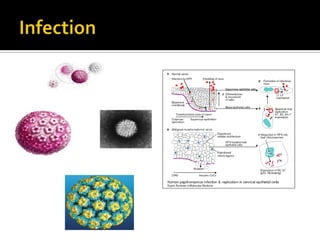
Human papillomavirus (HPV) infections play a critical role in the
development of cervical cancer.
 Almost all cervical cancers are caused by HPV
(human papilloma virus).
 HPV is a common virus that is spread through
sexual intercourse.
 There are many different types of HPV. Some
strains lead to cervical cancer.
 A woman's sexual habits and patterns can
increase her risk for cervical cancer.
 Risky sexual practices include having sex at
an early age, having multiple sexual partners,
and having multiple partners or partners who
participate in high-risk sexual activities
Risk factors for cervical cancer include:
 Not getting the HPV vaccine
 Poor economic status
 Women whose mothers took the drug DES
(diethylstilbestrol) during pregnancy in the early 1960s to
prevent miscarriage
 Weakened immune system
Symptoms that may occur can include:
 Abnormal vaginal bleeding between periods, after
intercourse, or after menopause
 Continuous vaginal discharge, which may be pale, watery,
pink, brown, bloody, or foul-smelling
 Periods become heavier and last longer than usual
Cervical cancer may spread to the bladder, intestines, lungs, and liver.
Symptoms of advanced cervical cancer may include:
•Back pain
•Bone pain or fractures
•Fatigue
•Leaking of urine or feces
from the vagina
•Leg pain
•Loss of appetite
•Pelvic pain
•Single swollen leg
•Weight loss
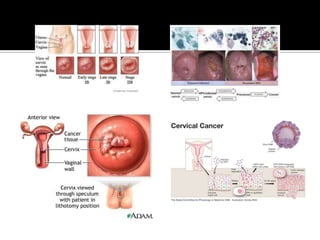
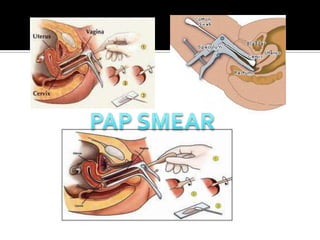
 Precancerous changes of the cervix and cervical cancer cannot be seen with the
naked eye. Special tests and tools are needed to spot such conditions.
 Pap smears screen for precancers and cancer, but do not make a final diagnosis.
 If abnormal changes are found, the cervix is usually examined under
magnification.This is called colposcopy Pieces of tissue are surgically removed
(biopsied) during this procedure and sent to a laboratory for examination.
 Cone biopsy may also be done.
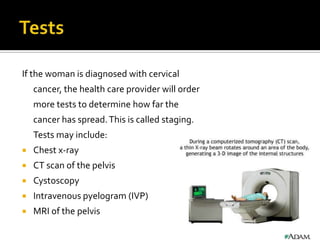
If the woman is diagnosed with cervical
cancer, the health care provider will order
more tests to determine how far the
cancer has spread.This is called staging.
Tests may include:
 Chest x-ray
 CT scan of the pelvis
 Cystoscopy
 Intravenous pyelogram (IVP)
 MRI of the pelvis
Treatment of cervical cancer depends on:
 The stage of the cancer
 The size and shape of the tumor
 The woman's age and general health
 Her desire to have children in the future
Types of surgery for early cervical cancer
include:
 Loop electrosurgical excision procedure (LEEP) -- uses electricity to
remove abnormal tissue
 Cryotherapy -- freezes abnormal cells
 Laser therapy -- uses light to burn abnormal tissue
 A hysterectomy (removal of the uterus but not the ovaries) is not often
performed for cervical cancer that has not spread. It may be done in
women who have repeated LEEP procedures.
Treatment for more advanced cervical cancer
may include:
 Radical hysterectomy, which removes the uterus and much
of the surrounding tissues, including lymph nodes and the
upper part of the vagina.
 Pelvic exenteration, an extreme type of surgery in which all
of the organs of the pelvis, including the bladder and rectum,
are removed.
Radiation may be used to treat cancer that has spread
beyond the pelvis, or cancer that has returned.
Radiation therapy is either external or internal.
 Internal radiation therapy uses a device filled with radioactive
material, which is placed inside the woman's vagina next to the
cervical cancer.The device is removed when she goes home.
 External radiation therapy beams radiation from a large machine
onto the body where the cancer is located. It is similar to an x-ray.
Chemotherapy uses drugs to kill cancer.
Some of the drugs used for cervical cancer :
 chemotherapy include 5-FU, cisplatin, carboplatin,
ifosfamide, paclitaxel, and cyclophosphamide.
Sometimes radiation and chemotherapy are used
before or after surgery.
How well the patient does depends on many
things, including:
 The type of cancer
 The stage of the disease
 The woman's age and general physical condition
 If the cancer comes back after treatment
 Some types of cervical cancer do not respond
well to treatment.
 The cancer may come back (recur) after
treatment.
 Women who have treatment to save the
uterus have a high risk of the cancer coming
back (recurrence).
 Surgery and radiation can cause problems
with sexual, bowel, and bladder function
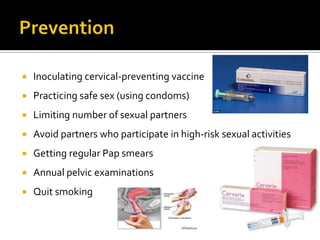
 Inoculating cervical-preventing vaccine
 Practicing safe sex (using condoms)
 Limiting number of sexual partners
 Avoid partners who participate in high-risk sexual activities
 Getting regular Pap smears
 Annual pelvic examinations
 Quit smoking
 Obstetrical and Gynaecological Society of
Malaysia
 NationalCancer Society Malaysia
 Noller KL. Intraepithelial neoplasia of the lower genital tract (cervix,
vulva): Etiology, screening, diagnostic techniques, management. In:
KatzVL, Lentz GM, Lobo RA, Gershenson DM, eds. Comprehensive
Gynecology. 5th ed. Philadelphia, Pa: Mosby Elsevier; 2007:chap 28.
 National Comprehensive Cancer Network. NCCN Practice Guidelines
in Oncology: Cervical Cancer Screening. v.1.2011.
 Smith RA, CokkinidesV, Brooks D, Saslow D, Brawley OW. Cancer
screening in the United States, 2010: a review of current American
Cancer Society guidelines and issues in cancer screening. CA Cancer J
Clin. 2010;60:99-119.

Cervical cancer

  • 1.
  • 2.
     Cervical Cancerthe Third Most Common Cancer Among Malaysian Women (www.venusbuzz.com/.../cervical-cancer-the-third-most-comm)  (www.mgcs.org.my)  Expert-reviewed information summary about the treatment of cervical cancer.  Over the past few decades the number of women with cervical cancer has decreased drastically in many countries, including Germany. Yet this kind of cancer is still a life-threatening disease. Human papillomavirus (HPV) infections play a critical role in the development of cervical cancer.
  • 5.
     Almost allcervical cancers are caused by HPV (human papilloma virus).  HPV is a common virus that is spread through sexual intercourse.  There are many different types of HPV. Some strains lead to cervical cancer.
  • 7.
     A woman'ssexual habits and patterns can increase her risk for cervical cancer.  Risky sexual practices include having sex at an early age, having multiple sexual partners, and having multiple partners or partners who participate in high-risk sexual activities
  • 8.
    Risk factors forcervical cancer include:  Not getting the HPV vaccine  Poor economic status  Women whose mothers took the drug DES (diethylstilbestrol) during pregnancy in the early 1960s to prevent miscarriage  Weakened immune system
  • 9.
    Symptoms that mayoccur can include:  Abnormal vaginal bleeding between periods, after intercourse, or after menopause  Continuous vaginal discharge, which may be pale, watery, pink, brown, bloody, or foul-smelling  Periods become heavier and last longer than usual
  • 10.
    Cervical cancer mayspread to the bladder, intestines, lungs, and liver. Symptoms of advanced cervical cancer may include: •Back pain •Bone pain or fractures •Fatigue •Leaking of urine or feces from the vagina •Leg pain •Loss of appetite •Pelvic pain •Single swollen leg •Weight loss
  • 11.
     Precancerous changesof the cervix and cervical cancer cannot be seen with the naked eye. Special tests and tools are needed to spot such conditions.  Pap smears screen for precancers and cancer, but do not make a final diagnosis.  If abnormal changes are found, the cervix is usually examined under magnification.This is called colposcopy Pieces of tissue are surgically removed (biopsied) during this procedure and sent to a laboratory for examination.  Cone biopsy may also be done.
  • 12.
    If the womanis diagnosed with cervical cancer, the health care provider will order more tests to determine how far the cancer has spread.This is called staging. Tests may include:  Chest x-ray  CT scan of the pelvis  Cystoscopy  Intravenous pyelogram (IVP)  MRI of the pelvis
  • 13.
    Treatment of cervicalcancer depends on:  The stage of the cancer  The size and shape of the tumor  The woman's age and general health  Her desire to have children in the future
  • 14.
    Types of surgeryfor early cervical cancer include:  Loop electrosurgical excision procedure (LEEP) -- uses electricity to remove abnormal tissue  Cryotherapy -- freezes abnormal cells  Laser therapy -- uses light to burn abnormal tissue  A hysterectomy (removal of the uterus but not the ovaries) is not often performed for cervical cancer that has not spread. It may be done in women who have repeated LEEP procedures.
  • 15.
    Treatment for moreadvanced cervical cancer may include:  Radical hysterectomy, which removes the uterus and much of the surrounding tissues, including lymph nodes and the upper part of the vagina.  Pelvic exenteration, an extreme type of surgery in which all of the organs of the pelvis, including the bladder and rectum, are removed.
  • 16.
    Radiation may beused to treat cancer that has spread beyond the pelvis, or cancer that has returned. Radiation therapy is either external or internal.  Internal radiation therapy uses a device filled with radioactive material, which is placed inside the woman's vagina next to the cervical cancer.The device is removed when she goes home.  External radiation therapy beams radiation from a large machine onto the body where the cancer is located. It is similar to an x-ray.
  • 17.
    Chemotherapy uses drugsto kill cancer. Some of the drugs used for cervical cancer :  chemotherapy include 5-FU, cisplatin, carboplatin, ifosfamide, paclitaxel, and cyclophosphamide. Sometimes radiation and chemotherapy are used before or after surgery.
  • 18.
    How well thepatient does depends on many things, including:  The type of cancer  The stage of the disease  The woman's age and general physical condition  If the cancer comes back after treatment
  • 19.
     Some typesof cervical cancer do not respond well to treatment.  The cancer may come back (recur) after treatment.  Women who have treatment to save the uterus have a high risk of the cancer coming back (recurrence).  Surgery and radiation can cause problems with sexual, bowel, and bladder function
  • 20.
     Inoculating cervical-preventingvaccine  Practicing safe sex (using condoms)  Limiting number of sexual partners  Avoid partners who participate in high-risk sexual activities  Getting regular Pap smears  Annual pelvic examinations  Quit smoking
  • 22.
     Obstetrical andGynaecological Society of Malaysia  NationalCancer Society Malaysia
  • 23.
     Noller KL.Intraepithelial neoplasia of the lower genital tract (cervix, vulva): Etiology, screening, diagnostic techniques, management. In: KatzVL, Lentz GM, Lobo RA, Gershenson DM, eds. Comprehensive Gynecology. 5th ed. Philadelphia, Pa: Mosby Elsevier; 2007:chap 28.  National Comprehensive Cancer Network. NCCN Practice Guidelines in Oncology: Cervical Cancer Screening. v.1.2011.  Smith RA, CokkinidesV, Brooks D, Saslow D, Brawley OW. Cancer screening in the United States, 2010: a review of current American Cancer Society guidelines and issues in cancer screening. CA Cancer J Clin. 2010;60:99-119.