CERAMIC MATERIALS:
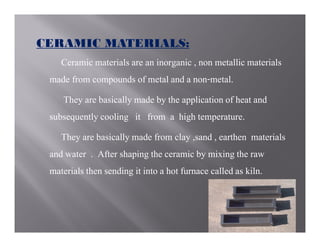
Ceramic materials are an inorganic , non metallic materials
made from compounds of metal and a non-metal.
They are basically made by the application of heat and
subsequently cooling it from a high temperature.
They are basicallymade from clay ,sand , earthen materials
and water . After shaping the ceramic by mixing the raw
materials then sending it into a hot furnace calledas kiln.
CLASSIFICATION OF CERAMIC MATERIALS :CLASSIFICATION OF CERAMIC MATERIALS :CLASSIFICATION OF CERAMIC MATERIALS :CLASSIFICATION OF CERAMIC MATERIALS :
Based on ApplicationsBased on ApplicationsBased on ApplicationsBased on Applications
CLASSIFICATION OF CERAMIC MATERIALS :CLASSIFICATION OF CERAMIC MATERIALS :CLASSIFICATION OF CERAMIC MATERIALS :CLASSIFICATION OF CERAMIC MATERIALS :
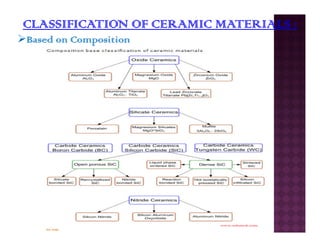
Based on CompositionBased on CompositionBased on CompositionBased on Composition
ALUMINUM OXIDE [Al2O3]
Aluminum oxide is the most widely applied ceramic type,
often used as electrical insulator and for wear-resistant
applications. The material is available in several grades.
PROPERTIES
•Electrical insulator
•Wear resistant
•Extremely heat resistant
•High stiffness , high purity.
•Melting point – 2050 *C.
•Density – 4.0 g/cm^3 .
•Strength – 455 Mpa .
•Co-efficient of thermal expansion – 8*10-6/*C .
•Thermal conductivity – 40 (W/mK) .
•Elastic modulus – 380 Gpa.
APPLICATIONS
•Machine components
•Machine and equipment
ZIRCONIUM OXIDE [ZrO2 ]
Of all types of ceramics, the properties of zirconium
oxide lie the closest to those of metals. The material is
less wear-resistant than e.g. silicon carbide or silicon
nitride. On the other hand: zirconium oxide is quite tough
and impact resistant
PROPERTIES
•Impact resistant .
•Low thermal conductor .
•High flexural strength .
•Toughness .
•Mechanically strong .
•Electrical insulators .
•Melting point – 2700 ºC.
•Density – 5.6 g/cm3 .
•Strength –175 Mpa.
•Co-efficient of thermal expansion – 10.5*10-6/ºc.
•Thermal conductivity – 19(W/mK).
•Elastic modulus – 140 Gpa.
APPLICATIONS
• Machine components
• Automotive
• Machine and equipment
SILICON NITRIDE [Si3N4]
Due to its crystal structure, silicon nitride is one of the
toughest ceramic materials. Furthermore it has a very
good thermal shock resistance and good tribiological
properties.
PROPERTIES
• High wear resistant
• Stiffness
• Chemical resistant
•Thermo shock resistant
• Electrical insulator or conductor
• Low expansion coefficient
•Melting point – 1900 *C.
•Density – 3.2g/cm^3 .
•Strength – 210 Mpa.
•Co-efficient of thermal expansion – 3.0*10-6/ºc
•Thermal conductivity – 17(W/mK).
•Elastic modulus – 175Gpa
APPLICATION
• Bearing
• Dosing
• Machine components
BORON NITRIDE [BN]
Boron nitride in the hexagonal crystal structure can be best
compared with graphite. Contrary to other types of ceramics,
this material is soft. Due to its high temperature resistance,
boron nitride is used often in the non-ferro industry.
PROPERTIES
•Good machinability
•Extremely heat resistant thermo shock resistant
•Electrical insulator
APPLICATION
•Lubricating
•Isolating
•Wear-resistant
•Positioning
SILICON CARBIDE [SIC]
Silicon carbide consists of the chemical elements silicon
(like in sand) and carbon, and is very hard. Due to the
good chemical resistance, silicon carbide can be applied
very well under extreme conditions.
PROPERTIES
•High stiffness
•High thermal conductor
•Chemical resistant
•Thermo shock resistant
•Low density
•Wear resistant
•Melting point – 2700 *C.
•Density – 3.2g/cm^3 .
•Strength – 140 Mpa.
•Co-efficient of thermal expansion – 4.3*10-6/º c
•Thermal conductivity – 50(W/mK).
•Elastic modulus – 210Gpa
APPLICATION
• Bearing
• Machine components
• Cutting tools
BORON CARBIDE [B4C]
Boron carbide is an extremely hard ceramic with a
low weight. This makes the material greatly useful
for ballistic applications.
PROPERTIES
•Hardness
•Wear resistant
•Lightweight
•Melting point – 2350 *C.
•Density – 2.5g/cm^3 .
•Strength – 350 Mpa.
•Co-efficient of thermal expansion – 4.3*10-6/ºcThermal
conductivity – 25(W/mK).
•Elastic modulus – 450Gpa
APPLICATION
• Nozzle
• Industrial knife
• Armor plate
• Powder
• Pump
• Machine and equipment
BORON CARBIDE
SILICATE CERAMICS
Silicate carbides materials are generally composed of silicon and
oxygen.
There are three types of silicate ceramics
1.Porcelain.
2.magnesium silicate.
3.Mullite.
PORCELAIN
It generally consists of silica(sio2) , alumina(al2o3)
The natural ingridients for these components are quartz, feldspar ,
soapstone , clay(kaolin).
PROPERTIES
High mechanical strength.
Excellent dielectric property.
High chemical resistant.
PRODUCTS
They are mainly used for electronic insulators.
MAGNESIUM SILICATES
They are made from silica(sio2), magnesia(mgo), and some
alumina(al2o3).
The natural ingridients are soapstone , clay , corundum , mullite.
PROPERTIES
High mechanical strength.
Good di electric property. (talc)
Very low loss factor.
PRODUCTS
Steatite are used in heat engineering and in electrical engineering
for manufacturing of sockets , control housings, insulating beads,
power fuses and base plates .
MULLITE
They are basically made up of mullite(3AlO3+2SiO2) , alumina
(Al2O3) , and glass(SiO2).
PROPERTIES
High strength.
High thermal shock resistant.
Relatively low thermal expansion.
Good creep resistant.
PRODUCTS
Used for high temperature parts , kiln furnace , slide gates , ladles for
molten metals , protection tubes for thermo couples , glass industry
refractories.
www.wikipedia.com
www.substech.com
ceramics by wiley.
http//www.elantechnology.com
world wide ceramic dictionary.
www.ceratech.com.
www.engineeringtools.com
  Ceramic materaials

Ceramic materaials

  • 2.
    CERAMIC MATERIALS: Ceramic materialsare an inorganic , non metallic materials made from compounds of metal and a non-metal. They are basically made by the application of heat and subsequently cooling it from a high temperature. They are basicallymade from clay ,sand , earthen materials and water . After shaping the ceramic by mixing the raw materials then sending it into a hot furnace calledas kiln.
  • 3.
    CLASSIFICATION OF CERAMICMATERIALS :CLASSIFICATION OF CERAMIC MATERIALS :CLASSIFICATION OF CERAMIC MATERIALS :CLASSIFICATION OF CERAMIC MATERIALS : Based on ApplicationsBased on ApplicationsBased on ApplicationsBased on Applications
  • 4.
    CLASSIFICATION OF CERAMICMATERIALS :CLASSIFICATION OF CERAMIC MATERIALS :CLASSIFICATION OF CERAMIC MATERIALS :CLASSIFICATION OF CERAMIC MATERIALS : Based on CompositionBased on CompositionBased on CompositionBased on Composition
  • 5.
    ALUMINUM OXIDE [Al2O3] Aluminumoxide is the most widely applied ceramic type, often used as electrical insulator and for wear-resistant applications. The material is available in several grades. PROPERTIES •Electrical insulator •Wear resistant •Extremely heat resistant •High stiffness , high purity. •Melting point – 2050 *C. •Density – 4.0 g/cm^3 . •Strength – 455 Mpa . •Co-efficient of thermal expansion – 8*10-6/*C . •Thermal conductivity – 40 (W/mK) . •Elastic modulus – 380 Gpa. APPLICATIONS •Machine components •Machine and equipment
  • 6.
    ZIRCONIUM OXIDE [ZrO2] Of all types of ceramics, the properties of zirconium oxide lie the closest to those of metals. The material is less wear-resistant than e.g. silicon carbide or silicon nitride. On the other hand: zirconium oxide is quite tough and impact resistant PROPERTIES •Impact resistant . •Low thermal conductor . •High flexural strength . •Toughness . •Mechanically strong . •Electrical insulators . •Melting point – 2700 ºC. •Density – 5.6 g/cm3 . •Strength –175 Mpa. •Co-efficient of thermal expansion – 10.5*10-6/ºc. •Thermal conductivity – 19(W/mK). •Elastic modulus – 140 Gpa.
  • 7.
    APPLICATIONS • Machine components •Automotive • Machine and equipment
  • 8.
    SILICON NITRIDE [Si3N4] Dueto its crystal structure, silicon nitride is one of the toughest ceramic materials. Furthermore it has a very good thermal shock resistance and good tribiological properties. PROPERTIES • High wear resistant • Stiffness • Chemical resistant •Thermo shock resistant • Electrical insulator or conductor • Low expansion coefficient •Melting point – 1900 *C. •Density – 3.2g/cm^3 . •Strength – 210 Mpa. •Co-efficient of thermal expansion – 3.0*10-6/ºc •Thermal conductivity – 17(W/mK). •Elastic modulus – 175Gpa
  • 9.
  • 10.
    BORON NITRIDE [BN] Boronnitride in the hexagonal crystal structure can be best compared with graphite. Contrary to other types of ceramics, this material is soft. Due to its high temperature resistance, boron nitride is used often in the non-ferro industry. PROPERTIES •Good machinability •Extremely heat resistant thermo shock resistant •Electrical insulator APPLICATION •Lubricating •Isolating •Wear-resistant •Positioning
  • 11.
    SILICON CARBIDE [SIC] Siliconcarbide consists of the chemical elements silicon (like in sand) and carbon, and is very hard. Due to the good chemical resistance, silicon carbide can be applied very well under extreme conditions. PROPERTIES •High stiffness •High thermal conductor •Chemical resistant •Thermo shock resistant •Low density •Wear resistant •Melting point – 2700 *C. •Density – 3.2g/cm^3 . •Strength – 140 Mpa. •Co-efficient of thermal expansion – 4.3*10-6/º c •Thermal conductivity – 50(W/mK). •Elastic modulus – 210Gpa
  • 12.
    APPLICATION • Bearing • Machinecomponents • Cutting tools
  • 13.
    BORON CARBIDE [B4C] Boroncarbide is an extremely hard ceramic with a low weight. This makes the material greatly useful for ballistic applications. PROPERTIES •Hardness •Wear resistant •Lightweight •Melting point – 2350 *C. •Density – 2.5g/cm^3 . •Strength – 350 Mpa. •Co-efficient of thermal expansion – 4.3*10-6/ºcThermal conductivity – 25(W/mK). •Elastic modulus – 450Gpa
  • 14.
    APPLICATION • Nozzle • Industrialknife • Armor plate • Powder • Pump • Machine and equipment BORON CARBIDE
  • 15.
    SILICATE CERAMICS Silicate carbidesmaterials are generally composed of silicon and oxygen. There are three types of silicate ceramics 1.Porcelain. 2.magnesium silicate. 3.Mullite. PORCELAIN It generally consists of silica(sio2) , alumina(al2o3) The natural ingridients for these components are quartz, feldspar , soapstone , clay(kaolin). PROPERTIES High mechanical strength. Excellent dielectric property. High chemical resistant.
  • 16.
    PRODUCTS They are mainlyused for electronic insulators. MAGNESIUM SILICATES They are made from silica(sio2), magnesia(mgo), and some alumina(al2o3). The natural ingridients are soapstone , clay , corundum , mullite. PROPERTIES High mechanical strength. Good di electric property. (talc) Very low loss factor. PRODUCTS Steatite are used in heat engineering and in electrical engineering for manufacturing of sockets , control housings, insulating beads, power fuses and base plates .
  • 17.
    MULLITE They are basicallymade up of mullite(3AlO3+2SiO2) , alumina (Al2O3) , and glass(SiO2). PROPERTIES High strength. High thermal shock resistant. Relatively low thermal expansion. Good creep resistant. PRODUCTS Used for high temperature parts , kiln furnace , slide gates , ladles for molten metals , protection tubes for thermo couples , glass industry refractories.
  • 18.
    www.wikipedia.com www.substech.com ceramics by wiley. http//www.elantechnology.com worldwide ceramic dictionary. www.ceratech.com. www.engineeringtools.com