Structural Ceramics
SUSHAN DESHMUKH
NIT WARANGAL
 Content
 Introduction
 Mechanical properties of Structural Ceramics
 Classification of Structural Ceramics
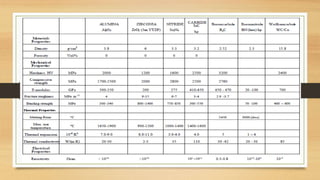
 General properties
 Processing techniques
 Area of Applications
 Summary
 INTRODUCTION
 As the name suggest, ceramics which serve as a structural member of the
device, often being under mechanical loading, are classified under structural
ceramics.
 The strong bond strength in these ceramics allow them to be employed in
several applications.
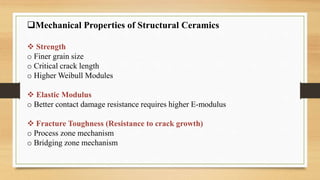
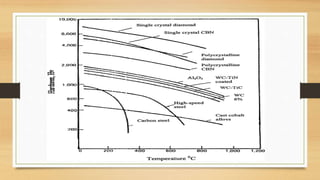
Mechanical Properties of Structural Ceramics
 Strength
o Finer grain size
o Critical crack length
o Higher Weibull Modules
 Elastic Modulus
o Better contact damage resistance requires higher E-modulus
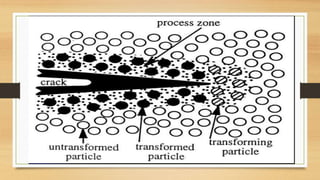
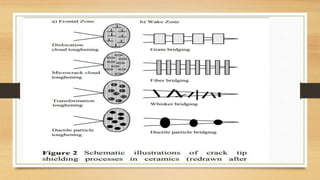
 Fracture Toughness (Resistance to crack growth)
o Process zone mechanism
o Bridging zone mechanism
 Classification of Structural Ceramics
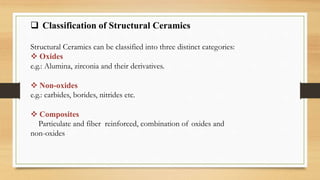
Structural Ceramics can be classified into three distinct categories:
 Oxides
e.g.: Alumina, zirconia and their derivatives.
 Non-oxides
e.g.: carbides, borides, nitrides etc.
 Composites
Particulate and fiber reinforced, combination of oxides and
non-oxides
 General Properties
 Oxide Ceramics
Oxidation resistant, thermally stable (alumina in particular),
chemically inert, electrically insulating, generally low thermal
conductivity, low cost particularly for alumina, even though zirconia
is relatively costly.
 Non-Oxide Ceramics
Low oxidation resistance, extreme hardness, chemically inert,
generally high thermal and electrically conductivity, energy intensive
and expensive manufacturing process. However, overall economics
come from their unique properties.
 Ceramic-Based Composites
Higher toughness particularly at high temperatures, variable
thermal and electrical conductivity, complex manufacturing
process and their high cost .
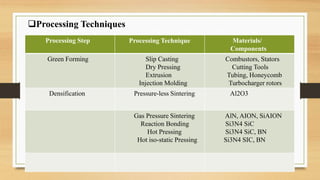
Processing Step Processing Technique Materials/
Components
Green Forming Slip Casting
Dry Pressing
Extrusion
Injection Molding
Combustors, Stators
Cutting Tools
Tubing, Honeycomb
Turbocharger rotors
Densification Pressure-less Sintering Al2O3
Gas Pressure Sintering
Reaction Bonding
Hot Pressing
Hot iso-static Pressing
AlN, AION, SiAION
Si3N4 SiC
Si3N4 SiC, BN
Si3N4 SIC, BN
Processing Techniques
 Areas of Application
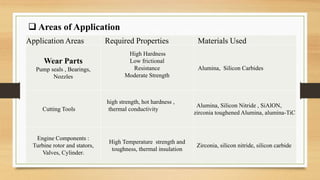
Application Areas Required Properties Materials Used
Wear Parts
Pump seals , Bearings,
Nozzles
High Hardness
Low frictional
Resistance
Moderate Strength
Alumina, Silicon Carbides
Cutting Tools
high strength, hot hardness ,
thermal conductivity
Alumina, Silicon Nitride , SiAlON,
zirconia toughened Alumina, alumina-TiC
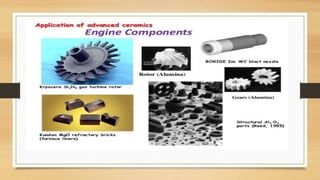
Engine Components :
Turbine rotor and stators,
Valves, Cylinder,
High Temperature strength and
toughness, thermal insulation
Zirconia, silicon nitride, silicon carbide
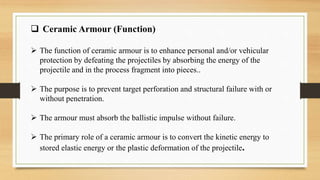
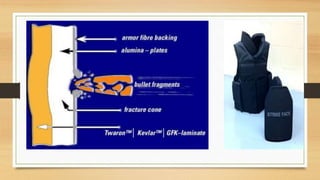
 Ceramic Armour (Function)
 The function of ceramic armour is to enhance personal and/or vehicular
protection by defeating the projectiles by absorbing the energy of the
projectile and in the process fragment into pieces..
 The purpose is to prevent target perforation and structural failure with or
without penetration.
 The armour must absorb the ballistic impulse without failure.
 The primary role of a ceramic armour is to convert the kinetic energy to
stored elastic energy or the plastic deformation of the projectile.
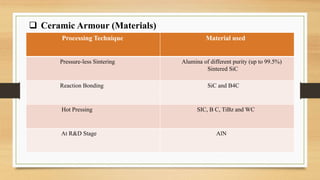
Processing Technique Material used
Pressure-less Sintering Alumina of different purity (up to 99.5%)
Sintered SiC
Reaction Bonding SiC and B4C
Hot Pressing SIC, B C, TiBz and WC
At R&D Stage AlN
 Ceramic Armour (Materials)
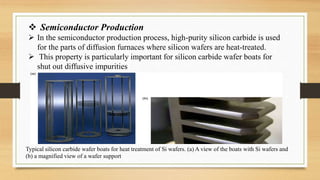
 Semiconductor Production
 In the semiconductor production process, high-purity silicon carbide is used
for the parts of diffusion furnaces where silicon wafers are heat-treated.
 This property is particularly important for silicon carbide wafer boats for
shut out diffusive impurities
Typical silicon carbide wafer boats for heat treatment of Si wafers. (a) A view of the boats with Si wafers and
(b) a magnified view of a wafer support
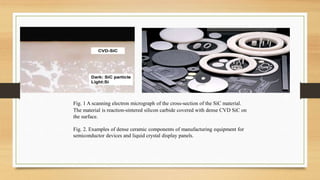
Fig. 1 A scanning electron micrograph of the cross-section of the SiC material.
The material is reaction-sintered silicon carbide covered with dense CVD SiC on
the surface.
Fig. 2. Examples of dense ceramic components of manufacturing equipment for
semiconductor devices and liquid crystal display panels.
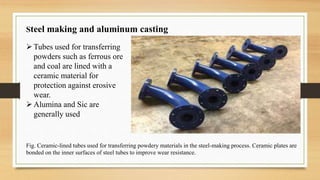
Steel making and aluminum casting
Fig. Ceramic-lined tubes used for transferring powdery materials in the steel-making process. Ceramic plates are
bonded on the inner surfaces of steel tubes to improve wear resistance.
Tubes used for transferring
powders such as ferrous ore
and coal are lined with a
ceramic material for
protection against erosive
wear.
Alumina and Sic are
generally used
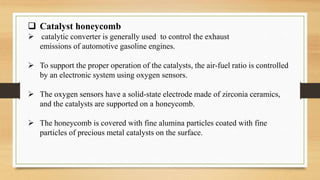
 Catalyst honeycomb
 catalytic converter is generally used to control the exhaust
emissions of automotive gasoline engines.
 To support the proper operation of the catalysts, the air-fuel ratio is controlled
by an electronic system using oxygen sensors.
 The oxygen sensors have a solid-state electrode made of zirconia ceramics,
and the catalysts are supported on a honeycomb.
 The honeycomb is covered with fine alumina particles coated with fine
particles of precious metal catalysts on the surface.
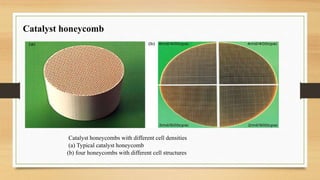
Catalyst honeycomb
Catalyst honeycombs with different cell densities
(a) Typical catalyst honeycomb
(b) four honeycombs with different cell structures
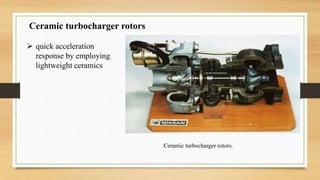
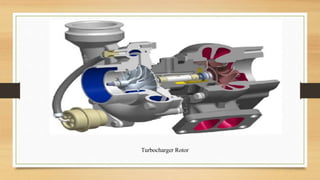
Ceramic turbocharger rotors.
Ceramic turbocharger rotors
 quick acceleration
response by employing
lightweight ceramics
Turbocharger Rotor
 Summary
 The market for structural ceramics has been steadily increasing
 High-purity alumina for the components of the equipment used in producing
semiconductor devices and liquid crystal display panels has contributed
substantially to the recent market for structural ceramics
 Extensive research on silicon nitride has led to new areas of application such
as ceramic bearings and ceramic springs.
 Recent successful applications of structural ceramics have been limited to
low levels of stress in severe environments. The next step for the application
of ceramics is thought to be uses in severe environments under higher
stresses.
 References
STRUCTURAL CERAMICS by HERBERT HERMAN, Department of
Materials Science and Engineering, State University of New York at Stony
Brook Stony Brook, New York ,1989
Advanced Structural Ceramics by Bikramjit Basu and Kantesh Balani
Department of Materials Science and Engineering Indian Institute of Technology
Kanpur, India, 2011
Akira Okada, Automotive and industrial applications of structural ceramics,
Journal of the European Ceramic Society 28 (2008) 1097–1104
Structural ceramics
Structural ceramics

Structural ceramics

  • 1.
  • 2.
     Content  Introduction Mechanical properties of Structural Ceramics  Classification of Structural Ceramics  General properties  Processing techniques  Area of Applications  Summary
  • 3.
     INTRODUCTION  Asthe name suggest, ceramics which serve as a structural member of the device, often being under mechanical loading, are classified under structural ceramics.  The strong bond strength in these ceramics allow them to be employed in several applications.
  • 4.
    Mechanical Properties ofStructural Ceramics  Strength o Finer grain size o Critical crack length o Higher Weibull Modules  Elastic Modulus o Better contact damage resistance requires higher E-modulus  Fracture Toughness (Resistance to crack growth) o Process zone mechanism o Bridging zone mechanism
  • 7.
     Classification ofStructural Ceramics Structural Ceramics can be classified into three distinct categories:  Oxides e.g.: Alumina, zirconia and their derivatives.  Non-oxides e.g.: carbides, borides, nitrides etc.  Composites Particulate and fiber reinforced, combination of oxides and non-oxides
  • 9.
     General Properties Oxide Ceramics Oxidation resistant, thermally stable (alumina in particular), chemically inert, electrically insulating, generally low thermal conductivity, low cost particularly for alumina, even though zirconia is relatively costly.  Non-Oxide Ceramics Low oxidation resistance, extreme hardness, chemically inert, generally high thermal and electrically conductivity, energy intensive and expensive manufacturing process. However, overall economics come from their unique properties.
  • 10.
     Ceramic-Based Composites Highertoughness particularly at high temperatures, variable thermal and electrical conductivity, complex manufacturing process and their high cost .
  • 15.
    Processing Step ProcessingTechnique Materials/ Components Green Forming Slip Casting Dry Pressing Extrusion Injection Molding Combustors, Stators Cutting Tools Tubing, Honeycomb Turbocharger rotors Densification Pressure-less Sintering Al2O3 Gas Pressure Sintering Reaction Bonding Hot Pressing Hot iso-static Pressing AlN, AION, SiAION Si3N4 SiC Si3N4 SiC, BN Si3N4 SIC, BN Processing Techniques
  • 16.
     Areas ofApplication Application Areas Required Properties Materials Used Wear Parts Pump seals , Bearings, Nozzles High Hardness Low frictional Resistance Moderate Strength Alumina, Silicon Carbides Cutting Tools high strength, hot hardness , thermal conductivity Alumina, Silicon Nitride , SiAlON, zirconia toughened Alumina, alumina-TiC Engine Components : Turbine rotor and stators, Valves, Cylinder, High Temperature strength and toughness, thermal insulation Zirconia, silicon nitride, silicon carbide
  • 17.
     Ceramic Armour(Function)  The function of ceramic armour is to enhance personal and/or vehicular protection by defeating the projectiles by absorbing the energy of the projectile and in the process fragment into pieces..  The purpose is to prevent target perforation and structural failure with or without penetration.  The armour must absorb the ballistic impulse without failure.  The primary role of a ceramic armour is to convert the kinetic energy to stored elastic energy or the plastic deformation of the projectile.
  • 19.
    Processing Technique Materialused Pressure-less Sintering Alumina of different purity (up to 99.5%) Sintered SiC Reaction Bonding SiC and B4C Hot Pressing SIC, B C, TiBz and WC At R&D Stage AlN  Ceramic Armour (Materials)
  • 20.
     Semiconductor Production In the semiconductor production process, high-purity silicon carbide is used for the parts of diffusion furnaces where silicon wafers are heat-treated.  This property is particularly important for silicon carbide wafer boats for shut out diffusive impurities Typical silicon carbide wafer boats for heat treatment of Si wafers. (a) A view of the boats with Si wafers and (b) a magnified view of a wafer support
  • 22.
    Fig. 1 Ascanning electron micrograph of the cross-section of the SiC material. The material is reaction-sintered silicon carbide covered with dense CVD SiC on the surface. Fig. 2. Examples of dense ceramic components of manufacturing equipment for semiconductor devices and liquid crystal display panels.
  • 23.
    Steel making andaluminum casting Fig. Ceramic-lined tubes used for transferring powdery materials in the steel-making process. Ceramic plates are bonded on the inner surfaces of steel tubes to improve wear resistance. Tubes used for transferring powders such as ferrous ore and coal are lined with a ceramic material for protection against erosive wear. Alumina and Sic are generally used
  • 24.
     Catalyst honeycomb catalytic converter is generally used to control the exhaust emissions of automotive gasoline engines.  To support the proper operation of the catalysts, the air-fuel ratio is controlled by an electronic system using oxygen sensors.  The oxygen sensors have a solid-state electrode made of zirconia ceramics, and the catalysts are supported on a honeycomb.  The honeycomb is covered with fine alumina particles coated with fine particles of precious metal catalysts on the surface.
  • 25.
    Catalyst honeycomb Catalyst honeycombswith different cell densities (a) Typical catalyst honeycomb (b) four honeycombs with different cell structures
  • 26.
    Ceramic turbocharger rotors. Ceramicturbocharger rotors  quick acceleration response by employing lightweight ceramics
  • 27.
  • 28.
     Summary  Themarket for structural ceramics has been steadily increasing  High-purity alumina for the components of the equipment used in producing semiconductor devices and liquid crystal display panels has contributed substantially to the recent market for structural ceramics  Extensive research on silicon nitride has led to new areas of application such as ceramic bearings and ceramic springs.  Recent successful applications of structural ceramics have been limited to low levels of stress in severe environments. The next step for the application of ceramics is thought to be uses in severe environments under higher stresses.
  • 29.
     References STRUCTURAL CERAMICSby HERBERT HERMAN, Department of Materials Science and Engineering, State University of New York at Stony Brook Stony Brook, New York ,1989 Advanced Structural Ceramics by Bikramjit Basu and Kantesh Balani Department of Materials Science and Engineering Indian Institute of Technology Kanpur, India, 2011 Akira Okada, Automotive and industrial applications of structural ceramics, Journal of the European Ceramic Society 28 (2008) 1097–1104