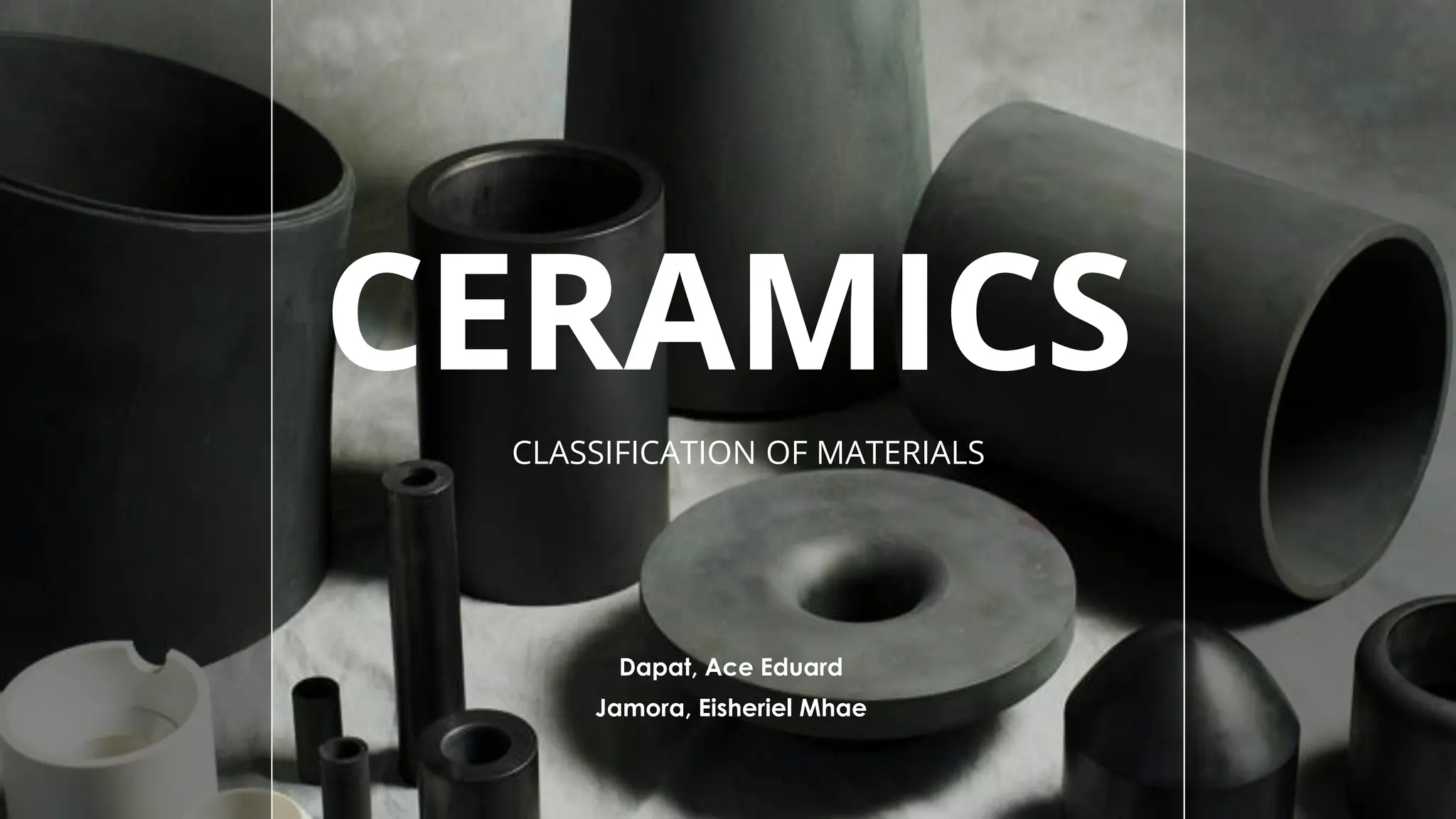
CERAMICS
Dapat, Ace Eduard
Jamora, Eisheriel Mhae
CLASSIFICATION OF MATERIALS
Ceramics
- from the Greek word keramos which means
‘potter’s clay’.
- compounds between metallic and nonmetallic
elements.
- Clay was one of the earliest materials used to
produce ceramics.
- they may be crystalline or partly crystalline.
- they are formed by the action of heat and
subsequent cooling.
LET’S GET STARTED
Download this
presentation as a
Powerpoint
template in 3 steps
— those composed of clay
minerals, such as porcelain
— cement and glass.
N
E
X
T
Traditional
Ceramics
Common Ceramic Materials
silicon dioxide (SiO2)
Silicon Carbide
(SiC)
N
E
X
T
Alumina
aluminum oxide (Al2O3)
Silica
Ceramic
Bonding
Crystal structures in ceramic materials are thought
of as being composed of ions rather than atoms.
In ionic bonding, a metal atom donates electrons,
and a nonmetal atom accepts electrons.
IONIC BONDING
N
E
X
T
HARDNESS
RIGIDITY
FRACTURE TOUGHNESS
COMPRESSIVE STRENGTH
MECHANICAL
PROPERTIES
N
E
X
T
TEMPERATURE STRENGTH
GRAIN SIZE
HARDNESS - Extremely hard. Nearly three times that of stainless steel.
They are hard because of their ordered structure.
N
E
X
T
RIGIDITY possess high rigidity, which is measured by inspecting the
elasticity of a specimen after applying a load.
FRACTURE
TOUGHNESS
Advanced ceramics are engineered to enhance toughness, the ability of a material to
resist fracture. These materials are used for cookware, cutlery, and even automobile
engine parts. Whereas traditional ceramics are highly susceptible to fracture.
N
E
X
T
COMPRESSIVE
STRENGTH
A measure of a material’s ability to resist compression. Ceramics are
typically hard and brittle. While their strength in compression is very
high, they are not suitable for loading in tension.
TEMPERATURE
STRENGTH
- Are typically insulative to the passage of heat and
electricity and are more resistant to high temperatures and
harsh environments than are metals and polymers
N
E
X
T
GRAIN SIZE
the microstructure is made up of
small crystals called grains. In
general, the smaller the grain size,
the stronger and denser is the
ceramic material.
THERMAL
PROPERTIES
N
E
X
T
THERMAL CONDUCTIVITY
THERMAL EXPANSION
SPECIFIC HEAT CAPACITY
THERMAL SHOCK RESISTANCE
THERMAL
CONDUCTIVITY
Thermal conductivity measures how well a material spreads heat within itself.
Technical ceramics are extraordinarily versatile, exhibiting a wide range of
thermal conductivity.
It defines how much a material expands or contracts
based on external temperatures. Ceramics generally
have a low coefficient due to their strong interatomic
bonds, making them more stable across wide
temperature ranges.
THERMAL
EXPANSION
Specific heat measures how easy or difficult it is to raise the
temperature of a product. Most of the ceramic materials have low
specific heat capacities in comparison with concrete or molten salts.
Thermal shock resistance measures the ability to withstand
dramatic and sharp temperature changes. Many technical
ceramic formulations display high thermal shock resistance,
meaning they minimally expand or contract during extreme
or rapid temperature changes.
N
E
X
T
SPECIFIC HEAT
CAPACITY
THERMAL SHOCK
CERAMIC
PROPERTIES
High hardness
N
E
X
T
High melting point
Heat resistant
High compressive
strength
Good electrical
insulation
Low ductility
Brittleness
Non-magnetic
Low thermal
shock resistance
Low thermal
expansion
APPLICATIONS
N
E
X
T
Spectrum of Ceramic Uses
CLASSIFICATION OF CERAMICS
CERAMIC MATERIAL
ABRASIVES
GLASSES
N
E
X
T
CLAY
PRODUCTS
REFRACTORIES CEMENTS
ADVANCED
CERAMICS
- optical
- composite
reinforce
- Containers/
household
- Whiteware
- structural
bricks for high
temperature
- sandpaper
- cutting
- polishing
- composites
- structural
- engine,
rotor,
valves,
bearings
- sensors
GLASSES
Glass ceramic materials have the same
chemical compositions as glasses but
differ from them in that they are
typically 95-98% crystalline by volume.
Furthermore, due to their crystallinity
and network of grain boundaries, they
are no longer transparent.
N
E
X
T
- Optical, composite reinforce, Containers/household
CLAY
PRODUCTS
Typical structural clay products are building brick,
terra-cotta facing tile, roofing tile, and drainage
pipe. They display such essential properties as
load-bearing strength, resistance to wear and
chemical attack.
N
E
X
T
Any of a broad class of ceramic products that are
white in appearance and frequently contain a
significant vitreous, or glassy component.
- Whiteware, structural
REFRACTORIES
Firebrick for furnaces and ovens. They
have high sililcon or aluminum oxide
content.
They are used to provide thermal
protection of other materials in very
high temperature applications.
N
E
X
T
- bricks for high temperature
ABRASIVES
Abrasive ceramics are used to wear, grind, or cut
away other materials, which necessarily are
softer.
Ceramic abrasives are some of the strongest and
sharpest abrasives currently on the market.
Ceramic sandpaper and other abrasives are
strong enough to cut and grind most metal
surfaces such as carbon steel, aerospace alloys,
titanium alloy, aluminum, ferrous metals, and
nonferrous metals.
N
E
X
T
- - Sandpaper, cutting, polishing
CEMENT
Another class of ceramics that are produced
and consumed in large commercial volumes
are the inorganics cements.
Cements are materials that form a paste
when mixed with water, which then sets and
hardens due to hydration reactions.
Tying bricks into walls is typically done with
cement-based mortar, which is also
composed of ceramic material.
N
E
X
T
- - Composites, structural
ADVANCED
CERAMICS
• Structural – applied as thermal barrier
coatings to protect metal structures, wear
parts, and integral components of engine.
• Electrical – capacitors, insulators,
integrated circuit packages, and
superconductors.
• Coatings – engine components, cutting
tools, and industrial wear parts.
• Chemical and environmental – filters,
membranes, and catalysts.
N
E
X
T
- - engine, rotor, valves, bearings, sensors
PRODUCTION
N
E
X
T
STAGES OF CERAMICS PROCESSING
The raw materials are prepared for ceramics processing
through a number of different techniques. This stage is
designed to separate the raw materials from any impurities
that may exist and to prepare them for better mixing and
forming.
1. MILLING
N
E
X
T
2. SIZING
During this step, the materials that have undergone the milling
and procurement process must be sized to separate desirable
material from non-usable material. By controlling the particle
size, the result will give you proper bonding and a smooth
surface on the finished product.
STAGES OF CERAMICS PROCESSING
This process can also be known as “blending” which calculates
amounts, weighing, and initial blending of the raw materials. For
consistent material flow into a pub mill hopper, vibratory feeders
can be applied in the process.
3. BATCHING
N
E
X
T
4. MIXING
To obtain a more chemically and physically homogeneous material
prior to forming, the constituents of the ceramic powder are
combined using the method of mixing or blunging.
STAGES OF CERAMICS PROCESSING
For this step, materials such as dry powders, pastes, or slurries are
consolidated and molded to produce a cohesive body for the desired
product. In the particular case of dry forming, vibratory compaction can be
used to achieve the desired shape.
5. FORMING
N
E
X
T
Slip Casting Dry Pressing
STAGES OF CERAMICS PROCESSING
For this step, materials such as dry powders, pastes, or slurries are
consolidated and molded to produce a cohesive body for the desired
product. In the particular case of dry forming, vibratory compaction can be
used to achieve the desired shape.
5. FORMING
N
E
X
T
6. DRYING
The formed materials hold water and binder in their mix that can cause
shrinkage, warping, or distortion of the product. Generally, convection drying
is the most commonly used method in which heated air is circulated around
the ceramic piece that alleviates the risk of such imperfections in the final
product.
STAGES OF CERAMICS PROCESSING
After being formed and left to dry, the ceramic materials are then glazed.
Each glaze has different properties that will help to determine the finish of
the final product. In ceramic manufacturing, glazing is usually done with
spray. I
7. GLAZING
N
E
X
T
8. FIRING
Also known as sintering or densification, the ceramics pass through a
controlled heat process where the oxides are consolidated into a dense,
cohesive body made up of uniform grain.
THANK YOU!
N
E
X
T

CERAMICS Property and Characteristics for Material Science

  • 1.
    CERAMICS Dapat, Ace Eduard Jamora,Eisheriel Mhae CLASSIFICATION OF MATERIALS
  • 2.
    Ceramics - from theGreek word keramos which means ‘potter’s clay’. - compounds between metallic and nonmetallic elements. - Clay was one of the earliest materials used to produce ceramics. - they may be crystalline or partly crystalline. - they are formed by the action of heat and subsequent cooling. LET’S GET STARTED
  • 3.
    Download this presentation asa Powerpoint template in 3 steps — those composed of clay minerals, such as porcelain — cement and glass. N E X T Traditional Ceramics
  • 4.
    Common Ceramic Materials silicondioxide (SiO2) Silicon Carbide (SiC) N E X T Alumina aluminum oxide (Al2O3) Silica
  • 5.
    Ceramic Bonding Crystal structures inceramic materials are thought of as being composed of ions rather than atoms. In ionic bonding, a metal atom donates electrons, and a nonmetal atom accepts electrons. IONIC BONDING N E X T
  • 6.
  • 7.
    HARDNESS - Extremelyhard. Nearly three times that of stainless steel. They are hard because of their ordered structure. N E X T RIGIDITY possess high rigidity, which is measured by inspecting the elasticity of a specimen after applying a load.
  • 8.
    FRACTURE TOUGHNESS Advanced ceramics areengineered to enhance toughness, the ability of a material to resist fracture. These materials are used for cookware, cutlery, and even automobile engine parts. Whereas traditional ceramics are highly susceptible to fracture. N E X T COMPRESSIVE STRENGTH A measure of a material’s ability to resist compression. Ceramics are typically hard and brittle. While their strength in compression is very high, they are not suitable for loading in tension.
  • 9.
    TEMPERATURE STRENGTH - Are typicallyinsulative to the passage of heat and electricity and are more resistant to high temperatures and harsh environments than are metals and polymers N E X T GRAIN SIZE the microstructure is made up of small crystals called grains. In general, the smaller the grain size, the stronger and denser is the ceramic material.
  • 10.
  • 11.
    THERMAL CONDUCTIVITY Thermal conductivity measureshow well a material spreads heat within itself. Technical ceramics are extraordinarily versatile, exhibiting a wide range of thermal conductivity. It defines how much a material expands or contracts based on external temperatures. Ceramics generally have a low coefficient due to their strong interatomic bonds, making them more stable across wide temperature ranges. THERMAL EXPANSION
  • 12.
    Specific heat measureshow easy or difficult it is to raise the temperature of a product. Most of the ceramic materials have low specific heat capacities in comparison with concrete or molten salts. Thermal shock resistance measures the ability to withstand dramatic and sharp temperature changes. Many technical ceramic formulations display high thermal shock resistance, meaning they minimally expand or contract during extreme or rapid temperature changes. N E X T SPECIFIC HEAT CAPACITY THERMAL SHOCK
  • 13.
    CERAMIC PROPERTIES High hardness N E X T High meltingpoint Heat resistant High compressive strength Good electrical insulation Low ductility Brittleness Non-magnetic Low thermal shock resistance Low thermal expansion
  • 14.
  • 15.
  • 16.
    CLASSIFICATION OF CERAMICS CERAMICMATERIAL ABRASIVES GLASSES N E X T CLAY PRODUCTS REFRACTORIES CEMENTS ADVANCED CERAMICS - optical - composite reinforce - Containers/ household - Whiteware - structural bricks for high temperature - sandpaper - cutting - polishing - composites - structural - engine, rotor, valves, bearings - sensors
  • 17.
    GLASSES Glass ceramic materialshave the same chemical compositions as glasses but differ from them in that they are typically 95-98% crystalline by volume. Furthermore, due to their crystallinity and network of grain boundaries, they are no longer transparent. N E X T - Optical, composite reinforce, Containers/household
  • 18.
    CLAY PRODUCTS Typical structural clayproducts are building brick, terra-cotta facing tile, roofing tile, and drainage pipe. They display such essential properties as load-bearing strength, resistance to wear and chemical attack. N E X T Any of a broad class of ceramic products that are white in appearance and frequently contain a significant vitreous, or glassy component. - Whiteware, structural
  • 19.
    REFRACTORIES Firebrick for furnacesand ovens. They have high sililcon or aluminum oxide content. They are used to provide thermal protection of other materials in very high temperature applications. N E X T - bricks for high temperature
  • 20.
    ABRASIVES Abrasive ceramics areused to wear, grind, or cut away other materials, which necessarily are softer. Ceramic abrasives are some of the strongest and sharpest abrasives currently on the market. Ceramic sandpaper and other abrasives are strong enough to cut and grind most metal surfaces such as carbon steel, aerospace alloys, titanium alloy, aluminum, ferrous metals, and nonferrous metals. N E X T - - Sandpaper, cutting, polishing
  • 21.
    CEMENT Another class ofceramics that are produced and consumed in large commercial volumes are the inorganics cements. Cements are materials that form a paste when mixed with water, which then sets and hardens due to hydration reactions. Tying bricks into walls is typically done with cement-based mortar, which is also composed of ceramic material. N E X T - - Composites, structural
  • 22.
    ADVANCED CERAMICS • Structural –applied as thermal barrier coatings to protect metal structures, wear parts, and integral components of engine. • Electrical – capacitors, insulators, integrated circuit packages, and superconductors. • Coatings – engine components, cutting tools, and industrial wear parts. • Chemical and environmental – filters, membranes, and catalysts. N E X T - - engine, rotor, valves, bearings, sensors
  • 23.
  • 25.
    STAGES OF CERAMICSPROCESSING The raw materials are prepared for ceramics processing through a number of different techniques. This stage is designed to separate the raw materials from any impurities that may exist and to prepare them for better mixing and forming. 1. MILLING N E X T 2. SIZING During this step, the materials that have undergone the milling and procurement process must be sized to separate desirable material from non-usable material. By controlling the particle size, the result will give you proper bonding and a smooth surface on the finished product.
  • 26.
    STAGES OF CERAMICSPROCESSING This process can also be known as “blending” which calculates amounts, weighing, and initial blending of the raw materials. For consistent material flow into a pub mill hopper, vibratory feeders can be applied in the process. 3. BATCHING N E X T 4. MIXING To obtain a more chemically and physically homogeneous material prior to forming, the constituents of the ceramic powder are combined using the method of mixing or blunging.
  • 27.
    STAGES OF CERAMICSPROCESSING For this step, materials such as dry powders, pastes, or slurries are consolidated and molded to produce a cohesive body for the desired product. In the particular case of dry forming, vibratory compaction can be used to achieve the desired shape. 5. FORMING N E X T Slip Casting Dry Pressing
  • 28.
    STAGES OF CERAMICSPROCESSING For this step, materials such as dry powders, pastes, or slurries are consolidated and molded to produce a cohesive body for the desired product. In the particular case of dry forming, vibratory compaction can be used to achieve the desired shape. 5. FORMING N E X T 6. DRYING The formed materials hold water and binder in their mix that can cause shrinkage, warping, or distortion of the product. Generally, convection drying is the most commonly used method in which heated air is circulated around the ceramic piece that alleviates the risk of such imperfections in the final product.
  • 29.
    STAGES OF CERAMICSPROCESSING After being formed and left to dry, the ceramic materials are then glazed. Each glaze has different properties that will help to determine the finish of the final product. In ceramic manufacturing, glazing is usually done with spray. I 7. GLAZING N E X T 8. FIRING Also known as sintering or densification, the ceramics pass through a controlled heat process where the oxides are consolidated into a dense, cohesive body made up of uniform grain.
  • 30.