CERAMICS
An inorganic compound consisting of a metal
(or semi-metal) and one or more nonmetals
- include silicates, metallic oxides and
combination of silicates and metal oxides
• Important examples:
– Silica - silicon dioxide (SiO2),
– Alumina - aluminum oxide (Al2O3), used in
various applications from abrasives to artificial
bones
– More complex compounds such as hydrous
aluminum silicate (Al2Si2O5(OH)4), the main
ingredient in most clay products
Properties of Ceramic Materials
• High hardness, electrical and thermal
insulating, chemical stability, and high
melting temperatures
• Brittle, no ductility
• Some ceramics are translucent- window
glass (based on silica)
Ceramic Products
• Clay construction products - bricks, clay
pipe, and building tile
• Refractory ceramics - high temperature
applications such as furnace walls,
crucibles, and molds
• Cement used in concrete - construction
and roads
• Whiteware products - pottery, stoneware,
fine china, porcelain, and other tableware,
based on mixtures of clay and other
minerals
Ceramic Products (continued)
• Glass - bottles, glasses, lenses, window
pane, and light bulbs
• Glass fibers - thermal insulating wool,
reinforced plastics (fiberglass), and fiber
optics communications lines
• Abrasives - aluminum oxide and silicon
carbide
• Cutting tool materials - tungsten
carbide, aluminum oxide, and cubic
boron nitride
Ceramic Products (continued)
• Ceramic insulators - applications include
electrical transmission components, spark
plugs, and microelectronic chip substrates
• Magnetic ceramics – example: computer
memories
• Nuclear fuels based on uranium oxide
(UO2)
• Bioceramics - artificial teeth and bones
Three Basic Categories of Ceramics
1. Traditional ceramics - clay products such as
pottery and bricks, common abrasives, and
cement
2. New ceramics - more recently developed
ceramics based on oxides, carbides, etc.,
and generally possessing mechanical or
physical properties superior or unique
compared to traditional ceramics
3. Glasses - based primarily on silica and
distinguished by their noncrystalline structure
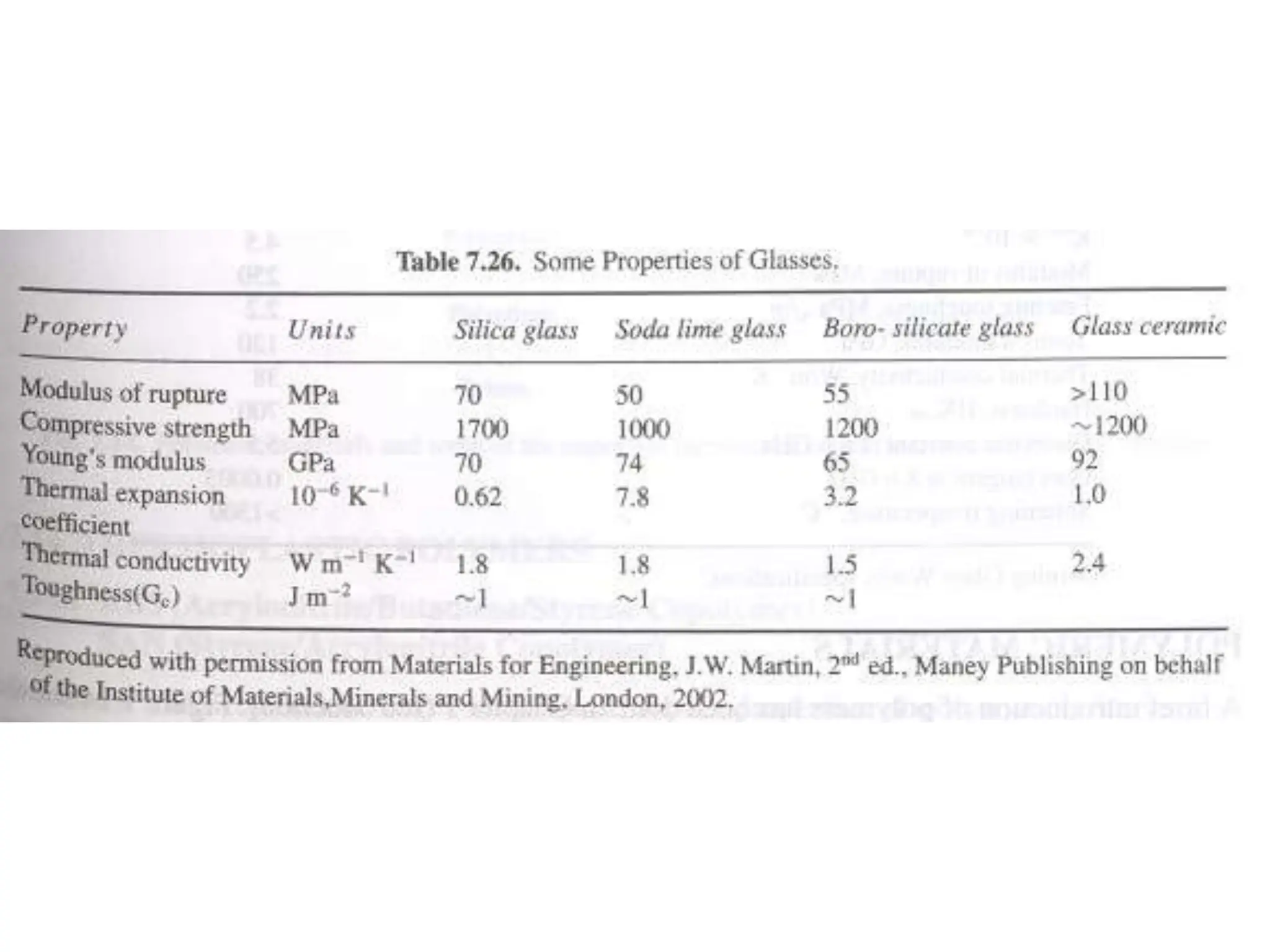
– In addition, glass ceramics - glasses
transformed into a largely crystalline
structure by heat treatment
Properties of Ceramics
• Theoretically, the strength of ceramics should
be higher than metals because their covalent
and ionic bonding types are stronger than
metallic bonding
• However, metallic bonding allows for slip, the
basic mechanism by which metals deform
plastically when subjected to high stresses
• Bonding in ceramics is more rigid and does not
permit slip under stress
• The inability to slip makes it much more difficult
for ceramics to absorb stresses
Imperfections in
Crystal Structure of Ceramics
• Ceramics contain the same imperfections in their
crystal structure as metals - vacancies,
displaced atoms, interstitialcies, and microscopic
cracks
• Internal flaws tend to concentrate stresses,
especially tensile, bending, or impact
– Hence, ceramics fail by brittle fracture much
more readily than metals
– Performance is much less predictable due to
random imperfections and processing
variations
Silica
• Available naturally in various forms, most
important is quartz
– The main source of quartz is sandstone
• Low in cost; also hard and chemically
stable
• Principal component in glass, and an
important ingredient in other ceramic
products including whiteware, refractories,
and abrasives
Alumina as a Ceramic Raw Material
• Bauxite - most alumina is processed from this
mineral, which is an impure mixture of hydrous
aluminum oxide and aluminum hydroxide plus
similar compounds of iron or manganese
– Bauxite is also the principal source of metallic
aluminum
• Corundum - a more pure but less common form
of Al2O3, which contains alumina in massive
amounts
• Alumina ceramic is used as an abrasive in
grinding wheels and as a refractory brick in
furnaces
Oxide Ceramics
• Most important oxide new ceramic is alumina
• alumina - produced synthetically from bauxite,
using an electric furnace method
• Alumina also has good hot hardness, low
thermal conductivity, and good corrosion
resistance
Products of Oxide Ceramics
• Abrasives (grinding wheel grit)
• Bioceramics (artificial bones and teeth)
• Electrical insulators and electronic
components
• Refractory brick
• Cutting tool inserts
• Spark plug barrels
• Engineering components
Carbides
• Silicon carbide (SiC), tungsten carbide (WC),
titanium carbide (TiC), tantalum carbide
(TaC), and chromium carbide (Cr3C2)
• WC, TiC, and TaC are valued for their
hardness and wear resistance in cutting tools
and other applications requiring these
properties
• WC, TiC, and TaC must be combined with a
metallic binder such as cobalt or nickel in
order to fabricate a useful solid product
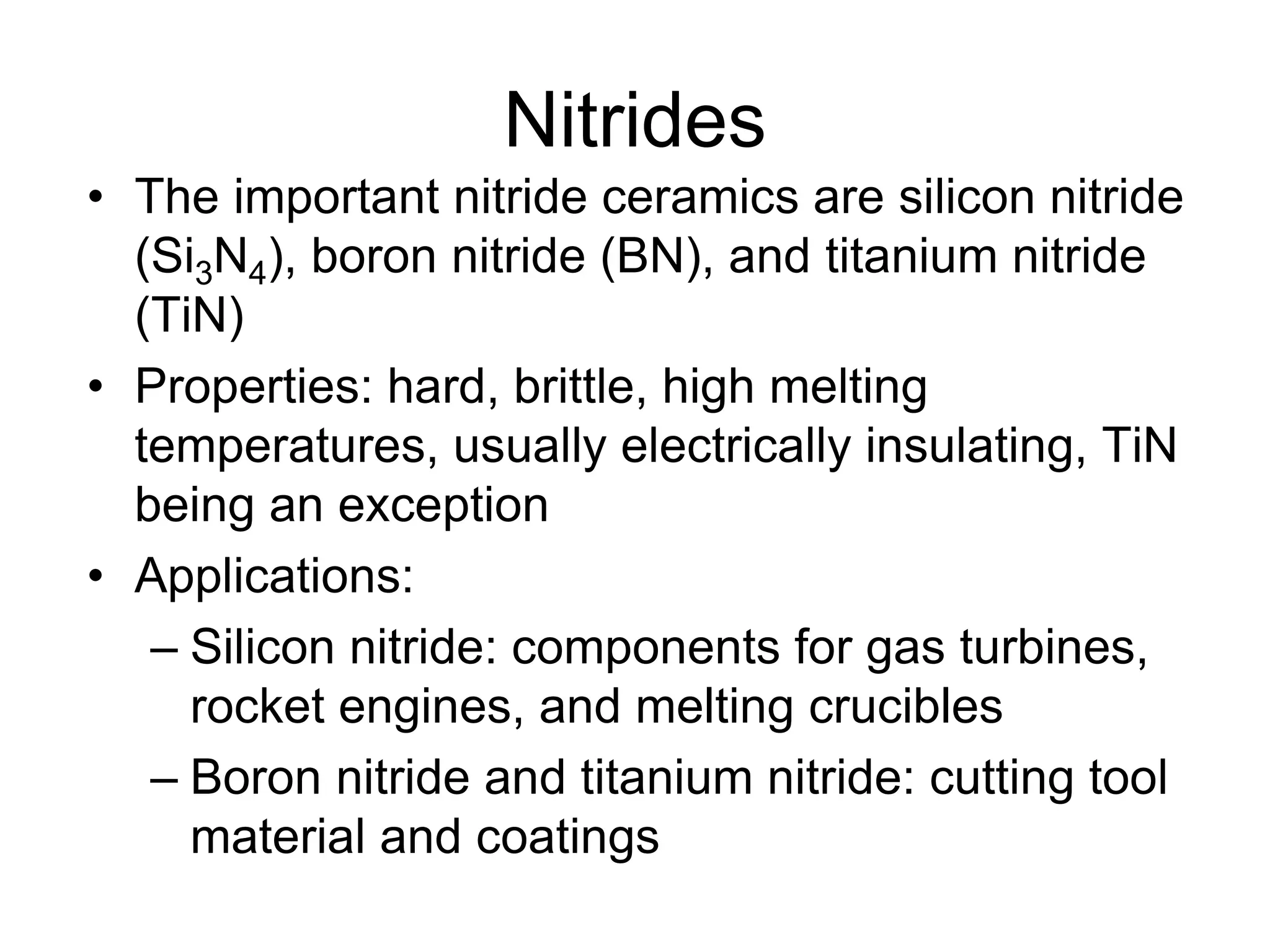
Nitrides
• The important nitride ceramics are silicon nitride
(Si3N4), boron nitride (BN), and titanium nitride
(TiN)
• Properties: hard, brittle, high melting
temperatures, usually electrically insulating, TiN
being an exception
• Applications:
– Silicon nitride: components for gas turbines,
rocket engines, and melting crucibles
– Boron nitride and titanium nitride: cutting tool
material and coatings
Glass
• A state of matter as well as a type of ceramic
• As a state of matter, the term refers to an
amorphous (noncrystalline) structure of a solid
material
– The glassy state occurs in a material when
insufficient time is allowed during cooling from
the molten state for the crystalline structure to
form
• As a type of ceramic, glass is an inorganic,
nonmetallic compound (or mixture of
compounds) that cools to a rigid condition
without crystallizing
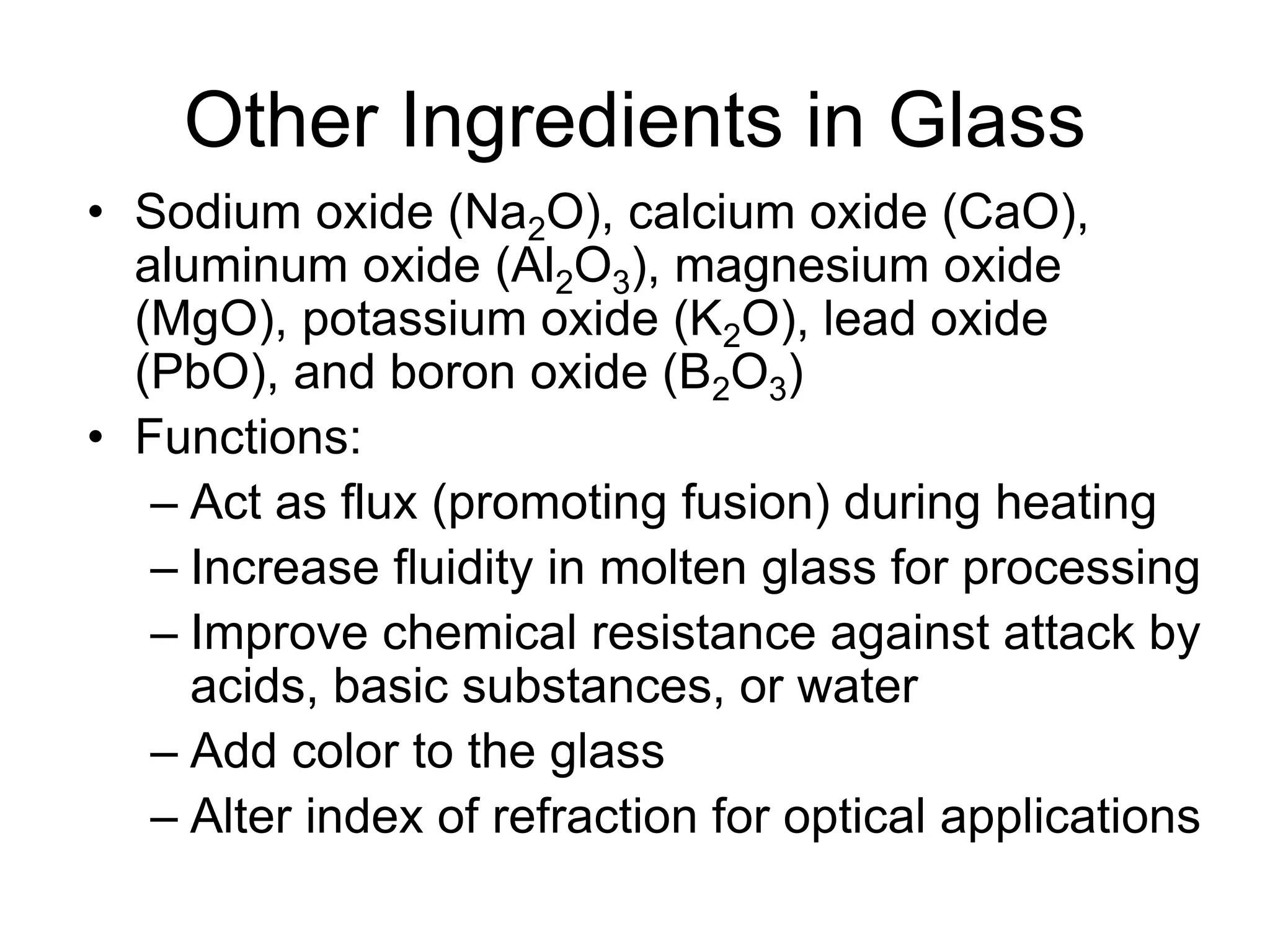
Other Ingredients in Glass
• Sodium oxide (Na2O), calcium oxide (CaO),
aluminum oxide (Al2O3), magnesium oxide
(MgO), potassium oxide (K2O), lead oxide
(PbO), and boron oxide (B2O3)
• Functions:
– Act as flux (promoting fusion) during heating
– Increase fluidity in molten glass for processing
– Improve chemical resistance against attack by
acids, basic substances, or water
– Add color to the glass
– Alter index of refraction for optical applications
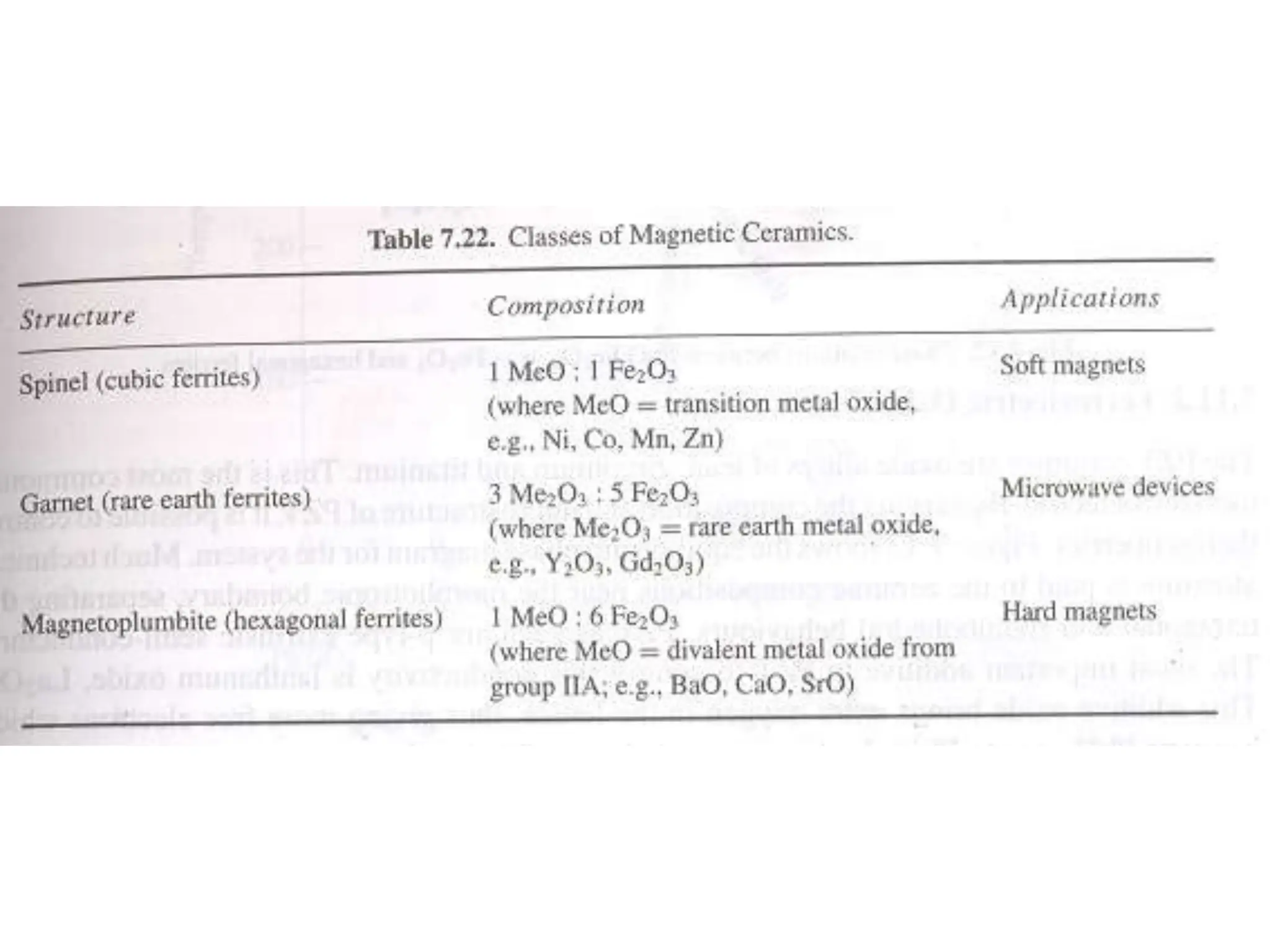
Magnetic oxides
• Three categories:Spinal or cubic ferrite ,
garnets or rare earth ferrites and magneto
plum-bites or hexagonal ferrites
Ferroelectric oxides
• PZT ceramics are oxide alloys of lead,
zirconium and titanium
• Used in ferroelectric- p type extrinsic semi
conductor
• Lanthanum doped lead zirconate-titanate
ceramics have good electro-optical
characteristics
Non oxide ceramics
• Carbide, nitrides and borides of early
transition metals are commonly called
refractory compounds
• Characteristics- high melting point,
hardness good physical and mechanical
properties
• Applications – cutting tools, wear and
metal forming applications
Silicon Carbide
• Characteristics- High hardness, heat and
corrosion resistance and high temperature
strength
• High temperature furnace components
( heating elements, core tubes, refractory
bricks etc)
• Corrosion resistant components and heat
resistant component
Silicon Nitide
• Alpha and beta silicon nitride has hardness , good
thermal stability (1800 deg C), oxidation resistance and
low coefficient of thermal expansion.
• Desirable properties are achieved in fully dense
conditions
• In reaction bonded silicon nitride, - silicon powder is
shaped, partially nitrided and then machined to product
form before fully Nitriding.
• Other consolidation techniques are- gas pressure
sintering, hot pressing sintering followed by hot isostatic
pressing, hot isostatic pressing after encapsulation of
powder
Boron Carbide
• Covalent ceramic has a density of 2.52
g/cm3 and a melting point of 2450 deg C.
low thermal conductivity and a high
thermoelectric power
• Light weight body armour
• Thermocouple in combination with
graphite
Boron Nitide
• Three types: hexogonal graphite type (h-BN);
cubic zinc blende type (c-BN) ; wurtzite type (w-
BN)
• Used as a solid lubricant , as a chemically
resistant container, and as a dielectric in
electronic applications
• Applications: masks for X-ray lithography,
crucibles for aluminium evaporation and
molecular beam epitaxy and powder and
bonded abrasives and cutting metals
Aluminium nitride
• A highly covalent ceramic with unusual
combination of high thermal conductivity ,
high insulation, excellent high temperature
strength, oxidation and thermal shock
resistance
ceramics.ppt

ceramics.ppt

  • 1.
  • 2.
    An inorganic compoundconsisting of a metal (or semi-metal) and one or more nonmetals - include silicates, metallic oxides and combination of silicates and metal oxides • Important examples: – Silica - silicon dioxide (SiO2), – Alumina - aluminum oxide (Al2O3), used in various applications from abrasives to artificial bones – More complex compounds such as hydrous aluminum silicate (Al2Si2O5(OH)4), the main ingredient in most clay products
  • 3.
    Properties of CeramicMaterials • High hardness, electrical and thermal insulating, chemical stability, and high melting temperatures • Brittle, no ductility • Some ceramics are translucent- window glass (based on silica)
  • 4.
    Ceramic Products • Clayconstruction products - bricks, clay pipe, and building tile • Refractory ceramics - high temperature applications such as furnace walls, crucibles, and molds • Cement used in concrete - construction and roads • Whiteware products - pottery, stoneware, fine china, porcelain, and other tableware, based on mixtures of clay and other minerals
  • 5.
    Ceramic Products (continued) •Glass - bottles, glasses, lenses, window pane, and light bulbs • Glass fibers - thermal insulating wool, reinforced plastics (fiberglass), and fiber optics communications lines • Abrasives - aluminum oxide and silicon carbide • Cutting tool materials - tungsten carbide, aluminum oxide, and cubic boron nitride
  • 6.
    Ceramic Products (continued) •Ceramic insulators - applications include electrical transmission components, spark plugs, and microelectronic chip substrates • Magnetic ceramics – example: computer memories • Nuclear fuels based on uranium oxide (UO2) • Bioceramics - artificial teeth and bones
  • 7.
    Three Basic Categoriesof Ceramics 1. Traditional ceramics - clay products such as pottery and bricks, common abrasives, and cement 2. New ceramics - more recently developed ceramics based on oxides, carbides, etc., and generally possessing mechanical or physical properties superior or unique compared to traditional ceramics 3. Glasses - based primarily on silica and distinguished by their noncrystalline structure – In addition, glass ceramics - glasses transformed into a largely crystalline structure by heat treatment
  • 8.
    Properties of Ceramics •Theoretically, the strength of ceramics should be higher than metals because their covalent and ionic bonding types are stronger than metallic bonding • However, metallic bonding allows for slip, the basic mechanism by which metals deform plastically when subjected to high stresses • Bonding in ceramics is more rigid and does not permit slip under stress • The inability to slip makes it much more difficult for ceramics to absorb stresses
  • 9.
    Imperfections in Crystal Structureof Ceramics • Ceramics contain the same imperfections in their crystal structure as metals - vacancies, displaced atoms, interstitialcies, and microscopic cracks • Internal flaws tend to concentrate stresses, especially tensile, bending, or impact – Hence, ceramics fail by brittle fracture much more readily than metals – Performance is much less predictable due to random imperfections and processing variations
  • 11.
    Silica • Available naturallyin various forms, most important is quartz – The main source of quartz is sandstone • Low in cost; also hard and chemically stable • Principal component in glass, and an important ingredient in other ceramic products including whiteware, refractories, and abrasives
  • 12.
    Alumina as aCeramic Raw Material • Bauxite - most alumina is processed from this mineral, which is an impure mixture of hydrous aluminum oxide and aluminum hydroxide plus similar compounds of iron or manganese – Bauxite is also the principal source of metallic aluminum • Corundum - a more pure but less common form of Al2O3, which contains alumina in massive amounts • Alumina ceramic is used as an abrasive in grinding wheels and as a refractory brick in furnaces
  • 13.
    Oxide Ceramics • Mostimportant oxide new ceramic is alumina • alumina - produced synthetically from bauxite, using an electric furnace method • Alumina also has good hot hardness, low thermal conductivity, and good corrosion resistance
  • 14.
    Products of OxideCeramics • Abrasives (grinding wheel grit) • Bioceramics (artificial bones and teeth) • Electrical insulators and electronic components • Refractory brick • Cutting tool inserts • Spark plug barrels • Engineering components
  • 22.
    Carbides • Silicon carbide(SiC), tungsten carbide (WC), titanium carbide (TiC), tantalum carbide (TaC), and chromium carbide (Cr3C2) • WC, TiC, and TaC are valued for their hardness and wear resistance in cutting tools and other applications requiring these properties • WC, TiC, and TaC must be combined with a metallic binder such as cobalt or nickel in order to fabricate a useful solid product
  • 23.
    Nitrides • The importantnitride ceramics are silicon nitride (Si3N4), boron nitride (BN), and titanium nitride (TiN) • Properties: hard, brittle, high melting temperatures, usually electrically insulating, TiN being an exception • Applications: – Silicon nitride: components for gas turbines, rocket engines, and melting crucibles – Boron nitride and titanium nitride: cutting tool material and coatings
  • 24.
    Glass • A stateof matter as well as a type of ceramic • As a state of matter, the term refers to an amorphous (noncrystalline) structure of a solid material – The glassy state occurs in a material when insufficient time is allowed during cooling from the molten state for the crystalline structure to form • As a type of ceramic, glass is an inorganic, nonmetallic compound (or mixture of compounds) that cools to a rigid condition without crystallizing
  • 25.
    Other Ingredients inGlass • Sodium oxide (Na2O), calcium oxide (CaO), aluminum oxide (Al2O3), magnesium oxide (MgO), potassium oxide (K2O), lead oxide (PbO), and boron oxide (B2O3) • Functions: – Act as flux (promoting fusion) during heating – Increase fluidity in molten glass for processing – Improve chemical resistance against attack by acids, basic substances, or water – Add color to the glass – Alter index of refraction for optical applications
  • 27.
    Magnetic oxides • Threecategories:Spinal or cubic ferrite , garnets or rare earth ferrites and magneto plum-bites or hexagonal ferrites
  • 28.
    Ferroelectric oxides • PZTceramics are oxide alloys of lead, zirconium and titanium • Used in ferroelectric- p type extrinsic semi conductor • Lanthanum doped lead zirconate-titanate ceramics have good electro-optical characteristics
  • 29.
    Non oxide ceramics •Carbide, nitrides and borides of early transition metals are commonly called refractory compounds • Characteristics- high melting point, hardness good physical and mechanical properties • Applications – cutting tools, wear and metal forming applications
  • 30.
    Silicon Carbide • Characteristics-High hardness, heat and corrosion resistance and high temperature strength • High temperature furnace components ( heating elements, core tubes, refractory bricks etc) • Corrosion resistant components and heat resistant component
  • 31.
    Silicon Nitide • Alphaand beta silicon nitride has hardness , good thermal stability (1800 deg C), oxidation resistance and low coefficient of thermal expansion. • Desirable properties are achieved in fully dense conditions • In reaction bonded silicon nitride, - silicon powder is shaped, partially nitrided and then machined to product form before fully Nitriding. • Other consolidation techniques are- gas pressure sintering, hot pressing sintering followed by hot isostatic pressing, hot isostatic pressing after encapsulation of powder
  • 32.
    Boron Carbide • Covalentceramic has a density of 2.52 g/cm3 and a melting point of 2450 deg C. low thermal conductivity and a high thermoelectric power • Light weight body armour • Thermocouple in combination with graphite
  • 33.
    Boron Nitide • Threetypes: hexogonal graphite type (h-BN); cubic zinc blende type (c-BN) ; wurtzite type (w- BN) • Used as a solid lubricant , as a chemically resistant container, and as a dielectric in electronic applications • Applications: masks for X-ray lithography, crucibles for aluminium evaporation and molecular beam epitaxy and powder and bonded abrasives and cutting metals
  • 34.
    Aluminium nitride • Ahighly covalent ceramic with unusual combination of high thermal conductivity , high insulation, excellent high temperature strength, oxidation and thermal shock resistance