Ceramic Materials
Asegid Tadesse
Wollega university, Ethiopia
Introduction
• In materials science we often divide materials into distinct classes. The primary
classes of solid materials are ceramics, metals, and polymers. This classification is
based on the types of atoms involved and the bonding between them. The other
widely recognized classes are semiconductors and composites.
• Composites are combinations of more than one material and often involve ceramics,
such as fiberglass. Semiconductors are materials with electrical conductivities that are
very sensitive to minute amounts of impurities.
• As we will see later, most materials that are semiconductors are actually ceramics, for
example, gallium nitride, the blue–green laser diode material. In this chapter we will
define what we mean by a “ceramic” and will also describe some of the general
properties of ceramics.
• The difficulty when drawing generalizations, particularly in this case, is that it is
always possible to find an exception to the rule.
• It is because of the wide range of properties exhibited by ceramics that they find
application in such a variety of areas.
• A general theme throughout this book is the interrelationship between the way in
which a ceramic is processed, its microstructure, and its properties.
• We give some examples of these interrelationships in this chapter to illustrate their
importance.
DEFINITIONS
• If you look in any introductory materials science book you will find that one of the
first sections describes the classification scheme.
• In classical materials science, materials are grouped into five categories: metals,
polymers, ceramics, semiconductors, and composites. The first three are based
primarily on the nature of the interatomic bonding, the fourth on the materials
conductivity, and the last on the materials structure—not a very consistent start.
• Metals, both pure and alloyed, consist of atoms held together by the delocalized
electrons that overcome the mutual repulsion between the ion cores.
• Many main-group elements and all the transition and inner transition elements are
metals. They also include alloys—combinations of metallic elements or metallic and
nonmetallic elements (such as in steel, which is an alloy of primarily Fe and C). Some
commercial steels, such as many tool steels, contain ceramics.
• These are the carbides (e.g., Fe3C and W6C) that produce the hardening and enhance
wear resistance, but also make it more brittle. The delocalized electrons give metals
many of their characteristic properties (e.g., good thermal and electrical conductivity).
It is because of their bonding that many metals have close packed structures and
deform plastically at room temperature.
• Polymers are macromolecules formed by covalent bonding of many simpler
molecular units called mers. Most polymers are organic compounds based on carbon,
hydrogen, and other nonmetals such as sulfur and chlorine.
• The bonding between the molecular chains determines many of their properties.
Cross-linking of the chains is the key to the vulcanization process that turned rubber
from an interesting but not very useful material into, for example, tires that made
traveling by bicycle much more comfortable and were important in the production of
the automobile.
• The terms “polymer” and “plastic” are often used interchangeably. However, many of
the plastics with which we are familiar are actually combinations of polymers, and
often include fillers and other additives to give the desired properties and appearance.
• Ceramics are usually associated with “mixed” bonding—a combination of covalent,
ionic, and sometimes metallic. They consist of arrays of interconnected atoms; there
are no discrete molecules. This characteristic distinguishes ceramics from molecular
solids such as iodine crystals (composed of discrete I2 molecules) and paraffin wax
(composed of long-chain alkane molecules). It also excludes ice, which is composed
of discrete H2O molecules and often behaves just like many ceramics.
• The majority of ceramics are compounds of metals or metalloids and nonmetals. Most
frequently they are oxides, nitrides, and carbides. However, we also classify diamond
and graphite as ceramics. These forms of carbon are inorganic in the most basic
meaning of the term: they were not prepared from the living organism. Richerson
(2000) says “most solid materials that aren’t metal, plastic, or derived from plants or
animals are ceramics.”
• Semiconductors are the only class of material based on a property.
• They are usually defined as having electrical conductivity between that of a good
conductor and an insulator.
• The conductivity is strongly dependent upon the presence of small amounts of
impurities—the key to making integrated circuits.
• Semiconductors with wide band gaps (greater than about 3 eV) such as silicon carbide
and boron nitride are becoming of increasing importance for high temperature
electronics, for example, SiC diodes are of interest for sensors in fuel cells.
• In the early days of semiconductor technology such materials would have been
regarded as insulators. Gallium nitride (GaN), a blue–green laser diode material, is
another ceramic that has a wide band gap.
• Composites are combinations of more than one material or phase. Ceramics are used
in many composites, often for reinforcement. For example, one of the reasons a B-2
stealth bomber is stealthy is that it contains over 22 tons of carbon/epoxy composite.
In some composites the ceramic is acting as the matrix (ceramic matrix composites or
CMCs).
• An early example of a CMC dating back over 9000 years is brick. These often
consisted of a fired clay body reinforced with straw.
• Clay is an important ceramic and the backbone of the traditional ceramic industry. In
concrete, both the matrix (cement) and the reinforcement (aggregate) are ceramics.
• The most widely accepted definition of a ceramic is given by Kingery et al. (1976):
“A ceramic is a nonmetallic, inorganic solid.” Thus all inorganic semiconductors are
ceramics. By definition, a material ceases to be a ceramic when it is melted. At the
opposite extreme, if we cool some ceramics enough they become superconductors.
• All the so-called high-temperature superconductors (HTSC) (ones that lose all
electrical resistance at liquidnitrogen temperatures) are ceramics. Trickier is glass
such as used in windows and optical fibers. Glass fulfills the standard definition of a
solid—it has its own fixed shape— but it is usually a supercooled liquid. This
property becomes evident at high temperatures when it undergoes viscous
deformation.
• Glasses are clearly special ceramics. We may crystallize certain glasses to make
glass–ceramics such as those found in CorningwareR. This process is referred to as
“ceramming” the glass, i.e., making it into a ceramic.
• We stand by Kingery’s definition and have to live with some confusion. We thus
define ceramics in terms of what they are not. It is also not possible to define
ceramics, or indeed any class of material, in terms of specific properties.
• We cannot say “ceramics are brittle” because some can be superplastically deformed
and some metals can be more brittle: a rubber hose or banana at 77 K shatters under a
hammer.
• We cannot say “ceramics are insulators” unless we put a value on the band gap (Eg)
where a material is not a semiconductor. We cannot say “ceramics are poor
conductors of heat” because diamond has the highest thermal conductivity of any
known material.
• Before we leave this section let us consider a little history. The word ceramic is
derived from the Greek keramos, which means “potter’s clay” or “pottery.” Its origin
is a Sanskrit term meaning “to burn.”
• So the early Greeks used “keramos” when describing products obtained by heating
clay-containing materials.
• The term has long included all products made from fired clay, for example, bricks,
fireclay refractories, sanitary ware, and tableware. In 1822, silica refractories were
first made. Although they contained no clay the traditional ceramic process of
shaping, drying, and firing was used to make them.
• So the term “ceramic,” while retaining its original sense of a product made from clay,
began to include other products made by the same manufacturing process.
• The field of ceramics (broader than the materials themselves) can be defined as the art
and science of making and using solid articles that contain as their essential
component a ceramic. This definition covers the purification of raw materials, the
study and production of the chemical compounds concerned, their formation into
components, and the study of structure, composition, and properties.
1.2 GENERAL PROPERTIES
• Ceramics generally have specific properties associated with them although, as we just
noted, this can be a misleading approach to defining a class of material. However, we
will look at some properties and see how closely they match our expectations of what
constitutes a ceramic.
• Brittleness. This probably comes from personal experiences such as dropping a glass
beaker or a dinner plate. The reason that the majority of ceramics are brittle is the
mixed ionic–covalent bonding that holds the constituent atoms together.
• At high temperatures (above the glass transition temperature) glass no longer behaves
in a brittle manner; it behaves as a viscous liquid. That is why it is easy to form glass
into intricate shapes.
• So what we can say is that most ceramics are brittle at room temperature but not
necessarily at elevated temperatures. Poor electrical and thermal conduction.
• The valence electrons are tied up in bonds, and are not free as they are in metals. In
metals it is the free electrons—the electron gas—that determines many of their
electrical and thermal properties.
• Diamond, which we classified as a ceramic in Section 1.1, has the highest thermal
conductivity of any known material. The conduction mechanism is due to phonons,
not electrons, as we describe in Chapter 34.
• Ceramics can also have high electrical conductivity: (1) the oxide ceramic, ReO3, has
an electrical conductivity at room temperature similar to that of Cu (2) the mixed
oxide YBa2Cu3O7 is an HTSC; it has zero resistivity below 92 K. These are two
examples that contradict the conventional wisdom when it comes to ceramics.
• Compressive strength. Ceramics are stronger in compression than in tension, whereas
metals have comparable tensile and compressive strengths. This difference is
important when we use ceramic components for load-bearing applications.
• It is necessary to consider the stress distributions in the ceramic to ensure that they are
compressive. An important example is in the design of concrete bridges—the
concrete, a CMC, must be kept in compression. Ceramics generally have low
toughness, although combining them in composites can dramatically improve this
property.
• Chemical insensitivity. A large number of ceramics are stable in both harsh chemical
and thermal environments. Pyrex glass is used widely in chemistry laboratories
specifically because it is resistant to many corrosive chemicals, stable at high
temperatures (it does not soften until 1100 K), and is resistant to thermal shock
because of its low coefficient of thermal expansion (33 × 10−7 K−1).
• It is also widely used in bakeware. Transparent. Many ceramics are transparent
because they have a large Eg. Examples include sapphire watch covers, precious
stones, and optical fibers. Glass optical fibers have a percent transmission
>96%km−1. Metals are transparent to visible light only when they are very thin,
typically less than 0.1 μm. Although it is always possible to find at least one ceramic
that shows atypical behavior, the properties we have mentioned here are in many
cases different from those shown by metals and polymers.
TYPES OF CERAMIC AND THEIR APPLICATIONS
• Using the definition given in Section 1.1 you can see that large numbers of materials
are ceramics.
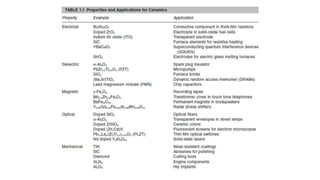
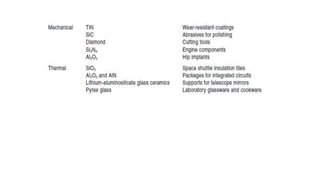
• The applications for these materials are diverse, from bricks and tiles to electronic and
magnetic components. These applications use the wide range of properties exhibited
by ceramics. Some of these properties are listed in Table 1.1 together with examples
of specific ceramics and applications. Each of these areas will be covered in more
detail later.
• The functions of ceramic products are dependent on their chemical composition and
microstructure, which determines their properties.
• It is the interrelationship between structure and properties that is a key element of
materials science and engineering.
• You may find that in addition to dividing ceramics according to their properties and
applications that it is common to class them as traditional or advanced.
• Traditional ceramics include high-volume items such bricks and tiles, toilet bowls
(whitewares), and pottery. A dvanced ceramics include newer materials such as laser
host materials, piezoelectric ceramics, ceramics for dynamic random access memories
(DRAMs), etc., often produced in small quantities with higher prices.
• There are other characteristics that separate these categories.
• Traditional ceramics are usually based on clay and silica. There is sometimes a
tendency to equate traditional ceramics with low technology, however, advanced
manufacturing techniques are often used.
• Competition among producers has caused processing to become more efficient and
cost effective. Complex tooling and machinery is often used and may be coupled with
computer-assisted process control.
• Advanced ceramics are also referred to as “special,” “technical,” or “engineering”
ceramics. They exhibit superior mechanical properties, corrosion/oxidation resistance,
or electrical, optical, and/or magnetic properties.
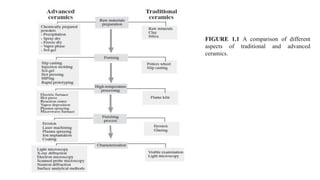
• While traditional clay-based ceramics have been used for over 25,000 years,
advanced ceramics have generally been developed within the last 100 years. Figure
1.1 compares traditional and advanced ceramics in terms of the type of raw materials
used, the forming and shaping processes, and the methods used for characterization.
FIGURE 1.1 A comparison of different
aspects of traditional and advanced
ceramics.
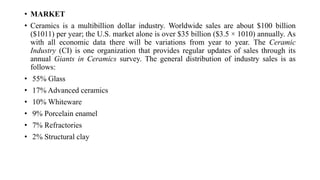
• MARKET
• Ceramics is a multibillion dollar industry. Worldwide sales are about $100 billion
($1011) per year; the U.S. market alone is over $35 billion ($3.5 × 10¹⁰) annually. As
with all economic data there will be variations from year to year. The Ceramic
Industry (CI) is one organization that provides regular updates of sales through its
annual Giants in Ceramics survey. The general distribution of industry sales is as
follows:
• 55% Glass
• 17% Advanced ceramics
• 10% Whiteware
• 9% Porcelain enamel
• 7% Refractories
• 2% Structural clay
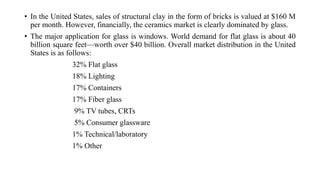
• In the United States, sales of structural clay in the form of bricks is valued at $160 M
per month. However, financially, the ceramics market is clearly dominated by glass.
• The major application for glass is windows. World demand for flat glass is about 40
billion square feet—worth over $40 billion. Overall market distribution in the United
States is as follows:
32% Flat glass
18% Lighting
17% Containers
17% Fiber glass
9% TV tubes, CRTs
5% Consumer glassware
1% Technical/laboratory
1% Other
• Advanced ceramics form the second largest sector of the industry. More than half of
this sector is electrical and electronic ceramics and ceramic packages:
• 36% Capacitors/substrates/packages
• 23% Other electrical/electronic ceramics
• 13% Other
• 12% Electrical porcelain
• 8% Engineering ceramics
• 8% Optical fibers
• High-temperature ceramic superconductors, which would fall into the category of
advanced ceramics, are not presently a major market area. They constitute less than
1% of the advanced ceramics market. Significant growth has been predicted because
of their increased use in microwave filters and resonators, with particular application
in the area of cell phones.
• Engineering ceramics, also called structural ceramics, include wear-resistant
components such as dies, nozzles, and bearings. Bioceramics such as ceramic and
glassceramic implants and dental crowns account for about 20% of this market.
• Dental crowns are made of porcelain and over 30 million are made in the United
States each year. Whiteware sales, which include sanitaryware (toilet bowls, basins,
etc.) and dinnerware (plates, cups), account for about 10% of the total market for
ceramics. The largest segment of the whiteware market, accounting for about 40%, is
floor and wall tiles. In the United States we use about 2.5 billion (2.5 × 10⁹) square
feet of ceramic tiles per year.
• Annual sales of sanitaryware in the United States total more than 30 million pieces.
Porcelain enamel is the ceramic coating applied to many steel appliances such as
kitchen stoves, washers, and dryers.
• Porcelain enamels have much wider applications as both interior and exterior
paneling in buildings, for example, in subway stations. Because of these widespread
applications it is perhaps not surprising that the porcelain enameling industry
accounts for more than $3 billion per year
• More than 50% of refractories are consumed by the steel industry. The major
steelmaking countries are China, Japan, and the United States. Structural clay
products include bricks, sewer pipes, and roofing tiles. These are high-volume low-
unit-cost items. Each year about 8 billion bricks are produced in the United States
with a market value of over $1.5 billion.
• 1.5 CRITICAL ISSUES FOR THE FUTURE
• Although glass dominates the global ceramics market, the most significant growth is
in advanced ceramics. There are many key issues that need to be addressed to
maintain this growth and expand the applications and uses of advanced ceramics. It is
in these areas that there will be increasing employment opportunities for ceramic
engineers and materials scientists.
• Structural ceramics include silicon nitride (Si3N4), silicon carbide (SiC), zirconia
(ZrO2), boron carbide (B4C), and alumina (Al2O3). They are used in applications
such as cutting tools, wear components, heat exchangers, and engine parts. Their
relevant properties are high hardness, low density, high-temperature mechanical
strength, creep resistance, corrosion resistance, and chemical inertness. There are
three key issues to solve in order to expand the use of structural ceramics:
• Reducing cost of the final product
• Improving reliability
• Improving reproducibility
• Electronic ceramics include barium titanate (BaTiO3), zinc oxide (ZnO), lead
zirconate titanate [Pb(ZrxTi1−x)O3], aluminum nitride (AlN), and HTSCs.
• They are used in applications as diverse as capacitor dielectrics, varistors,
microelectromechanical systems (MEMS), substrates, and packages for integrated
circuits.
• There are many challenges for the future: Integrating with existing semiconductor
technology Improving processing Enhancing compatibility with other materials
Bioceramics are used in the human body.
• The response of these materials varies from nearly inert to bioactive to resorbable.
Nearly inert bioceramics include alumina (Al2O3) and zirconia (ZrO2). Bioactive
ceramics include hydroxyapatite and some special glass and glass–ceramic
formulations. Tricalcium phosphate is an example of a resorbable bioceramic; it
dissolves in the body.
• Three issues will determine future progress: Matching mechanical properties to
human tissues Increasing reliability Improving processing methods Coatings and fi
lms are generally used to modify the surface properties of a material, for example, a
bioactive coating deposited onto the surface of a bioinert implant.
• They may also be used for economic reasons; we may want to apply a coating of an
expensive material to a lower cost substrate rather than make the component entirely
from the more expensive material.
• An example of this situation would be applying a diamond coating on a cutting tool.
In some cases we use films or coatings simply because the material performs better in
this form. An example is the transport properties of thin films of HTSCs, which are
improved over those of the material in bulk form. Some issues need to be addressed:
Understanding film deposition and growth Improving film/substrate adhesion
Increasing reproducibility
• Composites may use ceramics as the matrix phase and/or the reinforcing phase. The
purpose of a composite is to display a combination of the preferred characteristics of
each of the components. In CMCs one of the principal goals has been to increase
fracture toughness through reinforcement with whiskers or fibers. When ceramics are
the reinforcement phase in, for example, metal matrix composites the result is usually
an increase in strength, enhanced creep resistance, and greater wear resistance.
• Three issues must be solved: Reducing processing costs Developing compatible
combinations of materials (e.g., matching coefficients of thermal expansion)
Understanding interfaces Nanoceramics can be either well established or at an early
stage in their development. They are widely used in cosmetic products such as
sunscreens, and we know they
• are critical in many applications of catalysis, but their use in fuel cells, coatings, and
devices, for example, is often quite new. There are three main challenges: Making
them Integrating them into devices Ensuring that they do not have a negative impact
on society
• RELATIONSHIP BETWEEN MICROSTRUCTURE, PROCESSING, AND
APPLICATIONS
• The field of materials science and engineering is often defined by the interrelationship
between four topics—synthesis and processing, structure and composition, properties, and
performance. To understand the behavior and properties of any material, it is essential to
understand its structure. Structure can be considered on several levels, all of which influence
final behavior.
• At the finest level is the electron confi guration, which affects properties such as color,
electrical conductivity, and magnetic behavior. The arrangement of electrons in an atom
influences how it will bond to another atom and this, in turn, impacts the crystal structure.
• The arrangement of the atoms or ions in the material also needs to be considered. Crystalline
ceramics have a very regular atomic arrangement whereas in noncrystalline or amorphous
ceramics (e.g., oxide glasses) there is no long-range order, although locally we may identify
similar polyhedra.
• Such materials often behave differently relative to their crystalline counterparts. Not only
perfect lattices and ideal structures have to be considered but also the presence of structural
defects that are unavoidable in all materials, even the amorphous ones. Examples of such
defects include impurity atoms and dislocations.
• Polycrystalline ceramics have a structure consisting of many grains. The size, shape,
and orientation of the grains play a key role in many of the macroscopic properties of
these materials, for example, mechanical strength.
• In most ceramics, more than one phase is present, with each phase having its own
structure, composition, and properties. Control of the type, size, distribution, and
amount of these phases within the material provides a means to controlproperties.
• The microstructure of a ceramic is often a result of the way it was processed. For
example, hotpressed ceramics often have very few pores. This may not be the case in
sintered materials.
• The interrelationship between the structure, processing, and properties will be evident
throughout this text but are illustrated here by five examples.
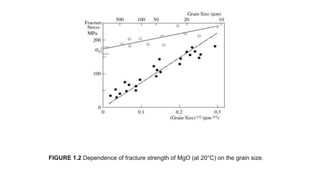
• 1. The strength of polycrystalline ceramics depends on the grain size through the
Hall–Petch equation. Figure 1.2 shows strength as a function of grain size for MgO.
As the grain size decreases the strength increases. The grain size is determined by the
size of the initial powder
FIGURE 1.2 Dependence of fracture strength of MgO (at 20°C) on the grain size.
• particles and the way in which they were consolidated. The grain boundaries in a
polycrystalline ceramic are also important.
• The strength then depends on whether or not the material is pure, contains a second
phase or pores, or just contains glass at the grain boundaries. The relationship is not
always obvious for nanoceramics.
• 2. Transparent or translucent ceramics require that we limit the scattering of light by
pores and second-phase particles.
• Reduction in porosity may be achieved by hot pressing to ensure a high-density
product. This approach has been used to make transparent PLZT ceramics for
electrooptical applications such as the flash-blindness goggles shown in Figure 1.3,
developed during the 1970s by Sandia National Laboratories in the United States
for use by combat pilots.
• 3. Thermal conductivity of commercially available polycrystalline AlN is usually
lower than that predicted by theory because of the presence of impurities, mainly
oxygen, which scatter phonons. Adding rare earth or alkaline metal oxides (such as
Y2O3 and CaO, respectively) can reduce the oxygen content by acting as a getter.
These oxides are mixed in with the AlN powder before it is shaped.
• The second phase, formed between the oxide additive and the oxide coating on the
AlN grains, segregates to triple points as shown in Figure 1.4.
• 4. Soft ferrites such as Mn1−δZnδFe2O4 are used in a range of different devices, for
example, as the yoke that moves the electron beam in a television tube.
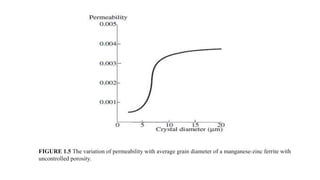
• The permeability of soft ferrites is a function of grain size as shown in Figure 1.5.
Large defect-free grains are preferred because we need to have very mobile domain
walls.
FIGURE 1.5 The variation of permeability with average grain diameter of a manganese-zinc ferrite with
uncontrolled porosity.
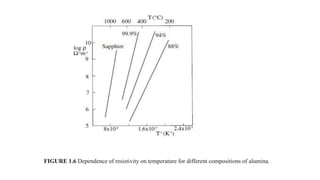
FIGURE 1.6 Dependence of resistivity on temperature for different compositions of alumina.
• Defects and grain boundaries pin the domain walls and make it more difficult to
achieve saturation magnetization.
• 5. Alumina ceramics are used as electrical insulators because of their high electrical
resistivity and low dielectric constant. For most applications pure alumina is not used.
Instead we blend the alumina with silicates to reduce the sintering temperature.
• These materials are known as debased aluminas and contain a glassy silicate phase
between alumina grains. Debased aluminas are generally more conductive (lower
resistivity) than pure aluminas as shown in Figure 1.6. Debased aluminas (containing
95% Al2O3) are used in spark plugs.
• SAFETY
• When working with any material, safety considerations should be uppermost. There
are several important precautions to take when working with ceramics. Toxicity of
powders containing, for example, Pb or Cd or fluorides should be known. When
shipping the material, the manufacturer supplies information on the hazards
associated with their product.
• It is important to read this information and keep it accessible. Some standard
resources that provide information about the toxicity of powders and the “acceptable”
exposure levels are given in the References. Small particles should not be inhaled.
The effects have been well known, documented, and often ignored since the 1860s.
• Proper ventilation, improved cleanliness, and protective clothing have significantly
reduced many of the industrial risks. Care should be taken when handling any
powders (of both toxic and nontoxic materials).
• The most injurious response is believed to be when the particle size is <1μm; larger
particles either do not remain suspended in the air sufficiently long to be inhaled or, if
inhaled, cannot negotiate the tortuous passage of the upper respiratory tract.
• The toxicity and environmental impact of nanopowders have not been clearly
addressed, but are the subject of various studies such as a recent report by the Royal
Society (2004). High temperatures are used in much of ceramic processing.
• The effects of high temperatures on the human body are obvious. What is not so
obvious is how hot something actually is. Table 1.2 gives the color scale for
temperature. From this tabulation you can see that an alumina tube at 400oC will not
show a change in color but it will still burn skin. Other safety issues involved with
furnaces are given in Chapter 9. Organics are used as solvents and binders during
processing.
• Traditionally, organic materials played little role in ceramic processing. Now they are
widely used in many forms of processing. Again, manufacturers will provide safety
data sheets on any product they ship. This information is important and should always
be read carefully. As a rule, the material safety data sheets (MSDS) should be readily
accessible for all the materials you are using; many states require that they are kept in
the laboratory.
CERAMICS ON THE INTERNET
• There is a great deal of information about ceramics on the Internet. Here are some of
the most useful web sites.
• www.FutureCeramics.com The web site for this text.
• www.acers.org The American Ceramic Society, membership information, meetings,
books.
• www.acers.org/cic/propertiesdb.asp The Ceramic Properties Database. This database
has links to many other sources of property information including the NIST and
NASA materials databases.
• www.ceramics.com Links to many technical and industrial sites.
• www.ceramicforum.com A web site for the ceramics professional.
• www.ecers.org The European Ceramics Society.
• www.ceramicsindustry.com Source of industry data.
• www.porcelainenamel.com The Porcelain Enamel Institute.
CERAMICS TEXTBOOKS
• Barsoum, M. (2003) Fundamentals of Ceramics, revised edition, CRC Press, Boca Raton, FL. Chiang, Y-M., Birnie, D., III,
and Kingery, W.D. (1998) Physical Ceramics: Principles for Ceramic Science and Engineering, Wiley, New York.
• Kingery, W.D., Bowen, H.K., and Uhlmann, D.R. (1976) Introduction to Ceramics, 2nd edition, Wiley, New York. This has
been the ceramics “bible” for 40 years since the publication of the first edition by David Kingery in 1960.
• Lee, W.E. and Rainforth, W.M. (1994) Ceramic Microstructures: Property Control by Processing, Chapman & Hall,
London.
• Norton, F.H. (1974) Elements of Ceramics, 2nd edition, Addison-Wesley, Reading, MA.
• Richerson, D.W. (2005) Modern Ceramic Engineering: Properties, Processing, and Use in Design, 3rd edition, CRC Press,
Boca Raton, FL. Van Vlack, L.H. (1964) Physical Ceramics for Engineers, Addison-Wesley, Reading, MA.
INTRODUCTION TO MATERIALS SCIENCE TEXTBOOKS
• Askeland, D.R. and Phule, P.P. (2005) The Science of Engineering Materials, 5th edition, Thompson Engineering, Florence,
KY.
• Callister, W.D. (2007) Materials Science and Engineering: An Introduction, 7th edition, Wiley, New York.
• Schaeffer, J.P., Saxena, A., Antolovich, S.D., Sanders, T.H., Jr., and Warner, S.B. (2000) The Science and Design of
Engineering Materials, 2nd edition, McGraw-Hill, Boston.
• Shackelford, J.F. (2004) Introduction to Materials Science for Engineers, 6th edition, Prentice Hall, Upper Saddle River,
NJ.
• Smith, W.F. and Hashemi, J. (2006) Foundations of Materials Science and Engineering, 4th edition, McGraw- Hill, Boston.
JOURNALS
• Bulletin of the American Ceramic Society, published by the American Ceramic Society (ACerS). News, society information,
industry updates, and positions. Free to society members. Ceramic Industry, published by Business News Publishing Co., Troy, MI.
Information on manufacturing.
• Designed mainly for the ceramist in industry.
• Ceramics International
• Glass Technology, published by The Society of Glass Technology, Sheffield, UK.
• Journal of the American Ceramic Society, house journal of the ACerS contains peer-reviewed articles, published monthly.
• Journal of the European Ceramics Society, house journal of the European Ceramic Society published by Elsevier.
• Journal of Non-Crystalline Solids
• Physics and Chemistry of Glasses
• Transactions of the British Ceramic Society
CONFERENCE PROCEEDINGS
• American Ceramic Society Transactions
• Ceramic Engineering and Science Proceedings. Published by the American Ceramic Society; each issue is based on proceedings of a
conference.
• USEFUL SOURCES OF PROPERTIES DATA, TERMINOLOGY, AND CONSTANTS
• Engineered Materials Handbook, Volume 4, Ceramics and Glasses (1991), volume chairman Samuel J.
• Schneider, Jr., ASM International, Washington, D.C.
• CRC Handbook of Chemistry and Physics, 86th edition (2005), edited by D.R. Lide, CRC Press, Boca Raton,
• FL. The standard resource for property data. Updated and revised each year.
EXERCISES
1.1 Which of the following materials could be classified as a ceramic. Justify your answer. (a) Solid argon (Ar);
(b) molybdenum disilicide (MoSi2); (c) NaCl; (d) crystalline sulfur (S); (e) ice; (f) boron carbide (B4C).
1.2 Is silicone rubber (widely used as a caulking material in bathrooms and kitchens) a ceramic or a polymer?
Explain your reasoning.
1.3 There are several different phases in the Fe-C system. One phase is the γ-Fe (austenite), which can contain
up to about 8 atomic % C. Another phase is cementite, which contains 25 atomic % C. Are either of these two
phases a ceramic? Justify your answer.
1.4 The following definition has been proposed: “All ceramics are transparent to visible light.” Is this a good
way of defining a ceramic? Explain your reasoning.
1.5 In the distribution of industry sales of advanced ceramics (Section 1.4), 13% was listed as “Other.” Suggest
applications that might be included in this group.
1.6 Ceramic tile accounts for about 15% of the floor tile market. (a) What alternatives are available? (b) What
advantages/disadvantages do ceramics have over the alternatives? (c) What factors do you think influence the
total amount of ceramic floor tiles used?
1.7 Gerber, the baby food manufacturer, is replacing most of its glass baby food jars with plastic. Miller
Brewing Co. now sells some of its popular beers in plastic containers. Compare glass and plastics in terms of
their application for packaging food and beverages.
1.8 The steel industry is the major consumer of refractories. What other industries might be users of this ceramic
product?
1.9 Pearls and garnets are both examples of gems. We classify garnet as a ceramic. Would you classify pearl as a
ceramic? Briefly justify your answer.
1.10 Some nuclear reactors use MOX fuel. What is MOX and is it a ceramic?
Ceramic materials

Ceramic materials

  • 1.
  • 2.
    Introduction • In materialsscience we often divide materials into distinct classes. The primary classes of solid materials are ceramics, metals, and polymers. This classification is based on the types of atoms involved and the bonding between them. The other widely recognized classes are semiconductors and composites. • Composites are combinations of more than one material and often involve ceramics, such as fiberglass. Semiconductors are materials with electrical conductivities that are very sensitive to minute amounts of impurities. • As we will see later, most materials that are semiconductors are actually ceramics, for example, gallium nitride, the blue–green laser diode material. In this chapter we will define what we mean by a “ceramic” and will also describe some of the general properties of ceramics. • The difficulty when drawing generalizations, particularly in this case, is that it is always possible to find an exception to the rule.
  • 3.
    • It isbecause of the wide range of properties exhibited by ceramics that they find application in such a variety of areas. • A general theme throughout this book is the interrelationship between the way in which a ceramic is processed, its microstructure, and its properties. • We give some examples of these interrelationships in this chapter to illustrate their importance.
  • 4.
    DEFINITIONS • If youlook in any introductory materials science book you will find that one of the first sections describes the classification scheme. • In classical materials science, materials are grouped into five categories: metals, polymers, ceramics, semiconductors, and composites. The first three are based primarily on the nature of the interatomic bonding, the fourth on the materials conductivity, and the last on the materials structure—not a very consistent start. • Metals, both pure and alloyed, consist of atoms held together by the delocalized electrons that overcome the mutual repulsion between the ion cores. • Many main-group elements and all the transition and inner transition elements are metals. They also include alloys—combinations of metallic elements or metallic and nonmetallic elements (such as in steel, which is an alloy of primarily Fe and C). Some commercial steels, such as many tool steels, contain ceramics.
  • 5.
    • These arethe carbides (e.g., Fe3C and W6C) that produce the hardening and enhance wear resistance, but also make it more brittle. The delocalized electrons give metals many of their characteristic properties (e.g., good thermal and electrical conductivity). It is because of their bonding that many metals have close packed structures and deform plastically at room temperature. • Polymers are macromolecules formed by covalent bonding of many simpler molecular units called mers. Most polymers are organic compounds based on carbon, hydrogen, and other nonmetals such as sulfur and chlorine.
  • 6.
    • The bondingbetween the molecular chains determines many of their properties. Cross-linking of the chains is the key to the vulcanization process that turned rubber from an interesting but not very useful material into, for example, tires that made traveling by bicycle much more comfortable and were important in the production of the automobile. • The terms “polymer” and “plastic” are often used interchangeably. However, many of the plastics with which we are familiar are actually combinations of polymers, and often include fillers and other additives to give the desired properties and appearance.
  • 7.
    • Ceramics areusually associated with “mixed” bonding—a combination of covalent, ionic, and sometimes metallic. They consist of arrays of interconnected atoms; there are no discrete molecules. This characteristic distinguishes ceramics from molecular solids such as iodine crystals (composed of discrete I2 molecules) and paraffin wax (composed of long-chain alkane molecules). It also excludes ice, which is composed of discrete H2O molecules and often behaves just like many ceramics. • The majority of ceramics are compounds of metals or metalloids and nonmetals. Most frequently they are oxides, nitrides, and carbides. However, we also classify diamond and graphite as ceramics. These forms of carbon are inorganic in the most basic meaning of the term: they were not prepared from the living organism. Richerson (2000) says “most solid materials that aren’t metal, plastic, or derived from plants or animals are ceramics.” • Semiconductors are the only class of material based on a property.
  • 8.
    • They areusually defined as having electrical conductivity between that of a good conductor and an insulator. • The conductivity is strongly dependent upon the presence of small amounts of impurities—the key to making integrated circuits. • Semiconductors with wide band gaps (greater than about 3 eV) such as silicon carbide and boron nitride are becoming of increasing importance for high temperature electronics, for example, SiC diodes are of interest for sensors in fuel cells. • In the early days of semiconductor technology such materials would have been regarded as insulators. Gallium nitride (GaN), a blue–green laser diode material, is another ceramic that has a wide band gap.
  • 9.
    • Composites arecombinations of more than one material or phase. Ceramics are used in many composites, often for reinforcement. For example, one of the reasons a B-2 stealth bomber is stealthy is that it contains over 22 tons of carbon/epoxy composite. In some composites the ceramic is acting as the matrix (ceramic matrix composites or CMCs). • An early example of a CMC dating back over 9000 years is brick. These often consisted of a fired clay body reinforced with straw. • Clay is an important ceramic and the backbone of the traditional ceramic industry. In concrete, both the matrix (cement) and the reinforcement (aggregate) are ceramics. • The most widely accepted definition of a ceramic is given by Kingery et al. (1976): “A ceramic is a nonmetallic, inorganic solid.” Thus all inorganic semiconductors are ceramics. By definition, a material ceases to be a ceramic when it is melted. At the opposite extreme, if we cool some ceramics enough they become superconductors.
  • 10.
    • All theso-called high-temperature superconductors (HTSC) (ones that lose all electrical resistance at liquidnitrogen temperatures) are ceramics. Trickier is glass such as used in windows and optical fibers. Glass fulfills the standard definition of a solid—it has its own fixed shape— but it is usually a supercooled liquid. This property becomes evident at high temperatures when it undergoes viscous deformation. • Glasses are clearly special ceramics. We may crystallize certain glasses to make glass–ceramics such as those found in CorningwareR. This process is referred to as “ceramming” the glass, i.e., making it into a ceramic. • We stand by Kingery’s definition and have to live with some confusion. We thus define ceramics in terms of what they are not. It is also not possible to define ceramics, or indeed any class of material, in terms of specific properties.
  • 11.
    • We cannotsay “ceramics are brittle” because some can be superplastically deformed and some metals can be more brittle: a rubber hose or banana at 77 K shatters under a hammer. • We cannot say “ceramics are insulators” unless we put a value on the band gap (Eg) where a material is not a semiconductor. We cannot say “ceramics are poor conductors of heat” because diamond has the highest thermal conductivity of any known material. • Before we leave this section let us consider a little history. The word ceramic is derived from the Greek keramos, which means “potter’s clay” or “pottery.” Its origin is a Sanskrit term meaning “to burn.” • So the early Greeks used “keramos” when describing products obtained by heating clay-containing materials.
  • 12.
    • The termhas long included all products made from fired clay, for example, bricks, fireclay refractories, sanitary ware, and tableware. In 1822, silica refractories were first made. Although they contained no clay the traditional ceramic process of shaping, drying, and firing was used to make them. • So the term “ceramic,” while retaining its original sense of a product made from clay, began to include other products made by the same manufacturing process. • The field of ceramics (broader than the materials themselves) can be defined as the art and science of making and using solid articles that contain as their essential component a ceramic. This definition covers the purification of raw materials, the study and production of the chemical compounds concerned, their formation into components, and the study of structure, composition, and properties.
  • 13.
    1.2 GENERAL PROPERTIES •Ceramics generally have specific properties associated with them although, as we just noted, this can be a misleading approach to defining a class of material. However, we will look at some properties and see how closely they match our expectations of what constitutes a ceramic. • Brittleness. This probably comes from personal experiences such as dropping a glass beaker or a dinner plate. The reason that the majority of ceramics are brittle is the mixed ionic–covalent bonding that holds the constituent atoms together. • At high temperatures (above the glass transition temperature) glass no longer behaves in a brittle manner; it behaves as a viscous liquid. That is why it is easy to form glass into intricate shapes. • So what we can say is that most ceramics are brittle at room temperature but not necessarily at elevated temperatures. Poor electrical and thermal conduction.
  • 14.
    • The valenceelectrons are tied up in bonds, and are not free as they are in metals. In metals it is the free electrons—the electron gas—that determines many of their electrical and thermal properties. • Diamond, which we classified as a ceramic in Section 1.1, has the highest thermal conductivity of any known material. The conduction mechanism is due to phonons, not electrons, as we describe in Chapter 34. • Ceramics can also have high electrical conductivity: (1) the oxide ceramic, ReO3, has an electrical conductivity at room temperature similar to that of Cu (2) the mixed oxide YBa2Cu3O7 is an HTSC; it has zero resistivity below 92 K. These are two examples that contradict the conventional wisdom when it comes to ceramics.
  • 15.
    • Compressive strength.Ceramics are stronger in compression than in tension, whereas metals have comparable tensile and compressive strengths. This difference is important when we use ceramic components for load-bearing applications. • It is necessary to consider the stress distributions in the ceramic to ensure that they are compressive. An important example is in the design of concrete bridges—the concrete, a CMC, must be kept in compression. Ceramics generally have low toughness, although combining them in composites can dramatically improve this property. • Chemical insensitivity. A large number of ceramics are stable in both harsh chemical and thermal environments. Pyrex glass is used widely in chemistry laboratories specifically because it is resistant to many corrosive chemicals, stable at high temperatures (it does not soften until 1100 K), and is resistant to thermal shock because of its low coefficient of thermal expansion (33 × 10−7 K−1).
  • 16.
    • It isalso widely used in bakeware. Transparent. Many ceramics are transparent because they have a large Eg. Examples include sapphire watch covers, precious stones, and optical fibers. Glass optical fibers have a percent transmission >96%km−1. Metals are transparent to visible light only when they are very thin, typically less than 0.1 μm. Although it is always possible to find at least one ceramic that shows atypical behavior, the properties we have mentioned here are in many cases different from those shown by metals and polymers.
  • 17.
    TYPES OF CERAMICAND THEIR APPLICATIONS • Using the definition given in Section 1.1 you can see that large numbers of materials are ceramics. • The applications for these materials are diverse, from bricks and tiles to electronic and magnetic components. These applications use the wide range of properties exhibited by ceramics. Some of these properties are listed in Table 1.1 together with examples of specific ceramics and applications. Each of these areas will be covered in more detail later. • The functions of ceramic products are dependent on their chemical composition and microstructure, which determines their properties. • It is the interrelationship between structure and properties that is a key element of materials science and engineering. • You may find that in addition to dividing ceramics according to their properties and applications that it is common to class them as traditional or advanced.
  • 20.
    • Traditional ceramicsinclude high-volume items such bricks and tiles, toilet bowls (whitewares), and pottery. A dvanced ceramics include newer materials such as laser host materials, piezoelectric ceramics, ceramics for dynamic random access memories (DRAMs), etc., often produced in small quantities with higher prices. • There are other characteristics that separate these categories. • Traditional ceramics are usually based on clay and silica. There is sometimes a tendency to equate traditional ceramics with low technology, however, advanced manufacturing techniques are often used. • Competition among producers has caused processing to become more efficient and cost effective. Complex tooling and machinery is often used and may be coupled with computer-assisted process control.
  • 21.
    • Advanced ceramicsare also referred to as “special,” “technical,” or “engineering” ceramics. They exhibit superior mechanical properties, corrosion/oxidation resistance, or electrical, optical, and/or magnetic properties. • While traditional clay-based ceramics have been used for over 25,000 years, advanced ceramics have generally been developed within the last 100 years. Figure 1.1 compares traditional and advanced ceramics in terms of the type of raw materials used, the forming and shaping processes, and the methods used for characterization.
  • 22.
    FIGURE 1.1 Acomparison of different aspects of traditional and advanced ceramics.
  • 23.
    • MARKET • Ceramicsis a multibillion dollar industry. Worldwide sales are about $100 billion ($1011) per year; the U.S. market alone is over $35 billion ($3.5 × 10¹⁰) annually. As with all economic data there will be variations from year to year. The Ceramic Industry (CI) is one organization that provides regular updates of sales through its annual Giants in Ceramics survey. The general distribution of industry sales is as follows: • 55% Glass • 17% Advanced ceramics • 10% Whiteware • 9% Porcelain enamel • 7% Refractories • 2% Structural clay
  • 24.
    • In theUnited States, sales of structural clay in the form of bricks is valued at $160 M per month. However, financially, the ceramics market is clearly dominated by glass. • The major application for glass is windows. World demand for flat glass is about 40 billion square feet—worth over $40 billion. Overall market distribution in the United States is as follows: 32% Flat glass 18% Lighting 17% Containers 17% Fiber glass 9% TV tubes, CRTs 5% Consumer glassware 1% Technical/laboratory 1% Other
  • 25.
    • Advanced ceramicsform the second largest sector of the industry. More than half of this sector is electrical and electronic ceramics and ceramic packages: • 36% Capacitors/substrates/packages • 23% Other electrical/electronic ceramics • 13% Other • 12% Electrical porcelain • 8% Engineering ceramics • 8% Optical fibers • High-temperature ceramic superconductors, which would fall into the category of advanced ceramics, are not presently a major market area. They constitute less than 1% of the advanced ceramics market. Significant growth has been predicted because of their increased use in microwave filters and resonators, with particular application in the area of cell phones.
  • 26.
    • Engineering ceramics,also called structural ceramics, include wear-resistant components such as dies, nozzles, and bearings. Bioceramics such as ceramic and glassceramic implants and dental crowns account for about 20% of this market. • Dental crowns are made of porcelain and over 30 million are made in the United States each year. Whiteware sales, which include sanitaryware (toilet bowls, basins, etc.) and dinnerware (plates, cups), account for about 10% of the total market for ceramics. The largest segment of the whiteware market, accounting for about 40%, is floor and wall tiles. In the United States we use about 2.5 billion (2.5 × 10⁹) square feet of ceramic tiles per year. • Annual sales of sanitaryware in the United States total more than 30 million pieces. Porcelain enamel is the ceramic coating applied to many steel appliances such as kitchen stoves, washers, and dryers. • Porcelain enamels have much wider applications as both interior and exterior paneling in buildings, for example, in subway stations. Because of these widespread applications it is perhaps not surprising that the porcelain enameling industry accounts for more than $3 billion per year
  • 27.
    • More than50% of refractories are consumed by the steel industry. The major steelmaking countries are China, Japan, and the United States. Structural clay products include bricks, sewer pipes, and roofing tiles. These are high-volume low- unit-cost items. Each year about 8 billion bricks are produced in the United States with a market value of over $1.5 billion. • 1.5 CRITICAL ISSUES FOR THE FUTURE • Although glass dominates the global ceramics market, the most significant growth is in advanced ceramics. There are many key issues that need to be addressed to maintain this growth and expand the applications and uses of advanced ceramics. It is in these areas that there will be increasing employment opportunities for ceramic engineers and materials scientists. • Structural ceramics include silicon nitride (Si3N4), silicon carbide (SiC), zirconia (ZrO2), boron carbide (B4C), and alumina (Al2O3). They are used in applications such as cutting tools, wear components, heat exchangers, and engine parts. Their relevant properties are high hardness, low density, high-temperature mechanical strength, creep resistance, corrosion resistance, and chemical inertness. There are three key issues to solve in order to expand the use of structural ceramics:
  • 28.
    • Reducing costof the final product • Improving reliability • Improving reproducibility • Electronic ceramics include barium titanate (BaTiO3), zinc oxide (ZnO), lead zirconate titanate [Pb(ZrxTi1−x)O3], aluminum nitride (AlN), and HTSCs. • They are used in applications as diverse as capacitor dielectrics, varistors, microelectromechanical systems (MEMS), substrates, and packages for integrated circuits.
  • 29.
    • There aremany challenges for the future: Integrating with existing semiconductor technology Improving processing Enhancing compatibility with other materials Bioceramics are used in the human body. • The response of these materials varies from nearly inert to bioactive to resorbable. Nearly inert bioceramics include alumina (Al2O3) and zirconia (ZrO2). Bioactive ceramics include hydroxyapatite and some special glass and glass–ceramic formulations. Tricalcium phosphate is an example of a resorbable bioceramic; it dissolves in the body. • Three issues will determine future progress: Matching mechanical properties to human tissues Increasing reliability Improving processing methods Coatings and fi lms are generally used to modify the surface properties of a material, for example, a bioactive coating deposited onto the surface of a bioinert implant.
  • 30.
    • They mayalso be used for economic reasons; we may want to apply a coating of an expensive material to a lower cost substrate rather than make the component entirely from the more expensive material. • An example of this situation would be applying a diamond coating on a cutting tool. In some cases we use films or coatings simply because the material performs better in this form. An example is the transport properties of thin films of HTSCs, which are improved over those of the material in bulk form. Some issues need to be addressed: Understanding film deposition and growth Improving film/substrate adhesion Increasing reproducibility
  • 31.
    • Composites mayuse ceramics as the matrix phase and/or the reinforcing phase. The purpose of a composite is to display a combination of the preferred characteristics of each of the components. In CMCs one of the principal goals has been to increase fracture toughness through reinforcement with whiskers or fibers. When ceramics are the reinforcement phase in, for example, metal matrix composites the result is usually an increase in strength, enhanced creep resistance, and greater wear resistance. • Three issues must be solved: Reducing processing costs Developing compatible combinations of materials (e.g., matching coefficients of thermal expansion) Understanding interfaces Nanoceramics can be either well established or at an early stage in their development. They are widely used in cosmetic products such as sunscreens, and we know they
  • 32.
    • are criticalin many applications of catalysis, but their use in fuel cells, coatings, and devices, for example, is often quite new. There are three main challenges: Making them Integrating them into devices Ensuring that they do not have a negative impact on society
  • 33.
    • RELATIONSHIP BETWEENMICROSTRUCTURE, PROCESSING, AND APPLICATIONS • The field of materials science and engineering is often defined by the interrelationship between four topics—synthesis and processing, structure and composition, properties, and performance. To understand the behavior and properties of any material, it is essential to understand its structure. Structure can be considered on several levels, all of which influence final behavior. • At the finest level is the electron confi guration, which affects properties such as color, electrical conductivity, and magnetic behavior. The arrangement of electrons in an atom influences how it will bond to another atom and this, in turn, impacts the crystal structure. • The arrangement of the atoms or ions in the material also needs to be considered. Crystalline ceramics have a very regular atomic arrangement whereas in noncrystalline or amorphous ceramics (e.g., oxide glasses) there is no long-range order, although locally we may identify similar polyhedra. • Such materials often behave differently relative to their crystalline counterparts. Not only perfect lattices and ideal structures have to be considered but also the presence of structural defects that are unavoidable in all materials, even the amorphous ones. Examples of such defects include impurity atoms and dislocations.
  • 34.
    • Polycrystalline ceramicshave a structure consisting of many grains. The size, shape, and orientation of the grains play a key role in many of the macroscopic properties of these materials, for example, mechanical strength. • In most ceramics, more than one phase is present, with each phase having its own structure, composition, and properties. Control of the type, size, distribution, and amount of these phases within the material provides a means to controlproperties. • The microstructure of a ceramic is often a result of the way it was processed. For example, hotpressed ceramics often have very few pores. This may not be the case in sintered materials. • The interrelationship between the structure, processing, and properties will be evident throughout this text but are illustrated here by five examples. • 1. The strength of polycrystalline ceramics depends on the grain size through the Hall–Petch equation. Figure 1.2 shows strength as a function of grain size for MgO. As the grain size decreases the strength increases. The grain size is determined by the size of the initial powder
  • 35.
    FIGURE 1.2 Dependenceof fracture strength of MgO (at 20°C) on the grain size.
  • 36.
    • particles andthe way in which they were consolidated. The grain boundaries in a polycrystalline ceramic are also important. • The strength then depends on whether or not the material is pure, contains a second phase or pores, or just contains glass at the grain boundaries. The relationship is not always obvious for nanoceramics. • 2. Transparent or translucent ceramics require that we limit the scattering of light by pores and second-phase particles. • Reduction in porosity may be achieved by hot pressing to ensure a high-density product. This approach has been used to make transparent PLZT ceramics for electrooptical applications such as the flash-blindness goggles shown in Figure 1.3, developed during the 1970s by Sandia National Laboratories in the United States for use by combat pilots.
  • 37.
    • 3. Thermalconductivity of commercially available polycrystalline AlN is usually lower than that predicted by theory because of the presence of impurities, mainly oxygen, which scatter phonons. Adding rare earth or alkaline metal oxides (such as Y2O3 and CaO, respectively) can reduce the oxygen content by acting as a getter. These oxides are mixed in with the AlN powder before it is shaped. • The second phase, formed between the oxide additive and the oxide coating on the AlN grains, segregates to triple points as shown in Figure 1.4. • 4. Soft ferrites such as Mn1−δZnδFe2O4 are used in a range of different devices, for example, as the yoke that moves the electron beam in a television tube. • The permeability of soft ferrites is a function of grain size as shown in Figure 1.5. Large defect-free grains are preferred because we need to have very mobile domain walls.
  • 38.
    FIGURE 1.5 Thevariation of permeability with average grain diameter of a manganese-zinc ferrite with uncontrolled porosity.
  • 39.
    FIGURE 1.6 Dependenceof resistivity on temperature for different compositions of alumina.
  • 40.
    • Defects andgrain boundaries pin the domain walls and make it more difficult to achieve saturation magnetization. • 5. Alumina ceramics are used as electrical insulators because of their high electrical resistivity and low dielectric constant. For most applications pure alumina is not used. Instead we blend the alumina with silicates to reduce the sintering temperature. • These materials are known as debased aluminas and contain a glassy silicate phase between alumina grains. Debased aluminas are generally more conductive (lower resistivity) than pure aluminas as shown in Figure 1.6. Debased aluminas (containing 95% Al2O3) are used in spark plugs.
  • 41.
    • SAFETY • Whenworking with any material, safety considerations should be uppermost. There are several important precautions to take when working with ceramics. Toxicity of powders containing, for example, Pb or Cd or fluorides should be known. When shipping the material, the manufacturer supplies information on the hazards associated with their product. • It is important to read this information and keep it accessible. Some standard resources that provide information about the toxicity of powders and the “acceptable” exposure levels are given in the References. Small particles should not be inhaled. The effects have been well known, documented, and often ignored since the 1860s. • Proper ventilation, improved cleanliness, and protective clothing have significantly reduced many of the industrial risks. Care should be taken when handling any powders (of both toxic and nontoxic materials). • The most injurious response is believed to be when the particle size is <1μm; larger particles either do not remain suspended in the air sufficiently long to be inhaled or, if inhaled, cannot negotiate the tortuous passage of the upper respiratory tract.
  • 42.
    • The toxicityand environmental impact of nanopowders have not been clearly addressed, but are the subject of various studies such as a recent report by the Royal Society (2004). High temperatures are used in much of ceramic processing. • The effects of high temperatures on the human body are obvious. What is not so obvious is how hot something actually is. Table 1.2 gives the color scale for temperature. From this tabulation you can see that an alumina tube at 400oC will not show a change in color but it will still burn skin. Other safety issues involved with furnaces are given in Chapter 9. Organics are used as solvents and binders during processing. • Traditionally, organic materials played little role in ceramic processing. Now they are widely used in many forms of processing. Again, manufacturers will provide safety data sheets on any product they ship. This information is important and should always be read carefully. As a rule, the material safety data sheets (MSDS) should be readily accessible for all the materials you are using; many states require that they are kept in the laboratory.
  • 43.
    CERAMICS ON THEINTERNET • There is a great deal of information about ceramics on the Internet. Here are some of the most useful web sites. • www.FutureCeramics.com The web site for this text. • www.acers.org The American Ceramic Society, membership information, meetings, books. • www.acers.org/cic/propertiesdb.asp The Ceramic Properties Database. This database has links to many other sources of property information including the NIST and NASA materials databases. • www.ceramics.com Links to many technical and industrial sites. • www.ceramicforum.com A web site for the ceramics professional. • www.ecers.org The European Ceramics Society. • www.ceramicsindustry.com Source of industry data. • www.porcelainenamel.com The Porcelain Enamel Institute.
  • 44.
    CERAMICS TEXTBOOKS • Barsoum,M. (2003) Fundamentals of Ceramics, revised edition, CRC Press, Boca Raton, FL. Chiang, Y-M., Birnie, D., III, and Kingery, W.D. (1998) Physical Ceramics: Principles for Ceramic Science and Engineering, Wiley, New York. • Kingery, W.D., Bowen, H.K., and Uhlmann, D.R. (1976) Introduction to Ceramics, 2nd edition, Wiley, New York. This has been the ceramics “bible” for 40 years since the publication of the first edition by David Kingery in 1960. • Lee, W.E. and Rainforth, W.M. (1994) Ceramic Microstructures: Property Control by Processing, Chapman & Hall, London. • Norton, F.H. (1974) Elements of Ceramics, 2nd edition, Addison-Wesley, Reading, MA. • Richerson, D.W. (2005) Modern Ceramic Engineering: Properties, Processing, and Use in Design, 3rd edition, CRC Press, Boca Raton, FL. Van Vlack, L.H. (1964) Physical Ceramics for Engineers, Addison-Wesley, Reading, MA. INTRODUCTION TO MATERIALS SCIENCE TEXTBOOKS • Askeland, D.R. and Phule, P.P. (2005) The Science of Engineering Materials, 5th edition, Thompson Engineering, Florence, KY. • Callister, W.D. (2007) Materials Science and Engineering: An Introduction, 7th edition, Wiley, New York. • Schaeffer, J.P., Saxena, A., Antolovich, S.D., Sanders, T.H., Jr., and Warner, S.B. (2000) The Science and Design of Engineering Materials, 2nd edition, McGraw-Hill, Boston. • Shackelford, J.F. (2004) Introduction to Materials Science for Engineers, 6th edition, Prentice Hall, Upper Saddle River, NJ. • Smith, W.F. and Hashemi, J. (2006) Foundations of Materials Science and Engineering, 4th edition, McGraw- Hill, Boston.
  • 45.
    JOURNALS • Bulletin ofthe American Ceramic Society, published by the American Ceramic Society (ACerS). News, society information, industry updates, and positions. Free to society members. Ceramic Industry, published by Business News Publishing Co., Troy, MI. Information on manufacturing. • Designed mainly for the ceramist in industry. • Ceramics International • Glass Technology, published by The Society of Glass Technology, Sheffield, UK. • Journal of the American Ceramic Society, house journal of the ACerS contains peer-reviewed articles, published monthly. • Journal of the European Ceramics Society, house journal of the European Ceramic Society published by Elsevier. • Journal of Non-Crystalline Solids • Physics and Chemistry of Glasses • Transactions of the British Ceramic Society CONFERENCE PROCEEDINGS • American Ceramic Society Transactions • Ceramic Engineering and Science Proceedings. Published by the American Ceramic Society; each issue is based on proceedings of a conference. • USEFUL SOURCES OF PROPERTIES DATA, TERMINOLOGY, AND CONSTANTS • Engineered Materials Handbook, Volume 4, Ceramics and Glasses (1991), volume chairman Samuel J. • Schneider, Jr., ASM International, Washington, D.C. • CRC Handbook of Chemistry and Physics, 86th edition (2005), edited by D.R. Lide, CRC Press, Boca Raton, • FL. The standard resource for property data. Updated and revised each year.
  • 46.
    EXERCISES 1.1 Which ofthe following materials could be classified as a ceramic. Justify your answer. (a) Solid argon (Ar); (b) molybdenum disilicide (MoSi2); (c) NaCl; (d) crystalline sulfur (S); (e) ice; (f) boron carbide (B4C). 1.2 Is silicone rubber (widely used as a caulking material in bathrooms and kitchens) a ceramic or a polymer? Explain your reasoning. 1.3 There are several different phases in the Fe-C system. One phase is the γ-Fe (austenite), which can contain up to about 8 atomic % C. Another phase is cementite, which contains 25 atomic % C. Are either of these two phases a ceramic? Justify your answer. 1.4 The following definition has been proposed: “All ceramics are transparent to visible light.” Is this a good way of defining a ceramic? Explain your reasoning. 1.5 In the distribution of industry sales of advanced ceramics (Section 1.4), 13% was listed as “Other.” Suggest applications that might be included in this group. 1.6 Ceramic tile accounts for about 15% of the floor tile market. (a) What alternatives are available? (b) What advantages/disadvantages do ceramics have over the alternatives? (c) What factors do you think influence the total amount of ceramic floor tiles used? 1.7 Gerber, the baby food manufacturer, is replacing most of its glass baby food jars with plastic. Miller Brewing Co. now sells some of its popular beers in plastic containers. Compare glass and plastics in terms of their application for packaging food and beverages. 1.8 The steel industry is the major consumer of refractories. What other industries might be users of this ceramic product? 1.9 Pearls and garnets are both examples of gems. We classify garnet as a ceramic. Would you classify pearl as a ceramic? Briefly justify your answer. 1.10 Some nuclear reactors use MOX fuel. What is MOX and is it a ceramic?