
CERAMIC MATERIALS
BY Louis Wayne
WHAT IS CERAMIC MATERIALS?
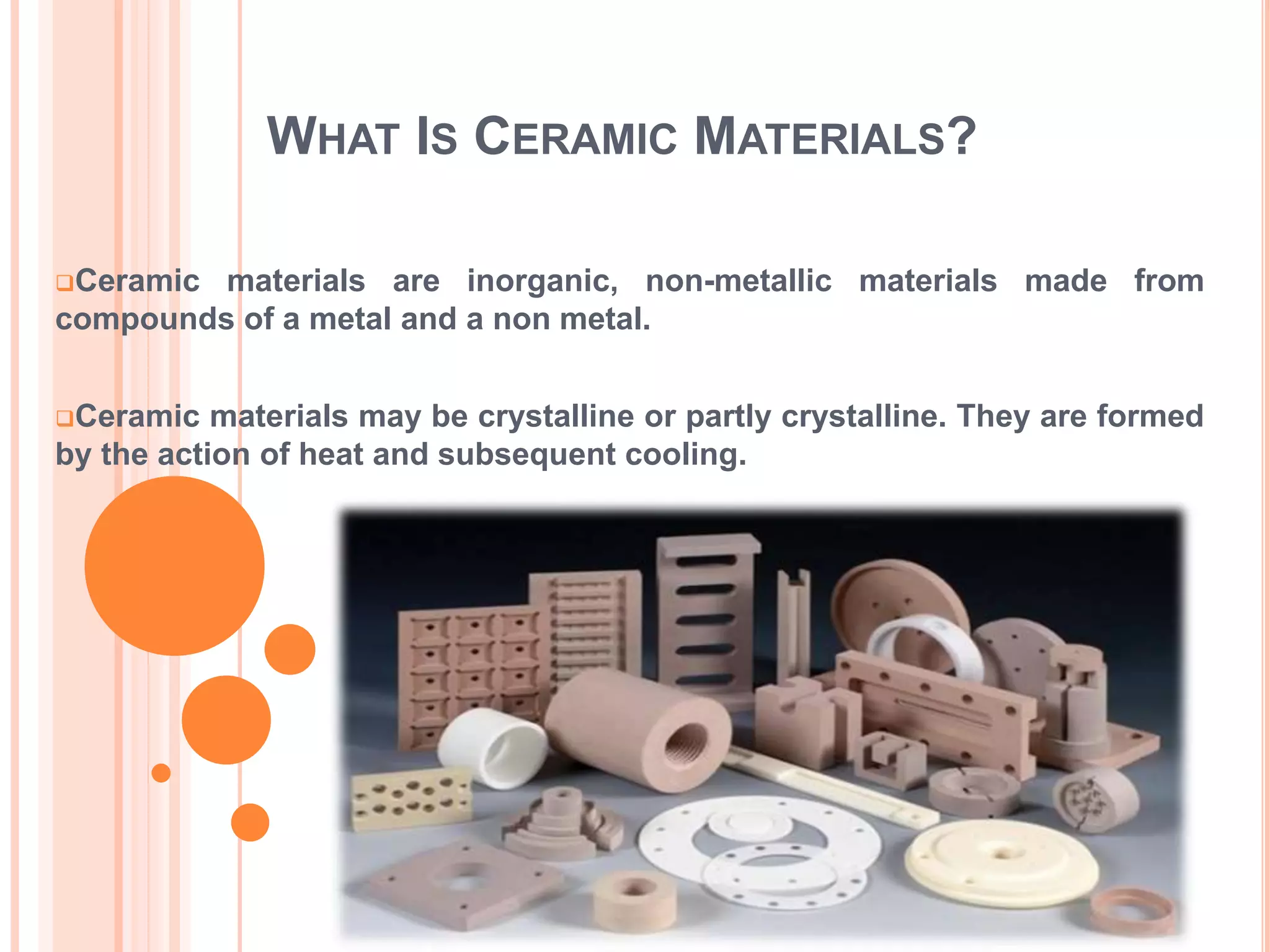
Ceramic materials are inorganic, non-metallic materials made from
compounds of a metal and a non metal.
Ceramic materials may be crystalline or partly crystalline. They are formed
by the action of heat and subsequent cooling.
CERAMIC PRODUCT
PROPERTIES
The properties of ceramic materials, like all materials,
are dictated by the types of atoms present, the types
of bonding between the atoms, and the way the atoms
are packed together. This is known as the atomic scale
structure. Most ceramics are made up of two or more
elements. This is called a compound. For example,
alumina (Al2O3), is a compound made up of aluminum
atoms and oxygen atoms.
REQUIREMENTS
Ceramic products for construction, domestic and industrial
uses are obtained making a wide use of natural raw materials.
Bricks, tiles, sanitaryware, tableware, lightweight aggregates
and silica-alumina refractories are all manufactured mainly
utilizing clay materials, feldspathic fluxes and/or quartzous
sands; in addition, complementary raw materials are seldom
used (e.g. talc, carbonates, wollastonite, zircon, borates,
lithium minerals).
IMPORTANCE OF CERAMICS IN TODAY'S
WORLD?
 Applications for advanced ceramics have received
major media attention in recent years, particularly
for use as parts in a future ceramic heat engine.
However, corrosion resistance, chemical inertness,
thermal shock resistance, and other properties that
materials scientists and engineers can design into
ceramic materials make both traditional and
advanced ceramics highly attractive in a large
number of applications
IMPORTANCE…………
 ceramics play a big role in the machine-tool
industry. Their thermal and mechanical stability
allows them to retain their smooth, accurate cutting
surfaces longer than metals do. Coated cutting
tools and inserts, some with as many as 12
extremely thin coatings, each designed to serve a
special function, can run productively at faster
cutting speeds and at faster feed rates than can
any metal-alloy tool in the machining of hard steels,
superalloys, and ceramics.
TYPES OF CERAMIC MATERIALS
• Alumina
Alumina is the most widely used advanced ceramic
material. It offers very good performance in terms of wear
resistance, corrosion resistance and strength at a
reasonable price. Its high dielectric properties are
beneficial in electronic products.
• Silicon
Silicon nitride exceeds other ceramic materials in
thermal shock resistance. It also offers an excellent
combination of low density, high strength, low thermal
expansion and good corrosion resistance and fracture
toughness.
USES OF CERAMIC MATERIALS
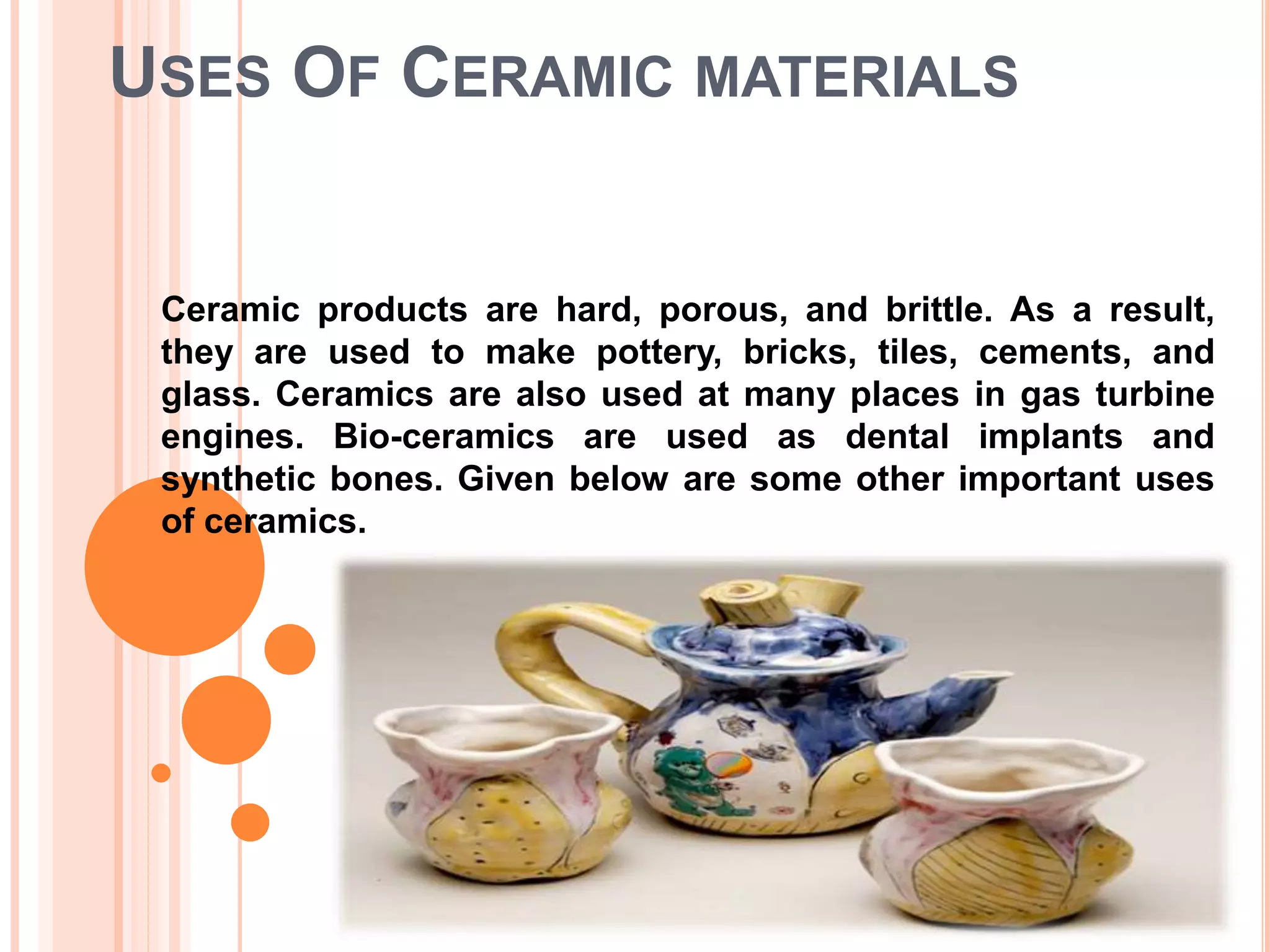
Ceramic products are hard, porous, and brittle. As a result,
they are used to make pottery, bricks, tiles, cements, and
glass. Ceramics are also used at many places in gas turbine
engines. Bio-ceramics are used as dental implants and
synthetic bones. Given below are some other important uses
of ceramics.
CONCLUSION………….
Civil Engineering's have a great impact on societies, they build
houses , roads , dams , irrigation , sanitary system , all these
services are mandatory for all societies , therefore civil engineers
significantly affect the countries and people
Ceramics

Ceramics

  • 1.
  • 2.
    WHAT IS CERAMICMATERIALS? Ceramic materials are inorganic, non-metallic materials made from compounds of a metal and a non metal. Ceramic materials may be crystalline or partly crystalline. They are formed by the action of heat and subsequent cooling.
  • 3.
  • 4.
    PROPERTIES The properties ofceramic materials, like all materials, are dictated by the types of atoms present, the types of bonding between the atoms, and the way the atoms are packed together. This is known as the atomic scale structure. Most ceramics are made up of two or more elements. This is called a compound. For example, alumina (Al2O3), is a compound made up of aluminum atoms and oxygen atoms.
  • 5.
    REQUIREMENTS Ceramic products forconstruction, domestic and industrial uses are obtained making a wide use of natural raw materials. Bricks, tiles, sanitaryware, tableware, lightweight aggregates and silica-alumina refractories are all manufactured mainly utilizing clay materials, feldspathic fluxes and/or quartzous sands; in addition, complementary raw materials are seldom used (e.g. talc, carbonates, wollastonite, zircon, borates, lithium minerals).
  • 6.
    IMPORTANCE OF CERAMICSIN TODAY'S WORLD?  Applications for advanced ceramics have received major media attention in recent years, particularly for use as parts in a future ceramic heat engine. However, corrosion resistance, chemical inertness, thermal shock resistance, and other properties that materials scientists and engineers can design into ceramic materials make both traditional and advanced ceramics highly attractive in a large number of applications
  • 7.
    IMPORTANCE…………  ceramics playa big role in the machine-tool industry. Their thermal and mechanical stability allows them to retain their smooth, accurate cutting surfaces longer than metals do. Coated cutting tools and inserts, some with as many as 12 extremely thin coatings, each designed to serve a special function, can run productively at faster cutting speeds and at faster feed rates than can any metal-alloy tool in the machining of hard steels, superalloys, and ceramics.
  • 8.
    TYPES OF CERAMICMATERIALS • Alumina Alumina is the most widely used advanced ceramic material. It offers very good performance in terms of wear resistance, corrosion resistance and strength at a reasonable price. Its high dielectric properties are beneficial in electronic products. • Silicon Silicon nitride exceeds other ceramic materials in thermal shock resistance. It also offers an excellent combination of low density, high strength, low thermal expansion and good corrosion resistance and fracture toughness.
  • 9.
    USES OF CERAMICMATERIALS Ceramic products are hard, porous, and brittle. As a result, they are used to make pottery, bricks, tiles, cements, and glass. Ceramics are also used at many places in gas turbine engines. Bio-ceramics are used as dental implants and synthetic bones. Given below are some other important uses of ceramics.
  • 10.
    CONCLUSION…………. Civil Engineering's havea great impact on societies, they build houses , roads , dams , irrigation , sanitary system , all these services are mandatory for all societies , therefore civil engineers significantly affect the countries and people