Cephalosporins
Sanjaya Mani Dixit
Assistant Prof of Pharmacology
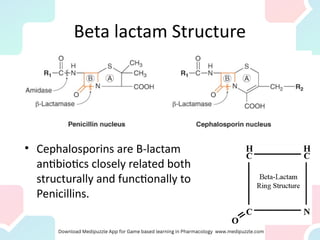
Beta lactam Structure
• Cephalosporins are B-lactam
antibiotics closely related both
structurally and functionally to
Penicillins.
B- Lactams--- Cephalosporins
• Beta-lactam antibiotics are among the most
commonly prescribed drugs, grouped together based
upon a shared structural feature, the beta-lactam
ring.
• Cephalosporins cover a broad range of organisms.
• They are generally well-tolerated, and are easy to
administer; thus, these agents are frequently used
beta-lactam drugs.
CEPHALOSPORINS
• From a fungus Cephalosporium acremonium
• Semi-synthetic Cephalosporins- from 7- Aminocephalosporanic acid.
- Gram (+ve) & Gram (-ve)
- More Resistant than PCNs to beta - lactamases
- Bactericidal - action similar to PCN’s
- Action - inhibits bacterial cell wall synthesis
- 4 groups (generations) - each effective against a
broader spectrum of bacteria
- about 10% of people allergic to PCN also to allergic to
cephalosporins
- IM & IV - onset = almost immediate
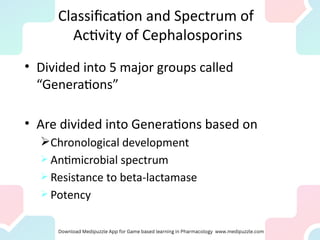
Classification and Spectrum of
Activity of Cephalosporins
• Divided into 5 major groups called
“Generations”
• Are divided into Generations based on
Chronological development
 Antimicrobial spectrum
 Resistance to beta-lactamase
 Potency
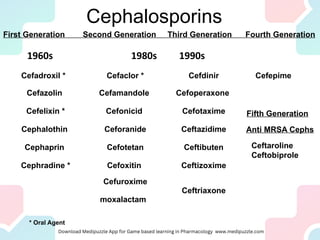
First Generation Second Generation Third Generation Fourth Generation
1960s 1980s 1990s
* Oral Agent
Cefadroxil * Cefaclor * Cefdinir Cefepime
Cefazolin Cefamandole Cefoperaxone
Cefelixin * Cefonicid Cefotaxime
Cephalothin Ceforanide Ceftazidime
Cephaprin Cefotetan Ceftibuten
Cephradine * Cefoxitin Ceftizoxime
Cefuroxime
moxalactam
Ceftriaxone
Cephalosporins
Fifth Generation
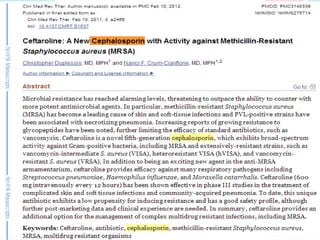
Ceftaroline
Ceftobiprole
Anti MRSA Cephs
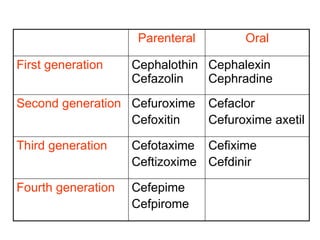
Parenteral Oral
First generation Cephalothin
Cefazolin
Cephalexin
Cephradine
Second generation Cefuroxime
Cefoxitin
Cefaclor
Cefuroxime axetil
Third generation Cefotaxime
Ceftizoxime
Cefixime
Cefdinir
Fourth generation Cefepime
Cefpirome
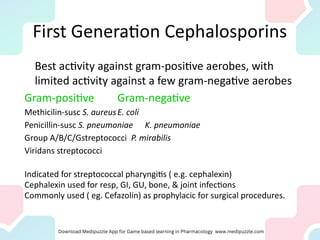
First Generation Cephalosporins
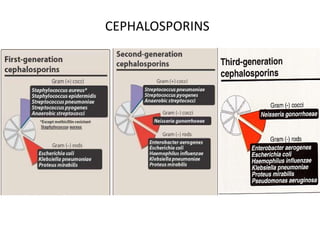
Best activity against gram-positive aerobes, with
limited activity against a few gram-negative aerobes
Gram-positive Gram-negative
Methicilin-susc S. aureusE. coli
Penicillin-susc S. pneumoniae K. pneumoniae
Group A/B/C/Gstreptococci P. mirabilis
Viridans streptococci
Indicated for streptococcal pharyngitis ( e.g. cephalexin)
Cephalexin used for resp, GI, GU, bone, & joint infections
Commonly used ( eg. Cefazolin) as prophylacic for surgical procedures.
Second Generation Cephalosporins
Spectrum of Activity
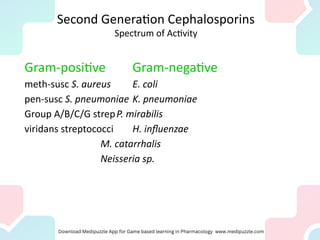
Gram-positive Gram-negative
meth-susc S. aureus E. coli
pen-susc S. pneumoniae K. pneumoniae
Group A/B/C/G strepP. mirabilis
viridans streptococci H. influenzae
M. catarrhalis
Neisseria sp.
Second Generation Cephalosporins
Spectrum of Activity
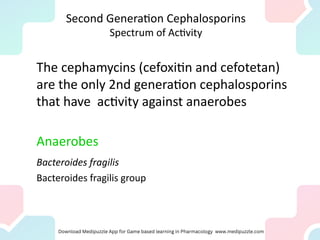
The cephamycins (cefoxitin and cefotetan)
are the only 2nd generation cephalosporins
that have activity against anaerobes
Anaerobes
Bacteroides fragilis
Bacteroides fragilis group
Second Generation Cephalosporins
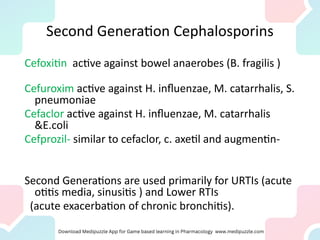
Cefoxitin active against bowel anaerobes (B. fragilis )
Cefuroxim active against H. influenzae, M. catarrhalis, S.
pneumoniae
Cefaclor active against H. influenzae, M. catarrhalis
&E.coli
Cefprozil- similar to cefaclor, c. axetil and augmentin-
Second Generations are used primarily for URTIs (acute
otitis media, sinusitis ) and Lower RTIs
(acute exacerbation of chronic bronchitis).
Third Generation Cephalosporins
Spectrum of Activity
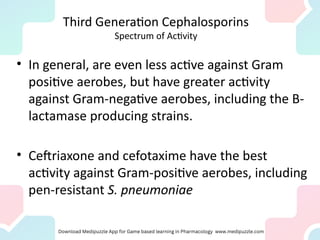
• In general, are even less active against Gram
positive aerobes, but have greater activity
against Gram-negative aerobes, including the B-
lactamase producing strains.
• Ceftriaxone and cefotaxime have the best
activity against Gram-positive aerobes, including
pen-resistant S. pneumoniae
Third Generation Cephalosporins
Spectrum of Activity
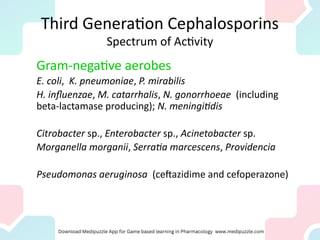
Gram-negative aerobes
E. coli, K. pneumoniae, P. mirabilis
H. influenzae, M. catarrhalis, N. gonorrhoeae (including
beta-lactamase producing); N. meningitidis
Citrobacter sp., Enterobacter sp., Acinetobacter sp.
Morganella morganii, Serratia marcescens, Providencia
Pseudomonas aeruginosa (ceftazidime and cefoperazone)
Third Generation Cephalosporins
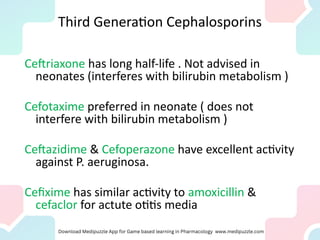
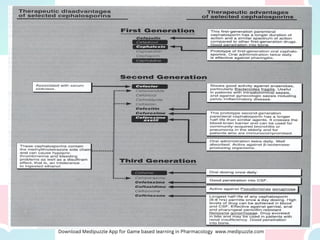
Ceftriaxone has long half-life . Not advised in
neonates (interferes with bilirubin metabolism )
Cefotaxime preferred in neonate ( does not
interfere with bilirubin metabolism )
Ceftazidime & Cefoperazone have excellent activity
against P. aeruginosa.
Cefixime has similar activity to amoxicillin &
cefaclor for actute otitis media
Fourth Generation Cephalosporins
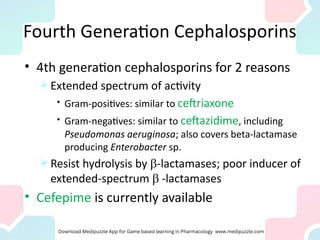
• 4th generation cephalosporins for 2 reasons
 Extended spectrum of activity
 Gram-positives: similar to ceftriaxone
 Gram-negatives: similar to ceftazidime, including
Pseudomonas aeruginosa; also covers beta-lactamase
producing Enterobacter sp.
 Resist hydrolysis by -lactamases; poor inducer of
extended-spectrum  -lactamases
• Cefepime is currently available
Fourth Generation Cephalosporins
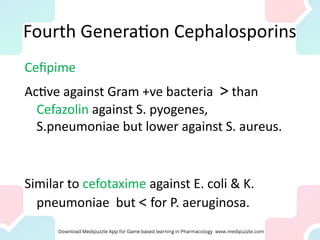
Cefipime
Active against Gram +ve bacteria > than
Cefazolin against S. pyogenes,
S.pneumoniae but lower against S. aureus.
Similar to cefotaxime against E. coli & K.
pneumoniae but < for P. aeruginosa.
Pharmacokinetics
• Some Cephalosporins may be given orally but most are
given parenterally (IM or IV).
• Widely distributed in the body like penicillins
• Third generation Cephs --Cefoperazone, Cefotaxime,
Ceftriaxone, and Ceftazidime also cross BBB and are DOC
for meningitis due to Gram-negative intestinal bacteria.
• Almost all are primally eliminated via the kidneys and are
actively secreted by the renal tubules. Cefoperazone and
ceftriaxone are eliminated through the biliary tract.
Uses:
• A cephalosporin with or without an aminoglycoside is
first-line treatment of Klebsiella.
• First generation cephalosporins are used for surgical
prophylaxis of wound infection.
• Third generation cephalosporins are used to treat
meningitis due to pneumococci, meningococci, and
Haemophillus influenza.
• Ceftriaxone is the drug of choice for treating beta-
lactamase producing Neisseria gonorrhea.
Uses:
–Septicaemia (e.g. cefuroxime, cefotaxime)
–Pneumonia caused by susceptible organisms
–Meningitis (e.g. ceftriaxone, cefotaxime)
–Biliary tract infection
–Urinary tract infection (especially in pregnancy
or in patients unresponsive to other drugs)
–Sinusitis (e.g. cefadroxil).
Adverse effects
• Hypersensitivity reactions -similar to -penicillins
• Diarrhea may occur with oral forms.
• Nephrotoxicity
• Intolerance to alcohol (Disulfiram like reaction) has been
reported. (cefotetan, cefoperazone)
• Superinfection.
• Hyperprothrombinemia, Thrombocytopenia, Platelet
dysfunction. Administration of vitamin K (10mg) twice a week
can prevent this.
• Especially seen with 3rd
generation cephlosporins which
eliminate the bacteria in intestinal tract that produce Vitamin K.
CEPHALOSPORINS
Drug interaction
• Cephalosporins demonstrate synergistic
activity when combined with an
aminoglycoside to treat Klebsiella.
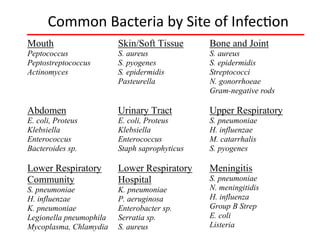
Common Bacteria by Site of Infection
Mouth
Peptococcus
Peptostreptococcus
Actinomyces
Skin/Soft Tissue
S. aureus
S. pyogenes
S. epidermidis
Pasteurella
Bone and Joint
S. aureus
S. epidermidis
Streptococci
N. gonorrhoeae
Gram-negative rods
Abdomen
E. coli, Proteus
Klebsiella
Enterococcus
Bacteroides sp.
Urinary Tract
E. coli, Proteus
Klebsiella
Enterococcus
Staph saprophyticus
Upper Respiratory
S. pneumoniae
H. influenzae
M. catarrhalis
S. pyogenes
Lower Respiratory
Community
S. pneumoniae
H. influenzae
K. pneumoniae
Legionella pneumophila
Mycoplasma, Chlamydia
Lower Respiratory
Hospital
K. pneumoniae
P. aeruginosa
Enterobacter sp.
Serratia sp.
S. aureus
Meningitis
S. pneumoniae
N. meningitidis
H. influenza
Group B Strep
E. coli
Listeria
www.medipuzzle.com
Trusted by
10K + Students
That’s All
ENJOY
26
AMA-_Cephalosporins.pdf

AMA-_Cephalosporins.pdf

  • 1.
  • 2.
    Beta lactam Structure •Cephalosporins are B-lactam antibiotics closely related both structurally and functionally to Penicillins.
  • 3.
    B- Lactams--- Cephalosporins •Beta-lactam antibiotics are among the most commonly prescribed drugs, grouped together based upon a shared structural feature, the beta-lactam ring. • Cephalosporins cover a broad range of organisms. • They are generally well-tolerated, and are easy to administer; thus, these agents are frequently used beta-lactam drugs.
  • 4.
    CEPHALOSPORINS • From afungus Cephalosporium acremonium • Semi-synthetic Cephalosporins- from 7- Aminocephalosporanic acid. - Gram (+ve) & Gram (-ve) - More Resistant than PCNs to beta - lactamases - Bactericidal - action similar to PCN’s - Action - inhibits bacterial cell wall synthesis - 4 groups (generations) - each effective against a broader spectrum of bacteria - about 10% of people allergic to PCN also to allergic to cephalosporins - IM & IV - onset = almost immediate
  • 5.
    Classification and Spectrumof Activity of Cephalosporins • Divided into 5 major groups called “Generations” • Are divided into Generations based on Chronological development  Antimicrobial spectrum  Resistance to beta-lactamase  Potency
  • 6.
    First Generation SecondGeneration Third Generation Fourth Generation 1960s 1980s 1990s * Oral Agent Cefadroxil * Cefaclor * Cefdinir Cefepime Cefazolin Cefamandole Cefoperaxone Cefelixin * Cefonicid Cefotaxime Cephalothin Ceforanide Ceftazidime Cephaprin Cefotetan Ceftibuten Cephradine * Cefoxitin Ceftizoxime Cefuroxime moxalactam Ceftriaxone Cephalosporins Fifth Generation Ceftaroline Ceftobiprole Anti MRSA Cephs
  • 7.
    Parenteral Oral First generationCephalothin Cefazolin Cephalexin Cephradine Second generation Cefuroxime Cefoxitin Cefaclor Cefuroxime axetil Third generation Cefotaxime Ceftizoxime Cefixime Cefdinir Fourth generation Cefepime Cefpirome
  • 8.
    First Generation Cephalosporins Bestactivity against gram-positive aerobes, with limited activity against a few gram-negative aerobes Gram-positive Gram-negative Methicilin-susc S. aureusE. coli Penicillin-susc S. pneumoniae K. pneumoniae Group A/B/C/Gstreptococci P. mirabilis Viridans streptococci Indicated for streptococcal pharyngitis ( e.g. cephalexin) Cephalexin used for resp, GI, GU, bone, & joint infections Commonly used ( eg. Cefazolin) as prophylacic for surgical procedures.
  • 9.
    Second Generation Cephalosporins Spectrumof Activity Gram-positive Gram-negative meth-susc S. aureus E. coli pen-susc S. pneumoniae K. pneumoniae Group A/B/C/G strepP. mirabilis viridans streptococci H. influenzae M. catarrhalis Neisseria sp.
  • 10.
    Second Generation Cephalosporins Spectrumof Activity The cephamycins (cefoxitin and cefotetan) are the only 2nd generation cephalosporins that have activity against anaerobes Anaerobes Bacteroides fragilis Bacteroides fragilis group
  • 11.
    Second Generation Cephalosporins Cefoxitinactive against bowel anaerobes (B. fragilis ) Cefuroxim active against H. influenzae, M. catarrhalis, S. pneumoniae Cefaclor active against H. influenzae, M. catarrhalis &E.coli Cefprozil- similar to cefaclor, c. axetil and augmentin- Second Generations are used primarily for URTIs (acute otitis media, sinusitis ) and Lower RTIs (acute exacerbation of chronic bronchitis).
  • 12.
    Third Generation Cephalosporins Spectrumof Activity • In general, are even less active against Gram positive aerobes, but have greater activity against Gram-negative aerobes, including the B- lactamase producing strains. • Ceftriaxone and cefotaxime have the best activity against Gram-positive aerobes, including pen-resistant S. pneumoniae
  • 13.
    Third Generation Cephalosporins Spectrumof Activity Gram-negative aerobes E. coli, K. pneumoniae, P. mirabilis H. influenzae, M. catarrhalis, N. gonorrhoeae (including beta-lactamase producing); N. meningitidis Citrobacter sp., Enterobacter sp., Acinetobacter sp. Morganella morganii, Serratia marcescens, Providencia Pseudomonas aeruginosa (ceftazidime and cefoperazone)
  • 14.
    Third Generation Cephalosporins Ceftriaxonehas long half-life . Not advised in neonates (interferes with bilirubin metabolism ) Cefotaxime preferred in neonate ( does not interfere with bilirubin metabolism ) Ceftazidime & Cefoperazone have excellent activity against P. aeruginosa. Cefixime has similar activity to amoxicillin & cefaclor for actute otitis media
  • 15.
    Fourth Generation Cephalosporins •4th generation cephalosporins for 2 reasons  Extended spectrum of activity  Gram-positives: similar to ceftriaxone  Gram-negatives: similar to ceftazidime, including Pseudomonas aeruginosa; also covers beta-lactamase producing Enterobacter sp.  Resist hydrolysis by -lactamases; poor inducer of extended-spectrum  -lactamases • Cefepime is currently available
  • 16.
    Fourth Generation Cephalosporins Cefipime Activeagainst Gram +ve bacteria > than Cefazolin against S. pyogenes, S.pneumoniae but lower against S. aureus. Similar to cefotaxime against E. coli & K. pneumoniae but < for P. aeruginosa.
  • 17.
    Pharmacokinetics • Some Cephalosporinsmay be given orally but most are given parenterally (IM or IV). • Widely distributed in the body like penicillins • Third generation Cephs --Cefoperazone, Cefotaxime, Ceftriaxone, and Ceftazidime also cross BBB and are DOC for meningitis due to Gram-negative intestinal bacteria. • Almost all are primally eliminated via the kidneys and are actively secreted by the renal tubules. Cefoperazone and ceftriaxone are eliminated through the biliary tract.
  • 18.
    Uses: • A cephalosporinwith or without an aminoglycoside is first-line treatment of Klebsiella. • First generation cephalosporins are used for surgical prophylaxis of wound infection. • Third generation cephalosporins are used to treat meningitis due to pneumococci, meningococci, and Haemophillus influenza. • Ceftriaxone is the drug of choice for treating beta- lactamase producing Neisseria gonorrhea.
  • 19.
    Uses: –Septicaemia (e.g. cefuroxime,cefotaxime) –Pneumonia caused by susceptible organisms –Meningitis (e.g. ceftriaxone, cefotaxime) –Biliary tract infection –Urinary tract infection (especially in pregnancy or in patients unresponsive to other drugs) –Sinusitis (e.g. cefadroxil).
  • 20.
    Adverse effects • Hypersensitivityreactions -similar to -penicillins • Diarrhea may occur with oral forms. • Nephrotoxicity • Intolerance to alcohol (Disulfiram like reaction) has been reported. (cefotetan, cefoperazone) • Superinfection. • Hyperprothrombinemia, Thrombocytopenia, Platelet dysfunction. Administration of vitamin K (10mg) twice a week can prevent this. • Especially seen with 3rd generation cephlosporins which eliminate the bacteria in intestinal tract that produce Vitamin K.
  • 21.
  • 22.
    Drug interaction • Cephalosporinsdemonstrate synergistic activity when combined with an aminoglycoside to treat Klebsiella.
  • 23.
    Common Bacteria bySite of Infection Mouth Peptococcus Peptostreptococcus Actinomyces Skin/Soft Tissue S. aureus S. pyogenes S. epidermidis Pasteurella Bone and Joint S. aureus S. epidermidis Streptococci N. gonorrhoeae Gram-negative rods Abdomen E. coli, Proteus Klebsiella Enterococcus Bacteroides sp. Urinary Tract E. coli, Proteus Klebsiella Enterococcus Staph saprophyticus Upper Respiratory S. pneumoniae H. influenzae M. catarrhalis S. pyogenes Lower Respiratory Community S. pneumoniae H. influenzae K. pneumoniae Legionella pneumophila Mycoplasma, Chlamydia Lower Respiratory Hospital K. pneumoniae P. aeruginosa Enterobacter sp. Serratia sp. S. aureus Meningitis S. pneumoniae N. meningitidis H. influenza Group B Strep E. coli Listeria
  • 25.
  • 26.