A Presentation On
Cephalosporin
Md. Ashraful Zaman Akash
Asraful Islam Rayhan
Md. Nazmus Sakib
Sanzida Afroze
ID-131017
ID-131039
ID-131032
ID-131004
ID-131021
Shamsunnahar Lipa
Md. Rubel Haque ID-131024
Presented
By……….
Outlines……
Definition
History
Chemistry
Properties
Classification & its Generation
Pharmacokinetics
Mechanismof action
Indication
Contraindication
Therapeuticuse
Adverseeffect
Resistance
Comparisonwith penicillin
Market preparation...
Any of a group of widely used broad-spectrum
antibiotics, originally isolated as a product of
fermentation from the fungus Cephalosporium
acremonium are called Cephalosporins.
Definition
Fig:Cephalosporium acremonium
The first chemical compounds of
the cephalosporin group were
isolated from Cephalosporium
acremonium, a cephalosporin-
producing fungus, first discovered
by Giuseppe Brotzu in 1948.
The Cephalosporines are isolated from
Cephalosporium species
Prepared semisynthetically
Giuseppe Brotzu
(1895-1976) Italy.
History:
system containing 4-
a bicyclic
𝖰 -lactam ring
It has
membered
membered dihydrothiazine
fused
ring
to a six
system
.Nucleous of the most cephalosporin is 7-
amino-cephalosporanic acid (7-ACA) .
Possible modifications
•7-Acylamino side chain
•3-Acetoxymethyl side chain
•Substitution at C-7
Chemistry of Cephalosporin:
N
O
H H
H
N
O
CO2
H
O M
e
C
O
HN
CO2
H
2
H
S
1
2
3
4
5
7 6
8
N
O
H H
2
H N S
CO2H
O Me
C
O
7-Aminocephalosporinic acid
(7-ACA)
Dihydrothiazine
ring
-Lactam
ring
Properties of cephalosporins
Broad spectrum activity
They are water soluble
The molecular weight of cephalosporins is 400-450
Relatively stable to pH and temperature changes
Nucleus of cephalosporin is 7-amino cephalos
poranic acid
Their activity is not reduced by serum
nucleus Consists of dihydrothiazine ring
fused to a β–lactam ring
Range from very narrow spectrum to very
broad spectrum
7-aminocephalosporanic acid has been
modified by addition of different side chains
to create a whole family of cephalosporin
antibiotics.
Classification of cephalosporins:
 According to generations Cephalosporins
are following types…
First Generation
Second Generation
Third Generation
Fourth Generation
Fifth Generation
Sixth Generation
First Generation:
 Parenteral Drugs:
 Cefazolin
 Cephalothin
 Cephapirin
 Cephradine
 Oral
 Cephalexin
 Cephradine
 Cefadroxil
•Exhibit good activity against gram-positive
bacteria
–Most gram-positive cocci
–Strepto,
–Pneumo,
• Modest activity against E. coli, K.
pneumoniae & Proteus mirabilis
Second Generation:
 Parenteral Drugs
 Cefamendole
 Cefonicid
 Cefoxidin
 Oral Drugs
 Cefaclor
 Cefuroxime axetil
 Exhibit somewhat increased activity against
gram negative organisms,
but much less active than third generation
agents.
 Less active against gram positive cocci & bacilli
compared to first gen. drugs.
Third Generation:
 Parenteral Drugs
 Cefotaxime
 Cefriaxone
 Ceftazidime
 Cefoperazone
 Oral Drugs
 Cefixime
 Cefotaxime
 Cefdinir
 Cefpodoxime proxetil
Highly augmented activity against gram-negative
organisms
All are highly resistant to β-lactamases from
gram negative bacteria.
 Some members of this group have enhanced ability
to cross the blood-brain barrier eg. Ceftriaxone .
Fourth Generation:
Parenteral Drugs:
Cefepime
Cefpirome
Cefozopran
 Highly active against G –ve organisms
 Effective against bacterial infections
resistant to earlier drugs.
 Ceftobiprole
 Ceftaroline
 Active against, g +ve cocci especially MRSA
penicillin resistant S. pneumoniae
and enterococci
Fifth Generation:
Pharmacokinetics:
 Rout of administration:
 Oral
 Parenteral
 Distribution
 Body fluid
 Joint fluid
 Pleural fluid
 CNS
 Elimination
 Unchanged in urine
 Renal tubules
 Plasma Half-life: 1-4 hours mostly
layer is important for cell wall structure integrity of
 Peptidoglycan
bacteria .
The final step in synthesis of peptidoglycan ( Transpeptidation) is
facilitated by transpeptidase ( PBP- Penicillin Binding Protein )
Cephalosporin comptitively inhibit PBP as it mimics the structure of
D-Ala-D-Ala link to which PBP bind for cross-linking of peptidoglycan
.
As it disrupting the cross-linking process the cell wall will lose
its strength which results in cell lysis.
Mechanism of action:
MECHANISM OF ACTION:
By Flow Chart:
Cephalosporin
Act as transpeptidase enzyme
Inhibit transpeptidation reaction
Block peptidoglycine synthesis
Activation of Autolytic enzyme
Increase the permeability of cell membrane
Cell explodes and lysed
Death of microorganism
oUTI
oInfection of gut
oRespiratory tract infection
oBoils, abscess
oProphylaxis in surgery
oBiliary sepsis
oPerson allergic to penicillin
Indication..
oMeningitis
oGonorrhoea
oInfected burns
oSepticaemia
oAspirin Pneumonia
oMixed infection
oTonsillitis
Contraindication:
 These drugs are contraindicated in patient with
known hypersensitivity to cephalosporin & penicillin
.
Renal failure
Hepatic impairment
Rheumatic fever
Lactating patient and anaerobic infections.
Pregnancy & Breastfeeding
Therapeutic Uses:
 Extensively used & therapeutically
importan antibiotics
 Effective therapeutic & prophylactic agents
AdverseEffect..
Allergic reaction
 Anaphaylaxis
 Serum sickness
 Urticaria
 Skin rash
 Haemolytic anaemia etc..
GIT upset
 Nausia
 Vomiting
 Diarrhoea
Nephrotoxicity:
 Interstitial Nephritis
 Renal Tubular necrosis
Others:
Disulfiram-like reaction
Local irritation after I/M injection
Thromboflavitis after repeated I/V
Bleeding tendency
Eosinophilia and thrombocytosis
Defect of newborn babies
Pharyngitis ( Throat infection)
Stillbirth or Miscarriage
 Impermeability to the antibiotic.
-to reach its site of action
Alteration in PBPs -antibiotics bind with low
affinity
Elaboration of β-lactamases; that can
hydrolyze the β-lactam ring and inactivate the
cephalosporin (most prevalent mech)
Resistance
Similarity :
 Both obtained from fungus
 Structural similarity
 Mechanism action ( Cell wall inhibitor )
Dissimilarity :
Resistant to beta lactamase
Antibiotic spectrum
 Precursor
COM
PARISON W
ITH PENICILLIN
 Broad spectrum of activity
 Stability to Beta-lactamase
 Oral and parenteral preparations
 Widely accepted
 Treats ‘Day to Day’as well as serious infections.
 High safety profile.
Why Cephalosporin is used-
 Extremely widely used :-
 Safe :
Side effects specific to individual members of
the family as well as the family as a whole
Not necessarily cross reaction with penicillin
hypersensitivity
Market Preparation Of Cephalosporin…
LORACEF (Square)
Doses form: Dose:
 Suspension 125mg/5ml
 Capsule 500mg
 Drop 100mg/1ml
CLOBAC (Opsonin)
-Dose:
100mg/1ml drop
125mg/5ml suspension
-Price:
100ml bot: 180.00 MRP
15ml bot: 125.00 MRP
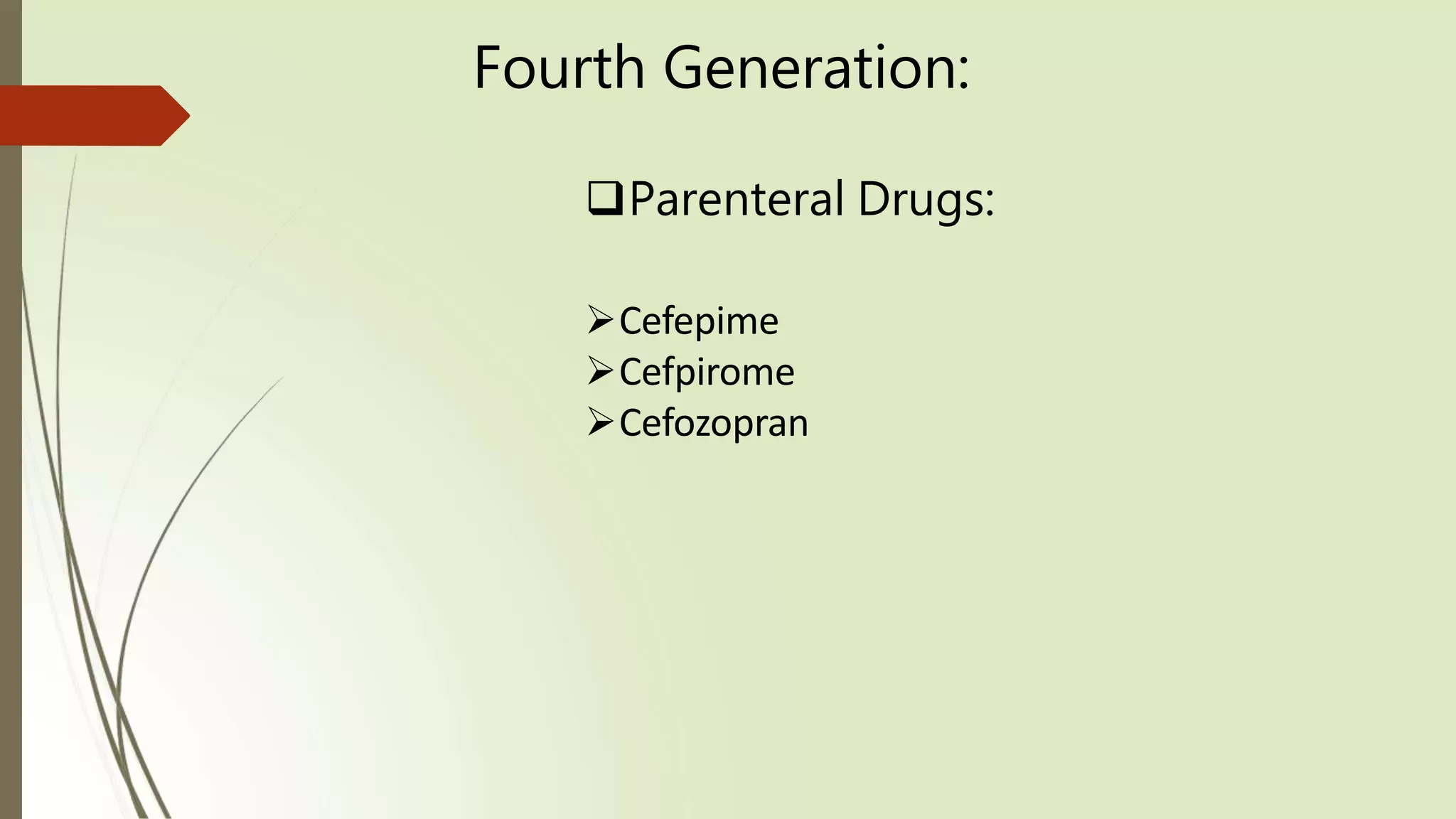
CEFLON (Eskayef)
Doses form: Dose:
 Suspension 125mg/5ml
 Capsule 500mg
 Drop 100mg/1ml
CEFTICLOR (Renata)
-Dose:
250mg & 500mg/capsule
125mg/5ml suspension
100mg/1ml drop
-Price:
250mg x 12s pack: 252.00 MRP; 500mg x 12s pack: 456.00 MRP
100ml bot: 190.00 MRP
15ml bot: 125.00 MRP
Refe
re
nce
s :
Lippincott’sIllustratedPharmacology,
ChampP.C- EssentialsofM
edical Pharmacology,
TripathiK.D-Basic&ClinicalPharmacology,
KatzungB.G.
www. Wikipedia.com
cephalosporin-180714171228.pptx

cephalosporin-180714171228.pptx

  • 1.
  • 2.
    Md. Ashraful ZamanAkash Asraful Islam Rayhan Md. Nazmus Sakib Sanzida Afroze ID-131017 ID-131039 ID-131032 ID-131004 ID-131021 Shamsunnahar Lipa Md. Rubel Haque ID-131024 Presented By……….
  • 3.
    Outlines…… Definition History Chemistry Properties Classification & itsGeneration Pharmacokinetics Mechanismof action Indication Contraindication Therapeuticuse Adverseeffect Resistance Comparisonwith penicillin Market preparation...
  • 4.
    Any of agroup of widely used broad-spectrum antibiotics, originally isolated as a product of fermentation from the fungus Cephalosporium acremonium are called Cephalosporins. Definition Fig:Cephalosporium acremonium
  • 5.
    The first chemicalcompounds of the cephalosporin group were isolated from Cephalosporium acremonium, a cephalosporin- producing fungus, first discovered by Giuseppe Brotzu in 1948. The Cephalosporines are isolated from Cephalosporium species Prepared semisynthetically Giuseppe Brotzu (1895-1976) Italy. History:
  • 6.
    system containing 4- abicyclic 𝖰 -lactam ring It has membered membered dihydrothiazine fused ring to a six system .Nucleous of the most cephalosporin is 7- amino-cephalosporanic acid (7-ACA) . Possible modifications •7-Acylamino side chain •3-Acetoxymethyl side chain •Substitution at C-7 Chemistry of Cephalosporin: N O H H H N O CO2 H O M e C O HN CO2 H 2 H S 1 2 3 4 5 7 6 8 N O H H 2 H N S CO2H O Me C O 7-Aminocephalosporinic acid (7-ACA) Dihydrothiazine ring -Lactam ring
  • 7.
    Properties of cephalosporins Broadspectrum activity They are water soluble The molecular weight of cephalosporins is 400-450 Relatively stable to pH and temperature changes Nucleus of cephalosporin is 7-amino cephalos poranic acid Their activity is not reduced by serum
  • 8.
    nucleus Consists ofdihydrothiazine ring fused to a β–lactam ring Range from very narrow spectrum to very broad spectrum 7-aminocephalosporanic acid has been modified by addition of different side chains to create a whole family of cephalosporin antibiotics.
  • 9.
    Classification of cephalosporins: According to generations Cephalosporins are following types… First Generation Second Generation Third Generation Fourth Generation Fifth Generation Sixth Generation
  • 10.
    First Generation:  ParenteralDrugs:  Cefazolin  Cephalothin  Cephapirin  Cephradine  Oral  Cephalexin  Cephradine  Cefadroxil
  • 11.
    •Exhibit good activityagainst gram-positive bacteria –Most gram-positive cocci –Strepto, –Pneumo, • Modest activity against E. coli, K. pneumoniae & Proteus mirabilis
  • 12.
    Second Generation:  ParenteralDrugs  Cefamendole  Cefonicid  Cefoxidin  Oral Drugs  Cefaclor  Cefuroxime axetil
  • 13.
     Exhibit somewhatincreased activity against gram negative organisms, but much less active than third generation agents.  Less active against gram positive cocci & bacilli compared to first gen. drugs.
  • 14.
    Third Generation:  ParenteralDrugs  Cefotaxime  Cefriaxone  Ceftazidime  Cefoperazone  Oral Drugs  Cefixime  Cefotaxime  Cefdinir  Cefpodoxime proxetil
  • 15.
    Highly augmented activityagainst gram-negative organisms All are highly resistant to β-lactamases from gram negative bacteria.  Some members of this group have enhanced ability to cross the blood-brain barrier eg. Ceftriaxone .
  • 16.
  • 17.
     Highly activeagainst G –ve organisms  Effective against bacterial infections resistant to earlier drugs.
  • 18.
     Ceftobiprole  Ceftaroline Active against, g +ve cocci especially MRSA penicillin resistant S. pneumoniae and enterococci Fifth Generation:
  • 19.
    Pharmacokinetics:  Rout ofadministration:  Oral  Parenteral  Distribution  Body fluid  Joint fluid  Pleural fluid  CNS  Elimination  Unchanged in urine  Renal tubules  Plasma Half-life: 1-4 hours mostly
  • 20.
    layer is importantfor cell wall structure integrity of  Peptidoglycan bacteria . The final step in synthesis of peptidoglycan ( Transpeptidation) is facilitated by transpeptidase ( PBP- Penicillin Binding Protein ) Cephalosporin comptitively inhibit PBP as it mimics the structure of D-Ala-D-Ala link to which PBP bind for cross-linking of peptidoglycan . As it disrupting the cross-linking process the cell wall will lose its strength which results in cell lysis. Mechanism of action:
  • 22.
  • 23.
    By Flow Chart: Cephalosporin Actas transpeptidase enzyme Inhibit transpeptidation reaction Block peptidoglycine synthesis Activation of Autolytic enzyme Increase the permeability of cell membrane Cell explodes and lysed Death of microorganism
  • 24.
    oUTI oInfection of gut oRespiratorytract infection oBoils, abscess oProphylaxis in surgery oBiliary sepsis oPerson allergic to penicillin Indication..
  • 25.
  • 26.
    Contraindication:  These drugsare contraindicated in patient with known hypersensitivity to cephalosporin & penicillin . Renal failure Hepatic impairment Rheumatic fever Lactating patient and anaerobic infections. Pregnancy & Breastfeeding
  • 27.
    Therapeutic Uses:  Extensivelyused & therapeutically importan antibiotics  Effective therapeutic & prophylactic agents
  • 28.
    AdverseEffect.. Allergic reaction  Anaphaylaxis Serum sickness  Urticaria  Skin rash  Haemolytic anaemia etc.. GIT upset  Nausia  Vomiting  Diarrhoea
  • 29.
    Nephrotoxicity:  Interstitial Nephritis Renal Tubular necrosis Others: Disulfiram-like reaction Local irritation after I/M injection Thromboflavitis after repeated I/V Bleeding tendency Eosinophilia and thrombocytosis Defect of newborn babies Pharyngitis ( Throat infection) Stillbirth or Miscarriage
  • 30.
     Impermeability tothe antibiotic. -to reach its site of action Alteration in PBPs -antibiotics bind with low affinity Elaboration of β-lactamases; that can hydrolyze the β-lactam ring and inactivate the cephalosporin (most prevalent mech) Resistance
  • 31.
    Similarity :  Bothobtained from fungus  Structural similarity  Mechanism action ( Cell wall inhibitor ) Dissimilarity : Resistant to beta lactamase Antibiotic spectrum  Precursor COM PARISON W ITH PENICILLIN
  • 32.
     Broad spectrumof activity  Stability to Beta-lactamase  Oral and parenteral preparations  Widely accepted  Treats ‘Day to Day’as well as serious infections.  High safety profile. Why Cephalosporin is used-
  • 33.
     Extremely widelyused :-  Safe : Side effects specific to individual members of the family as well as the family as a whole Not necessarily cross reaction with penicillin hypersensitivity
  • 34.
    Market Preparation OfCephalosporin…
  • 35.
    LORACEF (Square) Doses form:Dose:  Suspension 125mg/5ml  Capsule 500mg  Drop 100mg/1ml
  • 36.
    CLOBAC (Opsonin) -Dose: 100mg/1ml drop 125mg/5mlsuspension -Price: 100ml bot: 180.00 MRP 15ml bot: 125.00 MRP
  • 37.
    CEFLON (Eskayef) Doses form:Dose:  Suspension 125mg/5ml  Capsule 500mg  Drop 100mg/1ml
  • 38.
    CEFTICLOR (Renata) -Dose: 250mg &500mg/capsule 125mg/5ml suspension 100mg/1ml drop -Price: 250mg x 12s pack: 252.00 MRP; 500mg x 12s pack: 456.00 MRP 100ml bot: 190.00 MRP 15ml bot: 125.00 MRP
  • 39.
    Refe re nce s : Lippincott’sIllustratedPharmacology, ChampP.C- EssentialsofM edicalPharmacology, TripathiK.D-Basic&ClinicalPharmacology, KatzungB.G. www. Wikipedia.com