Cephalosporins
Dr. M N Nadeem,
Associate Professor,
Pharmacology, DCMS
MBBS, MD Pharmacology
β-lactam ring
Antibiotics with
beta-lactam ring structure
β-lactam antibiotics
(bacterial cell wall synthesis inhibitors)
1. Penicillins
2. Cephalosporins
3. Carbapenems
4. Monobactams
Introduction to cephalosporins
• It is Semisynthetic, derived from cephalosporin-c
obtained from fungus Cephalosporium
acremonium.
• Chemically related to penicillin.
• Classified into 5 Generations based on Chronological
sequence of development (Years they were
introduced) :–
– 1st gen (1960s),
– 2nd gen (1970s) ,
– 3rd gen (1980s),
– 4th gen (1997-98),
– 5th gen (2000 & later) .
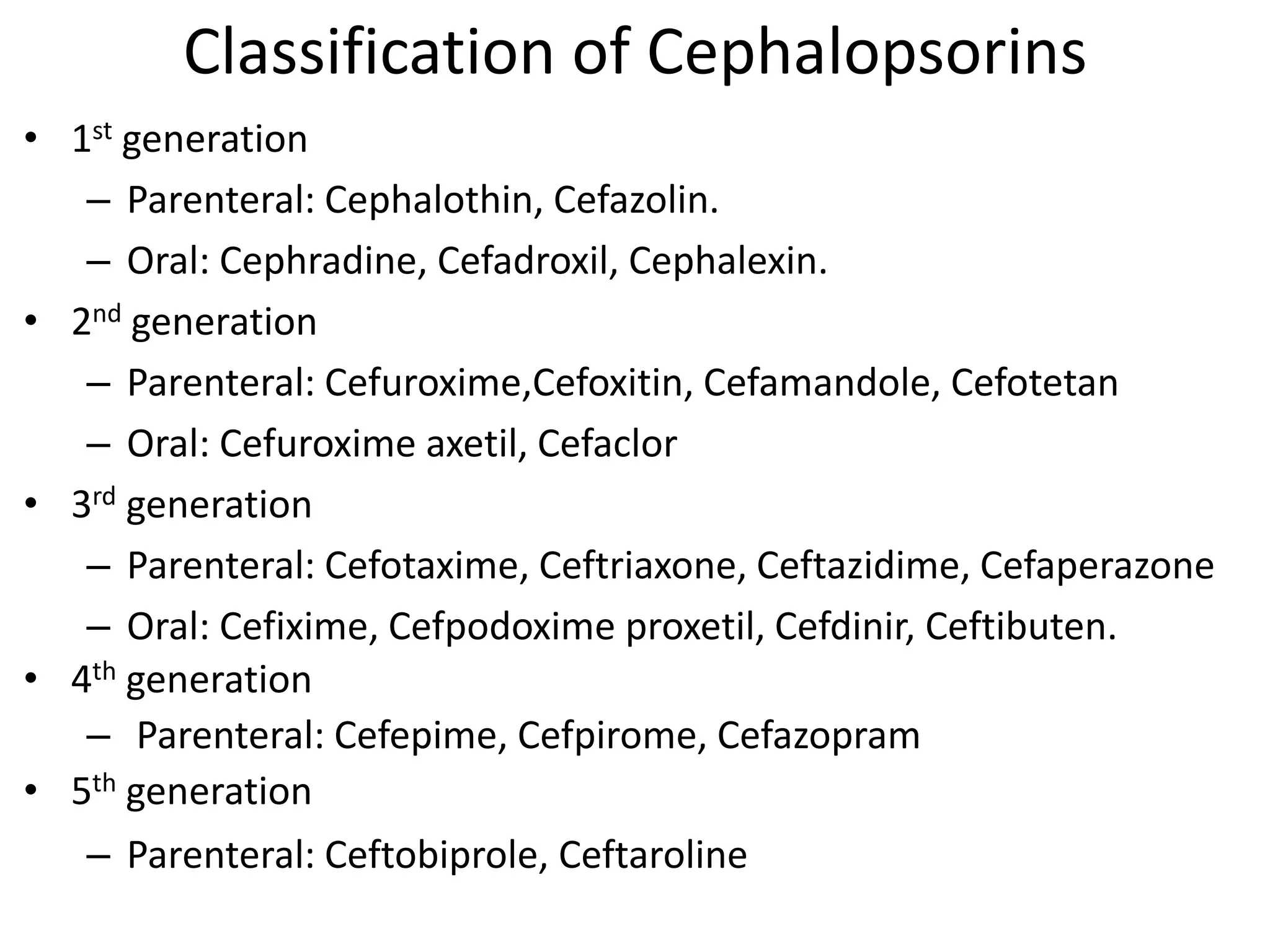
Classification of Cephalopsorins
• 1st generation
– Parenteral: Cephalothin, Cefazolin.
– Oral: Cephradine, Cefadroxil, Cephalexin.
• 2nd generation
– Parenteral: Cefuroxime,Cefoxitin, Cefamandole, Cefotetan
– Oral: Cefuroxime axetil, Cefaclor
• 3rd generation
– Parenteral: Cefotaxime, Ceftriaxone, Ceftazidime, Cefaperazone
– Oral: Cefixime, Cefpodoxime proxetil, Cefdinir, Ceftibuten.
• 4th generation
– Parenteral: Cefepime, Cefpirome, Cefazopram
• 5th generation
– Parenteral: Ceftobiprole, Ceftaroline
Bacterial cell wall & cross bridge formation
• Bacterial cell wall composed of PEPTIDOGLYCAN which are
parallelly arranged GLYCAN (polysaccharide) chains cross
linked by PEPTIDE chains.
• Glycan chains consists of repeating units of 2 aminosugars -
N-Acetylmuramic acid (NAcM) & N-Acetylglucosamine
(NAcG).
• The pentapeptide side chain (L-alanyl D-glutamyl –L- Lysyl- D-
alanyl D- alanine) is linked to NAcM.
• These peptide chains are cross linked to other peptide chains
by a pentapeptide bridge which extends from the L-lysine
residue of one peptide chain to the D-alanine residue of
another peptide chain.
• This cross bridging between the peptidoglycan strands
provides necessary strength to the bacterial cell wall.
Transpeptidation, Penicillin Binding Proteins (PBPs),
Killing of bacteria by β-lactam antibiotics
• This process of cross-bridging is called the
TRANSPEPTIDATION reaction and is catalysed by
PBPs which are the transmembrane surface
enzymes present in the bacteria.
• β-lactam antibiotics compete for & inhibit this
PBPs catalyzed process of transpeptidation.
• The formation of an imperfect cell wall leads to
an OSMOTIC DRIVE of the fluid from outside of
the environment to the inside of the bacteria
which then swells , bursts & die.
• Another mechanism by β-lactam antibiotics to
kill bacteria is by Activation of AUTOLYSING
ENZYMES called murein hydrolase (autolysins).
Bactericidal Effect of β-lactam
antibiotics
• Since Rapid cell wall synthesis takes place
when bacteria are multiplying, β-lactam
antibiotics are lethal in the multiplying phase
rather than dormant phase of the bacteria.
• Hence, they are BACTERICIDAL
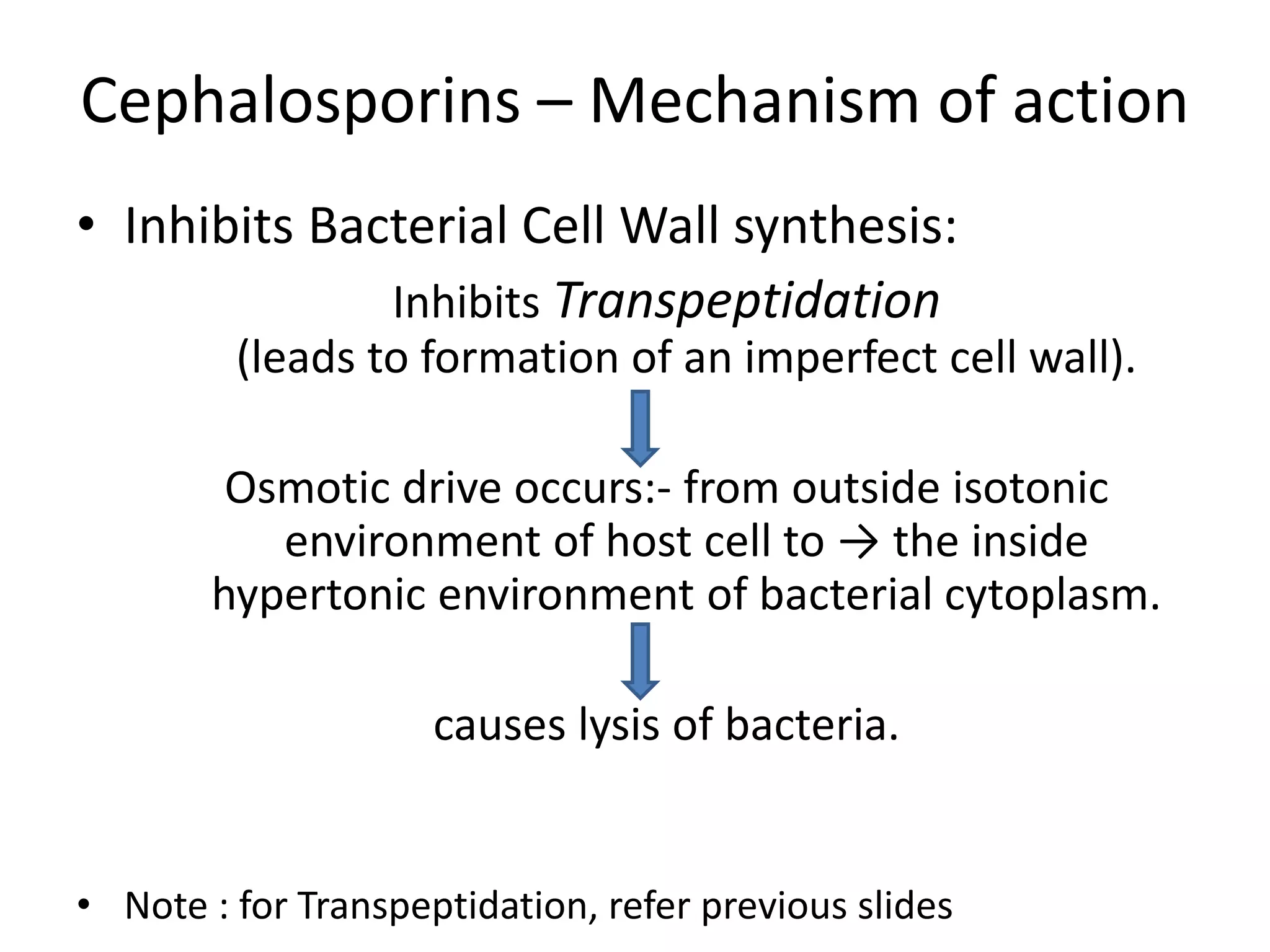
Cephalosporins – Mechanism of action
• Inhibits Bacterial Cell Wall synthesis:
Inhibits Transpeptidation
(leads to formation of an imperfect cell wall).
Osmotic drive occurs:- from outside isotonic
environment of host cell to → the inside
hypertonic environment of bacterial cytoplasm.
causes lysis of bacteria.
• Note : for Transpeptidation, refer previous slides
Mechanism of action of β-lactam antibiotics
Summary
β – lactam antibiotics
↓
Bind PBP
↓
Inhibit cross-linking of Peptidoglycan
(Inhibits Transpeptidation)
↓
Cell wall deficient bacteria
↓
Undergo Lysis
↓
Bactericidal effect
Why β-lactam antibiotics selective
active against Gram +ve organisms?
• Gram +ve bacteria are more susceptible to
Penicllins because they have a thick cell wall
(which is vital for living) & contains
PEPTIDOGLYCANS which is easily accesible to
β-lactam antibiotics.
• Penicillins are safe to use because the
Peptidoglycan layer is unique to bacteria & is
absent in higher animals.
Resistance to β – lactams is by following
mechanisms:
1. Inactivation of β – lactam ring by a β – lactamase
i. staphylococci produce a enzyme PENICILLINASE which is a
β – lactamase.
ii. Penicllinase cleaves opens the β – lactam ring
iii. Penicillin gets inactivated.
2. Altered PBPs (penicllin binding proteins) on cell wall
reduces affinity for Penicillins - MRSA (Methicllin
resistant Staphylococcus aureus)
3. Poor penetration of the drug into the bacteria,
(as in gram –ve bacteria)
4. Efflux of penicillin from the gram-negative
(by an efflux pump).
Cephalosporins differ among
themselves by varied:
1. Potency against specific organism
2. Antibacterial spectrum of activity
3. Susceptibility to β - lactamases
4. Pharmacokinetic properties –
– Some oral, while some parenteral
– not metabolized or not excreted by kidney
– t ½ variation
– Local irritation on i.m injection
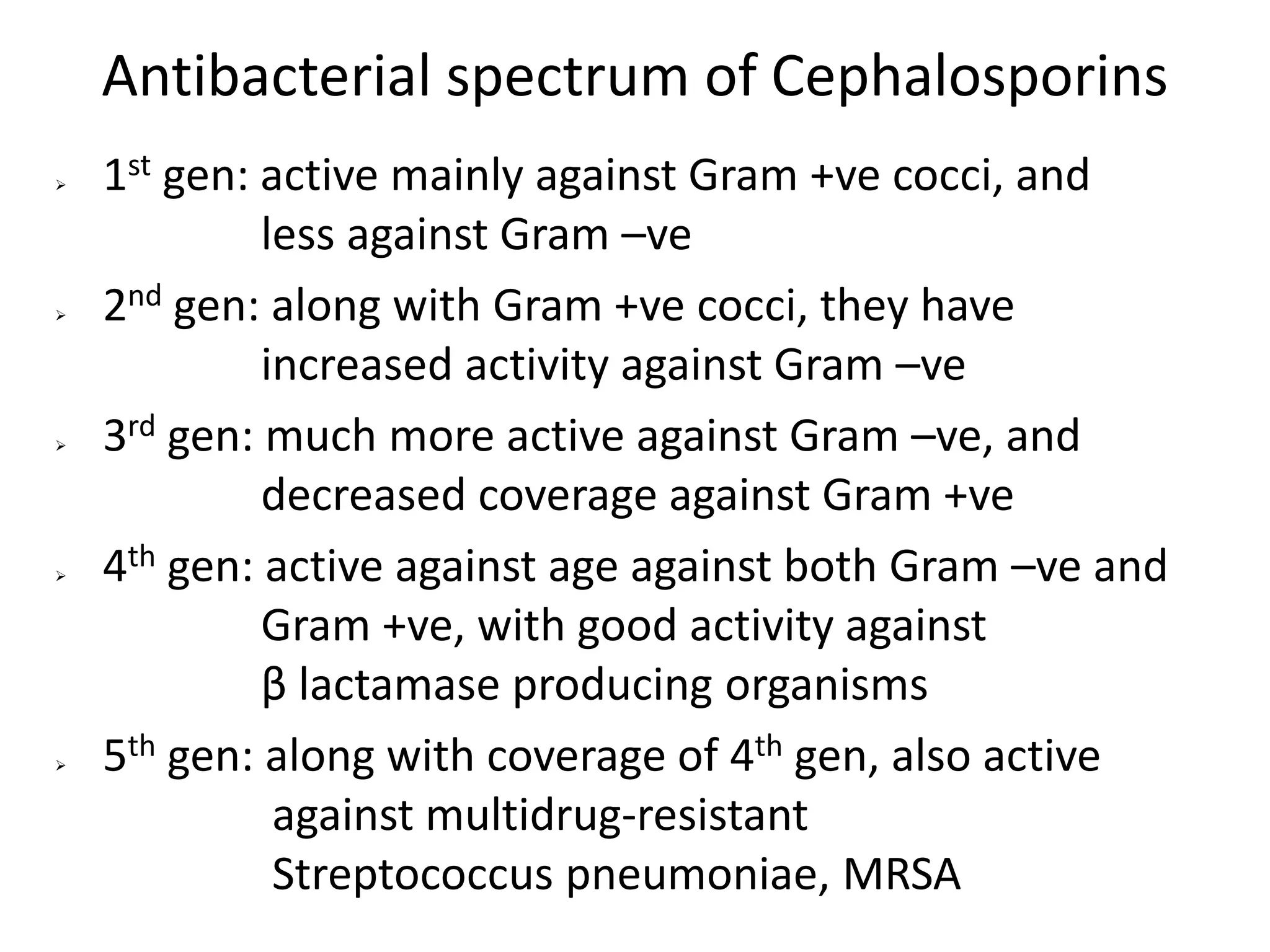
Antibacterial spectrum of Cephalosporins
➢ 1st gen: active mainly against Gram +ve cocci, and
less against Gram –ve
➢ 2nd gen: along with Gram +ve cocci, they have
increased activity against Gram –ve
➢ 3rd gen: much more active against Gram –ve, and
decreased coverage against Gram +ve
➢ 4th gen: active against age against both Gram –ve and
Gram +ve, with good activity against
β lactamase producing organisms
➢ 5th gen: along with coverage of 4th gen, also active
against multidrug-resistant
Streptococcus pneumoniae, MRSA
Uses of Cephalosporins (1st, 2nd and 3rd gen)
• 1st gen: skin & soft tissue infections (S. aureus, S. Pyogenes). Cefazolin is
preferred in surgical prophylaxis. Cefadroxil -good tissue penetration.
• 2nd gen: Cefoxitin:- bowel anaerobes (Bacteroides fragilis in peritonitis);
Cefuroxime- gonorrhoea and Meningitis; Cefamandole:- STDs;
Other common uses - URTIs & LRTIs
• 3rd gen: Many Serious Infections, Hospital acquired infections (multiple
Gm –ve), Meningitis, Multi-resistant Typhoid fever, Complicated UTIs,
Septicemias, Abdominal sepsis, Gonorrhoea;
CEFTAZIDIME & CEFOPERAZONE:- Excellent activity against Psedomonas
aeruginosae, Neutropenic pts with Haematological Malignancies,
Burns,UTIs, RTIs, skin-soft tissue infections, meningitis & septicemias
CEFIXIME (ORAL ):- Enterobacteriaceae (PEcK), H.influenza, UTIs, Biliary,
RTIs, Not active on - Pseudomonas.
Uses of 4th and 5th gen Cephalosporins
• 4th gen: septicemias, nosocomial infections,
serious infections of the skin, respiratory and
urinary tract infections, infections in immuno-
compromised patients, infections caused by
Pseudmonas and β-lactamase producers.
• 5th gen: skin and skin structure infections,
community acquired pnemonias, infections
caused by MRSA, Pseudmonas and
β-lactamase producers.
Summary of Uses of Cephalosporins
1. As an Alternative to penicillin
2. Respiratory Tract Infections , Urinary Tract Infections &
Soft tissue infections
3. Penicillinase producing Staph. infections.
5. Septicemias (Gm –ve ), (combined with Aminoglycosides)
6. Surgical prophylaxis, eg - 1st gen (Cefazolin)
7. Meningitis - Emperical therapy (with Ampicillin/Vancomycin)
8. Gonorrhoea
9. Typhoid
10. Mixed aerobic-anaerobic infections (in Cancer pts)
11. Hospital acquired infections
12. Infections in Neutropenic patients
Pharmacokinetics - Cephalosporins
• Plasma protein binding varies among each other
– Ceftriaxone 90% (long t ½ of 7 hours )
– Cephalexin only 10-15% (short t ½)
• Relatively lipid insoluble - Hence, most do not
penetrate cells / CNS (Except - 3rd Generations &
Cefuroxime of 2nd gen.),
• Major elimination route – RENAL
• Ceftriaxone - Eliminated through bile
• Probenacid - Slows elimination by blocking renal
tubular secretion & thus it Prolongs their t ½ .
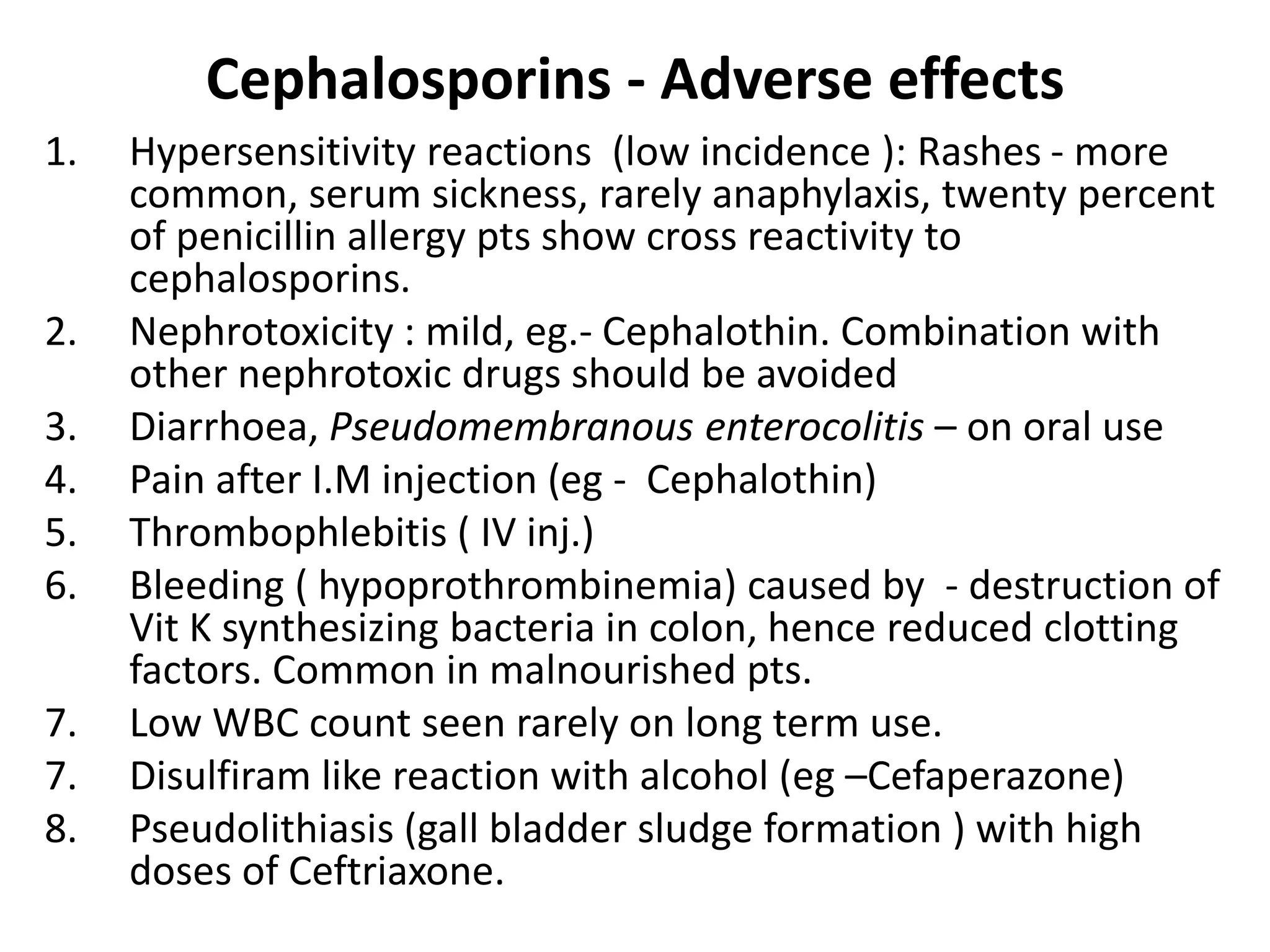
Cephalosporins - Adverse effects
1. Hypersensitivity reactions (low incidence ): Rashes - more
common, serum sickness, rarely anaphylaxis, twenty percent
of penicillin allergy pts show cross reactivity to
cephalosporins.
2. Nephrotoxicity : mild, eg.- Cephalothin. Combination with
other nephrotoxic drugs should be avoided
3. Diarrhoea, Pseudomembranous enterocolitis – on oral use
4. Pain after I.M injection (eg - Cephalothin)
5. Thrombophlebitis ( IV inj.)
6. Bleeding ( hypoprothrombinemia) caused by - destruction of
Vit K synthesizing bacteria in colon, hence reduced clotting
factors. Common in malnourished pts.
7. Low WBC count seen rarely on long term use.
7. Disulfiram like reaction with alcohol (eg –Cefaperazone)
8. Pseudolithiasis (gall bladder sludge formation ) with high
doses of Ceftriaxone.
Bibliography
• K.D. Tripathi. “Essentials of Medical
Pharmacology” 7th Edition, Jaypee Brothers
Medical Publishers (P) LTD, New Delhi, India,
2013.
• Sharma HL, Sharma KK. “Principles of
Pharmacology” 2nd Edition, Paras Medical
Publishers, Hyderabad, India, 2012.

Cephalosporins

  • 1.
    Cephalosporins Dr. M NNadeem, Associate Professor, Pharmacology, DCMS MBBS, MD Pharmacology
  • 2.
  • 3.
  • 4.
    β-lactam antibiotics (bacterial cellwall synthesis inhibitors) 1. Penicillins 2. Cephalosporins 3. Carbapenems 4. Monobactams
  • 5.
    Introduction to cephalosporins •It is Semisynthetic, derived from cephalosporin-c obtained from fungus Cephalosporium acremonium. • Chemically related to penicillin. • Classified into 5 Generations based on Chronological sequence of development (Years they were introduced) :– – 1st gen (1960s), – 2nd gen (1970s) , – 3rd gen (1980s), – 4th gen (1997-98), – 5th gen (2000 & later) .
  • 6.
    Classification of Cephalopsorins •1st generation – Parenteral: Cephalothin, Cefazolin. – Oral: Cephradine, Cefadroxil, Cephalexin. • 2nd generation – Parenteral: Cefuroxime,Cefoxitin, Cefamandole, Cefotetan – Oral: Cefuroxime axetil, Cefaclor • 3rd generation – Parenteral: Cefotaxime, Ceftriaxone, Ceftazidime, Cefaperazone – Oral: Cefixime, Cefpodoxime proxetil, Cefdinir, Ceftibuten. • 4th generation – Parenteral: Cefepime, Cefpirome, Cefazopram • 5th generation – Parenteral: Ceftobiprole, Ceftaroline
  • 7.
    Bacterial cell wall& cross bridge formation • Bacterial cell wall composed of PEPTIDOGLYCAN which are parallelly arranged GLYCAN (polysaccharide) chains cross linked by PEPTIDE chains. • Glycan chains consists of repeating units of 2 aminosugars - N-Acetylmuramic acid (NAcM) & N-Acetylglucosamine (NAcG). • The pentapeptide side chain (L-alanyl D-glutamyl –L- Lysyl- D- alanyl D- alanine) is linked to NAcM. • These peptide chains are cross linked to other peptide chains by a pentapeptide bridge which extends from the L-lysine residue of one peptide chain to the D-alanine residue of another peptide chain. • This cross bridging between the peptidoglycan strands provides necessary strength to the bacterial cell wall.
  • 8.
    Transpeptidation, Penicillin BindingProteins (PBPs), Killing of bacteria by β-lactam antibiotics • This process of cross-bridging is called the TRANSPEPTIDATION reaction and is catalysed by PBPs which are the transmembrane surface enzymes present in the bacteria. • β-lactam antibiotics compete for & inhibit this PBPs catalyzed process of transpeptidation. • The formation of an imperfect cell wall leads to an OSMOTIC DRIVE of the fluid from outside of the environment to the inside of the bacteria which then swells , bursts & die. • Another mechanism by β-lactam antibiotics to kill bacteria is by Activation of AUTOLYSING ENZYMES called murein hydrolase (autolysins).
  • 9.
    Bactericidal Effect ofβ-lactam antibiotics • Since Rapid cell wall synthesis takes place when bacteria are multiplying, β-lactam antibiotics are lethal in the multiplying phase rather than dormant phase of the bacteria. • Hence, they are BACTERICIDAL
  • 10.
    Cephalosporins – Mechanismof action • Inhibits Bacterial Cell Wall synthesis: Inhibits Transpeptidation (leads to formation of an imperfect cell wall). Osmotic drive occurs:- from outside isotonic environment of host cell to → the inside hypertonic environment of bacterial cytoplasm. causes lysis of bacteria. • Note : for Transpeptidation, refer previous slides
  • 11.
    Mechanism of actionof β-lactam antibiotics Summary β – lactam antibiotics ↓ Bind PBP ↓ Inhibit cross-linking of Peptidoglycan (Inhibits Transpeptidation) ↓ Cell wall deficient bacteria ↓ Undergo Lysis ↓ Bactericidal effect
  • 12.
    Why β-lactam antibioticsselective active against Gram +ve organisms? • Gram +ve bacteria are more susceptible to Penicllins because they have a thick cell wall (which is vital for living) & contains PEPTIDOGLYCANS which is easily accesible to β-lactam antibiotics. • Penicillins are safe to use because the Peptidoglycan layer is unique to bacteria & is absent in higher animals.
  • 13.
    Resistance to β– lactams is by following mechanisms: 1. Inactivation of β – lactam ring by a β – lactamase i. staphylococci produce a enzyme PENICILLINASE which is a β – lactamase. ii. Penicllinase cleaves opens the β – lactam ring iii. Penicillin gets inactivated. 2. Altered PBPs (penicllin binding proteins) on cell wall reduces affinity for Penicillins - MRSA (Methicllin resistant Staphylococcus aureus) 3. Poor penetration of the drug into the bacteria, (as in gram –ve bacteria) 4. Efflux of penicillin from the gram-negative (by an efflux pump).
  • 14.
    Cephalosporins differ among themselvesby varied: 1. Potency against specific organism 2. Antibacterial spectrum of activity 3. Susceptibility to β - lactamases 4. Pharmacokinetic properties – – Some oral, while some parenteral – not metabolized or not excreted by kidney – t ½ variation – Local irritation on i.m injection
  • 15.
    Antibacterial spectrum ofCephalosporins ➢ 1st gen: active mainly against Gram +ve cocci, and less against Gram –ve ➢ 2nd gen: along with Gram +ve cocci, they have increased activity against Gram –ve ➢ 3rd gen: much more active against Gram –ve, and decreased coverage against Gram +ve ➢ 4th gen: active against age against both Gram –ve and Gram +ve, with good activity against β lactamase producing organisms ➢ 5th gen: along with coverage of 4th gen, also active against multidrug-resistant Streptococcus pneumoniae, MRSA
  • 16.
    Uses of Cephalosporins(1st, 2nd and 3rd gen) • 1st gen: skin & soft tissue infections (S. aureus, S. Pyogenes). Cefazolin is preferred in surgical prophylaxis. Cefadroxil -good tissue penetration. • 2nd gen: Cefoxitin:- bowel anaerobes (Bacteroides fragilis in peritonitis); Cefuroxime- gonorrhoea and Meningitis; Cefamandole:- STDs; Other common uses - URTIs & LRTIs • 3rd gen: Many Serious Infections, Hospital acquired infections (multiple Gm –ve), Meningitis, Multi-resistant Typhoid fever, Complicated UTIs, Septicemias, Abdominal sepsis, Gonorrhoea; CEFTAZIDIME & CEFOPERAZONE:- Excellent activity against Psedomonas aeruginosae, Neutropenic pts with Haematological Malignancies, Burns,UTIs, RTIs, skin-soft tissue infections, meningitis & septicemias CEFIXIME (ORAL ):- Enterobacteriaceae (PEcK), H.influenza, UTIs, Biliary, RTIs, Not active on - Pseudomonas.
  • 17.
    Uses of 4thand 5th gen Cephalosporins • 4th gen: septicemias, nosocomial infections, serious infections of the skin, respiratory and urinary tract infections, infections in immuno- compromised patients, infections caused by Pseudmonas and β-lactamase producers. • 5th gen: skin and skin structure infections, community acquired pnemonias, infections caused by MRSA, Pseudmonas and β-lactamase producers.
  • 18.
    Summary of Usesof Cephalosporins 1. As an Alternative to penicillin 2. Respiratory Tract Infections , Urinary Tract Infections & Soft tissue infections 3. Penicillinase producing Staph. infections. 5. Septicemias (Gm –ve ), (combined with Aminoglycosides) 6. Surgical prophylaxis, eg - 1st gen (Cefazolin) 7. Meningitis - Emperical therapy (with Ampicillin/Vancomycin) 8. Gonorrhoea 9. Typhoid 10. Mixed aerobic-anaerobic infections (in Cancer pts) 11. Hospital acquired infections 12. Infections in Neutropenic patients
  • 19.
    Pharmacokinetics - Cephalosporins •Plasma protein binding varies among each other – Ceftriaxone 90% (long t ½ of 7 hours ) – Cephalexin only 10-15% (short t ½) • Relatively lipid insoluble - Hence, most do not penetrate cells / CNS (Except - 3rd Generations & Cefuroxime of 2nd gen.), • Major elimination route – RENAL • Ceftriaxone - Eliminated through bile • Probenacid - Slows elimination by blocking renal tubular secretion & thus it Prolongs their t ½ .
  • 20.
    Cephalosporins - Adverseeffects 1. Hypersensitivity reactions (low incidence ): Rashes - more common, serum sickness, rarely anaphylaxis, twenty percent of penicillin allergy pts show cross reactivity to cephalosporins. 2. Nephrotoxicity : mild, eg.- Cephalothin. Combination with other nephrotoxic drugs should be avoided 3. Diarrhoea, Pseudomembranous enterocolitis – on oral use 4. Pain after I.M injection (eg - Cephalothin) 5. Thrombophlebitis ( IV inj.) 6. Bleeding ( hypoprothrombinemia) caused by - destruction of Vit K synthesizing bacteria in colon, hence reduced clotting factors. Common in malnourished pts. 7. Low WBC count seen rarely on long term use. 7. Disulfiram like reaction with alcohol (eg –Cefaperazone) 8. Pseudolithiasis (gall bladder sludge formation ) with high doses of Ceftriaxone.
  • 21.
    Bibliography • K.D. Tripathi.“Essentials of Medical Pharmacology” 7th Edition, Jaypee Brothers Medical Publishers (P) LTD, New Delhi, India, 2013. • Sharma HL, Sharma KK. “Principles of Pharmacology” 2nd Edition, Paras Medical Publishers, Hyderabad, India, 2012.