


PREPARED BY: JEGAN.S. NADAR
ANTILEPROTIC DRUGS
LEPROSY
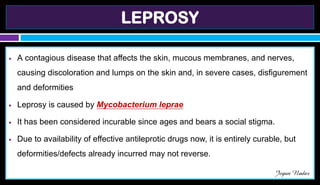
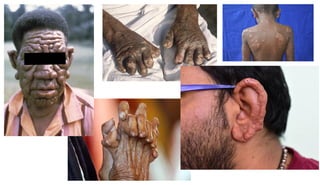
● A contagious disease that affects the skin, mucous membranes, and nerves,
causing discoloration and lumps on the skin and, in severe cases, disfigurement
and deformities
● Leprosy is caused by Mycobacterium leprae
● It has been considered incurable since ages and bears a social stigma.
● Due to availability of effective antileprotic drugs now, it is entirely curable, but
deformities/defects already incurred may not reverse.
Jegan Nadar
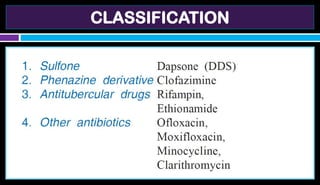
CLASSIFICATION
Sulfone
Dapsone (DDS)
● It is diamino diphenyl sulfone (DDS), the simplest, oldest, cheapest, most active
and most commonly used member of its class
● It is bacteriostatic for M. leprae
Dapsone
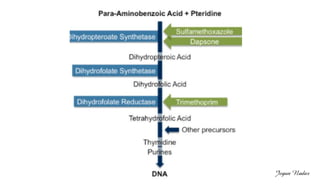
● Dapsone is structurally related to the sulfonamides and similarly inhibits
dihydropteroate synthetase in the folate synthesis pathway.
● Dapsone-resistance among M. leprae has been reported which necessitated the use of
multidrug therapy
● When dapsone resistance is encountered in an untreated patient, it is called ‘primary’,
and indicates that the infection was contacted from a patient harbouring resistant bacilli
● Resistance which develops during monotherapy in an individual patient with dapsone is
called ‘secondary’
Jegan Nadar
Jegan Nadar
Dapsone
● Dapsone is completely absorbed after oral administration and is widely
distributed in the body
● It is 70% plasma protein bound, but more importantly it is concentrated in skin
(especially lepromatous skin), muscle, liver and kidney.
● Dapsone is acetylated as well as glucuronide and sulfate conjugated in liver.
● Metabolites are excreted in urine.
● The plasma t½ of dapsone is variable, though often > 24 hrs
Jegan Nadar
Dapsone
● Dapsone is generally well tolerated at doses 100 mg/day or less.
● Mild haemolytic anaemia is common, Patients with G-6-PD deficiency are more
susceptible
● Gastric intolerance—nausea and anorexia are frequent in the beginning but decreases
later.
● Other side effects are methaemoglobinaemia, headache, paresthesias, mental
symptoms and drug fever.
● Cutaneous reactions include allergic rashes, fixed drug eruption, hypermelanosis,
phototoxicity and rarely exfoliative dermatitis Jegan Nadar
● Sulfone syndrome: It is the reaction which develops 4–6 weeks after starting
dapsone treatment
● Symptoms consists of fever, malaise, lymph node enlargement, desquamation of
skin, jaundice and anaemia.
● It is generally seen in malnourished patients, and has become more frequent
after the introduction of MDT.
● Dapsone should not be used in patients with severe anaemia (Hb < 7 g/dl), G-6-
PD deficiency and in those showing hypersensitivity reactions.
Jegan Nadar
Phenazine derivative
Clofazimine
● It is a dye with leprostatic and antiinflammatory properties.
● The putative mechanisms of antileprotic action of clofazimine are:
 Interference with template function of DNA in M.leprae
 Alteration of membrane stucture and its transport function.
 Disruption of mitochondrial electron transport chain.
Jegan Nadar
Clofazimine
● When used alone, the clinical response to clofazimine is slower than that to
dapsone, and resistance develops in 1–3 years.
● Dapsone resistant M. leprae respond to clofazimine, but apparently after a lag
period of about 2 months.
Jegan Nadar
Clofazimine
● Clofazimine is orally active (40–70% absorbed).
● It accumulates in macrophages and gets deposited in many tissues including
subcutaneous fat, as needle-shaped crystals.
● However, entry in CSF is poor.
● The t½ is 70 days so that intermittent therapy is possible.
Clofazimine
● In the doses employed for MDT, clofazimine is well tolerated
● Skin : The major disadvantage is reddish-black discolouration of skin, especially
on exposed parts. Dryness of skin and itching is often troublesome
● GI symptoms: Nausea, anorexia, abdominal pain, weight loss and enteritis with
intermittent loose stools can occur, particularly when higher doses are used to
control lepra reaction
Jegan Nadar
Antitubercular drugs
Rifampin (Rifampicin, R)
● It is a semisynthetic derivative of rifamycin B obtained from Streptomyces
mediterranei.
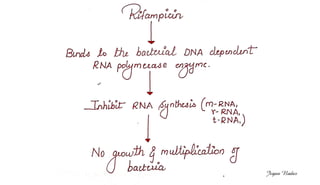
● Rifampin is bactericidal
● M. leprae is highly sensitive to Rifampin
Jegan Nadar
file:///tmp/mozilla_sjipr
staff0/New%20Doc%2
02019-10-
15%2012.01.51_5.jpg
Jegan Nadar
Rifampin
● It is well absorbed orally, (bioavailability is ~ 70%), but food decreases
absorption; rifampin is to be taken in empty stomach.
● It is widely distributed in the body: penetrates intracellularly, enters tubercular
cavities, caseous masses and placenta.
● Though it crosses meninges, it is largely pumped out from CNS by P-
glycoprotein.
● It is metabolized in liver to an active deacetylated metabolite
Jegan Nadar
Rifampin
● Rifampin is a microsomal enzyme inducer—increases several CYP450
isoenzymes, including CYP3A4, CYP2D6, CYP1A2 and CYP2C subfamily.
● It thus enhances its own metabolism as well as that of many drugs including
warfarin, oral contraceptives, corticosteroids, sulfonylureas, steroids, HIV
protease inhibitors, NNRTIs, theophylline, metoprolol, fluconazole,
ketoconazole, clarithromycin, phenytoin, etc.
● Contraceptive failures have occurred
Jegan Nadar
Rifampin
● Hepatitis, a major adverse effect, generally occurs in patients with preexisting
liver disease and is dose-related
● Minor reactions, usually not requiring drug withdrawal and more common with
intermittent regimens, are:
Jegan Nadar
Rifampin
● Cutaneous syndrome: flushing, pruritus + rash (especially on face and scalp),
redness and watering of eyes.
● Flu syndrome: with chills, fever, headache,malaise and bone pain.
● Abdominal syndrome: nausea, vomiting, abdominal cramps with or without
diarrhoea.
● Urine and secretions may become orange-red—but this is harmless.
Jegan Nadar
Thank You

Antileprotic drugs

  • 1.
    PREPARED BY: JEGAN.S.NADAR ANTILEPROTIC DRUGS
  • 2.
    LEPROSY ● A contagiousdisease that affects the skin, mucous membranes, and nerves, causing discoloration and lumps on the skin and, in severe cases, disfigurement and deformities ● Leprosy is caused by Mycobacterium leprae ● It has been considered incurable since ages and bears a social stigma. ● Due to availability of effective antileprotic drugs now, it is entirely curable, but deformities/defects already incurred may not reverse. Jegan Nadar
  • 4.
  • 5.
  • 6.
    Dapsone (DDS) ● Itis diamino diphenyl sulfone (DDS), the simplest, oldest, cheapest, most active and most commonly used member of its class ● It is bacteriostatic for M. leprae
  • 7.
    Dapsone ● Dapsone isstructurally related to the sulfonamides and similarly inhibits dihydropteroate synthetase in the folate synthesis pathway. ● Dapsone-resistance among M. leprae has been reported which necessitated the use of multidrug therapy ● When dapsone resistance is encountered in an untreated patient, it is called ‘primary’, and indicates that the infection was contacted from a patient harbouring resistant bacilli ● Resistance which develops during monotherapy in an individual patient with dapsone is called ‘secondary’ Jegan Nadar
  • 8.
  • 9.
    Dapsone ● Dapsone iscompletely absorbed after oral administration and is widely distributed in the body ● It is 70% plasma protein bound, but more importantly it is concentrated in skin (especially lepromatous skin), muscle, liver and kidney. ● Dapsone is acetylated as well as glucuronide and sulfate conjugated in liver. ● Metabolites are excreted in urine. ● The plasma t½ of dapsone is variable, though often > 24 hrs Jegan Nadar
  • 10.
    Dapsone ● Dapsone isgenerally well tolerated at doses 100 mg/day or less. ● Mild haemolytic anaemia is common, Patients with G-6-PD deficiency are more susceptible ● Gastric intolerance—nausea and anorexia are frequent in the beginning but decreases later. ● Other side effects are methaemoglobinaemia, headache, paresthesias, mental symptoms and drug fever. ● Cutaneous reactions include allergic rashes, fixed drug eruption, hypermelanosis, phototoxicity and rarely exfoliative dermatitis Jegan Nadar
  • 11.
    ● Sulfone syndrome:It is the reaction which develops 4–6 weeks after starting dapsone treatment ● Symptoms consists of fever, malaise, lymph node enlargement, desquamation of skin, jaundice and anaemia. ● It is generally seen in malnourished patients, and has become more frequent after the introduction of MDT. ● Dapsone should not be used in patients with severe anaemia (Hb < 7 g/dl), G-6- PD deficiency and in those showing hypersensitivity reactions. Jegan Nadar
  • 12.
  • 13.
    Clofazimine ● It isa dye with leprostatic and antiinflammatory properties. ● The putative mechanisms of antileprotic action of clofazimine are:  Interference with template function of DNA in M.leprae  Alteration of membrane stucture and its transport function.  Disruption of mitochondrial electron transport chain. Jegan Nadar
  • 14.
    Clofazimine ● When usedalone, the clinical response to clofazimine is slower than that to dapsone, and resistance develops in 1–3 years. ● Dapsone resistant M. leprae respond to clofazimine, but apparently after a lag period of about 2 months. Jegan Nadar
  • 15.
    Clofazimine ● Clofazimine isorally active (40–70% absorbed). ● It accumulates in macrophages and gets deposited in many tissues including subcutaneous fat, as needle-shaped crystals. ● However, entry in CSF is poor. ● The t½ is 70 days so that intermittent therapy is possible.
  • 16.
    Clofazimine ● In thedoses employed for MDT, clofazimine is well tolerated ● Skin : The major disadvantage is reddish-black discolouration of skin, especially on exposed parts. Dryness of skin and itching is often troublesome ● GI symptoms: Nausea, anorexia, abdominal pain, weight loss and enteritis with intermittent loose stools can occur, particularly when higher doses are used to control lepra reaction Jegan Nadar
  • 17.
  • 18.
    Rifampin (Rifampicin, R) ●It is a semisynthetic derivative of rifamycin B obtained from Streptomyces mediterranei. ● Rifampin is bactericidal ● M. leprae is highly sensitive to Rifampin Jegan Nadar
  • 19.
  • 20.
    Rifampin ● It iswell absorbed orally, (bioavailability is ~ 70%), but food decreases absorption; rifampin is to be taken in empty stomach. ● It is widely distributed in the body: penetrates intracellularly, enters tubercular cavities, caseous masses and placenta. ● Though it crosses meninges, it is largely pumped out from CNS by P- glycoprotein. ● It is metabolized in liver to an active deacetylated metabolite Jegan Nadar
  • 21.
    Rifampin ● Rifampin isa microsomal enzyme inducer—increases several CYP450 isoenzymes, including CYP3A4, CYP2D6, CYP1A2 and CYP2C subfamily. ● It thus enhances its own metabolism as well as that of many drugs including warfarin, oral contraceptives, corticosteroids, sulfonylureas, steroids, HIV protease inhibitors, NNRTIs, theophylline, metoprolol, fluconazole, ketoconazole, clarithromycin, phenytoin, etc. ● Contraceptive failures have occurred Jegan Nadar
  • 22.
    Rifampin ● Hepatitis, amajor adverse effect, generally occurs in patients with preexisting liver disease and is dose-related ● Minor reactions, usually not requiring drug withdrawal and more common with intermittent regimens, are: Jegan Nadar
  • 23.
    Rifampin ● Cutaneous syndrome:flushing, pruritus + rash (especially on face and scalp), redness and watering of eyes. ● Flu syndrome: with chills, fever, headache,malaise and bone pain. ● Abdominal syndrome: nausea, vomiting, abdominal cramps with or without diarrhoea. ● Urine and secretions may become orange-red—but this is harmless. Jegan Nadar
  • 24.