Cement
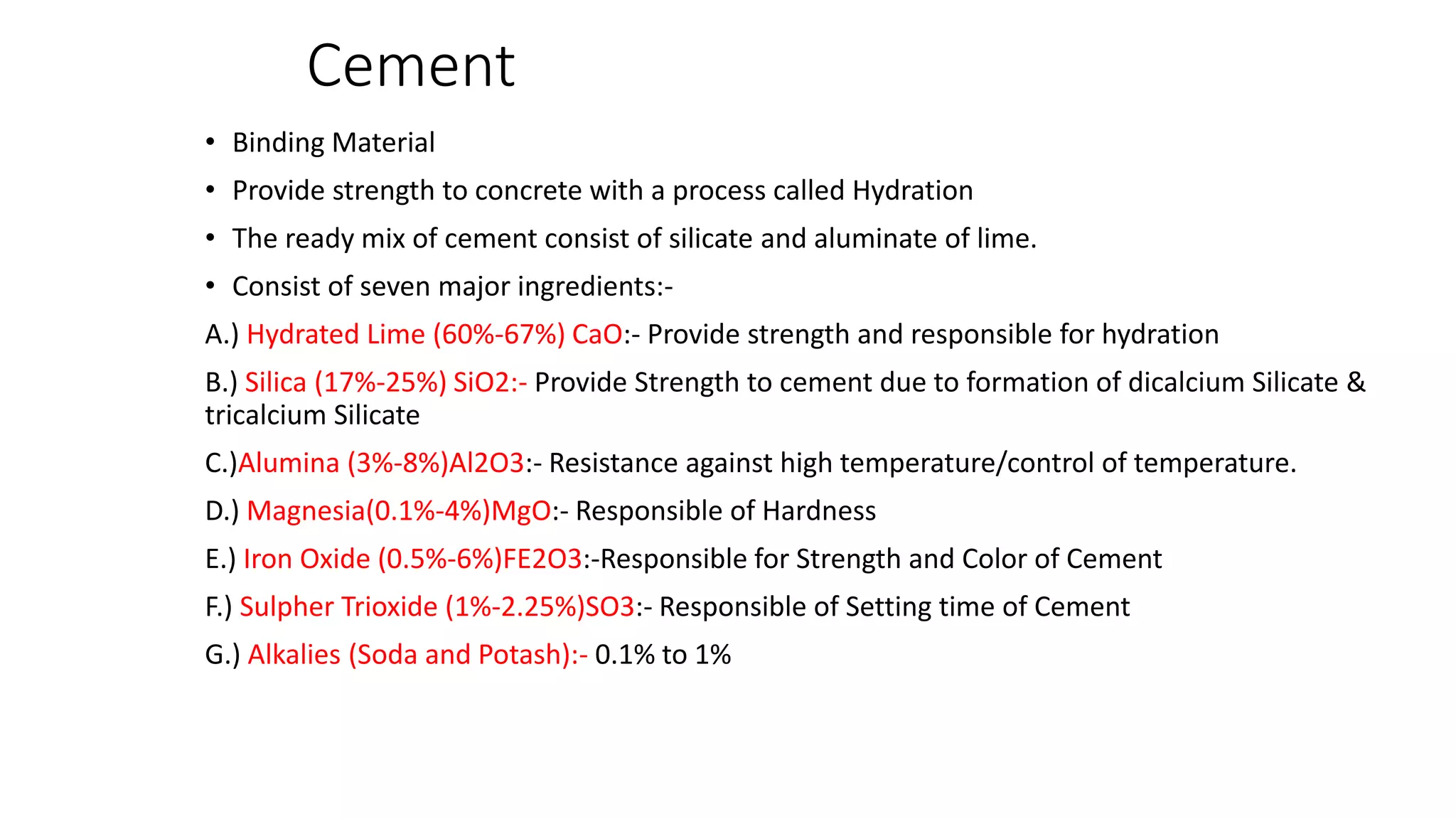
• Binding Material
• Provide strength to concrete with a process called Hydration
• The ready mix of cement consist of silicate and aluminate of lime.
• Consist of seven major ingredients:-
A.) Hydrated Lime (60%-67%) CaO:- Provide strength and responsible for hydration
B.) Silica (17%-25%) SiO2:- Provide Strength to cement due to formation of dicalcium Silicate &
tricalcium Silicate
C.)Alumina (3%-8%)Al2O3:- Resistance against high temperature/control of temperature.
D.) Magnesia(0.1%-4%)MgO:- Responsible of Hardness
E.) Iron Oxide (0.5%-6%)FE2O3:-Responsible for Strength and Color of Cement
F.) Sulpher Trioxide (1%-2.25%)SO3:- Responsible of Setting time of Cement
G.) Alkalies (Soda and Potash):- 0.1% to 1%
Types of Cement
Type Classification Characteristics
Applications
Type I OPC
BS EN-197-1:2000
ASTM C-150-94
Fairly high C3S content for good early strength development
Not more then 10% by weight particles will retain on BS Sieve No.170
Chemical composition:
C3S-tricalcium silicate=50% (Responsible for Finial setting time, produce heat)
C2S-dicalcium silicate=25% (Responsible for final setting time)
C3A-tricalcium aluminate=12% (Responsible for initial setting time and quick setting time, produce heat)
C4AF-tetracalcium aluminoferrite=8% (Responsible for initial setting time and quick setting time)
General construction (most buildings,
bridges, pavements, precast units,
etc)
Type II Moderate sulfate resistance
BS EN-197-1:2000
ASTM C-150
Low C3A content (<8%)
Chemical composition:
C3S=46%
C2S=29%
C3A=6%
C4AF=12%
Structures exposed to soil or water
containing sulfate ions
Type III Rapid Hardening Cement
BS EN -197-1
Grind more finely, provide more heated with high temperature in factory may have slightly more C3S
Not more then 5% by weight particles will retain on BS Sieve No.170
Chemical composition:
C3S=60%
C2S=12%
C3A=12%
C4AF=8%
Rapid construction, cold weather
concreting
Type IV Low heat of hydration (slow
reacting)
BS 1370-1979
Low content of C3S (<50%) and C3A=5%
More amount of C2S
Chemical composition:
C3S=30%
C2S=46%
C3A=5%
C4AF=12%
Massive structures such as
dams. Now rare.
Type V High sulfate resistance
BS-4027-1996
Very low C3A content (<5%)
Chemical composition:
C3S=43%
C2S=36%
C3A=4%
C4AF=12%
Structures exposed to high levels of
sulfate ions
White White color No C4AF, low MgO
Decorative (otherwise has properties
similar to Type I)
Tests of Cement
A.) Fineness Test:- to check the particles grinding
Equipment used: BS Sieve No.170
B.) Consistency Test: To Check the %age of water required for Cement Paste
Equipment Used: Vicat Apparatus
C.) Setting Time Test: to check Initial and Final setting time of Cement
Equipment Used:- Vicat Apparatus
D.) Soundness Test: to check the changes in volume of cement paste after setting
time.
Equipment Used: Le Chateller Apparatus
E.)Compression Test
F.) Tensile Test
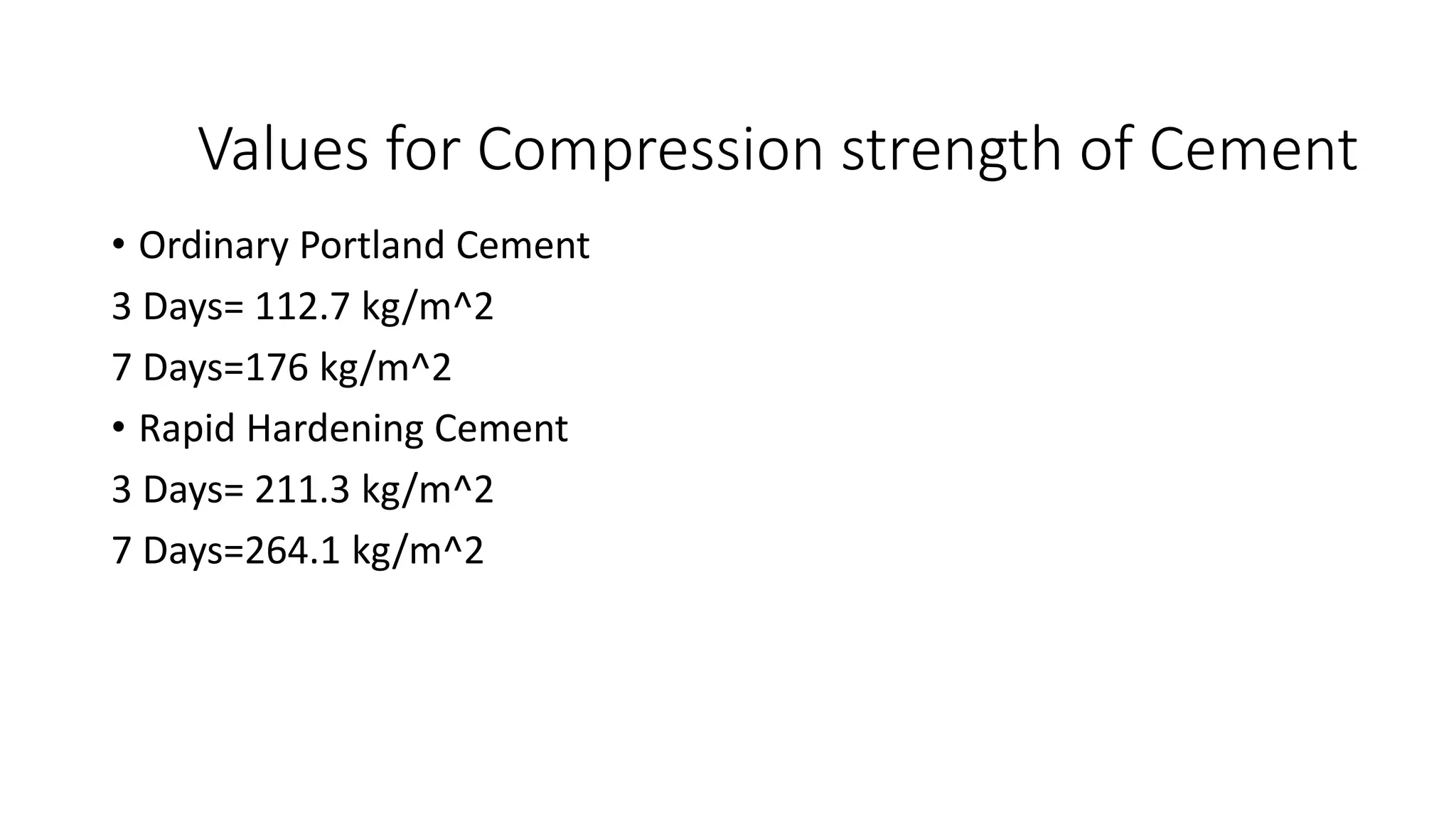
Values for Compression strength of Cement
• Ordinary Portland Cement
3 Days= 112.7 kg/m^2
7 Days=176 kg/m^2
• Rapid Hardening Cement
3 Days= 211.3 kg/m^2
7 Days=264.1 kg/m^2
Values for Tensile strength of Cement
• Ordinary Portland Cement
3 Days= 21 kg/m^2
7 Days=26 kg/m^2
• Rapid Hardening Cement
3 Days= 21 kg/m^2
7 Days=32 kg/m^2

Cement properties and types

  • 1.
    Cement • Binding Material •Provide strength to concrete with a process called Hydration • The ready mix of cement consist of silicate and aluminate of lime. • Consist of seven major ingredients:- A.) Hydrated Lime (60%-67%) CaO:- Provide strength and responsible for hydration B.) Silica (17%-25%) SiO2:- Provide Strength to cement due to formation of dicalcium Silicate & tricalcium Silicate C.)Alumina (3%-8%)Al2O3:- Resistance against high temperature/control of temperature. D.) Magnesia(0.1%-4%)MgO:- Responsible of Hardness E.) Iron Oxide (0.5%-6%)FE2O3:-Responsible for Strength and Color of Cement F.) Sulpher Trioxide (1%-2.25%)SO3:- Responsible of Setting time of Cement G.) Alkalies (Soda and Potash):- 0.1% to 1%
  • 2.
    Types of Cement TypeClassification Characteristics Applications Type I OPC BS EN-197-1:2000 ASTM C-150-94 Fairly high C3S content for good early strength development Not more then 10% by weight particles will retain on BS Sieve No.170 Chemical composition: C3S-tricalcium silicate=50% (Responsible for Finial setting time, produce heat) C2S-dicalcium silicate=25% (Responsible for final setting time) C3A-tricalcium aluminate=12% (Responsible for initial setting time and quick setting time, produce heat) C4AF-tetracalcium aluminoferrite=8% (Responsible for initial setting time and quick setting time) General construction (most buildings, bridges, pavements, precast units, etc) Type II Moderate sulfate resistance BS EN-197-1:2000 ASTM C-150 Low C3A content (<8%) Chemical composition: C3S=46% C2S=29% C3A=6% C4AF=12% Structures exposed to soil or water containing sulfate ions Type III Rapid Hardening Cement BS EN -197-1 Grind more finely, provide more heated with high temperature in factory may have slightly more C3S Not more then 5% by weight particles will retain on BS Sieve No.170 Chemical composition: C3S=60% C2S=12% C3A=12% C4AF=8% Rapid construction, cold weather concreting Type IV Low heat of hydration (slow reacting) BS 1370-1979 Low content of C3S (<50%) and C3A=5% More amount of C2S Chemical composition: C3S=30% C2S=46% C3A=5% C4AF=12% Massive structures such as dams. Now rare. Type V High sulfate resistance BS-4027-1996 Very low C3A content (<5%) Chemical composition: C3S=43% C2S=36% C3A=4% C4AF=12% Structures exposed to high levels of sulfate ions White White color No C4AF, low MgO Decorative (otherwise has properties similar to Type I)
  • 3.
    Tests of Cement A.)Fineness Test:- to check the particles grinding Equipment used: BS Sieve No.170 B.) Consistency Test: To Check the %age of water required for Cement Paste Equipment Used: Vicat Apparatus C.) Setting Time Test: to check Initial and Final setting time of Cement Equipment Used:- Vicat Apparatus D.) Soundness Test: to check the changes in volume of cement paste after setting time. Equipment Used: Le Chateller Apparatus E.)Compression Test F.) Tensile Test
  • 4.
    Values for Compressionstrength of Cement • Ordinary Portland Cement 3 Days= 112.7 kg/m^2 7 Days=176 kg/m^2 • Rapid Hardening Cement 3 Days= 211.3 kg/m^2 7 Days=264.1 kg/m^2
  • 5.
    Values for Tensilestrength of Cement • Ordinary Portland Cement 3 Days= 21 kg/m^2 7 Days=26 kg/m^2 • Rapid Hardening Cement 3 Days= 21 kg/m^2 7 Days=32 kg/m^2