Aggregates
• Stone particles collected from various sources
• Size range from 0.15 mm to 75 mm
• No Cementing power
• Insoluble materials
• 50% to 80% parts of concrete mix
Types of aggregate
Types of Aggregate
I. According to formation
II. According to size
III.According to gradation
IV.According to shapes
Types of aggregate according to Formation
1.) Natural Aggregate
2.) Artificial Aggregate
Types of Aggregate
1.) Natural Aggregate :
• The types of aggregate which that form from natural sources
• It could be found in river bed in shape of gravel or natural rocks
• Three types of natural rocks
A.) Igneous Rocks
B.) Sedimentary Rocks
D.) Metamorphic Rocks
A) Igneous Rocks:
Types of Aggregate
• They are formed by the cooling of molten magma on the earth's
surface due to volcanic eruptions.
• Granites and trapes stones are the examples of such rocks.
• Aggregate collected from such resources are more strong and low porosity.
• Porosity ranges 0.15 % to 3.8%
• Low porosity means:
• Small air voids in concrete as low porosity
• Normal air voids in concrete ranges from 5 %to 20% without compaction (note: 5% air
voids could reduce the strength of concrete by 30%)
• Low rate of expansion and contractions for concrete
• Minimum chances of cracks as low rate for expansion and contraction
• Better compaction of Concrete
B.) Sedimentary Rock
Types of Aggregate
• Such rocks are formed by the deposition and subsequent cementation of these
materials at the Earth's surface and within water.
• Lime stone and sand stone are the example of such rocks
• Could be in weak condition as the porosity level is high in lime stone that ranges
from 0% to 37%
• More porosity means
• High level air voids in concrete
• Reduction in strength of concrete due to air voids
• Segregation effect in concrete due to porosity
• High level of expansion and contraction due to porosity as the water absorb by the
stone.
• Poor compaction
• More chance of carbonation effects due to pores in
concrete
c.) Metamorphic Rocks
Types of Aggregate
• These types of rocks are form as the rocks subjected to very high heat
and pressure, which cause obvious physical and/or chemical changes
that causes to form metamorphic rocks.
• Marble and Schist are the example of such rocks
2.) Artificial Aggregate
Types of Aggregate
• This type of aggregate is formed by grinding of specified materials in
required size and shapes such as blast furnace’s slag that is grind to
achieve the artificial aggregate
• Usually use form light weight and heavy weight aggregate
• Such aggregates are not desirable for RCC work as week in
compressive strength
II.) Types of Aggregate According Size
A.) Fine Aggregate
B.) Coarse Aggregate
C.) All-In Aggregate
A.) Fine Aggregate
• Size ranges from 0.15 mm to 4.75 mm
• Types are as follow:
i.) Sand
ii.) Crushed Stone
i.) Sand
• These are the small particles of Silica
• Reduce Air voids in Concrete so that reduction in Shrinkage.
• Three types of sand are there:
• Fine Sand (0.15 mm to 0.425 mm)
• Medium Sand (0.425 mm to 2.00 mm)
• Coarse Sand ( 2.00 mm to 4.75 mm)
• For plaster we use fine aggregates as it contain more voids to help
varnishing and painting to make a very strong bond with plaster
surface
Qualities of Sand
• Should be clean
• No dust
• No salts
• Will contain various sizes particles
• Should be free from salts
Bulking of Sand
• Increase in volume of sand due to increase in moistures
• 3.76% moisture will increase 25% (maximum increment) in volume
• 20% moisture completely reduce the bulking of sand
• More fine particles means more bulking in sand as more voids
between the particles
ii.) Crushed Stone
• Such fine aggregate achieved from stones that cut and grind for
construction work.
• It contain different size particles 0.15 mm to 3 mm
• Suitable for masonry work
B.) Coarse Aggregate
• Size ranges from 4.75 mm to 75 mm
• Must contain various grade particles
• Strength must be between 800 kg/m^2 to 2500 kg/m^2
Types of Coarse Aggregate
i. Stone Ballast
ii. Gravels
iii. Brick Ballast
iv. Clinker
i.) Stone Ballast
• The most strong and durable types for aggregate
• The stone must not be pores
• Must not be laminated
• Must not contain any type of salts
• Granite and sand stones are known names for such aggregate
sources.
ii) Gravels
• Could be found in river beds
• More strong with high level crushing strength
• Usually consist of mineral salts and other harmful ingredients & not
popular for use in RCC works
iii) Brick Ballast
iv) Clinkers
• Not desirable for RCC work
• Week and pores
C.) All in Aggregate
• Consist of both fine and coarse aggregate
• Proper check required by sieve analysis before use to determine the
gradation
III) Types of Aggregate According to
Gradation
i) Single Grade Aggregate
ii) Graded Aggregate
iii)Gape Graded Aggregate
i) Single grade Aggregate
• Must contain 85% to 100% particles of specified size
• 0% to 25% particles will retain on next lower sieve
• Air voids ratio ranges from 38% to 42 %
ii) Graded Aggregate
• 90% to 100% particles will be pass by specified size of sieve
• 30% to 70% particles will retain on next lower sieve
iii) Gap Graded Aggregate
• Contain different types of particles
• Used for special type of concrete such as light weight concrete
IV) Types of Aggregate According to
Shape
i) Rounded Aggregate
ii) Irregular Aggregate
iii)Flaky Aggregate
iv)Elongated Aggregate
v) Angular Aggregate
Rounded Aggregate
• Gravels are examples for such aggregate
• Week bond between particles
• No edges
ii) Irregular Aggregate
• Such aggregate could be formed rocks as they collapsed
• Not in proper size and shapes
• If use in concrete will produce more air voids
• Not desirable of RCC work
iii) Flaky Aggregate
• Thickness will be less then 0.6 of specified thickness
• Could be determine by thickness gauge
• Maximum %age of Flaky aggregate should not be more then 40%
• At least 200 Nos of Aggregate shall be pass from gauge
iv) Elongated Aggregate
• 1.8% long from specified length
• Length gauge shall be used to determine such particles
• Maximum %age for elongated particles are 15%
• At least 200 Nos of Aggregate should be pass from the gauge
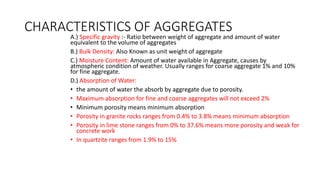
CHARACTERISTICS OF AGGREGATES
A.) Specific gravity :- Ratio between weight of aggregate and amount of water
equivalent to the volume of aggregates
B.) Bulk Density: Also Known as unit weight of aggregate
C.) Moisture Content: Amount of water available in Aggregate, causes by
atmospheric condition of weather. Usually ranges for coarse aggregate 1% and 10%
for fine aggregate.
D.) Absorption of Water:
• the amount of water the absorb by aggregate due to porosity.
• Maximum absorption for fine and coarse aggregates will not exceed 2%
• Minimum porosity means minimum absorption
• Porosity in granite rocks ranges from 0.4% to 3.8% means minimum absorption
• Porosity in lime stone ranges from 0% to 37.6% means more porosity and weak for
concrete work
• In quartzite ranges from 1.9% to 15%
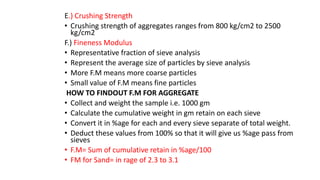
E.) Crushing Strength
• Crushing strength of aggregates ranges from 800 kg/cm2 to 2500
kg/cm2
F.) Fineness Modulus
• Representative fraction of sieve analysis
• Represent the average size of particles by sieve analysis
• More F.M means more coarse particles
• Small value of F.M means fine particles
HOW TO FINDOUT F.M FOR AGGREGATE
• Collect and weight the sample i.e. 1000 gm
• Calculate the cumulative weight in gm retain on each sieve
• Convert it in %age for each and every sieve separate of total weight.
• Deduct these values from 100% so that it will give us %age pass from
sieves
• F.M= Sum of cumulative retain in %age/100
• FM for Sand= in rage of 2.3 to 3.1

Aggregates introduction, types and properties

  • 1.
    Aggregates • Stone particlescollected from various sources • Size range from 0.15 mm to 75 mm • No Cementing power • Insoluble materials • 50% to 80% parts of concrete mix
  • 2.
    Types of aggregate Typesof Aggregate I. According to formation II. According to size III.According to gradation IV.According to shapes
  • 3.
    Types of aggregateaccording to Formation 1.) Natural Aggregate 2.) Artificial Aggregate Types of Aggregate 1.) Natural Aggregate : • The types of aggregate which that form from natural sources • It could be found in river bed in shape of gravel or natural rocks • Three types of natural rocks A.) Igneous Rocks B.) Sedimentary Rocks D.) Metamorphic Rocks
  • 4.
    A) Igneous Rocks: Typesof Aggregate • They are formed by the cooling of molten magma on the earth's surface due to volcanic eruptions. • Granites and trapes stones are the examples of such rocks. • Aggregate collected from such resources are more strong and low porosity. • Porosity ranges 0.15 % to 3.8% • Low porosity means: • Small air voids in concrete as low porosity • Normal air voids in concrete ranges from 5 %to 20% without compaction (note: 5% air voids could reduce the strength of concrete by 30%) • Low rate of expansion and contractions for concrete • Minimum chances of cracks as low rate for expansion and contraction • Better compaction of Concrete
  • 5.
    B.) Sedimentary Rock Typesof Aggregate • Such rocks are formed by the deposition and subsequent cementation of these materials at the Earth's surface and within water. • Lime stone and sand stone are the example of such rocks • Could be in weak condition as the porosity level is high in lime stone that ranges from 0% to 37% • More porosity means • High level air voids in concrete • Reduction in strength of concrete due to air voids • Segregation effect in concrete due to porosity • High level of expansion and contraction due to porosity as the water absorb by the stone. • Poor compaction • More chance of carbonation effects due to pores in concrete
  • 6.
    c.) Metamorphic Rocks Typesof Aggregate • These types of rocks are form as the rocks subjected to very high heat and pressure, which cause obvious physical and/or chemical changes that causes to form metamorphic rocks. • Marble and Schist are the example of such rocks
  • 7.
    2.) Artificial Aggregate Typesof Aggregate • This type of aggregate is formed by grinding of specified materials in required size and shapes such as blast furnace’s slag that is grind to achieve the artificial aggregate • Usually use form light weight and heavy weight aggregate • Such aggregates are not desirable for RCC work as week in compressive strength
  • 8.
    II.) Types ofAggregate According Size A.) Fine Aggregate B.) Coarse Aggregate C.) All-In Aggregate
  • 9.
    A.) Fine Aggregate •Size ranges from 0.15 mm to 4.75 mm • Types are as follow: i.) Sand ii.) Crushed Stone
  • 10.
    i.) Sand • Theseare the small particles of Silica • Reduce Air voids in Concrete so that reduction in Shrinkage. • Three types of sand are there: • Fine Sand (0.15 mm to 0.425 mm) • Medium Sand (0.425 mm to 2.00 mm) • Coarse Sand ( 2.00 mm to 4.75 mm) • For plaster we use fine aggregates as it contain more voids to help varnishing and painting to make a very strong bond with plaster surface
  • 11.
    Qualities of Sand •Should be clean • No dust • No salts • Will contain various sizes particles • Should be free from salts
  • 12.
    Bulking of Sand •Increase in volume of sand due to increase in moistures • 3.76% moisture will increase 25% (maximum increment) in volume • 20% moisture completely reduce the bulking of sand • More fine particles means more bulking in sand as more voids between the particles
  • 13.
    ii.) Crushed Stone •Such fine aggregate achieved from stones that cut and grind for construction work. • It contain different size particles 0.15 mm to 3 mm • Suitable for masonry work
  • 14.
    B.) Coarse Aggregate •Size ranges from 4.75 mm to 75 mm • Must contain various grade particles • Strength must be between 800 kg/m^2 to 2500 kg/m^2
  • 15.
    Types of CoarseAggregate i. Stone Ballast ii. Gravels iii. Brick Ballast iv. Clinker
  • 16.
    i.) Stone Ballast •The most strong and durable types for aggregate • The stone must not be pores • Must not be laminated • Must not contain any type of salts • Granite and sand stones are known names for such aggregate sources.
  • 17.
    ii) Gravels • Couldbe found in river beds • More strong with high level crushing strength • Usually consist of mineral salts and other harmful ingredients & not popular for use in RCC works
  • 18.
    iii) Brick Ballast iv)Clinkers • Not desirable for RCC work • Week and pores
  • 19.
    C.) All inAggregate • Consist of both fine and coarse aggregate • Proper check required by sieve analysis before use to determine the gradation
  • 20.
    III) Types ofAggregate According to Gradation i) Single Grade Aggregate ii) Graded Aggregate iii)Gape Graded Aggregate
  • 21.
    i) Single gradeAggregate • Must contain 85% to 100% particles of specified size • 0% to 25% particles will retain on next lower sieve • Air voids ratio ranges from 38% to 42 %
  • 22.
    ii) Graded Aggregate •90% to 100% particles will be pass by specified size of sieve • 30% to 70% particles will retain on next lower sieve
  • 23.
    iii) Gap GradedAggregate • Contain different types of particles • Used for special type of concrete such as light weight concrete
  • 24.
    IV) Types ofAggregate According to Shape i) Rounded Aggregate ii) Irregular Aggregate iii)Flaky Aggregate iv)Elongated Aggregate v) Angular Aggregate
  • 25.
    Rounded Aggregate • Gravelsare examples for such aggregate • Week bond between particles • No edges
  • 26.
    ii) Irregular Aggregate •Such aggregate could be formed rocks as they collapsed • Not in proper size and shapes • If use in concrete will produce more air voids • Not desirable of RCC work
  • 27.
    iii) Flaky Aggregate •Thickness will be less then 0.6 of specified thickness • Could be determine by thickness gauge • Maximum %age of Flaky aggregate should not be more then 40% • At least 200 Nos of Aggregate shall be pass from gauge
  • 28.
    iv) Elongated Aggregate •1.8% long from specified length • Length gauge shall be used to determine such particles • Maximum %age for elongated particles are 15% • At least 200 Nos of Aggregate should be pass from the gauge
  • 29.
    CHARACTERISTICS OF AGGREGATES A.)Specific gravity :- Ratio between weight of aggregate and amount of water equivalent to the volume of aggregates B.) Bulk Density: Also Known as unit weight of aggregate C.) Moisture Content: Amount of water available in Aggregate, causes by atmospheric condition of weather. Usually ranges for coarse aggregate 1% and 10% for fine aggregate. D.) Absorption of Water: • the amount of water the absorb by aggregate due to porosity. • Maximum absorption for fine and coarse aggregates will not exceed 2% • Minimum porosity means minimum absorption • Porosity in granite rocks ranges from 0.4% to 3.8% means minimum absorption • Porosity in lime stone ranges from 0% to 37.6% means more porosity and weak for concrete work • In quartzite ranges from 1.9% to 15%
  • 30.
    E.) Crushing Strength •Crushing strength of aggregates ranges from 800 kg/cm2 to 2500 kg/cm2 F.) Fineness Modulus • Representative fraction of sieve analysis • Represent the average size of particles by sieve analysis • More F.M means more coarse particles • Small value of F.M means fine particles HOW TO FINDOUT F.M FOR AGGREGATE • Collect and weight the sample i.e. 1000 gm • Calculate the cumulative weight in gm retain on each sieve • Convert it in %age for each and every sieve separate of total weight. • Deduct these values from 100% so that it will give us %age pass from sieves • F.M= Sum of cumulative retain in %age/100 • FM for Sand= in rage of 2.3 to 3.1