CON 123
Cementitious Materials


Session 2
Raw Materials & Manufacturing
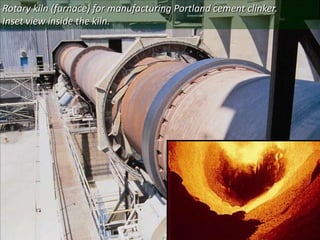
Rotary kiln (furnace) for manufacturing Portland cement clinker.
Inset view inside the kiln.
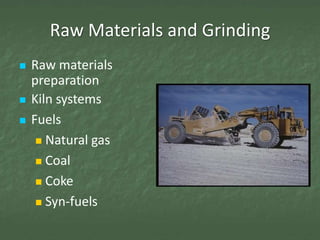
Raw Materials and Grinding
   Raw materials
    preparation
   Kiln systems
   Fuels
      Natural gas

      Coal

      Coke

      Syn-fuels
Primary Components of Raw Materials
Necessary for Portland Clinker Production
Materials used in the manufacture of Portland
cement must contain appropriate proportions:
 Calcium

 Silica

 Alumina

 Iron
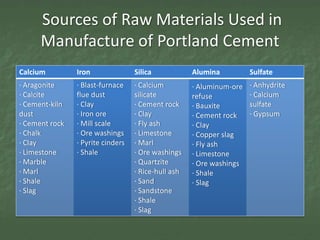
Sources of Raw Materials Used in
      Manufacture of Portland Cement
Calcium         Iron               Silica            Alumina          Sulfate
· Aragonite     · Blast-furnace    · Calcium         · Aluminum-ore   · Anhydrite
· Calcite       flue dust          silicate          refuse           · Calcium
· Cement-kiln   · Clay             · Cement rock     · Bauxite        sulfate
dust            · Iron ore         · Clay            · Cement rock    · Gypsum
· Cement rock   · Mill scale       · Fly ash         · Clay
· Chalk         · Ore washings     · Limestone       · Copper slag
· Clay          · Pyrite cinders   · Marl            · Fly ash
· Limestone     · Shale            · Ore washings    · Limestone
· Marble                           · Quartzite       · Ore washings
· Marl                             · Rice-hull ash   · Shale
· Shale                            · Sand            · Slag
· Slag                             · Sandstone
                                   · Shale
                                   · Slag
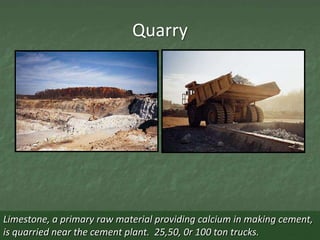
Quarry


Limestone, a primary raw material providing calcium in making cement,
is quarried near the cement plant. 25,50, 0r 100 ton trucks.
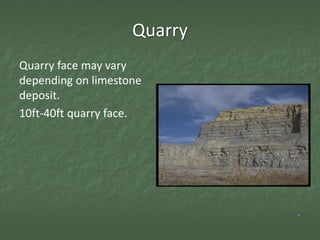
Quarry
Quarry face may vary
depending on limestone
deposit.
10ft-40ft quarry face.
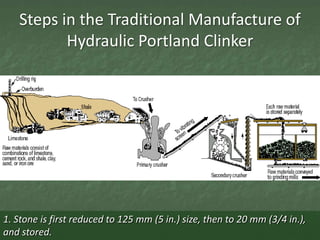
Steps in the Traditional Manufacture of
          Hydraulic Portland Clinker


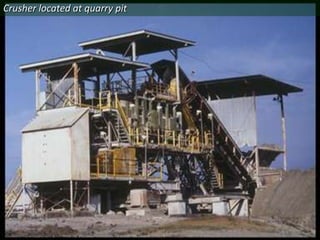
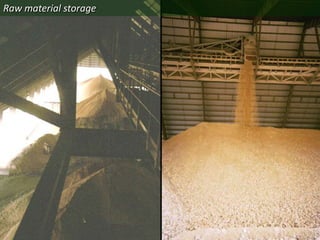
1. Stone is first reduced to 125 mm (5 in.) size, then to 20 mm (3/4 in.),
and stored.
Crusher located at quarry pit
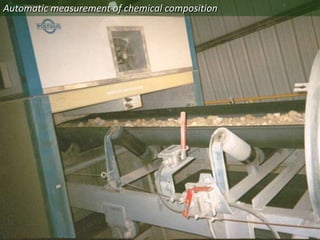
Automatic measurement of chemical composition
Raw material storage
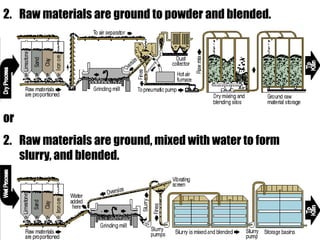
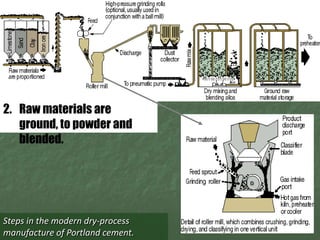
2. Raw materials are ground to powder and blended.


or
2. Raw materials are ground, mixed with water to form
   slurry, and blended.
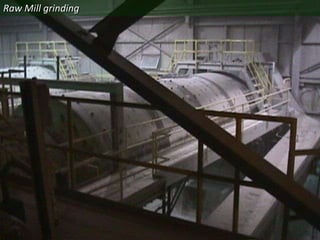
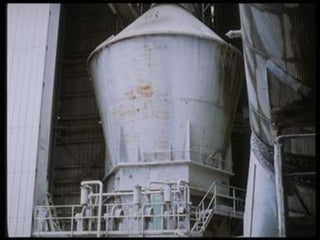
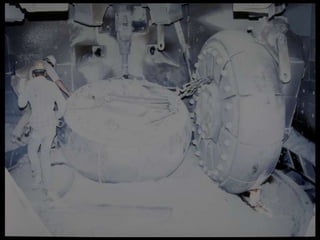
Raw Mill grinding
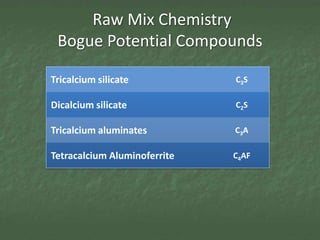
Raw Mix Chemistry
 Bogue Potential Compounds

Tricalcium silicate           C3S

Dicalcium silicate            C2S

Tricalcium aluminates         C3A

Tetracalcium Aluminoferrite   C4AF
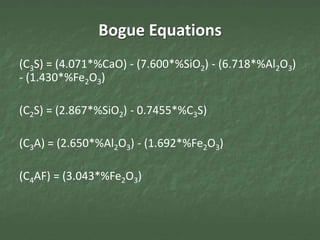
Bogue Equations
(C3S) = (4.071*%CaO) - (7.600*%SiO2) - (6.718*%Al2O3)
- (1.430*%Fe2O3)

(C2S) = (2.867*%SiO2) - 0.7455*%C3S)

(C3A) = (2.650*%Al2O3) - (1.692*%Fe2O3)

(C4AF) = (3.043*%Fe2O3)
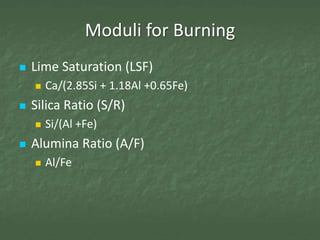
Moduli for Burning
   Lime Saturation (LSF)
       Ca/(2.85Si + 1.18Al +0.65Fe)
   Silica Ratio (S/R)
       Si/(Al +Fe)
   Alumina Ratio (A/F)
       Al/Fe
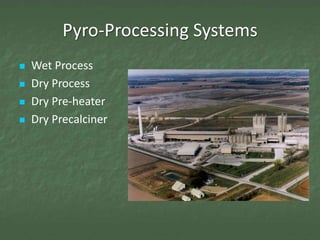
Pyro-Processing Systems
   Wet Process
   Dry Process
   Dry Pre-heater
   Dry Precalciner
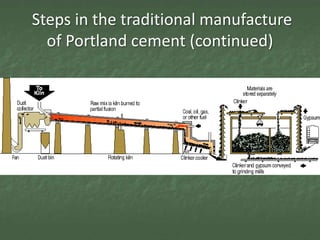
Steps in the traditional manufacture
       of Portland cement (continued)


3. Burning changes raw mix chemically into cement clinker.
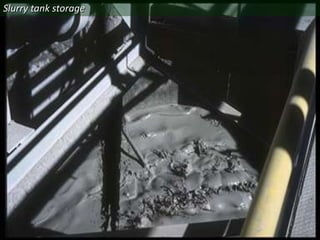
Slurry tank storage
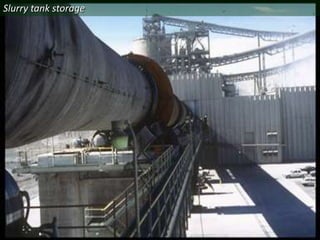
Slurry tank storage
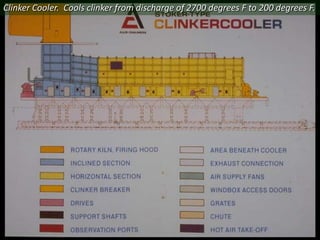
Clinker Cooler. Cools clinker from discharge of 2700 degrees F to 200 degrees F.
2. Raw materials are
   ground, to powder and
   blended.


Steps in the modern dry-process
manufacture of Portland cement.
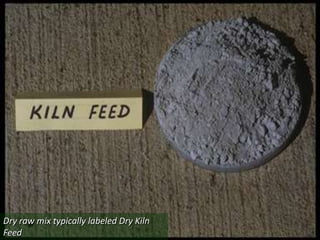
Dry raw mix typically labeled Dry Kiln
Feed
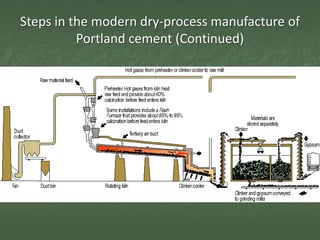
Steps in the modern dry-process manufacture of
             Portland cement (Continued)


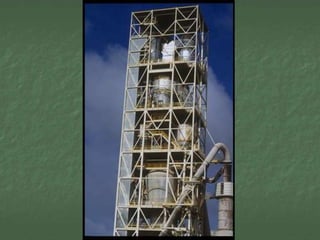
3. Burning changes raw mix chemically into clinker. Note
   four stage preheater, flash furnaces, and shorter kiln.
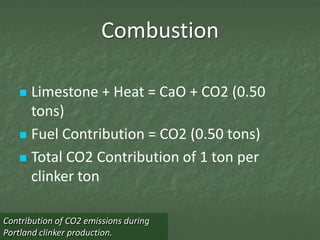
Combustion

    Limestone + Heat = CaO + CO2 (0.50
     tons)
    Fuel Contribution = CO2 (0.50 tons)

    Total CO2 Contribution of 1 ton per
     clinker ton

Contribution of CO2 emissions during
Portland clinker production.
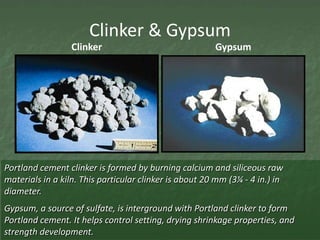
Clinker & Gypsum
                  Clinker                               Gypsum


Portland cement clinker is formed by burning calcium and siliceous raw
materials in a kiln. This particular clinker is about 20 mm (3¼ - 4 in.) in
diameter.
Gypsum, a source of sulfate, is interground with Portland clinker to form
Portland cement. It helps control setting, drying shrinkage properties, and
strength development.
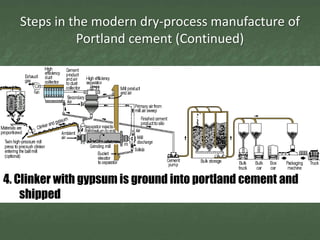
Steps in the modern dry-process manufacture of
             Portland cement (Continued)


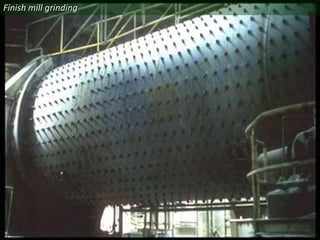
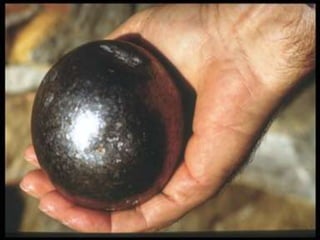
4. Clinker with gypsum is ground into portland cement and
    shipped
Finish mill grinding
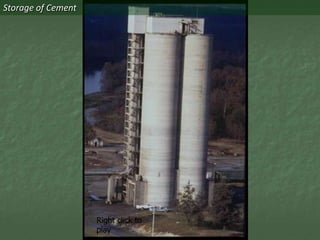
Storage of Cement


                    Right click to
                    play
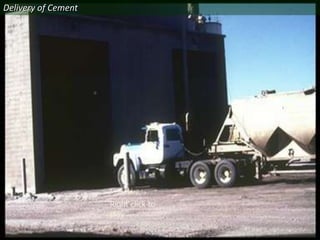
Delivery of Cement


                     Right click to
                     play
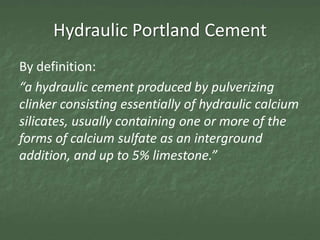
Hydraulic Portland Cement
By definition:
“a hydraulic cement produced by pulverizing
clinker consisting essentially of hydraulic calcium
silicates, usually containing one or more of the
forms of calcium sulfate as an interground
addition, and up to 5% limestone.”
Raw Materials and Grinding
Please return to Blackboard and watch the
following video:
 Video 1: Storage

CON 123 - Session 2 - Raw Materials and Grinding

  • 1.
    CON 123 Cementitious Materials Session2 Raw Materials & Manufacturing
  • 2.
    Rotary kiln (furnace)for manufacturing Portland cement clinker. Inset view inside the kiln.
  • 3.
    Raw Materials andGrinding  Raw materials preparation  Kiln systems  Fuels  Natural gas  Coal  Coke  Syn-fuels
  • 4.
    Primary Components ofRaw Materials Necessary for Portland Clinker Production Materials used in the manufacture of Portland cement must contain appropriate proportions:  Calcium  Silica  Alumina  Iron
  • 5.
    Sources of RawMaterials Used in Manufacture of Portland Cement Calcium Iron Silica Alumina Sulfate · Aragonite · Blast-furnace · Calcium · Aluminum-ore · Anhydrite · Calcite flue dust silicate refuse · Calcium · Cement-kiln · Clay · Cement rock · Bauxite sulfate dust · Iron ore · Clay · Cement rock · Gypsum · Cement rock · Mill scale · Fly ash · Clay · Chalk · Ore washings · Limestone · Copper slag · Clay · Pyrite cinders · Marl · Fly ash · Limestone · Shale · Ore washings · Limestone · Marble · Quartzite · Ore washings · Marl · Rice-hull ash · Shale · Shale · Sand · Slag · Slag · Sandstone · Shale · Slag
  • 6.
    Quarry Limestone, a primaryraw material providing calcium in making cement, is quarried near the cement plant. 25,50, 0r 100 ton trucks.
  • 7.
    Quarry Quarry face mayvary depending on limestone deposit. 10ft-40ft quarry face.
  • 8.
    Steps in theTraditional Manufacture of Hydraulic Portland Clinker 1. Stone is first reduced to 125 mm (5 in.) size, then to 20 mm (3/4 in.), and stored.
  • 9.
  • 10.
    Automatic measurement ofchemical composition
  • 11.
  • 12.
    2. Raw materialsare ground to powder and blended. or 2. Raw materials are ground, mixed with water to form slurry, and blended.
  • 13.
  • 14.
    Raw Mix Chemistry Bogue Potential Compounds Tricalcium silicate C3S Dicalcium silicate C2S Tricalcium aluminates C3A Tetracalcium Aluminoferrite C4AF
  • 15.
    Bogue Equations (C3S) =(4.071*%CaO) - (7.600*%SiO2) - (6.718*%Al2O3) - (1.430*%Fe2O3) (C2S) = (2.867*%SiO2) - 0.7455*%C3S) (C3A) = (2.650*%Al2O3) - (1.692*%Fe2O3) (C4AF) = (3.043*%Fe2O3)
  • 16.
    Moduli for Burning  Lime Saturation (LSF)  Ca/(2.85Si + 1.18Al +0.65Fe)  Silica Ratio (S/R)  Si/(Al +Fe)  Alumina Ratio (A/F)  Al/Fe
  • 17.
    Pyro-Processing Systems  Wet Process  Dry Process  Dry Pre-heater  Dry Precalciner
  • 18.
    Steps in thetraditional manufacture of Portland cement (continued) 3. Burning changes raw mix chemically into cement clinker.
  • 19.
  • 20.
  • 21.
    Clinker Cooler. Coolsclinker from discharge of 2700 degrees F to 200 degrees F.
  • 22.
    2. Raw materialsare ground, to powder and blended. Steps in the modern dry-process manufacture of Portland cement.
  • 25.
    Dry raw mixtypically labeled Dry Kiln Feed
  • 26.
    Steps in themodern dry-process manufacture of Portland cement (Continued) 3. Burning changes raw mix chemically into clinker. Note four stage preheater, flash furnaces, and shorter kiln.
  • 28.
    Combustion  Limestone + Heat = CaO + CO2 (0.50 tons)  Fuel Contribution = CO2 (0.50 tons)  Total CO2 Contribution of 1 ton per clinker ton Contribution of CO2 emissions during Portland clinker production.
  • 29.
    Clinker & Gypsum Clinker Gypsum Portland cement clinker is formed by burning calcium and siliceous raw materials in a kiln. This particular clinker is about 20 mm (3¼ - 4 in.) in diameter. Gypsum, a source of sulfate, is interground with Portland clinker to form Portland cement. It helps control setting, drying shrinkage properties, and strength development.
  • 30.
    Steps in themodern dry-process manufacture of Portland cement (Continued) 4. Clinker with gypsum is ground into portland cement and shipped
  • 31.
  • 33.
    Storage of Cement Right click to play
  • 34.
    Delivery of Cement Right click to play
  • 35.
    Hydraulic Portland Cement Bydefinition: “a hydraulic cement produced by pulverizing clinker consisting essentially of hydraulic calcium silicates, usually containing one or more of the forms of calcium sulfate as an interground addition, and up to 5% limestone.”
  • 36.
    Raw Materials andGrinding Please return to Blackboard and watch the following video:  Video 1: Storage