
CEMENT
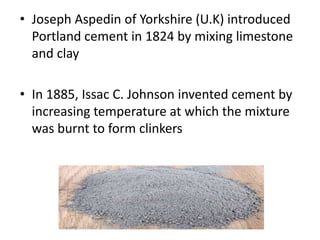
• Joseph Aspedin of Yorkshire (U.K) introduced
Portland cement in 1824 by mixing limestone
and clay
• In 1885, Issac C. Johnson invented cement by
increasing temperature at which the mixture
was burnt to form clinkers
• Cement is the mixture of calcareous, siliceous, argillaceous and other substances. It
is used as a binding material in mortar, concrete etc.
• Lime or calcium oxide, CaO: from limestone, chalk, shells, shale or calcareous rock
• Silica, SiO2: from sand, old bottles, clay or argillaceous rock
• Alumina, Al2O3: from bauxite, recycled aluminum, clay
• Iron, Fe2O3: from from clay, iron ore, scrap iron and fly ash
• Gypsum, CaSO4.2H20: found together with limestone
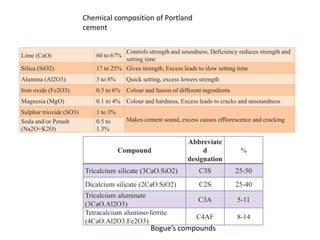
Lime (CaO) 60 to 67%
Controls strength and soundness, Deficiency reduces strength and
setting time
Silica (SiO2) 17 to 25% Gives strength, Excess leads to slow setting time
Alumina (Al2O3) 3 to 8% Quick setting, excess lowers strength
Iron oxide (Fe2O3) 0.5 to 6% Colour and fusion of different ingredients
Magnesia (MgO) 0.1 to 4% Colour and hardness, Excess leads to cracks and unsoundness
Sulphur trioxide (SO3) 1 to 3%
Makes cement sound, excess causes efflorescence and crackingSoda and/or Potash
(Na2O+K2O)
0.5 to
1.3%
Compound
Abbreviate
d
designation
%
Tricalcium silicate (3CaO.SiO2) C3S 25-50
Dicalcium silicate (2CaO.SiO2) C2S 25-40
Tricalcium aluminate
(3CaO.Al2O3)
C3A 5-11
Tetracalcium alumino-ferrite
(4CaO.Al2O3.Fe2O3)
C4AF 8-14
Bogue’s compounds
Chemical composition of Portland
cement
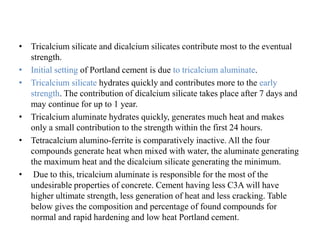
• Tricalcium silicate and dicalcium silicates contribute most to the eventual
strength.
• Initial setting of Portland cement is due to tricalcium aluminate.
• Tricalcium silicate hydrates quickly and contributes more to the early
strength. The contribution of dicalcium silicate takes place after 7 days and
may continue for up to 1 year.
• Tricalcium aluminate hydrates quickly, generates much heat and makes
only a small contribution to the strength within the first 24 hours.
• Tetracalcium alumino-ferrite is comparatively inactive. All the four
compounds generate heat when mixed with water, the aluminate generating
the maximum heat and the dicalcium silicate generating the minimum.
• Due to this, tricalcium aluminate is responsible for the most of the
undesirable properties of concrete. Cement having less C3A will have
higher ultimate strength, less generation of heat and less cracking. Table
below gives the composition and percentage of found compounds for
normal and rapid hardening and low heat Portland cement.
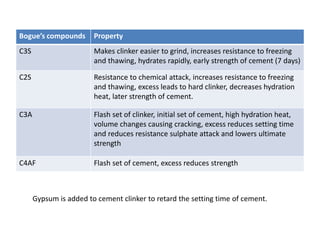
Bogue’s compounds Property
C3S Makes clinker easier to grind, increases resistance to freezing
and thawing, hydrates rapidly, early strength of cement (7 days)
C2S Resistance to chemical attack, increases resistance to freezing
and thawing, excess leads to hard clinker, decreases hydration
heat, later strength of cement.
C3A Flash set of clinker, initial set of cement, high hydration heat,
volume changes causing cracking, excess reduces setting time
and reduces resistance sulphate attack and lowers ultimate
strength
C4AF Flash set of cement, excess reduces strength
Gypsum is added to cement clinker to retard the setting time of cement.
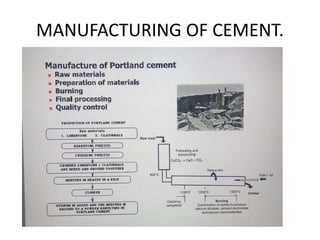
MANUFACTURING OF CEMENT.
• Raw materials are homogenized by crushing,
grinding and blending so that approximately
80% of the raw material pass a No.200 sieve.
• Mixture is fed into kiln & burned in a dry state
• This process provides considerable savings in
fuel consumption and water usage but the
process is dustier compared to wet process
that is more efficient than grinding.
DRY PROCESS
• Raw materials are homogenized by crushing, grinding and
blending so that approximately 80% of the raw material pass a
No.200 sieve.
• The mix will be turned into form of slurry by adding 30 - 40%
of water.
• It is then heated to about 2750ºF (1510ºC) in horizontal
revolving kilns (76-153m length and 3.6-4.8m in diameter.)
• Natural gas, petroleum or coal are used for burning. High fuel
requirement may make it uneconomical compared to dry
process.
WET PROCESS
• In the kiln, water from the raw material is driven off and limestone is
decomposed into lime and Carbon Dioxide.
limestone = lime + Carbon Dioxide
• In the burning zone, portion of the kiln, silica and alumina from the
clay undergo a solid state chemical reaction with lime to produce
calcium aluminate.
silica & alumina + lime = calcium aluminate
• The rotation and shape of kiln allow the blend to flow down the kiln,
submitting it to gradually increasing temperature.
• As the material moves through hotter regions in the kiln, calcium
silicates are formed These products, that are black or greenish black in
color are in the form of small pellets, called cement clinkers
• Cement clinkers are hard, irregular and ball shaped particles about
18mm in diameter.
DRY PROCES & WET PROCESS
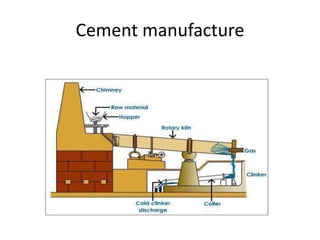
Cement manufacture
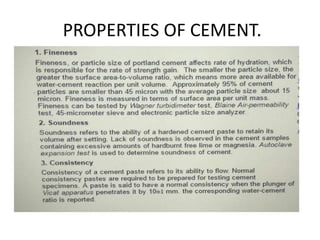
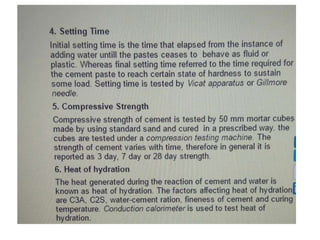
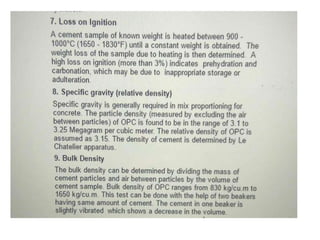
PROPERTIES OF CEMENT.
Two major types of cement
• 1.Hydraulic cement
• An inorganic material or a mixture of inorganic materials that sets and
develops strength by chemical reaction with water by formation of hydrates
and is capable of doing so under water.
• 2.Non-hydraulic cement
• Non-hydraulic cement is cement which cannot harden while in contact with
water, as opposed to hydraulic cement which can.
• Non-hydraulic cements are created using materials such as non-hydraulic
lime and gypsum plasters, and oxychloride.
• After non-hydraulic cement is utilized in construction, it must be kept dry
in order to gain strength and hold the structure.
• When non-hydraulic cement is used in mortars, those mortars can set only
by drying
• out, and therefore gain strength very slowly.
• Due to the difficulties associated with waiting long periods for setting and
drying, nonhydraulic cement is rarely utilized in modern times.
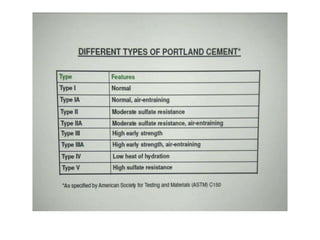
• Ordinary Portland cement
• Rapid Hardening Cement
• Quick setting cement
• Low Heat Cement
• Sulphates resisting cement
• Blast Furnace Slag Cement
• High Alumina Cement
• White Cement
• Coloured cement
• Pozzolanic Cement
• Air Entraining Cement
• Hydrographic cement
TYPES OF CEMENT.
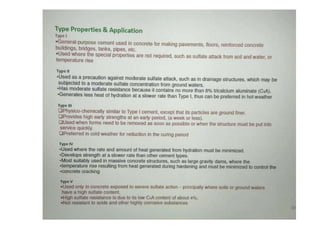
• Ordinary Portland cement
These are available in many grades , namely 33 grade , 43 grade, 53 grade etc
If 28 day strength is not less than 33N/mm2 then it is called 33 grade cement.
If 28 day strength is not less than 43N/mm2 then it is called 43 grade cement.
Use of higher grade cement offers many advantageous for making stronger
concrete. Although they are little costlier than the low grade cement, they offer
10 to 20% saving in the cement consumption and also they offer many other
hidden benefits. One of the most important benefits is the faster rate of
development of the strength. Used for the ordinary works.
• Rapid hardening cement
As the name indicate it develops the strength rapidly. This cement develops at
the age of three days , the same strength as that expected of Ordinary Portland
cement at seven days. The rapid rate of development of the strength is due to
the higher finness and higher C3S and lower C2S. Used for the Road repair
work, Early removal of the formwork, Cold weather concrete.
• Sulphate resisting cement
Ordinary Portland cement is susceptible to the sulphate attack. Sulphate react
with the free calcium hydroxide to form calcium sulphate and the hydrate of
calcium aluminate to form calciumsulphoaluminates, the volume of which is
approximately 227% of the volume of the original aluminates. Their expansion
results in cracks. To remedy this the use of the cement with the low C3A is
recommended. Such cement with the low C3A and content is known as the
Sulphate resisting cement. Used for Marine condition, Foundation in soil
infested with sulphates, Concrete used for the fabrication of pipes etc
• Quick setting cement
As the name indicates this type cement set quickly. This property is brought
out by reducing the gypsum content at the time of the clinker grinding. This
cement is required to mix, place and compacted very easly. Used for the
underwater construction.
• Super sulphated cement
Super sulphated cement is manufactured by grinding together a mixture of 80
to 85 % of the granulated slag, 10 to 15 % of the hard burnt gypsum, and 5%
Portland cement clinker. This cement is high sulphate resistant. Because of this
property it is used for the Foundation where chemically aggressive condition
exists
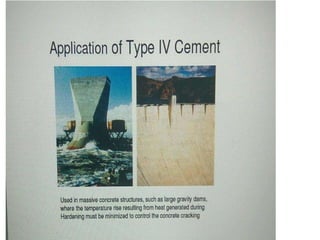
• Low heat cement
Hydration of the cement is exothermic process which liberates high quantity
of the heat. This will cause the formation of the cracks. A low heat evolution is
brought by Reducing the C3A and C3S which are the compounds evolving the
greater heat of hydration and increasing C2S. Rate of evolution of heat of
hydration will therefore will be less and evolution of heat will extend over a
large period. Therefore Low heat cement rate of the development of the
strength is very low. Used for the mass construction works
• Portland Pozzolona cement
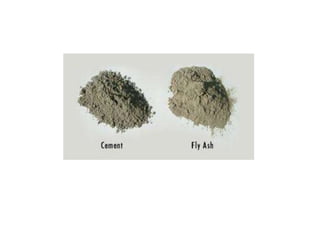
Portland Pozzolona cement is manufactured by intergrinding OPC clinker with 10
to 25% of the Pozzolona material like fly ash, burnt clay. Portland Pozzolona
cement produces low heat of hydration and offer greater resistance to the attack of
the aggressive water than OPC. Used for the mass construction works, marine and
hydraulic works.
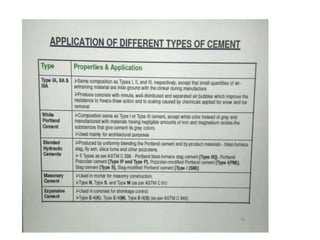
• Air entraining cement
This cement is manufactured by mixing small amount of the air entraining agent
with the OPC clinker at the time of grinding. At the time of mixing this cement
will produce air bubbles in the body of the concrete which will modify the
properties of the plastic concrete with respect to the workability, segregation and
bleeding
• Coloured cement
Coloured cement consists of the Portland cement with the 5 to 10 %
of the pigment. The cement and the pigment is grinded together.
• Hydrophobic cement
This cement is manufactured by grinding the OPC clinker with the
water repellent film forming substance such as stearic acid, oleic
acid. The water repellent film formed around each grain of the
cement reduces the deterioration of the cement during the long
storage, transportation and unfavourable conditions. Water repellent
film formed will also improve the workability
• Expansive cement
Concrete formed using the OPC shrinks during the setting due to
the loss of the water. In grouting works if concrete shrinks the
purpose for which the grout is used will be to some extend
defeated. A slight expansion with time is advantageous for the
grouting works. This type of the cement which does not suffer an
overall change in the volume on drying is known as the
Expansive cement.
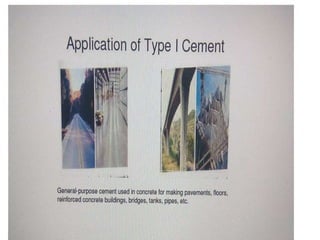
•It is used in mortar for plastering, masonry work, pointing, etc.
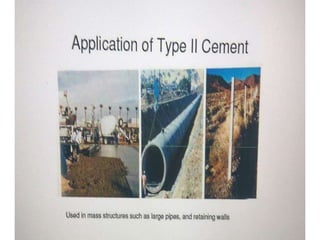
•It is used for making joints for drains and pipes.
•It is used for water tightness of structure.
•It is used in concrete for laying floors, roofs and constructing lintels,
beams, stairs, pillars etc.
•It is used where hard surface is required for the protection of
exposed surfaces of structures against the destructive agents of the
weather and certain organic or inorganic chemicals.
•It is used for precast pipes manufacturing, piles, fencing posts etc.
•It is used in the construction of important engineering structures
such as bridges, culverts, dams, tunnels, light houses etc.
•It is used in the preparation of foundations, water tight floors,
footpaths etc.
•It is employed for the construction of wells, water tanks, tennis
courts, lamp posts, telephone cabins, roads etc
USES OF CEMENT.
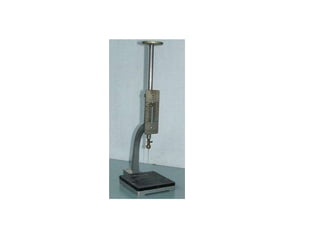
• CONSISTENCY TEST:This is a test to estimate the quantity of mixing
water to form a paste of normal consistency defined as that percentage
water requirement of the cement paste, the viscosity of which will be such
that the Vicat’s plunger penetrates up to a point 5 to 7 mm from the bottom
of the Vicat’s mould.
• The water requirement for various tests of cement depends on the normal
consistency of the cement, which itself depends upon the compound
composition and fineness of the cement.
Test Procedure:
300 g of cement is mixed with 25 per cent water. The paste is filled in the
mould of Vicat’s apparatus and the surface of the filled paste
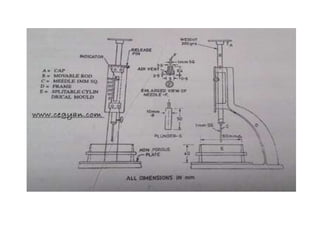
is smoothed and levelled. A square needle 10 mm x 10 mm attached to the
plunger is then lowered gently over the cement paste surface and is released
quickly. The plunger pierces the cement paste. The reading on the attached
scale is recorded. When the reading is 5-7 mm from the bottom of the
mould, the amount of water added is considered to be the correct
percentage of water for normal consistency.
TESTS ON CEMENT.
• INITIALAND FINAL SETTING TIME:
• When water is added to cement, the resulting paste starts to stiffen and gain
strength and lose the consistency simultaneously. The term setting implies
solidification of the plastic cement
paste.
• Initial and final setting times may be regarded as the two stiffening states of
the cement.
• The beginning of solidification, called the initial set, marks the point in
time when the paste has become unworkable. The time taken to solidify
completely marks the final set, which should not be too long in order to
resume construction activity within a reasonable time after the placement of
concrete.
The initial setting time may be defined as the time taken by the paste to
stiffen to such an extent that the Vicat’s needle of 1mm sq is not permitted
to move down through the paste to within 5 ± 0.5 mm measured from the
bottom of the mould. The final setting time is the time after which the paste
becomes so hard that the angular attachment of 5mm to the needle, under
standard weight, fails to leave any mark on the hardened concrete. Initial
and final setting times are the rheological properties of cement.
• Test procedure:
A neat cement paste is prepared by gauging cement with 0.85 times the
water required to give a paste of standard consistency. The stop watch is
started at the instant water is added to the cement. The mould resting on
a nonporous plate is filled completely with cement paste and the surface
of filled paste is levelled smooth with the top of the mould. The test is
conducted at room temperature of 27± 2°C. The mould with the cement
paste is placed in the Vicat’s apparatus and the needle is lowered gently in
contact with the test block and is then quickly released. The needle thus
penetrates the test block and the reading on the Vicat’s apparatus
graduated scale is recorded. The procedure is repeated until the needle
fails to pierce the block by about 5 mm measured from the bottom of the
mould. The stop watch is pushed off and the time is recorded which gives
the initial setting time. The cement is considered to be finally set when
upon applying the needle gently to the surface of test block, the needle
makes an impression, but the attachment fails to do so.
• COMPRESSIVE STRENGTH: Compressive strength is the basic data
required for mix design. By this test, the quality and the quantity
of concrete can be controlled and the degree of adulteration can be
checked.
• Test Procedure:
The test specimens are 70.6 mm cubes having face area of about 5000 sq.
mm. Large size specimen cubes cannot be made since cement shrinks and
cracks may develop. The temperature of water and test room should be
27°± 2°C. A mixture of cement and standard sand in the proportion 1:3 by
weight is mixed dry with a trowel for one minute and then with water until
the mixture is of uniform colour. Three specimen cubes are prepared. The
material for each cube is mixed separately. The quantities of cement,
standard sand and water are 185 g, 555 g and (P/4) + 3.5, respectively
where P = percentage of water required to produce a paste of standard
consistency.
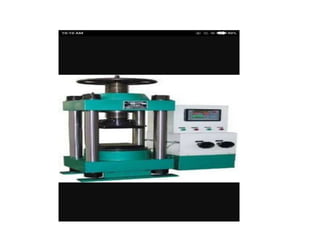
• The mould is filled completely with the cement paste and is placed on the
vibration table. Vibrations are imparted for about 2 minutes at a speed of
12000±400 per minute. The cubes are then removed from the moulds and
submerged in clean fresh water and are taken out just prior to testing in a
compression testing machine. Compressive strength is taken to be the
average of the results of the three cubes. The load is applied starting from
zero at a rate of 35 N/sq mm/minute. The compressive strength is
calculated from the crushing load divided by the average area over which
the load is applied. The result is expressed in N/mm2. For OPC,
compressive strength is 16 N/mm sq after 3 days.
• SOUNDNESS TEST: It is essential that the cement concrete does not
undergo large change in volume after setting. This is ensured by limiting
the quantities of free lime and magnesia which slake slowly causing change
in volume of cement (known as unsound). Soundness of cement may be
tested by LeChatelier method or by autoclave method. For OPC, RHC,
LHC and PPC it is limited to 10 mm, whereas for HAC and SSC it should
not exceed 5 mm.
• It is a very important test to assure the quality of cement since an unsound
cement produces cracks, distortion and disintegration, ultimately leading to
failure.
• Test Procedure:
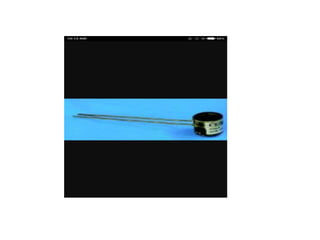
The Le Chatelier apparatus is used. The mould is placed on a glass sheet
and is filled with neat cement paste formed by gauging 100 g cement with
0.78 times the water required to give a paste of standard consistency. The
mould is covered with a glass sheet and a small weight is placed on the
covering glass sheet. The mould is then submerged in the water at
temperature of 27°-32°C. After 24 hours, the mould is taken out and the
distance separating the indicator points is measured. The mould is again
submerged in water. The water is now boiled for 3 hours. The mould is
removed from water and is cooled down. The distance between the
indicator points is measured again. The difference between the two
measurements represents the unsoundness of cement.
• TENSILE STRENGTH:The tensile strength may be determined by Briquette
test method
• Importance: The tensile strength of cement affords quicker indications of
defects in the cement than any other test. Also, the test is more
conveniently made than the compressive strength test. Moreover, since
the flexural strength, is directly related to the tensile strength this test is
ideally fitted to give information both with regard to tensile and
compressive strengths when the supply for material testing is small.
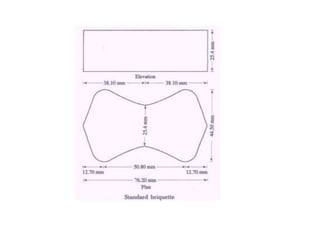
• Briquette test method:
A mixture of cement and sand is gauged in the proportion of 1:3 by weight.
The percentage of water to be used is calculated from the formula (P/5) +
2.5, where P = percentage of water required to produce a paste of standard
consistency. The temperature of the water and the test room should be 27°
± 2°C. The mix is filled in the moulds of the shape shown in Figure. After
filling the mould, an additional heap of mix is placed on the mould and is
pushed down with the standard spatula, until the mixture is level with the
top of the mould. This operation is repeated on the other side of the mould
also. The briquettes in the mould are finished by smoothing the surface
with the blade of a trowel. They are then kept for 24 hours at a temperature
of 27° ± 2°C and in an atmosphere having 90 per cent humidity. The
briquettes are then kept in clean fresh water and are taken out before
testing. Six briquettes are tested and the average tensile strength is
calculated. Load is applied steadily and uniformly, starting from zero and
increasing at the rate of 0.7 N/sq mm of section in 12 seconds. For OPC,
tensile strength is 2 N/mm sq after 3 days.
Cement intro
Cement intro

Cement intro

  • 1.
  • 2.
    • Joseph Aspedinof Yorkshire (U.K) introduced Portland cement in 1824 by mixing limestone and clay • In 1885, Issac C. Johnson invented cement by increasing temperature at which the mixture was burnt to form clinkers
  • 3.
    • Cement isthe mixture of calcareous, siliceous, argillaceous and other substances. It is used as a binding material in mortar, concrete etc. • Lime or calcium oxide, CaO: from limestone, chalk, shells, shale or calcareous rock • Silica, SiO2: from sand, old bottles, clay or argillaceous rock • Alumina, Al2O3: from bauxite, recycled aluminum, clay • Iron, Fe2O3: from from clay, iron ore, scrap iron and fly ash • Gypsum, CaSO4.2H20: found together with limestone
  • 4.
    Lime (CaO) 60to 67% Controls strength and soundness, Deficiency reduces strength and setting time Silica (SiO2) 17 to 25% Gives strength, Excess leads to slow setting time Alumina (Al2O3) 3 to 8% Quick setting, excess lowers strength Iron oxide (Fe2O3) 0.5 to 6% Colour and fusion of different ingredients Magnesia (MgO) 0.1 to 4% Colour and hardness, Excess leads to cracks and unsoundness Sulphur trioxide (SO3) 1 to 3% Makes cement sound, excess causes efflorescence and crackingSoda and/or Potash (Na2O+K2O) 0.5 to 1.3% Compound Abbreviate d designation % Tricalcium silicate (3CaO.SiO2) C3S 25-50 Dicalcium silicate (2CaO.SiO2) C2S 25-40 Tricalcium aluminate (3CaO.Al2O3) C3A 5-11 Tetracalcium alumino-ferrite (4CaO.Al2O3.Fe2O3) C4AF 8-14 Bogue’s compounds Chemical composition of Portland cement
  • 5.
    • Tricalcium silicateand dicalcium silicates contribute most to the eventual strength. • Initial setting of Portland cement is due to tricalcium aluminate. • Tricalcium silicate hydrates quickly and contributes more to the early strength. The contribution of dicalcium silicate takes place after 7 days and may continue for up to 1 year. • Tricalcium aluminate hydrates quickly, generates much heat and makes only a small contribution to the strength within the first 24 hours. • Tetracalcium alumino-ferrite is comparatively inactive. All the four compounds generate heat when mixed with water, the aluminate generating the maximum heat and the dicalcium silicate generating the minimum. • Due to this, tricalcium aluminate is responsible for the most of the undesirable properties of concrete. Cement having less C3A will have higher ultimate strength, less generation of heat and less cracking. Table below gives the composition and percentage of found compounds for normal and rapid hardening and low heat Portland cement.
  • 6.
    Bogue’s compounds Property C3SMakes clinker easier to grind, increases resistance to freezing and thawing, hydrates rapidly, early strength of cement (7 days) C2S Resistance to chemical attack, increases resistance to freezing and thawing, excess leads to hard clinker, decreases hydration heat, later strength of cement. C3A Flash set of clinker, initial set of cement, high hydration heat, volume changes causing cracking, excess reduces setting time and reduces resistance sulphate attack and lowers ultimate strength C4AF Flash set of cement, excess reduces strength Gypsum is added to cement clinker to retard the setting time of cement.
  • 7.
  • 8.
    • Raw materialsare homogenized by crushing, grinding and blending so that approximately 80% of the raw material pass a No.200 sieve. • Mixture is fed into kiln & burned in a dry state • This process provides considerable savings in fuel consumption and water usage but the process is dustier compared to wet process that is more efficient than grinding. DRY PROCESS
  • 9.
    • Raw materialsare homogenized by crushing, grinding and blending so that approximately 80% of the raw material pass a No.200 sieve. • The mix will be turned into form of slurry by adding 30 - 40% of water. • It is then heated to about 2750ºF (1510ºC) in horizontal revolving kilns (76-153m length and 3.6-4.8m in diameter.) • Natural gas, petroleum or coal are used for burning. High fuel requirement may make it uneconomical compared to dry process. WET PROCESS
  • 10.
    • In thekiln, water from the raw material is driven off and limestone is decomposed into lime and Carbon Dioxide. limestone = lime + Carbon Dioxide • In the burning zone, portion of the kiln, silica and alumina from the clay undergo a solid state chemical reaction with lime to produce calcium aluminate. silica & alumina + lime = calcium aluminate • The rotation and shape of kiln allow the blend to flow down the kiln, submitting it to gradually increasing temperature. • As the material moves through hotter regions in the kiln, calcium silicates are formed These products, that are black or greenish black in color are in the form of small pellets, called cement clinkers • Cement clinkers are hard, irregular and ball shaped particles about 18mm in diameter. DRY PROCES & WET PROCESS
  • 11.
  • 12.
  • 15.
    Two major typesof cement • 1.Hydraulic cement • An inorganic material or a mixture of inorganic materials that sets and develops strength by chemical reaction with water by formation of hydrates and is capable of doing so under water. • 2.Non-hydraulic cement • Non-hydraulic cement is cement which cannot harden while in contact with water, as opposed to hydraulic cement which can. • Non-hydraulic cements are created using materials such as non-hydraulic lime and gypsum plasters, and oxychloride. • After non-hydraulic cement is utilized in construction, it must be kept dry in order to gain strength and hold the structure. • When non-hydraulic cement is used in mortars, those mortars can set only by drying • out, and therefore gain strength very slowly. • Due to the difficulties associated with waiting long periods for setting and drying, nonhydraulic cement is rarely utilized in modern times.
  • 16.
    • Ordinary Portlandcement • Rapid Hardening Cement • Quick setting cement • Low Heat Cement • Sulphates resisting cement • Blast Furnace Slag Cement • High Alumina Cement • White Cement • Coloured cement • Pozzolanic Cement • Air Entraining Cement • Hydrographic cement TYPES OF CEMENT.
  • 17.
    • Ordinary Portlandcement These are available in many grades , namely 33 grade , 43 grade, 53 grade etc If 28 day strength is not less than 33N/mm2 then it is called 33 grade cement. If 28 day strength is not less than 43N/mm2 then it is called 43 grade cement. Use of higher grade cement offers many advantageous for making stronger concrete. Although they are little costlier than the low grade cement, they offer 10 to 20% saving in the cement consumption and also they offer many other hidden benefits. One of the most important benefits is the faster rate of development of the strength. Used for the ordinary works. • Rapid hardening cement As the name indicate it develops the strength rapidly. This cement develops at the age of three days , the same strength as that expected of Ordinary Portland cement at seven days. The rapid rate of development of the strength is due to the higher finness and higher C3S and lower C2S. Used for the Road repair work, Early removal of the formwork, Cold weather concrete.
  • 18.
    • Sulphate resistingcement Ordinary Portland cement is susceptible to the sulphate attack. Sulphate react with the free calcium hydroxide to form calcium sulphate and the hydrate of calcium aluminate to form calciumsulphoaluminates, the volume of which is approximately 227% of the volume of the original aluminates. Their expansion results in cracks. To remedy this the use of the cement with the low C3A is recommended. Such cement with the low C3A and content is known as the Sulphate resisting cement. Used for Marine condition, Foundation in soil infested with sulphates, Concrete used for the fabrication of pipes etc • Quick setting cement As the name indicates this type cement set quickly. This property is brought out by reducing the gypsum content at the time of the clinker grinding. This cement is required to mix, place and compacted very easly. Used for the underwater construction.
  • 19.
    • Super sulphatedcement Super sulphated cement is manufactured by grinding together a mixture of 80 to 85 % of the granulated slag, 10 to 15 % of the hard burnt gypsum, and 5% Portland cement clinker. This cement is high sulphate resistant. Because of this property it is used for the Foundation where chemically aggressive condition exists • Low heat cement Hydration of the cement is exothermic process which liberates high quantity of the heat. This will cause the formation of the cracks. A low heat evolution is brought by Reducing the C3A and C3S which are the compounds evolving the greater heat of hydration and increasing C2S. Rate of evolution of heat of hydration will therefore will be less and evolution of heat will extend over a large period. Therefore Low heat cement rate of the development of the strength is very low. Used for the mass construction works
  • 20.
    • Portland Pozzolonacement Portland Pozzolona cement is manufactured by intergrinding OPC clinker with 10 to 25% of the Pozzolona material like fly ash, burnt clay. Portland Pozzolona cement produces low heat of hydration and offer greater resistance to the attack of the aggressive water than OPC. Used for the mass construction works, marine and hydraulic works. • Air entraining cement This cement is manufactured by mixing small amount of the air entraining agent with the OPC clinker at the time of grinding. At the time of mixing this cement will produce air bubbles in the body of the concrete which will modify the properties of the plastic concrete with respect to the workability, segregation and bleeding
  • 22.
    • Coloured cement Colouredcement consists of the Portland cement with the 5 to 10 % of the pigment. The cement and the pigment is grinded together. • Hydrophobic cement This cement is manufactured by grinding the OPC clinker with the water repellent film forming substance such as stearic acid, oleic acid. The water repellent film formed around each grain of the cement reduces the deterioration of the cement during the long storage, transportation and unfavourable conditions. Water repellent film formed will also improve the workability
  • 23.
    • Expansive cement Concreteformed using the OPC shrinks during the setting due to the loss of the water. In grouting works if concrete shrinks the purpose for which the grout is used will be to some extend defeated. A slight expansion with time is advantageous for the grouting works. This type of the cement which does not suffer an overall change in the volume on drying is known as the Expansive cement.
  • 31.
    •It is usedin mortar for plastering, masonry work, pointing, etc. •It is used for making joints for drains and pipes. •It is used for water tightness of structure. •It is used in concrete for laying floors, roofs and constructing lintels, beams, stairs, pillars etc. •It is used where hard surface is required for the protection of exposed surfaces of structures against the destructive agents of the weather and certain organic or inorganic chemicals. •It is used for precast pipes manufacturing, piles, fencing posts etc. •It is used in the construction of important engineering structures such as bridges, culverts, dams, tunnels, light houses etc. •It is used in the preparation of foundations, water tight floors, footpaths etc. •It is employed for the construction of wells, water tanks, tennis courts, lamp posts, telephone cabins, roads etc USES OF CEMENT.
  • 32.
    • CONSISTENCY TEST:Thisis a test to estimate the quantity of mixing water to form a paste of normal consistency defined as that percentage water requirement of the cement paste, the viscosity of which will be such that the Vicat’s plunger penetrates up to a point 5 to 7 mm from the bottom of the Vicat’s mould. • The water requirement for various tests of cement depends on the normal consistency of the cement, which itself depends upon the compound composition and fineness of the cement. Test Procedure: 300 g of cement is mixed with 25 per cent water. The paste is filled in the mould of Vicat’s apparatus and the surface of the filled paste is smoothed and levelled. A square needle 10 mm x 10 mm attached to the plunger is then lowered gently over the cement paste surface and is released quickly. The plunger pierces the cement paste. The reading on the attached scale is recorded. When the reading is 5-7 mm from the bottom of the mould, the amount of water added is considered to be the correct percentage of water for normal consistency. TESTS ON CEMENT.
  • 34.
    • INITIALAND FINALSETTING TIME: • When water is added to cement, the resulting paste starts to stiffen and gain strength and lose the consistency simultaneously. The term setting implies solidification of the plastic cement paste. • Initial and final setting times may be regarded as the two stiffening states of the cement. • The beginning of solidification, called the initial set, marks the point in time when the paste has become unworkable. The time taken to solidify completely marks the final set, which should not be too long in order to resume construction activity within a reasonable time after the placement of concrete. The initial setting time may be defined as the time taken by the paste to stiffen to such an extent that the Vicat’s needle of 1mm sq is not permitted to move down through the paste to within 5 ± 0.5 mm measured from the bottom of the mould. The final setting time is the time after which the paste becomes so hard that the angular attachment of 5mm to the needle, under standard weight, fails to leave any mark on the hardened concrete. Initial and final setting times are the rheological properties of cement.
  • 35.
    • Test procedure: Aneat cement paste is prepared by gauging cement with 0.85 times the water required to give a paste of standard consistency. The stop watch is started at the instant water is added to the cement. The mould resting on a nonporous plate is filled completely with cement paste and the surface of filled paste is levelled smooth with the top of the mould. The test is conducted at room temperature of 27± 2°C. The mould with the cement paste is placed in the Vicat’s apparatus and the needle is lowered gently in contact with the test block and is then quickly released. The needle thus penetrates the test block and the reading on the Vicat’s apparatus graduated scale is recorded. The procedure is repeated until the needle fails to pierce the block by about 5 mm measured from the bottom of the mould. The stop watch is pushed off and the time is recorded which gives the initial setting time. The cement is considered to be finally set when upon applying the needle gently to the surface of test block, the needle makes an impression, but the attachment fails to do so.
  • 37.
    • COMPRESSIVE STRENGTH:Compressive strength is the basic data required for mix design. By this test, the quality and the quantity of concrete can be controlled and the degree of adulteration can be checked. • Test Procedure: The test specimens are 70.6 mm cubes having face area of about 5000 sq. mm. Large size specimen cubes cannot be made since cement shrinks and cracks may develop. The temperature of water and test room should be 27°± 2°C. A mixture of cement and standard sand in the proportion 1:3 by weight is mixed dry with a trowel for one minute and then with water until the mixture is of uniform colour. Three specimen cubes are prepared. The material for each cube is mixed separately. The quantities of cement, standard sand and water are 185 g, 555 g and (P/4) + 3.5, respectively where P = percentage of water required to produce a paste of standard consistency.
  • 38.
    • The mouldis filled completely with the cement paste and is placed on the vibration table. Vibrations are imparted for about 2 minutes at a speed of 12000±400 per minute. The cubes are then removed from the moulds and submerged in clean fresh water and are taken out just prior to testing in a compression testing machine. Compressive strength is taken to be the average of the results of the three cubes. The load is applied starting from zero at a rate of 35 N/sq mm/minute. The compressive strength is calculated from the crushing load divided by the average area over which the load is applied. The result is expressed in N/mm2. For OPC, compressive strength is 16 N/mm sq after 3 days.
  • 40.
    • SOUNDNESS TEST:It is essential that the cement concrete does not undergo large change in volume after setting. This is ensured by limiting the quantities of free lime and magnesia which slake slowly causing change in volume of cement (known as unsound). Soundness of cement may be tested by LeChatelier method or by autoclave method. For OPC, RHC, LHC and PPC it is limited to 10 mm, whereas for HAC and SSC it should not exceed 5 mm. • It is a very important test to assure the quality of cement since an unsound cement produces cracks, distortion and disintegration, ultimately leading to failure.
  • 41.
    • Test Procedure: TheLe Chatelier apparatus is used. The mould is placed on a glass sheet and is filled with neat cement paste formed by gauging 100 g cement with 0.78 times the water required to give a paste of standard consistency. The mould is covered with a glass sheet and a small weight is placed on the covering glass sheet. The mould is then submerged in the water at temperature of 27°-32°C. After 24 hours, the mould is taken out and the distance separating the indicator points is measured. The mould is again submerged in water. The water is now boiled for 3 hours. The mould is removed from water and is cooled down. The distance between the indicator points is measured again. The difference between the two measurements represents the unsoundness of cement.
  • 43.
    • TENSILE STRENGTH:Thetensile strength may be determined by Briquette test method • Importance: The tensile strength of cement affords quicker indications of defects in the cement than any other test. Also, the test is more conveniently made than the compressive strength test. Moreover, since the flexural strength, is directly related to the tensile strength this test is ideally fitted to give information both with regard to tensile and compressive strengths when the supply for material testing is small.
  • 44.
    • Briquette testmethod: A mixture of cement and sand is gauged in the proportion of 1:3 by weight. The percentage of water to be used is calculated from the formula (P/5) + 2.5, where P = percentage of water required to produce a paste of standard consistency. The temperature of the water and the test room should be 27° ± 2°C. The mix is filled in the moulds of the shape shown in Figure. After filling the mould, an additional heap of mix is placed on the mould and is pushed down with the standard spatula, until the mixture is level with the top of the mould. This operation is repeated on the other side of the mould also. The briquettes in the mould are finished by smoothing the surface with the blade of a trowel. They are then kept for 24 hours at a temperature of 27° ± 2°C and in an atmosphere having 90 per cent humidity. The briquettes are then kept in clean fresh water and are taken out before testing. Six briquettes are tested and the average tensile strength is calculated. Load is applied steadily and uniformly, starting from zero and increasing at the rate of 0.7 N/sq mm of section in 12 seconds. For OPC, tensile strength is 2 N/mm sq after 3 days.