SUBSCRIBER MY
CAHNNEL & LIKE
COMMENT
CEMENT
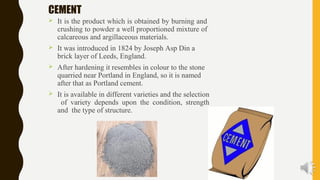
 It is the product which is obtained by burning and
crushing to powder a well proportioned mixture of
calcareous and argillaceous materials.
 It was introduced in 1824 by Joseph Asp Din a
brick layer of Leeds, England.
 After hardening it resembles in colour to the stone
quarried near Portland in England, so it is named
after that as Portland cement.
 It is available in different varieties and the selection
of variety depends upon the condition, strength
and the type of structure.
RAW MATERIALS REQUIRED
FOR MANUFACTURE OF
CEMENT ARE
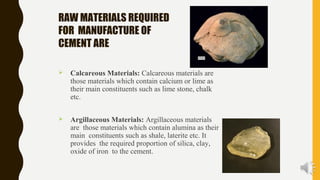
 Calcareous Materials: Calcareous materials are
those materials which contain calcium or lime as
their main constituents such as lime stone, chalk
etc.
 Argillaceous Materials: Argillaceous materials
are those materials which contain alumina as their
main constituents such as shale, laterite etc. It
provides the required proportion of silica, clay,
oxide of iron to the cement.
PROPORTION OF MIXING
 The ingredients are generally mixed in the ratio of two parts of
• Calcareous materials and one part argillaceous material.
 Limestone and shale are first crushed and then they are mixed either in wet state or in dry
by grounding them together.
 The mixture is then burnt in a rotary kiln at a temperature between
• 1400°C and l500°C.
 Pulverized coal, gas or oil being used as the fuel.
 The clinker so obtained is first cooled and then gypsum (3 to 4%) is added and it is grounde
the required fineness.
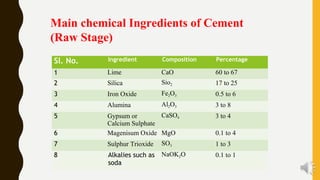
Main chemical Ingredients of Cement
(Raw Stage)
Sl. No. Ingredient Composition Percentage
1 Lime CaO 60 to 67
2 Silica Sio2 17 to 25
3 Iron Oxide Fe2O3 0.5 to 6
4 Alumina Al2O3 3 to 8
5 Gypsum or
Calcium Sulphate
CaSO4 3 to 4
6 Magenisum Oxide MgO 0.1 to 4
7 Sulphur Trioxide SO3 1 to 3
8 Alkalies such as
soda
NaOK2O 0.1 to 1
FUNCTIONS AND EFFECTS OF VARIOUS
INGREDIENTS
 Lime: It makes the cement sound and provides
strength to the cement. Excess of it in original form
causes the cement to expand and disintegrate.
 Silica: It provides strength to the cement. In excess
it slows down the setting of cement.
 Alumina: It provides quick setting property to the
cement. In excess it weakens the strength of
cement.
 Calcium Sulphate (Gypsum): It helps in increasing the
initial setting time of cement.
 Iron Oxide: It provides colour, hardness and strength to the
cement.
 Magnesium Oxide: It provides colour and hardness to the
cement. Excess of it in free state makes the cement unsound.
 Sulphur Trioxide: In small quantity it makes the cement
sound and in excess it makes the cement unsound.
 Alkalies: In excess it causes efflorescence.
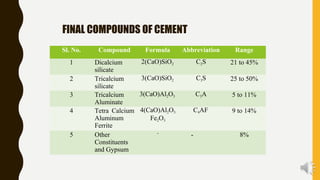
FINAL COMPOUNDS OF CEMENT
Sl. No. Compound Formula Abbreviation Range
1 Dicalcium
silicate
2(CaO)SiO2 C2S 21 to 45%
2 Tricalcium
silicate
3(CaO)SiO2 C3S 25 to 50%
3 Tricalcium
Aluminate
3(CaO)Al2O3 C3A 5 to 11%
4 Tetra Calcium
Aluminum
Ferrite
4(CaO)Al2O3
Fe2O3
C4AF 9 to 14%
5 Other
Constituents
and Gypsum
-
- 8%
FINAL COMPOUNDS OF CEMENT
CONTD…….
 C2S
 It hydrates slowly.
 It hardens more slowly
 It provides ultimate strength to the cement.
 It has more resistance to chemica1 attack.
 C3S
 It hydrates more rapidly.
 It develops early strength.
 It generates heat more rapidly and has less resistance
to chemical attack.
FINAL COMPOUNDS OF CEMENT
CONTD…….
 C3A
 It is fast reacting with large amount of heat
generation.
 It causes initial setting of cement.
 It is weak against sulphate attack.
 C4AF
 It is comparatively inactive.
 It has poor cementing value.
 It is slow in reaction with small heat generation.
1.Fineness:
It is the degree of grinding of cement.
The rate of reaction depends upon the fineness of grinding .
For accurate measurement it is measured by surface area, air
permeability method and the unit is cm2/gram of cement.
2.Setting Time:
Setting of cement is the phenomenon by virtue of which the
green cement changes into hard mass.
Initial setting is a stage in the process of hardening after which
any crack that may appear will not reunite and the completion of
this process is, known as final setting time.
The time between water is added in cement and initial setting
takes place is known as Initial Setting Time.
PROPERTIES OF CEMENT
 CEMENT SHOULD NOT LOOSE ITS PLASTICITY
TILL THE VARIOUS OPERATIONS OF MIXING,
TRANSPORTING AND PLACING ARE COMPLETE.
HENCE THIS TIME IS GENERALLY KEPT NOT LESS
THAN 30 MINUTES.
3.Strength:
The quality of concrete and cement is always judged by
strength and that is only by compressive strength because
cement is weak in tension and for it steel reinforcement is
always provided.
For this purpose cement and standard sand are mixed in the
ratio of 1:3
3.Soundness:
Free lime and magnesia present in cement makes the cement
unsound by increasing the volume after setting.
It is generally measured by Le-Chatelier method or by
Autoclave method.
4.Heat of Hydration:
Setting of cement is due to chemical reactions between cement
and water and this process is known as Hydration.
As, this reaction is exothermal process, so sufficient heat is
generated and this process continues for an indefinite period at a
diminishing rate.
It is always measured in calories/gram unit.
DIFFERENT TYPES OF CEMENT
1. Ordinary Portland cement.
2. Rapid Hardening Portland cement
3. Low Heat Portland cement
4. Portland Blast Furnace slag cement
5. Portland Sulphate resistant cement
6. Air entraining portland cement
7. White and coloured cement
8. High Alumina cement
9. Pozzoana cement
10.Oil well cement
11.Quick setting cement
12.Expanding cement
1.Ordinary Portland Cement:
It is also known as Normal setting cement.
It is used in Road pavements, buildings, culverts, water pipes
etc.
Out of the total consumption of different types of cement 90%
of this type is used.
2. Rapid Hardening Cement:
It contains less quantity of C2S and more quantity of C3S.
It is generally used where high early strength is required.
It is used by concrete product manufactures, highway
pavements which are to be opened early for road traffic and in
cold weather concreting due to its high heat of hydration
development.
3. Low Heat Portland Cement:
This cement is so called because it develops low heat at the time
of hydration.
It contains C3A and; C3S in less quantity because they develop
early heat.
It develops strength quite late and It is generally used in
massive concrete structures such as dams, bridge, abutments,
retaining walls etc.
4. Blast Furnace Slag Cement:
Percentage of slag varies from 25 to 65%.
It is cheaper as compared to ordinary cement because waste
product is used in it.
It can also be used in massive concrete such as dams, bridges
etc.
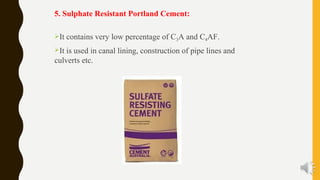
5. Sulphate Resistant Portland Cement:
It contains very low percentage of C3A and C4AF.
It is used in canal lining, construction of pipe lines and
culverts etc.
6. Air Entraining Portland Cement:
It is ordinary Portland cement mixed with small quantities or
air entertaining materials during grinding.
The diameter of air bubbles varies from 0.075 mm and 1.25
mm. On account of air bubbles the strength of cement is
reduced.
Air bubbles are permitted only up to 3 to 4 percentage, as
these reduce 10 to 15% strength of cement.
This cement is more plastic and workable causing less
segregation and bleeding in concrete.
It also reduces the water requirement and has high resistance
to weather.
7. WHITE AND COLOURED CEMENT:
 In it white chalk and china clay are used instead of lime
stone
and clay as these are having low percentage of Iron Oxide
i.e.1 %.
 Oil is used as fuel to avoid contamination o£ coal ash. It is 3
to 4 times costlier than ordinary cement.
 It is used for decorative floorings.
 For coloured cement suitable pigments varying from 5 to
10% free from soluble salts are added during grinding.
8. HIGH ALUMINA CEMENT:
 It contains 35% to 45% of aluminates Bauxite and chalk or
lime stone are mixed dry and heated till they melt and on
cooling they form clinkers.
 It is dark in colour and initial setting time varies from 3 to 6
hrs and final setting takes place with in 2 hours of the
Initial set.
 It gives high heat of hydration and, is also costlier than
ordinary Portland cement.
 It is used in structures subjected to the action of sea water,
chemical and sulphate bearing water. It
9. POZZOLANA CEMENT:
 Pozzolana is a naturally occurring material
such as volcanic ash or Pumice stone or an
artificial product such as burnt clay or shale
containing siliceous and aluminous mineral
substances.
 As per BIS 1489-1967, the proportion of
pozzolana material varies from 10 to 25%
by weight of cement.
 It increases the workability, reduces heat of
hydration, and increases the water tightness.
 It also offers greater resistance against
sulphatic action and sea water.
10. OIL WELL CEMENT:
 As the name indicates, it is used for cementing; oil wells.
 It is used at greeter depth under high temperature and
pressure.
 Iron Oxide is so adjusted that all the alumina is converted into
C4AF and sc proportion of C3A is very small, high increases
the setting time of cement and also hardens quickly after
setting.
 It protects the oil well causing from corrosion and also help in
supporting the oil well casing and thus reduce the tension, in
steel pipes.11. Quick Setting Cement:
It has less proportion of CaSO4 (Gypsum) or a small % of
aluminium sulphate is added at the time of grinding.
Its initial setting time is 5 minutes and final setting time is 30
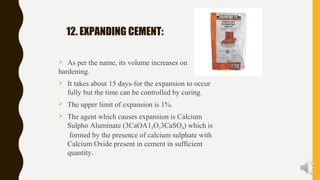
12. EXPANDING CEMENT:
 As per the name, its volume increases on
hardening.
 It takes about 15 days-for the expansion to occur
fully but the time can be controlled by curing.
 The upper limit of expansion is 1%.
 The agent which causes expansion is Calcium
Sulpho Aluminate (3CaOA12O33CaSO4) which is
formed by the presence of calcium sulphate with
Calcium Oxide present in cement in sufficient
quantity.
FIELD TESTS ON CEMENT:
 The colour of cement should be uniform gray with light
greenish shade.
 Cement should feel smooth when touched.
 If hand is inserted in a bag of cement it should feel cool not
warm.
 If a small quantity of cement is thrown in a bucket of water,
it
should sink and should not float on the surface.
 Cement should be free from any hard lumps
 A sample meant for testing shall be drawn from at least 12
different bags or barrels or containers or from 12 different
positions in a heap if cement is loose. Chemical composition
of cement should be checked for B. I. S. specifications.
LABORATORY TESTS ON CEMENT:
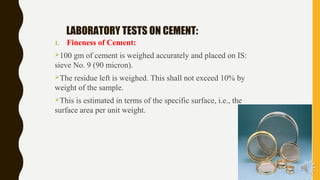
1. Fineness of Cement:
100 gm of cement is weighed accurately and placed on IS:
sieve No. 9 (90 micron).
The residue left is weighed. This shall not exceed 10% by
weight of the sample.
This is estimated in terms of the specific surface, i.e., the
surface area per unit weight.
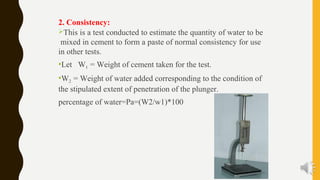
2. Consistency:
This is a test conducted to estimate the quantity of water to be
mixed in cement to form a paste of normal consistency for use
in other tests.
Let W1 = Weight of cement taken for the test.
W2 = Weight of water added corresponding to the condition of
the stipulated extent of penetration of the plunger.
percentage of water=Pa=(W2/w1)*100
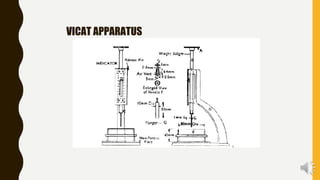
VICAT APPARATUS
3. TEST FOR SETTING TIME:
 The object of this test is to make a distinction between normal setting
and quick setting types of cement end also to detect deterioration due to
storage.
 Weigh 300 gm of cement and add Pa percentage of water (which is the
percentage of water required to have normal consistency. See test for
consistency.)
 The paste obtained after mixing is filled in the mould.1. In the Vicat
apparatus, attach the needle of square section, i.e. 1 mm X 1 mm to the
Vicat rod. Lower the system so that the needle just touches the surface of
the paste and gently release.
 Find out if the needle pierces into the paste fully. If it does, again release
the needle on the paste after a few seconds and again observe whether
the needle pierces fully into the paste
 This is repeated till the needle does not pierce into the paste
completely. Now the interval of time between this instant and
the instant at which water was added to the cement is called
the initial setting time.
 Now change the needle to the third one which has a
projecting
sharp point in the centre with an annular attachment.
 Now release this needle as before on the same paste. The
needle as well as the attachment will make their impressions
on the paste.
 Repeat this process till only the needle makes the impression
but not the attachment.
 The interval of time between this instant and the instant at
which the water was added is called the final setting time.

Cement

  • 1.
  • 2.
    CEMENT  It isthe product which is obtained by burning and crushing to powder a well proportioned mixture of calcareous and argillaceous materials.  It was introduced in 1824 by Joseph Asp Din a brick layer of Leeds, England.  After hardening it resembles in colour to the stone quarried near Portland in England, so it is named after that as Portland cement.  It is available in different varieties and the selection of variety depends upon the condition, strength and the type of structure.
  • 3.
    RAW MATERIALS REQUIRED FORMANUFACTURE OF CEMENT ARE  Calcareous Materials: Calcareous materials are those materials which contain calcium or lime as their main constituents such as lime stone, chalk etc.  Argillaceous Materials: Argillaceous materials are those materials which contain alumina as their main constituents such as shale, laterite etc. It provides the required proportion of silica, clay, oxide of iron to the cement.
  • 4.
    PROPORTION OF MIXING The ingredients are generally mixed in the ratio of two parts of • Calcareous materials and one part argillaceous material.  Limestone and shale are first crushed and then they are mixed either in wet state or in dry by grounding them together.  The mixture is then burnt in a rotary kiln at a temperature between • 1400°C and l500°C.  Pulverized coal, gas or oil being used as the fuel.  The clinker so obtained is first cooled and then gypsum (3 to 4%) is added and it is grounde the required fineness.
  • 5.
    Main chemical Ingredientsof Cement (Raw Stage) Sl. No. Ingredient Composition Percentage 1 Lime CaO 60 to 67 2 Silica Sio2 17 to 25 3 Iron Oxide Fe2O3 0.5 to 6 4 Alumina Al2O3 3 to 8 5 Gypsum or Calcium Sulphate CaSO4 3 to 4 6 Magenisum Oxide MgO 0.1 to 4 7 Sulphur Trioxide SO3 1 to 3 8 Alkalies such as soda NaOK2O 0.1 to 1
  • 6.
    FUNCTIONS AND EFFECTSOF VARIOUS INGREDIENTS  Lime: It makes the cement sound and provides strength to the cement. Excess of it in original form causes the cement to expand and disintegrate.  Silica: It provides strength to the cement. In excess it slows down the setting of cement.  Alumina: It provides quick setting property to the cement. In excess it weakens the strength of cement.
  • 7.
     Calcium Sulphate(Gypsum): It helps in increasing the initial setting time of cement.  Iron Oxide: It provides colour, hardness and strength to the cement.  Magnesium Oxide: It provides colour and hardness to the cement. Excess of it in free state makes the cement unsound.  Sulphur Trioxide: In small quantity it makes the cement sound and in excess it makes the cement unsound.  Alkalies: In excess it causes efflorescence.
  • 8.
    FINAL COMPOUNDS OFCEMENT Sl. No. Compound Formula Abbreviation Range 1 Dicalcium silicate 2(CaO)SiO2 C2S 21 to 45% 2 Tricalcium silicate 3(CaO)SiO2 C3S 25 to 50% 3 Tricalcium Aluminate 3(CaO)Al2O3 C3A 5 to 11% 4 Tetra Calcium Aluminum Ferrite 4(CaO)Al2O3 Fe2O3 C4AF 9 to 14% 5 Other Constituents and Gypsum - - 8%
  • 9.
    FINAL COMPOUNDS OFCEMENT CONTD…….  C2S  It hydrates slowly.  It hardens more slowly  It provides ultimate strength to the cement.  It has more resistance to chemica1 attack.  C3S  It hydrates more rapidly.  It develops early strength.  It generates heat more rapidly and has less resistance to chemical attack.
  • 10.
    FINAL COMPOUNDS OFCEMENT CONTD…….  C3A  It is fast reacting with large amount of heat generation.  It causes initial setting of cement.  It is weak against sulphate attack.  C4AF  It is comparatively inactive.  It has poor cementing value.  It is slow in reaction with small heat generation.
  • 11.
    1.Fineness: It is thedegree of grinding of cement. The rate of reaction depends upon the fineness of grinding . For accurate measurement it is measured by surface area, air permeability method and the unit is cm2/gram of cement. 2.Setting Time: Setting of cement is the phenomenon by virtue of which the green cement changes into hard mass. Initial setting is a stage in the process of hardening after which any crack that may appear will not reunite and the completion of this process is, known as final setting time. The time between water is added in cement and initial setting takes place is known as Initial Setting Time. PROPERTIES OF CEMENT
  • 12.
     CEMENT SHOULDNOT LOOSE ITS PLASTICITY TILL THE VARIOUS OPERATIONS OF MIXING, TRANSPORTING AND PLACING ARE COMPLETE. HENCE THIS TIME IS GENERALLY KEPT NOT LESS THAN 30 MINUTES. 3.Strength: The quality of concrete and cement is always judged by strength and that is only by compressive strength because cement is weak in tension and for it steel reinforcement is always provided. For this purpose cement and standard sand are mixed in the ratio of 1:3
  • 13.
    3.Soundness: Free lime andmagnesia present in cement makes the cement unsound by increasing the volume after setting. It is generally measured by Le-Chatelier method or by Autoclave method. 4.Heat of Hydration: Setting of cement is due to chemical reactions between cement and water and this process is known as Hydration. As, this reaction is exothermal process, so sufficient heat is generated and this process continues for an indefinite period at a diminishing rate. It is always measured in calories/gram unit.
  • 14.
    DIFFERENT TYPES OFCEMENT 1. Ordinary Portland cement. 2. Rapid Hardening Portland cement 3. Low Heat Portland cement 4. Portland Blast Furnace slag cement 5. Portland Sulphate resistant cement 6. Air entraining portland cement 7. White and coloured cement 8. High Alumina cement 9. Pozzoana cement 10.Oil well cement 11.Quick setting cement 12.Expanding cement
  • 15.
    1.Ordinary Portland Cement: Itis also known as Normal setting cement. It is used in Road pavements, buildings, culverts, water pipes etc. Out of the total consumption of different types of cement 90% of this type is used. 2. Rapid Hardening Cement: It contains less quantity of C2S and more quantity of C3S. It is generally used where high early strength is required. It is used by concrete product manufactures, highway pavements which are to be opened early for road traffic and in cold weather concreting due to its high heat of hydration development.
  • 16.
    3. Low HeatPortland Cement: This cement is so called because it develops low heat at the time of hydration. It contains C3A and; C3S in less quantity because they develop early heat. It develops strength quite late and It is generally used in massive concrete structures such as dams, bridge, abutments, retaining walls etc. 4. Blast Furnace Slag Cement: Percentage of slag varies from 25 to 65%. It is cheaper as compared to ordinary cement because waste product is used in it. It can also be used in massive concrete such as dams, bridges etc.
  • 17.
    5. Sulphate ResistantPortland Cement: It contains very low percentage of C3A and C4AF. It is used in canal lining, construction of pipe lines and culverts etc.
  • 18.
    6. Air EntrainingPortland Cement: It is ordinary Portland cement mixed with small quantities or air entertaining materials during grinding. The diameter of air bubbles varies from 0.075 mm and 1.25 mm. On account of air bubbles the strength of cement is reduced. Air bubbles are permitted only up to 3 to 4 percentage, as these reduce 10 to 15% strength of cement. This cement is more plastic and workable causing less segregation and bleeding in concrete. It also reduces the water requirement and has high resistance to weather.
  • 19.
    7. WHITE ANDCOLOURED CEMENT:  In it white chalk and china clay are used instead of lime stone and clay as these are having low percentage of Iron Oxide i.e.1 %.  Oil is used as fuel to avoid contamination o£ coal ash. It is 3 to 4 times costlier than ordinary cement.  It is used for decorative floorings.  For coloured cement suitable pigments varying from 5 to 10% free from soluble salts are added during grinding.
  • 20.
    8. HIGH ALUMINACEMENT:  It contains 35% to 45% of aluminates Bauxite and chalk or lime stone are mixed dry and heated till they melt and on cooling they form clinkers.  It is dark in colour and initial setting time varies from 3 to 6 hrs and final setting takes place with in 2 hours of the Initial set.  It gives high heat of hydration and, is also costlier than ordinary Portland cement.  It is used in structures subjected to the action of sea water, chemical and sulphate bearing water. It
  • 21.
    9. POZZOLANA CEMENT: Pozzolana is a naturally occurring material such as volcanic ash or Pumice stone or an artificial product such as burnt clay or shale containing siliceous and aluminous mineral substances.  As per BIS 1489-1967, the proportion of pozzolana material varies from 10 to 25% by weight of cement.  It increases the workability, reduces heat of hydration, and increases the water tightness.  It also offers greater resistance against sulphatic action and sea water.
  • 22.
    10. OIL WELLCEMENT:  As the name indicates, it is used for cementing; oil wells.  It is used at greeter depth under high temperature and pressure.  Iron Oxide is so adjusted that all the alumina is converted into C4AF and sc proportion of C3A is very small, high increases the setting time of cement and also hardens quickly after setting.  It protects the oil well causing from corrosion and also help in supporting the oil well casing and thus reduce the tension, in steel pipes.11. Quick Setting Cement: It has less proportion of CaSO4 (Gypsum) or a small % of aluminium sulphate is added at the time of grinding. Its initial setting time is 5 minutes and final setting time is 30
  • 23.
    12. EXPANDING CEMENT: As per the name, its volume increases on hardening.  It takes about 15 days-for the expansion to occur fully but the time can be controlled by curing.  The upper limit of expansion is 1%.  The agent which causes expansion is Calcium Sulpho Aluminate (3CaOA12O33CaSO4) which is formed by the presence of calcium sulphate with Calcium Oxide present in cement in sufficient quantity.
  • 24.
    FIELD TESTS ONCEMENT:  The colour of cement should be uniform gray with light greenish shade.  Cement should feel smooth when touched.  If hand is inserted in a bag of cement it should feel cool not warm.  If a small quantity of cement is thrown in a bucket of water, it should sink and should not float on the surface.  Cement should be free from any hard lumps  A sample meant for testing shall be drawn from at least 12 different bags or barrels or containers or from 12 different positions in a heap if cement is loose. Chemical composition of cement should be checked for B. I. S. specifications.
  • 25.
    LABORATORY TESTS ONCEMENT: 1. Fineness of Cement: 100 gm of cement is weighed accurately and placed on IS: sieve No. 9 (90 micron). The residue left is weighed. This shall not exceed 10% by weight of the sample. This is estimated in terms of the specific surface, i.e., the surface area per unit weight.
  • 26.
    2. Consistency: This isa test conducted to estimate the quantity of water to be mixed in cement to form a paste of normal consistency for use in other tests. Let W1 = Weight of cement taken for the test. W2 = Weight of water added corresponding to the condition of the stipulated extent of penetration of the plunger. percentage of water=Pa=(W2/w1)*100
  • 27.
  • 28.
    3. TEST FORSETTING TIME:  The object of this test is to make a distinction between normal setting and quick setting types of cement end also to detect deterioration due to storage.  Weigh 300 gm of cement and add Pa percentage of water (which is the percentage of water required to have normal consistency. See test for consistency.)  The paste obtained after mixing is filled in the mould.1. In the Vicat apparatus, attach the needle of square section, i.e. 1 mm X 1 mm to the Vicat rod. Lower the system so that the needle just touches the surface of the paste and gently release.  Find out if the needle pierces into the paste fully. If it does, again release the needle on the paste after a few seconds and again observe whether the needle pierces fully into the paste
  • 29.
     This isrepeated till the needle does not pierce into the paste completely. Now the interval of time between this instant and the instant at which water was added to the cement is called the initial setting time.  Now change the needle to the third one which has a projecting sharp point in the centre with an annular attachment.  Now release this needle as before on the same paste. The needle as well as the attachment will make their impressions on the paste.  Repeat this process till only the needle makes the impression but not the attachment.  The interval of time between this instant and the instant at which the water was added is called the final setting time.