Basics of
Cement in Civil
Engineering
Course Name: Basic Civil Engineering and
Engineering Mechanics
Course Code: BT204
Faculty Name: Mr. Gourav Agrawal
INTRODUCTION
• Cement in a mixture of calcareous, siliceous and argillaceous material along with some other
substances
• Cement is used as a binding Material in mortar, concrete etc. that is used in construction to hold
materials like sand, gravel, and aggregates together.
• Joseph Aspdin invented Portland cement in United Kingdom (London) in 1824
• He used a mixture of lime clay and water and heated it upto high temperature to manufacture
cement.
• The name “Portland” was chosen because of the similarity in appearance between the hardened
concrete made from Aspdin’s cement and the natural limestone found in Portland. The region of
Portland was known for its Portland stone, a light-colored, durable limestone that was widely
used in construction, including iconic buildings like St. Paul's Cathedral in London.
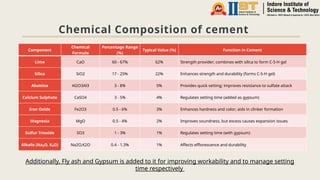
Chemical Composition of cement
Additionally, Fly ash and Gypsum is added to it for improving workability and to manage setting
time respectively
Component
Chemical
Formula
Percentage Range
(%)
Typical Value (%) Function in Cement
Lime CaO 60 - 67% 62% Strength provider; combines with silica to form C-S-H gel
Silica SiO2 17 - 25% 22% Enhances strength and durability (forms C-S-H gel)
Alumina Al2O3Al3 3 - 8% 5% Provides quick setting; improves resistance to sulfate attack
Calcium Sulphate CaSO4 3 - 5% 4% Regulates setting time (added as gypsum)
Iron Oxide Fe2O3 0.5 - 6% 3% Enhances hardness and color; aids in clinker formation
Magnesia MgO 0.5 - 4% 2% Improves soundness, but excess causes expansion issues
Sulfur Trioxide SO3​ 1 - 3% 1% Regulates setting time (with gypsum)
Alkalis (Na₂O, K₂O) Na2O,K2O 0.4 - 1.3% 1% Affects efflorescence and durability
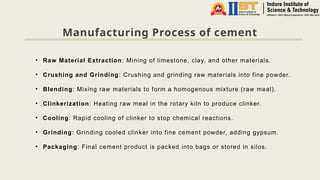
Manufacturing Process of cement
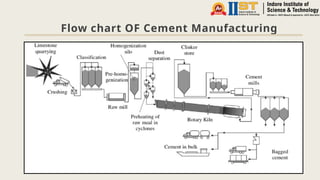
• Raw Material Extraction: Mining of limestone, clay, and other materials.
• Crushing and Grinding: Crushing and grinding raw materials into fine powder.
• Blending: Mixing raw materials to form a homogenous mixture (raw meal).
• Clinkerization: Heating raw meal in the rotary kiln to produce clinker.
• Cooling: Rapid cooling of clinker to stop chemical reactions.
• Grinding: Grinding cooled clinker into fine cement powder, adding gypsum.
• Packaging: Final cement product is packed into bags or stored in silos.
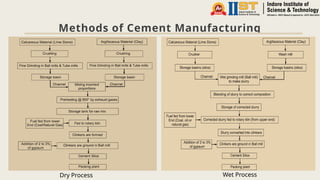
Methods of Cement Manufacturing
Dry Process Wet Process
Flow chart OF Cement Manufacturing
Composition of Clinkers
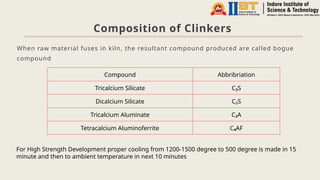
When raw material fuses in kiln, the resultant compound produced are called bogue
compound
For High Strength Development proper cooling from 1200-1500 degree to 500 degree is made in 15
minute and then to ambient temperature in next 10 minutes
Compound Abbribriation
Tricalcium Silicate C₃S
Dicalcium Silicate C₂S
Tricalcium Aluminate C₃A
Tetracalcium Aluminoferrite C₄AF
Composition of Clinkers
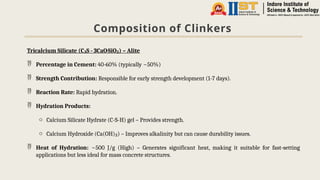
Tricalcium Silicate (C S - 3CaO·SiO ) – Alite
₃ ₂
 Percentage in Cement: 40-60% (typically ~50%)
 Strength Contribution: Responsible for early strength development (1-7 days).
 Reaction Rate: Rapid hydration.
 Hydration Products:
o Calcium Silicate Hydrate (C-S-H) gel – Provides strength.
o Calcium Hydroxide (Ca(OH) ) – Improves alkalinity but can cause durability issues.
₂
 Heat of Hydration: ~500 J/g (High) – Generates significant heat, making it suitable for fast-setting
applications but less ideal for mass concrete structures.
Composition of Clinkers
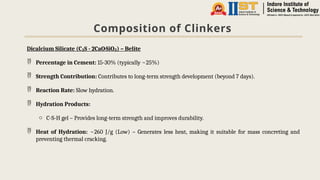
Dicalcium Silicate (C S - 2CaO·SiO ) – Belite
₂ ₂
 Percentage in Cement: 15-30% (typically ~25%)
 Strength Contribution: Contributes to long-term strength development (beyond 7 days).
 Reaction Rate: Slow hydration.
 Hydration Products:
o C-S-H gel – Provides long-term strength and improves durability.
 Heat of Hydration: ~260 J/g (Low) – Generates less heat, making it suitable for mass concreting and
preventing thermal cracking.
Composition of Clinkers
Tricalcium Aluminate (C A - 3CaO·Al O )
₃ ₂ ₃
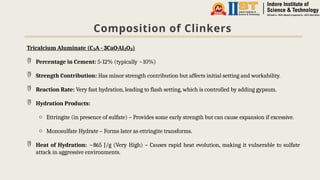
 Percentage in Cement: 5-12% (typically ~10%)
 Strength Contribution: Has minor strength contribution but affects initial setting and workability.
 Reaction Rate: Very fast hydration, leading to flash setting, which is controlled by adding gypsum.
 Hydration Products:
o Ettringite (in presence of sulfate) – Provides some early strength but can cause expansion if excessive.
o Monosulfate Hydrate – Forms later as ettringite transforms.
 Heat of Hydration: ~865 J/g (Very High) – Causes rapid heat evolution, making it vulnerable to sulfate
attack in aggressive environments.
Composition of Clinkers
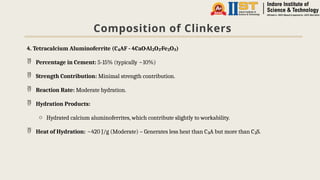
4. Tetracalcium Aluminoferrite (C AF - 4CaO·Al O ·Fe O )
₄ ₂ ₃ ₂ ₃
 Percentage in Cement: 5-15% (typically ~10%)
 Strength Contribution: Minimal strength contribution.
 Reaction Rate: Moderate hydration.
 Hydration Products:
o Hydrated calcium aluminoferrites, which contribute slightly to workability.
 Heat of Hydration: ~420 J/g (Moderate) – Generates less heat than C A but more than C S.
₃ ₂
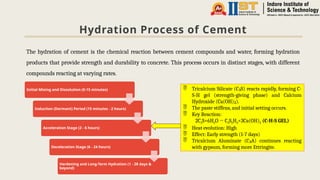
Hydration Process of Cement
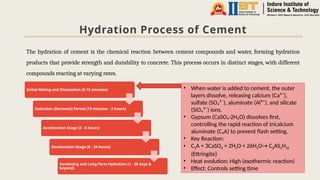
The hydration of cement is the chemical reaction between cement compounds and water, forming hydration
products that provide strength and durability to concrete. This process occurs in distinct stages, with different
compounds reacting at varying rates.
Initial Mixing and Dissolution (0-15 minutes)
Induction (Dormant) Period (15 minutes - 2 hours)
Acceleration Stage (2 - 6 hours)
Deceleration Stage (6 - 24 hours)
Hardening and Long-Term Hydration (1 - 28 days &
beyond)
• When water is added to cement, the outer
layers dissolve, releasing calcium (Ca²⁺),
sulfate (SO₄²⁻), aluminate (Al³⁺), and silicate
(SiO₄⁴⁻) ions.
• Gypsum (CaSO₄·2H₂O) dissolves first,
controlling the rapid reaction of tricalcium
aluminate (C₃A) to prevent flash setting.
• Key Reaction:
• C3A + 3CaSO4 + 2H2O + 26H2O→ C6AS3H32
(Ettringite)
• Heat evolution: High (exothermic reaction)
• Effect: Controls setting time
Hydration Process of Cement
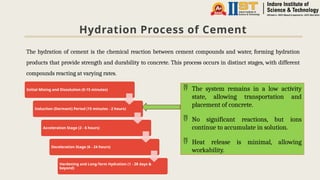
The hydration of cement is the chemical reaction between cement compounds and water, forming hydration
products that provide strength and durability to concrete. This process occurs in distinct stages, with different
compounds reacting at varying rates.
Initial Mixing and Dissolution (0-15 minutes)
Induction (Dormant) Period (15 minutes - 2 hours)
Acceleration Stage (2 - 6 hours)
Deceleration Stage (6 - 24 hours)
Hardening and Long-Term Hydration (1 - 28 days &
beyond)
 The system remains in a low activity
state, allowing transportation and
placement of concrete.
 No significant reactions, but ions
continue to accumulate in solution.
 Heat release is minimal, allowing
workability.
Hydration Process of Cement
The hydration of cement is the chemical reaction between cement compounds and water, forming hydration
products that provide strength and durability to concrete. This process occurs in distinct stages, with different
compounds reacting at varying rates.
Initial Mixing and Dissolution (0-15 minutes)
Induction (Dormant) Period (15 minutes - 2 hours)
Acceleration Stage (2 - 6 hours)
Deceleration Stage (6 - 24 hours)
Hardening and Long-Term Hydration (1 - 28 days &
beyond)
 Tricalcium Silicate (C S) reacts rapidly, forming C-
₃
S-H gel (strength-giving phase) and Calcium
Hydroxide (Ca(OH) ).
₂
 The paste stiffens, and initial setting occurs.
 Key Reaction:
2C3S+6H2O → C3S2H3+3Ca(OH)2­(C-H-S GEL)
 Heat evolution: High
 Effect: Early strength (1-7 days)
 Tricalcium Aluminate (C A) continues reacting
₃
with gypsum, forming more Ettringite.
Hydration Process of Cement
The hydration of cement is the chemical reaction between cement compounds and water, forming hydration
products that provide strength and durability to concrete. This process occurs in distinct stages, with different
compounds reacting at varying rates.
Initial Mixing and Dissolution (0-15 minutes)
Induction (Dormant) Period (15 minutes - 2 hours)
Acceleration Stage (2 - 6 hours)
Deceleration Stage (6 - 24 hours)
Hardening and Long-Term Hydration (1 - 28 days &
beyond)
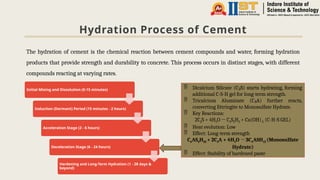
 Dicalcium Silicate (C S) starts hydrating, forming
₂
additional C-S-H gel for long-term strength.
 Tricalcium Aluminate (C A) further reacts,
₃
converting Ettringite to Monosulfate Hydrate.
 Key Reactions:
2C2S + 4H2O → C3S2H3 + Ca(OH)2 (C-H-S GEL)­
­
­
 Heat evolution: Low
 Effect: Long-term strength
C6AS3H32 + 2C3A + 4H2O → 3C4ASH12 ­
­
­
(Monosulfate
Hydrate)
 Effect: Stability of hardened paste
Hydration Process of Cement
The hydration of cement is the chemical reaction between cement compounds and water, forming hydration
products that provide strength and durability to concrete. This process occurs in distinct stages, with different
compounds reacting at varying rates.
Initial Mixing and Dissolution (0-15 minutes)
Induction (Dormant) Period (15 minutes - 2 hours)
Acceleration Stage (2 - 6 hours)
Deceleration Stage (6 - 24 hours)
Hardening and Long-Term Hydration (1 - 28 days &
beyond)
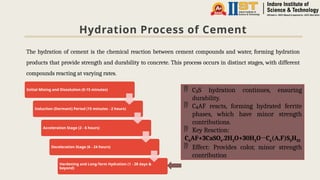
 C S hydration continues, ensuring
₂
durability.
 C AF reacts, forming hydrated ferrite
₄
phases, which have minor strength
contributions.
 Key Reaction:
C4AF+3CaSO4.2H2O+30H2O→C6(A,F)S3H32
 Effect: Provides color, minor strength
contribution
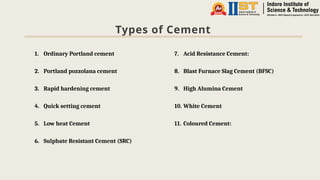
Types of Cement
1. Ordinary Portland cement
2. Portland pozzolana cement
3. Rapid hardening cement
4. Quick setting cement
5. Low heat Cement
6. Sulphate Resistant Cement (SRC)
7. Acid Resistance Cement:
8. Blast Furnace Slag Cement (BFSC)
9. High Alumina Cement
10. White Cement
11. Coloured Cement:
Types of Cement
Ordinary Portland Cement
• Most commonly used cement in construction.
• Made by grinding clinker (limestone + clay) with gypsum.
• Grades based on compressive strength:
• OPC 33
• OPC 43
• OPC 53
• Key Advantages:
• Fast setting & high early strength.
• Suitable for RCC structures, bridges, roads, general construction.
• Limitations:
• Generates high heat during hydration, leading to thermal cracks in mass concreting.
Types of Cement
Portland Pozzolana Cement (PPC)
• Blended cement made by adding pozzolanic materials (fly ash, volcanic ash, silica fumes) to OPC.
• Enhances durability and resistance to chemical attacks.
• Suitable for Marine structures, Bridges, Dams and Sewage treatment plants
• Key Benefits:
• Lower heat of hydration, reducing thermal cracks in mass concreting.
• Better long-term strength compared to OPC.
• Improves workability and reduces permeability.
• Eco-friendly (uses industrial byproducts like fly ash).
• Limitations:
• Slower setting time than OPC.
• Takes longer to gain strength, affecting rapid construction projects.
Types of Cement
Rapid Hardening Cement (RHC)
• Special cement designed for high early strength in a short time.
• Composition:
• Higher tri-calcium silicate (C S)
₃ content than OPC.
• Finely ground to accelerate hydration.
• Key Benefits:
• Achieves OPC strength in just 3 days.
• Reduces curing time, enabling faster construction.
• Ideal for road repairs, precast concrete, and cold-weather concreting.
• Limitations:
• Rapid hydration may cause shrinkage & cracking.
• Not suitable for mass concreting projects.
Types of Cement
Quick Setting Cement (QSC)
• Fast-setting cement, ideal for emergency repairs & underwater construction.
• Manufacturing Process:
• Reduced gypsum content.
• Finely ground clinker to accelerate setting.
• Setting Time:
• Initial setting: 5 to 10 minutes.
• Final setting: 30 minutes.
• Applications:
• Cold-weather concreting.
• Tunneling & rapid repair works.
• Underwater construction.
• Limitations:
• Requires immediate placement & finishing to avoid workability issues.
Types of Cement
Low Heat Cement (LHC)
• Special cement designed to reduce heat generation during hydration.
• Composition:
• Lower tricalcium silicate (C S)
₃ content.
• Higher dicalcium silicate (C S)
₂ content for slow strength gain & durability.
• Key Benefits:
• Minimizes thermal cracks in large concrete structures.
• Enhances long-term durability.
• Ideal for mass concreting applications.
• Applications:
• Dams, bridges, & large foundations.
• Limitations:
• Slower strength development compared to OPC.
• Not suitable for projects requiring rapid strength gain.
Types of Cement
Sulphate Resistant Cement (SRC)
• Special cement designed to resist sulphate attacks.
• Composition:
• Lower tricalcium aluminate (C A) content
₃ to enhance resistance against chemical
deterioration.
• Key Benefits:
• High durability in aggressive environments.
• Prevents damage from sulphate-rich soils & water.
• Applications:
• Marine structures.
• Sewage treatment plants.
• Foundations in sulphate-rich soils.
• Limitations: Slower strength gain compared to OPC.
Types of Cement
Blast Furnace Slag Cement (BFSC)
• Composition:
• Made by adding Granulated Blast Furnace Slag (GGBS) to Ordinary Portland Cement
(OPC).
• GGBS is obtained as a byproduct from blast furnaces during pig iron manufacturing.
• Contains essential cementitious elements: Alumina, Lime, and Silica.
• Key Features:
• Low heat of hydration → Reduces thermal cracking.
• Enhanced durability → Greater resistance to chemical attacks (e.g., sulphates, chlorides).
• Improved workability → Better performance in concrete mixes.
• Eco-friendly → Utilizes industrial byproducts, reducing carbon footprint.
• Applications:
• Marine structures.
• Bridges & underground works.
• Dams & foundations requiring long-term strength.
• Limitations:
• Gains strength slower than OPC, requiring longer curing time.
Types of Cement
White Cement
• Composition & Manufacturing:
• A type of Ordinary Portland Cement (OPC) with low iron and manganese content.
• Sodium aluminoferrite īs added to act as flux in absence of iron oxide.
• Achieves pure white color due to its high-purity raw materials.
• Uses oil fuel instead of coal during the burning process to avoid contamination.
• Key Features:
• Similar strength and durability to OPC.
• Aesthetic appeal → Preferred for decorative and architectural uses.
• High brightness & reflectivity → Enhances light dispersion in surfaces.
• Applications:
• Tiles & flooring.
• Precast facades & decorative concrete.
• Sculptures, grouts, and wall finishes.
• Limitations:
• More expensive than OPC due to special manufacturing process and raw materials.
Types of Cement
Coloured Cement
• Composition & Manufacturing:
• Made by mixing mineral pigments with Ordinary Portland Cement (OPC).
• Pigment content varies between 5% to 10%.
• Exceeding 10% pigment may reduce cement strength.
• Common Pigments & Colors:
• Chromium oxide → Brown, red, or yellow (varies with proportion).
• Cobalt oxide → Blue.
• Iron oxide → Red, brown, or black.
• Manganese dioxide → Black or deep brown.
• Applications:
• Floor finishing.
• External surfaces of buildings.
• Artificial marble production.
• Decorative windows & precast elements.
• Advantages:
• Enhances aesthetic appeal.
• Provides durability along with color.
Use of Cement
1. Masonry work – Used in cement mortars for brickwork, plastering, and pointing.
2. Concrete structures – Essential in constructing floors, roofs, lintels, beams, stairs, pillars, and weather
sheds.
3. Large engineering structures – Used in bridges, culverts, dams, tunnels, storage reservoirs, and
lighthouses.
4. Waterproof structures – Used in water tanks, septic tanks, and foundation waterproofing.
5. Pipe joints – Cement mortar is used for sealing drain pipes, water pipes, and sewage connections.
6. Precast products – Used in garden seats, fencing posts, flower pots, dustbins, and decorative elements.
7. Pathways and flooring – Ideal for footpaths, pavements, and high-strength flooring.
Physical Properties of Cement
1. Fineness
• Determines particle size distribution, affecting
hydration rate and strength development.
• Measured by:
• Percentage of weight retained on a 90-
micron sieve (should not exceed 10%).
• Specific surface area (minimum 2250 cm²/g)
as per IS standards.
• Impact: Higher fineness improves workability and
early strength.
2. Setting Time
• Ensures sufficient time for mixing,
transportation, and placement.
• Standard values (IS 269-1967):
• Initial setting time: 30 minutes
≥ .
• Final setting time: 600 minutes
≤ .
• Impact: Proper setting time prevents premature
hardening and ensures efficient strength gain.
3. Soundness
• Indicates dimensional stability of hardened
cement.
• Measured using the Le-Chatelier test.
• Expansion limit: Should not exceed 10 mm to
prevent cracks and structural failure.
• Impact: Ensures long-term durability of concrete
structures.
4. Compressive Strength
•Tested using mortar cubes prepared with standard
sand under compression as per IS specifications.
•Minimum required strength:
• 16 N/mm² after 3 days.
• 22 N/mm² after 7 days.
•Impact: Higher strength ensures better load-
bearing capacity and structural durability.
Field Test of Cement
Visual Inspection
Check for a uniform greenish-
grey color and ensure there are
no lumps, indicating no moisture
contamination.
Hand Test
Cement should feel cool to the
touch; any hard lumps suggest
moisture exposure.
Touch & Feel Test
Rubbing between fingers should
feel smooth and fine, not gritty,
ensuring proper fineness.
Water Float Test
Sprinkle cement over water;
good cement floats briefly
before sinking, while poor-
quality cement sinks
immediately.
Cake Test
A cement paste cake should
retain its shape and gain
strength after 24 hours of water
immersion.
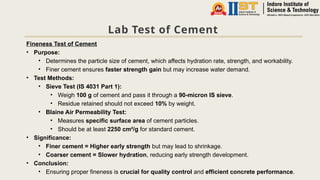
Lab Test of Cement
Fineness Test of Cement
• Purpose:
• Determines the particle size of cement, which affects hydration rate, strength, and workability.
• Finer cement ensures faster strength gain but may increase water demand.
• Test Methods:
• Sieve Test (IS 4031 Part 1):
• Weigh 100 g of cement and pass it through a 90-micron IS sieve.
• Residue retained should not exceed 10% by weight.
• Blaine Air Permeability Test:
• Measures specific surface area of cement particles.
• Should be at least 2250 cm²/g for standard cement.
• Significance:
• Finer cement = Higher early strength but may lead to shrinkage.
• Coarser cement = Slower hydration, reducing early strength development.
• Conclusion:
• Ensuring proper fineness is crucial for quality control and efficient concrete performance.
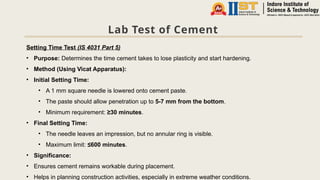
Lab Test of Cement
Setting Time Test (IS 4031 Part 5)
• Purpose: Determines the time cement takes to lose plasticity and start hardening.
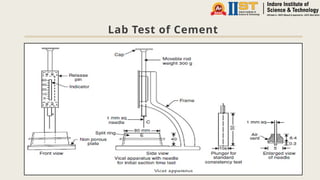
• Method (Using Vicat Apparatus):
• Initial Setting Time:
• A 1 mm square needle is lowered onto cement paste.
• The paste should allow penetration up to 5-7 mm from the bottom.
• Minimum requirement: ≥30 minutes.
• Final Setting Time:
• The needle leaves an impression, but no annular ring is visible.
• Maximum limit: ≤600 minutes.
• Significance:
• Ensures cement remains workable during placement.
• Helps in planning construction activities, especially in extreme weather conditions.
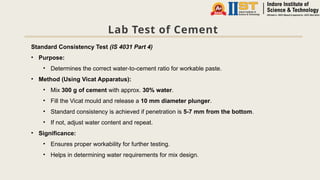
Lab Test of Cement
Standard Consistency Test (IS 4031 Part 4)
• Purpose:
• Determines the correct water-to-cement ratio for workable paste.
• Method (Using Vicat Apparatus):
• Mix 300 g of cement with approx. 30% water.
• Fill the Vicat mould and release a 10 mm diameter plunger.
• Standard consistency is achieved if penetration is 5-7 mm from the bottom.
• If not, adjust water content and repeat.
• Significance:
• Ensures proper workability for further testing.
• Helps in determining water requirements for mix design.
Lab Test of Cement
Lab Test of Cement
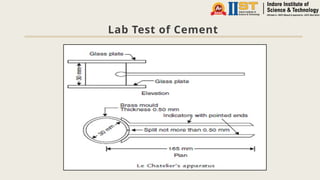
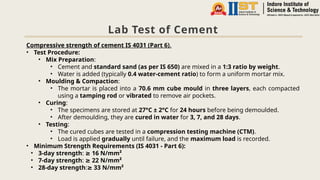
Soundness Test of Cement
• Purpose:
• Evaluates cement’s ability to retain volume after setting.
• Prevents excessive expansion, which can cause cracks in structures.
• Test Method (IS 4031 Part 3):
• Preparation:
• Mix cement with 0.78 times the standard consistency water.
• Fill the Le Chatelier mould with the paste.
• Cover with glass plates and submerge in water (24°C–30°C) for 24 hours.
• Heating Process:
• Measure the initial distance between the indicators.
• Heat the assembly to boiling temperature for 1 hour.
• Allow it to cool and measure the final distance between indicators.
• Acceptable Limit:
• The expansion should not exceed 10 mm.
• Significance:
• Ensures cement does not expand excessively, preventing structural failures.
• Confirms suitability for long-term durability in construction.
Lab Test of Cement
Lab Test of Cement
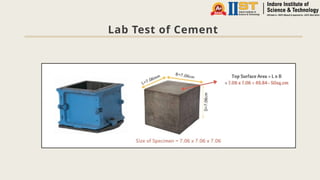
Compressive strength of cement IS 4031 (Part 6).
• Test Procedure:
• Mix Preparation:
• Cement and standard sand (as per IS 650) are mixed in a 1:3 ratio by weight.
• Water is added (typically 0.4 water-cement ratio) to form a uniform mortar mix.
• Moulding & Compaction:
• The mortar is placed into a 70.6 mm cube mould in three layers, each compacted
using a tamping rod or vibrated to remove air pockets.
• Curing:
• The specimens are stored at 27°C ± 2°C for 24 hours before being demoulded.
• After demoulding, they are cured in water for 3, 7, and 28 days.
• Testing:
• The cured cubes are tested in a compression testing machine (CTM).
• Load is applied gradually until failure, and the maximum load is recorded.
• Minimum Strength Requirements (IS 4031 - Part 6):
• 3-day strength: 16 N/mm²
≥
• 7-day strength: 22 N/mm²
≥
• 28-day strength: 33 N/mm²
≥
Lab Test of Cement
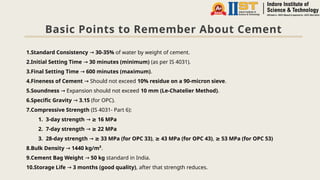
Basic Points to Remember About Cement
1.Standard Consistency → 30-35% of water by weight of cement.
2.Initial Setting Time → 30 minutes (minimum) (as per IS 4031).
3.Final Setting Time → 600 minutes (maximum).
4.Fineness of Cement Should not exceed
→ 10% residue on a 90-micron sieve.
5.Soundness Expansion should not exceed
→ 10 mm (Le-Chatelier Method).
6.Specific Gravity → 3.15 (for OPC).
7.Compressive Strength (IS 4031- Part 6):
1. 3-day strength → 16 MPa
≥
2. 7-day strength → 22 MPa
≥
3. 28-day strength → 33 MPa (for OPC 33)
≥ , 43 MPa (for OPC 43)
≥ , 53 MPa (for OPC 53)
≥
8.Bulk Density → 1440 kg/m³.
9.Cement Bag Weight → 50 kg standard in India.
10.Storage Life → 3 months (good quality), after that strength reduces.
cement presentation for basic civil engineering

cement presentation for basic civil engineering

  • 1.
    Basics of Cement inCivil Engineering Course Name: Basic Civil Engineering and Engineering Mechanics Course Code: BT204 Faculty Name: Mr. Gourav Agrawal
  • 2.
    INTRODUCTION • Cement ina mixture of calcareous, siliceous and argillaceous material along with some other substances • Cement is used as a binding Material in mortar, concrete etc. that is used in construction to hold materials like sand, gravel, and aggregates together. • Joseph Aspdin invented Portland cement in United Kingdom (London) in 1824 • He used a mixture of lime clay and water and heated it upto high temperature to manufacture cement. • The name “Portland” was chosen because of the similarity in appearance between the hardened concrete made from Aspdin’s cement and the natural limestone found in Portland. The region of Portland was known for its Portland stone, a light-colored, durable limestone that was widely used in construction, including iconic buildings like St. Paul's Cathedral in London.
  • 3.
    Chemical Composition ofcement Additionally, Fly ash and Gypsum is added to it for improving workability and to manage setting time respectively Component Chemical Formula Percentage Range (%) Typical Value (%) Function in Cement Lime CaO 60 - 67% 62% Strength provider; combines with silica to form C-S-H gel Silica SiO2 17 - 25% 22% Enhances strength and durability (forms C-S-H gel) Alumina Al2O3Al3 3 - 8% 5% Provides quick setting; improves resistance to sulfate attack Calcium Sulphate CaSO4 3 - 5% 4% Regulates setting time (added as gypsum) Iron Oxide Fe2O3 0.5 - 6% 3% Enhances hardness and color; aids in clinker formation Magnesia MgO 0.5 - 4% 2% Improves soundness, but excess causes expansion issues Sulfur Trioxide SO3​ 1 - 3% 1% Regulates setting time (with gypsum) Alkalis (Na₂O, K₂O) Na2O,K2O 0.4 - 1.3% 1% Affects efflorescence and durability
  • 4.
    Manufacturing Process ofcement • Raw Material Extraction: Mining of limestone, clay, and other materials. • Crushing and Grinding: Crushing and grinding raw materials into fine powder. • Blending: Mixing raw materials to form a homogenous mixture (raw meal). • Clinkerization: Heating raw meal in the rotary kiln to produce clinker. • Cooling: Rapid cooling of clinker to stop chemical reactions. • Grinding: Grinding cooled clinker into fine cement powder, adding gypsum. • Packaging: Final cement product is packed into bags or stored in silos.
  • 5.
    Methods of CementManufacturing Dry Process Wet Process
  • 6.
    Flow chart OFCement Manufacturing
  • 7.
    Composition of Clinkers Whenraw material fuses in kiln, the resultant compound produced are called bogue compound For High Strength Development proper cooling from 1200-1500 degree to 500 degree is made in 15 minute and then to ambient temperature in next 10 minutes Compound Abbribriation Tricalcium Silicate C₃S Dicalcium Silicate C₂S Tricalcium Aluminate C₃A Tetracalcium Aluminoferrite C₄AF
  • 8.
    Composition of Clinkers TricalciumSilicate (C S - 3CaO·SiO ) – Alite ₃ ₂  Percentage in Cement: 40-60% (typically ~50%)  Strength Contribution: Responsible for early strength development (1-7 days).  Reaction Rate: Rapid hydration.  Hydration Products: o Calcium Silicate Hydrate (C-S-H) gel – Provides strength. o Calcium Hydroxide (Ca(OH) ) – Improves alkalinity but can cause durability issues. ₂  Heat of Hydration: ~500 J/g (High) – Generates significant heat, making it suitable for fast-setting applications but less ideal for mass concrete structures.
  • 9.
    Composition of Clinkers DicalciumSilicate (C S - 2CaO·SiO ) – Belite ₂ ₂  Percentage in Cement: 15-30% (typically ~25%)  Strength Contribution: Contributes to long-term strength development (beyond 7 days).  Reaction Rate: Slow hydration.  Hydration Products: o C-S-H gel – Provides long-term strength and improves durability.  Heat of Hydration: ~260 J/g (Low) – Generates less heat, making it suitable for mass concreting and preventing thermal cracking.
  • 10.
    Composition of Clinkers TricalciumAluminate (C A - 3CaO·Al O ) ₃ ₂ ₃  Percentage in Cement: 5-12% (typically ~10%)  Strength Contribution: Has minor strength contribution but affects initial setting and workability.  Reaction Rate: Very fast hydration, leading to flash setting, which is controlled by adding gypsum.  Hydration Products: o Ettringite (in presence of sulfate) – Provides some early strength but can cause expansion if excessive. o Monosulfate Hydrate – Forms later as ettringite transforms.  Heat of Hydration: ~865 J/g (Very High) – Causes rapid heat evolution, making it vulnerable to sulfate attack in aggressive environments.
  • 11.
    Composition of Clinkers 4.Tetracalcium Aluminoferrite (C AF - 4CaO·Al O ·Fe O ) ₄ ₂ ₃ ₂ ₃  Percentage in Cement: 5-15% (typically ~10%)  Strength Contribution: Minimal strength contribution.  Reaction Rate: Moderate hydration.  Hydration Products: o Hydrated calcium aluminoferrites, which contribute slightly to workability.  Heat of Hydration: ~420 J/g (Moderate) – Generates less heat than C A but more than C S. ₃ ₂
  • 12.
    Hydration Process ofCement The hydration of cement is the chemical reaction between cement compounds and water, forming hydration products that provide strength and durability to concrete. This process occurs in distinct stages, with different compounds reacting at varying rates. Initial Mixing and Dissolution (0-15 minutes) Induction (Dormant) Period (15 minutes - 2 hours) Acceleration Stage (2 - 6 hours) Deceleration Stage (6 - 24 hours) Hardening and Long-Term Hydration (1 - 28 days & beyond) • When water is added to cement, the outer layers dissolve, releasing calcium (Ca²⁺), sulfate (SO₄²⁻), aluminate (Al³⁺), and silicate (SiO₄⁴⁻) ions. • Gypsum (CaSO₄·2H₂O) dissolves first, controlling the rapid reaction of tricalcium aluminate (C₃A) to prevent flash setting. • Key Reaction: • C3A + 3CaSO4 + 2H2O + 26H2O→ C6AS3H32 (Ettringite) • Heat evolution: High (exothermic reaction) • Effect: Controls setting time
  • 13.
    Hydration Process ofCement The hydration of cement is the chemical reaction between cement compounds and water, forming hydration products that provide strength and durability to concrete. This process occurs in distinct stages, with different compounds reacting at varying rates. Initial Mixing and Dissolution (0-15 minutes) Induction (Dormant) Period (15 minutes - 2 hours) Acceleration Stage (2 - 6 hours) Deceleration Stage (6 - 24 hours) Hardening and Long-Term Hydration (1 - 28 days & beyond)  The system remains in a low activity state, allowing transportation and placement of concrete.  No significant reactions, but ions continue to accumulate in solution.  Heat release is minimal, allowing workability.
  • 14.
    Hydration Process ofCement The hydration of cement is the chemical reaction between cement compounds and water, forming hydration products that provide strength and durability to concrete. This process occurs in distinct stages, with different compounds reacting at varying rates. Initial Mixing and Dissolution (0-15 minutes) Induction (Dormant) Period (15 minutes - 2 hours) Acceleration Stage (2 - 6 hours) Deceleration Stage (6 - 24 hours) Hardening and Long-Term Hydration (1 - 28 days & beyond)  Tricalcium Silicate (C S) reacts rapidly, forming C- ₃ S-H gel (strength-giving phase) and Calcium Hydroxide (Ca(OH) ). ₂  The paste stiffens, and initial setting occurs.  Key Reaction: 2C3S+6H2O → C3S2H3+3Ca(OH)2­(C-H-S GEL)  Heat evolution: High  Effect: Early strength (1-7 days)  Tricalcium Aluminate (C A) continues reacting ₃ with gypsum, forming more Ettringite.
  • 15.
    Hydration Process ofCement The hydration of cement is the chemical reaction between cement compounds and water, forming hydration products that provide strength and durability to concrete. This process occurs in distinct stages, with different compounds reacting at varying rates. Initial Mixing and Dissolution (0-15 minutes) Induction (Dormant) Period (15 minutes - 2 hours) Acceleration Stage (2 - 6 hours) Deceleration Stage (6 - 24 hours) Hardening and Long-Term Hydration (1 - 28 days & beyond)  Dicalcium Silicate (C S) starts hydrating, forming ₂ additional C-S-H gel for long-term strength.  Tricalcium Aluminate (C A) further reacts, ₃ converting Ettringite to Monosulfate Hydrate.  Key Reactions: 2C2S + 4H2O → C3S2H3 + Ca(OH)2 (C-H-S GEL)­ ­ ­  Heat evolution: Low  Effect: Long-term strength C6AS3H32 + 2C3A + 4H2O → 3C4ASH12 ­ ­ ­ (Monosulfate Hydrate)  Effect: Stability of hardened paste
  • 16.
    Hydration Process ofCement The hydration of cement is the chemical reaction between cement compounds and water, forming hydration products that provide strength and durability to concrete. This process occurs in distinct stages, with different compounds reacting at varying rates. Initial Mixing and Dissolution (0-15 minutes) Induction (Dormant) Period (15 minutes - 2 hours) Acceleration Stage (2 - 6 hours) Deceleration Stage (6 - 24 hours) Hardening and Long-Term Hydration (1 - 28 days & beyond)  C S hydration continues, ensuring ₂ durability.  C AF reacts, forming hydrated ferrite ₄ phases, which have minor strength contributions.  Key Reaction: C4AF+3CaSO4.2H2O+30H2O→C6(A,F)S3H32  Effect: Provides color, minor strength contribution
  • 17.
    Types of Cement 1.Ordinary Portland cement 2. Portland pozzolana cement 3. Rapid hardening cement 4. Quick setting cement 5. Low heat Cement 6. Sulphate Resistant Cement (SRC) 7. Acid Resistance Cement: 8. Blast Furnace Slag Cement (BFSC) 9. High Alumina Cement 10. White Cement 11. Coloured Cement:
  • 18.
    Types of Cement OrdinaryPortland Cement • Most commonly used cement in construction. • Made by grinding clinker (limestone + clay) with gypsum. • Grades based on compressive strength: • OPC 33 • OPC 43 • OPC 53 • Key Advantages: • Fast setting & high early strength. • Suitable for RCC structures, bridges, roads, general construction. • Limitations: • Generates high heat during hydration, leading to thermal cracks in mass concreting.
  • 19.
    Types of Cement PortlandPozzolana Cement (PPC) • Blended cement made by adding pozzolanic materials (fly ash, volcanic ash, silica fumes) to OPC. • Enhances durability and resistance to chemical attacks. • Suitable for Marine structures, Bridges, Dams and Sewage treatment plants • Key Benefits: • Lower heat of hydration, reducing thermal cracks in mass concreting. • Better long-term strength compared to OPC. • Improves workability and reduces permeability. • Eco-friendly (uses industrial byproducts like fly ash). • Limitations: • Slower setting time than OPC. • Takes longer to gain strength, affecting rapid construction projects.
  • 20.
    Types of Cement RapidHardening Cement (RHC) • Special cement designed for high early strength in a short time. • Composition: • Higher tri-calcium silicate (C S) ₃ content than OPC. • Finely ground to accelerate hydration. • Key Benefits: • Achieves OPC strength in just 3 days. • Reduces curing time, enabling faster construction. • Ideal for road repairs, precast concrete, and cold-weather concreting. • Limitations: • Rapid hydration may cause shrinkage & cracking. • Not suitable for mass concreting projects.
  • 21.
    Types of Cement QuickSetting Cement (QSC) • Fast-setting cement, ideal for emergency repairs & underwater construction. • Manufacturing Process: • Reduced gypsum content. • Finely ground clinker to accelerate setting. • Setting Time: • Initial setting: 5 to 10 minutes. • Final setting: 30 minutes. • Applications: • Cold-weather concreting. • Tunneling & rapid repair works. • Underwater construction. • Limitations: • Requires immediate placement & finishing to avoid workability issues.
  • 22.
    Types of Cement LowHeat Cement (LHC) • Special cement designed to reduce heat generation during hydration. • Composition: • Lower tricalcium silicate (C S) ₃ content. • Higher dicalcium silicate (C S) ₂ content for slow strength gain & durability. • Key Benefits: • Minimizes thermal cracks in large concrete structures. • Enhances long-term durability. • Ideal for mass concreting applications. • Applications: • Dams, bridges, & large foundations. • Limitations: • Slower strength development compared to OPC. • Not suitable for projects requiring rapid strength gain.
  • 23.
    Types of Cement SulphateResistant Cement (SRC) • Special cement designed to resist sulphate attacks. • Composition: • Lower tricalcium aluminate (C A) content ₃ to enhance resistance against chemical deterioration. • Key Benefits: • High durability in aggressive environments. • Prevents damage from sulphate-rich soils & water. • Applications: • Marine structures. • Sewage treatment plants. • Foundations in sulphate-rich soils. • Limitations: Slower strength gain compared to OPC.
  • 24.
    Types of Cement BlastFurnace Slag Cement (BFSC) • Composition: • Made by adding Granulated Blast Furnace Slag (GGBS) to Ordinary Portland Cement (OPC). • GGBS is obtained as a byproduct from blast furnaces during pig iron manufacturing. • Contains essential cementitious elements: Alumina, Lime, and Silica. • Key Features: • Low heat of hydration → Reduces thermal cracking. • Enhanced durability → Greater resistance to chemical attacks (e.g., sulphates, chlorides). • Improved workability → Better performance in concrete mixes. • Eco-friendly → Utilizes industrial byproducts, reducing carbon footprint. • Applications: • Marine structures. • Bridges & underground works. • Dams & foundations requiring long-term strength. • Limitations: • Gains strength slower than OPC, requiring longer curing time.
  • 25.
    Types of Cement WhiteCement • Composition & Manufacturing: • A type of Ordinary Portland Cement (OPC) with low iron and manganese content. • Sodium aluminoferrite īs added to act as flux in absence of iron oxide. • Achieves pure white color due to its high-purity raw materials. • Uses oil fuel instead of coal during the burning process to avoid contamination. • Key Features: • Similar strength and durability to OPC. • Aesthetic appeal → Preferred for decorative and architectural uses. • High brightness & reflectivity → Enhances light dispersion in surfaces. • Applications: • Tiles & flooring. • Precast facades & decorative concrete. • Sculptures, grouts, and wall finishes. • Limitations: • More expensive than OPC due to special manufacturing process and raw materials.
  • 26.
    Types of Cement ColouredCement • Composition & Manufacturing: • Made by mixing mineral pigments with Ordinary Portland Cement (OPC). • Pigment content varies between 5% to 10%. • Exceeding 10% pigment may reduce cement strength. • Common Pigments & Colors: • Chromium oxide → Brown, red, or yellow (varies with proportion). • Cobalt oxide → Blue. • Iron oxide → Red, brown, or black. • Manganese dioxide → Black or deep brown. • Applications: • Floor finishing. • External surfaces of buildings. • Artificial marble production. • Decorative windows & precast elements. • Advantages: • Enhances aesthetic appeal. • Provides durability along with color.
  • 27.
    Use of Cement 1.Masonry work – Used in cement mortars for brickwork, plastering, and pointing. 2. Concrete structures – Essential in constructing floors, roofs, lintels, beams, stairs, pillars, and weather sheds. 3. Large engineering structures – Used in bridges, culverts, dams, tunnels, storage reservoirs, and lighthouses. 4. Waterproof structures – Used in water tanks, septic tanks, and foundation waterproofing. 5. Pipe joints – Cement mortar is used for sealing drain pipes, water pipes, and sewage connections. 6. Precast products – Used in garden seats, fencing posts, flower pots, dustbins, and decorative elements. 7. Pathways and flooring – Ideal for footpaths, pavements, and high-strength flooring.
  • 28.
    Physical Properties ofCement 1. Fineness • Determines particle size distribution, affecting hydration rate and strength development. • Measured by: • Percentage of weight retained on a 90- micron sieve (should not exceed 10%). • Specific surface area (minimum 2250 cm²/g) as per IS standards. • Impact: Higher fineness improves workability and early strength. 2. Setting Time • Ensures sufficient time for mixing, transportation, and placement. • Standard values (IS 269-1967): • Initial setting time: 30 minutes ≥ . • Final setting time: 600 minutes ≤ . • Impact: Proper setting time prevents premature hardening and ensures efficient strength gain. 3. Soundness • Indicates dimensional stability of hardened cement. • Measured using the Le-Chatelier test. • Expansion limit: Should not exceed 10 mm to prevent cracks and structural failure. • Impact: Ensures long-term durability of concrete structures. 4. Compressive Strength •Tested using mortar cubes prepared with standard sand under compression as per IS specifications. •Minimum required strength: • 16 N/mm² after 3 days. • 22 N/mm² after 7 days. •Impact: Higher strength ensures better load- bearing capacity and structural durability.
  • 29.
    Field Test ofCement Visual Inspection Check for a uniform greenish- grey color and ensure there are no lumps, indicating no moisture contamination. Hand Test Cement should feel cool to the touch; any hard lumps suggest moisture exposure. Touch & Feel Test Rubbing between fingers should feel smooth and fine, not gritty, ensuring proper fineness. Water Float Test Sprinkle cement over water; good cement floats briefly before sinking, while poor- quality cement sinks immediately. Cake Test A cement paste cake should retain its shape and gain strength after 24 hours of water immersion.
  • 30.
    Lab Test ofCement Fineness Test of Cement • Purpose: • Determines the particle size of cement, which affects hydration rate, strength, and workability. • Finer cement ensures faster strength gain but may increase water demand. • Test Methods: • Sieve Test (IS 4031 Part 1): • Weigh 100 g of cement and pass it through a 90-micron IS sieve. • Residue retained should not exceed 10% by weight. • Blaine Air Permeability Test: • Measures specific surface area of cement particles. • Should be at least 2250 cm²/g for standard cement. • Significance: • Finer cement = Higher early strength but may lead to shrinkage. • Coarser cement = Slower hydration, reducing early strength development. • Conclusion: • Ensuring proper fineness is crucial for quality control and efficient concrete performance.
  • 31.
    Lab Test ofCement Setting Time Test (IS 4031 Part 5) • Purpose: Determines the time cement takes to lose plasticity and start hardening. • Method (Using Vicat Apparatus): • Initial Setting Time: • A 1 mm square needle is lowered onto cement paste. • The paste should allow penetration up to 5-7 mm from the bottom. • Minimum requirement: ≥30 minutes. • Final Setting Time: • The needle leaves an impression, but no annular ring is visible. • Maximum limit: ≤600 minutes. • Significance: • Ensures cement remains workable during placement. • Helps in planning construction activities, especially in extreme weather conditions.
  • 32.
    Lab Test ofCement Standard Consistency Test (IS 4031 Part 4) • Purpose: • Determines the correct water-to-cement ratio for workable paste. • Method (Using Vicat Apparatus): • Mix 300 g of cement with approx. 30% water. • Fill the Vicat mould and release a 10 mm diameter plunger. • Standard consistency is achieved if penetration is 5-7 mm from the bottom. • If not, adjust water content and repeat. • Significance: • Ensures proper workability for further testing. • Helps in determining water requirements for mix design.
  • 33.
  • 34.
    Lab Test ofCement Soundness Test of Cement • Purpose: • Evaluates cement’s ability to retain volume after setting. • Prevents excessive expansion, which can cause cracks in structures. • Test Method (IS 4031 Part 3): • Preparation: • Mix cement with 0.78 times the standard consistency water. • Fill the Le Chatelier mould with the paste. • Cover with glass plates and submerge in water (24°C–30°C) for 24 hours. • Heating Process: • Measure the initial distance between the indicators. • Heat the assembly to boiling temperature for 1 hour. • Allow it to cool and measure the final distance between indicators. • Acceptable Limit: • The expansion should not exceed 10 mm. • Significance: • Ensures cement does not expand excessively, preventing structural failures. • Confirms suitability for long-term durability in construction.
  • 35.
  • 36.
    Lab Test ofCement Compressive strength of cement IS 4031 (Part 6). • Test Procedure: • Mix Preparation: • Cement and standard sand (as per IS 650) are mixed in a 1:3 ratio by weight. • Water is added (typically 0.4 water-cement ratio) to form a uniform mortar mix. • Moulding & Compaction: • The mortar is placed into a 70.6 mm cube mould in three layers, each compacted using a tamping rod or vibrated to remove air pockets. • Curing: • The specimens are stored at 27°C ± 2°C for 24 hours before being demoulded. • After demoulding, they are cured in water for 3, 7, and 28 days. • Testing: • The cured cubes are tested in a compression testing machine (CTM). • Load is applied gradually until failure, and the maximum load is recorded. • Minimum Strength Requirements (IS 4031 - Part 6): • 3-day strength: 16 N/mm² ≥ • 7-day strength: 22 N/mm² ≥ • 28-day strength: 33 N/mm² ≥
  • 37.
  • 38.
    Basic Points toRemember About Cement 1.Standard Consistency → 30-35% of water by weight of cement. 2.Initial Setting Time → 30 minutes (minimum) (as per IS 4031). 3.Final Setting Time → 600 minutes (maximum). 4.Fineness of Cement Should not exceed → 10% residue on a 90-micron sieve. 5.Soundness Expansion should not exceed → 10 mm (Le-Chatelier Method). 6.Specific Gravity → 3.15 (for OPC). 7.Compressive Strength (IS 4031- Part 6): 1. 3-day strength → 16 MPa ≥ 2. 7-day strength → 22 MPa ≥ 3. 28-day strength → 33 MPa (for OPC 33) ≥ , 43 MPa (for OPC 43) ≥ , 53 MPa (for OPC 53) ≥ 8.Bulk Density → 1440 kg/m³. 9.Cement Bag Weight → 50 kg standard in India. 10.Storage Life → 3 months (good quality), after that strength reduces.