John Smeaton, building the third Eddystone lighthouse (1759)off the
coast of Cornwall in Southwestern England, found that a mix of lime,
clay and crushed slag from iron-making produced a mortar which
hardened under water. JosephAspdintook out a patent in 1824 for
"Portland Cement," a material he produced by firing finely-ground clay
and limestone until the limestone was calcined.He called it Portland
Cement because the concrete made from it looked like Portland stone, a
widely-used building stone in England.
A few years later, in 1845,Isaac Johnson made the first modern
Portland Cementby firing a mixture of chalk and clay at much higher
temperatures,similar to those used today. At these temperatures
(1400C-1500C),clinkering occurs and minerals form which are very
reactive and more strongly cementitious.
While Johnson used the same materials to make Portland cementas we
use now, three important developments in the manufacturing process
lead to modern Portland cement:
 Developmentof rotary kilns
 Addition of gypsum to control setting
 Use of ball mills to grind clinker and raw materials
From the turn of the 20th century, rotary cement kilns gradually
replaced the original vertical shaft kilns, used originally for making lime.
Rotary kilns heat the clinker mainly by radiative heat transfer and this is
more efficientat higher temperatures, enabling higher burning
temperatures to be achieved. Also, because the clinker is constantly
moving within the kiln, a fairly uniform clinkering temperature is achieved
in the hottest part of the kiln, the burning zone.
The two other principal technical developments,gypsum addition to
control setting and the use of ball mills to grind the clinker, were also
introduced at around the start of the 20th century.
Cement is manufactured through a closely controlled chemical
combination of calcium, silicon, aluminum, iron and other
ingredients.
Common materials used to manufacture cement include
limestone, shells, and chalk or marl combined with shale, clay,
slate, blast furnace slag, silica sand, and iron ore. These
ingredients, when heated at high temperatures form a rock-like
substance that is ground into the fine powder that we
commonly think of as cement.
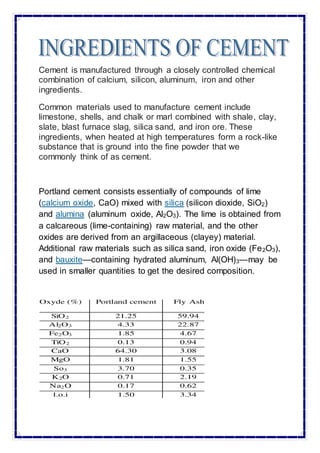
Portland cement consists essentially of compounds of lime
(calcium oxide, CaO) mixed with silica (silicon dioxide, SiO2)
and alumina (aluminum oxide, Al2O3). The lime is obtained from
a calcareous (lime-containing) raw material, and the other
oxides are derived from an argillaceous (clayey) material.
Additional raw materials such as silica sand, iron oxide (Fe2O3),
and bauxite—containing hydrated aluminum, Al(OH)3—may be
used in smaller quantities to get the desired composition.
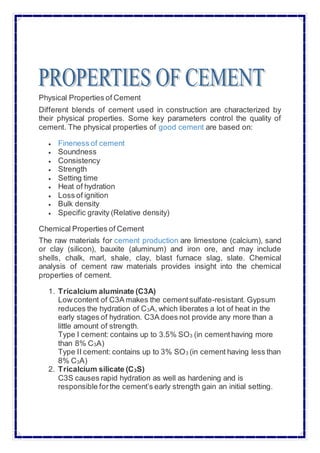
Physical Properties of Cement
Different blends of cement used in construction are characterized by
their physical properties. Some key parameters control the quality of
cement. The physical properties of good cement are based on:
 Fineness of cement
 Soundness
 Consistency
 Strength
 Setting time
 Heat of hydration
 Loss of ignition
 Bulk density
 Specific gravity (Relative density)
Chemical Properties of Cement
The raw materials for cement production are limestone (calcium), sand
or clay (silicon), bauxite (aluminum) and iron ore, and may include
shells, chalk, marl, shale, clay, blast furnace slag, slate. Chemical
analysis of cement raw materials provides insight into the chemical
properties of cement.
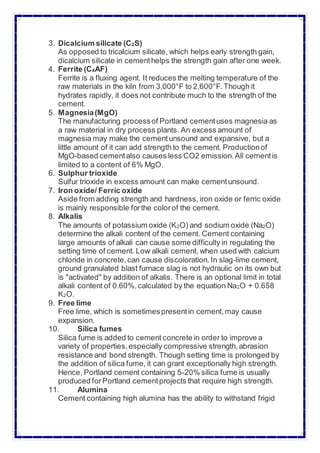
1. Tricalcium aluminate (C3A)
Low content of C3A makes the cementsulfate-resistant. Gypsum
reduces the hydration of C3A, which liberates a lot of heat in the
early stages of hydration. C3A does not provide any more than a
little amount of strength.
Type I cement: contains up to 3.5% SO3 (in cementhaving more
than 8% C3A)
Type II cement: contains up to 3% SO3 (in cement having less than
8% C3A)
2. Tricalcium silicate (C3S)
C3S causes rapid hydration as well as hardening and is
responsible forthe cement’s early strength gain an initial setting.
3. Dicalcium silicate (C2S)
As opposed to tricalcium silicate, which helps early strength gain,
dicalcium silicate in cementhelps the strength gain after one week.
4. Ferrite (C4AF)
Ferrite is a fluxing agent. It reduces the melting temperature of the
raw materials in the kiln from 3,000°F to 2,600°F.Though it
hydrates rapidly, it does not contribute much to the strength of the
cement.
5. Magnesia(MgO)
The manufacturing processof Portland cementuses magnesia as
a raw material in dry process plants. An excess amount of
magnesia may make the cementunsound and expansive, but a
little amount of it can add strength to the cement. Productionof
MgO-based cementalso causes less CO2 emission.All cementis
limited to a content of 6% MgO.
6. Sulphur trioxide
Sulfur trioxide in excess amount can make cementunsound.
7. Iron oxide/ Ferric oxide
Aside from adding strength and hardness, iron oxide or ferric oxide
is mainly responsible forthe colorof the cement.
8. Alkalis
The amounts of potassium oxide (K2O) and sodium oxide (Na2O)
determine the alkali content of the cement. Cement containing
large amounts of alkali can cause some difficulty in regulating the
setting time of cement. Low alkali cement, when used with calcium
chloride in concrete,can cause discoloration.In slag-lime cement,
ground granulated blast furnace slag is not hydraulic on its own but
is "activated" by addition of alkalis. There is an optional limit in total
alkali content of 0.60%,calculated by the equation Na2O + 0.658
K2O.
9. Free lime
Free lime, which is sometimespresentin cement,may cause
expansion.
10. Silica fumes
Silica fume is added to cement concrete in order to improve a
variety of properties,especially compressive strength,abrasion
resistance and bond strength. Though setting time is prolonged by
the addition of silica fume, it can grant exceptionally high strength.
Hence, Portland cement containing 5-20% silica fume is usually
produced forPortland cementprojects that require high strength.
11. Alumina
Cement containing high alumina has the ability to withstand frigid
temperatures since alumina is chemical-resistant. It also quickens
the setting but weakens the cement.
The main features of these cement ingredients along with their functions
and usefulness or harmfulness are given below:
1. Lime: Lime is calcium oxide or calcium hydroxide.
o Presence of lime in a sufficientquantity is required to form
silicates and aluminates of calcium.
o Deficiencyin lime reduces the strength of propertyto the
cement.
o Deficiencyin lime causes cementto set quickly.
o Excess lime makes cementunsound.
o Excessive presenceof lime cause cement to expand and
disintegrate.
2. Silica:Silicondioxide is known as silica, chemical formula SiO2.
o Sufficientquantity of silica should be present in cement to
dicalcium and tricalcium silicate.
o Silica imparts strength to cement.
o Silica usually present to the extent of about 30
percent cement.
3. Alumina: Alumina is Aluminium oxide. The chemical formula is
Al2O3.
o Alumina imparts quick setting property to the cement.
o Clinkering temperature is lowered by the presence of the
requisite quantity of alumina.
o Excess alumina weakens the cement.
4. Magnesia:Magnesium Oxide. Chemical formula is MgO.
o Magnesia should not be presentmore than 2% in cement.
o Excess magnesia will reduce the strength of the cement.
5. Iron oxide: Chemical formula is Fe2O3.
o Iron oxide imparts colorto cement.
o It acts as a flux.
o At a very high temperature, it imparts into the chemical
reaction with calcium and aluminum to form tricalcium
alumino-ferrite.
o Tricalcium alumino-ferrite imparts hardness and strength to
cement.
6. Calcium Sulfate:Chemical formula is CaSO4
.
o This is present in cement in the form of
gypsum(CaSO4.2H2O)
o It slows down or retards the setting action of cement.
7. Sulfur Trioxide:Chemicalformula is SO3
.
o Should not be present more than 2%.
o Excess Sulfur Trioxide causes cement to unsound.
8. Alkaline:
o Should not be present more than 1%.
o Excess Alkaline matter causes efflorescence.
Differentgrades of cementare specifiedby IS 1489-1991.Cements are
mainly classified on the basis of compressive strengthof particular
cement.
For example if cementhas compressive strength of 33 N/mm2 then it is
classified under grade 33.
Mainly 3 grades of cements are used:
 GRADE 33 ORDINARY PORTLAND CEMENT:
Fineness=300 m2/kg
Compressive strength after 3 days=16 N/mm2
Compressive strength after 7 days=22 N/mm2
Compressive strength after 28 days=33N/mm2
Grade 33 cementhas high workability and is mainly used for mortar in
masonry work and for plastering.
IS 269(1989)COVERS THE SPECIFICATIONOF GRADE 33
ORDINARY PORTLAND CEMENT.
 GRADE 43 ORDINARY PORTLAND CEMENT:
Fineness=225 m2/kg
Compressive strength after 3 days=23 N/mm2
Compressive strength after 7 days=33 N/mm2
Compressive strength after 28 days=43 N/mm2
Grade 43 cementis moderately sulphate resisting and has good
workability. Grade 43 cementhas low chloride content and thus resists
corrosionon R.C.C. Grade 43 cement has smoothand better finish.
Grade 43 cementis mainly used in:
1. Ready mix concrete.(R.M.C)
2. Reinforced cementconcrete work (R.C.C)
3. Pre-cast concrete.(Example in Delhi Metro pillars)
4. Silos and chimneys.
IS 8112(1989)COVERS THE SPECIFICATIONOF GRADE 43
ORDINARY PORTLAND CEMENT.
 GRADE 53 ORDINARY PORTLAND CEMENT:
Fineness=225 m2/kg
Compressive strength after 3 days=27 N/mm2
Compressive strength after 7 days=37 N/mm2
Compressive strength after 28 days=53 N/mm2
Grade 53 cementhas low chloride content and is moderately sulphate
resisting. Volume of cement required is less due to high strength and
surface area which saves the cost of construction.
Grade 53 cementis used in:
1. Industrial buildings, roads and subways.
2. Pre-cast concrete.
3. R.C.C Bridges.
4. Concrete sleeperforrailways.
Testing of cement Can be categorized as follows:
1) Field Testing.
2) Laboratory Testing.
1) Field TestingOf Cement
The Purity and quality of cementcan be judged by applying the following
rough and ready field tests:
 Colour test:The color of the cement should normally be greenish
grey.
 Temperature test :When hand is inserted into a bag of cement,It
should feel cooland not warm.
 Presence of lumps: moisture should not be present.
 Float test: cement should float for sometime before sinking.
 Adulteration test: we should feelrough when we hold it.
 Setting test: paste of cement is put on a glass plate and kept aside
for 24 hours should not get cracks.
2)Physical/ Laboratory TestingOf Cement
The following tests of cementare usually conducted in the laboratory:
a) Fineness Test
b) Normal consistencytest
c) Initial and final setting time test
d) Soundness test
e) compressive Strength Test
f) Heat of hydration test
g) Chemical compositiontest.
When cementis mixed with water is stiff and sticky paste is
formed.This cementpaste remains plastic for shortperiod. As the
time lapses , the plasticity gradually disappears and the paste
changes into a solid mass.
This phenomenon by virtue of which the cementpaste changes
from plastic state to solid state is known as setting of cement. The
time to reach this stage is known as setting time .
The time is reckoned from the instantwhen water is added to the
cement.The setting time is divided into two parts namely initial
setting time and final setting time .
The time at which the cementpaste loses its plasticity is termed
the initial setting time. the time taken to reach the stage when the
paste becomesa hard mass is known as the final setting time.
The initial and final setting time test is performed with the help of
Vicat apparatus. The initial setting time of cementshallbe the time
from the period elapsingbetween the time when the water is added
to the cementand the time at which the needle (1 mm square or
1.13 mm in dia and 40 to 50 mm in length) penetrate to a point 5 mm
from the bottom of the Vicat mould.
To perform this test about400 gm sieved cementis taken and water
is added to it @ 0.85 P by weightof cement. Where,P is the
percentage of water required for normalconsistencypaste.
At the instant of adding water,the stop watch is started. Water is
mixed thoroughly for about3 minutes. The paste is then filled in to
the Vicat mould,making it levelwith the top of the mould.
The filled up mould is placed centrallybelow the movable rod fitted
with needle.Thebottom surfaceof the needle is brought in contact
with the surfaceof the cementpaste and the readingof the scale is
taken.Therod is then quickly released and the penetration is
noted.
The procedure is repeated untilthe needle fails to penetrate the flock
for about 5 mm measuredfrom the bottom of the mould. The time
from the stop watch is recorded which gives the initial setting time.
The cementshallbe considered itfinally set while applying final
setting time needle gently, only an impressionis marked on the top
surface.
The cement should be stored carefully. Otherwise it may absorb
moisture from the atmosphere and may become uselessforthe
structural work. Following precautions are to be taken for the storage of
cement.
1. MOISTURE
If moisture is kept away from cement, it is found that cementwill
maintain its quality for an indefinite period.Absorptionof 1 to 2% of
moisture has no appreciable effecton quality of cement.But if moisture
absorptionexceeds 5%, the cementbecomestotally useless.Hence,
when cementis to be stored for a long period,it should be stored in air-
tight containers.
2. PERIOD OF STORAGE
The lose cementmay be stored indefinitely in air-tight containers. But it
is advisable to avoid storing of cement in jute bags for a period longer
than 3 months. If it is unavoidable, the cementshould be tested to
ascertain its properties.
3. PILES
The cement bags are stacked in piles. It is advisable to form a pile of
maximum 10 bags. There should be a clear distance of about 300 mm
between the piles of cement bag and exterior walls of building. In
between individual pile a passage of 900 mm should be provided for
easy access.Use tarpaulins or water proof paper at the top and bottom
of piles, while storing cementfor long period.
4. REMOVAL OF CEMENT
While removing cementbags from pile of sufficientheight, then steps
should be formed by taking out two or three bags from front piles.
Cement should be removed in order of its storage period, i.e. the rule
of first in, first out should be followed.
5. STORAGE SHEDS
The walls, roof and floorof storage sheds should be of water proof
construction. A minimum number of windows should be provided and
they should be kept tightly shut. The floor should be above ground. For
determining the size of storage shed,it is found that 20 bags or 10 kN of
cementwill require about 1m3
of space.

Bm cement ppt

  • 1.
    John Smeaton, buildingthe third Eddystone lighthouse (1759)off the coast of Cornwall in Southwestern England, found that a mix of lime, clay and crushed slag from iron-making produced a mortar which hardened under water. JosephAspdintook out a patent in 1824 for "Portland Cement," a material he produced by firing finely-ground clay and limestone until the limestone was calcined.He called it Portland Cement because the concrete made from it looked like Portland stone, a widely-used building stone in England. A few years later, in 1845,Isaac Johnson made the first modern Portland Cementby firing a mixture of chalk and clay at much higher temperatures,similar to those used today. At these temperatures (1400C-1500C),clinkering occurs and minerals form which are very reactive and more strongly cementitious. While Johnson used the same materials to make Portland cementas we use now, three important developments in the manufacturing process lead to modern Portland cement:  Developmentof rotary kilns  Addition of gypsum to control setting  Use of ball mills to grind clinker and raw materials From the turn of the 20th century, rotary cement kilns gradually replaced the original vertical shaft kilns, used originally for making lime. Rotary kilns heat the clinker mainly by radiative heat transfer and this is more efficientat higher temperatures, enabling higher burning temperatures to be achieved. Also, because the clinker is constantly moving within the kiln, a fairly uniform clinkering temperature is achieved in the hottest part of the kiln, the burning zone. The two other principal technical developments,gypsum addition to control setting and the use of ball mills to grind the clinker, were also introduced at around the start of the 20th century.
  • 2.
    Cement is manufacturedthrough a closely controlled chemical combination of calcium, silicon, aluminum, iron and other ingredients. Common materials used to manufacture cement include limestone, shells, and chalk or marl combined with shale, clay, slate, blast furnace slag, silica sand, and iron ore. These ingredients, when heated at high temperatures form a rock-like substance that is ground into the fine powder that we commonly think of as cement. Portland cement consists essentially of compounds of lime (calcium oxide, CaO) mixed with silica (silicon dioxide, SiO2) and alumina (aluminum oxide, Al2O3). The lime is obtained from a calcareous (lime-containing) raw material, and the other oxides are derived from an argillaceous (clayey) material. Additional raw materials such as silica sand, iron oxide (Fe2O3), and bauxite—containing hydrated aluminum, Al(OH)3—may be used in smaller quantities to get the desired composition.
  • 3.
    Physical Properties ofCement Different blends of cement used in construction are characterized by their physical properties. Some key parameters control the quality of cement. The physical properties of good cement are based on:  Fineness of cement  Soundness  Consistency  Strength  Setting time  Heat of hydration  Loss of ignition  Bulk density  Specific gravity (Relative density) Chemical Properties of Cement The raw materials for cement production are limestone (calcium), sand or clay (silicon), bauxite (aluminum) and iron ore, and may include shells, chalk, marl, shale, clay, blast furnace slag, slate. Chemical analysis of cement raw materials provides insight into the chemical properties of cement. 1. Tricalcium aluminate (C3A) Low content of C3A makes the cementsulfate-resistant. Gypsum reduces the hydration of C3A, which liberates a lot of heat in the early stages of hydration. C3A does not provide any more than a little amount of strength. Type I cement: contains up to 3.5% SO3 (in cementhaving more than 8% C3A) Type II cement: contains up to 3% SO3 (in cement having less than 8% C3A) 2. Tricalcium silicate (C3S) C3S causes rapid hydration as well as hardening and is responsible forthe cement’s early strength gain an initial setting.
  • 4.
    3. Dicalcium silicate(C2S) As opposed to tricalcium silicate, which helps early strength gain, dicalcium silicate in cementhelps the strength gain after one week. 4. Ferrite (C4AF) Ferrite is a fluxing agent. It reduces the melting temperature of the raw materials in the kiln from 3,000°F to 2,600°F.Though it hydrates rapidly, it does not contribute much to the strength of the cement. 5. Magnesia(MgO) The manufacturing processof Portland cementuses magnesia as a raw material in dry process plants. An excess amount of magnesia may make the cementunsound and expansive, but a little amount of it can add strength to the cement. Productionof MgO-based cementalso causes less CO2 emission.All cementis limited to a content of 6% MgO. 6. Sulphur trioxide Sulfur trioxide in excess amount can make cementunsound. 7. Iron oxide/ Ferric oxide Aside from adding strength and hardness, iron oxide or ferric oxide is mainly responsible forthe colorof the cement. 8. Alkalis The amounts of potassium oxide (K2O) and sodium oxide (Na2O) determine the alkali content of the cement. Cement containing large amounts of alkali can cause some difficulty in regulating the setting time of cement. Low alkali cement, when used with calcium chloride in concrete,can cause discoloration.In slag-lime cement, ground granulated blast furnace slag is not hydraulic on its own but is "activated" by addition of alkalis. There is an optional limit in total alkali content of 0.60%,calculated by the equation Na2O + 0.658 K2O. 9. Free lime Free lime, which is sometimespresentin cement,may cause expansion. 10. Silica fumes Silica fume is added to cement concrete in order to improve a variety of properties,especially compressive strength,abrasion resistance and bond strength. Though setting time is prolonged by the addition of silica fume, it can grant exceptionally high strength. Hence, Portland cement containing 5-20% silica fume is usually produced forPortland cementprojects that require high strength. 11. Alumina Cement containing high alumina has the ability to withstand frigid
  • 5.
    temperatures since aluminais chemical-resistant. It also quickens the setting but weakens the cement. The main features of these cement ingredients along with their functions and usefulness or harmfulness are given below: 1. Lime: Lime is calcium oxide or calcium hydroxide. o Presence of lime in a sufficientquantity is required to form silicates and aluminates of calcium. o Deficiencyin lime reduces the strength of propertyto the cement. o Deficiencyin lime causes cementto set quickly. o Excess lime makes cementunsound. o Excessive presenceof lime cause cement to expand and disintegrate. 2. Silica:Silicondioxide is known as silica, chemical formula SiO2. o Sufficientquantity of silica should be present in cement to dicalcium and tricalcium silicate. o Silica imparts strength to cement. o Silica usually present to the extent of about 30 percent cement. 3. Alumina: Alumina is Aluminium oxide. The chemical formula is Al2O3. o Alumina imparts quick setting property to the cement. o Clinkering temperature is lowered by the presence of the requisite quantity of alumina. o Excess alumina weakens the cement. 4. Magnesia:Magnesium Oxide. Chemical formula is MgO. o Magnesia should not be presentmore than 2% in cement. o Excess magnesia will reduce the strength of the cement. 5. Iron oxide: Chemical formula is Fe2O3. o Iron oxide imparts colorto cement. o It acts as a flux.
  • 6.
    o At avery high temperature, it imparts into the chemical reaction with calcium and aluminum to form tricalcium alumino-ferrite. o Tricalcium alumino-ferrite imparts hardness and strength to cement. 6. Calcium Sulfate:Chemical formula is CaSO4 . o This is present in cement in the form of gypsum(CaSO4.2H2O) o It slows down or retards the setting action of cement. 7. Sulfur Trioxide:Chemicalformula is SO3 . o Should not be present more than 2%. o Excess Sulfur Trioxide causes cement to unsound. 8. Alkaline: o Should not be present more than 1%. o Excess Alkaline matter causes efflorescence.
  • 7.
    Differentgrades of cementarespecifiedby IS 1489-1991.Cements are mainly classified on the basis of compressive strengthof particular cement. For example if cementhas compressive strength of 33 N/mm2 then it is classified under grade 33. Mainly 3 grades of cements are used:  GRADE 33 ORDINARY PORTLAND CEMENT: Fineness=300 m2/kg Compressive strength after 3 days=16 N/mm2 Compressive strength after 7 days=22 N/mm2 Compressive strength after 28 days=33N/mm2 Grade 33 cementhas high workability and is mainly used for mortar in masonry work and for plastering. IS 269(1989)COVERS THE SPECIFICATIONOF GRADE 33 ORDINARY PORTLAND CEMENT.  GRADE 43 ORDINARY PORTLAND CEMENT: Fineness=225 m2/kg Compressive strength after 3 days=23 N/mm2 Compressive strength after 7 days=33 N/mm2 Compressive strength after 28 days=43 N/mm2 Grade 43 cementis moderately sulphate resisting and has good workability. Grade 43 cementhas low chloride content and thus resists corrosionon R.C.C. Grade 43 cement has smoothand better finish. Grade 43 cementis mainly used in: 1. Ready mix concrete.(R.M.C) 2. Reinforced cementconcrete work (R.C.C)
  • 8.
    3. Pre-cast concrete.(Examplein Delhi Metro pillars) 4. Silos and chimneys. IS 8112(1989)COVERS THE SPECIFICATIONOF GRADE 43 ORDINARY PORTLAND CEMENT.  GRADE 53 ORDINARY PORTLAND CEMENT: Fineness=225 m2/kg Compressive strength after 3 days=27 N/mm2 Compressive strength after 7 days=37 N/mm2 Compressive strength after 28 days=53 N/mm2 Grade 53 cementhas low chloride content and is moderately sulphate resisting. Volume of cement required is less due to high strength and surface area which saves the cost of construction. Grade 53 cementis used in: 1. Industrial buildings, roads and subways. 2. Pre-cast concrete. 3. R.C.C Bridges. 4. Concrete sleeperforrailways.
  • 9.
    Testing of cementCan be categorized as follows: 1) Field Testing. 2) Laboratory Testing. 1) Field TestingOf Cement The Purity and quality of cementcan be judged by applying the following rough and ready field tests:  Colour test:The color of the cement should normally be greenish grey.  Temperature test :When hand is inserted into a bag of cement,It should feel cooland not warm.  Presence of lumps: moisture should not be present.  Float test: cement should float for sometime before sinking.  Adulteration test: we should feelrough when we hold it.  Setting test: paste of cement is put on a glass plate and kept aside for 24 hours should not get cracks. 2)Physical/ Laboratory TestingOf Cement The following tests of cementare usually conducted in the laboratory: a) Fineness Test b) Normal consistencytest c) Initial and final setting time test d) Soundness test e) compressive Strength Test f) Heat of hydration test
  • 10.
  • 11.
    When cementis mixedwith water is stiff and sticky paste is formed.This cementpaste remains plastic for shortperiod. As the time lapses , the plasticity gradually disappears and the paste changes into a solid mass. This phenomenon by virtue of which the cementpaste changes from plastic state to solid state is known as setting of cement. The time to reach this stage is known as setting time . The time is reckoned from the instantwhen water is added to the cement.The setting time is divided into two parts namely initial setting time and final setting time . The time at which the cementpaste loses its plasticity is termed the initial setting time. the time taken to reach the stage when the paste becomesa hard mass is known as the final setting time. The initial and final setting time test is performed with the help of Vicat apparatus. The initial setting time of cementshallbe the time from the period elapsingbetween the time when the water is added to the cementand the time at which the needle (1 mm square or 1.13 mm in dia and 40 to 50 mm in length) penetrate to a point 5 mm from the bottom of the Vicat mould. To perform this test about400 gm sieved cementis taken and water is added to it @ 0.85 P by weightof cement. Where,P is the percentage of water required for normalconsistencypaste. At the instant of adding water,the stop watch is started. Water is
  • 12.
    mixed thoroughly forabout3 minutes. The paste is then filled in to the Vicat mould,making it levelwith the top of the mould. The filled up mould is placed centrallybelow the movable rod fitted with needle.Thebottom surfaceof the needle is brought in contact with the surfaceof the cementpaste and the readingof the scale is taken.Therod is then quickly released and the penetration is noted. The procedure is repeated untilthe needle fails to penetrate the flock for about 5 mm measuredfrom the bottom of the mould. The time from the stop watch is recorded which gives the initial setting time. The cementshallbe considered itfinally set while applying final setting time needle gently, only an impressionis marked on the top surface.
  • 13.
    The cement shouldbe stored carefully. Otherwise it may absorb moisture from the atmosphere and may become uselessforthe structural work. Following precautions are to be taken for the storage of cement. 1. MOISTURE If moisture is kept away from cement, it is found that cementwill maintain its quality for an indefinite period.Absorptionof 1 to 2% of moisture has no appreciable effecton quality of cement.But if moisture absorptionexceeds 5%, the cementbecomestotally useless.Hence, when cementis to be stored for a long period,it should be stored in air- tight containers. 2. PERIOD OF STORAGE The lose cementmay be stored indefinitely in air-tight containers. But it is advisable to avoid storing of cement in jute bags for a period longer than 3 months. If it is unavoidable, the cementshould be tested to ascertain its properties. 3. PILES The cement bags are stacked in piles. It is advisable to form a pile of maximum 10 bags. There should be a clear distance of about 300 mm between the piles of cement bag and exterior walls of building. In between individual pile a passage of 900 mm should be provided for easy access.Use tarpaulins or water proof paper at the top and bottom of piles, while storing cementfor long period. 4. REMOVAL OF CEMENT While removing cementbags from pile of sufficientheight, then steps should be formed by taking out two or three bags from front piles. Cement should be removed in order of its storage period, i.e. the rule of first in, first out should be followed.
  • 14.
    5. STORAGE SHEDS Thewalls, roof and floorof storage sheds should be of water proof construction. A minimum number of windows should be provided and they should be kept tightly shut. The floor should be above ground. For determining the size of storage shed,it is found that 20 bags or 10 kN of cementwill require about 1m3 of space.