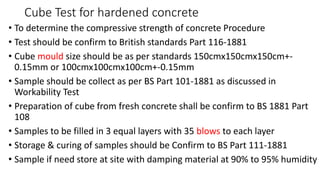
Cube Test for hardened concrete
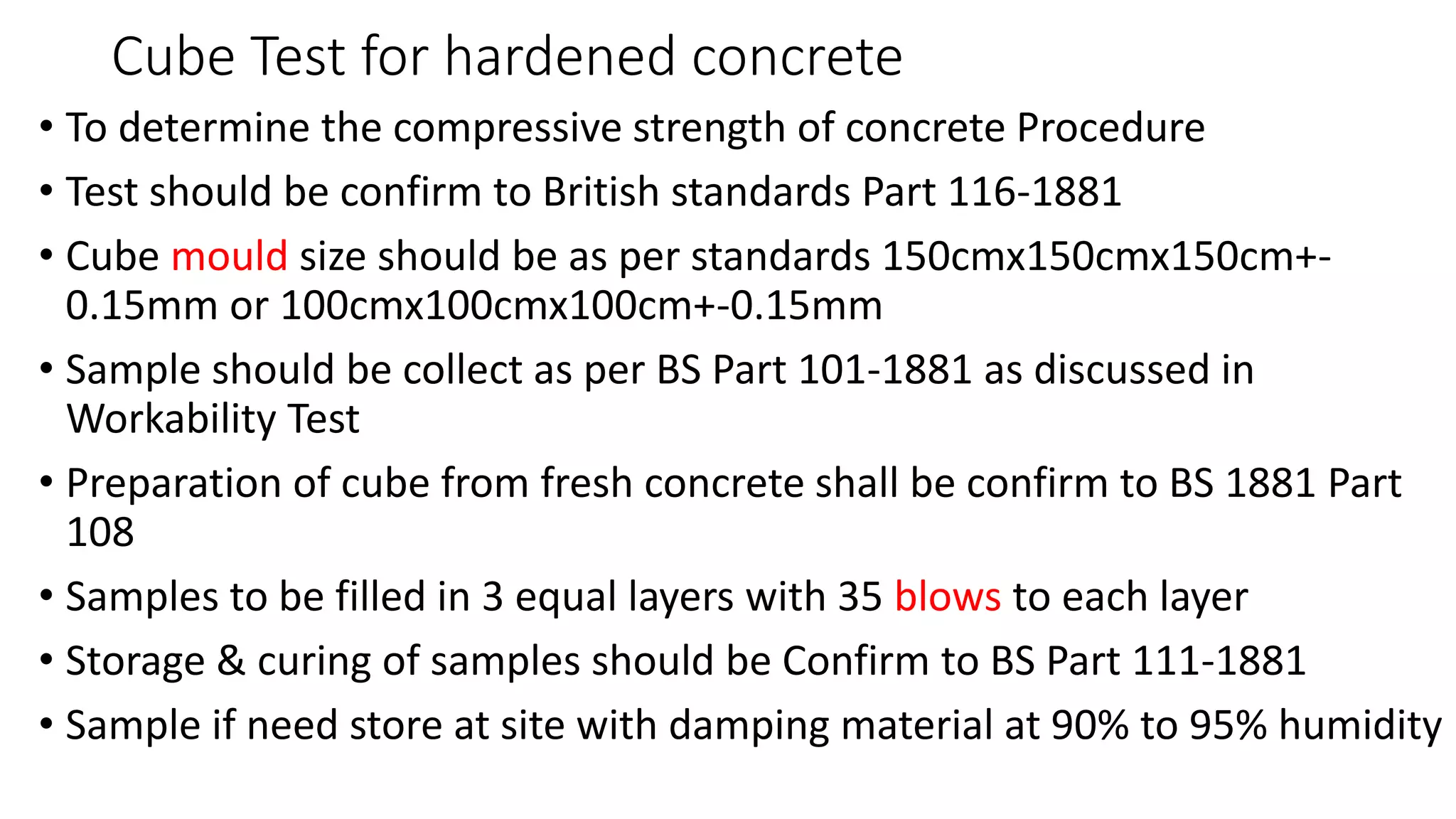
• To determine the compressive strength of concrete Procedure
• Test should be confirm to British standards Part 116-1881
• Cube mould size should be as per standards 150cmx150cmx150cm+-
0.15mm or 100cmx100cmx100cm+-0.15mm
• Sample should be collect as per BS Part 101-1881 as discussed in
Workability Test
• Preparation of cube from fresh concrete shall be confirm to BS 1881 Part
108
• Samples to be filled in 3 equal layers with 35 blows to each layer
• Storage & curing of samples should be Confirm to BS Part 111-1881
• Sample if need store at site with damping material at 90% to 95% humidity
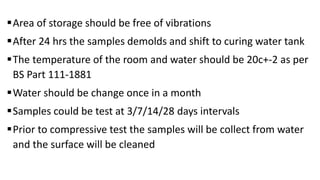
Area of storage should be free of vibrations
After 24 hrs the samples demolds and shift to curing water tank
The temperature of the room and water should be 20c+-2 as per
BS Part 111-1881
Water should be change once in a month
Samples could be test at 3/7/14/28 days intervals
Prior to compressive test the samples will be collect from water
and the surface will be cleaned
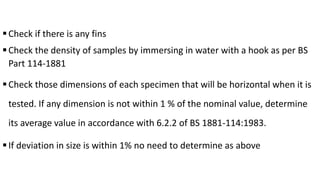
Check if there is any fins
Check the density of samples by immersing in water with a hook as per BS
Part 114-1881
Check those dimensions of each specimen that will be horizontal when it is
tested. If any dimension is not within 1 % of the nominal value, determine
its average value in accordance with 6.2.2 of BS 1881-114:1983.
If deviation in size is within 1% no need to determine as above
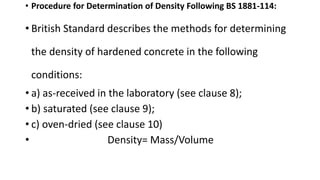
• Procedure for Determination of Density Following BS 1881-114:
• British Standard describes the methods for determining
the density of hardened concrete in the following
conditions:
• a) as-received in the laboratory (see clause 8);
• b) saturated (see clause 9);
• c) oven-dried (see clause 10)
• Density= Mass/Volume
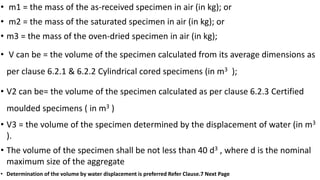
• m1 = the mass of the as-received specimen in air (in kg); or
• m2 = the mass of the saturated specimen in air (in kg); or
• m3 = the mass of the oven-dried specimen in air (in kg);
• V can be = the volume of the specimen calculated from its average dimensions as
per clause 6.2.1 & 6.2.2 Cylindrical cored specimens (in m3 );
• V2 can be= the volume of the specimen calculated as per clause 6.2.3 Certified
moulded specimens ( in m3 )
• V3 = the volume of the specimen determined by the displacement of water (in m3
).
• The volume of the specimen shall be not less than 40 d3 , where d is the nominal
maximum size of the aggregate
• Determination of the volume by water displacement is preferred Refer Clause.7 Next Page
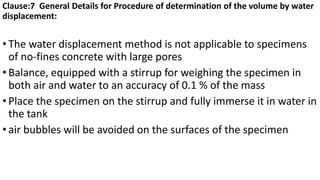
Clause:7 General Details for Procedure of determination of the volume by water
displacement:
• The water displacement method is not applicable to specimens
of no-fines concrete with large pores
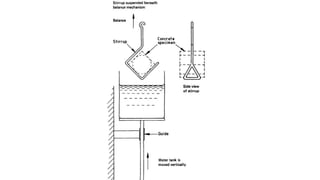
• Balance, equipped with a stirrup for weighing the specimen in
both air and water to an accuracy of 0.1 % of the mass
• Place the specimen on the stirrup and fully immerse it in water in
the tank
• air bubbles will be avoided on the surfaces of the specimen
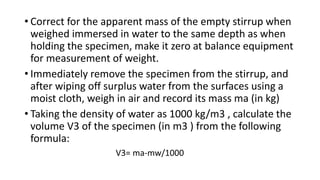
• Correct for the apparent mass of the empty stirrup when
weighed immersed in water to the same depth as when
holding the specimen, make it zero at balance equipment
for measurement of weight.
• Immediately remove the specimen from the stirrup, and
after wiping off surplus water from the surfaces using a
moist cloth, weigh in air and record its mass ma (in kg)
• Taking the density of water as 1000 kg/m3 , calculate the
volume V3 of the specimen (in m3 ) from the following
formula:
V3= ma-mw/1000
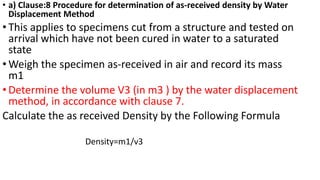
• a) Clause:8 Procedure for determination of as-received density by Water
Displacement Method
• This applies to specimens cut from a structure and tested on
arrival which have not been cured in water to a saturated
state
• Weigh the specimen as-received in air and record its mass
m1
• Determine the volume V3 (in m3 ) by the water displacement
method, in accordance with clause 7.
Calculate the as received Density by the Following Formula
Density=m1/v3
b) Clause 9: Procedure for determination of saturated density by Water
Displacement method:
• Fully immerse the specimen in water at 20 ± 2 °C until constant
mass is achieved as shown by two measurements, 24 h apart
• Determine the volume V3 (in m3 ) by the water displacement
method, in accordance with clause 7.
• Wipe off surplus water from the surface using a moist cloth.
Record the constant mass m2 (in kg).
Calculate the Saturated Density by given formula:
Density=m2/v3
c) Clause 10: Procedure for determination of oven dry density by Water
Displacement method:
• Place the specimen in the ventilated oven (4.4) and dry it at 105
± 5 °C until constant mass is achieved as shown by two
measurements, 24 h apart, giving a difference of less than 0.2 %
in the mass of the dry specimen
• Before each weighing, cool the specimen to near room
temperature
• Record the constant mass m3 (in kg).
• determine the volume V3 (in m3 ) by the water displacement
method in accordance with clause 7, promptly as immersed in
water.
• Determination of Compressive Strength:
• Compressive test machine should be confirm to BS Part 115-1881
• Immerse in water, for minimum of 5 min, those cubes which have not been cured
in water or where the surfaces have been allowed to dry
• Remove the cubes from the curing or density water tank and test while they are
still wet
• Load should be applied to opposite corners of the cube @ 2 kg to 4
kg/cm2/second.
• Check the crushing load of machine and divide this load by area specimen
• Standard deviation in cubes must not exceed 15%
• The standard deviation of a set of numbers tells us about how different the
individual readings typically are from the average of the set
• Load should be applied to two opposite edges of cube
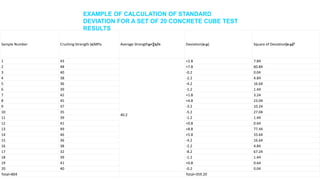
Sample Number Crushing Strength (x)MPa Average Strengthμ=∑x/n Deviation(x-μ) Square of Deviation(x-μ)2
1 43
40.2
+2.8 7.84
2 48 +7.8 60.84
3 40 -0.2 0.04
4 38 -2.2 4.84
5 36 -4.2 16.64
6 39 -1.2 1.44
7 42 +1.8 3.24
8 45 +4.8 23.04
9 37 -3.2 10.24
10 35 -5.2 27.04
11 39 -1.2 1.44
12 41 +0.8 0.64
13 49 +8.8 77.44
14 46 +5.8 33.64
15 36 -4.2 16.64
16 38 -2.2 4.84
17 32 -8.2 67.24
18 39 -1.2 1.44
19 41 +0.8 0.64
20 40 -0.2 0.04
Total=804 Total=359.20
EXAMPLE OF CALCULATION OF STANDARD
DEVIATION FOR A SET OF 20 CONCRETE CUBE TEST
RESULTS
• Average Strength, μ = 804/20 = 40.2 MPa
• Standard deviation = √[359.2/ (n-1)] = √(359.2/19) =
4.34 MPa
• Where, n = Total number of samples
• Coefficient of Variation = (Standard deviation/Average
strength)*100
• = (4.34/40.2)*100
• = 10.80%<15% ok
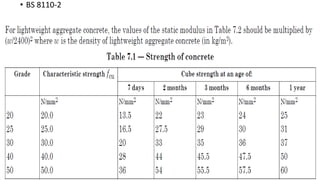
• BS 8110-2
Cube test for compressive strength of concrete

Cube test for compressive strength of concrete

  • 1.
    Cube Test forhardened concrete • To determine the compressive strength of concrete Procedure • Test should be confirm to British standards Part 116-1881 • Cube mould size should be as per standards 150cmx150cmx150cm+- 0.15mm or 100cmx100cmx100cm+-0.15mm • Sample should be collect as per BS Part 101-1881 as discussed in Workability Test • Preparation of cube from fresh concrete shall be confirm to BS 1881 Part 108 • Samples to be filled in 3 equal layers with 35 blows to each layer • Storage & curing of samples should be Confirm to BS Part 111-1881 • Sample if need store at site with damping material at 90% to 95% humidity
  • 2.
    Area of storageshould be free of vibrations After 24 hrs the samples demolds and shift to curing water tank The temperature of the room and water should be 20c+-2 as per BS Part 111-1881 Water should be change once in a month Samples could be test at 3/7/14/28 days intervals Prior to compressive test the samples will be collect from water and the surface will be cleaned
  • 3.
    Check if thereis any fins Check the density of samples by immersing in water with a hook as per BS Part 114-1881 Check those dimensions of each specimen that will be horizontal when it is tested. If any dimension is not within 1 % of the nominal value, determine its average value in accordance with 6.2.2 of BS 1881-114:1983. If deviation in size is within 1% no need to determine as above
  • 4.
    • Procedure forDetermination of Density Following BS 1881-114: • British Standard describes the methods for determining the density of hardened concrete in the following conditions: • a) as-received in the laboratory (see clause 8); • b) saturated (see clause 9); • c) oven-dried (see clause 10) • Density= Mass/Volume
  • 5.
    • m1 =the mass of the as-received specimen in air (in kg); or • m2 = the mass of the saturated specimen in air (in kg); or • m3 = the mass of the oven-dried specimen in air (in kg); • V can be = the volume of the specimen calculated from its average dimensions as per clause 6.2.1 & 6.2.2 Cylindrical cored specimens (in m3 ); • V2 can be= the volume of the specimen calculated as per clause 6.2.3 Certified moulded specimens ( in m3 ) • V3 = the volume of the specimen determined by the displacement of water (in m3 ). • The volume of the specimen shall be not less than 40 d3 , where d is the nominal maximum size of the aggregate • Determination of the volume by water displacement is preferred Refer Clause.7 Next Page
  • 6.
    Clause:7 General Detailsfor Procedure of determination of the volume by water displacement: • The water displacement method is not applicable to specimens of no-fines concrete with large pores • Balance, equipped with a stirrup for weighing the specimen in both air and water to an accuracy of 0.1 % of the mass • Place the specimen on the stirrup and fully immerse it in water in the tank • air bubbles will be avoided on the surfaces of the specimen
  • 7.
    • Correct forthe apparent mass of the empty stirrup when weighed immersed in water to the same depth as when holding the specimen, make it zero at balance equipment for measurement of weight. • Immediately remove the specimen from the stirrup, and after wiping off surplus water from the surfaces using a moist cloth, weigh in air and record its mass ma (in kg) • Taking the density of water as 1000 kg/m3 , calculate the volume V3 of the specimen (in m3 ) from the following formula: V3= ma-mw/1000
  • 8.
    • a) Clause:8Procedure for determination of as-received density by Water Displacement Method • This applies to specimens cut from a structure and tested on arrival which have not been cured in water to a saturated state • Weigh the specimen as-received in air and record its mass m1 • Determine the volume V3 (in m3 ) by the water displacement method, in accordance with clause 7. Calculate the as received Density by the Following Formula Density=m1/v3
  • 9.
    b) Clause 9:Procedure for determination of saturated density by Water Displacement method: • Fully immerse the specimen in water at 20 ± 2 °C until constant mass is achieved as shown by two measurements, 24 h apart • Determine the volume V3 (in m3 ) by the water displacement method, in accordance with clause 7. • Wipe off surplus water from the surface using a moist cloth. Record the constant mass m2 (in kg). Calculate the Saturated Density by given formula: Density=m2/v3
  • 10.
    c) Clause 10:Procedure for determination of oven dry density by Water Displacement method: • Place the specimen in the ventilated oven (4.4) and dry it at 105 ± 5 °C until constant mass is achieved as shown by two measurements, 24 h apart, giving a difference of less than 0.2 % in the mass of the dry specimen • Before each weighing, cool the specimen to near room temperature • Record the constant mass m3 (in kg). • determine the volume V3 (in m3 ) by the water displacement method in accordance with clause 7, promptly as immersed in water.
  • 12.
    • Determination ofCompressive Strength: • Compressive test machine should be confirm to BS Part 115-1881 • Immerse in water, for minimum of 5 min, those cubes which have not been cured in water or where the surfaces have been allowed to dry • Remove the cubes from the curing or density water tank and test while they are still wet • Load should be applied to opposite corners of the cube @ 2 kg to 4 kg/cm2/second. • Check the crushing load of machine and divide this load by area specimen • Standard deviation in cubes must not exceed 15% • The standard deviation of a set of numbers tells us about how different the individual readings typically are from the average of the set • Load should be applied to two opposite edges of cube
  • 13.
    Sample Number CrushingStrength (x)MPa Average Strengthμ=∑x/n Deviation(x-μ) Square of Deviation(x-μ)2 1 43 40.2 +2.8 7.84 2 48 +7.8 60.84 3 40 -0.2 0.04 4 38 -2.2 4.84 5 36 -4.2 16.64 6 39 -1.2 1.44 7 42 +1.8 3.24 8 45 +4.8 23.04 9 37 -3.2 10.24 10 35 -5.2 27.04 11 39 -1.2 1.44 12 41 +0.8 0.64 13 49 +8.8 77.44 14 46 +5.8 33.64 15 36 -4.2 16.64 16 38 -2.2 4.84 17 32 -8.2 67.24 18 39 -1.2 1.44 19 41 +0.8 0.64 20 40 -0.2 0.04 Total=804 Total=359.20 EXAMPLE OF CALCULATION OF STANDARD DEVIATION FOR A SET OF 20 CONCRETE CUBE TEST RESULTS
  • 14.
    • Average Strength,μ = 804/20 = 40.2 MPa • Standard deviation = √[359.2/ (n-1)] = √(359.2/19) = 4.34 MPa • Where, n = Total number of samples • Coefficient of Variation = (Standard deviation/Average strength)*100 • = (4.34/40.2)*100 • = 10.80%<15% ok
  • 15.