CE6002
CONCRETE TECHNOLOGY
Module 1
CONSTITUENT MATERIALS OF
CONCRETE
2/6/2018 1Dr.V.Kannan
CEMENT
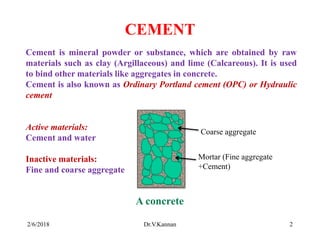
Cement is mineral powder or substance, which are obtained by raw
materials such as clay (Argillaceous) and lime (Calcareous). It is used
to bind other materials like aggregates in concrete.
Cement is also known as Ordinary Portland cement (OPC) or Hydraulic
cement
Active materials:
Cement and water
Inactive materials:
Fine and coarse aggregate
Coarse aggregate
Mortar (Fine aggregate
+Cement)
A concrete
2/6/2018 2Dr.V.Kannan
CEMENT MANUFACTURING PROCESS
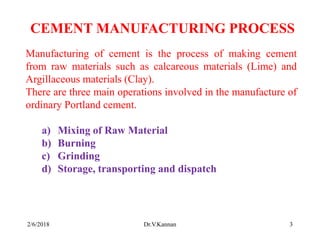
Manufacturing of cement is the process of making cement
from raw materials such as calcareous materials (Lime) and
Argillaceous materials (Clay).
There are three main operations involved in the manufacture of
ordinary Portland cement.
a) Mixing of Raw Material
b) Burning
c) Grinding
d) Storage, transporting and dispatch
2/6/2018 3Dr.V.Kannan
CEMENT MANUFACTURING PROCESS (cont.)
a) Mixing of Raw Material:
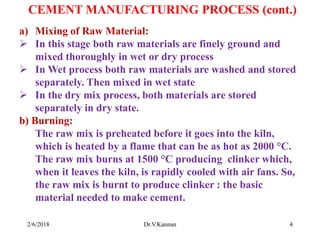
 In this stage both raw materials are finely ground and
mixed thoroughly in wet or dry process
 In Wet process both raw materials are washed and stored
separately. Then mixed in wet state
 In the dry mix process, both materials are stored
separately in dry state.
b) Burning:
The raw mix is preheated before it goes into the kiln,
which is heated by a flame that can be as hot as 2000 °C.
The raw mix burns at 1500 °C producing clinker which,
when it leaves the kiln, is rapidly cooled with air fans. So,
the raw mix is burnt to produce clinker : the basic
material needed to make cement.
2/6/2018 4Dr.V.Kannan
CEMENT MANUFACTURING PROCESS (cont.)
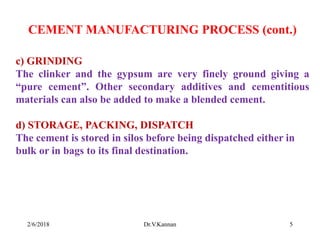
c) GRINDING
The clinker and the gypsum are very finely ground giving a
“pure cement”. Other secondary additives and cementitious
materials can also be added to make a blended cement.
d) STORAGE, PACKING, DISPATCH
The cement is stored in silos before being dispatched either in
bulk or in bags to its final destination.
2/6/2018 5Dr.V.Kannan
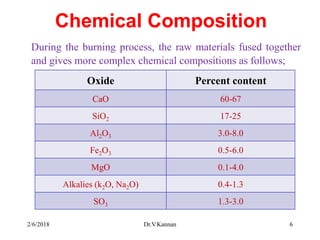
Chemical Composition
During the burning process, the raw materials fused together
and gives more complex chemical compositions as follows;
2/6/2018 Dr.V.Kannan 6
Oxide Percent content
CaO 60-67
SiO2 17-25
Al2O3 3.0-8.0
Fe2O3 0.5-6.0
MgO 0.1-4.0
Alkalies (k2O, Na2O) 0.4-1.3
SO3 1.3-3.0
Chemical Composition
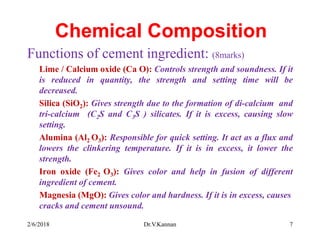
Functions of cement ingredient: (8marks)
Lime / Calcium oxide (Ca O): Controls strength and soundness. If it
is reduced in quantity, the strength and setting time will be
decreased.
Silica (SiO2): Gives strength due to the formation of di-calcium and
tri-calcium (C2S and C3S ) silicates. If it is excess, causing slow
setting.
Alumina (Al2 O3): Responsible for quick setting. It act as a flux and
lowers the clinkering temperature. If it is in excess, it lower the
strength.
Iron oxide (Fe2 O3): Gives color and help in fusion of different
ingredient of cement.
Magnesia (MgO): Gives color and hardness. If it is in excess, causes
cracks and cement unsound.
2/6/2018 Dr.V.Kannan 7
Chemical Composition
(Cont..)
Alkalies (K2O, Na2O): If it is in excess, causes alkali-aggregate
reactions, efflorescence and discoloring.
[Note: alkali-aggregate reactions: aggregates having silica, it react
with alkali’s and causes the expansion and cracking in concrete]
Sulphur (SO3): A small amount is used to make sound cement. If it
is in increase, causes unsound in cement.
**[Soundness of cement: It refers to the ability of a hardened
cement paste to retain its volume after setting without delayed
destructive expansion. ]
2/6/2018 Dr.V.Kannan 8
Chemical Composition
(Cont..)Major compounds in cement: (8marks)
When water is added to the cement, the major compounds are
developed. The identification of the major compounds are based on
R.H.Bogue’s research work, hence it is called Bogue’s compounds.
a) Tri Calcium Silicate (C3S) - 3CaO SiO2
b) Di Calcium Silicate (C2S) - 2CaO SiO2
c) Tri Calcium Aluminates (C3A) - 3CaO, Al2 O3
d) Tetra-Calcium Alumino Ferrite (C4AF) - 4CaO Al2O3 Fe2 O3
*C3S is formed with in a week, responsible for initial strength of
concrete and contribute 50-60% of strength.
* C2S is formed at last in the hydration process, responsible for later age
strength [needed for bridge / hydraulic structures]
*C3A is formed within 24 hours, responsible for initial setting time
*C4AF is also formed within 24 hours, responsible for heat of hydration
2/6/2018 Dr.V.Kannan 9
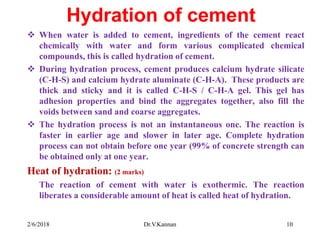
Hydration of cement
 When water is added to cement, ingredients of the cement react
chemically with water and form various complicated chemical
compounds, this is called hydration of cement.
 During hydration process, cement produces calcium hydrate silicate
(C-H-S) and calcium hydrate aluminate (C-H-A). These products are
thick and sticky and it is called C-H-S / C-H-A gel. This gel has
adhesion properties and bind the aggregates together, also fill the
voids between sand and coarse aggregates.
 The hydration process is not an instantaneous one. The reaction is
faster in earlier age and slower in later age. Complete hydration
process can not obtain before one year (99% of concrete strength can
be obtained only at one year.
Heat of hydration: (2 marks)
The reaction of cement with water is exothermic. The reaction
liberates a considerable amount of heat is called heat of hydration.
2/6/2018 Dr.V.Kannan 10
TYPES OF CEMENT
By altering the chemical compositions of the ordinary
Portland cement (OPC), many types of cement can be obtained
as follows;
1. Ordinary Portland cement (OPC)
2. Sulphate resistance cement
3. Low heat cement
4. Quick setting cement
5. Portland pozzolana cement (PPC)
6. High alumina cement
7. Colored cement
8. White cement
9. Air entraining cement
10. Hydrophobic cement
11. Expansion cement
12. Rapid hardening Portland cement
2/6/2018 11Dr.V.Kannan
TYPES OF CEMENT
1. Ordinary Portland cement:
This is the most commonly used cement for all types of engineering
works. Ordinary Portland cement (OPC) is manufactured in different
grades; the most common grades in India are 33, 43 and 53 grade. OPC
is manufactured by burning lime stone and clay at very high
temperature range of 1400o C to1700oC and thereafter grinding (or)
pulverizing it with gypsum to retard the setting time.
Uses / Advantages:
a) Normally used for all kind of construction works
b) Widely used in residential construction where special type of
cement properties is not required
2/6/2018 12Dr.V.Kannan
TYPES OF CEMENT
2. Sulphate resistance cement (
Sulphate resisting cement is a type of Portland cement in which the amount
of tri-calcium aluminates (C3A) is restricted to 5 %. The use of sulphate
resistance cement is particularly beneficial in such conditions where the
concrete is exposed to the risk of deterioration due to sulphate attack or
directly exposure to the soil.
Uses / Advantages:
a) It is used in the construction of foundations and piles.
b) Basements and underground structures.
c) Sewage and Water treatment plants.
d) Chemical, Fertilizers and Sugar factories.
e) Food processing industries and Petrochemical projects.
f) Coastal works.
g) Also for normal construction works where OPC is used.
h) Construction of building along the coastal area within 50 km from sea.
2/6/2018 13Dr.V.Kannan
TYPES OF CEMENT
3. Low heat cement
Low heat cement is produced by reducing the amount of tri-calcium
aluminates (C3A) & di-calcium silicate (C2S). This type of cement is used
in mass constructions (like dams) and in high wear resistance required
area. In general, this type of cement is producing very minimum amount
of CO2 emission than OPC.
Uses / Advantages:
a) It is very much used in the mass Construction of dams,
b) Mass construction of marine structures
c) Hydraulic Engineering Concrete
d) Retaining wall construction
2/6/2018 14Dr.V.Kannan
TYPES OF CEMENT
4. Quick setting cement
This type of cement is manufactured by reducing the amount of gypsum
and adding small amount of aluminum sulphate to accelerate setting time
of cement. As the name suggests, it is used where the works needs to be
done quickly and when mixed with water starts to set in five minutes and
become hard like stone in just 30 minutes.
Uses / Advantages:
a) It is used in under water construction.
b) It is also used in rainy & cold weather conditions.
c) Where, quick strength is needed in short span of time.
2/6/2018 15Dr.V.Kannan
TYPES OF CEMENT
5. Portland pozzolana cement (PPC)
PPC is manufactured by adding pozzolanic materials such as fly ash,
shales, clays etc. It gains high compressive strength with age and it is
affordable than other type of concrete.
Uses / Advantages:
a) Used in the hydraulic structures such as dam, canals, lining
etc.
b) Mass concreting works such as foundation, tall building etc.
c) Construction of marine structures.
d) This cement has higher resistance to chemical attacks. Hence
it can be used in construction of industrial buildings
e) Used in the construction of water tightened structures (Water
tank, retaining wall etc.)
2/6/2018 16Dr.V.Kannan
TYPES OF CEMENT
6. High alumina cement
High-alumina cement is rapid hardening cement made by fusing at 1500
to 1600 °C a mixture of bauxite and limestone in an electric furnace or in
a rotary kiln. It also can be made by sintering at about 1250 °C.
[*Sintering: Process of compacting and forming a solid mass of material
by heat or pressure without melting it to the point of liquification]
Uses / Advantages:
a) This cement is used in construction of refineries, factory or other
workshop type structure
b) Used in Sewage structures
c) Used where acid resistance structures are needed
2/6/2018 17Dr.V.Kannan
TYPES OF CEMENT
7. Colored cement
Colored cement is manufactured by mixing color pigments (5 - 10%) with
OPC. As the name suggests, It is used where colored cements required
for any aesthetic purpose. Chromium Oxide gives Green color. Cobalt
gives blue color. Iron oxide gives brown color.
Uses / Advantages:
a) These are wildly used for finishing of floor, external surface,
plastering wall, colored tiles.
b) Used in construction of swimming pool, garden path, tennis courts
etc.
c) Used in the construction of artificial marble
2/6/2018 18Dr.V.Kannan
TYPES OF CEMENT
8. White cement
This cement is white in color. This cement is free from coloring
ingredients such as iron oxide, magnesium oxide, chromium oxide.
This cement in burned by oil, and is very costlier than other type of
cements.
Uses / Advantages:
a) It is used for floor finishes, plaster works, pointing of brick and
stone works
b) Used in the manufacturing of precast stone and tiles, aerodromes
marking, traffic kerb and bridge rails.
c) Used as a base coat before painting
d) Used to cover the hairline cracks on concrete surface to give
smooth finish
2/6/2018 19Dr.V.Kannan
TYPES OF CEMENT
9. Air entrained cement
Air entraining cement produced by mixing small amount of air
entraining agent (Polymer based chemicals). Generally, this air
entraining agents are used to introduce a tiny bubbles in the concrete. It
is used to fill up the gap in concrete which are produced by excessive
amount of water during casting.
Uses / Advantages:
a) Used in frost resistance concrete (resistance to freezing and
thawing)
b) Air entrained concrete has less tendency to bleed, it is
considerably more plastic than ordinary concrete, and it generally
shows less segregation.
2/6/2018 20Dr.V.Kannan
TYPES OF CEMENT
10. Hydrophobic cement
This type of cement is manufactured by mixing admixtures like
petrolatum, napthalene soap which forms layer and act as water
repellent. It is useful in wet climatic conditions and Useful when cement
is stored for longer duration in wet climatic conditions.
11. Expansion cement
Expansive Cement is formed from the reaction of tri calcium aluminate
(C3A) with Calcium Sulphate (C2SO4). As the name suggests, it expands
and increases in volume while settled. Used to avoid the shrinkage of
concrete.
Uses / Advantages:
a) Used in repair works (to create a bond with old concrete surface)
b) Used in Hydraulic Structures
2/6/2018 21Dr.V.Kannan
TYPES OF CEMENT
12. Rapid hardening Portland cement (RHPC)
RHPC manufactured by combining lime stone (finely ground) and shale at
high temperature. This type of cement is used where high strength is needed
to be achieved quickly.
Uses / Advantages:
a) It is used where formwork has to be removed as early as possible in order
to reuse it.
b) It is used where high early strength is required.
c) It is generally used for constructing road pavements, where it is
important to open the road to traffic quickly.
d) It is used in industries which manufacture concrete products like slabs,
posts, electric poles, block fence, etc.
e) It is used for cold weather concreting
[The main disadvantage of the rapid hardening cement is costlier than
other type of cement]
2/6/2018 22Dr.V.Kannan
Grade of Cement
The Bureau of Indian Standard (BIS) has classified ordinary
Portland cement (OPC) in three different grades. The
classification is mainly based on the compressive strength of
cement -sand mortar cube at 28 days. The Grades are
a) 33 Grade cement
b) 43 Grade cement
c) 53 Grade cement
The Grade number (33, 43 and 53) indicates the minimum
compressive strength of cement sand mortar cube in N/mm2 at
28 days.
2/6/2018 Dr.V.Kannan 23
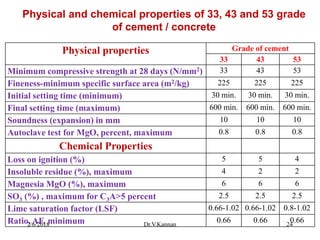
Physical and chemical properties of 33, 43 and 53 grade
of cement / concrete
Physical properties Grade of cement
33 43 53
Minimum compressive strength at 28 days (N/mm2) 33 43 53
Fineness-minimum specific surface area (m2/kg) 225 225 225
Initial setting time (minimum) 30 min. 30 min. 30 min.
Final setting time (maximum) 600 min. 600 min. 600 min.
Soundness (expansion) in mm 10 10 10
Autoclave test for MgO, percent, maximum 0.8 0.8 0.8
Chemical Properties
Loss on ignition (%) 5 5 4
Insoluble residue (%), maximum 4 2 2
Magnesia MgO (%), maximum 6 6 6
SO3 (%) , maximum for C3A>5 percent 2.5 2.5 2.5
Lime saturation factor (LSF) 0.66-1.02 0.66-1.02 0.8-1.02
Ratio, AF, minimum 0.66 0.66 0.662/6/2018 Dr.V.Kannan 24
GENERAL PROPERTIES OF CEMENT
a) It is an excellent binding material.
b) It gives strength to masonry.
c) It gives good plasticity.
d) It gives a good resistance to moisture.
e) It is easily workable. Hence less workmanship is
needed
f) It hardens quickly after addition of water.
g) It gives good bonding property to the concrete.
2/6/2018 Dr.V.Kannan 25
TEST ON CEMENT
In order to check the quality of cement the following tests
may be used;
Testing of cement can be brought under two categories:
1. Field testing
2. Laboratory Testing
2/6/2018 Dr.V.Kannan 26
Field testing
a) In the cement bag, there should not be any visible lumps and
the color should be greenish grey.
a) Thrust your hand into the cement bag. It must give you a cool
feeling.
b) Take a pinch of cement and feel between the fingers. It
should give a smooth and not a gritty feeling.
c) Take a handful of cement and throw it on a bucket full of
water, the particles should float for some time before they
sink.
d) Take about 100 grams of cement and a small quantity of
water and make a stiff paste. Put it on a glass plate and
slowly take it under water in a bucket. After 24 hours the
paste should retain its original shape
2/6/2018 Dr.V.Kannan 27
Laboratory testing
The following tests are conducted in the laboratory:
1. Fineness test
2. Soundness test
3. Setting time test
4. Strength test
2/6/2018 Dr.V.Kannan 28
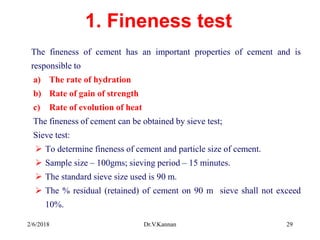
1. Fineness test
The fineness of cement has an important properties of cement and is
responsible to
a) The rate of hydration
b) Rate of gain of strength
c) Rate of evolution of heat
The fineness of cement can be obtained by sieve test;
Sieve test:
 To determine fineness of cement and particle size of cement.
 Sample size – 100gms; sieving period – 15 minutes.
 The standard sieve size used is 90 m.
 The % residual (retained) of cement on 90 m sieve shall not exceed
10%.
2/6/2018 Dr.V.Kannan 29
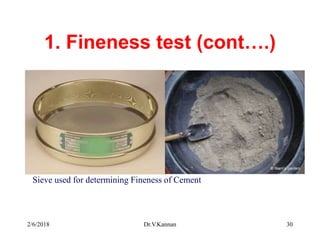
1. Fineness test (cont….)
2/6/2018 Dr.V.Kannan 30
Sieve used for determining Fineness of Cement
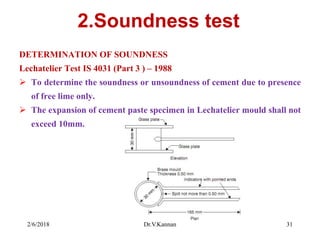
2.Soundness test
DETERMINATION OF SOUNDNESS
Lechatelier Test IS 4031 (Part 3 ) – 1988
 To determine the soundness or unsoundness of cement due to presence
of free lime only.
 The expansion of cement paste specimen in Lechatelier mould shall not
exceed 10mm.
2/6/2018 Dr.V.Kannan 31
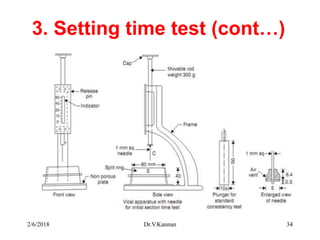
3. Setting time test
Initial setting time test (Vicat Apparatus)
IS : 4031 (Part 5) – 1988 (Reaffirmed 2000)
 To determine the time required by cement paste to loss its
plasticity.
 The Vicat apparatus is used to determine initial setting
time of cement where the penetration of the needle in the
cement paste kept in Vicat mould (40 mm height) shall be
in a range of 33 to 35 mm from the top.
 It shall not be less than 30minutes(≥30min) for normal
cement, 60 minutes for low heat cement and 5 minutes for
rapid hardening cement.
2/6/2018 Dr.V.Kannan 32
3. Setting time test (cont…)
Final setting time of cement (Vicat Apparatus)
 The time required by cement paste to gain the proper shape and
becoming hard considering from the instant of adding water is
called final setting time.
 i.e., the time elapsing from the instant of adding water to the
cement and the instant when paste becomes hard (solid) is
known as final setting time which is determined by Vicat
apparatus where the enlarge needle should not penetrate the
specimen of cement.
 Final setting time shall not exceed 10hrs for normal cement, 30
minutes for rapid hardening cement.
2/6/2018 Dr.V.Kannan 33
3. Setting time test (cont…)
2/6/2018 Dr.V.Kannan 34
4. Strength test
Compressive Strength Test (IS : 4031(Part 6):1988)
 To determine compressive strength of cement where the
specimen is made up of 1:3 (cement : sand) proportion i.e.
185 gm cement and 555gm sand or 200gm cement and
600gm sand.
 The specimen is tested under compression machine at an
age of 1 day, 3, 7 and 28 days.
 The compressive strength of rapid hardening cement at 1
day curing shall not be less than 16 MPa and at an age of 3
days it shall not be less than 27.5 MPa.
2/6/2018 Dr.V.Kannan 35
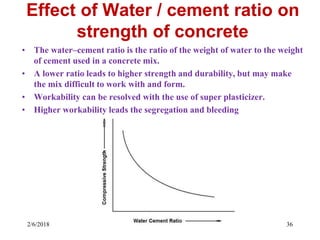
Effect of Water / cement ratio on
strength of concrete
• The water–cement ratio is the ratio of the weight of water to the weight
of cement used in a concrete mix.
• A lower ratio leads to higher strength and durability, but may make
the mix difficult to work with and form.
• Workability can be resolved with the use of super plasticizer.
• Higher workability leads the segregation and bleeding
2/6/2018 Dr.V.Kannan 36
Aggregate
 The aggregate is a relatively inert material and it imparts
volume stability.
 The aggregate provide about 75% of the body of the
concrete and hence its influence is extremely important.
 An aggregate should be of proper shape and size, clean,
hard and well graded.
 It must possess chemical stability and it must exhibit
abrasion resistance.
2/6/2018 Dr.V.Kannan 37
Classification of Aggregate
I. Classification Based on Size
a. Fine aggregates:
It is the aggregate, which is passes through a 4.75mm IS sieve and retained
on 0.7 mm. The fine aggregate may be natural sand, crushed stone sand or
crushed gravel sand. According to IS 383-1970, there are four grading
zones of the fine sand, Zone I, Zone II, Zone III and Zone IV.
b. Coarse aggregates:
The aggregates, most of which are retained on 4.75mm IS sieve are termed
as coarse aggregates. The coarse aggregates may be Crushed stone,
Uncrushed gravel and Partially crushed stone or gravel.
[*Sometimes combined aggregates are available in nature consisting of
different fractions of fine and coarse aggregates, which are known as all
in aggregate.]
2/6/2018 Dr.V.Kannan 38
Classification of Aggregate
II. Classification Based on Shape
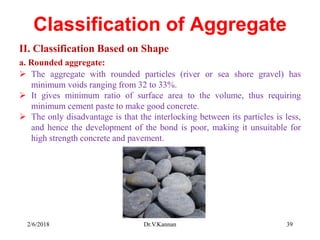
a. Rounded aggregate:
 The aggregate with rounded particles (river or sea shore gravel) has
minimum voids ranging from 32 to 33%.
 It gives minimum ratio of surface area to the volume, thus requiring
minimum cement paste to make good concrete.
 The only disadvantage is that the interlocking between its particles is less,
and hence the development of the bond is poor, making it unsuitable for
high strength concrete and pavement.
2/6/2018 Dr.V.Kannan 39
Classification of Aggregate (cont..)
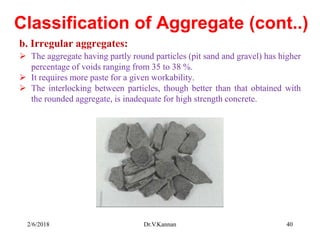
b. Irregular aggregates:
 The aggregate having partly round particles (pit sand and gravel) has higher
percentage of voids ranging from 35 to 38 %.
 It requires more paste for a given workability.
 The interlocking between particles, though better than that obtained with
the rounded aggregate, is inadequate for high strength concrete.
2/6/2018 Dr.V.Kannan 40
Classification of Aggregate (cont..)
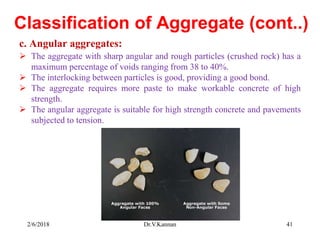
c. Angular aggregates:
 The aggregate with sharp angular and rough particles (crushed rock) has a
maximum percentage of voids ranging from 38 to 40%.
 The interlocking between particles is good, providing a good bond.
 The aggregate requires more paste to make workable concrete of high
strength.
 The angular aggregate is suitable for high strength concrete and pavements
subjected to tension.
2/6/2018 Dr.V.Kannan 41
Classification of Aggregate (cont..)
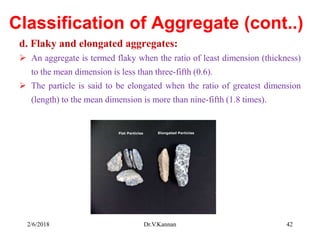
d. Flaky and elongated aggregates:
 An aggregate is termed flaky when the ratio of least dimension (thickness)
to the mean dimension is less than three-fifth (0.6).
 The particle is said to be elongated when the ratio of greatest dimension
(length) to the mean dimension is more than nine-fifth (1.8 times).
2/6/2018 Dr.V.Kannan 42
Classification of Aggregate (cont..)
III. Classification based on unit weight
a. Normal weight aggregates:
 The commonly used aggregates i.e. sand, gravel, crushed rocks such
as granite, basalt, sandstone (sedimentary) and limestone.
 It has specific gravities between 2.5 and 2.7 produce concrete with
unit weight ranging from 23 to 26 kN/m3
 The compressive strength at 28 days between 15 to 40 MPa are
termed Normal weight aggregate.
b. Heavy weight aggregates:
 Heavy weight concrete is produced from heavy weight aggregate,
which is more effective as a radiation shield.
 The unit weight of concrete varies from 30 to 57 kN /m3.
 The specific gravity is varies from 4 – 6.8
 Example: Baryte (Gs = 4 to 4.6), Ferrophosphorus (Gs = 5.8 to 6.8),
Haematite (Gs = 4.9 to 5.3) and Magnetite (Gs= 4.2 to 5.2)
2/6/2018 Dr.V.Kannan 43
Classification of Aggregate (cont..)
c. Light weight aggregates:
 The light weight aggregates have unit weight up to 12 kN /m3.
 These aggregates are obtained from pumice, volcanic cinder, Diatomite,
blast furnace slag, fly ash etc,.
 The weight of concrete (structure) is reduced to a great extent and it
provides better thermal insulation and improved fire resistance.
2/6/2018 Dr.V.Kannan 44
Physical Properties of Aggregates
The physical properties of aggregates are;
1. Shape
2. Size
3. Color
4. Texture
5. Gradation
6. Fineness modulus
2/6/2018 Dr.V.Kannan 45
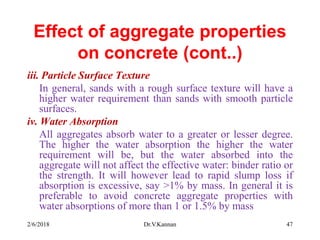
Effect of aggregate properties
on concrete
i. Particle Size, Grading and Dust Content
Well-graded sands tend to have lower water requirements
than single-sized sands and increasing dust contents tend to
increase the water requirement of sands.
ii. Particle Shape
It is fact that sands with well-rounded particles will be less
water and make more workable concrete than sands with flaky,
elongated particles. However, the strength is undesirable.
Aggregate with angular shape, will give moderate water and
high strength to concrete by good interlocking characteristics.
2/6/2018 Dr.V.Kannan 46
Effect of aggregate properties
on concrete (cont..)
iii. Particle Surface Texture
In general, sands with a rough surface texture will have a
higher water requirement than sands with smooth particle
surfaces.
iv. Water Absorption
All aggregates absorb water to a greater or lesser degree.
The higher the water absorption the higher the water
requirement will be, but the water absorbed into the
aggregate will not affect the effective water: binder ratio or
the strength. It will however lead to rapid slump loss if
absorption is excessive, say >1% by mass. In general it is
preferable to avoid concrete aggregate properties with
water absorptions of more than 1 or 1.5% by mass
2/6/2018 Dr.V.Kannan 47
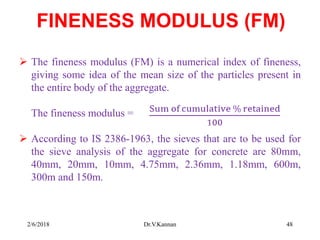
FINENESS MODULUS (FM)
 The fineness modulus (FM) is a numerical index of fineness,
giving some idea of the mean size of the particles present in
the entire body of the aggregate.
The fineness modulus =
 According to IS 2386-1963, the sieves that are to be used for
the sieve analysis of the aggregate for concrete are 80mm,
40mm, 20mm, 10mm, 4.75mm, 2.36mm, 1.18mm, 600m,
300m and 150m.
2/6/2018 Dr.V.Kannan 48
FINENESS MODULUS
(cont..)
 For example, a fineness modulus of 6 can be interpreted to
mean that the sixth sieve, i.e. 4.75 mm is the average size.
 The value of fineness modulus is higher for coarser
aggregate and lower for fine aggregate.
Limitations:
The FM for fine sand = 2 - 3.5
The FM for coarse aggregate = 5.5 - 8
[Note: higher FM, the mix will be harsh and if on the other
hand gives a lower FM, it produces an uneconomical mix]
2/6/2018 Dr.V.Kannan 49
FINENESS MODULUS (cont..)
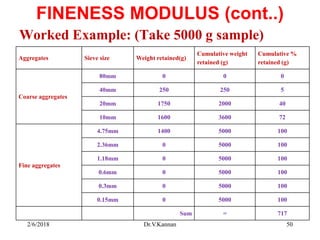
Worked Example: (Take 5000 g sample)
2/6/2018 Dr.V.Kannan 50
Aggregates Sieve size Weight retained(g)
Cumulative weight
retained (g)
Cumulative %
retained (g)
Coarse aggregates
80mm 0 0 0
40mm 250 250 5
20mm 1750 2000 40
10mm 1600 3600 72
Fine aggregates
4.75mm 1400 5000 100
2.36mm 0 5000 100
1.18mm 0 5000 100
0.6mm 0 5000 100
0.3mm 0 5000 100
0.15mm 0 5000 100
Sum = 717
FINENESS MODULUS (cont..)
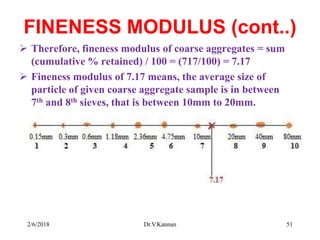
 Therefore, fineness modulus of coarse aggregates = sum
(cumulative % retained) / 100 = (717/100) = 7.17
 Fineness modulus of 7.17 means, the average size of
particle of given coarse aggregate sample is in between
7th and 8th sieves, that is between 10mm to 20mm.
2/6/2018 Dr.V.Kannan 51
Gradation of aggregates
 Gradation refers to the particle size distribution of
aggregates.
 The gradation of coarse aggregate plays an important role
in workability and paste requirements.
 The gradation of fine aggregate affects the workability and
finishing ability of concrete.
Types of gradation:
1. Well graded
2. Poor / Uniform graded
3. Gap graded
2/6/2018 Dr.V.Kannan 52
Gradation of aggregates
(Cont..)
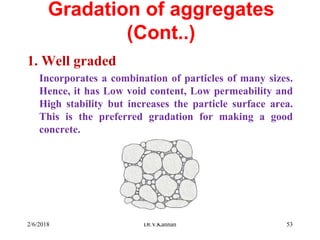
1. Well graded
Incorporates a combination of particles of many sizes.
Hence, it has Low void content, Low permeability and
High stability but increases the particle surface area.
This is the preferred gradation for making a good
concrete.
2/6/2018 Dr.V.Kannan 53
Gradation of aggregates
(Cont..)
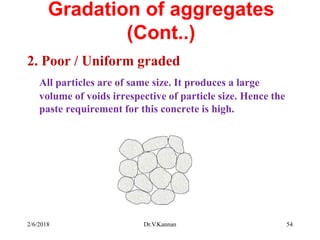
2. Poor / Uniform graded
All particles are of same size. It produces a large
volume of voids irrespective of particle size. Hence the
paste requirement for this concrete is high.
2/6/2018 Dr.V.Kannan 54
Gradation of aggregates
(Cont..)
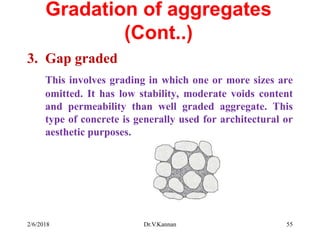
3. Gap graded
This involves grading in which one or more sizes are
omitted. It has low stability, moderate voids content
and permeability than well graded aggregate. This
type of concrete is generally used for architectural or
aesthetic purposes.
2/6/2018 Dr.V.Kannan 55
Mechanical Properties of
Aggregate
1. Crushing strength
2. Impact strength
3. Abrasion strength
2/6/2018 Dr.V.Kannan 56
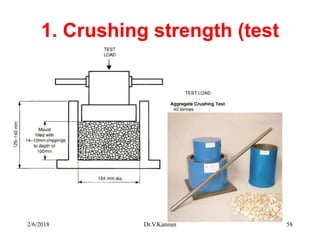
1. Crushing strength (IS2386-Part-4)
• It is the mechanical properties of aggregates
• Ascertained by aggregate crushing value
• It gives a relative measure of the resistance of an aggregate to
crushing under a gradually applied compressive load
• For this test, 12.5 mm passed and 10 mm retained aggregates
are used
• Surface dry condition aggregates are filled into the standard
cylinder with three layer of 25 blows
• Compressive force is gradually applied up to 40 tons in 10
minutes time
• The crushed aggregates are sieved in 2.36 mm sieve
Then aggregate crushing value = B/A x 100
where, A- Weight of sample and B- weight of retained aggregate in 2.36
mm sieve.
[Crushing value should not higher than 45%]
2/6/2018 Dr.V.Kannan 57
1. Crushing strength (test
sut up)
2/6/2018 Dr.V.Kannan 58
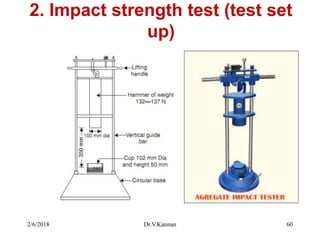
2. Impact strength test
• It is the another mechanical properties of aggregates
• Ascertained by aggregate impact value
• It gives a relative measure of the resistance of an aggregate to
sudden shock or impact
• For this test, 12.5 mm passed and 10 mm retained aggregates are
used
• Surface dry condition aggregates are filled into the test cylinder with
three layer of 25 blows
• Filled cylinder is placed in impact testing machine
• Then, 15 blows are given to the cylinder using 14 kg weight
hammer.
• The crushed aggregates are sieved in 2.36 mm sieve
Then aggregate impact value = B/A x 100
where, A- Weight of sample and B- weight of retained aggregate in
2.36 mm sieve.
[Crushing value should not higher than 45%]
2/6/2018 Dr.V.Kannan 59
2. Impact strength test (test set
up)
2/6/2018 Dr.V.Kannan 60
3. Abrasion test (Los angeles test)
• Select the grading to be used in the test such that it conforms
to the grading to be used in construction
• Choose the abrasive charge balls depending on grading of
aggregates.
• Place the aggregates and abrasive charge on the cylinder and
fix the cover.
• Rotate the machine at a speed of 30 to 33 revolutions per
minute with uniform speed.
• The machine is stopped after the desired number of revolutions
and material is discharged to a tray.
• The entire stone dust is sieved on 1.70 mm IS sieve.
• The material coarser than 1.7mm size is weighed correct to
one gram
2/6/2018 Dr.V.Kannan 61
3.Abrasion test (Los angeles test)
Abrasion Value = (W1 – W2 ) / W1 X 100
Where,
Original weight of aggregate sample = W1 g
Weight of aggregate sample retained = W2 g
Weight passing 1.7mm IS sieve = W1 – W2 g
[Note: Abrasion value should not more than 16%]
2/6/2018 Dr.V.Kannan 62
3. Abrasion test (Devals test)
• Select the grading to be used in the test such that it
conforms to the grading to be used in construction
• Choose the abrasive charge balls depending on grading
of aggregates.
• Place the aggregates and abrasive charge on the devals
cylinder and fix the cover.
• Rotate the machine at a speed of 30 to 33 revolutions
per minute with uniform speed up to 10,000 revolutions
and then stopped.
• The entire stone dust is sieved on 1.70 mm IS sieve.
• The material coarser than 1.7mm size is weighed
correct to one gram
2/6/2018 Dr.V.Kannan 63
3. Abrasion test (Devals test)
Devals abrasion Value = (W1 – W2 ) / W1 X 100
Where,
Original weight of aggregate sample = W1 g
Weight of aggregate sample retained = W2 g
Weight passing 1.7mm IS sieve = W1 – W2 g
[Note: Abrasion value should not more than 16%]
2/6/2018 Dr.V.Kannan 64
Water for concrete
• Water is the most important material for construction,
especially for making concrete.
The purpose of water in concrete are
• It distributes the cement evenly.
• It reacts with cement chemically and produces calcium
silicate hydrate (C-S-H) gel which gives the strength to
concrete.
• It provides for workability, i.e., it lubricates the mix.
Hence, for construction, quantity and quality of water is as
important as cement.
2/6/2018 Dr.V.Kannan 65
Water for concrete (Cont..)
As water quantity goes up in a mix (ill effect), the following
are the effects:
• Strength decreases
• Durability decreases
• Workability increases
• Cohesion decreases
• Economy may increase at the expense of quality and
reliability.
2/6/2018 Dr.V.Kannan 66
Quality of water for concrete
(IS10500:2012)
• Water used for mixing and curing should be free from oil,
acid and alkali, salts and organic material.
• It should be potable and concreting generally requires a
value purer than that of drinking
• Whenever there is uncertainty in quality, water should be
tested before use.
• Even chlorine added for city water supply will affect
concrete if used carelessly without proper testing and
treatment.
• If well water is used for construction, it must be tested for
impurities.
2/6/2018 Dr.V.Kannan 67
Quality of water for concrete
(cont.)
• Chlorides: They can cause corrosion of steel
reinforcement, can accelerate setting. The water used
may be contaminated with chlorides because of
seawater, some admixtures, salts or deliberate
chlorination for disinfections.
• Sulphates: They reduce long-term strength levels.
• Organic matter: Their effects on concrete are variable.
If an alga is present, water should not be used. It will
affect the setting and strength development.
• Sugar: It will retard setting time. Too much may ‘kill'
the concrete (the concrete will never set).
• Wastewater: It should never be used in construction.
Water for curing should be as pure as water for mixing
concrete.
2/6/2018 Dr.V.Kannan 68
THANK YOU
2/6/2018 Dr.V.Kannan 69

Constituent materials

  • 1.
    CE6002 CONCRETE TECHNOLOGY Module 1 CONSTITUENTMATERIALS OF CONCRETE 2/6/2018 1Dr.V.Kannan
  • 2.
    CEMENT Cement is mineralpowder or substance, which are obtained by raw materials such as clay (Argillaceous) and lime (Calcareous). It is used to bind other materials like aggregates in concrete. Cement is also known as Ordinary Portland cement (OPC) or Hydraulic cement Active materials: Cement and water Inactive materials: Fine and coarse aggregate Coarse aggregate Mortar (Fine aggregate +Cement) A concrete 2/6/2018 2Dr.V.Kannan
  • 3.
    CEMENT MANUFACTURING PROCESS Manufacturingof cement is the process of making cement from raw materials such as calcareous materials (Lime) and Argillaceous materials (Clay). There are three main operations involved in the manufacture of ordinary Portland cement. a) Mixing of Raw Material b) Burning c) Grinding d) Storage, transporting and dispatch 2/6/2018 3Dr.V.Kannan
  • 4.
    CEMENT MANUFACTURING PROCESS(cont.) a) Mixing of Raw Material:  In this stage both raw materials are finely ground and mixed thoroughly in wet or dry process  In Wet process both raw materials are washed and stored separately. Then mixed in wet state  In the dry mix process, both materials are stored separately in dry state. b) Burning: The raw mix is preheated before it goes into the kiln, which is heated by a flame that can be as hot as 2000 °C. The raw mix burns at 1500 °C producing clinker which, when it leaves the kiln, is rapidly cooled with air fans. So, the raw mix is burnt to produce clinker : the basic material needed to make cement. 2/6/2018 4Dr.V.Kannan
  • 5.
    CEMENT MANUFACTURING PROCESS(cont.) c) GRINDING The clinker and the gypsum are very finely ground giving a “pure cement”. Other secondary additives and cementitious materials can also be added to make a blended cement. d) STORAGE, PACKING, DISPATCH The cement is stored in silos before being dispatched either in bulk or in bags to its final destination. 2/6/2018 5Dr.V.Kannan
  • 6.
    Chemical Composition During theburning process, the raw materials fused together and gives more complex chemical compositions as follows; 2/6/2018 Dr.V.Kannan 6 Oxide Percent content CaO 60-67 SiO2 17-25 Al2O3 3.0-8.0 Fe2O3 0.5-6.0 MgO 0.1-4.0 Alkalies (k2O, Na2O) 0.4-1.3 SO3 1.3-3.0
  • 7.
    Chemical Composition Functions ofcement ingredient: (8marks) Lime / Calcium oxide (Ca O): Controls strength and soundness. If it is reduced in quantity, the strength and setting time will be decreased. Silica (SiO2): Gives strength due to the formation of di-calcium and tri-calcium (C2S and C3S ) silicates. If it is excess, causing slow setting. Alumina (Al2 O3): Responsible for quick setting. It act as a flux and lowers the clinkering temperature. If it is in excess, it lower the strength. Iron oxide (Fe2 O3): Gives color and help in fusion of different ingredient of cement. Magnesia (MgO): Gives color and hardness. If it is in excess, causes cracks and cement unsound. 2/6/2018 Dr.V.Kannan 7
  • 8.
    Chemical Composition (Cont..) Alkalies (K2O,Na2O): If it is in excess, causes alkali-aggregate reactions, efflorescence and discoloring. [Note: alkali-aggregate reactions: aggregates having silica, it react with alkali’s and causes the expansion and cracking in concrete] Sulphur (SO3): A small amount is used to make sound cement. If it is in increase, causes unsound in cement. **[Soundness of cement: It refers to the ability of a hardened cement paste to retain its volume after setting without delayed destructive expansion. ] 2/6/2018 Dr.V.Kannan 8
  • 9.
    Chemical Composition (Cont..)Major compoundsin cement: (8marks) When water is added to the cement, the major compounds are developed. The identification of the major compounds are based on R.H.Bogue’s research work, hence it is called Bogue’s compounds. a) Tri Calcium Silicate (C3S) - 3CaO SiO2 b) Di Calcium Silicate (C2S) - 2CaO SiO2 c) Tri Calcium Aluminates (C3A) - 3CaO, Al2 O3 d) Tetra-Calcium Alumino Ferrite (C4AF) - 4CaO Al2O3 Fe2 O3 *C3S is formed with in a week, responsible for initial strength of concrete and contribute 50-60% of strength. * C2S is formed at last in the hydration process, responsible for later age strength [needed for bridge / hydraulic structures] *C3A is formed within 24 hours, responsible for initial setting time *C4AF is also formed within 24 hours, responsible for heat of hydration 2/6/2018 Dr.V.Kannan 9
  • 10.
    Hydration of cement When water is added to cement, ingredients of the cement react chemically with water and form various complicated chemical compounds, this is called hydration of cement.  During hydration process, cement produces calcium hydrate silicate (C-H-S) and calcium hydrate aluminate (C-H-A). These products are thick and sticky and it is called C-H-S / C-H-A gel. This gel has adhesion properties and bind the aggregates together, also fill the voids between sand and coarse aggregates.  The hydration process is not an instantaneous one. The reaction is faster in earlier age and slower in later age. Complete hydration process can not obtain before one year (99% of concrete strength can be obtained only at one year. Heat of hydration: (2 marks) The reaction of cement with water is exothermic. The reaction liberates a considerable amount of heat is called heat of hydration. 2/6/2018 Dr.V.Kannan 10
  • 11.
    TYPES OF CEMENT Byaltering the chemical compositions of the ordinary Portland cement (OPC), many types of cement can be obtained as follows; 1. Ordinary Portland cement (OPC) 2. Sulphate resistance cement 3. Low heat cement 4. Quick setting cement 5. Portland pozzolana cement (PPC) 6. High alumina cement 7. Colored cement 8. White cement 9. Air entraining cement 10. Hydrophobic cement 11. Expansion cement 12. Rapid hardening Portland cement 2/6/2018 11Dr.V.Kannan
  • 12.
    TYPES OF CEMENT 1.Ordinary Portland cement: This is the most commonly used cement for all types of engineering works. Ordinary Portland cement (OPC) is manufactured in different grades; the most common grades in India are 33, 43 and 53 grade. OPC is manufactured by burning lime stone and clay at very high temperature range of 1400o C to1700oC and thereafter grinding (or) pulverizing it with gypsum to retard the setting time. Uses / Advantages: a) Normally used for all kind of construction works b) Widely used in residential construction where special type of cement properties is not required 2/6/2018 12Dr.V.Kannan
  • 13.
    TYPES OF CEMENT 2.Sulphate resistance cement ( Sulphate resisting cement is a type of Portland cement in which the amount of tri-calcium aluminates (C3A) is restricted to 5 %. The use of sulphate resistance cement is particularly beneficial in such conditions where the concrete is exposed to the risk of deterioration due to sulphate attack or directly exposure to the soil. Uses / Advantages: a) It is used in the construction of foundations and piles. b) Basements and underground structures. c) Sewage and Water treatment plants. d) Chemical, Fertilizers and Sugar factories. e) Food processing industries and Petrochemical projects. f) Coastal works. g) Also for normal construction works where OPC is used. h) Construction of building along the coastal area within 50 km from sea. 2/6/2018 13Dr.V.Kannan
  • 14.
    TYPES OF CEMENT 3.Low heat cement Low heat cement is produced by reducing the amount of tri-calcium aluminates (C3A) & di-calcium silicate (C2S). This type of cement is used in mass constructions (like dams) and in high wear resistance required area. In general, this type of cement is producing very minimum amount of CO2 emission than OPC. Uses / Advantages: a) It is very much used in the mass Construction of dams, b) Mass construction of marine structures c) Hydraulic Engineering Concrete d) Retaining wall construction 2/6/2018 14Dr.V.Kannan
  • 15.
    TYPES OF CEMENT 4.Quick setting cement This type of cement is manufactured by reducing the amount of gypsum and adding small amount of aluminum sulphate to accelerate setting time of cement. As the name suggests, it is used where the works needs to be done quickly and when mixed with water starts to set in five minutes and become hard like stone in just 30 minutes. Uses / Advantages: a) It is used in under water construction. b) It is also used in rainy & cold weather conditions. c) Where, quick strength is needed in short span of time. 2/6/2018 15Dr.V.Kannan
  • 16.
    TYPES OF CEMENT 5.Portland pozzolana cement (PPC) PPC is manufactured by adding pozzolanic materials such as fly ash, shales, clays etc. It gains high compressive strength with age and it is affordable than other type of concrete. Uses / Advantages: a) Used in the hydraulic structures such as dam, canals, lining etc. b) Mass concreting works such as foundation, tall building etc. c) Construction of marine structures. d) This cement has higher resistance to chemical attacks. Hence it can be used in construction of industrial buildings e) Used in the construction of water tightened structures (Water tank, retaining wall etc.) 2/6/2018 16Dr.V.Kannan
  • 17.
    TYPES OF CEMENT 6.High alumina cement High-alumina cement is rapid hardening cement made by fusing at 1500 to 1600 °C a mixture of bauxite and limestone in an electric furnace or in a rotary kiln. It also can be made by sintering at about 1250 °C. [*Sintering: Process of compacting and forming a solid mass of material by heat or pressure without melting it to the point of liquification] Uses / Advantages: a) This cement is used in construction of refineries, factory or other workshop type structure b) Used in Sewage structures c) Used where acid resistance structures are needed 2/6/2018 17Dr.V.Kannan
  • 18.
    TYPES OF CEMENT 7.Colored cement Colored cement is manufactured by mixing color pigments (5 - 10%) with OPC. As the name suggests, It is used where colored cements required for any aesthetic purpose. Chromium Oxide gives Green color. Cobalt gives blue color. Iron oxide gives brown color. Uses / Advantages: a) These are wildly used for finishing of floor, external surface, plastering wall, colored tiles. b) Used in construction of swimming pool, garden path, tennis courts etc. c) Used in the construction of artificial marble 2/6/2018 18Dr.V.Kannan
  • 19.
    TYPES OF CEMENT 8.White cement This cement is white in color. This cement is free from coloring ingredients such as iron oxide, magnesium oxide, chromium oxide. This cement in burned by oil, and is very costlier than other type of cements. Uses / Advantages: a) It is used for floor finishes, plaster works, pointing of brick and stone works b) Used in the manufacturing of precast stone and tiles, aerodromes marking, traffic kerb and bridge rails. c) Used as a base coat before painting d) Used to cover the hairline cracks on concrete surface to give smooth finish 2/6/2018 19Dr.V.Kannan
  • 20.
    TYPES OF CEMENT 9.Air entrained cement Air entraining cement produced by mixing small amount of air entraining agent (Polymer based chemicals). Generally, this air entraining agents are used to introduce a tiny bubbles in the concrete. It is used to fill up the gap in concrete which are produced by excessive amount of water during casting. Uses / Advantages: a) Used in frost resistance concrete (resistance to freezing and thawing) b) Air entrained concrete has less tendency to bleed, it is considerably more plastic than ordinary concrete, and it generally shows less segregation. 2/6/2018 20Dr.V.Kannan
  • 21.
    TYPES OF CEMENT 10.Hydrophobic cement This type of cement is manufactured by mixing admixtures like petrolatum, napthalene soap which forms layer and act as water repellent. It is useful in wet climatic conditions and Useful when cement is stored for longer duration in wet climatic conditions. 11. Expansion cement Expansive Cement is formed from the reaction of tri calcium aluminate (C3A) with Calcium Sulphate (C2SO4). As the name suggests, it expands and increases in volume while settled. Used to avoid the shrinkage of concrete. Uses / Advantages: a) Used in repair works (to create a bond with old concrete surface) b) Used in Hydraulic Structures 2/6/2018 21Dr.V.Kannan
  • 22.
    TYPES OF CEMENT 12.Rapid hardening Portland cement (RHPC) RHPC manufactured by combining lime stone (finely ground) and shale at high temperature. This type of cement is used where high strength is needed to be achieved quickly. Uses / Advantages: a) It is used where formwork has to be removed as early as possible in order to reuse it. b) It is used where high early strength is required. c) It is generally used for constructing road pavements, where it is important to open the road to traffic quickly. d) It is used in industries which manufacture concrete products like slabs, posts, electric poles, block fence, etc. e) It is used for cold weather concreting [The main disadvantage of the rapid hardening cement is costlier than other type of cement] 2/6/2018 22Dr.V.Kannan
  • 23.
    Grade of Cement TheBureau of Indian Standard (BIS) has classified ordinary Portland cement (OPC) in three different grades. The classification is mainly based on the compressive strength of cement -sand mortar cube at 28 days. The Grades are a) 33 Grade cement b) 43 Grade cement c) 53 Grade cement The Grade number (33, 43 and 53) indicates the minimum compressive strength of cement sand mortar cube in N/mm2 at 28 days. 2/6/2018 Dr.V.Kannan 23
  • 24.
    Physical and chemicalproperties of 33, 43 and 53 grade of cement / concrete Physical properties Grade of cement 33 43 53 Minimum compressive strength at 28 days (N/mm2) 33 43 53 Fineness-minimum specific surface area (m2/kg) 225 225 225 Initial setting time (minimum) 30 min. 30 min. 30 min. Final setting time (maximum) 600 min. 600 min. 600 min. Soundness (expansion) in mm 10 10 10 Autoclave test for MgO, percent, maximum 0.8 0.8 0.8 Chemical Properties Loss on ignition (%) 5 5 4 Insoluble residue (%), maximum 4 2 2 Magnesia MgO (%), maximum 6 6 6 SO3 (%) , maximum for C3A>5 percent 2.5 2.5 2.5 Lime saturation factor (LSF) 0.66-1.02 0.66-1.02 0.8-1.02 Ratio, AF, minimum 0.66 0.66 0.662/6/2018 Dr.V.Kannan 24
  • 25.
    GENERAL PROPERTIES OFCEMENT a) It is an excellent binding material. b) It gives strength to masonry. c) It gives good plasticity. d) It gives a good resistance to moisture. e) It is easily workable. Hence less workmanship is needed f) It hardens quickly after addition of water. g) It gives good bonding property to the concrete. 2/6/2018 Dr.V.Kannan 25
  • 26.
    TEST ON CEMENT Inorder to check the quality of cement the following tests may be used; Testing of cement can be brought under two categories: 1. Field testing 2. Laboratory Testing 2/6/2018 Dr.V.Kannan 26
  • 27.
    Field testing a) Inthe cement bag, there should not be any visible lumps and the color should be greenish grey. a) Thrust your hand into the cement bag. It must give you a cool feeling. b) Take a pinch of cement and feel between the fingers. It should give a smooth and not a gritty feeling. c) Take a handful of cement and throw it on a bucket full of water, the particles should float for some time before they sink. d) Take about 100 grams of cement and a small quantity of water and make a stiff paste. Put it on a glass plate and slowly take it under water in a bucket. After 24 hours the paste should retain its original shape 2/6/2018 Dr.V.Kannan 27
  • 28.
    Laboratory testing The followingtests are conducted in the laboratory: 1. Fineness test 2. Soundness test 3. Setting time test 4. Strength test 2/6/2018 Dr.V.Kannan 28
  • 29.
    1. Fineness test Thefineness of cement has an important properties of cement and is responsible to a) The rate of hydration b) Rate of gain of strength c) Rate of evolution of heat The fineness of cement can be obtained by sieve test; Sieve test:  To determine fineness of cement and particle size of cement.  Sample size – 100gms; sieving period – 15 minutes.  The standard sieve size used is 90 m.  The % residual (retained) of cement on 90 m sieve shall not exceed 10%. 2/6/2018 Dr.V.Kannan 29
  • 30.
    1. Fineness test(cont….) 2/6/2018 Dr.V.Kannan 30 Sieve used for determining Fineness of Cement
  • 31.
    2.Soundness test DETERMINATION OFSOUNDNESS Lechatelier Test IS 4031 (Part 3 ) – 1988  To determine the soundness or unsoundness of cement due to presence of free lime only.  The expansion of cement paste specimen in Lechatelier mould shall not exceed 10mm. 2/6/2018 Dr.V.Kannan 31
  • 32.
    3. Setting timetest Initial setting time test (Vicat Apparatus) IS : 4031 (Part 5) – 1988 (Reaffirmed 2000)  To determine the time required by cement paste to loss its plasticity.  The Vicat apparatus is used to determine initial setting time of cement where the penetration of the needle in the cement paste kept in Vicat mould (40 mm height) shall be in a range of 33 to 35 mm from the top.  It shall not be less than 30minutes(≥30min) for normal cement, 60 minutes for low heat cement and 5 minutes for rapid hardening cement. 2/6/2018 Dr.V.Kannan 32
  • 33.
    3. Setting timetest (cont…) Final setting time of cement (Vicat Apparatus)  The time required by cement paste to gain the proper shape and becoming hard considering from the instant of adding water is called final setting time.  i.e., the time elapsing from the instant of adding water to the cement and the instant when paste becomes hard (solid) is known as final setting time which is determined by Vicat apparatus where the enlarge needle should not penetrate the specimen of cement.  Final setting time shall not exceed 10hrs for normal cement, 30 minutes for rapid hardening cement. 2/6/2018 Dr.V.Kannan 33
  • 34.
    3. Setting timetest (cont…) 2/6/2018 Dr.V.Kannan 34
  • 35.
    4. Strength test CompressiveStrength Test (IS : 4031(Part 6):1988)  To determine compressive strength of cement where the specimen is made up of 1:3 (cement : sand) proportion i.e. 185 gm cement and 555gm sand or 200gm cement and 600gm sand.  The specimen is tested under compression machine at an age of 1 day, 3, 7 and 28 days.  The compressive strength of rapid hardening cement at 1 day curing shall not be less than 16 MPa and at an age of 3 days it shall not be less than 27.5 MPa. 2/6/2018 Dr.V.Kannan 35
  • 36.
    Effect of Water/ cement ratio on strength of concrete • The water–cement ratio is the ratio of the weight of water to the weight of cement used in a concrete mix. • A lower ratio leads to higher strength and durability, but may make the mix difficult to work with and form. • Workability can be resolved with the use of super plasticizer. • Higher workability leads the segregation and bleeding 2/6/2018 Dr.V.Kannan 36
  • 37.
    Aggregate  The aggregateis a relatively inert material and it imparts volume stability.  The aggregate provide about 75% of the body of the concrete and hence its influence is extremely important.  An aggregate should be of proper shape and size, clean, hard and well graded.  It must possess chemical stability and it must exhibit abrasion resistance. 2/6/2018 Dr.V.Kannan 37
  • 38.
    Classification of Aggregate I.Classification Based on Size a. Fine aggregates: It is the aggregate, which is passes through a 4.75mm IS sieve and retained on 0.7 mm. The fine aggregate may be natural sand, crushed stone sand or crushed gravel sand. According to IS 383-1970, there are four grading zones of the fine sand, Zone I, Zone II, Zone III and Zone IV. b. Coarse aggregates: The aggregates, most of which are retained on 4.75mm IS sieve are termed as coarse aggregates. The coarse aggregates may be Crushed stone, Uncrushed gravel and Partially crushed stone or gravel. [*Sometimes combined aggregates are available in nature consisting of different fractions of fine and coarse aggregates, which are known as all in aggregate.] 2/6/2018 Dr.V.Kannan 38
  • 39.
    Classification of Aggregate II.Classification Based on Shape a. Rounded aggregate:  The aggregate with rounded particles (river or sea shore gravel) has minimum voids ranging from 32 to 33%.  It gives minimum ratio of surface area to the volume, thus requiring minimum cement paste to make good concrete.  The only disadvantage is that the interlocking between its particles is less, and hence the development of the bond is poor, making it unsuitable for high strength concrete and pavement. 2/6/2018 Dr.V.Kannan 39
  • 40.
    Classification of Aggregate(cont..) b. Irregular aggregates:  The aggregate having partly round particles (pit sand and gravel) has higher percentage of voids ranging from 35 to 38 %.  It requires more paste for a given workability.  The interlocking between particles, though better than that obtained with the rounded aggregate, is inadequate for high strength concrete. 2/6/2018 Dr.V.Kannan 40
  • 41.
    Classification of Aggregate(cont..) c. Angular aggregates:  The aggregate with sharp angular and rough particles (crushed rock) has a maximum percentage of voids ranging from 38 to 40%.  The interlocking between particles is good, providing a good bond.  The aggregate requires more paste to make workable concrete of high strength.  The angular aggregate is suitable for high strength concrete and pavements subjected to tension. 2/6/2018 Dr.V.Kannan 41
  • 42.
    Classification of Aggregate(cont..) d. Flaky and elongated aggregates:  An aggregate is termed flaky when the ratio of least dimension (thickness) to the mean dimension is less than three-fifth (0.6).  The particle is said to be elongated when the ratio of greatest dimension (length) to the mean dimension is more than nine-fifth (1.8 times). 2/6/2018 Dr.V.Kannan 42
  • 43.
    Classification of Aggregate(cont..) III. Classification based on unit weight a. Normal weight aggregates:  The commonly used aggregates i.e. sand, gravel, crushed rocks such as granite, basalt, sandstone (sedimentary) and limestone.  It has specific gravities between 2.5 and 2.7 produce concrete with unit weight ranging from 23 to 26 kN/m3  The compressive strength at 28 days between 15 to 40 MPa are termed Normal weight aggregate. b. Heavy weight aggregates:  Heavy weight concrete is produced from heavy weight aggregate, which is more effective as a radiation shield.  The unit weight of concrete varies from 30 to 57 kN /m3.  The specific gravity is varies from 4 – 6.8  Example: Baryte (Gs = 4 to 4.6), Ferrophosphorus (Gs = 5.8 to 6.8), Haematite (Gs = 4.9 to 5.3) and Magnetite (Gs= 4.2 to 5.2) 2/6/2018 Dr.V.Kannan 43
  • 44.
    Classification of Aggregate(cont..) c. Light weight aggregates:  The light weight aggregates have unit weight up to 12 kN /m3.  These aggregates are obtained from pumice, volcanic cinder, Diatomite, blast furnace slag, fly ash etc,.  The weight of concrete (structure) is reduced to a great extent and it provides better thermal insulation and improved fire resistance. 2/6/2018 Dr.V.Kannan 44
  • 45.
    Physical Properties ofAggregates The physical properties of aggregates are; 1. Shape 2. Size 3. Color 4. Texture 5. Gradation 6. Fineness modulus 2/6/2018 Dr.V.Kannan 45
  • 46.
    Effect of aggregateproperties on concrete i. Particle Size, Grading and Dust Content Well-graded sands tend to have lower water requirements than single-sized sands and increasing dust contents tend to increase the water requirement of sands. ii. Particle Shape It is fact that sands with well-rounded particles will be less water and make more workable concrete than sands with flaky, elongated particles. However, the strength is undesirable. Aggregate with angular shape, will give moderate water and high strength to concrete by good interlocking characteristics. 2/6/2018 Dr.V.Kannan 46
  • 47.
    Effect of aggregateproperties on concrete (cont..) iii. Particle Surface Texture In general, sands with a rough surface texture will have a higher water requirement than sands with smooth particle surfaces. iv. Water Absorption All aggregates absorb water to a greater or lesser degree. The higher the water absorption the higher the water requirement will be, but the water absorbed into the aggregate will not affect the effective water: binder ratio or the strength. It will however lead to rapid slump loss if absorption is excessive, say >1% by mass. In general it is preferable to avoid concrete aggregate properties with water absorptions of more than 1 or 1.5% by mass 2/6/2018 Dr.V.Kannan 47
  • 48.
    FINENESS MODULUS (FM) The fineness modulus (FM) is a numerical index of fineness, giving some idea of the mean size of the particles present in the entire body of the aggregate. The fineness modulus =  According to IS 2386-1963, the sieves that are to be used for the sieve analysis of the aggregate for concrete are 80mm, 40mm, 20mm, 10mm, 4.75mm, 2.36mm, 1.18mm, 600m, 300m and 150m. 2/6/2018 Dr.V.Kannan 48
  • 49.
    FINENESS MODULUS (cont..)  Forexample, a fineness modulus of 6 can be interpreted to mean that the sixth sieve, i.e. 4.75 mm is the average size.  The value of fineness modulus is higher for coarser aggregate and lower for fine aggregate. Limitations: The FM for fine sand = 2 - 3.5 The FM for coarse aggregate = 5.5 - 8 [Note: higher FM, the mix will be harsh and if on the other hand gives a lower FM, it produces an uneconomical mix] 2/6/2018 Dr.V.Kannan 49
  • 50.
    FINENESS MODULUS (cont..) WorkedExample: (Take 5000 g sample) 2/6/2018 Dr.V.Kannan 50 Aggregates Sieve size Weight retained(g) Cumulative weight retained (g) Cumulative % retained (g) Coarse aggregates 80mm 0 0 0 40mm 250 250 5 20mm 1750 2000 40 10mm 1600 3600 72 Fine aggregates 4.75mm 1400 5000 100 2.36mm 0 5000 100 1.18mm 0 5000 100 0.6mm 0 5000 100 0.3mm 0 5000 100 0.15mm 0 5000 100 Sum = 717
  • 51.
    FINENESS MODULUS (cont..) Therefore, fineness modulus of coarse aggregates = sum (cumulative % retained) / 100 = (717/100) = 7.17  Fineness modulus of 7.17 means, the average size of particle of given coarse aggregate sample is in between 7th and 8th sieves, that is between 10mm to 20mm. 2/6/2018 Dr.V.Kannan 51
  • 52.
    Gradation of aggregates Gradation refers to the particle size distribution of aggregates.  The gradation of coarse aggregate plays an important role in workability and paste requirements.  The gradation of fine aggregate affects the workability and finishing ability of concrete. Types of gradation: 1. Well graded 2. Poor / Uniform graded 3. Gap graded 2/6/2018 Dr.V.Kannan 52
  • 53.
    Gradation of aggregates (Cont..) 1.Well graded Incorporates a combination of particles of many sizes. Hence, it has Low void content, Low permeability and High stability but increases the particle surface area. This is the preferred gradation for making a good concrete. 2/6/2018 Dr.V.Kannan 53
  • 54.
    Gradation of aggregates (Cont..) 2.Poor / Uniform graded All particles are of same size. It produces a large volume of voids irrespective of particle size. Hence the paste requirement for this concrete is high. 2/6/2018 Dr.V.Kannan 54
  • 55.
    Gradation of aggregates (Cont..) 3.Gap graded This involves grading in which one or more sizes are omitted. It has low stability, moderate voids content and permeability than well graded aggregate. This type of concrete is generally used for architectural or aesthetic purposes. 2/6/2018 Dr.V.Kannan 55
  • 56.
    Mechanical Properties of Aggregate 1.Crushing strength 2. Impact strength 3. Abrasion strength 2/6/2018 Dr.V.Kannan 56
  • 57.
    1. Crushing strength(IS2386-Part-4) • It is the mechanical properties of aggregates • Ascertained by aggregate crushing value • It gives a relative measure of the resistance of an aggregate to crushing under a gradually applied compressive load • For this test, 12.5 mm passed and 10 mm retained aggregates are used • Surface dry condition aggregates are filled into the standard cylinder with three layer of 25 blows • Compressive force is gradually applied up to 40 tons in 10 minutes time • The crushed aggregates are sieved in 2.36 mm sieve Then aggregate crushing value = B/A x 100 where, A- Weight of sample and B- weight of retained aggregate in 2.36 mm sieve. [Crushing value should not higher than 45%] 2/6/2018 Dr.V.Kannan 57
  • 58.
    1. Crushing strength(test sut up) 2/6/2018 Dr.V.Kannan 58
  • 59.
    2. Impact strengthtest • It is the another mechanical properties of aggregates • Ascertained by aggregate impact value • It gives a relative measure of the resistance of an aggregate to sudden shock or impact • For this test, 12.5 mm passed and 10 mm retained aggregates are used • Surface dry condition aggregates are filled into the test cylinder with three layer of 25 blows • Filled cylinder is placed in impact testing machine • Then, 15 blows are given to the cylinder using 14 kg weight hammer. • The crushed aggregates are sieved in 2.36 mm sieve Then aggregate impact value = B/A x 100 where, A- Weight of sample and B- weight of retained aggregate in 2.36 mm sieve. [Crushing value should not higher than 45%] 2/6/2018 Dr.V.Kannan 59
  • 60.
    2. Impact strengthtest (test set up) 2/6/2018 Dr.V.Kannan 60
  • 61.
    3. Abrasion test(Los angeles test) • Select the grading to be used in the test such that it conforms to the grading to be used in construction • Choose the abrasive charge balls depending on grading of aggregates. • Place the aggregates and abrasive charge on the cylinder and fix the cover. • Rotate the machine at a speed of 30 to 33 revolutions per minute with uniform speed. • The machine is stopped after the desired number of revolutions and material is discharged to a tray. • The entire stone dust is sieved on 1.70 mm IS sieve. • The material coarser than 1.7mm size is weighed correct to one gram 2/6/2018 Dr.V.Kannan 61
  • 62.
    3.Abrasion test (Losangeles test) Abrasion Value = (W1 – W2 ) / W1 X 100 Where, Original weight of aggregate sample = W1 g Weight of aggregate sample retained = W2 g Weight passing 1.7mm IS sieve = W1 – W2 g [Note: Abrasion value should not more than 16%] 2/6/2018 Dr.V.Kannan 62
  • 63.
    3. Abrasion test(Devals test) • Select the grading to be used in the test such that it conforms to the grading to be used in construction • Choose the abrasive charge balls depending on grading of aggregates. • Place the aggregates and abrasive charge on the devals cylinder and fix the cover. • Rotate the machine at a speed of 30 to 33 revolutions per minute with uniform speed up to 10,000 revolutions and then stopped. • The entire stone dust is sieved on 1.70 mm IS sieve. • The material coarser than 1.7mm size is weighed correct to one gram 2/6/2018 Dr.V.Kannan 63
  • 64.
    3. Abrasion test(Devals test) Devals abrasion Value = (W1 – W2 ) / W1 X 100 Where, Original weight of aggregate sample = W1 g Weight of aggregate sample retained = W2 g Weight passing 1.7mm IS sieve = W1 – W2 g [Note: Abrasion value should not more than 16%] 2/6/2018 Dr.V.Kannan 64
  • 65.
    Water for concrete •Water is the most important material for construction, especially for making concrete. The purpose of water in concrete are • It distributes the cement evenly. • It reacts with cement chemically and produces calcium silicate hydrate (C-S-H) gel which gives the strength to concrete. • It provides for workability, i.e., it lubricates the mix. Hence, for construction, quantity and quality of water is as important as cement. 2/6/2018 Dr.V.Kannan 65
  • 66.
    Water for concrete(Cont..) As water quantity goes up in a mix (ill effect), the following are the effects: • Strength decreases • Durability decreases • Workability increases • Cohesion decreases • Economy may increase at the expense of quality and reliability. 2/6/2018 Dr.V.Kannan 66
  • 67.
    Quality of waterfor concrete (IS10500:2012) • Water used for mixing and curing should be free from oil, acid and alkali, salts and organic material. • It should be potable and concreting generally requires a value purer than that of drinking • Whenever there is uncertainty in quality, water should be tested before use. • Even chlorine added for city water supply will affect concrete if used carelessly without proper testing and treatment. • If well water is used for construction, it must be tested for impurities. 2/6/2018 Dr.V.Kannan 67
  • 68.
    Quality of waterfor concrete (cont.) • Chlorides: They can cause corrosion of steel reinforcement, can accelerate setting. The water used may be contaminated with chlorides because of seawater, some admixtures, salts or deliberate chlorination for disinfections. • Sulphates: They reduce long-term strength levels. • Organic matter: Their effects on concrete are variable. If an alga is present, water should not be used. It will affect the setting and strength development. • Sugar: It will retard setting time. Too much may ‘kill' the concrete (the concrete will never set). • Wastewater: It should never be used in construction. Water for curing should be as pure as water for mixing concrete. 2/6/2018 Dr.V.Kannan 68
  • 69.