Cellulitis
A Clinician’s Approach to Treatment
By- Dr. Armaan Singh
Objectives
 To understand the definition of cellulitis
 To know what treatment is appropriate
 To know when hospitalization is needed
Definition
 Cellulitis is a skin infection that develops as a result of
bacterial entry via breaches in the skin barrier.
 Manifests as erythema, edema, and warmth.
 Predisposing factors include disruption to the skin barrier
as a result of trauma, inflammation, preexisting skin
infection (ie tinea pedis), and edema.
Diagnosis
 Diagnosis is based upon clinical manifestations. Cultures
of blood, needle aspirations, or punch biopsies aren’t
useful in mild infection.
 Cultures should be performed in patients with systemic
toxicity, extensive skin involvement, underlying
comorbidities (ie diabetes), animal bite, or recurrent
cellulitis.
 Radiographic exam can be useful in excluding occult
abscess and osteomyelitis.
Microbiology
 Most common pathogens are beta-hemolytic Strep and
Staph aureus, including MRSA. Gram-negative aerobic
bacilli are identified in a minority of cases.
Treatment
 Antibiotic selection for treatment depends on whether
presentation consists of purulent or nonpurulent cellulitis
(per 2011 ID Society of Americal guidelines).
Treatment: Purulent cellulitis
 Patients with purulent cellulitis (purulent drainage or
exudate, in the absence of a drainable abscess) should
be managed with empiric therapy for infection due to
MRSA.
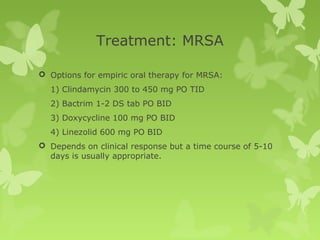
Treatment: MRSA
 Options for empiric oral therapy for MRSA:
1) Clindamycin 300 to 450 mg PO TID
2) Bactrim 1-2 DS tab PO BID
3) Doxycycline 100 mg PO BID
4) Linezolid 600 mg PO BID
 Depends on clinical response but a time course of 5-10
days is usually appropriate.
Treatment: Nonpurulent Cellulitis
 For nonpurulent cellulitis, cover for beta-hemolytic Strep
and MSSA.
 MRSA coverage is warranted for patients fail initial
therapy, signs of systemic illness, recurrent infection in
the setting of underlying predisposing conditions, and
previous episode of MRSA infection.
 Empiric MRSA coverage should be used in patients with
risk factors for MRSA and in communities with high
prevalence of MRSA.
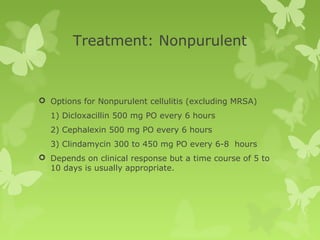
Treatment: Nonpurulent
 Options for Nonpurulent cellulitis (excluding MRSA)
1) Dicloxacillin 500 mg PO every 6 hours
2) Cephalexin 500 mg PO every 6 hours
3) Clindamycin 300 to 450 mg PO every 6-8 hours
 Depends on clinical response but a time course of 5 to
10 days is usually appropriate.
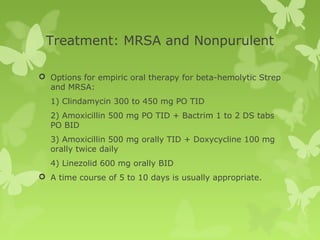
Treatment: MRSA and Nonpurulent
 Options for empiric oral therapy for beta-hemolytic Strep
and MRSA:
1) Clindamycin 300 to 450 mg PO TID
2) Amoxicillin 500 mg PO TID + Bactrim 1 to 2 DS tabs
PO BID
3) Amoxicillin 500 mg orally TID + Doxycycline 100 mg
orally twice daily
4) Linezolid 600 mg orally BID
 A time course of 5 to 10 days is usually appropriate.
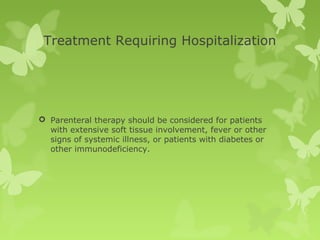
Treatment Requiring Hospitalization
 Parenteral therapy should be considered for patients
with extensive soft tissue involvement, fever or other
signs of systemic illness, or patients with diabetes or
other immunodeficiency.
TREATMENT: IV ANTIBIOTICS
 Vancomycin is antibiotic of choice for MRSA skin infections and for
those requiring hospitalization.
 For those who fail or can’t tolerate Vancomycin:
DaptomycinTigecylcline and Linezolid are alternative treatments.
Case presentation
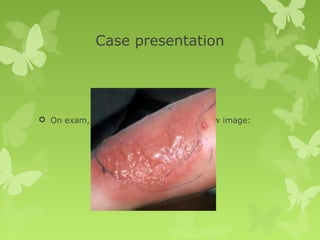
 A 48 year old male with history of HTN, Hyperlipidemia,
GERD, CKD on HD M,W,F (2/2 HTN) who presents to
your office with complaint of left leg swelling and
redness for the past 2-3 days. He states that this has
never happened before and that he his worried because
it has been worsening. He denies any recent travel. He’s
also noted some liquid draining from the area as well.
Case presentation
 On exam, his left leg is seen on the below image:
Case presentation
 What should your (the physician) next step be:
a)Tell him to raise his leg to help with swelling
b)Get an outpatient ultrasound to assess for a blood clot
c)To give him oral Keflex to treat a cellulitis
d)Admit to inpatient medicine for IV antibiotics
Case presentation
 You call the triage resident and notify them that you are
directly admitting this patient for parenteral antibiotics.
 What antibiotic choice is warranted in this patient?
a) cefazolin
b) vancomycin
c) daptomycin
d) clindamycin
SUMMARY
 Cellulitis manifests as erythema, edema, and warmth.
 Diagnosis is based upon clinical manifestations.
 Most common causes are beta-hemolytic Strep and Staph aureus.
 Management should include supportive measures.
 For non-purulent cellulitis, empiric therapy of beta-hemolytic Strep
and MSSA. Patients with non-purulent cellulitis and MRSA risk
factors should be covered for beta-hemolytic Strep & MRSA.
 Patients with purulent cellulitis should be managed with empiric
therapy for infection due to MRSA.
 For those requiring hospitalization, Vancomycin is antibiotic of
choice pending culture results.

Cellulitis

  • 1.
    Cellulitis A Clinician’s Approachto Treatment By- Dr. Armaan Singh
  • 2.
    Objectives  To understandthe definition of cellulitis  To know what treatment is appropriate  To know when hospitalization is needed
  • 3.
    Definition  Cellulitis isa skin infection that develops as a result of bacterial entry via breaches in the skin barrier.  Manifests as erythema, edema, and warmth.  Predisposing factors include disruption to the skin barrier as a result of trauma, inflammation, preexisting skin infection (ie tinea pedis), and edema.
  • 4.
    Diagnosis  Diagnosis isbased upon clinical manifestations. Cultures of blood, needle aspirations, or punch biopsies aren’t useful in mild infection.  Cultures should be performed in patients with systemic toxicity, extensive skin involvement, underlying comorbidities (ie diabetes), animal bite, or recurrent cellulitis.  Radiographic exam can be useful in excluding occult abscess and osteomyelitis.
  • 5.
    Microbiology  Most commonpathogens are beta-hemolytic Strep and Staph aureus, including MRSA. Gram-negative aerobic bacilli are identified in a minority of cases.
  • 6.
    Treatment  Antibiotic selectionfor treatment depends on whether presentation consists of purulent or nonpurulent cellulitis (per 2011 ID Society of Americal guidelines).
  • 7.
    Treatment: Purulent cellulitis Patients with purulent cellulitis (purulent drainage or exudate, in the absence of a drainable abscess) should be managed with empiric therapy for infection due to MRSA.
  • 8.
    Treatment: MRSA  Optionsfor empiric oral therapy for MRSA: 1) Clindamycin 300 to 450 mg PO TID 2) Bactrim 1-2 DS tab PO BID 3) Doxycycline 100 mg PO BID 4) Linezolid 600 mg PO BID  Depends on clinical response but a time course of 5-10 days is usually appropriate.
  • 9.
    Treatment: Nonpurulent Cellulitis For nonpurulent cellulitis, cover for beta-hemolytic Strep and MSSA.  MRSA coverage is warranted for patients fail initial therapy, signs of systemic illness, recurrent infection in the setting of underlying predisposing conditions, and previous episode of MRSA infection.  Empiric MRSA coverage should be used in patients with risk factors for MRSA and in communities with high prevalence of MRSA.
  • 10.
    Treatment: Nonpurulent  Optionsfor Nonpurulent cellulitis (excluding MRSA) 1) Dicloxacillin 500 mg PO every 6 hours 2) Cephalexin 500 mg PO every 6 hours 3) Clindamycin 300 to 450 mg PO every 6-8 hours  Depends on clinical response but a time course of 5 to 10 days is usually appropriate.
  • 11.
    Treatment: MRSA andNonpurulent  Options for empiric oral therapy for beta-hemolytic Strep and MRSA: 1) Clindamycin 300 to 450 mg PO TID 2) Amoxicillin 500 mg PO TID + Bactrim 1 to 2 DS tabs PO BID 3) Amoxicillin 500 mg orally TID + Doxycycline 100 mg orally twice daily 4) Linezolid 600 mg orally BID  A time course of 5 to 10 days is usually appropriate.
  • 12.
    Treatment Requiring Hospitalization Parenteral therapy should be considered for patients with extensive soft tissue involvement, fever or other signs of systemic illness, or patients with diabetes or other immunodeficiency.
  • 13.
    TREATMENT: IV ANTIBIOTICS Vancomycin is antibiotic of choice for MRSA skin infections and for those requiring hospitalization.  For those who fail or can’t tolerate Vancomycin: DaptomycinTigecylcline and Linezolid are alternative treatments.
  • 14.
    Case presentation  A48 year old male with history of HTN, Hyperlipidemia, GERD, CKD on HD M,W,F (2/2 HTN) who presents to your office with complaint of left leg swelling and redness for the past 2-3 days. He states that this has never happened before and that he his worried because it has been worsening. He denies any recent travel. He’s also noted some liquid draining from the area as well.
  • 15.
    Case presentation  Onexam, his left leg is seen on the below image:
  • 16.
    Case presentation  Whatshould your (the physician) next step be: a)Tell him to raise his leg to help with swelling b)Get an outpatient ultrasound to assess for a blood clot c)To give him oral Keflex to treat a cellulitis d)Admit to inpatient medicine for IV antibiotics
  • 17.
    Case presentation  Youcall the triage resident and notify them that you are directly admitting this patient for parenteral antibiotics.  What antibiotic choice is warranted in this patient? a) cefazolin b) vancomycin c) daptomycin d) clindamycin
  • 18.
    SUMMARY  Cellulitis manifestsas erythema, edema, and warmth.  Diagnosis is based upon clinical manifestations.  Most common causes are beta-hemolytic Strep and Staph aureus.  Management should include supportive measures.  For non-purulent cellulitis, empiric therapy of beta-hemolytic Strep and MSSA. Patients with non-purulent cellulitis and MRSA risk factors should be covered for beta-hemolytic Strep & MRSA.  Patients with purulent cellulitis should be managed with empiric therapy for infection due to MRSA.  For those requiring hospitalization, Vancomycin is antibiotic of choice pending culture results.

Editor's Notes

  • #4 The incidence is about 200 cases per 100,000 patients per year. Breaks in the skin between the toes are perhaps the most important potential sites for pathogen entry.
  • #5 In mild cases, blood cultures are positive in less than 5 percent of cases. Culture results from needle aspiration vary from ≤5 to 40%, while culture of punch biopsy specimens yields a pathogen in 20-30% of cases.
  • #6 Cellulitis pathogens implicated in special clinical circumstances include: pasteurella multocida and capnocytophaga canismorsus (dog and cat bites), pseudomonas aeruginoasa (diabetics).
  • #7 Purulent and non-purulent: These terms are designations within the 2011 Infectious Disease Society of America clinical practice guidelines for methicillin-resistant S. aureus (MRSA). The use of these terms in the guidelines suggests that an infection involving purulence is potentially attributable to S. aureus, which should be reflected in the choice of empiric antimicrobial therapy.
  • #8 In a study including 422 patients with purulent soft tissue infection, MRSA was the dominant organism, isolated from 59% patients, followed by MSSA (17%); beta-hemolytic streptococci accounted 2.6%.
  • #10 MRSA Risk factors include: recent hospitalization, residence in long term care facility, HD, Diabetes, IV drug use, recent antibiotic therapy, incarceration, HIV
  • #14 Of note, there is increasing concern regarding the rise in S. aureus MICs to vancomycin. If one is requiring hospitalization, it is best to cover for MRSA and can then narrow antibiotic selection depending on response and cultures, if obtained. Possible coverage for non-purulent (excluding MRSA) includes Cefazolin, Oxacillin IV.
  • #17 The answer is D. The patient has extensive involvement of his lower extremity with drainage and history of CKD requiring HD and thus will need IV antibiotics.
  • #18 Answer: B. As already mentioned, Vancomycin remains the antibiotic of choice for treatment of invasive MRSA skin. He will need to be renally dosed with his dialysis sessions.
  • #19 Of note, this presentation excludes orbital and preseptal cellulitis.