Hidradeni(s Suppura(va 
 A comprehensive review 

  Prepared By Yoon K. Cohen 
Hidradeni(s Suppura(va 
  HS is a chronic, recurrent, inflammatory disease 
   presen(ng as painful subcutaneous nodules 
  Double comedones, deep sinus tracts, and abscesses are 
   characteris(c for HS 
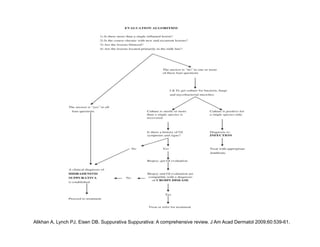
  A diagnosis of HS is made clinically without the use of 
   laboratory tests 


Alikhan A, Lynch PJ, Eisen DB. Suppurativa Suppurativa: A comprehensive review. J Am Acad Dermatol 2009;60:539-61.
Demographics 
  HS tends to begin in the second or third decades of life 
  Females are more likely to develop HS 
  Recent studies suggest a prevalence of about 1% 


Alikhan A, Lynch PJ, Eisen DB. Suppurativa Suppurativa: A comprehensive review. J Am Acad Dermatol 2009;60:539-61.
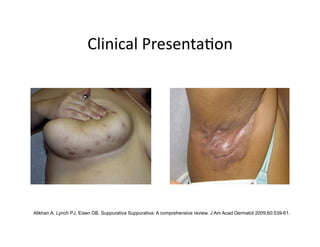
Clinical Presenta(on 
  HS mostly typically occurs in the axillary, inguinal, 
   perianal, perineal, mammary, and inframammary regions 
  The distribu(on paKern corresponds with the “milk line” 
   distribu(on of apocrine related mammary (ssue in 
   mammals 
  The most commonly affected site is the axilla 
  Perianal HS is associated with more debilita(ng 
   outcomes than axillary HS 


Alikhan A, Lynch PJ, Eisen DB. Suppurativa Suppurativa: A comprehensive review. J Am Acad Dermatol 2009;60:539-61.
Clinical Presenta(on 


Alikhan A, Lynch PJ, Eisen DB. Suppurativa Suppurativa: A comprehensive review. J Am Acad Dermatol 2009;60:539-61.
Clinical staging 
  Hurley’s staging system is simple and relies on the 
   subjec(ve extent of diseased (ssue 
  The Sartorius system is more sophis(cated then Hurley’s 
   and is likely to supplant it as a means for conduc(ng 
   clinical trials 


Alikhan A, Lynch PJ, Eisen DB. Suppurativa Suppurativa: A comprehensive review. J Am Acad Dermatol 2009;60:539-61.
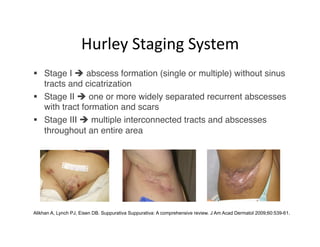
Hurley Staging System 
  Stage I  abscess formation (single or multiple) without sinus
   tracts and cicatrization

  Stage II  one or more widely separated recurrent abscesses
   with tract formation and scars 

  Stage III  multiple interconnected tracts and abscesses
   throughout an entire area 


Alikhan A, Lynch PJ, Eisen DB. Suppurativa Suppurativa: A comprehensive review. J Am Acad Dermatol 2009;60:539-61.
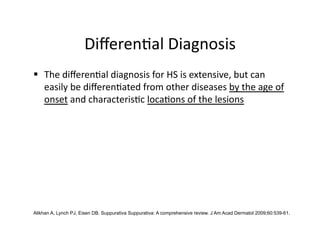
Differen(al Diagnosis 
  The differen(al diagnosis for HS is extensive, but can 
   easily be differen(ated from other diseases by the age of 
   onset and characteris(c loca(ons of the lesions 


Alikhan A, Lynch PJ, Eisen DB. Suppurativa Suppurativa: A comprehensive review. J Am Acad Dermatol 2009;60:539-61.
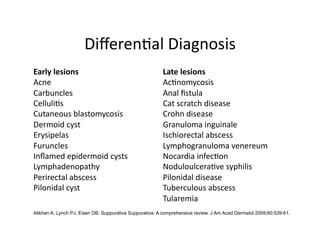
Differen(al Diagnosis 
Early lesions                                            Late lesions  
Acne                                                     Ac(nomycosis   
Carbuncles                                               Anal fistula   
Celluli(s                                                Cat scratch disease   
Cutaneous blastomycosis                                  Crohn disease   
Dermoid cyst                                             Granuloma inguinale   
Erysipelas                                               Ischiorectal abscess  
Furuncles                                                Lymphogranuloma venereum   
Inflamed epidermoid cysts                                 Nocardia infec(on   
Lymphadenopathy                                          Noduloulcera(ve syphilis   
Perirectal abscess                                       Pilonidal disease   
Pilonidal cyst                                           Tuberculous abscess   
                                                         Tularemia   
Alikhan A, Lynch PJ, Eisen DB. Suppurativa Suppurativa: A comprehensive review. J Am Acad Dermatol 2009;60:539-61.
E(opathogenesis 
  Long thought to be a disorder of apocrine origin, it is now thought 
   to be caused by follicular occlusion 
  Families with autosomal dominance type inheritance have been 
   reported 
  Hyperandrogenism likely does not play a role in HS 
  Bacteria are probably secondary colonizers, which may exacerbate 
   HS, but they are not the primary e(ologic agents 
  Poor hygiene does not cause HS 
  Some inves(gators postulate that there may be an underlying 
   immunologic aberra(on involved in the pathogenesis of HS; more 
   work needs to be done in this field before any conclusions can be 
   made 
  Smoking and obesity are not primary causes of HS but are strongly 
   associated with the disease and may exacerbate it 

Alikhan A, Lynch PJ, Eisen DB. Suppurativa Suppurativa: A comprehensive review. J Am Acad Dermatol 2009;60:539-61.
E(opathogenesis 
    Follicular and glandular factors 
    Gene(c factor 
    Endocrinologic factor 
    Bacterial factors 
    Environmental factors 
    Host defense factors 
    Pharmacologic factors 
    Smoking 
    Obesity 
Alikhan A, Lynch PJ, Eisen DB. Suppurativa Suppurativa: A comprehensive review. J Am Acad Dermatol 2009;60:539-61.
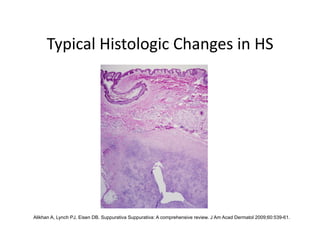
Typical Histologic Changes in HS 


Alikhan A, Lynch PJ, Eisen DB. Suppurativa Suppurativa: A comprehensive review. J Am Acad Dermatol 2009;60:539-61.
Psychological and physiologic 
                       morbidity 
  HS pa(ents experience a quality of life worse than 
   those with alopecia, mild to moderate psoriasis, and 
   several other dermatologic condi(ons 
  HS results in economic and psychological disability in 
   addi(on to the physical problems 


Alikhan A, Lynch PJ, Eisen DB. Suppurativa Suppurativa: A comprehensive review. J Am Acad Dermatol 2009;60:539-61.
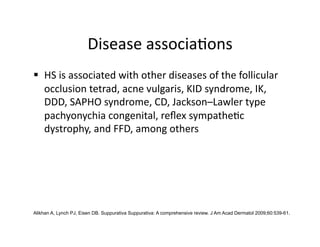
Disease associa(ons 
  HS is associated with other diseases of the follicular 
   occlusion tetrad, acne vulgaris, KID syndrome, IK, 
   DDD, SAPHO syndrome, CD, Jackson–Lawler type 
   pachyonychia congenital, reflex sympathe(c 
   dystrophy, and FFD, among others 


Alikhan A, Lynch PJ, Eisen DB. Suppurativa Suppurativa: A comprehensive review. J Am Acad Dermatol 2009;60:539-61.
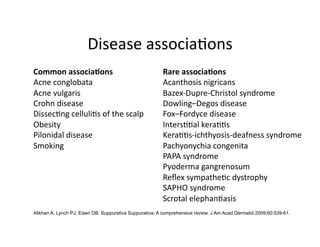
Disease associa(ons 
Common associa1ons                                       Rare associa1ons   
Acne conglobata                                          Acanthosis nigricans   
Acne vulgaris                                            Bazex‐Dupre‐Christol syndrome   
Crohn disease                                            Dowling–Degos disease  
Dissec(ng celluli(s of the scalp                         Fox–Fordyce disease   
Obesity                                                  Inters((al kera((s   
Pilonidal disease                                        Kera((s‐ichthyosis‐deafness syndrome   
Smoking                                                  Pachyonychia congenita  
                                                         PAPA syndrome  
                                                         Pyoderma gangrenosum   
                                                         Reflex sympathe(c dystrophy   
                                                         SAPHO syndrome   
                                                         Scrotal elephan(asis   
Alikhan A, Lynch PJ, Eisen DB. Suppurativa Suppurativa: A comprehensive review. J Am Acad Dermatol 2009;60:539-61.
Prognosis and disease complica(ons 
  The risk of SCC and other malignancies may be 
   increased in those with HS 
  Contractures, strictures, serious infec(on, and 
   anemia are also poten(al sequelae 


Alikhan A, Lynch PJ, Eisen DB. Suppurativa Suppurativa: A comprehensive review. J Am Acad Dermatol 2009;60:539-61.
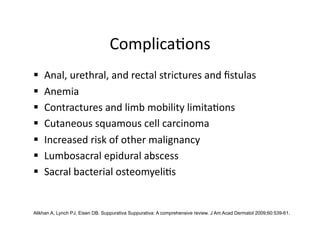
Complica(ons 
    Anal, urethral, and rectal strictures and fistulas   
    Anemia   
    Contractures and limb mobility limita(ons   
    Cutaneous squamous cell carcinoma   
    Increased risk of other malignancy   
    Lumbosacral epidural abscess   
    Sacral bacterial osteomyeli(s  


Alikhan A, Lynch PJ, Eisen DB. Suppurativa Suppurativa: A comprehensive review. J Am Acad Dermatol 2009;60:539-61.
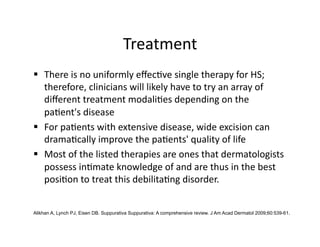
Treatment 
  There is no uniformly effec(ve single therapy for HS; 
   therefore, clinicians will likely have to try an array of 
   different treatment modali(es depending on the 
   pa(ent's disease 
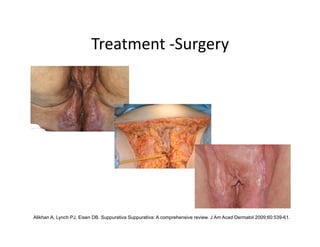
  For pa(ents with extensive disease, wide excision can 
   drama(cally improve the pa(ents' quality of life 
  Most of the listed therapies are ones that dermatologists 
   possess in(mate knowledge of and are thus in the best 
   posi(on to treat this debilita(ng disorder. 


Alikhan A, Lynch PJ, Eisen DB. Suppurativa Suppurativa: A comprehensive review. J Am Acad Dermatol 2009;60:539-61.
Treatment 
    An(bio(cs 
    Re(noids 
    Hormones 
    Immunosuppressive and an(inflammatory agents 
    Neurotoxins 
    Radiotherapy 
    Light, radiofrequency, and other procedures 
    Surgery 


Alikhan A, Lynch PJ, Eisen DB. Suppurativa Suppurativa: A comprehensive review. J Am Acad Dermatol 2009;60:539-61.
Treatment ‐Surgery 


Alikhan A, Lynch PJ, Eisen DB. Suppurativa Suppurativa: A comprehensive review. J Am Acad Dermatol 2009;60:539-61.
Approach to treatment 
Hurley stage I disease or first‐line therapy 
    An(bio(cs, either topical or systmic (A) 
    Hormonal therapy (A) 
    Re(noids (A) 
    Zinc (A) 
    Cryotherapy (B) 
    Botox (C) 
    Radiofrequency treatment (C) 
  Short‐term cor(costeropids (C) 
          
Alikhan A, Lynch PJ, Eisen DB. Suppurativa Suppurativa: A comprehensive review. J Am Acad Dermatol 2009;60:539-61.
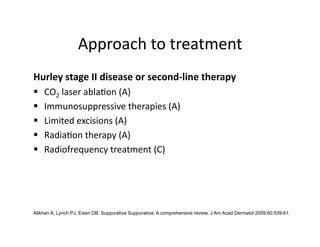
Approach to treatment 
Hurley stage II disease or second‐line therapy   
    CO2 laser abla(on (A) 
    Immunosuppressive therapies (A) 
    Limited excisions (A) 
    Radia(on therapy (A) 
    Radiofrequency treatment (C) 


Alikhan A, Lynch PJ, Eisen DB. Suppurativa Suppurativa: A comprehensive review. J Am Acad Dermatol 2009;60:539-61.
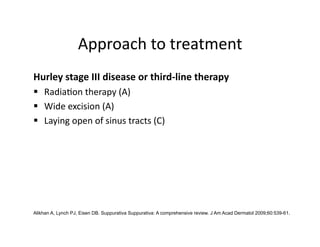
Approach to treatment 
Hurley stage III disease or third‐line therapy   
  Radia(on therapy (A) 
  Wide excision (A) 
  Laying open of sinus tracts (C) 


Alikhan A, Lynch PJ, Eisen DB. Suppurativa Suppurativa: A comprehensive review. J Am Acad Dermatol 2009;60:539-61.
General Treatment Sugges(ons 
    Avoidance of (ght‐fieng clothing  
    Nonnarco(c analgesics   
    Reassurance   
    Smoking cessa(on   
    Stress management  
    Support group referral   
    Weight loss   


Alikhan A, Lynch PJ, Eisen DB. Suppurativa Suppurativa: A comprehensive review. J Am Acad Dermatol 2009;60:539-61.
Conclusion 
  The prevalence of HS may equal or even surpass that of 
   psoriasis, yet it receives only a frac(on of the aKen(on and 
   scholarly contribu(ons. Though no overwhelmingly 
   effec(ve treatments have been described, novel therapies 
   are emerging 
  Many—if not all—of these therapies are well known to 
   dermatologists; therefore, we should play a lead role in 
   managing this debilita(ng disorder. As our understanding of 
   this disorder grows, so will our treatment op(ons 


Alikhan A, Lynch PJ, Eisen DB. Suppurativa Suppurativa: A comprehensive review. J Am Acad Dermatol 2009;60:539-61.
Thank You 

 Yoon K. Cohen 

Hidradenitis Suppurativa

  • 1.
  • 2.
    Hidradeni(s Suppura(va    HS is a chronic, recurrent, inflammatory disease  presen(ng as painful subcutaneous nodules    Double comedones, deep sinus tracts, and abscesses are  characteris(c for HS    A diagnosis of HS is made clinically without the use of  laboratory tests  Alikhan A, Lynch PJ, Eisen DB. Suppurativa Suppurativa: A comprehensive review. J Am Acad Dermatol 2009;60:539-61.
  • 3.
    Demographics    HS tends to begin in the second or third decades of life    Females are more likely to develop HS   Recent studies suggest a prevalence of about 1%  Alikhan A, Lynch PJ, Eisen DB. Suppurativa Suppurativa: A comprehensive review. J Am Acad Dermatol 2009;60:539-61.
  • 4.
    Clinical Presenta(on    HS mostly typically occurs in the axillary, inguinal,  perianal, perineal, mammary, and inframammary regions    The distribu(on paKern corresponds with the “milk line”  distribu(on of apocrine related mammary (ssue in  mammals    The most commonly affected site is the axilla    Perianal HS is associated with more debilita(ng  outcomes than axillary HS  Alikhan A, Lynch PJ, Eisen DB. Suppurativa Suppurativa: A comprehensive review. J Am Acad Dermatol 2009;60:539-61.
  • 5.
    Clinical Presenta(on  Alikhan A, LynchPJ, Eisen DB. Suppurativa Suppurativa: A comprehensive review. J Am Acad Dermatol 2009;60:539-61.
  • 6.
    Clinical staging    Hurley’s staging system is simple and relies on the  subjec(ve extent of diseased (ssue    The Sartorius system is more sophis(cated then Hurley’s  and is likely to supplant it as a means for conduc(ng  clinical trials  Alikhan A, Lynch PJ, Eisen DB. Suppurativa Suppurativa: A comprehensive review. J Am Acad Dermatol 2009;60:539-61.
  • 7.
    Hurley Staging System    Stage I abscess formation (single or multiple) without sinus tracts and cicatrization   Stage II  one or more widely separated recurrent abscesses with tract formation and scars   Stage III  multiple interconnected tracts and abscesses throughout an entire area Alikhan A, Lynch PJ, Eisen DB. Suppurativa Suppurativa: A comprehensive review. J Am Acad Dermatol 2009;60:539-61.
  • 8.
    Differen(al Diagnosis    The differen(al diagnosis for HS is extensive, but can  easily be differen(ated from other diseases by the age of  onset and characteris(c loca(ons of the lesions  Alikhan A, Lynch PJ, Eisen DB. Suppurativa Suppurativa: A comprehensive review. J Am Acad Dermatol 2009;60:539-61.
  • 9.
    Differen(al Diagnosis  Early lesions             Late lesions   Acne                Ac(nomycosis    Carbuncles              Anal fistula    Celluli(s              Cat scratch disease    Cutaneous blastomycosis      Crohn disease    Dermoid cyst            Granuloma inguinale    Erysipelas              Ischiorectal abscess   Furuncles              Lymphogranuloma venereum    Inflamed epidermoid cysts      Nocardia infec(on    Lymphadenopathy          Noduloulcera(ve syphilis    Perirectal abscess          Pilonidal disease    Pilonidal cyst            Tuberculous abscess                      Tularemia    Alikhan A, Lynch PJ, Eisen DB. Suppurativa Suppurativa: A comprehensive review. J Am Acad Dermatol 2009;60:539-61.
  • 10.
    Alikhan A, LynchPJ, Eisen DB. Suppurativa Suppurativa: A comprehensive review. J Am Acad Dermatol 2009;60:539-61.
  • 11.
    E(opathogenesis    Long thought to be a disorder of apocrine origin, it is now thought  to be caused by follicular occlusion    Families with autosomal dominance type inheritance have been  reported    Hyperandrogenism likely does not play a role in HS    Bacteria are probably secondary colonizers, which may exacerbate  HS, but they are not the primary e(ologic agents    Poor hygiene does not cause HS    Some inves(gators postulate that there may be an underlying  immunologic aberra(on involved in the pathogenesis of HS; more  work needs to be done in this field before any conclusions can be  made    Smoking and obesity are not primary causes of HS but are strongly  associated with the disease and may exacerbate it  Alikhan A, Lynch PJ, Eisen DB. Suppurativa Suppurativa: A comprehensive review. J Am Acad Dermatol 2009;60:539-61.
  • 12.
    E(opathogenesis    Follicular and glandular factors    Gene(c factor    Endocrinologic factor    Bacterial factors    Environmental factors    Host defense factors    Pharmacologic factors    Smoking    Obesity  Alikhan A, Lynch PJ, Eisen DB. Suppurativa Suppurativa: A comprehensive review. J Am Acad Dermatol 2009;60:539-61.
  • 13.
    Typical Histologic Changes in HS  Alikhan A, LynchPJ, Eisen DB. Suppurativa Suppurativa: A comprehensive review. J Am Acad Dermatol 2009;60:539-61.
  • 14.
    Psychological and physiologic  morbidity    HS pa(ents experience a quality of life worse than  those with alopecia, mild to moderate psoriasis, and  several other dermatologic condi(ons    HS results in economic and psychological disability in  addi(on to the physical problems  Alikhan A, Lynch PJ, Eisen DB. Suppurativa Suppurativa: A comprehensive review. J Am Acad Dermatol 2009;60:539-61.
  • 15.
    Disease associa(ons    HS is associated with other diseases of the follicular  occlusion tetrad, acne vulgaris, KID syndrome, IK,  DDD, SAPHO syndrome, CD, Jackson–Lawler type  pachyonychia congenital, reflex sympathe(c  dystrophy, and FFD, among others  Alikhan A, Lynch PJ, Eisen DB. Suppurativa Suppurativa: A comprehensive review. J Am Acad Dermatol 2009;60:539-61.
  • 16.
    Disease associa(ons  Common associa1ons        Rare associa1ons    Acne conglobata          Acanthosis nigricans    Acne vulgaris            Bazex‐Dupre‐Christol syndrome    Crohn disease            Dowling–Degos disease   Dissec(ng celluli(s of the scalp    Fox–Fordyce disease    Obesity               Inters((al kera((s    Pilonidal disease          Kera((s‐ichthyosis‐deafness syndrome    Smoking              Pachyonychia congenita                     PAPA syndrome                     Pyoderma gangrenosum                      Reflex sympathe(c dystrophy                      SAPHO syndrome                      Scrotal elephan(asis    Alikhan A, Lynch PJ, Eisen DB. Suppurativa Suppurativa: A comprehensive review. J Am Acad Dermatol 2009;60:539-61.
  • 17.
    Prognosis and disease complica(ons    The risk of SCC and other malignancies may be  increased in those with HS    Contractures, strictures, serious infec(on, and  anemia are also poten(al sequelae  Alikhan A, Lynch PJ, Eisen DB. Suppurativa Suppurativa: A comprehensive review. J Am Acad Dermatol 2009;60:539-61.
  • 18.
    Complica(ons    Anal, urethral, and rectal strictures and fistulas      Anemia      Contractures and limb mobility limita(ons      Cutaneous squamous cell carcinoma      Increased risk of other malignancy      Lumbosacral epidural abscess      Sacral bacterial osteomyeli(s   Alikhan A, Lynch PJ, Eisen DB. Suppurativa Suppurativa: A comprehensive review. J Am Acad Dermatol 2009;60:539-61.
  • 19.
    Treatment    There is no uniformly effec(ve single therapy for HS;  therefore, clinicians will likely have to try an array of  different treatment modali(es depending on the  pa(ent's disease    For pa(ents with extensive disease, wide excision can  drama(cally improve the pa(ents' quality of life    Most of the listed therapies are ones that dermatologists  possess in(mate knowledge of and are thus in the best  posi(on to treat this debilita(ng disorder.  Alikhan A, Lynch PJ, Eisen DB. Suppurativa Suppurativa: A comprehensive review. J Am Acad Dermatol 2009;60:539-61.
  • 20.
    Treatment    An(bio(cs    Re(noids    Hormones    Immunosuppressive and an(inflammatory agents    Neurotoxins    Radiotherapy    Light, radiofrequency, and other procedures    Surgery  Alikhan A, Lynch PJ, Eisen DB. Suppurativa Suppurativa: A comprehensive review. J Am Acad Dermatol 2009;60:539-61.
  • 21.
    Treatment ‐Surgery  Alikhan A, LynchPJ, Eisen DB. Suppurativa Suppurativa: A comprehensive review. J Am Acad Dermatol 2009;60:539-61.
  • 22.
    Approach to treatment  Hurley stage I disease or first‐line therapy    An(bio(cs, either topical or systmic (A)    Hormonal therapy (A)    Re(noids (A)    Zinc (A)    Cryotherapy (B)    Botox (C)    Radiofrequency treatment (C)    Short‐term cor(costeropids (C)        Alikhan A, Lynch PJ, Eisen DB. Suppurativa Suppurativa: A comprehensive review. J Am Acad Dermatol 2009;60:539-61.
  • 23.
    Approach to treatment  Hurley stage II disease or second‐line therapy      CO2 laser abla(on (A)    Immunosuppressive therapies (A)    Limited excisions (A)    Radia(on therapy (A)    Radiofrequency treatment (C)  Alikhan A, Lynch PJ, Eisen DB. Suppurativa Suppurativa: A comprehensive review. J Am Acad Dermatol 2009;60:539-61.
  • 24.
    Approach to treatment  Hurley stage III disease or third‐line therapy      Radia(on therapy (A)   Wide excision (A)    Laying open of sinus tracts (C)  Alikhan A, Lynch PJ, Eisen DB. Suppurativa Suppurativa: A comprehensive review. J Am Acad Dermatol 2009;60:539-61.
  • 25.
    General Treatment Sugges(ons    Avoidance of (ght‐fieng clothing     Nonnarco(c analgesics      Reassurance      Smoking cessa(on      Stress management     Support group referral      Weight loss    Alikhan A, Lynch PJ, Eisen DB. Suppurativa Suppurativa: A comprehensive review. J Am Acad Dermatol 2009;60:539-61.
  • 26.
    Conclusion    The prevalence of HS may equal or even surpass that of  psoriasis, yet it receives only a frac(on of the aKen(on and  scholarly contribu(ons. Though no overwhelmingly  effec(ve treatments have been described, novel therapies  are emerging    Many—if not all—of these therapies are well known to  dermatologists; therefore, we should play a lead role in  managing this debilita(ng disorder. As our understanding of  this disorder grows, so will our treatment op(ons  Alikhan A, Lynch PJ, Eisen DB. Suppurativa Suppurativa: A comprehensive review. J Am Acad Dermatol 2009;60:539-61.
  • 27.