Liver Abscess
Aetiology Bacterial, parasitic, or fungal in origin.  85% to 90% bacterial or pyogenic.  Bacteria access the liver via the biliary tree or portal vein.  Other causes include  biliary obstruction,  diverticulitis, trauma,  inflammatory bowel disease,
Incidence   Liver gets infected by Entamoeba histolytica commonly The most common location of a pyogenic abscess is the right lobe.  Chronic alcoholics - prone to get this infection Entamoeba histolytica is endemic in many parts of the world Pathophysiology The amoebic cyst is ingested  Cyst develops into the trophozoite form in the colon  Reaches the liver through portal circulation Pyogenic abscess may also occur due to the infection by streptococcus milleri and Escherichia coli. Many a time the pyogenic infection follows amoebic infection
Clinical Features Often the diagnosis of a bacterial abscess is suggested clinically . Fever Pain right hypochondrium Chills  Rigors Toxicity Right upper quadrant discomfort  Diarrhea weight loss Intercostal tendreness Swelling in the right hypo chondrium or epigastrium tender, enlarged liver .
USGM  of the liver X-Ray  of the chest to see whether there is any pneumonitis or effusion caused by the irritation of the nearby abscess TC  -Leukocytosis LFT  - Abnormal liver function tests (LFTs) CT  scan liver Investigations
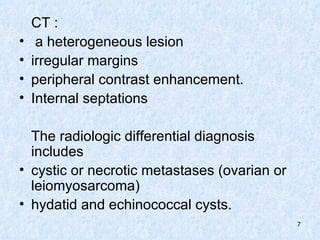
CT :  a heterogeneous lesion  irregular margins peripheral contrast enhancement.  Internal septations The radiologic differential diagnosis includes  cystic or necrotic metastases (ovarian or leiomyosarcoma) hydatid and echinococcal cysts.
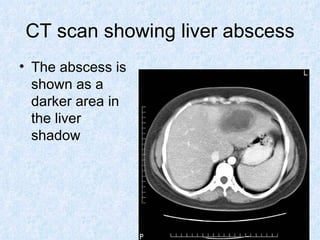
CT scan showing liver abscess The abscess is shown as a darker area in the liver shadow
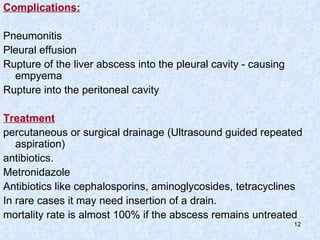
Complications: Pneumonitis Pleural effusion Rupture of the liver abscess into the pleural cavity - causing empyema Rupture into the peritoneal cavity Treatment percutaneous or surgical drainage (Ultrasound guided repeated aspiration) antibiotics.  Metronidazole Antibiotics like cephalosporins, aminoglycosides, tetracyclines In rare cases it may need insertion of a drain. mortality rate is almost 100% if the abscess remains untreated
Pleural Effusion secondary to amoebic liver abscess
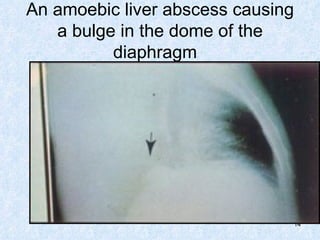
An amoebic liver abscess causing a bulge in the dome of the diaphragm
Amoebic liver abscess burst into the right pleural cavity
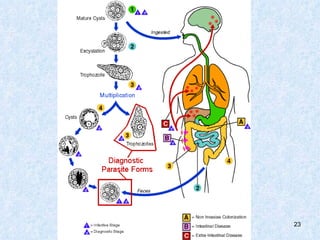
I.  Entamoeba histolytica : Amebic dysentery; amebic liver abscess Epidemiology :  Found worldwide, especially in tropical areas,  There is no animal reservoir.  Mode of transmission : Ingestion of cysts.  Anal-oral transmission due to sexual practice is also a consideration.  C.  Pathology : Two-stage life cycle.  The trophozoite (ameba stage) is motile.  The cyst stage is nonmotile.  Trophozoites are found in the intestinal and extraintestinal lesions.  Cysts predominate in the stools, with somes trophozoites present.
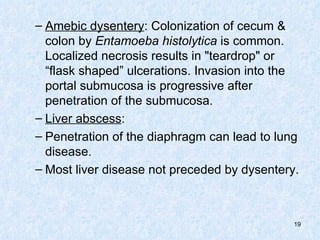
Amebic dysentery : Colonization of cecum & colon by  Entamoeba histolytica  is common. Localized necrosis results in "teardrop" or “flask shaped” ulcerations. Invasion into the portal submucosa is progressive after penetration of the submucosa.  Liver abscess :  Penetration of the diaphragm can lead to lung disease.  Most liver disease not preceded by dysentery.
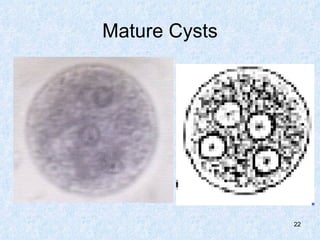
Mature Cysts
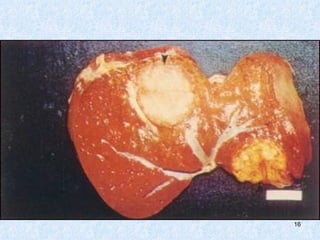
Liver abscess

Liver abscess

  • 1.
  • 2.
    Aetiology Bacterial, parasitic,or fungal in origin. 85% to 90% bacterial or pyogenic. Bacteria access the liver via the biliary tree or portal vein. Other causes include biliary obstruction, diverticulitis, trauma, inflammatory bowel disease,
  • 3.
    Incidence Liver gets infected by Entamoeba histolytica commonly The most common location of a pyogenic abscess is the right lobe. Chronic alcoholics - prone to get this infection Entamoeba histolytica is endemic in many parts of the world Pathophysiology The amoebic cyst is ingested Cyst develops into the trophozoite form in the colon Reaches the liver through portal circulation Pyogenic abscess may also occur due to the infection by streptococcus milleri and Escherichia coli. Many a time the pyogenic infection follows amoebic infection
  • 4.
    Clinical Features Oftenthe diagnosis of a bacterial abscess is suggested clinically . Fever Pain right hypochondrium Chills Rigors Toxicity Right upper quadrant discomfort Diarrhea weight loss Intercostal tendreness Swelling in the right hypo chondrium or epigastrium tender, enlarged liver .
  • 6.
    USGM ofthe liver X-Ray of the chest to see whether there is any pneumonitis or effusion caused by the irritation of the nearby abscess TC -Leukocytosis LFT - Abnormal liver function tests (LFTs) CT scan liver Investigations
  • 7.
    CT : a heterogeneous lesion irregular margins peripheral contrast enhancement. Internal septations The radiologic differential diagnosis includes cystic or necrotic metastases (ovarian or leiomyosarcoma) hydatid and echinococcal cysts.
  • 9.
    CT scan showingliver abscess The abscess is shown as a darker area in the liver shadow
  • 12.
    Complications: Pneumonitis Pleuraleffusion Rupture of the liver abscess into the pleural cavity - causing empyema Rupture into the peritoneal cavity Treatment percutaneous or surgical drainage (Ultrasound guided repeated aspiration) antibiotics. Metronidazole Antibiotics like cephalosporins, aminoglycosides, tetracyclines In rare cases it may need insertion of a drain. mortality rate is almost 100% if the abscess remains untreated
  • 13.
    Pleural Effusion secondaryto amoebic liver abscess
  • 14.
    An amoebic liverabscess causing a bulge in the dome of the diaphragm
  • 15.
    Amoebic liver abscessburst into the right pleural cavity
  • 18.
    I. Entamoebahistolytica : Amebic dysentery; amebic liver abscess Epidemiology : Found worldwide, especially in tropical areas, There is no animal reservoir. Mode of transmission : Ingestion of cysts. Anal-oral transmission due to sexual practice is also a consideration. C. Pathology : Two-stage life cycle. The trophozoite (ameba stage) is motile. The cyst stage is nonmotile. Trophozoites are found in the intestinal and extraintestinal lesions. Cysts predominate in the stools, with somes trophozoites present.
  • 19.
    Amebic dysentery :Colonization of cecum & colon by Entamoeba histolytica is common. Localized necrosis results in "teardrop" or “flask shaped” ulcerations. Invasion into the portal submucosa is progressive after penetration of the submucosa. Liver abscess : Penetration of the diaphragm can lead to lung disease. Most liver disease not preceded by dysentery.
  • 22.

Editor's Notes