1
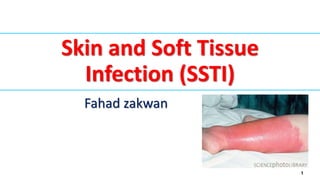
Skin and Soft Tissue
Infection (SSTI)
Fahad zakwan
2
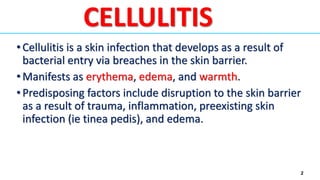
•Cellulitis is a skin infection that develops as a result of
bacterial entry via breaches in the skin barrier.
•Manifests as erythema, edema, and warmth.
•Predisposing factors include disruption to the skin barrier
as a result of trauma, inflammation, preexisting skin
infection (ie tinea pedis), and edema.
CELLULITIS
3
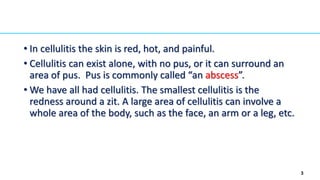
• In cellulitis the skin is red, hot, and painful.
• Cellulitis can exist alone, with no pus, or it can surround an
area of pus. Pus is commonly called “an abscess”.

• We have all had cellulitis. The smallest cellulitis is the
redness around a zit. A large area of cellulitis can involve a
whole area of the body, such as the face, an arm or a leg, etc.
4
5
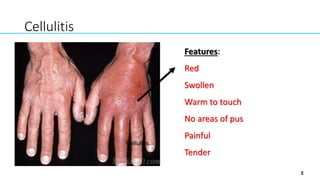
Cellulitis
Features:
Red
Swollen
Warm to touch
No areas of pus
Painful
Tender
Cellulitis
6
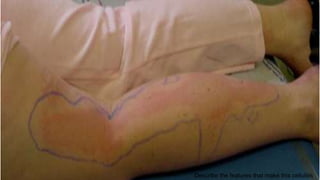
Cellulitis
Describe the features that make this cellulitis
7
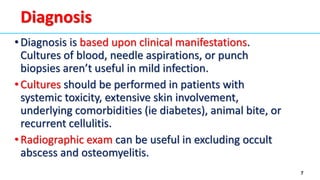
•Diagnosis is based upon clinical manifestations.
Cultures of blood, needle aspirations, or punch
biopsies aren’t useful in mild infection.
•Cultures should be performed in patients with
systemic toxicity, extensive skin involvement,
underlying comorbidities (ie diabetes), animal bite, or
recurrent cellulitis.
•Radiographic exam can be useful in excluding occult
abscess and osteomyelitis.
Diagnosis
8
•Most common pathogens are beta-
hemolytic Strep and Staph aureus,
including MRSA.
•Gram-negative aerobic bacilli are
identified in a minority of cases.
Microbiology
9
Antibiotic selection for treatment
depends on whether presentation
consists of purulent or nonpurulent
cellulitis (per 2011 ID Society of
American guidelines).
Treatment
10
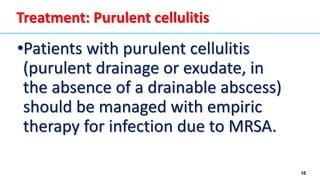
•Patients with purulent cellulitis
(purulent drainage or exudate, in
the absence of a drainable abscess)
should be managed with empiric
therapy for infection due to MRSA.
Treatment: Purulent cellulitis
11
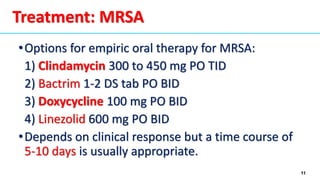
•Options for empiric oral therapy for MRSA:
1) Clindamycin 300 to 450 mg PO TID
2) Bactrim 1-2 DS tab PO BID
3) Doxycycline 100 mg PO BID
4) Linezolid 600 mg PO BID
•Depends on clinical response but a time course of
5-10 days is usually appropriate.
Treatment: MRSA
12
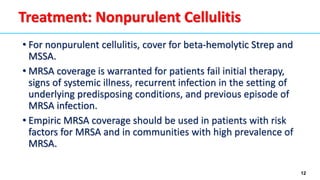
• For nonpurulent cellulitis, cover for beta-hemolytic Strep and
MSSA.
• MRSA coverage is warranted for patients fail initial therapy,
signs of systemic illness, recurrent infection in the setting of
underlying predisposing conditions, and previous episode of
MRSA infection.
• Empiric MRSA coverage should be used in patients with risk
factors for MRSA and in communities with high prevalence of
MRSA.
Treatment: Nonpurulent Cellulitis
13
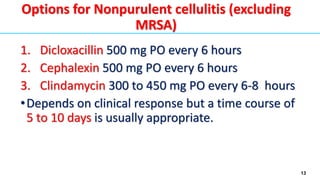
1. Dicloxacillin 500 mg PO every 6 hours
2. Cephalexin 500 mg PO every 6 hours
3. Clindamycin 300 to 450 mg PO every 6-8 hours
•Depends on clinical response but a time course of
5 to 10 days is usually appropriate.
Options for Nonpurulent cellulitis (excluding
MRSA)
14
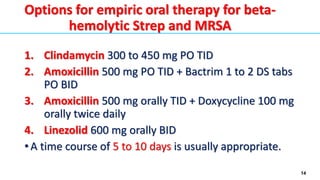
1. Clindamycin 300 to 450 mg PO TID
2. Amoxicillin 500 mg PO TID + Bactrim 1 to 2 DS tabs
PO BID
3. Amoxicillin 500 mg orally TID + Doxycycline 100 mg
orally twice daily
4. Linezolid 600 mg orally BID
• A time course of 5 to 10 days is usually appropriate.
Options for empiric oral therapy for beta-
hemolytic Strep and MRSA
15
Parenteral therapy should be
considered for patients with
extensive soft tissue involvement,
fever or other signs of systemic
illness, or patients with diabetes or
other immunodeficiency.
Treatment Requiring Hospitalization
16
•Vancomycin is antibiotic of choice for MRSA
skin infections and for those requiring
hospitalization.
•For those who fail or can’t tolerate
Vancomycin: DaptomycinTigecylcline and
Linezolid are alternative treatments.
TREATMENT: IV ANTIBIOTICS
17
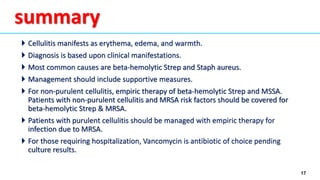
 Cellulitis manifests as erythema, edema, and warmth.
 Diagnosis is based upon clinical manifestations.
 Most common causes are beta-hemolytic Strep and Staph aureus.
 Management should include supportive measures.
 For non-purulent cellulitis, empiric therapy of beta-hemolytic Strep and MSSA.
Patients with non-purulent cellulitis and MRSA risk factors should be covered for
beta-hemolytic Strep & MRSA.
 Patients with purulent cellulitis should be managed with empiric therapy for
infection due to MRSA.
 For those requiring hospitalization, Vancomycin is antibiotic of choice pending
culture results.
summary
18
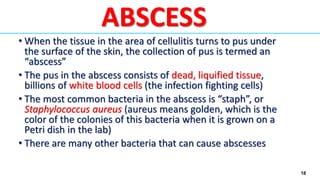
ABSCESS
• When the tissue in the area of cellulitis turns to pus under
the surface of the skin, the collection of pus is termed an
“abscess”
• The pus in the abscess consists of dead, liquified tissue,
billions of white blood cells (the infection fighting cells)
• The most common bacteria in the abscess is “staph”, or
Staphylococcus aureus (aureus means golden, which is the
color of the colonies of this bacteria when it is grown on a
Petri dish in the lab)
• There are many other bacteria that can cause abscesses
19
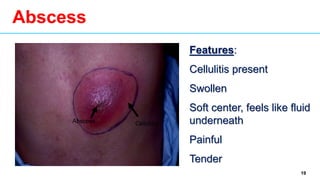
Abscess
Features:
Cellulitis present
Swollen
Soft center, feels like fluid
underneath
Painful
Tender
Cellulitis
Abscess
20
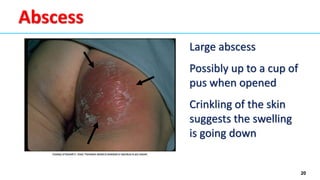
Abscess
Large abscess
Possibly up to a cup of
pus when opened
Crinkling of the skin
suggests the swelling
is going down
21
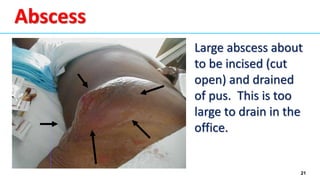
Abscess
Large abscess about
to be incised (cut
open) and drained
of pus. This is too
large to drain in the
office.
22
Treatment of Abscesses
•Abscesses should be drained
•This can be done at home with a sterilized single edged
razor blade, or an Exacto knife
•Sterilize by heating in a flame, allow to cool
•Clean the skin off with alcohol or iodine before opening
the abscess
•If the abscess has a lot of cellulitis around it, an
antibiotic is probably needed
23
“Sterile” Cellulitis and Abscesses
•If you inject sterile (no bacteria in it) tar heroin
under the skin the body will react to it in the
same way as it does to bacteria
•The cellulitis may not get better with antibiotics
•The abscess forms around the tar heroin that is
sitting in a glob under the skin
24
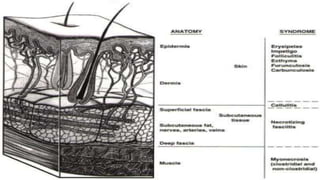
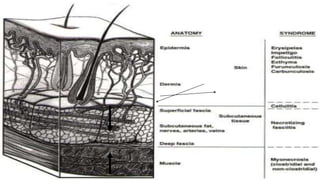
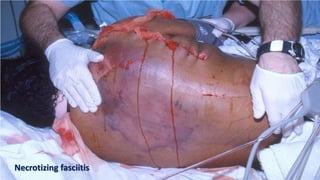
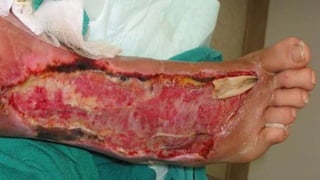
NECROTIZING FASCIITIS
• When the bacteria in a cellulitis or abscess start spreading quickly
between the fat layer and the muscle underneath it is termed
necrotizing fasciitis
• Necrotizing means turning living flesh to dead flesh
• Fasciitis means the infection is spreading along the space between
the fat and the muscle underneath
• The infection cuts off the blood supply to the tissue above it and the
tissue dies
• The bacteria also enter the bloodstream and cause severe systemic
illness called “sepsis”
25
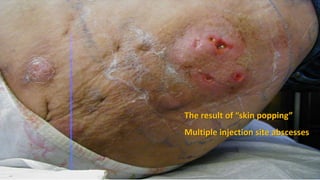
The result of “skin popping”
Multiple injection site abscesses
26
Necrotizing fasciitis
27
Indications of Necrotizing Fasciitis
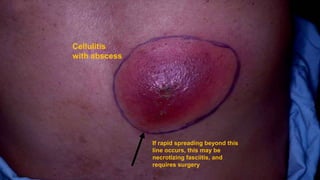
• If the area of redness is spreading rapidly (this means about
½ inch or more per hour) this may be “nec fasc”
• If the area is extremely painful
• If the person shows signs of bacteria getting into the
bloodstream (fever, change in mental function such as
delirium, profound weakness)
• Draw a line around the red area with a pen, then watch for
spreading beyond the line
• If spreading ½ inch or more per hour, go to a hospital
28
Cellulitis
with abscess
If rapid spreading beyond this
line occurs, this may be
necrotizing fasciitis, and
requires surgery
29
Necrotizing fasciitis
30
Treatment of Necrotizing Fasciitis
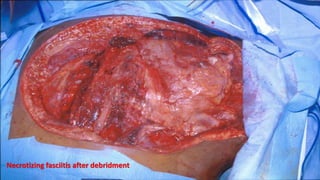
• Cut all the dead tissue out, and keep cutting until only living
tissue is left
• Go back and do the same thing every few hours, as often as
necessary, until the infection stops spreading
• Antibiotics help, but they will NOT cure the infection
• Without appropriate, drastic surgery the person will die
• The open muscle is then treated like a burn, with skin grafts
31
Necrotizing fasciitis after debridment
32
33
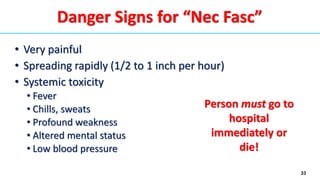
Danger Signs for “Nec Fasc”
• Very painful
• Spreading rapidly (1/2 to 1 inch per hour)
• Systemic toxicity
• Fever
• Chills, sweats
• Profound weakness
• Altered mental status
• Low blood pressure
Person must go to
hospital
immediately or
die!
34
Preventing Skin/Soft Tissue Infection
•Clean injection site (injection forces skin bacteria
under the skin where they can cause infection)
• Alcohol, hand alcohol gel, high octane booze
• Dish soap or other non-irritating soap
•Clean syringe and needle
•Clean drug (the longer you heat it the less likely
that bacteria will survive)
35
What is MRSA?
• It is Staphylococcus aureus,
• Which is a particular bacteria that is the most common cause of skin
infection in injectors as well as non-injectors
• Methicillin (like Keflex) Resistant Staphylococcus aureus
• MRSA is just Staph aureus that is resistant to the Keflex type antibiotics
AND
• It has picked up some new genes that make it more aggressive in skin, and
more likely to cause skin infection than “regular old” Staph aureus used to
• It now accounts for half the skin infections in injecting drug users
• It has to be treated with antibiotics other than Keflex or dicloxacillin
36
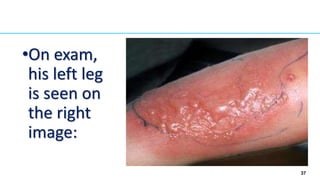
• A 48 year old male with history of HTN,
Hyperlipidemia, GERD, CKD on HD M,W,F (2/2 HTN)
who presents to your office with complaint of left leg
swelling and redness for the past 2-3 days. He states
that this has never happened before and that he his
worried because it has been worsening. He denies any
recent travel. He’s also noted some liquid draining
from the area as well.
Case presentation
37
•On exam,
his left leg
is seen on
the right
image:
38
a) Tell him to raise his leg to help with swelling
b) Get an outpatient ultrasound to assess for a blood
clot
c) To give him oral Keflex to treat a cellulitis
d) Admit to inpatient medicine for IV antibiotics
What should your (the physician) next step be:
39
•You call the triage resident and notify them that you
are directly admitting this patient for parenteral
antibiotics.
•What antibiotic choice is warranted in this patient?
a) cefazolin
b) vancomycin
c) daptomycin
d) clindamycin
40
Thank youuuu!!

04. cellulitis.ppt

  • 1.
    1 Skin and SoftTissue Infection (SSTI) Fahad zakwan
  • 2.
    2 •Cellulitis is askin infection that develops as a result of bacterial entry via breaches in the skin barrier. •Manifests as erythema, edema, and warmth. •Predisposing factors include disruption to the skin barrier as a result of trauma, inflammation, preexisting skin infection (ie tinea pedis), and edema. CELLULITIS
  • 3.
    3 • In cellulitisthe skin is red, hot, and painful. • Cellulitis can exist alone, with no pus, or it can surround an area of pus. Pus is commonly called “an abscess”. • We have all had cellulitis. The smallest cellulitis is the redness around a zit. A large area of cellulitis can involve a whole area of the body, such as the face, an arm or a leg, etc.
  • 4.
  • 5.
    5 Cellulitis Features: Red Swollen Warm to touch Noareas of pus Painful Tender Cellulitis
  • 6.
    6 Cellulitis Describe the featuresthat make this cellulitis
  • 7.
    7 •Diagnosis is basedupon clinical manifestations. Cultures of blood, needle aspirations, or punch biopsies aren’t useful in mild infection. •Cultures should be performed in patients with systemic toxicity, extensive skin involvement, underlying comorbidities (ie diabetes), animal bite, or recurrent cellulitis. •Radiographic exam can be useful in excluding occult abscess and osteomyelitis. Diagnosis
  • 8.
    8 •Most common pathogensare beta- hemolytic Strep and Staph aureus, including MRSA. •Gram-negative aerobic bacilli are identified in a minority of cases. Microbiology
  • 9.
    9 Antibiotic selection fortreatment depends on whether presentation consists of purulent or nonpurulent cellulitis (per 2011 ID Society of American guidelines). Treatment
  • 10.
    10 •Patients with purulentcellulitis (purulent drainage or exudate, in the absence of a drainable abscess) should be managed with empiric therapy for infection due to MRSA. Treatment: Purulent cellulitis
  • 11.
    11 •Options for empiricoral therapy for MRSA: 1) Clindamycin 300 to 450 mg PO TID 2) Bactrim 1-2 DS tab PO BID 3) Doxycycline 100 mg PO BID 4) Linezolid 600 mg PO BID •Depends on clinical response but a time course of 5-10 days is usually appropriate. Treatment: MRSA
  • 12.
    12 • For nonpurulentcellulitis, cover for beta-hemolytic Strep and MSSA. • MRSA coverage is warranted for patients fail initial therapy, signs of systemic illness, recurrent infection in the setting of underlying predisposing conditions, and previous episode of MRSA infection. • Empiric MRSA coverage should be used in patients with risk factors for MRSA and in communities with high prevalence of MRSA. Treatment: Nonpurulent Cellulitis
  • 13.
    13 1. Dicloxacillin 500mg PO every 6 hours 2. Cephalexin 500 mg PO every 6 hours 3. Clindamycin 300 to 450 mg PO every 6-8 hours •Depends on clinical response but a time course of 5 to 10 days is usually appropriate. Options for Nonpurulent cellulitis (excluding MRSA)
  • 14.
    14 1. Clindamycin 300to 450 mg PO TID 2. Amoxicillin 500 mg PO TID + Bactrim 1 to 2 DS tabs PO BID 3. Amoxicillin 500 mg orally TID + Doxycycline 100 mg orally twice daily 4. Linezolid 600 mg orally BID • A time course of 5 to 10 days is usually appropriate. Options for empiric oral therapy for beta- hemolytic Strep and MRSA
  • 15.
    15 Parenteral therapy shouldbe considered for patients with extensive soft tissue involvement, fever or other signs of systemic illness, or patients with diabetes or other immunodeficiency. Treatment Requiring Hospitalization
  • 16.
    16 •Vancomycin is antibioticof choice for MRSA skin infections and for those requiring hospitalization. •For those who fail or can’t tolerate Vancomycin: DaptomycinTigecylcline and Linezolid are alternative treatments. TREATMENT: IV ANTIBIOTICS
  • 17.
    17  Cellulitis manifestsas erythema, edema, and warmth.  Diagnosis is based upon clinical manifestations.  Most common causes are beta-hemolytic Strep and Staph aureus.  Management should include supportive measures.  For non-purulent cellulitis, empiric therapy of beta-hemolytic Strep and MSSA. Patients with non-purulent cellulitis and MRSA risk factors should be covered for beta-hemolytic Strep & MRSA.  Patients with purulent cellulitis should be managed with empiric therapy for infection due to MRSA.  For those requiring hospitalization, Vancomycin is antibiotic of choice pending culture results. summary
  • 18.
    18 ABSCESS • When thetissue in the area of cellulitis turns to pus under the surface of the skin, the collection of pus is termed an “abscess” • The pus in the abscess consists of dead, liquified tissue, billions of white blood cells (the infection fighting cells) • The most common bacteria in the abscess is “staph”, or Staphylococcus aureus (aureus means golden, which is the color of the colonies of this bacteria when it is grown on a Petri dish in the lab) • There are many other bacteria that can cause abscesses
  • 19.
    19 Abscess Features: Cellulitis present Swollen Soft center,feels like fluid underneath Painful Tender Cellulitis Abscess
  • 20.
    20 Abscess Large abscess Possibly upto a cup of pus when opened Crinkling of the skin suggests the swelling is going down
  • 21.
    21 Abscess Large abscess about tobe incised (cut open) and drained of pus. This is too large to drain in the office.
  • 22.
    22 Treatment of Abscesses •Abscessesshould be drained •This can be done at home with a sterilized single edged razor blade, or an Exacto knife •Sterilize by heating in a flame, allow to cool •Clean the skin off with alcohol or iodine before opening the abscess •If the abscess has a lot of cellulitis around it, an antibiotic is probably needed
  • 23.
    23 “Sterile” Cellulitis andAbscesses •If you inject sterile (no bacteria in it) tar heroin under the skin the body will react to it in the same way as it does to bacteria •The cellulitis may not get better with antibiotics •The abscess forms around the tar heroin that is sitting in a glob under the skin
  • 24.
    24 NECROTIZING FASCIITIS • Whenthe bacteria in a cellulitis or abscess start spreading quickly between the fat layer and the muscle underneath it is termed necrotizing fasciitis • Necrotizing means turning living flesh to dead flesh • Fasciitis means the infection is spreading along the space between the fat and the muscle underneath • The infection cuts off the blood supply to the tissue above it and the tissue dies • The bacteria also enter the bloodstream and cause severe systemic illness called “sepsis”
  • 25.
    25 The result of“skin popping” Multiple injection site abscesses
  • 26.
  • 27.
    27 Indications of NecrotizingFasciitis • If the area of redness is spreading rapidly (this means about ½ inch or more per hour) this may be “nec fasc” • If the area is extremely painful • If the person shows signs of bacteria getting into the bloodstream (fever, change in mental function such as delirium, profound weakness) • Draw a line around the red area with a pen, then watch for spreading beyond the line • If spreading ½ inch or more per hour, go to a hospital
  • 28.
    28 Cellulitis with abscess If rapidspreading beyond this line occurs, this may be necrotizing fasciitis, and requires surgery
  • 29.
  • 30.
    30 Treatment of NecrotizingFasciitis • Cut all the dead tissue out, and keep cutting until only living tissue is left • Go back and do the same thing every few hours, as often as necessary, until the infection stops spreading • Antibiotics help, but they will NOT cure the infection • Without appropriate, drastic surgery the person will die • The open muscle is then treated like a burn, with skin grafts
  • 31.
  • 32.
  • 33.
    33 Danger Signs for“Nec Fasc” • Very painful • Spreading rapidly (1/2 to 1 inch per hour) • Systemic toxicity • Fever • Chills, sweats • Profound weakness • Altered mental status • Low blood pressure Person must go to hospital immediately or die!
  • 34.
    34 Preventing Skin/Soft TissueInfection •Clean injection site (injection forces skin bacteria under the skin where they can cause infection) • Alcohol, hand alcohol gel, high octane booze • Dish soap or other non-irritating soap •Clean syringe and needle •Clean drug (the longer you heat it the less likely that bacteria will survive)
  • 35.
    35 What is MRSA? •It is Staphylococcus aureus, • Which is a particular bacteria that is the most common cause of skin infection in injectors as well as non-injectors • Methicillin (like Keflex) Resistant Staphylococcus aureus • MRSA is just Staph aureus that is resistant to the Keflex type antibiotics AND • It has picked up some new genes that make it more aggressive in skin, and more likely to cause skin infection than “regular old” Staph aureus used to • It now accounts for half the skin infections in injecting drug users • It has to be treated with antibiotics other than Keflex or dicloxacillin
  • 36.
    36 • A 48year old male with history of HTN, Hyperlipidemia, GERD, CKD on HD M,W,F (2/2 HTN) who presents to your office with complaint of left leg swelling and redness for the past 2-3 days. He states that this has never happened before and that he his worried because it has been worsening. He denies any recent travel. He’s also noted some liquid draining from the area as well. Case presentation
  • 37.
    37 •On exam, his leftleg is seen on the right image:
  • 38.
    38 a) Tell himto raise his leg to help with swelling b) Get an outpatient ultrasound to assess for a blood clot c) To give him oral Keflex to treat a cellulitis d) Admit to inpatient medicine for IV antibiotics What should your (the physician) next step be:
  • 39.
    39 •You call thetriage resident and notify them that you are directly admitting this patient for parenteral antibiotics. •What antibiotic choice is warranted in this patient? a) cefazolin b) vancomycin c) daptomycin d) clindamycin
  • 40.