The Cell Cycle and How Cells Divide
E-CLIP EIS Teaching – Learning Strategies / Procedures
Biology Secondary 6, duration 60 min.
Teacher: Mr.Wichai Likitponrak
2
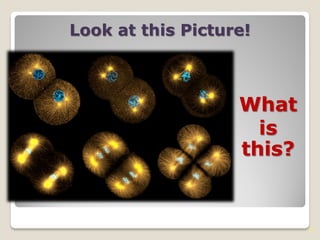
Look at this Picture!
What
is
this?
3
Introduction by this VDO!!!
https://www.youtube.com/watch?v=vA8aMpHwYh0
4
Phases of the Cell Cycle
 The cell cycle consists of
◦ Interphase – normal cell activity
◦ The mitotic phase – cell divsion
INTERPHASE
Growth
G 1
(DNA synthesis)
Growth
G2
5
Cell Division
 An integral part of the cell cycle
 Results in genetically identical daughter cells
 Cells duplicate their genetic material
◦ Before they divide, ensuring that each daughter
cell receives an exact copy of the genetic
material, DNA
20 µm100 µm 200 µm
(a) Reproduction. An amoeba,
a single-celled eukaryote, is
dividing into two cells. Each
new cell will be an individual
organism (LM).
(b) Growth and development.
This micrograph shows a
sand dollar embryo shortly after
the fertilized egg divided, forming
two cells (LM).
(c) Tissue renewal. These dividing
bone marrow cells (arrow) will
give rise to new blood cells (LM).
6
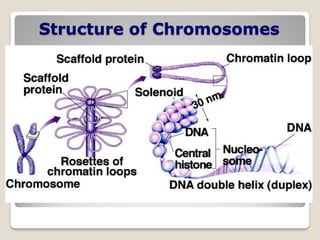
Structure of Chromosomes
7
Chromosome Duplication
0.5 µm
Chromosome
duplication
(including DNA
synthesis)
Centromere
Separation
of sister
chromatids
Sister
chromatids
Centrometers Sister chromatids
A eukaryotic cell has multiple
chromosomes, one of which is
represented here. Before
duplication, each chromosome
has a single DNA molecule.
Once duplicated, a chromosome
consists of two sister chromatids
connected at the centromere. Each
chromatid contains a copy of the
DNA molecule.
Mechanical processes separate
the sister chromatids into two
chromosomes and distribute
them to two daughter cells.
8
Structure of Chromosomes
 The centromere is a constricted region of the
chromosome containing a specific DNA sequence, to
which is bound 2 discs of protein called kinetochores.
 Kinetochores serve as points of attachment for
microtubules that move the chromosomes during cell
division:
Metaphase chromosome
Kinetochore
Kinetochore
microtubules
Centromere
region of
chromosome
Sister Chromatids
9
Phases of the Cell Cycle
 Interphase
◦ G1 - primary growth
◦ S - genome replicated
◦ G2 - secondary growth
 M - mitosis
 C - cytokinesis
10
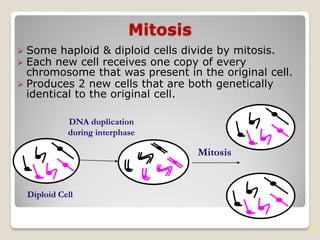
Mitosis
 Some haploid & diploid cells divide by mitosis.
 Each new cell receives one copy of every
chromosome that was present in the original cell.
 Produces 2 new cells that are both genetically
identical to the original cell.
DNA duplication
during interphase
Mitosis
Diploid Cell
11
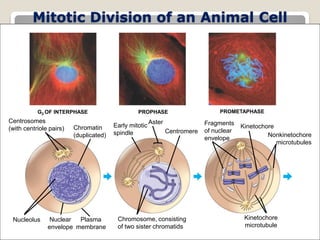
Mitotic Division of an Animal Cell
G2 OF INTERPHASE PROPHASE PROMETAPHASE
Centrosomes
(with centriole pairs) Chromatin
(duplicated)
Early mitotic
spindle
Aster
Centromere
Fragments
of nuclear
envelope
Kinetochore
Nucleolus Nuclear
envelope
Plasma
membrane
Chromosome, consisting
of two sister chromatids
Kinetochore
microtubule
Nonkinetochore
microtubules
12
METAPHASE ANAPHASE TELOPHASE AND CYTOKINESIS
Spindle
Metaphase
plate Nucleolus
forming
Cleavage
furrow
Nuclear
envelope
formingCentrosome at
one spindle pole
Daughter
chromosomes
Mitotic Division of an Animal Cell
13
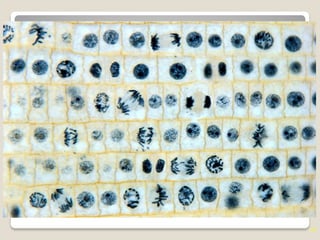
Mitosis in a plant cell
1 Prophase.
The chromatin
is condensing.
The nucleolus is
beginning to
disappear.
Although not
yet visible
in the micrograph,
the mitotic spindle is
staring to from.
Prometaphase.
We now see discrete
chromosomes; each
consists of two
identical sister
chromatids. Later
in prometaphase, the
nuclear envelop will
fragment.
Metaphase. The
spindle is complete,
and the chromosomes,
attached to microtubules
at their kinetochores,
are all at the metaphase
plate.
Anaphase. The
chromatids of each
chromosome have
separated, and the
daughter chromosomes
are moving to the ends
of cell as their
kinetochore
microtubles shorten.
Telophase. Daughter
nuclei are forming.
Meanwhile, cytokinesis
has started: The cell
plate, which will
divided the cytoplasm
in two, is growing
toward the perimeter
of the parent cell.
2 3 4 5
Nucleus
Nucleolus
ChromosomeChromatine
condensing
14
15
Meiosis
 Reduces the chromosome number such
that each daughter
 Cell has a haploid set of chromosomes
 Ensures that the next generation will
have:
◦ Diploid number of chromosome
◦ Exchange of genetic information
(combination of traits
◦ that differs from that of either
parent)
 Only diploid cells can divide by meiosis.
 Prior to meiosis I, DNA replication
occurs.
 During meiosis, there will be two
nuclear divisions, and the result will be
four haploid nuclei.
 No replication of DNA occurs between
meiosis I and meiosis II.
Interphase
Homologous pair
of chromosomes
in diploid parent cell
Chromosomes
replicate
Homologous pair of replicated chromosomes
Sister
chromatids Diploid cell with
replicated
chromosomes
1
2
Homologous
chromosomes
separate
Haploid cells with
replicated chromosomes
Sister chromatids
separate
Haploid cells with unreplicated chromosomes
Meiosis I
Meiosis II
16
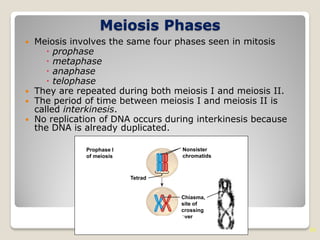
Meiosis Phases
 Meiosis involves the same four phases seen in mitosis
 prophase
 metaphase
 anaphase
 telophase
 They are repeated during both meiosis I and meiosis II.
 The period of time between meiosis I and meiosis II is
called interkinesis.
 No replication of DNA occurs during interkinesis because
the DNA is already duplicated.
Prophase I
of meiosis
Tetrad
Nonsister
chromatids
Chiasma,
site of
crossing
over
17
Sister
chromatids
Chiasmata
Spindle
Centromere
(with kinetochore)
Metaphase
plate
Homologous
chromosomes
separate
Sister chromatids
remain attached
Microtubule
attached to
kinetochore
Tetrad
PROPHASE I METAPHASE I ANAPHASE I
Homologous chromosomes
(red and blue) pair and
exchange segments; 2n = 6
in this example
Pairs of homologous
chromosomes split up
Tetrads line up
Meiosis I is very important to variation
(crossing over)
18
 Meiosis II is very similar to mitosis
Cleavage
furrow
PROPHASE II METAPHASE II ANAPHASE II
TELOPHASE I AND
CYTOKINESIS
TELOPHASE II AND
CYTOKINESIS
Sister chromatids
separate
Haploid daughter cells
forming
19
A Comparison of Mitosis and Meiosis
 Mitosis conserves the number of chromosome sets,
producing cells that are genetically identical to the parent
cell
 Meiosis reduces the number of chromosomes sets from two
(diploid) to one (haploid), producing cells that differ
genetically from each other and from the parent cell
 The mechanism for separating sister chromatids is virtually
identical in meiosis II and mitosis
20
MITOSIS MEIOSIS
Prophase
Duplicated chromosome
(two sister chromatids)
Chromosome
replication
Chromosome
replication
Parent cell
(before chromosome replication)
Chiasma (site of
crossing over)
MEIOSIS I
Prophase I
Tetrad formed by
synapsis of homologous
chromosomes
Metaphase
Chromosomes
positioned at the
metaphase plate
Tetrads
positioned at the
metaphase plate
Metaphase I
Anaphase I
Telophase I
Haploid
n = 3
MEIOSIS II
Daughter
cells of
meiosis I
Homologues
separate
during
anaphase I;
sister
chromatids
remain together
Daughter cells of meiosis II
n n n n
Sister chromatids separate during anaphase II
Anaphase
Telophase
Sister chromatids
separate during
anaphase
2n 2n
Daughter cells
of mitosis
2n = 6
A Comparison Of Mitosis And Meiosis
21
Assignment:
 Worksheet
 Pages 7-9
◦ 1.1, 1.2 and 1.3
Sent me back
in this class !!!

Celldivision mee

  • 1.
    The Cell Cycleand How Cells Divide E-CLIP EIS Teaching – Learning Strategies / Procedures Biology Secondary 6, duration 60 min. Teacher: Mr.Wichai Likitponrak
  • 2.
    2 Look at thisPicture! What is this?
  • 3.
    3 Introduction by thisVDO!!! https://www.youtube.com/watch?v=vA8aMpHwYh0
  • 4.
    4 Phases of theCell Cycle  The cell cycle consists of ◦ Interphase – normal cell activity ◦ The mitotic phase – cell divsion INTERPHASE Growth G 1 (DNA synthesis) Growth G2
  • 5.
    5 Cell Division  Anintegral part of the cell cycle  Results in genetically identical daughter cells  Cells duplicate their genetic material ◦ Before they divide, ensuring that each daughter cell receives an exact copy of the genetic material, DNA 20 µm100 µm 200 µm (a) Reproduction. An amoeba, a single-celled eukaryote, is dividing into two cells. Each new cell will be an individual organism (LM). (b) Growth and development. This micrograph shows a sand dollar embryo shortly after the fertilized egg divided, forming two cells (LM). (c) Tissue renewal. These dividing bone marrow cells (arrow) will give rise to new blood cells (LM).
  • 6.
  • 7.
    7 Chromosome Duplication 0.5 µm Chromosome duplication (includingDNA synthesis) Centromere Separation of sister chromatids Sister chromatids Centrometers Sister chromatids A eukaryotic cell has multiple chromosomes, one of which is represented here. Before duplication, each chromosome has a single DNA molecule. Once duplicated, a chromosome consists of two sister chromatids connected at the centromere. Each chromatid contains a copy of the DNA molecule. Mechanical processes separate the sister chromatids into two chromosomes and distribute them to two daughter cells.
  • 8.
    8 Structure of Chromosomes The centromere is a constricted region of the chromosome containing a specific DNA sequence, to which is bound 2 discs of protein called kinetochores.  Kinetochores serve as points of attachment for microtubules that move the chromosomes during cell division: Metaphase chromosome Kinetochore Kinetochore microtubules Centromere region of chromosome Sister Chromatids
  • 9.
    9 Phases of theCell Cycle  Interphase ◦ G1 - primary growth ◦ S - genome replicated ◦ G2 - secondary growth  M - mitosis  C - cytokinesis
  • 10.
    10 Mitosis  Some haploid& diploid cells divide by mitosis.  Each new cell receives one copy of every chromosome that was present in the original cell.  Produces 2 new cells that are both genetically identical to the original cell. DNA duplication during interphase Mitosis Diploid Cell
  • 11.
    11 Mitotic Division ofan Animal Cell G2 OF INTERPHASE PROPHASE PROMETAPHASE Centrosomes (with centriole pairs) Chromatin (duplicated) Early mitotic spindle Aster Centromere Fragments of nuclear envelope Kinetochore Nucleolus Nuclear envelope Plasma membrane Chromosome, consisting of two sister chromatids Kinetochore microtubule Nonkinetochore microtubules
  • 12.
    12 METAPHASE ANAPHASE TELOPHASEAND CYTOKINESIS Spindle Metaphase plate Nucleolus forming Cleavage furrow Nuclear envelope formingCentrosome at one spindle pole Daughter chromosomes Mitotic Division of an Animal Cell
  • 13.
    13 Mitosis in aplant cell 1 Prophase. The chromatin is condensing. The nucleolus is beginning to disappear. Although not yet visible in the micrograph, the mitotic spindle is staring to from. Prometaphase. We now see discrete chromosomes; each consists of two identical sister chromatids. Later in prometaphase, the nuclear envelop will fragment. Metaphase. The spindle is complete, and the chromosomes, attached to microtubules at their kinetochores, are all at the metaphase plate. Anaphase. The chromatids of each chromosome have separated, and the daughter chromosomes are moving to the ends of cell as their kinetochore microtubles shorten. Telophase. Daughter nuclei are forming. Meanwhile, cytokinesis has started: The cell plate, which will divided the cytoplasm in two, is growing toward the perimeter of the parent cell. 2 3 4 5 Nucleus Nucleolus ChromosomeChromatine condensing
  • 14.
  • 15.
    15 Meiosis  Reduces thechromosome number such that each daughter  Cell has a haploid set of chromosomes  Ensures that the next generation will have: ◦ Diploid number of chromosome ◦ Exchange of genetic information (combination of traits ◦ that differs from that of either parent)  Only diploid cells can divide by meiosis.  Prior to meiosis I, DNA replication occurs.  During meiosis, there will be two nuclear divisions, and the result will be four haploid nuclei.  No replication of DNA occurs between meiosis I and meiosis II. Interphase Homologous pair of chromosomes in diploid parent cell Chromosomes replicate Homologous pair of replicated chromosomes Sister chromatids Diploid cell with replicated chromosomes 1 2 Homologous chromosomes separate Haploid cells with replicated chromosomes Sister chromatids separate Haploid cells with unreplicated chromosomes Meiosis I Meiosis II
  • 16.
    16 Meiosis Phases  Meiosisinvolves the same four phases seen in mitosis  prophase  metaphase  anaphase  telophase  They are repeated during both meiosis I and meiosis II.  The period of time between meiosis I and meiosis II is called interkinesis.  No replication of DNA occurs during interkinesis because the DNA is already duplicated. Prophase I of meiosis Tetrad Nonsister chromatids Chiasma, site of crossing over
  • 17.
    17 Sister chromatids Chiasmata Spindle Centromere (with kinetochore) Metaphase plate Homologous chromosomes separate Sister chromatids remainattached Microtubule attached to kinetochore Tetrad PROPHASE I METAPHASE I ANAPHASE I Homologous chromosomes (red and blue) pair and exchange segments; 2n = 6 in this example Pairs of homologous chromosomes split up Tetrads line up Meiosis I is very important to variation (crossing over)
  • 18.
    18  Meiosis IIis very similar to mitosis Cleavage furrow PROPHASE II METAPHASE II ANAPHASE II TELOPHASE I AND CYTOKINESIS TELOPHASE II AND CYTOKINESIS Sister chromatids separate Haploid daughter cells forming
  • 19.
    19 A Comparison ofMitosis and Meiosis  Mitosis conserves the number of chromosome sets, producing cells that are genetically identical to the parent cell  Meiosis reduces the number of chromosomes sets from two (diploid) to one (haploid), producing cells that differ genetically from each other and from the parent cell  The mechanism for separating sister chromatids is virtually identical in meiosis II and mitosis
  • 20.
    20 MITOSIS MEIOSIS Prophase Duplicated chromosome (twosister chromatids) Chromosome replication Chromosome replication Parent cell (before chromosome replication) Chiasma (site of crossing over) MEIOSIS I Prophase I Tetrad formed by synapsis of homologous chromosomes Metaphase Chromosomes positioned at the metaphase plate Tetrads positioned at the metaphase plate Metaphase I Anaphase I Telophase I Haploid n = 3 MEIOSIS II Daughter cells of meiosis I Homologues separate during anaphase I; sister chromatids remain together Daughter cells of meiosis II n n n n Sister chromatids separate during anaphase II Anaphase Telophase Sister chromatids separate during anaphase 2n 2n Daughter cells of mitosis 2n = 6 A Comparison Of Mitosis And Meiosis
  • 21.
    21 Assignment:  Worksheet  Pages7-9 ◦ 1.1, 1.2 and 1.3 Sent me back in this class !!!