CELL DIVISION CHAPTER 5
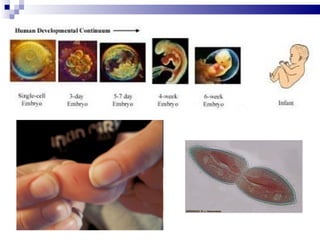
Significance of mitosis Growth-  allows a zygote to produce more cell in order to grow  Repair and replacement-  allow the multicellular organism maintain its tissues, example skin cells and blood Asexual reproduction-  clone
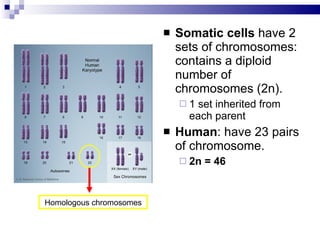
Somatic cells  have 2 sets of chromosomes: contains a diploid number of chromosomes (2n). 1 set inherited from each parent Human : have 23 pairs of chromosome.  2n = 46 Homologous chromosomes
Cell Cycle Cell cycle - The period that extends from the time a new cell is produced until the time the cell completes a cell division. Mitosis : nuclear division Cytokinesis : cytoplasmic division The cell cycle is divided into  two  major phases: Interphase Mitosis Cell grows Cell prepares to divide
Interphase The period between division, divided into 3 sub phases (G1, S and G2): G 1 - cells grow rapidly and new organelle are synthesis S - synthesis of DNA and chromosomes are replicated G 2  - cells prepare for mitosis, synthesis protein and mitotic spindle begin to form
Mitosis   Mitosis is a division of the nucleus to produce two new daughter cells containing chromosomes identical to the parent cell. Mitosis is a continuous process and divided into 4 main phases based on the appearance and behavior of the chromosomes. Prophase, P Metaphase, M Anaphase, A Telophase, T


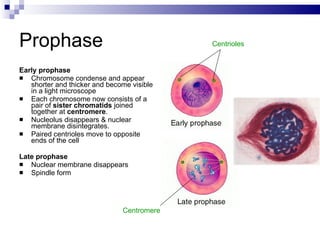
Prophase Early prophase Chromosome condense and appear shorter and thicker and become visible in a light microscope Each chromosome now consists of a pair of  sister chromatids  joined together at  centromere . Nucleolus disappears & nuclear membrane disintegrates. Paired centrioles move to opposite ends of the cell Late prophase Nuclear membrane disappears Spindle form Centrioles   Centromere
Metaphase  Spindle fibres are fully form Sister cromatids line up at the spindle equator/ metaphase plate. Two sister chromatids are still attached to one another at the centromere. At the end of metaphase, the centromers divide.
Anaphase  Anaphase begin with the separation of the centromers The sister cromatids are drawn to opposite poles of the cell by shortening of spindle fibres. Once separated, chromatids are referred to as  daughter chromosome. End anaphase: the poles of the cell have complete and equivalent sets of chromosome.
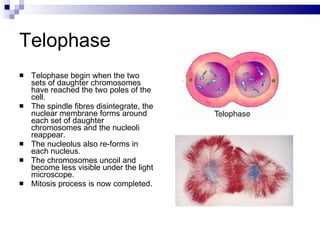
Telophase  Telophase begin when the two sets of daughter chromosomes have reached the two poles of the cell. The spindle fibres disintegrate, the nuclear membrane forms around each set of daughter chromosomes and the nucleoli reappear. The nucleolus also re-forms in each nucleus. The chromosomes uncoil and become less visible under the light microscope. Mitosis process is now completed.
Cytokinesis    process of cytoplasmic division to form two daughter cells. Different in animals and plants. Animal cells , the cytoplasm contracts to pull the plasma membrane inwards, forming groove called a  cleavage furrow  In  plant cells , cytokinesis in cells is markedly different. A  cleavage furrow  does not form. Instead, membrane-enclosed vesicle gather at a plant cell’s equator between the two nuclei. Vesicle fuse to form a  cell plate
 
The importance of controlled mitosis Controlled mitosis : the ability of the cell to divide at its own rate and time. Crucial to normal growth, development and maintenance for the perpetuity of living things. Eg: in  plants     controlled mitosis occurs at shoots results in growth of plants. in human   Malphigian layer of skin divides actively to replace dead and damaged cells.
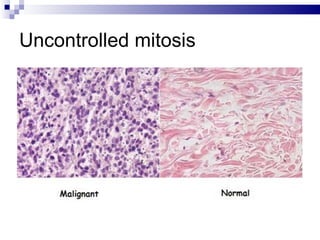
The effects of uncontrolled mitosis in living things Mutation is the change in the DNA structure of the cell. This change in the DNA corrupts the coded genetic instructions for mitosis control. This leads to uncontrolled mitosis, which is the non-stop division of cells, producing a mass of new daughter cells, called tumour.
Uncontrolled mitosis
Causes of Cancer Genetic-  some forms of cancer like prostate, colon, breast, skin, ovary are suspected to be inherited from the parents Carcinogens-  these are chemicals which affect genetic activity and cause cancer, e.g. of carcinogen a diesel exhaust, cigarette smoke, hair dyes, soot, arsenic, benzene and formaldehyde. Radiation-  excess exposure to x-ray, gamma-rays and ultra violet rays lead to increase cancer risk. Viruses-  some viruses (such as the HPV and HIV-1) cause cancer.
Application of Mitosis in Cloning Mitosis is used to  improve the quality , to  produce new species  and to  ensure uniformity in the traits . Cloning : process of  artificially  creating a  new individual  that is  genetically identical  to an existing individual. Technique in application of mitosis in cloning     tissue culture .
Application on mitosis in cloning Plant tissue Skin tissue

5.1 Mitosis

  • 1.
  • 2.
  • 3.
    Significance of mitosisGrowth- allows a zygote to produce more cell in order to grow Repair and replacement- allow the multicellular organism maintain its tissues, example skin cells and blood Asexual reproduction- clone
  • 4.
    Somatic cells have 2 sets of chromosomes: contains a diploid number of chromosomes (2n). 1 set inherited from each parent Human : have 23 pairs of chromosome. 2n = 46 Homologous chromosomes
  • 5.
    Cell Cycle Cellcycle - The period that extends from the time a new cell is produced until the time the cell completes a cell division. Mitosis : nuclear division Cytokinesis : cytoplasmic division The cell cycle is divided into two major phases: Interphase Mitosis Cell grows Cell prepares to divide
  • 6.
    Interphase The periodbetween division, divided into 3 sub phases (G1, S and G2): G 1 - cells grow rapidly and new organelle are synthesis S - synthesis of DNA and chromosomes are replicated G 2 - cells prepare for mitosis, synthesis protein and mitotic spindle begin to form
  • 7.
    Mitosis Mitosis is a division of the nucleus to produce two new daughter cells containing chromosomes identical to the parent cell. Mitosis is a continuous process and divided into 4 main phases based on the appearance and behavior of the chromosomes. Prophase, P Metaphase, M Anaphase, A Telophase, T
  • 8.
  • 9.
  • 10.
  • 11.
    Prophase Early prophaseChromosome condense and appear shorter and thicker and become visible in a light microscope Each chromosome now consists of a pair of sister chromatids joined together at centromere . Nucleolus disappears & nuclear membrane disintegrates. Paired centrioles move to opposite ends of the cell Late prophase Nuclear membrane disappears Spindle form Centrioles Centromere
  • 12.
    Metaphase Spindlefibres are fully form Sister cromatids line up at the spindle equator/ metaphase plate. Two sister chromatids are still attached to one another at the centromere. At the end of metaphase, the centromers divide.
  • 13.
    Anaphase Anaphasebegin with the separation of the centromers The sister cromatids are drawn to opposite poles of the cell by shortening of spindle fibres. Once separated, chromatids are referred to as daughter chromosome. End anaphase: the poles of the cell have complete and equivalent sets of chromosome.
  • 14.
    Telophase Telophasebegin when the two sets of daughter chromosomes have reached the two poles of the cell. The spindle fibres disintegrate, the nuclear membrane forms around each set of daughter chromosomes and the nucleoli reappear. The nucleolus also re-forms in each nucleus. The chromosomes uncoil and become less visible under the light microscope. Mitosis process is now completed.
  • 15.
    Cytokinesis  process of cytoplasmic division to form two daughter cells. Different in animals and plants. Animal cells , the cytoplasm contracts to pull the plasma membrane inwards, forming groove called a cleavage furrow In plant cells , cytokinesis in cells is markedly different. A cleavage furrow does not form. Instead, membrane-enclosed vesicle gather at a plant cell’s equator between the two nuclei. Vesicle fuse to form a cell plate
  • 16.
  • 17.
    The importance ofcontrolled mitosis Controlled mitosis : the ability of the cell to divide at its own rate and time. Crucial to normal growth, development and maintenance for the perpetuity of living things. Eg: in plants  controlled mitosis occurs at shoots results in growth of plants. in human  Malphigian layer of skin divides actively to replace dead and damaged cells.
  • 18.
    The effects ofuncontrolled mitosis in living things Mutation is the change in the DNA structure of the cell. This change in the DNA corrupts the coded genetic instructions for mitosis control. This leads to uncontrolled mitosis, which is the non-stop division of cells, producing a mass of new daughter cells, called tumour.
  • 19.
  • 20.
    Causes of CancerGenetic- some forms of cancer like prostate, colon, breast, skin, ovary are suspected to be inherited from the parents Carcinogens- these are chemicals which affect genetic activity and cause cancer, e.g. of carcinogen a diesel exhaust, cigarette smoke, hair dyes, soot, arsenic, benzene and formaldehyde. Radiation- excess exposure to x-ray, gamma-rays and ultra violet rays lead to increase cancer risk. Viruses- some viruses (such as the HPV and HIV-1) cause cancer.
  • 21.
    Application of Mitosisin Cloning Mitosis is used to improve the quality , to produce new species and to ensure uniformity in the traits . Cloning : process of artificially creating a new individual that is genetically identical to an existing individual. Technique in application of mitosis in cloning  tissue culture .
  • 22.
    Application on mitosisin cloning Plant tissue Skin tissue