
Eukaryotic cell
cycle
&
its Regulation

By
SHRUTI GUPTA
NCAAH
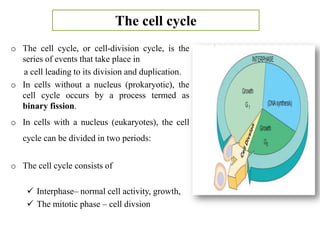
The cell cycle
o The cell cycle, or cell-division cycle, is the
series of events that take place in
a cell leading to its division and duplication.
o In cells without a nucleus (prokaryotic), the
cell cycle occurs by a process termed as
binary fission.
o In cells with a nucleus (eukaryotes), the cell

cycle can be divided in two periods:
o The cell cycle consists of

 Interphase– normal cell activity, growth,
 The mitotic phase – cell divsion
• Interphase: during which the cell grows, accumulating nutrients needed
for mitosis and duplicating its DNA.

• Mitosis (M) phase during which the cell splits itself into two distinct cells,
often called "daughter cells" .

• Cytokinesis, final phase, where the new cell is completely divided.
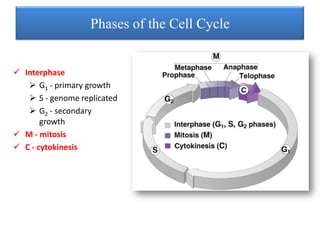
Phases of the Cell Cycle

 Interphase
 G1 - primary growth
 S - genome replicated
 G2 - secondary
growth
 M - mitosis
 C - cytokinesis
Interphase
G1 - Cells undergo majority of growth
S - Each chromosome replicates (Synthesizes) to
produce sister chromatids.
– Attached at centromere.
– Contains attachment site (kinetochore).

G2 -

Chromosomes condense - Assemble
machinery for division such as centrioles.
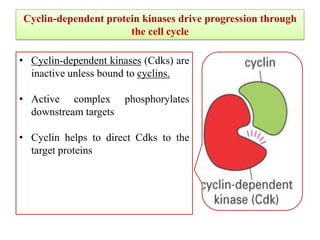
Cyclin-dependent protein kinases drive progression through
the cell cycle

• Cyclin-dependent kinases (Cdks) are
inactive unless bound to cyclins.
• Active complex phosphorylates
downstream targets
• Cyclin helps to direct Cdks to the
target proteins
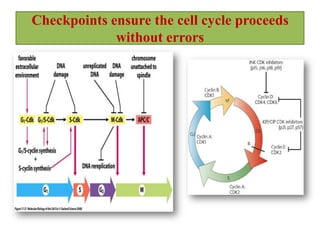
Checkpoints ensure the cell cycle proceeds
without errors
Eukaryotic cells divided by two
ways:
Mitosis- generally all somatic cells divide by
this way. Produces 2 identical cells.
Meiosis- germ cells follow this type of
division pattern, produces 4 identical cells.
MITOSIS
 Also named as equational division.
 Some haploid & diploid cells divide by mitosis.
 The term Mitosis was introduced by Walther Flemming in 1882.
 Mitosis is the process by which a eukaryotic cell separates the chromosomes
in its cell nucleus into two identical sets, in two separate nuclei
 “Open" mitosis, where the nuclear envelope breaks down before the
chromosomes separate, most animals
 “Closed" mitosis, where chromosomes divide within an intact cell nucleus,
fungi
 Prokaryotic cells, which lack a nucleus, divide by a process called binary
fission
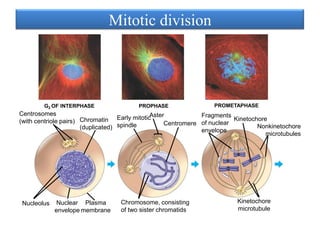
Mitotic division

G2 OF INTERPHASE

PROPHASE

PROMETAPHASE

Centrosomes
Aster
Fragments
Kinetochore
Chromatin Early mitotic
(with centriole pairs)
Centromere of nuclear
spindle
Nonkinetochore
(duplicated)
envelope
microtubules

Nucleolus

Nuclear Plasma
envelope membrane

Chromosome, consisting
of two sister chromatids

Kinetochore
microtubule
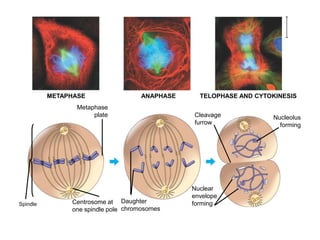
METAPHASE

ANAPHASE

Metaphase
plate

Spindle

Centrosome at Daughter
one spindle pole chromosomes

TELOPHASE AND CYTOKINESIS
Cleavage
furrow

Nuclear
envelope
forming

Nucleolus
forming
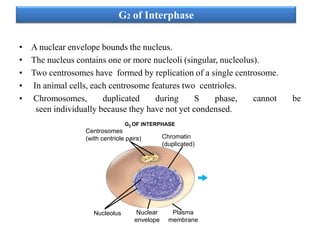
G2 of Interphase
• A nuclear envelope bounds the nucleus.
• The nucleus contains one or more nucleoli (singular, nucleolus).
• Two centrosomes have formed by replication of a single centrosome.
• In animal cells, each centrosome features two centrioles.
• Chromosomes,
duplicated
during
S
phase,
cannot
seen individually because they have not yet condensed.
G2 OF INTERPHASE

Centrosomes
(with centriole pairs)

Nucleolus

Nuclear
envelope

Chromatin
(duplicated)

Plasma
membrane

be
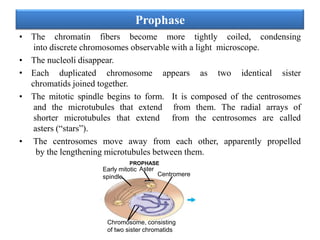
Prophase
• The chromatin fibers become more tightly coiled, condensing
into discrete chromosomes observable with a light microscope.
• The nucleoli disappear.
• Each duplicated chromosome appears as two identical sister
chromatids joined together.
• The mitotic spindle begins to form. It is composed of the centrosomes
and the microtubules that extend from them. The radial arrays of
shorter microtubules that extend from the centrosomes are called
asters (―stars‖).
• The centrosomes move away from each other, apparently propelled
by the lengthening microtubules between them.
PROPHASE

Early mitotic Aster
Centromere
spindle

Chromosome, consisting
of two sister chromatids
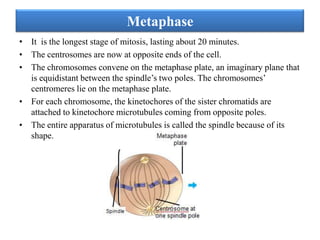
Metaphase
• It is the longest stage of mitosis, lasting about 20 minutes.
• The centrosomes are now at opposite ends of the cell.
• The chromosomes convene on the metaphase plate, an imaginary plane that
is equidistant between the spindle’s two poles. The chromosomes’
centromeres lie on the metaphase plate.
• For each chromosome, the kinetochores of the sister chromatids are
attached to kinetochore microtubules coming from opposite poles.
• The entire apparatus of microtubules is called the spindle because of its
shape.
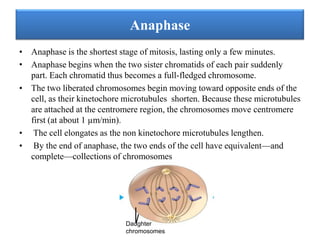
Anaphase
• Anaphase is the shortest stage of mitosis, lasting only a few minutes.
• Anaphase begins when the two sister chromatids of each pair suddenly
part. Each chromatid thus becomes a full-fledged chromosome.
• The two liberated chromosomes begin moving toward opposite ends of the
cell, as their kinetochore microtubules shorten. Because these microtubules
are attached at the centromere region, the chromosomes move centromere
first (at about 1 µm/min).
• The cell elongates as the non kinetochore microtubules lengthen.
• By the end of anaphase, the two ends of the cell have equivalent—and
complete—collections of chromosomes

Daughter
chromosomes
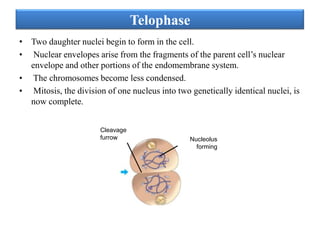
Telophase
• Two daughter nuclei begin to form in the cell.
• Nuclear envelopes arise from the fragments of the parent cell’s nuclear
envelope and other portions of the endomembrane system.
• The chromosomes become less condensed.
• Mitosis, the division of one nucleus into two genetically identical nuclei, is
now complete.
Cleavage
furrow

Nucleolus
forming
Cytokinesis
•

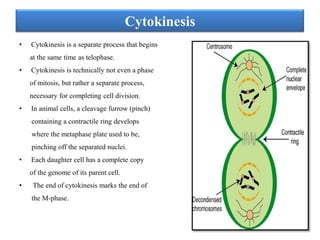
Cytokinesis is a separate process that begins
at the same time as telophase.

•

Cytokinesis is technically not even a phase
of mitosis, but rather a separate process,
necessary for completing cell division.

•

In animal cells, a cleavage furrow (pinch)
containing a contractile ring develops
where the metaphase plate used to be,

pinching off the separated nuclei.
•

Each daughter cell has a complete copy
of the genome of its parent cell.

•

The end of cytokinesis marks the end of

the M-phase.
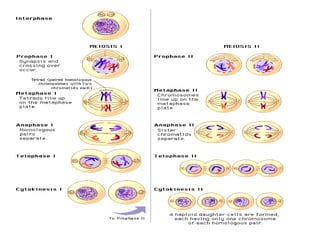
Meiosis
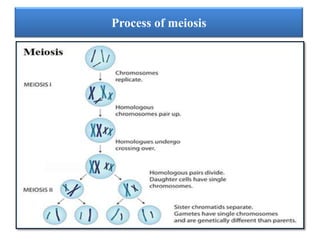
• Meiosis is a special type of cell division necessary for sexual reproduction

in eukaryotes. The cells produced by meiosis are gametes or spores.
• Meiosis differs from mitosis in two important respects:
 The chromosomes in meiosis undergo a recombination which shuffles the

genes producing a different genetic combination in each gamete.
 The outcome of meiosis is four (genetically unique) haploid cells,
compared with the two (genetically identical) diploid cells produced from
mitosis.
• Meiosis begins with one diploid cell containing two copies of each
chromosome one from the organism's mother and one from its father
and produces four haploid cells containing one copy of each
chromosome.
• Each of the resulting chromosomes in the gamete cells is a unique
mixture of maternal and paternal DNA, resulting in offspring that
are genetically distinct from either parent.
• This gives rise to genetic diversity in sexually reproducing
populations.
• During meiosis, specific genes are more highly transcribed, and
these are called the meiome (mRNA).
Process of meiosis
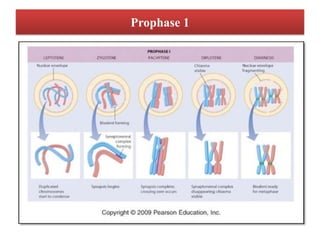
Prophase 1
The cell cycle

The cell cycle

  • 1.
  • 2.
    The cell cycle oThe cell cycle, or cell-division cycle, is the series of events that take place in a cell leading to its division and duplication. o In cells without a nucleus (prokaryotic), the cell cycle occurs by a process termed as binary fission. o In cells with a nucleus (eukaryotes), the cell cycle can be divided in two periods: o The cell cycle consists of  Interphase– normal cell activity, growth,  The mitotic phase – cell divsion
  • 3.
    • Interphase: duringwhich the cell grows, accumulating nutrients needed for mitosis and duplicating its DNA. • Mitosis (M) phase during which the cell splits itself into two distinct cells, often called "daughter cells" . • Cytokinesis, final phase, where the new cell is completely divided.
  • 4.
    Phases of theCell Cycle  Interphase  G1 - primary growth  S - genome replicated  G2 - secondary growth  M - mitosis  C - cytokinesis
  • 5.
    Interphase G1 - Cellsundergo majority of growth S - Each chromosome replicates (Synthesizes) to produce sister chromatids. – Attached at centromere. – Contains attachment site (kinetochore). G2 - Chromosomes condense - Assemble machinery for division such as centrioles.
  • 6.
    Cyclin-dependent protein kinasesdrive progression through the cell cycle • Cyclin-dependent kinases (Cdks) are inactive unless bound to cyclins. • Active complex phosphorylates downstream targets • Cyclin helps to direct Cdks to the target proteins
  • 7.
    Checkpoints ensure thecell cycle proceeds without errors
  • 8.
    Eukaryotic cells dividedby two ways: Mitosis- generally all somatic cells divide by this way. Produces 2 identical cells. Meiosis- germ cells follow this type of division pattern, produces 4 identical cells.
  • 9.
    MITOSIS  Also namedas equational division.  Some haploid & diploid cells divide by mitosis.  The term Mitosis was introduced by Walther Flemming in 1882.  Mitosis is the process by which a eukaryotic cell separates the chromosomes in its cell nucleus into two identical sets, in two separate nuclei  “Open" mitosis, where the nuclear envelope breaks down before the chromosomes separate, most animals  “Closed" mitosis, where chromosomes divide within an intact cell nucleus, fungi  Prokaryotic cells, which lack a nucleus, divide by a process called binary fission
  • 10.
    Mitotic division G2 OFINTERPHASE PROPHASE PROMETAPHASE Centrosomes Aster Fragments Kinetochore Chromatin Early mitotic (with centriole pairs) Centromere of nuclear spindle Nonkinetochore (duplicated) envelope microtubules Nucleolus Nuclear Plasma envelope membrane Chromosome, consisting of two sister chromatids Kinetochore microtubule
  • 11.
    METAPHASE ANAPHASE Metaphase plate Spindle Centrosome at Daughter onespindle pole chromosomes TELOPHASE AND CYTOKINESIS Cleavage furrow Nuclear envelope forming Nucleolus forming
  • 12.
    G2 of Interphase •A nuclear envelope bounds the nucleus. • The nucleus contains one or more nucleoli (singular, nucleolus). • Two centrosomes have formed by replication of a single centrosome. • In animal cells, each centrosome features two centrioles. • Chromosomes, duplicated during S phase, cannot seen individually because they have not yet condensed. G2 OF INTERPHASE Centrosomes (with centriole pairs) Nucleolus Nuclear envelope Chromatin (duplicated) Plasma membrane be
  • 13.
    Prophase • The chromatinfibers become more tightly coiled, condensing into discrete chromosomes observable with a light microscope. • The nucleoli disappear. • Each duplicated chromosome appears as two identical sister chromatids joined together. • The mitotic spindle begins to form. It is composed of the centrosomes and the microtubules that extend from them. The radial arrays of shorter microtubules that extend from the centrosomes are called asters (―stars‖). • The centrosomes move away from each other, apparently propelled by the lengthening microtubules between them. PROPHASE Early mitotic Aster Centromere spindle Chromosome, consisting of two sister chromatids
  • 14.
    Metaphase • It isthe longest stage of mitosis, lasting about 20 minutes. • The centrosomes are now at opposite ends of the cell. • The chromosomes convene on the metaphase plate, an imaginary plane that is equidistant between the spindle’s two poles. The chromosomes’ centromeres lie on the metaphase plate. • For each chromosome, the kinetochores of the sister chromatids are attached to kinetochore microtubules coming from opposite poles. • The entire apparatus of microtubules is called the spindle because of its shape.
  • 15.
    Anaphase • Anaphase isthe shortest stage of mitosis, lasting only a few minutes. • Anaphase begins when the two sister chromatids of each pair suddenly part. Each chromatid thus becomes a full-fledged chromosome. • The two liberated chromosomes begin moving toward opposite ends of the cell, as their kinetochore microtubules shorten. Because these microtubules are attached at the centromere region, the chromosomes move centromere first (at about 1 µm/min). • The cell elongates as the non kinetochore microtubules lengthen. • By the end of anaphase, the two ends of the cell have equivalent—and complete—collections of chromosomes Daughter chromosomes
  • 16.
    Telophase • Two daughternuclei begin to form in the cell. • Nuclear envelopes arise from the fragments of the parent cell’s nuclear envelope and other portions of the endomembrane system. • The chromosomes become less condensed. • Mitosis, the division of one nucleus into two genetically identical nuclei, is now complete. Cleavage furrow Nucleolus forming
  • 17.
    Cytokinesis • Cytokinesis is aseparate process that begins at the same time as telophase. • Cytokinesis is technically not even a phase of mitosis, but rather a separate process, necessary for completing cell division. • In animal cells, a cleavage furrow (pinch) containing a contractile ring develops where the metaphase plate used to be, pinching off the separated nuclei. • Each daughter cell has a complete copy of the genome of its parent cell. • The end of cytokinesis marks the end of the M-phase.
  • 18.
    Meiosis • Meiosis isa special type of cell division necessary for sexual reproduction in eukaryotes. The cells produced by meiosis are gametes or spores. • Meiosis differs from mitosis in two important respects:  The chromosomes in meiosis undergo a recombination which shuffles the genes producing a different genetic combination in each gamete.  The outcome of meiosis is four (genetically unique) haploid cells, compared with the two (genetically identical) diploid cells produced from mitosis.
  • 19.
    • Meiosis beginswith one diploid cell containing two copies of each chromosome one from the organism's mother and one from its father and produces four haploid cells containing one copy of each chromosome. • Each of the resulting chromosomes in the gamete cells is a unique mixture of maternal and paternal DNA, resulting in offspring that are genetically distinct from either parent. • This gives rise to genetic diversity in sexually reproducing populations. • During meiosis, specific genes are more highly transcribed, and these are called the meiome (mRNA).
  • 20.
  • 22.