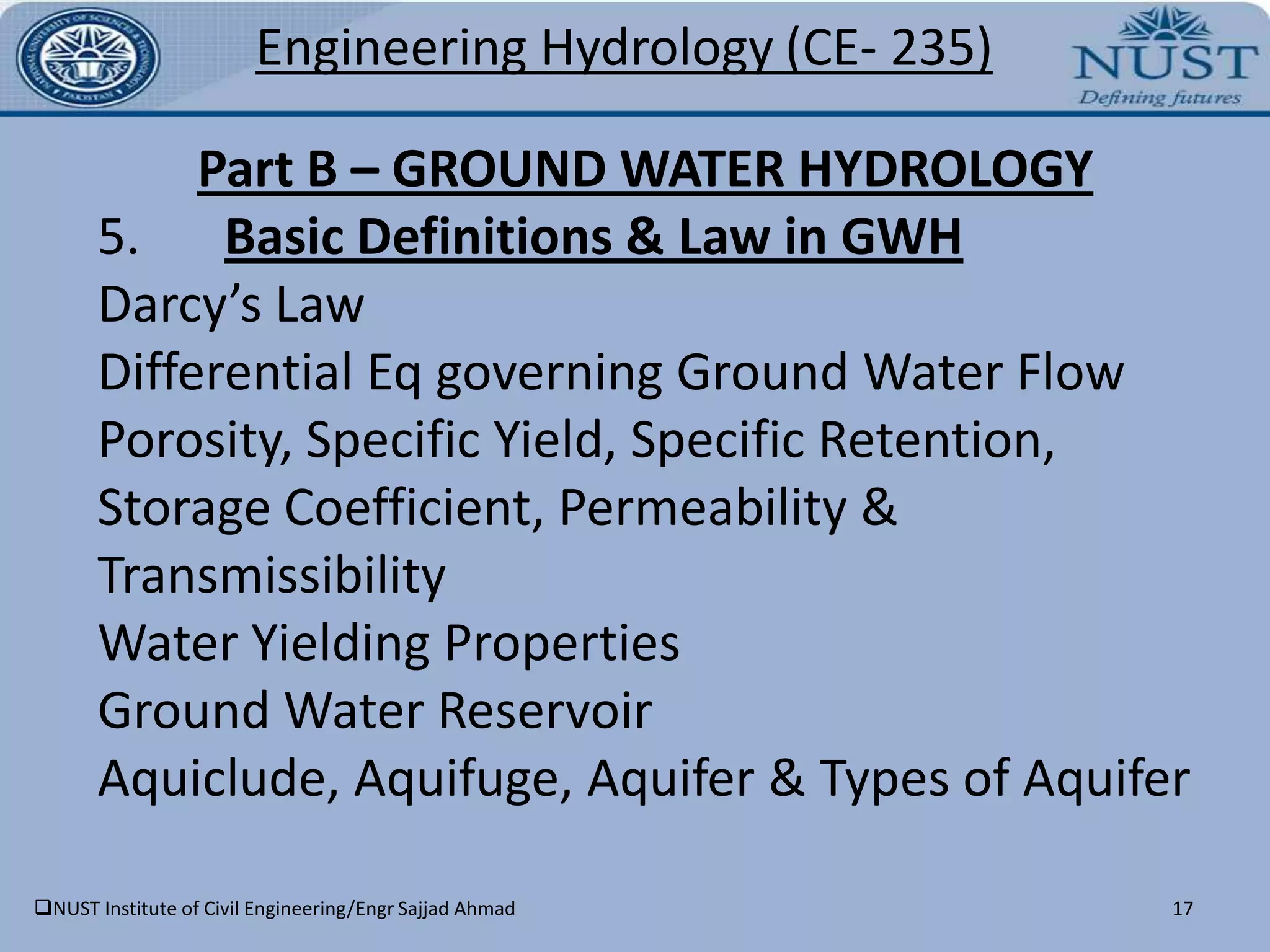
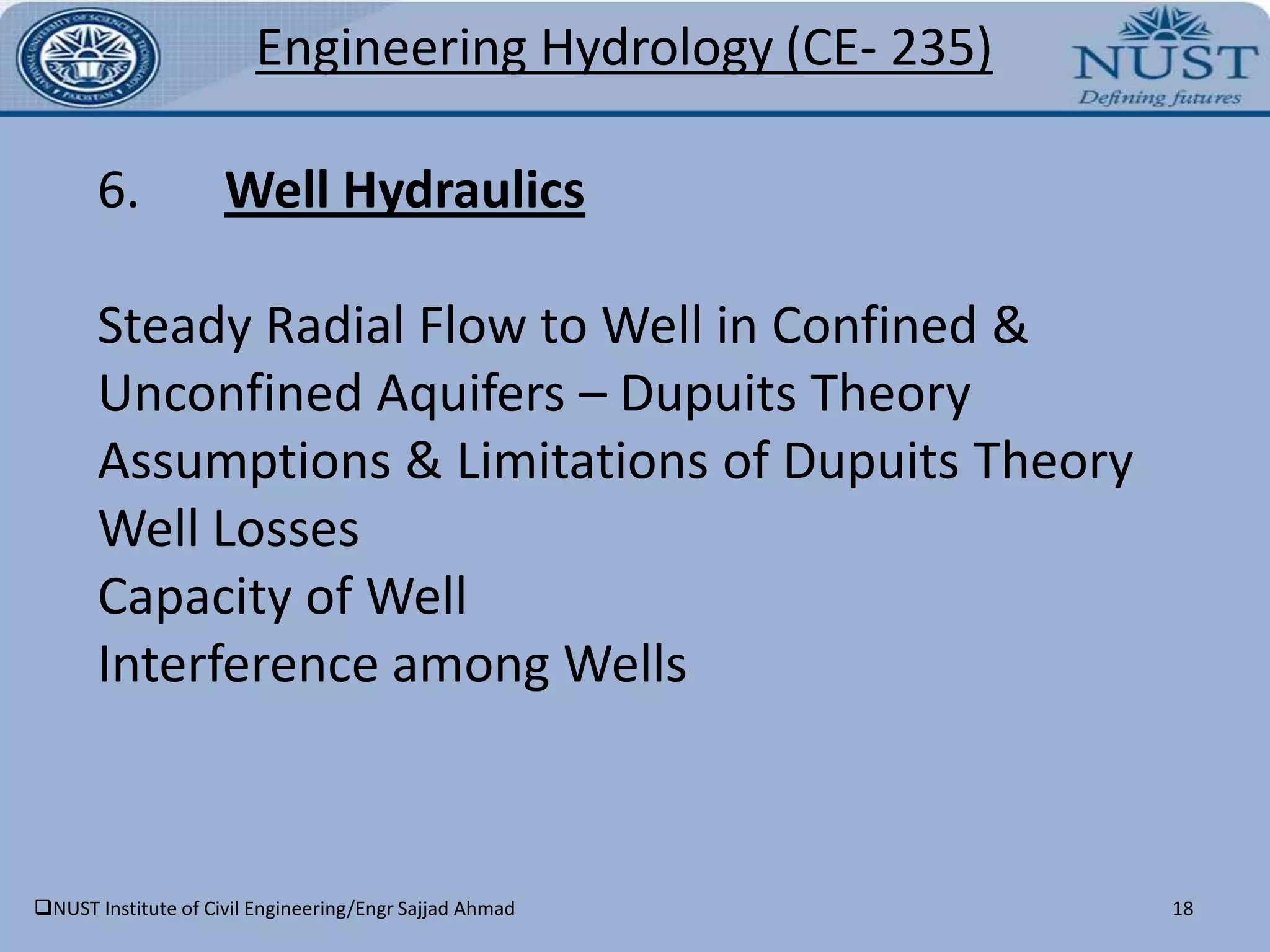
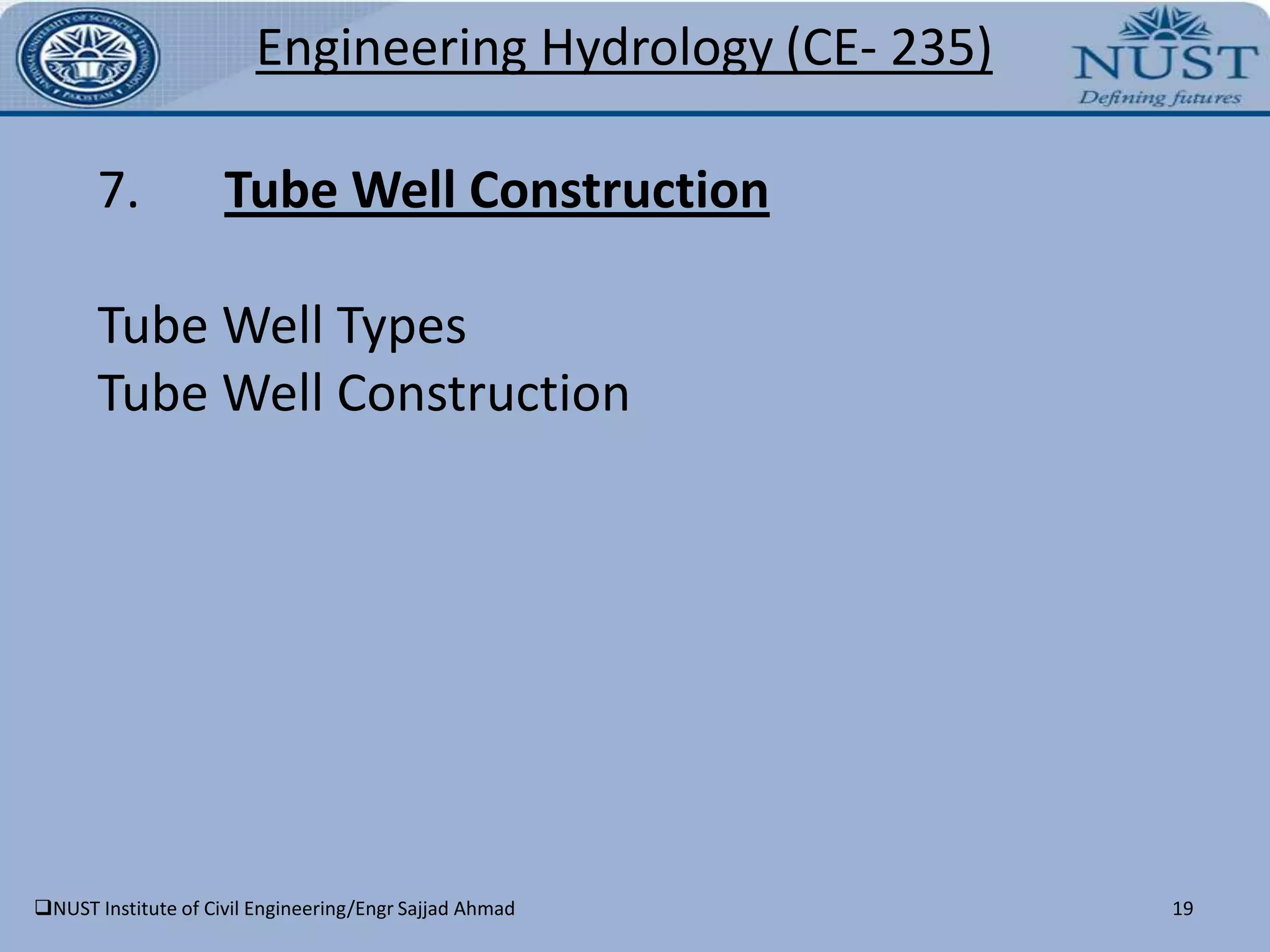

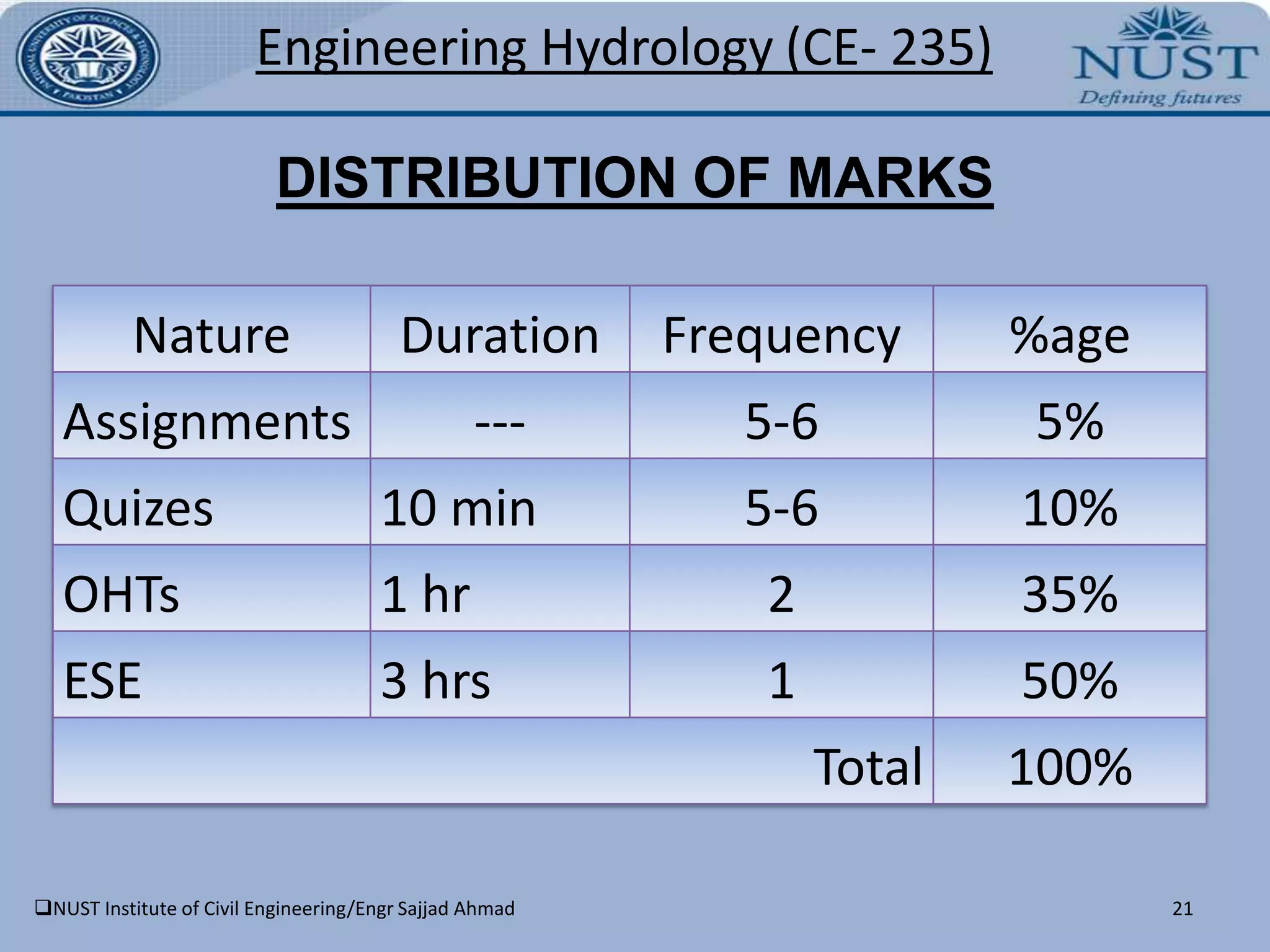

Engineering Hydrology(CE- 235)1INTRODUCTIONNUST Institute of Civil Engineering/Engr Sajjad Ahmad2Engineering Hydrology(CE- 235)INSTRUCTOR:		Lab Engr. Sajjad Ahmad				Phone: (051) 90854585				Email: pc277@yahoo.com OFFICE:			Hydraulics Lab, NICE				Building (Room # 08) OFFICE HOURS:		Mon - Fri (9:00am-5:00pm)NUST Institute of Civil Engineering/Engr Sajjad Ahmad3Engineering Hydrology(CE- 235)COURSE PURPOSE
COURSE OUTCOMES & OBJECTIVES
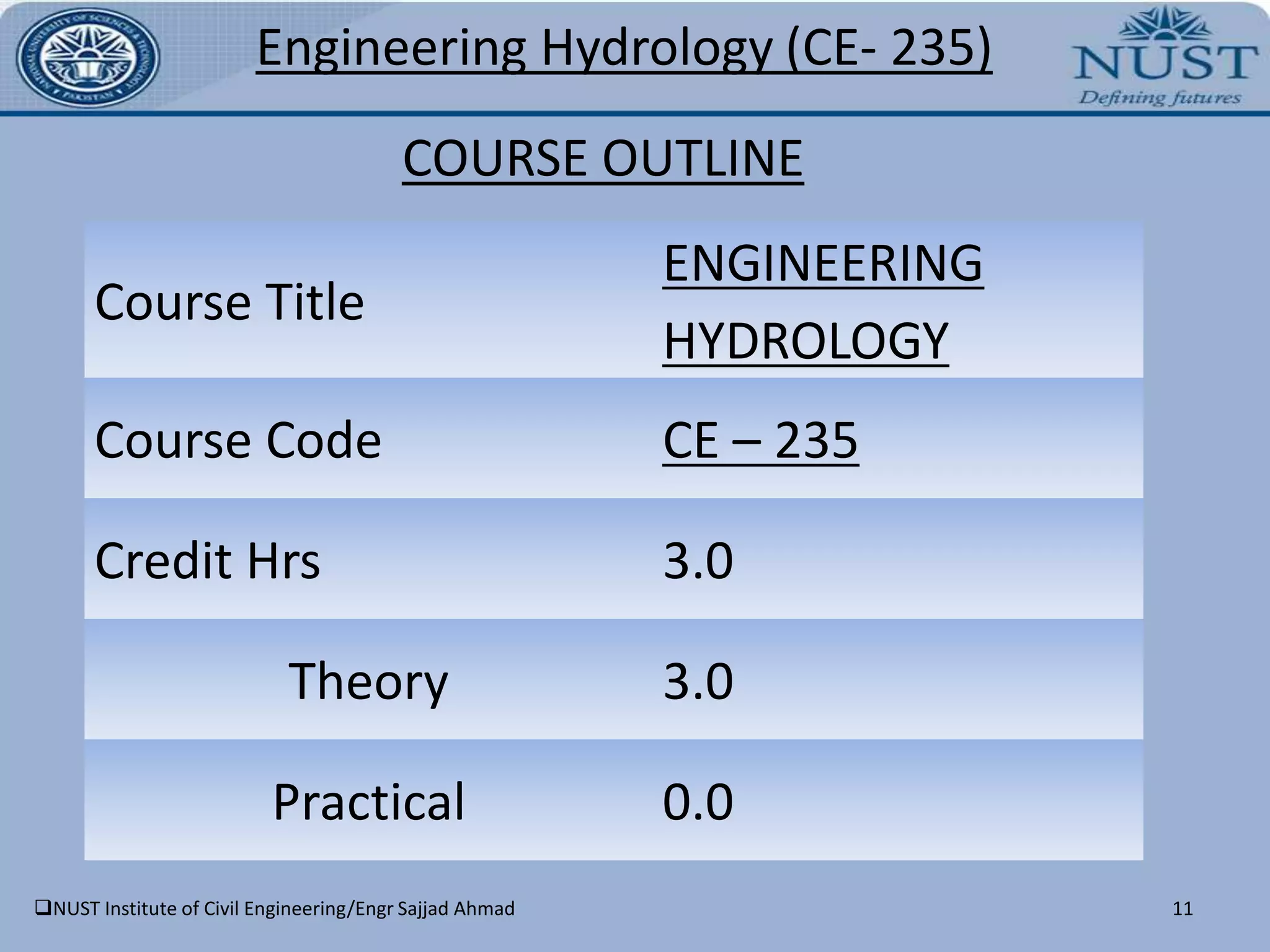
COURSE OUTLINE
DETAILED SYLLABUS
GRADING CRITERIA
NUST Institute of Civil Engineering/Engr Sajjad Ahmad4Engineering Hydrology(CE- 235)COURSE PURPOSENUST Institute of Civil Engineering/Engr Sajjad Ahmad5Engineering Hydrology(CE- 235)Introduce students about the principles of hydrology, including the hydrological cycle and its impact on water resources, measurement of catchment rainfall and its analysis, measurement of flow in natural rivers and channels
Introduction of fundamentals of subsurface flow
NUST Institute of Civil Engineering/Engr Sajjad AhmadNUST Institute of Civil Engineering/Engr Sajjad Ahmad6Engineering Hydrology(CE- 235)COURSE OUTCOMES & OBJECTIVES
7Engineering Hydrology(CE- 235)On completion of this course, the students will be able to:Understand the relative importance of the different physical processes of the hydrological cycle and their interplay to determine water resources availability
Calculate a catchment’s annual water balance
Identify suitable hydrological analyses for specified water resources projects
NUST Institute of Civil Engineering/Engr Sajjad Ahmad8Engineering Hydrology(CE- 235)Use point rainfall measurements to estimate catchment average rainfall
Estimate rainfall intensity for design purposes using simple empirical relationships
Gain a good working knowledge of contemporary institutional framework for managing the water cycle in Pakistan
Design and implement field measurements of river flow and/or analyze data from such an exercise to determine river channel flow
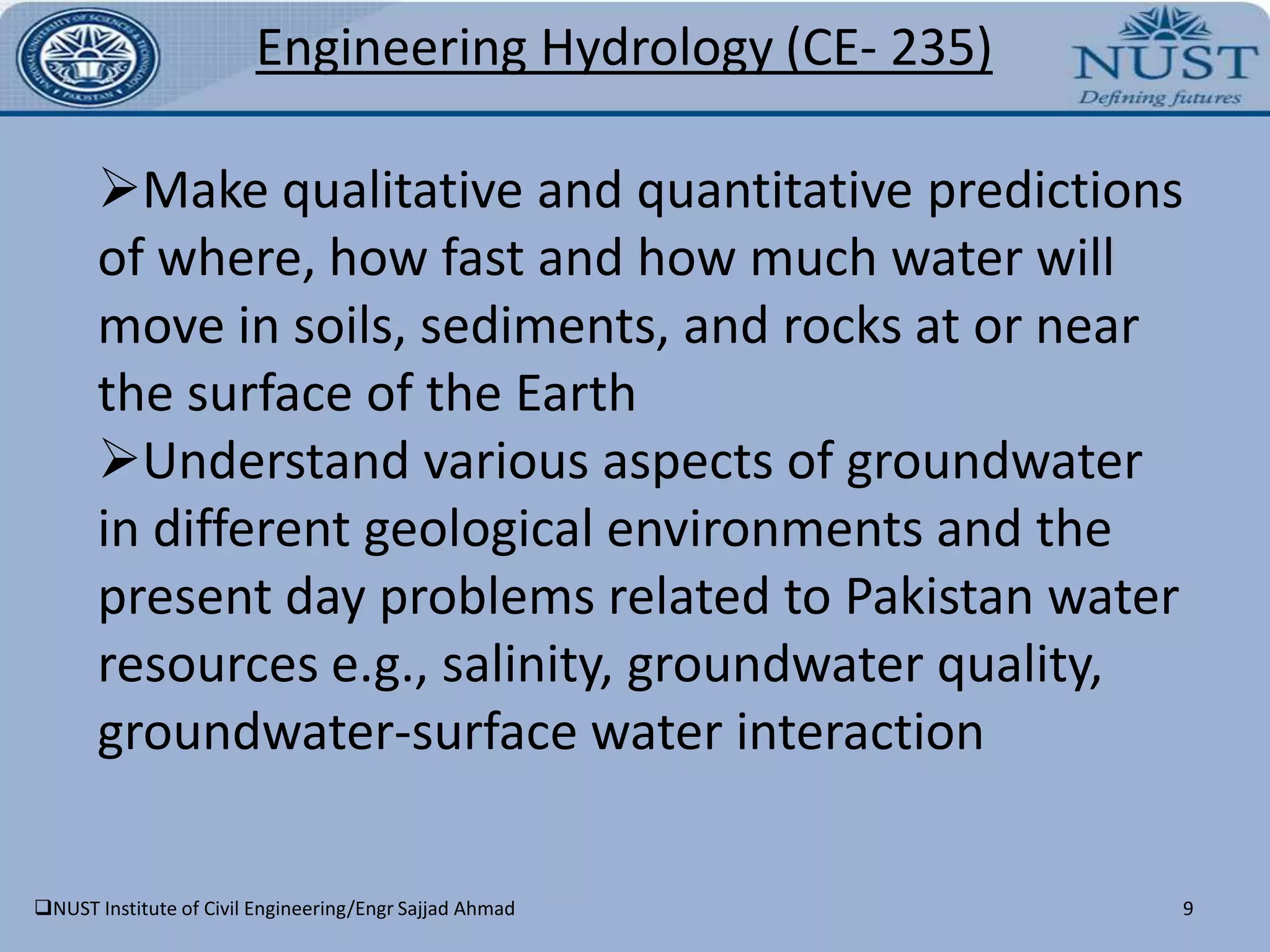
NUST Institute of Civil Engineering/Engr Sajjad Ahmad9Engineering Hydrology(CE- 235)Make qualitative and quantitative predictions of where, how fast and how much water will move in soils, sediments, and rocks at or near the surface of the Earth
Understand various aspects of groundwater in different geological environments and the present day problems related to Pakistan water resources e.g., salinity, groundwater quality, groundwater-surface water interaction
NUST Institute of Civil Engineering/Engr Sajjad Ahmad10Engineering Hydrology(CE- 235)COURSE OUTLINENUST Institute of Civil Engineering/Engr Sajjad Ahmad11Engineering Hydrology(CE- 235)COURSE OUTLINENUST Institute of Civil Engineering/Engr Sajjad Ahmad12Engineering Hydrology(CE- 235)DETAILED SYLLABUSNUST Institute of Civil Engineering/Engr Sajjad Ahmad13Engineering Hydrology(CE- 235)Part A – Surface Water Hydrology 1.IntroductionIntroductionHydrological cycleHydrologic equationImportance and practical applications of hydrologyNUST Institute of Civil Engineering/Engr Sajjad Ahmad14Engineering Hydrology(CE- 235)2.	PrecipitationTypes of precipitationFactors necessary for the formation of precipitationMeasurement of precipitationComputation of Average Rainfall over a BasinNUST Institute of Civil Engineering/Engr Sajjad Ahmad15Engineering Hydrology(CE- 235)3.        Runoff & HydrographRunoff & Factors Affecting RunoffComputation of RunoffCharacteristics of hydrographComponents of a hydrographHydrograph separationEstimation of maximum rate of runoff Unit HydrographS-curveDischarge estimation by probabilistic methodNUST Institute of Civil Engineering/Engr Sajjad Ahmad16Engineering Hydrology(CE- 235)4.	Stream Flow RoutingThe phenomenon of flooding and its causesFrequency and duration analysisReservoir & channel routingMethods of Stream GaugingMeasurement of Stream Flow by Current MeterNUST Institute of Civil Engineering/Engr Sajjad Ahmad17Engineering Hydrology(CE- 235)Part B – GROUND WATER HYDROLOGY5.Basic Definitions & Law in GWHDarcy’s LawDifferential Eq governing Ground Water FlowPorosity, Specific Yield, Specific Retention, Storage Coefficient, Permeability & TransmissibilityWater Yielding PropertiesGround Water ReservoirAquiclude, Aquifuge, Aquifer & Types of AquiferNUST Institute of Civil Engineering/Engr Sajjad Ahmad18Engineering Hydrology(CE- 235)6.Well HydraulicsSteady Radial Flow to Well in Confined & Unconfined Aquifers – Dupuits TheoryAssumptions & Limitations of Dupuits TheoryWell LossesCapacity of WellInterference among WellsNUST Institute of Civil Engineering/Engr Sajjad Ahmad19Engineering Hydrology(CE- 235)7.Tube Well ConstructionTube Well TypesTube Well ConstructionNUST Institute of Civil Engineering/Engr Sajjad Ahmad20Engineering Hydrology(CE- 235)GRADING CRITERIANUST Institute of Civil Engineering/Engr Sajjad Ahmad21Engineering Hydrology(CE- 235)DISTRIBUTION OF MARKSNUST Institute of Civil Engineering/Engr Sajjad AhmadNUST Institute of Civil Engineering/Engr Sajjad Ahmad22
CE-235 EH Coursepack 2010

CE-235 EH Coursepack 2010

  • 1.
    Engineering Hydrology(CE- 235)1INTRODUCTIONNUSTInstitute of Civil Engineering/Engr Sajjad Ahmad2Engineering Hydrology(CE- 235)INSTRUCTOR: Lab Engr. Sajjad Ahmad Phone: (051) 90854585 Email: pc277@yahoo.com OFFICE: Hydraulics Lab, NICE Building (Room # 08) OFFICE HOURS: Mon - Fri (9:00am-5:00pm)NUST Institute of Civil Engineering/Engr Sajjad Ahmad3Engineering Hydrology(CE- 235)COURSE PURPOSE
  • 2.
  • 3.
  • 4.
  • 5.
  • 6.
    NUST Institute ofCivil Engineering/Engr Sajjad Ahmad4Engineering Hydrology(CE- 235)COURSE PURPOSENUST Institute of Civil Engineering/Engr Sajjad Ahmad5Engineering Hydrology(CE- 235)Introduce students about the principles of hydrology, including the hydrological cycle and its impact on water resources, measurement of catchment rainfall and its analysis, measurement of flow in natural rivers and channels
  • 7.
  • 8.
    NUST Institute ofCivil Engineering/Engr Sajjad AhmadNUST Institute of Civil Engineering/Engr Sajjad Ahmad6Engineering Hydrology(CE- 235)COURSE OUTCOMES & OBJECTIVES
  • 9.
    7Engineering Hydrology(CE- 235)Oncompletion of this course, the students will be able to:Understand the relative importance of the different physical processes of the hydrological cycle and their interplay to determine water resources availability
  • 10.
    Calculate a catchment’sannual water balance
  • 11.
    Identify suitable hydrologicalanalyses for specified water resources projects
  • 12.
    NUST Institute ofCivil Engineering/Engr Sajjad Ahmad8Engineering Hydrology(CE- 235)Use point rainfall measurements to estimate catchment average rainfall
  • 13.
    Estimate rainfall intensityfor design purposes using simple empirical relationships
  • 14.
    Gain a goodworking knowledge of contemporary institutional framework for managing the water cycle in Pakistan
  • 15.
    Design and implementfield measurements of river flow and/or analyze data from such an exercise to determine river channel flow
  • 16.
    NUST Institute ofCivil Engineering/Engr Sajjad Ahmad9Engineering Hydrology(CE- 235)Make qualitative and quantitative predictions of where, how fast and how much water will move in soils, sediments, and rocks at or near the surface of the Earth
  • 17.
    Understand various aspectsof groundwater in different geological environments and the present day problems related to Pakistan water resources e.g., salinity, groundwater quality, groundwater-surface water interaction
  • 18.
    NUST Institute ofCivil Engineering/Engr Sajjad Ahmad10Engineering Hydrology(CE- 235)COURSE OUTLINENUST Institute of Civil Engineering/Engr Sajjad Ahmad11Engineering Hydrology(CE- 235)COURSE OUTLINENUST Institute of Civil Engineering/Engr Sajjad Ahmad12Engineering Hydrology(CE- 235)DETAILED SYLLABUSNUST Institute of Civil Engineering/Engr Sajjad Ahmad13Engineering Hydrology(CE- 235)Part A – Surface Water Hydrology 1.IntroductionIntroductionHydrological cycleHydrologic equationImportance and practical applications of hydrologyNUST Institute of Civil Engineering/Engr Sajjad Ahmad14Engineering Hydrology(CE- 235)2. PrecipitationTypes of precipitationFactors necessary for the formation of precipitationMeasurement of precipitationComputation of Average Rainfall over a BasinNUST Institute of Civil Engineering/Engr Sajjad Ahmad15Engineering Hydrology(CE- 235)3. Runoff & HydrographRunoff & Factors Affecting RunoffComputation of RunoffCharacteristics of hydrographComponents of a hydrographHydrograph separationEstimation of maximum rate of runoff Unit HydrographS-curveDischarge estimation by probabilistic methodNUST Institute of Civil Engineering/Engr Sajjad Ahmad16Engineering Hydrology(CE- 235)4. Stream Flow RoutingThe phenomenon of flooding and its causesFrequency and duration analysisReservoir & channel routingMethods of Stream GaugingMeasurement of Stream Flow by Current MeterNUST Institute of Civil Engineering/Engr Sajjad Ahmad17Engineering Hydrology(CE- 235)Part B – GROUND WATER HYDROLOGY5.Basic Definitions & Law in GWHDarcy’s LawDifferential Eq governing Ground Water FlowPorosity, Specific Yield, Specific Retention, Storage Coefficient, Permeability & TransmissibilityWater Yielding PropertiesGround Water ReservoirAquiclude, Aquifuge, Aquifer & Types of AquiferNUST Institute of Civil Engineering/Engr Sajjad Ahmad18Engineering Hydrology(CE- 235)6.Well HydraulicsSteady Radial Flow to Well in Confined & Unconfined Aquifers – Dupuits TheoryAssumptions & Limitations of Dupuits TheoryWell LossesCapacity of WellInterference among WellsNUST Institute of Civil Engineering/Engr Sajjad Ahmad19Engineering Hydrology(CE- 235)7.Tube Well ConstructionTube Well TypesTube Well ConstructionNUST Institute of Civil Engineering/Engr Sajjad Ahmad20Engineering Hydrology(CE- 235)GRADING CRITERIANUST Institute of Civil Engineering/Engr Sajjad Ahmad21Engineering Hydrology(CE- 235)DISTRIBUTION OF MARKSNUST Institute of Civil Engineering/Engr Sajjad AhmadNUST Institute of Civil Engineering/Engr Sajjad Ahmad22