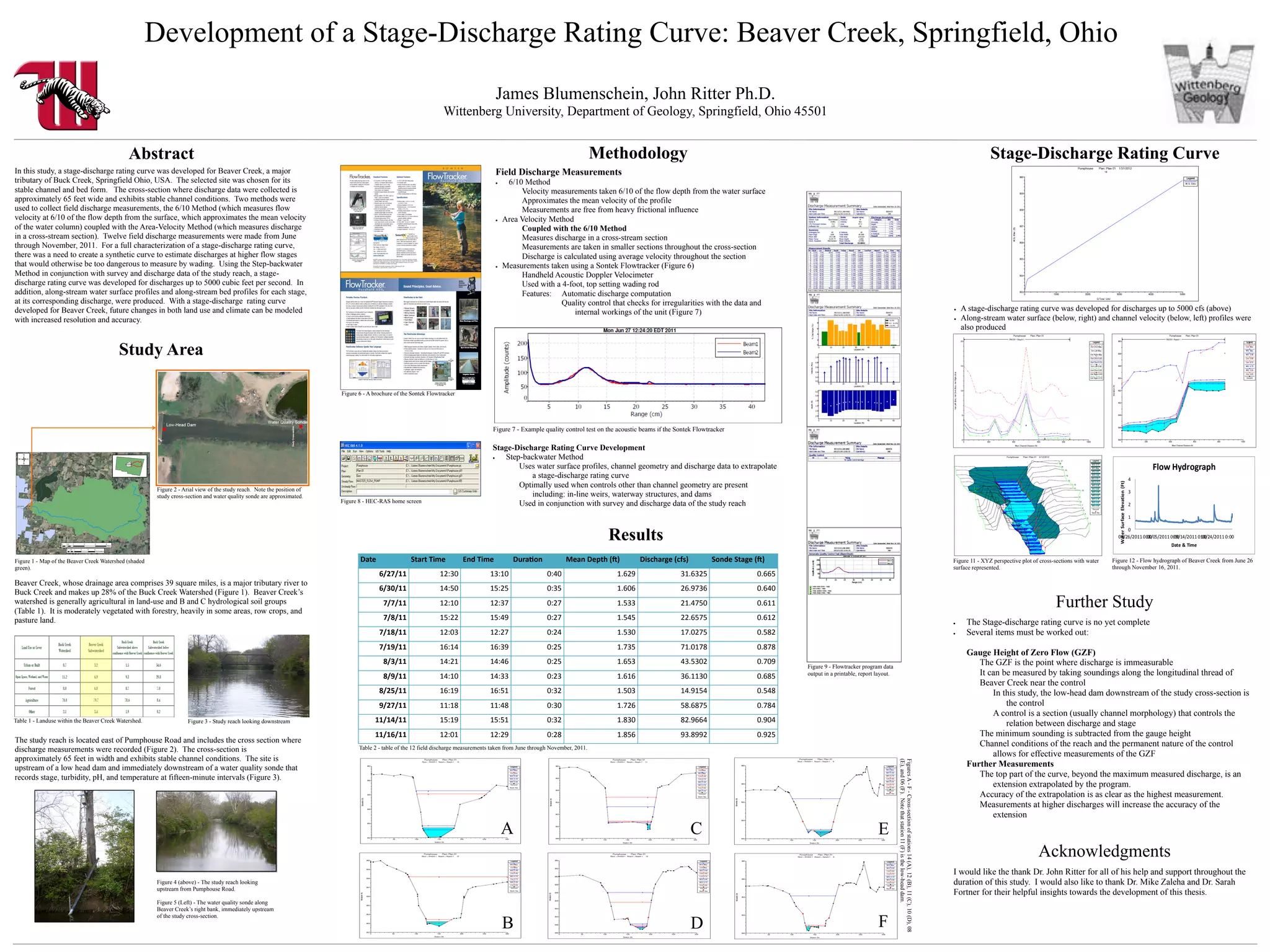
Development of a Stage-Discharge Rating Curve: Beaver Creek, Springfield, Ohio
James Blumenschein, John Ritter Ph.D.
Wittenberg University, Department of Geology, Springfield, Ohio 45501
In this study, a stage-discharge rating curve was developed for Beaver Creek, a major
tributary of Buck Creek, Springfield Ohio, USA. The selected site was chosen for its
stable channel and bed form. The cross-section where discharge data were collected is
approximately 65 feet wide and exhibits stable channel conditions. Two methods were
used to collect field discharge measurements, the 6/10 Method (which measures flow
velocity at 6/10 of the flow depth from the surface, which approximates the mean velocity
of the water column) coupled with the Area-Velocity Method (which measures discharge
in a cross-stream section). Twelve field discharge measurements were made from June
through November, 2011. For a full characterization of a stage-discharge rating curve,
there was a need to create a synthetic curve to estimate discharges at higher flow stages
that would otherwise be too dangerous to measure by wading. Using the Step-backwater
Method in conjunction with survey and discharge data of the study reach, a stage-
discharge rating curve was developed for discharges up to 5000 cubic feet per second. In
addition, along-stream water surface profiles and along-stream bed profiles for each stage,
at its corresponding discharge, were produced. With a stage-discharge rating curve
developed for Beaver Creek, future changes in both land use and climate can be modeled
with increased resolution and accuracy.
Figure 1 - Map of the Beaver Creek Watershed (shaded
green).
The study reach is located east of Pumphouse Road and includes the cross section where
discharge measurements were recorded (Figure 2). The cross-section is
approximately 65 feet in width and exhibits stable channel conditions. The site is
upstream of a low head dam and immediately downstream of a water quality sonde that
records stage, turbidity, pH, and temperature at fifteen-minute intervals (Figure 3).
Study Area
Beaver Creek, whose drainage area comprises 39 square miles, is a major tributary river to
Buck Creek and makes up 28% of the Buck Creek Watershed (Figure 1). Beaver Creek’s
watershed is generally agricultural in land-use and B and C hydrological soil groups
(Table 1). It is moderately vegetated with forestry, heavily in some areas, row crops, and
pasture land.
Table 1 - Landuse within the Beaver Creek Watershed.
Figure 4 (above) - The study reach looking
upstream from Pumphouse Road.
Figure 5 (Left) - The water quality sonde along
Beaver Creek’s right bank, immediately upstream
of the study cross-section.
Abstract Methodology
Field Discharge Measurements
 6/10 Method
Velocity measurements taken 6/10 of the flow depth from the water surface
Approximates the mean velocity of the profile
Measurements are free from heavy frictional influence
 Area Velocity Method
Coupled with the 6/10 Method
Measures discharge in a cross-stream section
Measurements are taken in smaller sections throughout the cross-section
Discharge is calculated using average velocity throughout the section
 Measurements taken using a Sontek Flowtracker (Figure 6)
Handheld Acoustic Doppler Velocimeter
Used with a 4-foot, top setting wading rod
Features: Automatic discharge computation
Quality control that checks for irregularities with the data and
internal workings of the unit (Figure 7)
Figure 6 - A brochure of the Sontek Flowtracker
Figure 7 - Example quality control test on the acoustic beams if the Sontek Flowtracker
Stage-Discharge Rating Curve Development
 Step-backwater Method
Uses water surface profiles, channel geometry and discharge data to extrapolate
a stage-discharge rating curve
Optimally used when controls other than channel geometry are present
including: in-line weirs, waterway structures, and dams
Used in conjunction with survey and discharge data of the study reachFigure 8 - HEC-RAS home screen
Results
Date Start Time End Time Duration Mean Depth (ft) Discharge (cfs) Sonde Stage (ft)
6/27/11 12:30 13:10 0:40 1.629 31.6325 0.665
6/30/11 14:50 15:25 0:35 1.606 26.9736 0.640
7/7/11 12:10 12:37 0:27 1.533 21.4750 0.611
7/8/11 15:22 15:49 0:27 1.545 22.6575 0.612
7/18/11 12:03 12:27 0:24 1.530 17.0275 0.582
7/19/11 16:14 16:39 0:25 1.735 71.0178 0.878
8/3/11 14:21 14:46 0:25 1.653 43.5302 0.709
8/9/11 14:10 14:33 0:23 1.616 36.1130 0.685
8/25/11 16:19 16:51 0:32 1.503 14.9154 0.548
9/27/11 11:18 11:48 0:30 1.726 58.6875 0.784
11/14/11 15:19 15:51 0:32 1.830 82.9664 0.904
11/16/11 12:01 12:29 0:28 1.856 93.8992 0.925
Table 2 - table of the 12 field discharge measurements taken from June through November, 2011.
0
1
2
3
4
06/26/2011 0:0008/05/2011 0:0009/14/2011 0:0010/24/2011 0:00
WaterSurfaceElevation(Ft)
Date & Time
Flow Hydrograph
Figure 3 - Study reach looking downstream
Stage-Discharge Rating Curve
 A stage-discharge rating curve was developed for discharges up to 5000 cfs (above)
 Along-stream water surface (below, right) and channel velocity (below, left) profiles were
also produced
A
B
C
D
E
F
Figure 11 - XYZ perspective plot of cross-sections with water
surface represented.
Figure 12 - Flow hydrograph of Beaver Creek from June 26
through November 16, 2011.
Further Study
 The Stage-discharge rating curve is no yet complete
 Several items must be worked out:
Gauge Height of Zero Flow (GZF)
The GZF is the point where discharge is immeasurable
It can be measured by taking soundings along the longitudinal thread of
Beaver Creek near the control
In this study, the low-head dam downstream of the study cross-section is
the control
A control is a section (usually channel morphology) that controls the
relation between discharge and stage
The minimum sounding is subtracted from the gauge height
Channel conditions of the reach and the permanent nature of the control
allows for effective measurements of the GZF
Further Measurements
The top part of the curve, beyond the maximum measured discharge, is an
extension extrapolated by the program.
Accuracy of the extrapolation is as clear as the highest measurement.
Measurements at higher discharges will increase the accuracy of the
extension
Acknowledgments
I would like the thank Dr. John Ritter for all of his help and support throughout the
duration of this study. I would also like to thank Dr. Mike Zaleha and Dr. Sarah
Fortner for their helpful insights towards the development of this thesis.
Figure 2 - Arial view of the study reach. Note the position of
study cross-section and water quality sonde are approximated.
FiguresA-F-Cross-sectionofstations14(A),12(B),11(C),10(D),08
(E),and06(F).Notethatstation11(F)isthelow-headdam.
Figure 9 - Flowtracker program data
output in a printable, report layout.

Senior Thesis Poster

  • 1.
    Development of aStage-Discharge Rating Curve: Beaver Creek, Springfield, Ohio James Blumenschein, John Ritter Ph.D. Wittenberg University, Department of Geology, Springfield, Ohio 45501 In this study, a stage-discharge rating curve was developed for Beaver Creek, a major tributary of Buck Creek, Springfield Ohio, USA. The selected site was chosen for its stable channel and bed form. The cross-section where discharge data were collected is approximately 65 feet wide and exhibits stable channel conditions. Two methods were used to collect field discharge measurements, the 6/10 Method (which measures flow velocity at 6/10 of the flow depth from the surface, which approximates the mean velocity of the water column) coupled with the Area-Velocity Method (which measures discharge in a cross-stream section). Twelve field discharge measurements were made from June through November, 2011. For a full characterization of a stage-discharge rating curve, there was a need to create a synthetic curve to estimate discharges at higher flow stages that would otherwise be too dangerous to measure by wading. Using the Step-backwater Method in conjunction with survey and discharge data of the study reach, a stage- discharge rating curve was developed for discharges up to 5000 cubic feet per second. In addition, along-stream water surface profiles and along-stream bed profiles for each stage, at its corresponding discharge, were produced. With a stage-discharge rating curve developed for Beaver Creek, future changes in both land use and climate can be modeled with increased resolution and accuracy. Figure 1 - Map of the Beaver Creek Watershed (shaded green). The study reach is located east of Pumphouse Road and includes the cross section where discharge measurements were recorded (Figure 2). The cross-section is approximately 65 feet in width and exhibits stable channel conditions. The site is upstream of a low head dam and immediately downstream of a water quality sonde that records stage, turbidity, pH, and temperature at fifteen-minute intervals (Figure 3). Study Area Beaver Creek, whose drainage area comprises 39 square miles, is a major tributary river to Buck Creek and makes up 28% of the Buck Creek Watershed (Figure 1). Beaver Creek’s watershed is generally agricultural in land-use and B and C hydrological soil groups (Table 1). It is moderately vegetated with forestry, heavily in some areas, row crops, and pasture land. Table 1 - Landuse within the Beaver Creek Watershed. Figure 4 (above) - The study reach looking upstream from Pumphouse Road. Figure 5 (Left) - The water quality sonde along Beaver Creek’s right bank, immediately upstream of the study cross-section. Abstract Methodology Field Discharge Measurements  6/10 Method Velocity measurements taken 6/10 of the flow depth from the water surface Approximates the mean velocity of the profile Measurements are free from heavy frictional influence  Area Velocity Method Coupled with the 6/10 Method Measures discharge in a cross-stream section Measurements are taken in smaller sections throughout the cross-section Discharge is calculated using average velocity throughout the section  Measurements taken using a Sontek Flowtracker (Figure 6) Handheld Acoustic Doppler Velocimeter Used with a 4-foot, top setting wading rod Features: Automatic discharge computation Quality control that checks for irregularities with the data and internal workings of the unit (Figure 7) Figure 6 - A brochure of the Sontek Flowtracker Figure 7 - Example quality control test on the acoustic beams if the Sontek Flowtracker Stage-Discharge Rating Curve Development  Step-backwater Method Uses water surface profiles, channel geometry and discharge data to extrapolate a stage-discharge rating curve Optimally used when controls other than channel geometry are present including: in-line weirs, waterway structures, and dams Used in conjunction with survey and discharge data of the study reachFigure 8 - HEC-RAS home screen Results Date Start Time End Time Duration Mean Depth (ft) Discharge (cfs) Sonde Stage (ft) 6/27/11 12:30 13:10 0:40 1.629 31.6325 0.665 6/30/11 14:50 15:25 0:35 1.606 26.9736 0.640 7/7/11 12:10 12:37 0:27 1.533 21.4750 0.611 7/8/11 15:22 15:49 0:27 1.545 22.6575 0.612 7/18/11 12:03 12:27 0:24 1.530 17.0275 0.582 7/19/11 16:14 16:39 0:25 1.735 71.0178 0.878 8/3/11 14:21 14:46 0:25 1.653 43.5302 0.709 8/9/11 14:10 14:33 0:23 1.616 36.1130 0.685 8/25/11 16:19 16:51 0:32 1.503 14.9154 0.548 9/27/11 11:18 11:48 0:30 1.726 58.6875 0.784 11/14/11 15:19 15:51 0:32 1.830 82.9664 0.904 11/16/11 12:01 12:29 0:28 1.856 93.8992 0.925 Table 2 - table of the 12 field discharge measurements taken from June through November, 2011. 0 1 2 3 4 06/26/2011 0:0008/05/2011 0:0009/14/2011 0:0010/24/2011 0:00 WaterSurfaceElevation(Ft) Date & Time Flow Hydrograph Figure 3 - Study reach looking downstream Stage-Discharge Rating Curve  A stage-discharge rating curve was developed for discharges up to 5000 cfs (above)  Along-stream water surface (below, right) and channel velocity (below, left) profiles were also produced A B C D E F Figure 11 - XYZ perspective plot of cross-sections with water surface represented. Figure 12 - Flow hydrograph of Beaver Creek from June 26 through November 16, 2011. Further Study  The Stage-discharge rating curve is no yet complete  Several items must be worked out: Gauge Height of Zero Flow (GZF) The GZF is the point where discharge is immeasurable It can be measured by taking soundings along the longitudinal thread of Beaver Creek near the control In this study, the low-head dam downstream of the study cross-section is the control A control is a section (usually channel morphology) that controls the relation between discharge and stage The minimum sounding is subtracted from the gauge height Channel conditions of the reach and the permanent nature of the control allows for effective measurements of the GZF Further Measurements The top part of the curve, beyond the maximum measured discharge, is an extension extrapolated by the program. Accuracy of the extrapolation is as clear as the highest measurement. Measurements at higher discharges will increase the accuracy of the extension Acknowledgments I would like the thank Dr. John Ritter for all of his help and support throughout the duration of this study. I would also like to thank Dr. Mike Zaleha and Dr. Sarah Fortner for their helpful insights towards the development of this thesis. Figure 2 - Arial view of the study reach. Note the position of study cross-section and water quality sonde are approximated. FiguresA-F-Cross-sectionofstations14(A),12(B),11(C),10(D),08 (E),and06(F).Notethatstation11(F)isthelow-headdam. Figure 9 - Flowtracker program data output in a printable, report layout.