Hydrology and Irrigation Engineering 10CV55
Department of Civil Engineering, SJBIT Page 1
HYDROLOGY AND IRRIGATION ENGINEERING
Subject Code: 10CV55 IA Marks: 25
Hours/Week: 04 Exam Hours: 03
Total Hours: 52 Exam Marks: 100
PART-A - HYDROLOGY
UNIT 1: INTRODUCTION & PRECIPITATION
Introduction, Hydrologic cycle (Horton‘s representation). Water budget equation
Precipitation: introduction, forms of precipitation, types of precipitation, measurement of
precipitation (Simon‘s gauge & Syphon gauge only), selection of rain gauge station. Adequacy
of rain gauges, methods of computing average rainfall, interpolation of missing data, adjustment
of missing data by double mass curve method. Hyetograph and mass curve of rainfall, 07 hrs
UNIT 2 : LOSSES FROM PRECIPITATION
Evaporation: Definition, factors affecting, measurement (Class A pan). Estimation using
empirical methods (Meyer‘s and Rohwer‘s equation), Evaporation control. Evapo-transpiration-
Definition, factors affecting, measurement, estimation (Blaney Criddle method) Infiltration -
Definition, factors affecting, measurement (double ring infiltrometer), infiltration indices,
Horton‘s equation of Infiltration. 07 hrs
UNIT 3: HYDROGRAPHS
Definition, components of hydrographs, unit hydrograph and its derivation from simple storm
hydrograph, base flow separation, Prepositions of unit hydrograph- problems. 06 hrs
UNIT 4: ESTIMATION OF FLOOD & FLOOD ROUTING
Definition of flood, factors affecting flood, methods of estimation (envelope curves, empirical
formulae, rational method ).
Flood routing: Introduction to hydrological routing, relationship of out flow and storage, general
storage equation, Muskingum routing method. 07 hrs
PART-B - IRRIGATION ENGINEERING
UNIT 5 : INTRODUCTION
Introduction, need for irrigation, advantages and disadvantages of irrigation, environmental
impacts of irrigation, Systems of irrigation: Gravity irrigation, lift irrigation, well irrigation, tube
well irrigation, infiltration galleries, sewage irrigation, supplemental irrigation. 06 hrs
Hydrology and Irrigation Engineering 10CV55
Department of Civil Engineering, SJBIT Page 2
UNIT 6: SOIL-WATER-CROP RELATIONSHIP
Introduction, soil profile, physical properties of soil, soil classification. Indian soils, functions of
irrigation soils, maintaining soil fertility, soil-water-plant relationship, soil moisture constants.
Irrigation relationship, frequency of irrigation. 06 hrs
UNIT 7: WATER REQUIREMENT OF CROPS
Introduction, definitions, crop seasons of India, water requirement of a crop, duty, delta, base
period. Consumptive use. Irrigation efficiencies. Assessment of irrigation water. 07 hrs
UNIT 8: CANALS
Definition, Types of canals, Alignment of canals, Design of canals by Kenedy‘s and Lacey‘s
methods- Problems 06 hrs
TEXT BOOKS:
1. Engineering Hydrology – Subramanya.K; Tata Mcgraw Hill NewDelhi-2008 (Ed)
2. Hydrology- Madan Mohan Das, Mim Mohan Das-PHI Learning private Ltd. New Delhi-2009
3. A Text Book Of Hydrology- Jayarami Reddy, Laksmi Publications, New Delhi-2007 (Ed)
4. Irrigation, Water Resources and water power Engineering- P.N.Modi- standard book house,
New Delhi.
5. Irrigation and Water Power Engineering-Madan Mohan Das & Mimi Das Saikia; PHI
Learning Pvt. Ltd. New Delhi 2009 (Ed).
REFERENCE BOOKS:
1. Hydrology & Soil Conservation Engineering- Ghanshyam Das- PHI Learning Private Ltd.,
New Delhi- 2009 (Ed)
2. Hydrology & Water Resources Engineering- Patra K.C. Narosa Book Distributors Pvt. Ltd.
New Delhi-2008 (Ed)
3. Hydrology & Water Resources Engineering- R.K.Sharma & Sharma, Oxford and IBH, New
Delhi
4. Irrigation Engineering and Hydraulic structures- S. K.Garg- Khanna Publication, New Delhi
Hydrology and Irrigation Engineering 10CV55
Department of Civil Engineering, SJBIT Page 3
Contents Page Nos.
PART-A - HYDROLOGY
UNIT 1: INTRODUCTION & PRECIPITATION 4 - 30
UNIT 2: LOSSES FROM PRECIPITATION 31 - 50
UNIT 3: HYDROGRAPHS 51 - 65
UNIT 4: ESTIMATION OF FLOOD & FLOOD ROUTING 66 - 91
PART-B - IRRIGATION ENGINEERING
UNIT 5: INTRODUCTION 92- 107
UNIT 6: SOIL-WATER-CROP RELATIONSHIP 108--126
UNIT 7: WATER REQUIREMENT OF CROPS 127 -146
UNIT 8: CANALS 147--164
Hydrology and Irrigation Engineering 10CV55
Department of Civil Engineering, SJBIT Page 4
UNIT-1
INTRODUCTION & PRECIPITATION
The world‘s total water resources are estimated to be around 1.36X 10¹⁴
ha-m. 92.7% of this
water is salty and is stored in oceans and seas. Only 2.8% of total available water is fresh water.
Out of this 2.8% fresh water, 2.2% is available as surface water and 0.6% as ground water. Out
Of the 2.2% surface water, 2.15% is stored in glaciers and ice caps, 0.01% in lakes and streams
and the rest is in circulation among the different components of the Earth‘s atmosphere.
Out of the 0.6% ground water only about 0.25% can be economically extracted. It can be
summarized that less than 0.26% of fresh water is available for use by humans and hence water
has become a very important resource.
Water is never stagnant (except in deep aquifers), it moves from one component to other
component of the earth through various process of precipitation, run off, infiltration, evaporation
etc. For a civil engineer, it is important to know the occurrence, flow, distribution etc. it
important to design and construct many structures in contact with water.
Hydrology
Hydrology may be defined as applied science concerned with water of the Earth in all its states,
their occurrences, distribution and circulation through the unending hydrologic cycle of
precipitation, consequent runoff, stream flow, infiltration and storage, eventual evaporation and
re-precipitation.
Hydrology is a highly inter-disciplinary science. It draws many principles from other branches of
science like –
1. Meteorology and Climatology
2. Physical Geography
3. Agronomy and Forestry
4. Geology and Soil science
5. Oceanography
6. Hydraulics
7. Probability and Statistics
Hydrology and Irrigation Engineering 10CV55
Department of Civil Engineering, SJBIT Page 5
8. Ecology
Hydrology concerns itself with three forms of water –
1. Above land as atmospheric water or precipitation.
2. On land or surface as stored water or runoff
3. Below the land surface as ground water or percolation
The Importance of Hydrology is seen in-
1. Design of Hydraulic Structures: - Structures such as bridges, causeways, dams, spillways
etc. are in contact with water. Accurate hydrological predictions are necessary for their
proper functioning. Due to a storm, the flow below a bridge has to be properly predicted.
Improper prediction may cause failure of the structure. Similarly the spillway in case of a
dam which is meant for disposing excess water in a dam should also be designed properly
otherwise flooding water may overtop the dam.
2. Municipal and Industrial Water supply: - Growth of towns and cities and also industries
around them is often dependent on fresh water availability in their vicinity. Water should
be drawn from rivers, streams, ground water. Proper estimation of water resources in a
place will help planning and implementation of facilities for municipal (domestic) and
industrial water supply.
3. Irrigation: - Dams are constructed to store water for multiple uses. For estimating
maximum storage capacity seepage, evaporation and other losses should be properly
estimated. These can be done with proper understanding of hydrology of a given river
basin and thus making the irrigation project a successful one. Artificial recharge will also
increase ground water storage. It has been estimated that ground water potential of
Gangetic basin is 40 times more than its surface flow.
4. Hydroelectric Power Generation: - A hydroelectric power plant need continuous water
supply without much variations in the stream flow. Variations will affect the functioning
of turbines in the electric plant. Hence proper estimation of river flow and also flood
occurrences will help to construct efficient balancing reservoirs and these will supply
water to turbines at a constant rate.
Hydrology and Irrigation Engineering 10CV55
Department of Civil Engineering, SJBIT Page 6
5. Flood control in rivers: - Controlling floods in a river is a complicated task. The flow
occurring due to a storm can be predicted if the catchment characteristics are properly
known. In many cases damages due to floods are high. Joint work of hydrologist and
meteorologists in threatening areas may reduce damage due to floods. Flood plain zones
maybe demarked to avoid losses.
6. Navigation: - Big canals in an irrigation scheme can be used for inland navigation. The
depth of water should be maintained at a constant level. This can be achieved by lock
gates provided and proper draft to be maintained. If the river water contains sediments,
they will settle in the channel and cause problems for navigation. Hence the catchment
characteristics should be considered and sediment entry into the canals should be done.
7. Pollution control: - It is an easy way to dispose sewage generated in a city or town into
streams and rivers. If large stream flow is available compared to the sewage discharge,
pollution problems do not arise as sewage gets diluted and flowing water also has self-
purifying capacity. The problem arises when each of the flows are not properly estimated.
In case sewage flow is high it should be treated before disposal into a river or stream.
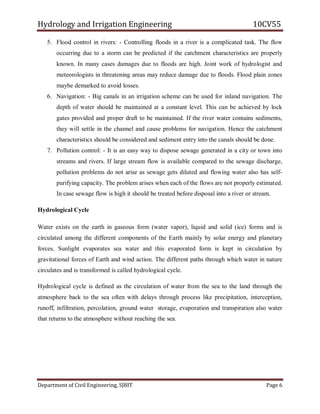
Hydrological Cycle
Water exists on the earth in gaseous form (water vapor), liquid and solid (ice) forms and is
circulated among the different components of the Earth mainly by solar energy and planetary
forces. Sunlight evaporates sea water and this evaporated form is kept in circulation by
gravitational forces of Earth and wind action. The different paths through which water in nature
circulates and is transformed is called hydrological cycle.
Hydrological cycle is defined as the circulation of water from the sea to the land through the
atmosphere back to the sea often with delays through process like precipitation, interception,
runoff, infiltration, percolation, ground water storage, evaporation and transpiration also water
that returns to the atmosphere without reaching the sea.
Hydrology and Irrigation Engineering 10CV55
Department of Civil Engineering, SJBIT Page 7
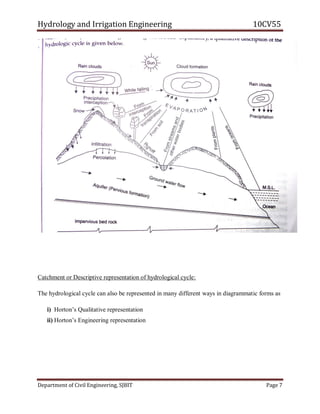
Catchment or Descriptive representation of hydrological cycle:
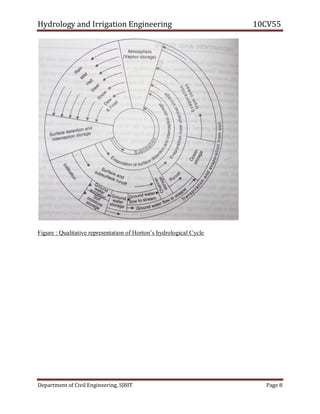
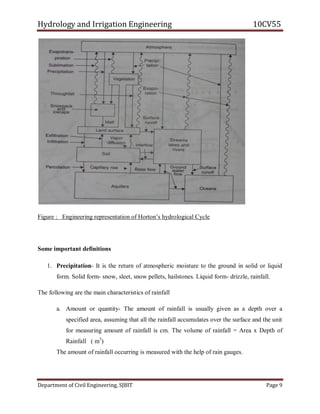
The hydrological cycle can also be represented in many different ways in diagrammatic forms as
i) Horton‘s Qualitative representation
ii) Horton‘s Engineering representation
Hydrology and Irrigation Engineering 10CV55
Department of Civil Engineering, SJBIT Page 8
Figure : Qualitative representation of Horton‘s hydrological Cycle
Hydrology and Irrigation Engineering 10CV55
Department of Civil Engineering, SJBIT Page 9
Figure : Engineering representation of Horton‘s hydrological Cycle
Some important definitions
1. Precipitation- It is the return of atmospheric moisture to the ground in solid or liquid
form. Solid form- snow, sleet, snow pellets, hailstones. Liquid form- drizzle, rainfall.
The following are the main characteristics of rainfall
a. Amount or quantity- The amount of rainfall is usually given as a depth over a
specified area, assuming that all the rainfall accumulates over the surface and the unit
for measuring amount of rainfall is cm. The volume of rainfall = Area x Depth of
Rainfall ( m3
)
The amount of rainfall occurring is measured with the help of rain gauges.
Hydrology and Irrigation Engineering 10CV55
Department of Civil Engineering, SJBIT Page 10
b. Intensity- This is usually average of rainfall rate of rainfall during the special periods
of a storm and is usually expressed as cm/ hour.
c. Duration of Storm- In the case of a complex storm, we can divide it into a series of
storms of different durations, during which the intensity is more or less uniform.
d. Aerial distribution- During a storm, the rainfall intensity or depth etc. will not be
uniform over the entire area. Hence we must consider the variation over the area i.e.
the aerial distribution of rainfall over which rainfall is uniform.
2. Infiltration- Infiltration is the passage of water across the soil surface. The vertical
downward movement of water within the soil is known as percolation. The infiltration
capacity is the maximum rate of infiltration for the given condition of the soil. Obviously
the infiltration capacity decreases with time during/ after a storm.
3. Overland Flow- This is the part of precipitation which is flowing over the ground
surface and is yet to reach a well-defined stream.
4. Surface runoff- When the overland flow enters a well-defined stream it is known as
surface runoff (SRO).
5. Interflow for Sub surface flow- A part of the precipitation which has in-filtered the
ground surface may flow within the soil but close to the surface. This is known as
interflow. When the interflow enters a well-defined stream, then and only it is called run
off.
6. Ground water flow- This is the flow of water in the soil occurring below the ground
water table. The ground water table is at the top level of the saturated zone within the soil
and it is at atmospheric pressure. Hence it is also called phreatic surface. A portion of
water may enter a well-defined stream. Only then it is known as runoff or base flow.
Hence we say that runoff is the portion of precipitation which enters a well-defined
stream and has three components; namely- surface runoff, interflow runoff and ground
water runoff or base flow.
7. Evaporation- This is the process by which state of substance (water) is changed from
liquid state to vapor form. Evaporation occurs constantly from water bodies, soil surface
and even from vegetation. In short evaporation occurs when water is exposed to
atmosphere (during sunlight). The rate of evaporation depends on the temperature and
humidity.
Hydrology and Irrigation Engineering 10CV55
Department of Civil Engineering, SJBIT Page 11
8. Transpiration – This is the process by which the water extracted by the roots of the
plants is lost to the atmosphere through the surface of leaves and branches by
evaporation. Hence it is also known as evapotranspiration.
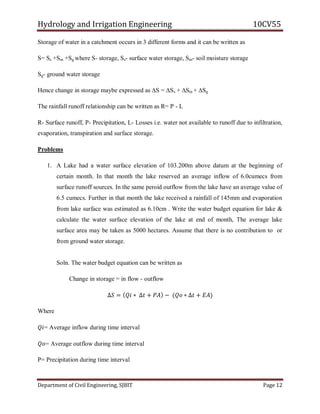
Water budget equation for a catchment
The area of land draining into a stream at a given location is known as catchment area or
drainage area or drainage basin or water shed.
For a given catchment area in any interval of time, the continuity equation for water balance is
given as-
(Change in mass storage)= (mass in flow) - (mass outflow)
∆s = Vi - Vo
The water budget equation for a catchment considering all process for a time interval ∆t is written
as
∆s = P- R-G-E-T
Where, ∆s represents change in storage
P- Precipitation G- Net ground water flowing outside the catchment
R- Surface runoff E- evaporation T- transpiration
Hydrology and Irrigation Engineering 10CV55
Department of Civil Engineering, SJBIT Page 12
Storage of water in a catchment occurs in 3 different forms and it can be written as
S= Ss +Sm +Sg where S- storage, Ss- surface water storage, Sm- soil moisture storage
Sg- ground water storage
Hence change in storage maybe expressed as ∆S = ∆Ss + ∆Sm + ∆Sg
The rainfall runoff relationship can be written as R= P - L
R- Surface runoff, P- Precipitation, L- Losses i.e. water not available to runoff due to infiltration,
evaporation, transpiration and surface storage.
Problems
1. A Lake had a water surface elevation of 103.200m above datum at the beginning of
certain month. In that month the lake reserved an average inflow of 6.0cumecs from
surface runoff sources. In the same peroid outflow from the lake have an average value of
6.5 cumecs. Further in that month the lake received a rainfall of 145mm and evaporation
from lake surface was estimated as 6.10cm . Write the water budget equation for lake &
calculate the water surface elevation of the lake at end of month, The average lake
surface area may be taken as 5000 hectares. Assume that there is no contribution to or
from ground water storage.
Soln. The water budget equation can be written as
Change in storage = in flow - outflow
∆𝑆 = 𝑄𝑖 ∗ ∆𝑡 + 𝑃𝐴 − (𝑄𝑜 ∗ ∆𝑡 + 𝐸𝐴)
Where
𝑄𝑖= Average inflow during time interval
𝑄𝑜= Average outflow during time interval
P= Precipitation during time interval
Hydrology and Irrigation Engineering 10CV55
Department of Civil Engineering, SJBIT Page 13
E= Evaporation during time interval
A= Area extend consider ( Area of lake)
𝑄𝑖 = 6 m3
/s P= 145x 10-3
m= 0.145m
𝑄𝑜= 6.5 m3
/s E= 0.061m
∆𝑡 = 1 month = 1* 30*24* 60* 60 = 2.592x10⁶
sec
A= 5000 ha= 5000x 104
m2
Substituting in the above equation given
∆𝑆 = 2.904 x 10⁶
m3
.
+ve indicates increase in storage .
In increase in storage height,
∆𝑆
𝐴
= 2.904 x 10⁶
/ 5000x104
= 0.05808m
Therefore new water surface elevation = 103.2 + 0.05808= 103.258m above datum.
2. A small catchment area of 150hectare received a rainfall of 10.5cm in 90 min due to a
storm at a theoutlet of catchment draining the catchment was dry before the storm &
expericed a runoff lasting for 10 hrs with average discharge of 1.5 m3
/s the stream was
dry again after runoff event.
a) What is amount of wate rwhich was not available to runoff due to combine effect of
infiltration evaporation?
b) What is the ratio of runoff to precipitaiton
Solution:
a) A= 150ha
P= 10.5cm
∆𝑡 = 90min
𝑄𝑜= 1.5 m3
/s
The water budget equation for catchment in a time interval ∆𝑡 given as
Hydrology and Irrigation Engineering 10CV55
Department of Civil Engineering, SJBIT Page 14
R= P- L
Where R= Surface runoff volume
P= Precipitation or rainfall volume
L= Losses due to Infiltration, Evaporation, Transpiration
P = 10.5x 150x 104
/ 100 = 157.5x 10³
m3
R= 1.5x10x60x60 = 54x 103
m3
L = P – R
= 157.5x 10³
- 54x 103
= 103500 m3
b) Ratio of runoff to precipitate
R/ P = 54000/ 157.5x 103
= 0.343
Precipitation
It is defined as the return of atmospheric moisture to the ground in the form of solids or liquids.
Forms of Precipitation
1. Drizzle- This is a form of precipitation consisting of water droplets of diameter less than
0.05 cm with intensity less than 0.01cm/ hour.
2. Rainfall- This is a form of precipitation of water drops larger than 0.05cm diameter up to
0.5cm diameter. Water drops of size greater than 0.5 cm diameter tend to break up as
they fall through the atmosphere. Intensity varies from 0.25 cm/ hour to 0.75cm/ hour.
3. Glaze- This is the ice coating formed when a drizzle or rainfall comes in contact with
very old objects on the ground
4. Sleet- This occurs when rain drops fall through air which is below 00
c. The grains are
transparent, round with diameter between 0.1 cm to 0.4 cm.
5. Snow Pellets- These are white opaque round grains of ice. They are crystalline and
rebound when falling onto the ground. The diameter varies from 0.05cm to 0.5cm.
6. Snow- This is precipitation in the form of ice crystals, usually a no. of ice crystals
combining to form snowflakes.
Hydrology and Irrigation Engineering 10CV55
Department of Civil Engineering, SJBIT Page 15
7. Hails- These are balls or irregular lumps of ice of over 0.5cm diameter formed by
repeated freezing and melting. These are formed by upward and downward movement of
air masses in turbulent air currents.
Necessary conditions for occurrence of Precipitation
For precipitation to occur, moisture (water vapor) is always necessary to be present. Moisture is
present due to the process of evaporation. There must also be some mechanism for large scale
lifting of moist, warm air so that there will be sufficient cooling. This will cause condensation
(conversion of vapors) to liquid and growth of water drops.
Condensation nuclei such as the oxides of nitrogen, salt crystals, carbon dioxide, silica etc. must
be present such that water vapor condenses around them. The conditions of electric charge in the
cloud, size of water droplets or ice crystals, temperature and relative movement of clouds must
be favorable so that the size of the condensed water drop increases and ultimately they begin to
fall to the ground due to gravity. A drop of size 0.5mm can fall through 2000m in unsaturated
air.
Types of Precipitation
One of the essential requirements for precipitation to occur is the cooling of large masses of
moist air. Lifting of air masses to higher altitudes is the only large scale process of cooling.
Hence the types of precipitation based on the mechanism which causes lifting of air masses are
as follows-
1. Cyclonic Precipitation- This is the precipitation associated with cyclones or moving
masses of air and involves the presence of low pressures. This is further sub divided into
2 categories-
a. Non Frontal cyclonic precipitation- In this, a low pressure area develops. (Low-pressure
area is a region where the atmospheric pressure is lower than that of surrounding
locations.) The air from surroundings converges laterally towards the low pressure area.
This results in lifting of air and hence cooling. It may result in precipitation.
b. Frontal cyclonic precipitation- FRONT is a barrier region between two air masses having
different temperature, densities, moisture, content etc. If a warm and moist air mass
Hydrology and Irrigation Engineering 10CV55
Department of Civil Engineering, SJBIT Page 16
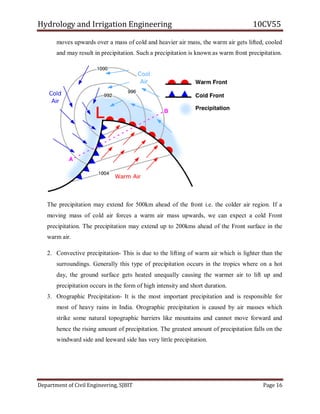
moves upwards over a mass of cold and heavier air mass, the warm air gets lifted, cooled
and may result in precipitation. Such a precipitation is known as warm front precipitation.
The precipitation may extend for 500km ahead of the front i.e. the colder air region. If a
moving mass of cold air forces a warm air mass upwards, we can expect a cold Front
precipitation. The precipitation may extend up to 200kms ahead of the Front surface in the
warm air.
2. Convective precipitation- This is due to the lifting of warm air which is lighter than the
surroundings. Generally this type of precipitation occurs in the tropics where on a hot
day, the ground surface gets heated unequally causing the warmer air to lift up and
precipitation occurs in the form of high intensity and short duration.
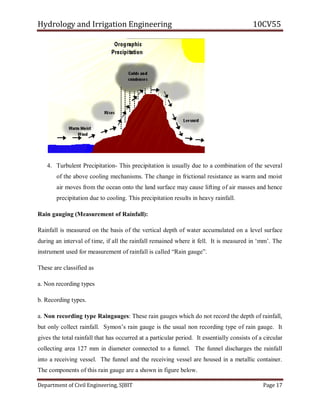
3. Orographic Precipitation- It is the most important precipitation and is responsible for
most of heavy rains in India. Orographic precipitation is caused by air masses which
strike some natural topographic barriers like mountains and cannot move forward and
hence the rising amount of precipitation. The greatest amount of precipitation falls on the
windward side and leeward side has very little precipitation.
Hydrology and Irrigation Engineering 10CV55
Department of Civil Engineering, SJBIT Page 17
4. Turbulent Precipitation- This precipitation is usually due to a combination of the several
of the above cooling mechanisms. The change in frictional resistance as warm and moist
air moves from the ocean onto the land surface may cause lifting of air masses and hence
precipitation due to cooling. This precipitation results in heavy rainfall.
Rain gauging (Measurement of Rainfall):
Rainfall is measured on the basis of the vertical depth of water accumulated on a level surface
during an interval of time, if all the rainfall remained where it fell. It is measured in ‗mm‘. The
instrument used for measurement of rainfall is called ―Rain gauge‖.
These are classified as
a. Non recording types
b. Recording types.
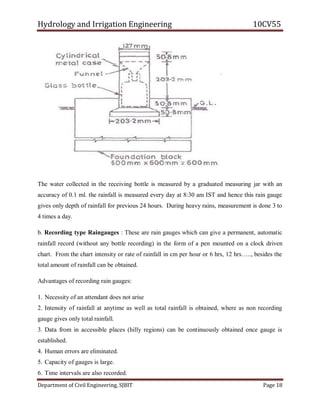
a. Non recording type Raingauges: These rain gauges which do not record the depth of rainfall,
but only collect rainfall. Symon‘s rain gauge is the usual non recording type of rain gauge. It
gives the total rainfall that has occurred at a particular period. It essentially consists of a circular
collecting area 127 mm in diameter connected to a funnel. The funnel discharges the rainfall
into a receiving vessel. The funnel and the receiving vessel are housed in a metallic container.
The components of this rain gauge are a shown in figure below.
Hydrology and Irrigation Engineering 10CV55
Department of Civil Engineering, SJBIT Page 18
The water collected in the receiving bottle is measured by a graduated measuring jar with an
accuracy of 0.1 ml. the rainfall is measured every day at 8:30 am IST and hence this rain gauge
gives only depth of rainfall for previous 24 hours. During heavy rains, measurement is done 3 to
4 times a day.
b. Recording type Raingauges : These are rain gauges which can give a permanent, automatic
rainfall record (without any bottle recording) in the form of a pen mounted on a clock driven
chart. From the chart intensity or rate of rainfall in cm per hour or 6 hrs, 12 hrs….., besides the
total amount of rainfall can be obtained.
Advantages of recording rain gauges:
1. Necessity of an attendant does not arise
2. Intensity of rainfall at anytime as well as total rainfall is obtained, where as non recording
gauge gives only total rainfall.
3. Data from in accessible places (hilly regions) can be continuously obtained once gauge is
established.
4. Human errors are eliminated.
5. Capacity of gauges is large.
6. Time intervals are also recorded.
Hydrology and Irrigation Engineering 10CV55
Department of Civil Engineering, SJBIT Page 19
Disadvantages of recording rain gauges:
1. High initial investment cost.
2. Recording is not reliable when faults in gauge arise (mechanical or electrical) till faults are
corrected.
Types of recording or automatic rain gauges:
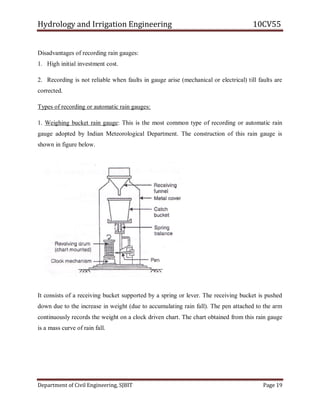
1. Weighing bucket rain gauge: This is the most common type of recording or automatic rain
gauge adopted by Indian Meteorological Department. The construction of this rain gauge is
shown in figure below.
It consists of a receiving bucket supported by a spring or lever. The receiving bucket is pushed
down due to the increase in weight (due to accumulating rain fall). The pen attached to the arm
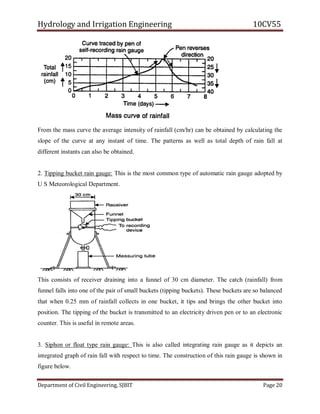
continuously records the weight on a clock driven chart. The chart obtained from this rain gauge
is a mass curve of rain fall.
Hydrology and Irrigation Engineering 10CV55
Department of Civil Engineering, SJBIT Page 20
From the mass curve the average intensity of rainfall (cm/hr) can be obtained by calculating the
slope of the curve at any instant of time. The patterns as well as total depth of rain fall at
different instants can also be obtained.
2. Tipping bucket rain gauge: This is the most common type of automatic rain gauge adopted by
U S Meteorological Department.
This consists of receiver draining into a funnel of 30 cm diameter. The catch (rainfall) from
funnel falls into one of the pair of small buckets (tipping buckets). These buckets are so balanced
that when 0.25 mm of rainfall collects in one bucket, it tips and brings the other bucket into
position. The tipping of the bucket is transmitted to an electricity driven pen or to an electronic
counter. This is useful in remote areas.
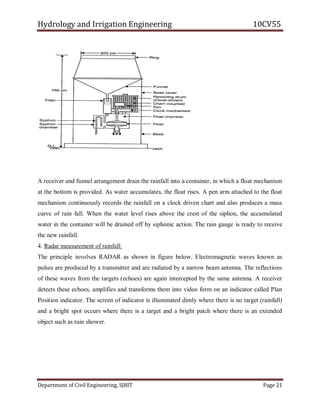
3. Siphon or float type rain gauge: This is also called integrating rain gauge as it depicts an
integrated graph of rain fall with respect to time. The construction of this rain gauge is shown in
figure below.
Hydrology and Irrigation Engineering 10CV55
Department of Civil Engineering, SJBIT Page 21
A receiver and funnel arrangement drain the rainfall into a container, in which a float mechanism
at the bottom is provided. As water accumulates, the float rises. A pen arm attached to the float
mechanism continuously records the rainfall on a clock driven chart and also produces a mass
curve of rain fall. When the water level rises above the crest of the siphon, the accumulated
water in the container will be drained off by siphonic action. The rain gauge is ready to receive
the new rainfall.
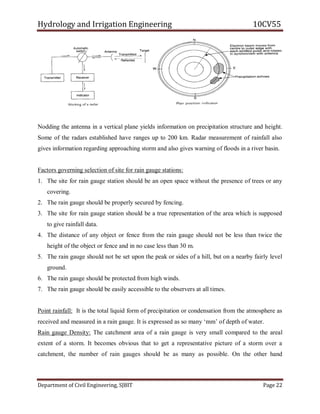
4. Radar measurement of rainfall:
The principle involves RADAR as shown in figure below. Electromagnetic waves known as
pulses are produced by a transmitter and are radiated by a narrow beam antenna. The reflections
of these waves from the targets (echoes) are again intercepted by the same antenna. A receiver
detects these echoes, amplifies and transforms them into video form on an indicator called Plan
Position indicator. The screen of indicator is illuminated dimly where there is no target (rainfall)
and a bright spot occurs where there is a target and a bright patch where there is an extended
object such as rain shower.
Hydrology and Irrigation Engineering 10CV55
Department of Civil Engineering, SJBIT Page 22
Nodding the antenna in a vertical plane yields information on precipitation structure and height.
Some of the radars established have ranges up to 200 km. Radar measurement of rainfall also
gives information regarding approaching storm and also gives warning of floods in a river basin.
Factors governing selection of site for rain gauge stations:
1. The site for rain gauge station should be an open space without the presence of trees or any
covering.
2. The rain gauge should be properly secured by fencing.
3. The site for rain gauge station should be a true representation of the area which is supposed
to give rainfall data.
4. The distance of any object or fence from the rain gauge should not be less than twice the
height of the object or fence and in no case less than 30 m.
5. The rain gauge should not be set upon the peak or sides of a hill, but on a nearby fairly level
ground.
6. The rain gauge should be protected from high winds.
7. The rain gauge should be easily accessible to the observers at all times.
Point rainfall: It is the total liquid form of precipitation or condensation from the atmosphere as
received and measured in a rain gauge. It is expressed as so many ‗mm‘ of depth of water.
Rain gauge Density: The catchment area of a rain gauge is very small compared to the areal
extent of a storm. It becomes obvious that to get a representative picture of a storm over a
catchment, the number of rain gauges should be as many as possible. On the other hand
Hydrology and Irrigation Engineering 10CV55
Department of Civil Engineering, SJBIT Page 23
topographic conditions and accessibility restrict the number of rain gauges to be set up. Hence
one aims at optimum number of rain gauges from which accurate information can be obtained.
From practical considerations IMD as per IS 4987 has recommended the following rain gauge
densities depending upon the type of area.
a. Plain areas – 1 station per 520 km2
b. Areas with 1000 m average elevation - 1 station per 260 to 350 km2
c. Predominantly hilly areas with heavy rainfall - 1 station per 130 km2
Determination of average precipitation over an area:
The rainfall measured by a rain gauge is called point precipitation because it represents the
rainfall pattern over a small area surrounding the rain gauge station. However in nature rain fall
pattern varies widely. The average precipitation over an area can be obtained only if several rain
gauges are evenly distributed over the area. But there is always limitation to establish several
rain gauges. However this draw back can be overcome by adopting certain methods as
mentioned below, which give fair results.
a. Arithmetic mean method: In this method to determine the average precipitation over an area
the rainfall data of all available stations are added and divided by the number of stations to give
an arithmetic mean for the area. That is if P1, P2 and P3 are the precipitations recorded at three
stations A, B and C respectively, then average precipitation over the area covered by the rain
gauges is given by
3
321
PPP
av
P


This method can be used if the area is reasonably flat and individual gauge readings do not
deviate from the mean (average). This method does not consider aerial variation of rainfall, non-
even distribution of gauges, Orographic influences (presence of hills), etc. This method can also
be used to determine the missing rain fall reading from any station also in the given area.
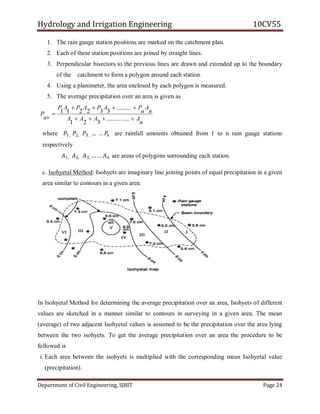
b. Thiessen Polygon method: This is also known as weighted mean method. This method is very
accurate for catchments having areas from 500 to 5000 km2
. In this method rainfall recorded at
each station is given a weight age on the basis of the area enclosing the area. The procedure
adopted is as follows.
Hydrology and Irrigation Engineering 10CV55
Department of Civil Engineering, SJBIT Page 24
1. The rain gauge station positions are marked on the catchment plan.
2. Each of these station positions are joined by straight lines.
3. Perpendicular bisectors to the previous lines are drawn and extended up to the boundary
of the catchment to form a polygon around each station.
4. Using a planimeter, the area enclosed by each polygon is measured.
5. The average precipitation over an area is given as
n
AAAA
n
A
n
PAPAPAP
av
P



...............
321
..........
332211
where 𝑃1 , 𝑃2, 𝑃3 , … … 𝑃𝑛 are rainfall amounts obtained from 1 to n rain gauge stations
respectively
𝐴1, 𝐴2, 𝐴3, … … 𝐴 𝑛 are areas of polygons surrounding each station.
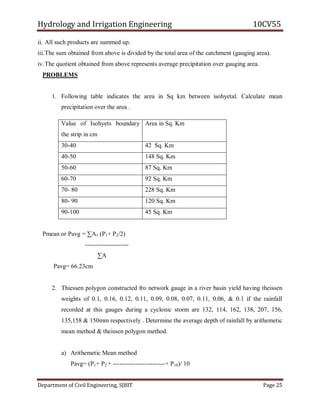
c. Isohyetal Method: Isohyets are imaginary line joining points of equal precipitation in a given
area similar to contours in a given area.
In Isohyetal Method for determining the average precipitation over an area, Isohyets of different
values are sketched in a manner similar to contours in surveying in a given area. The mean
(average) of two adjacent Isohyetal values is assumed to be the precipitation over the area lying
between the two isohyets. To get the average precipitation over an area the procedure to be
followed is
i. Each area between the isohyets is multiplied with the corresponding mean Isohyetal value
(precipitation).
Hydrology and Irrigation Engineering 10CV55
Department of Civil Engineering, SJBIT Page 25
ii. All such products are summed up.
iii.The sum obtained from above is divided by the total area of the catchment (gauging area).
iv.The quotient obtained from above represents average precipitation over gauging area.
PROBLEMS
1. Following table indicates the area in Sq km between isohyetal. Calculate mean
precipitation over the area .
Value of Isohyets boundary
the strip in cm
Area in Sq. Km
30-40 42 Sq. Km
40-50 148 Sq. Km
50-60 87 Sq. Km
60-70 92 Sq. Km
70- 80 228 Sq. Km
80- 90 120 Sq. Km
90-100 45 Sq. Km
Pmean or Pavg = ∑A1 (P1+ P2/2)
---------------------
∑A
Pavg= 66.23cm
2. Thiessen polygon constructed fro network gauge in a river basin yield having theissen
weights of 0.1, 0.16, 0.12, 0.11, 0.09, 0.08, 0.07, 0.11, 0.06, & 0.1 if the rainfall
recorded at this gauges during a cyclonic storm are 132, 114, 162, 138, 207, 156,
135,158 & 150mm respectively . Determine the average depth of rainfall by arithemetic
mean method & theissen polygon method.
a) Arithemetic Mean method
Pavg= (P1+ P2 + -------------------------+ P10)/ 10
Hydrology and Irrigation Engineering 10CV55
Department of Civil Engineering, SJBIT Page 26
= (132+ 114+162+ 138+207+ 156+ 135+ 158+108+150)/ 10
= 146 m
b) Theissen polygon method
Pmean=P1W1+ P2W2+ P3W3+ P4W4---------------------+ P10W10
=132*0.1+114*0.16+162*0.12+138*0.11+207*0.09+156*0.08+135*0.11+158*0.0
6+ 150*0.1
= 145.48mm
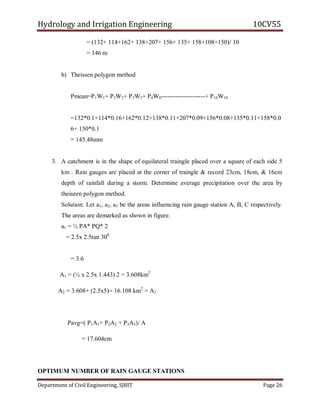
3. A catchment is in the shape of equilateral traingle placed over a square of each side 5
km . Rain gauges are placed at the corner of traingle & record 23cm, 18cm, & 16cm
depth of rainfall during a storm. Determine average precipitation over the area by
theiseen polygon method.
Solution: Let a1, a2, a3 be the areas influencing rain gauge station A, B, C respectively.
The areas are demarked as shown in figure.
a1 = ½ PA* PQ* 2
= 2.5x 2.5tan 300
= 3.6
A1 = (½ x 2.5x 1.443) 2 = 3.608km2
A2 = 3.608+ (2.5x5)= 16.108 km2
= A3
Pavg=( P1A1+ P2A2 + P3A3)/ A
= 17.604cm
OPTIMUM NUMBER OF RAIN GAUGE STATIONS
Hydrology and Irrigation Engineering 10CV55
Department of Civil Engineering, SJBIT Page 27
If there are already some raingauge stations in a catchment, the optimal number of stations that
should exist to have an assigned percentage of error in the estimation of mean rainfall is
obtained by statistical analysis as
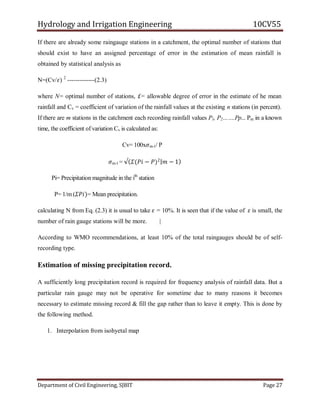
N=(Cv/𝜀) 2
-------------(2.3)
where N= optimal number of stations, £= allowable degree of error in the estimate of he mean
rainfall and Cv = coefficient of variation of the rainfall values at the existing n stations (in percent).
If there are m stations in the catchment each recording rainfall values P1, P2…….Pp... Pm in a known
time, the coefficient of variation Cv is calculated as:
Cv= 100x𝜎m-1/ P
𝜎m-1 = √ 𝛴(𝑃𝑖 − 𝑃)2
𝑚 − 1
Pi= Precipitation magnitude in the ith
station
P= 1/m (𝛴𝑃𝑖)= Mean precipitation.
calculating N from Eq. (2.3) it is usual to take 𝜀 = 10%. It is seen that if the value of 𝜀 is small, the
number of rain gauge stations will be more. |
According to WMO recommendations, at least 10% of the total raingauges should be of self-
recording type.
Estimation of missing precipitation record.
A sufficiently long precipitation record is required for frequency analysis of rainfall data. But a
particular rain gauge may not be operative for sometime due to many reasons it becomes
necessary to estimate missing record & fill the gap rather than to leave it empty. This is done by
the following method.
1. Interpolation from isohyetal map
Hydrology and Irrigation Engineering 10CV55
Department of Civil Engineering, SJBIT Page 28
In a isohytal map of the area the passion of the station (rain gauge) where record is
missing is marked by interpolation techniques the missing record is worked out the
factors like storm factor, topography nearness to sea are considered for proper estimation.
2. Arithmetic average method.
Here number of other rain gauge station record surrounding station in question (missing
record) are required. The missing rainfall record at the station is taken as average o fall
available data surrounding station in question. P1, P2, P3-------- etc Pn are rainfall record
from ―n‖ station surrounding a non operative station ‗x‖ the rainfall data for station ― x‖
is given as
Px= (P1+ P2+ P3------+ Pn) / N
This method is applicable when normal annual rainfall at station ―x‖ does not differ by
more than 10% with the surrounding station.
3. Normal ratio method.
This method is applicable when normal annual rainfall at required station differ more
than 10% of annual rainfall at surrounding station.
Let P1, P2, P3-------- Pn be rainfall record at ―n‖ station during a particular storm
surrounding station ― x‖ ( with missing record)
Let N1, N2 -------- Nn be annual normal rainfall for ―n‖ station Nx be annual rainfall for
station ―x‖
Then the rainfall at station ―x‖ during a given storm is calculated as
Px = 1/n (Nx/N1 P1+ Nx/N2 P2---- + Nx/ Nx Pn)
Px= Nx/n ∑ Pi/ Ni , i=1 to n
Hydrology and Irrigation Engineering 10CV55
Department of Civil Engineering, SJBIT Page 29
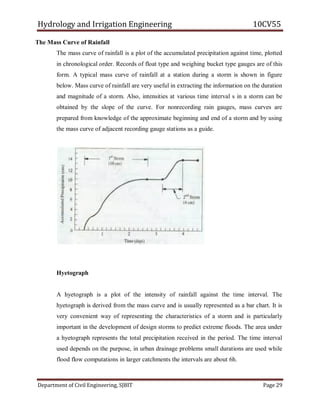
The Mass Curve of Rainfall
The mass curve of rainfall is a plot of the accumulated precipitation against time, plotted
in chronological order. Records of float type and weighing bucket type gauges are of this
form. A typical mass curve of rainfall at a station during a storm is shown in figure
below. Mass curve of rainfall are very useful in extracting the information on the duration
and magnitude of a storm. Also, intensities at various time interval s in a storm can be
obtained by the slope of the curve. For nonrecording rain gauges, mass curves are
prepared from knowledge of the approximate beginning and end of a storm and by using
the mass curve of adjacent recording gauge stations as a guide.
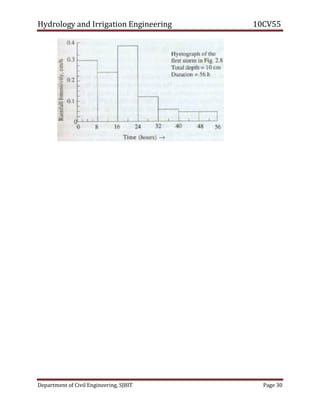
Hyetograph
A hyetograph is a plot of the intensity of rainfall against the time interval. The
hyetograph is derived from the mass curve and is usually represented as a bar chart. It is
very convenient way of representing the characteristics of a storm and is particularly
important in the development of design storms to predict extreme floods. The area under
a hyetograph represents the total precipitation received in the period. The time interval
used depends on the purpose, in urban drainage problems small durations are used while
flood flow computations in larger catchments the intervals are about 6h.
Hydrology and Irrigation Engineering 10CV55
Department of Civil Engineering, SJBIT Page 30
Hydrology and Irrigation Engineering 10CV55
Department of Civil Engineering, SJBIT Page 31
UNIT -2
LOSSES FROM PRECIPITATION
The hydrological equation states that ‗Runoff = Rainfall – Losses‘.
Hence the runoff from a watershed resulting due to a storm is dependent on the losses. Losses
may occur due to the following reasons
1. Evaporation
2. Evapotranspiration
3. Infiltration
4. Interception
5. Watershed leakage
The first three contribute to the major amount of losses.
EVAPORATION
It is the process by which a liquid changes to gaseous state at the free surface through transfer of
heat energy.
In an exposed water body like lakes or ponds, water molecules are in continuous motion with
arrange of velocities (faster at the top and slower at the bottom). Additional heat on water body
increases the velocities. When some water molecules posses‘ sufficient kinetic energy they may
cross over the water surface. Simultaneously the water molecules in atmosphere surrounding the
water body may penetrate the water body due to condensation. If the number of molecules
leaving the water body is greater than the number of molecules arriving or returning, difference
in vapour pressure occurs, leading to evaporation.
Factors affecting Evaporation
1. Vapour pressure difference: The number of molecules leaving or entering a water body
depends on the vapour pressure of water body at the surface and also the vapour pressure
of air. Higher water temperature leads to high vapour pressure at surface and tends to
increase the rate of evaporation. High humidity in air tends to increase vapour pressure in
air and in turn reduces rate of evaporation.
Hydrology and Irrigation Engineering 10CV55
Department of Civil Engineering, SJBIT Page 32
2. Temperature of air and water: The rate of emission of molecules from a water body is a
function of its temperature. At higher temperature molecules of water have greater energy
to escape. Hence maximum evaporation from water bodies takes place in summer. It has
been estimated that for every 1o
C rise in atmospheric temperature increases 5 cm of
evaporation annually.
3. Wind Velocity: When wind velocity is more the saturated air (humid air) is drifted away
and dry air comes in contact with water surface which is ready to absorb moisture. Hence
rate of evaporation is dependent on wind velocity. It has been estimated that 10%
increase in wind velocity increases 2 – 3% of evaporation.
4. Quality of water: The rate of evaporation of fresh water is greater than saline water.
(Specific gravity of saline water is greater than that of fresh water. It is established that
saline water has lesser vapour pressure and it is observed that evaporation from fresh
water is 3 – 4% more than sea water.
5. Atmospheric pressure and Altitude: Evaporation decreases with increase in atmospheric
pressure as the rate of diffusion from water body into the air is suppressed. At higher
altitude the atmospheric pressure is usually lesser and there by evaporation rate is higher.
6. Depth of water body: Evaporation shallow water bodies is greater when compared to
deep water bodies as the water at lower levels in deep water bodies is not heated much
and vapour pressure at lower levels is also reduced.
DALTON’S LAW OF EVAPORATION
The rate of evaporation is function of the difference in vapour pressure at the water surface and
the atmosphere.
Dalton‘s law of evaporation states that ―Evaporation is proportional to the difference in vapour
pressures of water and air.
i e E α (ew – ea) or E = k (ew – ea)
where E = daily evaporation
ew = saturated vapour pressure of water at a given temperature
ea = vapour pressure of air
k = proportionality constant
Considering the effect of wind Dalton‘s Law is expressed as E = kl
(ew – ea) (a+b V)
Hydrology and Irrigation Engineering 10CV55
Department of Civil Engineering, SJBIT Page 33
where V = wind velocity in km/hour
kl
, a & b are constants for a given area.
Measurement of Evaporation
In order to ensure proper planning and operation of reservoirs and irrigation systems estimation
of evaporation is necessary. However exact measurement of evaporation is not possible. But the
following methods are adopted as they give reliable results.
1. Pan measurement methods
2. Use of empirical formulae
3. Storage equation method
4. Energy budget method
Pan measurement method: Any galvanized iron cylindrical vessel of 1.2 m to 1.8 m diameter,
300 mm depth with opening at the top can be used as an evaporimeter or evaporation pan.
During any interval of time evaporation is measured as the drop in water level in the pan.
Rainfall data, atmospheric pressure data, temperature, etc should also be recorded.
It has been correlated that evaporation from a pan is not exactly the same as that taking place
from a water body. Hence while using a pan measurement data for measuring evaporation from a
lake or a water body, a correction factor has to be applied or multiplied by a pan co-efficient.
Pan coefficient =
actual evaporation from reservoir
measured evaporation from pan
The evaporation pans adopted in practice have a pan coefficient of 0.7 to 0.8.
The popularly used evaporation pans are
1. ISI standard pan or Class A pan
2. U S Class A pan
3. Colorado sunken pan
4. U S Geological Survey floating pan
Hydrology and Irrigation Engineering 10CV55
Department of Civil Engineering, SJBIT Page 34
ISI standard pan or Class A pan
This evaporation pan should confirm to IS – 5973:1976 and is also called Class A pan. It consists
of a circular copper vessel of 1220 mm effective diameter, 255 mm effective depth and a wall
thickness of 0.9 mm. A thermometer is assembled to record the variation in temperature. A wire
mesh cover with hexagonal openings is provided at the top to prevent entry of foreign matter. A
fixed gauge housed in a stilling well as shown in figure is provided. During evaporation
measurement a constant water level is maintained at the top level of fixed gauge. For this
purpose water has to be added or removed periodically. The water level measurements are done
using micrometer hook gauge. The entire assembly is mounted on a level wooden platform.
Hydrology and Irrigation Engineering 10CV55
Department of Civil Engineering, SJBIT Page 35
Colorado sunken pan
This pan, is made up of unpainted galvanized iron sheet and buried into the ground within
100mm of top. The chief advantage of sunken pan is that radiation and aerodynamic
characteristics are similar to those of lake.
However, it has the following is disadvantages :
i. Difficult to detect leaks.
ii. Extra care is needed to keep the surrounding area free from tall grass, dust ,etc
iii. Expensive to install.
Hydrology and Irrigation Engineering 10CV55
Department of Civil Engineering, SJBIT Page 36
U S Geological Survey floating pan
With view to simulate the characteristics by drum floats in the middle of a raft (4.25 m x 4.87m)
is set afloat in a lake. The water level in the pan is kept at the same level as the lake leaving a rim
of 75mm. Diagonal baffles provided in the pan reduce the surging in the pan due to wave action.
Its high cost of installation and maintenance together with the difficulty involved in performing
measurements are its main disadvantages.
Use of empirical formulae:
Hydrology and Irrigation Engineering 10CV55
Department of Civil Engineering, SJBIT Page 37
Based on Dalton‘s law of evaporation, various formulae have been suggested to estimate
evaporation.
a) Meyer‘s formula: It states that









16
91)(
V
aesemkE
Where E = evaporation from water body (mm/day)
se = saturation vapour pressure at water surface (mm of mercury)
ae = vapour pressure of overlying air measured at a height of 9 m above free water
surface (mm of mercury)
9V = mean monthly wind velocity measured at a height of 9 m above free water
surface (km/hr)
mk = a constant (0.36 for large deep water bodies, 0.5 for small shallow water bodies)
b) Rohwer‘s formula: It states that
   aeseVaPE  6.00733.044.000073.0465.1771.0
E, se and ae have the same meaning as above.
aP = atmospheric pressure (mm of mercury)
6.0V = mean wind velocity measured at a height of 0.6 m above free water surface (km/hr)
Methods to control evaporation from lakes:
Following are some recommended measures to reduce evaporation from water surfaces.
1. Storage reservoirs should have more depth and less surface area. The site for construction of
a dam should be so chosen that a deep reservoir with minimum surface area exposed to
atmosphere is formed.
2. Tall trees on the wind ward side of the reservoir should be planted so that they act as wind
breakers.
3. By spraying a chemical such as Acetyl Alcohol on water surface, a film of 0.15 microns
thickness is produced on the surface. This film allows precipitation in but does not allow
Hydrology and Irrigation Engineering 10CV55
Department of Civil Engineering, SJBIT Page 38
evaporation. This is suitable when wind velocities are less and for small and medium sized
reservoirs.
4. In case of ponds and lakes entire water body can be covered by thin polythene sheets as
mechanical covering.
5. In reservoirs outlet arrangements should be so done to let out warmer water at top than cold
water from bottom.
6. De-weeding the reservoirs should be done such that water consumed by weeds is reduced.
7. The streams and channels to be straightened so that length and in turn exposed area to
atmosphere are reduced.
Transpiration:
It is the process by which the water vapour escapes from living plants from surfaces of leaves,
branches and enter the atmosphere.
Plants also consume water for building tissue. It has been estimated that water lost by
transpiration is about 800 times more than that required for tissue building. Hence transpiration

losses must also be fairly accounted or measured.
One of the widely used laboratory methods is by phytometer. It is consists of a closed water
tight tank with soil for plant growth. The soil is covered by a polythene sheet with the plant only
exposed. The entire set up with the plant is weighed in the beginning (W1) and at the end (W2).
The amount of water applied during plant growth (W) is noted. Water consumed by
transpiration is given as
Wt = (W1+W) - W2
The laboratory results are multiplied by a co-efficient to obtain field results.
Transpiration ratio is defined as follows,
Transpiration ratio =
Weight of water transpired
Weight of dry matter produced
Hydrology and Irrigation Engineering 10CV55
Department of Civil Engineering, SJBIT Page 39
Evapotranspiration: In agricultural fields apart from transpiration, water is also lost due to
evaporation from adjacent soil. The sum of these two losses is often termed as evapotranspiration
(Et) or consumptive use (Cu).
Potential evapotranspiration: When sufficient moisture is freely available to completely meet
the needs of the vegetation fully covering an area, the resulting evapotranspiration is called
potential evapotranspiration.
Actual evapotranspiration: The real evapotranspiration occurring in a specific situation in the
field is called actual evapotranspiration.
The knowledge of evapotranspiration, potential evapotranspiration and actual evapotranspiration
are very much useful in designing irrigation systems (in deciding the amount of water to be
supplied for raising crops).
Factors affecting evapotranspiration:
Potential evapotranspiration is controlled by meteorological facts but actual evapotranspiration is
affected by plant and soil factors. In total the factors affecting evapotranspiration are,
1. Temperature
2. Humidity
3. Percentage sunshine hours
4. Wind speed
5. Type of crop
6. Season
7. Moisture holding capacity of soil
8. Irrigation Methods
9. Cropping patterns
Determination of Evapotranspiration (Et) or Consumptive use of water.
The time interval for supplying water to agricultural crops, is a factor dependent on water
requirement of crops, soil properties and as well as consumptive use. Hence accurate
Hydrology and Irrigation Engineering 10CV55
Department of Civil Engineering, SJBIT Page 40
determination of consumptive use or evapotranspiration is very much essential. The methods of
determining consumptive use are:-
i) Direct measurement method
ii) By use of empirical formulae
Direct measurement methods
The different methods of direct measurement are
a. Soil moisture studies on plots
b. Tank and lysimeter method
c. Field experimental plots
d. Integration method
e. Inflow and outflow studies for large areas
a) Soil moisture studies on plots
Soil moisture measurements are done before and after supplying water. The quantity
of water extracted per day from the soil is computed for each required period. A curve
is drawn by plotting the rate of water consumed against time. This curve is useful for
determining the average consumption daily or on monthly basis.
b) Tank and lysimeter method
Tanks are watertight cylindrical containers which are open at one end. They have a
diameter of 1-3 m and depth of 2-3 m. They are set in ground with the rim in flush
with the ground surface. The quantity of water to keep a constant moisture content
(for optimum growth) is determined, which itself represents consumptive use.
A lysimeter is a container similar to tank but has pervious bottom free drainage
through the bottom is collected in a pan which is kept below. The consumptive use of
water in this case therefore the difference between the water applied and drainage
collected in the pan.
Hydrology and Irrigation Engineering 10CV55
Department of Civil Engineering, SJBIT Page 41
c) Field experimental plots
In this method water is applied to selected field plots in such a way that there is
neither runoff nor deep percolation. Yield obtained from different plots is plotted
against total water used. It can be observed that increase in yield occurs with increase
in water applied up to a certain point. Further increase in water content reduces yield.
This break point in water application is taken as consumptive use.
d) Integration method
In this method the consumptive use of water for large areas is determined as the sum
of the following products.
I) Consumptive use of each crop and its area
II) Consumptive use of natural vegetation and its area
III) Evaporation from water surfaces and their area
IV) Evaporation from open lands and their area
e) Inflow and outflow studies for large areas
In this method consumptive use of water for large areas is given by the equation
Cu= I+P + (Gs- Ge) - O
where I= Total inflow into the area during a year
P= Total precipitation in the area during a year
Gs= Ground water storage at the beginning of the year
Ge= Ground water storage at the end of the year
O= Outflow from the area during the year
By Use of Empirical formulae
Following are some of the empirical methods or relations suggested for calculating consumptive
use
a) Blaney Criddle method
b) Penman method
c) Lowry and Johnson method
d) Hargreaves pan method
Hydrology and Irrigation Engineering 10CV55
Department of Civil Engineering, SJBIT Page 42
e) Thornthwaite method.
Infiltration
The water entering the soil at the ground surface after overcoming resistance to flow is called
infiltration. The process is also termed as infiltration.
Infiltration fills the voids in the soil. Excess water moves down by gravity and it is known as
percolation. Percolation takes place till water reachesground water table. For continuous
infiltration to occur it is essential that percolation should also be continuous, which is also
dependent of ground water movement.
Infiltration process: Infiltration plays an important role in the runoff process and it can be easily
understood by a simple analogy as shown below.
The soil medium where infiltration is to be observed may be considered as a small container
covered with a wire gauge mesh. If water is poured over the gauge, part of it enters the soil and
some part over flows. Further the runoff and infiltration depend on the condition of soil. When
soil reaches saturated condition infiltration stops and all input becomes runoff. Usually at the
beginning of a storm infiltration is more and runoff is less and when storm continues infiltration
becomes lesser and runoff become constant. The volume of rainfall that will result in runoff is
called ‗Rainfall excess‘.
Infiltration rate (f):
It is actually the prevailing rate at which the water is entering the given soil at any given instant
of time. It is expressed in cm/hr (i.e. depth of water entering soil per unit time).
Infiltration Capacity (fp):
It is the maximum rate at which a soil in any given condition is capable of absorbing water.
Hydrology and Irrigation Engineering 10CV55
Department of Civil Engineering, SJBIT Page 43
Factors affecting infiltration Capacity:
The variations in the infiltration capacity are large. The infiltration capacity is influenced by
many factors. Some factors contribute to long term variation, but some cause temporary
variations.
a. Depth of surface retention and thickness of saturated layer of soil.
b. Texture of soil and its gradation.
c. Compactness of soil
d. Surface cover condition
e. Current moisture level in soil.
f. Soil temperature
g. Intensity of rainfall
h. Season of year
Measurement of infiltration:
Infiltration rates are required in many hydrological problems such as runoff estimation, soil
moisture studies in agriculture, etc. The different methods of determination of infiltration are
1. Use of Infiltro-meters
2. Hydrograph analysis method
Infiltro-meters are of two types.
a) Flooding type Infiltro-meters
b) Rainfall simulators
In flooding type Infiltro-meters water is applied in form of a sheet, with constant depth of
flooding. The depletion of water depth is observed with respect to time. In case of rainfall
simulators water is applied by sprinkling at a constant rate in excess of infiltration capacity and
the runoff occurring is also recorded.
Infiltro-meters adopted in practice are,
1.Simple (Tube Type) Infiltro-meters
2. Double ring Infiltro-meters
Hydrology and Irrigation Engineering 10CV55
Department of Civil Engineering, SJBIT Page 44
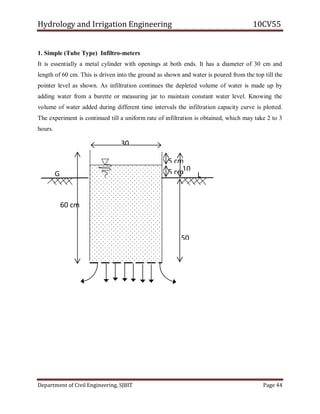
1. Simple (Tube Type) Infiltro-meters
It is essentially a metal cylinder with openings at both ends. It has a diameter of 30 cm and
length of 60 cm. This is driven into the ground as shown and water is poured from the top till the
pointer level as shown. As infiltration continues the depleted volume of water is made up by
adding water from a burette or measuring jar to maintain constant water level. Knowing the
volume of water added during different time intervals the infiltration capacity curve is plotted.
The experiment is continued till a uniform rate of infiltration is obtained, which may take 2 to 3
hours.
10
cm
60 cm
50
cm
5 cm
5 cmG L
30
cm
Hydrology and Irrigation Engineering 10CV55
Department of Civil Engineering, SJBIT Page 45
2. Double ring Infiltro-meters
A tube infiltrometer has a drawback that infiltration in it does not represent or simulate the
actual field conditions because the water tends to disperse laterally after coming out at the
bottom. To overcome this draw back a Double ring Infiltro-meter is widely used.
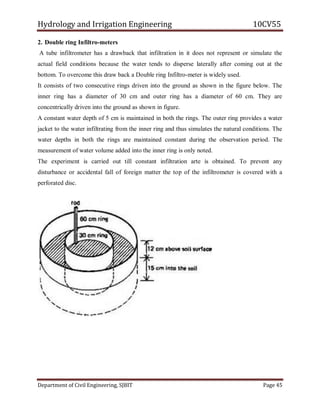
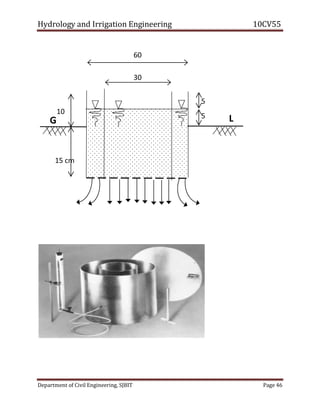
It consists of two consecutive rings driven into the ground as shown in the figure below. The
inner ring has a diameter of 30 cm and outer ring has a diameter of 60 cm. They are
concentrically driven into the ground as shown in figure.
A constant water depth of 5 cm is maintained in both the rings. The outer ring provides a water
jacket to the water infiltrating from the inner ring and thus simulates the natural conditions. The
water depths in both the rings are maintained constant during the observation period. The
measurement of water volume added into the inner ring is only noted.
The experiment is carried out till constant infiltration arte is obtained. To prevent any
disturbance or accidental fall of foreign matter the top of the infiltrometer is covered with a
perforated disc.
Hydrology and Irrigation Engineering 10CV55
Department of Civil Engineering, SJBIT Page 46
5
cm
10
cm
15 cm
5
cm
G L
30
cm
60
cm
Hydrology and Irrigation Engineering 10CV55
Department of Civil Engineering, SJBIT Page 47
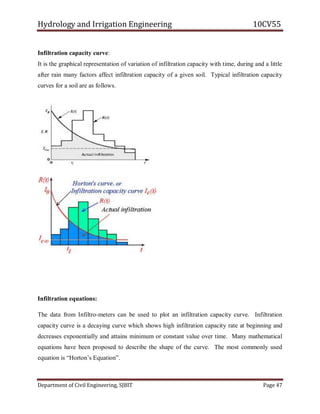
Infiltration capacity curve:
It is the graphical representation of variation of infiltration capacity with time, during and a little
after rain many factors affect infiltration capacity of a given soil. Typical infiltration capacity
curves for a soil are as follows.
Infiltration equations:
The data from Infiltro-meters can be used to plot an infiltration capacity curve. Infiltration
capacity curve is a decaying curve which shows high infiltration capacity rate at beginning and
decreases exponentially and attains minimum or constant value over time. Many mathematical
equations have been proposed to describe the shape of the curve. The most commonly used
equation is ―Horton‘s Equation‖.
Hydrology and Irrigation Engineering 10CV55
Department of Civil Engineering, SJBIT Page 48
The infiltration rate (f) at any time‗t‘ is given by Horton‘s equation
Fp= Fc+(Fo- Fc) e-Kht
Fo= initial rate of infiltration capacity
Fc= final constant rate of infiltration at saturation
K= a constant depending primarily upon soil and vegetation
e= base of Napier an logarithm
t= time from beginning of storm
Fc= shaded area obtained as shown from the graph also known as field capacity is the amount of
rainfall which can be absorbed by soil.
This equation when conjunctively used with rain fall data (hyetograph) can be used to calculate
surface runoff volumes occurring during a storm.
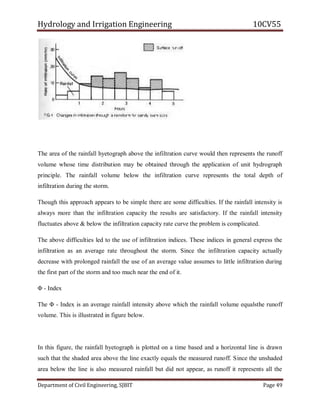
Infiltration indices
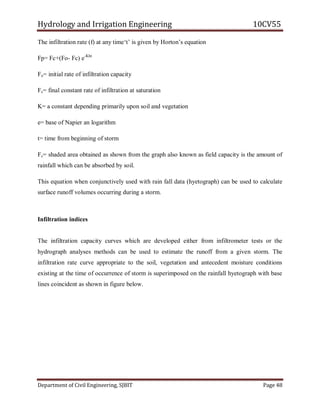
The infiltration capacity curves which are developed either from infiltrometer tests or the
hydrograph analyses methods can be used to estimate the runoff from a given storm. The
infiltration rate curve appropriate to the soil, vegetation and antecedent moisture conditions
existing at the time of occurrence of storm is superimposed on the rainfall hyetograph with base
lines coincident as shown in figure below.
Hydrology and Irrigation Engineering 10CV55
Department of Civil Engineering, SJBIT Page 49
The area of the rainfall hyetograph above the infiltration curve would then represents the runoff
volume whose time distribution may be obtained through the application of unit hydrograph
principle. The rainfall volume below the infiltration curve represents the total depth of
infiltration during the storm.
Though this approach appears to be simple there are some difficulties. If the rainfall intensity is
always more than the infiltration capacity the results are satisfactory. If the rainfall intensity
fluctuates above & below the infiltration capacity rate curve the problem is complicated.
The above difficulties led to the use of infiltration indices. These indices in general express the
infiltration as an average rate throughout the storm. Since the infiltration capacity actually
decrease with prolonged rainfall the use of an average value assumes to little infiltration during
the first part of the storm and too much near the end of it.
Φ - Index
The Φ - Index is an average rainfall intensity above which the rainfall volume equalsthe runoff
volume. This is illustrated in figure below.
In this figure, the rainfall hyetograph is plotted on a time based and a horizontal line is drawn
such that the shaded area above the line exactly equals the measured runoff. Since the unshaded
area below the line is also measured rainfall but did not appear, as runoff it represents all the
Hydrology and Irrigation Engineering 10CV55
Department of Civil Engineering, SJBIT Page 50
losses including depression storage, evaporation, interception as well as infiltration. However,
infiltration is the largest loss compared to the other losses. The Φ - Index can be determined for
each flood event for which the runoff measurements are available.
W – Index
The W – Index is refined version of Φ - Index. It excludes the depression storage and
interpolation from the total losses. It is the average infiltration rate during the time rainfall
intensity exceeds the capacity rate. That is
W= F/t= (P-Q-S)/ t
Where F is the total infiltration, t is the time during which rainfall intensity exceeds infiltration
capacity, P is the total precipitation corresponding to t, Q is the total storm runoff and S is the
volume of depression , storage and interception . Thus W- index is essentially equal to Φ - Index
minus the depression and interception storage.
Wmin – Index
This is the lowest value of W – Index which is observed under very wet initial conditions. Under
these conditions since the retention rate is very low W - Index and Φ - Index tend to be equal ..
This index is principally used in studies of maximum flood potential.
Hydrology and Irrigation Engineering 10CV55
Department of Civil Engineering, SJBIT Page 51
UNIT -3
HYDROGRAPHS
Run off
When precipitation occurs on land, a part of it is intercepted by vegetation and some part of it is
stored as depression storage. A part of precipitation infiltrates into the ground. The rate of
infiltration depends on the nature of the soil, moisture content in soil, topography, etc. If the rate
of precipitation is greater than the rate of infiltration, then the rainfall in excess of infiltration
will start flowing over the ground surface and is also known as over land flow. When overland
flow is occurring infiltration and evaporation may also occur. When over land flow reaches a
well defined stream it is known as surface run off.
A portion of infiltrating water will satisfy soil-moisture deficiency. A portion may move in soil
but very close to the surface. If this also reaches a well defined stream it is known as inter flow
or subsurface flow.
Another portion of infiltration may percolate deeper into the soil to reach ground water table.
Under favourable conditions some of the ground water may reach the streams and this portion is
known as Base flow or ground water flow.
A part of precipitation may occur directly on stream surface and this is known as channel
precipitation.
Hence Total runoff = Surface run off + Inter flow + Base flow + Channel precipitation
It is also evident that evaporation always occurs along with transpiration.
Hence
Precipitation = Run off + Evaporation
or
Precipitation = (Surface run off + Inter flow + Base flow + Channel precipitation) + Evaporation
Definitions:
Hydrology and Irrigation Engineering 10CV55
Department of Civil Engineering, SJBIT Page 52
1. Total Run off: This is the part of precipitation which appears in streams. It consists of
Surface run off, Inter flow, Base flow, and Channel precipitation.
2. Surface run off (SRO): This is the part of overland flow which reaches the streams.
3. Direct run off (DRO): It consists of Surface run off, Inter flow, and Channel precipitation,
but does not include Base flow.
Since channel precipitation is small and inter flow is uncertain, it is usual to include these
two run offs in surface run off. Hence there is no difference between direct run off and
surface run off.
Hence Total run off = Surface run off + Base flow
Since the base flow occurs in the stream after a longer time compared to surface run off, it is
necessary to separate the base flow and surface run off in preparing hydrographs.
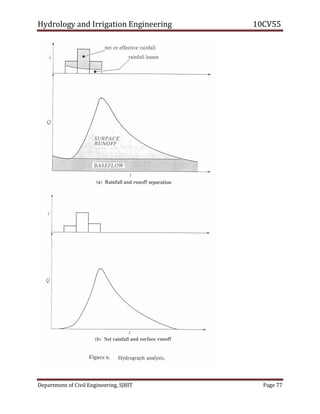
4. Hydrograph: A hydrograph is a plot of the run off or discharge in a stream versus time.
Hydrographs may be developed for isolated or complex storms using stream gauging data.
The area under the hydrograph gives the total volume of runoff and each ordinate gives the
discharge at the instant considered. It also indicates the peak discharge and the time base of
the flood in the stream.
5. Rainfall excess: This is the portion of rainfall appearing in the stream as surface run off.
6. Effective rainfall: This is the portion of rainfall which appears in the stream as the sum of
Surface run off, Inter flow, and Channel precipitation.
Since channel precipitation is small and inter flow is uncertain, it is usual to include these
two run offs in surface run off. Thus rainfall excess and effective rainfall may be considered
to be the same.
Note: Surface run off = Precipitation – (interception + depression storage + evaporation +
infiltration)
Hydrology and Irrigation Engineering 10CV55
Department of Civil Engineering, SJBIT Page 53
7. Channel storage: As runoff occurs in the stream, the water level will rise along the length of
the stream. Thus a large volume of water is temporarily stored in the channel. This is known
as channel storage. It reduces or moderates flood peaks. The channel storage therefore causes
delay in the appearance of discharge at any section of the stream.
Methods of estimating run off from basins:
(The basin area contributing to the flow in a stream goes on increasing as we go down along a
stream. Hence the section at which the flow is measured should be specified.)
The various methods for estimating run off from basins are
a. Empirical formulae and charts
b. By estimating losses (evaporation, transpiration, etc.)
c. By infiltration
d. Unit Hydrograph method
e. Synthetic Unit Hydrograph method (Synder‘s method)
It is difficult to obtain even a fairly approximate estimate of run off because the various
processes such as overland flow, base flow, infiltration, evaporation, etc are highly irregular and
complex. Thus none of the above methods can be considered as accurate. However the Unit
Hydrograph method is easier and is considered as the best among the methods mentioned.
Hydrograph: A Hydrograph is a graph showing the variation of discharge versus time.
Hydrology and Irrigation Engineering 10CV55
Department of Civil Engineering, SJBIT Page 54
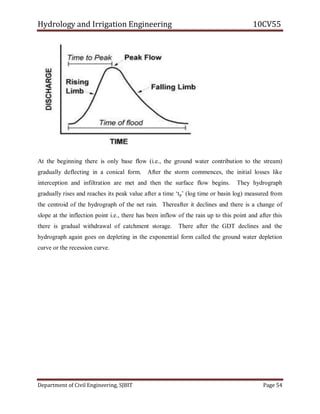
At the beginning there is only base flow (i.e., the ground water contribution to the stream)
gradually deflecting in a conical form. After the storm commences, the initial losses like
interception and infiltration are met and then the surface flow begins. They hydrograph
gradually rises and reaches its peak value after a time ‗tp‘ (log time or basin log) measured from
the centroid of the hydrograph of the net rain. Thereafter it declines and there is a change of
slope at the inflection point i.e., there has been inflow of the rain up to this point and after this
there is gradual withdrawal of catchment storage. There after the GDT declines and the
hydrograph again goes on depleting in the exponential form called the ground water depletion
curve or the recession curve.
Hydrology and Irrigation Engineering 10CV55
Department of Civil Engineering, SJBIT Page 55
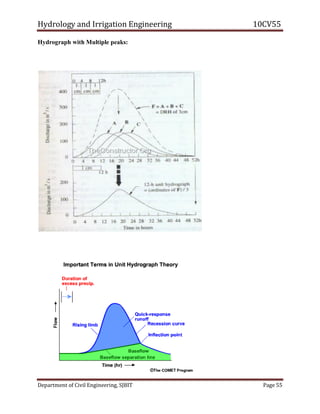
Hydrograph with Multiple peaks:
Hydrology and Irrigation Engineering 10CV55
Department of Civil Engineering, SJBIT Page 56
Basic definitions (Hydrograph features):
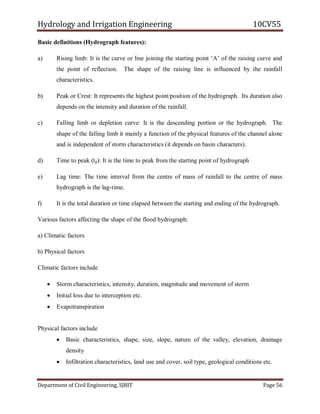
a) Rising limb: It is the curve or line joining the starting point ‗A‘ of the raising curve and
the point of reflection. The shape of the raising line is influenced by the rainfall
characteristics.
b) Peak or Crest: It represents the highest point/position of the hydrograph. Its duration also
depends on the intensity and duration of the rainfall.
c) Falling limb or depletion curve: It is the descending portion or the hydrograph. The
shape of the falling limb it mainly a function of the physical features of the channel alone
and is independent of storm characteristics (it depends on basin characters).
d) Time to peak (tp): It is the time to peak from the starting point of hydrograph
e) Lag time: The time interval from the centre of mass of rainfall to the centre of mass
hydrograph is the lag-time.
f) It is the total duration or time elapsed between the starting and ending of the hydrograph.
Various factors affecting the shape of the flood hydrograph:
a) Climatic factors
b) Physical factors
Climatic factors include
 Storm characteristics, intensity, duration, magnitude and movement of storm
 Initial loss due to interception etc.
 Evapotranspiration
Physical factors include
 Basic characteristics, shape, size, slope, nature of the valley, elevation, drainage
density
 Infiltration characteristics, land use and cover, soil type, geological conditions etc.
Hydrology and Irrigation Engineering 10CV55
Department of Civil Engineering, SJBIT Page 57
 Channel characteristics, cross section, roughness and storage capacity
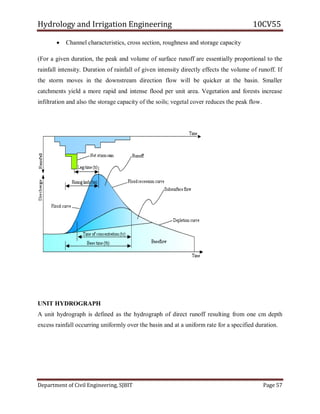
(For a given duration, the peak and volume of surface runoff are essentially proportional to the
rainfall intensity. Duration of rainfall of given intensity directly effects the volume of runoff. If
the storm moves in the downstream direction flow will be quicker at the basin. Smaller
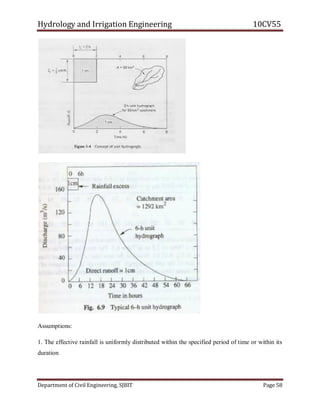
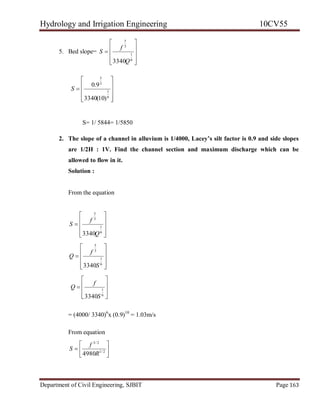
catchments yield a more rapid and intense flood per unit area. Vegetation and forests increase
infiltration and also the storage capacity of the soils; vegetal cover reduces the peak flow.
UNIT HYDROGRAPH
A unit hydrograph is defined as the hydrograph of direct runoff resulting from one cm depth
excess rainfall occurring uniformly over the basin and at a uniform rate for a specified duration.
Hydrology and Irrigation Engineering 10CV55
Department of Civil Engineering, SJBIT Page 58
Assumptions:
1. The effective rainfall is uniformly distributed within the specified period of time or within its
duration
Hydrology and Irrigation Engineering 10CV55
Department of Civil Engineering, SJBIT Page 59
2. The time or base duration of the hydrograph of direct runoff due to an effective rainfall of unit
duration shall be constant.
3. The effective rainfall is uniformly distributed throughout the area of drainage basin.
4. The direct runoff of common base line are proportional to the total amount of direct runoff.
5. The hydrograph of runoff due to a given period of rainfall for a drainage area shows all the
combined physical characteristics.
Limitations of Unit hydrograph theory :
1. Unit hydrograph is based on the assumption that effective rainfall is uniform over the
entire basin. However it is seldom true particularly in the case of large base. As such unit
hydrograph theory is limited to the basins of size nor exceeding 6000 km2
. Thus large
basins should be subdivided & unit hydrograph should be separately developed for each
basin.
2. This theory is not applicable when appoacciable quantity of precipitation occurs in the
form of snow.
Derivation:
1. Few unit periods of intense rainfall duration corresponding to an isolated storm uniformly
distributed over the area are collected from the past rainfall records.
2. From the collected past records of the drainage for the forms prepare the storm hydrograph for
some days after and before the rainfall of that unit duration.
3. Draw the line reporting the ground water flow and direct runoff by any of the standard base
flow separation procedures.
4. From the ordinate of the total runoff hydrograph deduct the corresponding ordinates of base
flow to obtain the ordinates of direct runoff.
5. Divide the volume of direct runoff by the area of the drainage basin to obtain the net
precipitation depth(x) over the basin.
Hydrology and Irrigation Engineering 10CV55
Department of Civil Engineering, SJBIT Page 60
6. Divide each of the ordinates of direct runoff by net precipitation depth to obtain the ordinates
of the unit hydrograph.
i.e., ordinate of unit hydrograph (UHG) = Ordinate of direct runoff (FHG)/Depth of net
precipitation(x)
i.e, UHG=FHG/x
7. Plot the ordinates of the unit hydrograph against time since the beginning of direct runoff,
which is the unit hydrograph for the basin for the duration of the storm.
Hydrograph separation/Base flow separation:
Figure;1. By simply drawing a line ‗AC‘ tangential to both the limbs at their lower portion. This
method is very simple but is approximate and can be used only for preliminary estimates.
2. Extending the recession curve exisiting prior to the occurance of the storm upto the point ‗D‘
directly under the peak of the hydrograph and then drawing a straight line DE.
Where E is a point hydrograph ‗N‘ days after the peak & N 9in days) is given by N= 0.8f3
Hydrology and Irrigation Engineering 10CV55
Department of Civil Engineering, SJBIT Page 61
Where A is the area of drainage basin (km)
& the size of the areas of the drainage basin as a guide to the values of ‗N‘ are given below:
Area of drainage basin, km
Time after peak N (days)
Simply by drawing a straight line AE, from the point of rise to the point E on the hydrograph,
‗N‘ days after the peak.
By producing a point on the recession curve backwards up to a point ‗F‘ directly below the
inflection point and the joining a straight line AF.
Problems
1: Following are the ordinates of a storm hydrograph of a river draining a catchment area
of 423 km2
due to a 6h storm.. Derive the ordinates of 6h unit hydrograph & plot the same.
Time in hr -6 0 6 12 18 24 30 36 42 48
Stream flow
m3
/s
10 10 30 87.5 115.5 102.5 85 71 59 475
Time in hr 54 60 66 72 78 84 90 96 102
Stream flow
m3
/s
39 31.5 26 21.5 17.5 15 12.5 12 12
Solutions: t= 6h, A=423 km2
Let us assume uniformly varying base flow from 10 to 12cumec. From 0 to 96 hours there are 17
values so that number of steps equals 17-1 = 16
Increase in the base flow = 12- 10/16 = 0.125
Hydrology and Irrigation Engineering 10CV55
Department of Civil Engineering, SJBIT Page 62
Runoff = R= 0.36x 59.6x6/ 423 = 3.04cm
Time in hr Stream flow m3
/s Base flow m3
/s Direct runoff
ordinate 4= 2-3
Ordinate of 6h
unit hydrograph
5/3.04 cm
-6 10 - - -
0 10 10 0 0
6 30 10.125 19.875 6.537
12 87.5 10.25 77.25 25.411
18 115.5 10.375 105.125 34.580
24 102.5 10.5 92 30.263
30 85 10.625 74.375 24.465
36 71 10.75 60.25 19.819
42 59 10.875 48.125 15.830
48 47.5 11 36.5 12.006
54 39 11.125 27.875 9.169
60 31.5 11.25 20.25 6.661
66 26 11.375 14.625 4.810
72 21.5 11.5 10 3.289
78 17.5 11.625 5.875 1.932
84 15 11.75 3.25 1.069
90 12.5 11.875 0.625 0.205
96 12 12 0 0
102 12 12.125 -0.125
Hydrology and Irrigation Engineering 10CV55
Department of Civil Engineering, SJBIT Page 63
2: Given below are the ordinates of 6h unit hydrograph for a catchment. Calculate the
ordinates of direct runoff hydrograph due to a rainfall excess of 3.5cm occurring in 6-h.
Time in
hr
0 3 6 9 12 15 18 24 30 36 42 48 54 60 69
Unit
ordinate
m3
/s
0 25 50 85 125 160 185 160 110 60 36 25 116 8 0
Solution:
The desired ordinates of the direct runoff ordinate are obtained by multiplying the ordinates of
the unit hydrograph by a factor of 3.5 to the unit ordinate shown in table.
Time in hr Ordinate of 6-h
Unit hydrograph (m3
/s)
Ordinate of 3.5 cm
DRH (m3
/s)
0 0 0
3 25 87.5
6 50 175
9 85 297.5
12 125 437.5
15 160 560
18 185 647.5
24 160 560
30 110 385
36 60 210
42 36 126
48 25 87.5
54 16 56
60 8 28
69 0 0
Hydrology and Irrigation Engineering 10CV55
Department of Civil Engineering, SJBIT Page 64
3. Rainfall of magnitude 3.8cm and 2.8cm occurring on two consecutive 4-h durations
on a catchment of area 27km2
produced the following hydrograph of flow at the
outlet of the catchment. Estimate the rainfall excess and ∅- index
Solutions:
The hydrograph is plotted to scale. It is seen that the storm hydrograph has a base- flow
component. For using the simple straight line method of base flow separation ,by
N= 0.83 x 270.2
= 1.6 days = 38.5h
However, by inspection, DRH starts at t=0, has the peak at t=12h and ends at t=48h (which gives
a value of N=48-12=36h. As N= 36h appears to be more satisfactory than N= 38.5, in the present
case DRH is assumed to exist from t= 0 to 48h. A straight line base flow separation gives a
constant value of 5 m3
/s for the base flow.
Area of DRH = 6x60x60( ½ (8) + ½ (8+21) + ½ (21+16) + ½(16+11)+ ½(11+7) + ½ (7+4)
+½(4+2)+ ½(2))
= 1.4904x 10⁶
m3
= Total direct runoff due to storm
Runoff depth = Runoff volume/ catchment area=
1.4904x 10⁶
m3
/ 27x106
= 0.0552 m
= 5.52cm = rainfall excess
Total rainfall = 3.8+2.8 = 6.6cm
Duration = 8h
∅- index = (6.6 – 5.52)/ 8 = 0.135cm/h
Hydrology and Irrigation Engineering 10CV55
Department of Civil Engineering, SJBIT Page 65
Hydrology and Irrigation Engineering 10CV55
Department of Civil Engineering, SJBIT Page 66
UNIT 4
ESTIMATION OF FLOOD & FLOOD ROUTING
Engineering hydrology is concerned with the quantitative relationship between rainfall and
'runoff' (i.e. passage of water on the surface of the Earth) and, in particular, with the magnitude
and time variations of runoff. This is because all water resource schemes require such estimates
to be made before design of the relevant structures may proceed. Examples include reservoir
design, Road alleviation schemes and land drainage. Each of these examples involves different
aspects of engineering hydrology, and all involve subsequent hydraulic analysis before safe and
economical structures can be constructed.
Engineering hydrology is conveniently subdivided into two main areas of interest, namely,
surface water hydrology and groundwater hydrology. The first of these is further subdivided
into rural hydrology and urban hydrology, since the runoff response of these catchment types to
rainfall is very different.
The most common use of engineering hydrology is the prediction of 'design' events. This may
be considered analogous to the estimation of 'design' loads on structures. Design events do not
mimic nature, but are merely a convenient way of designing safe and economical structures for
water resources schemes. As civil engineers are principally concerned with the extremes of
nature, design events may be either floods or droughts. The design of hydraulic structures will
normally require the estimation of a suitable design flood (e.g. for spillway sizing) and
sometimes a design drought (e.g. for reservoir capacity).
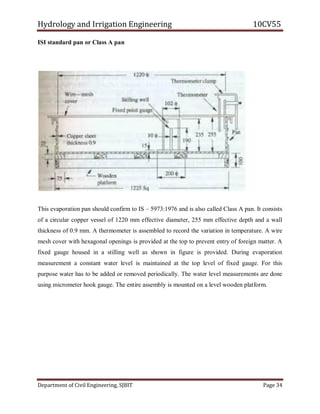
Catchment characteristics
A good starting point for a quantitative assessment of runoff is to consider the physical
processes occurring in the hydrological cycle and within the catchment, as shown in Figure 1.
Circulation of water takes place from the ocean to the atmosphere by evaporation, and this
water is deposited on a catchment mainly as rainfall from there, it may follow several routes,
but eventually the water is returned to the sea via the rivers.
Hydrology and Irrigation Engineering 10CV55
Department of Civil Engineering, SJBIT Page 67
Within the catchment, several circulation routes are possible. Rainfall is initially intercepted by
vegetation and may be evaporated. Secondly, infiltration into the soil or overland Row to a
stream channel or river may occur. Water entering the soil layer may remain in storage (in the
unsaturated zone) or may percolate to the groundwater table (the saturated zone). All subsurface
water may move laterally and eventually enter a stream channel.
A set of characteristics may be proposed which determine the response of the catchment to
rainfall. These might include the following:
(a) Catchment area:
(b) Soil type(s) and depth(s):
(c) Vegetation cover:
(d) Stream slopes and surface slopes:
(e) Rock type(s) and area(s)
(f) Drainage network (natural and man-made):
(g) Lakes and reservoirs:
(h) Impermeable areas (e.g. roads, buildings, etc.).
In addition, different catchments will experience different climates, and hence the response of
the catchment to rainfall will depend also on the prevailing climate. This may be represented
by:
(a) Rainfall (depth, duration and intensity):
(b) Evaporation potential (derived from temperature, humidity, wind speed and solar radiation
measurements or from evaporation pan records.)
However, from an engineering viewpoint, qualitative measures of catchment characteristics are
inadequate in themselves, and quantitative measures are necessary to predict flood magnitudes.
Flood Studies lead to the following equation for catchments:
Q = const x AREA0.94
x STMFRQ0.27
x S10850.16
x SOIL1.23
x RSMD1.03
x (1 + LAKE)-0.85
Hydrology and Irrigation Engineering 10CV55
Department of Civil Engineering, SJBIT Page 68
Where;
Q = the mean annual flood (m3
/s);
const. = a number depending on location;
AREA = the catchment area (km2
);
STMFRQ = the stream frequency (no. of stream junctions/AREA):
S1085 = the slope of the main stream (m/km);
SOIL = a number depending on soil type;
RSMD= I day rainfall of 5 year return period minus the mean soil moisture deficit (mm);
LAKE = the area of lakes or reservoirs (as a fraction of AREA).
Methods for estimating flood
To estimate the magnitude of a flood peak the following alternative methods available:
1. Rational method 2. Empirical method
3. Unit-hydrograph technique 4. Flood-frequency studies
The use of a particular method depends upon (i) the desired objective, (ii) t available data,
and (iii) the importance of the project. Further the rational formula only applicable to small-size (< 50
km2
) catchments and the unit-hydrograph method is normally restricted to moderate-size catchments
with areas less than 5000 km .
Consider a rainfall of uniform intensity and very long duration occurring over a
basin. The runoff rate gradually increases from zero to a constant value a indicated
in Fig. 7.1. The runoff increases as more and more flow from remote areas
of the catchment reach the outlet. Designating the time taken
J^ Jconccntra-
from the farthest part of the catchment to reach the outlet as tc= time of concentration, it is
obvious that if the rainfall continues beyond tc, the runoff will be constant
and at the peak value. The peak value of the runoff is given by
Hydrology and Irrigation Engineering 10CV55
Department of Civil Engineering, SJBIT Page 69
Qp = CAi for t>tc
Fig. 7.1 Runoff Hydrograph due to Uniform Rain
where C = coefficient of runoff = (runoff/rainfall), A | area of the catchment and
i = intensity of rainfall. This is the basic equation of the rational method. Using the commonly
used units, Eq. (7.1) is written for field application as
Qp= 1/3.6 C(Itc,p) A
where
Qp = peak discharge (m3
/s)
C = coefficient of runoff
(Itc,p) =
the mean intensity of precipitation (mm/h) for a duration equal to tc and an exceedence
probability P
A = drainage area in km2
.
The use of this method to compute Qp requires three parameters: tc, (itcp) and C.
Hydrology and Irrigation Engineering 10CV55
Department of Civil Engineering, SJBIT Page 70
"TIME OF CONCENTRATION (tc)
There are a number of empirical equations available for the estimation of the time of
concentration. Two of these are described below.
US PRACTICE : For small drainage basins, the time of concentration is assumed to be equal to
the lag time of the peak flow. Thus
Tc= Tp of = CtL(LLca/√S )n
where tc = time of concentration in hours, CtL, L, Lca, n and S have the same meaning as in Eq. (6.10) .
KIRPICH EQUATION (1940): This is the popularly used formula relating the time of
concentration of the length of travel and slope of the catchment as
tc =0.01947L0J7
ST0385
(7.4)
K1=√L3/H
where tc = time of concentration (minutes)
L = maximum length of travel of water (m), and S = slope of the catchment = A H/L in
which AH= difference in elevation between the most remote point on the catchment
and the outlet.
For easy use Eq. (7.4) is sometimes written
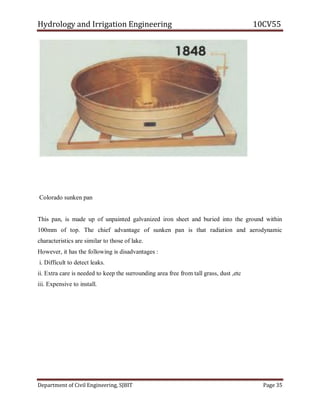
Tc= 0.01947K1
0.77
RAINFALL INTENSITY (itcp)
The rainfall intensity corresponding to a duration tc and the desired probability of exceedence P,
(i.e. return period T= 1/P) is found from the rainfall-frequency-duration relationship for the given
catchment area . This will usually be a relationship of the form of Eq. (2.15), viz.
itc,p = KTx
/ (tc+ a)n
Hydrology and Irrigation Engineering 10CV55
Department of Civil Engineering, SJBIT Page 71
in which the coefficients K, a, x and n are specific to a given area. Table 2.8 (preferably
in its expanded form) could be used to estimate these coefficients to a specific
catchment. In USA the peak discharges for purposes of urban area drainage are calculated
by using P = 0.05 to 0.1. The recommended frequencies for various types of
structures used in watershed development projects in India are as below:
Types of structure Return Period
(Years)
Storage and Diversion dams having
permanent spillways
Earth damsliavingJiatural spillways
Stock water dams
Small permanent masonry and
vegetated waterways
Terrace outlets and vegetated waterways
Field diversions
50-100
25-50
25 10-15
10
15
RUNOFF COEFFICIENT (C)
The coefficient C represents the integrated effect of the catchment losses and hence depends upon the
nature ofthe surface, surface slope and rainfall intensity. The effect of rainfall intensity is not considered in
the available tables of values of C. Some typical values of C are indicated in Table 7. l(a & b).
Equation(7.2)assumesahomogeneouscatchment surface.Ifhowever,thecatchment is non-homogeneous but
can be divided into distinct sub areas each having a different runoff coefficient, then the runoff from each
sub area is calculated separately and merged in proper time sequence. Sometimes, a non-
homogeneous catchment may have component sub areas distributed in such a complex manner
that distinct sub zones cannot be separated.Insuchcases a weighted equivalent runoffcoeffic.ent Ce as below
is used.
Ce= CiAi /AN
1
Hydrology and Irrigation Engineering 10CV55
Department of Civil Engineering, SJBIT Page 72
Empiricalformulae
The empirical formulae used for the estimation of the flood peak are essential regional formulae based on
statistical correlation of the observed peak and important an
catchment properties. To simplify the formofthe equation, only a few ofthe many parametersaffectingthe flood
peakareused.Forexample,almostallformulaeuseucatchmentareaasaparameteraffectingthefloodpeakandmost
ofthemneglectufloodfrequencyasaparameter.Inviewofthese,theempiricalformulaeareapplicableonlyinthe
region from which they were developed and when applied to other areas they can at best give
approximate values.
FLOOD PEAK-AREA RELATIONSHIPS
By far the simplest of the empirical relationships are those which relate the flood pea to the drainage area. The
maximumflooddischargeQp fromacatchment areaAgiven by these formulae as
Qp= f(A)
While there are a vast number of formulae of this kind proposed for various parts c the world, only a few
popular formulae used in various parts ofIndia are given below.
DICKENS FORMULA (1865)
Qp = CD A3/4
where Qp = maximumflooddischarge(m3
/s) A = catchment area (km2
)
CD = Dickens constant with value between 6 to 30 .The following are some guidelines in
selectingthe valueofCD:
Values of CD
North- Indian plains 6
North- Indian hilly regions 11-14
Central - India 14-28
Coastal Andhra and Orissa 22- 28
Hydrology and Irrigation Engineering 10CV55
Department of Civil Engineering, SJBIT Page 73
For actual use the local experience will be of aid in the proper selection of C IT v ens formula is used
in the central and northern parts of the country.
RYVESFORMULA (J884)
Qp = CR A2/3
where Q=maximumflooddischarge(m3
/s) A = catchment area (km2
) and CR = Ryves coefficient
This formula originally developed for the Tamil Nadu region, is in use in Tamil Nadu and parts ofKarnataka and
AndhraPradesh.The valuesofCRrecommended byRyvesfor use are:
CR = 6.8forareaswithin80kmfromtheeastcoast
=8.5forareaswhichare80—160kmfromtheeastcoast
=10.2forlimitedareas near hills
INGUS FORMULA (1930):This formula is based on flood data of catchments in Western Ghats in
Maharashtra.Thefloodpeak Qp inm/s isexpressedas
Qp = 124A / (A + 10.4)
There are many such empirical formulae developed ill various
where A is the catchment area in km .
Equation with small modifications in the constant in the numerator (124) is in use Maharashtra for
designs in small catchments.
OTHER FORMULAE parts of the world, References 3 and 5 list many such formulae suggested for use in
various partsofIndia as well as of the world
There are some empirical formulae which relate the peak discharge to the basin area and also include
the flood frequency, Fuller's formula (1914) derived for catchments in USA is a typical one of this
kind and is given by
Hydrology and Irrigation Engineering 10CV55
Department of Civil Engineering, SJBIT Page 74
Qp = CfA0.8
(1+0.8log T)
QTP= Maximum 24-h flood with a frequency of T years in m3
/s , A= catchment area n km2
, Cf= a
constant with values between 0.18 to 1.88.
ENVELOPE CURVES
In regions having same climatologically characteristics, if the
available flood data are meagre, the enveloping curve technique can be used to develop a relationship
between the maximum flood flow and drainage area. In this method
the available flood peak data from a large number of catchments which do not significantly differ from each
other in terms of meteorological and topographicalcharacteristics are collected. The data are then plotted on
a log-log paper as flood peak v, catchment area. This would result in a plot in which the data would be
scattered. If an enveloping curve that would encompass all the plotted data points is drawn, it can be
used to obtain maximum peak discharges for any given area. Envelop curves thus
obtained are very useful in getting quick rough estimations of peak values. If equa tions are fitted to these
enveloping curves, theyprovide empirical flood formulae ofthe type,
Q =f(A).
Kanwarsain and Karpov (1967) have presented enveloping curves representing the relationship between
the peak-flood flow and catchment area for Indian conditions. Two curves, one forthe southIndianrivers and
the other for north Indian and central Indian rivers, are developed (Fig. 7.2). These two curves are based on
data covering large catchment areas, in the range 103
to 106
km2
.
Basedonthe maximumrecordedfloodsthroughoutthe world, Baird and Mclllwraitli(1951) have correlatedthe
maximumflooddischargeQmp inm3
/swithcatchmentareaA in km2
as
Qmp= 3025A/ (278+A) 0.78
Frequency Analysis
For gauged catchments with long records (e.g. greater than 25 years) the techniques of
frequency analysis may be applied directly to determine the magnitude of any flood event (Q)
with a specified return period (Tt) The concept of return period is an important one because it
Hydrology and Irrigation Engineering 10CV55
Department of Civil Engineering, SJBIT Page 75
enables the determination of risk (economic or otherwise) associated with a given flood
magnitude. It may be formally defined as the number of years, on average, between a flood
event of magnitude (X) which is greater than or equal to a specified value (Q). The qualifier
'on average' is often misunderstood For example, although a 100 year flood event will occur,
on average, once every 100 years, it may occur at any time (i.e. today or in several years'
time). Also, within any particular 100 year period, floods of greater magnitude may occur.
The probability of occurrence P(X ≥ Q) is inversely related to return period (Tt), i.e.
P(X≥ Q) = 1/Tt
This relationship is the starting point of frequency analysis.
The annual maxima series
This is the simplest form of frequency analysis, in which the largest flood event from each year
of record is abstracted. The resulting series, in statistical terms, is considered to be an
independent series, and constitutes a random sample from an unknown population. The series
may be plotted as a histogram, as shown in Figure 4a. Taking, as an example, a 31 year record,
the annual maxima are divided into equal class intervals (0-10, 10-20, etc.). The probability that
the discharge will exceed, say, 60 m3/s is equal to the number of events greater than 60 m3/s
divided by the total number of events:
P(X≥60)=(4 +3+2)/31=0.29
and the corresponding return period is
T, =1/P(X≥ 60) = 3.4 years
If the histogram is now replaced by a smooth curve, as shown in Figure 4b, then
P(X ≥Q) = ∫Q
∞
f(x) dx
The function f(x) is known as a probability density function (pdf) and, by definition,
∫Q
∞
f(x) dx = 1
i e. P(X ≥ 0) = 1
Hydrology and Irrigation Engineering 10CV55
Department of Civil Engineering, SJBIT Page 76
The point of this analysis is that it makes it possible to estimate the probability that the
discharge will exceed any given value greater than the maximum value in the data set (90m3
/s
in this case). Replacing the histogram with the pdf allows such estimates to be made.
Unit hydrograph theory
Figure 6a shows a flood hydrograph and the causative rainfall. The hydrograph is composed of
two parts, the surface runoff, which is formed directly from the rainfall, and the base flow. The
latter is supplied from groundwater sources which do not generally respond quickly to rainfall.
The rainfall may also be considered to be composed of two parts. The net or effective rainfall is
that part which forms the surface runoff, while the rainfall losses constitute the remaining
rainfall (this is either evaporated or enters soil moisture and groundwater storages) Simple
techniques for separating runoff and rainfall have been developed.
The net rainfall and corresponding surface runoff are shown in figure below. The purpose of
unit hydrograph theory is to be able to predict the relationships between the two for any storm
event. A unit hydrograph is thus a simple model of the response of a catchment to rainfall.
Hydrology and Irrigation Engineering 10CV55
Department of Civil Engineering, SJBIT Page 77
Hydrology and Irrigation Engineering 10CV55
Department of Civil Engineering, SJBIT Page 78
Synthetic unit hydrographs
For ungauged catchments, unit hydrographs cannot be derived directly. However, measures of
catchment characteristics may be used to estimate a unit hydrograph. Such unit hydrographs are
termed 'synthetic', and examples of two are shown in figure below. They have a simple
triangular form, whose shape is determined by three parameters the time to peak (TP), the peak
runoff (QP) and the time base (TB). The 10 mm, 1 hour synthetic unit hydrograph in the Flood
studies report was derived using multiple regression techniques on data from gauged (rural)
catchments, and is given by;
TP = 46.6L0.14
S1085-0.38
(1+URB)-1.99
RSMD-0.4
QP = 2.2 AREA/TP
TB = 2.5 TP
where L is the mainstream length (km), URB is the fraction of catchment urbanized and S1085
is the slope of the main stream (m/km) and RSMD is the 1 day rainfall of 5 year return period
minus the mean soil moisture deficit (mm). TP and TB are in hours and QP, is in m3
/s.
Flood routing
The stage and discharge hydrographs represent the passage of waves of the river depth and
discharge respectively. As this wave moves down the river, the shape of the wave gets modified due
to various factors, such as channel storage, resistance, lateral addition or withdrawal of flows, etc.
When a flood wave passes through a reservoir, its peak is attenuated and the time base is enlarged
due to the effect of storage. Flood waves passing down a river have their peaks attenuated due to
friction if there is no lateral inflow. The addition of lateral inflows can cause a reduction of
attenuation or even amplification of a flood wave. The study of the basic aspects of these changes
in a flood wave passing through a channel system forms the subject matter of this chapter.
Flood routing is the technique of determining the flood hydrograph at a section of
a river by utilizing the data of flood flow at one or more upstream sections. The hydro-
logic analysis of problems such as flood forecasting, flood protection, reservoir de
sign and spillway design invariably include flood routing. In these applications two
broad categories of routing can be recognized. These are:
1. Reservoir routing, and 2. Channel routing.
Hydrology and Irrigation Engineering 10CV55
Department of Civil Engineering, SJBIT Page 79
In Reservoir routing the effect of a flood wave entering a reservoir is studied. Knowing the
volume-elevation characteristic of the reservoir and the outflow-elevation relationship for the spillways
and other outlet structures in the reservoir, the effect of a flood wave entering the reservoir is
studied to predict the variations of reservoir elevation and outflow discharge with time. This form
of reservoir routing is essential (i) in the design of the capacity of spillways and other reservoir outlet
structures, and (ii) in the location and sizing of the capacity of reservoirs to meet specific requirements.
In Channel routing the change in the shape of a hydrograph as it travels down a channel is
studied. By considering a channel reach and an input hydrograph at the upstream end, this form
of routing aims to predict the flood hydrograph at various sections of the reach. Information on the
flood-peak attenuation and the duration of high-water levels obtained by channel routing is of
utmost importance in flood-forecasting operations and flood-protection works.
A variety of routing methods are available and they can be broadly classified into two categories
as: (i) hydrologic routing, and (ii) hydraulic routing. Hydrologic-routing methods employ essentially
the equation of continuity. Hydraulic methods, on the other hand, employ the continuity equation
together with the equation of motion of unsteady flow. The basic differential equations used in the
hydraulic routing, known as St. Venant equations afford a better description of unsteady flow than
hydrologic methods.
Flood routing
So far, the discussion has centred on methods of estimating flood events at a given location.
However, the engineer requires estimates of both the stage and discharge along a watercourse
resulting from the passage of a flood wave. The technique of flood routing is used for this
purpose. There are two distinct kinds of problem:
(a) Reservoir routing: to find the outflow hydrograph over the spillway from the inflow
hydrograph.
(b) Channel routing: to find the outflow hydrograph from a river reach from the inflow
hydrograph.
Hydrology and Irrigation Engineering 10CV55
Department of Civil Engineering, SJBIT Page 80
In each case the peak flow of the outflow hydrograph is less than and later than that of the
inflow hydrograph. These processes are referred to as attenuation and translation, respectively.
To determine the outflow hydrograph from the inflow hydrograph requires the application of
the continuity equation in the form:
I - O = dV/dt
Where I is the inflow rate, O the outflow rate, V is the volume and t is time.
This is shown diagramatically in Figure 12. Expressing the above equation in a finite difference
form gives
ttt
tttttt
VVt
2
)OO(
t
2
)II(






Where tI and Ot, are inflow and outflow rates at time t and ttI  and Ot+∆t are inflow and
outflow rates at time t+∆t. This equation may be solved successively through time for a
known inflow hydrograph if the storage volume can be related to outflow (reservoir case) or
channel properties.
Reservoir routing
This case is shown in Figure The outflow is governed by the height (stage h) of water above
the spillway crest level, and the volume of live storage is a so governed by this height. Hence,
for a given reservoir, both the volume and outflow can be expressed as functions of stage.
This is achieved by a topographical survey and application of a suitable weir equation,
respectively.
Rearranging the finite difference equation in terms of unknown and known values,
tt
t
ttttt
tt
OO
t
V
IIO
t
V
2
22






Given the stage/storage and stage/discharge characteristics, a relationship between 2 V/A t +
O and O can be derived, which leads to a simple tabular solution.
Hydrology and Irrigation Engineering 10CV55
Department of Civil Engineering, SJBIT Page 81
HYDROLOGIC CHANNEL ROUTING
In reservoir routing presented in the previous sections, the storage was a unique function of the
outflow discharge, S=f(Q). However, in channel routing the storage is a function of both outflow
and inflow discharges and hence a different routing method is needed. The flow in a river during a
flood belongs to the category of gradually varied unsteady flow. The water surface in a channel
reach is not only not parallel to die channel bottom but also varies with time (Fig. 8.7). Considering
a channel reach having a flood flow, the total volume in storage can be considered under two catego-
ries as
1. Prism storage
2. Wedge storage
Inflow
PRISM STORAGE
It is the volume that would exist if the uniform flow occurred at the downstream depth, i.e. the volume
formed by an imaginary plane parallel to the channel bottom drawn at the outflow section water
surface.
WEDGE STORAGE
It is the wedge-like volume formed between the actual water surface profile and the top surface of
the prism storage.
Wedge storage
Prism storage -*
Hydrology and Irrigation Engineering 10CV55
Department of Civil Engineering, SJBIT Page 82
At a fixed depth at a downstream section of a river reach, the prism storage is constant while
the wedge storage changes from a positive value at an advancing flood to a negative value during a
receding flood. The prism storage Sp is similar to a reservoir and can be expressed as a function of the
outflow discharge, Sp = f(Q). The wedge storage can be accounted for by expressing it as Sw =/(/).
The total storage in the channel reach can then be expressed as
S= K(xIm
+ (1-x)Qm
)
Using m=1.0, equation reduces to a linear relationship for S in terms of I and Q as
S=K(xI+(1-x)Q)
And this relationship is known as the Muskingum equation .
In this parameter x is known as weight age factor and takes a values between 9 and 0.5. when
x=0, obviously the storage is a function of discharge only and equation reduces to
S = KQ
Such a storage is known as linear storage or linear reservoir. When x = 0.5 both the inflow and
outflow are equally important in determining the storage.
The coefficient K is known as storage-time constant and has the dimensions o time. It is
approximately equal to the time of travel of a flood wave through the channel reach.
Hydrology and Irrigation Engineering 10CV55
Department of Civil Engineering, SJBIT Page 83
ESTIMATION OF K AND x
Figure 8.8 shows a typical inflow and
outflow hydrograph through a
channel reach. Note that the outflow
peak does not occur at the point of
intersection of the inflow and outflow
hydrographs. Using the continuity
equation [Eq. (8.3)]
the increment in storage at any time t and
time element At can be calculated. Summation of the
various incremental storage values enables one to find
the channel storage S vs time f relationship (Fig. 8.8).
If an inflow and outflow hydrograph set is available
for a given reach, values of S at various time intervals
can be determined by the above technique. By
choosing a trial value of x, values of S at any time t are
plotted against the Time
Corresponding to [x I+ (1 -x) Q] values.
If the value of x is chosen correctly, a straight-line relationship as given by Eq. (8.12) will result
However, if an incorrect value of x is used, the plotted points will trace a looping curve By trial and
value of x is so chosen that the data very nearly describe a straight line (Fig 8.9) inverse slope of
this straight line will give the value of K:
Normally, for natural channels, the value of x lies between 0 to 0 3 For a reach, the values of x
and K are assumed to be constant
Lag
* ----- =-►
Attenuation1
Hydrology and Irrigation Engineering 10CV55
Department of Civil Engineering, SJBIT Page 84
FLOOD CONTROL
The term flood control is commonly used to denote all the measures adopted to reduce damages to life
and property by floods. Currently, many people prefer to use the term flood management instead of
flood control as it reflects the activity more realistically. As there is always a possibility, however
remote it may be, of an extremely large flood occurring in a river the complete control of the flood to
a level of zero losfs is neither physically possible nor economically feasible. The flood control
measures that are to use can be classified as:
1. Structural measures:
• Storage and detention reservoirs • Levees (flood embankments)
• Flood ways (new channels) • Channel improvement
• Watershed management
2. Non-structural methods:
• Flood plain zoning • Flood forecast/warning
• Evacuation and relocation • Flood insurance
STRUCTURAL METHODS
Storage Reservoirs :
Storage reservoirs offer one of the most reliable and effective methods of flood control. Ideally, in
this method, a part of the storage in the reservoir is kept apart to absorb the incoming flood. Further, the
stored water is released in a controlled way over an extended time so that downstream channels do
not get flooded. Figure 8.15 shows an ideal operating plan of a flood control reservoir. As most of
the present-day storage reservoirs have multipurpose commitments, the manipulation of reservoir
levels to satisfy many conflicting demands is a very difficult and complicated task. It so happens that
many storage reservoirs while reducing the floods and flood damages do not always aim at achieving
optimum benefits in the flood-control aspect. To achieve complete flood control in the entire length
of the river, a large number of reservoirs at strategic locations in the catchment will be necessary.
Hydrology and Irrigation Engineering 10CV55
Department of Civil Engineering, SJBIT Page 85
DETENTION RESERVOIRS: A detention reservoir consists of an obstruction to river with an
uncontrolled outlet. These are essentially small structures and operate t reduce the flood peak by providing
temporary storage and by restriction ofthe outflow rate. These structures are not common in India.
LEVEES: Levees, also known as dikes or flood embankments are earthen banks CONSTRUCTED parallel
to the course of the river to confine it to a fixed course and limited cross-sectional width. The heights of
levees will be higher than the design flood level with sufficient free board. The confinement of the river
to a fixed path frees large tracts of land from inundation and consequent damage (Fig. 8.16).
Hydrology and Irrigation Engineering 10CV55
Department of Civil Engineering, SJBIT Page 86
Levees areone oftheoldest and most common methodsofflood-protectionworks adaptedtothe world. Also,
theyareprobablytheCheapestofstructuralflood-controlmeasures. While the protectionoffered bya levee against
food damage is obvious, what is not often appreciated is the potential damage in the event of a levee failure.
The levees, being earth embankments require considerable care and maintenance, In the event of being overtopped,
they fail and the damage caused can be enormous. In fact, the sense of protection offered by a levee encourages
economic activity along the embankment and if the levee is overtopped the loss would be more than what would
have been if there were no levees. Confinement of flood banks of a river by levees to a narrower space leads to
higher flood levels foragivendischarge.Further, ifthe bed levelsoftheriveralsorise,astheydo inaggradingrivers,
thetopoftheleveeshavetoberaisedat frequent time intervalsto keepup its safetymargin.
The design of a levee is a major task in which costs and economic benefits have to be considered. The cross-
section of a levee will have to be designed like an earth dam. Regular maintenance and contingency
arrangements to fight floods are absolutely necessary to keep the levees functional.
Masonrystructuresusedtoconfinetheriverinamannersimilartoleveesareknownas flood walls. These are
used to protect important structures against floods, especially where the land is at a premium.
FLOODWAYS
Floodways are naturalchannels into which a part ofthe flood will be diverted during high stages. A floodwaycan
be a naturalor man-made channeland its location is controlled essentially bythe topography. Generally, wherever
theyare feasible, floodwaysofferaneconomicalalternativetootherstructuralflood-controlmeasures.To reducethe
levelofthe river Jhelumat Srinagar,a supplementarychannelhas been constructed to act as a floodway with a
capacity of 300 m3
/s. This channel is located 5 km upstream of Srinagar city and has its outfall in lake
Wullar. In Andhra Pradesh a floodway has been constructed to transfer a part ofthe flood waters of the river
Budamaru to river Krishna to prevent flood damages to the urban areas lying on the downstream reaches of
the river Budamaru.
CHANNELIMPROVEMENT:
The worksunderthis categoryinvolve:
1. Widening or deepening of the channel to increase the cross-sectional area.
2. Reduction of the channel roughness, by clearing of vegetation from the channel perimeter.
3. Short circuiting of meander loops by cutoff channels, leading to increased slopes.
Hydrology and Irrigation Engineering 10CV55
Department of Civil Engineering, SJBIT Page 87
Allthese three methods are essentiallyshort-termmeasures and require continued maintenance.
WATERSHED MANAGEMENT :
Watershed management and land treatment in the catchment aims at cutting down and delaying
the runoff before it gets into the river. Watershed management measures include developing the
vegetative and soil cover in conjunction with land treatment words like Nalabunds, check dams, contour
bunding, zing terraces etc. These measures are towards improvement of water infiltration capacity of
the soil and reduction of soil erosion. These treatments cause increased infiltration, greater
evapotranspiration and reduction in soil erosion; all leading to moderation of the peak flows and
increasing of dry weather flows. Watershed treatment is nowadays an integral part of flood
management. It is believed that while small and medium floods are reduced by watershed
management measures, the magnitude of extreme floods are unlikely to be affected by these
measures.
NON-STRUCTURAL METHODS
The flood management strategy has to include the philosophy of Living with the floods. The following
non-structural measures encompass this aspect.
FLOOD PLAIN ZONING: When the river discharges are very high, it is to be expected that the
river will overflow its banks and spill into flood plains. In view of the increasing pressure of
population this basic aspects of the river are disregarded and there are greater encroachment of
flood plains by man leading to distress.
Flood plain management identifies the flood prone areas of a river and regulates the land use to
restrict the damage due to floods. The locations and extent of areas likely to be affected by floods
of different return periods are identified and development plans ofthese areas are prepared in sucha manner
that the resulting damages due to floods are within acceptable limits ofrisk. Figure 8.17 shows a conceptual
zoning of a flood prone area.
FLOOD FORECASTING AND WARNING
Forecasting of floods sufficiently in advance enables a warning to be given to the people likely to be
affected and further enables civil authorities to take appropriate precautionary measures. It thus forms
Hydrology and Irrigation Engineering 10CV55
Department of Civil Engineering, SJBIT Page 88
a very important and relatively inexpensive non-structural flood management measure. However, it must
be realized that a flood warning is meaningful only if it is given sufficiently in advance. Further,
erroneous warnings will cause the populace to lose confidence and faith in the system. Thus the dual
requirements of reliability and advance notice are the essential ingredients of a flood-forecasting
system.
The flood forecasting techniques can be broadly divided into three categories:
(i) Short range forecasts
(ii) Medium range forecasts
(iii) Long range forecasts.
Short-Range Forecasts In this the river stages at successive stations on a river are correlated with
hydrological parameters, such as rainfall over the local area, antecedent precipitation index, and variation of
the stage at the upstream base point during the travel time of a flood. This method can give advance
warning of 12-40 hours for floods. The flood forecasting used for the metropolitan city of Delhi is
based on this technique.
Medium-Range Forecasts In this method rainfall-runoff relationships are used to predict flood
levels with warning of 2-5 days. Coaxial graphical correlations of runoff, with rainfall and other
parameters like the time of the year, storm duration and antecedent wetness have been developed to
a high stage of refinement by the US Weather Bureau.
Long-Range Forecasts: Using radars and meteorological satellite data, advance information about
critical storm-producing weather systems, their rain potential and time of occurrence of the event are
predicted well in advance.
EVACUATION AND RELOCATION: Evacuation of communities along with their live stocks and
other valuables in the chronic flood affected areas and relocation of them in nearby safer locations is an
area specific measure of flood management. This would be considered as non-structural measure when this
activity is a temporary measure confined to high floods. However, permanent shifting of communities to
safer locations would be termed as structural measure. Raising the elevations of buildings and public
Hydrology and Irrigation Engineering 10CV55
Department of Civil Engineering, SJBIT Page 89
utility installations above normal flood levels is termed as flood proofing and is sometimes adopted in
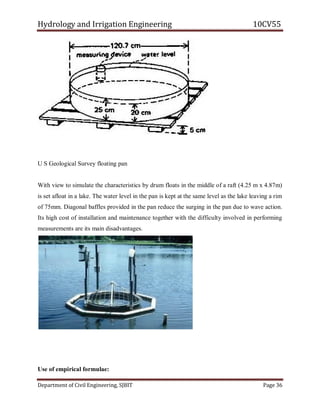
coastal areas subjected to severe cyclones.
FLOOD INSURANCE Flood insurance provides a mechanism for spreading the loss over large
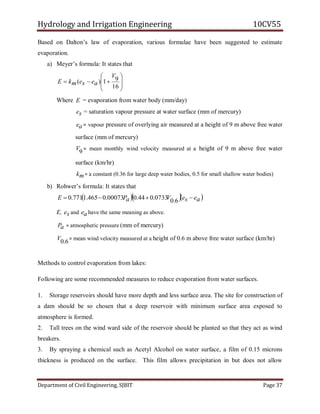
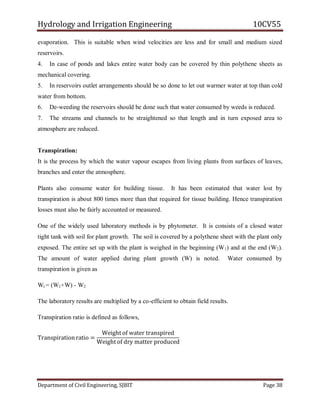
numbers of individuals and thus modifies the impact of loss burden. Further, it helps, though indirectly,
flood plain zoning, flood forecasting anddisaster preparedness activities.
Hydrology and Irrigation Engineering 10CV55
Department of Civil Engineering Page 90
Reservoir sizing - Mass curves
If the catchment runoff hydrograph is plotted cumulatively for any given time period, then the
resulting plot is known as a Mass Curve. These curves can be useful in reservoir design studies since
they provide a ready means of determining storage capacity necessary for particular rates of runoff and
draw off. Suppose for example that the mass curve OA of Figure 14 represents the runoff from a
catchment that is to be used for potential water supply for future population growth. If the predicted
draw off required is plotted on the diagram (Figure 15), as line OB, then the required storage capacity
to ensure that this rate can be accommodated can be found by drawing the line CD parallel to OB from
a point C at the beginning of the driest period recorded. The storage capacity necessary is denote by
the maximum ordinate eg. Normally much longer periods, e.g. 100 year drought events, are used for
reservoir design.
Hydrology and Irrigation Engineering 10CV55
Department of Civil Engineering Page 91
Hydrology and Irrigation Engineering 10CV55
Department of Civil Engineering Page 92
UNIT 5
IRRIGATION ENGINEERING
Introduction:
Irrigation may be defined as the process of artificially supplying water to the soil for raising crops. It is a
science of planning and designing an efficient low cost irrigation system to suite the natural conditions.
It is the engineering of controlling and harnessing the various natural sources of water by the construction
of dams and reservoirs, canals and head works and finally distributing the water to the agricultural fields.
Irrigation engineering includes the study and design of works connected with river control, drainage of
water logged areas and generations of hydro electric power.
Necessity or Importance of Irrigation:
India is basically an agricultural country and its resources on depend on the agricultural output.
Prosperity of our country depends mainly upon proper development of agriculture. Even after 60 years of
Independence, we have not succeeded in solving our food problems. The main reason for this miserable
state of affair is that we still continue to remain at the mercy of rain and practice age old methods of
cultivation.
Plants usually derive water from nature through rainfall. However, the total rainfall in a particular area
may be either insufficient or ill timed. In order to get the maximum yield, it is necessary to have a
systematic irrigation system for supplying optimum quantity of water at correct timing.
Importance of irrigation can be summarized under the following four aspects:
1. Area of less rainfall: Artificial supply of water is necessary when the total rainfall is less than the
water requirement of crops in such cases, irrigation works may be constructed at a place where
more water is available and conveyed to water deficit areas.
Eg: The Rajasthan canal supplies water from the river Yamuna to the arid regions of Rajasthan
where annual rainfall is less than 100 to 200 mm.
2. Non-Uniform rainfall: The rainfall in a particular area may not be uniform over the entire crop
period. Rainfall may be there during the early period of crops and may become scanty or
unavailable at the end resulting in lesser yield or total loss of the crop. Collection of water during
Hydrology and Irrigation Engineering 10CV55
Department of Civil Engineering Page 93
periods of excess rainfall and supplying the stored water during periods of scarcity may prove
beneficial to the farmers. Most irrigation projects in India are based on this aspect.
3. Commercial crops with additional water: The rainfall in a particular area may be sufficient to
raise the usual crops but insufficient for raising commercial and cash crops such as sugarcane and
cotton. In such situations, utilizing stored water by irrigation facilities is advantageous.
4. Controlled Water Supply: Dams are normally meant for storing water during excess flow periods.
But in situations of heavy rainfall, flooding can be controlled by arresting the flow in the river and
excess water can be released during low flow conditions.
Benefits of Irrigation:
There are many direct and indirect benefits or advantages of irrigation which can be listed as follows.
1. Increase in food production: Crops need optimum quantity of water at required intervals assured
and timely supply of water helps in achieving good yield and also superior crops can be grown
and thus, the value of the crops increases.
2. Protection from famine: Irrigation works can be constructed during famine (drought). This helps
in employment generation and people also get protection from famine. After completion of such
works, continuous water supply may be available for crops and people.
3. Cultivation of Cash crops: With the availability of continuous water supply, cash crops such as
sugarcane, indigo, tobacco, cotton etc. can be grown.
4. Increase in prosperity of people: Due to assured water supply people can get good yield and
returned for their crops. Land value increases and this raises the standard of living of the people
and hence prosperity takes place.
5. Generation of hydroelectric power: Major river valley projects are designed to provide power
generation facilities also apart from irrigation needs.
6. Domestic and Industrial water supply: Water stored in reservoirs can also be used to serve other
purposes like domestic water supply to towns and cities and also for industrial use. Canals can
also be effectively used to serve these purposes.
7. Inland Navigation: In some cases, the canals are very large enough to be used as channels for
inland navigation as water ways are the cheapest means of transportation.
Hydrology and Irrigation Engineering 10CV55
Department of Civil Engineering Page 94
8. Improvement in communication: Main canals in large irrigation projects are provided with
inspection roads all along the sides. These roads can be asphalted and used as a means of
communication.
9. Canal plantation: Due to continuous flow of water adjoining areas of a canal are always saturated
with water. In such places, trees can be planted which increases the timber wealth of the country.
10. Improvement in ground water storage: Due to constant percolation and seepage of irrigation
water, ground water table rises. The ground water may percolate and may be beneficial to other
areas.
11. Aid in civilization: Due to introduction of river valley projects, tribal people can adopt agriculture
as their profession which helps in improving the standards of living.
12. General development of a country: By assured water supply, farmers can expect good yield. By
exporting surplus goods, Government can get revenue. The government can then come forward
to improve communications facilities such as roads and railways and also social development by
providing schools, hospitals etc.,
Ill-effects of Irrigation:
If water is used in a controlled and careful manner, there would be no ill effects of irrigation. Excess and
unscientific use of irrigation of water, givers raise to the following ill effects.
1. Water logging: Excess water applied to the fields allows water to percolate below and ground
water table rise. The ground water table may rise saturating the root zone of the crop and cutting
of air supply to the roots of the crops. Such a phenomenon is called water logging.
Under such conditions fertility of land reduced and also reduction of crop yield.
2. Breeding placed for mosquitoes: Excess application of water for irrigation leads to water logging
and formation of stagnant water fools, which become breeding places for mosquitoes, thus
helping spreading of malaria.
3. Unhealthy Climate: Due to intense irrigation the climate becomes damp during summer due to
humidity, the climate is sultry and in winter it becomes excessively cold. The resistance of the
body to diseases is reduced. In addition to the above, careless use of water leads to wastage of
useful irrigation water for which any government will have incurred huge amounts.
Hydrology and Irrigation Engineering 10CV55
Department of Civil Engineering Page 95
Types or Systems of Irrigation:
Lift Irrigation: It is that system of irrigation in which irrigation water is available at a level lower than
that of the land to be irrigated and hence water is lifted by pumps or other mechanism (Hydraulic ram
and siphon action) and then conveyed to agriculture fields by gravity flow. Irrigation through wells is an
example of lift irrigation. Water from canals or any other source can also be lifted when the level of
water is lower than that of the area to be irrigated.
Inundation Irrigation: It is that system of irrigation in which large quantity of water flowing in a river is
allowed to flood or inundate the fields to be cultivated. The land becomes thoroughly saturated. Excess
water is drained off and the land is prepared for cultivation. Moisture stored in the soil is sufficient to
bring the crop to maturity. Inundation irrigation is commonly practiced in delta region of rivers. Canals
may be also employed to inundate the fields when water is available in plenty.
Perennial Irrigation: It is that system of irrigation in which irrigation water is supplied as per the crop
requirements at regular intervals throughout the crop period. The source of irrigation water may be a
perennial river, stored water in reservoirs or ground water drawn from open wells or bore wells. This is
the most commonly adopted irrigation system.
Direct Irrigation:
It is a type of flow irrigation in which water from rivers and streams are conveyed directly to agricultural
fields through a network of canals, without making any attempt to store water this is practiced in areas
where the rivers and streams are perennial. Small diversion dams or barrages may be constructed areas
the rivers to raise the water level and then divert the water into canals.
Hydrology and Irrigation Engineering 10CV55
Department of Civil Engineering Page 96
Storage Irrigation:
Dams are constructed across rivers which are non- perennial. The discharge in such rivers may be very
high during rainy season and may become less during dry stream. By constructing dams across such
rivers water can be stored as reservoir during excess flow and can be utilized or diverted to agriculture
fields through canals as and when required. Such a system is known as storage irrigation.
Hydrology and Irrigation Engineering 10CV55
Department of Civil Engineering Page 97
Bandhara Irrigation: It is a special irrigation scheme adopted across small perennial rivers. This system
lies somewhere between inundation type and permanent type of irrigation. A Bandhara is a low masonry
weir (obstruction) of height 1.2m to 4.5m constructed across the stream to divert water into a small canal.
The canal usually takes off from one side and the flow into the canal is controlled by a head regulator.
The length of the main canal is usually restricted to about 8km. A series of Bandharas may be
constructed one below the other on the same stream so that water spilling over from one Bandhara is
checked by another Bandhara. The irrigation capacity of each Bandhara is may be about 400 hectares.
Bandharas are adopted across small streams having isolated catchments which are considered to be non
feasible or uneconomical to be included under a large irrigation scheme.
This method of irrigation is followed in Central Maharashtra and is commonly known there as the `Phad‘
system.
Advantages of Bandharas:
1. Small quantity of flow in streams can be fully utilized or otherwise might have gone as a waste.
2. As the length of the canal is short, seepage and evaporation losses are less.
3. Intensive irrigation with high duty may be achieved and the area to be irrigated is close to the
source.
Hydrology and Irrigation Engineering 10CV55
Department of Civil Engineering Page 98
4. The initial investment and maintenance cost of the system is low.
Disadvantages of Bandharas:
1. The supply of water is unreliable when the flow in streams becomes lesser.
2. Excess water available cannot be utilized as area for cultivation below each Bandhara is fixed.
3. In dry seasons, people living on the downstream side of Bandharas may be deprived of water for
domestic made also.
Methods of Irrigation:
i)
Hydrology and Irrigation Engineering 10CV55
Department of Civil Engineering Page 99
Irrigation water may be applied to the crops by three basic methods, viz.
a. Surface irrigation methods
b. Subsurface irrigation methods
c. Sprinkler irrigation
Good irrigation methods result in increased yield, conservation of soil productivity and economic
utilization of water. Over irrigation results in soil erosion, water logging, salt accumulation, nutrient
leeching etc. The overall objective of an irrigation method is to see that the required amount of moisture
is available in the root zone of the crops.
The objectives or reasons for adopting any irrigation method for applying water to fields are as
follows.
1. For light irrigation uniform water distribution with a small depth of application, as small as 6
cm should be possible
2. For heavy irrigation uniform water depth application of 15 to 20 cm should be possible.
3. Large concentrated flow should be possible for reducing conveyance losses and labour costs.
4. Mechanical farming should be facilitated.
a. Surface irrigation method: In this method the irrigation water is applied by spreading water as a
sheet or as a small stream on the land to be irrigated.
Various surface irrigation methods that are practiced are listed as follows.
1. Wild flooding: In this method water is applied by spreading water over the land to be irrigated without
any preparation. There is no restriction for the movement of water. It follows the natural slope of the
land. The water may be applied to the land directly from a natural stream during season of high flow as
in inundation irrigation. This method is suitable for flat and smooth land but involves wastage of water
and hence it can be practiced where water is abundant and inexpensive.
2. Controlled flooding: In this method water is applied by spreading it over the land to be irrigated with
proper control over the flow of water and as well as the quantity of water to be applied. In such methods
prior land preparation is essential.
Hydrology and Irrigation Engineering 10CV55
Department of Civil Engineering Page 100
Various controlled flooding methods are as follows.
Free flooding: This method is also known as irrigation by plots. Here the field is divided into a number
of small sized plots which are practically level. Water is admitted at the higher end of the plots and the
water supply is cut off as soon as the water reaches the lower end of the plots.
ii) Border strip method: In this method the land to be irrigated is divided into a series of long
narrow strips separated from each other by levees (Earthen bunds) or borders. The width of the strips
varies between 10 to 20 m and the length of the strip varies between 60 to 300 m depending upon the
nature of the soil and rate of water supply.
The strip of the land has no cross slope and has uniform gentle slope in the longitudinal direction. This
method is suitable for forage crops requiring least labour. Mechanized farming can be adopted in this
method.
iii) Checks or Levees: In this method a comparatively large stream of water discharged into a relatively
level plot surrounded by check or levees or low rise bunds. The checks are usually 30 cm high. The
checks may be temporary for a single crop season or semi permanent for repeated used as in case of
paddy fields. The size of the plots depends upon the discharge of water and porosity of the soil. The usual
size of the plot varies between 0.04 hectares to 0.05 hectares.
Hydrology and Irrigation Engineering 10CV55
Department of Civil Engineering Page 101
iv) Basin flooding: This method of irrigation is adopted for irrigating orchards (enclosures of fruit
trees). For each tree, a separate basin which is circular usually is made. However, in some cases basins
are made large to include two or more trees in each basin. Water is supplied through a separate field
channel, but in some cases the basins are inter connected.
v) Zigzag flooding: This is a special method of flooding where the water takes a circuitous route before
reaching the dead end of each plot. Each plot is subdivided with help of low bunds. This method is
adopted in loose soils to prevent erosion at the higher ends.
Hydrology and Irrigation Engineering 10CV55
Department of Civil Engineering Page 102
vi) Furrow method: In this method water is applied to the land to be irrigated by a series of long narrow
field channels called furrows. A furrow is a narrow ditch 75 to 125 mm deep excavated between rows of
plants to carry irrigation water. The spacing of furrows depends upon the spacing of the plants. The
length of a furrow is usually 200metres. In this method only one fifth to one half of the surface is wetted.
The evaporation losses are very much reduced.
vii) Contour farming:
Contour farming is practiced in hilly regions where, the land to be irrigated has a steep slope. Here the
land is divided into a series of strips usually known as terraces or benches which are aligned to follow the
contour of the sloping area. This method also helps in controlling soil erosion.
Hydrology and Irrigation Engineering 10CV55
Department of Civil Engineering Page 103
b. Sub Surface Irrigation: This method consists of supplying water directly to the route zone through
ditches at a slow rate which are 0.5 m to 1 m deep and 25 to 50 cm wide. The ditches are spaced 50 to
100 m apart. Water seeps into the ground and is available to the crop in the form of a capillary fringe.
Proper drainage of excess water is permitted either naturally or providing suitable drainage works,
thereby preventing water logging in fields. The favourable conditions to practice subsurface conditions
are,
1. Availability of imperious subsoil at a reasonable depth (2 to 3m).
2. Water table is present at shallow depth.
3. Availability of moderate slope.
4. Availability of good quality irrigation water.
With the above favourable conditions and necessary precautions it is possible to achieve higher yields at
low cost.
c. Sprinkler Irrigation: This method consists of applying water in the form of a fine spray as similar to
rain fall. Stationary over head perforated pipes or fixed nozzle pipes installations were earlier used.
However, with the introduction of light weight pipes and quick couplers, portable sprinkler systems with
rotating nozzle have been developed and hence these have become popular. A pump usually lifts water
from the source and supplies it through the distribution system and then through the sprinkler nozzle or
sprinkler head mounted on the riser pipes. About, 80 % irrigation efficiency is possible with sprinkler
irrigation, particularly in semi arid and humid regions. The efficiency of this system decreases by 5 %
for every 7.5 km/hour of increase in wind velocity.
Note: Irrigation efficiency (𝜂) is given as,
𝜂 =
𝑤𝑠
𝑤𝑝
× 100 %
where
𝑤𝑠 - represents amount of irrigation water stored in root zone
𝑤𝑝 - amount of water pumped or supplied into the system.
Hydrology and Irrigation Engineering 10CV55
Department of Civil Engineering Page 104
Sprinkler irrigation method is adopted in regions where, surface irrigation methods cannot be used due to
the following reasons.
1. The soil is too pervious or impervious.
2. The nature of the soil is too erosive.
3. The topography is not uniform or very steep.
4. The land is not suitable for surface irrigation method.
Advantages:
1. Soil erosion is well controlled by adjusting the discharge through the nozzle.
2. Uniform water application is possible.
3. In case of seedlings and young plants, light irrigation is possible easily.
4. Much land preparation is not essential and hence labour cost is reduced.
5. More land for cropping is available since borders and ditches are not required.
6. Small amounts of irrigation water in water scarcity regions can be effectively utilized.
Disadvantages:
1. Wind will distort the sprinkling pattern.
2. Constant water supply under pressure is required for economic use of equipment.
3. Irrigation water must be free from silt, sand and impurities.
4. Initial investment is high.
5. Energy requirement for pumping water is high.
6. Heavy soil with poor infiltration (clayey soil) cannot be irrigated efficiently.
Drip or trickle irrigation: This is the latest irrigation method, which is becoming popular in water
scarcity areas and water with salt problems. In this method, small diameter plastic or PVC pipes with drip
nozzles commonly called emitters or drippers are adopted to deliver water to the land surface near the
base of the plant. Water can be applied at a rate varying between 2 to 10 liters per hour to keep the soil
moisture within the desired range for plant growth.
The main components of a drip irrigation system are a pumping unit, main pipelines, sub main pipe lines,
lateral pipelines, emitters, pressure gauges etc.,
Hydrology and Irrigation Engineering 10CV55
Department of Civil Engineering Page 105
Advantages of this method are,
1. Excellent control over water application and efficiency as high as up to 95% can be achieved.
2. Evaporation losses from land surface are minimum.
3. Losses due to deep percolation can be avoided.
4. Saline waters can be applied effectively.
5. Water soluble fertilizers can be applied through drip irrigation.
The draw backs of this system are,
1. It involves large investment.
2. Frequent blocking of nozzles takes place.
3. Tilling operation may be obstructed.
Supplemental Irrigation
Rain-fed agriculture accounts for about 80% of the world‘s farmland and two thirds of global food
production. Agriculture in these areas is limited by a number of factors including water scarcity, drought
and land degradation.
Shortage of soil moisture often occurs during the most sensitive stages of crop growth, i.e. flowering and
grain filling. This can severely affect plant growth and yield. Supplemental irrigation – the application of
limited amounts of water during critical crop growth stages – can substantially increase yield and water
productivity.
Supplemental irrigation may be defined as the addition of limited amounts of water to essentially rain-fed
crops, in order to improve and stabilize yields during times when rainfall fails to provide sufficient
moisture for normal plant growth.
Supplemental irrigation in rain-fed areas is based on the following three basic aspects
1. Water is applied to a rain-fed crop that would normally produce some yield without irrigation
2. Since rainfall is the principal source of water for rain fed crops, supplemental irrigation is only applied
when the rainfall fails to provide essential moisture for improved and stable production
Hydrology and Irrigation Engineering 10CV55
Department of Civil Engineering Page 106
3. The amount and timing of supplemental irrigations are optimally scheduled not to provide moisture
stress-free conditions throughout the growing season, but rather to ensure that a minimum amount of
water is available during the critical stages of crop growth that would permit optimal yield.
Amounts of water to be applied and time depends on crop water requirements and the water available in
the root zone after the rainy season. However, 100-200 mm of supplemental irrigation may be enough in
most of the areas and years.
Sewage Irrigation
Sewage is a water-carried waste, in solution or suspension, that is intended to be removed from a
community. Also known as waste water, it is more than 99% water.
In agriculture untreated wastewater is increasingly being used for irrigation . Cities provide lucrative
markets for fresh produce and are also beneficial to farmers. However, because agriculture is increasingly
facing scarcity of water and competence for water resources with industry and municipal users, there is
often no alternative for farmers but to use water polluted with urban waste, including sewage, directly to
water their crops.
There can be significant health hazards related to using water loaded with pathogens in this way,
especially if people eat raw vegetables that have been irrigated with the polluted water.
Infiltration Galleries
Hydrology and Irrigation Engineering 10CV55
Department of Civil Engineering Page 107
Infiltration galleries are horizontal tunnels (with holes on sides) constructed of masonry walls with roof
slabs to tap ground water flowing towards rivers or lakes. These are constructed at shallow depths (3-5m)
along the banks of river either axially along or across ground water flow. If large ground water quantity
exists, porous drain pipes are provided and they are surrounded by gravel and broken stone. The yield
from infiltration galleries may be 15,000 L/day / Meter length. A collecting well at shore end of gallery
serves as sump from where water can pumped out to required destination.
Hydrology and Irrigation Engineering 10CV55
Department of Civil Engineering Page 108
UNIT-6
SOIL – WATER - CROP RELATIONSHIPS
Introduction
The aim of the irrigation practice is to ensure that the plants have an adequate supply of water in their
root zone for achieving optimum yield of crops without damaging the quality of the soil. This
necessitates a clear understanding of the interaction among the soil, water and plants in the root zone of
the plants. The soil provides the structural base to the plants and allows the root system t get firmly
embedded in the soil. Further the soil also provides water as well as the nutrients required by the plants
for their growth.
Water is required by plants in small quantities for metabolism and transportation of plant nutrients, and in
much larger quantities in the physiological process of transpiration which protects the plants against the
injurious effects of high temperature. In addition to water, air must also be present in the root zone for the
respiration of the microorganisms to occur and to provide a favorable environment for root development
and the absorption of nutrients. As such the excess water must be drained out from the soil to enable free
circulation of air in the root zone.
For proper growth of the plants requisite quantities of water, air and nutrients must be available in the
soil. Therefore while practicing irrigation it must be ensured that there quantities are available in correct
proportions.
Composition of Soil, soil texture.
A soil is usually classified according to the size of its particles. The material having particles of diameter between
20 mmand 2 mm is called gravel,while that having particles smallerthan2 mm in diameter is called fine earth. The
term soil in general refers to fine earth, which has three components sand, silt and clay. According to International
Soil classification the range of diameters of particles of each or these components of the soil are as indicated
below.
Hydrology and Irrigation Engineering 10CV55
Department of Civil Engineering Page 109
Type of soil Rangeofparticlediameterinmillimetre
Coarse sand 2to 0.2
Fine sand 0.2to 0.02
Silt 0.02to 0.002
Clay Less than 0.002
Soil Texture.
Soil texture refers to the composition of the soil and it is reflected by the particle size, hape and gradation. Generally
the soils occurring in nature are a combination ofsand, silt and clay. The relative proportions ofsand, silt and clay in a
soil mass determines the soil texture. According to textural g radations the soils may be broadly classified as (1)
'open' or 'light' textured soils, (2') 'medium' textured SOILS, and (Hi) 'tight' or 'heavy' textured soils. The 'open'
or 'light' textured soils contain very low content of silt and clay, and hence these soils are coarse or sandy. The
'medium' textured soils contain sand, silt and clay in sizable proportions. In general loam is a soil which has all
the three major size actions in sizable proportions, and hence the loams are medium textured soils. The 'tight' or
'heavy' textured soil contains high content of clay. Thus clayey soils are tight or heavy textured soil Fig
3.1represents the textural classification chart for 12 main textural classes of soils which is given by united
states department of agriculture ,(USDA)
Hydrology and Irrigation Engineering 10CV55
Department of Civil Engineering Page 110
Soil groups in India
The Indian soils may be divided into four major groups viz., (i) alluvial soils, (ii) black soils, (iii) red soils, and
(iv) laterite soils. In addition to these four groups there exist another group of soils which includes forest
soils, desert soils, and saline and alkali soils.
Alluvialsoils
Alluvial soils are formed by successive deposition of silt transported by rivers during floods, in the
flood plains and along the coastal belts. The silt is formed from the weathering of the rocks by river water in the
hilly terrain through which it flows. These soils form the largest and the most important group of soil in
India. The alluvial soils occur in the Indo-Gangetic plains and Brahamputra plains in north India and also in
the plains of various rivers in other parts of the country. These are in general deep soils that is having more
that 1 metre depth above a hard stratum, but the properties of these soils occurring in different parts of the
country vary mainly because the parent material from which they have been derived are different. These soils
vary from clayey loam to sandy loam. The values of pH for these soils usual range between 7.0 and 9.0, and
hence these soils may be neutral or alkaline in character. The water holding capacity of these soils is fairly
good and they give good response to irrigation.
Hydrology and Irrigation Engineering 10CV55
Department of Civil Engineering Page 111
Black Soils
Black soils have evolved from the weathering of rocks such as basalts, traps, granites and gneisse.
These soils occur chiefly in the states of Andhra Pradesh, Gujrat, Madhya Pradesh, Tamil Nadu,
Maharashtra and Karnataka. The colour of these soils ranges from dark brown to black. Furth<
irrespective of the nature of the parent rock from which black soils have developed, they do not differ much
in general physical and chemical properties. These soils are highly argillaceous and very fine grained. Thus
these are heavy textured soils and their clay content varies from 40 to 60 percent. The values of pH for
these soils vary from 8.0 to 9.0 or higher in different states, and hence these soils are alkaline in character. A
special feature of the black soils is that they are plastic and sticky when wet, an very hard when dry. These
soils possess a high water holding capacity but poor drainage. Black soils ai sub-divided as (i) shallow black
soils which have a depth of 0.3 metre or less, (ii) medium black soil which are 0.3 metre to 1.0 metre in
depth, and (Hi) deep soils which are over 1 metre deep. Deep black soils are also referred to as black cotton
soils since cotton is the most important crop in these soils.
RedSoils
Red soils are formed by the weathering of igneous and metamorphic rocks comprising gneisses an
schists. These soils mostly occur in Tamil Nadu, Karnataka, Maharashtra, Andhra Pradesh, Madhya
Pradesh and Orissa. They also occur in Bihar, West Bengal and some parts of Uttar Pradesh. These soil are in
general light textured loams, but the properties of these soils vary from place to place. These are in general
deep soils with values of pH ranging between 5.0 and 8.0, and hence in most of the cases these soils are
acidic in character. The red soils have low water holding capacity. These soils react well to the application of
irrigation water and on account of low water holding capacity they are well drained.
LateriteSoils
Laterite soils are derived from the weathering of the laterite rocks. These soils occur mostly ii
Karnataka, Kerala, Madhya Pradesh, the Eastern Ghat region, Orissa, Maharashtra, Malabar and in some parts
of Assam. These soils are reddish or yellowish-red in colour. The laterite soils have values of pH between 5.0
and 6.0 and hence these soils are acidic in character. These soils have low clay content and hence possess
good drainage characteristics.
Hydrology and Irrigation Engineering 10CV55
Department of Civil Engineering Page 112
ForestSoils
Forest soils are formed by the deposition oforganic matter derived from forest growth.
Desert Soils
These soils are found in the arid areas in the north-western region in the states of Rajasthan, Haryana and
Punjab and are lying between the Indus river on the west and the range of Aravali Hills on the east. These
soils are blown in from the coastal region and Indus valley, and are also derived from disintegration of rocks in
the adjacent areas. These are light textured sandy soils of depth extending beyond 0.5 metre and react well to
the application of irrigation water. However, these soils have a fairly high values of pH, and some of these
soils contain a high percentage of soluble salts.
Saline and Alkali Soils
These are the soils which have appreciable concentration of soluble salts and exchangeable sodium
content. These salts usually appear in the form of a white efflorescent crust on the surface of the soil. These
soils are formed due to inadequate drainage of the irrigated lands, and hence these are found among the groups of
alluvial, black and red soils. These soils are not suitable for cultivation, unless these are reclaimed by
adopting suitable methods.
Functions of the Soil:
Soil provide the following for the life and development of plants
1. Anchor for plants roots
2. Water for transpiration and metabolism
3. Minerals and nutrients for metabolism
4. Oxygen for metabolism
Factors affecting suitability of soil for irrigation:
The following properties play an important role in determining the depth of water available in the root
zone of the soil in a single application of water and in turn the frequency of watering.
1. Size of soil particles
2. Compactness
Hydrology and Irrigation Engineering 10CV55
Department of Civil Engineering Page 113
3. Depth
4. Organic matter content
5. Position of water table
Classification of soils
1. Classification according to age of formation: In this method soil has subdivided as
a) Youth full: Soil which is fully pervious
b) Mature soil: Soil which is less permeable
c) Senile Soil: Soil which has little or no productivity. It has become hard and impermeable
2. Classification according to geological forces of formation
a) Residual soil: Soil formed by disintegration of rocks by various actions in the same place.
b) Alluvial soil: soils formed by deposition of water borne (carried by water) material.
c) Eolian soil: Solis formed by deposition of wind action.
d) Colluvial soil: soils formed by deposing by rain water below foot hills.
e) Glacial soil: Solis formed by transportation and deposition by glaciers.
f) Volcanic ash: Ash deposits due to volcanic eruptions.
g) Solis of aggradations: soils formed accumulation in layers.
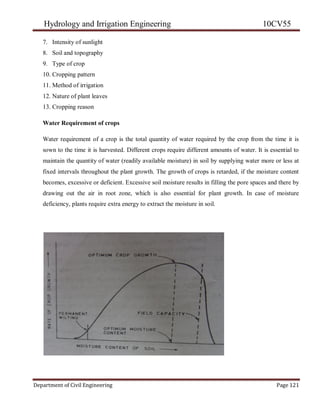
h) Soils of degradation: soils which are continuously zoning out due to erosion.
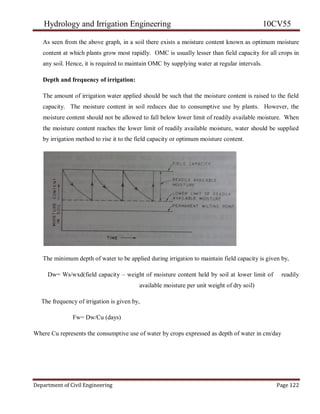
i) Pan clay pan: Impervious soils deposited on hard layers to form new set of soils & cemented
by calcium carbonate, Iron oxide, silica etc.
3. Classification based on salt content
a) Ped-O- Cal: Soil rich in calcium carbonate
b) Ped-Al-Fer: Soil rich in aluminum and iron salts
c) Humus: Soil rich in organic matter or salts.
4. Soil classification based on particle size
A composed soil can be classified on the basis of particular soil as coarse , medium, fine grain
depending upon the percentage of sand, silt, and clay.
Hydrology and Irrigation Engineering 10CV55
Department of Civil Engineering Page 114
5. Soil classification according to regional basis
a) Regions of autogenous of soil development
b) Regions of balanced decomposition
c) Regions of excessive denudation
d) Regions of eroded eolian accumulation
6. Classification of Indian soil
a) Alluvial soils: These are soils formed due to deposition by water in Indo-Gangetic plains.
These soils are very fertile and also absorb good amount of rainfall.
b) Red soil: It is a residual soil which is left over in a same place as a result of decay of
underlying parent rock & covering parent rock. These have light texture and good porosity
varying fertility and low soluble salt content. Such soils are found in central and peninsular
India.
c) Lateral soil: These are residual soils commonly found in coastal region. These are usually
porous and well drained & they do not contain common nutrients required for plant growth in
sufficient quality.
d) Black soil: The texture of this varies from clay to loamy
Functions of Irrigation Water:
Water and nutrients are the most important requirements of plants. Following are the main functions of
irrigation water
1. Water dissolves the nutrients, forms a solution of the nutrients and which are absorbed by the
roots and thus water acts as a nutrient carrier.
2. The irrigation water supplies moisture which is essential for the life of bacteria which are
beneficial to plant growth.
3. Irrigation water supplied moisture which is essential for the metabolism within the plant leading
to plant growth.
4. Some essential salts present in soil react in presence of water to produce nourishing food
products.
5. Water cools the soil and atmosphere, thus creating a healthy environment for plant growth.
6. It softens the tillage pans (area to be irrigated).
Hydrology and Irrigation Engineering 10CV55
Department of Civil Engineering Page 115
Suitability of water for irrigation:
In order to perform the required functions, for optimum growth of plants, the water may be turned as
unfit if,
1. Sediment concentration is excessive
2. Total concentration of salts of sodium (Na), calcium, magnesium and potassium is excessive.
3. Percentage of sodium ions to that of other ions is excessive.
4. Percentage of bicarbonates of calcium and magnesium becomes excessive.
5. Bacteria harmful to plant growth are present.
6. Contains chemicals toxic to plants, animals and humans.
Classes of soil water:
Water in the soil may be present in the following forms
1. Hygroscopic water:
2. Capillary water
3. Gravitational water
Hygroscopic water: When an over dried soil sample is exposed to atmosphere, the soil absorbs some
amount of water from the atmosphere. This water absorbed by the soil is called hygroscopic water and it
is not capable of moving either under capillary action or gravitation.
Capillary water: It is that part of water in excess of hygroscopic water, which exists in the pore spaces
(voids) of the soil due to molecular attraction.
Gravitational water is that part of water in excess of hygroscopic and capillary water which will drain out
under favourable conditions.
Hydrology and Irrigation Engineering 10CV55
Department of Civil Engineering Page 116
Soil moisture constants:
Saturation Capacity (Maximum moisture holding capacity): It is defined as the amount of water required
to fill all the pore spaces between soil particles by replacing all the air. It is inclusive of hygroscopic
water, capillary water and gravitational water. When the porosity of a soil sample is known the saturation
capacity can be expressed as equivalent depth of water in cm per meter of soil depth.
Ex: If porosity of a soil sample is 50% by volume, the moisture in each meter of a saturated soil is
equivalent to 50 cm on the field surface.
Field Capacity: It is defined as the maximum amount of moisture which can be held by a soil against
gravity, thus immediately after the gravitational water has drained off from a saturated soil mass. Field
capacity is the upper limit of the capillary water of moisture content available to the plants. The field
capacity is usually given as the weight of the maximum amount of moisture held by the soil against
gravity per unit weight of dry soil and is expressed as a percentage.
Field Capacity =
Weight of maximum moisture content held in soil sample
Weight of dried soil sample
X 100%
Hydrology and Irrigation Engineering 10CV55
Department of Civil Engineering Page 117
Permanent wilting point or coefficient: It is that water content at which plants can no longer extract
sufficient water from the soil for growth and become permanently wilted. At permanent wilting point, the
film of water around the soil particles is held so tightly that plant roots cannot extract enough moisture
for metabolism.
It is the lower limit of available or capillary water and is usually expressed as the weight of water held in
soil per unit weight of dry soil when the plants are permanently wilted.
Permanent wilting point differs from soil to soil but is the same for different plants grown in the same
soil.
The permanent wilting point is expressed as a percentage. It is as low as 2% for light sandy soils and
may be as high as 30% for heavy clayey soils.
Available moisture: It is the different in water content of the soil between field capacity and permanent
wilting point.
Readily available moisture: It is that portion of available moisture which is most easily extracted by plant
roots. Only about 75% of available moisture is readily available.
Expression for Depth of Water held by soil in root zone:
The water held by soil, in root zone may be expressed in terms of depth of water as indicated below.
Let, y = depth of water available in root zone
d = depth of root zone in meters
Fc= field capacity of soil expressed as a ratio
γs = Density or unit weight of soil
γw = Density or unit weight of water
Consider one square meter or unit area of soil mass,
We know that,
Hydrology and Irrigation Engineering 10CV55
Department of Civil Engineering Page 118
Field Capacity =
Weight of water retained in root zone
Weight of soil in root zone
i. e Fc =
γw . 1 . y
γs . 1 . d
therefore Weight of water retained in root zone is given as
γw . 1 . y = Fc . γs . 1 . d
therefore depth of water retained in root zone at field capacity is given as
y =
Fc . d . γs
γw
Similarly, depth of water stored in root zone at permanent wilting point,
y =
PWPt. d . γs
γw
Also depth of available water in root zone is equal to
y =
(Fc − PWPt). d . γs
γw
Also depth of readily available water in root zone
y =
0.75 (Fc − PWPt). d . γs
γw
Problem1:
Find the field capacity of a soil for the following data.
Depth of root zone = 2m
Existing moisture content = 5%
Dry density of soil =15 kN/m3
Water applied to soil = 600 m3
Hydrology and Irrigation Engineering 10CV55
Department of Civil Engineering Page 119
Water lost due to evaporation and deep percolation = 10%
Area of land irrigated = 900 m2
Solution:
Total water applied = 600 m3
Loss of water = 10
Amount of water retained in soil =
600 X 90
100
= 540 m3
Weight of water retained in the soil = 540 m3
x γw
= 540 x 10 = 5400 kN
Total weight of dry soil = (V x γd ) = 900 x 2 x 15 =2700 kN
Percentage of water retained in soil =
5400 X 100
2700
= 20%
Field capacity = Available water + Existing or Hydroscopic water = 20% + 5% = 25%
Problem2:
A loam silt soil has field capacity of 25% and permanent wilting coefficient of 10%. The dry
unit weight of soil is 1.5g/cc. If the depth of root zone is 0.75m, determine the storage capacity
of the soil. If the moisture content drops to 14% determine the depth of irrigation water to be
applied to maintain available water, also take application efficiency as 75%.
Solution:
a. Storage capacity of soil is nothing but the depth of available water in root zone.
Hydrology and Irrigation Engineering 10CV55
Department of Civil Engineering Page 120
y =
(Fc − PWPt). γs . d
γw
y =
25 − 10 X 1.5 X 0.75
1
X
1
100
y = 0.169 m
b. Depth of irrigation water required to raise moisture level from minimum level to field capacity
y =
(Fc − Min moisture content). γs . d
γw
c. Depth of irrigation water to be applied at the field =
Depth of irrigation water required
Water application efficiency
=
0.124
0.75
= 0.165m.
Consumptive use of water:
It is defined as the total quantity of water used by plants in transpiration; tissues build up, evaporation
from adjacent or exposed soil in an area at any specific time.
Transportation is the process by which plants dissipate the water absorbed from the soil through the
roots into the atmosphere through the surface of leaves, stalks and trunk.
Evaporation is the process by which soil loses water in the form of vapours.
Consumptive use also includes water consumed by accompanying could growth, water deposited by
dew or rainfall and subsequently evaporation without entering the plant systems.
The following factors affect the consumptive use of water,
1. Direct evaporation from soil
2. Relative humidity of air
3. Wind velocity
4. Temperature
5. Precipitation
6. Hours of the day
Hydrology and Irrigation Engineering 10CV55
Department of Civil Engineering Page 121
7. Intensity of sunlight
8. Soil and topography
9. Type of crop
10. Cropping pattern
11. Method of irrigation
12. Nature of plant leaves
13. Cropping reason
Water Requirement of crops
Water requirement of a crop is the total quantity of water required by the crop from the time it is
sown to the time it is harvested. Different crops require different amounts of water. It is essential to
maintain the quantity of water (readily available moisture) in soil by supplying water more or less at
fixed intervals throughout the plant growth. The growth of crops is retarded, if the moisture content
becomes, excessive or deficient. Excessive soil moisture results in filling the pore spaces and there by
drawing out the air in root zone, which is also essential for plant growth. In case of moisture
deficiency, plants require extra energy to extract the moisture in soil.
Hydrology and Irrigation Engineering 10CV55
Department of Civil Engineering Page 122
As seen from the above graph, in a soil there exists a moisture content known as optimum moisture
content at which plants grow most rapidly. OMC is usually lesser than field capacity for all crops in
any soil. Hence, it is required to maintain OMC by supplying water at regular intervals.
Depth and frequency of irrigation:
The amount of irrigation water applied should be such that the moisture content is raised to the field
capacity. The moisture content in soil reduces due to consumptive use by plants. However, the
moisture content should not be allowed to fall below lower limit of readily available moisture. When
the moisture content reaches the lower limit of readily available moisture, water should be supplied
by irrigation method to rise it to the field capacity or optimum moisture content.
The minimum depth of water to be applied during irrigation to maintain field capacity is given by,
Dw= Ws/wxd(field capacity – weight of moisture content held by soil at lower limit of readily
available moisture per unit weight of dry soil)
The frequency of irrigation is given by,
Fw= Dw/Cu (days)
Where Cu represents the consumptive use of water by crops expressed as depth of water in cm/day
Hydrology and Irrigation Engineering 10CV55
Department of Civil Engineering Page 123
Problems 3:
The root zone of a certain soil has a field capacity of 30% and permanent wilting percentage is
10%
(i)What is the depth of moisture in the root zone at field capacity and permanent wilting point?
ii) How much water is available if the root zone depth is 1.2 m . The dry weight of the soil is 13.73kN/m3
Solution:
(i) The depth of moisture in root zone at field capacity per metre depth of soil 1 =Sp.
gr. of soil x Field capacity
= (13.73x 10³
/9810) X 30/100
= 0.42 m/m = 420 mm/m
The depth of moisture in root zone at permanent wilting point per metre depth of soil
= Sp. gr. of soil x Permanent wilting point
=(13.73x 10³
/9810) X 10/100
= 0.14 m/m = 40 mm/m
(ii ) Depth of available water per metre depth of soil.
= Ws/w (Field capacity—Permanent wilting point)
= (13.73x 10³
/9810) X (30/100 – 10/100) =
= 0.28m/m = 280mm/m
Total water available in the root zone
= 280 x 1.2 = 336 mm
Hydrology and Irrigation Engineering 10CV55
Department of Civil Engineering Page 124
Problems 4:
The field capacity of a certain soils is 18.3% and its specific gravity is 1.25. A wet sample of the
soil taken before irrigation weighs 153gm and weight after drying in the oven is 138gm. What
depth of water must be applied to irrigate the soil to a depth of 1.2m
Solution: The moisture content before irrigation
= ( 153-138/ 138 ) x 100= 10.9% by weight
Depth of water required to be applied to bring the moisture upto its field capacity
= 1.25 x 1.2 (
18.3
100
−
10.9
100
) = 0.111m = 111mm
Problems 5:
The field capacity of a certain soil is 12.6% and its specific gravity is 1.42. If the moisture
content of present in the soil before irrigation is 8.2%. How deep the soil profile will be
welted with an application of 50mm of irrigation water.
Solution :
Depth of irrigation water applied=Sxd (field capacity–Moisture content before irrigation )
Thus by substitution we have
50/1000= 1.42 x d (12.6/100 – 82/100)
D= 50/1000x 1/1.42x 100/4.4
= 0.80m = 800mm
Problems : 6
Determine the area which can be irrigated using surface method of irrigation with a source of
water having a discharge of 10000 litres per minute. The available moisture holding capacity of
the soil is 180mm per metre and depth of root zone is 1.1m. Irrigation is done when 40% of
available moisture is used. The total losses during irrigation are 35% and peak daily moisture use
is 4.5mm.
Hydrology and Irrigation Engineering 10CV55
Department of Civil Engineering Page 125
Solution:
Effectivedischargeofthesourceforirrigation
=(10000x0.65)=6500litres/minute
Depthofwateravailablefortheuseofplants
= (180x0.40) = 72mm/m
Depth of root zone = 1.1 m
Depthofwateravailable fortheentirerootzone
=(72x1.1) = 79.2mm
Peakdailymoistureuse=4.5mm
Wateringinterval=79.2/4.5=17.6days=17days
Thus ifa is the area in hectares which can be irrigated then we have
(6500/1000) x 17x 24x 60 = a x 104
x 79.2/1000
a= 201ha
Problems 7:
The following data pertains to healthy growth of crop.
i. Field capacity = 30%
ii. Permanent wilting percentage = 11%
iii. Density of soil=1300kg/m3
iv. Effective depth of soil= 700mm
v. Daily consumptive use of water for given crop= 12mm
For healthy growth moisture content must not fall below25% of the water holding capacity
between the field capacity and permanent wilting point. Determine the watering intervals in
days.
Hydrology and Irrigation Engineering 10CV55
Department of Civil Engineering Page 126
Solution :
Maximum storage capacity of soil= (Ws/w)x d(field capacity–Moisture content before irrigation )
Ws - 1300 kg/m3
; w- 1000 kg/m3
; d= 700 mm = 0.7 m;
Field capacity =30/100 = 0.30; and
Permanent wilting percentage = 11% = 0.11
Thus, by substitution, we get
Maximum storage capacity of soil= 1300 /1000 x 0.7(0.30-0.11) = 0.1729m= 172.9mm
Since for healthy growth moisture content must not fell below 25% of the maximum water holding capacity
of soil, °
Available moisture = 172.9 x75 /100= 129.675 mm
Daily consumptive use of water = 12 mm
Watering interval = 129.675 /12= 10.891 days = 10days
Hydrology and Irrigation Engineering 10CV55
Department of Civil Engineering Page 127
UNIT 7
WATER REQUIREMENT OF CROPS
INTRODUCTION
Water requirement of a crop is the total quantity of water required by the crop from the time it is sown to
the time it is harvested. Different crops require different quantities of water. Since the growing crops use
water continuously, it is essential to maintain the quantity of readily available moisture in the soil by
irrigation. As such the total quantity of water required by a crop is so distributed that a part of it is applied
each time at a more or less fixed interval throughout the period of growth. The quantity of water applied at
each irrigation should be such that water sufficient to meet the needs of the crop for a period between two
successive irrigations is stored in the soil. Therefore in addition to the total quantity of water required by a
crop, it is also essential to determine the frequency of irrigation as well as the quantitv of water required to
be applied during each application.
LIMITING SOIL MOISTURE CONDITIONS
The growth of most crops is retarded by either excessive or deficient amounts of soil moisture content.
The excessive moisture content in the soil results in filling the soil pore spaces completely with water,
thus driving out air from the soil in the root zone J Since for satisfactory plant growth the presence of air
in the root zone is essential the absence of the same retards the plant growth. On the other hand soils
having deficient amounts of moisture hold it so tightly that plants are required to spend extra energy to
obtain it. Moreover, if the rate of intake by the plants is not sufficient to maintain turbidity of the leaves,
permanent wilting follows. In between these two extreme soil moisture conditions, there is a moisture
content designated as optimummoisturecontentat which plants grow most rapidly,resulting intheoptimumgrowthof
crops.
Duty of Water:
Duty represents the irrigating capacity of a unit of water.
It is usually defined as the area of land in hectares which can be irrigated to grow a crop of one cumec of
water is continuously supplied for the entire period of the crop.
Hydrology and Irrigation Engineering 10CV55
Department of Civil Engineering Page 128
Ex: If 5100 hectares of land can be irrigated for growing a crop with a available discharge of 3 cumec
continuously for the entire crop period, then the duty of water for this crop = 5100/3 = 1700
hectares/cumec.
Different crops require different amounts of water before their harvesting and hence duty of water varies
with the crops. Duty of water is said to be high, if the area of land irrigated per cumic is large.
Duty of water can be expressed in different ways as follows.
1. By the number of hectares that one cumec of water can irrigate during the base period.
2. By the total depth of water (Delta) applied
3. By the numbers of hectares can be irrigated by one million m3
of stored water
4. By the number of hectare-meters of water expended (used) per hectare of land irrigated.
As in case 1, the duty expressed is called flow duty of water and commonly used in canal irrigation.
As in case 3, duty of water is suitable for tank irrigation because the area that can be irrigated is less and
amount of water stored in tanks is less. It is also known as quantity duty or storage duty.
Case 4 is applicable for large storage volumes available in multi-purpose reservoirs.
The duty of water varies with the place of its measurement due to losses such as percolation; evaporation
etc. The quantity of water delivered to the fields is different to the quantity of water leaving the head of
the canal.
Figure:
Ex: Let ‗C‘ be the head of the field, ‗B‘ be the head of field water course. ‗A‘ be the head of the
distributory (Starting point).
If the area of the field to be irrigated is 1200 hectares and If 1 cumec of water be required at the point ‗C‘
then the duty of water at point ‗C‘ is equal to 1200/1 = 1200 hectares/cumec.
Similarly let conveyance loss between B and A be 0.2 cumec
Discharge required at A = (1.0 + 0.1 + 0.2) cumec = 1.3 cumec
Duty of water at A = 1200/1.3 = 923 hectare/cumec.
Hydrology and Irrigation Engineering 10CV55
Department of Civil Engineering Page 129
Hence, the duty of water increases as we move from the lead of the canal system to the field. Therefore,
it is necessary to mention the place of measurement of duty.
Factors affecting duty:
The duty water of a canal system depends on the following factors.
1. Methods and systems of irrigation: Perennial system of irrigation has more duty of water than
inundation irrigation system the loss of water by deep percolation is minimum in the first case. In
flow irrigation by channels the duty is less as conveyance losses are more. In lift irrigation the
lands to be irrigated are very near to the source of water than any surface irrigation method.
2. Type of Crop: Different crops require varying quantities of water and therefore duty of water
varies from crop to crop. Crops requiring large quantity of water have lower duty than crops
requiring lesser quantity of water.
3. Climate conditions of the area:The climatic condition such as wind, temperature, humidity and
rainfall affect the duty of water. At high temperature losses due to evaporation and transpiration
are more and hence duty decreases. At higher wind velocity, rate of evaporation and transpiration
are more thereby, duty decreased. But in humid conditions evaporations and transpiration losses
are minimum, there by duty increases.
4. Canal conditions: In earthen canals, seepage losses are high resulting low duty. If canal is lined,
losses are minimum and hence duty increases. If the length of the canal is very large before it
reaches the irrigation fields (as in hilly areas) the duty of water decreases.
5. Quality of Water: If water contains harmful salts and alkali contents, then more water is to be
applied liberally to leach out these salts and in turn duty of water decreases.
6. Characteristics of soil and subsoil in field and canals: If the soil and subsoil of the field and canals
are made of coarse grained soils the seepage and percolation losses are more and hence the duty
of water decreases.
7. Topography of land: If the area to be irrigated is level, uniform water application is possible
which will result in economical views and hence duty of water increases.
8. Method of Cultivation: If the land is properly tilled up to the required depth and soil is made loose
before irrigation, water retaining capacity of soil increases. This reduces the number of watering
or frequency of watering and hence duty increases.
Hydrology and Irrigation Engineering 10CV55
Department of Civil Engineering Page 130
Delta:
It is the total depth of water required by a crop during the entire crop period and is denoted as ‗∆‗
Ex: A crop require 12 waterings at an interval of 10 days and depth of water required in each watering is
10cms, the delta for the crop is 12x10cms=120cms=1.2m
If the crop is grown in an area of ‗A‘ hectares, then the total quantity of water required is = 1.2 x A
hectares-meter in a period of 120 days.
Some definitions:
1. Crop Period: It is the time in days that a crop takes from the instant of its sowing to that of its
harvesting.
2. Base period: It refers to the whole period of cultivation from the time when irrigation water is
first applied for preparation of the ground for planting the crop to its last watering before
harvesting.
3. Gross command area: It is the total area laying between the drainage boundaries which can be
commanded or irrigated by a canal system.
4. Culturable command area: Gross command area may also contain villages, ponds, barrel lands,
alkaline lands etc., and such areas are turned as unculturable area. The remaining area on which
crops can be grown satisfactory is known as culturable command area.
Relationship between Duty and Delta:
Let D = Duty of water in hectares/cumec
∆ = Total depth of water required during base period in ‗m‘
B = Base period in days, ∆= 8.64𝐵/𝐷
Consider a field of ‗D‘ hectare to be irrigated and ∆ be the corresponding depth of water.
The total volume of water required to be supplied for the field of ‗D‘ hectares, if cumec is to be supplied
during the entire base period ‗B‘
Hydrology and Irrigation Engineering 10CV55
Department of Civil Engineering Page 131
Problems 1:
Find the delta for a crop if the duty for a base period of 110 days is 1400 hectares/cumec.
Solution:
∆= 8.64𝐵/𝐷
∆= 8.64𝑥 110/1400
= 0.68m = 68cm
Problems 2:
A crop requires a total depth of 9.2cm of water for a base period of 120 days. Find the duty of
water.
Solution :
𝐷 = 8.64𝐵/∆
𝐷 = 8.64 𝑥 120/0.092
= 1300 hectare/ cumec
Crop seasons of India:
Sowing of crops in irrigation of crops in India is usually done in 2 seasons, known as Crop seasons.
They are
1. Kharif season
2. Rabi season
Kharif season begins with the onset of south west monsoons sowing of crops in Kharif season is done
during June-July and these crops are harvested in October-November. In Rabi season the crops are sown
during September-October and harvested during march-April. The various crops grown in different
seasons and Delta for these crops are tabulated as follows
Hydrology and Irrigation Engineering 10CV55
Department of Civil Engineering Page 132
Kharif Crops - Rabi Crops-
Paddy 120cms Wheat 40cms
Maize 45cms Barley 45cms
Millets 30cms Peas 50cms
Jowar 30cms Mustard 45cms
Pulses 30cms Tobacco 60cms
Groundnut 45cms Potato 75cms
Grains 30cms
Sugarcane has a delta of about 90cms but has a period of 1 year or more. It is as such termed as a
perennial crop.
Assessment of Irrigation water:
Multipurpose river projects are constructed to serve irrigation purposes also. They involve huge amounts
of money which has to be borne by the government or authority. Hence charges have to be levied on
farmers for consuming water and for other reasons as follows.
1. To recover the cost of construction of the project
2. To recover the maintenance cost of project
3. To collect revenue for the nation
4. To control the cultivators against uneconomical and careless use of water.
Methods of charging the farmers /Assessment of irrigation water are done by the following methods:
1. Assessment on area basis/crop rate basis: In this method farmer is charged depending upon the
area cultivated by him and the type of crop grown by him.
2. Volumetric assessment: In this method the actual amount of water utilized by the farmers to grow
crops is done by measuring the discharge entering the field by device and then charges are levied
per unit of water.
3. Assessment on seasonal basis: Depending upon the cropping season the farmers are also charged
for the cropping area. In ruby season, availability of water is less and demand is more and hence
in Rabi season farmers are charged higher rates.
Hydrology and Irrigation Engineering 10CV55
Department of Civil Engineering Page 133
4. Composite rate basis: In addition to water consumed by farmers for cultivation, they are required
to pay land revenue. Hence in this basis both these charges are collected together by one single
agency based on the extent of the area cultivated.
5. Permanent assessment: In some cases farmers have their own source of water supply such as an
open well or tube well. They may require water from a canal system only during droughts.
Hence, in such cases they are charged a nominal amount on a permanent basis.
Crop rotation:
In a given plot of land different crops are grown one after the other in service in different seasons such a
practice is known as crop rotation. Crop rotation is necessary for the following reasons.
1. Different crops require different types of nutrients available in soil
If crop rotation is adopted all nutrients are utilized beneficially
2. By growing the same crop in the field continuously diseases and pests cannot be controlled easily.
By crop rotation such a hazard can be minimized.
3. Different crops have different depths of root zones hence the nutrients at different levels can be
well utilized by crop rotation.
4. By growing grams which are leguminous (they absorb more nitrogen) a plant, the nitrogen
content is soil is increased and becomes beneficial for subsequent crops.
The usual crop rotations adopted in India are,
a. Wheat-Millet-gram
b. Paddy-gram
c. Cotton-wheat-gram
d. Cotton-wheat-sugarcane
e. Cotton-millet-gram
CONSUMPTIVE USE OF WATER (EVAPO-TRANSPIRATION
Evapo-transpiration or consumptive use of water by a crop is the depth of water consumed by
evaporation and transpiration during crop growth, including water consumed by accompanying weed
growth. Water deposited by dew or rainfall, and subsequently evaporating without entering the plant
system is part of consumptive use. When the consumptive use of the crop is known, the water use of
Large units can be calculated.
Hydrology and Irrigation Engineering 10CV55
Department of Civil Engineering Page 134
Evaporation
Evaporation is the transfer of water from the liquid to the vapour state. The rate of evaporation
from water surface is proportional to the difference between the vapour pressure at the surface and the
vapor pressure in the overlaying air (Dalton's law). When irrigation water is applied by flooding
methods, large amounts of water are lost by direct evaporation from soil surface without having passed
through the roots, stems and leaves of the plants.
Transpiration and Transpiration Ratio
Transpiration is the process by which plants dissipate water from the surface of their leaves, stalks and
trunks in the process of growth. As much as 99% of total water received by a plant through its roots is
,lost to the atmosphere by this process.
Transpiration is associated with photosynthesis of plants; it is therefore, a process ofday light hours.
Water from soil is taken up by plant roots through a membrane by a process called osmosis. Green cells,
called chloroplasts in plant leaf prepare food in presence of sun light and C02 and leave water through
tiny openings called stomata the density of which may vary from 8000 to 12000 per sq. cm. The
transpiration ratio is the ratio of the weight of water transpired by the plant during its growth to the
weight of dry matter produced by the plant exclusive of roots. The average values of transpiration ratio
for wheat and rice are 560 and 680 respectively.
Factors affecting Consumptive Use of Water
1. Evaporation, which depends upon humidity.
2. Mean monthly temperature.
3. Growing season of crop and cropping pattern.
4. Monthly precipitation in the area.
5. Irrigation depth or the depth of water applied for irrigation.
6. Wind velocity in the locality.
7. Soil and topography.
8. Irrigation practices and methods of irrigation
Hydrology and Irrigation Engineering 10CV55
Department of Civil Engineering Page 135
Direct measurement of consumptive use
The consumptive use or evapotranspiration can be measured by five principal methods.
1. Tank and lysimeter methods
2. Field experiments plots
3. Soil moisture studies
4. Integration method
5. Inflow and outflow studies for large area
1. Tank and Lysimeter Method
Tanks are containers set flush with the ground level having an area of 10m
and 3 m deep. Larger the size of the tank greater is the resemblance to root development. The tank is
filled with soil of the field and crop is grown in it. Consumptive use is determined by measuring the
quantity of water required to maintain constant moisture conditions within the tank for satisfactory
proper growth of the crop. In Lysimeters, the bottom is pervious. Consumptive use is the difference of
water applied and that draining through pervious bottom and collected in a pan.
2. Field Experimental Plots
This method is more dependable than the tank and lysimeter method. In this method, irrigation
water is applied to the selected field experimental plots in such a way that there is neither runoff nor deep
percolation. Yield obtained from different fields are plotted against the total water used, and, as basis for
arriving at the consumptive use, those yields are selected which appear to be most profitable. It is seen
from observations that for every type of crop, the yield increases rapidly with an increase of water used
to a certain point, and then decreases with further increase in water. At the 'break in the curve the
amount of water used is considered as the consumptive use.
3. Soil Moisture Studies
This method is specially suited to those areas where soil is fairly uniform and ground water is
deep enough so that it does not affect the fluctuations in soil moisture within the root zone of the soil.
Soil moisture measurements are done before and after each irrigation. The quantity of water extracted per
Hydrology and Irrigation Engineering 10CV55
Department of Civil Engineering Page 136
day from soil is computed for each period. A curve is drawn by plotting the rate of use against time and
from this curve, seasonal use can be determined.
4. Integration Method
In this method, it is necessary to know the division of total area under irrigation crqps, natural
vegetation, water surface area and bare land area. The integration method is summation of the products
of (i) unit consumptive use for each crop times its area, (w)^unit consumptive use of native vegetation
times its area, (Hi) water surface evaporation times the water surface area, and (iv) evaporation from
bare land times its area. Thus, in this method, annual consumptive use for the whole of the area is found,
in hectare-metre units.
5. Inflow-Outflow Studies for Large Areas
In this method also, annual consumptive use is found for large areas, is the valley
consumptive use, its value is given by
U=(I + P) + (Gs-Ge)-R
where, £7= Valley consumptive use (in hectare-metre) /= Total inflow
during 12-months year P = Yearly precipitation on valley floor
Gs = Ground storage at the beginning of the year
Hydrology and Irrigation Engineering 10CV55
Department of Civil Engineering, SJBIT Page 137
IRRIGATION EFFICIENCIES
Efficient use of irrigation water is an obligation of each user as well as of the planners
Even under the best method of irrigation, not all the water applied during an irrigation & is
stored in the root zone. In general, efficiency is the ratio of water output to the water input and is
expressed as percentage. The objective of efficiency concepts is to show when improvements
can be made which will result in more efficient irrigation. The following are the various types of
irrigation efficiencies : (i) water conveyance efficiency, (u) water application efficiency, (Ui)
water use efficiency, (iv) water storage efficiency, (v) water distribution efficiency and (vi)
consumptive use efficiency.
1. Water Conveyance Efficiency (ὴs )
This takes into account the conveyance or transit losses and is determined from the
following expression :
where (ὴs )=
Wf
Wr
(ὴs ) =
Wf
Wr
= water conveyance efficiency
Wf= water delivered to the farm or irrigation plot
2. Water Application Efficiency (ὴa )
The water application efficiency is the ratio of the quantity of water stored intothe root zone of
the crops to the quantity of water delivered to the field. This focusesthe attention of the
suitability of the method of application of crater to the crops.
It is determined from the following expression
ὴa = Ws/Wf
where ὴa = water application efficiency
Ws= Water stored in the root zone during the irrigation
Wf= water delivered to the farm.
Hydrology and Irrigation Engineering 10CV55
Department of Civil Engineering, SJBIT Page 138
The common sources of loss of irrigation water during water application are (i) surface run off
Rf from the farm and (ii) deep percolation Df below the farm root-zone soil. Hence
Wf=Ws+Rf+Df
In a well designed surface irrigation system, the water application efficiency should be atleast
60% . In the sprinkler irrigation system this efficiency is about 76%.
3, Water Use Efficiency (ὴu)
It is the ratio of water beneficially used, including leaching water, to the quantity water
delivered, and is determined from the following expression :
ὴu = Wu/Wdxl00 ..
here ὴu = water use efficiency
Wu = water used beneficially or consumptively
Wd= water delivered.
4. Water Storage Efficiency (ὴs )
The concept of water storage efficiency gives an insight to how completely the required water
has been stored in the root zone during irrigation. It is determined from the following expression:
(ὴs)= Ws/Wnx100 ...(
vhere ὴs = water storage efficiency
Ws = water stored in the root zone during irrigation
Wn = water needed in the root zone prior to irrigation
=(Fieldcapacity - Available moisture).
Hydrology and Irrigation Engineering 10CV55
Department of Civil Engineering, SJBIT Page 139
5. Water Distribution Efficiency ((ὴd)
Water distribution efficiency evaluates the degree to which water is uniformly distributed throughout
the root zone. Uneven distribution has many undesirable results, the more uniformly the water is
distributed, the better will be the crop response, It is determined from the following expression4
ὴd=100(1 −
y
d
)
where ὴd = water distribution efficiency
y = average numerical deviation in depth of water stored from average depth stored
during irrigation.
d = average depth of water stored during irrigation.
The efficiency provides a measure for comparing various systems or methods of water application, i.e.
sprinkler compared to surface, one sprinkler system compared to the other system or one surface method
compared to other surface method.
6. Consumptive Use Efficiency (ὴCU )
It is given by
ὴcu= Wcu/Wdxl00
where Wcu or Cu = normal consumptive use of water
Wd= net amount of water depleted from root zone of soil.
The efficiency, therefore evaluates the loss of water by deep percolation and by excessive surface
evaporation following an irrigation.
DETERMINATION OF IRRIGATION REQUIREMENTS OF CROPS
In order to determine the irrigation requirements of certain crop, during its base period, the
tollowmg terms are required :
(i) Effective Rainfall (Re)
Hydrology and Irrigation Engineering 10CV55
Department of Civil Engineering, SJBIT Page 140
Effective rainfall is that part of the precipitation falling during the growing period of a crop
that is available to meet the evapo-transpiration needs of the crop.
(ii) Consumptive Irrigation Requirement (CIR)
Consumptive irrigation requirement is defined as the amount of irrigation water that is
required to meet the evapo-transpiration needs of the crop during its full growth. Therefore,
CIR = CU-Re
where Cu is the consumptive use of water.
iii) Net Irrigation Requirement (NCR)
Net irrigation requirement is defined as the amount of irrigation water required at the plot to meet the
evapo-transpiration needs of water as well as other needs such as leaching etc.
Thus NIR= Cu - Re + water lost in deep percolation for the purpose of leaching etc.
iv) Field Irrigation Requirement (FIR)
Field irrigation requirement is the amount of water required, to meet 'net irrigation requirements,
plus
the water lost in percolation in the field water courses, field channels and in field applications of water. If ὴ a
is water application efficiency, we have
FIR=NIR/ὴ
v) Gross Irrigation Requirement (GTR)
Gross irrigation requirement is the sum of water required to satisfy the field irrigation requirement and
the water lost as conveyance losses in distributaries upto the field. If ὴa is the water conveyance efficiency,
we have
GIR=FIR/ὴc
Hydrology and Irrigation Engineering 10CV55
Department of Civil Engineering, SJBIT Page 141
CROP ROTATION
The term rotation of crops is somewhat self explanatory. It implies that nature of the crop sown in a
particular field is changed year after year.
Necessity for rotation
The necessity for rotation arises from the fact that soil gradually losses its fertility if the
same crop is sown every year and the field has to be allowed to lie fallow in order to regain its
fertility. The effect of fallow is obtained by rotation of crops.
All crops require similar type of nutrients for their growth but all of them do not take in the
same quantities or proportions; some crop favours certain plant nutrients and take them more than
the others. Thus if a particular crop is grown year after year, the soil gets deficient in the plant food
favored by that crop. If different crops are to be raised there would certainly be more balanced
flooding and soil deficient in one particular type of nutrient is allowed to recoupled.
Crop diseases and insect pests will multiply at an alarming rate, if the same crop is to be grown
continuously. Rotation will check this disease.
A leguminous crop (such as gram) if introduced in rotation will increase nitrogen content of the soil
thus increasing its fertility.
Problems 3:
A certain crop is grown in an area of 3000 hectares which is
fed by a canal system. The data pertaining to irrigation are as follows :
Field capacity of soil= 26%
Optimum moisture= 12
Permanent wilting point-10%
Effective depth of root zone -80 cm
Relative density of soil=1.4
Hydrology and Irrigation Engineering 10CV55
Department of Civil Engineering, SJBIT Page 142
If the frequency of irrigation is 10 days and the overall efficiency is 23%,fina
(i) the daily consumptive use (ii) The water discharge in m2
/sec required in the canal feeding the
area.
Solution
dw = Sg.d [Fc - m0] = 1.4 x 80 [0.26 - 0.12]=15.68 cm
Frequency of irrigation = 10 days.
Daily consumption use= 15.68/10= 1.568cm= 15.68mm
Total water required in 10 days= Ax dw= 3000x 104
x 15.68/100= 4704000m3
Discharge in the canal= 4704000/(10x24x3600) = 5.45 cumecs
Problems 4.
The gross commanded area for a distributory is 20000 hectares,75% of which can be irrigated.
The intensity of irrigation for Rabi season is 40% that for Kharif season is 10%. If kor period is
4 weeks for rabi and 2.5 weeks for rice, determine he outlet discharge . Outlet factors for rabi and
rice may be assumed as 1800 hectares/ cumec and 775 hectares/ cumec. Also calculate delta for each
crop.
Gross commanded area = 20000 hectares
Culturable commanded area = 0.75 x 20000 = 15000 hectares.
Area under irrigation in Rabi season at 40% intensity = 15000 x 0.4 = 6000 hectares
Area under irrigation in Kharif season at 10% intensity = 15000 x 0.1 = 1500 hectares.
Outlet Discharge for Rabi = 6000/1800= 3.33 cumec
Outlet Discharge for Kharif = 1500/775= 1.94cumec
From the equation
Similarly for rabi ∆= 8.64𝐵/𝐷
Hydrology and Irrigation Engineering 10CV55
Department of Civil Engineering, SJBIT Page 143
∆= 8.64(4𝑥7)/1800
∆= 0.134𝑚 = 134𝑚𝑚
Similarly for rice ∆= 8.64𝐵/𝐷
∆= 8.64(2.5𝑥7)/775
∆= 0.195𝑚 = 195𝑚𝑚
Problems 5.
The base period, duty at the field of difference crops, and area under each crop in the command
area are given below. Find the required reservoir capacity to cater to the needs of the crops.
Crops
Base
period
(days)
Duty @ field
(Ha/cumec)
Intensity of
irrigation
(%)
Wheat 120 1800 20
Sugar cane 360 1700 20
Cotton 180 1400 10
Rice 120 800 15
Vegetables 120 700 15
Hydrology and Irrigation Engineering 10CV55
Department of Civil Engineering, SJBIT Page 144
Total=40354
Total volume of water required by the crops
= 40354 Hectare- meters
Required capacity of the reservoirs=40354/0.8x0.9 = 5.605x10⁴
hectare- metre
Problems 6.
A water course has a culturable command area of 1200 hectares. The intensity of irrigation for
crop A is 40 % and for B is 35%, both the crops being rabi crops. Crop A has a kor period of 20
days and crop B has kor period is 15 days. Calculate the discharge of the water course if the kor
depth for crop A is 10cm and for it is 16cm.
Solutions:
(A)For Crop A
Area under irrigation =1200 x0.4 = 480 hectares
Kor period = b= 20days
Kor depth = D= 10cm= 0.1m
Duty = ∆= 8.64𝐵/𝐷 = 8.64 x20/0.1 =1728 hectares/cumec
Hence discharge required = Area under irrigation/ outlet factor=480/1728 = 0.278 cumec
(B) For Crop B
Crops
Duty @ field
(Ha /cumec)
Base period
(days) ∆= 8.64𝐵/𝐷
Delta (m)
Area under each
crop(hectares)
Volume of
water required
(Ha-m)
Wheat 1800 120 0.576 8000= (40000x.2) 4608
Sugar cane 1700 360 1.830 8000= (40000x.2) 14640
Cotton 1400 180 1.111 4000= (40000x.1) 4444
Rice 800 120 1.296 6000= (40000x.15) 7776
Vegetables 700 120 1.481 6000= (40000x.15) 8886
Hydrology and Irrigation Engineering 10CV55
Department of Civil Engineering, SJBIT Page 145
Area under irrigation =1200 x0.35 = 420 hectares
Kor period = b= 15 days
Kor depth = D= 16cm= 0.16m
Duty = ∆= 8.64𝐵/𝐷 = 8.64 x15/0.16 =810 hectares/cumec
Hence discharge required = Area under irrigation/ outlet factor=420/810 = 0.519 cumec
Thus, the design discharge of water course= 0.276 +0.519= 0.8 cumec
Problems 7
A water course commands an irrigated area of 1000 hectares. The intensity of irrigation for rice
in this area is 70 %. The transplantation of rice crop takes 15days and during the
transplantation period the total depth of water required by the crop on the field is 500mm.
During the transplantation period , the useful rain falling on the field is 120mm. Find the duty
of irrigation water for the crop on the field during transplantation, at the head of the field is and
also at the head of the water course assuming losses of water to be 20% in the water course. Also
calculate the discharge required in the water course.
Solutions:
Depth of water required on the field during transplantation = 500mm
Useful rainfall during this period= 120mm
Depth of water required to be supplied by the water course= 500-120= 380mm= 0.38m
Duty = ∆= 8.64𝐵/𝐷
Duty of water on the field is = Duty = ∆= 8.64𝑥 0.15/0.38 = 341 hectares/ cumec
Since the losses of water in the water course are 20%, a discharge of 1 cumec at the head of the
water course will be reduced to 0.8cumec at the head of the field and hence will irrigate.
= 381x 0.8= 272.8 hectares.
Duty of water at the head of the water course = 272.8 hectares.
Discharge at the head of water course = 700 / 272.8
Hydrology and Irrigation Engineering 10CV55
Department of Civil Engineering, SJBIT Page 146
= 2.57 cumecs
Hydrology and Irrigation Engineering 10CV55
Department of Civil Engineering, SJBIT Page 147
Unit -8
CANALS
Canals
A canal is an artificial channel, generally trapezoidal in shape, constructed on the ground to
carry water to the fields either from a river or tank or reservoir.
If the full supply level (FSL) of a canal is below the natural ground surface, an open cut or excavation
is necessary to construct a canal. If the FSL of the canal is above the existing ground level, the canal is
constructed by providing earthen banks on both sides. In the first case the channel is called a canal in
cutting and in the second case it is called a canal in filling. Sometimes a canal can be of the
intermediate type and the channel is called a canal in partial cutting and Partial filling.
Classification of Canals:
The irrigation canals can be classified in different ways based on the following considerations.
1. Classification based on the nature of source of supply:
In this method canals may be classified as
Hydrology and Irrigation Engineering 10CV55
Department of Civil Engineering, SJBIT Page 148
a) Permanent canals
b) Inundation canals
A permanent canal is one which draws water from a permanent source of supply. The canal in such
cases is made as a regular graded canal (fixed slope). It is provided with permanent regulation and
distribution works. A permanent canal may also be perennial canal or non-perennial canal depending
on whether the source supplying water is a perennial one or a non-perennial.
An inundation canal is one which draws water from a river when the water level in the river is high or
the river is in floods. These canals are not provided with any regulatory works, but an open cut is made
in the banks of the canal to divert water.
2. Classification based on the function of the canal:
Here the canals may be classified as
a) Feeder canals
b) Carrier canals
c) Navigation canals
d) Power canals
A feeder canal is constructed for the purpose of supplying water to two or more canals only but not
directly irrigating the fields.
A carrier canal carries water for irrigating the fields and also feeds other canals for their needs.
A canal serving the purpose of in-land navigation is called a navigation canal.
A power canal supplies water to a hydro electric power generation plant for generation of electrical
power.
3. Classification based on the discharge and its relative importance in a given network of canals:
On this basis an irrigation canal system consists of
a) Main canal
Hydrology and Irrigation Engineering 10CV55
Department of Civil Engineering, SJBIT Page 149
b) Branch canal
c) Major distributory
d) Minor distributory
e) Water course or Field channel
A main canal is the principal canal in a network of irrigation canals. It directly takes off from a river,
reservoir or a feeder canal. It has large capacity and supplies water to branch canals and even to major
distributaries.
Branch canals take off from a main canal on either side at regular intervals. They carry a discharge of
about 5 cumec and are not usually used to directly irrigate the fields.
A major distributory takes off a branch canal or a main canal. It has a discharge capacity of 0.25 to 5
cumec. They are used for direct irrigation and also to feed minor distributaries.
Minor distributaries are canals taking off from the branch canals and major distributaries. They carry a
discharge less than 0.25 cumec. These canals supply water to field channels.
A water course or field channel takes off from either a major or minor distributory or a branch canal
also. These are constructed and maintained by the cultivators/farmers. The other canals are constructed
and maintained by the government or the Command Area Development Authority.
4. Classification based on Canal alignment:
On the basis of canal alignment, the canals are classified as
a) Ridge canal or watershed canal
b) Contour canal
c) Side slope canal
Hydrology and Irrigation Engineering 10CV55
Department of Civil Engineering, SJBIT Page 150
A Ridge canal or watershed canal is one which runs along the ridge or watershed line. It can irrigate
the fields on both sides. In case of ridge canals the necessity of cross drainage works does not arise as
the canal is not intercepted by natural streams or drains.
A contour canal is one which is aligned nearly parallel to the contours of the country/area. These
canals can irrigate the lands on only one side. The ground level on one side is higher and hence bank
on the higher side may not be necessary. A contour canal may be intercepted by natural streams/drains
and hence cross drainage works may be essential.
A Side slope canal is one which is aligned at right angles to the contour of the country/area. It is a
canal running between a ridge and a valley. This canal is not intercepted by streams and hence no
cross drainage works may be essential. This canal has steep bed slope since the ground has steep slope
in a direction perpendicular to the contours of the country/area.
5. Classification based on the financial output:
On the basis of the financial output /revenue from the canals, the canals are called as
a) Productive canals
b) Protective canals
A productive canal is one which is fully developed and earns enough revenue for its running and
maintenance and also recovers the cost of its initial investment. It is essential the cost of its initial
investment is recovered within 16 years of construction.
Hydrology and Irrigation Engineering 10CV55
Department of Civil Engineering, SJBIT Page 151
Protective canals are those constructed at times of famine to provide relief and employment to the
people of the area. The revenue from such a canal may not be sufficient for its maintenance. The
investment may also not be recovered within the stipulated time.
6. Classification based on the soil through which they are constructed:
On the above basis the canals are classified as
a) Alluvial canals
b) Non-alluvial canals.
Canals constructed in alluvial soils are known as alluvial canals. Alluvial soils are found in the Indo-
Gangetic plains of North India. The alluvial soils can be easily scoured and deposited by water.
Canals constructed through hard soils or disintegrated rocks are called non-alluvial canals. Such soils
are usually found in Central and South India.
7. Classification based on Lining being provided or not:
On the above basis the canals are classified as
a) Unlined canals
b) Lined canals
An unlined canal is one which the bed and banks of the canal are made up of natural soil through
which it is constructed. A protective lining of impervious material is not provided. The velocity of
flow is kept low such that bed and banks are not scoured.
A lined canal is one which is provide with a lining of impervious material on its banks and beds, to
prevent the seepage of water and also scouring of banks and bed. Higher velocity for water can be
permitted in lined canals and hence cross sectional area can be reduced.
Hydrology and Irrigation Engineering 10CV55
Department of Civil Engineering, SJBIT Page 152
Canal alignment: In aligning an irrigation canal, the following points must be considered.
1. An irrigation canal should be aligned in such a way that maximum area is irrigated with least length
of canal.
2. Cross drainage works should be avoided as far as possible, such that the cost is reduced.
3. The off taking point of the canal from the source should be on a ridge, such that the canal must run
as a ridge canal and irrigate lands on both sides.
4. Sharp curves in canals must be avoided.
5. In hilly areas, when it is not possible to construct ridge canals, the canal must be made to run as a
contour canal.
6. The canal should be aligned such that the idle length of the canal is minimum.
7. The alignment should be such that heavy cutting or heavy filling are avoided. If possible balanced
depth of cutting and filling is achieved.
8. It should not be aligned in rocky and cracked strata.
9. The alignment should avoid villages, roads, places of worship and other obligatory points.
Design of unlined canals in alluvial soils
When water from the catchment or drainage basin enters the river it carries huge amounts of silt or
sediments along with it. The sediment is carried either in suspension or dragged along the rivers bed.
A portion of this silt or sediment also entire the canals. These sediments can cause a problem in the
design of unlined canals in alluvial soils.
If the velocity of flowing water in the canal is less, the sediments get deposited on the bed of the canal,
thereby reducing the cross sectional area of flow and in turn the irrigating capacity of the canal
reduces. On the other hand, if the velocity is increased too much, erosion of the bed and sides of the
canal takes place. Thus the area of the channel increases, full supply depth in canals decreases and
also causing other damages. Hence, in case of unlined canals, the velocity of flow should be such that
Hydrology and Irrigation Engineering 10CV55
Department of Civil Engineering, SJBIT Page 153
it is neither silting nor scouring. Such a velocity is called non-silting and non scouring velocity or also
called as critical velocity.
To carry the required design discharge (Q), knowing the surface and soil properties such as (N) and
silt factor (f), the design of an irrigation channel includes determining
1. Cross sectional area of flow (A)
2. Hydraulic mean radius ( R )
3. Velocity of flow (V)
4. Bed slope (S)
R G Kennedy, former Executive Engineer, Punjab Irrigation Department and Gerald Lacey, former
Chief Engineer, U P Irrigation Department made a lot of investigations in this area and put forward
theories named after them such as,
1. Kennedy‘s theory
2. Lacey‘s Regime theory.
1. Kennedy’s theory of designing unlined Canals: Kennedy selected a number of canal sections
in the upper Bari-Doab region which did not required any silt clearance for more than 35 years
and were supposed to be flowing with non-silting and non-scouring velocity. Kennedy put
forward the following facts out of his study.
 The bed of the canal offers frictional resistance to the flow of water, as a result critical
eddies (Turbulences) arise from the bottom of the bed. These eddies keep the sediments
carried by water in suspension. Some eddies also arise from the sides of the canal, but do
not support the sediments. Hence, the sediment supporting capacity is proportional to the
bed width of the canal.
 The critical velocity or non-silting and non scouring velocity (Vo) is a function of the depth
of the flowing water (D). It is given by the relationship Vo = c m Dn
Where, `c‘ is and `n‘ are coefficients suggested by Kennedy for canals of Bari-Doad region. The
values of `c‘ differs for different materials are
Light Sandy silt – c = 0.53
Hydrology and Irrigation Engineering 10CV55
Department of Civil Engineering, SJBIT Page 154
Coarse light sandy silt - c = 0.59
Sandy loan - c = 0.65
Coarse silt - c = 0.70
Note: Unless otherwise specified, values of c and n can be taken as c = 0.55 and n = 0.64
Thus, the equation for critical velocity becomes Vo = 0.55 m D 0.64
In this above, ‗m‘ represents critical velocity ratio which is given as
𝑚 =
V
Vo
Where, V represents mean velocity of flow. The value of ‗m‘ also varies with the silt
material
Note: Unless, otherwise specified m = 1.0
The mean velocity of flow is given by 𝑉 = 𝐶√𝑅 𝑆
Where C represents Chezzy‘s constant and is given by
𝐶 =
23 +
1
N
+
0.0015
S
1 + (23 +
0.0015
S
)
N
√R
Where N represents Kutter‘s Rugosity coefficient,
Types of Silt Value of ‗m‘
Silt of Indus rivers 0.7
Light Sandy silt of north India 1.0
Coarse-sandy silt 1.1
Sandy, Loamy silt 1.2
Coarse silt of hard rock 1.3
Hydrology and Irrigation Engineering 10CV55
Department of Civil Engineering, SJBIT Page 155
S represents Bed slope of the canal
R represents Hydraulic mean radius and is given by R= A/P
Where A is cross sectional area of canal and P is wetted perimeter.
When a canal is designed by Kennedy‘s method it is required that Vo is equal to V.
i.e., Critical velocity ratio m = 1
Note: The cross section for an irrigation canal is assumed as a trapezoidal channel as follows.
Kennedy’s procedure for designing unlined canals:
In designing the required canal section, the following equations are adopted.
𝑄 = 𝐴 Vo
Vo = 0.55 m D 0.64
𝑉 = 𝐶√𝑅 𝑆
R
N
S
SNC









0015.0
231
0015.01
23
Knowing the different quantities such as
1. Discharge (Q)
Cross Sectional Area of flow A= BD+KD2
Wetted Perimeter 𝑃 = 𝐵 + 2𝐷√1 + 𝐾2
KK
1 1
B
D
FSL
Hydrology and Irrigation Engineering 10CV55
Department of Civil Engineering, SJBIT Page 156
2. Rugosity coefficient (N) (if the value of ‗N‘ is not specified, it is assumed as 0.025)
3. Critical velocity ratio (m)
4. Bed slope (S) or B/D ratio
the properties of the canal such as cross sectional area of flow, hydraulic mean radius, mean velocity
of flow are determined.
Case 1: When bed slope ‘S’ is given
1. For the given discharge (Q) assume a trail value of the depth of flow (D)
For different values of discharge (Q) the trail values of depth of flow (D) are given as follows.
Q(m3
/s) 0.283 0.708 1.416 2.832 7.079 14.158 28.317 56.634
D(m) 0.49 0.66 0.84 1.04 1.43 1.73 1.98 2.26
2. Calculate Vo from Vo = 0.55 m D 0.64
3. Determine ‗A‘ from 𝑄 = 𝐴 Vo
4. Knowing ‗D‘ and ‗A‘ calculate the ‗Bed width‘ ‗B‘
5. Knowing ‗B‘ and ‗D‘ calculate the wetted perimeter ‗P‘
6. Knowing ‗A‘ and ‗P‘ calculate hydraulic mean radius ‗R‘
7. Calculate mean velocity of flow from the equation 𝑉 = 𝐶√𝑅 𝑆 .
8. If critical velocity ratio is equal to 1 (m=1), then the assumed value of ‗D‘ is correct.
9. If not revise the depth ‘D‘.
Case-2: When B/D ratio is given
1. Let B/D = x B = D x
2. Calculate cross sectional area in terms of ‗D‘ A = B D + K D2
3. Calculate critical velocity Vo in terms of ‗D‘ by substituting in Vo = 0.55 m D 0.64
4. Substituting for ‗A‘ and ‗ Vo‘ in 𝑄 = 𝐴 Vo, ‗D‘ can be determined.
5. Knowing ‗D‘, ‗A‘ and ‗B‘ calculate ‗P‘ and ‗R‘
6. Calculate Vo from equation Vo = 0.55 m D 0.64
7. Assuming a trial value for ‗S‘, Calculate Chezzy‘s constant from equation
Hydrology and Irrigation Engineering 10CV55
Department of Civil Engineering, SJBIT Page 157
R
N
S
SNC









0015.0
231
0015.01
23
8. Calculate mean velocity of flow from equation 𝑉 = 𝐶√𝑅 𝑆
9. Calculate critical velocity ratio ‗m‘. If m = 1 the bed slope provided is adequate.
10. If not, revise the bed slope ‗S‘.
Note: The trial values of bed slope S are assumed depending upon the discharge (Q) as follows.
Q (m3
/s) 0.283 0.708 1.416 2.832 7.079 14.158 28.317 56.634
S (1 in ___) 3333 3636 4000 4444 4444 5000 5000 5714
Draw backs in Kennedy‘s theory
1. Kutters equation is used for determining the mean velocity of flow and hence the limitations
of kutter‘s equation are incorporated in kennedy‘s theory.
2. The significance of B/D ratio is not considered in the theory
3. No equation for the bed slope has been given which may lead to varied designs of the channel
with slight variation in the bed slope.
4. Silt charge and silt grade are not considered. The complex phenomenon of silt transportation is
incorporated in a single factor are called critical velocity ratio.
5. The value of m is decided arbitrarily since there is no method given for determining its value.
6. This theory is aimed to design only an average regime channel.
7. The design of channel by the method based on this theory involves trial and error which is
quite cumbersome.
Problems
1. Design and sketch an irrigation channel to carry 5 cumec. The channel is to be laid on a
slope of 0.2m per kilometer. Assume N=0.025 and m=1
Solution:
1. Assume a trial depth D equal to 1.0m
Hydrology and Irrigation Engineering 10CV55
Department of Civil Engineering, SJBIT Page 158
2. V= Vo = 0.55 m D 0.64
= 0.55x 1.0x 1.0 0.64
3. Area = 𝑄 = 𝐴 Vo
A= Q/ V = 5/0.55= 9.09m2
4. A = B D + K D2
= 9.09 = Bx1.0 +1.02
/2
B= 8.59m
5. Perimeter = P= B+ D √ 5
8.59+1.0√ 5 =10.83m
R= A/P= 9.09/10.83
= 0.84m
6. Mean velocity flow
𝑉 = 𝐶√𝑅 𝑆
R
N
S
SNC









0015.0
231
0015.01
23
R= 0.84m , S= 0.2/1000 , N= 0.0225
C= 42.85
𝑉 = 𝐶√𝑅 𝑆 = 42.85 √0.84𝑥0.2 /1000
= 0.555m/s
7. Ratio of velocities found in step 6 and step2
= 0.555/0.55 = 1.009= 1.0
Hence assumed d is satisfactory.
2. Determine the dimensions of the irrigation canal for the following data B/D ratio = 3.7,
N= 0.0225, m=1.0 and S= 1/ 4000 side slopes of the channel is ½ H : 1V. Also determine
the discharge which will be flowing in the channel.
Hydrology and Irrigation Engineering 10CV55
Department of Civil Engineering, SJBIT Page 159
Solution: B/D = 3.7
B= 3.7D
For the channel with side slopes of 1/2H : 1V
R=
𝐵𝐷+(
𝐷2
2
)
𝐵+𝐷√5
= 0.708D
From kennedy‘s equation ,
Vo = 0.55 m D 0.64
Vo = 0.55 D 0.64
R
N
S
SNC









0015.0
231
0015.01
23
Equating the two values of V, we get
0.55 D 0.64
= 0.975D1/2
/ (1+0.781D-1/2
)
0.55 D 0.64
+ 0.4296D0.14
= 0.9795D1/2
Solving the above equation by trial and error , we get
D= 1.0m
B= 3.7m
V= 0.55m/s
A = B D + D2
/2
A= 4.2m
Q= Ax V=4.2 x0.55
= 2.31 cumes
Hydrology and Irrigation Engineering 10CV55
Department of Civil Engineering, SJBIT Page 160
Lacey’s Regime Theory: Lacey carried out a detailed study in designing suitable channels in alluvial
soils. He developed the regime theory and formulated a number of expressions based on his
observations. The salient features of Lacey‘s theory are stated as follows.
1. In a channel constructed in alluvial soil to carry a certain discharge, the bottom width, depth
and bed slope of the channel will undergo modifications by silting and scouring till equilibrium
is attained. The channel is now said to be a regime channel. (A regime channel is defined as a
stable channel whose bed width, depth and side slopes have undergone modifications by silting
and scouring and are so adjusted that equilibrium is attained.)
A channel is said to be in regime when the following conditions are satisfied.
a. The Channel is flowing in unlimited incoherent alluvium of the same character as that of
the transported sediment. (Incoherent alluvium is a soil composed of loose granular
material which can be scoured and deposited with the same ease.)
b. Silt grade (silt size) and silt charge (silt concentration) is the same throughout the channel.
c. Discharge in the canal is constant.
2. The silt carried by the flowing water in the canal is kept in suspension by vertical eddies
generated from the bed as well as from the sides of the canal.
3. The silt grade also plays an important role in controlling the regime conditions of the channel.
The silt factor is given by the relationship 𝑓 = 1.76√𝑑 where 𝑑 represents diameter of silt
particle in mm.
Lacey’s procedures for designing unlined canals:
In Lacey‘s method for designing unlined canals in alluvial soils for a known discharge ‗Q‘ and a
mean diameter of silt particle ‗d‘, the required quantities are calculated as follows.
1. The mean velocity of flow is computed from the relation.
Hydrology and Irrigation Engineering 10CV55
Department of Civil Engineering, SJBIT Page 161
6
1
2
140







Qf
V m/s
Where Q is discharge in m3
/s, f is silt factor given by 𝑓 = 1.76√𝑑, d is diameter of silt
particle in mm.
2. Calculate the cross sectional area of flow 𝐴 =
Q
V
3. Knowing the side slope express ‘A‘ in terms of B and D A = B D + K D2
4. Determine the required wetted perimeter from the relationship 𝑃 = 4.75 𝑄 -------(1)
5. Express the wetted perimeter in terms of B and D 𝑃 = 𝐵 + 2 𝐷√1 + 𝐾2 -------------(2)
6. From equations 1 and 2 solve for values of B and D
7. Calculate ‗Hydraulic mean radius‘ (R) from the relationship 






f
V
R
2
2
5
-----(3)
8. Also calculate hydraulic mean radius ‗R‘ from the relationship
𝑅 =
A
P
=
𝐵 𝐷 + 𝐾 𝐷2
𝐵+2 𝐷√1+𝐾2
----- (4)
9. If the values of hydraulic mean radius ‗R‘ worked out from equations 3 and 4 are the same then
the design is OK.
10. Calculated the Bed slope from the equation











6
1
3
5
3340Q
f
S
Draw backs in Lacey‘s theory
1. The theory does not give a clear description of physical aspects of the problem.
2. It does not define what actually governs the characteristics of an alluvial channel.
3. The derivation of various formulae depends upon a single factor f and dependence on single
factor f is not adequate.
Hydrology and Irrigation Engineering 10CV55
Department of Civil Engineering, SJBIT Page 162
4. There are different phases of flow on bed and sides and hence different values of silt factor for
bed and side should have been used.
5. Lacey‘s equations do not include a concentration of silt as variable.
6. Lacey did not take into account the silt left in channel by water that is lost in absorption which
is as much as 12 to 15% of the total discharge of channel.
7. The effect of silt accumulation was also ignored. The silt size does actually go on decreasing
by the process attrition among the rolling silt particles dragged along the bed.
8. Lacey did not properly define the silt grade and silt charge.
9. Lacey introduced semiellipse as ideal shape of a regime channel which is not correct.
Problems
1. Design a irrigation channel in alluvial soil according to Lace’s silt theory for the
folloeing data.
Full supply discharge= 10cumecs
Lacey’s silt factor= 0.9
Side slopes of channel= 1/2H: 1V
Solution:
1. Velocity =
6
1
2
140







Qf
V
m/s
V= (10x 0.92
/140)1/6
= 0.62m/s
2. Area= A= Q / V= 10 / 0.62= 16.13m2
3. Hydraulic mean radius= 






f
V
R
2
2
5
= 5/2(0.622
/0.9) = 1.07m
4. Perimeter= 𝑃 = 4.75 𝑄= A/R= 16.13/1.07= 15.07m
𝑃 = 𝐵 + 2 𝐷√1 + 𝐾2
Hydrology and Irrigation Engineering 10CV55
Department of Civil Engineering, SJBIT Page 163
5. Bed slope=











6
1
3
5
3340Q
f
S











6
1
3
5
)10(3340
9.0
S
S= 1/ 5844= 1/5850
2. The slope of a channel in alluvium is 1/4000, Lacey’s silt factor is 0.9 and side slopes
are 1/2H : 1V. Find the channel section and maximum discharge which can be
allowed to flow in it.
Solution :
From the equation











6
1
3
5
3340Q
f
S











6
1
3
5
3340S
f
Q









6
1
3340S
f
Q
= (4000/ 3340)6
x (0.9)10
= 1.03m/s
From equation






 2/1
2/3
4980R
f
S
Hydrology and Irrigation Engineering 10CV55
Department of Civil Engineering, SJBIT Page 164






 2
3
4980S
f
R
= (0.9)3
x 4000x 4000/ (4980x4980) = 0.47m
From the equation
𝑃 = 4.75 𝑄
P= 4.75√1.03 =4.82m
A= PR= 4.82x 0.47= 2.27m2
A= BD+ D2
/2 = 2.27 ---------equ 1
P= B+ D√5 = 4.82 ------------------ equ 2
Solving equation 1 and 2 we get
B= 3.48m
D= 0.6m

Civil v-hydrology and irrigation engineering [10 cv55]-notes

  • 1.
    Hydrology and IrrigationEngineering 10CV55 Department of Civil Engineering, SJBIT Page 1 HYDROLOGY AND IRRIGATION ENGINEERING Subject Code: 10CV55 IA Marks: 25 Hours/Week: 04 Exam Hours: 03 Total Hours: 52 Exam Marks: 100 PART-A - HYDROLOGY UNIT 1: INTRODUCTION & PRECIPITATION Introduction, Hydrologic cycle (Horton‘s representation). Water budget equation Precipitation: introduction, forms of precipitation, types of precipitation, measurement of precipitation (Simon‘s gauge & Syphon gauge only), selection of rain gauge station. Adequacy of rain gauges, methods of computing average rainfall, interpolation of missing data, adjustment of missing data by double mass curve method. Hyetograph and mass curve of rainfall, 07 hrs UNIT 2 : LOSSES FROM PRECIPITATION Evaporation: Definition, factors affecting, measurement (Class A pan). Estimation using empirical methods (Meyer‘s and Rohwer‘s equation), Evaporation control. Evapo-transpiration- Definition, factors affecting, measurement, estimation (Blaney Criddle method) Infiltration - Definition, factors affecting, measurement (double ring infiltrometer), infiltration indices, Horton‘s equation of Infiltration. 07 hrs UNIT 3: HYDROGRAPHS Definition, components of hydrographs, unit hydrograph and its derivation from simple storm hydrograph, base flow separation, Prepositions of unit hydrograph- problems. 06 hrs UNIT 4: ESTIMATION OF FLOOD & FLOOD ROUTING Definition of flood, factors affecting flood, methods of estimation (envelope curves, empirical formulae, rational method ). Flood routing: Introduction to hydrological routing, relationship of out flow and storage, general storage equation, Muskingum routing method. 07 hrs PART-B - IRRIGATION ENGINEERING UNIT 5 : INTRODUCTION Introduction, need for irrigation, advantages and disadvantages of irrigation, environmental impacts of irrigation, Systems of irrigation: Gravity irrigation, lift irrigation, well irrigation, tube well irrigation, infiltration galleries, sewage irrigation, supplemental irrigation. 06 hrs
  • 2.
    Hydrology and IrrigationEngineering 10CV55 Department of Civil Engineering, SJBIT Page 2 UNIT 6: SOIL-WATER-CROP RELATIONSHIP Introduction, soil profile, physical properties of soil, soil classification. Indian soils, functions of irrigation soils, maintaining soil fertility, soil-water-plant relationship, soil moisture constants. Irrigation relationship, frequency of irrigation. 06 hrs UNIT 7: WATER REQUIREMENT OF CROPS Introduction, definitions, crop seasons of India, water requirement of a crop, duty, delta, base period. Consumptive use. Irrigation efficiencies. Assessment of irrigation water. 07 hrs UNIT 8: CANALS Definition, Types of canals, Alignment of canals, Design of canals by Kenedy‘s and Lacey‘s methods- Problems 06 hrs TEXT BOOKS: 1. Engineering Hydrology – Subramanya.K; Tata Mcgraw Hill NewDelhi-2008 (Ed) 2. Hydrology- Madan Mohan Das, Mim Mohan Das-PHI Learning private Ltd. New Delhi-2009 3. A Text Book Of Hydrology- Jayarami Reddy, Laksmi Publications, New Delhi-2007 (Ed) 4. Irrigation, Water Resources and water power Engineering- P.N.Modi- standard book house, New Delhi. 5. Irrigation and Water Power Engineering-Madan Mohan Das & Mimi Das Saikia; PHI Learning Pvt. Ltd. New Delhi 2009 (Ed). REFERENCE BOOKS: 1. Hydrology & Soil Conservation Engineering- Ghanshyam Das- PHI Learning Private Ltd., New Delhi- 2009 (Ed) 2. Hydrology & Water Resources Engineering- Patra K.C. Narosa Book Distributors Pvt. Ltd. New Delhi-2008 (Ed) 3. Hydrology & Water Resources Engineering- R.K.Sharma & Sharma, Oxford and IBH, New Delhi 4. Irrigation Engineering and Hydraulic structures- S. K.Garg- Khanna Publication, New Delhi
  • 3.
    Hydrology and IrrigationEngineering 10CV55 Department of Civil Engineering, SJBIT Page 3 Contents Page Nos. PART-A - HYDROLOGY UNIT 1: INTRODUCTION & PRECIPITATION 4 - 30 UNIT 2: LOSSES FROM PRECIPITATION 31 - 50 UNIT 3: HYDROGRAPHS 51 - 65 UNIT 4: ESTIMATION OF FLOOD & FLOOD ROUTING 66 - 91 PART-B - IRRIGATION ENGINEERING UNIT 5: INTRODUCTION 92- 107 UNIT 6: SOIL-WATER-CROP RELATIONSHIP 108--126 UNIT 7: WATER REQUIREMENT OF CROPS 127 -146 UNIT 8: CANALS 147--164
  • 4.
    Hydrology and IrrigationEngineering 10CV55 Department of Civil Engineering, SJBIT Page 4 UNIT-1 INTRODUCTION & PRECIPITATION The world‘s total water resources are estimated to be around 1.36X 10¹⁴ ha-m. 92.7% of this water is salty and is stored in oceans and seas. Only 2.8% of total available water is fresh water. Out of this 2.8% fresh water, 2.2% is available as surface water and 0.6% as ground water. Out Of the 2.2% surface water, 2.15% is stored in glaciers and ice caps, 0.01% in lakes and streams and the rest is in circulation among the different components of the Earth‘s atmosphere. Out of the 0.6% ground water only about 0.25% can be economically extracted. It can be summarized that less than 0.26% of fresh water is available for use by humans and hence water has become a very important resource. Water is never stagnant (except in deep aquifers), it moves from one component to other component of the earth through various process of precipitation, run off, infiltration, evaporation etc. For a civil engineer, it is important to know the occurrence, flow, distribution etc. it important to design and construct many structures in contact with water. Hydrology Hydrology may be defined as applied science concerned with water of the Earth in all its states, their occurrences, distribution and circulation through the unending hydrologic cycle of precipitation, consequent runoff, stream flow, infiltration and storage, eventual evaporation and re-precipitation. Hydrology is a highly inter-disciplinary science. It draws many principles from other branches of science like – 1. Meteorology and Climatology 2. Physical Geography 3. Agronomy and Forestry 4. Geology and Soil science 5. Oceanography 6. Hydraulics 7. Probability and Statistics
  • 5.
    Hydrology and IrrigationEngineering 10CV55 Department of Civil Engineering, SJBIT Page 5 8. Ecology Hydrology concerns itself with three forms of water – 1. Above land as atmospheric water or precipitation. 2. On land or surface as stored water or runoff 3. Below the land surface as ground water or percolation The Importance of Hydrology is seen in- 1. Design of Hydraulic Structures: - Structures such as bridges, causeways, dams, spillways etc. are in contact with water. Accurate hydrological predictions are necessary for their proper functioning. Due to a storm, the flow below a bridge has to be properly predicted. Improper prediction may cause failure of the structure. Similarly the spillway in case of a dam which is meant for disposing excess water in a dam should also be designed properly otherwise flooding water may overtop the dam. 2. Municipal and Industrial Water supply: - Growth of towns and cities and also industries around them is often dependent on fresh water availability in their vicinity. Water should be drawn from rivers, streams, ground water. Proper estimation of water resources in a place will help planning and implementation of facilities for municipal (domestic) and industrial water supply. 3. Irrigation: - Dams are constructed to store water for multiple uses. For estimating maximum storage capacity seepage, evaporation and other losses should be properly estimated. These can be done with proper understanding of hydrology of a given river basin and thus making the irrigation project a successful one. Artificial recharge will also increase ground water storage. It has been estimated that ground water potential of Gangetic basin is 40 times more than its surface flow. 4. Hydroelectric Power Generation: - A hydroelectric power plant need continuous water supply without much variations in the stream flow. Variations will affect the functioning of turbines in the electric plant. Hence proper estimation of river flow and also flood occurrences will help to construct efficient balancing reservoirs and these will supply water to turbines at a constant rate.
  • 6.
    Hydrology and IrrigationEngineering 10CV55 Department of Civil Engineering, SJBIT Page 6 5. Flood control in rivers: - Controlling floods in a river is a complicated task. The flow occurring due to a storm can be predicted if the catchment characteristics are properly known. In many cases damages due to floods are high. Joint work of hydrologist and meteorologists in threatening areas may reduce damage due to floods. Flood plain zones maybe demarked to avoid losses. 6. Navigation: - Big canals in an irrigation scheme can be used for inland navigation. The depth of water should be maintained at a constant level. This can be achieved by lock gates provided and proper draft to be maintained. If the river water contains sediments, they will settle in the channel and cause problems for navigation. Hence the catchment characteristics should be considered and sediment entry into the canals should be done. 7. Pollution control: - It is an easy way to dispose sewage generated in a city or town into streams and rivers. If large stream flow is available compared to the sewage discharge, pollution problems do not arise as sewage gets diluted and flowing water also has self- purifying capacity. The problem arises when each of the flows are not properly estimated. In case sewage flow is high it should be treated before disposal into a river or stream. Hydrological Cycle Water exists on the earth in gaseous form (water vapor), liquid and solid (ice) forms and is circulated among the different components of the Earth mainly by solar energy and planetary forces. Sunlight evaporates sea water and this evaporated form is kept in circulation by gravitational forces of Earth and wind action. The different paths through which water in nature circulates and is transformed is called hydrological cycle. Hydrological cycle is defined as the circulation of water from the sea to the land through the atmosphere back to the sea often with delays through process like precipitation, interception, runoff, infiltration, percolation, ground water storage, evaporation and transpiration also water that returns to the atmosphere without reaching the sea.
  • 7.
    Hydrology and IrrigationEngineering 10CV55 Department of Civil Engineering, SJBIT Page 7 Catchment or Descriptive representation of hydrological cycle: The hydrological cycle can also be represented in many different ways in diagrammatic forms as i) Horton‘s Qualitative representation ii) Horton‘s Engineering representation
  • 8.
    Hydrology and IrrigationEngineering 10CV55 Department of Civil Engineering, SJBIT Page 8 Figure : Qualitative representation of Horton‘s hydrological Cycle
  • 9.
    Hydrology and IrrigationEngineering 10CV55 Department of Civil Engineering, SJBIT Page 9 Figure : Engineering representation of Horton‘s hydrological Cycle Some important definitions 1. Precipitation- It is the return of atmospheric moisture to the ground in solid or liquid form. Solid form- snow, sleet, snow pellets, hailstones. Liquid form- drizzle, rainfall. The following are the main characteristics of rainfall a. Amount or quantity- The amount of rainfall is usually given as a depth over a specified area, assuming that all the rainfall accumulates over the surface and the unit for measuring amount of rainfall is cm. The volume of rainfall = Area x Depth of Rainfall ( m3 ) The amount of rainfall occurring is measured with the help of rain gauges.
  • 10.
    Hydrology and IrrigationEngineering 10CV55 Department of Civil Engineering, SJBIT Page 10 b. Intensity- This is usually average of rainfall rate of rainfall during the special periods of a storm and is usually expressed as cm/ hour. c. Duration of Storm- In the case of a complex storm, we can divide it into a series of storms of different durations, during which the intensity is more or less uniform. d. Aerial distribution- During a storm, the rainfall intensity or depth etc. will not be uniform over the entire area. Hence we must consider the variation over the area i.e. the aerial distribution of rainfall over which rainfall is uniform. 2. Infiltration- Infiltration is the passage of water across the soil surface. The vertical downward movement of water within the soil is known as percolation. The infiltration capacity is the maximum rate of infiltration for the given condition of the soil. Obviously the infiltration capacity decreases with time during/ after a storm. 3. Overland Flow- This is the part of precipitation which is flowing over the ground surface and is yet to reach a well-defined stream. 4. Surface runoff- When the overland flow enters a well-defined stream it is known as surface runoff (SRO). 5. Interflow for Sub surface flow- A part of the precipitation which has in-filtered the ground surface may flow within the soil but close to the surface. This is known as interflow. When the interflow enters a well-defined stream, then and only it is called run off. 6. Ground water flow- This is the flow of water in the soil occurring below the ground water table. The ground water table is at the top level of the saturated zone within the soil and it is at atmospheric pressure. Hence it is also called phreatic surface. A portion of water may enter a well-defined stream. Only then it is known as runoff or base flow. Hence we say that runoff is the portion of precipitation which enters a well-defined stream and has three components; namely- surface runoff, interflow runoff and ground water runoff or base flow. 7. Evaporation- This is the process by which state of substance (water) is changed from liquid state to vapor form. Evaporation occurs constantly from water bodies, soil surface and even from vegetation. In short evaporation occurs when water is exposed to atmosphere (during sunlight). The rate of evaporation depends on the temperature and humidity.
  • 11.
    Hydrology and IrrigationEngineering 10CV55 Department of Civil Engineering, SJBIT Page 11 8. Transpiration – This is the process by which the water extracted by the roots of the plants is lost to the atmosphere through the surface of leaves and branches by evaporation. Hence it is also known as evapotranspiration. Water budget equation for a catchment The area of land draining into a stream at a given location is known as catchment area or drainage area or drainage basin or water shed. For a given catchment area in any interval of time, the continuity equation for water balance is given as- (Change in mass storage)= (mass in flow) - (mass outflow) ∆s = Vi - Vo The water budget equation for a catchment considering all process for a time interval ∆t is written as ∆s = P- R-G-E-T Where, ∆s represents change in storage P- Precipitation G- Net ground water flowing outside the catchment R- Surface runoff E- evaporation T- transpiration
  • 12.
    Hydrology and IrrigationEngineering 10CV55 Department of Civil Engineering, SJBIT Page 12 Storage of water in a catchment occurs in 3 different forms and it can be written as S= Ss +Sm +Sg where S- storage, Ss- surface water storage, Sm- soil moisture storage Sg- ground water storage Hence change in storage maybe expressed as ∆S = ∆Ss + ∆Sm + ∆Sg The rainfall runoff relationship can be written as R= P - L R- Surface runoff, P- Precipitation, L- Losses i.e. water not available to runoff due to infiltration, evaporation, transpiration and surface storage. Problems 1. A Lake had a water surface elevation of 103.200m above datum at the beginning of certain month. In that month the lake reserved an average inflow of 6.0cumecs from surface runoff sources. In the same peroid outflow from the lake have an average value of 6.5 cumecs. Further in that month the lake received a rainfall of 145mm and evaporation from lake surface was estimated as 6.10cm . Write the water budget equation for lake & calculate the water surface elevation of the lake at end of month, The average lake surface area may be taken as 5000 hectares. Assume that there is no contribution to or from ground water storage. Soln. The water budget equation can be written as Change in storage = in flow - outflow ∆𝑆 = 𝑄𝑖 ∗ ∆𝑡 + 𝑃𝐴 − (𝑄𝑜 ∗ ∆𝑡 + 𝐸𝐴) Where 𝑄𝑖= Average inflow during time interval 𝑄𝑜= Average outflow during time interval P= Precipitation during time interval
  • 13.
    Hydrology and IrrigationEngineering 10CV55 Department of Civil Engineering, SJBIT Page 13 E= Evaporation during time interval A= Area extend consider ( Area of lake) 𝑄𝑖 = 6 m3 /s P= 145x 10-3 m= 0.145m 𝑄𝑜= 6.5 m3 /s E= 0.061m ∆𝑡 = 1 month = 1* 30*24* 60* 60 = 2.592x10⁶ sec A= 5000 ha= 5000x 104 m2 Substituting in the above equation given ∆𝑆 = 2.904 x 10⁶ m3 . +ve indicates increase in storage . In increase in storage height, ∆𝑆 𝐴 = 2.904 x 10⁶ / 5000x104 = 0.05808m Therefore new water surface elevation = 103.2 + 0.05808= 103.258m above datum. 2. A small catchment area of 150hectare received a rainfall of 10.5cm in 90 min due to a storm at a theoutlet of catchment draining the catchment was dry before the storm & expericed a runoff lasting for 10 hrs with average discharge of 1.5 m3 /s the stream was dry again after runoff event. a) What is amount of wate rwhich was not available to runoff due to combine effect of infiltration evaporation? b) What is the ratio of runoff to precipitaiton Solution: a) A= 150ha P= 10.5cm ∆𝑡 = 90min 𝑄𝑜= 1.5 m3 /s The water budget equation for catchment in a time interval ∆𝑡 given as
  • 14.
    Hydrology and IrrigationEngineering 10CV55 Department of Civil Engineering, SJBIT Page 14 R= P- L Where R= Surface runoff volume P= Precipitation or rainfall volume L= Losses due to Infiltration, Evaporation, Transpiration P = 10.5x 150x 104 / 100 = 157.5x 10³ m3 R= 1.5x10x60x60 = 54x 103 m3 L = P – R = 157.5x 10³ - 54x 103 = 103500 m3 b) Ratio of runoff to precipitate R/ P = 54000/ 157.5x 103 = 0.343 Precipitation It is defined as the return of atmospheric moisture to the ground in the form of solids or liquids. Forms of Precipitation 1. Drizzle- This is a form of precipitation consisting of water droplets of diameter less than 0.05 cm with intensity less than 0.01cm/ hour. 2. Rainfall- This is a form of precipitation of water drops larger than 0.05cm diameter up to 0.5cm diameter. Water drops of size greater than 0.5 cm diameter tend to break up as they fall through the atmosphere. Intensity varies from 0.25 cm/ hour to 0.75cm/ hour. 3. Glaze- This is the ice coating formed when a drizzle or rainfall comes in contact with very old objects on the ground 4. Sleet- This occurs when rain drops fall through air which is below 00 c. The grains are transparent, round with diameter between 0.1 cm to 0.4 cm. 5. Snow Pellets- These are white opaque round grains of ice. They are crystalline and rebound when falling onto the ground. The diameter varies from 0.05cm to 0.5cm. 6. Snow- This is precipitation in the form of ice crystals, usually a no. of ice crystals combining to form snowflakes.
  • 15.
    Hydrology and IrrigationEngineering 10CV55 Department of Civil Engineering, SJBIT Page 15 7. Hails- These are balls or irregular lumps of ice of over 0.5cm diameter formed by repeated freezing and melting. These are formed by upward and downward movement of air masses in turbulent air currents. Necessary conditions for occurrence of Precipitation For precipitation to occur, moisture (water vapor) is always necessary to be present. Moisture is present due to the process of evaporation. There must also be some mechanism for large scale lifting of moist, warm air so that there will be sufficient cooling. This will cause condensation (conversion of vapors) to liquid and growth of water drops. Condensation nuclei such as the oxides of nitrogen, salt crystals, carbon dioxide, silica etc. must be present such that water vapor condenses around them. The conditions of electric charge in the cloud, size of water droplets or ice crystals, temperature and relative movement of clouds must be favorable so that the size of the condensed water drop increases and ultimately they begin to fall to the ground due to gravity. A drop of size 0.5mm can fall through 2000m in unsaturated air. Types of Precipitation One of the essential requirements for precipitation to occur is the cooling of large masses of moist air. Lifting of air masses to higher altitudes is the only large scale process of cooling. Hence the types of precipitation based on the mechanism which causes lifting of air masses are as follows- 1. Cyclonic Precipitation- This is the precipitation associated with cyclones or moving masses of air and involves the presence of low pressures. This is further sub divided into 2 categories- a. Non Frontal cyclonic precipitation- In this, a low pressure area develops. (Low-pressure area is a region where the atmospheric pressure is lower than that of surrounding locations.) The air from surroundings converges laterally towards the low pressure area. This results in lifting of air and hence cooling. It may result in precipitation. b. Frontal cyclonic precipitation- FRONT is a barrier region between two air masses having different temperature, densities, moisture, content etc. If a warm and moist air mass
  • 16.
    Hydrology and IrrigationEngineering 10CV55 Department of Civil Engineering, SJBIT Page 16 moves upwards over a mass of cold and heavier air mass, the warm air gets lifted, cooled and may result in precipitation. Such a precipitation is known as warm front precipitation. The precipitation may extend for 500km ahead of the front i.e. the colder air region. If a moving mass of cold air forces a warm air mass upwards, we can expect a cold Front precipitation. The precipitation may extend up to 200kms ahead of the Front surface in the warm air. 2. Convective precipitation- This is due to the lifting of warm air which is lighter than the surroundings. Generally this type of precipitation occurs in the tropics where on a hot day, the ground surface gets heated unequally causing the warmer air to lift up and precipitation occurs in the form of high intensity and short duration. 3. Orographic Precipitation- It is the most important precipitation and is responsible for most of heavy rains in India. Orographic precipitation is caused by air masses which strike some natural topographic barriers like mountains and cannot move forward and hence the rising amount of precipitation. The greatest amount of precipitation falls on the windward side and leeward side has very little precipitation.
  • 17.
    Hydrology and IrrigationEngineering 10CV55 Department of Civil Engineering, SJBIT Page 17 4. Turbulent Precipitation- This precipitation is usually due to a combination of the several of the above cooling mechanisms. The change in frictional resistance as warm and moist air moves from the ocean onto the land surface may cause lifting of air masses and hence precipitation due to cooling. This precipitation results in heavy rainfall. Rain gauging (Measurement of Rainfall): Rainfall is measured on the basis of the vertical depth of water accumulated on a level surface during an interval of time, if all the rainfall remained where it fell. It is measured in ‗mm‘. The instrument used for measurement of rainfall is called ―Rain gauge‖. These are classified as a. Non recording types b. Recording types. a. Non recording type Raingauges: These rain gauges which do not record the depth of rainfall, but only collect rainfall. Symon‘s rain gauge is the usual non recording type of rain gauge. It gives the total rainfall that has occurred at a particular period. It essentially consists of a circular collecting area 127 mm in diameter connected to a funnel. The funnel discharges the rainfall into a receiving vessel. The funnel and the receiving vessel are housed in a metallic container. The components of this rain gauge are a shown in figure below.
  • 18.
    Hydrology and IrrigationEngineering 10CV55 Department of Civil Engineering, SJBIT Page 18 The water collected in the receiving bottle is measured by a graduated measuring jar with an accuracy of 0.1 ml. the rainfall is measured every day at 8:30 am IST and hence this rain gauge gives only depth of rainfall for previous 24 hours. During heavy rains, measurement is done 3 to 4 times a day. b. Recording type Raingauges : These are rain gauges which can give a permanent, automatic rainfall record (without any bottle recording) in the form of a pen mounted on a clock driven chart. From the chart intensity or rate of rainfall in cm per hour or 6 hrs, 12 hrs….., besides the total amount of rainfall can be obtained. Advantages of recording rain gauges: 1. Necessity of an attendant does not arise 2. Intensity of rainfall at anytime as well as total rainfall is obtained, where as non recording gauge gives only total rainfall. 3. Data from in accessible places (hilly regions) can be continuously obtained once gauge is established. 4. Human errors are eliminated. 5. Capacity of gauges is large. 6. Time intervals are also recorded.
  • 19.
    Hydrology and IrrigationEngineering 10CV55 Department of Civil Engineering, SJBIT Page 19 Disadvantages of recording rain gauges: 1. High initial investment cost. 2. Recording is not reliable when faults in gauge arise (mechanical or electrical) till faults are corrected. Types of recording or automatic rain gauges: 1. Weighing bucket rain gauge: This is the most common type of recording or automatic rain gauge adopted by Indian Meteorological Department. The construction of this rain gauge is shown in figure below. It consists of a receiving bucket supported by a spring or lever. The receiving bucket is pushed down due to the increase in weight (due to accumulating rain fall). The pen attached to the arm continuously records the weight on a clock driven chart. The chart obtained from this rain gauge is a mass curve of rain fall.
  • 20.
    Hydrology and IrrigationEngineering 10CV55 Department of Civil Engineering, SJBIT Page 20 From the mass curve the average intensity of rainfall (cm/hr) can be obtained by calculating the slope of the curve at any instant of time. The patterns as well as total depth of rain fall at different instants can also be obtained. 2. Tipping bucket rain gauge: This is the most common type of automatic rain gauge adopted by U S Meteorological Department. This consists of receiver draining into a funnel of 30 cm diameter. The catch (rainfall) from funnel falls into one of the pair of small buckets (tipping buckets). These buckets are so balanced that when 0.25 mm of rainfall collects in one bucket, it tips and brings the other bucket into position. The tipping of the bucket is transmitted to an electricity driven pen or to an electronic counter. This is useful in remote areas. 3. Siphon or float type rain gauge: This is also called integrating rain gauge as it depicts an integrated graph of rain fall with respect to time. The construction of this rain gauge is shown in figure below.
  • 21.
    Hydrology and IrrigationEngineering 10CV55 Department of Civil Engineering, SJBIT Page 21 A receiver and funnel arrangement drain the rainfall into a container, in which a float mechanism at the bottom is provided. As water accumulates, the float rises. A pen arm attached to the float mechanism continuously records the rainfall on a clock driven chart and also produces a mass curve of rain fall. When the water level rises above the crest of the siphon, the accumulated water in the container will be drained off by siphonic action. The rain gauge is ready to receive the new rainfall. 4. Radar measurement of rainfall: The principle involves RADAR as shown in figure below. Electromagnetic waves known as pulses are produced by a transmitter and are radiated by a narrow beam antenna. The reflections of these waves from the targets (echoes) are again intercepted by the same antenna. A receiver detects these echoes, amplifies and transforms them into video form on an indicator called Plan Position indicator. The screen of indicator is illuminated dimly where there is no target (rainfall) and a bright spot occurs where there is a target and a bright patch where there is an extended object such as rain shower.
  • 22.
    Hydrology and IrrigationEngineering 10CV55 Department of Civil Engineering, SJBIT Page 22 Nodding the antenna in a vertical plane yields information on precipitation structure and height. Some of the radars established have ranges up to 200 km. Radar measurement of rainfall also gives information regarding approaching storm and also gives warning of floods in a river basin. Factors governing selection of site for rain gauge stations: 1. The site for rain gauge station should be an open space without the presence of trees or any covering. 2. The rain gauge should be properly secured by fencing. 3. The site for rain gauge station should be a true representation of the area which is supposed to give rainfall data. 4. The distance of any object or fence from the rain gauge should not be less than twice the height of the object or fence and in no case less than 30 m. 5. The rain gauge should not be set upon the peak or sides of a hill, but on a nearby fairly level ground. 6. The rain gauge should be protected from high winds. 7. The rain gauge should be easily accessible to the observers at all times. Point rainfall: It is the total liquid form of precipitation or condensation from the atmosphere as received and measured in a rain gauge. It is expressed as so many ‗mm‘ of depth of water. Rain gauge Density: The catchment area of a rain gauge is very small compared to the areal extent of a storm. It becomes obvious that to get a representative picture of a storm over a catchment, the number of rain gauges should be as many as possible. On the other hand
  • 23.
    Hydrology and IrrigationEngineering 10CV55 Department of Civil Engineering, SJBIT Page 23 topographic conditions and accessibility restrict the number of rain gauges to be set up. Hence one aims at optimum number of rain gauges from which accurate information can be obtained. From practical considerations IMD as per IS 4987 has recommended the following rain gauge densities depending upon the type of area. a. Plain areas – 1 station per 520 km2 b. Areas with 1000 m average elevation - 1 station per 260 to 350 km2 c. Predominantly hilly areas with heavy rainfall - 1 station per 130 km2 Determination of average precipitation over an area: The rainfall measured by a rain gauge is called point precipitation because it represents the rainfall pattern over a small area surrounding the rain gauge station. However in nature rain fall pattern varies widely. The average precipitation over an area can be obtained only if several rain gauges are evenly distributed over the area. But there is always limitation to establish several rain gauges. However this draw back can be overcome by adopting certain methods as mentioned below, which give fair results. a. Arithmetic mean method: In this method to determine the average precipitation over an area the rainfall data of all available stations are added and divided by the number of stations to give an arithmetic mean for the area. That is if P1, P2 and P3 are the precipitations recorded at three stations A, B and C respectively, then average precipitation over the area covered by the rain gauges is given by 3 321 PPP av P   This method can be used if the area is reasonably flat and individual gauge readings do not deviate from the mean (average). This method does not consider aerial variation of rainfall, non- even distribution of gauges, Orographic influences (presence of hills), etc. This method can also be used to determine the missing rain fall reading from any station also in the given area. b. Thiessen Polygon method: This is also known as weighted mean method. This method is very accurate for catchments having areas from 500 to 5000 km2 . In this method rainfall recorded at each station is given a weight age on the basis of the area enclosing the area. The procedure adopted is as follows.
  • 24.
    Hydrology and IrrigationEngineering 10CV55 Department of Civil Engineering, SJBIT Page 24 1. The rain gauge station positions are marked on the catchment plan. 2. Each of these station positions are joined by straight lines. 3. Perpendicular bisectors to the previous lines are drawn and extended up to the boundary of the catchment to form a polygon around each station. 4. Using a planimeter, the area enclosed by each polygon is measured. 5. The average precipitation over an area is given as n AAAA n A n PAPAPAP av P    ............... 321 .......... 332211 where 𝑃1 , 𝑃2, 𝑃3 , … … 𝑃𝑛 are rainfall amounts obtained from 1 to n rain gauge stations respectively 𝐴1, 𝐴2, 𝐴3, … … 𝐴 𝑛 are areas of polygons surrounding each station. c. Isohyetal Method: Isohyets are imaginary line joining points of equal precipitation in a given area similar to contours in a given area. In Isohyetal Method for determining the average precipitation over an area, Isohyets of different values are sketched in a manner similar to contours in surveying in a given area. The mean (average) of two adjacent Isohyetal values is assumed to be the precipitation over the area lying between the two isohyets. To get the average precipitation over an area the procedure to be followed is i. Each area between the isohyets is multiplied with the corresponding mean Isohyetal value (precipitation).
  • 25.
    Hydrology and IrrigationEngineering 10CV55 Department of Civil Engineering, SJBIT Page 25 ii. All such products are summed up. iii.The sum obtained from above is divided by the total area of the catchment (gauging area). iv.The quotient obtained from above represents average precipitation over gauging area. PROBLEMS 1. Following table indicates the area in Sq km between isohyetal. Calculate mean precipitation over the area . Value of Isohyets boundary the strip in cm Area in Sq. Km 30-40 42 Sq. Km 40-50 148 Sq. Km 50-60 87 Sq. Km 60-70 92 Sq. Km 70- 80 228 Sq. Km 80- 90 120 Sq. Km 90-100 45 Sq. Km Pmean or Pavg = ∑A1 (P1+ P2/2) --------------------- ∑A Pavg= 66.23cm 2. Thiessen polygon constructed fro network gauge in a river basin yield having theissen weights of 0.1, 0.16, 0.12, 0.11, 0.09, 0.08, 0.07, 0.11, 0.06, & 0.1 if the rainfall recorded at this gauges during a cyclonic storm are 132, 114, 162, 138, 207, 156, 135,158 & 150mm respectively . Determine the average depth of rainfall by arithemetic mean method & theissen polygon method. a) Arithemetic Mean method Pavg= (P1+ P2 + -------------------------+ P10)/ 10
  • 26.
    Hydrology and IrrigationEngineering 10CV55 Department of Civil Engineering, SJBIT Page 26 = (132+ 114+162+ 138+207+ 156+ 135+ 158+108+150)/ 10 = 146 m b) Theissen polygon method Pmean=P1W1+ P2W2+ P3W3+ P4W4---------------------+ P10W10 =132*0.1+114*0.16+162*0.12+138*0.11+207*0.09+156*0.08+135*0.11+158*0.0 6+ 150*0.1 = 145.48mm 3. A catchment is in the shape of equilateral traingle placed over a square of each side 5 km . Rain gauges are placed at the corner of traingle & record 23cm, 18cm, & 16cm depth of rainfall during a storm. Determine average precipitation over the area by theiseen polygon method. Solution: Let a1, a2, a3 be the areas influencing rain gauge station A, B, C respectively. The areas are demarked as shown in figure. a1 = ½ PA* PQ* 2 = 2.5x 2.5tan 300 = 3.6 A1 = (½ x 2.5x 1.443) 2 = 3.608km2 A2 = 3.608+ (2.5x5)= 16.108 km2 = A3 Pavg=( P1A1+ P2A2 + P3A3)/ A = 17.604cm OPTIMUM NUMBER OF RAIN GAUGE STATIONS
  • 27.
    Hydrology and IrrigationEngineering 10CV55 Department of Civil Engineering, SJBIT Page 27 If there are already some raingauge stations in a catchment, the optimal number of stations that should exist to have an assigned percentage of error in the estimation of mean rainfall is obtained by statistical analysis as N=(Cv/𝜀) 2 -------------(2.3) where N= optimal number of stations, £= allowable degree of error in the estimate of he mean rainfall and Cv = coefficient of variation of the rainfall values at the existing n stations (in percent). If there are m stations in the catchment each recording rainfall values P1, P2…….Pp... Pm in a known time, the coefficient of variation Cv is calculated as: Cv= 100x𝜎m-1/ P 𝜎m-1 = √ 𝛴(𝑃𝑖 − 𝑃)2 𝑚 − 1 Pi= Precipitation magnitude in the ith station P= 1/m (𝛴𝑃𝑖)= Mean precipitation. calculating N from Eq. (2.3) it is usual to take 𝜀 = 10%. It is seen that if the value of 𝜀 is small, the number of rain gauge stations will be more. | According to WMO recommendations, at least 10% of the total raingauges should be of self- recording type. Estimation of missing precipitation record. A sufficiently long precipitation record is required for frequency analysis of rainfall data. But a particular rain gauge may not be operative for sometime due to many reasons it becomes necessary to estimate missing record & fill the gap rather than to leave it empty. This is done by the following method. 1. Interpolation from isohyetal map
  • 28.
    Hydrology and IrrigationEngineering 10CV55 Department of Civil Engineering, SJBIT Page 28 In a isohytal map of the area the passion of the station (rain gauge) where record is missing is marked by interpolation techniques the missing record is worked out the factors like storm factor, topography nearness to sea are considered for proper estimation. 2. Arithmetic average method. Here number of other rain gauge station record surrounding station in question (missing record) are required. The missing rainfall record at the station is taken as average o fall available data surrounding station in question. P1, P2, P3-------- etc Pn are rainfall record from ―n‖ station surrounding a non operative station ‗x‖ the rainfall data for station ― x‖ is given as Px= (P1+ P2+ P3------+ Pn) / N This method is applicable when normal annual rainfall at station ―x‖ does not differ by more than 10% with the surrounding station. 3. Normal ratio method. This method is applicable when normal annual rainfall at required station differ more than 10% of annual rainfall at surrounding station. Let P1, P2, P3-------- Pn be rainfall record at ―n‖ station during a particular storm surrounding station ― x‖ ( with missing record) Let N1, N2 -------- Nn be annual normal rainfall for ―n‖ station Nx be annual rainfall for station ―x‖ Then the rainfall at station ―x‖ during a given storm is calculated as Px = 1/n (Nx/N1 P1+ Nx/N2 P2---- + Nx/ Nx Pn) Px= Nx/n ∑ Pi/ Ni , i=1 to n
  • 29.
    Hydrology and IrrigationEngineering 10CV55 Department of Civil Engineering, SJBIT Page 29 The Mass Curve of Rainfall The mass curve of rainfall is a plot of the accumulated precipitation against time, plotted in chronological order. Records of float type and weighing bucket type gauges are of this form. A typical mass curve of rainfall at a station during a storm is shown in figure below. Mass curve of rainfall are very useful in extracting the information on the duration and magnitude of a storm. Also, intensities at various time interval s in a storm can be obtained by the slope of the curve. For nonrecording rain gauges, mass curves are prepared from knowledge of the approximate beginning and end of a storm and by using the mass curve of adjacent recording gauge stations as a guide. Hyetograph A hyetograph is a plot of the intensity of rainfall against the time interval. The hyetograph is derived from the mass curve and is usually represented as a bar chart. It is very convenient way of representing the characteristics of a storm and is particularly important in the development of design storms to predict extreme floods. The area under a hyetograph represents the total precipitation received in the period. The time interval used depends on the purpose, in urban drainage problems small durations are used while flood flow computations in larger catchments the intervals are about 6h.
  • 30.
    Hydrology and IrrigationEngineering 10CV55 Department of Civil Engineering, SJBIT Page 30
  • 31.
    Hydrology and IrrigationEngineering 10CV55 Department of Civil Engineering, SJBIT Page 31 UNIT -2 LOSSES FROM PRECIPITATION The hydrological equation states that ‗Runoff = Rainfall – Losses‘. Hence the runoff from a watershed resulting due to a storm is dependent on the losses. Losses may occur due to the following reasons 1. Evaporation 2. Evapotranspiration 3. Infiltration 4. Interception 5. Watershed leakage The first three contribute to the major amount of losses. EVAPORATION It is the process by which a liquid changes to gaseous state at the free surface through transfer of heat energy. In an exposed water body like lakes or ponds, water molecules are in continuous motion with arrange of velocities (faster at the top and slower at the bottom). Additional heat on water body increases the velocities. When some water molecules posses‘ sufficient kinetic energy they may cross over the water surface. Simultaneously the water molecules in atmosphere surrounding the water body may penetrate the water body due to condensation. If the number of molecules leaving the water body is greater than the number of molecules arriving or returning, difference in vapour pressure occurs, leading to evaporation. Factors affecting Evaporation 1. Vapour pressure difference: The number of molecules leaving or entering a water body depends on the vapour pressure of water body at the surface and also the vapour pressure of air. Higher water temperature leads to high vapour pressure at surface and tends to increase the rate of evaporation. High humidity in air tends to increase vapour pressure in air and in turn reduces rate of evaporation.
  • 32.
    Hydrology and IrrigationEngineering 10CV55 Department of Civil Engineering, SJBIT Page 32 2. Temperature of air and water: The rate of emission of molecules from a water body is a function of its temperature. At higher temperature molecules of water have greater energy to escape. Hence maximum evaporation from water bodies takes place in summer. It has been estimated that for every 1o C rise in atmospheric temperature increases 5 cm of evaporation annually. 3. Wind Velocity: When wind velocity is more the saturated air (humid air) is drifted away and dry air comes in contact with water surface which is ready to absorb moisture. Hence rate of evaporation is dependent on wind velocity. It has been estimated that 10% increase in wind velocity increases 2 – 3% of evaporation. 4. Quality of water: The rate of evaporation of fresh water is greater than saline water. (Specific gravity of saline water is greater than that of fresh water. It is established that saline water has lesser vapour pressure and it is observed that evaporation from fresh water is 3 – 4% more than sea water. 5. Atmospheric pressure and Altitude: Evaporation decreases with increase in atmospheric pressure as the rate of diffusion from water body into the air is suppressed. At higher altitude the atmospheric pressure is usually lesser and there by evaporation rate is higher. 6. Depth of water body: Evaporation shallow water bodies is greater when compared to deep water bodies as the water at lower levels in deep water bodies is not heated much and vapour pressure at lower levels is also reduced. DALTON’S LAW OF EVAPORATION The rate of evaporation is function of the difference in vapour pressure at the water surface and the atmosphere. Dalton‘s law of evaporation states that ―Evaporation is proportional to the difference in vapour pressures of water and air. i e E α (ew – ea) or E = k (ew – ea) where E = daily evaporation ew = saturated vapour pressure of water at a given temperature ea = vapour pressure of air k = proportionality constant Considering the effect of wind Dalton‘s Law is expressed as E = kl (ew – ea) (a+b V)
  • 33.
    Hydrology and IrrigationEngineering 10CV55 Department of Civil Engineering, SJBIT Page 33 where V = wind velocity in km/hour kl , a & b are constants for a given area. Measurement of Evaporation In order to ensure proper planning and operation of reservoirs and irrigation systems estimation of evaporation is necessary. However exact measurement of evaporation is not possible. But the following methods are adopted as they give reliable results. 1. Pan measurement methods 2. Use of empirical formulae 3. Storage equation method 4. Energy budget method Pan measurement method: Any galvanized iron cylindrical vessel of 1.2 m to 1.8 m diameter, 300 mm depth with opening at the top can be used as an evaporimeter or evaporation pan. During any interval of time evaporation is measured as the drop in water level in the pan. Rainfall data, atmospheric pressure data, temperature, etc should also be recorded. It has been correlated that evaporation from a pan is not exactly the same as that taking place from a water body. Hence while using a pan measurement data for measuring evaporation from a lake or a water body, a correction factor has to be applied or multiplied by a pan co-efficient. Pan coefficient = actual evaporation from reservoir measured evaporation from pan The evaporation pans adopted in practice have a pan coefficient of 0.7 to 0.8. The popularly used evaporation pans are 1. ISI standard pan or Class A pan 2. U S Class A pan 3. Colorado sunken pan 4. U S Geological Survey floating pan
  • 34.
    Hydrology and IrrigationEngineering 10CV55 Department of Civil Engineering, SJBIT Page 34 ISI standard pan or Class A pan This evaporation pan should confirm to IS – 5973:1976 and is also called Class A pan. It consists of a circular copper vessel of 1220 mm effective diameter, 255 mm effective depth and a wall thickness of 0.9 mm. A thermometer is assembled to record the variation in temperature. A wire mesh cover with hexagonal openings is provided at the top to prevent entry of foreign matter. A fixed gauge housed in a stilling well as shown in figure is provided. During evaporation measurement a constant water level is maintained at the top level of fixed gauge. For this purpose water has to be added or removed periodically. The water level measurements are done using micrometer hook gauge. The entire assembly is mounted on a level wooden platform.
  • 35.
    Hydrology and IrrigationEngineering 10CV55 Department of Civil Engineering, SJBIT Page 35 Colorado sunken pan This pan, is made up of unpainted galvanized iron sheet and buried into the ground within 100mm of top. The chief advantage of sunken pan is that radiation and aerodynamic characteristics are similar to those of lake. However, it has the following is disadvantages : i. Difficult to detect leaks. ii. Extra care is needed to keep the surrounding area free from tall grass, dust ,etc iii. Expensive to install.
  • 36.
    Hydrology and IrrigationEngineering 10CV55 Department of Civil Engineering, SJBIT Page 36 U S Geological Survey floating pan With view to simulate the characteristics by drum floats in the middle of a raft (4.25 m x 4.87m) is set afloat in a lake. The water level in the pan is kept at the same level as the lake leaving a rim of 75mm. Diagonal baffles provided in the pan reduce the surging in the pan due to wave action. Its high cost of installation and maintenance together with the difficulty involved in performing measurements are its main disadvantages. Use of empirical formulae:
  • 37.
    Hydrology and IrrigationEngineering 10CV55 Department of Civil Engineering, SJBIT Page 37 Based on Dalton‘s law of evaporation, various formulae have been suggested to estimate evaporation. a) Meyer‘s formula: It states that          16 91)( V aesemkE Where E = evaporation from water body (mm/day) se = saturation vapour pressure at water surface (mm of mercury) ae = vapour pressure of overlying air measured at a height of 9 m above free water surface (mm of mercury) 9V = mean monthly wind velocity measured at a height of 9 m above free water surface (km/hr) mk = a constant (0.36 for large deep water bodies, 0.5 for small shallow water bodies) b) Rohwer‘s formula: It states that    aeseVaPE  6.00733.044.000073.0465.1771.0 E, se and ae have the same meaning as above. aP = atmospheric pressure (mm of mercury) 6.0V = mean wind velocity measured at a height of 0.6 m above free water surface (km/hr) Methods to control evaporation from lakes: Following are some recommended measures to reduce evaporation from water surfaces. 1. Storage reservoirs should have more depth and less surface area. The site for construction of a dam should be so chosen that a deep reservoir with minimum surface area exposed to atmosphere is formed. 2. Tall trees on the wind ward side of the reservoir should be planted so that they act as wind breakers. 3. By spraying a chemical such as Acetyl Alcohol on water surface, a film of 0.15 microns thickness is produced on the surface. This film allows precipitation in but does not allow
  • 38.
    Hydrology and IrrigationEngineering 10CV55 Department of Civil Engineering, SJBIT Page 38 evaporation. This is suitable when wind velocities are less and for small and medium sized reservoirs. 4. In case of ponds and lakes entire water body can be covered by thin polythene sheets as mechanical covering. 5. In reservoirs outlet arrangements should be so done to let out warmer water at top than cold water from bottom. 6. De-weeding the reservoirs should be done such that water consumed by weeds is reduced. 7. The streams and channels to be straightened so that length and in turn exposed area to atmosphere are reduced. Transpiration: It is the process by which the water vapour escapes from living plants from surfaces of leaves, branches and enter the atmosphere. Plants also consume water for building tissue. It has been estimated that water lost by transpiration is about 800 times more than that required for tissue building. Hence transpiration losses must also be fairly accounted or measured. One of the widely used laboratory methods is by phytometer. It is consists of a closed water tight tank with soil for plant growth. The soil is covered by a polythene sheet with the plant only exposed. The entire set up with the plant is weighed in the beginning (W1) and at the end (W2). The amount of water applied during plant growth (W) is noted. Water consumed by transpiration is given as Wt = (W1+W) - W2 The laboratory results are multiplied by a co-efficient to obtain field results. Transpiration ratio is defined as follows, Transpiration ratio = Weight of water transpired Weight of dry matter produced
  • 39.
    Hydrology and IrrigationEngineering 10CV55 Department of Civil Engineering, SJBIT Page 39 Evapotranspiration: In agricultural fields apart from transpiration, water is also lost due to evaporation from adjacent soil. The sum of these two losses is often termed as evapotranspiration (Et) or consumptive use (Cu). Potential evapotranspiration: When sufficient moisture is freely available to completely meet the needs of the vegetation fully covering an area, the resulting evapotranspiration is called potential evapotranspiration. Actual evapotranspiration: The real evapotranspiration occurring in a specific situation in the field is called actual evapotranspiration. The knowledge of evapotranspiration, potential evapotranspiration and actual evapotranspiration are very much useful in designing irrigation systems (in deciding the amount of water to be supplied for raising crops). Factors affecting evapotranspiration: Potential evapotranspiration is controlled by meteorological facts but actual evapotranspiration is affected by plant and soil factors. In total the factors affecting evapotranspiration are, 1. Temperature 2. Humidity 3. Percentage sunshine hours 4. Wind speed 5. Type of crop 6. Season 7. Moisture holding capacity of soil 8. Irrigation Methods 9. Cropping patterns Determination of Evapotranspiration (Et) or Consumptive use of water. The time interval for supplying water to agricultural crops, is a factor dependent on water requirement of crops, soil properties and as well as consumptive use. Hence accurate
  • 40.
    Hydrology and IrrigationEngineering 10CV55 Department of Civil Engineering, SJBIT Page 40 determination of consumptive use or evapotranspiration is very much essential. The methods of determining consumptive use are:- i) Direct measurement method ii) By use of empirical formulae Direct measurement methods The different methods of direct measurement are a. Soil moisture studies on plots b. Tank and lysimeter method c. Field experimental plots d. Integration method e. Inflow and outflow studies for large areas a) Soil moisture studies on plots Soil moisture measurements are done before and after supplying water. The quantity of water extracted per day from the soil is computed for each required period. A curve is drawn by plotting the rate of water consumed against time. This curve is useful for determining the average consumption daily or on monthly basis. b) Tank and lysimeter method Tanks are watertight cylindrical containers which are open at one end. They have a diameter of 1-3 m and depth of 2-3 m. They are set in ground with the rim in flush with the ground surface. The quantity of water to keep a constant moisture content (for optimum growth) is determined, which itself represents consumptive use. A lysimeter is a container similar to tank but has pervious bottom free drainage through the bottom is collected in a pan which is kept below. The consumptive use of water in this case therefore the difference between the water applied and drainage collected in the pan.
  • 41.
    Hydrology and IrrigationEngineering 10CV55 Department of Civil Engineering, SJBIT Page 41 c) Field experimental plots In this method water is applied to selected field plots in such a way that there is neither runoff nor deep percolation. Yield obtained from different plots is plotted against total water used. It can be observed that increase in yield occurs with increase in water applied up to a certain point. Further increase in water content reduces yield. This break point in water application is taken as consumptive use. d) Integration method In this method the consumptive use of water for large areas is determined as the sum of the following products. I) Consumptive use of each crop and its area II) Consumptive use of natural vegetation and its area III) Evaporation from water surfaces and their area IV) Evaporation from open lands and their area e) Inflow and outflow studies for large areas In this method consumptive use of water for large areas is given by the equation Cu= I+P + (Gs- Ge) - O where I= Total inflow into the area during a year P= Total precipitation in the area during a year Gs= Ground water storage at the beginning of the year Ge= Ground water storage at the end of the year O= Outflow from the area during the year By Use of Empirical formulae Following are some of the empirical methods or relations suggested for calculating consumptive use a) Blaney Criddle method b) Penman method c) Lowry and Johnson method d) Hargreaves pan method
  • 42.
    Hydrology and IrrigationEngineering 10CV55 Department of Civil Engineering, SJBIT Page 42 e) Thornthwaite method. Infiltration The water entering the soil at the ground surface after overcoming resistance to flow is called infiltration. The process is also termed as infiltration. Infiltration fills the voids in the soil. Excess water moves down by gravity and it is known as percolation. Percolation takes place till water reachesground water table. For continuous infiltration to occur it is essential that percolation should also be continuous, which is also dependent of ground water movement. Infiltration process: Infiltration plays an important role in the runoff process and it can be easily understood by a simple analogy as shown below. The soil medium where infiltration is to be observed may be considered as a small container covered with a wire gauge mesh. If water is poured over the gauge, part of it enters the soil and some part over flows. Further the runoff and infiltration depend on the condition of soil. When soil reaches saturated condition infiltration stops and all input becomes runoff. Usually at the beginning of a storm infiltration is more and runoff is less and when storm continues infiltration becomes lesser and runoff become constant. The volume of rainfall that will result in runoff is called ‗Rainfall excess‘. Infiltration rate (f): It is actually the prevailing rate at which the water is entering the given soil at any given instant of time. It is expressed in cm/hr (i.e. depth of water entering soil per unit time). Infiltration Capacity (fp): It is the maximum rate at which a soil in any given condition is capable of absorbing water.
  • 43.
    Hydrology and IrrigationEngineering 10CV55 Department of Civil Engineering, SJBIT Page 43 Factors affecting infiltration Capacity: The variations in the infiltration capacity are large. The infiltration capacity is influenced by many factors. Some factors contribute to long term variation, but some cause temporary variations. a. Depth of surface retention and thickness of saturated layer of soil. b. Texture of soil and its gradation. c. Compactness of soil d. Surface cover condition e. Current moisture level in soil. f. Soil temperature g. Intensity of rainfall h. Season of year Measurement of infiltration: Infiltration rates are required in many hydrological problems such as runoff estimation, soil moisture studies in agriculture, etc. The different methods of determination of infiltration are 1. Use of Infiltro-meters 2. Hydrograph analysis method Infiltro-meters are of two types. a) Flooding type Infiltro-meters b) Rainfall simulators In flooding type Infiltro-meters water is applied in form of a sheet, with constant depth of flooding. The depletion of water depth is observed with respect to time. In case of rainfall simulators water is applied by sprinkling at a constant rate in excess of infiltration capacity and the runoff occurring is also recorded. Infiltro-meters adopted in practice are, 1.Simple (Tube Type) Infiltro-meters 2. Double ring Infiltro-meters
  • 44.
    Hydrology and IrrigationEngineering 10CV55 Department of Civil Engineering, SJBIT Page 44 1. Simple (Tube Type) Infiltro-meters It is essentially a metal cylinder with openings at both ends. It has a diameter of 30 cm and length of 60 cm. This is driven into the ground as shown and water is poured from the top till the pointer level as shown. As infiltration continues the depleted volume of water is made up by adding water from a burette or measuring jar to maintain constant water level. Knowing the volume of water added during different time intervals the infiltration capacity curve is plotted. The experiment is continued till a uniform rate of infiltration is obtained, which may take 2 to 3 hours. 10 cm 60 cm 50 cm 5 cm 5 cmG L 30 cm
  • 45.
    Hydrology and IrrigationEngineering 10CV55 Department of Civil Engineering, SJBIT Page 45 2. Double ring Infiltro-meters A tube infiltrometer has a drawback that infiltration in it does not represent or simulate the actual field conditions because the water tends to disperse laterally after coming out at the bottom. To overcome this draw back a Double ring Infiltro-meter is widely used. It consists of two consecutive rings driven into the ground as shown in the figure below. The inner ring has a diameter of 30 cm and outer ring has a diameter of 60 cm. They are concentrically driven into the ground as shown in figure. A constant water depth of 5 cm is maintained in both the rings. The outer ring provides a water jacket to the water infiltrating from the inner ring and thus simulates the natural conditions. The water depths in both the rings are maintained constant during the observation period. The measurement of water volume added into the inner ring is only noted. The experiment is carried out till constant infiltration arte is obtained. To prevent any disturbance or accidental fall of foreign matter the top of the infiltrometer is covered with a perforated disc.
  • 46.
    Hydrology and IrrigationEngineering 10CV55 Department of Civil Engineering, SJBIT Page 46 5 cm 10 cm 15 cm 5 cm G L 30 cm 60 cm
  • 47.
    Hydrology and IrrigationEngineering 10CV55 Department of Civil Engineering, SJBIT Page 47 Infiltration capacity curve: It is the graphical representation of variation of infiltration capacity with time, during and a little after rain many factors affect infiltration capacity of a given soil. Typical infiltration capacity curves for a soil are as follows. Infiltration equations: The data from Infiltro-meters can be used to plot an infiltration capacity curve. Infiltration capacity curve is a decaying curve which shows high infiltration capacity rate at beginning and decreases exponentially and attains minimum or constant value over time. Many mathematical equations have been proposed to describe the shape of the curve. The most commonly used equation is ―Horton‘s Equation‖.
  • 48.
    Hydrology and IrrigationEngineering 10CV55 Department of Civil Engineering, SJBIT Page 48 The infiltration rate (f) at any time‗t‘ is given by Horton‘s equation Fp= Fc+(Fo- Fc) e-Kht Fo= initial rate of infiltration capacity Fc= final constant rate of infiltration at saturation K= a constant depending primarily upon soil and vegetation e= base of Napier an logarithm t= time from beginning of storm Fc= shaded area obtained as shown from the graph also known as field capacity is the amount of rainfall which can be absorbed by soil. This equation when conjunctively used with rain fall data (hyetograph) can be used to calculate surface runoff volumes occurring during a storm. Infiltration indices The infiltration capacity curves which are developed either from infiltrometer tests or the hydrograph analyses methods can be used to estimate the runoff from a given storm. The infiltration rate curve appropriate to the soil, vegetation and antecedent moisture conditions existing at the time of occurrence of storm is superimposed on the rainfall hyetograph with base lines coincident as shown in figure below.
  • 49.
    Hydrology and IrrigationEngineering 10CV55 Department of Civil Engineering, SJBIT Page 49 The area of the rainfall hyetograph above the infiltration curve would then represents the runoff volume whose time distribution may be obtained through the application of unit hydrograph principle. The rainfall volume below the infiltration curve represents the total depth of infiltration during the storm. Though this approach appears to be simple there are some difficulties. If the rainfall intensity is always more than the infiltration capacity the results are satisfactory. If the rainfall intensity fluctuates above & below the infiltration capacity rate curve the problem is complicated. The above difficulties led to the use of infiltration indices. These indices in general express the infiltration as an average rate throughout the storm. Since the infiltration capacity actually decrease with prolonged rainfall the use of an average value assumes to little infiltration during the first part of the storm and too much near the end of it. Φ - Index The Φ - Index is an average rainfall intensity above which the rainfall volume equalsthe runoff volume. This is illustrated in figure below. In this figure, the rainfall hyetograph is plotted on a time based and a horizontal line is drawn such that the shaded area above the line exactly equals the measured runoff. Since the unshaded area below the line is also measured rainfall but did not appear, as runoff it represents all the
  • 50.
    Hydrology and IrrigationEngineering 10CV55 Department of Civil Engineering, SJBIT Page 50 losses including depression storage, evaporation, interception as well as infiltration. However, infiltration is the largest loss compared to the other losses. The Φ - Index can be determined for each flood event for which the runoff measurements are available. W – Index The W – Index is refined version of Φ - Index. It excludes the depression storage and interpolation from the total losses. It is the average infiltration rate during the time rainfall intensity exceeds the capacity rate. That is W= F/t= (P-Q-S)/ t Where F is the total infiltration, t is the time during which rainfall intensity exceeds infiltration capacity, P is the total precipitation corresponding to t, Q is the total storm runoff and S is the volume of depression , storage and interception . Thus W- index is essentially equal to Φ - Index minus the depression and interception storage. Wmin – Index This is the lowest value of W – Index which is observed under very wet initial conditions. Under these conditions since the retention rate is very low W - Index and Φ - Index tend to be equal .. This index is principally used in studies of maximum flood potential.
  • 51.
    Hydrology and IrrigationEngineering 10CV55 Department of Civil Engineering, SJBIT Page 51 UNIT -3 HYDROGRAPHS Run off When precipitation occurs on land, a part of it is intercepted by vegetation and some part of it is stored as depression storage. A part of precipitation infiltrates into the ground. The rate of infiltration depends on the nature of the soil, moisture content in soil, topography, etc. If the rate of precipitation is greater than the rate of infiltration, then the rainfall in excess of infiltration will start flowing over the ground surface and is also known as over land flow. When overland flow is occurring infiltration and evaporation may also occur. When over land flow reaches a well defined stream it is known as surface run off. A portion of infiltrating water will satisfy soil-moisture deficiency. A portion may move in soil but very close to the surface. If this also reaches a well defined stream it is known as inter flow or subsurface flow. Another portion of infiltration may percolate deeper into the soil to reach ground water table. Under favourable conditions some of the ground water may reach the streams and this portion is known as Base flow or ground water flow. A part of precipitation may occur directly on stream surface and this is known as channel precipitation. Hence Total runoff = Surface run off + Inter flow + Base flow + Channel precipitation It is also evident that evaporation always occurs along with transpiration. Hence Precipitation = Run off + Evaporation or Precipitation = (Surface run off + Inter flow + Base flow + Channel precipitation) + Evaporation Definitions:
  • 52.
    Hydrology and IrrigationEngineering 10CV55 Department of Civil Engineering, SJBIT Page 52 1. Total Run off: This is the part of precipitation which appears in streams. It consists of Surface run off, Inter flow, Base flow, and Channel precipitation. 2. Surface run off (SRO): This is the part of overland flow which reaches the streams. 3. Direct run off (DRO): It consists of Surface run off, Inter flow, and Channel precipitation, but does not include Base flow. Since channel precipitation is small and inter flow is uncertain, it is usual to include these two run offs in surface run off. Hence there is no difference between direct run off and surface run off. Hence Total run off = Surface run off + Base flow Since the base flow occurs in the stream after a longer time compared to surface run off, it is necessary to separate the base flow and surface run off in preparing hydrographs. 4. Hydrograph: A hydrograph is a plot of the run off or discharge in a stream versus time. Hydrographs may be developed for isolated or complex storms using stream gauging data. The area under the hydrograph gives the total volume of runoff and each ordinate gives the discharge at the instant considered. It also indicates the peak discharge and the time base of the flood in the stream. 5. Rainfall excess: This is the portion of rainfall appearing in the stream as surface run off. 6. Effective rainfall: This is the portion of rainfall which appears in the stream as the sum of Surface run off, Inter flow, and Channel precipitation. Since channel precipitation is small and inter flow is uncertain, it is usual to include these two run offs in surface run off. Thus rainfall excess and effective rainfall may be considered to be the same. Note: Surface run off = Precipitation – (interception + depression storage + evaporation + infiltration)
  • 53.
    Hydrology and IrrigationEngineering 10CV55 Department of Civil Engineering, SJBIT Page 53 7. Channel storage: As runoff occurs in the stream, the water level will rise along the length of the stream. Thus a large volume of water is temporarily stored in the channel. This is known as channel storage. It reduces or moderates flood peaks. The channel storage therefore causes delay in the appearance of discharge at any section of the stream. Methods of estimating run off from basins: (The basin area contributing to the flow in a stream goes on increasing as we go down along a stream. Hence the section at which the flow is measured should be specified.) The various methods for estimating run off from basins are a. Empirical formulae and charts b. By estimating losses (evaporation, transpiration, etc.) c. By infiltration d. Unit Hydrograph method e. Synthetic Unit Hydrograph method (Synder‘s method) It is difficult to obtain even a fairly approximate estimate of run off because the various processes such as overland flow, base flow, infiltration, evaporation, etc are highly irregular and complex. Thus none of the above methods can be considered as accurate. However the Unit Hydrograph method is easier and is considered as the best among the methods mentioned. Hydrograph: A Hydrograph is a graph showing the variation of discharge versus time.
  • 54.
    Hydrology and IrrigationEngineering 10CV55 Department of Civil Engineering, SJBIT Page 54 At the beginning there is only base flow (i.e., the ground water contribution to the stream) gradually deflecting in a conical form. After the storm commences, the initial losses like interception and infiltration are met and then the surface flow begins. They hydrograph gradually rises and reaches its peak value after a time ‗tp‘ (log time or basin log) measured from the centroid of the hydrograph of the net rain. Thereafter it declines and there is a change of slope at the inflection point i.e., there has been inflow of the rain up to this point and after this there is gradual withdrawal of catchment storage. There after the GDT declines and the hydrograph again goes on depleting in the exponential form called the ground water depletion curve or the recession curve.
  • 55.
    Hydrology and IrrigationEngineering 10CV55 Department of Civil Engineering, SJBIT Page 55 Hydrograph with Multiple peaks:
  • 56.
    Hydrology and IrrigationEngineering 10CV55 Department of Civil Engineering, SJBIT Page 56 Basic definitions (Hydrograph features): a) Rising limb: It is the curve or line joining the starting point ‗A‘ of the raising curve and the point of reflection. The shape of the raising line is influenced by the rainfall characteristics. b) Peak or Crest: It represents the highest point/position of the hydrograph. Its duration also depends on the intensity and duration of the rainfall. c) Falling limb or depletion curve: It is the descending portion or the hydrograph. The shape of the falling limb it mainly a function of the physical features of the channel alone and is independent of storm characteristics (it depends on basin characters). d) Time to peak (tp): It is the time to peak from the starting point of hydrograph e) Lag time: The time interval from the centre of mass of rainfall to the centre of mass hydrograph is the lag-time. f) It is the total duration or time elapsed between the starting and ending of the hydrograph. Various factors affecting the shape of the flood hydrograph: a) Climatic factors b) Physical factors Climatic factors include  Storm characteristics, intensity, duration, magnitude and movement of storm  Initial loss due to interception etc.  Evapotranspiration Physical factors include  Basic characteristics, shape, size, slope, nature of the valley, elevation, drainage density  Infiltration characteristics, land use and cover, soil type, geological conditions etc.
  • 57.
    Hydrology and IrrigationEngineering 10CV55 Department of Civil Engineering, SJBIT Page 57  Channel characteristics, cross section, roughness and storage capacity (For a given duration, the peak and volume of surface runoff are essentially proportional to the rainfall intensity. Duration of rainfall of given intensity directly effects the volume of runoff. If the storm moves in the downstream direction flow will be quicker at the basin. Smaller catchments yield a more rapid and intense flood per unit area. Vegetation and forests increase infiltration and also the storage capacity of the soils; vegetal cover reduces the peak flow. UNIT HYDROGRAPH A unit hydrograph is defined as the hydrograph of direct runoff resulting from one cm depth excess rainfall occurring uniformly over the basin and at a uniform rate for a specified duration.
  • 58.
    Hydrology and IrrigationEngineering 10CV55 Department of Civil Engineering, SJBIT Page 58 Assumptions: 1. The effective rainfall is uniformly distributed within the specified period of time or within its duration
  • 59.
    Hydrology and IrrigationEngineering 10CV55 Department of Civil Engineering, SJBIT Page 59 2. The time or base duration of the hydrograph of direct runoff due to an effective rainfall of unit duration shall be constant. 3. The effective rainfall is uniformly distributed throughout the area of drainage basin. 4. The direct runoff of common base line are proportional to the total amount of direct runoff. 5. The hydrograph of runoff due to a given period of rainfall for a drainage area shows all the combined physical characteristics. Limitations of Unit hydrograph theory : 1. Unit hydrograph is based on the assumption that effective rainfall is uniform over the entire basin. However it is seldom true particularly in the case of large base. As such unit hydrograph theory is limited to the basins of size nor exceeding 6000 km2 . Thus large basins should be subdivided & unit hydrograph should be separately developed for each basin. 2. This theory is not applicable when appoacciable quantity of precipitation occurs in the form of snow. Derivation: 1. Few unit periods of intense rainfall duration corresponding to an isolated storm uniformly distributed over the area are collected from the past rainfall records. 2. From the collected past records of the drainage for the forms prepare the storm hydrograph for some days after and before the rainfall of that unit duration. 3. Draw the line reporting the ground water flow and direct runoff by any of the standard base flow separation procedures. 4. From the ordinate of the total runoff hydrograph deduct the corresponding ordinates of base flow to obtain the ordinates of direct runoff. 5. Divide the volume of direct runoff by the area of the drainage basin to obtain the net precipitation depth(x) over the basin.
  • 60.
    Hydrology and IrrigationEngineering 10CV55 Department of Civil Engineering, SJBIT Page 60 6. Divide each of the ordinates of direct runoff by net precipitation depth to obtain the ordinates of the unit hydrograph. i.e., ordinate of unit hydrograph (UHG) = Ordinate of direct runoff (FHG)/Depth of net precipitation(x) i.e, UHG=FHG/x 7. Plot the ordinates of the unit hydrograph against time since the beginning of direct runoff, which is the unit hydrograph for the basin for the duration of the storm. Hydrograph separation/Base flow separation: Figure;1. By simply drawing a line ‗AC‘ tangential to both the limbs at their lower portion. This method is very simple but is approximate and can be used only for preliminary estimates. 2. Extending the recession curve exisiting prior to the occurance of the storm upto the point ‗D‘ directly under the peak of the hydrograph and then drawing a straight line DE. Where E is a point hydrograph ‗N‘ days after the peak & N 9in days) is given by N= 0.8f3
  • 61.
    Hydrology and IrrigationEngineering 10CV55 Department of Civil Engineering, SJBIT Page 61 Where A is the area of drainage basin (km) & the size of the areas of the drainage basin as a guide to the values of ‗N‘ are given below: Area of drainage basin, km Time after peak N (days) Simply by drawing a straight line AE, from the point of rise to the point E on the hydrograph, ‗N‘ days after the peak. By producing a point on the recession curve backwards up to a point ‗F‘ directly below the inflection point and the joining a straight line AF. Problems 1: Following are the ordinates of a storm hydrograph of a river draining a catchment area of 423 km2 due to a 6h storm.. Derive the ordinates of 6h unit hydrograph & plot the same. Time in hr -6 0 6 12 18 24 30 36 42 48 Stream flow m3 /s 10 10 30 87.5 115.5 102.5 85 71 59 475 Time in hr 54 60 66 72 78 84 90 96 102 Stream flow m3 /s 39 31.5 26 21.5 17.5 15 12.5 12 12 Solutions: t= 6h, A=423 km2 Let us assume uniformly varying base flow from 10 to 12cumec. From 0 to 96 hours there are 17 values so that number of steps equals 17-1 = 16 Increase in the base flow = 12- 10/16 = 0.125
  • 62.
    Hydrology and IrrigationEngineering 10CV55 Department of Civil Engineering, SJBIT Page 62 Runoff = R= 0.36x 59.6x6/ 423 = 3.04cm Time in hr Stream flow m3 /s Base flow m3 /s Direct runoff ordinate 4= 2-3 Ordinate of 6h unit hydrograph 5/3.04 cm -6 10 - - - 0 10 10 0 0 6 30 10.125 19.875 6.537 12 87.5 10.25 77.25 25.411 18 115.5 10.375 105.125 34.580 24 102.5 10.5 92 30.263 30 85 10.625 74.375 24.465 36 71 10.75 60.25 19.819 42 59 10.875 48.125 15.830 48 47.5 11 36.5 12.006 54 39 11.125 27.875 9.169 60 31.5 11.25 20.25 6.661 66 26 11.375 14.625 4.810 72 21.5 11.5 10 3.289 78 17.5 11.625 5.875 1.932 84 15 11.75 3.25 1.069 90 12.5 11.875 0.625 0.205 96 12 12 0 0 102 12 12.125 -0.125
  • 63.
    Hydrology and IrrigationEngineering 10CV55 Department of Civil Engineering, SJBIT Page 63 2: Given below are the ordinates of 6h unit hydrograph for a catchment. Calculate the ordinates of direct runoff hydrograph due to a rainfall excess of 3.5cm occurring in 6-h. Time in hr 0 3 6 9 12 15 18 24 30 36 42 48 54 60 69 Unit ordinate m3 /s 0 25 50 85 125 160 185 160 110 60 36 25 116 8 0 Solution: The desired ordinates of the direct runoff ordinate are obtained by multiplying the ordinates of the unit hydrograph by a factor of 3.5 to the unit ordinate shown in table. Time in hr Ordinate of 6-h Unit hydrograph (m3 /s) Ordinate of 3.5 cm DRH (m3 /s) 0 0 0 3 25 87.5 6 50 175 9 85 297.5 12 125 437.5 15 160 560 18 185 647.5 24 160 560 30 110 385 36 60 210 42 36 126 48 25 87.5 54 16 56 60 8 28 69 0 0
  • 64.
    Hydrology and IrrigationEngineering 10CV55 Department of Civil Engineering, SJBIT Page 64 3. Rainfall of magnitude 3.8cm and 2.8cm occurring on two consecutive 4-h durations on a catchment of area 27km2 produced the following hydrograph of flow at the outlet of the catchment. Estimate the rainfall excess and ∅- index Solutions: The hydrograph is plotted to scale. It is seen that the storm hydrograph has a base- flow component. For using the simple straight line method of base flow separation ,by N= 0.83 x 270.2 = 1.6 days = 38.5h However, by inspection, DRH starts at t=0, has the peak at t=12h and ends at t=48h (which gives a value of N=48-12=36h. As N= 36h appears to be more satisfactory than N= 38.5, in the present case DRH is assumed to exist from t= 0 to 48h. A straight line base flow separation gives a constant value of 5 m3 /s for the base flow. Area of DRH = 6x60x60( ½ (8) + ½ (8+21) + ½ (21+16) + ½(16+11)+ ½(11+7) + ½ (7+4) +½(4+2)+ ½(2)) = 1.4904x 10⁶ m3 = Total direct runoff due to storm Runoff depth = Runoff volume/ catchment area= 1.4904x 10⁶ m3 / 27x106 = 0.0552 m = 5.52cm = rainfall excess Total rainfall = 3.8+2.8 = 6.6cm Duration = 8h ∅- index = (6.6 – 5.52)/ 8 = 0.135cm/h
  • 65.
    Hydrology and IrrigationEngineering 10CV55 Department of Civil Engineering, SJBIT Page 65
  • 66.
    Hydrology and IrrigationEngineering 10CV55 Department of Civil Engineering, SJBIT Page 66 UNIT 4 ESTIMATION OF FLOOD & FLOOD ROUTING Engineering hydrology is concerned with the quantitative relationship between rainfall and 'runoff' (i.e. passage of water on the surface of the Earth) and, in particular, with the magnitude and time variations of runoff. This is because all water resource schemes require such estimates to be made before design of the relevant structures may proceed. Examples include reservoir design, Road alleviation schemes and land drainage. Each of these examples involves different aspects of engineering hydrology, and all involve subsequent hydraulic analysis before safe and economical structures can be constructed. Engineering hydrology is conveniently subdivided into two main areas of interest, namely, surface water hydrology and groundwater hydrology. The first of these is further subdivided into rural hydrology and urban hydrology, since the runoff response of these catchment types to rainfall is very different. The most common use of engineering hydrology is the prediction of 'design' events. This may be considered analogous to the estimation of 'design' loads on structures. Design events do not mimic nature, but are merely a convenient way of designing safe and economical structures for water resources schemes. As civil engineers are principally concerned with the extremes of nature, design events may be either floods or droughts. The design of hydraulic structures will normally require the estimation of a suitable design flood (e.g. for spillway sizing) and sometimes a design drought (e.g. for reservoir capacity). Catchment characteristics A good starting point for a quantitative assessment of runoff is to consider the physical processes occurring in the hydrological cycle and within the catchment, as shown in Figure 1. Circulation of water takes place from the ocean to the atmosphere by evaporation, and this water is deposited on a catchment mainly as rainfall from there, it may follow several routes, but eventually the water is returned to the sea via the rivers.
  • 67.
    Hydrology and IrrigationEngineering 10CV55 Department of Civil Engineering, SJBIT Page 67 Within the catchment, several circulation routes are possible. Rainfall is initially intercepted by vegetation and may be evaporated. Secondly, infiltration into the soil or overland Row to a stream channel or river may occur. Water entering the soil layer may remain in storage (in the unsaturated zone) or may percolate to the groundwater table (the saturated zone). All subsurface water may move laterally and eventually enter a stream channel. A set of characteristics may be proposed which determine the response of the catchment to rainfall. These might include the following: (a) Catchment area: (b) Soil type(s) and depth(s): (c) Vegetation cover: (d) Stream slopes and surface slopes: (e) Rock type(s) and area(s) (f) Drainage network (natural and man-made): (g) Lakes and reservoirs: (h) Impermeable areas (e.g. roads, buildings, etc.). In addition, different catchments will experience different climates, and hence the response of the catchment to rainfall will depend also on the prevailing climate. This may be represented by: (a) Rainfall (depth, duration and intensity): (b) Evaporation potential (derived from temperature, humidity, wind speed and solar radiation measurements or from evaporation pan records.) However, from an engineering viewpoint, qualitative measures of catchment characteristics are inadequate in themselves, and quantitative measures are necessary to predict flood magnitudes. Flood Studies lead to the following equation for catchments: Q = const x AREA0.94 x STMFRQ0.27 x S10850.16 x SOIL1.23 x RSMD1.03 x (1 + LAKE)-0.85
  • 68.
    Hydrology and IrrigationEngineering 10CV55 Department of Civil Engineering, SJBIT Page 68 Where; Q = the mean annual flood (m3 /s); const. = a number depending on location; AREA = the catchment area (km2 ); STMFRQ = the stream frequency (no. of stream junctions/AREA): S1085 = the slope of the main stream (m/km); SOIL = a number depending on soil type; RSMD= I day rainfall of 5 year return period minus the mean soil moisture deficit (mm); LAKE = the area of lakes or reservoirs (as a fraction of AREA). Methods for estimating flood To estimate the magnitude of a flood peak the following alternative methods available: 1. Rational method 2. Empirical method 3. Unit-hydrograph technique 4. Flood-frequency studies The use of a particular method depends upon (i) the desired objective, (ii) t available data, and (iii) the importance of the project. Further the rational formula only applicable to small-size (< 50 km2 ) catchments and the unit-hydrograph method is normally restricted to moderate-size catchments with areas less than 5000 km . Consider a rainfall of uniform intensity and very long duration occurring over a basin. The runoff rate gradually increases from zero to a constant value a indicated in Fig. 7.1. The runoff increases as more and more flow from remote areas of the catchment reach the outlet. Designating the time taken J^ Jconccntra- from the farthest part of the catchment to reach the outlet as tc= time of concentration, it is obvious that if the rainfall continues beyond tc, the runoff will be constant and at the peak value. The peak value of the runoff is given by
  • 69.
    Hydrology and IrrigationEngineering 10CV55 Department of Civil Engineering, SJBIT Page 69 Qp = CAi for t>tc Fig. 7.1 Runoff Hydrograph due to Uniform Rain where C = coefficient of runoff = (runoff/rainfall), A | area of the catchment and i = intensity of rainfall. This is the basic equation of the rational method. Using the commonly used units, Eq. (7.1) is written for field application as Qp= 1/3.6 C(Itc,p) A where Qp = peak discharge (m3 /s) C = coefficient of runoff (Itc,p) = the mean intensity of precipitation (mm/h) for a duration equal to tc and an exceedence probability P A = drainage area in km2 . The use of this method to compute Qp requires three parameters: tc, (itcp) and C.
  • 70.
    Hydrology and IrrigationEngineering 10CV55 Department of Civil Engineering, SJBIT Page 70 "TIME OF CONCENTRATION (tc) There are a number of empirical equations available for the estimation of the time of concentration. Two of these are described below. US PRACTICE : For small drainage basins, the time of concentration is assumed to be equal to the lag time of the peak flow. Thus Tc= Tp of = CtL(LLca/√S )n where tc = time of concentration in hours, CtL, L, Lca, n and S have the same meaning as in Eq. (6.10) . KIRPICH EQUATION (1940): This is the popularly used formula relating the time of concentration of the length of travel and slope of the catchment as tc =0.01947L0J7 ST0385 (7.4) K1=√L3/H where tc = time of concentration (minutes) L = maximum length of travel of water (m), and S = slope of the catchment = A H/L in which AH= difference in elevation between the most remote point on the catchment and the outlet. For easy use Eq. (7.4) is sometimes written Tc= 0.01947K1 0.77 RAINFALL INTENSITY (itcp) The rainfall intensity corresponding to a duration tc and the desired probability of exceedence P, (i.e. return period T= 1/P) is found from the rainfall-frequency-duration relationship for the given catchment area . This will usually be a relationship of the form of Eq. (2.15), viz. itc,p = KTx / (tc+ a)n
  • 71.
    Hydrology and IrrigationEngineering 10CV55 Department of Civil Engineering, SJBIT Page 71 in which the coefficients K, a, x and n are specific to a given area. Table 2.8 (preferably in its expanded form) could be used to estimate these coefficients to a specific catchment. In USA the peak discharges for purposes of urban area drainage are calculated by using P = 0.05 to 0.1. The recommended frequencies for various types of structures used in watershed development projects in India are as below: Types of structure Return Period (Years) Storage and Diversion dams having permanent spillways Earth damsliavingJiatural spillways Stock water dams Small permanent masonry and vegetated waterways Terrace outlets and vegetated waterways Field diversions 50-100 25-50 25 10-15 10 15 RUNOFF COEFFICIENT (C) The coefficient C represents the integrated effect of the catchment losses and hence depends upon the nature ofthe surface, surface slope and rainfall intensity. The effect of rainfall intensity is not considered in the available tables of values of C. Some typical values of C are indicated in Table 7. l(a & b). Equation(7.2)assumesahomogeneouscatchment surface.Ifhowever,thecatchment is non-homogeneous but can be divided into distinct sub areas each having a different runoff coefficient, then the runoff from each sub area is calculated separately and merged in proper time sequence. Sometimes, a non- homogeneous catchment may have component sub areas distributed in such a complex manner that distinct sub zones cannot be separated.Insuchcases a weighted equivalent runoffcoeffic.ent Ce as below is used. Ce= CiAi /AN 1
  • 72.
    Hydrology and IrrigationEngineering 10CV55 Department of Civil Engineering, SJBIT Page 72 Empiricalformulae The empirical formulae used for the estimation of the flood peak are essential regional formulae based on statistical correlation of the observed peak and important an catchment properties. To simplify the formofthe equation, only a few ofthe many parametersaffectingthe flood peakareused.Forexample,almostallformulaeuseucatchmentareaasaparameteraffectingthefloodpeakandmost ofthemneglectufloodfrequencyasaparameter.Inviewofthese,theempiricalformulaeareapplicableonlyinthe region from which they were developed and when applied to other areas they can at best give approximate values. FLOOD PEAK-AREA RELATIONSHIPS By far the simplest of the empirical relationships are those which relate the flood pea to the drainage area. The maximumflooddischargeQp fromacatchment areaAgiven by these formulae as Qp= f(A) While there are a vast number of formulae of this kind proposed for various parts c the world, only a few popular formulae used in various parts ofIndia are given below. DICKENS FORMULA (1865) Qp = CD A3/4 where Qp = maximumflooddischarge(m3 /s) A = catchment area (km2 ) CD = Dickens constant with value between 6 to 30 .The following are some guidelines in selectingthe valueofCD: Values of CD North- Indian plains 6 North- Indian hilly regions 11-14 Central - India 14-28 Coastal Andhra and Orissa 22- 28
  • 73.
    Hydrology and IrrigationEngineering 10CV55 Department of Civil Engineering, SJBIT Page 73 For actual use the local experience will be of aid in the proper selection of C IT v ens formula is used in the central and northern parts of the country. RYVESFORMULA (J884) Qp = CR A2/3 where Q=maximumflooddischarge(m3 /s) A = catchment area (km2 ) and CR = Ryves coefficient This formula originally developed for the Tamil Nadu region, is in use in Tamil Nadu and parts ofKarnataka and AndhraPradesh.The valuesofCRrecommended byRyvesfor use are: CR = 6.8forareaswithin80kmfromtheeastcoast =8.5forareaswhichare80—160kmfromtheeastcoast =10.2forlimitedareas near hills INGUS FORMULA (1930):This formula is based on flood data of catchments in Western Ghats in Maharashtra.Thefloodpeak Qp inm/s isexpressedas Qp = 124A / (A + 10.4) There are many such empirical formulae developed ill various where A is the catchment area in km . Equation with small modifications in the constant in the numerator (124) is in use Maharashtra for designs in small catchments. OTHER FORMULAE parts of the world, References 3 and 5 list many such formulae suggested for use in various partsofIndia as well as of the world There are some empirical formulae which relate the peak discharge to the basin area and also include the flood frequency, Fuller's formula (1914) derived for catchments in USA is a typical one of this kind and is given by
  • 74.
    Hydrology and IrrigationEngineering 10CV55 Department of Civil Engineering, SJBIT Page 74 Qp = CfA0.8 (1+0.8log T) QTP= Maximum 24-h flood with a frequency of T years in m3 /s , A= catchment area n km2 , Cf= a constant with values between 0.18 to 1.88. ENVELOPE CURVES In regions having same climatologically characteristics, if the available flood data are meagre, the enveloping curve technique can be used to develop a relationship between the maximum flood flow and drainage area. In this method the available flood peak data from a large number of catchments which do not significantly differ from each other in terms of meteorological and topographicalcharacteristics are collected. The data are then plotted on a log-log paper as flood peak v, catchment area. This would result in a plot in which the data would be scattered. If an enveloping curve that would encompass all the plotted data points is drawn, it can be used to obtain maximum peak discharges for any given area. Envelop curves thus obtained are very useful in getting quick rough estimations of peak values. If equa tions are fitted to these enveloping curves, theyprovide empirical flood formulae ofthe type, Q =f(A). Kanwarsain and Karpov (1967) have presented enveloping curves representing the relationship between the peak-flood flow and catchment area for Indian conditions. Two curves, one forthe southIndianrivers and the other for north Indian and central Indian rivers, are developed (Fig. 7.2). These two curves are based on data covering large catchment areas, in the range 103 to 106 km2 . Basedonthe maximumrecordedfloodsthroughoutthe world, Baird and Mclllwraitli(1951) have correlatedthe maximumflooddischargeQmp inm3 /swithcatchmentareaA in km2 as Qmp= 3025A/ (278+A) 0.78 Frequency Analysis For gauged catchments with long records (e.g. greater than 25 years) the techniques of frequency analysis may be applied directly to determine the magnitude of any flood event (Q) with a specified return period (Tt) The concept of return period is an important one because it
  • 75.
    Hydrology and IrrigationEngineering 10CV55 Department of Civil Engineering, SJBIT Page 75 enables the determination of risk (economic or otherwise) associated with a given flood magnitude. It may be formally defined as the number of years, on average, between a flood event of magnitude (X) which is greater than or equal to a specified value (Q). The qualifier 'on average' is often misunderstood For example, although a 100 year flood event will occur, on average, once every 100 years, it may occur at any time (i.e. today or in several years' time). Also, within any particular 100 year period, floods of greater magnitude may occur. The probability of occurrence P(X ≥ Q) is inversely related to return period (Tt), i.e. P(X≥ Q) = 1/Tt This relationship is the starting point of frequency analysis. The annual maxima series This is the simplest form of frequency analysis, in which the largest flood event from each year of record is abstracted. The resulting series, in statistical terms, is considered to be an independent series, and constitutes a random sample from an unknown population. The series may be plotted as a histogram, as shown in Figure 4a. Taking, as an example, a 31 year record, the annual maxima are divided into equal class intervals (0-10, 10-20, etc.). The probability that the discharge will exceed, say, 60 m3/s is equal to the number of events greater than 60 m3/s divided by the total number of events: P(X≥60)=(4 +3+2)/31=0.29 and the corresponding return period is T, =1/P(X≥ 60) = 3.4 years If the histogram is now replaced by a smooth curve, as shown in Figure 4b, then P(X ≥Q) = ∫Q ∞ f(x) dx The function f(x) is known as a probability density function (pdf) and, by definition, ∫Q ∞ f(x) dx = 1 i e. P(X ≥ 0) = 1
  • 76.
    Hydrology and IrrigationEngineering 10CV55 Department of Civil Engineering, SJBIT Page 76 The point of this analysis is that it makes it possible to estimate the probability that the discharge will exceed any given value greater than the maximum value in the data set (90m3 /s in this case). Replacing the histogram with the pdf allows such estimates to be made. Unit hydrograph theory Figure 6a shows a flood hydrograph and the causative rainfall. The hydrograph is composed of two parts, the surface runoff, which is formed directly from the rainfall, and the base flow. The latter is supplied from groundwater sources which do not generally respond quickly to rainfall. The rainfall may also be considered to be composed of two parts. The net or effective rainfall is that part which forms the surface runoff, while the rainfall losses constitute the remaining rainfall (this is either evaporated or enters soil moisture and groundwater storages) Simple techniques for separating runoff and rainfall have been developed. The net rainfall and corresponding surface runoff are shown in figure below. The purpose of unit hydrograph theory is to be able to predict the relationships between the two for any storm event. A unit hydrograph is thus a simple model of the response of a catchment to rainfall.
  • 77.
    Hydrology and IrrigationEngineering 10CV55 Department of Civil Engineering, SJBIT Page 77
  • 78.
    Hydrology and IrrigationEngineering 10CV55 Department of Civil Engineering, SJBIT Page 78 Synthetic unit hydrographs For ungauged catchments, unit hydrographs cannot be derived directly. However, measures of catchment characteristics may be used to estimate a unit hydrograph. Such unit hydrographs are termed 'synthetic', and examples of two are shown in figure below. They have a simple triangular form, whose shape is determined by three parameters the time to peak (TP), the peak runoff (QP) and the time base (TB). The 10 mm, 1 hour synthetic unit hydrograph in the Flood studies report was derived using multiple regression techniques on data from gauged (rural) catchments, and is given by; TP = 46.6L0.14 S1085-0.38 (1+URB)-1.99 RSMD-0.4 QP = 2.2 AREA/TP TB = 2.5 TP where L is the mainstream length (km), URB is the fraction of catchment urbanized and S1085 is the slope of the main stream (m/km) and RSMD is the 1 day rainfall of 5 year return period minus the mean soil moisture deficit (mm). TP and TB are in hours and QP, is in m3 /s. Flood routing The stage and discharge hydrographs represent the passage of waves of the river depth and discharge respectively. As this wave moves down the river, the shape of the wave gets modified due to various factors, such as channel storage, resistance, lateral addition or withdrawal of flows, etc. When a flood wave passes through a reservoir, its peak is attenuated and the time base is enlarged due to the effect of storage. Flood waves passing down a river have their peaks attenuated due to friction if there is no lateral inflow. The addition of lateral inflows can cause a reduction of attenuation or even amplification of a flood wave. The study of the basic aspects of these changes in a flood wave passing through a channel system forms the subject matter of this chapter. Flood routing is the technique of determining the flood hydrograph at a section of a river by utilizing the data of flood flow at one or more upstream sections. The hydro- logic analysis of problems such as flood forecasting, flood protection, reservoir de sign and spillway design invariably include flood routing. In these applications two broad categories of routing can be recognized. These are: 1. Reservoir routing, and 2. Channel routing.
  • 79.
    Hydrology and IrrigationEngineering 10CV55 Department of Civil Engineering, SJBIT Page 79 In Reservoir routing the effect of a flood wave entering a reservoir is studied. Knowing the volume-elevation characteristic of the reservoir and the outflow-elevation relationship for the spillways and other outlet structures in the reservoir, the effect of a flood wave entering the reservoir is studied to predict the variations of reservoir elevation and outflow discharge with time. This form of reservoir routing is essential (i) in the design of the capacity of spillways and other reservoir outlet structures, and (ii) in the location and sizing of the capacity of reservoirs to meet specific requirements. In Channel routing the change in the shape of a hydrograph as it travels down a channel is studied. By considering a channel reach and an input hydrograph at the upstream end, this form of routing aims to predict the flood hydrograph at various sections of the reach. Information on the flood-peak attenuation and the duration of high-water levels obtained by channel routing is of utmost importance in flood-forecasting operations and flood-protection works. A variety of routing methods are available and they can be broadly classified into two categories as: (i) hydrologic routing, and (ii) hydraulic routing. Hydrologic-routing methods employ essentially the equation of continuity. Hydraulic methods, on the other hand, employ the continuity equation together with the equation of motion of unsteady flow. The basic differential equations used in the hydraulic routing, known as St. Venant equations afford a better description of unsteady flow than hydrologic methods. Flood routing So far, the discussion has centred on methods of estimating flood events at a given location. However, the engineer requires estimates of both the stage and discharge along a watercourse resulting from the passage of a flood wave. The technique of flood routing is used for this purpose. There are two distinct kinds of problem: (a) Reservoir routing: to find the outflow hydrograph over the spillway from the inflow hydrograph. (b) Channel routing: to find the outflow hydrograph from a river reach from the inflow hydrograph.
  • 80.
    Hydrology and IrrigationEngineering 10CV55 Department of Civil Engineering, SJBIT Page 80 In each case the peak flow of the outflow hydrograph is less than and later than that of the inflow hydrograph. These processes are referred to as attenuation and translation, respectively. To determine the outflow hydrograph from the inflow hydrograph requires the application of the continuity equation in the form: I - O = dV/dt Where I is the inflow rate, O the outflow rate, V is the volume and t is time. This is shown diagramatically in Figure 12. Expressing the above equation in a finite difference form gives ttt tttttt VVt 2 )OO( t 2 )II(       Where tI and Ot, are inflow and outflow rates at time t and ttI  and Ot+∆t are inflow and outflow rates at time t+∆t. This equation may be solved successively through time for a known inflow hydrograph if the storage volume can be related to outflow (reservoir case) or channel properties. Reservoir routing This case is shown in Figure The outflow is governed by the height (stage h) of water above the spillway crest level, and the volume of live storage is a so governed by this height. Hence, for a given reservoir, both the volume and outflow can be expressed as functions of stage. This is achieved by a topographical survey and application of a suitable weir equation, respectively. Rearranging the finite difference equation in terms of unknown and known values, tt t ttttt tt OO t V IIO t V 2 22       Given the stage/storage and stage/discharge characteristics, a relationship between 2 V/A t + O and O can be derived, which leads to a simple tabular solution.
  • 81.
    Hydrology and IrrigationEngineering 10CV55 Department of Civil Engineering, SJBIT Page 81 HYDROLOGIC CHANNEL ROUTING In reservoir routing presented in the previous sections, the storage was a unique function of the outflow discharge, S=f(Q). However, in channel routing the storage is a function of both outflow and inflow discharges and hence a different routing method is needed. The flow in a river during a flood belongs to the category of gradually varied unsteady flow. The water surface in a channel reach is not only not parallel to die channel bottom but also varies with time (Fig. 8.7). Considering a channel reach having a flood flow, the total volume in storage can be considered under two catego- ries as 1. Prism storage 2. Wedge storage Inflow PRISM STORAGE It is the volume that would exist if the uniform flow occurred at the downstream depth, i.e. the volume formed by an imaginary plane parallel to the channel bottom drawn at the outflow section water surface. WEDGE STORAGE It is the wedge-like volume formed between the actual water surface profile and the top surface of the prism storage. Wedge storage Prism storage -*
  • 82.
    Hydrology and IrrigationEngineering 10CV55 Department of Civil Engineering, SJBIT Page 82 At a fixed depth at a downstream section of a river reach, the prism storage is constant while the wedge storage changes from a positive value at an advancing flood to a negative value during a receding flood. The prism storage Sp is similar to a reservoir and can be expressed as a function of the outflow discharge, Sp = f(Q). The wedge storage can be accounted for by expressing it as Sw =/(/). The total storage in the channel reach can then be expressed as S= K(xIm + (1-x)Qm ) Using m=1.0, equation reduces to a linear relationship for S in terms of I and Q as S=K(xI+(1-x)Q) And this relationship is known as the Muskingum equation . In this parameter x is known as weight age factor and takes a values between 9 and 0.5. when x=0, obviously the storage is a function of discharge only and equation reduces to S = KQ Such a storage is known as linear storage or linear reservoir. When x = 0.5 both the inflow and outflow are equally important in determining the storage. The coefficient K is known as storage-time constant and has the dimensions o time. It is approximately equal to the time of travel of a flood wave through the channel reach.
  • 83.
    Hydrology and IrrigationEngineering 10CV55 Department of Civil Engineering, SJBIT Page 83 ESTIMATION OF K AND x Figure 8.8 shows a typical inflow and outflow hydrograph through a channel reach. Note that the outflow peak does not occur at the point of intersection of the inflow and outflow hydrographs. Using the continuity equation [Eq. (8.3)] the increment in storage at any time t and time element At can be calculated. Summation of the various incremental storage values enables one to find the channel storage S vs time f relationship (Fig. 8.8). If an inflow and outflow hydrograph set is available for a given reach, values of S at various time intervals can be determined by the above technique. By choosing a trial value of x, values of S at any time t are plotted against the Time Corresponding to [x I+ (1 -x) Q] values. If the value of x is chosen correctly, a straight-line relationship as given by Eq. (8.12) will result However, if an incorrect value of x is used, the plotted points will trace a looping curve By trial and value of x is so chosen that the data very nearly describe a straight line (Fig 8.9) inverse slope of this straight line will give the value of K: Normally, for natural channels, the value of x lies between 0 to 0 3 For a reach, the values of x and K are assumed to be constant Lag * ----- =-► Attenuation1
  • 84.
    Hydrology and IrrigationEngineering 10CV55 Department of Civil Engineering, SJBIT Page 84 FLOOD CONTROL The term flood control is commonly used to denote all the measures adopted to reduce damages to life and property by floods. Currently, many people prefer to use the term flood management instead of flood control as it reflects the activity more realistically. As there is always a possibility, however remote it may be, of an extremely large flood occurring in a river the complete control of the flood to a level of zero losfs is neither physically possible nor economically feasible. The flood control measures that are to use can be classified as: 1. Structural measures: • Storage and detention reservoirs • Levees (flood embankments) • Flood ways (new channels) • Channel improvement • Watershed management 2. Non-structural methods: • Flood plain zoning • Flood forecast/warning • Evacuation and relocation • Flood insurance STRUCTURAL METHODS Storage Reservoirs : Storage reservoirs offer one of the most reliable and effective methods of flood control. Ideally, in this method, a part of the storage in the reservoir is kept apart to absorb the incoming flood. Further, the stored water is released in a controlled way over an extended time so that downstream channels do not get flooded. Figure 8.15 shows an ideal operating plan of a flood control reservoir. As most of the present-day storage reservoirs have multipurpose commitments, the manipulation of reservoir levels to satisfy many conflicting demands is a very difficult and complicated task. It so happens that many storage reservoirs while reducing the floods and flood damages do not always aim at achieving optimum benefits in the flood-control aspect. To achieve complete flood control in the entire length of the river, a large number of reservoirs at strategic locations in the catchment will be necessary.
  • 85.
    Hydrology and IrrigationEngineering 10CV55 Department of Civil Engineering, SJBIT Page 85 DETENTION RESERVOIRS: A detention reservoir consists of an obstruction to river with an uncontrolled outlet. These are essentially small structures and operate t reduce the flood peak by providing temporary storage and by restriction ofthe outflow rate. These structures are not common in India. LEVEES: Levees, also known as dikes or flood embankments are earthen banks CONSTRUCTED parallel to the course of the river to confine it to a fixed course and limited cross-sectional width. The heights of levees will be higher than the design flood level with sufficient free board. The confinement of the river to a fixed path frees large tracts of land from inundation and consequent damage (Fig. 8.16).
  • 86.
    Hydrology and IrrigationEngineering 10CV55 Department of Civil Engineering, SJBIT Page 86 Levees areone oftheoldest and most common methodsofflood-protectionworks adaptedtothe world. Also, theyareprobablytheCheapestofstructuralflood-controlmeasures. While the protectionoffered bya levee against food damage is obvious, what is not often appreciated is the potential damage in the event of a levee failure. The levees, being earth embankments require considerable care and maintenance, In the event of being overtopped, they fail and the damage caused can be enormous. In fact, the sense of protection offered by a levee encourages economic activity along the embankment and if the levee is overtopped the loss would be more than what would have been if there were no levees. Confinement of flood banks of a river by levees to a narrower space leads to higher flood levels foragivendischarge.Further, ifthe bed levelsoftheriveralsorise,astheydo inaggradingrivers, thetopoftheleveeshavetoberaisedat frequent time intervalsto keepup its safetymargin. The design of a levee is a major task in which costs and economic benefits have to be considered. The cross- section of a levee will have to be designed like an earth dam. Regular maintenance and contingency arrangements to fight floods are absolutely necessary to keep the levees functional. Masonrystructuresusedtoconfinetheriverinamannersimilartoleveesareknownas flood walls. These are used to protect important structures against floods, especially where the land is at a premium. FLOODWAYS Floodways are naturalchannels into which a part ofthe flood will be diverted during high stages. A floodwaycan be a naturalor man-made channeland its location is controlled essentially bythe topography. Generally, wherever theyare feasible, floodwaysofferaneconomicalalternativetootherstructuralflood-controlmeasures.To reducethe levelofthe river Jhelumat Srinagar,a supplementarychannelhas been constructed to act as a floodway with a capacity of 300 m3 /s. This channel is located 5 km upstream of Srinagar city and has its outfall in lake Wullar. In Andhra Pradesh a floodway has been constructed to transfer a part ofthe flood waters of the river Budamaru to river Krishna to prevent flood damages to the urban areas lying on the downstream reaches of the river Budamaru. CHANNELIMPROVEMENT: The worksunderthis categoryinvolve: 1. Widening or deepening of the channel to increase the cross-sectional area. 2. Reduction of the channel roughness, by clearing of vegetation from the channel perimeter. 3. Short circuiting of meander loops by cutoff channels, leading to increased slopes.
  • 87.
    Hydrology and IrrigationEngineering 10CV55 Department of Civil Engineering, SJBIT Page 87 Allthese three methods are essentiallyshort-termmeasures and require continued maintenance. WATERSHED MANAGEMENT : Watershed management and land treatment in the catchment aims at cutting down and delaying the runoff before it gets into the river. Watershed management measures include developing the vegetative and soil cover in conjunction with land treatment words like Nalabunds, check dams, contour bunding, zing terraces etc. These measures are towards improvement of water infiltration capacity of the soil and reduction of soil erosion. These treatments cause increased infiltration, greater evapotranspiration and reduction in soil erosion; all leading to moderation of the peak flows and increasing of dry weather flows. Watershed treatment is nowadays an integral part of flood management. It is believed that while small and medium floods are reduced by watershed management measures, the magnitude of extreme floods are unlikely to be affected by these measures. NON-STRUCTURAL METHODS The flood management strategy has to include the philosophy of Living with the floods. The following non-structural measures encompass this aspect. FLOOD PLAIN ZONING: When the river discharges are very high, it is to be expected that the river will overflow its banks and spill into flood plains. In view of the increasing pressure of population this basic aspects of the river are disregarded and there are greater encroachment of flood plains by man leading to distress. Flood plain management identifies the flood prone areas of a river and regulates the land use to restrict the damage due to floods. The locations and extent of areas likely to be affected by floods of different return periods are identified and development plans ofthese areas are prepared in sucha manner that the resulting damages due to floods are within acceptable limits ofrisk. Figure 8.17 shows a conceptual zoning of a flood prone area. FLOOD FORECASTING AND WARNING Forecasting of floods sufficiently in advance enables a warning to be given to the people likely to be affected and further enables civil authorities to take appropriate precautionary measures. It thus forms
  • 88.
    Hydrology and IrrigationEngineering 10CV55 Department of Civil Engineering, SJBIT Page 88 a very important and relatively inexpensive non-structural flood management measure. However, it must be realized that a flood warning is meaningful only if it is given sufficiently in advance. Further, erroneous warnings will cause the populace to lose confidence and faith in the system. Thus the dual requirements of reliability and advance notice are the essential ingredients of a flood-forecasting system. The flood forecasting techniques can be broadly divided into three categories: (i) Short range forecasts (ii) Medium range forecasts (iii) Long range forecasts. Short-Range Forecasts In this the river stages at successive stations on a river are correlated with hydrological parameters, such as rainfall over the local area, antecedent precipitation index, and variation of the stage at the upstream base point during the travel time of a flood. This method can give advance warning of 12-40 hours for floods. The flood forecasting used for the metropolitan city of Delhi is based on this technique. Medium-Range Forecasts In this method rainfall-runoff relationships are used to predict flood levels with warning of 2-5 days. Coaxial graphical correlations of runoff, with rainfall and other parameters like the time of the year, storm duration and antecedent wetness have been developed to a high stage of refinement by the US Weather Bureau. Long-Range Forecasts: Using radars and meteorological satellite data, advance information about critical storm-producing weather systems, their rain potential and time of occurrence of the event are predicted well in advance. EVACUATION AND RELOCATION: Evacuation of communities along with their live stocks and other valuables in the chronic flood affected areas and relocation of them in nearby safer locations is an area specific measure of flood management. This would be considered as non-structural measure when this activity is a temporary measure confined to high floods. However, permanent shifting of communities to safer locations would be termed as structural measure. Raising the elevations of buildings and public
  • 89.
    Hydrology and IrrigationEngineering 10CV55 Department of Civil Engineering, SJBIT Page 89 utility installations above normal flood levels is termed as flood proofing and is sometimes adopted in coastal areas subjected to severe cyclones. FLOOD INSURANCE Flood insurance provides a mechanism for spreading the loss over large numbers of individuals and thus modifies the impact of loss burden. Further, it helps, though indirectly, flood plain zoning, flood forecasting anddisaster preparedness activities.
  • 90.
    Hydrology and IrrigationEngineering 10CV55 Department of Civil Engineering Page 90 Reservoir sizing - Mass curves If the catchment runoff hydrograph is plotted cumulatively for any given time period, then the resulting plot is known as a Mass Curve. These curves can be useful in reservoir design studies since they provide a ready means of determining storage capacity necessary for particular rates of runoff and draw off. Suppose for example that the mass curve OA of Figure 14 represents the runoff from a catchment that is to be used for potential water supply for future population growth. If the predicted draw off required is plotted on the diagram (Figure 15), as line OB, then the required storage capacity to ensure that this rate can be accommodated can be found by drawing the line CD parallel to OB from a point C at the beginning of the driest period recorded. The storage capacity necessary is denote by the maximum ordinate eg. Normally much longer periods, e.g. 100 year drought events, are used for reservoir design.
  • 91.
    Hydrology and IrrigationEngineering 10CV55 Department of Civil Engineering Page 91
  • 92.
    Hydrology and IrrigationEngineering 10CV55 Department of Civil Engineering Page 92 UNIT 5 IRRIGATION ENGINEERING Introduction: Irrigation may be defined as the process of artificially supplying water to the soil for raising crops. It is a science of planning and designing an efficient low cost irrigation system to suite the natural conditions. It is the engineering of controlling and harnessing the various natural sources of water by the construction of dams and reservoirs, canals and head works and finally distributing the water to the agricultural fields. Irrigation engineering includes the study and design of works connected with river control, drainage of water logged areas and generations of hydro electric power. Necessity or Importance of Irrigation: India is basically an agricultural country and its resources on depend on the agricultural output. Prosperity of our country depends mainly upon proper development of agriculture. Even after 60 years of Independence, we have not succeeded in solving our food problems. The main reason for this miserable state of affair is that we still continue to remain at the mercy of rain and practice age old methods of cultivation. Plants usually derive water from nature through rainfall. However, the total rainfall in a particular area may be either insufficient or ill timed. In order to get the maximum yield, it is necessary to have a systematic irrigation system for supplying optimum quantity of water at correct timing. Importance of irrigation can be summarized under the following four aspects: 1. Area of less rainfall: Artificial supply of water is necessary when the total rainfall is less than the water requirement of crops in such cases, irrigation works may be constructed at a place where more water is available and conveyed to water deficit areas. Eg: The Rajasthan canal supplies water from the river Yamuna to the arid regions of Rajasthan where annual rainfall is less than 100 to 200 mm. 2. Non-Uniform rainfall: The rainfall in a particular area may not be uniform over the entire crop period. Rainfall may be there during the early period of crops and may become scanty or unavailable at the end resulting in lesser yield or total loss of the crop. Collection of water during
  • 93.
    Hydrology and IrrigationEngineering 10CV55 Department of Civil Engineering Page 93 periods of excess rainfall and supplying the stored water during periods of scarcity may prove beneficial to the farmers. Most irrigation projects in India are based on this aspect. 3. Commercial crops with additional water: The rainfall in a particular area may be sufficient to raise the usual crops but insufficient for raising commercial and cash crops such as sugarcane and cotton. In such situations, utilizing stored water by irrigation facilities is advantageous. 4. Controlled Water Supply: Dams are normally meant for storing water during excess flow periods. But in situations of heavy rainfall, flooding can be controlled by arresting the flow in the river and excess water can be released during low flow conditions. Benefits of Irrigation: There are many direct and indirect benefits or advantages of irrigation which can be listed as follows. 1. Increase in food production: Crops need optimum quantity of water at required intervals assured and timely supply of water helps in achieving good yield and also superior crops can be grown and thus, the value of the crops increases. 2. Protection from famine: Irrigation works can be constructed during famine (drought). This helps in employment generation and people also get protection from famine. After completion of such works, continuous water supply may be available for crops and people. 3. Cultivation of Cash crops: With the availability of continuous water supply, cash crops such as sugarcane, indigo, tobacco, cotton etc. can be grown. 4. Increase in prosperity of people: Due to assured water supply people can get good yield and returned for their crops. Land value increases and this raises the standard of living of the people and hence prosperity takes place. 5. Generation of hydroelectric power: Major river valley projects are designed to provide power generation facilities also apart from irrigation needs. 6. Domestic and Industrial water supply: Water stored in reservoirs can also be used to serve other purposes like domestic water supply to towns and cities and also for industrial use. Canals can also be effectively used to serve these purposes. 7. Inland Navigation: In some cases, the canals are very large enough to be used as channels for inland navigation as water ways are the cheapest means of transportation.
  • 94.
    Hydrology and IrrigationEngineering 10CV55 Department of Civil Engineering Page 94 8. Improvement in communication: Main canals in large irrigation projects are provided with inspection roads all along the sides. These roads can be asphalted and used as a means of communication. 9. Canal plantation: Due to continuous flow of water adjoining areas of a canal are always saturated with water. In such places, trees can be planted which increases the timber wealth of the country. 10. Improvement in ground water storage: Due to constant percolation and seepage of irrigation water, ground water table rises. The ground water may percolate and may be beneficial to other areas. 11. Aid in civilization: Due to introduction of river valley projects, tribal people can adopt agriculture as their profession which helps in improving the standards of living. 12. General development of a country: By assured water supply, farmers can expect good yield. By exporting surplus goods, Government can get revenue. The government can then come forward to improve communications facilities such as roads and railways and also social development by providing schools, hospitals etc., Ill-effects of Irrigation: If water is used in a controlled and careful manner, there would be no ill effects of irrigation. Excess and unscientific use of irrigation of water, givers raise to the following ill effects. 1. Water logging: Excess water applied to the fields allows water to percolate below and ground water table rise. The ground water table may rise saturating the root zone of the crop and cutting of air supply to the roots of the crops. Such a phenomenon is called water logging. Under such conditions fertility of land reduced and also reduction of crop yield. 2. Breeding placed for mosquitoes: Excess application of water for irrigation leads to water logging and formation of stagnant water fools, which become breeding places for mosquitoes, thus helping spreading of malaria. 3. Unhealthy Climate: Due to intense irrigation the climate becomes damp during summer due to humidity, the climate is sultry and in winter it becomes excessively cold. The resistance of the body to diseases is reduced. In addition to the above, careless use of water leads to wastage of useful irrigation water for which any government will have incurred huge amounts.
  • 95.
    Hydrology and IrrigationEngineering 10CV55 Department of Civil Engineering Page 95 Types or Systems of Irrigation: Lift Irrigation: It is that system of irrigation in which irrigation water is available at a level lower than that of the land to be irrigated and hence water is lifted by pumps or other mechanism (Hydraulic ram and siphon action) and then conveyed to agriculture fields by gravity flow. Irrigation through wells is an example of lift irrigation. Water from canals or any other source can also be lifted when the level of water is lower than that of the area to be irrigated. Inundation Irrigation: It is that system of irrigation in which large quantity of water flowing in a river is allowed to flood or inundate the fields to be cultivated. The land becomes thoroughly saturated. Excess water is drained off and the land is prepared for cultivation. Moisture stored in the soil is sufficient to bring the crop to maturity. Inundation irrigation is commonly practiced in delta region of rivers. Canals may be also employed to inundate the fields when water is available in plenty. Perennial Irrigation: It is that system of irrigation in which irrigation water is supplied as per the crop requirements at regular intervals throughout the crop period. The source of irrigation water may be a perennial river, stored water in reservoirs or ground water drawn from open wells or bore wells. This is the most commonly adopted irrigation system. Direct Irrigation: It is a type of flow irrigation in which water from rivers and streams are conveyed directly to agricultural fields through a network of canals, without making any attempt to store water this is practiced in areas where the rivers and streams are perennial. Small diversion dams or barrages may be constructed areas the rivers to raise the water level and then divert the water into canals.
  • 96.
    Hydrology and IrrigationEngineering 10CV55 Department of Civil Engineering Page 96 Storage Irrigation: Dams are constructed across rivers which are non- perennial. The discharge in such rivers may be very high during rainy season and may become less during dry stream. By constructing dams across such rivers water can be stored as reservoir during excess flow and can be utilized or diverted to agriculture fields through canals as and when required. Such a system is known as storage irrigation.
  • 97.
    Hydrology and IrrigationEngineering 10CV55 Department of Civil Engineering Page 97 Bandhara Irrigation: It is a special irrigation scheme adopted across small perennial rivers. This system lies somewhere between inundation type and permanent type of irrigation. A Bandhara is a low masonry weir (obstruction) of height 1.2m to 4.5m constructed across the stream to divert water into a small canal. The canal usually takes off from one side and the flow into the canal is controlled by a head regulator. The length of the main canal is usually restricted to about 8km. A series of Bandharas may be constructed one below the other on the same stream so that water spilling over from one Bandhara is checked by another Bandhara. The irrigation capacity of each Bandhara is may be about 400 hectares. Bandharas are adopted across small streams having isolated catchments which are considered to be non feasible or uneconomical to be included under a large irrigation scheme. This method of irrigation is followed in Central Maharashtra and is commonly known there as the `Phad‘ system. Advantages of Bandharas: 1. Small quantity of flow in streams can be fully utilized or otherwise might have gone as a waste. 2. As the length of the canal is short, seepage and evaporation losses are less. 3. Intensive irrigation with high duty may be achieved and the area to be irrigated is close to the source.
  • 98.
    Hydrology and IrrigationEngineering 10CV55 Department of Civil Engineering Page 98 4. The initial investment and maintenance cost of the system is low. Disadvantages of Bandharas: 1. The supply of water is unreliable when the flow in streams becomes lesser. 2. Excess water available cannot be utilized as area for cultivation below each Bandhara is fixed. 3. In dry seasons, people living on the downstream side of Bandharas may be deprived of water for domestic made also. Methods of Irrigation: i)
  • 99.
    Hydrology and IrrigationEngineering 10CV55 Department of Civil Engineering Page 99 Irrigation water may be applied to the crops by three basic methods, viz. a. Surface irrigation methods b. Subsurface irrigation methods c. Sprinkler irrigation Good irrigation methods result in increased yield, conservation of soil productivity and economic utilization of water. Over irrigation results in soil erosion, water logging, salt accumulation, nutrient leeching etc. The overall objective of an irrigation method is to see that the required amount of moisture is available in the root zone of the crops. The objectives or reasons for adopting any irrigation method for applying water to fields are as follows. 1. For light irrigation uniform water distribution with a small depth of application, as small as 6 cm should be possible 2. For heavy irrigation uniform water depth application of 15 to 20 cm should be possible. 3. Large concentrated flow should be possible for reducing conveyance losses and labour costs. 4. Mechanical farming should be facilitated. a. Surface irrigation method: In this method the irrigation water is applied by spreading water as a sheet or as a small stream on the land to be irrigated. Various surface irrigation methods that are practiced are listed as follows. 1. Wild flooding: In this method water is applied by spreading water over the land to be irrigated without any preparation. There is no restriction for the movement of water. It follows the natural slope of the land. The water may be applied to the land directly from a natural stream during season of high flow as in inundation irrigation. This method is suitable for flat and smooth land but involves wastage of water and hence it can be practiced where water is abundant and inexpensive. 2. Controlled flooding: In this method water is applied by spreading it over the land to be irrigated with proper control over the flow of water and as well as the quantity of water to be applied. In such methods prior land preparation is essential.
  • 100.
    Hydrology and IrrigationEngineering 10CV55 Department of Civil Engineering Page 100 Various controlled flooding methods are as follows. Free flooding: This method is also known as irrigation by plots. Here the field is divided into a number of small sized plots which are practically level. Water is admitted at the higher end of the plots and the water supply is cut off as soon as the water reaches the lower end of the plots. ii) Border strip method: In this method the land to be irrigated is divided into a series of long narrow strips separated from each other by levees (Earthen bunds) or borders. The width of the strips varies between 10 to 20 m and the length of the strip varies between 60 to 300 m depending upon the nature of the soil and rate of water supply. The strip of the land has no cross slope and has uniform gentle slope in the longitudinal direction. This method is suitable for forage crops requiring least labour. Mechanized farming can be adopted in this method. iii) Checks or Levees: In this method a comparatively large stream of water discharged into a relatively level plot surrounded by check or levees or low rise bunds. The checks are usually 30 cm high. The checks may be temporary for a single crop season or semi permanent for repeated used as in case of paddy fields. The size of the plots depends upon the discharge of water and porosity of the soil. The usual size of the plot varies between 0.04 hectares to 0.05 hectares.
  • 101.
    Hydrology and IrrigationEngineering 10CV55 Department of Civil Engineering Page 101 iv) Basin flooding: This method of irrigation is adopted for irrigating orchards (enclosures of fruit trees). For each tree, a separate basin which is circular usually is made. However, in some cases basins are made large to include two or more trees in each basin. Water is supplied through a separate field channel, but in some cases the basins are inter connected. v) Zigzag flooding: This is a special method of flooding where the water takes a circuitous route before reaching the dead end of each plot. Each plot is subdivided with help of low bunds. This method is adopted in loose soils to prevent erosion at the higher ends.
  • 102.
    Hydrology and IrrigationEngineering 10CV55 Department of Civil Engineering Page 102 vi) Furrow method: In this method water is applied to the land to be irrigated by a series of long narrow field channels called furrows. A furrow is a narrow ditch 75 to 125 mm deep excavated between rows of plants to carry irrigation water. The spacing of furrows depends upon the spacing of the plants. The length of a furrow is usually 200metres. In this method only one fifth to one half of the surface is wetted. The evaporation losses are very much reduced. vii) Contour farming: Contour farming is practiced in hilly regions where, the land to be irrigated has a steep slope. Here the land is divided into a series of strips usually known as terraces or benches which are aligned to follow the contour of the sloping area. This method also helps in controlling soil erosion.
  • 103.
    Hydrology and IrrigationEngineering 10CV55 Department of Civil Engineering Page 103 b. Sub Surface Irrigation: This method consists of supplying water directly to the route zone through ditches at a slow rate which are 0.5 m to 1 m deep and 25 to 50 cm wide. The ditches are spaced 50 to 100 m apart. Water seeps into the ground and is available to the crop in the form of a capillary fringe. Proper drainage of excess water is permitted either naturally or providing suitable drainage works, thereby preventing water logging in fields. The favourable conditions to practice subsurface conditions are, 1. Availability of imperious subsoil at a reasonable depth (2 to 3m). 2. Water table is present at shallow depth. 3. Availability of moderate slope. 4. Availability of good quality irrigation water. With the above favourable conditions and necessary precautions it is possible to achieve higher yields at low cost. c. Sprinkler Irrigation: This method consists of applying water in the form of a fine spray as similar to rain fall. Stationary over head perforated pipes or fixed nozzle pipes installations were earlier used. However, with the introduction of light weight pipes and quick couplers, portable sprinkler systems with rotating nozzle have been developed and hence these have become popular. A pump usually lifts water from the source and supplies it through the distribution system and then through the sprinkler nozzle or sprinkler head mounted on the riser pipes. About, 80 % irrigation efficiency is possible with sprinkler irrigation, particularly in semi arid and humid regions. The efficiency of this system decreases by 5 % for every 7.5 km/hour of increase in wind velocity. Note: Irrigation efficiency (𝜂) is given as, 𝜂 = 𝑤𝑠 𝑤𝑝 × 100 % where 𝑤𝑠 - represents amount of irrigation water stored in root zone 𝑤𝑝 - amount of water pumped or supplied into the system.
  • 104.
    Hydrology and IrrigationEngineering 10CV55 Department of Civil Engineering Page 104 Sprinkler irrigation method is adopted in regions where, surface irrigation methods cannot be used due to the following reasons. 1. The soil is too pervious or impervious. 2. The nature of the soil is too erosive. 3. The topography is not uniform or very steep. 4. The land is not suitable for surface irrigation method. Advantages: 1. Soil erosion is well controlled by adjusting the discharge through the nozzle. 2. Uniform water application is possible. 3. In case of seedlings and young plants, light irrigation is possible easily. 4. Much land preparation is not essential and hence labour cost is reduced. 5. More land for cropping is available since borders and ditches are not required. 6. Small amounts of irrigation water in water scarcity regions can be effectively utilized. Disadvantages: 1. Wind will distort the sprinkling pattern. 2. Constant water supply under pressure is required for economic use of equipment. 3. Irrigation water must be free from silt, sand and impurities. 4. Initial investment is high. 5. Energy requirement for pumping water is high. 6. Heavy soil with poor infiltration (clayey soil) cannot be irrigated efficiently. Drip or trickle irrigation: This is the latest irrigation method, which is becoming popular in water scarcity areas and water with salt problems. In this method, small diameter plastic or PVC pipes with drip nozzles commonly called emitters or drippers are adopted to deliver water to the land surface near the base of the plant. Water can be applied at a rate varying between 2 to 10 liters per hour to keep the soil moisture within the desired range for plant growth. The main components of a drip irrigation system are a pumping unit, main pipelines, sub main pipe lines, lateral pipelines, emitters, pressure gauges etc.,
  • 105.
    Hydrology and IrrigationEngineering 10CV55 Department of Civil Engineering Page 105 Advantages of this method are, 1. Excellent control over water application and efficiency as high as up to 95% can be achieved. 2. Evaporation losses from land surface are minimum. 3. Losses due to deep percolation can be avoided. 4. Saline waters can be applied effectively. 5. Water soluble fertilizers can be applied through drip irrigation. The draw backs of this system are, 1. It involves large investment. 2. Frequent blocking of nozzles takes place. 3. Tilling operation may be obstructed. Supplemental Irrigation Rain-fed agriculture accounts for about 80% of the world‘s farmland and two thirds of global food production. Agriculture in these areas is limited by a number of factors including water scarcity, drought and land degradation. Shortage of soil moisture often occurs during the most sensitive stages of crop growth, i.e. flowering and grain filling. This can severely affect plant growth and yield. Supplemental irrigation – the application of limited amounts of water during critical crop growth stages – can substantially increase yield and water productivity. Supplemental irrigation may be defined as the addition of limited amounts of water to essentially rain-fed crops, in order to improve and stabilize yields during times when rainfall fails to provide sufficient moisture for normal plant growth. Supplemental irrigation in rain-fed areas is based on the following three basic aspects 1. Water is applied to a rain-fed crop that would normally produce some yield without irrigation 2. Since rainfall is the principal source of water for rain fed crops, supplemental irrigation is only applied when the rainfall fails to provide essential moisture for improved and stable production
  • 106.
    Hydrology and IrrigationEngineering 10CV55 Department of Civil Engineering Page 106 3. The amount and timing of supplemental irrigations are optimally scheduled not to provide moisture stress-free conditions throughout the growing season, but rather to ensure that a minimum amount of water is available during the critical stages of crop growth that would permit optimal yield. Amounts of water to be applied and time depends on crop water requirements and the water available in the root zone after the rainy season. However, 100-200 mm of supplemental irrigation may be enough in most of the areas and years. Sewage Irrigation Sewage is a water-carried waste, in solution or suspension, that is intended to be removed from a community. Also known as waste water, it is more than 99% water. In agriculture untreated wastewater is increasingly being used for irrigation . Cities provide lucrative markets for fresh produce and are also beneficial to farmers. However, because agriculture is increasingly facing scarcity of water and competence for water resources with industry and municipal users, there is often no alternative for farmers but to use water polluted with urban waste, including sewage, directly to water their crops. There can be significant health hazards related to using water loaded with pathogens in this way, especially if people eat raw vegetables that have been irrigated with the polluted water. Infiltration Galleries
  • 107.
    Hydrology and IrrigationEngineering 10CV55 Department of Civil Engineering Page 107 Infiltration galleries are horizontal tunnels (with holes on sides) constructed of masonry walls with roof slabs to tap ground water flowing towards rivers or lakes. These are constructed at shallow depths (3-5m) along the banks of river either axially along or across ground water flow. If large ground water quantity exists, porous drain pipes are provided and they are surrounded by gravel and broken stone. The yield from infiltration galleries may be 15,000 L/day / Meter length. A collecting well at shore end of gallery serves as sump from where water can pumped out to required destination.
  • 108.
    Hydrology and IrrigationEngineering 10CV55 Department of Civil Engineering Page 108 UNIT-6 SOIL – WATER - CROP RELATIONSHIPS Introduction The aim of the irrigation practice is to ensure that the plants have an adequate supply of water in their root zone for achieving optimum yield of crops without damaging the quality of the soil. This necessitates a clear understanding of the interaction among the soil, water and plants in the root zone of the plants. The soil provides the structural base to the plants and allows the root system t get firmly embedded in the soil. Further the soil also provides water as well as the nutrients required by the plants for their growth. Water is required by plants in small quantities for metabolism and transportation of plant nutrients, and in much larger quantities in the physiological process of transpiration which protects the plants against the injurious effects of high temperature. In addition to water, air must also be present in the root zone for the respiration of the microorganisms to occur and to provide a favorable environment for root development and the absorption of nutrients. As such the excess water must be drained out from the soil to enable free circulation of air in the root zone. For proper growth of the plants requisite quantities of water, air and nutrients must be available in the soil. Therefore while practicing irrigation it must be ensured that there quantities are available in correct proportions. Composition of Soil, soil texture. A soil is usually classified according to the size of its particles. The material having particles of diameter between 20 mmand 2 mm is called gravel,while that having particles smallerthan2 mm in diameter is called fine earth. The term soil in general refers to fine earth, which has three components sand, silt and clay. According to International Soil classification the range of diameters of particles of each or these components of the soil are as indicated below.
  • 109.
    Hydrology and IrrigationEngineering 10CV55 Department of Civil Engineering Page 109 Type of soil Rangeofparticlediameterinmillimetre Coarse sand 2to 0.2 Fine sand 0.2to 0.02 Silt 0.02to 0.002 Clay Less than 0.002 Soil Texture. Soil texture refers to the composition of the soil and it is reflected by the particle size, hape and gradation. Generally the soils occurring in nature are a combination ofsand, silt and clay. The relative proportions ofsand, silt and clay in a soil mass determines the soil texture. According to textural g radations the soils may be broadly classified as (1) 'open' or 'light' textured soils, (2') 'medium' textured SOILS, and (Hi) 'tight' or 'heavy' textured soils. The 'open' or 'light' textured soils contain very low content of silt and clay, and hence these soils are coarse or sandy. The 'medium' textured soils contain sand, silt and clay in sizable proportions. In general loam is a soil which has all the three major size actions in sizable proportions, and hence the loams are medium textured soils. The 'tight' or 'heavy' textured soil contains high content of clay. Thus clayey soils are tight or heavy textured soil Fig 3.1represents the textural classification chart for 12 main textural classes of soils which is given by united states department of agriculture ,(USDA)
  • 110.
    Hydrology and IrrigationEngineering 10CV55 Department of Civil Engineering Page 110 Soil groups in India The Indian soils may be divided into four major groups viz., (i) alluvial soils, (ii) black soils, (iii) red soils, and (iv) laterite soils. In addition to these four groups there exist another group of soils which includes forest soils, desert soils, and saline and alkali soils. Alluvialsoils Alluvial soils are formed by successive deposition of silt transported by rivers during floods, in the flood plains and along the coastal belts. The silt is formed from the weathering of the rocks by river water in the hilly terrain through which it flows. These soils form the largest and the most important group of soil in India. The alluvial soils occur in the Indo-Gangetic plains and Brahamputra plains in north India and also in the plains of various rivers in other parts of the country. These are in general deep soils that is having more that 1 metre depth above a hard stratum, but the properties of these soils occurring in different parts of the country vary mainly because the parent material from which they have been derived are different. These soils vary from clayey loam to sandy loam. The values of pH for these soils usual range between 7.0 and 9.0, and hence these soils may be neutral or alkaline in character. The water holding capacity of these soils is fairly good and they give good response to irrigation.
  • 111.
    Hydrology and IrrigationEngineering 10CV55 Department of Civil Engineering Page 111 Black Soils Black soils have evolved from the weathering of rocks such as basalts, traps, granites and gneisse. These soils occur chiefly in the states of Andhra Pradesh, Gujrat, Madhya Pradesh, Tamil Nadu, Maharashtra and Karnataka. The colour of these soils ranges from dark brown to black. Furth< irrespective of the nature of the parent rock from which black soils have developed, they do not differ much in general physical and chemical properties. These soils are highly argillaceous and very fine grained. Thus these are heavy textured soils and their clay content varies from 40 to 60 percent. The values of pH for these soils vary from 8.0 to 9.0 or higher in different states, and hence these soils are alkaline in character. A special feature of the black soils is that they are plastic and sticky when wet, an very hard when dry. These soils possess a high water holding capacity but poor drainage. Black soils ai sub-divided as (i) shallow black soils which have a depth of 0.3 metre or less, (ii) medium black soil which are 0.3 metre to 1.0 metre in depth, and (Hi) deep soils which are over 1 metre deep. Deep black soils are also referred to as black cotton soils since cotton is the most important crop in these soils. RedSoils Red soils are formed by the weathering of igneous and metamorphic rocks comprising gneisses an schists. These soils mostly occur in Tamil Nadu, Karnataka, Maharashtra, Andhra Pradesh, Madhya Pradesh and Orissa. They also occur in Bihar, West Bengal and some parts of Uttar Pradesh. These soil are in general light textured loams, but the properties of these soils vary from place to place. These are in general deep soils with values of pH ranging between 5.0 and 8.0, and hence in most of the cases these soils are acidic in character. The red soils have low water holding capacity. These soils react well to the application of irrigation water and on account of low water holding capacity they are well drained. LateriteSoils Laterite soils are derived from the weathering of the laterite rocks. These soils occur mostly ii Karnataka, Kerala, Madhya Pradesh, the Eastern Ghat region, Orissa, Maharashtra, Malabar and in some parts of Assam. These soils are reddish or yellowish-red in colour. The laterite soils have values of pH between 5.0 and 6.0 and hence these soils are acidic in character. These soils have low clay content and hence possess good drainage characteristics.
  • 112.
    Hydrology and IrrigationEngineering 10CV55 Department of Civil Engineering Page 112 ForestSoils Forest soils are formed by the deposition oforganic matter derived from forest growth. Desert Soils These soils are found in the arid areas in the north-western region in the states of Rajasthan, Haryana and Punjab and are lying between the Indus river on the west and the range of Aravali Hills on the east. These soils are blown in from the coastal region and Indus valley, and are also derived from disintegration of rocks in the adjacent areas. These are light textured sandy soils of depth extending beyond 0.5 metre and react well to the application of irrigation water. However, these soils have a fairly high values of pH, and some of these soils contain a high percentage of soluble salts. Saline and Alkali Soils These are the soils which have appreciable concentration of soluble salts and exchangeable sodium content. These salts usually appear in the form of a white efflorescent crust on the surface of the soil. These soils are formed due to inadequate drainage of the irrigated lands, and hence these are found among the groups of alluvial, black and red soils. These soils are not suitable for cultivation, unless these are reclaimed by adopting suitable methods. Functions of the Soil: Soil provide the following for the life and development of plants 1. Anchor for plants roots 2. Water for transpiration and metabolism 3. Minerals and nutrients for metabolism 4. Oxygen for metabolism Factors affecting suitability of soil for irrigation: The following properties play an important role in determining the depth of water available in the root zone of the soil in a single application of water and in turn the frequency of watering. 1. Size of soil particles 2. Compactness
  • 113.
    Hydrology and IrrigationEngineering 10CV55 Department of Civil Engineering Page 113 3. Depth 4. Organic matter content 5. Position of water table Classification of soils 1. Classification according to age of formation: In this method soil has subdivided as a) Youth full: Soil which is fully pervious b) Mature soil: Soil which is less permeable c) Senile Soil: Soil which has little or no productivity. It has become hard and impermeable 2. Classification according to geological forces of formation a) Residual soil: Soil formed by disintegration of rocks by various actions in the same place. b) Alluvial soil: soils formed by deposition of water borne (carried by water) material. c) Eolian soil: Solis formed by deposition of wind action. d) Colluvial soil: soils formed by deposing by rain water below foot hills. e) Glacial soil: Solis formed by transportation and deposition by glaciers. f) Volcanic ash: Ash deposits due to volcanic eruptions. g) Solis of aggradations: soils formed accumulation in layers. h) Soils of degradation: soils which are continuously zoning out due to erosion. i) Pan clay pan: Impervious soils deposited on hard layers to form new set of soils & cemented by calcium carbonate, Iron oxide, silica etc. 3. Classification based on salt content a) Ped-O- Cal: Soil rich in calcium carbonate b) Ped-Al-Fer: Soil rich in aluminum and iron salts c) Humus: Soil rich in organic matter or salts. 4. Soil classification based on particle size A composed soil can be classified on the basis of particular soil as coarse , medium, fine grain depending upon the percentage of sand, silt, and clay.
  • 114.
    Hydrology and IrrigationEngineering 10CV55 Department of Civil Engineering Page 114 5. Soil classification according to regional basis a) Regions of autogenous of soil development b) Regions of balanced decomposition c) Regions of excessive denudation d) Regions of eroded eolian accumulation 6. Classification of Indian soil a) Alluvial soils: These are soils formed due to deposition by water in Indo-Gangetic plains. These soils are very fertile and also absorb good amount of rainfall. b) Red soil: It is a residual soil which is left over in a same place as a result of decay of underlying parent rock & covering parent rock. These have light texture and good porosity varying fertility and low soluble salt content. Such soils are found in central and peninsular India. c) Lateral soil: These are residual soils commonly found in coastal region. These are usually porous and well drained & they do not contain common nutrients required for plant growth in sufficient quality. d) Black soil: The texture of this varies from clay to loamy Functions of Irrigation Water: Water and nutrients are the most important requirements of plants. Following are the main functions of irrigation water 1. Water dissolves the nutrients, forms a solution of the nutrients and which are absorbed by the roots and thus water acts as a nutrient carrier. 2. The irrigation water supplies moisture which is essential for the life of bacteria which are beneficial to plant growth. 3. Irrigation water supplied moisture which is essential for the metabolism within the plant leading to plant growth. 4. Some essential salts present in soil react in presence of water to produce nourishing food products. 5. Water cools the soil and atmosphere, thus creating a healthy environment for plant growth. 6. It softens the tillage pans (area to be irrigated).
  • 115.
    Hydrology and IrrigationEngineering 10CV55 Department of Civil Engineering Page 115 Suitability of water for irrigation: In order to perform the required functions, for optimum growth of plants, the water may be turned as unfit if, 1. Sediment concentration is excessive 2. Total concentration of salts of sodium (Na), calcium, magnesium and potassium is excessive. 3. Percentage of sodium ions to that of other ions is excessive. 4. Percentage of bicarbonates of calcium and magnesium becomes excessive. 5. Bacteria harmful to plant growth are present. 6. Contains chemicals toxic to plants, animals and humans. Classes of soil water: Water in the soil may be present in the following forms 1. Hygroscopic water: 2. Capillary water 3. Gravitational water Hygroscopic water: When an over dried soil sample is exposed to atmosphere, the soil absorbs some amount of water from the atmosphere. This water absorbed by the soil is called hygroscopic water and it is not capable of moving either under capillary action or gravitation. Capillary water: It is that part of water in excess of hygroscopic water, which exists in the pore spaces (voids) of the soil due to molecular attraction. Gravitational water is that part of water in excess of hygroscopic and capillary water which will drain out under favourable conditions.
  • 116.
    Hydrology and IrrigationEngineering 10CV55 Department of Civil Engineering Page 116 Soil moisture constants: Saturation Capacity (Maximum moisture holding capacity): It is defined as the amount of water required to fill all the pore spaces between soil particles by replacing all the air. It is inclusive of hygroscopic water, capillary water and gravitational water. When the porosity of a soil sample is known the saturation capacity can be expressed as equivalent depth of water in cm per meter of soil depth. Ex: If porosity of a soil sample is 50% by volume, the moisture in each meter of a saturated soil is equivalent to 50 cm on the field surface. Field Capacity: It is defined as the maximum amount of moisture which can be held by a soil against gravity, thus immediately after the gravitational water has drained off from a saturated soil mass. Field capacity is the upper limit of the capillary water of moisture content available to the plants. The field capacity is usually given as the weight of the maximum amount of moisture held by the soil against gravity per unit weight of dry soil and is expressed as a percentage. Field Capacity = Weight of maximum moisture content held in soil sample Weight of dried soil sample X 100%
  • 117.
    Hydrology and IrrigationEngineering 10CV55 Department of Civil Engineering Page 117 Permanent wilting point or coefficient: It is that water content at which plants can no longer extract sufficient water from the soil for growth and become permanently wilted. At permanent wilting point, the film of water around the soil particles is held so tightly that plant roots cannot extract enough moisture for metabolism. It is the lower limit of available or capillary water and is usually expressed as the weight of water held in soil per unit weight of dry soil when the plants are permanently wilted. Permanent wilting point differs from soil to soil but is the same for different plants grown in the same soil. The permanent wilting point is expressed as a percentage. It is as low as 2% for light sandy soils and may be as high as 30% for heavy clayey soils. Available moisture: It is the different in water content of the soil between field capacity and permanent wilting point. Readily available moisture: It is that portion of available moisture which is most easily extracted by plant roots. Only about 75% of available moisture is readily available. Expression for Depth of Water held by soil in root zone: The water held by soil, in root zone may be expressed in terms of depth of water as indicated below. Let, y = depth of water available in root zone d = depth of root zone in meters Fc= field capacity of soil expressed as a ratio γs = Density or unit weight of soil γw = Density or unit weight of water Consider one square meter or unit area of soil mass, We know that,
  • 118.
    Hydrology and IrrigationEngineering 10CV55 Department of Civil Engineering Page 118 Field Capacity = Weight of water retained in root zone Weight of soil in root zone i. e Fc = γw . 1 . y γs . 1 . d therefore Weight of water retained in root zone is given as γw . 1 . y = Fc . γs . 1 . d therefore depth of water retained in root zone at field capacity is given as y = Fc . d . γs γw Similarly, depth of water stored in root zone at permanent wilting point, y = PWPt. d . γs γw Also depth of available water in root zone is equal to y = (Fc − PWPt). d . γs γw Also depth of readily available water in root zone y = 0.75 (Fc − PWPt). d . γs γw Problem1: Find the field capacity of a soil for the following data. Depth of root zone = 2m Existing moisture content = 5% Dry density of soil =15 kN/m3 Water applied to soil = 600 m3
  • 119.
    Hydrology and IrrigationEngineering 10CV55 Department of Civil Engineering Page 119 Water lost due to evaporation and deep percolation = 10% Area of land irrigated = 900 m2 Solution: Total water applied = 600 m3 Loss of water = 10 Amount of water retained in soil = 600 X 90 100 = 540 m3 Weight of water retained in the soil = 540 m3 x γw = 540 x 10 = 5400 kN Total weight of dry soil = (V x γd ) = 900 x 2 x 15 =2700 kN Percentage of water retained in soil = 5400 X 100 2700 = 20% Field capacity = Available water + Existing or Hydroscopic water = 20% + 5% = 25% Problem2: A loam silt soil has field capacity of 25% and permanent wilting coefficient of 10%. The dry unit weight of soil is 1.5g/cc. If the depth of root zone is 0.75m, determine the storage capacity of the soil. If the moisture content drops to 14% determine the depth of irrigation water to be applied to maintain available water, also take application efficiency as 75%. Solution: a. Storage capacity of soil is nothing but the depth of available water in root zone.
  • 120.
    Hydrology and IrrigationEngineering 10CV55 Department of Civil Engineering Page 120 y = (Fc − PWPt). γs . d γw y = 25 − 10 X 1.5 X 0.75 1 X 1 100 y = 0.169 m b. Depth of irrigation water required to raise moisture level from minimum level to field capacity y = (Fc − Min moisture content). γs . d γw c. Depth of irrigation water to be applied at the field = Depth of irrigation water required Water application efficiency = 0.124 0.75 = 0.165m. Consumptive use of water: It is defined as the total quantity of water used by plants in transpiration; tissues build up, evaporation from adjacent or exposed soil in an area at any specific time. Transportation is the process by which plants dissipate the water absorbed from the soil through the roots into the atmosphere through the surface of leaves, stalks and trunk. Evaporation is the process by which soil loses water in the form of vapours. Consumptive use also includes water consumed by accompanying could growth, water deposited by dew or rainfall and subsequently evaporation without entering the plant systems. The following factors affect the consumptive use of water, 1. Direct evaporation from soil 2. Relative humidity of air 3. Wind velocity 4. Temperature 5. Precipitation 6. Hours of the day
  • 121.
    Hydrology and IrrigationEngineering 10CV55 Department of Civil Engineering Page 121 7. Intensity of sunlight 8. Soil and topography 9. Type of crop 10. Cropping pattern 11. Method of irrigation 12. Nature of plant leaves 13. Cropping reason Water Requirement of crops Water requirement of a crop is the total quantity of water required by the crop from the time it is sown to the time it is harvested. Different crops require different amounts of water. It is essential to maintain the quantity of water (readily available moisture) in soil by supplying water more or less at fixed intervals throughout the plant growth. The growth of crops is retarded, if the moisture content becomes, excessive or deficient. Excessive soil moisture results in filling the pore spaces and there by drawing out the air in root zone, which is also essential for plant growth. In case of moisture deficiency, plants require extra energy to extract the moisture in soil.
  • 122.
    Hydrology and IrrigationEngineering 10CV55 Department of Civil Engineering Page 122 As seen from the above graph, in a soil there exists a moisture content known as optimum moisture content at which plants grow most rapidly. OMC is usually lesser than field capacity for all crops in any soil. Hence, it is required to maintain OMC by supplying water at regular intervals. Depth and frequency of irrigation: The amount of irrigation water applied should be such that the moisture content is raised to the field capacity. The moisture content in soil reduces due to consumptive use by plants. However, the moisture content should not be allowed to fall below lower limit of readily available moisture. When the moisture content reaches the lower limit of readily available moisture, water should be supplied by irrigation method to rise it to the field capacity or optimum moisture content. The minimum depth of water to be applied during irrigation to maintain field capacity is given by, Dw= Ws/wxd(field capacity – weight of moisture content held by soil at lower limit of readily available moisture per unit weight of dry soil) The frequency of irrigation is given by, Fw= Dw/Cu (days) Where Cu represents the consumptive use of water by crops expressed as depth of water in cm/day
  • 123.
    Hydrology and IrrigationEngineering 10CV55 Department of Civil Engineering Page 123 Problems 3: The root zone of a certain soil has a field capacity of 30% and permanent wilting percentage is 10% (i)What is the depth of moisture in the root zone at field capacity and permanent wilting point? ii) How much water is available if the root zone depth is 1.2 m . The dry weight of the soil is 13.73kN/m3 Solution: (i) The depth of moisture in root zone at field capacity per metre depth of soil 1 =Sp. gr. of soil x Field capacity = (13.73x 10³ /9810) X 30/100 = 0.42 m/m = 420 mm/m The depth of moisture in root zone at permanent wilting point per metre depth of soil = Sp. gr. of soil x Permanent wilting point =(13.73x 10³ /9810) X 10/100 = 0.14 m/m = 40 mm/m (ii ) Depth of available water per metre depth of soil. = Ws/w (Field capacity—Permanent wilting point) = (13.73x 10³ /9810) X (30/100 – 10/100) = = 0.28m/m = 280mm/m Total water available in the root zone = 280 x 1.2 = 336 mm
  • 124.
    Hydrology and IrrigationEngineering 10CV55 Department of Civil Engineering Page 124 Problems 4: The field capacity of a certain soils is 18.3% and its specific gravity is 1.25. A wet sample of the soil taken before irrigation weighs 153gm and weight after drying in the oven is 138gm. What depth of water must be applied to irrigate the soil to a depth of 1.2m Solution: The moisture content before irrigation = ( 153-138/ 138 ) x 100= 10.9% by weight Depth of water required to be applied to bring the moisture upto its field capacity = 1.25 x 1.2 ( 18.3 100 − 10.9 100 ) = 0.111m = 111mm Problems 5: The field capacity of a certain soil is 12.6% and its specific gravity is 1.42. If the moisture content of present in the soil before irrigation is 8.2%. How deep the soil profile will be welted with an application of 50mm of irrigation water. Solution : Depth of irrigation water applied=Sxd (field capacity–Moisture content before irrigation ) Thus by substitution we have 50/1000= 1.42 x d (12.6/100 – 82/100) D= 50/1000x 1/1.42x 100/4.4 = 0.80m = 800mm Problems : 6 Determine the area which can be irrigated using surface method of irrigation with a source of water having a discharge of 10000 litres per minute. The available moisture holding capacity of the soil is 180mm per metre and depth of root zone is 1.1m. Irrigation is done when 40% of available moisture is used. The total losses during irrigation are 35% and peak daily moisture use is 4.5mm.
  • 125.
    Hydrology and IrrigationEngineering 10CV55 Department of Civil Engineering Page 125 Solution: Effectivedischargeofthesourceforirrigation =(10000x0.65)=6500litres/minute Depthofwateravailablefortheuseofplants = (180x0.40) = 72mm/m Depth of root zone = 1.1 m Depthofwateravailable fortheentirerootzone =(72x1.1) = 79.2mm Peakdailymoistureuse=4.5mm Wateringinterval=79.2/4.5=17.6days=17days Thus ifa is the area in hectares which can be irrigated then we have (6500/1000) x 17x 24x 60 = a x 104 x 79.2/1000 a= 201ha Problems 7: The following data pertains to healthy growth of crop. i. Field capacity = 30% ii. Permanent wilting percentage = 11% iii. Density of soil=1300kg/m3 iv. Effective depth of soil= 700mm v. Daily consumptive use of water for given crop= 12mm For healthy growth moisture content must not fall below25% of the water holding capacity between the field capacity and permanent wilting point. Determine the watering intervals in days.
  • 126.
    Hydrology and IrrigationEngineering 10CV55 Department of Civil Engineering Page 126 Solution : Maximum storage capacity of soil= (Ws/w)x d(field capacity–Moisture content before irrigation ) Ws - 1300 kg/m3 ; w- 1000 kg/m3 ; d= 700 mm = 0.7 m; Field capacity =30/100 = 0.30; and Permanent wilting percentage = 11% = 0.11 Thus, by substitution, we get Maximum storage capacity of soil= 1300 /1000 x 0.7(0.30-0.11) = 0.1729m= 172.9mm Since for healthy growth moisture content must not fell below 25% of the maximum water holding capacity of soil, ° Available moisture = 172.9 x75 /100= 129.675 mm Daily consumptive use of water = 12 mm Watering interval = 129.675 /12= 10.891 days = 10days
  • 127.
    Hydrology and IrrigationEngineering 10CV55 Department of Civil Engineering Page 127 UNIT 7 WATER REQUIREMENT OF CROPS INTRODUCTION Water requirement of a crop is the total quantity of water required by the crop from the time it is sown to the time it is harvested. Different crops require different quantities of water. Since the growing crops use water continuously, it is essential to maintain the quantity of readily available moisture in the soil by irrigation. As such the total quantity of water required by a crop is so distributed that a part of it is applied each time at a more or less fixed interval throughout the period of growth. The quantity of water applied at each irrigation should be such that water sufficient to meet the needs of the crop for a period between two successive irrigations is stored in the soil. Therefore in addition to the total quantity of water required by a crop, it is also essential to determine the frequency of irrigation as well as the quantitv of water required to be applied during each application. LIMITING SOIL MOISTURE CONDITIONS The growth of most crops is retarded by either excessive or deficient amounts of soil moisture content. The excessive moisture content in the soil results in filling the soil pore spaces completely with water, thus driving out air from the soil in the root zone J Since for satisfactory plant growth the presence of air in the root zone is essential the absence of the same retards the plant growth. On the other hand soils having deficient amounts of moisture hold it so tightly that plants are required to spend extra energy to obtain it. Moreover, if the rate of intake by the plants is not sufficient to maintain turbidity of the leaves, permanent wilting follows. In between these two extreme soil moisture conditions, there is a moisture content designated as optimummoisturecontentat which plants grow most rapidly,resulting intheoptimumgrowthof crops. Duty of Water: Duty represents the irrigating capacity of a unit of water. It is usually defined as the area of land in hectares which can be irrigated to grow a crop of one cumec of water is continuously supplied for the entire period of the crop.
  • 128.
    Hydrology and IrrigationEngineering 10CV55 Department of Civil Engineering Page 128 Ex: If 5100 hectares of land can be irrigated for growing a crop with a available discharge of 3 cumec continuously for the entire crop period, then the duty of water for this crop = 5100/3 = 1700 hectares/cumec. Different crops require different amounts of water before their harvesting and hence duty of water varies with the crops. Duty of water is said to be high, if the area of land irrigated per cumic is large. Duty of water can be expressed in different ways as follows. 1. By the number of hectares that one cumec of water can irrigate during the base period. 2. By the total depth of water (Delta) applied 3. By the numbers of hectares can be irrigated by one million m3 of stored water 4. By the number of hectare-meters of water expended (used) per hectare of land irrigated. As in case 1, the duty expressed is called flow duty of water and commonly used in canal irrigation. As in case 3, duty of water is suitable for tank irrigation because the area that can be irrigated is less and amount of water stored in tanks is less. It is also known as quantity duty or storage duty. Case 4 is applicable for large storage volumes available in multi-purpose reservoirs. The duty of water varies with the place of its measurement due to losses such as percolation; evaporation etc. The quantity of water delivered to the fields is different to the quantity of water leaving the head of the canal. Figure: Ex: Let ‗C‘ be the head of the field, ‗B‘ be the head of field water course. ‗A‘ be the head of the distributory (Starting point). If the area of the field to be irrigated is 1200 hectares and If 1 cumec of water be required at the point ‗C‘ then the duty of water at point ‗C‘ is equal to 1200/1 = 1200 hectares/cumec. Similarly let conveyance loss between B and A be 0.2 cumec Discharge required at A = (1.0 + 0.1 + 0.2) cumec = 1.3 cumec Duty of water at A = 1200/1.3 = 923 hectare/cumec.
  • 129.
    Hydrology and IrrigationEngineering 10CV55 Department of Civil Engineering Page 129 Hence, the duty of water increases as we move from the lead of the canal system to the field. Therefore, it is necessary to mention the place of measurement of duty. Factors affecting duty: The duty water of a canal system depends on the following factors. 1. Methods and systems of irrigation: Perennial system of irrigation has more duty of water than inundation irrigation system the loss of water by deep percolation is minimum in the first case. In flow irrigation by channels the duty is less as conveyance losses are more. In lift irrigation the lands to be irrigated are very near to the source of water than any surface irrigation method. 2. Type of Crop: Different crops require varying quantities of water and therefore duty of water varies from crop to crop. Crops requiring large quantity of water have lower duty than crops requiring lesser quantity of water. 3. Climate conditions of the area:The climatic condition such as wind, temperature, humidity and rainfall affect the duty of water. At high temperature losses due to evaporation and transpiration are more and hence duty decreases. At higher wind velocity, rate of evaporation and transpiration are more thereby, duty decreased. But in humid conditions evaporations and transpiration losses are minimum, there by duty increases. 4. Canal conditions: In earthen canals, seepage losses are high resulting low duty. If canal is lined, losses are minimum and hence duty increases. If the length of the canal is very large before it reaches the irrigation fields (as in hilly areas) the duty of water decreases. 5. Quality of Water: If water contains harmful salts and alkali contents, then more water is to be applied liberally to leach out these salts and in turn duty of water decreases. 6. Characteristics of soil and subsoil in field and canals: If the soil and subsoil of the field and canals are made of coarse grained soils the seepage and percolation losses are more and hence the duty of water decreases. 7. Topography of land: If the area to be irrigated is level, uniform water application is possible which will result in economical views and hence duty of water increases. 8. Method of Cultivation: If the land is properly tilled up to the required depth and soil is made loose before irrigation, water retaining capacity of soil increases. This reduces the number of watering or frequency of watering and hence duty increases.
  • 130.
    Hydrology and IrrigationEngineering 10CV55 Department of Civil Engineering Page 130 Delta: It is the total depth of water required by a crop during the entire crop period and is denoted as ‗∆‗ Ex: A crop require 12 waterings at an interval of 10 days and depth of water required in each watering is 10cms, the delta for the crop is 12x10cms=120cms=1.2m If the crop is grown in an area of ‗A‘ hectares, then the total quantity of water required is = 1.2 x A hectares-meter in a period of 120 days. Some definitions: 1. Crop Period: It is the time in days that a crop takes from the instant of its sowing to that of its harvesting. 2. Base period: It refers to the whole period of cultivation from the time when irrigation water is first applied for preparation of the ground for planting the crop to its last watering before harvesting. 3. Gross command area: It is the total area laying between the drainage boundaries which can be commanded or irrigated by a canal system. 4. Culturable command area: Gross command area may also contain villages, ponds, barrel lands, alkaline lands etc., and such areas are turned as unculturable area. The remaining area on which crops can be grown satisfactory is known as culturable command area. Relationship between Duty and Delta: Let D = Duty of water in hectares/cumec ∆ = Total depth of water required during base period in ‗m‘ B = Base period in days, ∆= 8.64𝐵/𝐷 Consider a field of ‗D‘ hectare to be irrigated and ∆ be the corresponding depth of water. The total volume of water required to be supplied for the field of ‗D‘ hectares, if cumec is to be supplied during the entire base period ‗B‘
  • 131.
    Hydrology and IrrigationEngineering 10CV55 Department of Civil Engineering Page 131 Problems 1: Find the delta for a crop if the duty for a base period of 110 days is 1400 hectares/cumec. Solution: ∆= 8.64𝐵/𝐷 ∆= 8.64𝑥 110/1400 = 0.68m = 68cm Problems 2: A crop requires a total depth of 9.2cm of water for a base period of 120 days. Find the duty of water. Solution : 𝐷 = 8.64𝐵/∆ 𝐷 = 8.64 𝑥 120/0.092 = 1300 hectare/ cumec Crop seasons of India: Sowing of crops in irrigation of crops in India is usually done in 2 seasons, known as Crop seasons. They are 1. Kharif season 2. Rabi season Kharif season begins with the onset of south west monsoons sowing of crops in Kharif season is done during June-July and these crops are harvested in October-November. In Rabi season the crops are sown during September-October and harvested during march-April. The various crops grown in different seasons and Delta for these crops are tabulated as follows
  • 132.
    Hydrology and IrrigationEngineering 10CV55 Department of Civil Engineering Page 132 Kharif Crops - Rabi Crops- Paddy 120cms Wheat 40cms Maize 45cms Barley 45cms Millets 30cms Peas 50cms Jowar 30cms Mustard 45cms Pulses 30cms Tobacco 60cms Groundnut 45cms Potato 75cms Grains 30cms Sugarcane has a delta of about 90cms but has a period of 1 year or more. It is as such termed as a perennial crop. Assessment of Irrigation water: Multipurpose river projects are constructed to serve irrigation purposes also. They involve huge amounts of money which has to be borne by the government or authority. Hence charges have to be levied on farmers for consuming water and for other reasons as follows. 1. To recover the cost of construction of the project 2. To recover the maintenance cost of project 3. To collect revenue for the nation 4. To control the cultivators against uneconomical and careless use of water. Methods of charging the farmers /Assessment of irrigation water are done by the following methods: 1. Assessment on area basis/crop rate basis: In this method farmer is charged depending upon the area cultivated by him and the type of crop grown by him. 2. Volumetric assessment: In this method the actual amount of water utilized by the farmers to grow crops is done by measuring the discharge entering the field by device and then charges are levied per unit of water. 3. Assessment on seasonal basis: Depending upon the cropping season the farmers are also charged for the cropping area. In ruby season, availability of water is less and demand is more and hence in Rabi season farmers are charged higher rates.
  • 133.
    Hydrology and IrrigationEngineering 10CV55 Department of Civil Engineering Page 133 4. Composite rate basis: In addition to water consumed by farmers for cultivation, they are required to pay land revenue. Hence in this basis both these charges are collected together by one single agency based on the extent of the area cultivated. 5. Permanent assessment: In some cases farmers have their own source of water supply such as an open well or tube well. They may require water from a canal system only during droughts. Hence, in such cases they are charged a nominal amount on a permanent basis. Crop rotation: In a given plot of land different crops are grown one after the other in service in different seasons such a practice is known as crop rotation. Crop rotation is necessary for the following reasons. 1. Different crops require different types of nutrients available in soil If crop rotation is adopted all nutrients are utilized beneficially 2. By growing the same crop in the field continuously diseases and pests cannot be controlled easily. By crop rotation such a hazard can be minimized. 3. Different crops have different depths of root zones hence the nutrients at different levels can be well utilized by crop rotation. 4. By growing grams which are leguminous (they absorb more nitrogen) a plant, the nitrogen content is soil is increased and becomes beneficial for subsequent crops. The usual crop rotations adopted in India are, a. Wheat-Millet-gram b. Paddy-gram c. Cotton-wheat-gram d. Cotton-wheat-sugarcane e. Cotton-millet-gram CONSUMPTIVE USE OF WATER (EVAPO-TRANSPIRATION Evapo-transpiration or consumptive use of water by a crop is the depth of water consumed by evaporation and transpiration during crop growth, including water consumed by accompanying weed growth. Water deposited by dew or rainfall, and subsequently evaporating without entering the plant system is part of consumptive use. When the consumptive use of the crop is known, the water use of Large units can be calculated.
  • 134.
    Hydrology and IrrigationEngineering 10CV55 Department of Civil Engineering Page 134 Evaporation Evaporation is the transfer of water from the liquid to the vapour state. The rate of evaporation from water surface is proportional to the difference between the vapour pressure at the surface and the vapor pressure in the overlaying air (Dalton's law). When irrigation water is applied by flooding methods, large amounts of water are lost by direct evaporation from soil surface without having passed through the roots, stems and leaves of the plants. Transpiration and Transpiration Ratio Transpiration is the process by which plants dissipate water from the surface of their leaves, stalks and trunks in the process of growth. As much as 99% of total water received by a plant through its roots is ,lost to the atmosphere by this process. Transpiration is associated with photosynthesis of plants; it is therefore, a process ofday light hours. Water from soil is taken up by plant roots through a membrane by a process called osmosis. Green cells, called chloroplasts in plant leaf prepare food in presence of sun light and C02 and leave water through tiny openings called stomata the density of which may vary from 8000 to 12000 per sq. cm. The transpiration ratio is the ratio of the weight of water transpired by the plant during its growth to the weight of dry matter produced by the plant exclusive of roots. The average values of transpiration ratio for wheat and rice are 560 and 680 respectively. Factors affecting Consumptive Use of Water 1. Evaporation, which depends upon humidity. 2. Mean monthly temperature. 3. Growing season of crop and cropping pattern. 4. Monthly precipitation in the area. 5. Irrigation depth or the depth of water applied for irrigation. 6. Wind velocity in the locality. 7. Soil and topography. 8. Irrigation practices and methods of irrigation
  • 135.
    Hydrology and IrrigationEngineering 10CV55 Department of Civil Engineering Page 135 Direct measurement of consumptive use The consumptive use or evapotranspiration can be measured by five principal methods. 1. Tank and lysimeter methods 2. Field experiments plots 3. Soil moisture studies 4. Integration method 5. Inflow and outflow studies for large area 1. Tank and Lysimeter Method Tanks are containers set flush with the ground level having an area of 10m and 3 m deep. Larger the size of the tank greater is the resemblance to root development. The tank is filled with soil of the field and crop is grown in it. Consumptive use is determined by measuring the quantity of water required to maintain constant moisture conditions within the tank for satisfactory proper growth of the crop. In Lysimeters, the bottom is pervious. Consumptive use is the difference of water applied and that draining through pervious bottom and collected in a pan. 2. Field Experimental Plots This method is more dependable than the tank and lysimeter method. In this method, irrigation water is applied to the selected field experimental plots in such a way that there is neither runoff nor deep percolation. Yield obtained from different fields are plotted against the total water used, and, as basis for arriving at the consumptive use, those yields are selected which appear to be most profitable. It is seen from observations that for every type of crop, the yield increases rapidly with an increase of water used to a certain point, and then decreases with further increase in water. At the 'break in the curve the amount of water used is considered as the consumptive use. 3. Soil Moisture Studies This method is specially suited to those areas where soil is fairly uniform and ground water is deep enough so that it does not affect the fluctuations in soil moisture within the root zone of the soil. Soil moisture measurements are done before and after each irrigation. The quantity of water extracted per
  • 136.
    Hydrology and IrrigationEngineering 10CV55 Department of Civil Engineering Page 136 day from soil is computed for each period. A curve is drawn by plotting the rate of use against time and from this curve, seasonal use can be determined. 4. Integration Method In this method, it is necessary to know the division of total area under irrigation crqps, natural vegetation, water surface area and bare land area. The integration method is summation of the products of (i) unit consumptive use for each crop times its area, (w)^unit consumptive use of native vegetation times its area, (Hi) water surface evaporation times the water surface area, and (iv) evaporation from bare land times its area. Thus, in this method, annual consumptive use for the whole of the area is found, in hectare-metre units. 5. Inflow-Outflow Studies for Large Areas In this method also, annual consumptive use is found for large areas, is the valley consumptive use, its value is given by U=(I + P) + (Gs-Ge)-R where, £7= Valley consumptive use (in hectare-metre) /= Total inflow during 12-months year P = Yearly precipitation on valley floor Gs = Ground storage at the beginning of the year
  • 137.
    Hydrology and IrrigationEngineering 10CV55 Department of Civil Engineering, SJBIT Page 137 IRRIGATION EFFICIENCIES Efficient use of irrigation water is an obligation of each user as well as of the planners Even under the best method of irrigation, not all the water applied during an irrigation & is stored in the root zone. In general, efficiency is the ratio of water output to the water input and is expressed as percentage. The objective of efficiency concepts is to show when improvements can be made which will result in more efficient irrigation. The following are the various types of irrigation efficiencies : (i) water conveyance efficiency, (u) water application efficiency, (Ui) water use efficiency, (iv) water storage efficiency, (v) water distribution efficiency and (vi) consumptive use efficiency. 1. Water Conveyance Efficiency (ὴs ) This takes into account the conveyance or transit losses and is determined from the following expression : where (ὴs )= Wf Wr (ὴs ) = Wf Wr = water conveyance efficiency Wf= water delivered to the farm or irrigation plot 2. Water Application Efficiency (ὴa ) The water application efficiency is the ratio of the quantity of water stored intothe root zone of the crops to the quantity of water delivered to the field. This focusesthe attention of the suitability of the method of application of crater to the crops. It is determined from the following expression ὴa = Ws/Wf where ὴa = water application efficiency Ws= Water stored in the root zone during the irrigation Wf= water delivered to the farm.
  • 138.
    Hydrology and IrrigationEngineering 10CV55 Department of Civil Engineering, SJBIT Page 138 The common sources of loss of irrigation water during water application are (i) surface run off Rf from the farm and (ii) deep percolation Df below the farm root-zone soil. Hence Wf=Ws+Rf+Df In a well designed surface irrigation system, the water application efficiency should be atleast 60% . In the sprinkler irrigation system this efficiency is about 76%. 3, Water Use Efficiency (ὴu) It is the ratio of water beneficially used, including leaching water, to the quantity water delivered, and is determined from the following expression : ὴu = Wu/Wdxl00 .. here ὴu = water use efficiency Wu = water used beneficially or consumptively Wd= water delivered. 4. Water Storage Efficiency (ὴs ) The concept of water storage efficiency gives an insight to how completely the required water has been stored in the root zone during irrigation. It is determined from the following expression: (ὴs)= Ws/Wnx100 ...( vhere ὴs = water storage efficiency Ws = water stored in the root zone during irrigation Wn = water needed in the root zone prior to irrigation =(Fieldcapacity - Available moisture).
  • 139.
    Hydrology and IrrigationEngineering 10CV55 Department of Civil Engineering, SJBIT Page 139 5. Water Distribution Efficiency ((ὴd) Water distribution efficiency evaluates the degree to which water is uniformly distributed throughout the root zone. Uneven distribution has many undesirable results, the more uniformly the water is distributed, the better will be the crop response, It is determined from the following expression4 ὴd=100(1 − y d ) where ὴd = water distribution efficiency y = average numerical deviation in depth of water stored from average depth stored during irrigation. d = average depth of water stored during irrigation. The efficiency provides a measure for comparing various systems or methods of water application, i.e. sprinkler compared to surface, one sprinkler system compared to the other system or one surface method compared to other surface method. 6. Consumptive Use Efficiency (ὴCU ) It is given by ὴcu= Wcu/Wdxl00 where Wcu or Cu = normal consumptive use of water Wd= net amount of water depleted from root zone of soil. The efficiency, therefore evaluates the loss of water by deep percolation and by excessive surface evaporation following an irrigation. DETERMINATION OF IRRIGATION REQUIREMENTS OF CROPS In order to determine the irrigation requirements of certain crop, during its base period, the tollowmg terms are required : (i) Effective Rainfall (Re)
  • 140.
    Hydrology and IrrigationEngineering 10CV55 Department of Civil Engineering, SJBIT Page 140 Effective rainfall is that part of the precipitation falling during the growing period of a crop that is available to meet the evapo-transpiration needs of the crop. (ii) Consumptive Irrigation Requirement (CIR) Consumptive irrigation requirement is defined as the amount of irrigation water that is required to meet the evapo-transpiration needs of the crop during its full growth. Therefore, CIR = CU-Re where Cu is the consumptive use of water. iii) Net Irrigation Requirement (NCR) Net irrigation requirement is defined as the amount of irrigation water required at the plot to meet the evapo-transpiration needs of water as well as other needs such as leaching etc. Thus NIR= Cu - Re + water lost in deep percolation for the purpose of leaching etc. iv) Field Irrigation Requirement (FIR) Field irrigation requirement is the amount of water required, to meet 'net irrigation requirements, plus the water lost in percolation in the field water courses, field channels and in field applications of water. If ὴ a is water application efficiency, we have FIR=NIR/ὴ v) Gross Irrigation Requirement (GTR) Gross irrigation requirement is the sum of water required to satisfy the field irrigation requirement and the water lost as conveyance losses in distributaries upto the field. If ὴa is the water conveyance efficiency, we have GIR=FIR/ὴc
  • 141.
    Hydrology and IrrigationEngineering 10CV55 Department of Civil Engineering, SJBIT Page 141 CROP ROTATION The term rotation of crops is somewhat self explanatory. It implies that nature of the crop sown in a particular field is changed year after year. Necessity for rotation The necessity for rotation arises from the fact that soil gradually losses its fertility if the same crop is sown every year and the field has to be allowed to lie fallow in order to regain its fertility. The effect of fallow is obtained by rotation of crops. All crops require similar type of nutrients for their growth but all of them do not take in the same quantities or proportions; some crop favours certain plant nutrients and take them more than the others. Thus if a particular crop is grown year after year, the soil gets deficient in the plant food favored by that crop. If different crops are to be raised there would certainly be more balanced flooding and soil deficient in one particular type of nutrient is allowed to recoupled. Crop diseases and insect pests will multiply at an alarming rate, if the same crop is to be grown continuously. Rotation will check this disease. A leguminous crop (such as gram) if introduced in rotation will increase nitrogen content of the soil thus increasing its fertility. Problems 3: A certain crop is grown in an area of 3000 hectares which is fed by a canal system. The data pertaining to irrigation are as follows : Field capacity of soil= 26% Optimum moisture= 12 Permanent wilting point-10% Effective depth of root zone -80 cm Relative density of soil=1.4
  • 142.
    Hydrology and IrrigationEngineering 10CV55 Department of Civil Engineering, SJBIT Page 142 If the frequency of irrigation is 10 days and the overall efficiency is 23%,fina (i) the daily consumptive use (ii) The water discharge in m2 /sec required in the canal feeding the area. Solution dw = Sg.d [Fc - m0] = 1.4 x 80 [0.26 - 0.12]=15.68 cm Frequency of irrigation = 10 days. Daily consumption use= 15.68/10= 1.568cm= 15.68mm Total water required in 10 days= Ax dw= 3000x 104 x 15.68/100= 4704000m3 Discharge in the canal= 4704000/(10x24x3600) = 5.45 cumecs Problems 4. The gross commanded area for a distributory is 20000 hectares,75% of which can be irrigated. The intensity of irrigation for Rabi season is 40% that for Kharif season is 10%. If kor period is 4 weeks for rabi and 2.5 weeks for rice, determine he outlet discharge . Outlet factors for rabi and rice may be assumed as 1800 hectares/ cumec and 775 hectares/ cumec. Also calculate delta for each crop. Gross commanded area = 20000 hectares Culturable commanded area = 0.75 x 20000 = 15000 hectares. Area under irrigation in Rabi season at 40% intensity = 15000 x 0.4 = 6000 hectares Area under irrigation in Kharif season at 10% intensity = 15000 x 0.1 = 1500 hectares. Outlet Discharge for Rabi = 6000/1800= 3.33 cumec Outlet Discharge for Kharif = 1500/775= 1.94cumec From the equation Similarly for rabi ∆= 8.64𝐵/𝐷
  • 143.
    Hydrology and IrrigationEngineering 10CV55 Department of Civil Engineering, SJBIT Page 143 ∆= 8.64(4𝑥7)/1800 ∆= 0.134𝑚 = 134𝑚𝑚 Similarly for rice ∆= 8.64𝐵/𝐷 ∆= 8.64(2.5𝑥7)/775 ∆= 0.195𝑚 = 195𝑚𝑚 Problems 5. The base period, duty at the field of difference crops, and area under each crop in the command area are given below. Find the required reservoir capacity to cater to the needs of the crops. Crops Base period (days) Duty @ field (Ha/cumec) Intensity of irrigation (%) Wheat 120 1800 20 Sugar cane 360 1700 20 Cotton 180 1400 10 Rice 120 800 15 Vegetables 120 700 15
  • 144.
    Hydrology and IrrigationEngineering 10CV55 Department of Civil Engineering, SJBIT Page 144 Total=40354 Total volume of water required by the crops = 40354 Hectare- meters Required capacity of the reservoirs=40354/0.8x0.9 = 5.605x10⁴ hectare- metre Problems 6. A water course has a culturable command area of 1200 hectares. The intensity of irrigation for crop A is 40 % and for B is 35%, both the crops being rabi crops. Crop A has a kor period of 20 days and crop B has kor period is 15 days. Calculate the discharge of the water course if the kor depth for crop A is 10cm and for it is 16cm. Solutions: (A)For Crop A Area under irrigation =1200 x0.4 = 480 hectares Kor period = b= 20days Kor depth = D= 10cm= 0.1m Duty = ∆= 8.64𝐵/𝐷 = 8.64 x20/0.1 =1728 hectares/cumec Hence discharge required = Area under irrigation/ outlet factor=480/1728 = 0.278 cumec (B) For Crop B Crops Duty @ field (Ha /cumec) Base period (days) ∆= 8.64𝐵/𝐷 Delta (m) Area under each crop(hectares) Volume of water required (Ha-m) Wheat 1800 120 0.576 8000= (40000x.2) 4608 Sugar cane 1700 360 1.830 8000= (40000x.2) 14640 Cotton 1400 180 1.111 4000= (40000x.1) 4444 Rice 800 120 1.296 6000= (40000x.15) 7776 Vegetables 700 120 1.481 6000= (40000x.15) 8886
  • 145.
    Hydrology and IrrigationEngineering 10CV55 Department of Civil Engineering, SJBIT Page 145 Area under irrigation =1200 x0.35 = 420 hectares Kor period = b= 15 days Kor depth = D= 16cm= 0.16m Duty = ∆= 8.64𝐵/𝐷 = 8.64 x15/0.16 =810 hectares/cumec Hence discharge required = Area under irrigation/ outlet factor=420/810 = 0.519 cumec Thus, the design discharge of water course= 0.276 +0.519= 0.8 cumec Problems 7 A water course commands an irrigated area of 1000 hectares. The intensity of irrigation for rice in this area is 70 %. The transplantation of rice crop takes 15days and during the transplantation period the total depth of water required by the crop on the field is 500mm. During the transplantation period , the useful rain falling on the field is 120mm. Find the duty of irrigation water for the crop on the field during transplantation, at the head of the field is and also at the head of the water course assuming losses of water to be 20% in the water course. Also calculate the discharge required in the water course. Solutions: Depth of water required on the field during transplantation = 500mm Useful rainfall during this period= 120mm Depth of water required to be supplied by the water course= 500-120= 380mm= 0.38m Duty = ∆= 8.64𝐵/𝐷 Duty of water on the field is = Duty = ∆= 8.64𝑥 0.15/0.38 = 341 hectares/ cumec Since the losses of water in the water course are 20%, a discharge of 1 cumec at the head of the water course will be reduced to 0.8cumec at the head of the field and hence will irrigate. = 381x 0.8= 272.8 hectares. Duty of water at the head of the water course = 272.8 hectares. Discharge at the head of water course = 700 / 272.8
  • 146.
    Hydrology and IrrigationEngineering 10CV55 Department of Civil Engineering, SJBIT Page 146 = 2.57 cumecs
  • 147.
    Hydrology and IrrigationEngineering 10CV55 Department of Civil Engineering, SJBIT Page 147 Unit -8 CANALS Canals A canal is an artificial channel, generally trapezoidal in shape, constructed on the ground to carry water to the fields either from a river or tank or reservoir. If the full supply level (FSL) of a canal is below the natural ground surface, an open cut or excavation is necessary to construct a canal. If the FSL of the canal is above the existing ground level, the canal is constructed by providing earthen banks on both sides. In the first case the channel is called a canal in cutting and in the second case it is called a canal in filling. Sometimes a canal can be of the intermediate type and the channel is called a canal in partial cutting and Partial filling. Classification of Canals: The irrigation canals can be classified in different ways based on the following considerations. 1. Classification based on the nature of source of supply: In this method canals may be classified as
  • 148.
    Hydrology and IrrigationEngineering 10CV55 Department of Civil Engineering, SJBIT Page 148 a) Permanent canals b) Inundation canals A permanent canal is one which draws water from a permanent source of supply. The canal in such cases is made as a regular graded canal (fixed slope). It is provided with permanent regulation and distribution works. A permanent canal may also be perennial canal or non-perennial canal depending on whether the source supplying water is a perennial one or a non-perennial. An inundation canal is one which draws water from a river when the water level in the river is high or the river is in floods. These canals are not provided with any regulatory works, but an open cut is made in the banks of the canal to divert water. 2. Classification based on the function of the canal: Here the canals may be classified as a) Feeder canals b) Carrier canals c) Navigation canals d) Power canals A feeder canal is constructed for the purpose of supplying water to two or more canals only but not directly irrigating the fields. A carrier canal carries water for irrigating the fields and also feeds other canals for their needs. A canal serving the purpose of in-land navigation is called a navigation canal. A power canal supplies water to a hydro electric power generation plant for generation of electrical power. 3. Classification based on the discharge and its relative importance in a given network of canals: On this basis an irrigation canal system consists of a) Main canal
  • 149.
    Hydrology and IrrigationEngineering 10CV55 Department of Civil Engineering, SJBIT Page 149 b) Branch canal c) Major distributory d) Minor distributory e) Water course or Field channel A main canal is the principal canal in a network of irrigation canals. It directly takes off from a river, reservoir or a feeder canal. It has large capacity and supplies water to branch canals and even to major distributaries. Branch canals take off from a main canal on either side at regular intervals. They carry a discharge of about 5 cumec and are not usually used to directly irrigate the fields. A major distributory takes off a branch canal or a main canal. It has a discharge capacity of 0.25 to 5 cumec. They are used for direct irrigation and also to feed minor distributaries. Minor distributaries are canals taking off from the branch canals and major distributaries. They carry a discharge less than 0.25 cumec. These canals supply water to field channels. A water course or field channel takes off from either a major or minor distributory or a branch canal also. These are constructed and maintained by the cultivators/farmers. The other canals are constructed and maintained by the government or the Command Area Development Authority. 4. Classification based on Canal alignment: On the basis of canal alignment, the canals are classified as a) Ridge canal or watershed canal b) Contour canal c) Side slope canal
  • 150.
    Hydrology and IrrigationEngineering 10CV55 Department of Civil Engineering, SJBIT Page 150 A Ridge canal or watershed canal is one which runs along the ridge or watershed line. It can irrigate the fields on both sides. In case of ridge canals the necessity of cross drainage works does not arise as the canal is not intercepted by natural streams or drains. A contour canal is one which is aligned nearly parallel to the contours of the country/area. These canals can irrigate the lands on only one side. The ground level on one side is higher and hence bank on the higher side may not be necessary. A contour canal may be intercepted by natural streams/drains and hence cross drainage works may be essential. A Side slope canal is one which is aligned at right angles to the contour of the country/area. It is a canal running between a ridge and a valley. This canal is not intercepted by streams and hence no cross drainage works may be essential. This canal has steep bed slope since the ground has steep slope in a direction perpendicular to the contours of the country/area. 5. Classification based on the financial output: On the basis of the financial output /revenue from the canals, the canals are called as a) Productive canals b) Protective canals A productive canal is one which is fully developed and earns enough revenue for its running and maintenance and also recovers the cost of its initial investment. It is essential the cost of its initial investment is recovered within 16 years of construction.
  • 151.
    Hydrology and IrrigationEngineering 10CV55 Department of Civil Engineering, SJBIT Page 151 Protective canals are those constructed at times of famine to provide relief and employment to the people of the area. The revenue from such a canal may not be sufficient for its maintenance. The investment may also not be recovered within the stipulated time. 6. Classification based on the soil through which they are constructed: On the above basis the canals are classified as a) Alluvial canals b) Non-alluvial canals. Canals constructed in alluvial soils are known as alluvial canals. Alluvial soils are found in the Indo- Gangetic plains of North India. The alluvial soils can be easily scoured and deposited by water. Canals constructed through hard soils or disintegrated rocks are called non-alluvial canals. Such soils are usually found in Central and South India. 7. Classification based on Lining being provided or not: On the above basis the canals are classified as a) Unlined canals b) Lined canals An unlined canal is one which the bed and banks of the canal are made up of natural soil through which it is constructed. A protective lining of impervious material is not provided. The velocity of flow is kept low such that bed and banks are not scoured. A lined canal is one which is provide with a lining of impervious material on its banks and beds, to prevent the seepage of water and also scouring of banks and bed. Higher velocity for water can be permitted in lined canals and hence cross sectional area can be reduced.
  • 152.
    Hydrology and IrrigationEngineering 10CV55 Department of Civil Engineering, SJBIT Page 152 Canal alignment: In aligning an irrigation canal, the following points must be considered. 1. An irrigation canal should be aligned in such a way that maximum area is irrigated with least length of canal. 2. Cross drainage works should be avoided as far as possible, such that the cost is reduced. 3. The off taking point of the canal from the source should be on a ridge, such that the canal must run as a ridge canal and irrigate lands on both sides. 4. Sharp curves in canals must be avoided. 5. In hilly areas, when it is not possible to construct ridge canals, the canal must be made to run as a contour canal. 6. The canal should be aligned such that the idle length of the canal is minimum. 7. The alignment should be such that heavy cutting or heavy filling are avoided. If possible balanced depth of cutting and filling is achieved. 8. It should not be aligned in rocky and cracked strata. 9. The alignment should avoid villages, roads, places of worship and other obligatory points. Design of unlined canals in alluvial soils When water from the catchment or drainage basin enters the river it carries huge amounts of silt or sediments along with it. The sediment is carried either in suspension or dragged along the rivers bed. A portion of this silt or sediment also entire the canals. These sediments can cause a problem in the design of unlined canals in alluvial soils. If the velocity of flowing water in the canal is less, the sediments get deposited on the bed of the canal, thereby reducing the cross sectional area of flow and in turn the irrigating capacity of the canal reduces. On the other hand, if the velocity is increased too much, erosion of the bed and sides of the canal takes place. Thus the area of the channel increases, full supply depth in canals decreases and also causing other damages. Hence, in case of unlined canals, the velocity of flow should be such that
  • 153.
    Hydrology and IrrigationEngineering 10CV55 Department of Civil Engineering, SJBIT Page 153 it is neither silting nor scouring. Such a velocity is called non-silting and non scouring velocity or also called as critical velocity. To carry the required design discharge (Q), knowing the surface and soil properties such as (N) and silt factor (f), the design of an irrigation channel includes determining 1. Cross sectional area of flow (A) 2. Hydraulic mean radius ( R ) 3. Velocity of flow (V) 4. Bed slope (S) R G Kennedy, former Executive Engineer, Punjab Irrigation Department and Gerald Lacey, former Chief Engineer, U P Irrigation Department made a lot of investigations in this area and put forward theories named after them such as, 1. Kennedy‘s theory 2. Lacey‘s Regime theory. 1. Kennedy’s theory of designing unlined Canals: Kennedy selected a number of canal sections in the upper Bari-Doab region which did not required any silt clearance for more than 35 years and were supposed to be flowing with non-silting and non-scouring velocity. Kennedy put forward the following facts out of his study.  The bed of the canal offers frictional resistance to the flow of water, as a result critical eddies (Turbulences) arise from the bottom of the bed. These eddies keep the sediments carried by water in suspension. Some eddies also arise from the sides of the canal, but do not support the sediments. Hence, the sediment supporting capacity is proportional to the bed width of the canal.  The critical velocity or non-silting and non scouring velocity (Vo) is a function of the depth of the flowing water (D). It is given by the relationship Vo = c m Dn Where, `c‘ is and `n‘ are coefficients suggested by Kennedy for canals of Bari-Doad region. The values of `c‘ differs for different materials are Light Sandy silt – c = 0.53
  • 154.
    Hydrology and IrrigationEngineering 10CV55 Department of Civil Engineering, SJBIT Page 154 Coarse light sandy silt - c = 0.59 Sandy loan - c = 0.65 Coarse silt - c = 0.70 Note: Unless otherwise specified, values of c and n can be taken as c = 0.55 and n = 0.64 Thus, the equation for critical velocity becomes Vo = 0.55 m D 0.64 In this above, ‗m‘ represents critical velocity ratio which is given as 𝑚 = V Vo Where, V represents mean velocity of flow. The value of ‗m‘ also varies with the silt material Note: Unless, otherwise specified m = 1.0 The mean velocity of flow is given by 𝑉 = 𝐶√𝑅 𝑆 Where C represents Chezzy‘s constant and is given by 𝐶 = 23 + 1 N + 0.0015 S 1 + (23 + 0.0015 S ) N √R Where N represents Kutter‘s Rugosity coefficient, Types of Silt Value of ‗m‘ Silt of Indus rivers 0.7 Light Sandy silt of north India 1.0 Coarse-sandy silt 1.1 Sandy, Loamy silt 1.2 Coarse silt of hard rock 1.3
  • 155.
    Hydrology and IrrigationEngineering 10CV55 Department of Civil Engineering, SJBIT Page 155 S represents Bed slope of the canal R represents Hydraulic mean radius and is given by R= A/P Where A is cross sectional area of canal and P is wetted perimeter. When a canal is designed by Kennedy‘s method it is required that Vo is equal to V. i.e., Critical velocity ratio m = 1 Note: The cross section for an irrigation canal is assumed as a trapezoidal channel as follows. Kennedy’s procedure for designing unlined canals: In designing the required canal section, the following equations are adopted. 𝑄 = 𝐴 Vo Vo = 0.55 m D 0.64 𝑉 = 𝐶√𝑅 𝑆 R N S SNC          0015.0 231 0015.01 23 Knowing the different quantities such as 1. Discharge (Q) Cross Sectional Area of flow A= BD+KD2 Wetted Perimeter 𝑃 = 𝐵 + 2𝐷√1 + 𝐾2 KK 1 1 B D FSL
  • 156.
    Hydrology and IrrigationEngineering 10CV55 Department of Civil Engineering, SJBIT Page 156 2. Rugosity coefficient (N) (if the value of ‗N‘ is not specified, it is assumed as 0.025) 3. Critical velocity ratio (m) 4. Bed slope (S) or B/D ratio the properties of the canal such as cross sectional area of flow, hydraulic mean radius, mean velocity of flow are determined. Case 1: When bed slope ‘S’ is given 1. For the given discharge (Q) assume a trail value of the depth of flow (D) For different values of discharge (Q) the trail values of depth of flow (D) are given as follows. Q(m3 /s) 0.283 0.708 1.416 2.832 7.079 14.158 28.317 56.634 D(m) 0.49 0.66 0.84 1.04 1.43 1.73 1.98 2.26 2. Calculate Vo from Vo = 0.55 m D 0.64 3. Determine ‗A‘ from 𝑄 = 𝐴 Vo 4. Knowing ‗D‘ and ‗A‘ calculate the ‗Bed width‘ ‗B‘ 5. Knowing ‗B‘ and ‗D‘ calculate the wetted perimeter ‗P‘ 6. Knowing ‗A‘ and ‗P‘ calculate hydraulic mean radius ‗R‘ 7. Calculate mean velocity of flow from the equation 𝑉 = 𝐶√𝑅 𝑆 . 8. If critical velocity ratio is equal to 1 (m=1), then the assumed value of ‗D‘ is correct. 9. If not revise the depth ‘D‘. Case-2: When B/D ratio is given 1. Let B/D = x B = D x 2. Calculate cross sectional area in terms of ‗D‘ A = B D + K D2 3. Calculate critical velocity Vo in terms of ‗D‘ by substituting in Vo = 0.55 m D 0.64 4. Substituting for ‗A‘ and ‗ Vo‘ in 𝑄 = 𝐴 Vo, ‗D‘ can be determined. 5. Knowing ‗D‘, ‗A‘ and ‗B‘ calculate ‗P‘ and ‗R‘ 6. Calculate Vo from equation Vo = 0.55 m D 0.64 7. Assuming a trial value for ‗S‘, Calculate Chezzy‘s constant from equation
  • 157.
    Hydrology and IrrigationEngineering 10CV55 Department of Civil Engineering, SJBIT Page 157 R N S SNC          0015.0 231 0015.01 23 8. Calculate mean velocity of flow from equation 𝑉 = 𝐶√𝑅 𝑆 9. Calculate critical velocity ratio ‗m‘. If m = 1 the bed slope provided is adequate. 10. If not, revise the bed slope ‗S‘. Note: The trial values of bed slope S are assumed depending upon the discharge (Q) as follows. Q (m3 /s) 0.283 0.708 1.416 2.832 7.079 14.158 28.317 56.634 S (1 in ___) 3333 3636 4000 4444 4444 5000 5000 5714 Draw backs in Kennedy‘s theory 1. Kutters equation is used for determining the mean velocity of flow and hence the limitations of kutter‘s equation are incorporated in kennedy‘s theory. 2. The significance of B/D ratio is not considered in the theory 3. No equation for the bed slope has been given which may lead to varied designs of the channel with slight variation in the bed slope. 4. Silt charge and silt grade are not considered. The complex phenomenon of silt transportation is incorporated in a single factor are called critical velocity ratio. 5. The value of m is decided arbitrarily since there is no method given for determining its value. 6. This theory is aimed to design only an average regime channel. 7. The design of channel by the method based on this theory involves trial and error which is quite cumbersome. Problems 1. Design and sketch an irrigation channel to carry 5 cumec. The channel is to be laid on a slope of 0.2m per kilometer. Assume N=0.025 and m=1 Solution: 1. Assume a trial depth D equal to 1.0m
  • 158.
    Hydrology and IrrigationEngineering 10CV55 Department of Civil Engineering, SJBIT Page 158 2. V= Vo = 0.55 m D 0.64 = 0.55x 1.0x 1.0 0.64 3. Area = 𝑄 = 𝐴 Vo A= Q/ V = 5/0.55= 9.09m2 4. A = B D + K D2 = 9.09 = Bx1.0 +1.02 /2 B= 8.59m 5. Perimeter = P= B+ D √ 5 8.59+1.0√ 5 =10.83m R= A/P= 9.09/10.83 = 0.84m 6. Mean velocity flow 𝑉 = 𝐶√𝑅 𝑆 R N S SNC          0015.0 231 0015.01 23 R= 0.84m , S= 0.2/1000 , N= 0.0225 C= 42.85 𝑉 = 𝐶√𝑅 𝑆 = 42.85 √0.84𝑥0.2 /1000 = 0.555m/s 7. Ratio of velocities found in step 6 and step2 = 0.555/0.55 = 1.009= 1.0 Hence assumed d is satisfactory. 2. Determine the dimensions of the irrigation canal for the following data B/D ratio = 3.7, N= 0.0225, m=1.0 and S= 1/ 4000 side slopes of the channel is ½ H : 1V. Also determine the discharge which will be flowing in the channel.
  • 159.
    Hydrology and IrrigationEngineering 10CV55 Department of Civil Engineering, SJBIT Page 159 Solution: B/D = 3.7 B= 3.7D For the channel with side slopes of 1/2H : 1V R= 𝐵𝐷+( 𝐷2 2 ) 𝐵+𝐷√5 = 0.708D From kennedy‘s equation , Vo = 0.55 m D 0.64 Vo = 0.55 D 0.64 R N S SNC          0015.0 231 0015.01 23 Equating the two values of V, we get 0.55 D 0.64 = 0.975D1/2 / (1+0.781D-1/2 ) 0.55 D 0.64 + 0.4296D0.14 = 0.9795D1/2 Solving the above equation by trial and error , we get D= 1.0m B= 3.7m V= 0.55m/s A = B D + D2 /2 A= 4.2m Q= Ax V=4.2 x0.55 = 2.31 cumes
  • 160.
    Hydrology and IrrigationEngineering 10CV55 Department of Civil Engineering, SJBIT Page 160 Lacey’s Regime Theory: Lacey carried out a detailed study in designing suitable channels in alluvial soils. He developed the regime theory and formulated a number of expressions based on his observations. The salient features of Lacey‘s theory are stated as follows. 1. In a channel constructed in alluvial soil to carry a certain discharge, the bottom width, depth and bed slope of the channel will undergo modifications by silting and scouring till equilibrium is attained. The channel is now said to be a regime channel. (A regime channel is defined as a stable channel whose bed width, depth and side slopes have undergone modifications by silting and scouring and are so adjusted that equilibrium is attained.) A channel is said to be in regime when the following conditions are satisfied. a. The Channel is flowing in unlimited incoherent alluvium of the same character as that of the transported sediment. (Incoherent alluvium is a soil composed of loose granular material which can be scoured and deposited with the same ease.) b. Silt grade (silt size) and silt charge (silt concentration) is the same throughout the channel. c. Discharge in the canal is constant. 2. The silt carried by the flowing water in the canal is kept in suspension by vertical eddies generated from the bed as well as from the sides of the canal. 3. The silt grade also plays an important role in controlling the regime conditions of the channel. The silt factor is given by the relationship 𝑓 = 1.76√𝑑 where 𝑑 represents diameter of silt particle in mm. Lacey’s procedures for designing unlined canals: In Lacey‘s method for designing unlined canals in alluvial soils for a known discharge ‗Q‘ and a mean diameter of silt particle ‗d‘, the required quantities are calculated as follows. 1. The mean velocity of flow is computed from the relation.
  • 161.
    Hydrology and IrrigationEngineering 10CV55 Department of Civil Engineering, SJBIT Page 161 6 1 2 140        Qf V m/s Where Q is discharge in m3 /s, f is silt factor given by 𝑓 = 1.76√𝑑, d is diameter of silt particle in mm. 2. Calculate the cross sectional area of flow 𝐴 = Q V 3. Knowing the side slope express ‘A‘ in terms of B and D A = B D + K D2 4. Determine the required wetted perimeter from the relationship 𝑃 = 4.75 𝑄 -------(1) 5. Express the wetted perimeter in terms of B and D 𝑃 = 𝐵 + 2 𝐷√1 + 𝐾2 -------------(2) 6. From equations 1 and 2 solve for values of B and D 7. Calculate ‗Hydraulic mean radius‘ (R) from the relationship        f V R 2 2 5 -----(3) 8. Also calculate hydraulic mean radius ‗R‘ from the relationship 𝑅 = A P = 𝐵 𝐷 + 𝐾 𝐷2 𝐵+2 𝐷√1+𝐾2 ----- (4) 9. If the values of hydraulic mean radius ‗R‘ worked out from equations 3 and 4 are the same then the design is OK. 10. Calculated the Bed slope from the equation            6 1 3 5 3340Q f S Draw backs in Lacey‘s theory 1. The theory does not give a clear description of physical aspects of the problem. 2. It does not define what actually governs the characteristics of an alluvial channel. 3. The derivation of various formulae depends upon a single factor f and dependence on single factor f is not adequate.
  • 162.
    Hydrology and IrrigationEngineering 10CV55 Department of Civil Engineering, SJBIT Page 162 4. There are different phases of flow on bed and sides and hence different values of silt factor for bed and side should have been used. 5. Lacey‘s equations do not include a concentration of silt as variable. 6. Lacey did not take into account the silt left in channel by water that is lost in absorption which is as much as 12 to 15% of the total discharge of channel. 7. The effect of silt accumulation was also ignored. The silt size does actually go on decreasing by the process attrition among the rolling silt particles dragged along the bed. 8. Lacey did not properly define the silt grade and silt charge. 9. Lacey introduced semiellipse as ideal shape of a regime channel which is not correct. Problems 1. Design a irrigation channel in alluvial soil according to Lace’s silt theory for the folloeing data. Full supply discharge= 10cumecs Lacey’s silt factor= 0.9 Side slopes of channel= 1/2H: 1V Solution: 1. Velocity = 6 1 2 140        Qf V m/s V= (10x 0.92 /140)1/6 = 0.62m/s 2. Area= A= Q / V= 10 / 0.62= 16.13m2 3. Hydraulic mean radius=        f V R 2 2 5 = 5/2(0.622 /0.9) = 1.07m 4. Perimeter= 𝑃 = 4.75 𝑄= A/R= 16.13/1.07= 15.07m 𝑃 = 𝐵 + 2 𝐷√1 + 𝐾2
  • 163.
    Hydrology and IrrigationEngineering 10CV55 Department of Civil Engineering, SJBIT Page 163 5. Bed slope=            6 1 3 5 3340Q f S            6 1 3 5 )10(3340 9.0 S S= 1/ 5844= 1/5850 2. The slope of a channel in alluvium is 1/4000, Lacey’s silt factor is 0.9 and side slopes are 1/2H : 1V. Find the channel section and maximum discharge which can be allowed to flow in it. Solution : From the equation            6 1 3 5 3340Q f S            6 1 3 5 3340S f Q          6 1 3340S f Q = (4000/ 3340)6 x (0.9)10 = 1.03m/s From equation        2/1 2/3 4980R f S
  • 164.
    Hydrology and IrrigationEngineering 10CV55 Department of Civil Engineering, SJBIT Page 164        2 3 4980S f R = (0.9)3 x 4000x 4000/ (4980x4980) = 0.47m From the equation 𝑃 = 4.75 𝑄 P= 4.75√1.03 =4.82m A= PR= 4.82x 0.47= 2.27m2 A= BD+ D2 /2 = 2.27 ---------equ 1 P= B+ D√5 = 4.82 ------------------ equ 2 Solving equation 1 and 2 we get B= 3.48m D= 0.6m