Hydrology & Hydraulics
for
Bridge Design
Bridge Hydraulics Overview
Topics for this presentation:
Item 1 – Design discharges (Hydrology)
Item 2 – Channel & Bridge Characteristics
Item 3 – Hydraulic Analysis using HEC-RAS
Item 4 – National Flood Insurance Program
Item 5 – Scour Analysis & Channel Protection
Item 6 – ODOT Submittal Requirements
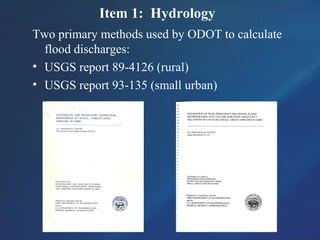
Item 1: Hydrology
Two primary methods used by ODOT to calculate
flood discharges:
• USGS report 89-4126 (rural)
• USGS report 93-135 (small urban)
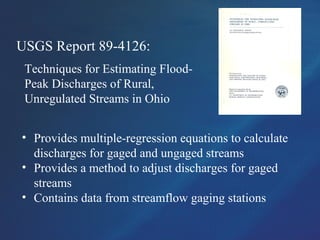
USGS Report 89-4126:
Techniques for Estimating Flood-
Peak Discharges of Rural,
Unregulated Streams in Ohio
• Provides multiple-regression equations to calculate
discharges for gaged and ungaged streams
• Provides a method to adjust discharges for gaged
streams
• Contains data from streamflow gaging stations
USGS Report 89-4126:
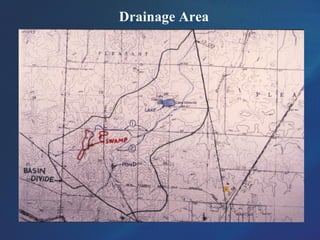
Drainage Area
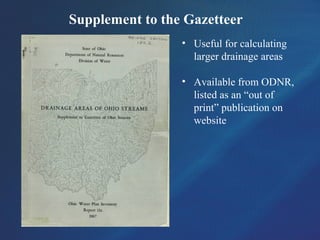
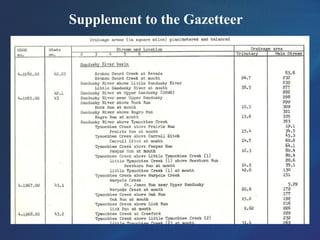
Supplement to the Gazetteer
• Useful for calculating
larger drainage areas
• Available from ODNR,
listed as an “out of
print” publication on
website
Supplement to the Gazetteer
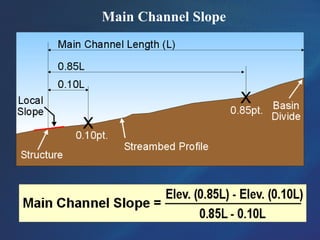
Main Channel Slope
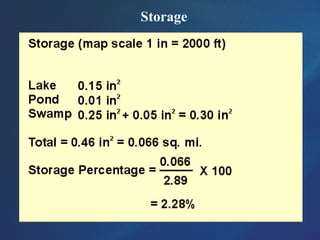
Storage
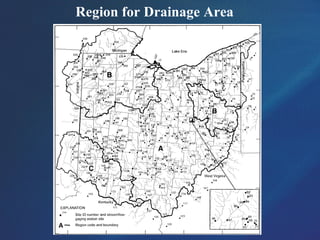
Region for Drainage Area
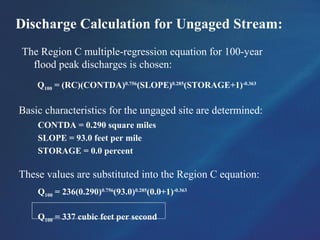
Discharge Calculation for Ungaged Stream:
The Region C multiple-regression equation for 100-year
flood peak discharges is chosen:
Q100 = (RC)(CONTDA)0.756
(SLOPE)0.285
(STORAGE+1)-0.363
Basic characteristics for the ungaged site are determined:
CONTDA = 0.290 square miles
SLOPE = 93.0 feet per mile
STORAGE = 0.0 percent
These values are substituted into the Region C equation:
Q100 = 236(0.290)0.756
(93.0)0.285
(0.0+1)-0.363
Q100 = 337 cubic feet per second
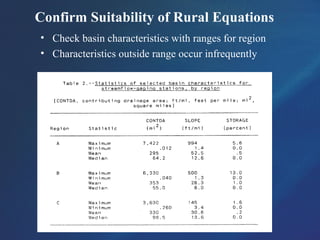
Confirm Suitability of Rural Equations
• Check basin characteristics with ranges for region
• Characteristics outside range occur infrequently
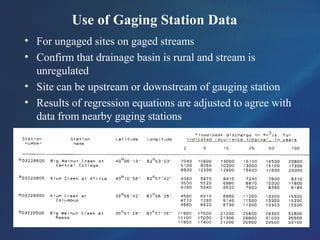
Use of Gaging Station Data
• For ungaged sites on gaged streams
• Confirm that drainage basin is rural and stream is
unregulated
• Site can be upstream or downstream of gauging station
• Results of regression equations are adjusted to agree with
data from nearby gaging stations
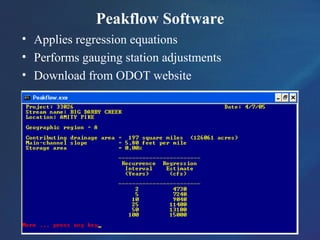
Peakflow Software
• Applies regression equations
• Performs gauging station adjustments
• Download from ODOT website
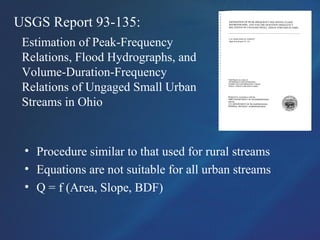
USGS Report 93-135:
Estimation of Peak-Frequency
Relations, Flood Hydrographs, and
Volume-Duration-Frequency
Relations of Ungaged Small Urban
Streams in Ohio
• Procedure similar to that used for rural streams
• Equations are not suitable for all urban streams
• Q = f (Area, Slope, BDF)
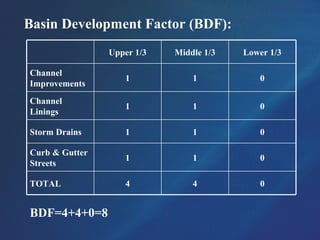
Basin Development Factor (BDF):
• A measure of urban development within a drainage basin
0 = No development
12 = Maximum development
• Divide basin into three subdivisions
• Estimate development in each subdivision
044TOTAL
011
Curb & Gutter
Streets
011Storm Drains
011
Channel
Linings
011
Channel
Improvements
Lower 1/3Middle 1/3Upper 1/3
BDF=4+4+0=8
Basin Development Factor (BDF):
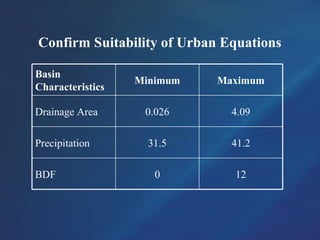
Confirm Suitability of Urban Equations
120BDF
41.231.5Precipitation
4.090.026Drainage Area
MaximumMinimum
Basin
Characteristics
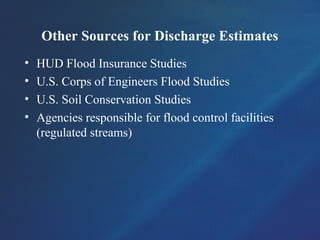
Other Sources for Discharge Estimates
• HUD Flood Insurance Studies
• U.S. Corps of Engineers Flood Studies
• U.S. Soil Conservation Studies
• Agencies responsible for flood control facilities
(regulated streams)
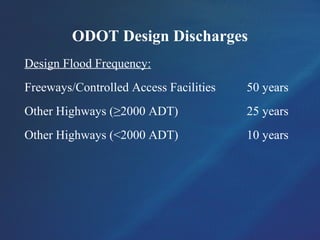
ODOT Design Discharges
Design Flood Frequency:
Freeways/Controlled Access Facilities 50 years
Other Highways (≥2000 ADT) 25 years
Other Highways (<2000 ADT) 10 years
Item 2: Channel & Bridge Characteristics
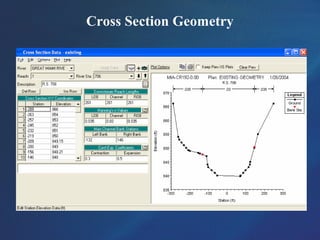
• Perform channel survey
• Data Requirements:
– Cross section geometry
– Roughness values
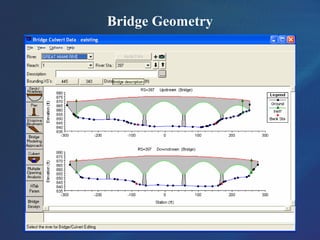
– Bridge characteristics
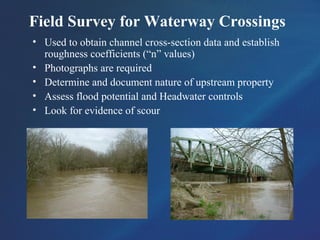
Field Survey for Waterway Crossings
• Used to obtain channel cross-section data and establish
roughness coefficients (“n” values)
• Photographs are required
• Determine and document nature of upstream property
• Assess flood potential and Headwater controls
• Look for evidence of scour
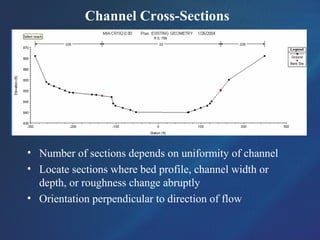
Channel Cross-Sections
• Number of sections depends on uniformity of channel
• Locate sections where bed profile, channel width or
depth, or roughness change abruptly
• Orientation perpendicular to direction of flow
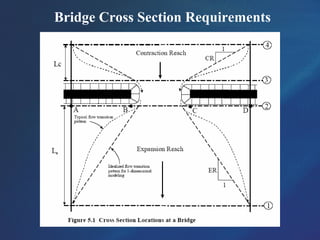
Bridge Cross Section Requirements
Manning’s Roughness Coefficients
• Various sources for “n” values
• Roughness varies with season (Use worst case)
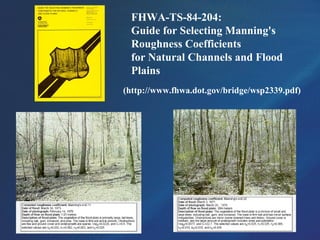
FHWA-TS-84-204:
Guide for Selecting Manning's
Roughness Coefficients
for Natural Channels and Flood
Plains
(http://www.fhwa.dot.gov/bridge/wsp2339.pdf)
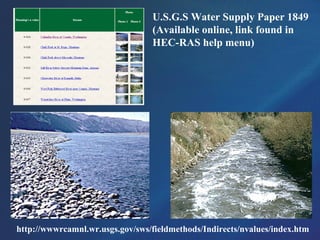
U.S.G.S Water Supply Paper 1849
(Available online, link found in
HEC-RAS help menu)
http://wwwrcamnl.wr.usgs.gov/sws/fieldmethods/Indirects/nvalues/index.htm
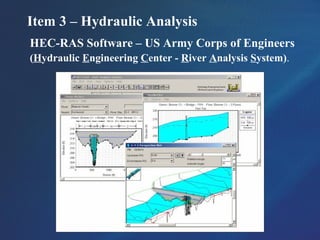
Item 3 – Hydraulic Analysis
HEC-RAS Software – US Army Corps of Engineers
(Hydraulic Engineering Center - River Analysis System).
• Software and Users Manuals are downloadable for free
from Corps of Engineers website (
www.hec.usace.army.mil)
• User inputs design flood flows, channel and structure
survey information
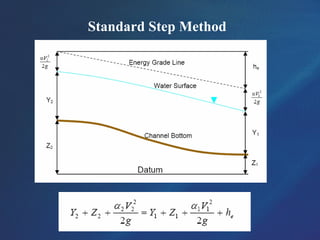
• HEC-RAS uses the Standard Step method to compute
steady flow water surface profiles
• HEC-RAS is capable of modeling subcritical, supercritical,
and mixed flow
HEC-RAS Software
Standard Step Method
• Also known as the “Step Backwater Method”
• Uses the Energy Equation and Manning’s Equation to
evaluate points along the water surface profile.
Basic Assumptions
1. Steady flow
2. Flow type constant between sections
3. Normal depths considered vertical depths
4. Level water surface across channel
5. Sediment and air entrainment are negligible
Standard Step Method
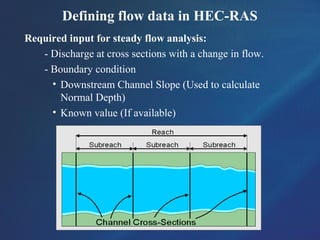
Defining flow data in HEC-RAS
Required input for steady flow analysis:
- Discharge at cross sections with a change in flow.
- Boundary condition
• Downstream Channel Slope (Used to calculate
Normal Depth)
• Known value (If available)
Cross Section Geometry
Bridge Geometry
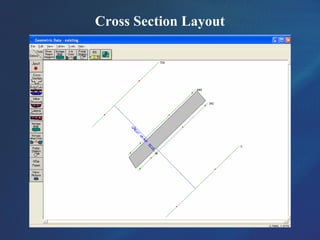
Cross Section Layout
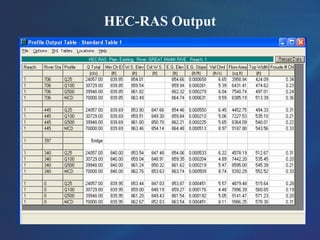
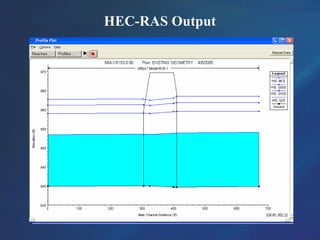
HEC-RAS Output
HEC-RAS Output
Allowable Backwater
• In general, the bridge should be designed to clear the
design frequency flood
• Meet NFIP (National Flood Insurance Program)
requirements
• Meet Conservancy District requirements
• Limited to 1-foot raise in 100-year backwater if outside
of NFIP jurisdiction (Ohio Revised Code, section
1521.13)
• Backwater should not be allowed to flood
“Unreasonably large areas of usable land”
• Backwater should not be increased in urban areas
Item 4 - National Flood Insurance Program
(NFIP)
• Most Ohio communities participate
• Each community adopts local ordinances
• Enforced by local floodplain coordinator
(see ODNR website for listing)
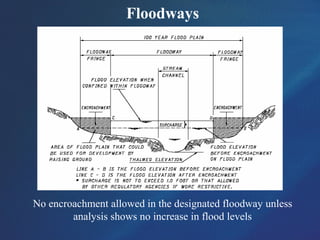
Floodways
No encroachment allowed in the designated floodway unless
analysis shows no increase in flood levels
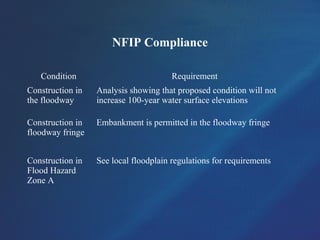
NFIP Compliance
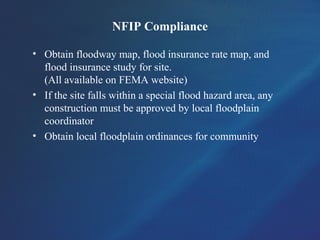
• Obtain floodway map, flood insurance rate map, and
flood insurance study for site.
(All available on FEMA website)
• If the site falls within a special flood hazard area, any
construction must be approved by local floodplain
coordinator
• Obtain local floodplain ordinances for community
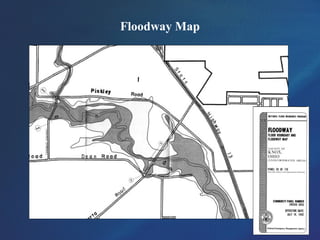
Floodway Map
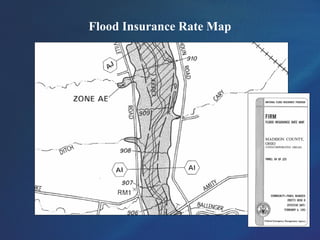
Flood Insurance Rate Map
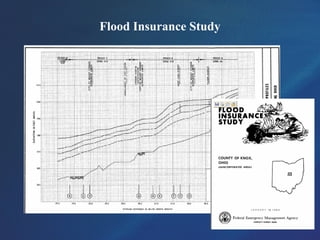
Flood Insurance Study
NFIP Compliance
Condition Requirement
Construction in
the floodway
Analysis showing that proposed condition will not
increase 100-year water surface elevations
Construction in
floodway fringe
Embankment is permitted in the floodway fringe
Construction in
Flood Hazard
Zone A
See local floodplain regulations for requirements
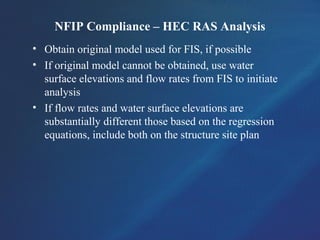
NFIP Compliance – HEC RAS Analysis
• Obtain original model used for FIS, if possible
• If original model cannot be obtained, use water
surface elevations and flow rates from FIS to initiate
analysis
• If flow rates and water surface elevations are
substantially different those based on the regression
equations, include both on the structure site plan
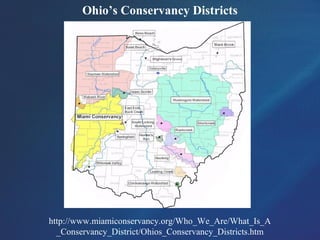
Ohio’s Conservancy Districts
http://www.miamiconservancy.org/Who_We_Are/What_Is_A
_Conservancy_District/Ohios_Conservancy_Districts.htm
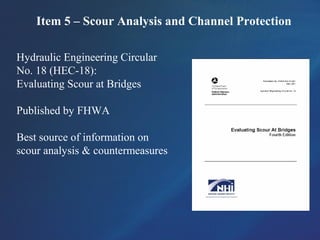
Item 5 – Scour Analysis and Channel Protection
Hydraulic Engineering Circular
No. 18 (HEC-18):
Evaluating Scour at Bridges
Published by FHWA
Best source of information on
scour analysis & countermeasures
Total Scour –three components:
1. Long term aggradation and degradation
2. Contraction scour
3. Local scour
Long-Term Aggradation and Degradation
• Not computed by HEC-RAS
• What is the long-term trend?
• Trends can change due to natural or man-made causes.
• Evaluate using HEC-18 before performing analysis
• ODOT District personnel and County Engineers are a good
source of information.
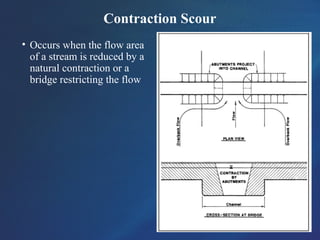
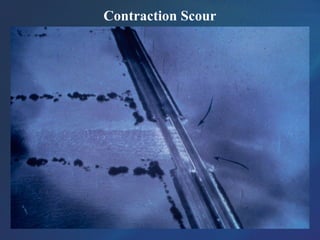
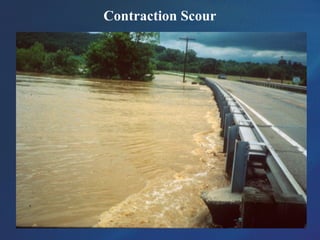
Contraction Scour
• Occurs when the flow area
of a stream is reduced by a
natural contraction or a
bridge restricting the flow
Contraction Scour
Contraction Scour
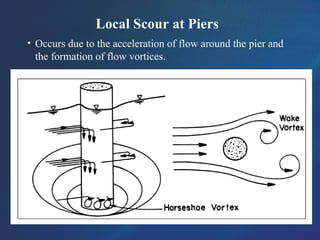
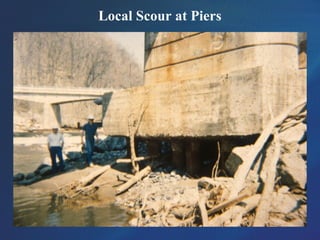
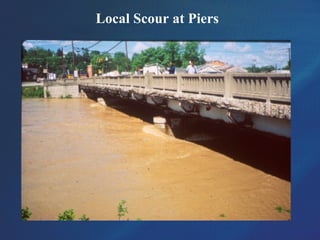
Local Scour at Piers
• Occurs due to the acceleration of flow around the pier and
the formation of flow vortices.
Local Scour at Piers
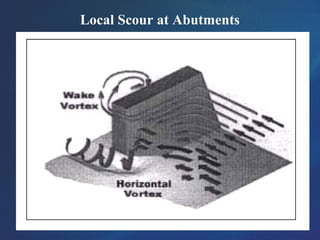
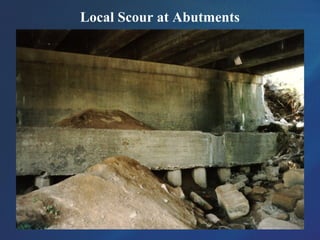
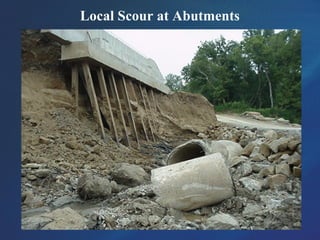
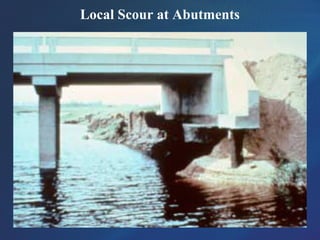
Local Scour at Abutments
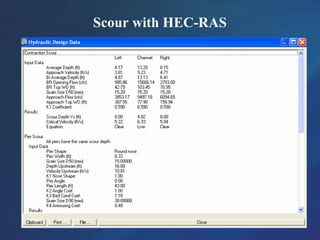
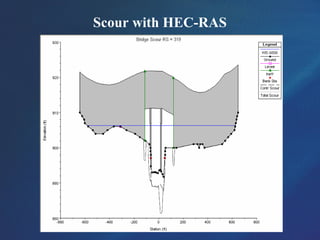
Scour with HEC-RAS
Scour with HEC-RAS
ODOT Scour Protection Requirements
• Deep foundations (piles or drilled shafts) or spread footings
in rock
• Spill-through earth slopes armored with rock channel
protection
– Minimum size and thickness of RCP given in
ODOT Bridge Design Manual
– Increase thickness of RCP outside portion of
curved channels or where ice flow is concern
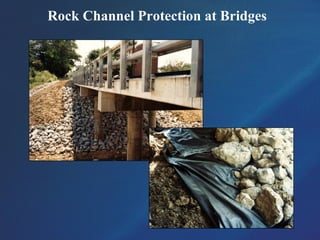
Rock Channel Protection at Bridges
Item 6 - ODOT Submittal Requirements:
Include a “Hydraulic Report” with the Structure
Type Study. This report should include:
1. Computation of flood flows
2. Hydraulic analysis of existing and proposed
structure (include both hard copy and HEC-RAS
files)
3. Information on NFIP floodmaps and flood
insurance studies referenced
4. Scour analysis of proposed structure

Hydrology and hydraulics for design design

  • 1.
  • 2.
    Bridge Hydraulics Overview Topicsfor this presentation: Item 1 – Design discharges (Hydrology) Item 2 – Channel & Bridge Characteristics Item 3 – Hydraulic Analysis using HEC-RAS Item 4 – National Flood Insurance Program Item 5 – Scour Analysis & Channel Protection Item 6 – ODOT Submittal Requirements
  • 3.
    Item 1: Hydrology Twoprimary methods used by ODOT to calculate flood discharges: • USGS report 89-4126 (rural) • USGS report 93-135 (small urban)
  • 4.
    USGS Report 89-4126: Techniquesfor Estimating Flood- Peak Discharges of Rural, Unregulated Streams in Ohio • Provides multiple-regression equations to calculate discharges for gaged and ungaged streams • Provides a method to adjust discharges for gaged streams • Contains data from streamflow gaging stations
  • 5.
  • 6.
  • 7.
    Supplement to theGazetteer • Useful for calculating larger drainage areas • Available from ODNR, listed as an “out of print” publication on website
  • 8.
  • 9.
  • 10.
  • 11.
  • 12.
    Discharge Calculation forUngaged Stream: The Region C multiple-regression equation for 100-year flood peak discharges is chosen: Q100 = (RC)(CONTDA)0.756 (SLOPE)0.285 (STORAGE+1)-0.363 Basic characteristics for the ungaged site are determined: CONTDA = 0.290 square miles SLOPE = 93.0 feet per mile STORAGE = 0.0 percent These values are substituted into the Region C equation: Q100 = 236(0.290)0.756 (93.0)0.285 (0.0+1)-0.363 Q100 = 337 cubic feet per second
  • 13.
    Confirm Suitability ofRural Equations • Check basin characteristics with ranges for region • Characteristics outside range occur infrequently
  • 14.
    Use of GagingStation Data • For ungaged sites on gaged streams • Confirm that drainage basin is rural and stream is unregulated • Site can be upstream or downstream of gauging station • Results of regression equations are adjusted to agree with data from nearby gaging stations
  • 15.
    Peakflow Software • Appliesregression equations • Performs gauging station adjustments • Download from ODOT website
  • 16.
    USGS Report 93-135: Estimationof Peak-Frequency Relations, Flood Hydrographs, and Volume-Duration-Frequency Relations of Ungaged Small Urban Streams in Ohio • Procedure similar to that used for rural streams • Equations are not suitable for all urban streams • Q = f (Area, Slope, BDF)
  • 17.
    Basin Development Factor(BDF): • A measure of urban development within a drainage basin 0 = No development 12 = Maximum development • Divide basin into three subdivisions • Estimate development in each subdivision
  • 18.
    044TOTAL 011 Curb & Gutter Streets 011StormDrains 011 Channel Linings 011 Channel Improvements Lower 1/3Middle 1/3Upper 1/3 BDF=4+4+0=8 Basin Development Factor (BDF):
  • 19.
    Confirm Suitability ofUrban Equations 120BDF 41.231.5Precipitation 4.090.026Drainage Area MaximumMinimum Basin Characteristics
  • 20.
    Other Sources forDischarge Estimates • HUD Flood Insurance Studies • U.S. Corps of Engineers Flood Studies • U.S. Soil Conservation Studies • Agencies responsible for flood control facilities (regulated streams)
  • 21.
    ODOT Design Discharges DesignFlood Frequency: Freeways/Controlled Access Facilities 50 years Other Highways (≥2000 ADT) 25 years Other Highways (<2000 ADT) 10 years
  • 22.
    Item 2: Channel& Bridge Characteristics • Perform channel survey • Data Requirements: – Cross section geometry – Roughness values – Bridge characteristics
  • 23.
    Field Survey forWaterway Crossings • Used to obtain channel cross-section data and establish roughness coefficients (“n” values) • Photographs are required • Determine and document nature of upstream property • Assess flood potential and Headwater controls • Look for evidence of scour
  • 24.
    Channel Cross-Sections • Numberof sections depends on uniformity of channel • Locate sections where bed profile, channel width or depth, or roughness change abruptly • Orientation perpendicular to direction of flow
  • 25.
  • 26.
    Manning’s Roughness Coefficients •Various sources for “n” values • Roughness varies with season (Use worst case)
  • 27.
    FHWA-TS-84-204: Guide for SelectingManning's Roughness Coefficients for Natural Channels and Flood Plains (http://www.fhwa.dot.gov/bridge/wsp2339.pdf)
  • 28.
    U.S.G.S Water SupplyPaper 1849 (Available online, link found in HEC-RAS help menu) http://wwwrcamnl.wr.usgs.gov/sws/fieldmethods/Indirects/nvalues/index.htm
  • 29.
    Item 3 –Hydraulic Analysis HEC-RAS Software – US Army Corps of Engineers (Hydraulic Engineering Center - River Analysis System).
  • 30.
    • Software andUsers Manuals are downloadable for free from Corps of Engineers website ( www.hec.usace.army.mil) • User inputs design flood flows, channel and structure survey information • HEC-RAS uses the Standard Step method to compute steady flow water surface profiles • HEC-RAS is capable of modeling subcritical, supercritical, and mixed flow HEC-RAS Software
  • 31.
    Standard Step Method •Also known as the “Step Backwater Method” • Uses the Energy Equation and Manning’s Equation to evaluate points along the water surface profile. Basic Assumptions 1. Steady flow 2. Flow type constant between sections 3. Normal depths considered vertical depths 4. Level water surface across channel 5. Sediment and air entrainment are negligible
  • 32.
  • 33.
    Defining flow datain HEC-RAS Required input for steady flow analysis: - Discharge at cross sections with a change in flow. - Boundary condition • Downstream Channel Slope (Used to calculate Normal Depth) • Known value (If available)
  • 34.
  • 35.
  • 36.
  • 37.
  • 38.
  • 39.
    Allowable Backwater • Ingeneral, the bridge should be designed to clear the design frequency flood • Meet NFIP (National Flood Insurance Program) requirements • Meet Conservancy District requirements • Limited to 1-foot raise in 100-year backwater if outside of NFIP jurisdiction (Ohio Revised Code, section 1521.13) • Backwater should not be allowed to flood “Unreasonably large areas of usable land” • Backwater should not be increased in urban areas
  • 40.
    Item 4 -National Flood Insurance Program (NFIP) • Most Ohio communities participate • Each community adopts local ordinances • Enforced by local floodplain coordinator (see ODNR website for listing)
  • 41.
    Floodways No encroachment allowedin the designated floodway unless analysis shows no increase in flood levels
  • 42.
    NFIP Compliance • Obtainfloodway map, flood insurance rate map, and flood insurance study for site. (All available on FEMA website) • If the site falls within a special flood hazard area, any construction must be approved by local floodplain coordinator • Obtain local floodplain ordinances for community
  • 43.
  • 44.
  • 45.
  • 46.
    NFIP Compliance Condition Requirement Constructionin the floodway Analysis showing that proposed condition will not increase 100-year water surface elevations Construction in floodway fringe Embankment is permitted in the floodway fringe Construction in Flood Hazard Zone A See local floodplain regulations for requirements
  • 47.
    NFIP Compliance –HEC RAS Analysis • Obtain original model used for FIS, if possible • If original model cannot be obtained, use water surface elevations and flow rates from FIS to initiate analysis • If flow rates and water surface elevations are substantially different those based on the regression equations, include both on the structure site plan
  • 48.
  • 49.
    Item 5 –Scour Analysis and Channel Protection Hydraulic Engineering Circular No. 18 (HEC-18): Evaluating Scour at Bridges Published by FHWA Best source of information on scour analysis & countermeasures
  • 50.
    Total Scour –threecomponents: 1. Long term aggradation and degradation 2. Contraction scour 3. Local scour
  • 51.
    Long-Term Aggradation andDegradation • Not computed by HEC-RAS • What is the long-term trend? • Trends can change due to natural or man-made causes. • Evaluate using HEC-18 before performing analysis • ODOT District personnel and County Engineers are a good source of information.
  • 52.
    Contraction Scour • Occurswhen the flow area of a stream is reduced by a natural contraction or a bridge restricting the flow
  • 53.
  • 54.
  • 55.
    Local Scour atPiers • Occurs due to the acceleration of flow around the pier and the formation of flow vortices.
  • 56.
  • 57.
  • 58.
  • 59.
    Local Scour atAbutments
  • 60.
    Local Scour atAbutments
  • 61.
    Local Scour atAbutments
  • 62.
    Local Scour atAbutments
  • 63.
  • 64.
  • 65.
    ODOT Scour ProtectionRequirements • Deep foundations (piles or drilled shafts) or spread footings in rock • Spill-through earth slopes armored with rock channel protection – Minimum size and thickness of RCP given in ODOT Bridge Design Manual – Increase thickness of RCP outside portion of curved channels or where ice flow is concern
  • 66.
  • 67.
    Item 6 -ODOT Submittal Requirements: Include a “Hydraulic Report” with the Structure Type Study. This report should include: 1. Computation of flood flows 2. Hydraulic analysis of existing and proposed structure (include both hard copy and HEC-RAS files) 3. Information on NFIP floodmaps and flood insurance studies referenced 4. Scour analysis of proposed structure

Editor's Notes

  • #2 This presentation will cover Hydraulic Design of bridges. Culverts will be covered in a later section.
  • #3 The presentation will be divided into 6 general topics.
  • #4 First topic is Hydrology, which is the determination of what volume of flow will pass through the bridge during storm events of various frequencies. This will be a main focus of this presentation, because there is a lot of trivial information to know, and a common area for mistakes in submittals. Two primary methods are used to calculate flood discharges: rural equations and urban equations. Rural is used for the vast majority of bridge projects. Urban equations are used only for urban sites with drainage areas less than 4 square miles. (Covered in BDM)
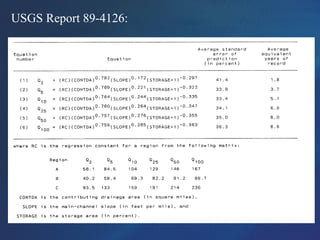
  • #6 This is a table showing the regression equations from report 89-4126. The variables in the equations include drainage area, channel slope, and storage. Interesting to note the standard error of the equations.
  • #7 This graphic shows one method that can be used to calculate drainage areas for use in the regression equations. Here, the drainage area is drawn on USGS quadrangle mapping, and the area is measured using a planimeter. There are also a number of computer programs available to measure drainage areas For larger areas, additional tools are available
  • #8 The supplement to the gazetteer of Ohio streams can be used to help calculate drainage areas for bridge sites with large drainage areas. Drainage areas on larger streams are tabulated at various points Saves you from stringing multiple USGS quad maps. Available from ODNR, can be ordered from website.
  • #57 &amp;lt;number&amp;gt;