


NUST Institute of Civil Engineering/Engr Sajjad Ahmad1
Engineering Hydrology(CE- 235)CHAPTER - 32Runoff & Hydrographs(Contd…)NUST Institute of Civil Engineering/Engr Sajjad AhmadRunoff & hydrograph - OutlineEstimation of evaporation
Direct measurement
Indirect or theoretical method
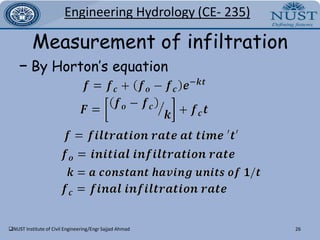
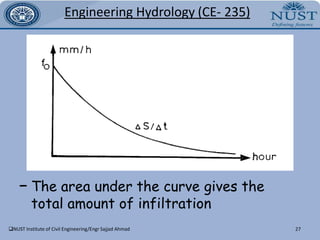
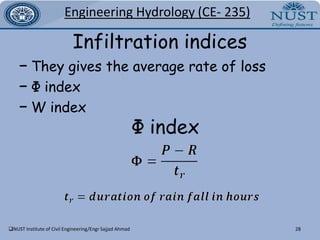
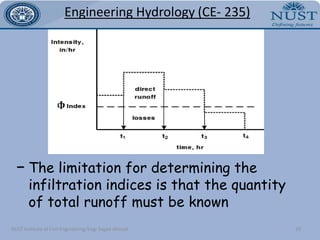
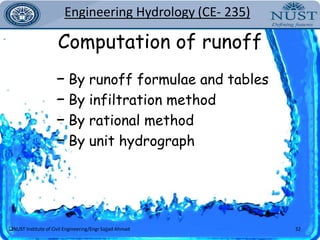
Measurement of infiltration3Engineering Hydrology(CE- 235)NUST Institute of Civil Engineering/Engr Sajjad AhmadRunoff & hydrograph - OutlineComputation of runoff by various methods
Characteristics of hydrograph
Components of a hydrograph
Hydrograph separation
Unit Hydrograph
S-curve4Engineering Hydrology(CE- 235)NUST Institute of Civil Engineering/Engr Sajjad Ahmad5Engineering Hydrology(CE- 235)Direct measurement of evaporation by Pan	There are three types of panSunken pans
Above ground or surface pans
Floating pans
NUST Institute of Civil Engineering/Engr Sajjad Ahmad6Engineering Hydrology(CE- 235)Sunken pansBuried in ground
Wall effects such as heat exchange and ration effects are neglected
More accurate results
NUST Institute of Civil Engineering/Engr Sajjad Ahmad7Engineering Hydrology(CE- 235)Sunken pans drawbacksDifficult to clean
Error due to leakage
Height of vegetation around pan is critical
Plant leaves, seeds and debris can enter easily
NUST Institute of Civil Engineering/Engr Sajjad Ahmad8Engineering Hydrology(CE- 235)Bureau of  plant industry (B. P. I) panCircular in shape
1.80 m in diameter and 0.55m deep
Edges are 0.05m above ground
Total depth is 0.60m
NUST Institute of Civil Engineering/Engr Sajjad Ahmad9Engineering Hydrology(CE- 235)Colorado panSquare in shape
Dimensions are 0.90m x 0.90m and 0.45m deep
Rim projection from ground is 5 cm
Water maintained 2 inch below rim
NUST Institute of Civil Engineering/Engr Sajjad Ahmad10Engineering Hydrology(CE- 235)Young’s panCircular shape
0.6m diameter
0.9m deep
Covered with 6mm wire mesh screen
NUST Institute of Civil Engineering/Engr Sajjad Ahmad11Engineering Hydrology(CE- 235)Above ground or surface panMade from galvanized sheet
Placed on wooden floor
Easy operation and maintenance
Correction factors are applied
NUST Institute of Civil Engineering/Engr Sajjad Ahmad12Engineering Hydrology(CE- 235)Floating pansFloat over surface of water
Gives accurate reading which are free from atmospheric effects
Drawbacks
Difficulty in measurement
Leakage cannot be detected
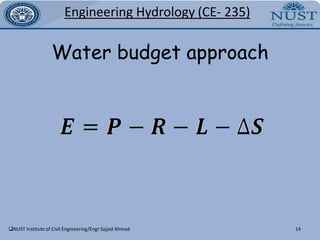
NUST Institute of Civil Engineering/Engr Sajjad Ahmad13Engineering Hydrology(CE- 235)Estimation by theoretical methodWater budget approach
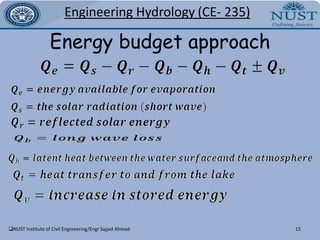
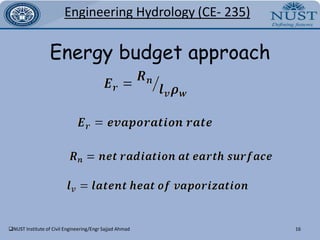
Energy budget approach
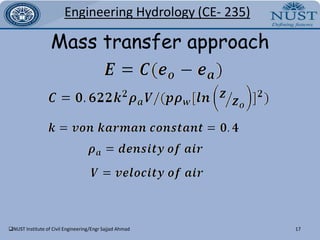
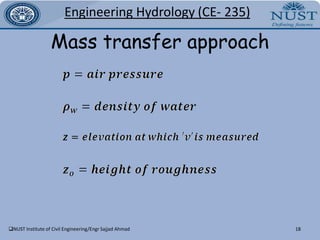
Mass transfer approach
NUST Institute of Civil Engineering/Engr Sajjad Ahmad14Engineering Hydrology(CE- 235)Water budget approachNUST Institute of Civil Engineering/Engr Sajjad Ahmad15Engineering Hydrology(CE- 235)Energy budget approachNUST Institute of Civil Engineering/Engr Sajjad Ahmad16Engineering Hydrology(CE- 235)Energy budget approachNUST Institute of Civil Engineering/Engr Sajjad Ahmad17Engineering Hydrology(CE- 235)Mass transfer approachNUST Institute of Civil Engineering/Engr Sajjad Ahmad18Engineering Hydrology(CE- 235)Mass transfer approachNUST Institute of Civil Engineering/Engr Sajjad Ahmad19Engineering Hydrology(CE- 235)Pan coefficientMeasured evaporation is always greater than the actual value
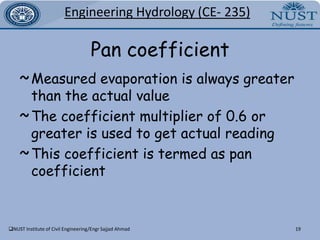
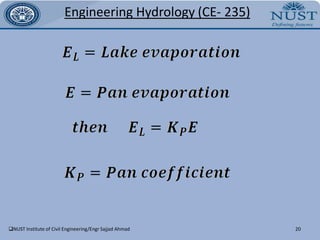
The coefficient multiplier of 0.6 or greater is used to get actual reading
This coefficient is termed as pan coefficient
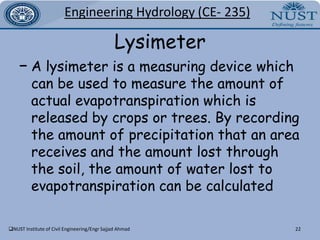
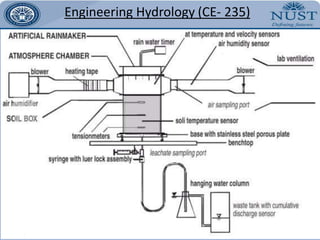
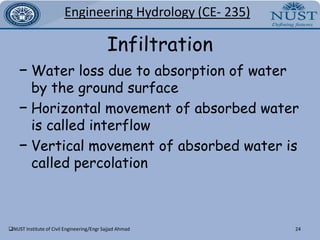
NUST Institute of Civil Engineering/Engr Sajjad Ahmad20Engineering Hydrology(CE- 235)NUST Institute of Civil Engineering/Engr Sajjad Ahmad21Engineering Hydrology(CE- 235)Example # 1 (from book)Example # 2 (from book)Example # 3 (from book)Example # 4 (from book)Example # 5(from book)NUST Institute of Civil Engineering/Engr Sajjad AhmadLysimeterA lysimeter is a measuring device which can be used to measure the amount of actual evapotranspiration which is released by crops or trees. By recording the amount of precipitation that an area receives and the amount lost through the soil, the amount of water lost to evapotranspiration can be calculated22Engineering Hydrology(CE- 235)NUST Institute of Civil Engineering/Engr Sajjad Ahmad23Engineering Hydrology(CE- 235)NUST Institute of Civil Engineering/Engr Sajjad AhmadInfiltrationWater loss due to absorption of water by the ground surface
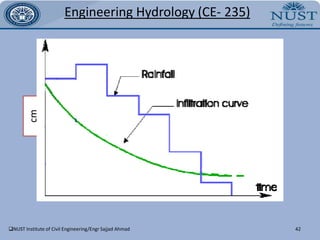
Horizontal movement of absorbed water is called interflow

Runoff and Hydrograph