NORTH SOUTH UNIVERSITY
GROUP PROJECT
HYGDROLOGY PROJECT
Introduction
Hydrology is the study area which relates to water. Precipitation, surface runoff, base flow, flow
rate, average flow, rainfall event, rainfall intensity, etc are explained in hydrology which are
important factors for managing every area’s water resource, sewer system, water usage.
Seasons, natural event, climate change, area type depending on development, population, etc
affect them. The world’s hydrologic system has been changed than before. Therefore
Bangladesh also faces the changes as days goes by. Previously Bangladesh was called temperate
country. But as it’s average temperature has increased and it is becoming warmer it is not
anymore temperate. This important change affects almost everything related to the weather of
Bangladesh. Now we see some major changes and rare event for this reason. Hydrological
research can inform environmental engineering policy and planning.
Background
Our local Ward Commissioner has heard that we are studying at NSU CEE Department and as
we have basic hydrology concepts has asked us to help solve the local drainage problem with the
City Corporation drainage engineers. We took some of our class-mates to meet the drainage
engineers. In the meeting, they ask for our help to determine from where the storm water is
coming and where it is draining out. They also want our help to estimate flow rates for different
rain events that will help them design better drains in your local area. So that is why we made 3
groups (each including 3 members ) and took different areas as our study area and then we
observed a rainfall event. Focusing on that event we took It’s discharge then calculated the direct
runoff.
Study Area Description
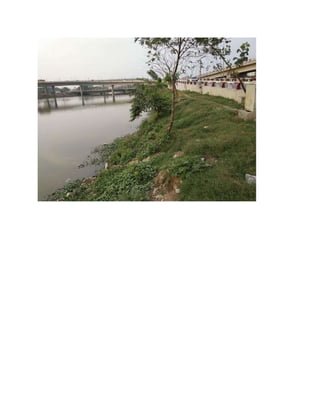
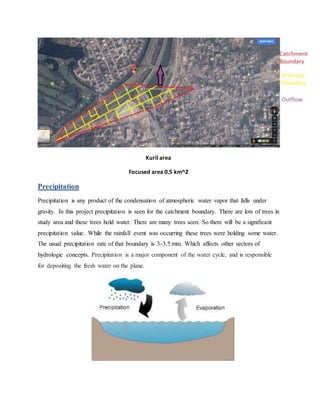
The focused area was Kuril, Dhaka. The boundary is within 0.5 km^2. It is residential area and
mostly impervious. The area is higher than It’s neighboring area. So infiltration rate is less than
surface runoff. It is near Bashundhara and Bishwa road. During rainfall event water is hardly
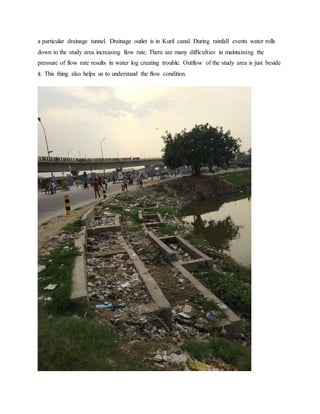
seen stored on the roads. Storm water drains out from different pipes which acts like channels to
a particular drainage tunnel. Drainage outlet is in Kuril canal. During rainfall events water rolls
down to the study area increasing flow rate. There are many difficulties in maintaining the
pressure of flow rate results in water log creating trouble. Outflow of the study area is just beside
it. This thing also helps us to understand the flow condition.
Kuril area
Focused area 0.5 km^2
Precipitation
Precipitation is any product of the condensation of atmospheric water vapor that falls under
gravity. In this project precipitation is seen for the catchment boundary. There are lots of trees in
study area and these trees hold water. There are many trees seen. So there will be a significant
precipitation value. While the rainfall event was occurring these trees were holding some water.
The usual precipitation rate of that boundary is 3-3.5 mm. Which affects other sectors of
hydrologic concepts. Precipitation is a major component of the water cycle, and is responsible
for depositing the fresh water on the plane.
Abstraction
Abstraction is something which holds water but it does not allow water to flow through. This
will lead to some loss of water from runoff. In our study area there are some abstractions. Those
abstractions are there because of breaking the road specially. Adding to that there is constructing
a new flyover, which lead to many new abstractions which were not there in the previous times
and some old abstraction are being filled up. This makes the abstraction value variable with time
and condition.
Methodology
The first thing was to select the area and fix the boundary. The area was taken 0.5 km^2. The
drainage channel are along the left side of the roads. A particular rainfall event on 20th march
2017 left the capital’s traffic in complete chaos as all the major roads along with numerous alleys
got submerged, causing immense sufferings to commuters. The traffic congestions lasted for
longer periods compared to other rainy days as many vehicles went out of order in the middle of
the waterlogged streets, obstructing traffic for hours together. The met office recorded it 40 mm
in 4 hrs.
So, the intensity would be, i= 10mm/hr.
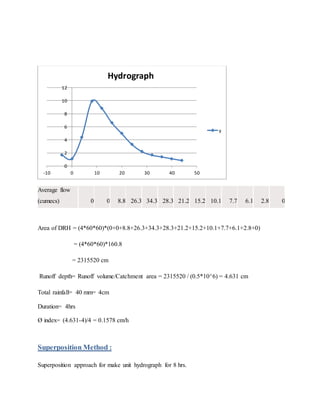
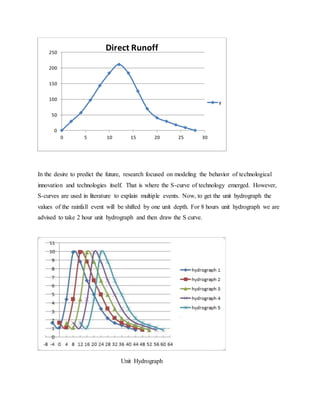
Then the discharge values per time was collected. After that the values were plotted on graph.
With the help of straight line base flow method the Direct Runoff was calculated. The volume
was calculated then from the graph. To get the Ø index the difference between total rainfall and
total direct runoff will be divided by unit hour.
Calculation
Average flow
(cumecs) 0 0 8.8 26.3 34.3 28.3 21.2 15.2 10.1 7.7 6.1 2.8 0
Area of DRH = (4*60*60)*(0+0+8.8+26.3+34.3+28.3+21.2+15.2+10.1+7.7+6.1+2.8+0)
= (4*60*60)*160.8
= 2315520 cm
Runoff depth= Runoff volume/Catchment area = 2315520 / (0.5*10^6) = 4.631 cm
Total rainfall= 40 mm= 4cm
Duration= 4hrs
Ø index= (4.631-4)/4 = 0.1578 cm/h
Superposition Method :
Superposition approach for make unit hydrograph for 8 hrs.
0
2
4
6
8
10
12
-10 0 10 20 30 40 50
Hydrograph
y
In the desire to predict the future, research focused on modeling the behavior of technological
innovation and technologies itself. That is where the S-curve of technology emerged. However,
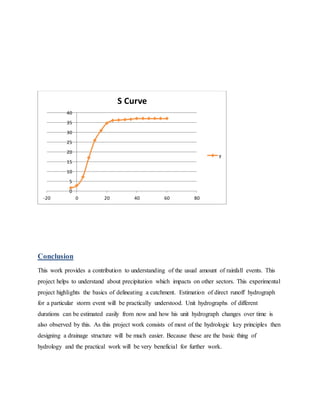
S-curves are used in literature to explain multiple events. Now, to get the unit hydrograph the
values of the rainfall event will be shifted by one unit depth. For 8 hours unit hydrograph we are
advised to take 2 hour unit hydrograph and then draw the S curve.
Unit Hydrograph
0
50
100
150
200
250
0 5 10 15 20 25 30
Direct Runoff
y
Conclusion
This work provides a contribution to understanding of the usual amount of rainfall events. This
project helps to understand about precipitation which impacts on other sectors. This experimental
project highlights the basics of delineating a catchment. Estimation of direct runoff hydrograph
for a particular storm event will be practically understood. Unit hydrographs of different
durations can be estimated easily from now and how his unit hydrograph changes over time is
also observed by this. As this project work consists of most of the hydrologic key principles then
designing a drainage structure will be much easier. Because these are the basic thing of
hydrology and the practical work will be very beneficial for further work.
0
5
10
15
20
25
30
35
40
-20 0 20 40 60 80
S Curve
y
References
http://www.accuweather.com/en/bd/dhaka/28143/daily-weather-forecast/28143
http://www.timeanddate.com/weather/bangladesh/dhaka/ext
https://en.wikipedia.org/wiki/Hydrograph
https://water watercycleprecipitation.html.usgs.gov/edu/
THE END

Hydrology project

  • 1.
    NORTH SOUTH UNIVERSITY GROUPPROJECT HYGDROLOGY PROJECT
  • 3.
    Introduction Hydrology is thestudy area which relates to water. Precipitation, surface runoff, base flow, flow rate, average flow, rainfall event, rainfall intensity, etc are explained in hydrology which are important factors for managing every area’s water resource, sewer system, water usage. Seasons, natural event, climate change, area type depending on development, population, etc affect them. The world’s hydrologic system has been changed than before. Therefore Bangladesh also faces the changes as days goes by. Previously Bangladesh was called temperate country. But as it’s average temperature has increased and it is becoming warmer it is not anymore temperate. This important change affects almost everything related to the weather of Bangladesh. Now we see some major changes and rare event for this reason. Hydrological research can inform environmental engineering policy and planning. Background Our local Ward Commissioner has heard that we are studying at NSU CEE Department and as we have basic hydrology concepts has asked us to help solve the local drainage problem with the City Corporation drainage engineers. We took some of our class-mates to meet the drainage engineers. In the meeting, they ask for our help to determine from where the storm water is coming and where it is draining out. They also want our help to estimate flow rates for different rain events that will help them design better drains in your local area. So that is why we made 3 groups (each including 3 members ) and took different areas as our study area and then we observed a rainfall event. Focusing on that event we took It’s discharge then calculated the direct runoff. Study Area Description The focused area was Kuril, Dhaka. The boundary is within 0.5 km^2. It is residential area and mostly impervious. The area is higher than It’s neighboring area. So infiltration rate is less than surface runoff. It is near Bashundhara and Bishwa road. During rainfall event water is hardly seen stored on the roads. Storm water drains out from different pipes which acts like channels to
  • 4.
    a particular drainagetunnel. Drainage outlet is in Kuril canal. During rainfall events water rolls down to the study area increasing flow rate. There are many difficulties in maintaining the pressure of flow rate results in water log creating trouble. Outflow of the study area is just beside it. This thing also helps us to understand the flow condition.
  • 5.
    Kuril area Focused area0.5 km^2 Precipitation Precipitation is any product of the condensation of atmospheric water vapor that falls under gravity. In this project precipitation is seen for the catchment boundary. There are lots of trees in study area and these trees hold water. There are many trees seen. So there will be a significant precipitation value. While the rainfall event was occurring these trees were holding some water. The usual precipitation rate of that boundary is 3-3.5 mm. Which affects other sectors of hydrologic concepts. Precipitation is a major component of the water cycle, and is responsible for depositing the fresh water on the plane.
  • 6.
    Abstraction Abstraction is somethingwhich holds water but it does not allow water to flow through. This will lead to some loss of water from runoff. In our study area there are some abstractions. Those abstractions are there because of breaking the road specially. Adding to that there is constructing a new flyover, which lead to many new abstractions which were not there in the previous times and some old abstraction are being filled up. This makes the abstraction value variable with time and condition. Methodology The first thing was to select the area and fix the boundary. The area was taken 0.5 km^2. The drainage channel are along the left side of the roads. A particular rainfall event on 20th march 2017 left the capital’s traffic in complete chaos as all the major roads along with numerous alleys got submerged, causing immense sufferings to commuters. The traffic congestions lasted for longer periods compared to other rainy days as many vehicles went out of order in the middle of the waterlogged streets, obstructing traffic for hours together. The met office recorded it 40 mm in 4 hrs. So, the intensity would be, i= 10mm/hr. Then the discharge values per time was collected. After that the values were plotted on graph. With the help of straight line base flow method the Direct Runoff was calculated. The volume was calculated then from the graph. To get the Ø index the difference between total rainfall and total direct runoff will be divided by unit hour. Calculation
  • 7.
    Average flow (cumecs) 00 8.8 26.3 34.3 28.3 21.2 15.2 10.1 7.7 6.1 2.8 0 Area of DRH = (4*60*60)*(0+0+8.8+26.3+34.3+28.3+21.2+15.2+10.1+7.7+6.1+2.8+0) = (4*60*60)*160.8 = 2315520 cm Runoff depth= Runoff volume/Catchment area = 2315520 / (0.5*10^6) = 4.631 cm Total rainfall= 40 mm= 4cm Duration= 4hrs Ø index= (4.631-4)/4 = 0.1578 cm/h Superposition Method : Superposition approach for make unit hydrograph for 8 hrs. 0 2 4 6 8 10 12 -10 0 10 20 30 40 50 Hydrograph y
  • 8.
    In the desireto predict the future, research focused on modeling the behavior of technological innovation and technologies itself. That is where the S-curve of technology emerged. However, S-curves are used in literature to explain multiple events. Now, to get the unit hydrograph the values of the rainfall event will be shifted by one unit depth. For 8 hours unit hydrograph we are advised to take 2 hour unit hydrograph and then draw the S curve. Unit Hydrograph 0 50 100 150 200 250 0 5 10 15 20 25 30 Direct Runoff y
  • 9.
    Conclusion This work providesa contribution to understanding of the usual amount of rainfall events. This project helps to understand about precipitation which impacts on other sectors. This experimental project highlights the basics of delineating a catchment. Estimation of direct runoff hydrograph for a particular storm event will be practically understood. Unit hydrographs of different durations can be estimated easily from now and how his unit hydrograph changes over time is also observed by this. As this project work consists of most of the hydrologic key principles then designing a drainage structure will be much easier. Because these are the basic thing of hydrology and the practical work will be very beneficial for further work. 0 5 10 15 20 25 30 35 40 -20 0 20 40 60 80 S Curve y
  • 10.