Wollega University
College of Engineering and Technology
Hydraulic and water Resources Engineering Department
Course Title- Applied Hydrology
Course Code- HENG-6121
Degree Programme- Master of Science in Hydraulic
Engineering
Module- Applied Hydrology and Water System Planning
and Management
ECTS Credits-6
Contact Hours per week-6
Hydrology Defined
Hydrology is an earth science.
It encompasses
 the origin (occurrence),
 distribution,
 movement, and
 properties of the waters of the earth.
 A knowledge of hydrology is one of the key ingredients in decision
making processes where water is involved.
 The study of water can mean different things to different professions.
 To a chemist, a water molecule is a stable chemical bond of two atoms
of hydrogen and one atom of oxygen;
Hydrology Defined
 the chemist will be interested in the properties of water and its role
in chemical reactions.
 The climatologist will be interested in the effect of the water stored
in the soil and lakes on climatic processes.
 To those involved in the design of hydraulic machinery, the study of
the properties of water will concentrate on the forces exerted by
water in a dynamic state.
 To the mechanical engineer, the properties of water in the form of
steam can be important
 The ground water hydrologist will be interested in the movement of
water in transporting pollutants.
Hydrology Defined
 Even geographers and historians may be interested in water, at least
in terms of how its availability and accessibility has shaped
development and culture.
 However, our interest herein is in the narrow field of hydrologic
engineering analysis and design
 Engineering hydrology encompasses those aspects of hydrology that
relate to the design and operation of engineering projects for the
control and use of water.
 In an attempt to overcome the problems created by the variations in
the temporal and spatial variations in water availability, engineers
and hydrologists attempt to make predictions of water availability.
Hydrology Defined
 These predictions are used in the evaluation of alternative means of
preventing or solving problems. A number of factors contribute to the
ineffectiveness of these engineering designs.
 First, the occurrence of rainfall cannot be predicted with certainty.
That is, it is not possible to predict exactly how much rain will occur
in one time period (for example, day, month, and year).
 The uncertainty of extreme variation in rainfall amounts is even
greater than the uncertainty in the rainfall volumes occurring in the
more frequent storm events.
 It is difficult to design engineering works that will control the water
under all conditions of variation in both the time and spatial
distribution.
Hydrology Defined
 Second, even if we had perfect information, the cost of all of the
worthwhile projects needed to provide the optimum availability of
water is still prohibitive.
 Therefore, only the most efficient and necessary projects can be
constructed.
 Third, hydrologic processes such as rainfall and runoff are very
complex and a complete, unified theory of hydrology does not exist.
 Therefore, measurements of observed occurrences are used to
supplement the scant theoretical understanding of hydrologic
processes that exists.
 However, given the limited records of data, the accuracy of many
engineering designs is less than we would like.
Hydrology Defined
 These three factors (hydrologic uncertainty, economic limitations,
and lack of theory and observed data) are just some of the reasons
that we cannot provide solutions to all problems created by
undesirable variations in the spatial and temporal distributions of
water.
Engineering application
Hydrology finds its greatest application in the design and operation of
engineering projects, such as:
1. Irrigation 4. Hydropower plants
2. Water supply 5. Navigation
3. Flood control
 In all these projects hydrological investigations for the proper
assessment of the following factors are necessary.
1. The capacity of storage structures such as reservoirs
2. The magnitude of flood flows to enable safe disposal of the excess
flow
Engineering application
3.The minimum flow and quantity of flow available at various seasons
4.The interaction of the flood wave and hydraulic structures, such as
levees, reservoirs, barrages and bridges
 Engineering application of principles of hydrology also include
 the design of culverts (for example, a pipe that crosses under a road
or embankment), surface drainage inlets, and bridges that cross over
rivers and streams
 Those involved in the design of structures must understand the basic
concepts of hydrologic analysis because design of these structures
require consideration of the fundamental concepts of hydrology.
Engineering application
 For proper drainage of storm runoff the fundamental knowledge of
hydrology is required.
 There are many other hydrologic analyses required in building
construction
 When clearing land for development:
 Provision of sediment control facilities to ensure that eroded soil
does not enter into waterways and wetlands.
 Sediment control depends:
 on the area of the land being cleared,
 the amount of rainfall that can be expected during the period where
the soil will be exposed to rainfall impact,
Engineering application
and site characteristics such as
the slope and soil type.
In addition to hydrologic considerations during the land development
stage, site development must consider drainage patterns after
development.
The design must consider meteorological factors, geomorphological
factors, and the economic value of the land, as well as human value
considerations such as aesthetic and public safety aspects of the
design.
The design of a storm water detention basin should also consider the
possible effects of inadequate maintenance of the facility.
Engineering application
 The hydrologic designs discussed in the preceding paragraphs are
based primarily on rainfall and the resulting surface runoff.
 Dams and the water stored in the reservoirs behind the dams provide
many benefits, such as
 power generation, recreation,
 flood control,
 irrigation, and
 the maintenance of low flows for water quality control.
 In addition to estimating the volume of inflow into the reservoir, dam
design requires assessment of the evaporation losses from the
reservoir.
Engineering application
 For reservoirs with large surface areas,
 evaporation losses can be significant.
 Failure to consider evaporation losses during the design could result
 in overestimating the water that would be available for the
purposes stated above.
 Thus, failure to understand the processes of the hydrologic cycle
may render the design inadequate.
The Hydrologic cycle
 The physical processes controlling the distribution and movement of
water are best understood in terms of the hydrologic cycle.
 Although there is no real beginning or ending point of the hydrologic
cycle, we can begin the discussion with precipitation
 The hydrologic cycle is a global process whereby water is
transported from the oceans to the atmosphere to the land and back to
the sea.
The Hydrologic cycle
 The ocean is the earth’s principal reservoir; 97% of the terrestrial water
 Water is evaporated by the sun, incorporated into clouds as water vapor,
falls to the land and sea as precipitation, and ultimately finds its way
back to the atmosphere through a variety of hydrologic processes.
 The hydrologic cycle can be considered a closed system for the earth
because the total amount of water in the cycle is fixed even though its
distribution in time and space varies.
 There are many sub-cycles within the worldwide system, however, and
they are generally open ended.
 It is these subsystems that give rise to the many problems of water
supply and allocation that confront hydrologists and water managers.
The Hydrologic cycle
 The hydrologic cycle is usually described in terms of six major
components:
 Precipitation (p),
 Infiltration (I),
 evaporation (E),
 Transpiration (T),
 surface runoff (R), and
 groundwater flow (G).
 For computational purposes, evaporation and transpiration are
sometimes lumped together as evapotranspiration (ET).
The Hydrologic cycle
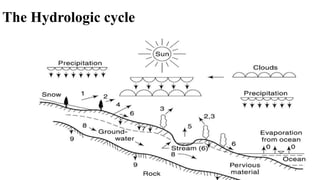
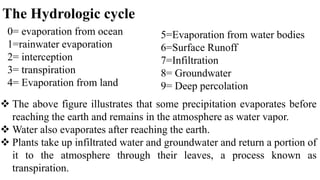
0= evaporation from ocean
1=rainwater evaporation
2= interception
3= transpiration
4= Evaporation from land
5=Evaporation from water bodies
6=Surface Runoff
7=Infiltration
8= Groundwater
9= Deep percolation
 The above figure illustrates that some precipitation evaporates before
reaching the earth and remains in the atmosphere as water vapor.
 Water also evaporates after reaching the earth.
 Plants take up infiltrated water and groundwater and return a portion of
it to the atmosphere through their leaves, a process known as
transpiration.
The Hydrologic cycle
Some infiltrated water may emerge to surface water bodies as
interflow, while other portions may become groundwater flow.
 Groundwater may ultimately be discharged into streams or may
emerge as springs.
After an initial filling of interception and depression storages and
providing that the rate of precipitation exceeds that of infiltration,
overland flow (surface runoff) begins.
The magnitude and duration of a precipitation event determine the
relative importance of each component of the hydrologic cycle during
that event.
The hydrologic cycle, while simple in concept, is in reality, very
The Hydrologic cycle
 The hydrologic cycle, while simple in concept, is in reality, very
complex.
 Paths taken by precipitated droplets of water are many and varied
before the sea is reached.
 The time scale may be of the order of seconds, minutes, hours, days,
or even years.
Hydrologic Abstractions
The collective term given to the various processes that act to remove
water from the incoming precipitation before it leaves the watershed
as runoff is abstractions.
These processes are
evaporation,
transpiration,
interception,
infiltration,
depression storage, and
detention storage.
Hydrologic Abstractions
The most important abstractions in determining the surface runoff
from a given precipitation event are
infiltration,
depression storage, and
detention storage.
Evaporation
 Evaporation is the process by which water from the land and water
surfaces is converted into water vapor and returned to the
atmosphere.
 It occurs continually whenever the air is unsaturated and temperatures
are sufficiently high.
Evaporation
Air is 'saturated' when it holds its maximum capacity of moisture at the
given temperature.
Saturated air has a relative humidity of 100 percent.
Evaporation plays a major role in determining the long-term water
balance in a watershed.
 However, evaporation is usually insignificant in small watersheds for
single storm events and can be discounted when calculating the
discharge from a given rainfall event.
Transpiration
Transpiration is the physical removal of water from the watershed by
the life actions associated with the growth of vegetation.
Transpiration
In the process of respiration, green plants consume water from the
ground and transpire water vapor to the air through their foliage.
As was the case with evaporation, this abstraction is only significant
when taken over a long period of time, and has minimal effect upon
the runoff resulting from a single storm event for a watershed.
Interception
 Interception is the removal of water that wets and adheres to objects
above ground such as buildings, trees, and vegetation.
 This water is subsequently removed from the surface through
evaporation.
 Interception can be as high as 2 mm during a single rainfall event,
but usually is nearer 0.5 mm.
Interception
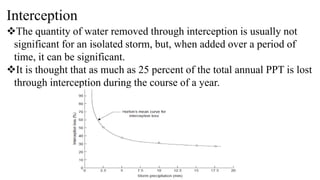
The quantity of water removed through interception is usually not
significant for an isolated storm, but, when added over a period of
time, it can be significant.
It is thought that as much as 25 percent of the total annual PPT is lost
through interception during the course of a year.
Infiltration
Infiltration is the flow of water into the ground by percolation
through the earth's surface.
The process of infiltration is complex and depends upon many
factors such as soil type, vegetal cover, antecedent moisture
conditions or the amount of time elapsed since the last precipitation
event, precipitation intensity, and temperature.
Infiltration is usually the single most important abstraction in
determining the response of a watershed to a given rainfall event.
As important as it is, no generally acceptable model has been
developed to accurately predict infiltration rates or total infiltration
volumes for a given watershed.
Depression Storage
Depression storage is the term applied to water that is lost because it
becomes trapped in the numerous small depressions that are
characteristic of any natural surface.
When water temporarily accumulates in a low point with no
possibility for escape as runoff, the accumulation is referred to as
depression storage.
The amount of water that is lost due to depression storage varies
greatly with the land use. A paved surface will not detain as much
water as a recently furrowed field.
The relative importance of depression storage in determining the
runoff from a given storm depends on the amount and intensity of
precipitation in the storm.
Depression Storage
 Typical values for depression storage range from 1 to 8 mm (0.04 to
0.3 in) with some values as high as 15 mm (0.6 in) per event.
 As with evaporation and transpiration, depression storage is generally
not directly calculated in highway design.
Detention Storage
 Detention structures store water for a relatively short period of time.
 These facilities drain primarily by discharging either overland or
directly to a man-made or natural watercourse.
 Examples of detention structures include detention basins,
subsurface structures for temporary storm water storage, and (on a
larger scale) flood control reservoirs.
Detention Storage
Natural ponds, lakes, and stream channels also provide detention of
water as it moves over the face of the earth.
Detention storage is water that is temporarily stored in the depth of
water necessary for overland flow to occur.
The volume of water in motion over the land constitutes the
detention storage.
The amount of water that will be stored is dependent on a number of
factors such as land use, vegetal cover, slope, and rainfall intensity.
Typical values for detention storage range from 2 to 10 mm, but
values as high as 50 mm have been reported.
Retention structures
 Retention structures: generally hold water for a relatively long
period of time.
 Stored water in retention systems is depleted overtime primarily by
infiltration or evaporation.
 The distinguishing characteristic of retention facilities is that they
do not have a surface discharge for most flows (although they may
be designed with an overflow provision for extreme storm events).
 Examples of retention structures include recharge basins or ponds
(sometimes referred to as infiltration basins), subsurface recharge
systems such as dry wells and infiltration galleys, and water quality
swales designed for infiltration.
Total Abstraction Methods
 While the volumes of the individual abstractions may be small, their
sum can be hydrologically significant.
 Therefore, hydrologic methods commonly lump all abstractions
together and compute a single value.
 The SCS curve number method lumps all abstractions together, with
the volume equal to the difference between the volumes of rainfall and
runoff.
 The phi-index method assumes a constant rate of abstraction over the
duration of the storm.
 These total abstraction methods simplify the calculation of storm
runoff rates.
Hydro-meteorological measurement and data analysis
a. Units of Measurements:
 stream and river flows are usually recorded as cubic meter per second
(m3/s).
 Groundwater flows and water supply flows are commonly measured in
m3 or liters per unit time and flows used in agriculture or related to
water storage are often expressed as depth per unit time.
 Volumes are given as cubic meters, liters or cubic centimeters.
 Precipitation depths are recorded in inches or centimeters, whereas
precipitation rates are given in inches or centimeters per unit time.
 Evaporation, Transpiration and infiltration rates are also given as
inches or centimeters of depth per unit time.
Hydro-meteorological measurement and data
analysis
b. Hydrological data:
 data on hydrological variables are fundamental to analyses,
forecasting, and modeling.
c. General climatological data:
 The most readily available sources of data on temperature, solar
radiation, wind, relative humidity and precipitation in Ethiopia is the
National Meteorological Service Agency (NMSA).
 The data is available on daily basis.
 There are also some web sites where data can be downloaded for
certain use in some software like SWAT.
Hydro-meteorological measurement and data analysis
d. Precipitation Measurement and data analysis:
 Precipitation is the primary source of fresh water supply and its
records are the basis of most studies dealing with water supply in all
its forms, floods, and droughts.
 Of all hydrological data, data on precipitation are most readily
available and have been collected for the longest periods.
 Precipitation is all meteoric water (water of direct atmospheric origin)
that falls on the Earth’s surface, whether in liquid form (rain or
drizzle), solid form (snow, ice pellets, hail), or occult form (frost, dew,
hoarfrost).
Hydro-meteorological measurement and data analysis
The formation of precipitation requires a four step process:
(1) Cooling of air to approximately the dew-point temperature;
(2) Condensation on nuclei to form cloud droplets or ice crystals;
(3) Growth of droplets or crystals into rain drops, snowflakes or
hailstones and
(4) Importation of water vapor to sustain the process of precipitation
geographically, temporally, and seasonally.
 This regional and temporal variation in precipitation are important in
water resources planning and hydrologic studies.
 The amount fallen is usually expressed in terms of precipitation depth
per unit of horizontal area [mm] or in terms of intensity[mm/h], which
Hydro-meteorological measurement and data analysis
 Precipitation is usually measured with a rain gauge placed in the
open space.
 The catch of a gauge is influenced by the wind, which usually
causes low readings.
 Gauges for measuring rainfall may be recording or non-recording.
 The most commonly non-recording gauge is the US Weather
Bureau Standard 8-inch gauge.
 They cannot be used to indicate the time distribution of rainfall.
 Time variation in rainfall intensity is extremely important in the
rainfall-runoff process.
 Recording gauges continuously sense the rate of rainfall and its time
Hydro-meteorological measurement and data analysis
 These gauges are either of the weighing-recording type or the tipping-
bucket type.
 Weighing type gauges usually run for a period of one week, at which
time their charts must be changed.
 Rainfall measurements can also be made using satellite sensors and
radar.
Types of Precipitation (by Origin)
 Precipitation can be classified by the origin of the lifting motion that
causes the precipitation.
 The three major types of storms are classified as convective storms,
orographic storms, and cyclonic storms
Types of Precipitation (by Origin)
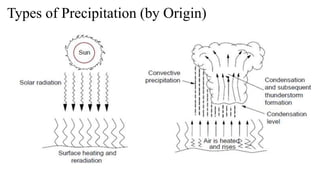
A) Convective Storms
 Precipitation from convective storms results as warm moist air rises
from lower elevations into cooler overlying air.
 The characteristic form of convective precipitation is the summer
thunderstorm.
 The surface of the earth is warmed considerably by mid- to late
afternoon of a summer day, the surface imparting its heat to the
adjacent air.
 The rapid condensation may often result in huge quantities of rain
from a single thunderstorm spawned by convective action, and very
large rainfall rates and depths are quite common beneath slowly
moving thunderstorms.
Types of Precipitation (by Origin)
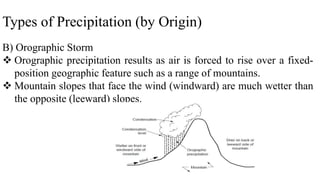
B) Orographic Storm
 Orographic precipitation results as air is forced to rise over a fixed-
position geographic feature such as a range of mountains.
 Mountain slopes that face the wind (windward) are much wetter than
the opposite (leeward) slopes.
Types of Precipitation (by Origin)
C) Cyclonic Storms
 Cyclonic precipitation is caused by the rising or lifting of air as it
converges on an area of low pressure.
 Air moves from areas of higher pressure toward areas of lower
pressure. In the middle latitudes, cyclonic storms generally move
from west to east and have both cold and warm air associated with
them.
 These mid-latitude cyclones are sometimes called extra-tropical
cyclones or continental storms.
Processing and Analysis of Precipitation Data
Point Precipitation
 Precipitation events are recorded by gauges at specific locations.
 The resulting data permit determination of the frequency and
character of precipitation events in the vicinity of the site.
 Point precipitation data are used collectively to estimate areal
variability of rain and are also used individually for developing
design storm characteristics of small urban and other watersheds.
 Point rainfall data are used to derive intensity-duration- frequency
curves.
 Failure of any rain gauge or absence of observer from a station
causes short break in the record of rainfall at the station.
Processing and Analysis of Precipitation Data
 These gaps are to be estimated first before we use the rainfall data
for any analysis.
 The surrounding stations located within the basin help to fill the
missing data on the assumption of hydro-meteorological similarity
of the group of stations.
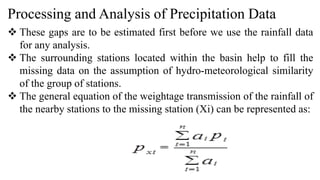
 The general equation of the weightage transmission of the rainfall of
the nearby stations to the missing station (Xi) can be represented as:
Processing and Analysis of Precipitation Data
Where,
 Pi is the normal rainfall of ith surrounding station, i= 1, 2, … n are
the surrounding gauge numbers which are used for filling the gaps,
 ai the weighting factor of the station Pi and Pxi is the data
required to be filled up.
 The methods mostly to be used in hydrology for filling the missing
data are, Arithmetic mean method, normal ratio method, and
distance power methods are generally used for filling up the
missing rainfall data.
a) Arithmetic Mean Method
This method is used when:
Processing and Analysis of Precipitation Data
(i) The normal annual rainfall of the missing station x is within 10% of
the normal annual rainfall of the surrounding stations,
(ii) Data of at least three surrounding stations, called index station are
available within the basin,
(iii)The index stations should be evenly spaced around the missing
station and should be as close as possible,
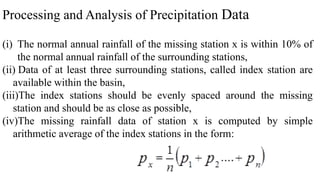
(iv)The missing rainfall data of station x is computed by simple
arithmetic average of the index stations in the form:
Processing and Analysis of Precipitation Data
 In which are the precipitations of index stations and px
that of the missing station, n the number of index stations.
 The word normal means average of 30 years of data, i.e., 30 values
of the latest records.
 For example, for a station when the last 30 years of June month
rainfall is averaged, we call it as normal rainfall for the month of
June for that station.
b) Normal Ratio Method
 This method is used when the normal annual precipitation of the
index stations differ by more than 10% of the missing stations.
Processing and Analysis of Precipitation Data
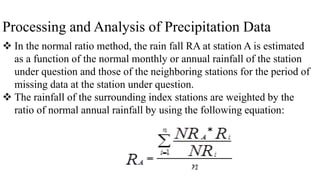
 In the normal ratio method, the rain fall RA at station A is estimated
as a function of the normal monthly or annual rainfall of the station
under question and those of the neighboring stations for the period of
missing data at the station under question.
 The rainfall of the surrounding index stations are weighted by the
ratio of normal annual rainfall by using the following equation:
Processing and Analysis of Precipitation Data
Where,
RA is the estimated rainfall at station A
Ri is the rainfall at surrounding stations
NRA is the normal monthly or seasonal rainfall at station A
NRi is the normal monthly or seasonal rainfall at station i
n is the number of surrounding stations whose data used for
estimation
c) Distance power method:
In this method, the rainfall at a station is estimated as a weighted
average of observed rainfall at the neighboring stations.
Processing and Analysis of Precipitation Data
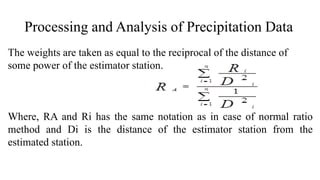
The weights are taken as equal to the reciprocal of the distance of
some power of the estimator station.
Where, RA and Ri has the same notation as in case of normal ratio
method and Di is the distance of the estimator station from the
estimated station.
Processing and Analysis of Precipitation Data
d) Inverse Distance Methods
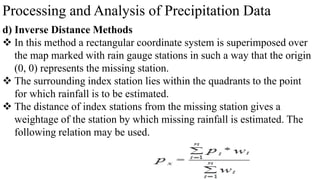
 In this method a rectangular coordinate system is superimposed over
the map marked with rain gauge stations in such a way that the origin
(0, 0) represents the missing station.
 The surrounding index station lies within the quadrants to the point
for which rainfall is to be estimated.
 The distance of index stations from the missing station gives a
weightage of the station by which missing rainfall is estimated. The
following relation may be used.
Processing and Analysis of Precipitation Data
Where, wi =1/D2, D2 = ( is the distance of the station I in x and y
coordinates taking missing rainfall station at (0, 0) position. This is
the most acceptable method and is widely used for determining the
missing rainfall for any scientific analysis.
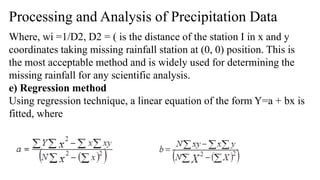
e) Regression method
Using regression technique, a linear equation of the form Y=a + bx is
fitted, where
Areal Distribution of Rainfall
 For most hydrologic analyses, it is important to know the areal
distribution of precipitation.
 average depths for representative portions of the watershed are
determined and used for this purpose.
 The most direct approach is to use the arithmetic average of gauged
quantities.
 This procedure is satisfactory if gauges are uniformly distributed
and the topography is flat.
Spatial Averaging of Rainfall Data
 Precipitation observations from gauges are point measurements.
 However, in the hydrological analysis and design, we frequently
require mean areal precipitation over an area.
Areal Distribution of Rainfall
 A characteristic of the precipitation process is that it exhibits
appreciable spatial variation though the values at relatively short
distances may have good correlation.
 Numerous methods of computing areal rainfall from point
measurements have been developed.
 While using precipitation data, one often comes across missing data
situations.
 Data for the period of missing rainfall could be filled using various
techniques.
 Due to the spatial structure of precipitation data, some type of
interpolation making use of the data of nearby stations is commonly
adopted.
Areal Distribution of Rainfall
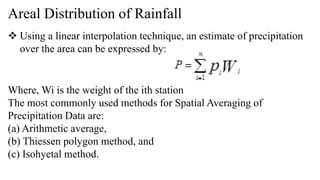
 Using a linear interpolation technique, an estimate of precipitation
over the area can be expressed by:
Where, Wi is the weight of the ith station
The most commonly used methods for Spatial Averaging of
Precipitation Data are:
(a) Arithmetic average,
(b) Thiessen polygon method, and
(c) Isohyetal method.
Areal Distribution of Rainfall
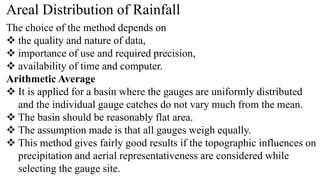
The choice of the method depends on
 the quality and nature of data,
 importance of use and required precision,
 availability of time and computer.
Arithmetic Average
 It is applied for a basin where the gauges are uniformly distributed
and the individual gauge catches do not vary much from the mean.
 The basin should be reasonably flat area.
 The assumption made is that all gauges weigh equally.
 This method gives fairly good results if the topographic influences on
precipitation and aerial representativeness are considered while
selecting the gauge site.
Areal Distribution of Rainfall
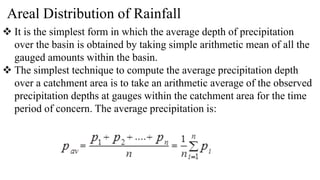
 It is the simplest form in which the average depth of precipitation
over the basin is obtained by taking simple arithmetic mean of all the
gauged amounts within the basin.
 The simplest technique to compute the average precipitation depth
over a catchment area is to take an arithmetic average of the observed
precipitation depths at gauges within the catchment area for the time
period of concern. The average precipitation is:
Areal Distribution of Rainfall
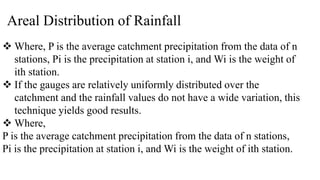
 Where, P is the average catchment precipitation from the data of n
stations, Pi is the precipitation at station i, and Wi is the weight of
ith station.
 If the gauges are relatively uniformly distributed over the
catchment and the rainfall values do not have a wide variation, this
technique yields good results.
 Where,
P is the average catchment precipitation from the data of n stations,
Pi is the precipitation at station i, and Wi is the weight of ith station.
Areal Distribution of Rainfall
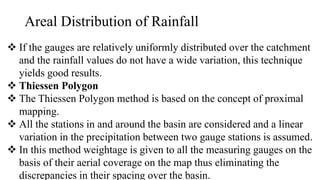
 If the gauges are relatively uniformly distributed over the catchment
and the rainfall values do not have a wide variation, this technique
yields good results.
 Thiessen Polygon
 The Thiessen Polygon method is based on the concept of proximal
mapping.
 All the stations in and around the basin are considered and a linear
variation in the precipitation between two gauge stations is assumed.
 In this method weightage is given to all the measuring gauges on the
basis of their aerial coverage on the map thus eliminating the
discrepancies in their spacing over the basin.
Areal Distribution of Rainfall
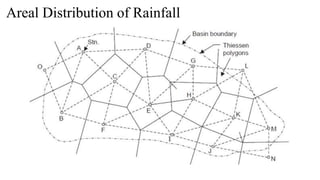
 Weights are assigned to each station according to the catchment area
which is closer to that station than to any other station.
 This area is found by drawing perpendicular bisectors of the lines
joining the nearby stations so that the polygons are formed around
each station.
 It is assumed that these polygons are the boundaries of the catchment
area which is represented by the station lying inside the polygon.
Areal Distribution of Rainfall
 The area represented by each station is measured and is expressed as
a percentage of the total area.
 The weighted average precipitation for the basin is computed by
multiplying the precipitation received at each station by its weight
and summing.
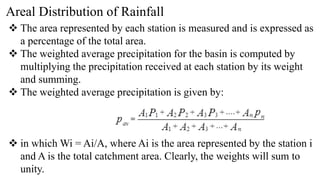
 The weighted average precipitation is given by:
 in which Wi = Ai/A, where Ai is the area represented by the station i
and A is the total catchment area. Clearly, the weights will sum to
unity.
Areal Distribution of Rainfall
An advantage of this method is that the data of stations outside the
catchment may also be used if these are believed to help in capturing
the variation of rainfall in the catchment.
The method works well with non-uniform spacing of stations.
Isohyetal Method
The isohyetal method employs the area encompassed between
isohyetal lines.
Rainfall values are plotted at their respective stations on a suitable
base map and contours of equal rainfall, called isohyets, are drawn.
 In regions of little or no physiographic influence, drawing of
isohyetal contours is relatively simple matter of interpolation.
Areal Distribution of Rainfall
The isohyetal contours may be drawn take into account the spacing
of stations, the quality, and variability of the data.
In pronounced orography where precipitation is influenced by
topography, the analyst should take into consideration the orographic
effects, storm orientation etc. to adjust or interpolate between station
values.
 Computers are being used to draw isohyetal maps these days, by
using special software.
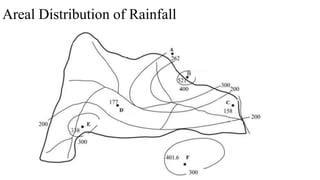
 As an example, the isohyetal map for an area is shown in Fig
below.
Areal Distribution of Rainfall
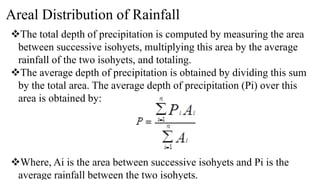
The total depth of precipitation is computed by measuring the area
between successive isohyets, multiplying this area by the average
rainfall of the two isohyets, and totaling.
The average depth of precipitation is obtained by dividing this sum
by the total area. The average depth of precipitation (Pi) over this
area is obtained by:
Where, Ai is the area between successive isohyets and Pi is the
average rainfall between the two isohyets.
Optimum Rain-gauge Network Design
Ideally a basin should have as many numbers of gauges possible to
give a clear representative picture of the aerial distribution of the
precipitation.
Factors like economy, topography, accessibility, and rainfall
variability govern the number of stations for a basin.
There is no definite rule as to how many gauge are needed for a
complete ungauged basin.
WMO recommends certain density of gauges to be followed for
different types of catchments.
The optimum rain-gauge network design is to obtain all quantitative
data averages and extremes that define the statistical distribution of the
hydro-meteorological elements, with sufficient accuracy.
Optimum Rain-gauge Network Design
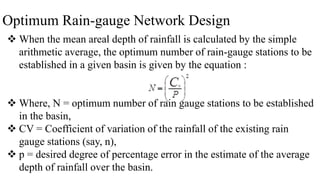
 When the mean areal depth of rainfall is calculated by the simple
arithmetic average, the optimum number of rain-gauge stations to be
established in a given basin is given by the equation :
 Where, N = optimum number of rain gauge stations to be established
in the basin,
 CV = Coefficient of variation of the rainfall of the existing rain
gauge stations (say, n),
 p = desired degree of percentage error in the estimate of the average
depth of rainfall over the basin.
Optimum Rain-gauge Network Design
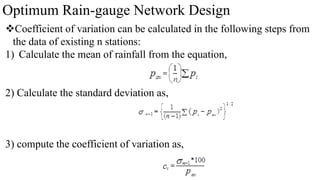
Coefficient of variation can be calculated in the following steps from
the data of existing n stations:
1) Calculate the mean of rainfall from the equation,
2) Calculate the standard deviation as,
3) compute the coefficient of variation as,
Optimum Rain-gauge Network Design
If the allowable percent of error in estimating the mean rainfall is
taken higher, then a basin will require fewer numbers of gauges and
vice-versa.
The allowable percent of error is normally taken as 10%.
 The number of additional rain-gauge stations (N–n) should be
distributed in the different zones (caused by isohyets) in proportion
to their areas, i.e., depending upon the spatial distribution of the
existing rain-gauge stations and the variability of the rainfall over
the basin.
 Testing and Adjustment of Precipitation Records
 Rainfall data reported from a station may not be consistent always.
Over the period of observation of rainfall records,
Testing and Adjustment of Precipitation Records
there could be:
(i) unreported shifting of the rain gauge site by as much as 8 km aerially
or 30m in elevation,
(ii) significant construction work in the area might have changed the
surroundings
(iii) change in observational procedure incorporated from a certain
period or,
(iv) a heavy forest fire, earth quake or land slide might have taken place
in the area.
Such changes at any station are likely to affect the consistency of data from a
station.
Use of double mass curve checks the consistency of the record and helps to correct
the rainfall data for the station.
Testing and Adjustment of Precipitation Records
 Over a period of observation of rainfall records, there could be
(i) unreported shifting of the rain gauge site by as much as 8 km
aerially or 30m in elevation,
(ii) significant construction work in the area might have changed the
surroundings
(iii) change in observational procedure incorporated from a certain
period or,
(iv) a heavy forest fire, earth quake or land slide might have taken place
in the area, Such changes at any station are likely to affect the
consistency of data from a station.
(v) Use of double mass curve checks the consistency of the record and
helps to correct the rainfall data for the station.
Testing and Adjustment of Precipitation Records
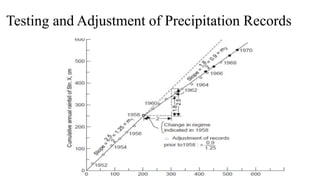
Double-mass analysis:
The consistency of records at the station in question (say, X) is tested
by a double mass curve by plotting the cumulative annual (or
seasonal) rainfall at station X against the concurrent cumulative
values of mean annual (or seasonal) rainfall for a group of
surrounding stations, for the number of years of record.
In this method, the accumulated annual rainfall of a particular station
is compared with the concurrent accumulated values of mean rainfall
of groups of 5 to 8 surrounding base stations.
The basis of such an exercise is that a group of sample data (for any
period) drawn from its population will be the same.
Testing and Adjustment of Precipitation Records
 From the plot, the year in which a change in regime (or environment)
has occurred is indicated by the change in slope of the straight line
plot.
 The rainfall records of the station x are adjusted by multiplying the
recorded values of rainfall by the ratio of slopes of the straight lines
before and after change in environment.
 Procedure of computation is as follows
 From the plot, the year in which a change in regime (or environment)
has occurred is indicated by the change in slope of the straight line
plot.
Testing and Adjustment of Precipitation Records
 The rainfall records of the station x are adjusted by multiplying the
recorded values of rainfall by the ratio of slopes of the straight lines
before and after change in environment.
 Procedure of computation is as follows:
Step 1: a computation table is prepared with the following columns
Column 1: The years are represented in a decreasing order, i.e., with the
latest year as a first entry in the column.
Column 2: Yearly precipitation values of station whose consistency
needs to be checked are entered in column 2
Column 3: the cumulative annual rainfall of station whose consistency
is in question are entered
Testing and Adjustment of Precipitation Records
Column 4: mean annual precipitation of the group of stations
surrounding the station whose consistency has to be checked are
computed and entered.
Column 5: cumulative mean annual precipitation of group of stations
surrounding the station whose consistency has to be checked is
entered.
Step 2: A graph is plotted taking the cumulative mean annual
precipitation of a group of stations along abscissa (x-axis) and
cumulative annual precipitation of station A along the ordinate (y-
axis). Consecutive points are joined by a straight line.
Testing and Adjustment of Precipitation Records
Step 3: If the consistency of station A has undergone changes from any
year, then it can be noticed from the change in slope of the plotted
points.
 The straight line joining the initial points of the graph are extended
by a dotted line and correction (C/Ci) is computed
Step 4: Annual rainfall (recorded at station A) of subsequent years from
the year of deviation are corrected by multiplying by the correction
factor.
Testing and Adjustment of Precipitation Records
Presentation of Precipitation Data
Rainfall is usually presented in the form of the following graphs. Such
graphs are useful for analysis and design purpose.
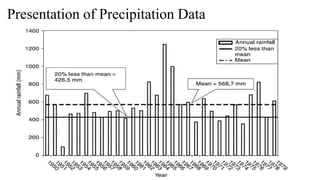
1.Moving average curve
2.Mass curve
3.Rainfall hyetograph
4.Intensity-Duration-Frequency curves
Moving Average:
 Rainfall data are plotted chronologically with time in x-axis and
rainfall magnitude in y-axis.
 An event of rainfall is always associated with randomness.
 In order to overcome the random component in rainfall magnitudes,
a simple moving average of order 3 or 5 is used.
Presentation of Precipitation Data
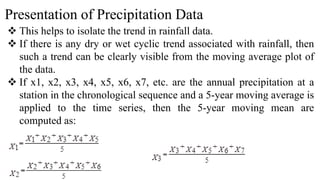
 This helps to isolate the trend in rainfall data.
 If there is any dry or wet cyclic trend associated with rainfall, then
such a trend can be clearly visible from the moving average plot of
the data.
 If x1, x2, x3, x4, x5, x6, x7, etc. are the annual precipitation at a
station in the chronological sequence and a 5-year moving average is
applied to the time series, then the 5-year moving mean are
computed as:
Presentation of Precipitation Data
The 5-year moving average data x1, x2, x3, etc. obtained as above
can be presented from third year onward only.
For example, if data are available from 1961 t0 1996, then a 5-year
moving average can be represented from the year 1963 to 1994.
The data corresponding to the first two years (1961and 1962) and
the last two years (1995 and 1996) are lost in the moving average
process.
Presentation of Precipitation Data
Mass Curve
 Mass curve is a graphic representation of rainfall data in which
time is represented along the abscissa and the cumulative
precipitation is represented along the ordinate.
 Plot of a mass curve gives information regarding rainfall intensity,
duration, magnitude, onset and cessation of precipitation of any
storm.
 All self-recording rain gauges automatically record the mass
curve of precipitation at a place over time.
 Therefore, all information about the storm at the place is known
from the graph record.
Presentation of Precipitation Data
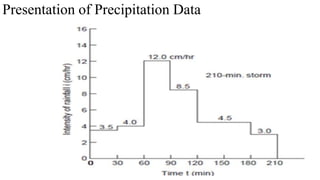
Rainfall Hyetograph
 The variation of rainfall with respect to time may be shown
graphically by a hyetograph.
 A hyetograph is a bar graph showing the intensity of rainfall with
respect to time and is useful in determining the maximum
intensities of rainfall during a particular storm as is required in
land drainage and design of culverts.
 During a storm, intensity always changes with time.
 On a mass curve any two points can be marked and the depth of
rainfall (∆y) between these two points are noted from the y-axis.
Presentation of Precipitation Data
 Time between these two points (∆t) are recorded from x-axis. The
depth divided by time i.e., (∆y/(∆t) is the intensity of rainfall for the
period under consideration.
 When the plot of rainfall intensity with time is presented in the
form of a bar graph such a graph is known as hyetograph.
 The plot is very useful for flood studies and calculation of rainfall
indices.
Presentation of Precipitation Data
Intensity-Duration- Frequency Curve
 Rainfall during a year or season (or a number of years) consists of
several storms.
 The characteristics of a rainstorm are
 (i) intensity (cm/hr),
 (ii) duration (min, hr, or days),
 (iii) frequency(once in 5 years or once in 10, 20, 40, 60 or 100
years), and
 (iv) areal extent (i.e., area over which it is distributed).
 Suppose a number of years of rainfall records observed on recording
and non-recording rain-gauges for a river basin are available; then it
is possible to correlate
 (i) the intensity and duration of storms, and (ii) the intensity,
Intensity-Duration- Frequency Curve
duration and frequency of storms.
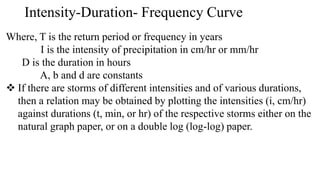
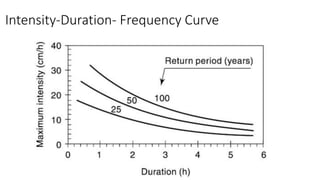
 An intensity-duration-frequency curve is a three parameter curve
in which duration is taken on x-axis, intensity on y-axis and the
return period or frequency as a third parameter.
 By fixing the return period of say 10, 50, 100 years or any other
period, a particular curve between intensity and duration can be
obtained for the area. Through such a curve, an exponential
equation of the following order can be fit.
T
a
C
I   
 d
a
d
b
D
CT
B
D




Intensity-Duration- Frequency Curve
Where, T is the return period or frequency in years
I is the intensity of precipitation in cm/hr or mm/hr
D is the duration in hours
A, b and d are constants
 If there are storms of different intensities and of various durations,
then a relation may be obtained by plotting the intensities (i, cm/hr)
against durations (t, min, or hr) of the respective storms either on the
natural graph paper, or on a double log (log-log) paper.
Intensity-Duration- Frequency Curve
Depth-Area- Duration Curve (DAD) curve
 The depth-area-duration (DAD) relationships provide the designer
with important information on temporal and spatial variation of
rainfall for a given area
 DAD also provide one of the simplest methods of transposing of
the storm data.
 For a given storm with one centre the depth-area relationship is
derived using the isohyets as boundaries of individual areas,
working from the centre outwards.
 Depth of precipitation of a storm is related to the area of its
coverage and duration of a storm.
 DAD analysis is carried out to obtain a curve relating the depth of
precipitation, D, area of its coverage, A, and
Depth-Area- Duration Curve (DAD) curve
duration of occurrence of the storm, D.
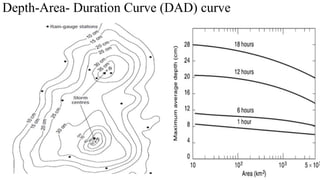
 A DAD curve is a graphical representation of the gradual decrease of
depth of precipitation with a progressive increase of the area of the
storm away from the storm center, of a given duration taken as a
third parameter.
 It gives a direct relationship between depth, area and duration of
precipitation over the region for which the analysis is carried out.
 The main aim of the DAD analysis is to determine the maximum
precipitation amounts that have occurred over various sizes of
drainage area during the passage of storm periods of say 6hr, 12hr,
Depth-Area- Duration Curve (DAD) curve
24hr or other durations.
 There are two methods of carrying out the DAD analysis.
 They are mass curve method and incremental-isohyetal method.
 The second method is most popular and is extensively used by the
hydrologists.
 The procedure of DAD analysis is given herein.
Step1: All the major storms of the area are identified
Step 2: the duration of the storms are noted. For example, if the
duration is chosen as 1-day, then all the storms occurring for 1-day
period are selected.
Further when a storm has occurred, say for 3 days, then the maximum
one day precipitation out of the three days is also noted.
Depth-Area- Duration Curve (DAD) curve
Step 3: Isohyetal patterns for all 1-day storms are prepared on maps.
Step 4: for each 1-day storm considered, the area bounded within the
highest isohyet is determined.
 This is called the eye-area of the storm.
 Then the area bounded between the largest and the second largest
isohyets is determined.
 The depth of precipitation in the area covering up to the second
largest isohyets is obtained as d2= (Pm1A1+ Pm2A2)/(A1+A2),
where, Pm1 is the mean precipitation over the area A1 bounded
within the highest isohyets and pm2 is the mean precipitation over
the area A2 bounded between the largest and the second largest
isohyets.
Depth-Area- Duration Curve (DAD) curve
 Similarly, for the area covering up to the 3rd largest isohyets, the
depth of precipitation d3 can be obtained by the relation d3=
(Pm1A1+Pm2A2+Pm3A3)/ A1+A2+A3) where pm3 is the mean
precipitation between the second largest and the 3rd largest isohyets
covering an area A3 between them.
 The procedure is repeated to cover the remaining isohyets of the area.
Step 5 : All the area- depth precipitations are recorded in a table
Step 6: step 4 is repeated for all other 1-day storms considered for the
area.
Step 7: A graph is plotted taking area along the abscissa and maximum
average depths of precipitation as ordinate covering the depth-area data
of all 1-day storms of step 5.
Depth-Area- Duration Curve (DAD) curve
Step 8: Such an exercise may also be taken up for 6-hr, 12-hr, 2-day,
and 3-day storms of the region.
 The curves are plotted on the same paper as in step 6
Step 9: if a semi-log graph paper is used with area plotted on log scale
then the curve will plot close to a straight line.
Depth-Area- Duration Curve (DAD) curve
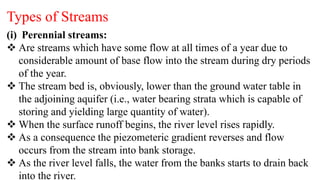
Types of Streams
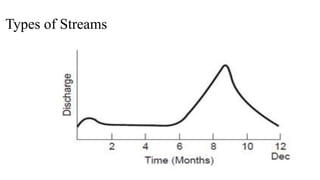
(i) Perennial streams:
 Are streams which have some flow at all times of a year due to
considerable amount of base flow into the stream during dry periods
of the year.
 The stream bed is, obviously, lower than the ground water table in
the adjoining aquifer (i.e., water bearing strata which is capable of
storing and yielding large quantity of water).
 When the surface runoff begins, the river level rises rapidly.
 As a consequence the piezometeric gradient reverses and flow
occurs from the stream into bank storage.
 As the river level falls, the water from the banks starts to drain back
into the river.
Types of Streams
Types of Streams
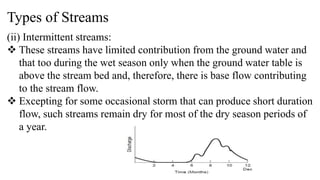
(ii) Intermittent streams:
 These streams have limited contribution from the ground water and
that too during the wet season only when the ground water table is
above the stream bed and, therefore, there is base flow contributing
to the stream flow.
 Excepting for some occasional storm that can produce short duration
flow, such streams remain dry for most of the dry season periods of
a year.
Types of Streams
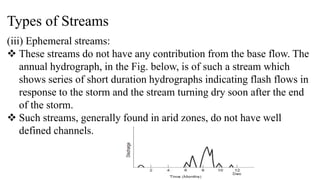
(iii) Ephemeral streams:
 These streams do not have any contribution from the base flow. The
annual hydrograph, in the Fig. below, is of such a stream which
shows series of short duration hydrographs indicating flash flows in
response to the storm and the stream turning dry soon after the end
of the storm.
 Such streams, generally found in arid zones, do not have well
defined channels.
Types of Streams
 The most satisfactory determination of the runoff from a catchment
is by measuring the discharge of the stream draining it, which is
termed as stream gauging.
 A gauging station is the place or section on a stream where
discharge measurements are made.
Streamflow Measurement
 The total runoff consisting of surface flow, subsurface flow,
groundwater or base flow, and the precipitation falling directly on
the stream is the stream flow or the total runoff of a basin.
Streamflow Measurement
 When the rate of rainfall or snowmelt exceeds the interception
requirements and the rate of infiltration, water starts to accumulate
on the surface.
 At first the excess water collects into the small depressions and
hollows, until the surface detention requirements are satisfied.
 After that water begins to move down the slopes as a thin film and
tiny streams.
 This early stage of overland flow is greatly influenced by surface
tension and friction forces.
 With continuing rainfall the depth of surface detention and the rate of overland
flow increase, Streamflow representing the runoff phase of the hydrologic
cycle is the most important basic data for hydrologic studies.
Streamflow Measurement
 Streamflow is the only part of the hydrologic cycle that can be
measured accurately.
 It is measured in units of discharge (m3/s) occurring at a specified
time and constitutes a historical data.
 The measurement of discharge in a stream forms an important
branch of Hydrometry, the science and practice of water
measurement.
 Streamflow measurement techniques can be broadly classified into
two categories as
 (a) Direct determination of stream discharge and
 (b) Indirect determination. Under each category there are a host of
methods.
Streamflow Measurement
a) Direct method of streamflow measurement
1) Area velocity method
(2) Dilution Technique
(3) electromagnetic method and
(4) Ultrasonic method
b)Indirect determination of streamflow measurement
1)Hydraulic structures, such as weirs, flumes, and gated structures and
2)Slope area method
The flow characteristics of a stream depend upon
(i) the intensity and duration of rainfall besides spatial and temporal
distribution of the rainfall,
Streamflow Measurement
ii) shape, soil, vegetation, slope, and drainage network of the
catchment basin, and
(iii) climatic factors influencing evapotranspiration. Based on the
characteristics of yearly hydrograph, (graphical plot of discharge
versus time in chronological order is plotted).
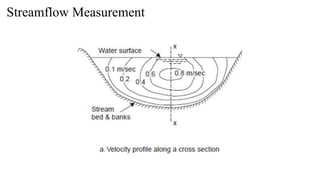
A) Direct Measurement
i)Area velocity method
The area of cross-section of flow may be determined by sounding and
plotting the profile. The mean velocity of flow (V) may be
determined by making velocity measurements.
Streamflow Measurement
ii)STAGE-DISCHARGE-RATING CURVE
 The measurement of discharge by the direct method involves a
two-step procedure, the development of the stage –discharge
relationship which forms the first step is of at most importance.
 Once the stage-discharge (G-Q) relationship is established, the
subsequent procedure consists of measuring the stage (G) and
reading the discharge (Q ) from the (G-Q) relationship.
 This second part is a routine operation.
 The stage discharge relationship is also known as rating curve.
 The measured value of discharges when plotted against the
corresponding stages gives relationship that represents the
integrated effect of a wide range of channels and flow parameters
Streamflow Measurement
Is termed as control.
 If the (G: Q) relationship for a gauging section is constant and does
not change with time, the control is said to be permanent.
 If it changes with time, it is called shifting control.
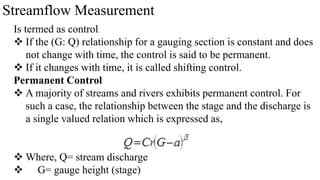
Permanent Control
 A majority of streams and rivers exhibits permanent control. For
such a case, the relationship between the stage and the discharge is
a single valued relation which is expressed as,
 Where, Q= stream discharge
 G= gauge height (stage)
Streamflow Measurement
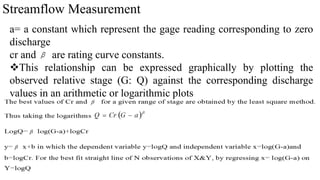
a= a constant which represent the gage reading corresponding to zero
discharge
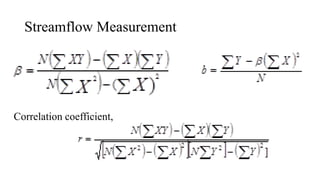
cr and are rating curve constants.
This relationship can be expressed graphically by plotting the
observed relative stage (G: Q) against the corresponding discharge
values in an arithmetic or logarithmic plots
Streamflow Measurement
Correlation coefficient,
Streamflow Measurement
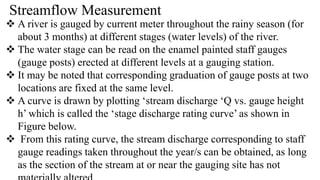
 A river is gauged by current meter throughout the rainy season (for
about 3 months) at different stages (water levels) of the river.
 The water stage can be read on the enamel painted staff gauges
(gauge posts) erected at different levels at a gauging station.
 It may be noted that corresponding graduation of gauge posts at two
locations are fixed at the same level.
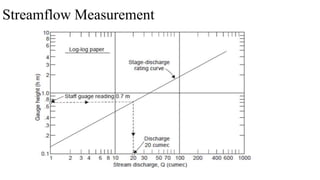
 A curve is drawn by plotting ‘stream discharge ‘Q vs. gauge height
h’ which is called the ‘stage discharge rating curve’ as shown in
Figure below.
 From this rating curve, the stream discharge corresponding to staff
gauge readings taken throughout the year/s can be obtained, as long
as the section of the stream at or near the gauging site has not
Streamflow Measurement
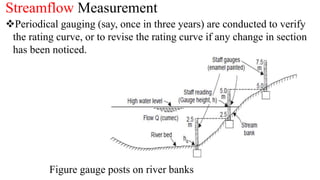
Periodical gauging (say, once in three years) are conducted to verify
the rating curve, or to revise the rating curve if any change in section
has been noticed.
Figure gauge posts on river banks
Streamflow Measurement
B) Indirect method of streamflow measurement
 Under this category are included those methods which make use
of the relationship between the flow discharge and the depths at
specified locations.
 The field measurement is restricted to the measurements of depths
only. Two broad classifications of these indirect methods are
(1) flow measuring structures
(2) Slope-area method
Flow Measuring Structures
(a) Venturiflumes or standing wave flumes (critical depth meter) for
small channels.
Streamflow Measurement
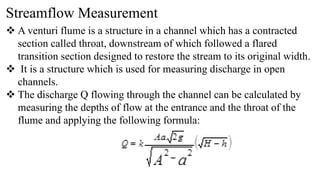
 A venturi flume is a structure in a channel which has a contracted
section called throat, downstream of which followed a flared
transition section designed to restore the stream to its original width.
 It is a structure which is used for measuring discharge in open
channels.
 The discharge Q flowing through the channel can be calculated by
measuring the depths of flow at the entrance and the throat of the
flume and applying the following formula:
Streamflow Measurement
 In which A, a, and H, h are the areas and depths of flow section at
entrance and throats of the flume respectively and k is the discharge
coefficient of the flume.
 The discharge coefficient must be determined by calibration through
the entire range of head.
(b) Weirs
 A weir is the name given to a concrete or masonry structure built
across a river or stream in order to raise the level of water on the
upstream side and to allow the excess water to flow over its entire
length to the downstream side.
 Weirs are used for measuring the rate of flow of water in rivers or
streams.
Streamflow Measurement
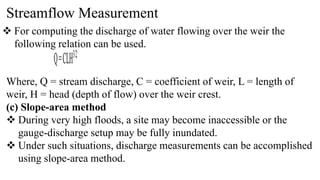
 For computing the discharge of water flowing over the weir the
following relation can be used.
Q=CLH3/2
Where, Q = stream discharge, C = coefficient of weir, L = length of
weir, H = head (depth of flow) over the weir crest.
(c) Slope-area method
 During very high floods, a site may become inaccessible or the
gauge-discharge setup may be fully inundated.
 Under such situations, discharge measurements can be accomplished
using slope-area method.
Streamflow Measurement
 The previous peak flood stages at two locations can be collected
from the flood marks in the river courses which give the water
surface slope of the peak flood.
 By knowing the distance between the two points along the river,
slope Sf can be computed.
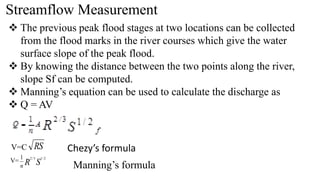
 Manning’s equation can be used to calculate the discharge as
 Q = AV
V=C RS Chezy’s formula
V= S
R
n
2
/
1
3
/
2
1
Manning’s formula
Streamflow Measurement
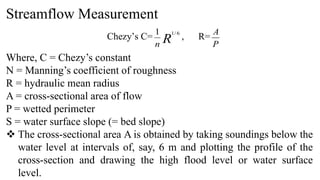
Chezy’s C= R
n
6
/
1
1
, R=
P
A
Where, C = Chezy’s constant
N = Manning’s coefficient of roughness
R = hydraulic mean radius
A = cross-sectional area of flow
P = wetted perimeter
S = water surface slope (= bed slope)
 The cross-sectional area A is obtained by taking soundings below the
water level at intervals of, say, 6 m and plotting the profile of the
cross-section and drawing the high flood level or water surface
level.
Streamflow Measurement
The water surface slope is determined by means of gauges placed at
the ends of the reach, say 1 km upstream of the gauging station and 1
km downstream of the gauging station(in a straight reach; if Δh is the
difference in water levels in a length L of the reach, then S =Δh/L.
The slope may also be determined by means of flood marks on either
side or their subsequent leveling.
The slope-area method is often used to estimate peak floods where
no gauging station exists.
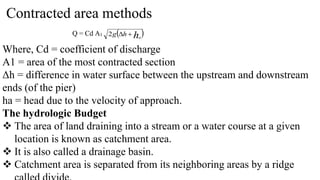
(d) Contracted area methods: The drop in water surface in contracted
sections as in bridge openings, canal falls etc. is measured and the
discharge is approximately given by:
Contracted area methods
Q = Cd A1  
ha
h
g 

2
Where, Cd = coefficient of discharge
A1 = area of the most contracted section
Δh = difference in water surface between the upstream and downstream
ends (of the pier)
ha = head due to the velocity of approach.
The hydrologic Budget
 The area of land draining into a stream or a water course at a given
location is known as catchment area.
 It is also called a drainage basin.
 Catchment area is separated from its neighboring areas by a ridge
The Hydrologic Budget
Thus, the catchment area is a logical and convenient unit to study
various aspects relating to hydrology and water resources of a region.
Rainfall can be viewed as an input to the surface of Earth.
The surface can be viewed as a series of storage elements, such as
storage on the surface of vegetation and depression storage.
Runoff from the surface can be viewed as an output from surface
storage elements.
This would be a systems representation of the physical processes
controlling surface runoff.
The Hydrologic Budget
If river channel processes are the important elements of the
hydrologic design, then the surface runoff can be viewed as the input,
the channel itself as the storage element, and the runoff out of the
channel (into another channel, a lake, or an ocean) as the output from
the system.
 A water budget is an accounting of water movement into and out of,
and storage change within, some control volume.
 The universal concept of mass conservation of water implies that
water-budget methods are applicable over any space and time scales
(Healy et al., 2007).
The Hydrologic Budget
 The water budget of a soil column in a laboratory can be studied at
scales of millimeters and seconds.
 A water-budget equation is also an integral component of
atmospheric general circulation models used to predict global
climates over periods of decades or more.
 Water-budget methods represent the largest class of techniques for
estimating recharge.
 Most hydrologic models are derived from a water-budget equation
and can therefore be classified as water-budget models.
 For a given problem area, say a catchment, in an interval of time ∆t,
the continuity equation for water in its various phases is written as:
The Hydrologic Budget
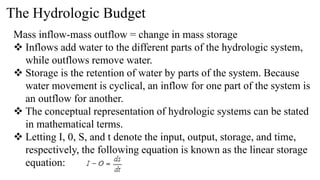
Mass inflow-mass outflow = change in mass storage
 Inflows add water to the different parts of the hydrologic system,
while outflows remove water.
 Storage is the retention of water by parts of the system. Because
water movement is cyclical, an inflow for one part of the system is
an outflow for another.
 The conceptual representation of hydrologic systems can be stated
in mathematical terms.
 Letting I, 0, S, and t denote the input, output, storage, and time,
respectively, the following equation is known as the linear storage
equation:
The Hydrologic Budget
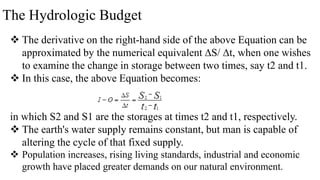
 The derivative on the right-hand side of the above Equation can be
approximated by the numerical equivalent ∆S/ ∆t, when one wishes
to examine the change in storage between two times, say t2 and t1.
 In this case, the above Equation becomes:
in which S2 and S1 are the storages at times t2 and t1, respectively.
 The earth's water supply remains constant, but man is capable of
altering the cycle of that fixed supply.
 Population increases, rising living standards, industrial and economic
growth have placed greater demands on our natural environment.
The Hydrologic Budget
Our activities can create an imbalance in the hydrologic equation and
can affect the quantity and quality of natural water resources
available to current and future generations.
The storage equation can be used for other types of hydrologic
problems.
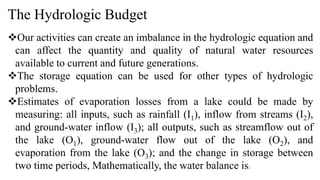
Estimates of evaporation losses from a lake could be made by
measuring: all inputs, such as rainfall (I1), inflow from streams (I2),
and ground-water inflow (I3); all outputs, such as streamflow out of
the lake (O1), ground-water flow out of the lake (O2), and
evaporation from the lake (O3); and the change in storage between
two time periods, Mathematically, the water balance is:
The Hydrologic Budget
The hydrologic budget is a convenient way of modeling the elements
of the hydrologic cycle. It will be used frequently in describing the
problems of analysis and design.
The Hydrologic Budget
According to estimates (Seckler et al., 1998), the annual average
depth of precipitation on the land surface is about 108*103 km3. Out
of this, about 61*103 km3 is returned to the atmosphere as
evapotranspiration and the runoff from land to oceans is 47*103 km3.
 As far as the water balance of oceans is concerned, the depth of
precipitation over them is about 410*103 km3 , 47 *103 km3 of
water is received as runoff from the land, and 457*103 km3 is lost as
evaporation.
 If we consider the water balance of atmosphere, 457*103 km3 of
water is received as evaporation from oceans and 61*103 km3 from
land. The precipitation over oceans is 410*103 km3 and it is 108*103
km3 over land.
Global Water Balance
 The hydrologic equation may be applied for areas of any size, but
the complexity of computation greatly depends on the extent of the
area under study.
 The smaller is the area, the more complicated is its water balance
because it is difficult to estimate components of the equation.
 Finally, the components of the hydrologic equation may be
expressed in terms of the mean depth of water (mm), or as a volume
of water (m3), or in the form of flow rates (m3/s or mm/s).
Infiltration
Estimating the quantity of flow allows us to determine the fraction of
the rainfall that will contribute to surface runoff, and the fraction that
will feed the groundwater flow and thus recharge the aquifers.
 Infiltration is the transfer of water through the surface layers of the
soil after it has been subjected to rain or has been submerged.
The infiltrating water initially fills the interstices in the surface soil
and then penetrates the soil under the forces of gravity and soil
suction.
The rate at which net precipitation enters the soil surface depends on
several soil surface conditions and the physical characteristics of the
soil itself.
Infiltration
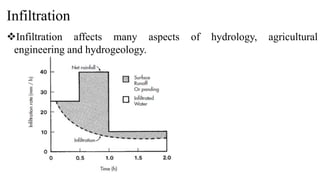
Infiltration affects many aspects of hydrology, agricultural
engineering and hydrogeology.
Infiltration
The maximum rate at which water can enter the soil surface is called
infiltration capacity.
Infiltration capacity diminishes over time in response to several
factors that affect the downward movement of the wetting front.
The size of individual pores and the total amount of pore space in a
soil generally decrease with increasing soil depth.
The actual infiltration rate equals the infiltration capacity only when
the rate of rainfall or snowmelt equals or exceeds the infiltration
capacity.
When rainfall or snowmelt rates exceed infiltration capacity, surface
runoff or ponding of water on the soil surface occurs.
Infiltration
When rainfall intensity is less than the infiltration capacity, the rate of
infiltration equals rainfall intensity.
In these instances, water enters the soil and is either held within the
soil if soil moisture content is less than the field capacity or percolates
downward under the influence of gravity when soil moisture content is
greater than the field capacity.
The infiltration capacity of a soil depends on several factors including
texture, structure, surface conditions, the nature of soil colloids, organic
matter content, soil depth or the presence of impermeable layers, and
the presence of macro-pores within the soil.
Macro-pores function as small channels or pipes within a soil and are
non-uniformly distributed pores created by processes such as
Infiltration
earthworm activity, decaying plant roots, the burrowing of small
animals, and so forth.
Rate of infiltration i (t): also called the infiltration regime, is the rate
of flow of water penetrating the soil.
 It is usually expressed in mm/h.
 The rate of infiltration depends above all on the mode of inputs
(irrigation, rain) but also on the properties of the soil.
Cumulative infiltration, I(t): is the total volume of water infiltrated in
a given time period.
 It is equal to the integral over time of the rate of infiltration,
Infiltration
Where, I(t) is the cumulative infiltration at time t [mm] and i(t) is the
rate of infiltration for time t [mm/h].
Figure General Evolution of the rate of infiltration and of cumulative
infiltration over time (Ks = saturated hydraulic conductivity)
Infiltration
Saturated hydraulic conductivity (Ks): is a key parameter of
infiltration.
 It represents the limit value of the rate of infiltration if the soil is
saturated and homogeneous.
 This parameter is part of many equations for calculating infiltration.
Infiltration capacity or absorption capacity: is the maximum amount
of water flow that the soil can absorb through its surface, when it
receives an effective rainfall or is covered with water.
 It depends on texture and structure of the soil, and also on the initial
conditions, which is to say, the initial water content of the soil profile
and the water content imposed on the surface.
Infiltration
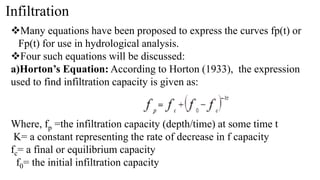
Many equations have been proposed to express the curves fp(t) or
Fp(t) for use in hydrological analysis.
Four such equations will be discussed:
a)Horton’s Equation: According to Horton (1933), the expression
used to find infiltration capacity is given as:
Where, fp =the infiltration capacity (depth/time) at some time t
K= a constant representing the rate of decrease in f capacity
fc= a final or equilibrium capacity
f0= the initial infiltration capacity
Infiltration
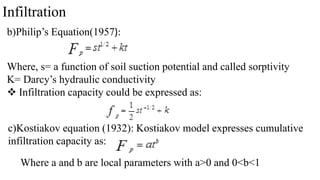
b)Philip’s Equation(1957):
Where, s= a function of soil suction potential and called sorptivity
K= Darcy’s hydraulic conductivity
 Infiltration capacity could be expressed as:
c)Kostiakov equation (1932): Kostiakov model expresses cumulative
infiltration capacity as:
Where a and b are local parameters with a>0 and 0<b<1
Infiltration
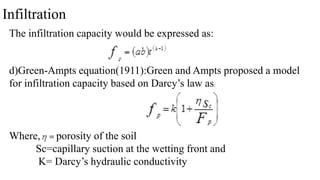
The infiltration capacity would be expressed as:
d)Green-Ampts equation(1911):Green and Ampts proposed a model
for infiltration capacity based on Darcy’s law as:
Where, porosity of the soil
Sc=capillary suction at the wetting front and
K= Darcy’s hydraulic conductivity
Percolation and effective rainfall
Percolation: indicates the vertical flow of water in the soil
(unsaturated porous media) towards the groundwater table, mostly
under the influence of gravity.
 This process follows infiltration and directly determines the water
supply to underground aquifers.
Precipitation excess or effective rainfall: is the quantity of rain that
flows only on the surface of the soil during a rain.
 The net storm rain is deducted from the total rainfall, minus the
amounts that are intercepted by vegetation or stored in depressions
in the soil, and minus the fraction that infiltrates.
Factors Influencing Infiltration
 Infiltration is affected by the following main factors:
a) Type of soil (structure, texture, porosity): The characteristics of
the soil matrix influence the forces of capillarity and adsorption giving
rise to the force of suction, which in part governs infiltration.
b) Compaction of the soil surface: is the result of the impact of rain
drops or other causes (thermal and anthropogenic).
 For example, heavy machinery in agricultural land can degrade the
structure of the surface soil layer and cause the formation of a
dense and impermeable crust to a certain depth (this can be the
result of plowing, for example).
Factors Influencing Infiltration
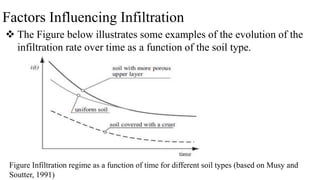
 The Figure below illustrates some examples of the evolution of the
infiltration rate over time as a function of the soil type.
Figure Infiltration regime as a function of time for different soil types (based on Musy and
Soutter, 1991)
Factors Influencing Infiltration
c) Soil cover: Vegetation has a positive influence on infiltration by
slowing down surface runoff and giving the water more time to
penetrate the soil.
 In addition, the root systems improve the permeability of the soil.
Lastly, foliage protects the soil from the impact of the rain drops, and
so decreases surface sealing.
d) Topography and morphology: Slope, for example, has the opposite
effect of vegetation. A steep slope increases surface flow at the expense
of infiltration.
e) Water Supply: This is the intensity of precipitation or the irrigation
water rate.
Factors Influencing Infiltration
f) Initial water content of the soil: The water content of the soil is an
essential factor affecting the infiltration rate, because the force of
suction is a function of the moisture content in the soil.
 The infiltration rate over time will evolve differently depending on
the initial condition (wet or dry) of the soil.
 The moisture content of the soil is usually understood by studying the
precipitation that fell in a given time period preceding rain.
 The Antecedent Precipitation Indices (IAP) are often used to establish
the moisture content of the soil preceding a rain.
 In summary, for the same type of topography, the most influential
factors affecting infiltration are the soil type, the soil cover, and the
initial water content.
Infiltration Indices
 In hydrological calculations involving floods it is found convenient to
use a constant value of infiltration rate for the duration of the storm.
 The defined average infiltration rate is called infiltration index and
two types of indices are in common use.
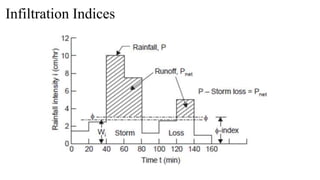
Φ-Index
 Infiltration indexes generally, assume that infiltration occurs at some
constant or average rate throughout a storm.
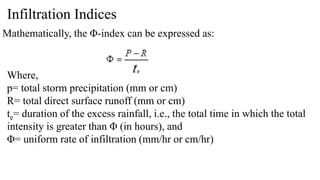
 Consequently, initial rates are underestimated and final rates are
overestimated if an entire storm sequence with little antecedent
moisture is considered.
 The Φ-index is the average rainfall above which the rainfall volume is
equal to the runoff volume.
Infiltration Indices
 The Φ-index is derived from the rainfall hyetograph with the
knowledge of the resulting runoff volume.
 If the rainfall intensity is less than Φ, then the infiltration rate is equal
to the rainfall intensity; however, if the rainfall intensity is larger than
Φ the difference between the rainfall and infiltration in an interval of
time represents the runoff volume.
 The amount of rainfall in excess of the index is called rainfall excess.
 In connection with runoff and flood studies it is also known as
effective rainfall.
 The Φ-index accounts for the total abstraction and enables magnitudes
to be estimated for a given rainfall hyetograph.
Infiltration Indices
 The Φ-index is derived from the rainfall hyetograph with the
knowledge of the resulting runoff volume.
 If the rainfall intensity is less than Φ, then the infiltration rate is
equal to the rainfall intensity; however, if the rainfall intensity is
larger than Φ the difference between the rainfall and infiltration in an
interval of time represents the runoff volume.
 The amount of rainfall in excess of the index is called rainfall
excess.
 In connection with runoff and flood studies it is also known as
effective rainfall.
 The Φ-index thus accounts for the total abstraction and enables
magnitudes to be estimated for a given rainfall hyetograph.
Infiltration Indices
Mathematically, the Φ-index can be expressed as:
Where,
p= total storm precipitation (mm or cm)
R= total direct surface runoff (mm or cm)
te= duration of the excess rainfall, i.e., the total time in which the total
intensity is greater than Φ (in hours), and
Φ= uniform rate of infiltration (mm/hr or cm/hr)
Infiltration Indices
W-Index
 In an attempt to refine the Φ-index, the initial losses are separated
from the total abstractions and an average value of infiltration rate
(called the w-index) is calculated as given below:
Where, p= total storm precipitation (cm)
R=total storm runoff (cm)
Ia= initial losses (cm)
te= duration of the excess rainfall (in hours), i.e., the total time
in which the rainfall intensity is greater than infiltration capacity and
Infiltration Indices
w= average rate of infiltration (cm/hr)
 The minimum value of W-index obtained under very wet soil
conditions, representing the constant minimum rate of infiltration of
the catchment, is known as Wmin.
 It is to be noted that both the -index and W index vary from storm
to storm.
Rainfall-Runoff Relation
 When rain falls on the earth’s surface, some of that rain is
intercepted by the surfaces of vegetation located in its path
(interception)
 Depending on soil characteristics and amount of rainfall, some or all
of the remaining rainfall will enter the ground through pores in the
Rainfall-Runoff Relation
surface soils (infiltration).
 As the remaining water, if any, flows overland, irregularities in the
surface of the land trap some of this water as depression storage.
 The portion of this overland flow that reaches the watershed outlet
is called direct runoff, or storm water runoff.
 This relationship can be expressed as a storm event water balance,
by the following equation:
 Runoff = Precipitation - Interception - Infiltration - Depression
Storage-Evapotranspiration
 This very basic relationship is the basis for most methods used to
estimate runoff.
Rainfall-Runoff Relation
 In hydrologic analysis, interception, infiltration, and depression
storage are sometimes referred to as “abstractions”.
 Thus, runoff is what remains of rainfall, after accounting for
abstractions.
 When we estimate runoff, we are concerned with the quantities of
runoff volume and runoff rate.
Runoff Volume
 The volume of surface runoff that will occur on a site during a given
rainfall event depends on a number of factors:
 For very large watersheds, the volume of runoff from one storm event
may depend on rainfall that occurred during previous storm events.
Rainfall-Runoff Relation
 In addition to rainfall, other factors affect the volume of runoff are:
Basin characteristics
 Size, Shape, Slope, Altitude (elevation), Topography, Geology (type
of soil), Land use/land cover /vegetation, Orientation, Type of
drainage network , Proximity to ocean and mountain ranges.
Storm characteristics
 Amount of precipitation; Rainfall event, duration and intensity; Type
or nature of storm and season, Intensity of storm, Duration and Areal
extent (distribution), Frequency antecedent precipitation and
Direction of storm movement.
Storage characteristics
Depressions Pools and ponds / lakes Stream Channels, Check dams,
Rainfall-Runoff Relation
(in gullies), Upstream reservoir /or tanks Flood plains, swamps Ground
water storage in pervious deposits (aquifers In analyzing the hydrology
of an area, several runoff volume quantities are of interest.
For instance:
 The runoff volume associated with a storm event;
 The runoff volume over an extended time (e.g., annual runoff);
 A runoff volume for water quality treatment.
 Runoff volumes are generally estimated in terms of “watershed
meters”, cubic meters (m3), or acre-feet.
 A “watershed -meter” is equivalent to a one-meter depth of water
spread over the entire contributing watershed.
Rainfall-Runoff Relation
 An “acre-foot” is equivalent to one foot of water spread over an acre
of area.
Methods Commonly used for Estimating Runoff Volume
 The volume of runoff that will occur on a site during a given rainfall
event depends on a number of factors:
 The area of land from which runoff occurs (known as the
watershed);
 amount of precipitation;
 the duration and intensity (volume per unit of time) at which
precipitation falls;
 the soils at and near the land surface; and
 the surface cover (combination of exposed earth, vegetation, pavement and roofs).
Rainfall-Runoff Relation
 The rate at which runoff discharges from a given site is known as the
runoff rate or discharge rate. The rate of runoff depends on the
following factors
 the roughness of the surface, which is determined by the type of
surface cover;
 the location of the impervious area in the watershed in relation to the
point of analysis;
 slope of the ground surface (flatter slopes result in slower rates of
flow over the ground, steeper slopes result in faster rates of flow);
 total distance the runoff must travel to the point of analysis.
How is Runoff Related to Rainfall?
Rainfall-Runoff Relation
 When rain falls on the earth’s surface, some of that rain is intercepted
by the surfaces of vegetation located in its path (interception).
 Depending on soil characteristics and amount of rainfall, some or all
of the remaining rainfall will enter the ground through pores in the
surface soils (infiltration).
 As the remaining water, if any, flows overland, irregularities in the
surface of the land trap some of this water as depression storage.
 The portion of this overland flow that reaches the watershed outlet is
called direct runoff, or storm water runoff.
This relationship can be expressed as a storm event water balance, by the
following equation:
 Runoff = Precipitation - Interception - Infiltration - Depression
Rainfall-Runoff Relation
 This very basic relationship is the basis for most methods used to
estimate runoff.
 In hydrologic analysis, interception, infiltration, and depression
storage are sometimes referred to as “abstractions”.
 Thus, runoff is what remains of rainfall, after accounting for
abstractions.
 Anything that affects the “abstraction” processeswill affect the amount
of runoff.
Runoff Volume
 The volume of surface runoff that will occur on a site during a given
rainfall event depends on a number of factors:
 Watershed area;
Runoff Volume
 Rainfall event duration and intensity (volume per unit of time);
 Surface soils characteristics; and
 and-use surface cover.
 Runoff volumes are generally estimated in terms of “watershed
inches”, cubic feet (ft3), or acre-feet.
 A “watershed inch” is equivalent to a one-inch depth of water spread
 over the entire contributing watershed.
 An “acre-foot” is equivalent to one foot of water spread over an acre
of area.
Methods Commonly used for Estimating Runoff
 There are many methods available for the estimation of runoff
volumes and rates.
Methods Commonly used for Estimating Runoff
 Runoff volume and rate can be estimated using Soil Conservation
Service (SCS, now the Natural Resources Conservation Service)
methods, assuming the necessary underlying assumptions of the SCS
models are satisfied.
 The selection of methods depends on a number of factors, including:
 Whether the method will be used to estimate total runoff volumes,
peak rates, or variations of flow rate with time over the duration of a
storm event;
 Whether the values obtained by the method will be used for sizing
storm drain pipes,
 detention facilities, water quality treatment facilities, or other purpose;
 Limitations inherent in each method;
Methods Commonly used for Estimating Runoff
 Data available for performing the calculations; and
 Whether the method requires calibration to actual field data.
The Rational Method
The SCS Curve Number/Unit Hydrograph Method
The Rational Method:
 is generally used for estimating peak flows, to develop designs for
conveyance systems such as culverts, piped storm drains, and open
channel systems.
 While there is an adaptation of the rational method that may be used
for estimating detention storage volumes, the method is cumbersome
to use in comparison to other available modeling tools.
The Rational Method
 Also, it is not generally appropriate for development of peak rate
control devices such as detention and retention basins.
 For those interested in how to use the Rational Method,
 Applicability:
 Required output: peak discharge only
 Drainage area: less than or equal to 20 acres
 The Rational Method is used for determining peak discharges from
small drainage areas.
 This method is traditionally used to size storm sewers, channels, and
other storm water structures, which handle runoff from drainage areas
less than 20 acres.
 The Rational Formula is expressed as q=C*i*A
The Rational Method
where:
q = Peak rate of runoff in cubic feet per second
C = Runoff coefficient, an empirical coefficient representing a
relationship between rainfall and runoff
i = Average intensity of rainfall in inches per hour for the time of
concentration (Tc) for a selected frequency of occurrence or return
period.
Tc = The rainfall intensity averaging time usually referred to as the time
of concentration, equal to the time required for water to flow form the
hydraulically most distant point in the watershed to the point of design.
A = The watershed area in acres
Runoff Estimation Rational Method
Description of Step Reference
Step 1 Identify Analysis Points
Step 2 Delineate Watershed of Each Analysis Point
Step 3 Characterize Each Watershed:
 Total area (A), expressed in acres
Land cover type, soils, and slope condition –
corresponding to table of runoff coefficients
Area of each cover/soils/slope complex
Step 4 Determine Runoff Coefficient (C)
 Determine c for each unique sub-area, based on cover/soils/slope
complex
Runoff Estimation Rational Method
 Determine weighted c for each watershed
Step 5 Determine Time of Concentration (tc)
Note that this time is sometimes expressed in hours, and sometimes in
minutes, and may need to be converted to appropriate units for
computing intensity
Step 6 Determine Rainfall Intensity (i)
Note that intensity must be expressed in units of
inches/hour
Step 7 Determine Peak Discharge (q, expressed in cfs)
Use Rational Formula:
q = C * i * A
Assumptions in Runoff Estimation Using Rational
Method
1.The peak rate of runoff at any point is a direct function of the tributary
drainage area and the average rainfall intensity during the time of
concentration to that point.
2. The return period of the peak discharge rate is the same as the return
period of the average rainfall intensity or rainfall event.
3. The rainfall is uniformly distributed over the watershed.
4. The rainfall intensity remains constant during the time period equal
to Tc.
5. The relationship between rainfall and runoff is linear.
6. The runoff coefficient, C, is constant for storms of any duration or
frequency on the watershed.
Limitations
1.When basins become complex, and where sub-basins combine, the
Rational Formula will tend to overestimate the actual flow
2. The method assumes that the rainfall intensity is uniform over the
entire watershed. This assumption is true only for small watersheds and
time periods, thus limiting the use of the formula to small watersheds.
3The results of using the formula are frequently not replicable from
user to user. There are considerable variation in interpretation and
methodology in the use of the formula.
4. The Rational Formula only produces one point on the runoff
hydrograph, the peak discharge rate.
The SCS Curve Number Method
 In 1972, the soil conservation service developed a method for
computing abstractions from storm rainfall, considering the storm as
a whole, the depth of excess precipitation or direct runoff Pe is
always less than or equal to the depth of precipitation P.
 Similarly, after runoff begins, the additional depth of water retained
in the watershed Fa is less than or equal to the potential maximum
retention S.
 There is some amount of rainfall in the form of initial abstraction
before ponding Ia, for which no runoff will occur.
 Hence, the potential runoff is P-Ia.
The SCS Curve Number Method
 For many peak discharge estimation methods, the input includes
variables to reflect the size of the contributing area, the amount of
rainfall, the potential watershed storage, and the time-area
distribution of the watershed.
 These are often translated into input variables such as the drainage
area, the depth of rainfall, an index reflecting land use and soil type,
and the time of concentration.
 In developing the SCS rainfall-runoff relationship, the total rainfall
was separated into three components: direct runoff (Q), actual
retention (F), and the initial abstraction (Ia).
 The retention (F) was assumed to be a function of the depths of
rainfall and runoff and the initial abstraction.
Hypothesis of the SCS method
 The ratio of actual additional depth of water retained in the watershed
Fa to the potential maximum retention S is equal to the ratio of the
actual depth of excess of precipitation or direct runoff Pe to the
potential runoff (P-Ia). That is,
(1)
 Applying the principle of continuity, we have, Depth of
precipitation= Depth of excess precipitation or direct runoff + depth
of initial abstraction before ponding +additional depth of water
retained in the watershed
( 2)
Hypothesis of the SCS method
From equation (1) (3)
From equation (2)
(4)
Substituting the value of Fa in equation (4) in equation (3) we have
Hypothesis of the SCS method
 This equation is the basic equation for computing the depth of excess
rainfall or direct runoff from a storm by SCS method.
 By study of results from many small experimental watershed, an
empirical relation was developed.
Ia =0.2S
Substituting Ia =0.2S in equation
Hypothesis of the SCS method
Where,
P = depth of precipitation, mm (in)
Ia = initial abstraction, mm (in)
S = maximum potential retention, mm (in)
The retention S should be a function of the following five factors:
land use, interception, infiltration, depression storage, and antecedent
moisture.
 The above equation represents the basic equation for computing the
runoff depth, Q, for a given rainfall depth, P.
 It is worthwhile noting that while Q and P have units of depth, Q
and P reflect volumes and are often referred to as volumes.
Hypothesis of the SCS method
Additional empirical analyses were made to estimate the value of S. The
studies found that S was related to soil type, land cover, and the
hydrologic condition of the watershed. These are represented by the
runoff curve number (CN), which is used to estimate S by:
Empirical analyses suggested that the CN was a function of three
factors: soil group, the cover complex, and antecedent moisture
conditions.
Soil Group Classification
 SCS developed a soil classification system that consists of four
groups, which are identified by the letters A, B, C, and D.
 Soil characteristics that are associated with each group are as follows:
Group A: deep sand, deep loess; aggregated silts
Group B: shallow loess; sandy loam
Group C: clay loams; shallow sandy loam; soils low in organic content;
soils usually high in clay
Group D: soils that swell significantly when wet; heavy plastic clays;
certain saline soils
Cover Complex Classification:
 The SCS cover complex classification consists of three factors: land
use, treatment or practice, and hydrologic condition.
Cover Complex Classification
 Many different land uses are identified in the tables for estimating
runoff curve numbers.
 Agricultural land uses are often subdivided by treatment or
practices, such as contoured or straight row; this separation reflects
the different hydrologic runoff potential that is associated with
variation in land treatment.
 The hydrologic condition reflects the level of land management; it is
separated into three classes: poor, fair, and good.
 Not all of the land uses are separated by treatment or condition.
Cover Complex Classification
 To standardize the SCS curves, a dimensionless curve number CN is
defined such that 0 ≤ CN ≤ 100.
 The curve for dry conditions (AMC I) or wet conditions (AMCIII),
equivalent curve numbers can be computed by:
and
 The range of antecedent moisture conditions for each classes is
shown in the following table.
CN (I) =  
 
II
CN
II
CN
058
.
0
10
2
.
4

Cover Complex Classification
Table: Classification of antecedent moisture classes (AMC) for the SCS
method of rainfall abstractions
AMC group Total 5-day antecedent rainfall(inches)
Dormant seasons Growing seasons
I <0.5 <1.4
II 0.5 to 1.1 1.4 to2.1
III >1.1 >2.1
Runoff Rate
 The term runoff rate refers to the volume of runoff discharging from
a given watershed per unit of time.
Runoff Rate
 The rate at which runoff discharges from a given watershed depends
on the following factors in addition to those affecting runoff volume:
Surface roughness (determined by the type of surface cover);
 Location of impervious area in the watershed relative to the point of
analysis;
 Slope of the ground surface;
 Distance the runoff must travel to the point of analysis.
 Runoff rates (volume of runoff in a unit time) are usually estimated
or measured in cubic meter per second (m3/s).
Runoff Depth Estimation
 A common assumption in hydrologic modeling is that the rainfall
available for runoff is separated into three parts:
Runoff Depth Estimation
direct (or storm) runoff, initial abstraction, and losses.
 Factors that affect the split between losses and direct runoff include
the volume of rainfall, land cover and use, soil type, and antecedent
moisture conditions.
 Land cover and land use will determine the amount of depression
and interception storage.
 The following equation can be used to compute a peak discharge
with the SCS method:
 Where, qp = peak discharge, m3/s (ft3/s
 qu = unit peak discharge, m3/s/km2/mm (ft3/s/ mi2/in)
 A = drainage area, km2 (mi2) Q = depth of runoff, mm (in).
Base Flow Separation
 The first step in developing a unit hydrograph is to plot the
measured hydrograph and separate base flow from the total runoff
hydrograph
 In perennial streams the base flow is not assumed to be part of the
runoff from a given rainfall and is separated first
 The separation of the base flow, however, is not an easy task.
Base Flow Separation
c) Method III: In this method the base flow curve existing prior to the
commencement of the surface runoff is extended till it intersects the
ordinate drawn at the peak point. Then this point is joined to point C
by a straight line
2.RESPONSE FUNCTIONS OF LINEAR SYSTEMS
UNIT HYDROGRAPH CONCEPTS
 The hydrograph is the response of a given catchment to a rainfall
input
 The interactions of various storms and catchments are in general
extremely complex
 Two different storms in a given catchment produce hydrographs
differing from each other
 Similarly identical storms in two catchment produce hydrographs
that are different
 These complex hydrographs are the result of storm and catchment
peculiarities and their complex interaction.
 Hence, simple hydrographs resulting from isolated storms are preferred for
UNIT HYDROGRAPH CONCEPTS
 The unit hydrograph is a simple linear model that can be used to
derive the hydrograph resulting from any amount of excess rainfall.
 First proposed by Sherman (1932), the unit hydrograph originally
named unit-graph of a watershed is defined as a direct runoff
hydrograph (DRH) resulting from 1’’ (usually taken as 1 cm in SI
units) of excess rainfall generated uniformly over the drainage area at
a constant rate for an effective duration.
 Sherman originally used the word “unit” to denote a unit of time.
But since that time it has often been interpreted as a unit depth of excess
rainfall.
UNIT HYDROGRAPH CONCEPTS
 Sherman classified runoff into surface runoff and groundwater runoff
and defined the unit hydrograph for use only with surface runoff
 The unit hydrograph is a widely used element of hydrological studies
and applies to runoff from rainfall only, not to that from melting of
snow or ice.
 The UH refers to runoff from a rainfall excess uniformly distributed
over the entire catchment.
 Isolated storm results single peak hydrograph and complex storm
yields multiple peak hydrograph
The following basic assumptions are inherent in this model;
 1. Rainfall excess of equal duration are assumed to produce
hydrographs with equivalent time bases regardless of the intensity of the rain,
UNIT HYDROGRAPH CONCEPTS
2. Direct runoff ordinates for a storm of given duration are assumed
directly proportional to rainfall excess volumes.
3. The time distribution of direct runoff is assumed independent of
antecedent precipitation,
4. Rainfall distribution is assumed to be the same for all storms of equal
duration, both spatially and temporally.
Sherman based his formulation on three postulates:
(a)Constant base length: This means that for a given catchment the
duration of runoff is essentially constant for all rainfalls of a given
duration and independent of the total volume of runoff.
(b) Proportional ordinates. It is assumed that for a given duration and catchment
the ordinates of the runoff hydrograph are proportional to the total volume of
UNIT HYDROGRAPH CONCEPTS
(c) Superposition. This is the assumption of linearity. Accordingly the
runoff hydrograph of a particular rainfall can be superimposed with
concurrent runoff due to preceding rainfalls.
 The unit hydrographs are derived from measured hydrographs and
therefore incorporate the integrated effect of all the catchment
characteristics, such as infiltration, surface detention, physical
features and vegetation of the catchment, as well as the effect of the
actual distribution of rainfall.
Rules to be observed in developing UH from gauged watershed
 1. Storms should be selected with a simple structure with relatively
uniform spatial and temporal distributions
UNIT HYDROGRAPH CONCEPTS
2. Watershed sizes should generally fall between 1.0 and 100 mi2 in
modern watershed analysis
3. Direct runoff should range 0.5 to 2 in.
4. Duration of rainfall excess D should be approximately 25% to 30% of
lag time tp
5. A number of storms of similar duration should be analyzed to obtain
an average UH for that duration
6. Step 5 should be repeated for several rainfalls of different durations
Essential steps for developing UH from single storm hydrograph
1. Analyze the hydrograph and separate base flow
2. Measure the total volume of DRO under the hydrograph and convert
time to inches (mm) over the watershed
UNIT HYDROGRAPH CONCEPTS
3. Convert total rainfall to rainfall excess through infiltration methods,
such that rainfall excess = DRO, and evaluate duration D of the rainfall
excess that produced the DRO hydrograph
4. Divide the ordinates of the DRO hydrograph by the volume in inches
(mm) and plot these results as the UH for the basin. Time base Tb is
assumed constant for storms of equal duration and thus it will not
change.
5. Check the volume of the UH to make sure it is 1.0 in. (1.0mm), and
graphically adjust ordinates as required.
Hydrograph Components
A hydrograph has four components. (1) Direct surface runoff, (2) interflow (3)
groundwater or base flow, and 4) Channel precipitation.
Hydrograph Components
 Hydrograph has three regions: rising limb, crest segment and falling
limb.
 Rising limb–Ascending portion representing rising discharge due to
gradual increase in flow in stream. Slope depend on storm and basin
characteristics.
 Crest Segment–Inflection point on rising limb to falling limb,
Indicate the peak flow, Controlled by storm and watershed
characteristics, multiple peaks due to occurrence of two or more
storms of different intensities in a closer interval.
 Falling limb (recession limb) –From point of inflection at the end of
crest segment to base flow.
Hydrograph Components
 Inflection point indicate the time at which rainfall stopped.
 Hydrograph shape is independent of storm characteristics but
dependent on watershed characteristics.
Hydrograph Components
Factors affecting shape of hydrograph
A. Climatic factors
Form of precipitation: Rainfall and snow fall –rainfall tends to produce
runoff rapidly generating hydrograph with high peak and narrow base,
affect volume of runoff, occurrence of peak flow, and duration of surface
flow.
Duration of rainfall- Longer the duration more the volume, longer
duration, peak flow occur after longer time and hydrograph is flatter with
broad base.
Distribution of rainfall- When heavy rain occur near outlet, Peak flow
occur quickly and When heavy rain occur in upper areas Peak flow occur
after few hours, Lower peak and broad base (more time taken for flow to reach
Factors affecting shape of hydrograph
Direction of storm movement- Affects amount of peak flow and
surface flow duration.
Upward direction –lower peak and broad base, downward direction-
sharp peak and narrow base.
Rainfall Intensity- Higher the intensity quicker the peak flow and
conical hydrograph
 The most venerable and widely used transfer function for systems
modeling of hydrologic response is the unit hydrograph.
 The central hypothesis of the unit-hydrograph approach is that
watershed response is linear; that is, the ordinates of the hydrograph
responding to a steady inputs
Factors affecting shape of hydrograph
B. Physiographic factors
1. Basin Characteristics
a) Shape b) Size c) Slope d) Nature of the valley e)Drainage density
f) elevation
2) Infiltration characteristics
a) Land use and cover b) soil type and geological conditions c)lakes
swamps and other storages
3. Channel characteristics
Cross section, roughness and storage capacity
Hydrograph Components
There are four aspects of this definition that should be given special
notice:
1) One inch of rainfall excess,
(2) Uniform spatial distribution of rainfall over the watershed,
(3) A rainfall excess rate that is constant with time, and
(4) Specific duration of rainfall excess.
 The term unit here refers to a unit depth of rainfall excess which is
usually taken as 1cm.
 The duration being a very important characteristics, is used as a
prefix to a specific unit hydrograph.
 When developing a unit hydrograph, it is important to ensure that
the sum of the ordinates is equivalent to 1 area-in. of direct runoff.
Hydrograph Components
 A lack of spatial uniformity of rainfall can result in a unit hydrograph
that does not reflect the temporal characteristics of runoff.
 The third part of the definition can be constraining because it is
difficult to find storm events of significant volume where the excess
rate is constant; it is usually necessary to accept some departure from
the assumption of a constant rate.
 The peak and time to peak of a UH are sensitive to the duration of the
rainfall excess, so it must be specified when developing a UH and
considered when using a UH for design.
 After the initial losses and infiltration losses are met, the rainfall
excess reaches the stream through overland channel flows.
 In the process of translations a certain amount of storage is built up in
Hydrograph Components
the overland and channel flow phases.
 This storage gradually depletes after the cessation of the rainfall
 Thus there is a time lag between the occurrences of rainfall in the
basin and the time when the water passes the gauging station at the
basin outlet.
The definition of a unit hydrograph implies the following:
 The unit hydrograph represents the lumped response of the catchment
to a unit excess of D-h duration to produce a direct runoff
hydrograph.
 It relates only the direct runoff to the rainfall excess. Hence the
volume of water contained in the unit hydrograph must be equal to
the rainfall excess.
Hydrograph Components
 If, for example, a rainfall event lasted for 1 hour, the corresponding
runoff hydrograph would be the response of the given watershed to a
1-hour storm.
 Suppose that the same watershed was subjected to another storm that
was the same in all respects except that the rainfall excess was twice
as intense. The unit hydrograph technique assumes that the time base
of the runoff hydrograph remains unchanged for equal duration
storms and that the ordinates are directly proportional to the amount
of rainfall excess.
 In this particular case, the ordinates are twice as high as for the
previous storm.
 This illustrates the linearity assumption that underlies unit hydrograph theory.
Hydrograph Components
 The amount of direct runoff is directly proportional to the amount of
rainfall excess.
 Now suppose that immediately after the 1-hour storm, another 1-hour
storm of exactly the same intensity and spatial distribution occurred.
 Unit hydrograph theory assumes that the second storm by itself would
produce an identical direct runoff hydrograph that is independent of
antecedent conditions.
 It would be exactly the same as the first hydrograph and would be
additive to the first except lagged by 1 hour.
Hydrograph Components
As 1 cm depth of rainfall excess is considered the area of unit
hydrograph is equal to a volume given by 1 cm over the catchment.
 The rainfall is considered to have an average intensity of excess
rainfall (ER) of 1/D cm/h for the duration D-h of the storm.
 The distribution of the storm is considered to be uniform all over the
catchment.
The basic assumptions constitute the foundations for the unit –
hydrograph theory are:
1.The excess rainfall has a constant intensity within the effective
duration.
2.The excess rainfall is uniformly distributed throughout the whole
drainage area.
Hydrograph Components
3.The base time of the DRH (the duration of direct runoff) resulting from
an excess rainfall of given duration is constant
4.The ordinates of all DRH’s of a common base time are directly
proportional to the total amount of direct runoff represented by each
hydrograph.
5.For a given watershed, the hydrograph resulting from a given excess
rainfall reflects the unchanging characteristics of the watershed.
 Under natural condition, the above assumptions cannot be perfectly
satisfied.
 However, when the hydrologic data to be used are carefully selected so
that they come close to meeting the above assumptions, the results obtained by
the unit hydrograph model are generally acceptable for practical purposes.
Hydrograph Components
 Although the model was originally devised for large watersheds, it
has been found applicable to small watersheds from less than 0.5ha to
25km2.
 Some cases do not support the use of the model because one or more
of the assumptions are not well satisfied.
 For such reasons, the model is considered inapplicable to runoff
originating from snow or ice.
 Concerning assumption (1), the storms selected for analysis should be
of short duration, since these will most likely produce an intense and
nearly constant excess rainfall rate, yielding a well- defined single-
peaked hydrograph of short time base.
Hydrograph Components
 Concerning assumption (2), the unit hydrograph may become
inapplicable when the drainage area is too large to be covered by a
nearly uniform distribution of rainfall. In such cases, the area has to
be divided and each sub-area analyzed for storms covering the whole
sub-area.
 Concerning assumption (3), the base time of the direct runoff
hydrograph (DRH) is generally uncertain but depend on the method
of base flow separation. The base time is usually short if the direct
runoff is considered to include the surface runoff only; t is long if the
direct runoff also includes subsurface runoff.
 Concerning assumption (4), the principle of superposition and
proportionality are assumed.
UNIT HYDROGRAPH ANALYSIS
 A number of conceptual frameworks are available for hydrograph
analysis.
 However, the one presented herein will involve the following:
(1)the separation of the rainfall hyetograph into three parts,
(2)the separation of the runoff hydrograph into two parts, and
(3) the identification of the unit hydrograph as the transfer function.
 The rainfall hyetograph is separated into three time-dependent
functions: the initial abstraction, the loss function, and the rainfall
excess
 The initial abstraction is that part of the rainfall that occurs prior to
the start of direct runoff (which is defined below).
 The rainfall excess is that part of the rainfall that appears as direct
UNIT HYDROGRAPH ANALYSIS
 The loss function is that part of the rainfall that occurs after the start
of direct runoff, but does not appear as direct runoff.
 The process is sometimes conceptualized as a two-part separation of the
rainfall, with the initial abstraction being included as part of the loss function.
 The runoff hydrograph is conceptually separated into two parts: direct runoff
and base flow
 The direct runoff is the storm runoff that results from rainfall excess; the
volumes of rainfall excess and direct runoff must be equal.
 The transfer function, or unit hydrograph, is the function that transforms the
rainfall excess into the direct runoff.
 Having completed the analysis phase through the development of a unit
hydrograph, the results of the analysis can be used to synthesize hydrographs at
ungauged locations
UNIT HYDROGRAPH ANALYSIS
 The process of transforming the rainfall excess into direct runoff
using the unit hydrograph is called convolution.
 In summary, in the analysis phase, the hyetograph and hydrograph
are known and the unit hydrograph is estimated. In the synthesis
phase, a hyetograph is used with a unit hydrograph to compute a
runoff hydrograph.
 In performing a hydrograph analysis for a basin with gauged rainfall
and runoff data, it is common to begin by separating the base flow
from the total runoff hydrograph.
 The direct runoff hydrograph equals the difference between the total
hydrograph and the base flow.
UNIT HYDROGRAPH ANALYSIS
Most practical techniques of forecasting runoff from rainfall are based
on either correlation techniques between observed volumes of runoff
and rainfall or on the unit hydrograph technique.
The hydrograph method relies on the separation of the hydrograph
into at least two components and this is at its best an empirical
separation.
 The entire runoff may just be the sum of flows which reach the stream
through a large number of different paths
How is a unit hydrograph developed?
In analysis, a unit hydrograph is computed from the time distributions of rainfall
excess and direct runoff.
If the rainfall excess distribution is more complex, then a more sophisticated
method of analysis, such as least squares, will need to be used.
UNIT HYDROGRAPH ANALYSIS
 To illustrate the computations involved in unit hydrograph
development, assume that a direct runoff hydrograph has the
following ordinates: DRO(t) = {40, 70, 50, 20) ft3/sec. Assuming that
the ordinates are on a 30-min time interval (the duration of direct
runoff is 2 hr) and the watershed area is 35 acres, then the depth of
direct runoff is(40 + 70 + 50 + 20) ft3/sec (30min) (60sec/min)
(1/35ac) (1ac/43560ft2) (12in/ft)=2.55in
 The unit hydrograph is obtained by dividing each ordinate of the
direct runoff hydrograph by 2.55, which yields the unit hydrograph:
U(t) = {15.7,27.5, 19.6, 7.8) ft3/sec/in.
 To check the depth of runoff in the unit hydrograph, follow the same
approach used to compute the depth of direct runoff:
UNIT HYDROGRAPH ANALYSIS
15.7 + 27.5 + 19.6 + 7.8) ft3/s (30min) (60s/min)(1/35ac) (1ac/43560ft2)
(12in/ft)=1.0in
Application of UHG
 Once the unit hydrograph has been determined, it may be applied to
find the direct runoff and streamflow hydrographs.
 A rainfall hyetograph is selected, the abstractions are estimated and
the excess rainfall hyetograph is calculated.
 The time interval used in defining the excess rainfall hyetograph
ordinates must be the same as that for which the unit hydrograph was
specified.
 Using the basic principles of the unit hydrograph, one can easily calculate the
DRH in a catchment given storm if an appropriate unit hydrograph was
available.
Application of UHG
 The initial losses and infiltration losses are estimated and deducted
from the storm hyetograph to obtain the ERH.
 The ERH is then divided into M blocks of D-h duration each.
Derivation of Unit Hydrograph
 The following steps are involved in deriving the unit hydrograph using
the rainfall-runoff data of a particular storm.
1)Obtain mean rainfall values at each computational interval taking the
weighted mean of the observed values at different stations.
2)Estimate direct surface runoff separating the base-flow from the
discharge hydrograph using one of the base-flow separation techniques.
3)Estimate the excess rainfall hyetograph separating the loss from total
rainfall hyetograph.
Derivation of Unit Hydrograph
4)Estimate the first and the second moment of effective rainfall
hyetograph about the origin.
5)Estimate the first and second moment of direct surface runoff
hydrograph about the origin.
6)Find out the parameter n and k using the values of moments obtained
from step 4 and 5.
7)Estimate the unit hydrograph of duration T hours using the Nash
model.
 The unit hydrograph technique discussed above, although simple, has
a serious limitation.
 Runoff hydrographs resulting from a single period of rainfall are in
nature exceedingly rare.
Derivation of Unit Hydrograph
 The hydrographs are usually produced by a sequence of rainfalls
and therefore one has to develop procedures by which the unit
hydrograph can be derived from data produced by a multi-period
rainfall.
 Separation of losses yields the histogram of rainfall excess.
Unit Hydrograph Limitations
 Because of the assumptions made in the development of unit
hydrograph procedures, a designer should be familiar with several
limitations and sources of error.
 Uniformity of rainfall intensity and duration over the drainage basin
is a requirement that is seldom met.
Unit Hydrograph Limitations
 For this reason it is best to use large storms covering a major portion
of the drainage area when developing unit hydrographs.
 If the basin is only partially covered, a routing problem may be
involved.
 To minimize the effects of non-uniform distribution of rainfall, an
average unit hydrograph of a specified unit duration might be
considered from several major storms.
 This average unit hydrograph should be developed from the average
peak flow, the time base, and the time to peak, with the shape of the
final unit hydrograph adjusted to a depth of 1 mm (1 in) of runoff.
 The lack of stations with recording rain gauges makes it very difficult
to obtain accurate rainfall distribution data.
Unit Hydrograph Limitations
 Even bucket-type gauges may have limitations because they are read
only periodically (e.g., every 24 hours).
 Thus, a single reading in a 24-hour period would introduce serious
error in the rainfall intensity if, in fact, all the precipitation occurred
in the first 6 hours.
 Inadequate rainfall intensity data will introduce errors in both the
peak flow and time to peak of the unit hydrograph.
 Storm movement is still another consideration in the development of
unit hydrographs, especially for basins that are relatively narrow and long.
 Generally, storms moving down the basin will result in hydrographs
with higher peak flows and longer times to peak than comparable
storms moving up the basin.
Unit Hydrograph Limitations
 Finally, it should be remembered that the unit hydrograph will be no
more accurate than the data from which it is developed.
 In contrast to frequency analysis where documented historical peak
flows are estimated and included in the analysis with little error, the
reliability of hydrograph analyses is directly impacted by the lack of
continuous records or gauge malfunction.
 In order to overcome some of these limitations, unit hydrograph
development should be limited to drainage areas less than 2,600
km2 (1,000 mi2).
 In addition, when applying the unit hydrograph to a synthetic
design storm, the design storm should be sufficiently long to allow
the entire watershed to contribute to the outlet point.
Unit Hydrograph Limitations
 Since a design storm may not be of uniform intensity, the design
storm length should be between 1 and 1.7 times the time of
concentration of the watershed.
 In the case of the SCS 24-hour design storm, this guidance implies
that its use may be limited to watersheds with a time of concentration
less than 14 to 24 hours.
Synthetic Unit Hydrograph
 The unit hydrograph developed from rainfall and streamflow data on a
watershed applies only for that watershed and for the point on the stream where
the streamflow data were measured.
 Synthetic unit hydrograph procedures are used to develop unit hydrographs for
other locations on the stream in the same watershed or for nearby watersheds of
Synthetic Unit Hydrograph
There are three types of synthetic unit hydrographs:
1)Those relating hydrograph characteristics (peak flow rate, base time
etc.) to watershed characteristics (Snyder,1938;Gray,1961)
2)Those based on a dimensionless unit hydrograph (soil conservation
service,1972) and
3)Those based on models of watershed storage (Clark, 1943).
Snyder Unit Hydrograph
 In the Snyder method, two empirically defined terms, Ct and Cp, and
the physiographic characteristics of the drainage basin are used to
determine a D-hour unit hydrograph.
 The entire time distribution of the unit hydrograph is not explicitly determined
using this method, but seven points are given through which a smooth curve can
Snyder Unit Hydrograph
 Certain key parameters of the unit hydrograph are evaluated and from
these a characteristic unit hydrograph is constructed.
 The key parameters are the lag time, the unit hydrograph duration, the
peak discharge, and the hydrograph time widths at 50 percent and 75
percent of the peak discharge.
 With these points a characteristic unit hydrograph is sketched. The
volume of this hydrograph is then checked to ensure it equals 1 mm (1
in) of runoff.
 If it does not, the ordinates are adjusted accordingly.
Snyder Unit Hydrograph
Figure Snyder synthetic unit hydrograph definition
Snyder Unit Hydrograph
A step-by-step procedure to develop the Snyder unit hydrograph is
presented as follows
a. Data collection and determination of physiographic constants:
 Snyder developed his method using data for watersheds in the
Appalachian Highlands and consequently the values derived for the
constants Ct and Cp are characteristic of this area of the country.
 However, the general method has been successfully applied
throughout the country by appropriate modification of these
empirical constants.
 Values for Ct and Cp need to be determined for the watershed under
consideration.
Snyder Unit Hydrograph
 Ct is a coefficient that represents the variation of unit hydrograph lag
time with watershed slope and storage.
 In his Appalachian Highlands study, Snyder found Ct to vary from 1.8
to 2.2.
 Cp is a coefficient that represents the variation of the unit hydrograph
peak discharge with watershed slope, storage, lag time, and effective
area.
 Values of Cp range between 0.4 and 0.94.
 In addition to these empirical coefficients, the watershed area, A, the
length along the main channel from the outlet to the divide, L, and the
length along the main channel to a point opposite the watershed
centroid, Lca need to be determined from available topographic maps.
Snyder Unit Hydrograph
What is basin lag?
 Though direct run of begins with the commencement of effective
rainfall the largest portion of runoff generally lags the rainfall.
 Basin lag time tl, locates the hydrograph’s position relative to the
causative storm pattern.
 It is most often defined as the difference in time between the center of mass of
effective rainfall and the center of mass of direct runoff produced by the net
rain.
 Two common variations in the definition are:
1. The time interval from the maximum rainfall rate to the peak of runoff and,
2. The time from the center of mass of actual rainfall to the peak rate of runoff.
b. Determination of lag time:
Snyder Unit Hydrograph
 The next step is to determine the lag time, TL, of the unit hydrograph.
The lag time is the time from the centroid of the excess rainfall to the
hydrograph peak.
 The following empirical equation is used to estimate the lag time:
TL = αCt (L Lca) 0.3
Where,
TL = lag time, h
C t = empirical coefficient
L = length along main channel from outlet to divide, km (mi)
Lca = length along main channel from outlet to a point opposite the watershed centroid,
Km (mi)
α = conversion constant (0.75 for SI units and 1.00 for CU units).
Snyder Unit Hydrograph
c. Determine unit duration of the unit hydrograph:
 The relationship developed by Snyder for the unit duration of the
excess rainfall, TR in hours, is a function of the lag time computed
above, namely:
 A relationship has been developed to adjust the computed lag time for
other unit durations.
 This is necessary because the equation above may result in
inconvenient values of the unit duration. The adjustment relationship
is:
 TL (adj.) = T L + 0.25 (T R' - T R)
Snyder Unit Hydrograph
Where,
TL (adj.) = adjusted lag time for the new duration, h
TL = original lag time as computed above, h
TR = original unit duration (i.e., Equation 6.9), h
TR’ = desired unit duration, h.
 As an example, if the originally computed lag time, TL, was 12.5 hours, then
the corresponding unit duration would be (12.5/5.5) or 2.3 hours.
 It would be more convenient to have a unit duration of 2.0 hours, so the lag
time is adjusted as follows:
TL (adj) = TL + 0.25 (TR’ – T)
= 12.5 + 0.25 (2.0 - 2.3)
=12.4h
An alternative procedure would be to use the S-curve method to convert the 2.3-
hour UH to a 2.0-hour UH, but the above empirical procedure is much simpler.
Snyder Unit Hydrograph
d. Determine peak discharge:
 The peak discharge for the unit hydrograph is determined from the
following equation:
Where,
qp = unit peak discharge, m³/s/mm (ft³/s/in)
Cp = empirical coefficient
A = watershed area, km2 (mi2)
α = conversion constant (0.275 for SI and 640 for CU units).
e. Determine time base of unit hydrograph:
The time base, TB, of the unit hydrograph was determined by Snyder to be
approximately equal to:
Snyder Unit Hydrograph
Where,
TB = time of the synthetic unit hydrograph, days.
f. Estimate W50 and W75:
 The time widths of the unit hydrograph at discharges equal to 50
percent and 75 percent of the peak discharges, W50 and W75,
respectively, are approximated by the following equations:
Snyder Unit Hydrograph
and
Where,
W50 = time interval between the rising and falling limbs at 50% of
peak discharge, h
W75 = time interval between the rising and falling limbs at 75% of
peak discharge, h
qp = unit peak discharge, m3/s/mm (ft3/s/in)
A = watershed area, km2 (mi2)
α25 = unit conversion constant (0.18 in SI and 735in CU units)
α75 = unit conversion constant (0.10 in SI and 434 in CU units).
Snyder Unit Hydrograph
g. Construct unit hydrograph:
 Using the values computed in the previous steps, the unit hydrograph
can now be sketched, remembering that the total depth of runoff must
equal 1mm (1 in).
 A rule of thumb to assist in sketching the unit hydrograph is that the
W50 and W75 time widths should be apportioned with one-third to
the left of the peak and two-thirds to the right of the peak.
Snyder Unit Hydrograph
Instantaneous unit Hydrograph
 If the excess rainfall is of unit amount and its duration is
infinitesimally small, the resulting hydrograph is an impulse
response called the instantaneous unit hydrograph (IUH).
 For an IUH, the excess rainfall is applied to the drainage area in zero
time.
 Of course, this is only a theoretical concept and cannot be realized
in actual watersheds, but it is useful because the IUH characterizes
the watershed's response to rainfall without reference to the rainfall
duration.
3. GENERAL HYDROLOGIC SYSTEM MODEL
 The amount of water stored in a hydrologic system, S may be related
to the rates of inflow I and outflow Q by the integral equation of
continuity:
 The water is stored in a hydrologic system, such as a reservoir in
which the amount of storage rises and falls with time in response to I
and Q and their rates of change with respect to time.
Watershed as a hydrologic system
 The concept of hydrographs, is helpful to discuss the issue in terms of
a fundamental concept of systems theory.
Watershed as a hydrologic system
A system can be viewed as consisting of three functions: the input
function, the transfer function, and the output function.
The rainfall hyetograph is the input function hydrograph is a transfer
function and the total runoff hydrograph is the output function .
A purpose of hydrograph analysis is to analyze measured rainfall and
runoff data to obtain an estimate of the transfer function.
Once the transfer function has been developed, it can be used with
both design storms and measured rainfall hyetographs to compute
(synthesize) the expected runoff.
Once the transfer function has been developed, it can be used with
both design storms and measured rainfall hyetographs to compute
(synthesize) the expected runoff.
Watershed as a hydrologic system
 Unit hydrographs (UH) can be developed for a specific watershed or
for general use on watersheds where data are not available to
develop a unit hydrograph specifically for that watershed; those of
the latter type are sometimes referred to as synthetic unit
hydrographs.
 While a number of conceptual frameworks are available for
hydrograph analysis, the one presented herein will involve the
following:
(1) the separation of the rainfall hyetograph into three parts,
(2) the separation of the runoff hydrograph into two parts, and
(3) the identification of the unit hydrograph as the transfer function.
Watershed as a hydrologic system
 The rainfall hyetograph is separated into three time-dependent
functions: the initial abstraction, the loss function, and the rainfall
excess.
 The initial abstraction is that part of the rainfall that occurs prior to
the start of direct runoff.
 The loss function is that part of the rainfall that occurs after the start
of direct runoff, but does not appear as direct runoff.
 The process is sometimes conceptualized as a two-part separation of
the rainfall, with the initial abstraction being included as part of the
loss function.
 The runoff hydrograph is conceptually separated into two parts:
direct runoff and base flow
Watershed as a hydrologic system
The direct runoff is the storm runoff that results from rainfall excess;
the volumes of rainfall excess and direct runoff must be equal
The transfer function, or unit hydrograph, is the function that
transforms the rainfall excess into the direct runoff.
Base flow is the runoff that has resulted from an accumulation of
water in the watershed from past storm events and would appear as
stream flow even if the rain for the current storm event had not
occurred.
It also includes increases to ground-water discharge that occurs during
and after storm events.
A rainfall excess hyetograph and a unit hydrograph are used to
compute a direct runoff hydrograph.
Watershed as a hydrologic system
 The process of transforming the rainfall excess into direct runoff
using the unit hydrograph is called convolution.
 In performing a hydrograph analysis for a basin with gauged rainfall
and runoff data, it is common to begin by separating the base flow
from the total runoff hydrograph.
 The direct runoff hydrograph equals the difference between the total
hydrograph and the base flow
 Having computed the base flow and direct runoff hydrographs, the
volume of direct runoff can be computed as the volume under the
direct runoff hydrograph.
 Then the initial abstraction is delineated, if the initial abstraction is
to be handled separately from the other losses.
Watershed as a hydrologic system
 Finally, the losses are separated from the total rainfall hyetograph
such that the volume of rainfall excess equals the volume of direct
runoff.
Linear System in Continuous Time
 For the storage function to describe a linear system, it must be
expressed as a linear equation with constant coefficients.
Fig Continuity of water stored in
hydrologic system
Linear System in Continuous Time
 The solution of the transfer function of hydrologic systems follows
two basic principles for linear system operations which are derived
from methods for solving linear differential equations with constant
coefficients.
1. If a solution f(Q) is multiplied by a constant c, the resulting function
cf(Q) is also a solution (principle of proportionality).
2. If two solutions f1 (Q) and f2 (Q) of the equation are added, the
resulting function f1 (Q) +f2 (Q) is also a solution of the equation
(principle of additivity or superposition).
Impulse Response Function
 The response of a linear system is uniquely characterized by its
impulse response function.
Impulse Response Function
If a system receives an input of unit amount applied instantaneously (a
unit impulse) at time τ, the response of the system at a later time t is
described by the unit impulse response function u (t -τ); t -τ is the time
lag since the impulse was applied.
If the storage reservoir in the above Fig. is initially empty, and then the
reservoir is instantaneously filled with a unit amount of water, the
resulting outflow function Q (t) is the impulse response function.
Following the two principles of linear system operation cited above, if
two impulses are applied, one of 3 units at time τ1 and the other 2 units
at time τ2 the response of the system will be 3u(t -τ1) + 2u(t — τ2) as
shown in the figure below.
Impulse Response Function
FIGURE: Responses of a linear system to impulse inputs,(a) unit
impulse response (b) the response to two impulses is found by summing
the individual response function
Impulse Response Function
Analogously, continuous input can be treated as a sum of
infinitesimal impulses.
The amount of input entering the system between times τ and τ + dτ
is I(τ) dτ.
For example, if I(τ) is the precipitation intensity in inches per hour
and dτ is an infinitesimal time interval measured in hours, then I(τ)dτ
is the depth in inches of precipitation input to the system during this
interval.
The direct runoff t-τ time units later resulting from this input is I(τ)u(t
-τ)dτ.
The response to the complete input time function I (τ) can then be
found by integrating the response to its constituent impulses
Convolution
 The process by which the design storm is combined with the unit
hydrograph to produce the direct runoff hydrograph is called
convolution.
 Conceptually, it is a process of multiplication, translation with time,
and addition.
 That is, the first burst of rainfall excess of duration D is multiplied by
the ordinates of the unit hydrograph, the UH is then translated a time
length of D, and the next D-hour burst of rainfall excess is multiplied
by the UH.
 After the UH has been translated for all D-hour bursts of rainfall
excess, the results of the multiplications are summed for each time
interval.
Convolution
 This process of multiplication, translation, and addition is the means
of deriving a design runoff hydrograph from the rainfall excess and
the UH.
 The convolution process is best introduced using some simple
examples that illustrate the multiplication-translation-addition
operations.
 First, consider a burst of rainfall excess of 1 mm (1 in) that occurs
over a period D. Assuming that the UH consists of two ordinates, 0.4
and 0.6, the direct runoff is computed by multiplying the rainfall
excess burst by the UH
 It is important to note that the volume of direct runoff equals the
volume of rainfall excess, which in this case is 1 mm (1 in).
Convolution
 The convolution process is best introduced using some very simple
examples that illustrate the multiplication-translation-addition
operation.
 First, consider a burst of rainfall excess of 1 in. that occurs over a
period D.
 Assuming that the UH consists of two ordinates, 0.4 and 0.6, the
direct runoff is computed by multiplying the rainfall excess burst by
the UH;
 It is important to note that the depth of direct runoff equals the depth
of rainfall excess, which in this case is 1 in.
 If 2 in. of rainfall excess occurs over a period of D, the depth of direct
runoff must he 2 in. Using the same UH as the previous example, the
Convolution
Convolution
 In both this example and the previous example, computation of the
runoff hydrograph consisted solely of multiplication; the translation
and addition parts of the convolution process were not necessary
because the rainfall excess occurred over a single time interval of D.
 To illustrate the multiplication-translation-addition operation,
consider 2 in. of rainfall excess that occurs uniformly over a period
2D.
 This gives an intensity of 1 in. per time interval. In this case, the
direct runoff will have a depth of 2 in., but the time distribution of
direct runoff will differ from that of the previous example because the
time distribution of rainfall excess is different.
Convolution
 The following fig shows the multiplication-translation-addition
operation. In this case, the time base of the runoff hydrograph is 3
time units (3D)
Convolution
 In general, the time base of the runoff (tbRo) is given by:
 For the example above, both tbPE, and tbUH, equal 2, and therefore,
according to Equation above tbRo equals 3D time units.
 One more simple example should illustrate the convolution process.
 Assume the depth of rainfall excess equals 3 in., with 2 in. occurring
in the first time unit.
 In this case, the second ordinate of the runoff hydrograph is the sum
of 2 in. times the second ordinate of the UH and 1 in. times the first
ordinate of the translated UH:
2 (0.6)+ 1(0.4)=1.6
Convolution
 The convolution process can be used for processes with either a
discrete or continuous distribution function.
Convolution
 For a continuous process the multiplication-translation-addition
operation is made using the convolution integral:
in which U(t) is the time distributed UH, y(t) is the time distribution of
direct runoff, X(T) is the computed time distribution of rainfall excess,
and T is the time lag between the beginning times of rainfall excess and
the unit hydrograph.
 The convolution integral of the above equation can be placed in
discrete form, which is the form used in hydrology with the digital
computer. The discrete form relates the time distributions of rainfall
excess x(T), direct runoff y(t), and the unit hydrograph U(t - T):
Convolution
rainfall excess x(T),
direct runoff y(t),
unit hydrograph U(t - T)
Convolution
The discrete convolution equation for a linear system is given as:
The notation n ≤ M as the upper limit of the summation shows that the
terms are summed for m = 1 , 2 , . . . , n for n ≤ M, but for n > M, the
summation is limited to m = 1,2,. . . ,M.
As an example, suppose there are M = 3 pulses of input: P1, P2 , and P3.
For the first time interval (n= 1), there is only one term in the
convolution, that for m = 1;
≥
Convolution
For n = 2, there are two terms, corresponding to m = 1,2:
For n = 3, there are three terms:
And for n = 4,5, . . . there continue to be just three terms:
Qn and Pm are expressed in different dimensions, and U has dimensions
that are the ratio of the dimensions of Qn and Pm to make dimensionally
consistent. For example, if Pm is measured in inches and Qn in cfs, then
the dimensions of U are cfs/in, which may be interpreted as cfs of output
per inch of input.
Convolution
Pm is the depth of precipitation
falling during the time
interval (in inches or
centimeters).
FLOOD FREQUENCY ANALYSIS
4.1Extreme Event
 The principal extreme events in hydrology are floods and droughts
 A flood can be defined as a flow that overtops the banks of a river or
a stream.
 This definition is not entirely hydrological since it also involves
geo-morphological, engineering and water management features.
 The bank-full capacity of a stream depends on the geology and
topography of the area and it could be substantially modified by
manmade structures, such as stop-banks or levees.
 In deep valleys and mountain gorges floods according to this
definition would never occur.
FLOOD FREQUENCY ANALYSIS
 Flood is an unusual high stage of river that overflows the natural or
manmade banks spreading water to its flood plains that are thickly
populated due to the obvious advantage of water supply and
irrigation.
 . Floods may be further characterized by the peak flow rate, flood
elevation, flood volume and flood duration
 The flood discharge is a convenient characteristic because it relates to
the flow only and is not affected by the geometry of the river channel.
 Flood elevation is an important parameter in relation to the level of
the banks and to human activities, but it is a difficult parameter to use
because its value depends on the cross-section of the river channel
and varies along the watercourse.
FLOOD FREQUENCY ANALYSIS
 For planning of flood protection flood volume is one of the most
important parameters.
 The magnitude of an extreme event is inversely related to its
frequency of occurrence.
 Very severe events occur less frequently than more moderate
events.
 The objective of frequency analysis is to relate the magnitude of
extreme events to their frequency of occurrence through the use
probability distributions.
 The assumptions in the frequency analysis are:
 The hydrologic data analyzed are independent and identically
distributed
FLOOD FREQUENCY ANALYSIS
 The hydrologic system producing the hydrologic data is considered to
be stochastic, space independent, and time independent.
 The uses of flood frequency analysis are:
1.For the design of dams, bridges, culverts and flood control structures
2.To determine the economic value of flood control projects
3.To demarcate the flood plains and determine the effect of
encroachment on the flood plains.
 A Flood frequency analysis uses sample information to fit a
population, which is a probability distribution.
 These distributions have parameters that must be estimated in order to
make probability statements about the likelihood of future flood
magnitudes.
FLOOD FREQUENCY ANALYSIS
 A number of methods for estimating the parameters are available.
 Since the future occurrences of a random variable cannot be
predicted exactly, the concepts of probability were used to describe
its expected behavior.
 Runoff and rainfall can be viewed as a random variable, so the
concept of frequency applies to runoff characteristics and to rainfall
characteristics.
 The peak of the discharge hydrograph is an important design
variable, so the frequency of a peak discharge plays a central role in
hydrology.
 The frequency concept for runoff can be discussed in terms of either
the return period or the exceedence probability.
FLOOD FREQUENCY ANALYSIS
 Design problems such as the delineation of flood profiles requires
estimates of discharge rates.
 A number of methods of estimating peak discharge rates will be
discussed.
 The methods can be divided into two basic groups:
a) Those intended for use at sites where gauged stream (flow records)
are available and
b) Those intended for use at sites where such records are not available;
these two groups will be referred to as methods for gauged and
ungauged sites, respectively.
 Statistical frequency analysis is the most commonly used procedure
for the analysis of flood data at a gauged location.
FLOOD FREQUENCY ANALYSIS
 Actually, statistically frequency analysis is a general procedure that
can be applied to any type of data.
 Because it is so widely used with flood data, the term "flood
frequency analysis'' is common.
 However, statistical frequency analysis can also be applied to other
hydrologic variables such as rainfall data for the development of
intensity-duration-frequency curves and low-flow discharges for use
in water quality control.
 The variable could also be the mean annual rainfall, the peak
discharge, the 7-day low flow, or a water quality parameter.
 It is possible to predict and contain a flood to a reasonable extent
with the aid of forecasting models and technologies.
FLOOD FREQUENCY ANALYSIS
 The first information required for predicting a flood at a particular
place and time is the measurement of all floods to maintain a good
record.
 Analysis of historical flood records gives an in-depth knowledge
based on which flood prediction and protection measures can be
carried out.
 For urban areas where catchments sizes are small, flood prediction
may be carried out using empirical relations.
 For design of culverts, bridges, barrages, small dams, embankments,
protective works and water supply schemes, the peak flood
discharge is the greatest concern on the basis of which the sizes,
capacities, locations, and outlets of these structures are fixed.
FLOOD FREQUENCY ANALYSIS
 The magnitudes of floods are described by flood discharge, elevation
(stage), and volume.
 Each of these quantities is important for specific design for a
structure.
 For design of important structures (costly structures) like a big dam,
complete flood hydrograph at the site is an important requirement.
 The design flood to be considered for the sizing of a structure
depends on a large number of factors, but the importance of the
structure and its desired objective have to be kept in mind.
 Depending on the size of the project, any of the following types of
flood can be estimated.
Design Flood
 A design flood is a flood used for the design of a structure on
considerations of its safety, economy, life expectancy, and probable
damage considerations.
 The failure of a dam, a stopbank, a drainage system, or whatever the
project may be, during a flood may result in many kinds of damage
to property, economic loss and danger to life.
 The design of a project, however, has to be based on a "design
flood".
 The selection of the design flood is, in principle, an assessment of
the risk involved against the cost of the failure of a structure which
has been designed to prevent any loss with floods equal to or less
than that of the selected frequency.
Design Flood
 The "cost" includes the losses caused by the failure, the cost of
repairs and the loss of revenue or service, etc.
 The most controversial factor in these cost estimates is the cost of
human life.
 The basic statement is usually that human risk is intolerable.
 This implies that human life has an infinite value, an assumption
contrary to all other expenditures for safety.
 Projects which do not involve danger to life have generally been
designed on the basis of economic cost-benefit considerations or
justified on purely social or political grounds.
 Larger projects, where the consequences of failure are of major concern,
should be designed for floods estimated from probability considerations.
Design Flood
 For important structures located on strategic locations, virtually no
risk can be taken for its failure.
 The flood selected for design of such structures should probably be
the highest one.
 For other structures some probability of failure can be allowed.
 Damages caused due to the failures of small structures like minor
irrigation projects, or bridges create temporary disruptions of the
area.
 Losses to life and property from such damages are small.
 However, for large dams and important bridges, no risk can be taken
while designing them.
Design Flood
Design flood is based on the following factors
1) Importance of the structure
2) Economy
3) Probable effect at its downstream due to its sudden damage
4) Life expectancy of the structure.
5) Inconvenience it can cause to traffic
6) Population density of the downstream area
7) Submergence of mineral, industrial and other strategic areas.
Frequency Based Flood (FBF)
A design flood estimated using Flood- frequency analysis for an
accepted return period (say 100 years) is called frequency based flood
(FBF). Sometimes frequency analysis of rainfall data is carried out and
a suitable rainfall-runoff model generates the required FBF.
Probable Maximum Flood
 It is the extreme maximum flood which is physically possible in a
region due to the most severe combination of critical meteorological
and hydrological factors that are reasonably possible over the region
under consideration.
 PMF is used for the design of all important structures with virtually
no-risk criterion.
 When the water level crosses the maximum reservoir level, it will
cause the dam to fail and the flood water can completely wash away
life and property of the area lying in the downstream of the structure.
 Failure of such structure can cause immense loss to a nation.
 Virtually 100% safety against such failures must be ensured.
 Hence, a PMF cannot be assigned a specific return period on the basis
Probable Maximum Precipitation (PMP)
 The rainfall depths obtained from maximization of all contributing
effects (maximization of storms, moisture maximization, wind
maximization and spatial maximization) are usually several times the
maximum observed value.
 These large values of the estimate are not necessarily unrealistic.
 These are estimates of extremes which have a very small and,
unfortunately, unknown probability of occurrence.
 The term probable maximum precipitation should not be assumed to
mean that the method yields the maximum value and removes the
need to assess risk, that is, it does not provide a solution which
removes the responsibility for the making a decision about the level
of risk.
Probable Maximum Precipitation (PMP)
 The rainfall depths obtained from maximization of all contributing
effects are usually several times the maximum observed value.
 These large values of the estimate are not necessarily unrealistic.
 These are estimates of extremes which have a very small and,
unfortunately, unknown probability of occurrence.
 PMP is the estimate of the extreme maximum rainfall of a given
duration that is physically possible over the basin under critical
hydrological and meteorological conditions.
 Using a suitable rainfall-Runoff model this precipitation is used to
compute flood (considered as design flood for the project).
How is PMP estimated?
Two available methods of PMP estimation are:
How is PMP estimated?
(1)Statistical procedure and
(2)Meteorological Approach. The statistical approach of PMP uses the
following Chow’s equation.
Where, is the mean of annual maximum values, is the standard
deviation and k is the frequency factor which varies with the rainfall
duration.
 K is found to vary between 5 and 30.
 The approach should not be interpreted to imply that a specific
probability is assigned to PMP.
 This method gives a rough estimate of the magnitude of the event.
PMP= 
K
P

How is PMP estimated?
 In meteorological approach, the storm experience of the basin is
maximized by taking all the storms of the basin and adjoin areas
which are meteorologically homogeneous.
 The steps involved in obtaining PMP are:
1.Depth-Area-Duration analysis of major storms of the region which is
considered transposable to the new basin of interest.
2.Maximization of the storm and
3.Enveloping the maximized values of all the storms to obtain DAD
curve of PMP.
Standard Project Flood
 A flood computed from the standard project storm (SPS) that have
occurred over the project area under consideration or on the
adjoining areas with similar hydro-meteorological and basin
characteristics without its maximization as in PMP is called the
standard project flood.
 The flood is considered reasonably characteristic of the region.
 It usually varies between 40 and 60% of the probable maximum
flood.
 The US Army Corps of Engineers classified water resources
structures as low, significant, or high potential depending on the
following criterion.
 Low Hazard: Almost no loss of life and minimal economic loss.
Standard Project Flood
 There is no permanent structure of human habitation and the region is
considered almost undeveloped.
 Significant hazard: Few loss of life may be possible.
 There is no urban development in the region.
 The economic loss due to agriculture, industry or structures is
appreciable.
 High Hazard: Loss of life of the people is more than a few.
 The economic loss is excessive.
 The hazard potential classification of the structures are directly related
to the hydraulic head of the dam, it’s storage capacity and the
catchment area draining up to the project site.
Return Periods
 An extreme event is said to have occurred if the value of a random
variable X is greater than or equal to some value XT.
 What is recurrence interval?
 It is the time between occurrences of X Xt.
 For example, let us consider the record of annual maximum
discharge (m3) of a river at a gauging site as shown in the following
table:
Return Periods
Year Qmax year Qmax year Qmax year Qmax year Qmax
1935 38500 1944 12300 1953 11600 1962 10800 1971 9740
1936 179000 1945 22000 1954 8560 1963 4100 1972 58500
1937 17200 1946 17900 1955 4950 1964 5720 1973 33100
1938 25400 1947 46000 1956 1730 1965 15000 1974 25200
1939 4940 1948 6970 1957 25300 1966 9790 1975 30200
1940 55900 1949 20600 1958 58300 1967 70000 1976 14100
1941 58000 1950 13300 1959 10100 1968 44300 1977 54500
1942 56000 1951 12300 1960 23700 1969 15200 1978 12700
1943 7710 1952 28400 1961 55800 1970 9190
Return Periods
Let XT= 50000m3. It can be seen from the table that this value of
50,000m3 was exceeded nine times during the period of record.
 The recurrence intervals of X XT ranged from 1 year to 16 years as
shown in the table
Exceedence year Recurrence interval (years)
1936
1940 4
1941 1
1942 1
1958 16
1961 3
1967 6
1972 5
1977 5
Return Periods
 The return period T of the event X XT is the expected value of the
recurrence interval τ, E (τ).
 The expected value of the recurrence interval, E (τ) is the average
value measured over a very large number of occurrences.
 For the river data shown above, the annual maximum discharge
exceeded XT = 50,000 m3 nine times during the period of record.
 That is, there were 8 recurrence intervals of X XT =50,000m3 in a
total period of 41 years between the first exceedence of 50,000m3 in
the year 1936 and the last exceedence of 50,000m3 in the year 1977.
 So the return period of an annual maximum discharge with a
magnitude equal to or exceeding 50,000m3 at the gauging site of the
river is approximately:
Return Periods
 The return period of an event of a given magnitude is defined as the
average recurrence interval between events equaling or exceeding a
specified magnitude.
 The probability of an occurrence of an event in any observation is
the inverse of its return period,
 What is the probability that the annual maximum discharge in the
river given above will equal or exceed 50,000m3 in any year?
 It is approximately
P=
P(XXT) =I/T
Return Periods
What is the probability that T-year return period event occur in a year?
that is, P(X XT in any year)=
T
1
What is the probability that a T-year return period event will not occur
in a year?
It is given by P(X<XT in any year) =1-p = 1-(
T
1
)
What is the probability that a T- year return period event will not occur
in any year in N years?
It is given by P(X< XT) each year for N years =
N
N
T
p 














1
1
)
1
( (1)
Return Periods
Therefore, the probability that a T-year return period event will occur at
least in N years is nothing but the complement of the situation described
by equation 1 above. That is,
P(X XT at least once in N years) =
N
T 







1
1
1
Hydrological Data Series
Complete Duration Series: It is a time series which consists of all the
data available.
Partial Duration Series: It is a time series of data which are selected
so that their magnitudes are greater than a pre-defined base value.
Hydrological Data Series
Annual Exceedence Serious: If the base value is selected so that the
number of values in the series is equal to the number of years of the
record, the series is called the annual exceedence series.
Extreme Value Series: It includes the largest or smallest values
occurring in each of the equally-long time intervals of the record.
 If the equal length of long time intervals is taken as one year, the
data series formed is called an annual series.
 Using the largest annual values, the series is called an annual
maximum series.
 Using the smallest annual values produces an annual minimum
series.
Hydrological Data Series
 The annual maximum values and the annual exceedence values of
the data are arranged in descending order of magnitude.
 The return period TE of event magnitude developed from an annual
exceedence series is related to the corresponding return period T for
magnitude derived from an annual maximum series by the equation.
 Why is it better to use the annual maximum series than the annual
exceedence series for frequency analysis?
 The use of annual exceedence series is limited since it is difficult to
verify that all the observations are independent.
Hydrological Data Series
 The occurrence of a large flood could be related to saturated soil
conditions produced during another flood occurred a short time
earlier.
 Hence, it is usually advisable to use maximum series for analysis.
Theoretical Probability Distributions
 Probability is a scale of measurement that is used to describe the
likelihood of an event where an event is defined as the occurrence of
a specified value of the random variable.
 The scale on which probability is measured extends from 0 to 1,
inclusive, where a value of 1 indicates a certainty of occurrence of the
event and a value of 0 indicates a certainty of failure to occur or
nonoccurrence of the event.
Theoretical Probability Distributions
 Probability has two important boundary conditions:
 First, the probability of an event xk must be less than or equal to 1,
and
 second, it must be greater than or equal to zero:
 Many standard theoretical probability distribution have been to
describe hydrologic process.
 However it should be remembered that any theoretical distribution is
not an exact representation of the natural process but only a
description that approximates the underlying phenomenon and has
proved useful in describing the observed data.
 Statistical parameters describe the statistical distribution
characteristics of a sample.
Theoretical Probability Distributions
 A hydrologist must be in a position to predict hydrological events
with their frequency of occurrence
 This helps to assess a flood of a particular magnitude that can be
expected in the life of the project.
 By fitting a frequency distribution to the set of hydrological data,
the probability of occurrences of a random parameter can be
calculated.
 Fitting of the distribution can be carried out either by:
 Method of moment
 Method of maximum likelihood
 We will concentrate on the first method in which the moment of
probability density function (PDF) about its origin is equated with the
moments of the sample data.
Theoretical Probability Distributions
 To obtain PDF first the range of the random variables is divided into
classes (discrete intervals, ∆x).
 The number of observations falling in each interval (frequency) is
counted.
 A plot between the numbers of observations in each interval against
class magnitude of the variate in abscissa gives the so called
frequency distribution.
Relative frequency function is obtained by dividing the frequencies to the total number of
observations. Sum of the values of the relative frequency at any point gives the cumulative
frequency function. The relative frequency is also called as the probability P of a function and the
total probability for all variates should be (   1
p ) unity. In a limiting case, as a sample size
becomes very large, i.e., n 
 , and ∆x 0
 , the relative frequency function divided by the
interval ∆x, becomes the PDF. There are two types of distributions:
THEORETICAL PROBABILITY DISTRIBUTIONS
COMMONLY USED DISTRIBUTIONS
 In flood frequency analysis the sample data is used to fit probability
distribution which in turn is used to extrapolate from recorded
events to design events either graphically or analytically by
estimating the parameters of the distribution.
 Some of probability distributions, which are commonly used in
frequency analysis, are explained in brief in subsequent sections.
(a)Discrete distribution
I)Binomial distribution
II)Poisson distribution
 Continuous distribution
(i)Normal distribution (ii)Log normal distribution
COMMONLY USED DISTRIBUTIONS
(iii) Extreme value distribution
(iv) Gamma distribution
(v) Pearson (type III) distribution
1.Normal Distribution
 The normal distribution is a symmetrical, bell-shaped frequency
function, also known as the Gaussian distribution or the natural law of
errors.
 The normal distribution is one of the most important distribution in
statistical hydrology.
 This is a bell shaped symmetrical distribution having coefficient of
skewness equal to zero.
 The normal distribution enjoys unique position in the field of statistics
due to central limit theorem.
1.Normal Distribution
 This theorem states that under certain very broad conditions, the
distribution of sum of random variables tends to a normal
distribution irrespective of the distribution of random variables, as
the number of terms in the sum increases.
 The normal distribution has two parameters, the mean, and the
standard deviation, for which and s, derived from sample data are
substituted. we have

 The quantity is the same as the standard normal variable z. The
value of z corresponding to an exceedence probability of p (p=1/T) can
be calculated by finding the value of an intermediate variable w,
1.Normal Distribution
(0<p 0.5)……………….8
Then z is calculated using the approximation
w
w
w
w
w
w
z 3
2
2
001308
.
0
189269
.
0
432788
.
1
1
010328
.
0
802853
.
0
515517
.
2






 (9)
When P>0.5, (1-p) is substituted for p in the expression for w given by equation (8)
and the value of z computed by equation (9) is given a negative sign.
1.Normal Distribution
2.Lognormal distribution
 Lognormal distribution is a special case of normal distribution in
which the variates are replaced by their logarithmic transformed
values with base e.
 For the lognormal distribution, the same procedure applies except that
it is applied to the logarithms of the variables, and their mean,
standard deviation are used.
 The probability density function (PDF) for lognormal distribution is
given as
2.Lognormal distribution
and it ranges from 



 Y and 0 

 x where y=ln x, y
is mean and 
2
y is
the variance.
3. General Extreme Value Distribution (GEV)
 The study of extreme hydrologic events involves the selection of a
sequence of largest or smallest observations from sets of data.
 For example, the study of peak flows uses just the largest flow
recorded each year at a gauging station out of the many thousands of
values recorded.
 If the flow is recorded every 15 minutes, for every hour in a day,
there are 4 recordings in an hour.
 Hence, for a day, there are 4x24= 96 values of flow.
3. General Extreme Value Distribution (GEV)
 For a year, there would be 365x96=35040 values recorded.
 So, the annual maximum flow event for flood frequency analysis is the
largest of these 35040 observations recorded during that year.
 And this exercise is carried out for each year of the historical data.
 Since these observations are located in the extreme tail of the
probability distribution of all observations from which they are drawn
(the parent population), it is not surprising that their probability
distribution is different from that of the parent population.
 There are three different forms of the distributions of extreme values,
namely Type I, Type II, and Type III, respectively.
The extreme value Type I (EVI) probability distribution function is
-∞ ≤x≤∞
3. General Extreme Value Distribution (GEV)
The parameters α and u are estimated by
∝=
U=
The parameter u is the mode of the distribution (point of maximum
probability density). A reduced variate y can be defined as:
Substituting the reduced variate in the above equation gives:
F(x) =exp [-exp {-y}]
3. General Extreme Value Distribution (GEV)
Taking ln on either sides of equation we have,
ln F(x)= ln[exp{-exp(-y)}]=-exp(-y)=-1/ex=ey=
Taking ln on both sides of the above equation, we have,
ln (ey)=-ln
 This equation is used to define y for the type II and type III
distributions.
 For the extreme value type I (EVI) distributions, the plot is a straight
line.
 For large values of y, the corresponding curve for the extreme value type
II (EVII) distribution slopes more steeply than for EVI, and the curve for
the EVIII distribution slopes less steeply, being bounded from above.
3. General Extreme Value Distribution (GEV)
 The probability of occurrence of an event in any observation is the
reciprocal of its return period. That is
3. General Extreme Value Distribution (GEV)
 Extreme value distributions have been widely used in hydrology.
 They form the basis for the standardized method for flood frequency
analysis.
 Storm rainfalls are most commonly modeled by the extreme value
type I distribution, drought flows by the Weibull distribution, that is,
the EVIII distribution.
4.GUMBEL (EXTREME VALUE TYPE1) DISTRIBUTION
 One of the most commonly used distributions in flood frequency
analysis is the double exponential distribution (known as Gumbel
distribution or extreme value type 1 or Gumbel EVI distribution).
4.GUMBEL (EXTREME VALUE TYPE1)
DISTRIBUTION
The CDF of EV-1 distribution is defined as
 One of the most commonly used distributions in flood frequency
analysis is the double exponential distribution (known as Gumbel
distribution or extreme value type 1 or Gumbel EVI distribution).
The CDF of EV-1 distribution is defined as:
 Where, x u  0.5772a
5.Gamma distribution
The gamma distribution has a smoothly varying form like the typical
probability density function and is useful for describing skewed
F(x)expexp((xu)/a)
Gamma distribution
 It has been applied to describe the distribution of depth of
precipitation in storms and in general it is given by:
Gamma distribution has two parameters and
6. Pearson (type III) distribution
 The Pearson Type III distribution, also called the three-parameter
gamma distribution, introduces a third parameter, the lower bound
so that by the method of moments, three sample moments (the mean, the
standard deviation, and the coefficient of skewness) can be transformed
into the three parameters , and of the probability distribution.
6. Log-Pearson Type III Distribution
 For this distribution, the first step is to take the logarithms of the
hydrologic data y=logx.
 Usually logarithms to base 10 are used. The mean y, standard
deviation sy, and coefficient of skewness Cs are calculated for the
logarithms of the data.
TIME SERIES ANALYSIS
 A time series is often defined in the literature as a series or
function of a variable over time.
 This often means that a particular variable takes a particular
discrete value at a sequence of points in time.
 Many versions of a time series exist during data processing.
TIME SERIES ANALYSIS
 These versions can be hierarchically organized, which leads to the
use of Qualities to describe them.
 The definition is as follows:
A time series consists of
A set of attributes and
A set of value functions.
 Every quality of a time series has exactly one value function
corresponding to it, which maps a value to each point in time.
TIME SERIES ANALYSIS
 The set of time relationships can take several different forms, which
leads to the subdivision of the term time series.
Attribute sets
 The attributes indicate the type of data, indicate the geographical
source of the data (location reference), and are used to hold other
global information about the time series, such as precision, proof
limit, and unit.
 The location reference is usually a measurement position number, or
a location for which simulated data exists.
 Two groups of attributes are differentiated. Firstly there are
identification attributes.
Attribute sets
 parameter (quantity)
 (set of) location reference(s)
 type of time series and time where necessary
 Statistical parameter.
 If one of these attributes is changed, the time series is changed, thus
these attributes identify the time series.
 The parameter is the physical quantity which is measured or
calculated, such as `precipitation' or `temperature'.
 The statistical parameter is a population statistic such as total,
average, or minimax value.
 A daily total series has the statistical parametertotal" and the time
distance of  days".
Attribute sets
 The statistical parameter is also used to indicate that a continuous
time series is a cumulative series.
 The time interval is only useful with interval time series.
 The interval can be indeterminate or fixed.
 Daily totals usually have a fixed period of 24 hours for example.
 The second group of attributes are interpretation attributes.
 These can be given to or modified in any time series.
1.valid period 2. unit 3.tolerance 4. measurement accuracy
5.proof limit 6.Relative starting point of a time interval 7. data type
8.combination equation 9. comments
 The valid period indicates during which time the location reference
is valid.
Attribute sets
 The stored values in a time series cannot completely represent the
original data.
 The allowable deviation is stored in the attribute tolerance.
 In contrast, accuracy indicates how exactly the original data
represents reality, which is taken into consideration when time
series are multiplied with one another.
 The proof limit indicates how large a value has to be before it can
be considered to represent a valid value.
 Measurements are known as original data.
 The other types are transformed data, simulated data and
statistically derived data.
Attribute sets
 A transformed time series is obtained when an original time series
has been combined with other external data.
 A typical example is a time series for discharge volume, which is
calculated from the water level data.
 The external function used in this case is the so called discharge
curve".
 Simulated time series are produced by simulation programs, e.g.
regional rainfall.
 These differ from the derived time series in that they cannot be
derived from a set of other time series using only simple operations.
 Simple operations are e.g. addition of two time series or the
calculation of a daily total out of continuous data.
Time Intervals
 A time interval is an interval in the mathematical sense, and a subset
of the set time.
 An interval is specified by a starting point ‘a’ and end point ‘b’, and is
an interval of the form (a; b].
Periods of Time
 A period of time is either the length of an interval of time or a length
of time designated by such terms as Month", or year".
 These do not have identical lengths, but are nonetheless similar to one
another.
 Multiples of periods of time are allowed in addition to the basic unit.
Types of Time Series
 Every quality of a time series has a value function associated with it.
Types of Time Series
 A more exact examination shows that the range can be one of several
types.
 Time series from precipitation measuring bottles record one daily
sum per day, whereas precipitation recording stations record a
continuous chart for every point in time.
 There are also other time series which are only valid at one particular
point in time, such as a time series for all peak events in one year.
 These three types of time series are described in the following
sections.
 The domain is either numeric or textual.
Continuous Time Series
 Hydrological parameters are often continuously recorded.
 This occurs either on the record sheet ϵof a chart recorder, or a data
logger is used.
 A data logger typically records the data either at fixed time intervals,
or after a certain change in the Y-value has taken place.
 Despite this sampling, the data are interpreted as if they were
continuous data.
 The data are recorded so that the information content due to the
continuity is retained.(e.g. a precipitation event).
 If there is no value for any particular point in time then y = y-gap.
 The function f does not have a closed continuous representation. It is
only represented internally by the finite number of sample points.
Continuous Time Series
 Linear interpolation is used between these points.
 For the majority of evaluations, the location of the sampling points
is not relevant.
 The sampled data is nonetheless available for the purpose of
visualization or for certain other operations.
Interval Time Series
 An interval time series does not contain values for points in time but
rather for particular intervals of time.
 These time intervals can be equidistantly or randomly distributed in
time. Equidistant in terms of years or months still means that the
actual intervals have different lengths.
Interval Time Series
 A typical equidistant time series is a daily total series, where each
value is for an interval of 24 hours, usually starting at 7:30 am.
 The relative starting point of an interval is an attribute of an
equidistant interval time series.
 The Set of intervals is known as the interval set; this is a property of
the value function.
 A typical example of non-equidistant interval time series is the data
for a precipitation measuring bottle, which is installed at a site which
is not used at weekends (e.g. sewage works).
 The value read at 7:30 on the Monday morning is therefore the total
for Friday to Sunday. The total will be stored for exactly this time
Interval.
Momentary time series
 The momentary time series is the rarest form of time series.
 In contrast to the other time series, a momentary time series is only
defined for a discrete set of points in time.
 The time series does not contain any information for the time
between these points.
 An example of a momentary time series is the series of local
maxima of a precipitation time series.
 The set of points in time is made up of randomly distributed points
in time, there is no information for all other points in time.
 Such a time series can be used to compare neighboring precipitation
measurement stations.
Momentary time series
 Continuous time series, which are not sampled appropriate to the
dynamic behavior of the function being measured, are, upon closer
examination, also momentary time series.
 If one measures the air temperature once every two months, for
example, and considers these sample points as knots for a continuous
function, any attempt to interpolate these results is completely
meaningless.
 Whether a measured parameter can be put into this category or not is
often difficult to decide.
 These data must be expertly interpreted.
Periodic Time Series
 All three time series refer to absolute points in time
Periodic Time Series
 Some statistics are, however, periodic.
 A typical example of this is the long term average monthly rainfall".
 For all the available years, the average value for each month is
calculated.
 The averages for each January are then averaged to produce the long
term average for January.
 This is then repeated for all the other months of the year.
 The result is an interval time series with the interval month for all
months of a year.
 Such a time series would be a periodic time series in our data model.
Periodic Time Series
 The time series in the above example has a period of one year.
 Every month of a year is assigned the same value as the same month
in any other year | each month in the year has only one value.
 The two important applications are possible: Visualization of the
data, and combination of the time series with other time series.
 A periodic time series is, of course, the prerequisite for the use of
more complex analytical functions such as Fourier or Laplace
transformations.
Gaps
 A period of time, for which there is no data is called a gap.
 There are many possible reasons why the data is missing.
 For example for original data:
Gaps
No data was available to measure.
Sensor was out of order.
Nonsensical data was deleted.
Data not yet available as digital data.
 The Form of a gap depends on the time reference of the time series.
Continuous time series: The gap is an interval of the form (a; b).
 The values a and b exist, and there are appropriate knots at these
points. f(t) =y-gap for all t ϵ (a; b).
Continuous time series:
Interval time series: The gap is a time interval, which thus has the
form (a; b].
Fig. Gaps in an interval time series
Fig. Gaps in a continuous time series
Momentary time series
N.B. Equidistant interval time series do not necessarily have gaps which
are the length of an interval; a gap could also be some multiple of this
interval. f(t) = y-gap for all t ϵ (a; b]
Momentary time series: A gap in a momentary time series is a single
point in time.
Momentary time series
The gap can be defined as {t} and f(t) = y-gap.
The value function has the value undefined for all points in time that
are not in the set of points in time for the series.
If time series are being statistically evaluated, and statistics which refer
to complete time periods are to be calculated (e.g. averages), then it is
important to know how large the proportion of gaps to data is, without
having to generate gaps.

Applied Hydrology.pptx

  • 1.
    Wollega University College ofEngineering and Technology Hydraulic and water Resources Engineering Department Course Title- Applied Hydrology Course Code- HENG-6121 Degree Programme- Master of Science in Hydraulic Engineering Module- Applied Hydrology and Water System Planning and Management ECTS Credits-6 Contact Hours per week-6
  • 2.
    Hydrology Defined Hydrology isan earth science. It encompasses  the origin (occurrence),  distribution,  movement, and  properties of the waters of the earth.  A knowledge of hydrology is one of the key ingredients in decision making processes where water is involved.  The study of water can mean different things to different professions.  To a chemist, a water molecule is a stable chemical bond of two atoms of hydrogen and one atom of oxygen;
  • 3.
    Hydrology Defined  thechemist will be interested in the properties of water and its role in chemical reactions.  The climatologist will be interested in the effect of the water stored in the soil and lakes on climatic processes.  To those involved in the design of hydraulic machinery, the study of the properties of water will concentrate on the forces exerted by water in a dynamic state.  To the mechanical engineer, the properties of water in the form of steam can be important  The ground water hydrologist will be interested in the movement of water in transporting pollutants.
  • 4.
    Hydrology Defined  Evengeographers and historians may be interested in water, at least in terms of how its availability and accessibility has shaped development and culture.  However, our interest herein is in the narrow field of hydrologic engineering analysis and design  Engineering hydrology encompasses those aspects of hydrology that relate to the design and operation of engineering projects for the control and use of water.  In an attempt to overcome the problems created by the variations in the temporal and spatial variations in water availability, engineers and hydrologists attempt to make predictions of water availability.
  • 5.
    Hydrology Defined  Thesepredictions are used in the evaluation of alternative means of preventing or solving problems. A number of factors contribute to the ineffectiveness of these engineering designs.  First, the occurrence of rainfall cannot be predicted with certainty. That is, it is not possible to predict exactly how much rain will occur in one time period (for example, day, month, and year).  The uncertainty of extreme variation in rainfall amounts is even greater than the uncertainty in the rainfall volumes occurring in the more frequent storm events.  It is difficult to design engineering works that will control the water under all conditions of variation in both the time and spatial distribution.
  • 6.
    Hydrology Defined  Second,even if we had perfect information, the cost of all of the worthwhile projects needed to provide the optimum availability of water is still prohibitive.  Therefore, only the most efficient and necessary projects can be constructed.  Third, hydrologic processes such as rainfall and runoff are very complex and a complete, unified theory of hydrology does not exist.  Therefore, measurements of observed occurrences are used to supplement the scant theoretical understanding of hydrologic processes that exists.  However, given the limited records of data, the accuracy of many engineering designs is less than we would like.
  • 7.
    Hydrology Defined  Thesethree factors (hydrologic uncertainty, economic limitations, and lack of theory and observed data) are just some of the reasons that we cannot provide solutions to all problems created by undesirable variations in the spatial and temporal distributions of water.
  • 8.
    Engineering application Hydrology findsits greatest application in the design and operation of engineering projects, such as: 1. Irrigation 4. Hydropower plants 2. Water supply 5. Navigation 3. Flood control  In all these projects hydrological investigations for the proper assessment of the following factors are necessary. 1. The capacity of storage structures such as reservoirs 2. The magnitude of flood flows to enable safe disposal of the excess flow
  • 9.
    Engineering application 3.The minimumflow and quantity of flow available at various seasons 4.The interaction of the flood wave and hydraulic structures, such as levees, reservoirs, barrages and bridges  Engineering application of principles of hydrology also include  the design of culverts (for example, a pipe that crosses under a road or embankment), surface drainage inlets, and bridges that cross over rivers and streams  Those involved in the design of structures must understand the basic concepts of hydrologic analysis because design of these structures require consideration of the fundamental concepts of hydrology.
  • 10.
    Engineering application  Forproper drainage of storm runoff the fundamental knowledge of hydrology is required.  There are many other hydrologic analyses required in building construction  When clearing land for development:  Provision of sediment control facilities to ensure that eroded soil does not enter into waterways and wetlands.  Sediment control depends:  on the area of the land being cleared,  the amount of rainfall that can be expected during the period where the soil will be exposed to rainfall impact,
  • 11.
    Engineering application and sitecharacteristics such as the slope and soil type. In addition to hydrologic considerations during the land development stage, site development must consider drainage patterns after development. The design must consider meteorological factors, geomorphological factors, and the economic value of the land, as well as human value considerations such as aesthetic and public safety aspects of the design. The design of a storm water detention basin should also consider the possible effects of inadequate maintenance of the facility.
  • 12.
    Engineering application  Thehydrologic designs discussed in the preceding paragraphs are based primarily on rainfall and the resulting surface runoff.  Dams and the water stored in the reservoirs behind the dams provide many benefits, such as  power generation, recreation,  flood control,  irrigation, and  the maintenance of low flows for water quality control.  In addition to estimating the volume of inflow into the reservoir, dam design requires assessment of the evaporation losses from the reservoir.
  • 13.
    Engineering application  Forreservoirs with large surface areas,  evaporation losses can be significant.  Failure to consider evaporation losses during the design could result  in overestimating the water that would be available for the purposes stated above.  Thus, failure to understand the processes of the hydrologic cycle may render the design inadequate.
  • 14.
    The Hydrologic cycle The physical processes controlling the distribution and movement of water are best understood in terms of the hydrologic cycle.  Although there is no real beginning or ending point of the hydrologic cycle, we can begin the discussion with precipitation  The hydrologic cycle is a global process whereby water is transported from the oceans to the atmosphere to the land and back to the sea.
  • 15.
    The Hydrologic cycle The ocean is the earth’s principal reservoir; 97% of the terrestrial water  Water is evaporated by the sun, incorporated into clouds as water vapor, falls to the land and sea as precipitation, and ultimately finds its way back to the atmosphere through a variety of hydrologic processes.  The hydrologic cycle can be considered a closed system for the earth because the total amount of water in the cycle is fixed even though its distribution in time and space varies.  There are many sub-cycles within the worldwide system, however, and they are generally open ended.  It is these subsystems that give rise to the many problems of water supply and allocation that confront hydrologists and water managers.
  • 16.
    The Hydrologic cycle The hydrologic cycle is usually described in terms of six major components:  Precipitation (p),  Infiltration (I),  evaporation (E),  Transpiration (T),  surface runoff (R), and  groundwater flow (G).  For computational purposes, evaporation and transpiration are sometimes lumped together as evapotranspiration (ET).
  • 17.
  • 18.
    The Hydrologic cycle 0=evaporation from ocean 1=rainwater evaporation 2= interception 3= transpiration 4= Evaporation from land 5=Evaporation from water bodies 6=Surface Runoff 7=Infiltration 8= Groundwater 9= Deep percolation  The above figure illustrates that some precipitation evaporates before reaching the earth and remains in the atmosphere as water vapor.  Water also evaporates after reaching the earth.  Plants take up infiltrated water and groundwater and return a portion of it to the atmosphere through their leaves, a process known as transpiration.
  • 19.
    The Hydrologic cycle Someinfiltrated water may emerge to surface water bodies as interflow, while other portions may become groundwater flow.  Groundwater may ultimately be discharged into streams or may emerge as springs. After an initial filling of interception and depression storages and providing that the rate of precipitation exceeds that of infiltration, overland flow (surface runoff) begins. The magnitude and duration of a precipitation event determine the relative importance of each component of the hydrologic cycle during that event. The hydrologic cycle, while simple in concept, is in reality, very
  • 20.
    The Hydrologic cycle The hydrologic cycle, while simple in concept, is in reality, very complex.  Paths taken by precipitated droplets of water are many and varied before the sea is reached.  The time scale may be of the order of seconds, minutes, hours, days, or even years.
  • 21.
    Hydrologic Abstractions The collectiveterm given to the various processes that act to remove water from the incoming precipitation before it leaves the watershed as runoff is abstractions. These processes are evaporation, transpiration, interception, infiltration, depression storage, and detention storage.
  • 22.
    Hydrologic Abstractions The mostimportant abstractions in determining the surface runoff from a given precipitation event are infiltration, depression storage, and detention storage. Evaporation  Evaporation is the process by which water from the land and water surfaces is converted into water vapor and returned to the atmosphere.  It occurs continually whenever the air is unsaturated and temperatures are sufficiently high.
  • 23.
    Evaporation Air is 'saturated'when it holds its maximum capacity of moisture at the given temperature. Saturated air has a relative humidity of 100 percent. Evaporation plays a major role in determining the long-term water balance in a watershed.  However, evaporation is usually insignificant in small watersheds for single storm events and can be discounted when calculating the discharge from a given rainfall event. Transpiration Transpiration is the physical removal of water from the watershed by the life actions associated with the growth of vegetation.
  • 24.
    Transpiration In the processof respiration, green plants consume water from the ground and transpire water vapor to the air through their foliage. As was the case with evaporation, this abstraction is only significant when taken over a long period of time, and has minimal effect upon the runoff resulting from a single storm event for a watershed. Interception  Interception is the removal of water that wets and adheres to objects above ground such as buildings, trees, and vegetation.  This water is subsequently removed from the surface through evaporation.  Interception can be as high as 2 mm during a single rainfall event, but usually is nearer 0.5 mm.
  • 25.
    Interception The quantity ofwater removed through interception is usually not significant for an isolated storm, but, when added over a period of time, it can be significant. It is thought that as much as 25 percent of the total annual PPT is lost through interception during the course of a year.
  • 26.
    Infiltration Infiltration is theflow of water into the ground by percolation through the earth's surface. The process of infiltration is complex and depends upon many factors such as soil type, vegetal cover, antecedent moisture conditions or the amount of time elapsed since the last precipitation event, precipitation intensity, and temperature. Infiltration is usually the single most important abstraction in determining the response of a watershed to a given rainfall event. As important as it is, no generally acceptable model has been developed to accurately predict infiltration rates or total infiltration volumes for a given watershed.
  • 27.
    Depression Storage Depression storageis the term applied to water that is lost because it becomes trapped in the numerous small depressions that are characteristic of any natural surface. When water temporarily accumulates in a low point with no possibility for escape as runoff, the accumulation is referred to as depression storage. The amount of water that is lost due to depression storage varies greatly with the land use. A paved surface will not detain as much water as a recently furrowed field. The relative importance of depression storage in determining the runoff from a given storm depends on the amount and intensity of precipitation in the storm.
  • 28.
    Depression Storage  Typicalvalues for depression storage range from 1 to 8 mm (0.04 to 0.3 in) with some values as high as 15 mm (0.6 in) per event.  As with evaporation and transpiration, depression storage is generally not directly calculated in highway design. Detention Storage  Detention structures store water for a relatively short period of time.  These facilities drain primarily by discharging either overland or directly to a man-made or natural watercourse.  Examples of detention structures include detention basins, subsurface structures for temporary storm water storage, and (on a larger scale) flood control reservoirs.
  • 29.
    Detention Storage Natural ponds,lakes, and stream channels also provide detention of water as it moves over the face of the earth. Detention storage is water that is temporarily stored in the depth of water necessary for overland flow to occur. The volume of water in motion over the land constitutes the detention storage. The amount of water that will be stored is dependent on a number of factors such as land use, vegetal cover, slope, and rainfall intensity. Typical values for detention storage range from 2 to 10 mm, but values as high as 50 mm have been reported.
  • 30.
    Retention structures  Retentionstructures: generally hold water for a relatively long period of time.  Stored water in retention systems is depleted overtime primarily by infiltration or evaporation.  The distinguishing characteristic of retention facilities is that they do not have a surface discharge for most flows (although they may be designed with an overflow provision for extreme storm events).  Examples of retention structures include recharge basins or ponds (sometimes referred to as infiltration basins), subsurface recharge systems such as dry wells and infiltration galleys, and water quality swales designed for infiltration.
  • 31.
    Total Abstraction Methods While the volumes of the individual abstractions may be small, their sum can be hydrologically significant.  Therefore, hydrologic methods commonly lump all abstractions together and compute a single value.  The SCS curve number method lumps all abstractions together, with the volume equal to the difference between the volumes of rainfall and runoff.  The phi-index method assumes a constant rate of abstraction over the duration of the storm.  These total abstraction methods simplify the calculation of storm runoff rates.
  • 32.
    Hydro-meteorological measurement anddata analysis a. Units of Measurements:  stream and river flows are usually recorded as cubic meter per second (m3/s).  Groundwater flows and water supply flows are commonly measured in m3 or liters per unit time and flows used in agriculture or related to water storage are often expressed as depth per unit time.  Volumes are given as cubic meters, liters or cubic centimeters.  Precipitation depths are recorded in inches or centimeters, whereas precipitation rates are given in inches or centimeters per unit time.  Evaporation, Transpiration and infiltration rates are also given as inches or centimeters of depth per unit time.
  • 33.
    Hydro-meteorological measurement anddata analysis b. Hydrological data:  data on hydrological variables are fundamental to analyses, forecasting, and modeling. c. General climatological data:  The most readily available sources of data on temperature, solar radiation, wind, relative humidity and precipitation in Ethiopia is the National Meteorological Service Agency (NMSA).  The data is available on daily basis.  There are also some web sites where data can be downloaded for certain use in some software like SWAT.
  • 34.
    Hydro-meteorological measurement anddata analysis d. Precipitation Measurement and data analysis:  Precipitation is the primary source of fresh water supply and its records are the basis of most studies dealing with water supply in all its forms, floods, and droughts.  Of all hydrological data, data on precipitation are most readily available and have been collected for the longest periods.  Precipitation is all meteoric water (water of direct atmospheric origin) that falls on the Earth’s surface, whether in liquid form (rain or drizzle), solid form (snow, ice pellets, hail), or occult form (frost, dew, hoarfrost).
  • 35.
    Hydro-meteorological measurement anddata analysis The formation of precipitation requires a four step process: (1) Cooling of air to approximately the dew-point temperature; (2) Condensation on nuclei to form cloud droplets or ice crystals; (3) Growth of droplets or crystals into rain drops, snowflakes or hailstones and (4) Importation of water vapor to sustain the process of precipitation geographically, temporally, and seasonally.  This regional and temporal variation in precipitation are important in water resources planning and hydrologic studies.  The amount fallen is usually expressed in terms of precipitation depth per unit of horizontal area [mm] or in terms of intensity[mm/h], which
  • 36.
    Hydro-meteorological measurement anddata analysis  Precipitation is usually measured with a rain gauge placed in the open space.  The catch of a gauge is influenced by the wind, which usually causes low readings.  Gauges for measuring rainfall may be recording or non-recording.  The most commonly non-recording gauge is the US Weather Bureau Standard 8-inch gauge.  They cannot be used to indicate the time distribution of rainfall.  Time variation in rainfall intensity is extremely important in the rainfall-runoff process.  Recording gauges continuously sense the rate of rainfall and its time
  • 37.
    Hydro-meteorological measurement anddata analysis  These gauges are either of the weighing-recording type or the tipping- bucket type.  Weighing type gauges usually run for a period of one week, at which time their charts must be changed.  Rainfall measurements can also be made using satellite sensors and radar. Types of Precipitation (by Origin)  Precipitation can be classified by the origin of the lifting motion that causes the precipitation.  The three major types of storms are classified as convective storms, orographic storms, and cyclonic storms
  • 38.
    Types of Precipitation(by Origin) A) Convective Storms  Precipitation from convective storms results as warm moist air rises from lower elevations into cooler overlying air.  The characteristic form of convective precipitation is the summer thunderstorm.  The surface of the earth is warmed considerably by mid- to late afternoon of a summer day, the surface imparting its heat to the adjacent air.  The rapid condensation may often result in huge quantities of rain from a single thunderstorm spawned by convective action, and very large rainfall rates and depths are quite common beneath slowly moving thunderstorms.
  • 39.
  • 40.
    Types of Precipitation(by Origin) B) Orographic Storm  Orographic precipitation results as air is forced to rise over a fixed- position geographic feature such as a range of mountains.  Mountain slopes that face the wind (windward) are much wetter than the opposite (leeward) slopes.
  • 41.
    Types of Precipitation(by Origin) C) Cyclonic Storms  Cyclonic precipitation is caused by the rising or lifting of air as it converges on an area of low pressure.  Air moves from areas of higher pressure toward areas of lower pressure. In the middle latitudes, cyclonic storms generally move from west to east and have both cold and warm air associated with them.  These mid-latitude cyclones are sometimes called extra-tropical cyclones or continental storms.
  • 42.
    Processing and Analysisof Precipitation Data Point Precipitation  Precipitation events are recorded by gauges at specific locations.  The resulting data permit determination of the frequency and character of precipitation events in the vicinity of the site.  Point precipitation data are used collectively to estimate areal variability of rain and are also used individually for developing design storm characteristics of small urban and other watersheds.  Point rainfall data are used to derive intensity-duration- frequency curves.  Failure of any rain gauge or absence of observer from a station causes short break in the record of rainfall at the station.
  • 43.
    Processing and Analysisof Precipitation Data  These gaps are to be estimated first before we use the rainfall data for any analysis.  The surrounding stations located within the basin help to fill the missing data on the assumption of hydro-meteorological similarity of the group of stations.  The general equation of the weightage transmission of the rainfall of the nearby stations to the missing station (Xi) can be represented as:
  • 44.
    Processing and Analysisof Precipitation Data Where,  Pi is the normal rainfall of ith surrounding station, i= 1, 2, … n are the surrounding gauge numbers which are used for filling the gaps,  ai the weighting factor of the station Pi and Pxi is the data required to be filled up.  The methods mostly to be used in hydrology for filling the missing data are, Arithmetic mean method, normal ratio method, and distance power methods are generally used for filling up the missing rainfall data. a) Arithmetic Mean Method This method is used when:
  • 45.
    Processing and Analysisof Precipitation Data (i) The normal annual rainfall of the missing station x is within 10% of the normal annual rainfall of the surrounding stations, (ii) Data of at least three surrounding stations, called index station are available within the basin, (iii)The index stations should be evenly spaced around the missing station and should be as close as possible, (iv)The missing rainfall data of station x is computed by simple arithmetic average of the index stations in the form:
  • 46.
    Processing and Analysisof Precipitation Data  In which are the precipitations of index stations and px that of the missing station, n the number of index stations.  The word normal means average of 30 years of data, i.e., 30 values of the latest records.  For example, for a station when the last 30 years of June month rainfall is averaged, we call it as normal rainfall for the month of June for that station. b) Normal Ratio Method  This method is used when the normal annual precipitation of the index stations differ by more than 10% of the missing stations.
  • 47.
    Processing and Analysisof Precipitation Data  In the normal ratio method, the rain fall RA at station A is estimated as a function of the normal monthly or annual rainfall of the station under question and those of the neighboring stations for the period of missing data at the station under question.  The rainfall of the surrounding index stations are weighted by the ratio of normal annual rainfall by using the following equation:
  • 48.
    Processing and Analysisof Precipitation Data Where, RA is the estimated rainfall at station A Ri is the rainfall at surrounding stations NRA is the normal monthly or seasonal rainfall at station A NRi is the normal monthly or seasonal rainfall at station i n is the number of surrounding stations whose data used for estimation c) Distance power method: In this method, the rainfall at a station is estimated as a weighted average of observed rainfall at the neighboring stations.
  • 49.
    Processing and Analysisof Precipitation Data The weights are taken as equal to the reciprocal of the distance of some power of the estimator station. Where, RA and Ri has the same notation as in case of normal ratio method and Di is the distance of the estimator station from the estimated station.
  • 50.
    Processing and Analysisof Precipitation Data d) Inverse Distance Methods  In this method a rectangular coordinate system is superimposed over the map marked with rain gauge stations in such a way that the origin (0, 0) represents the missing station.  The surrounding index station lies within the quadrants to the point for which rainfall is to be estimated.  The distance of index stations from the missing station gives a weightage of the station by which missing rainfall is estimated. The following relation may be used.
  • 51.
    Processing and Analysisof Precipitation Data Where, wi =1/D2, D2 = ( is the distance of the station I in x and y coordinates taking missing rainfall station at (0, 0) position. This is the most acceptable method and is widely used for determining the missing rainfall for any scientific analysis. e) Regression method Using regression technique, a linear equation of the form Y=a + bx is fitted, where
  • 52.
    Areal Distribution ofRainfall  For most hydrologic analyses, it is important to know the areal distribution of precipitation.  average depths for representative portions of the watershed are determined and used for this purpose.  The most direct approach is to use the arithmetic average of gauged quantities.  This procedure is satisfactory if gauges are uniformly distributed and the topography is flat. Spatial Averaging of Rainfall Data  Precipitation observations from gauges are point measurements.  However, in the hydrological analysis and design, we frequently require mean areal precipitation over an area.
  • 53.
    Areal Distribution ofRainfall  A characteristic of the precipitation process is that it exhibits appreciable spatial variation though the values at relatively short distances may have good correlation.  Numerous methods of computing areal rainfall from point measurements have been developed.  While using precipitation data, one often comes across missing data situations.  Data for the period of missing rainfall could be filled using various techniques.  Due to the spatial structure of precipitation data, some type of interpolation making use of the data of nearby stations is commonly adopted.
  • 54.
    Areal Distribution ofRainfall  Using a linear interpolation technique, an estimate of precipitation over the area can be expressed by: Where, Wi is the weight of the ith station The most commonly used methods for Spatial Averaging of Precipitation Data are: (a) Arithmetic average, (b) Thiessen polygon method, and (c) Isohyetal method.
  • 55.
    Areal Distribution ofRainfall The choice of the method depends on  the quality and nature of data,  importance of use and required precision,  availability of time and computer. Arithmetic Average  It is applied for a basin where the gauges are uniformly distributed and the individual gauge catches do not vary much from the mean.  The basin should be reasonably flat area.  The assumption made is that all gauges weigh equally.  This method gives fairly good results if the topographic influences on precipitation and aerial representativeness are considered while selecting the gauge site.
  • 56.
    Areal Distribution ofRainfall  It is the simplest form in which the average depth of precipitation over the basin is obtained by taking simple arithmetic mean of all the gauged amounts within the basin.  The simplest technique to compute the average precipitation depth over a catchment area is to take an arithmetic average of the observed precipitation depths at gauges within the catchment area for the time period of concern. The average precipitation is:
  • 57.
    Areal Distribution ofRainfall  Where, P is the average catchment precipitation from the data of n stations, Pi is the precipitation at station i, and Wi is the weight of ith station.  If the gauges are relatively uniformly distributed over the catchment and the rainfall values do not have a wide variation, this technique yields good results.  Where, P is the average catchment precipitation from the data of n stations, Pi is the precipitation at station i, and Wi is the weight of ith station.
  • 58.
    Areal Distribution ofRainfall  If the gauges are relatively uniformly distributed over the catchment and the rainfall values do not have a wide variation, this technique yields good results.  Thiessen Polygon  The Thiessen Polygon method is based on the concept of proximal mapping.  All the stations in and around the basin are considered and a linear variation in the precipitation between two gauge stations is assumed.  In this method weightage is given to all the measuring gauges on the basis of their aerial coverage on the map thus eliminating the discrepancies in their spacing over the basin.
  • 59.
    Areal Distribution ofRainfall  Weights are assigned to each station according to the catchment area which is closer to that station than to any other station.  This area is found by drawing perpendicular bisectors of the lines joining the nearby stations so that the polygons are formed around each station.  It is assumed that these polygons are the boundaries of the catchment area which is represented by the station lying inside the polygon.
  • 60.
    Areal Distribution ofRainfall  The area represented by each station is measured and is expressed as a percentage of the total area.  The weighted average precipitation for the basin is computed by multiplying the precipitation received at each station by its weight and summing.  The weighted average precipitation is given by:  in which Wi = Ai/A, where Ai is the area represented by the station i and A is the total catchment area. Clearly, the weights will sum to unity.
  • 61.
  • 62.
    Areal Distribution ofRainfall An advantage of this method is that the data of stations outside the catchment may also be used if these are believed to help in capturing the variation of rainfall in the catchment. The method works well with non-uniform spacing of stations. Isohyetal Method The isohyetal method employs the area encompassed between isohyetal lines. Rainfall values are plotted at their respective stations on a suitable base map and contours of equal rainfall, called isohyets, are drawn.  In regions of little or no physiographic influence, drawing of isohyetal contours is relatively simple matter of interpolation.
  • 63.
    Areal Distribution ofRainfall The isohyetal contours may be drawn take into account the spacing of stations, the quality, and variability of the data. In pronounced orography where precipitation is influenced by topography, the analyst should take into consideration the orographic effects, storm orientation etc. to adjust or interpolate between station values.  Computers are being used to draw isohyetal maps these days, by using special software.  As an example, the isohyetal map for an area is shown in Fig below.
  • 64.
  • 65.
    Areal Distribution ofRainfall The total depth of precipitation is computed by measuring the area between successive isohyets, multiplying this area by the average rainfall of the two isohyets, and totaling. The average depth of precipitation is obtained by dividing this sum by the total area. The average depth of precipitation (Pi) over this area is obtained by: Where, Ai is the area between successive isohyets and Pi is the average rainfall between the two isohyets.
  • 66.
    Optimum Rain-gauge NetworkDesign Ideally a basin should have as many numbers of gauges possible to give a clear representative picture of the aerial distribution of the precipitation. Factors like economy, topography, accessibility, and rainfall variability govern the number of stations for a basin. There is no definite rule as to how many gauge are needed for a complete ungauged basin. WMO recommends certain density of gauges to be followed for different types of catchments. The optimum rain-gauge network design is to obtain all quantitative data averages and extremes that define the statistical distribution of the hydro-meteorological elements, with sufficient accuracy.
  • 67.
    Optimum Rain-gauge NetworkDesign  When the mean areal depth of rainfall is calculated by the simple arithmetic average, the optimum number of rain-gauge stations to be established in a given basin is given by the equation :  Where, N = optimum number of rain gauge stations to be established in the basin,  CV = Coefficient of variation of the rainfall of the existing rain gauge stations (say, n),  p = desired degree of percentage error in the estimate of the average depth of rainfall over the basin.
  • 68.
    Optimum Rain-gauge NetworkDesign Coefficient of variation can be calculated in the following steps from the data of existing n stations: 1) Calculate the mean of rainfall from the equation, 2) Calculate the standard deviation as, 3) compute the coefficient of variation as,
  • 69.
    Optimum Rain-gauge NetworkDesign If the allowable percent of error in estimating the mean rainfall is taken higher, then a basin will require fewer numbers of gauges and vice-versa. The allowable percent of error is normally taken as 10%.  The number of additional rain-gauge stations (N–n) should be distributed in the different zones (caused by isohyets) in proportion to their areas, i.e., depending upon the spatial distribution of the existing rain-gauge stations and the variability of the rainfall over the basin.  Testing and Adjustment of Precipitation Records  Rainfall data reported from a station may not be consistent always. Over the period of observation of rainfall records,
  • 70.
    Testing and Adjustmentof Precipitation Records there could be: (i) unreported shifting of the rain gauge site by as much as 8 km aerially or 30m in elevation, (ii) significant construction work in the area might have changed the surroundings (iii) change in observational procedure incorporated from a certain period or, (iv) a heavy forest fire, earth quake or land slide might have taken place in the area. Such changes at any station are likely to affect the consistency of data from a station. Use of double mass curve checks the consistency of the record and helps to correct the rainfall data for the station.
  • 71.
    Testing and Adjustmentof Precipitation Records  Over a period of observation of rainfall records, there could be (i) unreported shifting of the rain gauge site by as much as 8 km aerially or 30m in elevation, (ii) significant construction work in the area might have changed the surroundings (iii) change in observational procedure incorporated from a certain period or, (iv) a heavy forest fire, earth quake or land slide might have taken place in the area, Such changes at any station are likely to affect the consistency of data from a station. (v) Use of double mass curve checks the consistency of the record and helps to correct the rainfall data for the station.
  • 72.
    Testing and Adjustmentof Precipitation Records Double-mass analysis: The consistency of records at the station in question (say, X) is tested by a double mass curve by plotting the cumulative annual (or seasonal) rainfall at station X against the concurrent cumulative values of mean annual (or seasonal) rainfall for a group of surrounding stations, for the number of years of record. In this method, the accumulated annual rainfall of a particular station is compared with the concurrent accumulated values of mean rainfall of groups of 5 to 8 surrounding base stations. The basis of such an exercise is that a group of sample data (for any period) drawn from its population will be the same.
  • 73.
    Testing and Adjustmentof Precipitation Records  From the plot, the year in which a change in regime (or environment) has occurred is indicated by the change in slope of the straight line plot.  The rainfall records of the station x are adjusted by multiplying the recorded values of rainfall by the ratio of slopes of the straight lines before and after change in environment.  Procedure of computation is as follows  From the plot, the year in which a change in regime (or environment) has occurred is indicated by the change in slope of the straight line plot.
  • 74.
    Testing and Adjustmentof Precipitation Records  The rainfall records of the station x are adjusted by multiplying the recorded values of rainfall by the ratio of slopes of the straight lines before and after change in environment.  Procedure of computation is as follows: Step 1: a computation table is prepared with the following columns Column 1: The years are represented in a decreasing order, i.e., with the latest year as a first entry in the column. Column 2: Yearly precipitation values of station whose consistency needs to be checked are entered in column 2 Column 3: the cumulative annual rainfall of station whose consistency is in question are entered
  • 75.
    Testing and Adjustmentof Precipitation Records Column 4: mean annual precipitation of the group of stations surrounding the station whose consistency has to be checked are computed and entered. Column 5: cumulative mean annual precipitation of group of stations surrounding the station whose consistency has to be checked is entered. Step 2: A graph is plotted taking the cumulative mean annual precipitation of a group of stations along abscissa (x-axis) and cumulative annual precipitation of station A along the ordinate (y- axis). Consecutive points are joined by a straight line.
  • 76.
    Testing and Adjustmentof Precipitation Records Step 3: If the consistency of station A has undergone changes from any year, then it can be noticed from the change in slope of the plotted points.  The straight line joining the initial points of the graph are extended by a dotted line and correction (C/Ci) is computed Step 4: Annual rainfall (recorded at station A) of subsequent years from the year of deviation are corrected by multiplying by the correction factor.
  • 77.
    Testing and Adjustmentof Precipitation Records
  • 78.
    Presentation of PrecipitationData Rainfall is usually presented in the form of the following graphs. Such graphs are useful for analysis and design purpose. 1.Moving average curve 2.Mass curve 3.Rainfall hyetograph 4.Intensity-Duration-Frequency curves Moving Average:  Rainfall data are plotted chronologically with time in x-axis and rainfall magnitude in y-axis.  An event of rainfall is always associated with randomness.  In order to overcome the random component in rainfall magnitudes, a simple moving average of order 3 or 5 is used.
  • 79.
    Presentation of PrecipitationData  This helps to isolate the trend in rainfall data.  If there is any dry or wet cyclic trend associated with rainfall, then such a trend can be clearly visible from the moving average plot of the data.  If x1, x2, x3, x4, x5, x6, x7, etc. are the annual precipitation at a station in the chronological sequence and a 5-year moving average is applied to the time series, then the 5-year moving mean are computed as:
  • 80.
    Presentation of PrecipitationData The 5-year moving average data x1, x2, x3, etc. obtained as above can be presented from third year onward only. For example, if data are available from 1961 t0 1996, then a 5-year moving average can be represented from the year 1963 to 1994. The data corresponding to the first two years (1961and 1962) and the last two years (1995 and 1996) are lost in the moving average process.
  • 81.
  • 82.
    Presentation of PrecipitationData Mass Curve  Mass curve is a graphic representation of rainfall data in which time is represented along the abscissa and the cumulative precipitation is represented along the ordinate.  Plot of a mass curve gives information regarding rainfall intensity, duration, magnitude, onset and cessation of precipitation of any storm.  All self-recording rain gauges automatically record the mass curve of precipitation at a place over time.  Therefore, all information about the storm at the place is known from the graph record.
  • 83.
    Presentation of PrecipitationData Rainfall Hyetograph  The variation of rainfall with respect to time may be shown graphically by a hyetograph.  A hyetograph is a bar graph showing the intensity of rainfall with respect to time and is useful in determining the maximum intensities of rainfall during a particular storm as is required in land drainage and design of culverts.  During a storm, intensity always changes with time.  On a mass curve any two points can be marked and the depth of rainfall (∆y) between these two points are noted from the y-axis.
  • 84.
    Presentation of PrecipitationData  Time between these two points (∆t) are recorded from x-axis. The depth divided by time i.e., (∆y/(∆t) is the intensity of rainfall for the period under consideration.  When the plot of rainfall intensity with time is presented in the form of a bar graph such a graph is known as hyetograph.  The plot is very useful for flood studies and calculation of rainfall indices.
  • 85.
  • 86.
    Intensity-Duration- Frequency Curve Rainfall during a year or season (or a number of years) consists of several storms.  The characteristics of a rainstorm are  (i) intensity (cm/hr),  (ii) duration (min, hr, or days),  (iii) frequency(once in 5 years or once in 10, 20, 40, 60 or 100 years), and  (iv) areal extent (i.e., area over which it is distributed).  Suppose a number of years of rainfall records observed on recording and non-recording rain-gauges for a river basin are available; then it is possible to correlate  (i) the intensity and duration of storms, and (ii) the intensity,
  • 87.
    Intensity-Duration- Frequency Curve durationand frequency of storms.  An intensity-duration-frequency curve is a three parameter curve in which duration is taken on x-axis, intensity on y-axis and the return period or frequency as a third parameter.  By fixing the return period of say 10, 50, 100 years or any other period, a particular curve between intensity and duration can be obtained for the area. Through such a curve, an exponential equation of the following order can be fit. T a C I     d a d b D CT B D    
  • 88.
    Intensity-Duration- Frequency Curve Where,T is the return period or frequency in years I is the intensity of precipitation in cm/hr or mm/hr D is the duration in hours A, b and d are constants  If there are storms of different intensities and of various durations, then a relation may be obtained by plotting the intensities (i, cm/hr) against durations (t, min, or hr) of the respective storms either on the natural graph paper, or on a double log (log-log) paper.
  • 89.
  • 90.
    Depth-Area- Duration Curve(DAD) curve  The depth-area-duration (DAD) relationships provide the designer with important information on temporal and spatial variation of rainfall for a given area  DAD also provide one of the simplest methods of transposing of the storm data.  For a given storm with one centre the depth-area relationship is derived using the isohyets as boundaries of individual areas, working from the centre outwards.  Depth of precipitation of a storm is related to the area of its coverage and duration of a storm.  DAD analysis is carried out to obtain a curve relating the depth of precipitation, D, area of its coverage, A, and
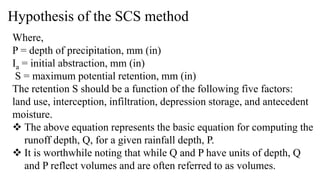
  • 91.
    Depth-Area- Duration Curve(DAD) curve duration of occurrence of the storm, D.  A DAD curve is a graphical representation of the gradual decrease of depth of precipitation with a progressive increase of the area of the storm away from the storm center, of a given duration taken as a third parameter.  It gives a direct relationship between depth, area and duration of precipitation over the region for which the analysis is carried out.  The main aim of the DAD analysis is to determine the maximum precipitation amounts that have occurred over various sizes of drainage area during the passage of storm periods of say 6hr, 12hr,
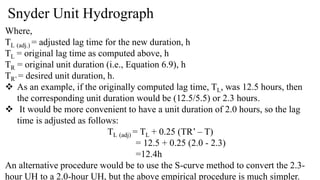
  • 92.
    Depth-Area- Duration Curve(DAD) curve 24hr or other durations.  There are two methods of carrying out the DAD analysis.  They are mass curve method and incremental-isohyetal method.  The second method is most popular and is extensively used by the hydrologists.  The procedure of DAD analysis is given herein. Step1: All the major storms of the area are identified Step 2: the duration of the storms are noted. For example, if the duration is chosen as 1-day, then all the storms occurring for 1-day period are selected. Further when a storm has occurred, say for 3 days, then the maximum one day precipitation out of the three days is also noted.
  • 93.
    Depth-Area- Duration Curve(DAD) curve Step 3: Isohyetal patterns for all 1-day storms are prepared on maps. Step 4: for each 1-day storm considered, the area bounded within the highest isohyet is determined.  This is called the eye-area of the storm.  Then the area bounded between the largest and the second largest isohyets is determined.  The depth of precipitation in the area covering up to the second largest isohyets is obtained as d2= (Pm1A1+ Pm2A2)/(A1+A2), where, Pm1 is the mean precipitation over the area A1 bounded within the highest isohyets and pm2 is the mean precipitation over the area A2 bounded between the largest and the second largest isohyets.
  • 94.
    Depth-Area- Duration Curve(DAD) curve  Similarly, for the area covering up to the 3rd largest isohyets, the depth of precipitation d3 can be obtained by the relation d3= (Pm1A1+Pm2A2+Pm3A3)/ A1+A2+A3) where pm3 is the mean precipitation between the second largest and the 3rd largest isohyets covering an area A3 between them.  The procedure is repeated to cover the remaining isohyets of the area. Step 5 : All the area- depth precipitations are recorded in a table Step 6: step 4 is repeated for all other 1-day storms considered for the area. Step 7: A graph is plotted taking area along the abscissa and maximum average depths of precipitation as ordinate covering the depth-area data of all 1-day storms of step 5.
  • 95.
    Depth-Area- Duration Curve(DAD) curve Step 8: Such an exercise may also be taken up for 6-hr, 12-hr, 2-day, and 3-day storms of the region.  The curves are plotted on the same paper as in step 6 Step 9: if a semi-log graph paper is used with area plotted on log scale then the curve will plot close to a straight line.
  • 96.
  • 97.
    Types of Streams (i)Perennial streams:  Are streams which have some flow at all times of a year due to considerable amount of base flow into the stream during dry periods of the year.  The stream bed is, obviously, lower than the ground water table in the adjoining aquifer (i.e., water bearing strata which is capable of storing and yielding large quantity of water).  When the surface runoff begins, the river level rises rapidly.  As a consequence the piezometeric gradient reverses and flow occurs from the stream into bank storage.  As the river level falls, the water from the banks starts to drain back into the river.
  • 98.
  • 99.
    Types of Streams (ii)Intermittent streams:  These streams have limited contribution from the ground water and that too during the wet season only when the ground water table is above the stream bed and, therefore, there is base flow contributing to the stream flow.  Excepting for some occasional storm that can produce short duration flow, such streams remain dry for most of the dry season periods of a year.
  • 100.
    Types of Streams (iii)Ephemeral streams:  These streams do not have any contribution from the base flow. The annual hydrograph, in the Fig. below, is of such a stream which shows series of short duration hydrographs indicating flash flows in response to the storm and the stream turning dry soon after the end of the storm.  Such streams, generally found in arid zones, do not have well defined channels.
  • 101.
    Types of Streams The most satisfactory determination of the runoff from a catchment is by measuring the discharge of the stream draining it, which is termed as stream gauging.  A gauging station is the place or section on a stream where discharge measurements are made. Streamflow Measurement  The total runoff consisting of surface flow, subsurface flow, groundwater or base flow, and the precipitation falling directly on the stream is the stream flow or the total runoff of a basin.
  • 102.
    Streamflow Measurement  Whenthe rate of rainfall or snowmelt exceeds the interception requirements and the rate of infiltration, water starts to accumulate on the surface.  At first the excess water collects into the small depressions and hollows, until the surface detention requirements are satisfied.  After that water begins to move down the slopes as a thin film and tiny streams.  This early stage of overland flow is greatly influenced by surface tension and friction forces.  With continuing rainfall the depth of surface detention and the rate of overland flow increase, Streamflow representing the runoff phase of the hydrologic cycle is the most important basic data for hydrologic studies.
  • 103.
    Streamflow Measurement  Streamflowis the only part of the hydrologic cycle that can be measured accurately.  It is measured in units of discharge (m3/s) occurring at a specified time and constitutes a historical data.  The measurement of discharge in a stream forms an important branch of Hydrometry, the science and practice of water measurement.  Streamflow measurement techniques can be broadly classified into two categories as  (a) Direct determination of stream discharge and  (b) Indirect determination. Under each category there are a host of methods.
  • 104.
    Streamflow Measurement a) Directmethod of streamflow measurement 1) Area velocity method (2) Dilution Technique (3) electromagnetic method and (4) Ultrasonic method b)Indirect determination of streamflow measurement 1)Hydraulic structures, such as weirs, flumes, and gated structures and 2)Slope area method The flow characteristics of a stream depend upon (i) the intensity and duration of rainfall besides spatial and temporal distribution of the rainfall,
  • 105.
    Streamflow Measurement ii) shape,soil, vegetation, slope, and drainage network of the catchment basin, and (iii) climatic factors influencing evapotranspiration. Based on the characteristics of yearly hydrograph, (graphical plot of discharge versus time in chronological order is plotted). A) Direct Measurement i)Area velocity method The area of cross-section of flow may be determined by sounding and plotting the profile. The mean velocity of flow (V) may be determined by making velocity measurements.
  • 106.
  • 107.
    Streamflow Measurement ii)STAGE-DISCHARGE-RATING CURVE The measurement of discharge by the direct method involves a two-step procedure, the development of the stage –discharge relationship which forms the first step is of at most importance.  Once the stage-discharge (G-Q) relationship is established, the subsequent procedure consists of measuring the stage (G) and reading the discharge (Q ) from the (G-Q) relationship.  This second part is a routine operation.  The stage discharge relationship is also known as rating curve.  The measured value of discharges when plotted against the corresponding stages gives relationship that represents the integrated effect of a wide range of channels and flow parameters
  • 108.
    Streamflow Measurement Is termedas control.  If the (G: Q) relationship for a gauging section is constant and does not change with time, the control is said to be permanent.  If it changes with time, it is called shifting control. Permanent Control  A majority of streams and rivers exhibits permanent control. For such a case, the relationship between the stage and the discharge is a single valued relation which is expressed as,  Where, Q= stream discharge  G= gauge height (stage)
  • 109.
    Streamflow Measurement a= aconstant which represent the gage reading corresponding to zero discharge cr and are rating curve constants. This relationship can be expressed graphically by plotting the observed relative stage (G: Q) against the corresponding discharge values in an arithmetic or logarithmic plots
  • 110.
  • 111.
    Streamflow Measurement  Ariver is gauged by current meter throughout the rainy season (for about 3 months) at different stages (water levels) of the river.  The water stage can be read on the enamel painted staff gauges (gauge posts) erected at different levels at a gauging station.  It may be noted that corresponding graduation of gauge posts at two locations are fixed at the same level.  A curve is drawn by plotting ‘stream discharge ‘Q vs. gauge height h’ which is called the ‘stage discharge rating curve’ as shown in Figure below.  From this rating curve, the stream discharge corresponding to staff gauge readings taken throughout the year/s can be obtained, as long as the section of the stream at or near the gauging site has not
  • 112.
    Streamflow Measurement Periodical gauging(say, once in three years) are conducted to verify the rating curve, or to revise the rating curve if any change in section has been noticed. Figure gauge posts on river banks
  • 113.
  • 114.
    Streamflow Measurement B) Indirectmethod of streamflow measurement  Under this category are included those methods which make use of the relationship between the flow discharge and the depths at specified locations.  The field measurement is restricted to the measurements of depths only. Two broad classifications of these indirect methods are (1) flow measuring structures (2) Slope-area method Flow Measuring Structures (a) Venturiflumes or standing wave flumes (critical depth meter) for small channels.
  • 115.
    Streamflow Measurement  Aventuri flume is a structure in a channel which has a contracted section called throat, downstream of which followed a flared transition section designed to restore the stream to its original width.  It is a structure which is used for measuring discharge in open channels.  The discharge Q flowing through the channel can be calculated by measuring the depths of flow at the entrance and the throat of the flume and applying the following formula:
  • 116.
    Streamflow Measurement  Inwhich A, a, and H, h are the areas and depths of flow section at entrance and throats of the flume respectively and k is the discharge coefficient of the flume.  The discharge coefficient must be determined by calibration through the entire range of head. (b) Weirs  A weir is the name given to a concrete or masonry structure built across a river or stream in order to raise the level of water on the upstream side and to allow the excess water to flow over its entire length to the downstream side.  Weirs are used for measuring the rate of flow of water in rivers or streams.
  • 117.
    Streamflow Measurement  Forcomputing the discharge of water flowing over the weir the following relation can be used. Q=CLH3/2 Where, Q = stream discharge, C = coefficient of weir, L = length of weir, H = head (depth of flow) over the weir crest. (c) Slope-area method  During very high floods, a site may become inaccessible or the gauge-discharge setup may be fully inundated.  Under such situations, discharge measurements can be accomplished using slope-area method.
  • 118.
    Streamflow Measurement  Theprevious peak flood stages at two locations can be collected from the flood marks in the river courses which give the water surface slope of the peak flood.  By knowing the distance between the two points along the river, slope Sf can be computed.  Manning’s equation can be used to calculate the discharge as  Q = AV V=C RS Chezy’s formula V= S R n 2 / 1 3 / 2 1 Manning’s formula
  • 119.
    Streamflow Measurement Chezy’s C=R n 6 / 1 1 , R= P A Where, C = Chezy’s constant N = Manning’s coefficient of roughness R = hydraulic mean radius A = cross-sectional area of flow P = wetted perimeter S = water surface slope (= bed slope)  The cross-sectional area A is obtained by taking soundings below the water level at intervals of, say, 6 m and plotting the profile of the cross-section and drawing the high flood level or water surface level.
  • 120.
    Streamflow Measurement The watersurface slope is determined by means of gauges placed at the ends of the reach, say 1 km upstream of the gauging station and 1 km downstream of the gauging station(in a straight reach; if Δh is the difference in water levels in a length L of the reach, then S =Δh/L. The slope may also be determined by means of flood marks on either side or their subsequent leveling. The slope-area method is often used to estimate peak floods where no gauging station exists. (d) Contracted area methods: The drop in water surface in contracted sections as in bridge openings, canal falls etc. is measured and the discharge is approximately given by:
  • 121.
    Contracted area methods Q= Cd A1   ha h g   2 Where, Cd = coefficient of discharge A1 = area of the most contracted section Δh = difference in water surface between the upstream and downstream ends (of the pier) ha = head due to the velocity of approach. The hydrologic Budget  The area of land draining into a stream or a water course at a given location is known as catchment area.  It is also called a drainage basin.  Catchment area is separated from its neighboring areas by a ridge
  • 122.
    The Hydrologic Budget Thus,the catchment area is a logical and convenient unit to study various aspects relating to hydrology and water resources of a region. Rainfall can be viewed as an input to the surface of Earth. The surface can be viewed as a series of storage elements, such as storage on the surface of vegetation and depression storage. Runoff from the surface can be viewed as an output from surface storage elements. This would be a systems representation of the physical processes controlling surface runoff.
  • 123.
    The Hydrologic Budget Ifriver channel processes are the important elements of the hydrologic design, then the surface runoff can be viewed as the input, the channel itself as the storage element, and the runoff out of the channel (into another channel, a lake, or an ocean) as the output from the system.  A water budget is an accounting of water movement into and out of, and storage change within, some control volume.  The universal concept of mass conservation of water implies that water-budget methods are applicable over any space and time scales (Healy et al., 2007).
  • 124.
    The Hydrologic Budget The water budget of a soil column in a laboratory can be studied at scales of millimeters and seconds.  A water-budget equation is also an integral component of atmospheric general circulation models used to predict global climates over periods of decades or more.  Water-budget methods represent the largest class of techniques for estimating recharge.  Most hydrologic models are derived from a water-budget equation and can therefore be classified as water-budget models.  For a given problem area, say a catchment, in an interval of time ∆t, the continuity equation for water in its various phases is written as:
  • 125.
    The Hydrologic Budget Massinflow-mass outflow = change in mass storage  Inflows add water to the different parts of the hydrologic system, while outflows remove water.  Storage is the retention of water by parts of the system. Because water movement is cyclical, an inflow for one part of the system is an outflow for another.  The conceptual representation of hydrologic systems can be stated in mathematical terms.  Letting I, 0, S, and t denote the input, output, storage, and time, respectively, the following equation is known as the linear storage equation:
  • 126.
    The Hydrologic Budget The derivative on the right-hand side of the above Equation can be approximated by the numerical equivalent ∆S/ ∆t, when one wishes to examine the change in storage between two times, say t2 and t1.  In this case, the above Equation becomes: in which S2 and S1 are the storages at times t2 and t1, respectively.  The earth's water supply remains constant, but man is capable of altering the cycle of that fixed supply.  Population increases, rising living standards, industrial and economic growth have placed greater demands on our natural environment.
  • 127.
    The Hydrologic Budget Ouractivities can create an imbalance in the hydrologic equation and can affect the quantity and quality of natural water resources available to current and future generations. The storage equation can be used for other types of hydrologic problems. Estimates of evaporation losses from a lake could be made by measuring: all inputs, such as rainfall (I1), inflow from streams (I2), and ground-water inflow (I3); all outputs, such as streamflow out of the lake (O1), ground-water flow out of the lake (O2), and evaporation from the lake (O3); and the change in storage between two time periods, Mathematically, the water balance is:
  • 128.
    The Hydrologic Budget Thehydrologic budget is a convenient way of modeling the elements of the hydrologic cycle. It will be used frequently in describing the problems of analysis and design.
  • 129.
    The Hydrologic Budget Accordingto estimates (Seckler et al., 1998), the annual average depth of precipitation on the land surface is about 108*103 km3. Out of this, about 61*103 km3 is returned to the atmosphere as evapotranspiration and the runoff from land to oceans is 47*103 km3.  As far as the water balance of oceans is concerned, the depth of precipitation over them is about 410*103 km3 , 47 *103 km3 of water is received as runoff from the land, and 457*103 km3 is lost as evaporation.  If we consider the water balance of atmosphere, 457*103 km3 of water is received as evaporation from oceans and 61*103 km3 from land. The precipitation over oceans is 410*103 km3 and it is 108*103 km3 over land.
  • 130.
    Global Water Balance The hydrologic equation may be applied for areas of any size, but the complexity of computation greatly depends on the extent of the area under study.  The smaller is the area, the more complicated is its water balance because it is difficult to estimate components of the equation.  Finally, the components of the hydrologic equation may be expressed in terms of the mean depth of water (mm), or as a volume of water (m3), or in the form of flow rates (m3/s or mm/s).
  • 131.
    Infiltration Estimating the quantityof flow allows us to determine the fraction of the rainfall that will contribute to surface runoff, and the fraction that will feed the groundwater flow and thus recharge the aquifers.  Infiltration is the transfer of water through the surface layers of the soil after it has been subjected to rain or has been submerged. The infiltrating water initially fills the interstices in the surface soil and then penetrates the soil under the forces of gravity and soil suction. The rate at which net precipitation enters the soil surface depends on several soil surface conditions and the physical characteristics of the soil itself.
  • 132.
    Infiltration Infiltration affects manyaspects of hydrology, agricultural engineering and hydrogeology.
  • 133.
    Infiltration The maximum rateat which water can enter the soil surface is called infiltration capacity. Infiltration capacity diminishes over time in response to several factors that affect the downward movement of the wetting front. The size of individual pores and the total amount of pore space in a soil generally decrease with increasing soil depth. The actual infiltration rate equals the infiltration capacity only when the rate of rainfall or snowmelt equals or exceeds the infiltration capacity. When rainfall or snowmelt rates exceed infiltration capacity, surface runoff or ponding of water on the soil surface occurs.
  • 134.
    Infiltration When rainfall intensityis less than the infiltration capacity, the rate of infiltration equals rainfall intensity. In these instances, water enters the soil and is either held within the soil if soil moisture content is less than the field capacity or percolates downward under the influence of gravity when soil moisture content is greater than the field capacity. The infiltration capacity of a soil depends on several factors including texture, structure, surface conditions, the nature of soil colloids, organic matter content, soil depth or the presence of impermeable layers, and the presence of macro-pores within the soil. Macro-pores function as small channels or pipes within a soil and are non-uniformly distributed pores created by processes such as
  • 135.
    Infiltration earthworm activity, decayingplant roots, the burrowing of small animals, and so forth. Rate of infiltration i (t): also called the infiltration regime, is the rate of flow of water penetrating the soil.  It is usually expressed in mm/h.  The rate of infiltration depends above all on the mode of inputs (irrigation, rain) but also on the properties of the soil. Cumulative infiltration, I(t): is the total volume of water infiltrated in a given time period.  It is equal to the integral over time of the rate of infiltration,
  • 136.
    Infiltration Where, I(t) isthe cumulative infiltration at time t [mm] and i(t) is the rate of infiltration for time t [mm/h]. Figure General Evolution of the rate of infiltration and of cumulative infiltration over time (Ks = saturated hydraulic conductivity)
  • 137.
    Infiltration Saturated hydraulic conductivity(Ks): is a key parameter of infiltration.  It represents the limit value of the rate of infiltration if the soil is saturated and homogeneous.  This parameter is part of many equations for calculating infiltration. Infiltration capacity or absorption capacity: is the maximum amount of water flow that the soil can absorb through its surface, when it receives an effective rainfall or is covered with water.  It depends on texture and structure of the soil, and also on the initial conditions, which is to say, the initial water content of the soil profile and the water content imposed on the surface.
  • 138.
    Infiltration Many equations havebeen proposed to express the curves fp(t) or Fp(t) for use in hydrological analysis. Four such equations will be discussed: a)Horton’s Equation: According to Horton (1933), the expression used to find infiltration capacity is given as: Where, fp =the infiltration capacity (depth/time) at some time t K= a constant representing the rate of decrease in f capacity fc= a final or equilibrium capacity f0= the initial infiltration capacity
  • 139.
    Infiltration b)Philip’s Equation(1957): Where, s=a function of soil suction potential and called sorptivity K= Darcy’s hydraulic conductivity  Infiltration capacity could be expressed as: c)Kostiakov equation (1932): Kostiakov model expresses cumulative infiltration capacity as: Where a and b are local parameters with a>0 and 0<b<1
  • 140.
    Infiltration The infiltration capacitywould be expressed as: d)Green-Ampts equation(1911):Green and Ampts proposed a model for infiltration capacity based on Darcy’s law as: Where, porosity of the soil Sc=capillary suction at the wetting front and K= Darcy’s hydraulic conductivity
  • 141.
    Percolation and effectiverainfall Percolation: indicates the vertical flow of water in the soil (unsaturated porous media) towards the groundwater table, mostly under the influence of gravity.  This process follows infiltration and directly determines the water supply to underground aquifers. Precipitation excess or effective rainfall: is the quantity of rain that flows only on the surface of the soil during a rain.  The net storm rain is deducted from the total rainfall, minus the amounts that are intercepted by vegetation or stored in depressions in the soil, and minus the fraction that infiltrates.
  • 142.
    Factors Influencing Infiltration Infiltration is affected by the following main factors: a) Type of soil (structure, texture, porosity): The characteristics of the soil matrix influence the forces of capillarity and adsorption giving rise to the force of suction, which in part governs infiltration. b) Compaction of the soil surface: is the result of the impact of rain drops or other causes (thermal and anthropogenic).  For example, heavy machinery in agricultural land can degrade the structure of the surface soil layer and cause the formation of a dense and impermeable crust to a certain depth (this can be the result of plowing, for example).
  • 143.
    Factors Influencing Infiltration The Figure below illustrates some examples of the evolution of the infiltration rate over time as a function of the soil type. Figure Infiltration regime as a function of time for different soil types (based on Musy and Soutter, 1991)
  • 144.
    Factors Influencing Infiltration c)Soil cover: Vegetation has a positive influence on infiltration by slowing down surface runoff and giving the water more time to penetrate the soil.  In addition, the root systems improve the permeability of the soil. Lastly, foliage protects the soil from the impact of the rain drops, and so decreases surface sealing. d) Topography and morphology: Slope, for example, has the opposite effect of vegetation. A steep slope increases surface flow at the expense of infiltration. e) Water Supply: This is the intensity of precipitation or the irrigation water rate.
  • 145.
    Factors Influencing Infiltration f)Initial water content of the soil: The water content of the soil is an essential factor affecting the infiltration rate, because the force of suction is a function of the moisture content in the soil.  The infiltration rate over time will evolve differently depending on the initial condition (wet or dry) of the soil.  The moisture content of the soil is usually understood by studying the precipitation that fell in a given time period preceding rain.  The Antecedent Precipitation Indices (IAP) are often used to establish the moisture content of the soil preceding a rain.  In summary, for the same type of topography, the most influential factors affecting infiltration are the soil type, the soil cover, and the initial water content.
  • 146.
    Infiltration Indices  Inhydrological calculations involving floods it is found convenient to use a constant value of infiltration rate for the duration of the storm.  The defined average infiltration rate is called infiltration index and two types of indices are in common use. Φ-Index  Infiltration indexes generally, assume that infiltration occurs at some constant or average rate throughout a storm.  Consequently, initial rates are underestimated and final rates are overestimated if an entire storm sequence with little antecedent moisture is considered.  The Φ-index is the average rainfall above which the rainfall volume is equal to the runoff volume.
  • 147.
    Infiltration Indices  TheΦ-index is derived from the rainfall hyetograph with the knowledge of the resulting runoff volume.  If the rainfall intensity is less than Φ, then the infiltration rate is equal to the rainfall intensity; however, if the rainfall intensity is larger than Φ the difference between the rainfall and infiltration in an interval of time represents the runoff volume.  The amount of rainfall in excess of the index is called rainfall excess.  In connection with runoff and flood studies it is also known as effective rainfall.  The Φ-index accounts for the total abstraction and enables magnitudes to be estimated for a given rainfall hyetograph.
  • 148.
    Infiltration Indices  TheΦ-index is derived from the rainfall hyetograph with the knowledge of the resulting runoff volume.  If the rainfall intensity is less than Φ, then the infiltration rate is equal to the rainfall intensity; however, if the rainfall intensity is larger than Φ the difference between the rainfall and infiltration in an interval of time represents the runoff volume.  The amount of rainfall in excess of the index is called rainfall excess.  In connection with runoff and flood studies it is also known as effective rainfall.  The Φ-index thus accounts for the total abstraction and enables magnitudes to be estimated for a given rainfall hyetograph.
  • 149.
    Infiltration Indices Mathematically, theΦ-index can be expressed as: Where, p= total storm precipitation (mm or cm) R= total direct surface runoff (mm or cm) te= duration of the excess rainfall, i.e., the total time in which the total intensity is greater than Φ (in hours), and Φ= uniform rate of infiltration (mm/hr or cm/hr)
  • 150.
  • 151.
    Infiltration Indices W-Index  Inan attempt to refine the Φ-index, the initial losses are separated from the total abstractions and an average value of infiltration rate (called the w-index) is calculated as given below: Where, p= total storm precipitation (cm) R=total storm runoff (cm) Ia= initial losses (cm) te= duration of the excess rainfall (in hours), i.e., the total time in which the rainfall intensity is greater than infiltration capacity and
  • 152.
    Infiltration Indices w= averagerate of infiltration (cm/hr)  The minimum value of W-index obtained under very wet soil conditions, representing the constant minimum rate of infiltration of the catchment, is known as Wmin.  It is to be noted that both the -index and W index vary from storm to storm. Rainfall-Runoff Relation  When rain falls on the earth’s surface, some of that rain is intercepted by the surfaces of vegetation located in its path (interception)  Depending on soil characteristics and amount of rainfall, some or all of the remaining rainfall will enter the ground through pores in the
  • 153.
    Rainfall-Runoff Relation surface soils(infiltration).  As the remaining water, if any, flows overland, irregularities in the surface of the land trap some of this water as depression storage.  The portion of this overland flow that reaches the watershed outlet is called direct runoff, or storm water runoff.  This relationship can be expressed as a storm event water balance, by the following equation:  Runoff = Precipitation - Interception - Infiltration - Depression Storage-Evapotranspiration  This very basic relationship is the basis for most methods used to estimate runoff.
  • 154.
    Rainfall-Runoff Relation  Inhydrologic analysis, interception, infiltration, and depression storage are sometimes referred to as “abstractions”.  Thus, runoff is what remains of rainfall, after accounting for abstractions.  When we estimate runoff, we are concerned with the quantities of runoff volume and runoff rate. Runoff Volume  The volume of surface runoff that will occur on a site during a given rainfall event depends on a number of factors:  For very large watersheds, the volume of runoff from one storm event may depend on rainfall that occurred during previous storm events.
  • 155.
    Rainfall-Runoff Relation  Inaddition to rainfall, other factors affect the volume of runoff are: Basin characteristics  Size, Shape, Slope, Altitude (elevation), Topography, Geology (type of soil), Land use/land cover /vegetation, Orientation, Type of drainage network , Proximity to ocean and mountain ranges. Storm characteristics  Amount of precipitation; Rainfall event, duration and intensity; Type or nature of storm and season, Intensity of storm, Duration and Areal extent (distribution), Frequency antecedent precipitation and Direction of storm movement. Storage characteristics Depressions Pools and ponds / lakes Stream Channels, Check dams,
  • 156.
    Rainfall-Runoff Relation (in gullies),Upstream reservoir /or tanks Flood plains, swamps Ground water storage in pervious deposits (aquifers In analyzing the hydrology of an area, several runoff volume quantities are of interest. For instance:  The runoff volume associated with a storm event;  The runoff volume over an extended time (e.g., annual runoff);  A runoff volume for water quality treatment.  Runoff volumes are generally estimated in terms of “watershed meters”, cubic meters (m3), or acre-feet.  A “watershed -meter” is equivalent to a one-meter depth of water spread over the entire contributing watershed.
  • 157.
    Rainfall-Runoff Relation  An“acre-foot” is equivalent to one foot of water spread over an acre of area. Methods Commonly used for Estimating Runoff Volume  The volume of runoff that will occur on a site during a given rainfall event depends on a number of factors:  The area of land from which runoff occurs (known as the watershed);  amount of precipitation;  the duration and intensity (volume per unit of time) at which precipitation falls;  the soils at and near the land surface; and  the surface cover (combination of exposed earth, vegetation, pavement and roofs).
  • 158.
    Rainfall-Runoff Relation  Therate at which runoff discharges from a given site is known as the runoff rate or discharge rate. The rate of runoff depends on the following factors  the roughness of the surface, which is determined by the type of surface cover;  the location of the impervious area in the watershed in relation to the point of analysis;  slope of the ground surface (flatter slopes result in slower rates of flow over the ground, steeper slopes result in faster rates of flow);  total distance the runoff must travel to the point of analysis. How is Runoff Related to Rainfall?
  • 159.
    Rainfall-Runoff Relation  Whenrain falls on the earth’s surface, some of that rain is intercepted by the surfaces of vegetation located in its path (interception).  Depending on soil characteristics and amount of rainfall, some or all of the remaining rainfall will enter the ground through pores in the surface soils (infiltration).  As the remaining water, if any, flows overland, irregularities in the surface of the land trap some of this water as depression storage.  The portion of this overland flow that reaches the watershed outlet is called direct runoff, or storm water runoff. This relationship can be expressed as a storm event water balance, by the following equation:  Runoff = Precipitation - Interception - Infiltration - Depression
  • 160.
    Rainfall-Runoff Relation  Thisvery basic relationship is the basis for most methods used to estimate runoff.  In hydrologic analysis, interception, infiltration, and depression storage are sometimes referred to as “abstractions”.  Thus, runoff is what remains of rainfall, after accounting for abstractions.  Anything that affects the “abstraction” processeswill affect the amount of runoff. Runoff Volume  The volume of surface runoff that will occur on a site during a given rainfall event depends on a number of factors:  Watershed area;
  • 161.
    Runoff Volume  Rainfallevent duration and intensity (volume per unit of time);  Surface soils characteristics; and  and-use surface cover.  Runoff volumes are generally estimated in terms of “watershed inches”, cubic feet (ft3), or acre-feet.  A “watershed inch” is equivalent to a one-inch depth of water spread  over the entire contributing watershed.  An “acre-foot” is equivalent to one foot of water spread over an acre of area. Methods Commonly used for Estimating Runoff  There are many methods available for the estimation of runoff volumes and rates.
  • 162.
    Methods Commonly usedfor Estimating Runoff  Runoff volume and rate can be estimated using Soil Conservation Service (SCS, now the Natural Resources Conservation Service) methods, assuming the necessary underlying assumptions of the SCS models are satisfied.  The selection of methods depends on a number of factors, including:  Whether the method will be used to estimate total runoff volumes, peak rates, or variations of flow rate with time over the duration of a storm event;  Whether the values obtained by the method will be used for sizing storm drain pipes,  detention facilities, water quality treatment facilities, or other purpose;  Limitations inherent in each method;
  • 163.
    Methods Commonly usedfor Estimating Runoff  Data available for performing the calculations; and  Whether the method requires calibration to actual field data. The Rational Method The SCS Curve Number/Unit Hydrograph Method The Rational Method:  is generally used for estimating peak flows, to develop designs for conveyance systems such as culverts, piped storm drains, and open channel systems.  While there is an adaptation of the rational method that may be used for estimating detention storage volumes, the method is cumbersome to use in comparison to other available modeling tools.
  • 164.
    The Rational Method Also, it is not generally appropriate for development of peak rate control devices such as detention and retention basins.  For those interested in how to use the Rational Method,  Applicability:  Required output: peak discharge only  Drainage area: less than or equal to 20 acres  The Rational Method is used for determining peak discharges from small drainage areas.  This method is traditionally used to size storm sewers, channels, and other storm water structures, which handle runoff from drainage areas less than 20 acres.  The Rational Formula is expressed as q=C*i*A
  • 165.
    The Rational Method where: q= Peak rate of runoff in cubic feet per second C = Runoff coefficient, an empirical coefficient representing a relationship between rainfall and runoff i = Average intensity of rainfall in inches per hour for the time of concentration (Tc) for a selected frequency of occurrence or return period. Tc = The rainfall intensity averaging time usually referred to as the time of concentration, equal to the time required for water to flow form the hydraulically most distant point in the watershed to the point of design. A = The watershed area in acres
  • 166.
    Runoff Estimation RationalMethod Description of Step Reference Step 1 Identify Analysis Points Step 2 Delineate Watershed of Each Analysis Point Step 3 Characterize Each Watershed:  Total area (A), expressed in acres Land cover type, soils, and slope condition – corresponding to table of runoff coefficients Area of each cover/soils/slope complex Step 4 Determine Runoff Coefficient (C)  Determine c for each unique sub-area, based on cover/soils/slope complex
  • 167.
    Runoff Estimation RationalMethod  Determine weighted c for each watershed Step 5 Determine Time of Concentration (tc) Note that this time is sometimes expressed in hours, and sometimes in minutes, and may need to be converted to appropriate units for computing intensity Step 6 Determine Rainfall Intensity (i) Note that intensity must be expressed in units of inches/hour Step 7 Determine Peak Discharge (q, expressed in cfs) Use Rational Formula: q = C * i * A
  • 168.
    Assumptions in RunoffEstimation Using Rational Method 1.The peak rate of runoff at any point is a direct function of the tributary drainage area and the average rainfall intensity during the time of concentration to that point. 2. The return period of the peak discharge rate is the same as the return period of the average rainfall intensity or rainfall event. 3. The rainfall is uniformly distributed over the watershed. 4. The rainfall intensity remains constant during the time period equal to Tc. 5. The relationship between rainfall and runoff is linear. 6. The runoff coefficient, C, is constant for storms of any duration or frequency on the watershed.
  • 169.
    Limitations 1.When basins becomecomplex, and where sub-basins combine, the Rational Formula will tend to overestimate the actual flow 2. The method assumes that the rainfall intensity is uniform over the entire watershed. This assumption is true only for small watersheds and time periods, thus limiting the use of the formula to small watersheds. 3The results of using the formula are frequently not replicable from user to user. There are considerable variation in interpretation and methodology in the use of the formula. 4. The Rational Formula only produces one point on the runoff hydrograph, the peak discharge rate.
  • 170.
    The SCS CurveNumber Method  In 1972, the soil conservation service developed a method for computing abstractions from storm rainfall, considering the storm as a whole, the depth of excess precipitation or direct runoff Pe is always less than or equal to the depth of precipitation P.  Similarly, after runoff begins, the additional depth of water retained in the watershed Fa is less than or equal to the potential maximum retention S.  There is some amount of rainfall in the form of initial abstraction before ponding Ia, for which no runoff will occur.  Hence, the potential runoff is P-Ia.
  • 171.
    The SCS CurveNumber Method  For many peak discharge estimation methods, the input includes variables to reflect the size of the contributing area, the amount of rainfall, the potential watershed storage, and the time-area distribution of the watershed.  These are often translated into input variables such as the drainage area, the depth of rainfall, an index reflecting land use and soil type, and the time of concentration.  In developing the SCS rainfall-runoff relationship, the total rainfall was separated into three components: direct runoff (Q), actual retention (F), and the initial abstraction (Ia).  The retention (F) was assumed to be a function of the depths of rainfall and runoff and the initial abstraction.
  • 172.
    Hypothesis of theSCS method  The ratio of actual additional depth of water retained in the watershed Fa to the potential maximum retention S is equal to the ratio of the actual depth of excess of precipitation or direct runoff Pe to the potential runoff (P-Ia). That is, (1)  Applying the principle of continuity, we have, Depth of precipitation= Depth of excess precipitation or direct runoff + depth of initial abstraction before ponding +additional depth of water retained in the watershed ( 2)
  • 173.
    Hypothesis of theSCS method From equation (1) (3) From equation (2) (4) Substituting the value of Fa in equation (4) in equation (3) we have
  • 174.
    Hypothesis of theSCS method  This equation is the basic equation for computing the depth of excess rainfall or direct runoff from a storm by SCS method.  By study of results from many small experimental watershed, an empirical relation was developed. Ia =0.2S Substituting Ia =0.2S in equation
  • 175.
    Hypothesis of theSCS method Where, P = depth of precipitation, mm (in) Ia = initial abstraction, mm (in) S = maximum potential retention, mm (in) The retention S should be a function of the following five factors: land use, interception, infiltration, depression storage, and antecedent moisture.  The above equation represents the basic equation for computing the runoff depth, Q, for a given rainfall depth, P.  It is worthwhile noting that while Q and P have units of depth, Q and P reflect volumes and are often referred to as volumes.
  • 176.
    Hypothesis of theSCS method Additional empirical analyses were made to estimate the value of S. The studies found that S was related to soil type, land cover, and the hydrologic condition of the watershed. These are represented by the runoff curve number (CN), which is used to estimate S by: Empirical analyses suggested that the CN was a function of three factors: soil group, the cover complex, and antecedent moisture conditions.
  • 177.
    Soil Group Classification SCS developed a soil classification system that consists of four groups, which are identified by the letters A, B, C, and D.  Soil characteristics that are associated with each group are as follows: Group A: deep sand, deep loess; aggregated silts Group B: shallow loess; sandy loam Group C: clay loams; shallow sandy loam; soils low in organic content; soils usually high in clay Group D: soils that swell significantly when wet; heavy plastic clays; certain saline soils Cover Complex Classification:  The SCS cover complex classification consists of three factors: land use, treatment or practice, and hydrologic condition.
  • 178.
    Cover Complex Classification Many different land uses are identified in the tables for estimating runoff curve numbers.  Agricultural land uses are often subdivided by treatment or practices, such as contoured or straight row; this separation reflects the different hydrologic runoff potential that is associated with variation in land treatment.  The hydrologic condition reflects the level of land management; it is separated into three classes: poor, fair, and good.  Not all of the land uses are separated by treatment or condition.
  • 179.
  • 180.
  • 181.
  • 182.
    Cover Complex Classification To standardize the SCS curves, a dimensionless curve number CN is defined such that 0 ≤ CN ≤ 100.  The curve for dry conditions (AMC I) or wet conditions (AMCIII), equivalent curve numbers can be computed by: and  The range of antecedent moisture conditions for each classes is shown in the following table. CN (I) =     II CN II CN 058 . 0 10 2 . 4 
  • 183.
    Cover Complex Classification Table:Classification of antecedent moisture classes (AMC) for the SCS method of rainfall abstractions AMC group Total 5-day antecedent rainfall(inches) Dormant seasons Growing seasons I <0.5 <1.4 II 0.5 to 1.1 1.4 to2.1 III >1.1 >2.1 Runoff Rate  The term runoff rate refers to the volume of runoff discharging from a given watershed per unit of time.
  • 184.
    Runoff Rate  Therate at which runoff discharges from a given watershed depends on the following factors in addition to those affecting runoff volume: Surface roughness (determined by the type of surface cover);  Location of impervious area in the watershed relative to the point of analysis;  Slope of the ground surface;  Distance the runoff must travel to the point of analysis.  Runoff rates (volume of runoff in a unit time) are usually estimated or measured in cubic meter per second (m3/s). Runoff Depth Estimation  A common assumption in hydrologic modeling is that the rainfall available for runoff is separated into three parts:
  • 185.
    Runoff Depth Estimation direct(or storm) runoff, initial abstraction, and losses.  Factors that affect the split between losses and direct runoff include the volume of rainfall, land cover and use, soil type, and antecedent moisture conditions.  Land cover and land use will determine the amount of depression and interception storage.  The following equation can be used to compute a peak discharge with the SCS method:  Where, qp = peak discharge, m3/s (ft3/s  qu = unit peak discharge, m3/s/km2/mm (ft3/s/ mi2/in)  A = drainage area, km2 (mi2) Q = depth of runoff, mm (in).
  • 186.
    Base Flow Separation The first step in developing a unit hydrograph is to plot the measured hydrograph and separate base flow from the total runoff hydrograph  In perennial streams the base flow is not assumed to be part of the runoff from a given rainfall and is separated first  The separation of the base flow, however, is not an easy task.
  • 187.
  • 188.
  • 189.
    Base Flow Separation c)Method III: In this method the base flow curve existing prior to the commencement of the surface runoff is extended till it intersects the ordinate drawn at the peak point. Then this point is joined to point C by a straight line
  • 190.
    2.RESPONSE FUNCTIONS OFLINEAR SYSTEMS UNIT HYDROGRAPH CONCEPTS  The hydrograph is the response of a given catchment to a rainfall input  The interactions of various storms and catchments are in general extremely complex  Two different storms in a given catchment produce hydrographs differing from each other  Similarly identical storms in two catchment produce hydrographs that are different  These complex hydrographs are the result of storm and catchment peculiarities and their complex interaction.  Hence, simple hydrographs resulting from isolated storms are preferred for
  • 191.
    UNIT HYDROGRAPH CONCEPTS The unit hydrograph is a simple linear model that can be used to derive the hydrograph resulting from any amount of excess rainfall.  First proposed by Sherman (1932), the unit hydrograph originally named unit-graph of a watershed is defined as a direct runoff hydrograph (DRH) resulting from 1’’ (usually taken as 1 cm in SI units) of excess rainfall generated uniformly over the drainage area at a constant rate for an effective duration.  Sherman originally used the word “unit” to denote a unit of time. But since that time it has often been interpreted as a unit depth of excess rainfall.
  • 192.
    UNIT HYDROGRAPH CONCEPTS Sherman classified runoff into surface runoff and groundwater runoff and defined the unit hydrograph for use only with surface runoff  The unit hydrograph is a widely used element of hydrological studies and applies to runoff from rainfall only, not to that from melting of snow or ice.  The UH refers to runoff from a rainfall excess uniformly distributed over the entire catchment.  Isolated storm results single peak hydrograph and complex storm yields multiple peak hydrograph The following basic assumptions are inherent in this model;  1. Rainfall excess of equal duration are assumed to produce hydrographs with equivalent time bases regardless of the intensity of the rain,
  • 193.
    UNIT HYDROGRAPH CONCEPTS 2.Direct runoff ordinates for a storm of given duration are assumed directly proportional to rainfall excess volumes. 3. The time distribution of direct runoff is assumed independent of antecedent precipitation, 4. Rainfall distribution is assumed to be the same for all storms of equal duration, both spatially and temporally. Sherman based his formulation on three postulates: (a)Constant base length: This means that for a given catchment the duration of runoff is essentially constant for all rainfalls of a given duration and independent of the total volume of runoff. (b) Proportional ordinates. It is assumed that for a given duration and catchment the ordinates of the runoff hydrograph are proportional to the total volume of
  • 194.
    UNIT HYDROGRAPH CONCEPTS (c)Superposition. This is the assumption of linearity. Accordingly the runoff hydrograph of a particular rainfall can be superimposed with concurrent runoff due to preceding rainfalls.  The unit hydrographs are derived from measured hydrographs and therefore incorporate the integrated effect of all the catchment characteristics, such as infiltration, surface detention, physical features and vegetation of the catchment, as well as the effect of the actual distribution of rainfall. Rules to be observed in developing UH from gauged watershed  1. Storms should be selected with a simple structure with relatively uniform spatial and temporal distributions
  • 195.
    UNIT HYDROGRAPH CONCEPTS 2.Watershed sizes should generally fall between 1.0 and 100 mi2 in modern watershed analysis 3. Direct runoff should range 0.5 to 2 in. 4. Duration of rainfall excess D should be approximately 25% to 30% of lag time tp 5. A number of storms of similar duration should be analyzed to obtain an average UH for that duration 6. Step 5 should be repeated for several rainfalls of different durations Essential steps for developing UH from single storm hydrograph 1. Analyze the hydrograph and separate base flow 2. Measure the total volume of DRO under the hydrograph and convert time to inches (mm) over the watershed
  • 196.
    UNIT HYDROGRAPH CONCEPTS 3.Convert total rainfall to rainfall excess through infiltration methods, such that rainfall excess = DRO, and evaluate duration D of the rainfall excess that produced the DRO hydrograph 4. Divide the ordinates of the DRO hydrograph by the volume in inches (mm) and plot these results as the UH for the basin. Time base Tb is assumed constant for storms of equal duration and thus it will not change. 5. Check the volume of the UH to make sure it is 1.0 in. (1.0mm), and graphically adjust ordinates as required. Hydrograph Components A hydrograph has four components. (1) Direct surface runoff, (2) interflow (3) groundwater or base flow, and 4) Channel precipitation.
  • 197.
    Hydrograph Components  Hydrographhas three regions: rising limb, crest segment and falling limb.  Rising limb–Ascending portion representing rising discharge due to gradual increase in flow in stream. Slope depend on storm and basin characteristics.  Crest Segment–Inflection point on rising limb to falling limb, Indicate the peak flow, Controlled by storm and watershed characteristics, multiple peaks due to occurrence of two or more storms of different intensities in a closer interval.  Falling limb (recession limb) –From point of inflection at the end of crest segment to base flow.
  • 198.
    Hydrograph Components  Inflectionpoint indicate the time at which rainfall stopped.  Hydrograph shape is independent of storm characteristics but dependent on watershed characteristics.
  • 199.
    Hydrograph Components Factors affectingshape of hydrograph A. Climatic factors Form of precipitation: Rainfall and snow fall –rainfall tends to produce runoff rapidly generating hydrograph with high peak and narrow base, affect volume of runoff, occurrence of peak flow, and duration of surface flow. Duration of rainfall- Longer the duration more the volume, longer duration, peak flow occur after longer time and hydrograph is flatter with broad base. Distribution of rainfall- When heavy rain occur near outlet, Peak flow occur quickly and When heavy rain occur in upper areas Peak flow occur after few hours, Lower peak and broad base (more time taken for flow to reach
  • 200.
    Factors affecting shapeof hydrograph Direction of storm movement- Affects amount of peak flow and surface flow duration. Upward direction –lower peak and broad base, downward direction- sharp peak and narrow base. Rainfall Intensity- Higher the intensity quicker the peak flow and conical hydrograph  The most venerable and widely used transfer function for systems modeling of hydrologic response is the unit hydrograph.  The central hypothesis of the unit-hydrograph approach is that watershed response is linear; that is, the ordinates of the hydrograph responding to a steady inputs
  • 201.
    Factors affecting shapeof hydrograph B. Physiographic factors 1. Basin Characteristics a) Shape b) Size c) Slope d) Nature of the valley e)Drainage density f) elevation 2) Infiltration characteristics a) Land use and cover b) soil type and geological conditions c)lakes swamps and other storages 3. Channel characteristics Cross section, roughness and storage capacity
  • 202.
    Hydrograph Components There arefour aspects of this definition that should be given special notice: 1) One inch of rainfall excess, (2) Uniform spatial distribution of rainfall over the watershed, (3) A rainfall excess rate that is constant with time, and (4) Specific duration of rainfall excess.  The term unit here refers to a unit depth of rainfall excess which is usually taken as 1cm.  The duration being a very important characteristics, is used as a prefix to a specific unit hydrograph.  When developing a unit hydrograph, it is important to ensure that the sum of the ordinates is equivalent to 1 area-in. of direct runoff.
  • 203.
    Hydrograph Components  Alack of spatial uniformity of rainfall can result in a unit hydrograph that does not reflect the temporal characteristics of runoff.  The third part of the definition can be constraining because it is difficult to find storm events of significant volume where the excess rate is constant; it is usually necessary to accept some departure from the assumption of a constant rate.  The peak and time to peak of a UH are sensitive to the duration of the rainfall excess, so it must be specified when developing a UH and considered when using a UH for design.  After the initial losses and infiltration losses are met, the rainfall excess reaches the stream through overland channel flows.  In the process of translations a certain amount of storage is built up in
  • 204.
    Hydrograph Components the overlandand channel flow phases.  This storage gradually depletes after the cessation of the rainfall  Thus there is a time lag between the occurrences of rainfall in the basin and the time when the water passes the gauging station at the basin outlet. The definition of a unit hydrograph implies the following:  The unit hydrograph represents the lumped response of the catchment to a unit excess of D-h duration to produce a direct runoff hydrograph.  It relates only the direct runoff to the rainfall excess. Hence the volume of water contained in the unit hydrograph must be equal to the rainfall excess.
  • 205.
    Hydrograph Components  If,for example, a rainfall event lasted for 1 hour, the corresponding runoff hydrograph would be the response of the given watershed to a 1-hour storm.  Suppose that the same watershed was subjected to another storm that was the same in all respects except that the rainfall excess was twice as intense. The unit hydrograph technique assumes that the time base of the runoff hydrograph remains unchanged for equal duration storms and that the ordinates are directly proportional to the amount of rainfall excess.  In this particular case, the ordinates are twice as high as for the previous storm.  This illustrates the linearity assumption that underlies unit hydrograph theory.
  • 206.
    Hydrograph Components  Theamount of direct runoff is directly proportional to the amount of rainfall excess.  Now suppose that immediately after the 1-hour storm, another 1-hour storm of exactly the same intensity and spatial distribution occurred.  Unit hydrograph theory assumes that the second storm by itself would produce an identical direct runoff hydrograph that is independent of antecedent conditions.  It would be exactly the same as the first hydrograph and would be additive to the first except lagged by 1 hour.
  • 207.
  • 208.
  • 209.
  • 210.
    Hydrograph Components As 1cm depth of rainfall excess is considered the area of unit hydrograph is equal to a volume given by 1 cm over the catchment.  The rainfall is considered to have an average intensity of excess rainfall (ER) of 1/D cm/h for the duration D-h of the storm.  The distribution of the storm is considered to be uniform all over the catchment. The basic assumptions constitute the foundations for the unit – hydrograph theory are: 1.The excess rainfall has a constant intensity within the effective duration. 2.The excess rainfall is uniformly distributed throughout the whole drainage area.
  • 211.
    Hydrograph Components 3.The basetime of the DRH (the duration of direct runoff) resulting from an excess rainfall of given duration is constant 4.The ordinates of all DRH’s of a common base time are directly proportional to the total amount of direct runoff represented by each hydrograph. 5.For a given watershed, the hydrograph resulting from a given excess rainfall reflects the unchanging characteristics of the watershed.  Under natural condition, the above assumptions cannot be perfectly satisfied.  However, when the hydrologic data to be used are carefully selected so that they come close to meeting the above assumptions, the results obtained by the unit hydrograph model are generally acceptable for practical purposes.
  • 212.
    Hydrograph Components  Althoughthe model was originally devised for large watersheds, it has been found applicable to small watersheds from less than 0.5ha to 25km2.  Some cases do not support the use of the model because one or more of the assumptions are not well satisfied.  For such reasons, the model is considered inapplicable to runoff originating from snow or ice.  Concerning assumption (1), the storms selected for analysis should be of short duration, since these will most likely produce an intense and nearly constant excess rainfall rate, yielding a well- defined single- peaked hydrograph of short time base.
  • 213.
    Hydrograph Components  Concerningassumption (2), the unit hydrograph may become inapplicable when the drainage area is too large to be covered by a nearly uniform distribution of rainfall. In such cases, the area has to be divided and each sub-area analyzed for storms covering the whole sub-area.  Concerning assumption (3), the base time of the direct runoff hydrograph (DRH) is generally uncertain but depend on the method of base flow separation. The base time is usually short if the direct runoff is considered to include the surface runoff only; t is long if the direct runoff also includes subsurface runoff.  Concerning assumption (4), the principle of superposition and proportionality are assumed.
  • 214.
    UNIT HYDROGRAPH ANALYSIS A number of conceptual frameworks are available for hydrograph analysis.  However, the one presented herein will involve the following: (1)the separation of the rainfall hyetograph into three parts, (2)the separation of the runoff hydrograph into two parts, and (3) the identification of the unit hydrograph as the transfer function.  The rainfall hyetograph is separated into three time-dependent functions: the initial abstraction, the loss function, and the rainfall excess  The initial abstraction is that part of the rainfall that occurs prior to the start of direct runoff (which is defined below).  The rainfall excess is that part of the rainfall that appears as direct
  • 215.
    UNIT HYDROGRAPH ANALYSIS The loss function is that part of the rainfall that occurs after the start of direct runoff, but does not appear as direct runoff.  The process is sometimes conceptualized as a two-part separation of the rainfall, with the initial abstraction being included as part of the loss function.  The runoff hydrograph is conceptually separated into two parts: direct runoff and base flow  The direct runoff is the storm runoff that results from rainfall excess; the volumes of rainfall excess and direct runoff must be equal.  The transfer function, or unit hydrograph, is the function that transforms the rainfall excess into the direct runoff.  Having completed the analysis phase through the development of a unit hydrograph, the results of the analysis can be used to synthesize hydrographs at ungauged locations
  • 216.
    UNIT HYDROGRAPH ANALYSIS The process of transforming the rainfall excess into direct runoff using the unit hydrograph is called convolution.  In summary, in the analysis phase, the hyetograph and hydrograph are known and the unit hydrograph is estimated. In the synthesis phase, a hyetograph is used with a unit hydrograph to compute a runoff hydrograph.  In performing a hydrograph analysis for a basin with gauged rainfall and runoff data, it is common to begin by separating the base flow from the total runoff hydrograph.  The direct runoff hydrograph equals the difference between the total hydrograph and the base flow.
  • 217.
    UNIT HYDROGRAPH ANALYSIS Mostpractical techniques of forecasting runoff from rainfall are based on either correlation techniques between observed volumes of runoff and rainfall or on the unit hydrograph technique. The hydrograph method relies on the separation of the hydrograph into at least two components and this is at its best an empirical separation.  The entire runoff may just be the sum of flows which reach the stream through a large number of different paths How is a unit hydrograph developed? In analysis, a unit hydrograph is computed from the time distributions of rainfall excess and direct runoff. If the rainfall excess distribution is more complex, then a more sophisticated method of analysis, such as least squares, will need to be used.
  • 218.
    UNIT HYDROGRAPH ANALYSIS To illustrate the computations involved in unit hydrograph development, assume that a direct runoff hydrograph has the following ordinates: DRO(t) = {40, 70, 50, 20) ft3/sec. Assuming that the ordinates are on a 30-min time interval (the duration of direct runoff is 2 hr) and the watershed area is 35 acres, then the depth of direct runoff is(40 + 70 + 50 + 20) ft3/sec (30min) (60sec/min) (1/35ac) (1ac/43560ft2) (12in/ft)=2.55in  The unit hydrograph is obtained by dividing each ordinate of the direct runoff hydrograph by 2.55, which yields the unit hydrograph: U(t) = {15.7,27.5, 19.6, 7.8) ft3/sec/in.  To check the depth of runoff in the unit hydrograph, follow the same approach used to compute the depth of direct runoff:
  • 219.
    UNIT HYDROGRAPH ANALYSIS 15.7+ 27.5 + 19.6 + 7.8) ft3/s (30min) (60s/min)(1/35ac) (1ac/43560ft2) (12in/ft)=1.0in Application of UHG  Once the unit hydrograph has been determined, it may be applied to find the direct runoff and streamflow hydrographs.  A rainfall hyetograph is selected, the abstractions are estimated and the excess rainfall hyetograph is calculated.  The time interval used in defining the excess rainfall hyetograph ordinates must be the same as that for which the unit hydrograph was specified.  Using the basic principles of the unit hydrograph, one can easily calculate the DRH in a catchment given storm if an appropriate unit hydrograph was available.
  • 220.
    Application of UHG The initial losses and infiltration losses are estimated and deducted from the storm hyetograph to obtain the ERH.  The ERH is then divided into M blocks of D-h duration each. Derivation of Unit Hydrograph  The following steps are involved in deriving the unit hydrograph using the rainfall-runoff data of a particular storm. 1)Obtain mean rainfall values at each computational interval taking the weighted mean of the observed values at different stations. 2)Estimate direct surface runoff separating the base-flow from the discharge hydrograph using one of the base-flow separation techniques. 3)Estimate the excess rainfall hyetograph separating the loss from total rainfall hyetograph.
  • 221.
    Derivation of UnitHydrograph 4)Estimate the first and the second moment of effective rainfall hyetograph about the origin. 5)Estimate the first and second moment of direct surface runoff hydrograph about the origin. 6)Find out the parameter n and k using the values of moments obtained from step 4 and 5. 7)Estimate the unit hydrograph of duration T hours using the Nash model.  The unit hydrograph technique discussed above, although simple, has a serious limitation.  Runoff hydrographs resulting from a single period of rainfall are in nature exceedingly rare.
  • 222.
    Derivation of UnitHydrograph  The hydrographs are usually produced by a sequence of rainfalls and therefore one has to develop procedures by which the unit hydrograph can be derived from data produced by a multi-period rainfall.  Separation of losses yields the histogram of rainfall excess. Unit Hydrograph Limitations  Because of the assumptions made in the development of unit hydrograph procedures, a designer should be familiar with several limitations and sources of error.  Uniformity of rainfall intensity and duration over the drainage basin is a requirement that is seldom met.
  • 223.
    Unit Hydrograph Limitations For this reason it is best to use large storms covering a major portion of the drainage area when developing unit hydrographs.  If the basin is only partially covered, a routing problem may be involved.  To minimize the effects of non-uniform distribution of rainfall, an average unit hydrograph of a specified unit duration might be considered from several major storms.  This average unit hydrograph should be developed from the average peak flow, the time base, and the time to peak, with the shape of the final unit hydrograph adjusted to a depth of 1 mm (1 in) of runoff.  The lack of stations with recording rain gauges makes it very difficult to obtain accurate rainfall distribution data.
  • 224.
    Unit Hydrograph Limitations Even bucket-type gauges may have limitations because they are read only periodically (e.g., every 24 hours).  Thus, a single reading in a 24-hour period would introduce serious error in the rainfall intensity if, in fact, all the precipitation occurred in the first 6 hours.  Inadequate rainfall intensity data will introduce errors in both the peak flow and time to peak of the unit hydrograph.  Storm movement is still another consideration in the development of unit hydrographs, especially for basins that are relatively narrow and long.  Generally, storms moving down the basin will result in hydrographs with higher peak flows and longer times to peak than comparable storms moving up the basin.
  • 225.
    Unit Hydrograph Limitations Finally, it should be remembered that the unit hydrograph will be no more accurate than the data from which it is developed.  In contrast to frequency analysis where documented historical peak flows are estimated and included in the analysis with little error, the reliability of hydrograph analyses is directly impacted by the lack of continuous records or gauge malfunction.  In order to overcome some of these limitations, unit hydrograph development should be limited to drainage areas less than 2,600 km2 (1,000 mi2).  In addition, when applying the unit hydrograph to a synthetic design storm, the design storm should be sufficiently long to allow the entire watershed to contribute to the outlet point.
  • 226.
    Unit Hydrograph Limitations Since a design storm may not be of uniform intensity, the design storm length should be between 1 and 1.7 times the time of concentration of the watershed.  In the case of the SCS 24-hour design storm, this guidance implies that its use may be limited to watersheds with a time of concentration less than 14 to 24 hours. Synthetic Unit Hydrograph  The unit hydrograph developed from rainfall and streamflow data on a watershed applies only for that watershed and for the point on the stream where the streamflow data were measured.  Synthetic unit hydrograph procedures are used to develop unit hydrographs for other locations on the stream in the same watershed or for nearby watersheds of
  • 227.
    Synthetic Unit Hydrograph Thereare three types of synthetic unit hydrographs: 1)Those relating hydrograph characteristics (peak flow rate, base time etc.) to watershed characteristics (Snyder,1938;Gray,1961) 2)Those based on a dimensionless unit hydrograph (soil conservation service,1972) and 3)Those based on models of watershed storage (Clark, 1943). Snyder Unit Hydrograph  In the Snyder method, two empirically defined terms, Ct and Cp, and the physiographic characteristics of the drainage basin are used to determine a D-hour unit hydrograph.  The entire time distribution of the unit hydrograph is not explicitly determined using this method, but seven points are given through which a smooth curve can
  • 228.
    Snyder Unit Hydrograph Certain key parameters of the unit hydrograph are evaluated and from these a characteristic unit hydrograph is constructed.  The key parameters are the lag time, the unit hydrograph duration, the peak discharge, and the hydrograph time widths at 50 percent and 75 percent of the peak discharge.  With these points a characteristic unit hydrograph is sketched. The volume of this hydrograph is then checked to ensure it equals 1 mm (1 in) of runoff.  If it does not, the ordinates are adjusted accordingly.
  • 229.
    Snyder Unit Hydrograph FigureSnyder synthetic unit hydrograph definition
  • 230.
    Snyder Unit Hydrograph Astep-by-step procedure to develop the Snyder unit hydrograph is presented as follows a. Data collection and determination of physiographic constants:  Snyder developed his method using data for watersheds in the Appalachian Highlands and consequently the values derived for the constants Ct and Cp are characteristic of this area of the country.  However, the general method has been successfully applied throughout the country by appropriate modification of these empirical constants.  Values for Ct and Cp need to be determined for the watershed under consideration.
  • 231.
    Snyder Unit Hydrograph Ct is a coefficient that represents the variation of unit hydrograph lag time with watershed slope and storage.  In his Appalachian Highlands study, Snyder found Ct to vary from 1.8 to 2.2.  Cp is a coefficient that represents the variation of the unit hydrograph peak discharge with watershed slope, storage, lag time, and effective area.  Values of Cp range between 0.4 and 0.94.  In addition to these empirical coefficients, the watershed area, A, the length along the main channel from the outlet to the divide, L, and the length along the main channel to a point opposite the watershed centroid, Lca need to be determined from available topographic maps.
  • 232.
    Snyder Unit Hydrograph Whatis basin lag?  Though direct run of begins with the commencement of effective rainfall the largest portion of runoff generally lags the rainfall.  Basin lag time tl, locates the hydrograph’s position relative to the causative storm pattern.  It is most often defined as the difference in time between the center of mass of effective rainfall and the center of mass of direct runoff produced by the net rain.  Two common variations in the definition are: 1. The time interval from the maximum rainfall rate to the peak of runoff and, 2. The time from the center of mass of actual rainfall to the peak rate of runoff. b. Determination of lag time:
  • 233.
    Snyder Unit Hydrograph The next step is to determine the lag time, TL, of the unit hydrograph. The lag time is the time from the centroid of the excess rainfall to the hydrograph peak.  The following empirical equation is used to estimate the lag time: TL = αCt (L Lca) 0.3 Where, TL = lag time, h C t = empirical coefficient L = length along main channel from outlet to divide, km (mi) Lca = length along main channel from outlet to a point opposite the watershed centroid, Km (mi) α = conversion constant (0.75 for SI units and 1.00 for CU units).
  • 234.
    Snyder Unit Hydrograph c.Determine unit duration of the unit hydrograph:  The relationship developed by Snyder for the unit duration of the excess rainfall, TR in hours, is a function of the lag time computed above, namely:  A relationship has been developed to adjust the computed lag time for other unit durations.  This is necessary because the equation above may result in inconvenient values of the unit duration. The adjustment relationship is:  TL (adj.) = T L + 0.25 (T R' - T R)
  • 235.
    Snyder Unit Hydrograph Where, TL(adj.) = adjusted lag time for the new duration, h TL = original lag time as computed above, h TR = original unit duration (i.e., Equation 6.9), h TR’ = desired unit duration, h.  As an example, if the originally computed lag time, TL, was 12.5 hours, then the corresponding unit duration would be (12.5/5.5) or 2.3 hours.  It would be more convenient to have a unit duration of 2.0 hours, so the lag time is adjusted as follows: TL (adj) = TL + 0.25 (TR’ – T) = 12.5 + 0.25 (2.0 - 2.3) =12.4h An alternative procedure would be to use the S-curve method to convert the 2.3- hour UH to a 2.0-hour UH, but the above empirical procedure is much simpler.
  • 236.
    Snyder Unit Hydrograph d.Determine peak discharge:  The peak discharge for the unit hydrograph is determined from the following equation: Where, qp = unit peak discharge, m³/s/mm (ft³/s/in) Cp = empirical coefficient A = watershed area, km2 (mi2) α = conversion constant (0.275 for SI and 640 for CU units). e. Determine time base of unit hydrograph: The time base, TB, of the unit hydrograph was determined by Snyder to be approximately equal to:
  • 237.
    Snyder Unit Hydrograph Where, TB= time of the synthetic unit hydrograph, days. f. Estimate W50 and W75:  The time widths of the unit hydrograph at discharges equal to 50 percent and 75 percent of the peak discharges, W50 and W75, respectively, are approximated by the following equations:
  • 238.
    Snyder Unit Hydrograph and Where, W50= time interval between the rising and falling limbs at 50% of peak discharge, h W75 = time interval between the rising and falling limbs at 75% of peak discharge, h qp = unit peak discharge, m3/s/mm (ft3/s/in) A = watershed area, km2 (mi2) α25 = unit conversion constant (0.18 in SI and 735in CU units) α75 = unit conversion constant (0.10 in SI and 434 in CU units).
  • 239.
    Snyder Unit Hydrograph g.Construct unit hydrograph:  Using the values computed in the previous steps, the unit hydrograph can now be sketched, remembering that the total depth of runoff must equal 1mm (1 in).  A rule of thumb to assist in sketching the unit hydrograph is that the W50 and W75 time widths should be apportioned with one-third to the left of the peak and two-thirds to the right of the peak.
  • 240.
  • 241.
    Snyder Unit Hydrograph Instantaneousunit Hydrograph  If the excess rainfall is of unit amount and its duration is infinitesimally small, the resulting hydrograph is an impulse response called the instantaneous unit hydrograph (IUH).  For an IUH, the excess rainfall is applied to the drainage area in zero time.  Of course, this is only a theoretical concept and cannot be realized in actual watersheds, but it is useful because the IUH characterizes the watershed's response to rainfall without reference to the rainfall duration.
  • 242.
    3. GENERAL HYDROLOGICSYSTEM MODEL  The amount of water stored in a hydrologic system, S may be related to the rates of inflow I and outflow Q by the integral equation of continuity:  The water is stored in a hydrologic system, such as a reservoir in which the amount of storage rises and falls with time in response to I and Q and their rates of change with respect to time. Watershed as a hydrologic system  The concept of hydrographs, is helpful to discuss the issue in terms of a fundamental concept of systems theory.
  • 243.
    Watershed as ahydrologic system A system can be viewed as consisting of three functions: the input function, the transfer function, and the output function. The rainfall hyetograph is the input function hydrograph is a transfer function and the total runoff hydrograph is the output function . A purpose of hydrograph analysis is to analyze measured rainfall and runoff data to obtain an estimate of the transfer function. Once the transfer function has been developed, it can be used with both design storms and measured rainfall hyetographs to compute (synthesize) the expected runoff. Once the transfer function has been developed, it can be used with both design storms and measured rainfall hyetographs to compute (synthesize) the expected runoff.
  • 244.
    Watershed as ahydrologic system  Unit hydrographs (UH) can be developed for a specific watershed or for general use on watersheds where data are not available to develop a unit hydrograph specifically for that watershed; those of the latter type are sometimes referred to as synthetic unit hydrographs.  While a number of conceptual frameworks are available for hydrograph analysis, the one presented herein will involve the following: (1) the separation of the rainfall hyetograph into three parts, (2) the separation of the runoff hydrograph into two parts, and (3) the identification of the unit hydrograph as the transfer function.
  • 245.
    Watershed as ahydrologic system  The rainfall hyetograph is separated into three time-dependent functions: the initial abstraction, the loss function, and the rainfall excess.  The initial abstraction is that part of the rainfall that occurs prior to the start of direct runoff.  The loss function is that part of the rainfall that occurs after the start of direct runoff, but does not appear as direct runoff.  The process is sometimes conceptualized as a two-part separation of the rainfall, with the initial abstraction being included as part of the loss function.  The runoff hydrograph is conceptually separated into two parts: direct runoff and base flow
  • 246.
    Watershed as ahydrologic system The direct runoff is the storm runoff that results from rainfall excess; the volumes of rainfall excess and direct runoff must be equal The transfer function, or unit hydrograph, is the function that transforms the rainfall excess into the direct runoff. Base flow is the runoff that has resulted from an accumulation of water in the watershed from past storm events and would appear as stream flow even if the rain for the current storm event had not occurred. It also includes increases to ground-water discharge that occurs during and after storm events. A rainfall excess hyetograph and a unit hydrograph are used to compute a direct runoff hydrograph.
  • 247.
    Watershed as ahydrologic system  The process of transforming the rainfall excess into direct runoff using the unit hydrograph is called convolution.  In performing a hydrograph analysis for a basin with gauged rainfall and runoff data, it is common to begin by separating the base flow from the total runoff hydrograph.  The direct runoff hydrograph equals the difference between the total hydrograph and the base flow  Having computed the base flow and direct runoff hydrographs, the volume of direct runoff can be computed as the volume under the direct runoff hydrograph.  Then the initial abstraction is delineated, if the initial abstraction is to be handled separately from the other losses.
  • 248.
    Watershed as ahydrologic system  Finally, the losses are separated from the total rainfall hyetograph such that the volume of rainfall excess equals the volume of direct runoff. Linear System in Continuous Time  For the storage function to describe a linear system, it must be expressed as a linear equation with constant coefficients. Fig Continuity of water stored in hydrologic system
  • 249.
    Linear System inContinuous Time  The solution of the transfer function of hydrologic systems follows two basic principles for linear system operations which are derived from methods for solving linear differential equations with constant coefficients. 1. If a solution f(Q) is multiplied by a constant c, the resulting function cf(Q) is also a solution (principle of proportionality). 2. If two solutions f1 (Q) and f2 (Q) of the equation are added, the resulting function f1 (Q) +f2 (Q) is also a solution of the equation (principle of additivity or superposition). Impulse Response Function  The response of a linear system is uniquely characterized by its impulse response function.
  • 250.
    Impulse Response Function Ifa system receives an input of unit amount applied instantaneously (a unit impulse) at time τ, the response of the system at a later time t is described by the unit impulse response function u (t -τ); t -τ is the time lag since the impulse was applied. If the storage reservoir in the above Fig. is initially empty, and then the reservoir is instantaneously filled with a unit amount of water, the resulting outflow function Q (t) is the impulse response function. Following the two principles of linear system operation cited above, if two impulses are applied, one of 3 units at time τ1 and the other 2 units at time τ2 the response of the system will be 3u(t -τ1) + 2u(t — τ2) as shown in the figure below.
  • 251.
    Impulse Response Function FIGURE:Responses of a linear system to impulse inputs,(a) unit impulse response (b) the response to two impulses is found by summing the individual response function
  • 252.
    Impulse Response Function Analogously,continuous input can be treated as a sum of infinitesimal impulses. The amount of input entering the system between times τ and τ + dτ is I(τ) dτ. For example, if I(τ) is the precipitation intensity in inches per hour and dτ is an infinitesimal time interval measured in hours, then I(τ)dτ is the depth in inches of precipitation input to the system during this interval. The direct runoff t-τ time units later resulting from this input is I(τ)u(t -τ)dτ. The response to the complete input time function I (τ) can then be found by integrating the response to its constituent impulses
  • 253.
    Convolution  The processby which the design storm is combined with the unit hydrograph to produce the direct runoff hydrograph is called convolution.  Conceptually, it is a process of multiplication, translation with time, and addition.  That is, the first burst of rainfall excess of duration D is multiplied by the ordinates of the unit hydrograph, the UH is then translated a time length of D, and the next D-hour burst of rainfall excess is multiplied by the UH.  After the UH has been translated for all D-hour bursts of rainfall excess, the results of the multiplications are summed for each time interval.
  • 254.
    Convolution  This processof multiplication, translation, and addition is the means of deriving a design runoff hydrograph from the rainfall excess and the UH.  The convolution process is best introduced using some simple examples that illustrate the multiplication-translation-addition operations.  First, consider a burst of rainfall excess of 1 mm (1 in) that occurs over a period D. Assuming that the UH consists of two ordinates, 0.4 and 0.6, the direct runoff is computed by multiplying the rainfall excess burst by the UH  It is important to note that the volume of direct runoff equals the volume of rainfall excess, which in this case is 1 mm (1 in).
  • 255.
    Convolution  The convolutionprocess is best introduced using some very simple examples that illustrate the multiplication-translation-addition operation.  First, consider a burst of rainfall excess of 1 in. that occurs over a period D.  Assuming that the UH consists of two ordinates, 0.4 and 0.6, the direct runoff is computed by multiplying the rainfall excess burst by the UH;  It is important to note that the depth of direct runoff equals the depth of rainfall excess, which in this case is 1 in.  If 2 in. of rainfall excess occurs over a period of D, the depth of direct runoff must he 2 in. Using the same UH as the previous example, the
  • 256.
  • 257.
    Convolution  In boththis example and the previous example, computation of the runoff hydrograph consisted solely of multiplication; the translation and addition parts of the convolution process were not necessary because the rainfall excess occurred over a single time interval of D.  To illustrate the multiplication-translation-addition operation, consider 2 in. of rainfall excess that occurs uniformly over a period 2D.  This gives an intensity of 1 in. per time interval. In this case, the direct runoff will have a depth of 2 in., but the time distribution of direct runoff will differ from that of the previous example because the time distribution of rainfall excess is different.
  • 258.
    Convolution  The followingfig shows the multiplication-translation-addition operation. In this case, the time base of the runoff hydrograph is 3 time units (3D)
  • 259.
    Convolution  In general,the time base of the runoff (tbRo) is given by:  For the example above, both tbPE, and tbUH, equal 2, and therefore, according to Equation above tbRo equals 3D time units.  One more simple example should illustrate the convolution process.  Assume the depth of rainfall excess equals 3 in., with 2 in. occurring in the first time unit.  In this case, the second ordinate of the runoff hydrograph is the sum of 2 in. times the second ordinate of the UH and 1 in. times the first ordinate of the translated UH: 2 (0.6)+ 1(0.4)=1.6
  • 260.
    Convolution  The convolutionprocess can be used for processes with either a discrete or continuous distribution function.
  • 261.
    Convolution  For acontinuous process the multiplication-translation-addition operation is made using the convolution integral: in which U(t) is the time distributed UH, y(t) is the time distribution of direct runoff, X(T) is the computed time distribution of rainfall excess, and T is the time lag between the beginning times of rainfall excess and the unit hydrograph.  The convolution integral of the above equation can be placed in discrete form, which is the form used in hydrology with the digital computer. The discrete form relates the time distributions of rainfall excess x(T), direct runoff y(t), and the unit hydrograph U(t - T):
  • 262.
    Convolution rainfall excess x(T), directrunoff y(t), unit hydrograph U(t - T)
  • 263.
    Convolution The discrete convolutionequation for a linear system is given as: The notation n ≤ M as the upper limit of the summation shows that the terms are summed for m = 1 , 2 , . . . , n for n ≤ M, but for n > M, the summation is limited to m = 1,2,. . . ,M. As an example, suppose there are M = 3 pulses of input: P1, P2 , and P3. For the first time interval (n= 1), there is only one term in the convolution, that for m = 1; ≥
  • 264.
    Convolution For n =2, there are two terms, corresponding to m = 1,2: For n = 3, there are three terms: And for n = 4,5, . . . there continue to be just three terms: Qn and Pm are expressed in different dimensions, and U has dimensions that are the ratio of the dimensions of Qn and Pm to make dimensionally consistent. For example, if Pm is measured in inches and Qn in cfs, then the dimensions of U are cfs/in, which may be interpreted as cfs of output per inch of input.
  • 265.
    Convolution Pm is thedepth of precipitation falling during the time interval (in inches or centimeters).
  • 266.
    FLOOD FREQUENCY ANALYSIS 4.1ExtremeEvent  The principal extreme events in hydrology are floods and droughts  A flood can be defined as a flow that overtops the banks of a river or a stream.  This definition is not entirely hydrological since it also involves geo-morphological, engineering and water management features.  The bank-full capacity of a stream depends on the geology and topography of the area and it could be substantially modified by manmade structures, such as stop-banks or levees.  In deep valleys and mountain gorges floods according to this definition would never occur.
  • 267.
    FLOOD FREQUENCY ANALYSIS Flood is an unusual high stage of river that overflows the natural or manmade banks spreading water to its flood plains that are thickly populated due to the obvious advantage of water supply and irrigation.  . Floods may be further characterized by the peak flow rate, flood elevation, flood volume and flood duration  The flood discharge is a convenient characteristic because it relates to the flow only and is not affected by the geometry of the river channel.  Flood elevation is an important parameter in relation to the level of the banks and to human activities, but it is a difficult parameter to use because its value depends on the cross-section of the river channel and varies along the watercourse.
  • 268.
    FLOOD FREQUENCY ANALYSIS For planning of flood protection flood volume is one of the most important parameters.  The magnitude of an extreme event is inversely related to its frequency of occurrence.  Very severe events occur less frequently than more moderate events.  The objective of frequency analysis is to relate the magnitude of extreme events to their frequency of occurrence through the use probability distributions.  The assumptions in the frequency analysis are:  The hydrologic data analyzed are independent and identically distributed
  • 269.
    FLOOD FREQUENCY ANALYSIS The hydrologic system producing the hydrologic data is considered to be stochastic, space independent, and time independent.  The uses of flood frequency analysis are: 1.For the design of dams, bridges, culverts and flood control structures 2.To determine the economic value of flood control projects 3.To demarcate the flood plains and determine the effect of encroachment on the flood plains.  A Flood frequency analysis uses sample information to fit a population, which is a probability distribution.  These distributions have parameters that must be estimated in order to make probability statements about the likelihood of future flood magnitudes.
  • 270.
    FLOOD FREQUENCY ANALYSIS A number of methods for estimating the parameters are available.  Since the future occurrences of a random variable cannot be predicted exactly, the concepts of probability were used to describe its expected behavior.  Runoff and rainfall can be viewed as a random variable, so the concept of frequency applies to runoff characteristics and to rainfall characteristics.  The peak of the discharge hydrograph is an important design variable, so the frequency of a peak discharge plays a central role in hydrology.  The frequency concept for runoff can be discussed in terms of either the return period or the exceedence probability.
  • 271.
    FLOOD FREQUENCY ANALYSIS Design problems such as the delineation of flood profiles requires estimates of discharge rates.  A number of methods of estimating peak discharge rates will be discussed.  The methods can be divided into two basic groups: a) Those intended for use at sites where gauged stream (flow records) are available and b) Those intended for use at sites where such records are not available; these two groups will be referred to as methods for gauged and ungauged sites, respectively.  Statistical frequency analysis is the most commonly used procedure for the analysis of flood data at a gauged location.
  • 272.
    FLOOD FREQUENCY ANALYSIS Actually, statistically frequency analysis is a general procedure that can be applied to any type of data.  Because it is so widely used with flood data, the term "flood frequency analysis'' is common.  However, statistical frequency analysis can also be applied to other hydrologic variables such as rainfall data for the development of intensity-duration-frequency curves and low-flow discharges for use in water quality control.  The variable could also be the mean annual rainfall, the peak discharge, the 7-day low flow, or a water quality parameter.  It is possible to predict and contain a flood to a reasonable extent with the aid of forecasting models and technologies.
  • 273.
    FLOOD FREQUENCY ANALYSIS The first information required for predicting a flood at a particular place and time is the measurement of all floods to maintain a good record.  Analysis of historical flood records gives an in-depth knowledge based on which flood prediction and protection measures can be carried out.  For urban areas where catchments sizes are small, flood prediction may be carried out using empirical relations.  For design of culverts, bridges, barrages, small dams, embankments, protective works and water supply schemes, the peak flood discharge is the greatest concern on the basis of which the sizes, capacities, locations, and outlets of these structures are fixed.
  • 274.
    FLOOD FREQUENCY ANALYSIS The magnitudes of floods are described by flood discharge, elevation (stage), and volume.  Each of these quantities is important for specific design for a structure.  For design of important structures (costly structures) like a big dam, complete flood hydrograph at the site is an important requirement.  The design flood to be considered for the sizing of a structure depends on a large number of factors, but the importance of the structure and its desired objective have to be kept in mind.  Depending on the size of the project, any of the following types of flood can be estimated.
  • 275.
    Design Flood  Adesign flood is a flood used for the design of a structure on considerations of its safety, economy, life expectancy, and probable damage considerations.  The failure of a dam, a stopbank, a drainage system, or whatever the project may be, during a flood may result in many kinds of damage to property, economic loss and danger to life.  The design of a project, however, has to be based on a "design flood".  The selection of the design flood is, in principle, an assessment of the risk involved against the cost of the failure of a structure which has been designed to prevent any loss with floods equal to or less than that of the selected frequency.
  • 276.
    Design Flood  The"cost" includes the losses caused by the failure, the cost of repairs and the loss of revenue or service, etc.  The most controversial factor in these cost estimates is the cost of human life.  The basic statement is usually that human risk is intolerable.  This implies that human life has an infinite value, an assumption contrary to all other expenditures for safety.  Projects which do not involve danger to life have generally been designed on the basis of economic cost-benefit considerations or justified on purely social or political grounds.  Larger projects, where the consequences of failure are of major concern, should be designed for floods estimated from probability considerations.
  • 277.
    Design Flood  Forimportant structures located on strategic locations, virtually no risk can be taken for its failure.  The flood selected for design of such structures should probably be the highest one.  For other structures some probability of failure can be allowed.  Damages caused due to the failures of small structures like minor irrigation projects, or bridges create temporary disruptions of the area.  Losses to life and property from such damages are small.  However, for large dams and important bridges, no risk can be taken while designing them.
  • 278.
    Design Flood Design floodis based on the following factors 1) Importance of the structure 2) Economy 3) Probable effect at its downstream due to its sudden damage 4) Life expectancy of the structure. 5) Inconvenience it can cause to traffic 6) Population density of the downstream area 7) Submergence of mineral, industrial and other strategic areas. Frequency Based Flood (FBF) A design flood estimated using Flood- frequency analysis for an accepted return period (say 100 years) is called frequency based flood (FBF). Sometimes frequency analysis of rainfall data is carried out and a suitable rainfall-runoff model generates the required FBF.
  • 279.
    Probable Maximum Flood It is the extreme maximum flood which is physically possible in a region due to the most severe combination of critical meteorological and hydrological factors that are reasonably possible over the region under consideration.  PMF is used for the design of all important structures with virtually no-risk criterion.  When the water level crosses the maximum reservoir level, it will cause the dam to fail and the flood water can completely wash away life and property of the area lying in the downstream of the structure.  Failure of such structure can cause immense loss to a nation.  Virtually 100% safety against such failures must be ensured.  Hence, a PMF cannot be assigned a specific return period on the basis
  • 280.
    Probable Maximum Precipitation(PMP)  The rainfall depths obtained from maximization of all contributing effects (maximization of storms, moisture maximization, wind maximization and spatial maximization) are usually several times the maximum observed value.  These large values of the estimate are not necessarily unrealistic.  These are estimates of extremes which have a very small and, unfortunately, unknown probability of occurrence.  The term probable maximum precipitation should not be assumed to mean that the method yields the maximum value and removes the need to assess risk, that is, it does not provide a solution which removes the responsibility for the making a decision about the level of risk.
  • 281.
    Probable Maximum Precipitation(PMP)  The rainfall depths obtained from maximization of all contributing effects are usually several times the maximum observed value.  These large values of the estimate are not necessarily unrealistic.  These are estimates of extremes which have a very small and, unfortunately, unknown probability of occurrence.  PMP is the estimate of the extreme maximum rainfall of a given duration that is physically possible over the basin under critical hydrological and meteorological conditions.  Using a suitable rainfall-Runoff model this precipitation is used to compute flood (considered as design flood for the project). How is PMP estimated? Two available methods of PMP estimation are:
  • 282.
    How is PMPestimated? (1)Statistical procedure and (2)Meteorological Approach. The statistical approach of PMP uses the following Chow’s equation. Where, is the mean of annual maximum values, is the standard deviation and k is the frequency factor which varies with the rainfall duration.  K is found to vary between 5 and 30.  The approach should not be interpreted to imply that a specific probability is assigned to PMP.  This method gives a rough estimate of the magnitude of the event. PMP=  K P 
  • 283.
    How is PMPestimated?  In meteorological approach, the storm experience of the basin is maximized by taking all the storms of the basin and adjoin areas which are meteorologically homogeneous.  The steps involved in obtaining PMP are: 1.Depth-Area-Duration analysis of major storms of the region which is considered transposable to the new basin of interest. 2.Maximization of the storm and 3.Enveloping the maximized values of all the storms to obtain DAD curve of PMP.
  • 284.
    Standard Project Flood A flood computed from the standard project storm (SPS) that have occurred over the project area under consideration or on the adjoining areas with similar hydro-meteorological and basin characteristics without its maximization as in PMP is called the standard project flood.  The flood is considered reasonably characteristic of the region.  It usually varies between 40 and 60% of the probable maximum flood.  The US Army Corps of Engineers classified water resources structures as low, significant, or high potential depending on the following criterion.  Low Hazard: Almost no loss of life and minimal economic loss.
  • 285.
    Standard Project Flood There is no permanent structure of human habitation and the region is considered almost undeveloped.  Significant hazard: Few loss of life may be possible.  There is no urban development in the region.  The economic loss due to agriculture, industry or structures is appreciable.  High Hazard: Loss of life of the people is more than a few.  The economic loss is excessive.  The hazard potential classification of the structures are directly related to the hydraulic head of the dam, it’s storage capacity and the catchment area draining up to the project site.
  • 286.
    Return Periods  Anextreme event is said to have occurred if the value of a random variable X is greater than or equal to some value XT.  What is recurrence interval?  It is the time between occurrences of X Xt.  For example, let us consider the record of annual maximum discharge (m3) of a river at a gauging site as shown in the following table:
  • 287.
    Return Periods Year Qmaxyear Qmax year Qmax year Qmax year Qmax 1935 38500 1944 12300 1953 11600 1962 10800 1971 9740 1936 179000 1945 22000 1954 8560 1963 4100 1972 58500 1937 17200 1946 17900 1955 4950 1964 5720 1973 33100 1938 25400 1947 46000 1956 1730 1965 15000 1974 25200 1939 4940 1948 6970 1957 25300 1966 9790 1975 30200 1940 55900 1949 20600 1958 58300 1967 70000 1976 14100 1941 58000 1950 13300 1959 10100 1968 44300 1977 54500 1942 56000 1951 12300 1960 23700 1969 15200 1978 12700 1943 7710 1952 28400 1961 55800 1970 9190
  • 288.
    Return Periods Let XT=50000m3. It can be seen from the table that this value of 50,000m3 was exceeded nine times during the period of record.  The recurrence intervals of X XT ranged from 1 year to 16 years as shown in the table Exceedence year Recurrence interval (years) 1936 1940 4 1941 1 1942 1 1958 16 1961 3 1967 6 1972 5 1977 5
  • 289.
    Return Periods  Thereturn period T of the event X XT is the expected value of the recurrence interval τ, E (τ).  The expected value of the recurrence interval, E (τ) is the average value measured over a very large number of occurrences.  For the river data shown above, the annual maximum discharge exceeded XT = 50,000 m3 nine times during the period of record.  That is, there were 8 recurrence intervals of X XT =50,000m3 in a total period of 41 years between the first exceedence of 50,000m3 in the year 1936 and the last exceedence of 50,000m3 in the year 1977.  So the return period of an annual maximum discharge with a magnitude equal to or exceeding 50,000m3 at the gauging site of the river is approximately:
  • 290.
    Return Periods  Thereturn period of an event of a given magnitude is defined as the average recurrence interval between events equaling or exceeding a specified magnitude.  The probability of an occurrence of an event in any observation is the inverse of its return period,  What is the probability that the annual maximum discharge in the river given above will equal or exceed 50,000m3 in any year?  It is approximately P= P(XXT) =I/T
  • 291.
    Return Periods What isthe probability that T-year return period event occur in a year? that is, P(X XT in any year)= T 1 What is the probability that a T-year return period event will not occur in a year? It is given by P(X<XT in any year) =1-p = 1-( T 1 ) What is the probability that a T- year return period event will not occur in any year in N years? It is given by P(X< XT) each year for N years = N N T p                1 1 ) 1 ( (1)
  • 292.
    Return Periods Therefore, theprobability that a T-year return period event will occur at least in N years is nothing but the complement of the situation described by equation 1 above. That is, P(X XT at least once in N years) = N T         1 1 1 Hydrological Data Series Complete Duration Series: It is a time series which consists of all the data available. Partial Duration Series: It is a time series of data which are selected so that their magnitudes are greater than a pre-defined base value.
  • 293.
    Hydrological Data Series AnnualExceedence Serious: If the base value is selected so that the number of values in the series is equal to the number of years of the record, the series is called the annual exceedence series. Extreme Value Series: It includes the largest or smallest values occurring in each of the equally-long time intervals of the record.  If the equal length of long time intervals is taken as one year, the data series formed is called an annual series.  Using the largest annual values, the series is called an annual maximum series.  Using the smallest annual values produces an annual minimum series.
  • 294.
    Hydrological Data Series The annual maximum values and the annual exceedence values of the data are arranged in descending order of magnitude.  The return period TE of event magnitude developed from an annual exceedence series is related to the corresponding return period T for magnitude derived from an annual maximum series by the equation.  Why is it better to use the annual maximum series than the annual exceedence series for frequency analysis?  The use of annual exceedence series is limited since it is difficult to verify that all the observations are independent.
  • 295.
    Hydrological Data Series The occurrence of a large flood could be related to saturated soil conditions produced during another flood occurred a short time earlier.  Hence, it is usually advisable to use maximum series for analysis. Theoretical Probability Distributions  Probability is a scale of measurement that is used to describe the likelihood of an event where an event is defined as the occurrence of a specified value of the random variable.  The scale on which probability is measured extends from 0 to 1, inclusive, where a value of 1 indicates a certainty of occurrence of the event and a value of 0 indicates a certainty of failure to occur or nonoccurrence of the event.
  • 296.
    Theoretical Probability Distributions Probability has two important boundary conditions:  First, the probability of an event xk must be less than or equal to 1, and  second, it must be greater than or equal to zero:  Many standard theoretical probability distribution have been to describe hydrologic process.  However it should be remembered that any theoretical distribution is not an exact representation of the natural process but only a description that approximates the underlying phenomenon and has proved useful in describing the observed data.  Statistical parameters describe the statistical distribution characteristics of a sample.
  • 297.
    Theoretical Probability Distributions A hydrologist must be in a position to predict hydrological events with their frequency of occurrence  This helps to assess a flood of a particular magnitude that can be expected in the life of the project.  By fitting a frequency distribution to the set of hydrological data, the probability of occurrences of a random parameter can be calculated.  Fitting of the distribution can be carried out either by:  Method of moment  Method of maximum likelihood  We will concentrate on the first method in which the moment of probability density function (PDF) about its origin is equated with the moments of the sample data.
  • 298.
    Theoretical Probability Distributions To obtain PDF first the range of the random variables is divided into classes (discrete intervals, ∆x).  The number of observations falling in each interval (frequency) is counted.  A plot between the numbers of observations in each interval against class magnitude of the variate in abscissa gives the so called frequency distribution. Relative frequency function is obtained by dividing the frequencies to the total number of observations. Sum of the values of the relative frequency at any point gives the cumulative frequency function. The relative frequency is also called as the probability P of a function and the total probability for all variates should be (   1 p ) unity. In a limiting case, as a sample size becomes very large, i.e., n   , and ∆x 0  , the relative frequency function divided by the interval ∆x, becomes the PDF. There are two types of distributions:
  • 299.
    THEORETICAL PROBABILITY DISTRIBUTIONS COMMONLYUSED DISTRIBUTIONS  In flood frequency analysis the sample data is used to fit probability distribution which in turn is used to extrapolate from recorded events to design events either graphically or analytically by estimating the parameters of the distribution.  Some of probability distributions, which are commonly used in frequency analysis, are explained in brief in subsequent sections. (a)Discrete distribution I)Binomial distribution II)Poisson distribution  Continuous distribution (i)Normal distribution (ii)Log normal distribution
  • 300.
    COMMONLY USED DISTRIBUTIONS (iii)Extreme value distribution (iv) Gamma distribution (v) Pearson (type III) distribution 1.Normal Distribution  The normal distribution is a symmetrical, bell-shaped frequency function, also known as the Gaussian distribution or the natural law of errors.  The normal distribution is one of the most important distribution in statistical hydrology.  This is a bell shaped symmetrical distribution having coefficient of skewness equal to zero.  The normal distribution enjoys unique position in the field of statistics due to central limit theorem.
  • 301.
    1.Normal Distribution  Thistheorem states that under certain very broad conditions, the distribution of sum of random variables tends to a normal distribution irrespective of the distribution of random variables, as the number of terms in the sum increases.  The normal distribution has two parameters, the mean, and the standard deviation, for which and s, derived from sample data are substituted. we have   The quantity is the same as the standard normal variable z. The value of z corresponding to an exceedence probability of p (p=1/T) can be calculated by finding the value of an intermediate variable w,
  • 302.
    1.Normal Distribution (0<p 0.5)……………….8 Thenz is calculated using the approximation w w w w w w z 3 2 2 001308 . 0 189269 . 0 432788 . 1 1 010328 . 0 802853 . 0 515517 . 2        (9) When P>0.5, (1-p) is substituted for p in the expression for w given by equation (8) and the value of z computed by equation (9) is given a negative sign.
  • 303.
  • 304.
    2.Lognormal distribution  Lognormaldistribution is a special case of normal distribution in which the variates are replaced by their logarithmic transformed values with base e.  For the lognormal distribution, the same procedure applies except that it is applied to the logarithms of the variables, and their mean, standard deviation are used.  The probability density function (PDF) for lognormal distribution is given as
  • 305.
    2.Lognormal distribution and itranges from      Y and 0    x where y=ln x, y is mean and  2 y is the variance. 3. General Extreme Value Distribution (GEV)  The study of extreme hydrologic events involves the selection of a sequence of largest or smallest observations from sets of data.  For example, the study of peak flows uses just the largest flow recorded each year at a gauging station out of the many thousands of values recorded.  If the flow is recorded every 15 minutes, for every hour in a day, there are 4 recordings in an hour.  Hence, for a day, there are 4x24= 96 values of flow.
  • 306.
    3. General ExtremeValue Distribution (GEV)  For a year, there would be 365x96=35040 values recorded.  So, the annual maximum flow event for flood frequency analysis is the largest of these 35040 observations recorded during that year.  And this exercise is carried out for each year of the historical data.  Since these observations are located in the extreme tail of the probability distribution of all observations from which they are drawn (the parent population), it is not surprising that their probability distribution is different from that of the parent population.  There are three different forms of the distributions of extreme values, namely Type I, Type II, and Type III, respectively. The extreme value Type I (EVI) probability distribution function is -∞ ≤x≤∞
  • 307.
    3. General ExtremeValue Distribution (GEV) The parameters α and u are estimated by ∝= U= The parameter u is the mode of the distribution (point of maximum probability density). A reduced variate y can be defined as: Substituting the reduced variate in the above equation gives: F(x) =exp [-exp {-y}]
  • 308.
    3. General ExtremeValue Distribution (GEV) Taking ln on either sides of equation we have, ln F(x)= ln[exp{-exp(-y)}]=-exp(-y)=-1/ex=ey= Taking ln on both sides of the above equation, we have, ln (ey)=-ln  This equation is used to define y for the type II and type III distributions.  For the extreme value type I (EVI) distributions, the plot is a straight line.  For large values of y, the corresponding curve for the extreme value type II (EVII) distribution slopes more steeply than for EVI, and the curve for the EVIII distribution slopes less steeply, being bounded from above.
  • 309.
    3. General ExtremeValue Distribution (GEV)  The probability of occurrence of an event in any observation is the reciprocal of its return period. That is
  • 310.
    3. General ExtremeValue Distribution (GEV)  Extreme value distributions have been widely used in hydrology.  They form the basis for the standardized method for flood frequency analysis.  Storm rainfalls are most commonly modeled by the extreme value type I distribution, drought flows by the Weibull distribution, that is, the EVIII distribution. 4.GUMBEL (EXTREME VALUE TYPE1) DISTRIBUTION  One of the most commonly used distributions in flood frequency analysis is the double exponential distribution (known as Gumbel distribution or extreme value type 1 or Gumbel EVI distribution).
  • 311.
    4.GUMBEL (EXTREME VALUETYPE1) DISTRIBUTION The CDF of EV-1 distribution is defined as  One of the most commonly used distributions in flood frequency analysis is the double exponential distribution (known as Gumbel distribution or extreme value type 1 or Gumbel EVI distribution). The CDF of EV-1 distribution is defined as:  Where, x u  0.5772a 5.Gamma distribution The gamma distribution has a smoothly varying form like the typical probability density function and is useful for describing skewed F(x)expexp((xu)/a)
  • 312.
    Gamma distribution  Ithas been applied to describe the distribution of depth of precipitation in storms and in general it is given by: Gamma distribution has two parameters and 6. Pearson (type III) distribution  The Pearson Type III distribution, also called the three-parameter gamma distribution, introduces a third parameter, the lower bound so that by the method of moments, three sample moments (the mean, the standard deviation, and the coefficient of skewness) can be transformed into the three parameters , and of the probability distribution.
  • 313.
    6. Log-Pearson TypeIII Distribution  For this distribution, the first step is to take the logarithms of the hydrologic data y=logx.  Usually logarithms to base 10 are used. The mean y, standard deviation sy, and coefficient of skewness Cs are calculated for the logarithms of the data. TIME SERIES ANALYSIS  A time series is often defined in the literature as a series or function of a variable over time.  This often means that a particular variable takes a particular discrete value at a sequence of points in time.  Many versions of a time series exist during data processing.
  • 314.
    TIME SERIES ANALYSIS These versions can be hierarchically organized, which leads to the use of Qualities to describe them.  The definition is as follows: A time series consists of A set of attributes and A set of value functions.  Every quality of a time series has exactly one value function corresponding to it, which maps a value to each point in time.
  • 315.
    TIME SERIES ANALYSIS The set of time relationships can take several different forms, which leads to the subdivision of the term time series. Attribute sets  The attributes indicate the type of data, indicate the geographical source of the data (location reference), and are used to hold other global information about the time series, such as precision, proof limit, and unit.  The location reference is usually a measurement position number, or a location for which simulated data exists.  Two groups of attributes are differentiated. Firstly there are identification attributes.
  • 316.
    Attribute sets  parameter(quantity)  (set of) location reference(s)  type of time series and time where necessary  Statistical parameter.  If one of these attributes is changed, the time series is changed, thus these attributes identify the time series.  The parameter is the physical quantity which is measured or calculated, such as `precipitation' or `temperature'.  The statistical parameter is a population statistic such as total, average, or minimax value.  A daily total series has the statistical parametertotal" and the time distance of days".
  • 317.
    Attribute sets  Thestatistical parameter is also used to indicate that a continuous time series is a cumulative series.  The time interval is only useful with interval time series.  The interval can be indeterminate or fixed.  Daily totals usually have a fixed period of 24 hours for example.  The second group of attributes are interpretation attributes.  These can be given to or modified in any time series. 1.valid period 2. unit 3.tolerance 4. measurement accuracy 5.proof limit 6.Relative starting point of a time interval 7. data type 8.combination equation 9. comments  The valid period indicates during which time the location reference is valid.
  • 318.
    Attribute sets  Thestored values in a time series cannot completely represent the original data.  The allowable deviation is stored in the attribute tolerance.  In contrast, accuracy indicates how exactly the original data represents reality, which is taken into consideration when time series are multiplied with one another.  The proof limit indicates how large a value has to be before it can be considered to represent a valid value.  Measurements are known as original data.  The other types are transformed data, simulated data and statistically derived data.
  • 319.
    Attribute sets  Atransformed time series is obtained when an original time series has been combined with other external data.  A typical example is a time series for discharge volume, which is calculated from the water level data.  The external function used in this case is the so called discharge curve".  Simulated time series are produced by simulation programs, e.g. regional rainfall.  These differ from the derived time series in that they cannot be derived from a set of other time series using only simple operations.  Simple operations are e.g. addition of two time series or the calculation of a daily total out of continuous data.
  • 320.
    Time Intervals  Atime interval is an interval in the mathematical sense, and a subset of the set time.  An interval is specified by a starting point ‘a’ and end point ‘b’, and is an interval of the form (a; b]. Periods of Time  A period of time is either the length of an interval of time or a length of time designated by such terms as Month", or year".  These do not have identical lengths, but are nonetheless similar to one another.  Multiples of periods of time are allowed in addition to the basic unit. Types of Time Series  Every quality of a time series has a value function associated with it.
  • 321.
    Types of TimeSeries  A more exact examination shows that the range can be one of several types.  Time series from precipitation measuring bottles record one daily sum per day, whereas precipitation recording stations record a continuous chart for every point in time.  There are also other time series which are only valid at one particular point in time, such as a time series for all peak events in one year.  These three types of time series are described in the following sections.  The domain is either numeric or textual.
  • 322.
    Continuous Time Series Hydrological parameters are often continuously recorded.  This occurs either on the record sheet ϵof a chart recorder, or a data logger is used.  A data logger typically records the data either at fixed time intervals, or after a certain change in the Y-value has taken place.  Despite this sampling, the data are interpreted as if they were continuous data.  The data are recorded so that the information content due to the continuity is retained.(e.g. a precipitation event).  If there is no value for any particular point in time then y = y-gap.  The function f does not have a closed continuous representation. It is only represented internally by the finite number of sample points.
  • 323.
    Continuous Time Series Linear interpolation is used between these points.  For the majority of evaluations, the location of the sampling points is not relevant.  The sampled data is nonetheless available for the purpose of visualization or for certain other operations. Interval Time Series  An interval time series does not contain values for points in time but rather for particular intervals of time.  These time intervals can be equidistantly or randomly distributed in time. Equidistant in terms of years or months still means that the actual intervals have different lengths.
  • 324.
    Interval Time Series A typical equidistant time series is a daily total series, where each value is for an interval of 24 hours, usually starting at 7:30 am.  The relative starting point of an interval is an attribute of an equidistant interval time series.  The Set of intervals is known as the interval set; this is a property of the value function.  A typical example of non-equidistant interval time series is the data for a precipitation measuring bottle, which is installed at a site which is not used at weekends (e.g. sewage works).  The value read at 7:30 on the Monday morning is therefore the total for Friday to Sunday. The total will be stored for exactly this time Interval.
  • 325.
    Momentary time series The momentary time series is the rarest form of time series.  In contrast to the other time series, a momentary time series is only defined for a discrete set of points in time.  The time series does not contain any information for the time between these points.  An example of a momentary time series is the series of local maxima of a precipitation time series.  The set of points in time is made up of randomly distributed points in time, there is no information for all other points in time.  Such a time series can be used to compare neighboring precipitation measurement stations.
  • 326.
    Momentary time series Continuous time series, which are not sampled appropriate to the dynamic behavior of the function being measured, are, upon closer examination, also momentary time series.  If one measures the air temperature once every two months, for example, and considers these sample points as knots for a continuous function, any attempt to interpolate these results is completely meaningless.  Whether a measured parameter can be put into this category or not is often difficult to decide.  These data must be expertly interpreted. Periodic Time Series  All three time series refer to absolute points in time
  • 327.
    Periodic Time Series Some statistics are, however, periodic.  A typical example of this is the long term average monthly rainfall".  For all the available years, the average value for each month is calculated.  The averages for each January are then averaged to produce the long term average for January.  This is then repeated for all the other months of the year.  The result is an interval time series with the interval month for all months of a year.  Such a time series would be a periodic time series in our data model.
  • 328.
    Periodic Time Series The time series in the above example has a period of one year.  Every month of a year is assigned the same value as the same month in any other year | each month in the year has only one value.  The two important applications are possible: Visualization of the data, and combination of the time series with other time series.  A periodic time series is, of course, the prerequisite for the use of more complex analytical functions such as Fourier or Laplace transformations. Gaps  A period of time, for which there is no data is called a gap.  There are many possible reasons why the data is missing.  For example for original data:
  • 329.
    Gaps No data wasavailable to measure. Sensor was out of order. Nonsensical data was deleted. Data not yet available as digital data.  The Form of a gap depends on the time reference of the time series. Continuous time series: The gap is an interval of the form (a; b).  The values a and b exist, and there are appropriate knots at these points. f(t) =y-gap for all t ϵ (a; b).
  • 330.
    Continuous time series: Intervaltime series: The gap is a time interval, which thus has the form (a; b]. Fig. Gaps in an interval time series Fig. Gaps in a continuous time series
  • 331.
    Momentary time series N.B.Equidistant interval time series do not necessarily have gaps which are the length of an interval; a gap could also be some multiple of this interval. f(t) = y-gap for all t ϵ (a; b] Momentary time series: A gap in a momentary time series is a single point in time.
  • 332.
    Momentary time series Thegap can be defined as {t} and f(t) = y-gap. The value function has the value undefined for all points in time that are not in the set of points in time for the series. If time series are being statistically evaluated, and statistics which refer to complete time periods are to be calculated (e.g. averages), then it is important to know how large the proportion of gaps to data is, without having to generate gaps.